


Abstract
Assessment of air quality in urban areas is very important because pollutants affect both the environment and human health. In Perm (Russia), a moss biomonitoring method was used to assess the level of air pollution. The concentrations of 15 elements in 87 samples of moss Pleurozium schreberi in the city territory were determined using a direct mercury analyzer and an inductively coupled plasma atomic emission spectroscopy. Using factor and correlation analyses, the grouping of elements and their relationship with emission sources were established. The main sources of emissions of potentially toxic elements are the transportation (road and rail), metallurgical, and chemical industries. The level of atmospheric air pollution was assessed by calculating the environmental risk index, pollutant load index, and pollution coefficient. Based on the values of the pollution index, the level of atmospheric air pollution in Perm varies from unpolluted to highly polluted, with moderate environmental risk.
1. Introduction
Air pollution is directly linked to urbanization and is one of the most important environmental problems [1]. According to the World Health Organization (WHO) [2], air pollution results in 4.2 million premature deaths worldwide, and 89% of them are in low- and middle-income countries. According to WHO estimations, the deaths are mainly caused by chronic obstructive pulmonary disease, ischemic heart disease, cancer, and acute respiratory infections.
Potentially toxic elements (PTEs) are among the main air pollutants and may originate in the environment from a mixture of natural and anthropic emission sources, including forest fires, volcano eruptions, soil erosion, vehicles, industry, fuel combustion, mining, and agricultural activities [3,4,5,6]. The hazards of PTEs are attributed to their persistence in the environment and bioaccumulation in food chains, which can have negative impacts on ecosystems, food quality, and human health [7].
Numerous initiatives have been taken to combat air pollution, but at the same time, pollution levels continue to be a problem in many cities. Static monitoring stations currently utilize equipment to monitor a suite of air pollutants, including CO, NOx, NO and NO2, O3, PM10, and PM2.5 [8]. However, these stations are often very expensive (the price ranges from EUR 5000 to EUR 30,000) and require regularly maintenance. Listed limitations as well as specific criteria for their installations results in the operation of air monitoring stations in more densely populated urban and residential areas, which satisfies legal requirements but allows accurate data only for a limited number of locations, leading to a lack information about localized gradients that may be important for health protection. Moreover, many cities in developing countries do not have such stations due to financial reasons [8,9].
Biomonitoring is increasingly recognized as a cost-effective alternative method that can facilitate large-scale and long-term quantitative and qualitative assessments; therefore, this method can help overcome the financial and instrumental limitations of conventional monitoring [10].
Among plants, mosses are ecological indicators widely used to assess air pollution in urban areas [11,12]. Because of their distinct physiological characteristics, such as a lack of a well-developed root system, which contributes to nutrition uptake from wet and/or dry depositions, mosses are a perfect natural indicator of the quality of the air [13,14]. Other advantages of mosses include their ubiquity, ability to transport and accumulate PTEs at very high concentrations, high cation exchange capacity, and a large surface-to-volume ratio [15,16,17]. In addition, due to their slow growth rate, moss growth segments can be used as an estimate of the integrated exposure to toxic metals over longer periods, and not just the current state at the time of collection, which is particularly important in areas where levels of emissions of potentially toxic elements change rapidly [13,16].
Two types of biomonitoring that use moss as a bioindicator to evaluate atmospheric contamination are differentiated in the literature: (i) passive biomonitoring, which refers to the use of moss that grows naturally in a particular area, and (ii) active biomonitoring, which refers to the transplantation of moss from other locations to areas of interest. Passive biomonitoring is more appropriate for extensive studies in large areas (i.e., regional or national studies), while active biomonitoring is more appropriate for studies in smaller areas (i.e., urban or industrial areas) [18,19].
The majority of the research on passive biomonitoring is performed within the framework of the United Nations Economic Commission for Europe International Cooperative Program on Effects of Air Pollution on Natural Vegetation and Crops (UNECE ICP Vegetation), which was established in 1990 and covers most European countries. Twenty-one European countries contributed to the first campaign of the project [20]. Since 1990, moss surveys have been performed every five years, and the number of countries involved in the program continuously increases [14]. In addition to their use in monitoring on the national level, mosses have been extensively used for environmental monitoring in many urban areas [12,13,21,22,23]. However, active monitoring is mainly performed in urban areas due to the scarcity or absence of moss [19].
The aim of the present study was to assess the level of air pollution in Perm, the industrial center of the Urals (Russia), using the passive moss biomonitoring technique. To achieve this goal, the following specific objectives were pursued: (1) a determination of the concentrations of PTEs in mosses collected in Perm using several analytical techniques; (2) the identification of possible sources of PTE emissions using statistical tools; and (3) an assessment of the level of air pollution and the associated human health risks.
2. Results and Discussion
2.1. Basic Statistics
Table 1 shows the minimum, maximum, median, and mean values for elements identified in moss samples as well as the standard deviation (SD), coefficient of variation (CV), and background values (in mg/kg). The results obtained for moss samples collected in the Gainsky district (a relatively clean region of the Perm region) were used as background data.
Table 1.
Basic statistics, which serve as background values (in mg/kg), for moss samples collected in Perm.
The mean concentrations of elements in the moss samples were ranked in the following order: P > Al > Fe > S > Mn > Ba > Zn > Sr > Cu > V > Pb > Cr > Co > Cd > Hg. Phosphorous is an important nutrient for moss development, and it was shown that P. schreberi has a higher capacity to absorb P than other moss species [24,25]. Other elements determined in moss samples can have both natural and anthropic origins. The concentrations of elements in moss samples collected in the background area were consistently lower than the mean values for the majority of the elements; Co (81%), Fe (79%), Cr, V (75% for both elements), Al (65%), and Mn (62%) had the greatest differences. P (9.1%) had the smallest difference.
For all the tested elements, the CV values were below 75% (from 21% to 83%), indicating moderate variability in the data set. It is considered that a moderate variation reflects similar contamination levels for all elements throughout the study area [26]. High CV values for Mn (83%) and Al (75%) suggest an effect due to a polluted air mass derived from long transportation durations or regional air pollution [27].
2.2. Correlation and Factor Analyses
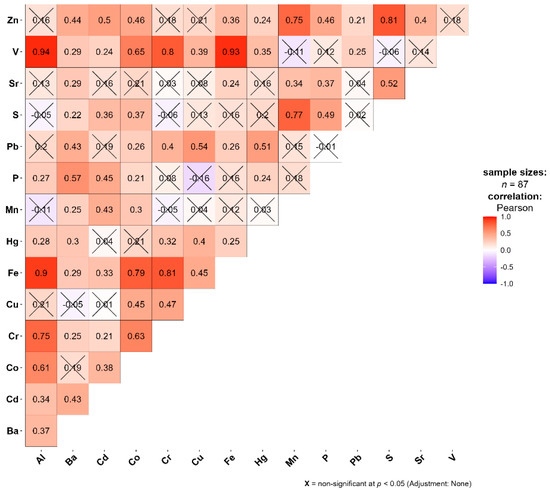
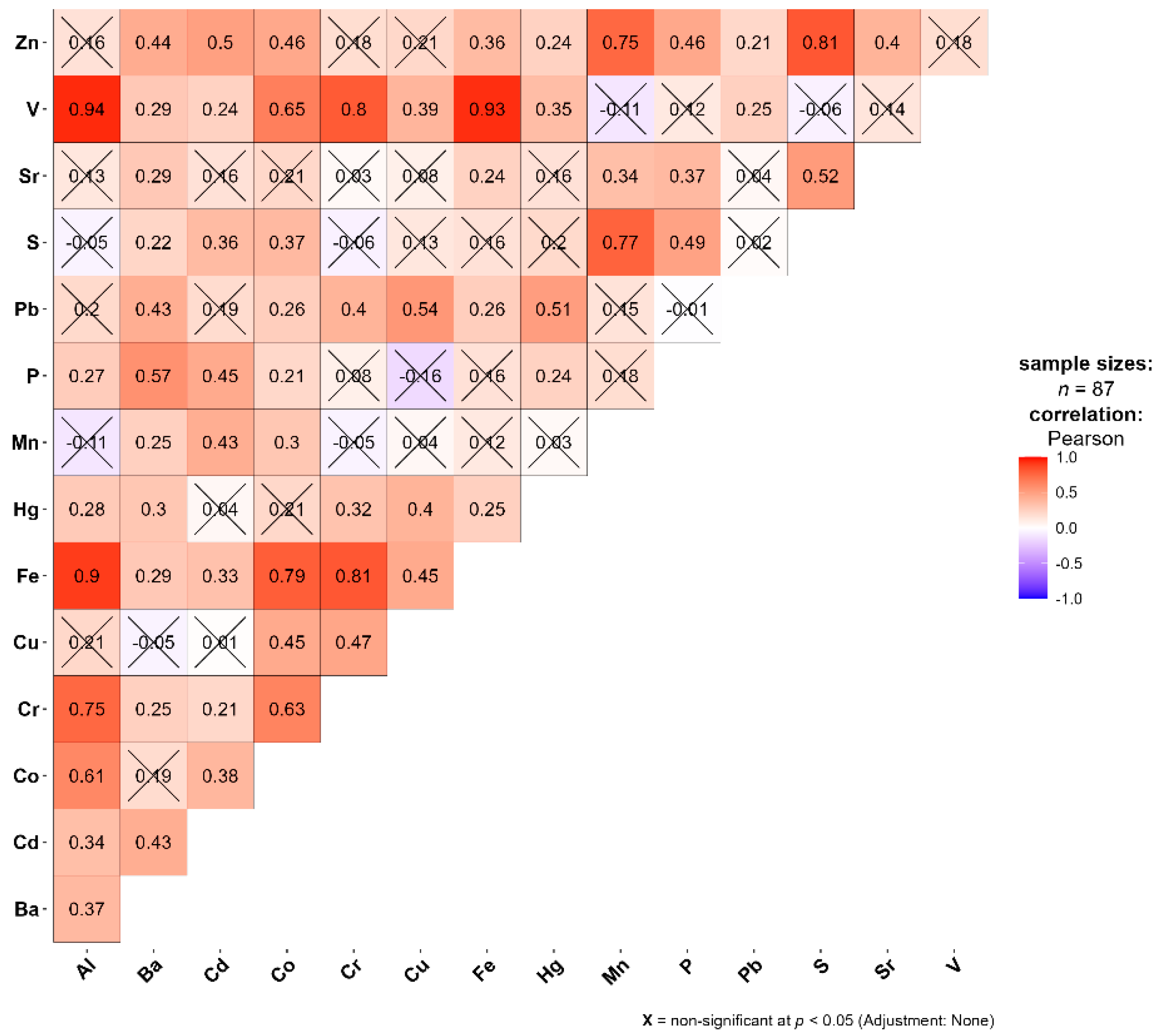
Across the sampling region, there were a number of significant (p < 0.05) and strong (r ≥ 0.7) correlations between the tested elements (Figure 1).
Figure 1.
Correlation analysis for moss samples collected in Perm.
Strong positive correlations (r ≥ 0.7) were evident between Al and V, Al and Fe, and Al and Cr. There were also strong and significant correlations between Co and Fe, Cr and Fe, Cr and V, Fe and V, and Fe and Cr. Additionally, Mn showed a high correlation with S and Zn (Figure 2). No correlations were evident between Ba, Cd, Hg, P, and Sr and any other metals.
Figure 2.
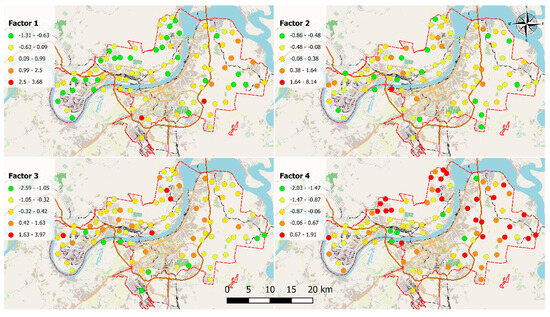
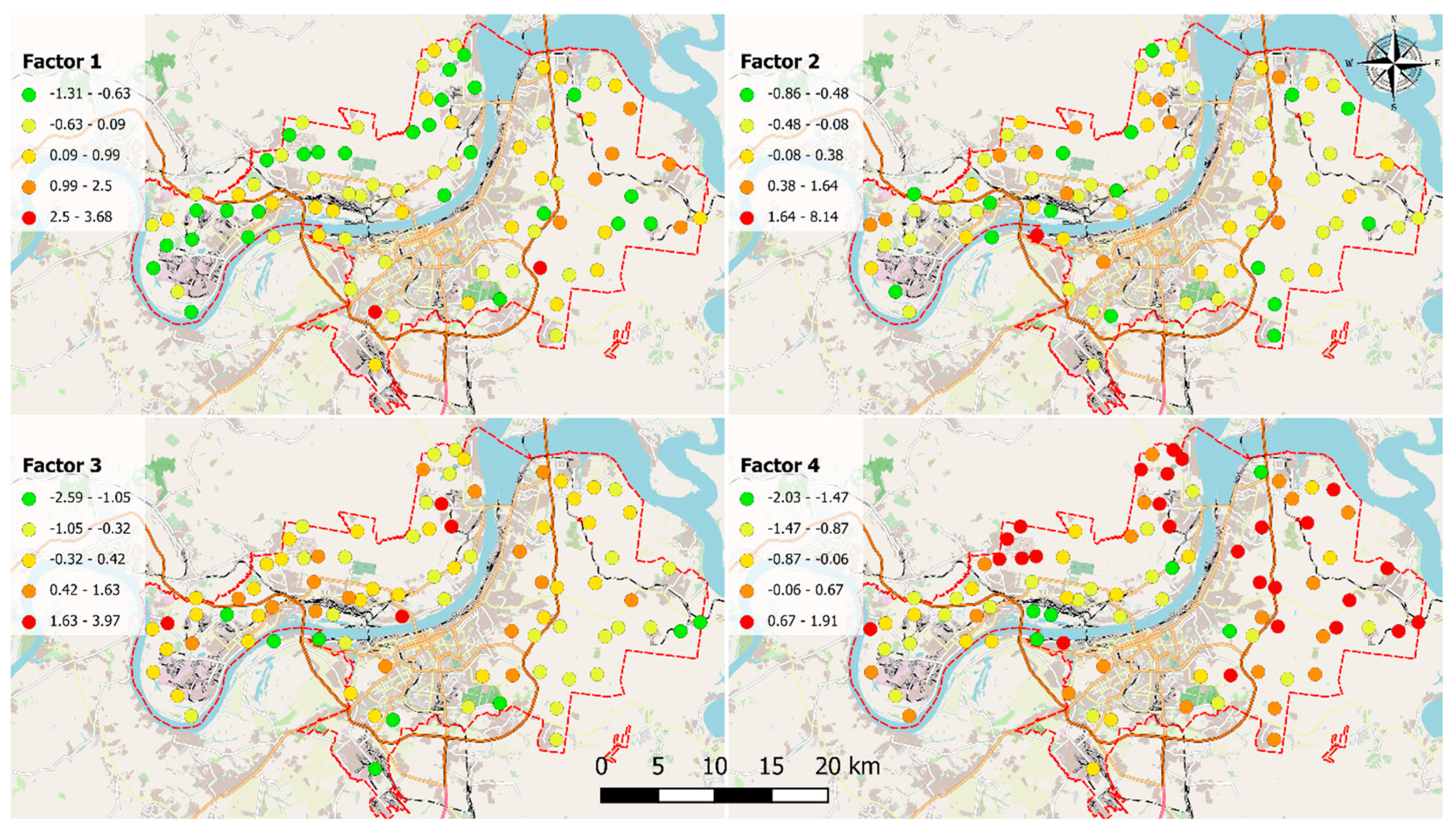
The distribution of the factor scores for Factors 1–4.
The relationships between these elements were further investigated using factor analysis. Four main factors that represent 78% of the total variance were identified. The matrix of rotated factor loadings is presented in Table 2, and the distribution of factor scores is displayed in Figure 2.
Table 2.
Matrix of rotated factor loadings (varimax-normalized).
The association of Al, Co, Cr, Fe, and V is represented by Factor 1 (Figure 2), which has 45% of the variance. The primary sources of these elements are industrial activity and road dust. According to Charron et al. [28], traffic is a significant source of PTEs in urban environments due to both exhaust and non-exhaust emissions. In urban areas, the elemental composition of road dust is very similar to that of soil [29]. Even though Al and Fe are considered crustal metals [3], in urban areas, Fe could originate from metallic brakes and steel fibers [28]. Chromium is a component of brake linings and also originates from oil combustion [28]. Furthermore, Cr is also a component of yellow road markings [30]. Vanadium is present in the residual and fuel oils of all types of engines [31]. The high concentrations of elements grouped in Factor 1 were determined in samples collected near highways and secondary roads.
Thus, vehicles are one of the most important sources of PTEs in Perm. High levels of elements were also found near railways and the Osentsovsky industrial hub (one of the largest in Russia), which includes 46 metallurgical, chemical, construction, and oil refinery companies. High levels of Fe, Co, and Cr were found near the railway in Poland [32]. Oil products are a significant source of vanadium in the atmosphere [31], while construction materials can contribute to Al, Fe, Co, and Cr emissions [33].
Twenty-two percent of the variance can be attributed to Factor 2, which is associated with high loadings of Mn, S, and Zn. The highest concentrations of elements were determined near the Perm Chemical Company, Perm powder mill, and gravel plant. Sulfur is one of the main components used for black powder production [34]. Zinc compounds are mainly used for galvanization (50%), automotive tire production (20%), die casting (17%), and brass production (17%), as well as the production of tiles, ceramics, and glass [35]. Manganese is widely used in the production of non-ferrous metallurgy, steel, batteries, electrode materials, catalysts, Mn alloy production, welding, coke ovens, and Mn salt production [36,37]. In addition to industrial processes, both metals can be emitted by vehicles. Zinc is the most abundant PTE emitted from tires due to the addition of ZnO and ZnS during vulcanization [4]. Methylcyclopentadienyl manganese tricarbonyl is used as an additive in unleaded gasoline [38]. Thus, the chemical and defense industries, as well as vehicles, are important emitters of elements included in Factor 2.
Copper, Hg, and Pb have high loadings in Factor 3, which accounts for 12% of the total variance. The highest concentrations of elements were determined near Promtec (production of compressors and gas pumping equipment), Kamskaya Chemical Company (production of chemicals, paints, laboratory equipment and appliances, and household chemicals), transport maintenance facilities, Uralmechanics (metal processing and coating), and Perm Plant “Zvezda” (production of metal structures, products, and parts for buildings). Fuel combustion and non-ferrous metal production are the major anthropogenic sources of Cu emissions found in the atmosphere [39]. Lead is widely used in the chemical industry, the manufacturing of batteries and paints, the processing of metals, and the production of leaded aviation gasoline [40,41]. The four main anthropogenic sources of Pb in the environment are the combustion of leaded gasoline, coal combustion, metallurgical activities, and waste incineration [5]. Anthropogenic Hg emissions can be associated with non-ferrous metal smelting, the iron and steel industries, the chlor-alkali industry, and fossil fuel burning [42,43].
Factor 4 (which accounts for 13% of the explained variance) is represented by Ba and P. Barium is a component of the filler of brake linings [28]. Mineral dust and coal combustion are the dominant sources of atmospheric P emissions [44]. Since high concentrations of these elements were found near highways, road and mineral dust can be considered the main sources of their emissions in Perm.
2.3. Assessment of the Level of Air Pollution
To assess the level of air pollution in Perm, the CF and PLI were calculated (Table 3). CF values for Hg and P indicate the absence or suspicion of pollution. For Cd and Sr, the contamination ranged from no contamination to slight contamination, while for Ba, Cu, Pb, S, and Zn, the CFs indicated low to moderate contamination. A severe level of pollution was found for Al, Co, Cr, Fe, Mn, and V. The highest CF values were obtained for moss samples collected in the vicinity of highways (Fe, Al, Cd, and Mn) and industrial enterprises (Co, Cr, Pb, S, Sr, Zn, and Hg). Based on the PLI values, Perm can be characterized as unpolluted and moderately polluted.
Table 3.
Contamination factor, pollution load index, and potential ecological risk index values for moss samples collected in Perm.
The PER values ranged from 3.6 to 16.3 for Cd, from 4.1 to 31 for Cr, from 33 to 112 for Cu, from 13.6 to 74 for Pb, and from 34 to 201 for Zn. RI values ranged from 100 to 316, with an average value of 170. Regarding the sampling sites, 28% were characterized by a low RI, 71% by a moderate RI, and 1% by a considerable RI. The highest RI was calculated for samples collected near an industrial cluster, indicating the negative impact of industrial activity on air quality and human health.
3. Materials and Methods
3.1. Study Area
Passive moss biomonitoring was performed in Perm, a city with an area of about 800 km2 located in the Cis-Ural region, which is one of the largest industrial centers of the Russian Federation and the Perm region. Perm is located on the border of two forest regions: the taiga zone, which is the southern taiga region of the European part of the Russian Federation, and the coniferous broadleaved forest zone, which is the region of coniferous–deciduous (mixed) forests of the European part of the Russian Federation (southern part). Urban forests make up slightly more than 330 km2 (more than 40% of the city’s territory). The climate in Perm is moderately continental, with an average temperature of +17 °C in July and −15 °C in January. Annual precipitation is 500–600 mm. Loamy and soddy-podzolic soils prevail.
Perm is one the largest industrial centers, where the leading industries are machine building, oil and gas refining, the chemical and petrochemical industry, electric power engineering, metalworking, woodworking, and the paper industry, as well as manufacturing industries [45]. The largest producers of industrial products are enterprises within the defense complex, as well as the Joint Stock Company (JSC) Novomet-Perm, JSC Perm Mashinostroitel Plant, SIBUR-Khimprom JSC, HaloPolymer Perm JSC, and Kamtex-Khimprom JSC [46,47].
3.2. Sampling and Chemical Analysis
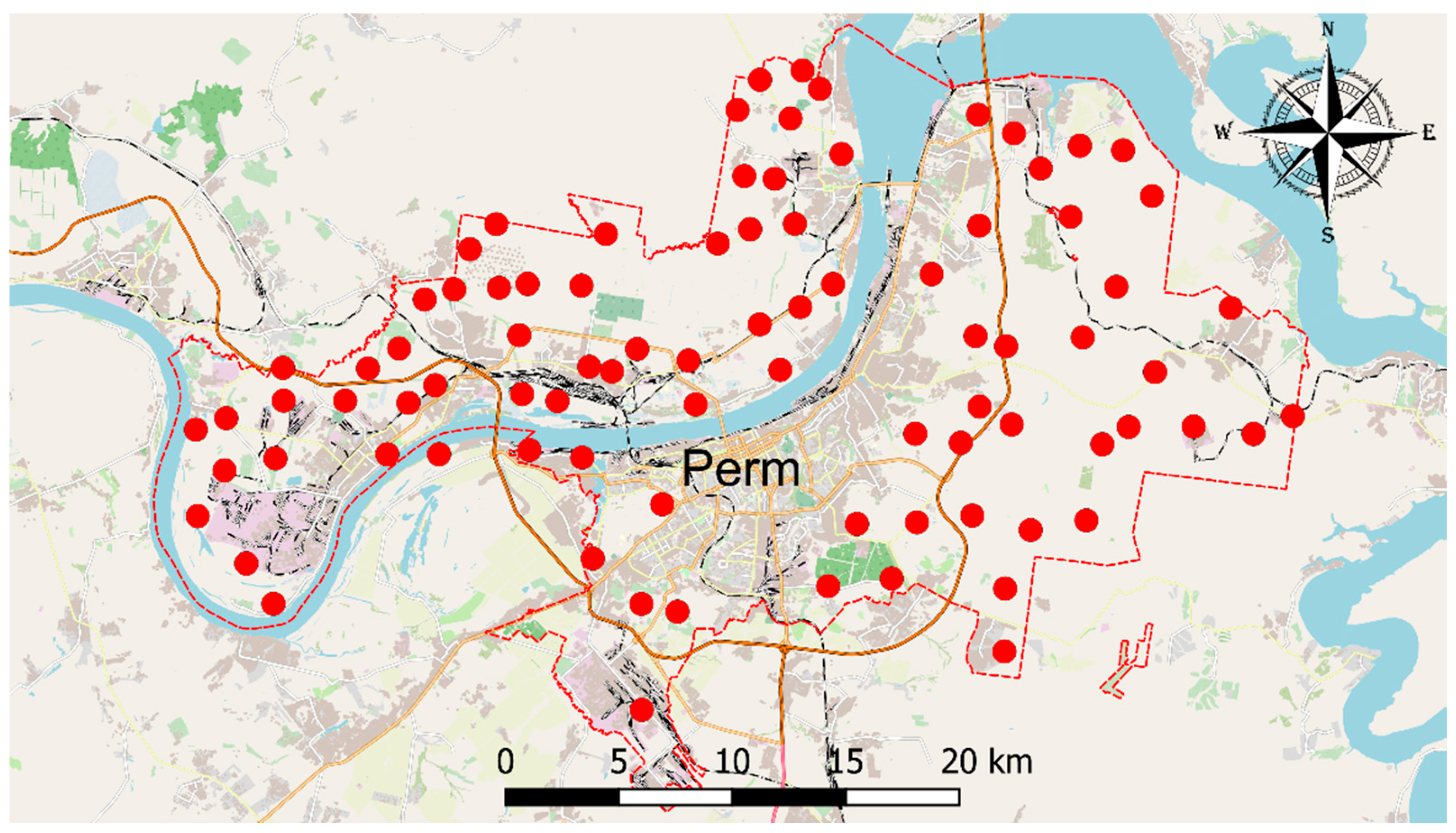
Pleurozium schreberi (P. schreberi) (Brid.) Mitt. is representative of the family Hylocomiaceae, which comprises the red-stemmed feather moss. P. schreberi is the most common moss species and is predominant in the ground layer of boreal forests and subalpine and arctic ecosystems [48]. Two sampling campaigns were carried out during July of 2022 and 2023. Pleurozium schreberi moss samples were collected at 87 sites, mainly located in urban forests (Figure 3). Moss sampling was performed according to a manual developed by the ICP Vegetation program [14]. For the analysis, green and green-brown moss segments corresponding to a three-year growth period were selected. The moss was thoroughly cleaned of foreign debris and soil residues. Moss samples from the Gainsky district (a relatively clean area of Perm region) in the northwestern part of Perm Krai were taken as background data.
Figure 3.
Moss sampling map of Perm, Russia.
The elemental composition of the moss samples was determined using inductively coupled plasma optical emission spectrometry (ICP-OES) and a DMA-80 Milestone direct mercury analyzer. Mercury content in moss samples was determined according to a procedure described in [23]. For ICP-OES analysis, 0.5 g of moss was placed in a Teflon vessel with 5 mL of HNO3 and 2 mL of H2O2. The samples were digested in a MARS-6 microwave system (CEM, Matthews, Pittsburgh, PA, USA). After digestion, the resulting solutions were filtered through 0.45 µm filter paper and diluted to a final volume of 50 mL with bi-distilled water. The concentrations of 14 elements, i.e., Al, Ba, Cd, Co, Cr, Cu, Fe, Mn, P, Pb, S, Sr, V, and Zn, were determined via ICP-OES using a Plasmaquant PQ 9000 Elite (Analytik Jena, Jena, Germany). To ensure the quality control of the results, the certified reference material INCT-PVTL-6 (Polish Virginia Tobacco Leaves) was analyzed (Table 4). The recovery of the elements ranged from 85 to 116%.
Table 4.
Results of quality control for the INCT-PVTL-6.
3.3. Statistical Analysis
Processing of the data was performed using Excel (version 17) (Microsoft, Redmond, WA, USA) and IBM SPSS software (version 25) (IBM, Armonk, NY, USA). Descriptive statistics for the elements in the samples from 87 locations were calculated (Table 1). To discover associations between the chemical elements and to decrease the number of variables for the resulting data, factor analysis and correlation analysis were used. Multivariate statistical methods are applied in environmental studies to simplify large data sets with the purpose of identifying pollution sources and their relative elemental composition and to determine the contribution of each source to the total pollution level [49]. Since many statistical techniques, including factor analysis, are sensitive to non-normally distributed data, the Box-Cox transformation was performed. The ArcGIS software (Esri, Redlands, CA, USA) was used to build maps showing the spatial distributions of elements using the radial basis functions method.
3.4. Data Evaluation
To assess the level of air pollution, the contamination factor (CF) and Pollution load index were calculated. According to [50], the CF, a single index, is the ratio of an element’s concentration in the sample to its background value and is given by
where Cm is the concentration of a given element and Cb is the background concentration for the same element.
The degrees of contamination fell into the following categories: CF < 1—no contamination; 1–2—suspected contamination; 2–3.5—slight contamination; 3.5–8—moderate contamination; 8–27—severe contamination; and >27—extreme contamination [50].
The pollution load index (PLI) was used to assess the comprehensive level of PTEs for the studied area. The PLI represents the nth order geometric mean of the entire set of CF [51] and is given by
where n is the total number of elements.
The PLI data were divided into multiple categories: PLI < 1—unpolluted, 1 < PLI < 2—unpolluted to moderately polluted, 2 < PLI < 3—moderately polluted, 3 < PLI < 4—moderately to highly polluted, 4 < PLI < 5—highly polluted, and PLI < 5—very highly polluted [52].
The ecological risk of a particular element in moss is determined by the ecological risk index (RI), which takes into account the response of the environment and the toxicity of metals and is given by
where is the potential ecological risk index of each element, is the contamination factor, and is the “no toxic-response” coefficient for the given single metal. The toxic response factors are 2 for Cr, 5 for Cu, 30 for Cd, 1 for Zn, and 5 for Pb. There are four categories for ecological risk: RI < 150—low ecological risk; 150 ≤ RI < 300—moderate ecological risk; 300 ≤ RI < 600—considerable ecological risk; and RI ≥ 600—very high ecological risk [53].
4. Conclusions
Urban areas are exposed to serious environmental pollution due to intensive population growth and industrial development. The concentrations of 15 elements in moss samples taken at 87 sites in Perm were determined. The correlation and factor analysis results established the prevalence of anthropogenic sources of PTE emissions in Perm, which include the chemical, defense, and metallurgical industries, as well as automobile and railway transportation.
This is in agreement with national reports. Transportation is considered a primary source of Fe, Al, Cd, and Mn, and industrial enterprises are considered primary sources of Co, Cr, Pb, S, Sr, Zn, and Hg. The air pollution levels ranged from unpolluted to severely polluted; severe pollution was mainly found in industrial areas. These results are supported by the RI data, which indicate considerable ecological risk in industrial zones. The results show that city authorities should pay more attention to air pollution, which can cause serious health problems, especially among citizens living in close proximity to industrial enterprises.
Author Contributions
E.G.—conceptualization, moss sample collection, and manuscript draft preparation and final revision; I.Z.—ICP-OES analysis and manuscript draft preparation and final revision; N.Y.—ICP-OES analysis, mapping, and manuscript final revision; O.C.—statistical analysis and manuscript final revision; M.F.—conceptualization and manuscript final revision; A.S.—moss sample collection, ICP-OES analysis, and manuscript final revision. All authors have read and agreed to the published version of the manuscript.
Funding
This research received no external funding.
Data Availability Statement
The experimental data will be made available on reasonable request.
Conflicts of Interest
The authors declare no conflicts of interest.
References
- Bibi, D.; Tőzsér, D.; Sipos, B.; Molnár, V.É.; Simon, E.; Tóthmérész, B. Complex Study of Air Pollution Based on Tree Species in Vienna. Air Qual. Atmos. Health 2024, 17, 417–424. [Google Scholar] [CrossRef] [Scilit]
- WHO. Ambient (Outdoor) Air Pollution. Available online: https://www.who.int/news-room/fact-sheets/detail/ambient-(outdoor)-air-quality-and-health (accessed on 20 May 2024).
- Aksu, A. Sources of Metal Pollution in the Urban Atmosphere (A Case Study: Tuzla, Istanbul). J. Environ. Health Sci. Eng. 2015, 13, 79. [Google Scholar] [CrossRef] [Scilit] [PubMed]
- Adamiec, E.; Jarosz-Krzemińska, E.; Wieszała, R. Heavy Metals from Non-Exhaust Vehicle Emissions in Urban and Motorway Road Dusts. Environ. Monit. Assess. 2016, 188, 369. [Google Scholar] [CrossRef] [Scilit]
- Chen, L.C.; Maciejczyk, P.; Thurston, G.D. Metals and Air Pollution. In Handbook on the Toxicology of Metals: Volume I: General Considerations; Academic Press: Cambridge, MA, USA, 2021; pp. 137–182. ISBN 9780128232927. [Google Scholar]
- Cowden, P.; Aherne, J. Assessment of Atmospheric Metal Deposition by Moss Biomonitoring in a Region under the Influence of a Long Standing Active Aluminium Smelter. Atmos. Environ. 2019, 201, 84–91. [Google Scholar] [CrossRef] [Scilit]
- Mao, H.T.; Wang, X.M.; Wu, N.; Chen, L.X.; Yuan, M.; Hu, J.C.; Chen, Y.E. Temporal and Spatial Biomonitoring of Atmospheric Heavy Metal Pollution Using Moss Bags in Xichang. Ecotoxicol. Environ. Saf. 2022, 239, 113688. [Google Scholar] [CrossRef] [Scilit]
- Castell, N.; Dauge, F.R.; Schneider, P.; Vogt, M.; Lerner, U.; Fishbain, B.; Broday, D.; Bartonova, A. Can Commercial Low-Cost Sensor Platforms Contribute to Air Quality Monitoring and Exposure Estimates? Environ. Int. 2017, 99, 293–302. [Google Scholar] [CrossRef] [Scilit]
- Monaci, F.; Ancora, S.; Paoli, L.; Loppi, S.; Franzaring, J. Air Quality in Post-Mining Towns: Tracking Potentially Toxic Elements Using Tree Leaves. Environ. Geochem. Health 2023, 45, 843–859. [Google Scholar] [CrossRef] [Scilit] [PubMed]
- Ștefănuț, S.; Öllerer, K.; Ion, M.C.; Florescu, L.I.; Constantin, M.; Banciu, C.; Onete, M.; Manu, M.; Vicol, I.; Moldoveanu, M.M.; et al. Country-Scale Complementary Passive and Active Biomonitoring of Airborne Trace Elements for Environmental Risk Assessment. Ecol. Indic. 2021, 126, 107357. [Google Scholar] [CrossRef] [Scilit]
- Solgi, E.; Keramaty, M.; Solgi, M. Biomonitoring of Airborne Cu, Pb, and Zn in an Urban Area Employing a Broad Leaved and a Conifer Tree Species. J. Geochem. Explor. 2020, 208, 106400. [Google Scholar] [CrossRef] [Scilit]
- Urošević, M.A.; Lazo, P.; Stafilov, T.; Nečemer, M.; Andonovska, K.B.; Balabanova, B.; Hristozova, G.; Papagiannis, S.; Stihi, C.; Suljkanović, M.; et al. Active Biomonitoring of Potentially Toxic Elements in Urban Air by Two Distinct Moss Species and Two Analytical Techniques: A Pan-Southeastern European Study. Air Qual. Atmos. Health 2023, 16, 595–612. [Google Scholar] [CrossRef] [Scilit]
- Chaudhuri, S.; Roy, M. Global Ambient Air Quality Monitoring: Can Mosses Help? A Systematic Meta-Analysis of Literature about Passive Moss Biomonitoring. Environ. Dev. Sustain. 2024, 26, 5735–5773. [Google Scholar] [CrossRef] [Scilit]
- Frontasyeva, M.; Harmens, H.; Uzhinskiy, A.; Chaligava, O. Mosses as Biomonitors of Air Pollution: 2015/2016 Survey on Heavy Metals, Nitrogen and POPs in Europe and Beyond; Report of the ICP Vegetation Moss Survey Coordination Centre; LRTAP: Châtelaine, Switzerland, 2020; ISBN 9785953005081. [Google Scholar]
- Boquete, M.T.; Lang, I.; Weidinger, M.; Richards, C.L.; Alonso, C. Patterns and Mechanisms of Heavy Metal Accumulation and Tolerance in Two Terrestrial Moss Species with Contrasting Habitat Specialization. Environ. Exp. Bot. 2021, 182, 104336. [Google Scholar] [CrossRef] [Scilit]
- Kılıç, Ö.; Belivermiş, M.; Sıkdokur, E.; Sezer, N.; Erentürk, S.A.; Haciyakupoglu, S.; Chaligava, O.; Frontasyeva, M.; Zinicovscaia, I.; Madadzada, A. Temporal Changes of Atmospheric Deposition of Major and Trace Elements in European Turkey, Thrace Region. J. Radioanal. Nucl. Chem. 2021, 329, 371–381. [Google Scholar] [CrossRef] [Scilit]
- Maresca, V.; Bellini, E.; Landi, S.; Capasso, G.; Cianciullo, P.; Carraturo, F.; Pirintsos, S.; Sorbo, S.; Sanità di Toppi, L.; Esposito, S.; et al. Biological Responses to Heavy Metal Stress in the Moss Leptodictyum riparium (Hedw.) Warnst. Ecotoxicol. Environ. Saf. 2022, 229, 113078. [Google Scholar] [CrossRef] [Scilit] [PubMed]
- Wolterbeek, B. Biomonitoring of Trace Element Air Pollution: Principles, Possibilities and Perspectives. Environ. Pollut. 2002, 120, 11–21. [Google Scholar] [CrossRef] [Scilit]
- Ares, A.; Aboal, J.R.; Carballeira, A.; Giordano, S.; Adamo, P.; Fernández, J.A. Moss Bag Biomonitoring: A Methodological Review. Sci. Total Environ. 2012, 432, 143–158. [Google Scholar] [CrossRef] [Scilit] [PubMed]
- Harmens, H.; Norris, D.A.; Steinnes, E.; Kubin, E.; Piispanen, J.; Alber, R.; Aleksiayenak, Y.; Blum, O.; Coşkun, M.; Dam, M.; et al. Mosses as Biomonitors of Atmospheric Heavy Metal Deposition: Spatial Patterns and Temporal Trends in Europe. Environ. Pollut. 2010, 158, 3144–3156. [Google Scholar] [CrossRef] [Scilit] [PubMed]
- Capozzi, F.; Giordano, S.; Di Palma, A.; Spagnuolo, V.; De Nicola, F.; Adamo, P. Biomonitoring of Atmospheric Pollution by Moss Bags: Discriminating Urban-Rural Structure in a Fragmented Landscape. Chemosphere 2016, 149, 211–218. [Google Scholar] [CrossRef] [Scilit]
- Świsłowski, P.; Vergel, K.; Zinicovscaia, I.; Rajfur, M.; Wacławek, M. Mosses as a Biomonitor to Identify Elements Released into the Air as a Result of Car Workshop Activities. Ecol. Indic. 2022, 138, 108849. [Google Scholar] [CrossRef] [Scilit]
- Zinicovscaia, I.; Narmandakh, J.; Yushin, N.; Peshkova, A.; Chaligava, O.; Tsendsuren, T.O.; Tserendorj, B.; Tsogbadrakh, T. Assessment of Air Pollution in Ulaanbaatar Using the Moss Bag Technique. Arch. Environ. Contam. Toxicol. 2024, 86, 152–164. [Google Scholar] [CrossRef] [Scilit]
- Chapin, F.S.; Oechel, W.C.; Van Cleve, K.; Lawrence, W. The Role of Mosses in the Phosphorus Cycling of an Alaskan Black Spruce Forest. Oecologia 1987, 74, 310–315. [Google Scholar] [CrossRef] [Scilit] [PubMed]
- Liu, X.; Wang, Z.; Li, X.; Bao, W. Nitrogen and Phosphorus Translocation of Forest Floor Mosses as Affected by a Pulse of These Nutrients. J. Plant Ecol. 2020, 13, 633–640. [Google Scholar] [CrossRef] [Scilit]
- Vergel, K.; Zinicovscaia, I.; Yushin, N.; Chaligava, O.; Nekhoroshkov, P.; Grozdov, D. Moss Biomonitoring of Atmospheric Pollution with Trace Elements in the Moscow Region, Russia. Toxics 2022, 10, 66. [Google Scholar] [CrossRef] [Scilit] [PubMed]
- Lazo, P.; Kika, A.; Qarri, F.; Bekteshi, L.; Allajbeu, S.; Stafilov, T. Air Quality Assessment by Moss Biomonitoring and Trace Metals Atmospheric Deposition. Aerosol Air Qual. Res. 2022, 22, 220008. [Google Scholar] [CrossRef] [Scilit]
- Charron, A.; Polo-Rehn, L.; Besombes, J.L.; Golly, B.; Buisson, C.; Chanut, H.; Marchand, N.; Guillaud, G.; Jaffrezo, J.L. Identification and Quantification of Particulate Tracers of Exhaust and Non-Exhaust Vehicle Emissions. Atmos. Chem. Phys. 2019, 19, 5187–5207. [Google Scholar] [CrossRef] [Scilit]
- Faiz, Y.; Siddique, N.; Tufail, M. Pollution Level and Health Risk Assessment of Road Dust from an Expressway. J. Environ. Sci. Health—Part A Toxic/Hazard. Subst. Environ. Eng. 2012, 47, 818–829. [Google Scholar] [CrossRef] [Scilit]
- Murakami, M.; Nakajima, F.; Furumai, H.; Tomiyasu, B.; Owari, M. Identification of Particles Containing Chromium and Lead in Road Dust and Soakaway Sediment by Electron Probe Microanalyser. Chemosphere 2007, 67, 2000–2010. [Google Scholar] [CrossRef] [Scilit]
- Shafer, M.M.; Toner, B.M.; Overdier, J.T.; Schauer, J.J.; Fakra, S.C.; Hu, S.; Herner, J.D.; Ayala, A. Chemical Speciation of Vanadium in Particulate Matter Emitted from Diesel Vehicles and Urban Atmospheric Aerosols. Environ. Sci. Technol. 2012, 46, 189–195. [Google Scholar] [CrossRef] [Scilit]
- Wiłkomirski, B.; Sudnik-Wójcikowska, B.; Galera, H.; Wierzbicka, M.; Malawska, M. Railway Transportation as a Serious Source of Organic and Inorganic Pollution. Water Air Soil Pollut. 2011, 218, 333–345. [Google Scholar] [CrossRef] [Scilit]
- Mehra, S.; Singh, M.; Sharma, G.; Kumar, S.; Navishi; Chadha, P. Impact of Construction Material on Environment. In Ecological and Health Effects of Building Materials; Springer International Publishing: Berlin/Heidelberg, Germany, 2021; pp. 427–442. ISBN 9783030760731. [Google Scholar]
- Sun, Y.; Han, Z.; Du, Z.; Li, Z.; Cong, X. Preparation and Performance of Environmental Friendly Sulphur-Free Propellant for Fireworks. Appl. Therm. Eng. 2017, 126, 987–996. [Google Scholar] [CrossRef] [Scilit]
- Jones, F.; Bankiewicz, D.; Hupa, M. Occurrence and Sources of Zinc in Fuels. Fuel 2014, 117, 763–775. [Google Scholar] [CrossRef] [Scilit]
- Röllin, H.B.; Nogueira, C.M.C.A. Manganese: Environmental Pollution and Health Effects. In Encyclopedia of Environmental Health; Elsevier: Amsterdam, The Netherlands, 2011; Volume 3, pp. 617–629. ISBN 9780444522733. [Google Scholar]
- Wu, R.; Yao, F.; Li, X.; Shi, C.; Zang, X.; Shu, X.; Liu, H.; Zhang, W. Manganese Pollution and Its Remediation: A Review of Biological Removal and Promising Combination Strategies. Microorganisms 2022, 10, 2411. [Google Scholar] [CrossRef] [Scilit] [PubMed]
- Loranger, S.; Zayed, J. Manganese and Lead Concentrations in Ambient Air and Emission Rates from Unleaded and Leaded Gasoline between 1981 and 1992 in Canada: A Comparative Study. Atmos. Environ. 1994, 28, 1645–1651. [Google Scholar] [CrossRef] [Scilit]
- Rehman, M.; Liu, L.; Wang, Q.; Saleem, M.H.; Bashir, S.; Ullah, S.; Peng, D. Copper Environmental Toxicology, Recent Advances, and Future Outlook: A Review. Environ. Sci. Pollut. Res. 2019, 26, 18003–18016. [Google Scholar] [CrossRef] [Scilit]
- Yang, J.; Li, X.; Xiong, Z.; Wang, M.; Liu, Q. Environmental Pollution Effect Analysis of Lead Compounds in China Based on Life Cycle. Int. J. Environ. Res. Public Health 2020, 17, 2184. [Google Scholar] [CrossRef] [Scilit]
- Zhang, R.; Wilson, V.L.; Hou, A.; Meng, G. Source of Lead Pollution, Its Influence on Public. Int. J. Health Anim. Sci. Food Saf. 2015, 2, 18–31. [Google Scholar]
- OECD. Risk Reduction Monograph No. 4: Mercury_Background and National Experience with Reducing Risk; OECD Environment monograph series no. 103; OECD: Paris, France, 1995. [Google Scholar]
- Pavithra, K.G.; SundarRajan, P.; Kumar, P.S.; Rangasamy, G. Mercury Sources, Contaminations, Mercury Cycle, Detection and Treatment Techniques: A Review. Chemosphere 2023, 312, 137314. [Google Scholar] [CrossRef] [Scilit]
- Meng, Y.; Li, R.; Fu, H.; Bing, H.; Huang, K.; Wu, Y. The Sources and Atmospheric Pathway of Phosphorus to a High Alpine Forest in Eastern Tibetan Plateau, China. J. Geophys. Res. Atmos. 2020, 125, e2019JD031327. [Google Scholar] [CrossRef] [Scilit]
- Meshchurova, Т.А. Assessment of air pollution in the cities of Perm region. Bull. Nizhnevartovsk State Univ. 2020, 1, 110–119. [Google Scholar] [CrossRef] [Scilit]
- Leading Large and Medium Enterprises (Organizations) of the City of Perm. Available online: http://invest.gorodperm.ru/o-gorode/industrial/predpriytiy goroda/ (accessed on 29 May 2024).
- Perm Enterprises, Perm Plants, Industry. Available online: https://ibprom.ru/predpriyatiya-permi (accessed on 29 May 2024).
- Pederson, E.R.A.; Warshan, D.; Rasmussen, U. Genome Sequencing of Pleurozium schreberi: The Assembled and Annotated Draft Genome of a Pleurocarpous Feather Moss. G3 Genes Genomes Genet. 2019, 9, 2791–2797. [Google Scholar] [CrossRef] [Scilit]
- Zinicovscaia, I.; Chaligava, O.; Yushin, N.; Grozdov, D.; Vergel, K.; Hramco, C. Moss Biomonitoring of Atmospheric Trace Element Pollution in the Republic of Moldova. Arch. Environ. Contam. Toxicol. 2022, 82, 355–366. [Google Scholar] [CrossRef] [Scilit] [PubMed]
- Fernández, J.A.; Carballeira, A. Evaluation of Contamination, by Different Elements, in Terrestrial Mosses. Arch. Environ. Contam. Toxicol. 2001, 40, 461–468. [Google Scholar] [CrossRef] [Scilit] [PubMed]
- Tomlinson, D.L.; Wilson, J.G.; Harris, C.R.; Jeffrey, D.W. Problems in the Assessment of Heavy-Metal Levels in Estuaries and the Formation of a Pollution Index. Helgol. Meeresunters. 1980, 33, 566–575. [Google Scholar] [CrossRef] [Scilit]
- Wu, W.; Wu, P.; Yang, F.; Sun, D.L.; Zhang, D.X.; Zhou, Y.K. Assessment of Heavy Metal Pollution and Human Health Risks in Urban Soils around an Electronics Manufacturing Facility. Sci. Total Environ. 2018, 630, 53–61. [Google Scholar] [CrossRef] [Scilit]
- Hakanson, L. An Ecological Risk Index for Aquatic Pollution Control.a Sedimentological Approach. Water Res. 1980, 14, 975–1001. [Google Scholar] [CrossRef] [Scilit]

Disclaimer/Publisher’s Note: The statements, opinions and data contained in all publications are solely those of the individual author(s) and contributor(s) and not of MDPI and/or the editor(s). MDPI and/or the editor(s) disclaim responsibility for any injury to people or property resulting from any ideas, methods, instructions or products referred to in the content. |
© 2024 by the authors. Licensee MDPI, Basel, Switzerland. This article is an open access article distributed under the terms and conditions of the Creative Commons Attribution (CC BY) license (https://creativecommons.org/licenses/by/4.0/).