


Tocopherols in Cultivated Apple Malus sp. Seeds: Composition, Variability and Specificity



Abstract
1. Introduction
2. Results and Discussion
3. Materials and Methods
3.1. Reagents
3.2. Plant Material
3.3. Tocopherol Homologues Analysis
3.4. Statistical Analysis
4. Conclusions
Author Contributions
Funding
Institutional Review Board Statement
Informed Consent Statement
Data Availability Statement
Conflicts of Interest
References
- FAOSTAT. FAO Statistical Database. Available online: http://www.fao.org (accessed on 4 December 2022).
- Strohm, K. Of the 30,000 Apple Varieties Found All over the World Only 30 Are Used and Traded Commercially. Available online: www.agribenchmark.org (accessed on 4 December 2022).
- Musacchi, S.; Serra, S. Apple fruit quality: Overview on pre-harvest factors. Sci. Hortic. 2018, 234, 409–430. [Google Scholar] [CrossRef]
- Sheick, R.; Serra, S.; Tillman, J.; Luby, J.; Evans, K.; Musacchi, S. Characterization of a novel S-RNase allele and genotyping of new apple cultivars. Sci. Hortic. 2020, 273, 109630. [Google Scholar] [CrossRef]
- Farneti, B.; Masuero, D.; Costa, F.; Magnago, P.; Malnoy, M.; Costa, G.; Vrhovsek, U.; Mattivi, F. Is there room for improving the nutraceutical composition of apple? J. Agric. Food Chem. 2015, 63, 2750–2759. [Google Scholar] [CrossRef] [PubMed]
- Górnaś, P.; Baškirovs, G.; Siger, A. Free and esterified tocopherols, tocotrienols and other extractable and non-extractable tocochromanol-related molecules: Compendium of knowledge, future perspectives and recommendations for chromatographic techniques, tools, and approaches used for tocochromanol determination. Molecules 2022, 27, 6560. [Google Scholar]
- Falk, J.; Munne-Bosch, S. Tocochromanol functions in plants: Antioxidation and beyond. J. Exp. Bot. 2010, 61, 1549–1566. [Google Scholar] [CrossRef]
- Horvath, G.; Wessjohann, L.; Bigirimana, J.; Jansen, M.; Guisez, Y.; Caubergs, R.; Horemans, N. Differential distribution of tocopherols and tocotrienols in photosynthetic and non-photosynthetic tissues. Phytochemistry 2006, 67, 1185–1195. [Google Scholar] [CrossRef]
- Goffman, F.D.; Thies, W.; Velasco, L. Chemotaxonomic value of tocopherols in Brassicaceae. Phytochemistry 1999, 50, 793–798. [Google Scholar] [CrossRef]
- Siger, A.; Górnaś, P. Free tocopherols and tocotrienols in 82 plant species’ oil: Chemotaxonomic relation as demonstrated by PCA and HCA. Food Res. Int. 2023, 164, 112386. [Google Scholar] [CrossRef]
- Górnaś, P. Oak Quercus rubra L. and Quercus robur L. acorns as an unconventional source of gamma-and beta-tocopherol. Eur. Food Res. Technol. 2019, 245, 257–261. [Google Scholar] [CrossRef]
- De Agostini, A.; Cogoni, A.; Cortis, P.; Vacca, A.; Becerril, J.M.; Hernández, A.; Esteban, R. Heavy metal tolerance strategies in metallicolous and non-metallicolous populations of mosses: Insights of γ+ β-tocopherol regulatory role. Environ. Exp. Bot. 2022, 194, 104738. [Google Scholar] [CrossRef]
- Górnaś, P.; Segliņa, D.; Lācis, G.; Pugajeva, I. Dessert and crab apple seeds as a promising and rich source of all four homologues of tocopherol (a, b, g and d). LWT Food Sci. Technol. 2014, 59, 211–214. [Google Scholar] [CrossRef]
- Fromm, M.; Bayha, S.; Kammerer, D.R.; Carle, R. Identification and quantitation of carotenoids and tocopherols in seed oils recovered from different rosaceae species. J. Agric. Food Chem. 2012, 60, 10733–10742. [Google Scholar] [CrossRef]
- Arain, S.; Sherazi, S.T.H.; Bhanger, M.I.; Memon, N.; Mahesar, S.A.; Rajput, M.T. Prospects of fatty acid profile and bioactive composition from lipid seeds for the discrimination of apple varieties with the application of chemometrics. Grasas Aceites 2012, 63, 175–183. [Google Scholar]
- Pieszka, M.; Migdał, W.; Gąsior, R.; Rudzińska, M.; Bederska-Łojewska, D.; Pieszka, M.; Szczurek, P. Native oils from apple, blackcurrant, raspberry, and strawberry seeds as a source of polyenoic fatty acids, tocochromanols, and phytosterols: A health implication. J. Chem. 2015, 2015, 659541. [Google Scholar] [CrossRef]
- Rodríguez Madrera, R.; Suárez Valles, B. Characterization of apple seeds and their oils from the cider-making industry. Eur. Food Res. Technol. 2018, 244, 1821–1827. [Google Scholar] [CrossRef]
- Górnaś, P.; Mišina, I.; Ikase, L. Crab apple (Malus spp.) seed tocopherol profile: Impact of genotype, species, purpose and rootstock. Agronomy 2022, 12, 2736. [Google Scholar] [CrossRef]
- Górnaś, P.; Siger, A.; Czubinski, J.; Dwiecki, K.; Segliņa, D.; Nogala-Kalucka, M. An alternative RP-HPLC method for the separation and determination of tocopherol and tocotrienol homologues as butter authenticity markers: A comparative study between two European countries. Eur. J. Lipid Sci. Technol. 2014, 116, 895–903. [Google Scholar] [CrossRef]
- Górnaś, P.; Mišina, I.; Lāce, B.; Lācis, G.; Segliņa, D. Tocochromanols composition in seeds recovered from different pear cultivars: RP-HPLC/FLD and RP-UPLC-ESI/MSn study. LWT Food Sci. Technol. 2015, 62, 104–107. [Google Scholar] [CrossRef]
- Sipeniece, E.; Mišina, I.; Grygier, A.; Qian, Y.; Rudzińska, M.; Kaufmane, E.; Segliņa, D.; Siger, A.; Górnaś, P. Impact of the harvest year of three cultivars of Japanese quince (Chaenomeles japonica) on the oil content and its composition. Sci. Hortic. 2021, 275, 109683. [Google Scholar] [CrossRef]
- Górnaś, P.; Mišina, I.; Grāvīte, I.; Soliven, A.; Kaufmane, E.; Segliņa, D. Tocochromanols composition in kernels recovered from different apricot varieties: RP-HPLC/FLD and RP-UPLC-ESI/MSn study. Nat. Prod. Res. 2015, 29, 1222–1227. [Google Scholar] [CrossRef]
- Górnaś, P.; Mišina, I.; Ruisa, S.; Rubauskis, E.; Lācis, G.; Segliņa, D. Composition of tocochromanols in kernels recovered from different sweet cherry (Prunus avium L.) cultivars: RP-HPLC/FLD and RP-UPLC-ESI/MSn study. Eur. Food Res. Technol. 2015, 240, 663–667. [Google Scholar] [CrossRef]
- Górnaś, P.; Rudzinska, M.; Raczyk, M.; Mišina, I.; Soliven, A.; Lācis, G.; Seglina, D. Impact of species and variety on concentrations of minor lipophilic bioactive compounds in oils recovered from plum kernels. J. Agric. Food Chem. 2016, 64, 898–905. [Google Scholar] [CrossRef] [PubMed]
- Górnaś, P.; Rudzińska, M.; Raczyk, M.; Mišina, I.; Soliven, A.; Segliņa, D. Composition of bioactive compounds in kernel oils recovered from sour cherry (Prunus cerasus L.) by-products: Impact of the cultivar on potential applications. Ind. Crops Prod. 2016, 82, 44–50. [Google Scholar] [CrossRef]
- Mišina, I.; Sipeniece, E.; Rudzińska, M.; Grygier, A.; Radzimirska-Graczyk, M.; Kaufmane, E.; Segliņa, D.; Lācis, G.; Górnaś, P. Associations between oil yield and profile of fatty acids, sterols, squalene, carotenoids, and tocopherols in seed oil of selected Japanese quince genotypes during fruit development. Eur. J. Lipid Sci. Technol. 2020, 122, 1900386. [Google Scholar] [CrossRef]
- Mène-Saffrané, L. Vitamin E biosynthesis and its regulation in plants. Antioxidants 2017, 7, 2. [Google Scholar] [CrossRef]
- Muñoz, P.; Munné-Bosch, S. Vitamin E in plants: Biosynthesis, transport, and function. Trends Plant Sci. 2019, 24, 1040–1051. [Google Scholar] [CrossRef]
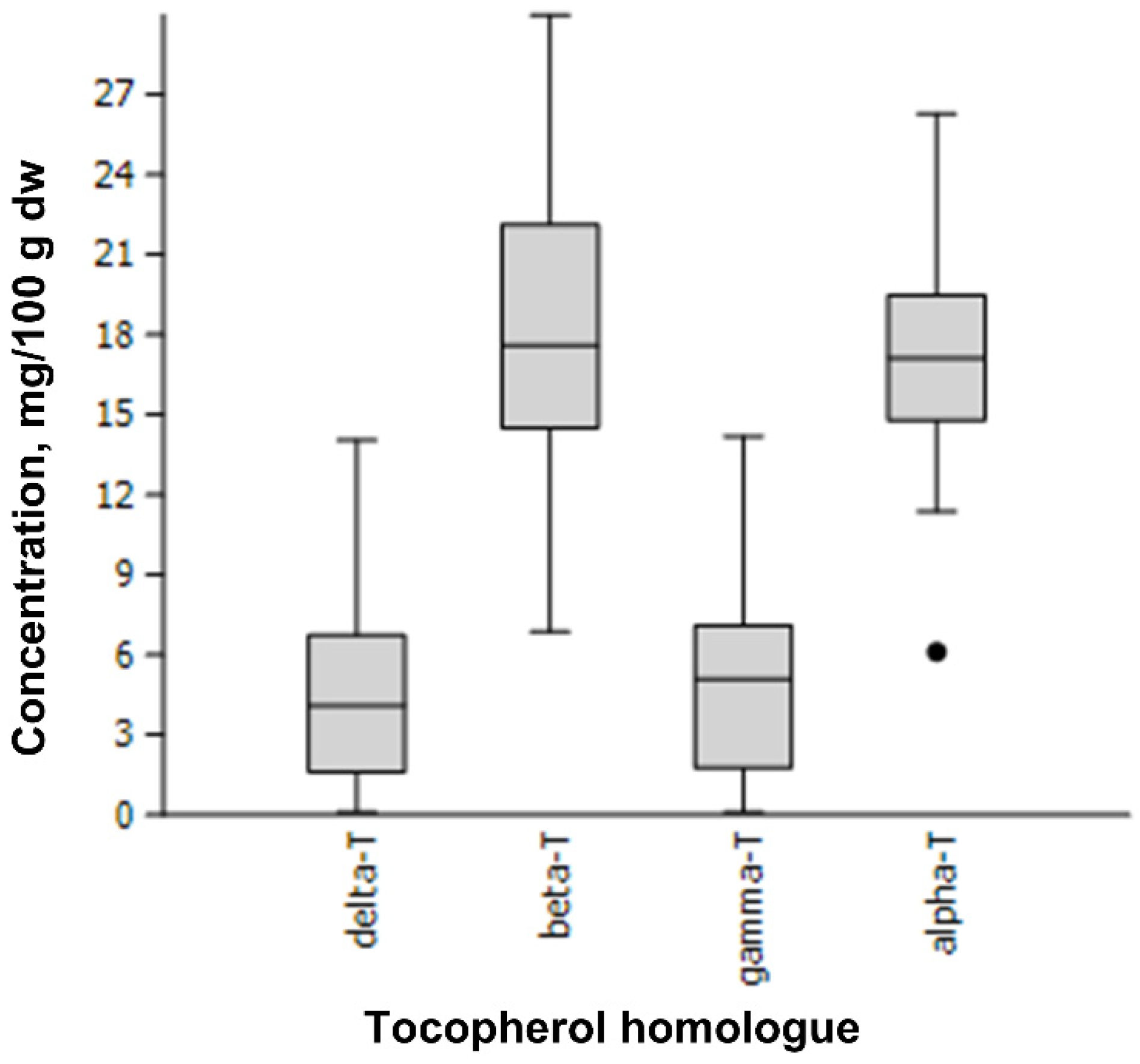
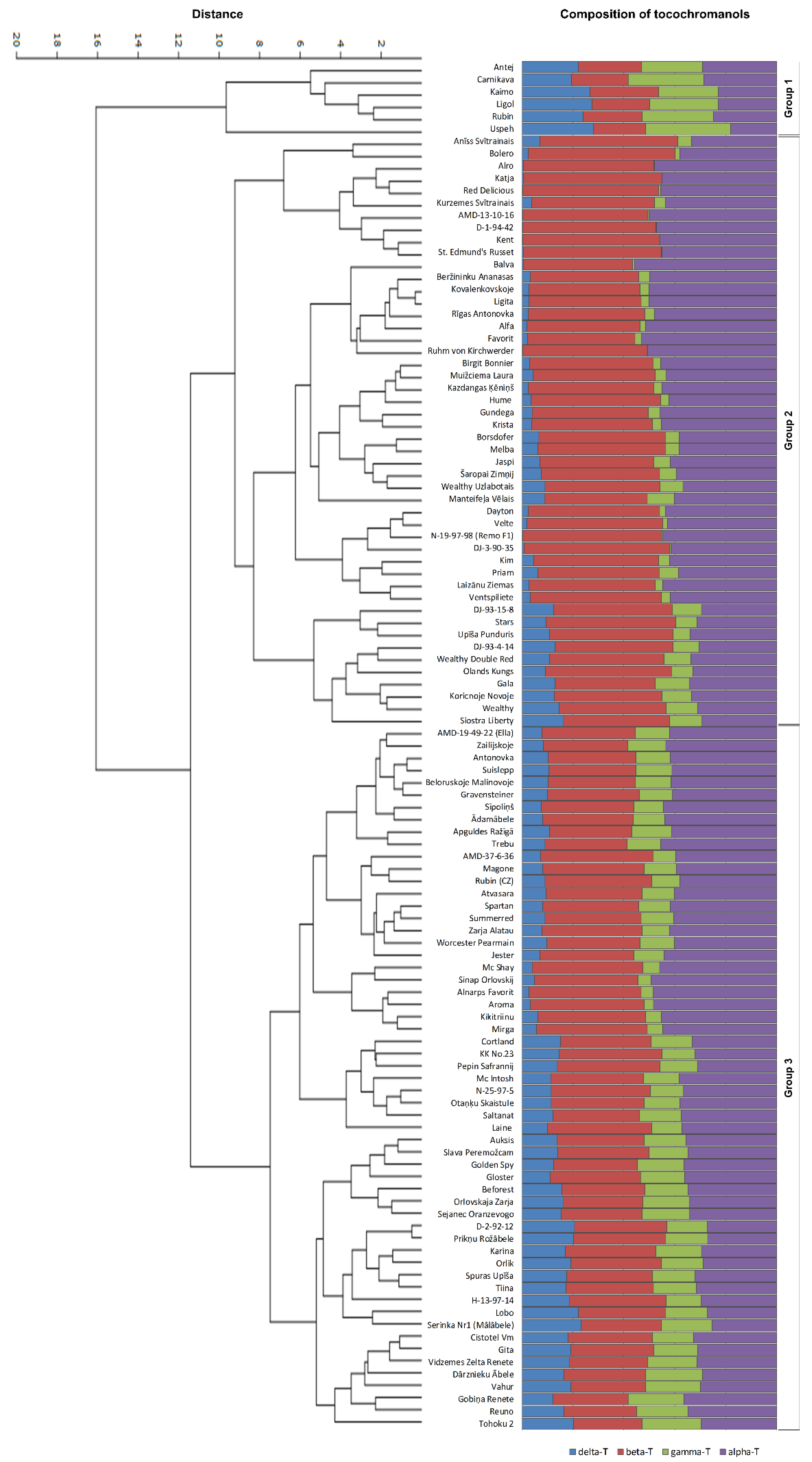
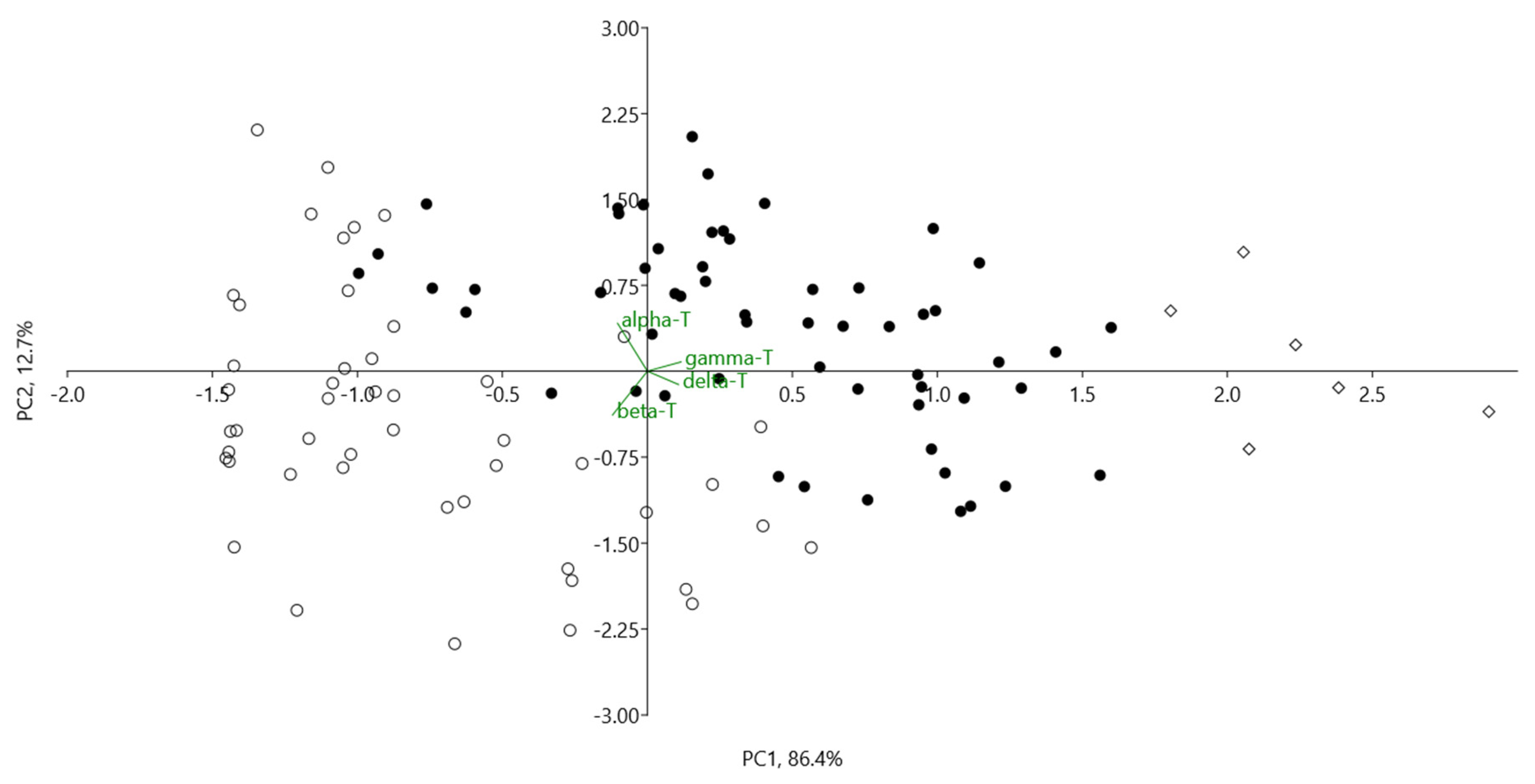
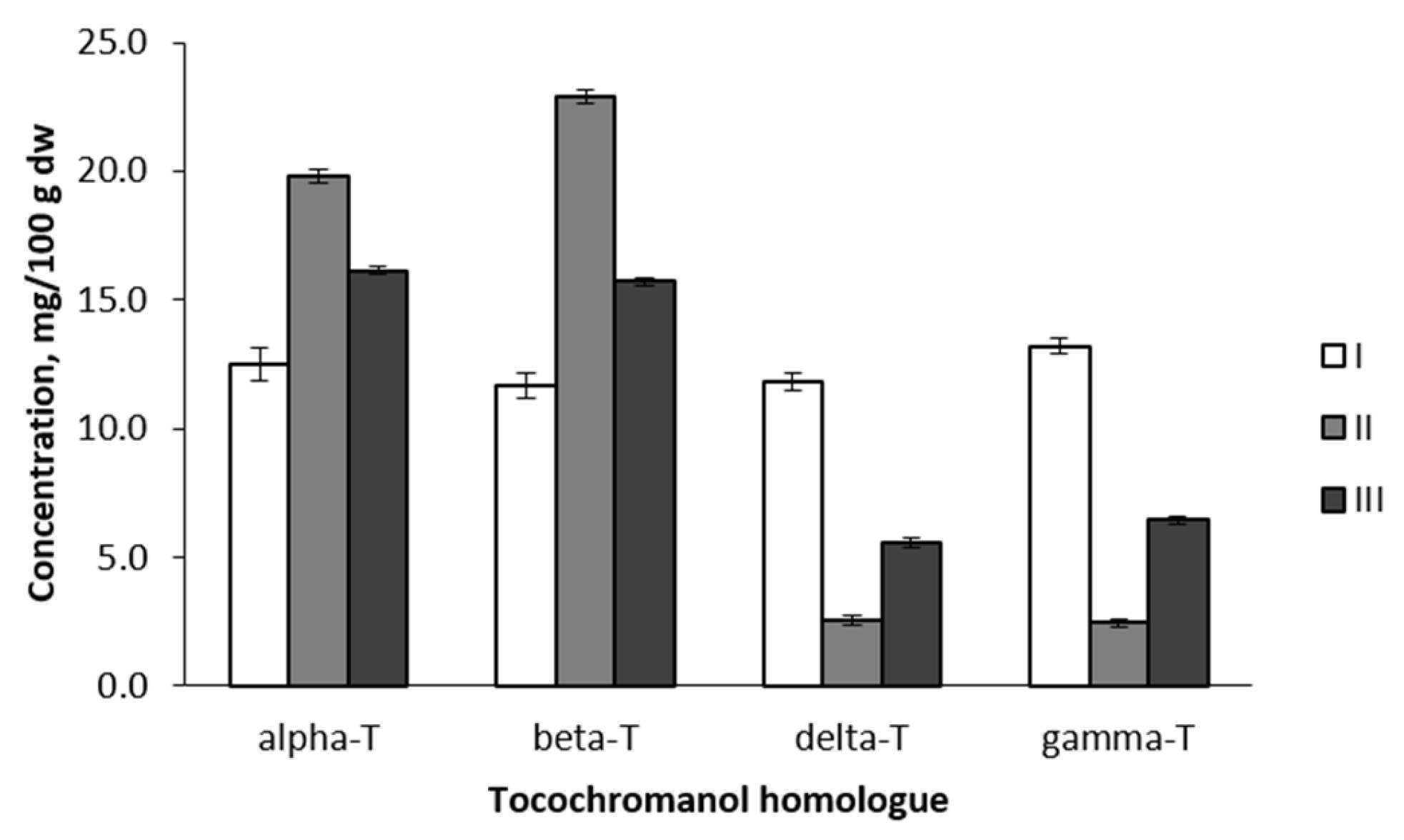

| Genotype | Country of Origin | alpha-T | beta-T | gamma-T | delta-T | Harvest Time * | Notes |
|---|---|---|---|---|---|---|---|
| Ādamābele | LVA | 19.18 | 15.48 | 5.29 | 3.46 | medium | Triploid |
| Alfa 68 | SWE | 21.81 | 18.66 | 0.93 | 0.82 | medium | Tetraploid |
| Alnarps Favorit | SWE | 17.64 | 15.96 | 1.70 | 1.01 | medium | Triploid |
| Alro | LVA | 26.29 | 28.00 | 0.15 | 0.30 | medium | |
| AMD-13-10-16 | LVA | 24.87 | 24.41 | 0.30 | 0.17 | late | |
| AMD-37-6-36 | LVA | 18.20 | 20.07 | 4.08 | 3.34 | medium | |
| Anīss Svītrainais | RUS | 18.53 | 29.98 | 2.85 | 3.94 | early | syn. Anis Polosatij |
| Antej | BLR | 16.45 | 14.12 | 13.57 | 12.42 | late | |
| Antonovka | RUS | 17.02 | 14.09 | 5.43 | 4.15 | medium | |
| Apguldes Ražīgā | LVA | 15.94 | 12.47 | 5.88 | 4.11 | medium | |
| Aroma | SWE | 18.61 | 17.25 | 1.35 | 1.19 | late | |
| Atvasara | LVA | 20.18 | 18.90 | 6.36 | 4.82 | early | |
| Auksis | LTU | 16.33 | 15.71 | 7.54 | 6.23 | medium | |
| Ādamābele | LVA | 19.18 | 15.48 | 5.29 | 3.46 | medium | Triploid |
| Balva | LVA | 22.37 | 17.16 | 0.28 | 0.25 | medium | |
| Beforest | CAN | 18.69 | 17.65 | 9.11 | 8.30 | late | |
| Beloruskoje Malinovoje | BLR | 18.26 | 15.07 | 6.06 | 4.52 | late | |
| Beržininku Ananasas | LTU | 23.36 | 19.87 | 2.07 | 1.54 | early | |
| Birgit Bonnier | SWE | 21.12 | 22.47 | 1.45 | 1.43 | medium | |
| Bolero | GBR | 19.52 | 29.50 | 1.01 | 1.32 | late | Columnar, syn. Tuscan |
| Borsdofer | DEU | 19.14 | 24.79 | 2.88 | 3.30 | late | syn. Edelborsdorfer |
| Carnikava | LVA | 13.54 | 10.56 | 14.20 | 9.17 | medium | Redleaf |
| Chistotel | RUS | 14.33 | 14.52 | 7.03 | 7.78 | medium | Rvi5 |
| Cortland | USA | 12.97 | 13.89 | 6.27 | 5.83 | late | |
| D-1-94-42 | LVA | 22.73 | 25.05 | 0.14 | 0.16 | medium | Rvi5 |
| D-2-92-12 | LVA | 14.17 | 18.72 | 8.18 | 10.65 | early | Rvi6 |
| Dayton | USA | 18.31 | 21.58 | 0.96 | 0.98 | medium | Rvi6 |
| Dārznieku Ābele | LVA | 12.50 | 13.67 | 9.55 | 7.11 | medium | |
| DJ-3-90-35 | LVA | 15.59 | 21.41 | 0.22 | 0.28 | late | Rvi6; cider apple |
| DJ-93-15-8 | LVA | 16.24 | 25.69 | 6.24 | 6.73 | medium | cider apple |
| DJ-93-4-14 | LVA | 15.24 | 23.18 | 5.18 | 6.50 | late | cider apple |
| Ella | LVA | 16.25 | 14.22 | 5.11 | 2.98 | medium | |
| Favorit | RUS | 25.19 | 20.13 | 1.28 | 1.03 | late | syn. Orlovskij Favorit |
| Gala | NZL | 16.64 | 19.20 | 6.60 | 6.30 | medium | |
| Gita | LVA | 13.56 | 14.35 | 7.53 | 8.34 | medium | Rvi6 |
| Gloster | DEU | 17.57 | 17.23 | 8.43 | 5.37 | late | |
| Gobiņa Renete | LVA | 15.88 | 12.91 | 9.59 | 5.35 | medium | |
| Golden Spy | USA | 16.66 | 15.17 | 8.51 | 5.64 | late | |
| Gravensteiner | DEU | 17.56 | 15.48 | 5.65 | 4.33 | late | Triploid |
| Gundega | LVA | 23.16 | 23.15 | 2.32 | 1.96 | medium | |
| H-13-97-14 | LVA | 13.37 | 17.12 | 6.01 | 8.26 | late | Rvi6; cider apple |
| Hume | CAN | 20.13 | 24.27 | 1.58 | 1.63 | medium | |
| Jaspi | FIN | 20.69 | 22.14 | 3.02 | 3.45 | early | |
| Jester | GBR | 21.15 | 17.48 | 5.63 | 3.42 | medium | |
| Kaimo | EST | 11.38 | 13.20 | 11.56 | 13.19 | early | |
| Karamba | EST | 14.52 | 17.52 | 8.77 | 8.31 | medium | syn. Karina |
| Katja | SWE | 23.99 | 29.05 | 0.13 | 0.24 | medium | |
| Kazdangas Ķēniņš | LVA | 21.52 | 23.48 | 1.50 | 1.20 | medium | |
| Kent | GBR | 23.18 | 27.09 | 0.26 | 0.16 | late | |
| Kikitriinu | EST | 17.91 | 16.70 | 2.42 | 2.42 | medium | |
| Kim | SWE | 17.13 | 19.89 | 1.70 | 1.84 | late | |
| KK No.23 | EST | 11.60 | 14.46 | 4.61 | 5.26 | medium | |
| Korichnoje Novoje | RUS | 15.95 | 20.35 | 5.58 | 5.95 | medium | |
| Kovalenkovskoje | BLR | 22.47 | 19.53 | 1.61 | 1.20 | medium | |
| Krista | EST | 23.83 | 24.93 | 1.96 | 1.99 | medium | |
| Kurzemes Svītrainais | LVA | 24.94 | 27.43 | 2.25 | 2.14 | medium | |
| Laine | LVA | 14.97 | 16.53 | 4.76 | 3.98 | early | |
| Laizānu Ziemas | LVA | 16.31 | 18.16 | 1.05 | 0.95 | medium | |
| Ligita | LVA | 22.39 | 19.76 | 1.42 | 1.17 | late | Rvi6 |
| Ligol | POL | 11.81 | 11.75 | 13.93 | 14.05 | late | |
| Lobo | CAN | 12.75 | 15.87 | 7.66 | 10.26 | late | |
| Magone | LVA | 17.43 | 17.59 | 5.66 | 3.61 | late | |
| Manteifeļa Vēlais | LVA | 21.91 | 21.90 | 5.85 | 4.83 | medium | |
| Mc Intosh | CAN | 14.98 | 14.29 | 5.56 | 4.39 | late | |
| Mc Shay | USA | 14.67 | 13.92 | 2.02 | 1.23 | medium | Rvi6 |
| Melba | CAN | 18.34 | 23.98 | 2.63 | 2.88 | early | |
| Mirga | LVA | 16.81 | 16.31 | 2.33 | 2.14 | early | |
| Muižciema Lauka | LVA | 20.71 | 22.86 | 2.03 | 2.09 | medium | cider apple |
| N-19-97-98 | LVA | 18.48 | 22.51 | 0.20 | 0.16 | medium | cider apple |
| N-25-97-5 | LVA | 12.77 | 13.60 | 4.52 | 3.94 | medium | cider apple |
| Olands Kungs | LVA | 14.68 | 21.85 | 3.75 | 4.14 | medium | |
| Orlik | RUS | 13.99 | 17.26 | 7.93 | 9.29 | medium | |
| Orlovskaja Zarja | RUS | 17.01 | 15.49 | 9.10 | 8.07 | medium | |
| Otaņķu Skaistule | LVA | 13.31 | 12.85 | 4.96 | 3.98 | late | |
| Pepin Safrannij | RUS | 12.39 | 16.06 | 5.92 | 5.54 | late | |
| Priam | FRA | 16.24 | 20.15 | 3.25 | 2.56 | medium | Rvi6 |
| Prikņu Rožābele | LVA | 14.15 | 18.68 | 8.64 | 10.53 | medium | syn. Roosioun |
| Red Delicious | USA | 25.39 | 29.71 | 0.48 | 0.14 | late | clone Cooper Zanzi Red |
| Reuno | EST | 14.92 | 12.29 | 8.62 | 7.06 | medium | |
| Rīgas Antonovka | LVA | 21.52 | 20.58 | 1.69 | 1.07 | medium | |
| Rubin (KAZ) | KAZ | 12.16 | 11.25 | 13.66 | 11.78 | medium | Liivi Kuldrenett × Suislepp |
| Rubin (CZE) | CZE | 17.30 | 18.99 | 5.10 | 4.15 | late | Lord Lambourne × Golden Delicious |
| Ruhm von Kirchwerder | DEU | 22.83 | 22.10 | 0.16 | 0.12 | medium | syn. Ruhm von Kirchwalden |
| Saltanat | KAZ | 13.76 | 12.52 | 6.02 | 4.45 | medium | |
| Sejanec Oranzhevogo | RUS | 17.83 | 16.55 | 9.72 | 7.99 | medium | |
| Serinka No.1 (Mālābele) | LVA | 12.51 | 15.50 | 9.74 | 11.42 | medium | standard clone of Serinka |
| Sharopai Zimņij | RUS | 18.85 | 22.15 | 3.15 | 3.57 | medium | |
| Sinap Orlovskij | RUS | 16.90 | 14.13 | 1.76 | 1.73 | late | syn. Orlovski Sinap |
| Siostra Liberty | POL | 16.08 | 22.82 | 7.12 | 8.98 | medium | Rvi6 |
| Sīpoliņš | LVA | 18.23 | 14.86 | 4.66 | 3.06 | late | |
| Slava Peremozhcam | UKR | 15.54 | 16.00 | 6.73 | 6.25 | medium | |
| Spartan | CAN | 19.19 | 17.26 | 5.62 | 3.72 | late | |
| Spuras Upīša | LVA | 16.67 | 17.42 | 8.60 | 9.08 | early | |
| St. Edmund’s Russet | GBR | 22.15 | 26.60 | 0.16 | 0.24 | medium | |
| Stars | LVA | 16.50 | 26.75 | 4.35 | 5.02 | late | |
| Suislepp | EST | 17.32 | 14.49 | 5.88 | 4.40 | early | |
| Summered | CAN | 19.21 | 17.94 | 6.14 | 4.29 | medium | |
| Tiina | EST | 15.75 | 17.17 | 8.41 | 8.54 | medium | |
| Tohoku 2 | JAP | 11.72 | 10.74 | 9.08 | 7.95 | medium | |
| Treboux Sämling | EST | 16.50 | 11.66 | 4.83 | 3.26 | medium | syn. Pärnu Tuviõun |
| Upīša Punduris | LVA | 17.60 | 25.19 | 3.52 | 5.60 | medium | |
| Uspeh | RUS | 6.12 | 6.87 | 11.30 | 9.52 | late | |
| Vahur | EST | 14.37 | 14.04 | 10.24 | 9.10 | early | |
| Velte | LVA | 17.44 | 21.62 | 0.73 | 0.84 | medium | |
| Ventspiliete | LVA | 14.79 | 18.19 | 1.12 | 1.12 | medium | |
| Vidzemes Zelta Renete | LVA | 13.88 | 13.84 | 8.66 | 8.18 | medium | syn. Liivi Kuldrenett |
| Wealthy | USA | 14.57 | 19.91 | 5.84 | 6.82 | medium | M. × cerasifera F1 |
| Wealthy Double Red | USA | 17.01 | 22.76 | 5.34 | 5.34 | medium | Clone of Wealthy |
| Wealthy Uzlabotais | LVA | 18.36 | 22.52 | 4.45 | 4.48 | medium | Clone of Wealthy |
| Worcester Pearmain | GBR | 18.32 | 16.64 | 6.17 | 4.49 | early | |
| Zailijskoje | KAZ | 17.37 | 13.26 | 5.95 | 3.29 | medium | |
| Zarja Alatau | KAZ | 19.49 | 18.23 | 4.92 | 3.57 | late |
Disclaimer/Publisher’s Note: The statements, opinions and data contained in all publications are solely those of the individual author(s) and contributor(s) and not of MDPI and/or the editor(s). MDPI and/or the editor(s) disclaim responsibility for any injury to people or property resulting from any ideas, methods, instructions or products referred to in the content. |
© 2023 by the authors. Licensee MDPI, Basel, Switzerland. This article is an open access article distributed under the terms and conditions of the Creative Commons Attribution (CC BY) license (https://creativecommons.org/licenses/by/4.0/).
Share and Cite
Górnaś, P.; Lācis, G.; Mišina, I.; Ikase, L. Tocopherols in Cultivated Apple Malus sp. Seeds: Composition, Variability and Specificity. Plants 2023, 12, 1169. https://doi.org/10.3390/plants12051169
Górnaś P, Lācis G, Mišina I, Ikase L. Tocopherols in Cultivated Apple Malus sp. Seeds: Composition, Variability and Specificity. Plants. 2023; 12(5):1169. https://doi.org/10.3390/plants12051169
Chicago/Turabian StyleGórnaś, Paweł, Gunārs Lācis, Inga Mišina, and Laila Ikase. 2023. "Tocopherols in Cultivated Apple Malus sp. Seeds: Composition, Variability and Specificity" Plants 12, no. 5: 1169. https://doi.org/10.3390/plants12051169
APA StyleGórnaś, P., Lācis, G., Mišina, I., & Ikase, L. (2023). Tocopherols in Cultivated Apple Malus sp. Seeds: Composition, Variability and Specificity. Plants, 12(5), 1169. https://doi.org/10.3390/plants12051169

