


Uncovering Static–Dynamic Interaction Patterns Between Commercial and Residential Spaces Within Beijing’s Sixth Ring Road Using POI and Human Mobility Trajectory Data
Abstract
1. Introduction
- (1)
- Methodologically, we propose an integrated static–dynamic analytical framework that addresses the limitation of examining facility configurations and mobility connections separately. At a common subdistrict scale, the framework relates residential and commercial facility intensities to destination-oriented inbound mobility and combines rank-correlation analysis, a facility–mobility correspondence typology, and OD-network analysis. It thereby identifies both concordant and contrasting patterns and distinguishes spatial co-distribution from observed travel connectivity.
- (2)
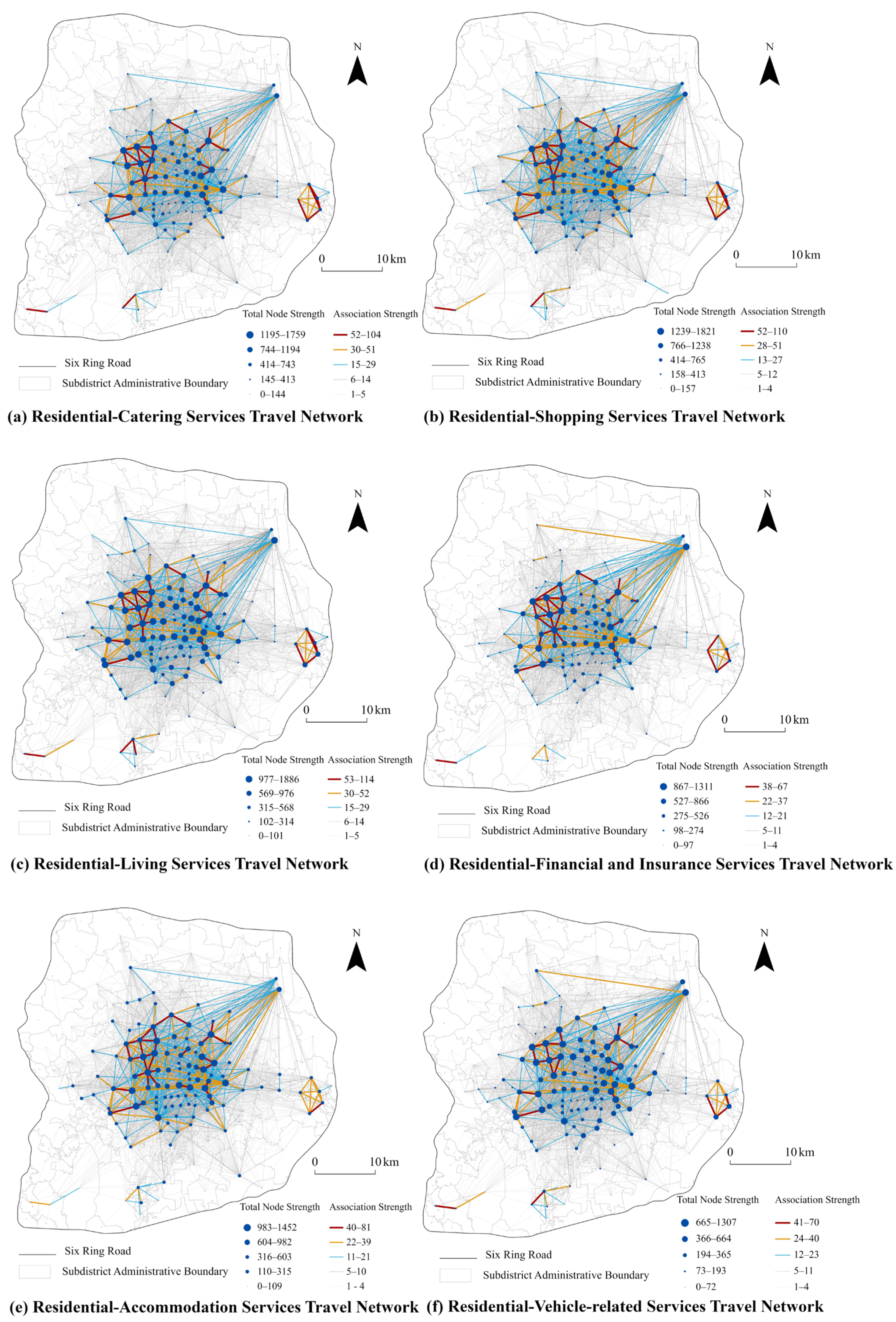
- We refine commercial–residential analysis by disaggregating commercial facilities into six service categories: catering, shopping, financial and insurance, vehicle-related, living, and accommodation. This categorization enables category-specific comparisons of residential–commercial facility correspondence, commercial facility–inbound mobility correspondence, and OD-network organization. It reveals variations that may be concealed when commercial facilities are treated as an aggregate category and provides service-specific evidence for facility planning.
2. Study Area, Data, and Methodology
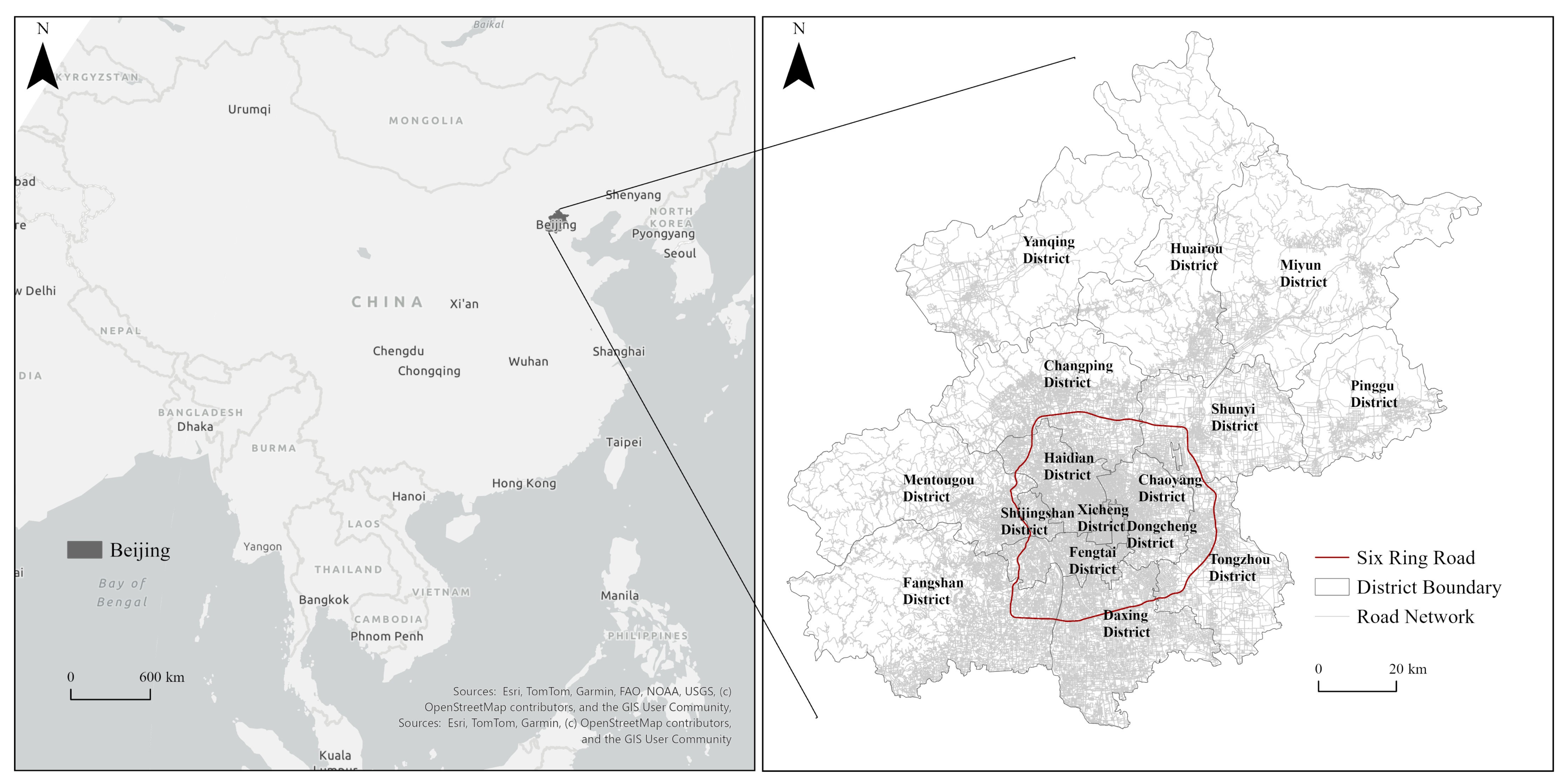
2.1. Study Area
2.2. Data
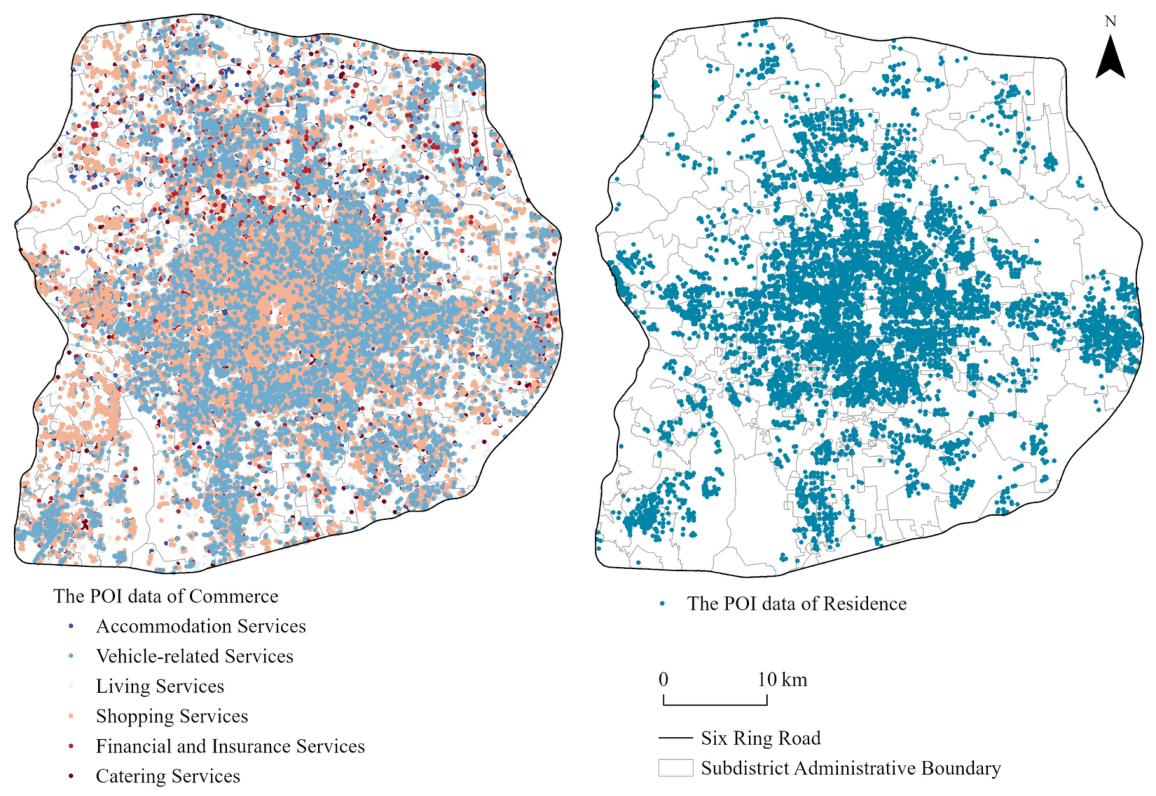
2.2.1. POI Data
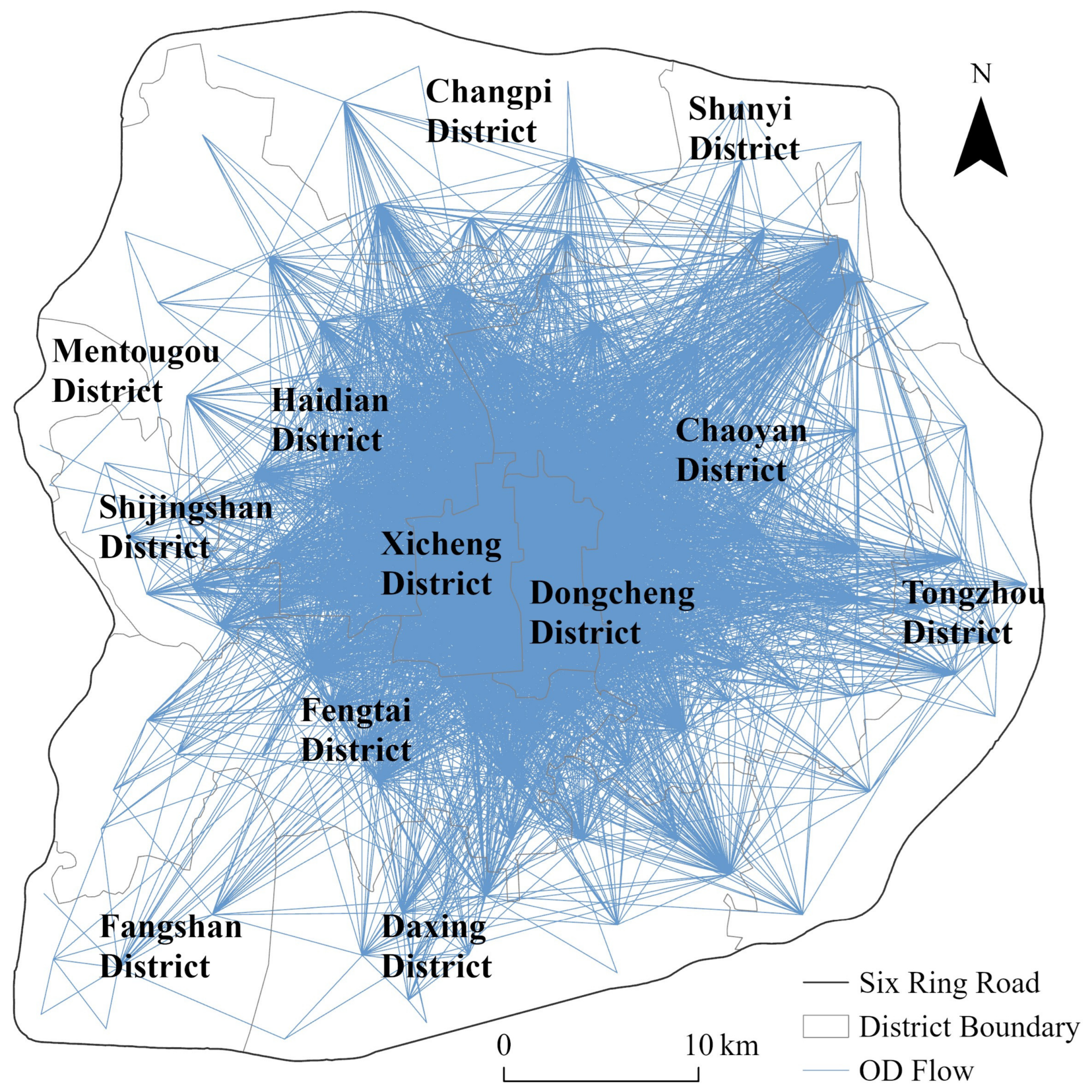
2.2.2. Ride-Hailing Vehicle Origin–Destination (OD) Data
2.2.3. Spatial Data Preprocessing, Coordinate System, and Buffer-Distance Sensitivity
2.3. Methodology
2.3.1. Kernel Density Estimation Method
2.3.2. Average Nearest Neighbor Analysis
2.3.3. Global Spatial Autocorrelation and Bivariate Spatial Association Analysis
2.3.4. Network Construction and Strength-Based Node Centrality Assessment
2.3.5. Subdistrict-Level Static–Dynamic Comparison
3. Results
3.1. Analysis of Static Interaction Patterns Between Commercial and Residential Spaces
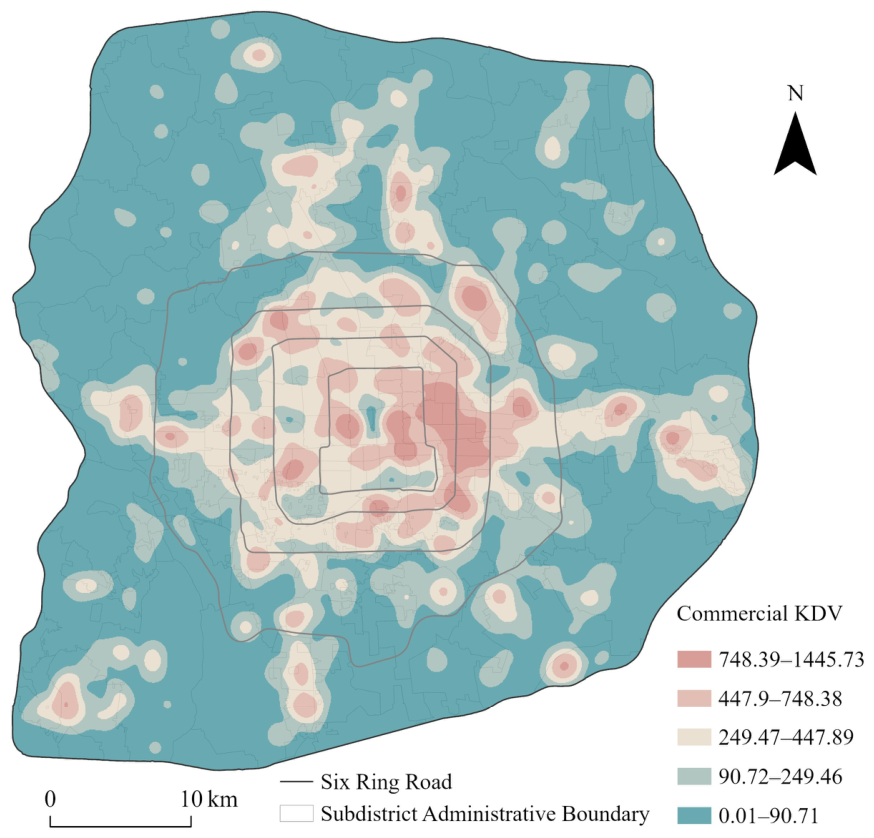
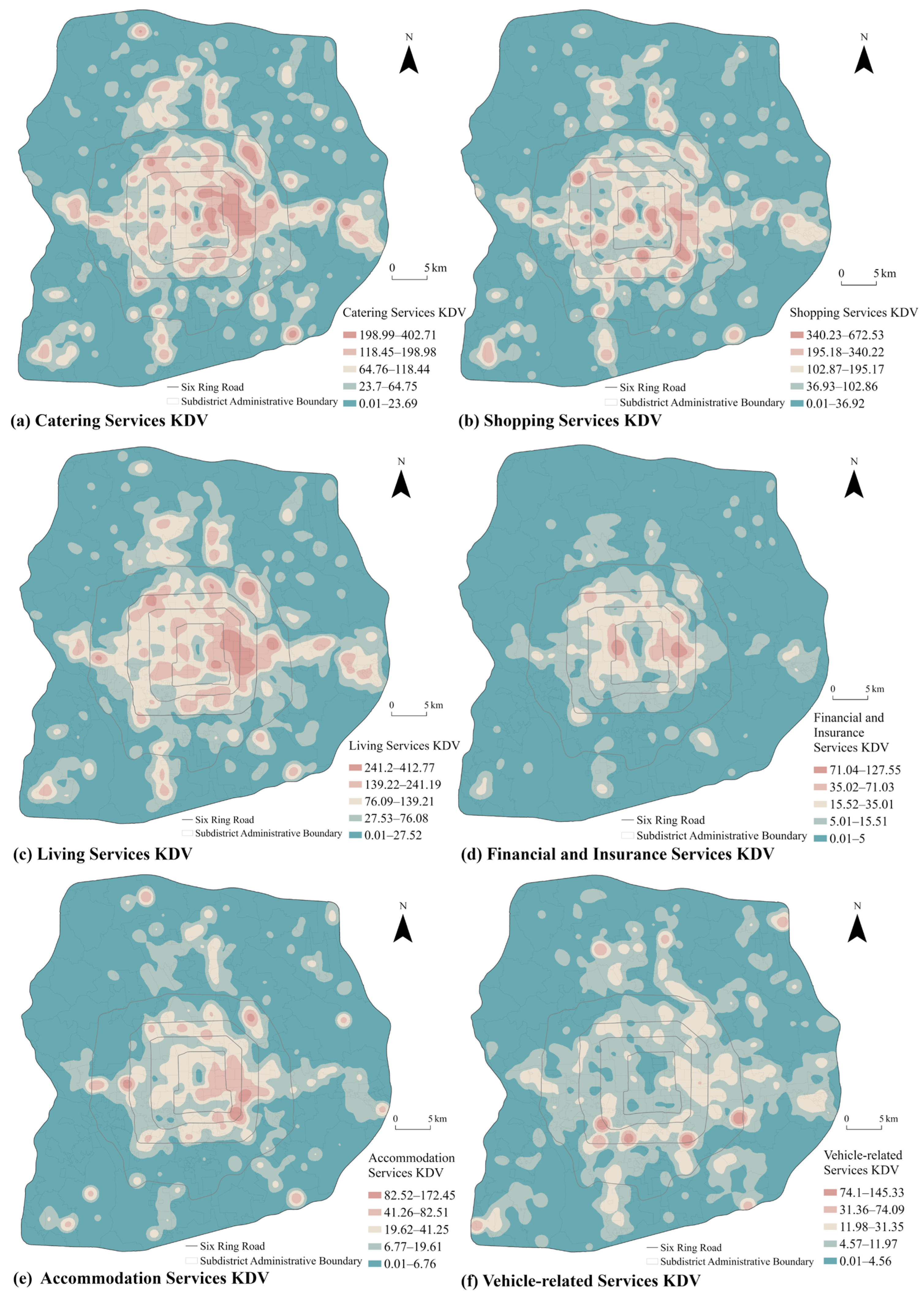
3.1.1. Spatial Distribution Patterns of Commercial Areas
- (1)
- High values in the center and low values at the periphery
- (2)
- Band-like and patch-based polycentric patterns
- (3)
- Stronger in the east than in the west
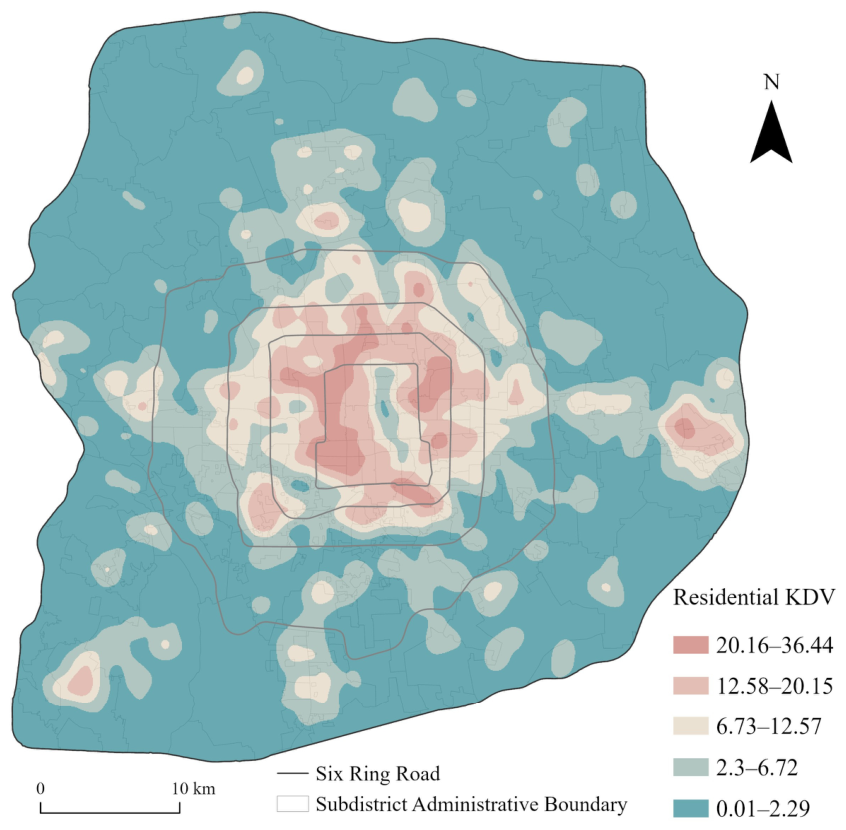
3.1.2. Spatial Distribution Patterns of Residential Areas
3.1.3. Spatial Autocorrelation and Bivariate Spatial Association Between Commercial and Residential Spaces
3.2. Analysis of Dynamic Interaction Patterns Between Commercial and Residential Spaces
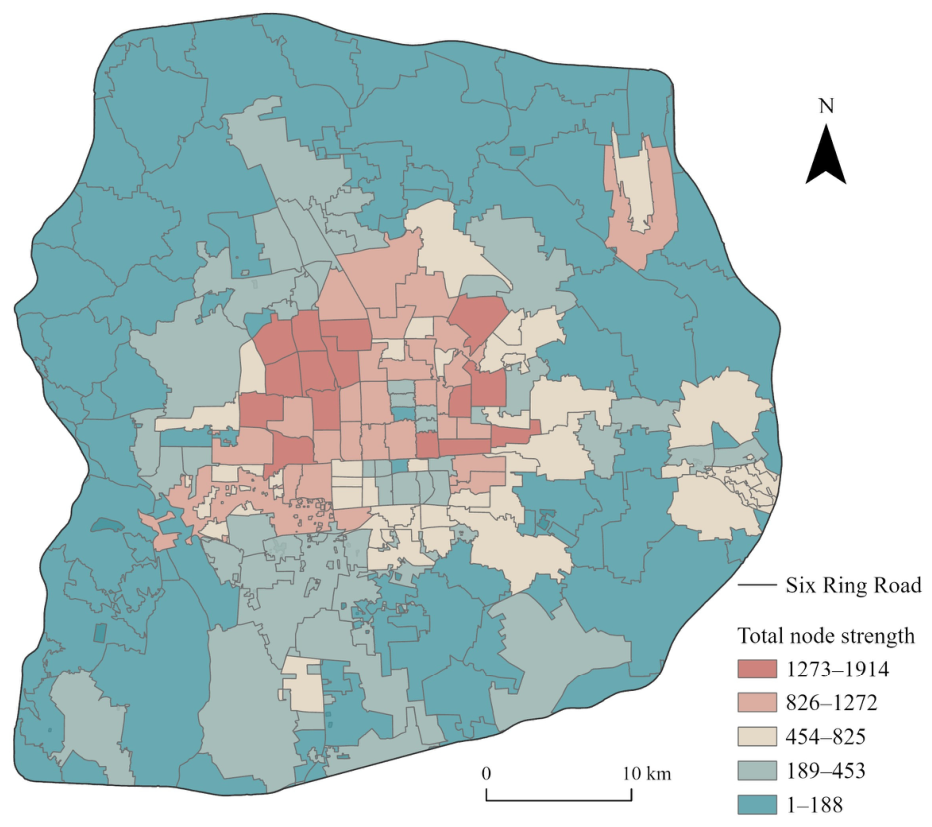
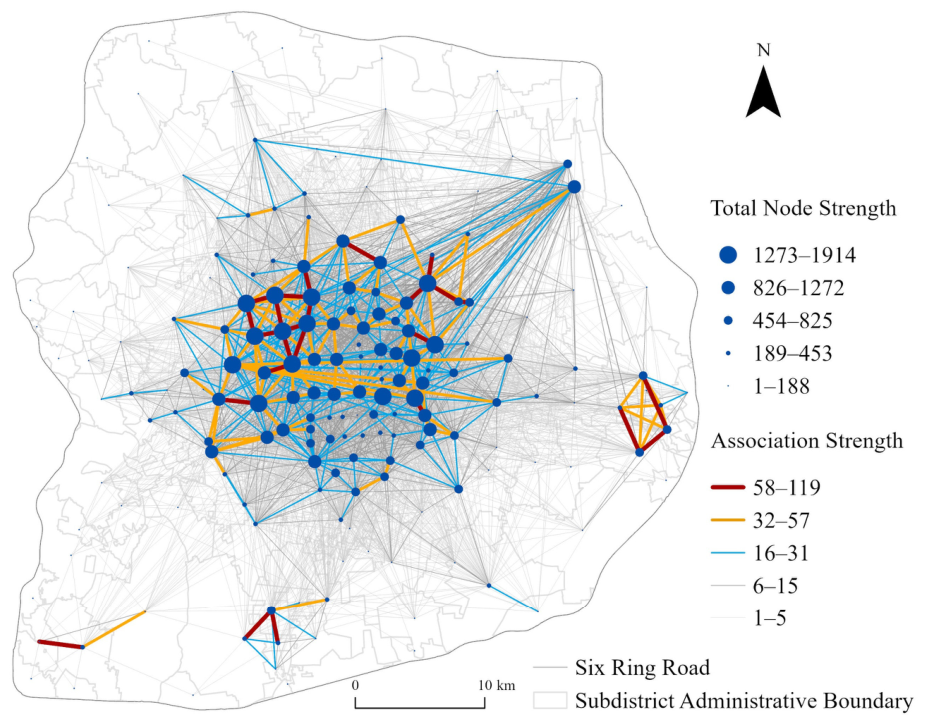
3.2.1. Node Hierarchy Characteristics of the Residential-to-Commercial Travel Subdistrict-Level Network
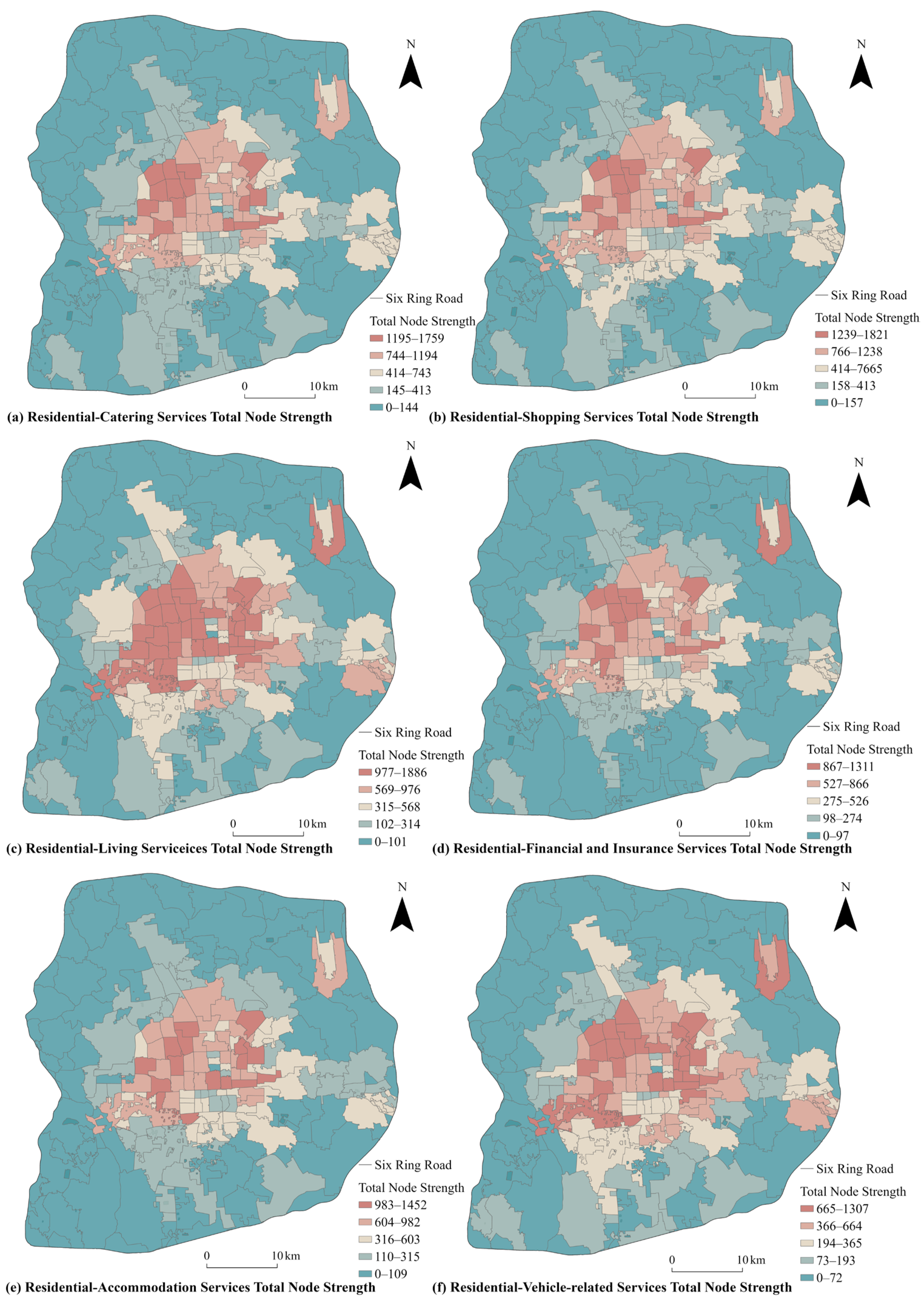
3.2.2. Dynamic Interaction Patterns of Residential-to-Commercial Travel Network
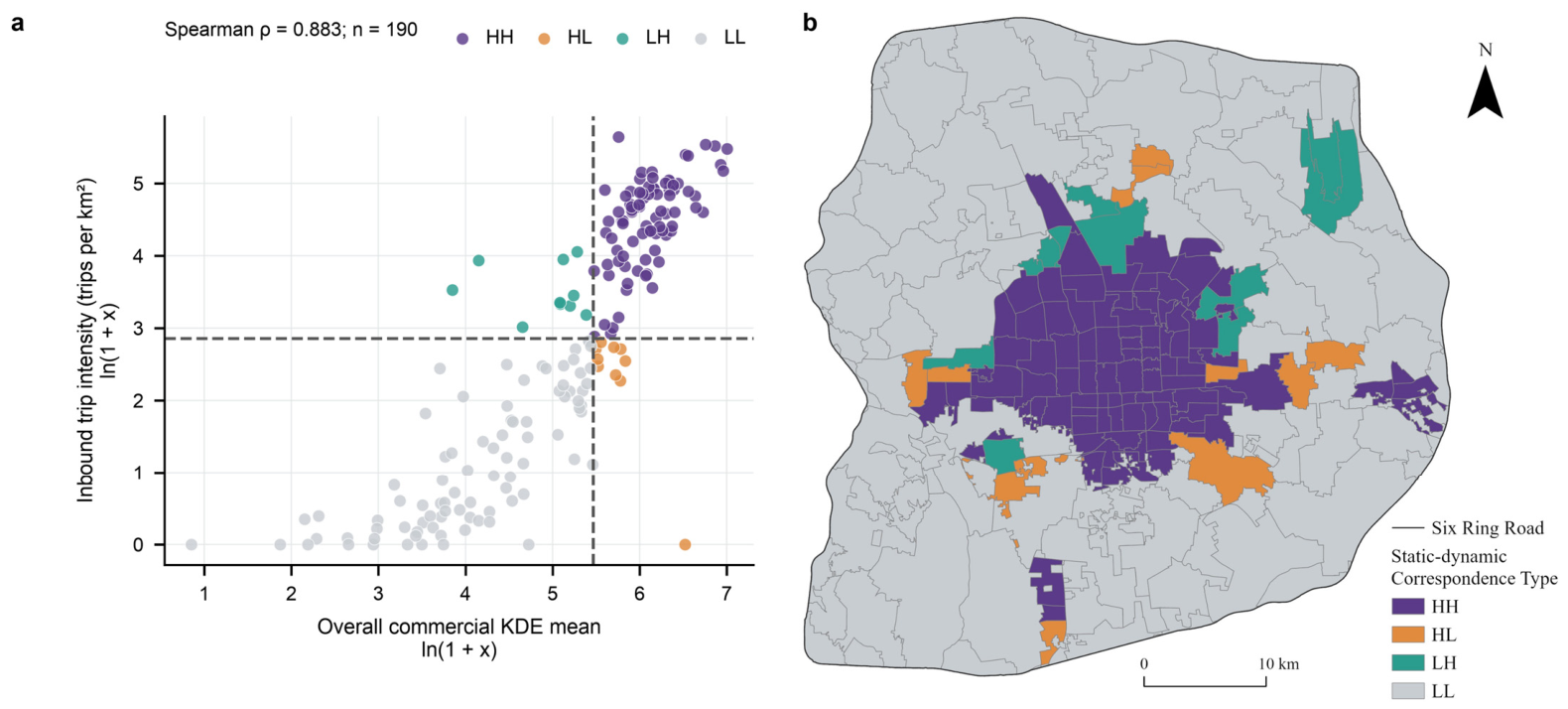
3.3. Subdistrict-Level Static–Dynamic Correspondence
4. Discussion
5. Conclusions
Author Contributions
Funding
Data Availability Statement
Acknowledgments
Conflicts of Interest
References
- Oosterbaan, C.; Arku, G.; Asiedu, A.B. Conversion of Residential Units to Commercial Spaces in Accra, Ghana: A Policy Dilemma. Int. Plan. Stud. 2012, 17, 45–66. [Google Scholar] [CrossRef] [Scilit]
- Kang, C.; Liu, Y.; Wu, L. Delineating Intra-Urban Spatial Connectivity Patterns by Travel-Activities: A Case Study of Beijing, China. In Proceedings of the 2015 23rd International Conference on Geoinformatics, Wuhan, China, 19–21 June 2015; IEEE: New York, NY, USA, 2015; pp. 1–7. [Google Scholar] [CrossRef] [Scilit]
- Liu, J.; Meng, B.; Shi, C. A Multi-Activity View of Intra-Urban Travel Networks: A Case Study of Beijing. Cities 2023, 143, 104634. [Google Scholar] [CrossRef] [Scilit]
- Psyllidis, A.; Gao, S.; Hu, Y.; Kim, E.-K.; McKenzie, G.; Purves, R.; Yuan, M.; Andris, C. Points of Interest (POI): A Commentary on the State of the Art, Challenges, and Prospects for the Future. Comput. Urban Sci. 2022, 2, 20. [Google Scholar] [CrossRef] [Scilit] [PubMed]
- Fang, Y.; Yu, H.; Chen, Y.; Fu, X. Spatial Distribution Characteristics and Influencing Factors of the Retail Industry in Ningbo City in Eastern China Based on POI Data. Sustainability 2024, 16, 7525. [Google Scholar] [CrossRef] [Scilit]
- Xue, B.; Xiao, X.; Li, J.; Xie, X.; Lu, C.; Ren, W. POI-Based Spatial Correlation of the Residences and Retail Industry in Shenyang City. Geogr. Sci. 2019, 39, 442–449. [Google Scholar] [CrossRef]
- Liu, W.; Lei, N.; Liu, D. Analysis of the Relationship Between Residential Areas and the Retail Sector in Taiyuan—An Example of POI Application. Technol. Innov. Appl. 2024, 14, 123–128. [Google Scholar] [CrossRef]
- Zhou, L.; Liu, M.; Zheng, Z.; Wang, W. Quantification of Spatial Association between Commercial and Residential Spaces in Beijing Using Urban Big Data. ISPRS Int. J. Geo-Inf. 2022, 11, 249. [Google Scholar] [CrossRef] [Scilit]
- Zhou, L.; Wang, C. Detecting the Spatial Association between Commercial Sites and Residences in Beijing on the Basis of the Colocation Quotient. ISPRS Int. J. Geo-Inf. 2024, 13, 7. [Google Scholar] [CrossRef] [Scilit]
- Wu, D.; Zhou, S. The Matching Pattern of Housing-Shopping Space Based on Residents’ Daily Shopping Behaviors: A Case Study of Communities in Guangzhou, China. Geogr. Sci. 2017, 37, 228–235. [Google Scholar] [CrossRef]
- Ma, L.; Xiu, L. Research on the Matching Relationship Between Residential and Commercial Space in Shenyang Based on Shopping Trips. Hum. Geogr. 2022, 37, 63–70. [Google Scholar] [CrossRef]
- Zhang, Y.; Zhou, G.; Liu, Y.; Fu, H.; Sun, H. Matching of Residential and Commercial Space in Shrinking Cities from the Perspective of Supply and Demand: A Case Study of Yichun City, China. Chin. Geogr. Sci. 2022, 32, 389–404. [Google Scholar] [CrossRef] [Scilit]
- Zhou, L.; Wang, C.; Zhen, F. Exploring and Evaluating the Spatial Association between Commercial and Residential Spaces Using Baidu Trajectory Data. Cities 2023, 141, 104514. [Google Scholar] [CrossRef] [Scilit]
- Zhang, X. Static Matching and Dynamic Association of Urban Commercial and Residential Spaces Based on POI and Trajectory Big Data—Shanghai as an Example. Master’s Thesis, Nanjing University of Posts and Telecommunications, Nanjing, China, 2024. [Google Scholar] [CrossRef]
- He, T. Research on the Correlation Between Commercial and Residential Spaces Based on the Multi-Source Geographic Big Data—A Case study of Zhuhai. Master’s Thesis, Nanjing University of Posts and Telecommunications, Nanjing, China, 2024. [Google Scholar] [CrossRef]
- Zhou, L.; Xiao, W.; Wang, C.; Wang, H. Exploring Spatial Association between Residential and Commercial Urban Spaces: A Machine Learning Approach Using Taxi Trajectory Data. J. Transp. Land Use 2024, 17, 143–161. [Google Scholar] [CrossRef] [Scilit]
- Lin, G.; Song, P.; Li, R.; Yang, F. The Progress and Prospect of Commercial Geography in the Context of Consumption Society. Hum. Geogr. 2019, 34, 80–89. [Google Scholar] [CrossRef]
- Chen, W.; Liu, L.; Liang, Y. Retail Center Recognition and Spatial Aggregating Feature Analysis of Retail Formats in Guangzhou Based on POI Data. Geogr. Res. 2016, 35, 703–716. [Google Scholar]
- Gao, Y.; Yang, Q.; Liang, L.; Zhao, Y. Spatial Pattern and Influencing Factors of Retailing Industries in Xi’an Based on POI Data. Geogr. Sci. 2020, 40, 710–719. [Google Scholar] [CrossRef]
- Hao, F.L.; Wang, S.J.; Feng, Z.X.; Yu, T.; Ma, L. Spatial pattern and its industrial distribution of commercial space in Changchun based on POI data. Geogr. Res. 2018, 37, 366–378. [Google Scholar]
- Wang, N.; Zheng, L.; Shen, H.; Li, S. Ride-Hailing Origin-Destination Demand Prediction with Spatiotemporal Information Fusion. Transp. Saf. Environ. 2024, 6, tdad026. [Google Scholar] [CrossRef] [Scilit]
- Liang, Z.; Kong, W.; Zhan, X.; Xiao, Y. Analysis of the Impact of Ride-Hailing on Urban Road Network Traffic by Using Vehicle Trajectory Data. J. Adv. Transp. 2022, 2022, 6940850. [Google Scholar] [CrossRef] [Scilit]
- Gehrke, S.R.; Felix, A.; Reardon, T.G. Substitution of Ride-Hailing Services for More Sustainable Travel Options in the Greater Boston Region. Transp. Res. Rec. J. Transp. Res. Board 2019, 2673, 438–446. [Google Scholar] [CrossRef] [Scilit]
- Liu, X.; Tian, Y.; Zhang, X.; Wan, Z. Identification of Urban Functional Regions in Chengdu Based on Taxi Trajectory Time Series Data. ISPRS Int. J. Geo-Inf. 2020, 9, 158. [Google Scholar] [CrossRef] [Scilit]
- Wang, H.; Huang, H.; Ni, X.; Zeng, W. Revealing Spatial-Temporal Characteristics and Patterns of Urban Travel: A Large-Scale Analysis and Visualization Study with Taxi GPS Data. ISPRS Int. J. Geo-Inf. 2019, 8, 257. [Google Scholar] [CrossRef] [Scilit]
- Liu, X.; Gong, L.; Gong, Y.; Liu, Y. Revealing Travel Patterns and City Structure with Taxi Trip Data. J. Transp. Geogr. 2015, 43, 78–90. [Google Scholar] [CrossRef] [Scilit]
- Fu, X.; Yang, Y.; Sun, H. Structural complexity and spatial differentiation characteristics of taxi trip trajectory network. J. Traffic Transp. Eng. 2017, 17, 106–116. [Google Scholar]
- Zhang, Y.; Zheng, X.; Chen, M.; Li, Y.; Yan, Y.; Wang, P. Urban Fine-Grained Spatial Structure Detection Based on a New Traffic Flow Interaction Analysis Framework. ISPRS Int. J. Geo-Inf. 2021, 10, 227. [Google Scholar] [CrossRef] [Scilit]
- Zhang, Y.; Li, Y.; Zheng, X.; Liu, H. Research on Track Network and Flow Mode Based on Taxi Data. Geospat. Inf. 2021, 19, 1–6. [Google Scholar] [CrossRef]
- Zhou, X.; Zhang, H.; Ye, X. A Multi-Hierarchical Method to Extract Spatial Network Structures from Large-Scale Origin-Destination Flow Data. Int. J. Geogr. Inf. Sci. 2024, 38, 577–602. [Google Scholar] [CrossRef] [Scilit]
- Barroso, J.M.F.; Albuquerque-Oliveira, J.L.; Oliveira-Neto, F.M. Correlation Analysis of Day-to-Day Origin-Destination Flows and Traffic Volumes in Urban Networks. J. Transp. Geogr. 2020, 89, 102899. [Google Scholar] [CrossRef] [Scilit]
- The People’s Government of Beijing Municipality. Available online: https://www.beijing.gov.cn/zhengce/zhengcefagui/202503/t20250320_4039431.html (accessed on 27 July 2026).
- GB 50137-2011; Code for Classification of Urban Land Use and Planning Standards of Development Land. China Architecture & Building Press: Beijing, China, 2011.
- Ministry of Natural Resources of the People’s Republic of China. Guidelines for Land and Sea Use Classification in Territorial Spatial Survey, Planning, and Use Regulation; Ministry of Natural Resources of the People’s Republic of China: Beijing, China, 2023.
- Silverman, B.W. Density Estimation for Statistics and Data Analysis; Chapman and Hall: New York, NY, USA, 1986. [Google Scholar]
- Ebdon, D. Statistics in Geography; Blackwell: Hoboken, NJ, USA, 1985. [Google Scholar]
- Mitchell, A. The ESRI Guide to GIS Analysis; ESRI Press: Redlands, CA, USA, 2005; Volume 2. [Google Scholar]
- Getis, A.; Ord, J.K. The Analysis of Spatial Association by Use of Distance Statistics. Geogr. Anal. 1992, 24, 189–206. [Google Scholar] [CrossRef] [Scilit]
- Moran, P.A.P. Notes on Continuous Stochastic Phenomena. Biometrika 1950, 37, 17–23. [Google Scholar] [CrossRef] [Scilit]
- Wartenberg, D. Multivariate Spatial Correlation: A Method for Exploratory Geographical Analysis. Geogr. Anal. 1985, 17, 263–283. [Google Scholar] [CrossRef] [Scilit]
- Liu, J. An Introduction to Social Network Analysis, 1st ed.; Social Sciences Academic Press: Beijing, China, 2004. [Google Scholar]
- Wang, L.; Liu, H.; Liu, Q. China’s city network based on Tencent’s migration big data. Acta Geogr. Sin. 2021, 76, 853. [Google Scholar] [CrossRef]
- Zhang, X.; Han, H.; Tang, Y.; Luo, G. Research on the Characteristics of Urban Network Structure in China based on Baidu Migration Data. J. Geo-Inf. Sci. 2021, 23, 1798–1808. [Google Scholar] [CrossRef]
- Opsahl, T.; Agneessens, F.; Skvoretz, J. Node Centrality in Weighted Networks: Generalizing Degree and Shortest Paths. Soc. Netw. 2010, 32, 245–251. [Google Scholar] [CrossRef] [Scilit]
- Spearman, C. The Proof and Measurement of Association Between Two Things. In Studies in Individual Differences: The Search for Intelligence; Appleton-Century-Crofts: New York, NY, USA, 1961; pp. 45–58. [Google Scholar] [CrossRef] [Scilit]
- Kendall, M.G. The Treatment of Ties in Ranking Problems. Biometrika 1945, 33, 239–251. [Google Scholar] [CrossRef] [Scilit]
- Yang, J.; Yi, D.; Qiao, B.; Zhang, J. Spatio-Temporal Change Characteristics of Spatial-Interaction Networks: Case Study within the Sixth Ring Road of Beijing, China. ISPRS Int. J. Geo-Inf. 2019, 8, 273. [Google Scholar] [CrossRef] [Scilit]



| POI Type | POI Subcategory | Subcategory | Count | Percentage |
|---|---|---|---|---|
| commercial POIs | catering services | Tea houses, bakeries, coffee shops, fast-food restaurants, ice cream shops, dessert shops, international restaurants, Chinese restaurants, food-related venues, casual dining venues | 86,360 | 25.34% |
| shopping services | Convenience stores, supermarkets, clothing, footwear, and leather goods stores, personal care and cosmetics stores, shopping-related venues, flower, bird, fish, and pet markets, home appliance and electronics stores, home furnishings and building materials markets, shopping malls, specialty shopping streets, specialized retail venues, sporting goods stores, specialty stores, general markets | 114,309 | 33.54% | |
| financial and insurance services | Insurance Companies, Finance Companies, Providers of Financial and Insurance Services, Banks, Bank-Related Services, Securities Firms, ATMs | 10,268 | 3.01% | |
| vehicle-related services | Charging stations, used car sales, battery swap stations, natural gas stations, gas stations, other energy stations, vehicle-related services, roadside assistance, car clubs, auto parts sales, auto maintenance/customization, car rentals, car washes | 13,163 | 3.86% | |
| living services | Moving Companies, Lottery Ticket Outlets, Electric Vehicle Charging Stations, Electricity Service Centers, Telecommunications Service Centers, Shared Equipment, Travel Agencies, Beauty Salons and Hair Salons, Job Fairs, Funeral Services, Photo Development Shops, Living Services Venues, Offices, Ticket Offices, Repair Shops, Logistics and Courier Services, Laundromats, Bathhouses and Massage Parlors, Information Centers, Baby Care Facilities, Post Offices, Brokerage Firms, Water Utility Service Centers | 99,116 | 29.08% | |
| accommodation services | Hotels, Inns, and Accommodation Services | 17,572 | 5.16% | |
| Residential POIs | -- | Residential | 7691 | -- |
| Vehicle ID | Trip ID | Pickup Time | Pickup Location Latitude | Pickup Location Longitude | Drop-Off Time | Drop-Off Location Latitude | Drop-Off Location Longitude |
|---|---|---|---|---|---|---|---|
| 000bd19a2f452081780f97905a2532f9 | 1 | 8 January 2025, 10:49 | 39.90775 | 116.54727 | 8 January 2025, 10:57 | 39.91308 | 116.5756 |
| 000fbc133b327175c9a8410221bf523d | 2 | 8 January 2025, 12:55 | 39.96255 | 116.32845 | 8 January 2025, 13:44 | 39.8645 | 116.37376 |
| 001996ce08eb1915396edfe7655221e2 | 3 | 8 January 2025, 10:11 | 39.94482 | 116.31409 | 8 January 2025, 10:25 | 39.97733 | 116.37508 |
| 001996ce08eb1915396edfe7655221e2 | 4 | 8 January 2025, 10:37 | 39.98922 | 116.37684 | 8 January 2025, 11:01 | 39.99229 | 116.46221 |
| … | … | … | … | … | … | … | … |
| Commercial POIs Subcategories | Nearest Neighbor Ratio (NNR) | z-Score | p-Value | Rank |
|---|---|---|---|---|
| catering services | 0.245980 | −423.906564 | <0.001 | 1 |
| financial and insurance services | 0.253174 | −144.774822 | <0.001 | 2 |
| shopping services | 0.293541 | −456.938792 | <0.001 | 3 |
| living services | 0.387316 | −369.011088 | <0.001 | 4 |
| accommodation services | 0.388959 | −154.957153 | <0.001 | 5 |
| vehicle-related services | 0.466487 | −117.098994 | <0.001 | 6 |
| Variable | Global Moran’s I | Permutation p | Bivariate Moran’s I | Permutation p | FDR q |
|---|---|---|---|---|---|
| Residential | 0.786 | 0.0001 | — | — | — |
| Overall commercial | 0.725 | 0.0001 | 0.645 | 0.0001 | 0.000117 |
| Living services | 0.732 | 0.0001 | 0.642 | 0.0001 | 0.000117 |
| Financial and insurance services | 0.663 | 0.0001 | 0.633 | 0.0001 | 0.000117 |
| Catering services | 0.725 | 0.0001 | 0.618 | 0.0001 | 0.000117 |
| Shopping services | 0.625 | 0.0001 | 0.608 | 0.0001 | 0.000117 |
| Accommodation services | 0.673 | 0.0001 | 0.562 | 0.0001 | 0.000117 |
| Vehicle-related services | 0.435 | 0.0001 | 0.282 | 0.0002 | 0.0002 |
| Level | Subdistrict Total Node Strength | Example Subdistricts |
|---|---|---|
| First Tier (7.69%) | 1273–1914 | Bali Zhuang Subdistrict, Zhanlan Road Subdistrict, Beitaipingzhuang Subdistrict, Huayuan Road Subdistrict, Wangjing Subdistrict, Jianwai Subdistrict, Yangfangdian Subdistrict, Beixiaguan Subdistrict, Sanlitun Subdistrict, Haidian Subdistrict. |
| Second Tier (15.38%) | 826–1272 | Desheng Subdistrict, You’anmen Subdistrict, Taipingqiao Subdistrict, Xueyuanlu Subdistrict, Zuojiazhuang Subdistrict, Wanshoulu Subdistrict, Taiyanggong District Office, Donghuamen Subdistrict, Hepingli Subdistrict, West Chang’an Street Subdistrict. |
| Third Tier (16.48%) | 454–825 | Shuguang Subdistrict, Xiaoguan Subdistrict, Nanmofang District Office, Lugouqiao Subdistrict, Jiuxianqiao Subdistrict, Anzhen Subdistrict, Chongwenmenwai Subdistrict, Xiangheyuan Subdistrict, Panjiaoyuan Subdistrict, Yongshun District Office. |
| Fourth Tier (22.53%) | 189–453 | Wangjing Development Subdistrict, Huaxiang District Office, Majiabao Subdistrict, Jiaodaokou Subdistrict, Donghuashi Subdistrict, Tiantan Subdistrict, Tianqiao Subdistrict, Dongsisi Subdistrict, Beiyuan Subdistrict, Longtan Subdistrict. |
| Fifth Tier (37.91%) | 1–188 | Guan Zhuang Subdistrict Office, Dongba Subdistrict Office, Qianmen Subdistrict, Jiugong Subdistrict Office, Malianwa Subdistrict, Laoshan Subdistrict, Lutong Town, Wangsiying Subdistrict Office, Xiaohongmen Subdistrict Office, Xilu Subdistrict. |
| Commercial Category | Residential–Commercial ρ | Commercial–Inbound Mobility ρ |
|---|---|---|
| Overall commercial | 0.869 | 0.883 |
| Catering services | 0.864 | 0.911 |
| Shopping services | 0.830 | 0.874 |
| Financial and insurance services | 0.893 | 0.964 |
| Vehicle-related services | 0.538 | 0.666 |
| Living services | 0.883 | 0.913 |
| Accommodation services | 0.821 | 0.902 |
Disclaimer/Publisher’s Note: The statements, opinions and data contained in all publications are solely those of the individual author(s) and contributor(s) and not of MDPI and/or the editor(s). MDPI and/or the editor(s) disclaim responsibility for any injury to people or property resulting from any ideas, methods, instructions or products referred to in the content. |
© 2026 by the authors. Published by MDPI on behalf of the International Society for Photogrammetry and Remote Sensing. Licensee MDPI, Basel, Switzerland. This article is an open access article distributed under the terms and conditions of the Creative Commons Attribution (CC BY) license.
Share and Cite
Hu, L.; Liu, H.; Ma, J.; Zhang, X. Uncovering Static–Dynamic Interaction Patterns Between Commercial and Residential Spaces Within Beijing’s Sixth Ring Road Using POI and Human Mobility Trajectory Data. ISPRS Int. J. Geo-Inf. 2026, 15, 444. https://doi.org/10.3390/ijgi15100444
Hu L, Liu H, Ma J, Zhang X. Uncovering Static–Dynamic Interaction Patterns Between Commercial and Residential Spaces Within Beijing’s Sixth Ring Road Using POI and Human Mobility Trajectory Data. ISPRS International Journal of Geo-Information. 2026; 15(10):444. https://doi.org/10.3390/ijgi15100444
Chicago/Turabian StyleHu, Lujin, Hao Liu, Jianing Ma, and Xinyu Zhang. 2026. "Uncovering Static–Dynamic Interaction Patterns Between Commercial and Residential Spaces Within Beijing’s Sixth Ring Road Using POI and Human Mobility Trajectory Data" ISPRS International Journal of Geo-Information 15, no. 10: 444. https://doi.org/10.3390/ijgi15100444
APA StyleHu, L., Liu, H., Ma, J., & Zhang, X. (2026). Uncovering Static–Dynamic Interaction Patterns Between Commercial and Residential Spaces Within Beijing’s Sixth Ring Road Using POI and Human Mobility Trajectory Data. ISPRS International Journal of Geo-Information, 15(10), 444. https://doi.org/10.3390/ijgi15100444