

High-Spatiotemporal-Resolution Population Distribution Estimation Based on the Strong and Weak Perception of Population Activity Patterns


Abstract
1. Introduction
- Sequence Snapshot Data: Data that reflects the state of a system at specific time points, arranged in a sequence by time. Each data snapshot is a static observation, such as the population distribution at a given moment [47].
- Strong/Weak-Perception Period: The temporal perception of population activity is the basis and prerequisite for understanding population activity patterns. This study accounts for bias in the sequence snapshot data commonly used for population distribution estimation [44], considering the characteristics of reduced perception intensity during the early morning hours, and the behavior of populations that rest at night and become active during the day. The daily period is divided into a weak-perception period (00:00–08:00) and a strong-perception period (08:00–24:00).
- Strongly/Weakly Perceived Activity Populations: Due to sampling biases in spatiotemporal data sources across users, this study classifies the population into strongly perceived activity populations (ages 18–59) and weakly perceived activity populations, including minors (ages 0–17) and older people (ages 60+).
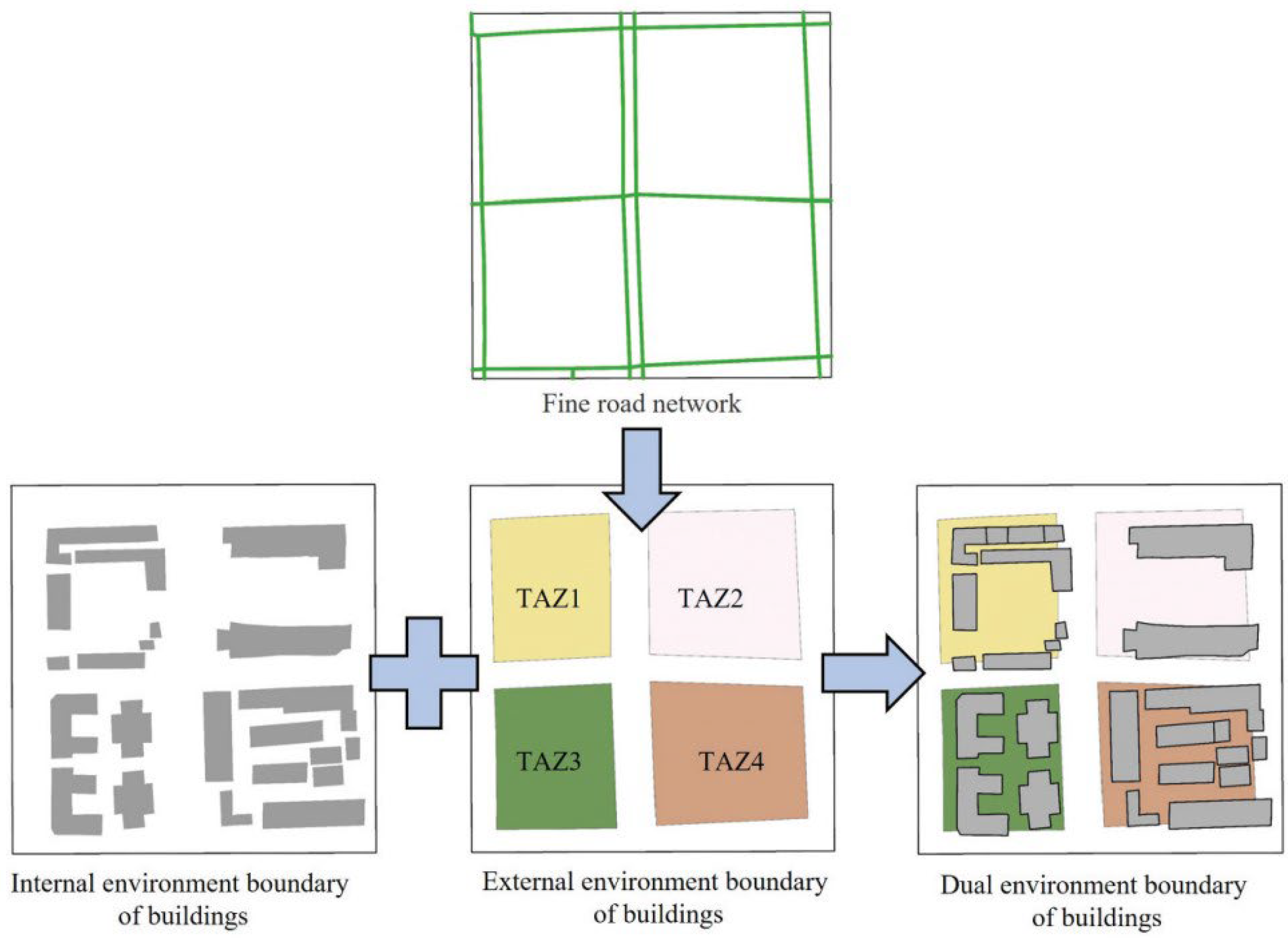
- Dual Environment of Buildings: This refers to the dual environment of buildings proposed in previous research [22], encompassing both the building’s internal and external environments. The internal environmental boundary is defined by the building’s physical outline and serves as the fundamental independent unit for accommodating the population. The building’s outline can more accurately reflect the impact of internal features on population distribution. The external environmental boundary is defined by the boundary of the surrounding Traffic Analysis Zone (TAZ), aligning more closely with the proper urban construction form.
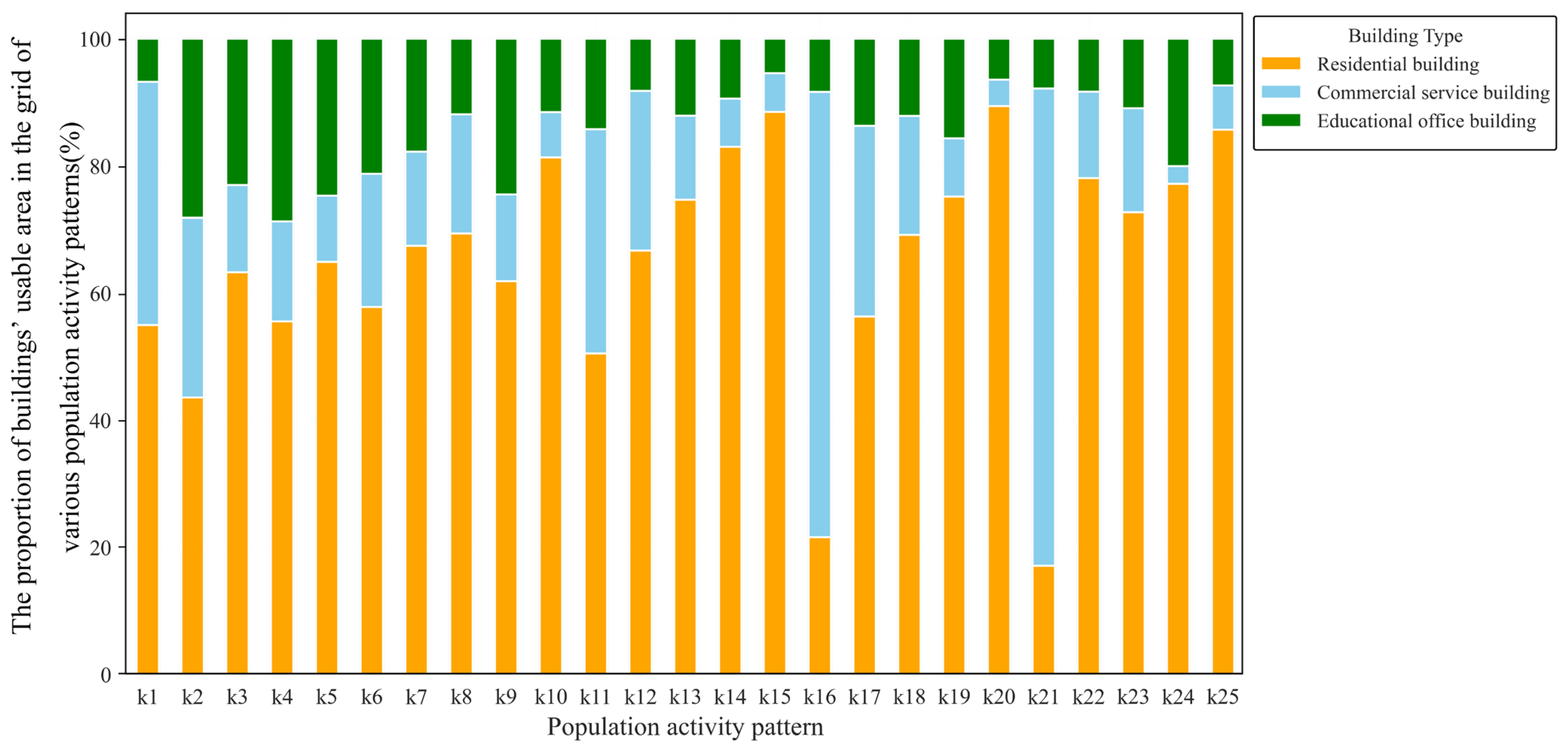
- Spatial Environment Functional Purity (SEFP): This refers to the proportion of usable area occupied by a specific type of building within a geographic analysis unit. For example, if educational office buildings occupy the largest share of usable area within a 200 m grid, the SEFP of that grid for educational office function will be highest. This study uses SEFP to extract basic population activity patterns.
2. Methods
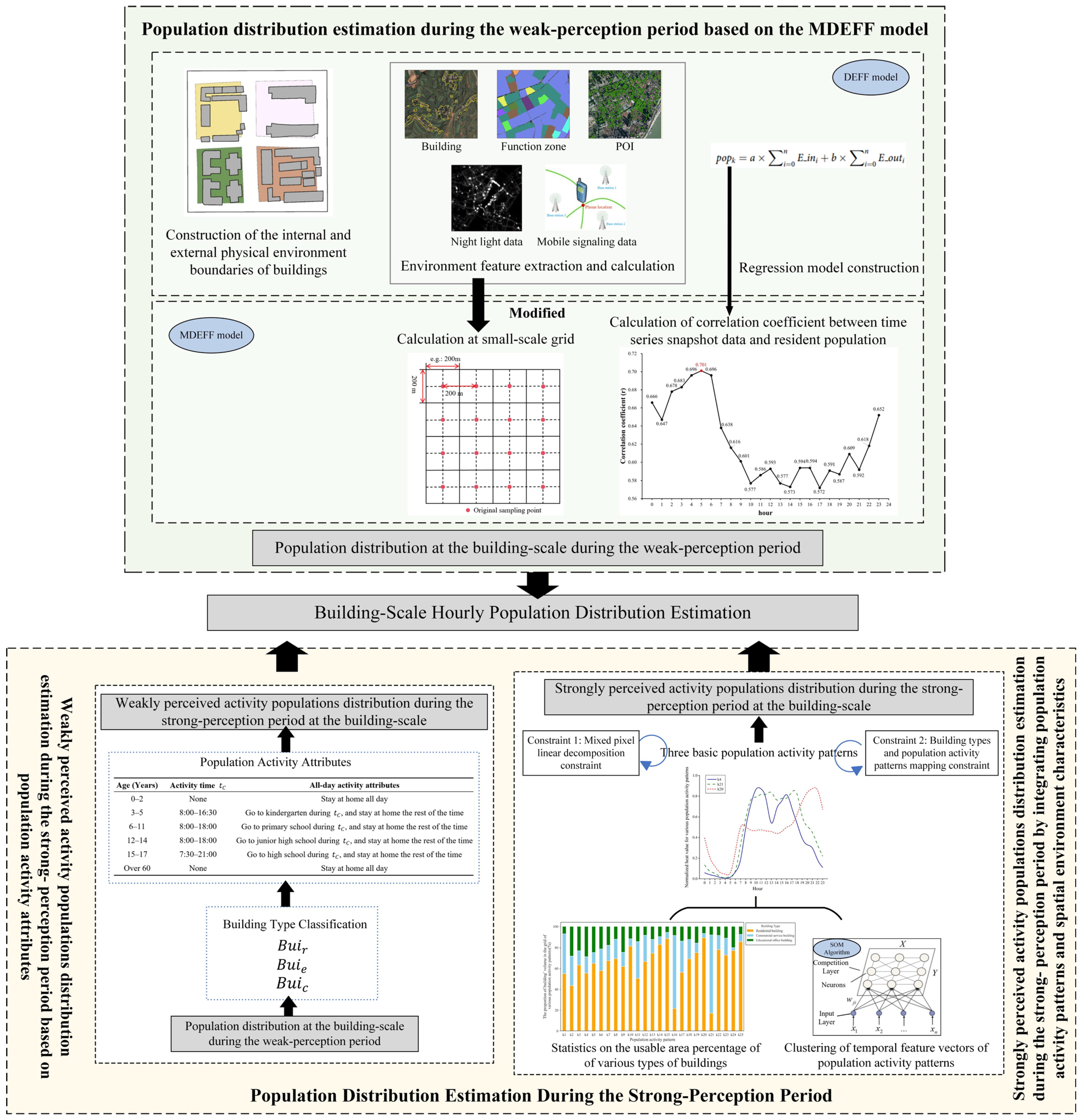
2.1. Population Distribution Estimation During the Weak-Perception Period Based on the MDEFF Model
2.2. Weakly Perceived Activity Populations Distribution Estimation During the Strong-Perception Period Based on Population Activity Attributes
2.3. Strongly Perceived Activity Populations Distribution Estimation During the Strong-Perception Period by Integrating Population Activity Patterns and Spatial Environment Characteristics
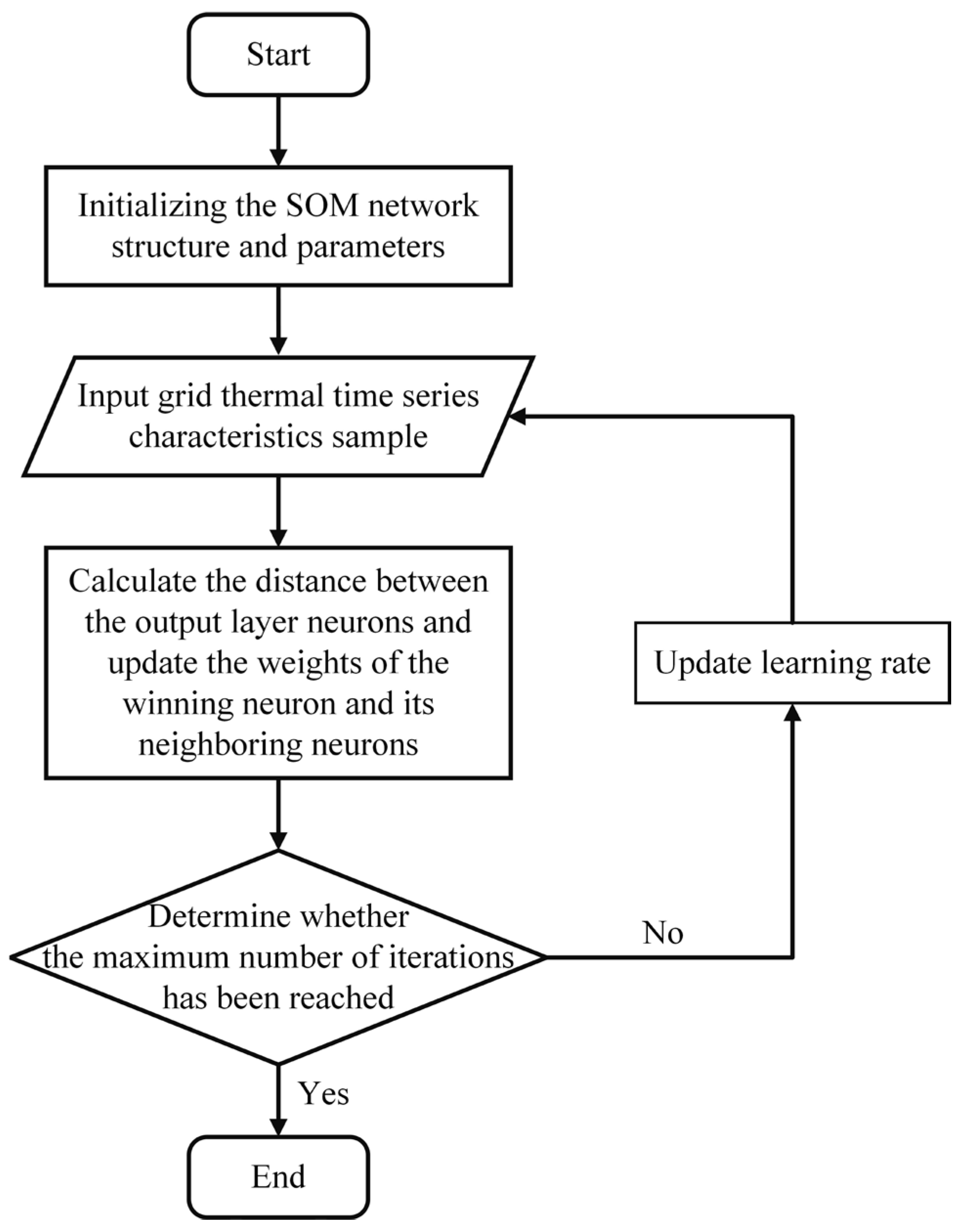
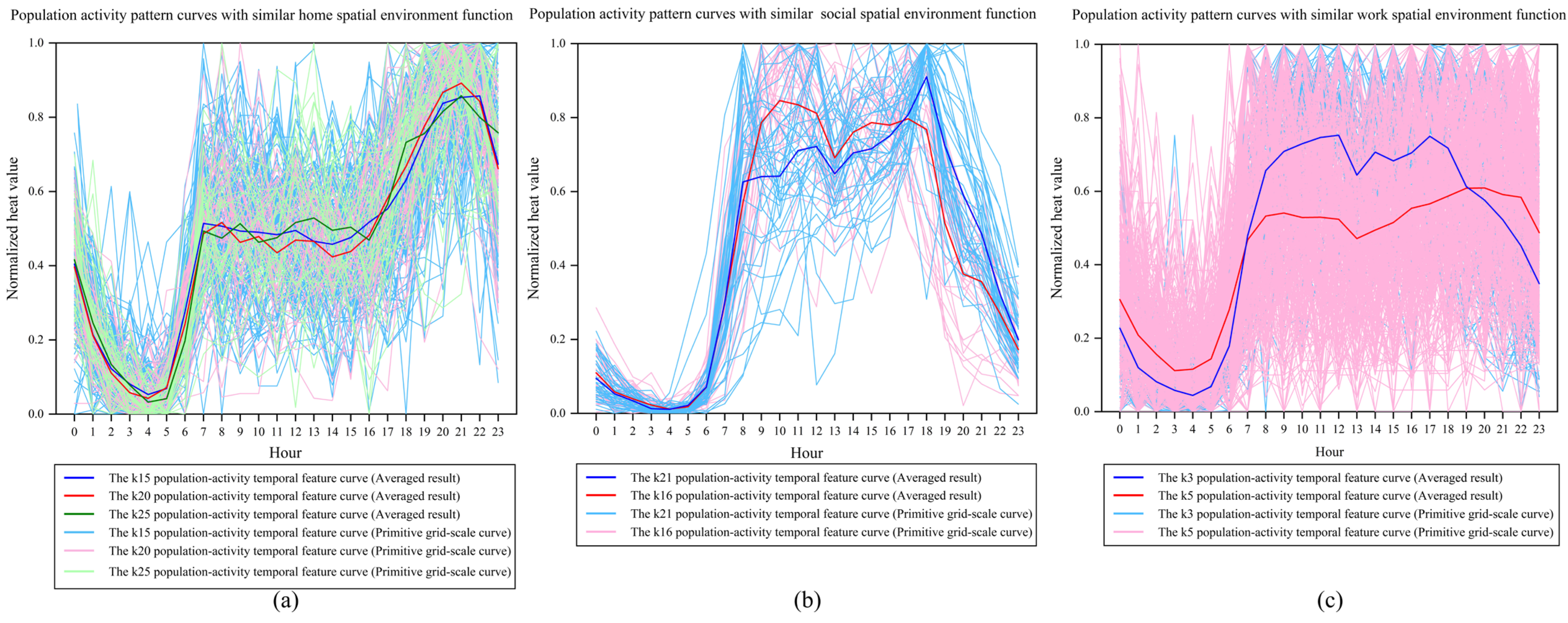
2.3.1. Population Activity Patterns Extraction Based on the SOM Algorithm and Spatial Environment Functional Purity
2.3.2. Strongly Perceived Activity Populations Distribution Estimation During the Strong-Perception Period Based on Population Activity Pattern Constraints
- (1)
- Mixed Pixel Linear Decomposition Constraint
- (2)
- Constraint of Correspondence Between Building Types and Population Activity Patterns
3. Study Area and Data Sources
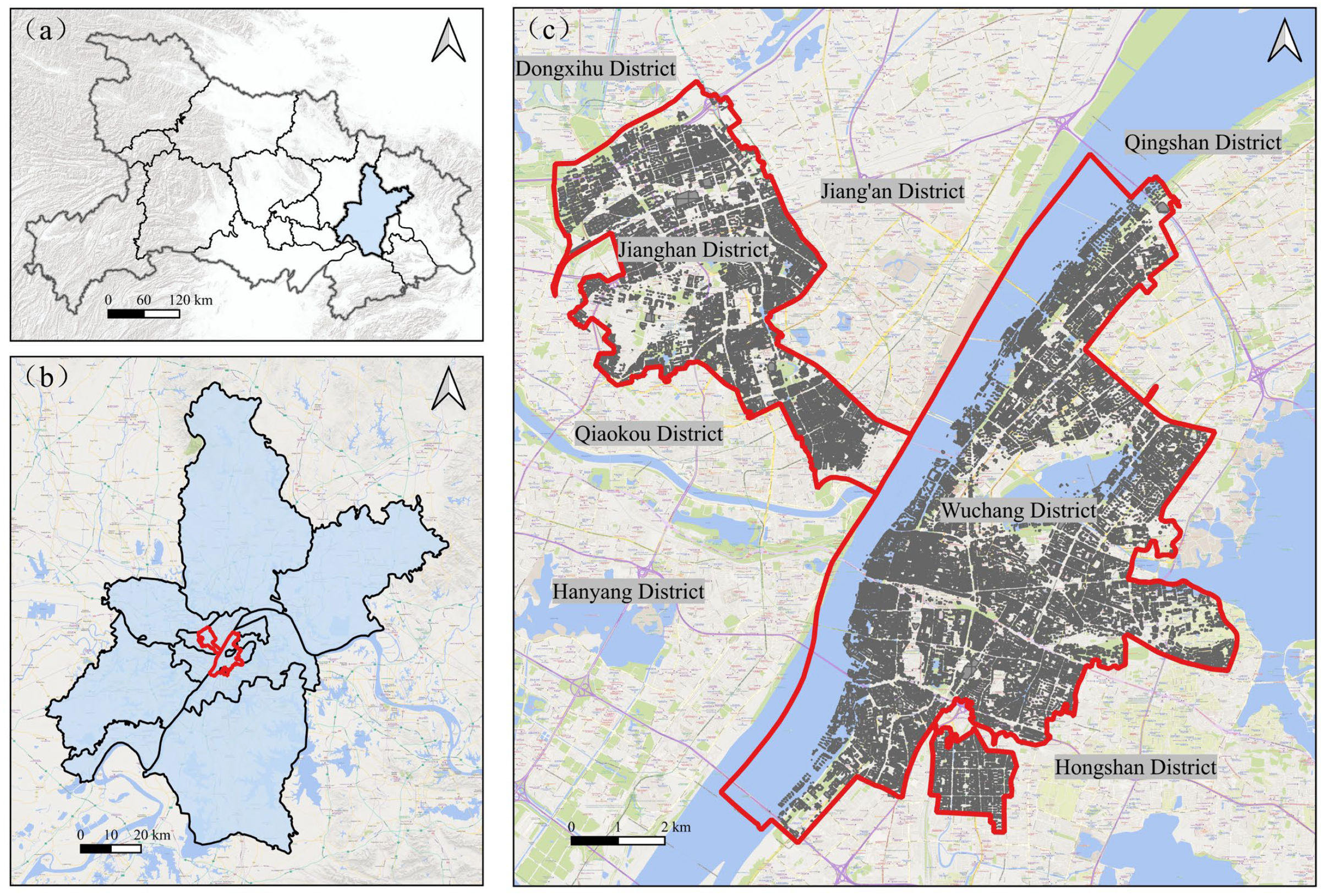
3.1. Study Area
3.2. Data Sources
3.2.1. Data Introduction
3.2.2. Temporal Coordination of Multi-Year Data
- (1)
- Census-based calibration.
- (2)
- Stability assumptions.
- (3)
- Scale-free normalization.
- (4)
- No leakage.
- (5)
- Robustness basis.
4. Experimental Results
4.1. Results of Population Activity Patterns Perception
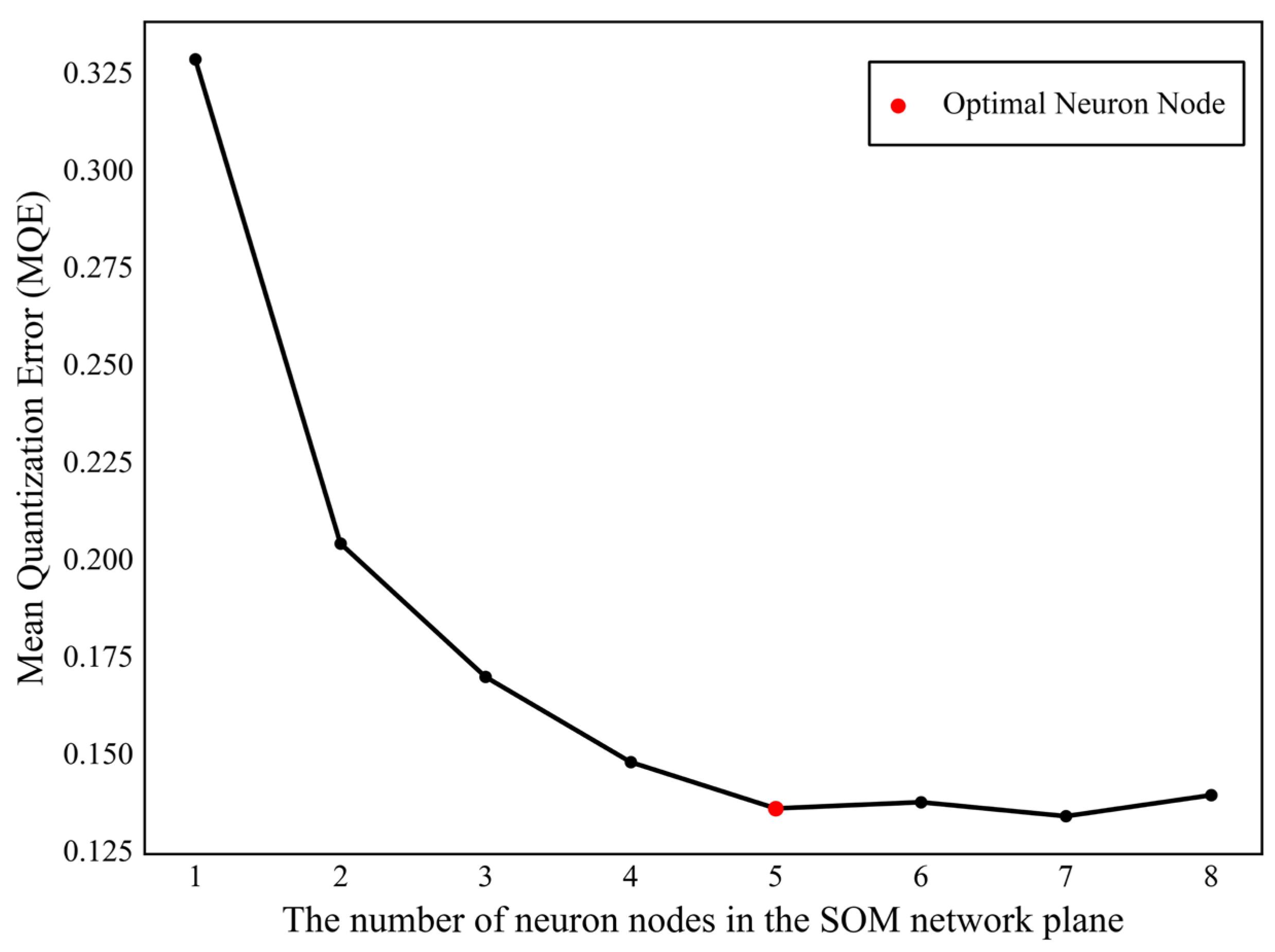
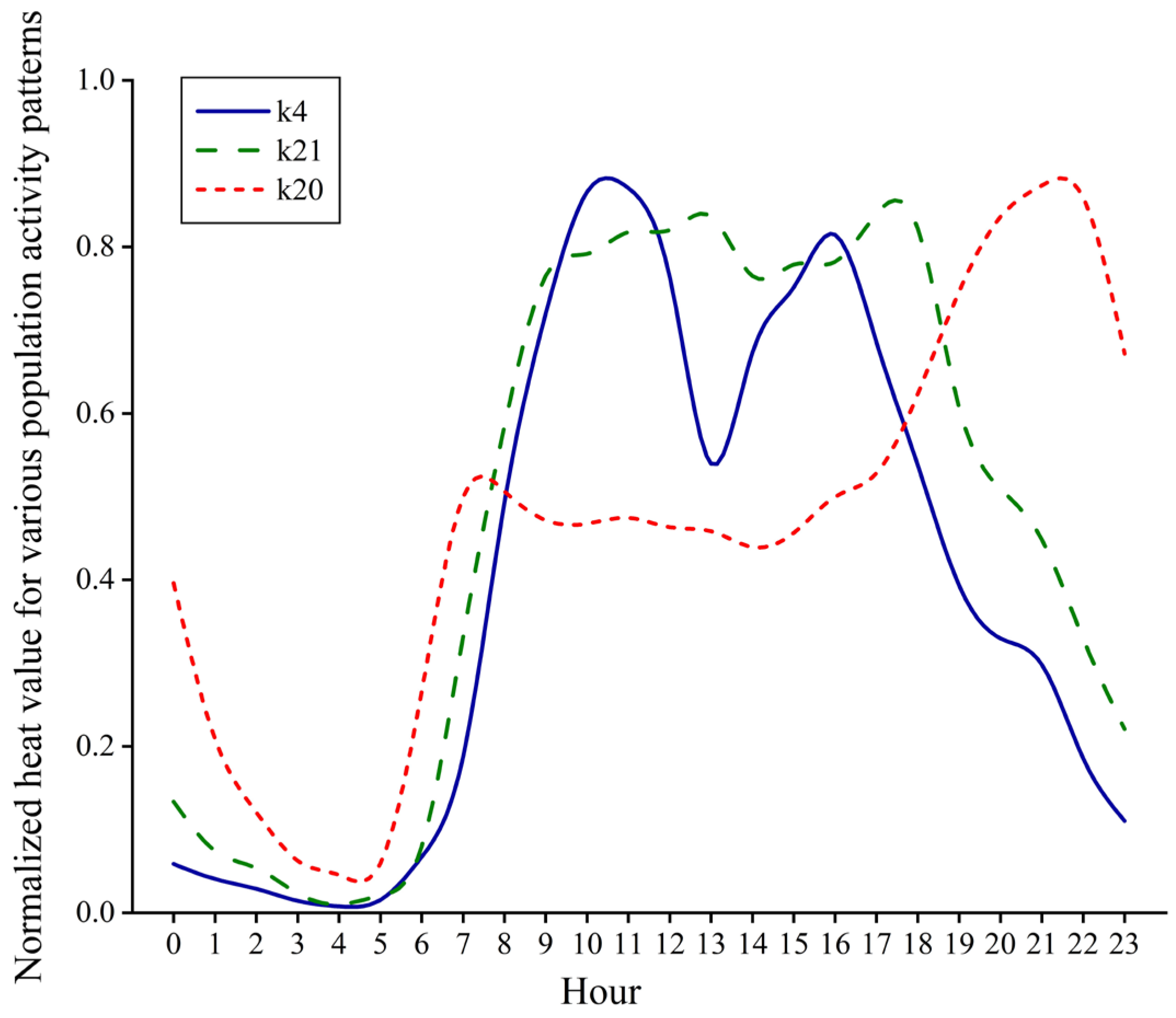
4.1.1. Results of Population Activity Patterns Extraction Based on the SOM Algorithm and Spatial Environment Functional Purity
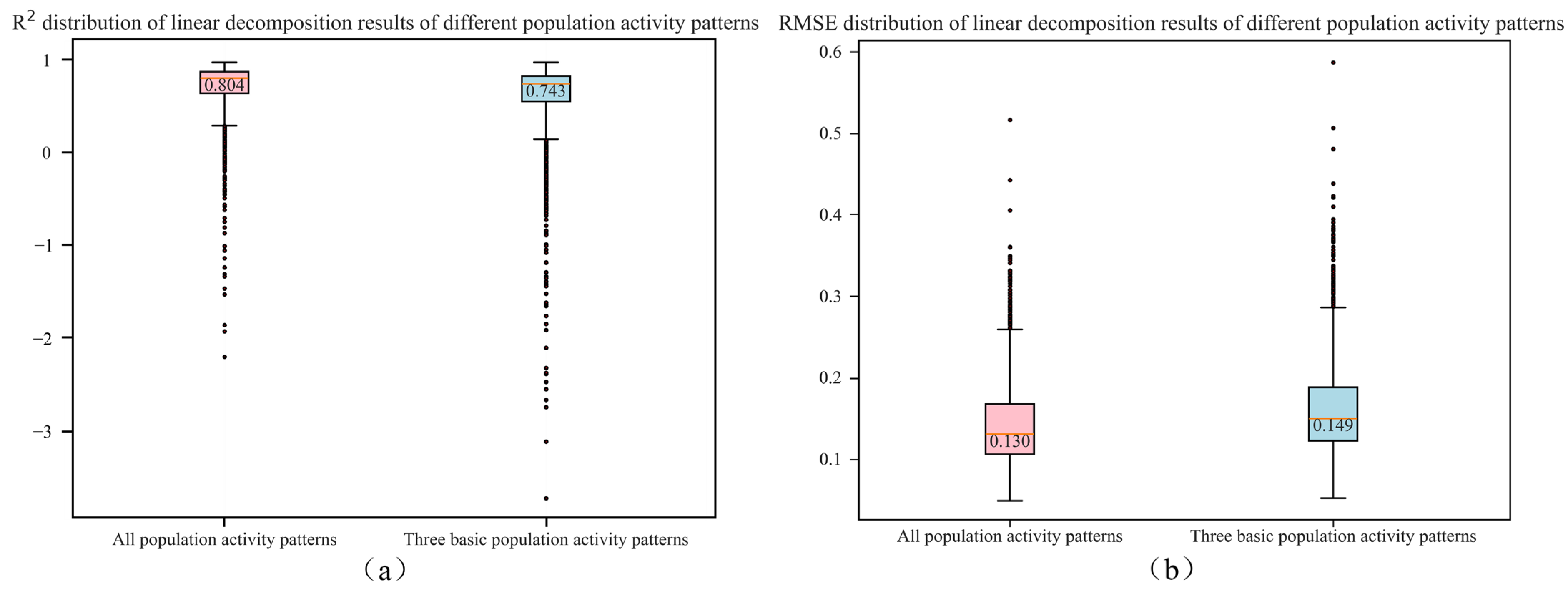
4.1.2. Validation of Population Activity Patterns Based on Mixed Decomposition Linear Model
4.2. Results of High-Spatiotemporal-Resolution Population Distribution Estimation
4.2.1. Results of Overall Population Distribution Estimation in the Study Area
4.2.2. Results of Population Distribution Estimation for Typical Regions
4.3. Validation of the Results of High-Spatiotemporal-Resolution Population Distribution Estimation
4.3.1. Validation of the Results of Population Distribution Estimation During the Weak-Perception Period
4.3.2. Validation of the Results of Population Distribution Estimation During the Strong-Perception Period
- (1)
- Comparative Validation Based on the Ablation Model
- (2)
- Comparative Validation of Area-Weighted Direct Allocation Baseline Model
- (3)
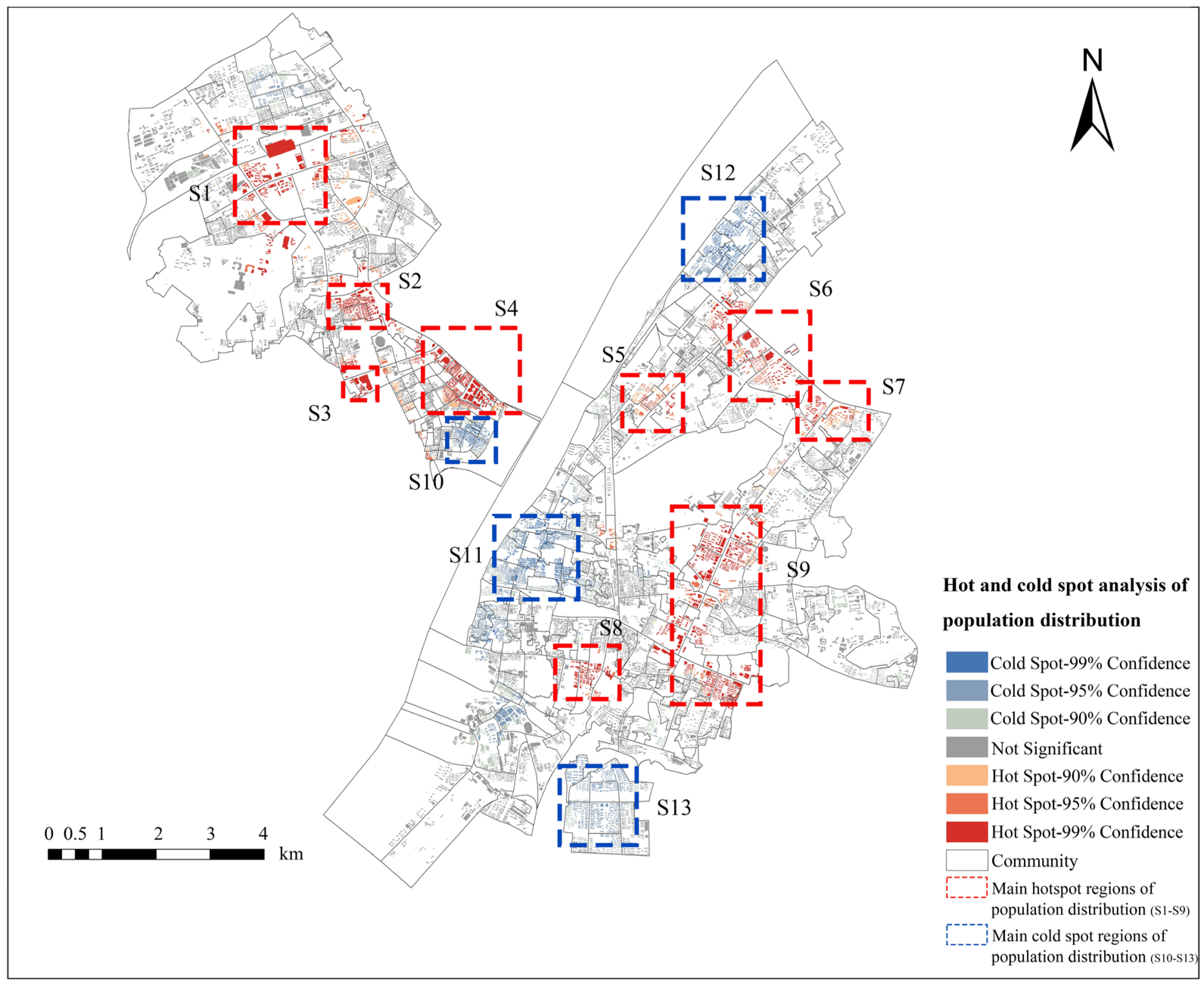
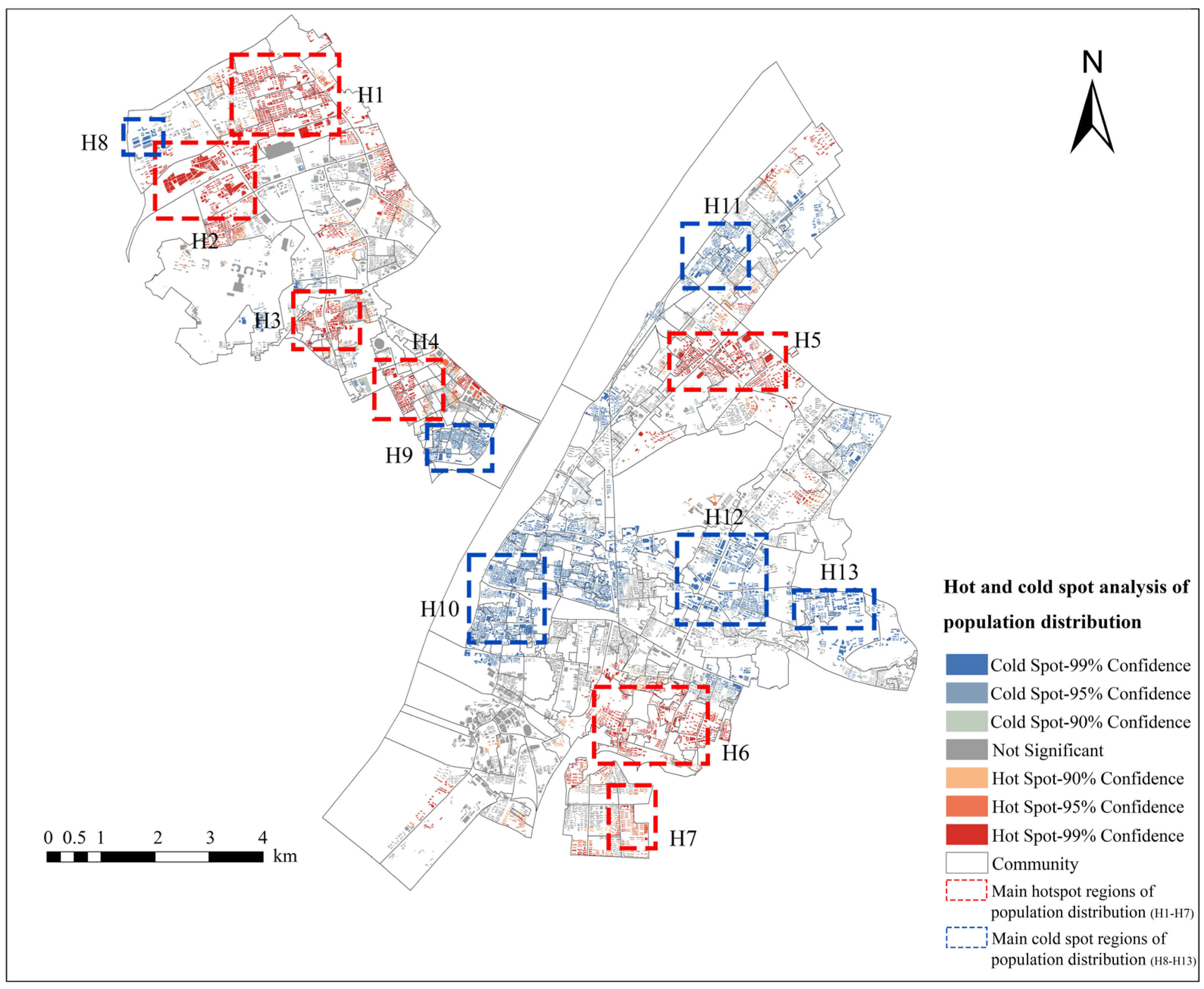
- Validation Analysis of Hot and Cold Spots of Population Distribution at Peak Periods of Various Activity Patterns.
5. Discussion
6. Conclusions
- 1.
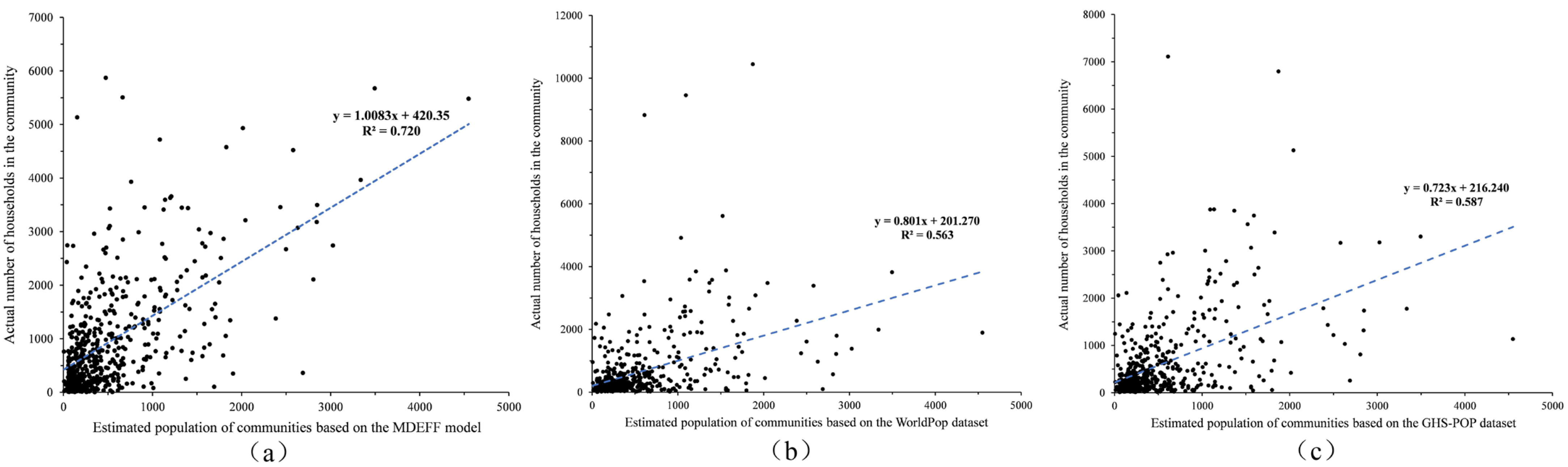
- The correlation coefficient between the estimated and actual household populations for the MDEFF model is 0.72. This is 0.157 higher than that obtained from the WorldPop dataset and 0.133 higher than that from the GHS-POP dataset, demonstrating the superior performance of the MDEFF model in estimating population distribution during the weak-perception period.
- 2.
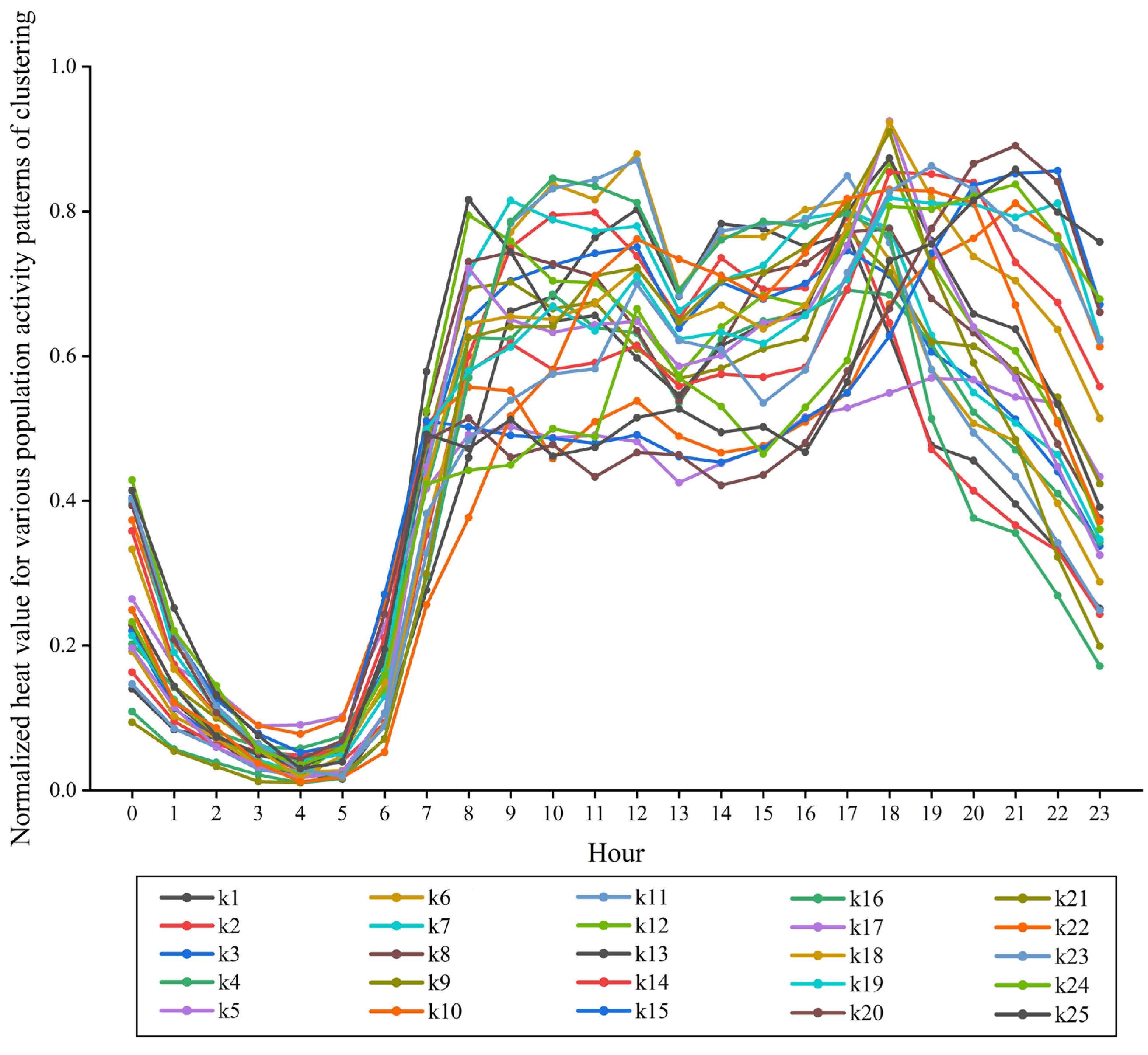
- Three basic population activity patterns were identified using population activity data and employing the SOM algorithm and spatial environment functional purity. Linear decomposition of the temporal characteristics of these patterns yielded median and values of 0.743 and 0.149, respectively. This validates the effectiveness of population activity patterns in capturing spatiotemporal characteristics and establishes a basis for high-spatiotemporal-resolution population distribution estimation.
- 3.
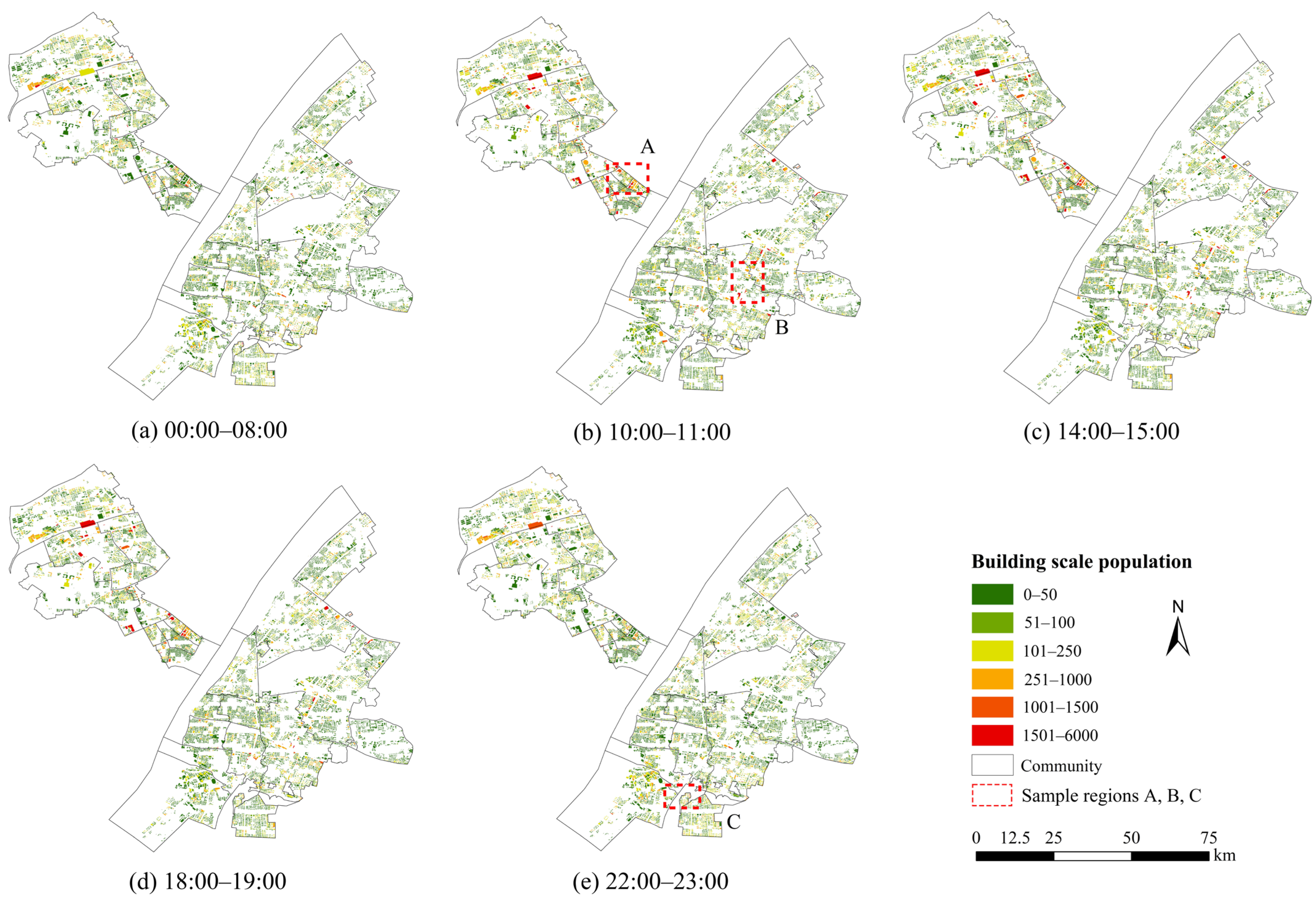
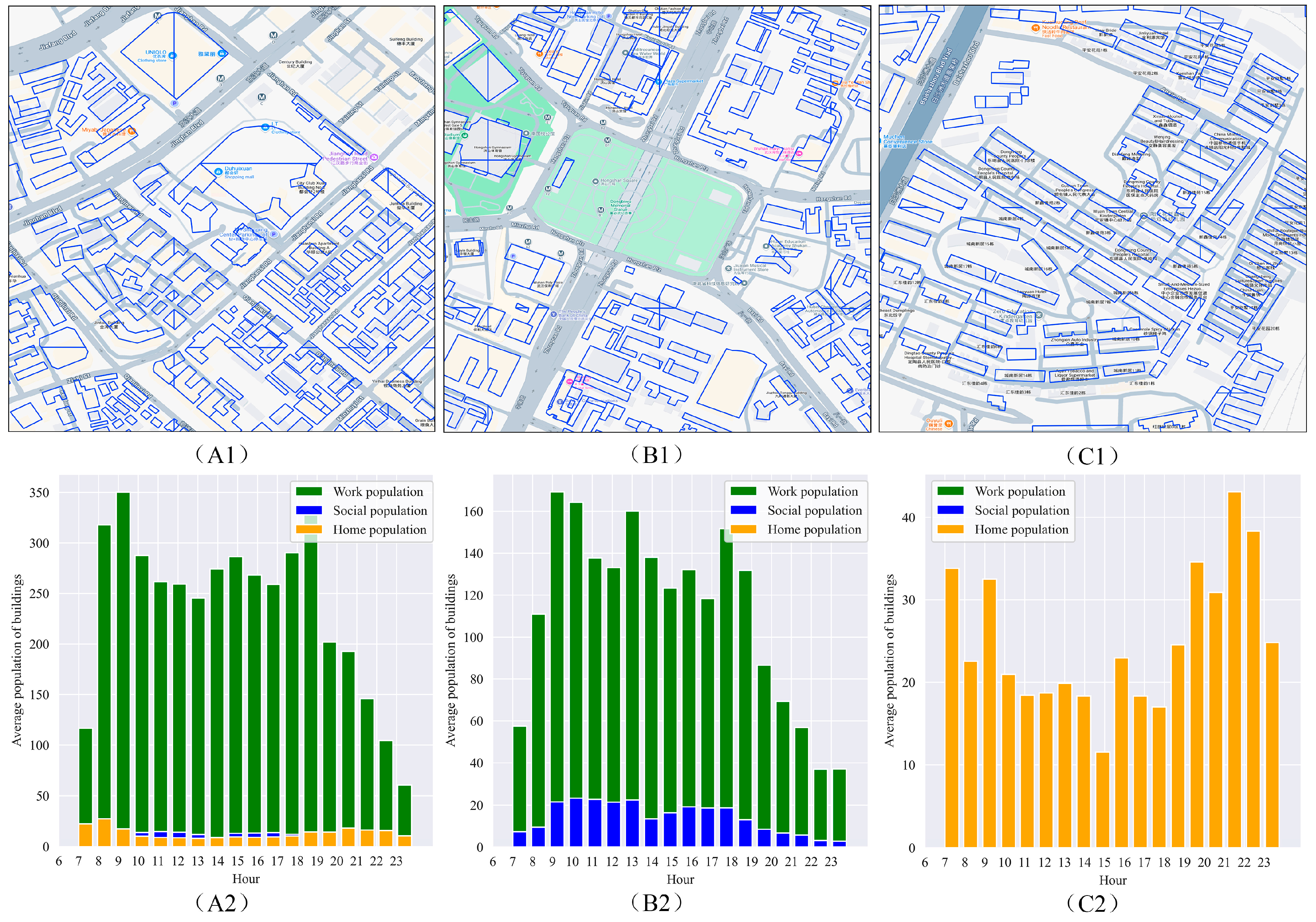
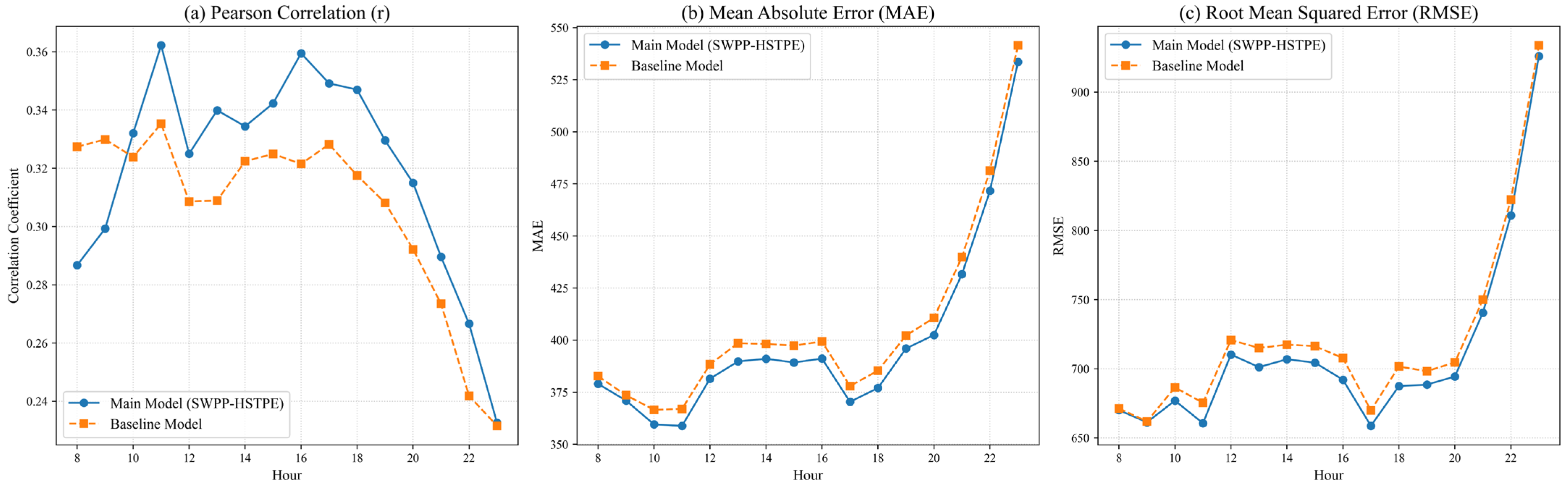
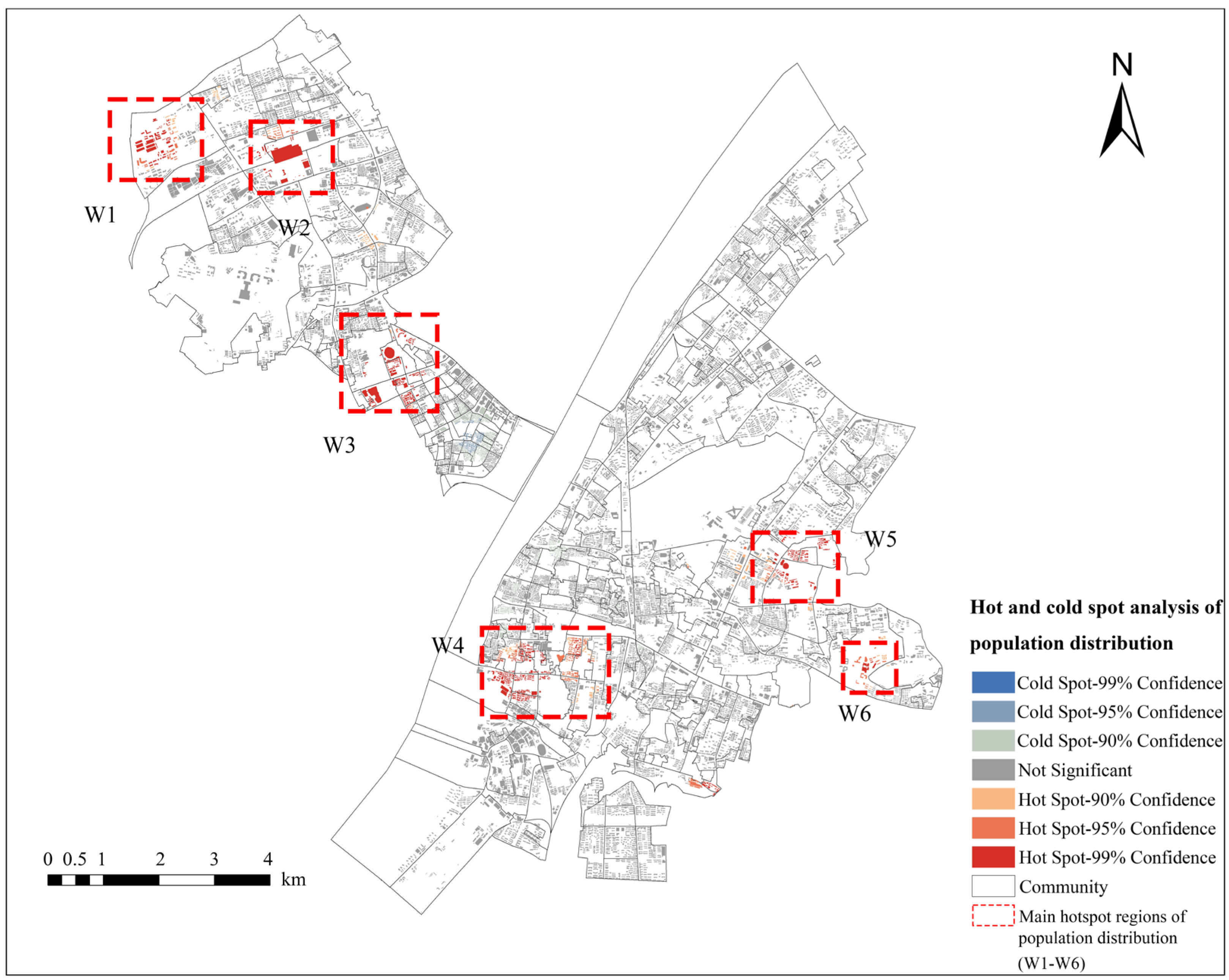
- During the strong-perception period, the SWPP-HSTPE main model outperforms the area-based baseline across all evaluation metrics—including correlation, MAE, and RMSE—demonstrating its superior ability to capture daytime dynamic population patterns. Analysis of the index based on population distribution estimates during the strong-perception period accurately reflects the spatial aggregation of population hot and cold spots during the peak periods of various activity patterns. This confirms that the SWPP-HSTPE method can provide precise, high-spatiotemporal-resolution estimates of population distribution across different activity patterns.
- The current temporal segmentation remains relatively coarse. The weak-perception period has not yet been subdivided into finer activity patterns, nor does the present framework incorporate seasonal or weekday–weekend/holiday variations. As data quality improves, future work may further refine the characterization of nighttime activities.
- The linear regression and SOM approaches employed in this study are still limited in capturing complex temporal dynamics. Subsequent research could explore more advanced and efficient models, while strengthening cross-city and cross-year generalization and improving uncertainty assessment.
- This study has not yet applied the high-spatiotemporal-resolution population distribution dataset to real urban planning scenarios. Future efforts could establish deeper integration with public service provision, transport operations, and public health management to develop transferable and reusable application frameworks.
- Due to data constraints, the method may be less applicable in rural or peripheral areas. Future research may incorporate rule-based reasoning and adaptive modeling to reduce dependence on dense data sources.
Author Contributions
Funding
Data Availability Statement
Acknowledgments
Conflicts of Interest
Abbreviations
| SWPP-HSTPE | High-Spatiotemporal-Resolution Population Distribution Estimation Based on the Strong and Weak Perception of Population Activity Patterns |
| SOM | Self-Organizing Map |
| AI | artificial intelligence |
| SEFP | Spatial Environment Functional Purity |
| DEFF | Dual-Environment Feature Fusion |
| MDEFF | Modified Dual-Environment Feature Fusion |
| DQW-TOPSIS | Data Quality-based Technique for Order of Preference by Similarity to Ideal Solution |
| POI | point of interest |
| AOI | area of interest |
| GIS | Geographic Information Systems |
| MQE | Mean Quantization Error |
References
- Zhou, C.; Sun, J.; Su, F.; Yang, X.; Pei, T.; Ge, Y.; Yang, Y.; Zhang, A.; Liao, X.; Lu, F.; et al. Geographic Information Science Development and Technological Application. Acta Geogr. Sin. 2020, 75, 2593–2609. [Google Scholar] [CrossRef]
- Xiao, Z.; Shen, Z. The temporal and spatial evolution of population & industrial agglomeration and environmental pollution and the relevance analysis. J. Arid. Land Resour. Environ. 2019, 33, 1–8. [Google Scholar] [CrossRef]
- Zhang, M.; Tan, S.; Zhang, C.; Han, S.; Zou, S.; Chen, E. Assessing the Impact of Fractional Vegetation Cover on Urban Thermal Environment: A Case Study of Hangzhou, China. Sustain. Cities Soc. 2023, 96, 104663. [Google Scholar] [CrossRef]
- Yang, J.; Zhan, Y.; Xiao, X.; Xia, J.C.; Sun, W.; Li, X. Investigating the Diversity of Land Surface Temperature Characteristics in Different Scale Cities Based on Local Climate Zones. Urban Clim. 2020, 34, 100700. [Google Scholar] [CrossRef]
- Zhang, M.; Zhang, C.; Kafy, A.-A.; Tan, S. Simulating the Relationship between Land Use/Cover Change and Urban Thermal Environment Using Machine Learning Algorithms in Wuhan City, China. Land 2021, 11, 14. [Google Scholar] [CrossRef]
- Xia, J.; Zhou, Y.; Li, Z.; Li, F.; Yue, Y.; Cheng, T.; Li, Q. COVID-19 risk assessment driven by urban spatiotemporal big data: A case study of Guangdong-Hong Kong-Macao Greater Bay Area. Cehui Xuebao/Acta Geod. Et Cartogr. Sin. 2020, 49, 671–680. [Google Scholar]
- Li, R.; Wang, J.; Wang, S.; Wu, H. Prediction of Network Public Opinion Features in Urban Planning Based on Geographical Case-Based Reasoning. Int. J. Digit. Earth 2022, 15, 890–910. [Google Scholar] [CrossRef]
- Jiang, D.; Yang, X.; Wang, N.; Liu, H. Study on spatial distribution of population based on remote sensing and GIS. Adv. Earth Sci. 2002, 17, 734. [Google Scholar]
- Wu, S.; Qiu, X.; Wang, L. Population Estimation Methods in GIS and Remote Sensing: A Review. GIScience Remote Sens. 2005, 42, 80–96. [Google Scholar] [CrossRef]
- Dobson, J.E.; Bright, E.A.; Coleman, P.R.; Durfee, R.C.; Worley, B.A. LandScan: A global population database for estimating populations at risk. Photogramm. Eng. Remote Sens. 2000, 66, 849–857. [Google Scholar] [CrossRef]
- Martin, D.; Cockings, S.; Leung, S. Developing a Flexible Framework for Spatiotemporal Population Modeling. Ann. Assoc. Am. Geogr. 2015, 105, 754–772. [Google Scholar] [CrossRef]
- Yao, Y.; Liu, X.; Li, X.; Zhang, J.; Liang, Z.; Mai, K.; Zhang, Y. Mapping Fine-Scale Population Distributions at the Building Level by Integrating Multisource Geospatial Big Data. Int. J. Geogr. Inf. Sci. 2017, 31, 1220–1244. [Google Scholar] [CrossRef]
- Zhao, X.; Zhou, Y.; Chen, W.; Li, X.; Li, X.; Li, D. Mapping Hourly Population Dynamics Using Remotely Sensed and Geospatial Data: A Case Study in Beijing, China. GIScience Remote Sens. 2021, 58, 717–732. [Google Scholar] [CrossRef]
- Shi, Q.; Zhuo, L.; Tao, H.; Li, Q. Mining Hourly Population Dynamics by Activity Type Based on Decomposition of Sequential Snapshot Data. Int. J. Digit. Earth 2022, 15, 1395–1416. [Google Scholar] [CrossRef]
- Chen, Y.; Liu, X.; Gao, W.; Wang, R.Y.; Li, Y.; Tu, W. Emerging Social Media Data on Measuring Urban Park Use. Urban For. Urban Green. 2018, 31, 130–141. [Google Scholar] [CrossRef]
- Wu, L.; Cheng, X.; Kang, C.; Zhu, D.; Huang, Z.; Liu, Y. A Framework for Mixed-Use Decomposition Based on Temporal Activity Signatures Extracted from Big Geo-Data. Int. J. Digit. Earth 2020, 13, 708–726. [Google Scholar] [CrossRef]
- Liu, Z.; Ma, T.; Du, Y.; Pei, T.; Yi, J.; Peng, H. Mapping Hourly Dynamics of Urban Population Using Trajectories Reconstructed from Mobile Phone Records. Trans. GIS 2018, 22, 494–513. [Google Scholar] [CrossRef]
- Khodabandelou, G.; Gauthier, V.; Fiore, M.; El-Yacoubi, M.A. Estimation of Static and Dynamic Urban Populations with Mobile Network Metadata. IEEE Trans. Mob. Comput 2019, 18, 2034–2047. [Google Scholar] [CrossRef]
- Khodabandelou, G.; Gauthier, V.; El-Yacoubi, M.; Fiore, M. Population Estimation from Mobile Network Traffic Metadata. In Proceedings of the 2016 IEEE 17th International Symposium on a World of Wireless, Mobile and Multimedia Networks (WoWMoM), Coimbra, Portugal, 21–24 June 2016; IEEE: Coimbra, Portugal, 2016; pp. 1–9. [Google Scholar] [CrossRef]
- Zong, Z.; Feng, J.; Liu, K.; Shi, H.; Li, Y. DeepDPM: Dynamic Population Mapping via Deep Neural Network. AAAI 2019, 33, 1294–1301. [Google Scholar] [CrossRef]
- Chen, J.; Pei, T.; Shaw, S.-L.; Lu, F.; Li, M.; Cheng, S.; Liu, X.; Zhang, H. Fine-Grained Prediction of Urban Population Using Mobile Phone Location Data. Int. J. Geogr. Inf. Sci. 2018, 32, 1770–1786. [Google Scholar] [CrossRef]
- Liu, G.; Li, R.; Xia, J.; Liu, Z.; Cai, J.; Wu, H.; Peng, M. Dual-Environment Feature Fusion-Based Method for Estimating Building-Scale Population Distributions. Geo-Spat. Inf. Sci. 2024, 27, 1943–1958. [Google Scholar] [CrossRef]
- Qi, W.; Li, Y.; Liu, S.; Gao, X.; Zhao, M. Estimation of Urban Population at Daytime and Nighttime and Analyses of Their Spatial pattern: A Case Study of Haidian District, Beijing. Acta Geogr. Sin. 2013, 68, 1344–1356. [Google Scholar] [CrossRef]
- Ma, Y.; Xu, W.; Zhao, X.; Li, Y. Modeling the Hourly Distribution of Population at a High Spatiotemporal Resolution Using Subway Smart Card Data: A Case Study in the Central Area of Beijing. IJGI 2017, 6, 128. [Google Scholar] [CrossRef]
- Feng, J.; Li, Y.; Xu, F.; Jin, D. A Bimodal Model to Estimate Dynamic Metropolitan Population by Mobile Phone Data. Sensors 2018, 18, 3431. [Google Scholar] [CrossRef] [PubMed]
- Liu, S.; Long, Y.; Zhang, L.; Liu, H. Semantic Enhancement of Human Urban Activity Chain Construction Using Mobile Phone Signaling Data. IJGI 2021, 10, 545. [Google Scholar] [CrossRef]
- Fan, Y.-D.; Shi, P.-J.; Gu, Z.-H.; Li, X.-B. A Method of Data Gridding from Administration Cell to Gridding Cell. Geogr. Sci. 2004, 24, 105–108. [Google Scholar]
- Bergroth, C.; Järv, O.; Tenkanen, H.; Manninen, M.; Toivonen, T. A 24-Hour Population Distribution Dataset Based on Mobile Phone Data from Helsinki Metropolitan Area, Finland. Sci. Data 2022, 9, 39. [Google Scholar] [CrossRef]
- Deville, P.; Linard, C.; Martin, S.; Gilbert, M.; Stevens, F.R.; Gaughan, A.E.; Blondel, V.D.; Tatem, A.J. Dynamic Population Mapping Using Mobile Phone Data. Proc. Natl. Acad. Sci. USA 2014, 111, 15888–15893. [Google Scholar] [CrossRef]
- Xia, J.; Li, R.; Yang, X.; Wang, J.; Zou, N. High-Resolution Population Distribution Prediction Considering the Spatiotemporal Heterogeneity of Geolocated Behavior. Int. J. Geogr. Inf. Sci. 2025, 1–33. [Google Scholar] [CrossRef]
- Calabrese, F.; Diao, M.; Di Lorenzo, G.; Ferreira, J.; Ratti, C. Understanding Individual Mobility Patterns from Urban Sensing Data: A Mobile Phone Trace Example. Transp. Res. Part C Emerg. Technol. 2013, 26, 301–313. [Google Scholar] [CrossRef]
- Huang, A.; Levinson, D. Axis of Travel: Modeling Non-Work Destination Choice with GPS Data. Transp. Res. Part C Emerg. Technol. 2015, 58, 208–223. [Google Scholar] [CrossRef]
- Cao, G.; Wang, S.; Hwang, M.; Padmanabhan, A.; Zhang, Z.; Soltani, K. A Scalable Framework for Spatiotemporal Analysis of Location-Based Social Media Data. Comput. Environ. Urban Syst. 2015, 51, 70–82. [Google Scholar] [CrossRef]
- Patel, N.N.; Stevens, F.R.; Huang, Z.; Gaughan, A.E.; Elyazar, I.; Tatem, A.J. Improving Large Area Population Mapping Using Geotweet Densities. Trans. GIS 2017, 21, 317–331. [Google Scholar] [CrossRef] [PubMed]
- Tsou, M.-H.; Zhang, H.; Nara, A.; Han, S.Y. Estimating Hourly Population Distribution Change at High Spatiotemporal Resolution in Urban Areas Using Geo-Tagged Tweets, Land Use Data, and Dasymetric Maps. arXiv 2018, arXiv:1810.06554. [Google Scholar] [CrossRef]
- Sun, L.; Axhausen, K.W. Understanding Urban Mobility Patterns with a Probabilistic Tensor Factorization Framework. Transp. Res. Part B Methodol. 2016, 91, 511–524. [Google Scholar] [CrossRef]
- Nemeškal, J.; Ouředníček, M.; Pospíšilová, L. Temporality of Urban Space: Daily Rhythms of a Typical Week Day in the Prague Metropolitan Area. J. Maps 2020, 16, 30–39. [Google Scholar] [CrossRef]
- Nitsche, P.; Widhalm, P.; Breuss, S.; Brändle, N.; Maurer, P. Supporting Large-Scale Travel Surveys with Smartphones—A Practical Approach. Transp. Res. Part C Emerg. Technol. 2014, 43, 212–221. [Google Scholar] [CrossRef]
- Kontokosta, C.E.; Johnson, N. Urban Phenology: Toward a Real-Time Census of the City Using Wi-Fi Data. Comput. Environ. Urban Syst. 2017, 64, 144–153. [Google Scholar] [CrossRef]
- Kubíček, P.; Konečný, M.; Stachoň, Z.; Shen, J.; Herman, L.; Řezník, T.; Staněk, K.; Štampach, R.; Leitgeb, Š. Population Distribution Modelling at Fine Spatio-Temporal Scale Based on Mobile Phone Data. Int. J. Digit. Earth 2019, 12, 1319–1340. [Google Scholar] [CrossRef]
- Alexander, L.; Jiang, S.; Murga, M.; González, M.C. Origin–Destination Trips by Purpose and Time of Day Inferred from Mobile Phone Data. Transp. Res. Part C Emerg. Technol. 2015, 58, 240–250. [Google Scholar] [CrossRef]
- Liu, Z.; Li, R.; Cai, J.; Hu, Q.; Wu, H. Mobility Difference Index: A Quantitative Method for Detecting Human Mobility Difference. GIScience Remote Sens. 2024, 61, 2301274. [Google Scholar] [CrossRef]
- Wang, Z.; Yue, Y.; He, B.; Nie, K.; Tu, W.; Du, Q.; Li, Q. A Bayesian Spatio-Temporal Model to Analyzing the Stability of Patterns of Population Distribution in an Urban Space Using Mobile Phone Data. Int. J. Geogr. Inf. Sci. 2021, 35, 116–134. [Google Scholar] [CrossRef]
- Liu, S. Analysis and Research on the Spatio-Temporal Pattern of Urban Crowd Activities Based on Mobile Signaling Data. Ph.D. Thesis, Nanjing Normal University, Nanjing, China, 2022. [Google Scholar] [CrossRef]
- Chen, Y.; Liu, X.; Li, X.; Liu, X.; Yao, Y.; Hu, G.; Xu, X.; Pei, F. Delineating Urban Functional Areas with Building-Level Social Media Data: A Dynamic Time Warping (DTW) Distance Based k -Medoids Method. Landsc. Urban Plan. 2017, 160, 48–60. [Google Scholar] [CrossRef]
- Cici, B.; Gjoka, M.; Markopoulou, A.; Butts, C.T. On the Decomposition of Cell Phone Activity Patterns and Their Connection with Urban Ecology. In Proceedings of the 16th ACM International Symposium on Mobile Ad Hoc Networking and Computing, Hangzhou, China, 22–25 June 2015; ACM: Hangzhou, China, 2015; pp. 317–326. [Google Scholar] [CrossRef]
- Li, D.; Wang, S.; Li, D. Spatial Data Mining; Springer: Berlin/Heidelberg, Germany, 2015. [Google Scholar] [CrossRef]
- Lin, L.; Lin, G.; Yan, X.; Chen, A.; Yang, Z. Spatialization Models of Census Data: A Review. J. Subtrop. Resour. Environ. 2010, 5, 10–16. [Google Scholar] [CrossRef]
- Dai, T.; Zhao, Y.; Liao, C. Maximum Spatial Equality of Educational Opportunity Based on the Proximity-Random System: A Case Study of Xicheng District, Beijing. Econ. Geogr. 2019, 39, 7. [Google Scholar] [CrossRef]
- Huang, J.; Zhang, R.; Hu, G. A Research of the Elderly’s Daily Life Circle Based on Spatial-Temporal Behaviors—Analysis of Place Recognition and Spatial Features. Urban Plan. Forum 2019, 3, 87–95. [Google Scholar] [CrossRef]
- Vesanto, J.; Alhoniemi, E. Clustering of the Self-Organizing Map. IEEE Trans. Neural Netw. 2000, 11, 586–600. [Google Scholar] [CrossRef]
- Li, Z. Research on Demand of Emergency Supplies for Flood Under the Cooperation of Baidu Heat Map and Multi-Layer Perceptron Neural Network. Master’s Thesis, Wuhan University of Technology, Wuhan, China, 2019. [Google Scholar] [CrossRef]
- Chen, Z.; Yu, B.; Yang, C.; Zhou, Y.; Yao, S.; Qian, X.; Wang, C.; Wu, B.; Wu, J. An Extended Time Series (2000–2018) of Global NPP-VIIRS-like Nighttime Light Data from a Cross-Sensor Calibration. Earth Syst. Sci. Data 2021, 13, 889–906. [Google Scholar] [CrossRef]
- Zheng, Q.; Seto, K.C.; Zhou, Y.; You, S.; Weng, Q. Nighttime Light Remote Sensing for Urban Applications: Progress, Challenges, and Prospects. ISPRS J. Photogramm. Remote Sens. 2023, 202, 125–141. [Google Scholar] [CrossRef]
- Yang, X.; Li, R.; Xia, J.; Wang, J.; Li, H.; Zou, N. HMS-PAU-IN: A Heterogeneous Multi-Scale Spatiotemporal Interaction Network Model for Population Analysis Units. Int. J. Appl. Earth Obs. Geoinf. 2025, 140, 104565. [Google Scholar] [CrossRef]
- Liu, X.; Li, R.; Cai, J.; Li, B.; Li, Y. Quantifying Urban Function Accessibility and Its Effect on Population Mobility Based on Function-Associated Population Mobility Network. Int. J. Appl. Earth Obs. Geoinf. 2024, 135, 104273. [Google Scholar] [CrossRef]
- Li, H.; Li, R.; Cai, J.; Wang, S. The Spatial Equilibrium Model of Elderly Care Facilities with High Spatiotemporal Sensitivity and Its Economic Associations Study. ISPRS Int. J. Geo-Inf. 2024, 13, 268. [Google Scholar] [CrossRef]
- Cai, J.; Li, R.; Liu, Z.; Liu, X.; Wu, H. Quantifying Spatial Interaction Centrality in Urban Population Mobility: A Mobility Feature- and Network Topology-Based Locational Measure. Sustain. Cities Soc. 2024, 114, 105769. [Google Scholar] [CrossRef]








| Age (Years) | Type Alias C | (%) |
|---|---|---|
| 0–2 | C0 | 1.85 |
| 3–5 | C1 | 2.77 |
| 6–11 | C2 | 5.04 |
| 12–14 | C3 | 1.84 |
| 15–17 | C4 | 1.54 |
| 18–59 | C5 | 69.72 |
| Over 60 | C6 | 17.23 |
| Type Alias C | All-Day Activity Attributes | |
|---|---|---|
| C0 | None | Stay at home all day |
| C1 | 8:00–16:30 | , and stay at home the rest of the time |
| C2 | 8:00–18:00 | , and stay at home the rest of the time |
| C3 | 8:00–18:00 | , and stay at home the rest of the time |
| C4 | 7:30–21:00 | , and stay at home the rest of the time |
| C6 | None | Stay at home all day |
| Building Type | Population Activity Pattern | Population |
|---|---|---|
| Residential building ( | Home activity ( | Population engaged in home activities () |
| Educational office building ( | Work activity ( | Population engaged in work activities () |
| Commercial service building ( | Social activity ( | Population engaged in social activities () |
| Land-Use Type | |
|---|---|
| Transportation service station land | [1, 1, 1, 1, 1, 1, 1, 1, 1, 1, 1, 1, 1, 1, 1, 1, 1, 1, 1, 1, 1, 1, 1, 1] |
| Parks and green spaces | [1, 1, 1, 1, 1, 1, 1, 1, 1, 1, 1, 1, 1, 1, 1, 1, 1, 1, 1, 1, 1, 1, 1, 1] |
| Square land | [1, 1, 1, 1, 1, 1, 1, 1, 1, 1, 1, 1, 1, 1, 1, 1, 1, 1, 1, 1, 1, 1, 1, 1] |
| Public utility land | [1, 1, 1, 1, 1, 1, 1, 1, 1, 1, 1, 1, 1, 1, 1, 1, 1, 1, 1, 1, 1, 1, 1, 1] |
| Logistics and warehousing land | [1, 1, 1, 1, 1, 1, 1, 1, 1, 1, 1, 1, 1, 1, 1, 1, 1, 1, 1, 1, 1, 1, 1, 1] |
| Port terminal land | [1, 1, 1, 1, 1, 1, 1, 1, 1, 1, 1, 1, 1, 1, 1, 1, 1, 1, 1, 1, 1, 1, 1, 1] |
| Rail transit land | [1, 1, 1, 1, 1, 1, 1, 1, 1, 1, 1, 1, 1, 1, 1, 1, 1, 1, 1, 1, 1, 1, 1, 1] |
| Urban and rural road land | [1, 1, 1, 1, 1, 1, 1, 1, 1, 1, 1, 1, 1, 1, 1, 1, 1, 1, 1, 1, 1, 1, 1, 1] |
| Urban residential land | [1, 1, 1, 1, 1, 1, 1, 1, 1, 1, 1, 1, 1, 1, 1, 1, 1, 1, 1, 1, 1, 1, 1, 1] |
| Land for science, education, culture, and health | [0, 0, 0, 0, 0, 0, 0, 0, 1, 1, 1, 1, 1, 1, 1, 1, 1, 1, 0, 0, 0, 0, 0, 0] |
| Industrial land | [0, 0, 0, 0, 0, 0, 0, 0, 1, 1, 1, 1, 1, 1, 1, 1, 1, 1, 0, 0, 0, 0, 0, 0] |
| Land for press and publication | [0, 0, 0, 0, 0, 0, 0, 0, 1, 1, 1, 1, 1, 1, 1, 1, 1, 1, 0, 0, 0, 0, 0, 0] |
| Commercial service facilities land | [0, 0, 0, 0, 0, 0, 0, 0, 0, 0, 1, 1, 1, 1, 1, 1, 1, 1, 1, 1, 1, 1, 0, 0] |
| Data Type | Data Name | Data Source | Year |
|---|---|---|---|
| Foundational geographic data | Population data | Government Statistics | 2020 |
| Building data | Government Statistics | 2021 | |
| Land-use data | Government Statistics | 2020 | |
| Road network | Government Statistics | 2018 | |
| Social perception data | Baidu heatmap | Huiyan of Baidu Maps | 2023 |
| Night light data of Luojia-01 | Hubei Data and Application Center of High Resolution Earth Observation System | 2018 | |
| Point of interest | Amap | 2022 | |
| Area of interest | Amap | 2023 | |
| Validation data | WorldPop | https://hub.worldpop.org/ | 2020 |
| GHS-POP | https://ghsl.jrc.ec.europa.eu/ | 2015 | |
| LandScan | https://landscan.ornl.gov/ | 2022 | |
| Anjuke’s community data | https://m.anjuke.com/bj/ | 2024 | |
| Baidu’s population data | Huiyan of Baidu Maps | 2023 | |
| Employed population data | Government Statistics | 2020 |
| Time (t) | |||
|---|---|---|---|
| 0–7 | 92.27% | 0.46% | 7.27% |
| 8 | 73.95% | 8.65% | 17.40% |
| 9 | 58.64% | 17.55% | 23.81% |
| 10 | 34.26% | 25.84% | 39.91% |
| 11 | 32.66% | 27.82% | 39.52% |
| 12 | 33.21% | 24.64% | 42.15% |
| 13 | 34.15% | 22.88% | 42.98% |
| 14 | 33.67% | 25.15% | 41.18% |
| 15 | 32.01% | 27.28% | 40.71% |
| 16 | 31.77% | 28.36% | 39.87% |
| 17 | 32.96% | 28.19% | 38.85% |
| 18 | 34.02% | 26.49% | 39.49% |
| 19 | 44.69% | 12.20% | 43.11% |
| 20 | 55.18% | 11.24% | 33.58% |
| 21 | 67.61% | 0.94% | 31.45% |
| 22 | 71.35% | 0.75% | 27.90% |
| 23 | 87.41% | 0.51% | 12.08% |
| Years the Community was Built (Years) | MDEFF | WorldPop | GHS-POP |
|---|---|---|---|
| (2014, 2024] | 0.720 | 0.563 | 0.587 |
| (2004, 2014] | 0.759 | 0.613 | 0.624 |
| Before 2004 | 0.807 | 0.606 | 0.600 |
| Population with Different Activity Patterns | SWPP-HSTPE | Ablation Model |
|---|---|---|
| 0.862 | 0.743 | |
| 0.624 | 0.590 | |
| 0.571 | 0.552 |
| Hour | Pearson | Mean Absolute Error (MAE) | Root Mean Square Error (RMSE) | |||
|---|---|---|---|---|---|---|
| Baseline | SWPP-HSTPE | Baseline | SWPP-HSTPE | Baseline | SWPP-HSTPE | |
| 8 | 0.3274 | 0.2867 | 382.7017 | 379.0218 | 671.2818 | 670.0618 |
| 9 | 0.3299 | 0.2993 | 373.5400 | 370.9798 | 661.8940 | 661.3043 |
| 10 | 0.3239 | 0.3320 | 366.5802 | 359.5478 | 686.4726 | 676.9503 |
| 11 | 0.3353 | 0.3622 | 366.9983 | 358.8352 | 675.4161 | 660.6282 |
| 12 | 0.3086 | 0.3250 | 388.3766 | 381.4980 | 720.7615 | 710.2570 |
| 13 | 0.3089 | 0.3399 | 398.5180 | 389.7664 | 715.0393 | 701.1763 |
| 14 | 0.3224 | 0.3344 | 398.1758 | 391.0668 | 717.3915 | 706.8538 |
| 15 | 0.3249 | 0.3423 | 397.3794 | 389.2459 | 716.3840 | 704.3898 |
| 16 | 0.3215 | 0.3595 | 399.3398 | 391.1488 | 707.6874 | 692.0621 |
| 17 | 0.3282 | 0.3492 | 377.9474 | 370.3824 | 669.8795 | 658.6959 |
| 18 | 0.3176 | 0.3470 | 385.3712 | 377.0137 | 701.6371 | 687.4497 |
| 19 | 0.3082 | 0.3296 | 402.1709 | 395.9690 | 698.2332 | 688.5163 |
| 20 | 0.2922 | 0.3150 | 410.6992 | 402.4604 | 704.6128 | 694.4084 |
| 21 | 0.2735 | 0.2896 | 439.9255 | 431.7153 | 749.9794 | 740.5431 |
| 22 | 0.2419 | 0.2666 | 481.3857 | 471.6276 | 822.2811 | 810.9434 |
| 23 | 0.2316 | 0.2326 | 541.5071 | 533.5981 | 933.8147 | 926.0437 |
Disclaimer/Publisher’s Note: The statements, opinions and data contained in all publications are solely those of the individual author(s) and contributor(s) and not of MDPI and/or the editor(s). MDPI and/or the editor(s) disclaim responsibility for any injury to people or property resulting from any ideas, methods, instructions or products referred to in the content. |
© 2026 by the authors. Published by MDPI on behalf of the International Society for Photogrammetry and Remote Sensing. Licensee MDPI, Basel, Switzerland. This article is an open access article distributed under the terms and conditions of the Creative Commons Attribution (CC BY) license.
Share and Cite
Li, R.; Liu, G.; Li, H.; Xia, J. High-Spatiotemporal-Resolution Population Distribution Estimation Based on the Strong and Weak Perception of Population Activity Patterns. ISPRS Int. J. Geo-Inf. 2026, 15, 34. https://doi.org/10.3390/ijgi15010034
Li R, Liu G, Li H, Xia J. High-Spatiotemporal-Resolution Population Distribution Estimation Based on the Strong and Weak Perception of Population Activity Patterns. ISPRS International Journal of Geo-Information. 2026; 15(1):34. https://doi.org/10.3390/ijgi15010034
Chicago/Turabian StyleLi, Rui, Guangyu Liu, Hongyan Li, and Jing Xia. 2026. "High-Spatiotemporal-Resolution Population Distribution Estimation Based on the Strong and Weak Perception of Population Activity Patterns" ISPRS International Journal of Geo-Information 15, no. 1: 34. https://doi.org/10.3390/ijgi15010034
APA StyleLi, R., Liu, G., Li, H., & Xia, J. (2026). High-Spatiotemporal-Resolution Population Distribution Estimation Based on the Strong and Weak Perception of Population Activity Patterns. ISPRS International Journal of Geo-Information, 15(1), 34. https://doi.org/10.3390/ijgi15010034