Analysis of 14 Years of X-Ray Emission from SN 2011DH



Abstract
1. Introduction
2. Observations
2.1. Chandra
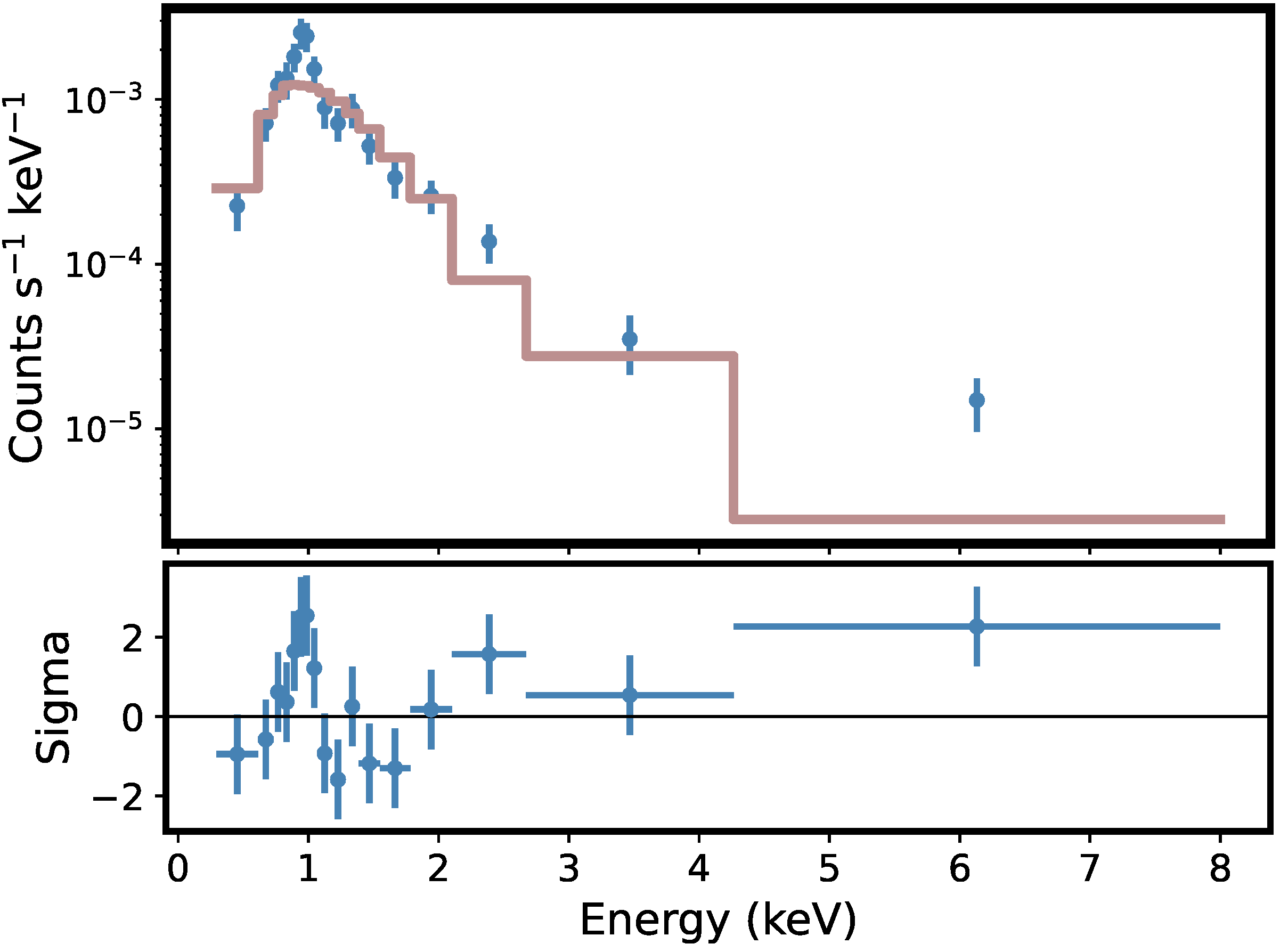
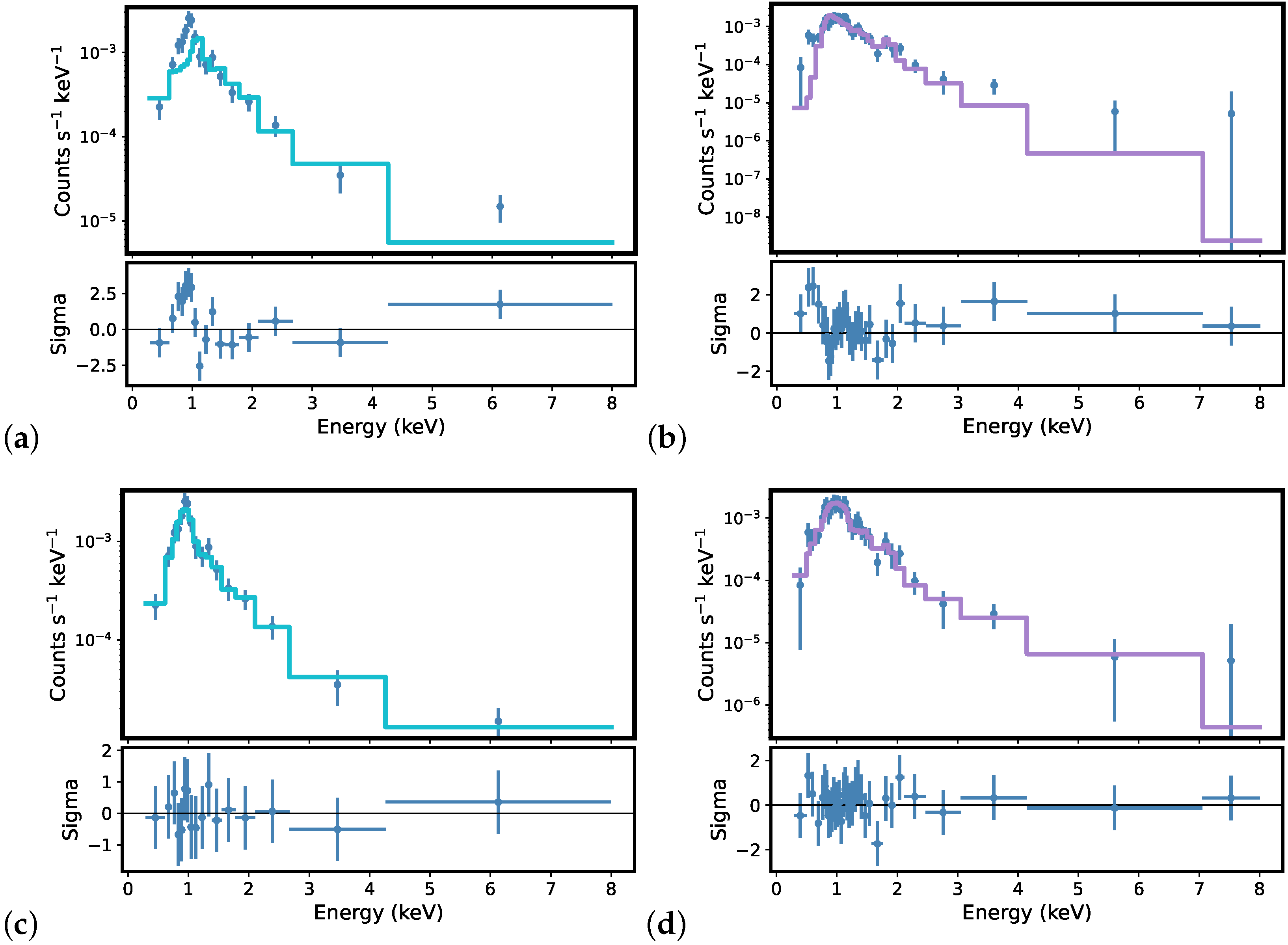
Fitting
2.2. XMM-Newton
2.3. Swift
3. Results
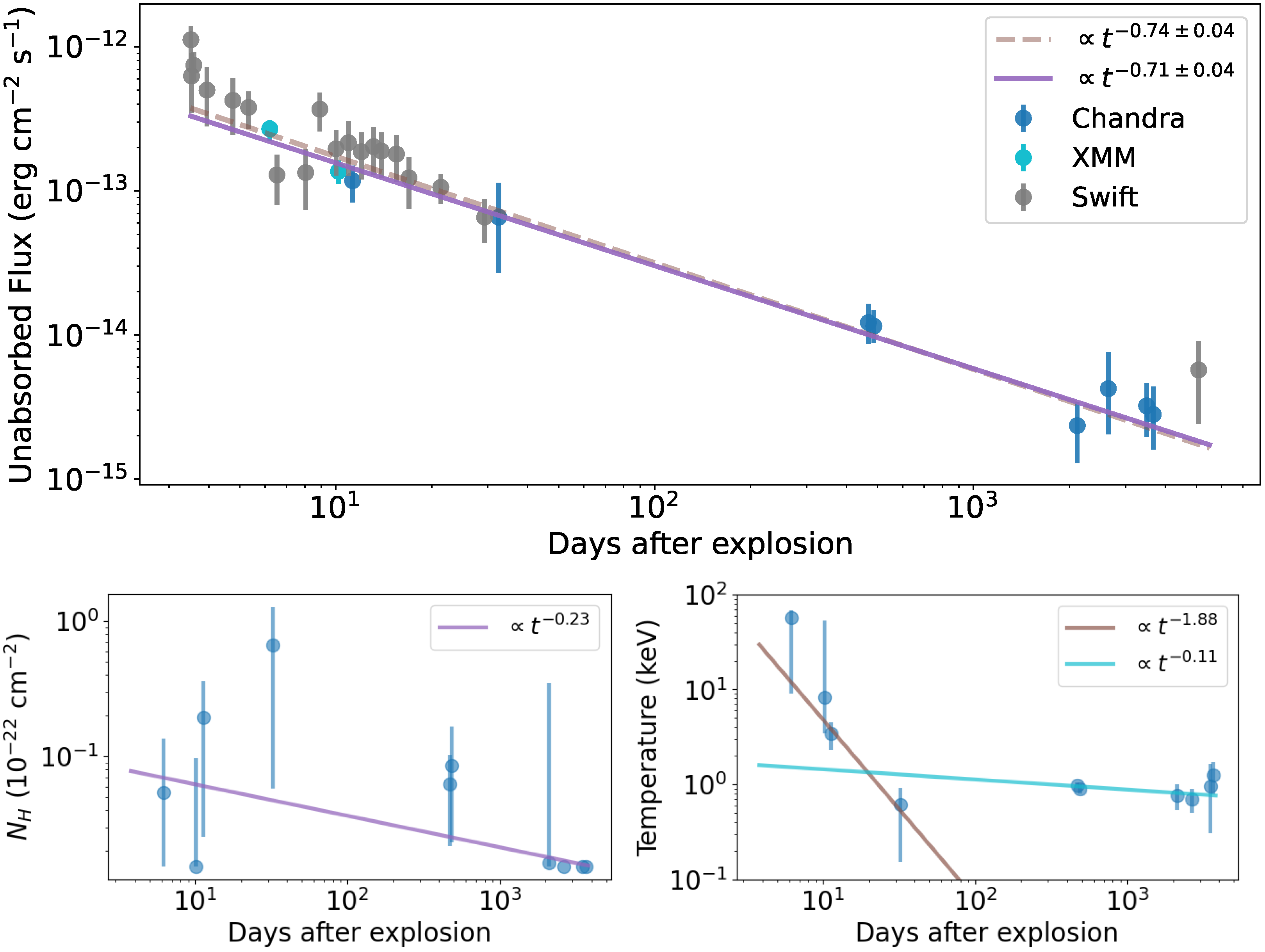
3.1. Time Evolution of Unabsorbed Flux, Temperature and Column Density
3.2. Determination of the CSM Density
3.3. Mass-Loss Rate
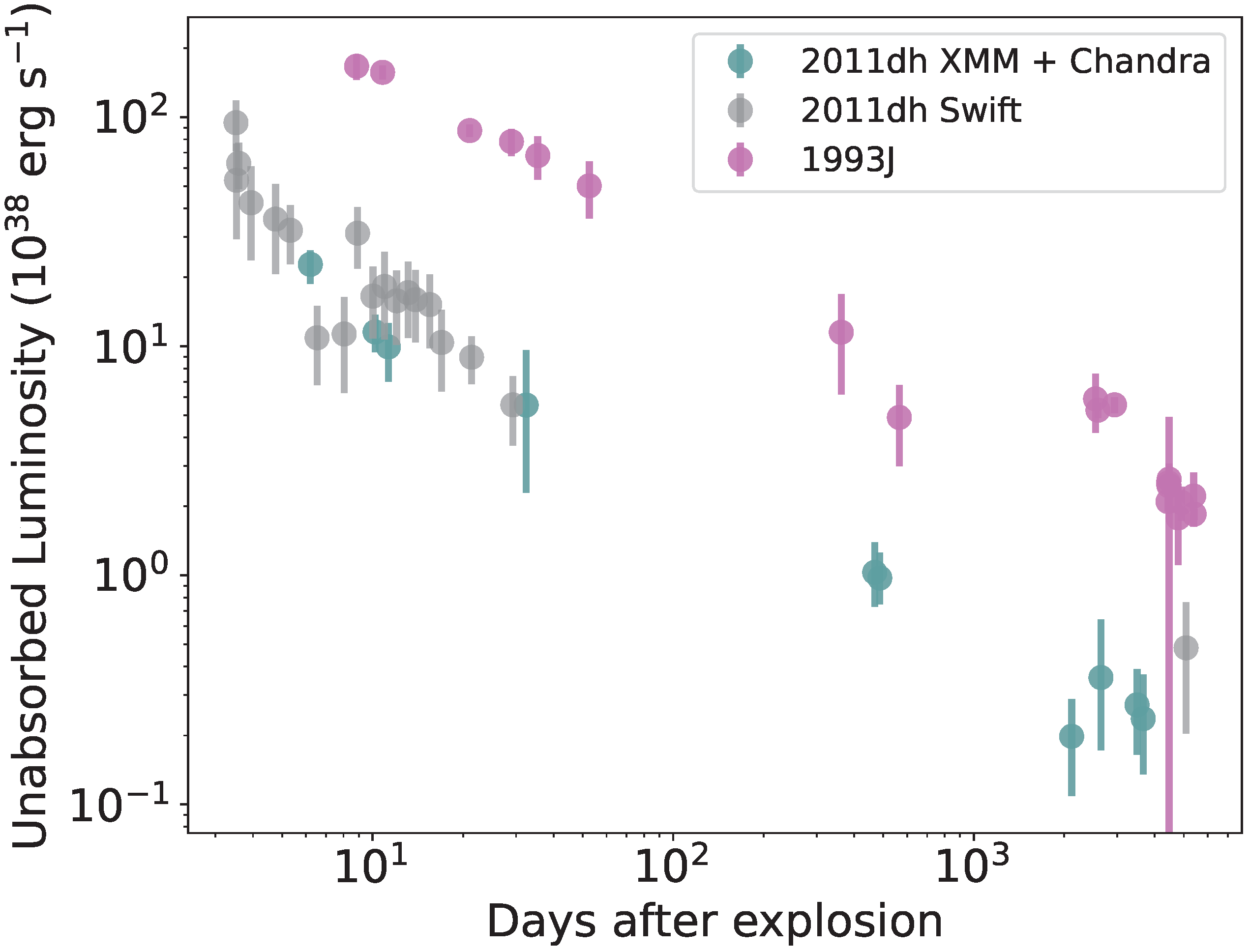
4. Comparison with Type IIb SN 1993J
5. Discussion and Conclusions
Author Contributions
Funding
Institutional Review Board Statement
Data Availability Statement
Acknowledgments
Conflicts of Interest
References
- Fransson, C.; Lundqvist, P.; Chevalier, R.A. Circumstellar Interaction in SN 1993J. Astrophys. J. 1996, 461, 993. [Google Scholar] [CrossRef]
- Chandra, P.; Dwarkadas, V.V.; Ray, A.; Immler, S.; Pooley, D. X-rays from the Explosion Site: 15 Years of Light Curves of SN 1993J. Astrophys. J. 2009, 699, 388–399. [Google Scholar] [CrossRef]
- Chevalier, R.A. Self-similar solutions for the interaction of stellar ejecta with an external medium. Astrophys. J. 1982, 258, 790–797. [Google Scholar] [CrossRef]
- Chevalier, R.A.; Fransson, C. Thermal and Non-thermal Emission from Circumstellar Interaction. In Handbook of Supernovae; Alsabti, A.W., Murdin, P., Eds.; Springer: Cham, Switzerland, 2017; p. 875. [Google Scholar] [CrossRef]
- Dwarkadas, V.V. On the X-Ray Emission from Supernovae, and Implications for the Mass-Loss Rates of Their Progenitor Stars. Universe 2025, 11, 161. [Google Scholar] [CrossRef]
- Freedman, W.L.; Hughes, S.M.; Madore, B.F.; Mould, J.R.; Lee, M.G.; Stetson, P.; Kennicutt, R.C.; Turner, A.; Ferrarese, L.; Ford, H.; et al. The Hubble Space Telescope Extragalactic Distance Scale Key Project. I. The Discovery of Cepheids and a New Distance to M81. Astrophys. J. 1994, 427, 628. [Google Scholar] [CrossRef]
- Tatischeff, V. Radio emission and nonlinear diffusive shock acceleration of cosmic rays in the supernova SN 1993J. Astron. Astrophys. 2009, 499, 191–213. [Google Scholar] [CrossRef]
- Björnsson, C.I. The Initial Evolution of SN 1993J: Piston Phase versus Standard Model. Astrophys. J. 2025, 987, 3. [Google Scholar] [CrossRef]
- Suzuki, T.; Kumagai, S.; Shigeyama, T.; Nomoto, K.; Yamaoka, H.; Saio, H. Hydrodynamical Models for X-Ray Emissions from SN 1993J in M81. Astrophys. J. 1993, 419, L73. [Google Scholar] [CrossRef]
- Suzuki, T.; Nomoto, K. X-Rays from SN 1993J and Structures of Ejecta and Circumstellar Medium. Astrophys. J. 1995, 455, 658. [Google Scholar] [CrossRef]
- Fransson, C.; Björnsson, C.I. Radio Emission and Particle Acceleration in SN 1993J. Astrophys. J. 1998, 509, 861–878. [Google Scholar] [CrossRef]
- Mioduszewski, A.J.; Dwarkadas, V.V.; Ball, L. Simulated Radio Images and Light Curves of Young Supernovae. Astrophys. J. 2001, 562, 869–879. [Google Scholar] [CrossRef][Green Version]
- Weiler, K.W.; Williams, C.L.; Panagia, N.; Stockdale, C.J.; Kelley, M.T.; Sramek, R.A.; Van Dyk, S.D.; Marcaide, J.M. Long-Term Radio Monitoring of SN 1993J. Astrophys. J. 2007, 671, 1959–1980. [Google Scholar] [CrossRef]
- Björnsson, C.I. Joining radio with X-rays: A revised model for SN 1993J. Astrophys. J. 2015, 813, 43. [Google Scholar] [CrossRef]
- Dwarkadas, V.; Bauer, F.; Bietenholz, M.; Bartel, N. SN 1993J—The X-ray Story of a Supernova Slowly Transitioning to a Remnant. In Proceedings of the X-Ray Universe 2014, Dublin, Ireland, 16–19 June 2014; p. 248. Available online: http://www.cosmos.esa.int/web/xmm-newton/2014-symposium/ (accessed on 10 September 2025).
- Maeda, K.; Katsuda, S.; Bamba, A.; Terada, Y.; Fukazawa, Y. Long-Lasting X-ray emission from Type IIb supernova 2011dh and mass-loss history of the yellow supergiant progenitor. Astrophys. J. 2014, 785, 95. [Google Scholar] [CrossRef]
- Silverman, J.M.; Filippenko, A.V.; Cenko, S.B. PTF Discovery of a Type II Supernova in M51. Astron. Telegr. 2011, 3398, 1. [Google Scholar]
- Arcavi, I.; Gal-Yam, A.; Yaron, O.; Sternberg, A.; Rabinak, I.; Waxman, E.; Kasliwal, M.M.; Quimby, R.M.; Ofek, E.O.; Horesh, A.; et al. SN 2011dh: Discovery of a Type IIb Supernova from a Compact Progenitor in the Nearby Galaxy M51. Astrophys. J. Lett. 2011, 742, L18. [Google Scholar] [CrossRef]
- Marion, G.H.; Kirshner, R.; Wheeler, J.C.; Vinko, J.; Chornock, R.; Foley, R.J.; Challis, P.; Friedman, A.; Garnavich, P.; Krisciunas, K. Helium Detection in IRTF Spectra of SN 2011dh. Astron. Telegr. 2011, 3435, 1. [Google Scholar]
- Filippenko, A.V. Optical Spectra of Supernovae. Annu. Rev. Astron. Astrophys. 1997, 35, 309–355. [Google Scholar] [CrossRef]
- Soderberg, A.M.; Margutti, R.; Zauderer, B.A.; Krauss, M.; Katz, B.; Chomiuk, L.; Dittmann, J.A.; Nakar, E.; Sakamoto, T.; Kawai, N.; et al. Panchromatic Observations of SN 2011dh Point to a Compact Progenitor Star. Astrophys. J. 2012, 752, 78. [Google Scholar] [CrossRef]
- Van Dyk, S.D.; Li, W.; Cenko, S.B.; Kasliwal, M.M.; Horesh, A.; Ofek, E.O.; Kraus, A.L.; Silverman, J.M.; Arcavi, I.; Filippenko, A.V.; et al. THE PROGENITOR OF SUPERNOVA 2011dh/PTF11eon IN MESSIER 51. Astrophys. J. Lett. 2011, 741, L28. [Google Scholar] [CrossRef]
- Maund, J.R.; Fraser, M.; Ergon, M.; Pastorello, A.; Smartt, S.J.; Sollerman, J.; Benetti, S.; Botticella, M.T.; Bufano, F.; Danziger, I.J.; et al. The yellow supergiant progenitor of the Type II supernova 2011dh in M51. Astrophys. J. Lett. 2011, 739, L37. [Google Scholar] [CrossRef]
- Bersten, M.C.; Benvenuto, O.G.; Nomoto, K.; Ergon, M.; Folatelli, G.; Sollerman, J.; Benetti, S.; Botticella, M.T.; Fraser, M.; Kotak, R.; et al. The type IIb supernova 2011dh from a supergiant progenitor. Astrophys. J. 2012, 757, 31. [Google Scholar] [CrossRef]
- Campana, S.; Immler, S. XMM-Newton and Swift observations of the Type IIb supernova 2011dh in Messier 51. Mon. Not. R. Astron. Soc. 2012, 427, L70–L74. [Google Scholar] [CrossRef]
- Sasaki, M.; Ducci, L. Observations of the post-shock break-out emission of SN 2011dh with XMM-Newton. Astron. Astrophys. 2012, 546, A80. [Google Scholar] [CrossRef]
- Dickey, J.M.; Lockman, F.J. H I in the galaxy. Annu. Rev. Astron. Astrophys. 1990, 28, 215–261. [Google Scholar] [CrossRef]
- Chevalier, R.A.; Fransson, C. Emission from Circumstellar Interaction in Normal Type II Supernovae. Astrophys. J. 1994, 420, 268. [Google Scholar] [CrossRef]
- Matzner, C.D.; McKee, C.F. The Expulsion of Stellar Envelopes in Core-Collapse Supernovae. Astrophys. J. 1999, 510, 379–403. [Google Scholar] [CrossRef]
- Dwarkadas, V.V.; Gruszko, J. What are published X-ray light curves telling us about young supernova expansion? Mon. Not. R. Astron. Soc. 2012, 419, 1515–1524. [Google Scholar] [CrossRef]
- Ramakrishnan, V.; Dwarkadas, V.V. From Supernova to Remnant: Tracking the Evolution of the Oldest Known X-Ray Supernovae. Astrophys. J. 2020, 901, 119. [Google Scholar] [CrossRef]
- Bietenholz, M.F.; Brunthaler, A.; Soderberg, A.M.; Krauss, M.; Zauderer, B.; Bartel, N.; Chomiuk, L.; Rupen, M.P. VLBI Observations of the nearby Type IIb supernova 2011dh. Astrophys. J. 2012, 751, 125. [Google Scholar] [CrossRef]
- Chevalier, R.A.; Fransson, C. Supernova Interaction with a Circumstellar Medium. In Supernovae and Gamma-Ray Bursters; Weiler, K.W., Ed.; Springer: Berlin/Heidelberg, Germany, 2003; pp. 171–194. [Google Scholar] [CrossRef]
- Nadezhin, D.K. On the Initial Phase of Interaction Between Expanding Stellar Envelopes and Surrounding Medium. Astrophys. Space Sci. 1985, 112, 225–249. [Google Scholar] [CrossRef]
- Nymark, T.K.; Chandra, P.; Fransson, C. Modeling the X-ray emission of SN 1993J. Astron. Astrophys. 2009, 494, 179–189. [Google Scholar] [CrossRef]
- Chandra, P.; Chevalier, R.A.; Chugai, N.; Fransson, C.; Irwin, C.M.; Soderberg, A.M.; Chakraborti, S.; Immler, S. Radio and X-Ray Observations of SN 2006jd: Another Strongly Interacting Type IIn Supernova. Astrophys. J. 2012, 755, 110. [Google Scholar] [CrossRef]
- Dwarkadas, V.V. On the lack of X-ray bright Type IIP supernovae. Mon. Not. R. Astron. Soc. 2014, 440, 1917–1924. [Google Scholar] [CrossRef]
- Dwarkadas, V.V.; Romero-Cañizales, C.; Reddy, R.; Bauer, F.E. X-ray and radio emission from the luminous supernova 2005kd. Mon. Not. R. Astron. Soc. 2016, 462, 1101–1110. [Google Scholar] [CrossRef]
- Chandra, P.; Chevalier, R.A.; Irwin, C.M.; Chugai, N.; Fransson, C.; Soderberg, A.M. Strong Evolution of X-Ray Absorption in the Type IIn Supernova SN 2010jl. Astrophys. J. Lett. 2012, 750, L2. [Google Scholar] [CrossRef]



| Observation ID | Days After Explosion * | Instrument | Count Rate (cts s−1) | Exposure Time (ks) |
|---|---|---|---|---|
| 0677980701 | 6.21 | XMM PN | 4.3 | |
| 0677980801 | 10.20 | XMM PN | 2.0 | |
| 12562 | 11.29 | Chandra ACIS-S | 9.6 | |
| 12668 | 32.44 | Chandra ACIS-S | 9.9 | |
| (13812, 13813) | 468.25 | Chandra ACIS-S | 358.4 | |
| (15496, 13814, 13815, | 486.71 | Chandra ACIS-S | 408.7 | |
| 13816, 15553) | ||||
| 19522 | 2116.03 | Chandra ACIS-I | 37.8 | |
| 20998 | 2648.67 | Chandra ACIS-S | 19.8 | |
| (23472–23476) | 3491.98 | Chandra ACIS-S | 173.2 | |
| (23477–23481, 25689) | 3662.52 | Chandra ACIS-S | 167.3 | |
| (00011417207–8, a | 5084.28 | Swift XRT | 33.7 | |
| 00011417210–18 | ||||
| 00011417220–29, | ||||
| 00011417231) |
| Observation ID | Days After Explosion * | ( ) | (keV) | Unabsorbed Flux ( erg ) |
|---|---|---|---|---|
| 0677980701 | 6.21 | |||
| 0677980801 | 10.20 | 13.68 ±2.54 | ||
| 12562 | 11.29 | 0.19 ±0.17 | 3.44 ±1.13 | |
| 12668 | 32.44 | 0.67 ±0.61 | ||
| 13812, 13813 a | 468.25 | 0.06 ±0.04 | ||
| 11.7 ±1.4 | ||||
| 15496, 13814, 13815 b | 486.71 | 0.90 ±0.10 | ||
| 13816, 15553 | ||||
| 19522 | 2116.03 | 0.77 ±0.23 | 0.23 ±0.11 | |
| 20998 | 2648.67 | 0.0154 c | 0.70 ±0.20 c | |
| 23472–23476 | 3491.98 | 0.0154 c | 0.96 ±0.66 | |
| 23477–23481, 25689 | 3662.52 | 0.0154 c | 1.25 ±0.47 | |
| 00011417207–8, 00011417210–18 | 5084.28 | 0.0154 c | 0.74 ±0.20 c | |
| 00011417220–29, 00011417231 |
| Observation Time (Days) | (Days) | () |
|---|---|---|
| 6.21 | 39 | 0.22 |
| 10.20 | 62 | 0.13 |
| 11.29 | 77 | 0.13 |
| 32.44 | 37 | 0.10 |
| 468.25 | 1061 | 0.15 |
| 486.71 | 1016 | 0.17 |
| 2116.03 | 7104 | 0.20 |
| 2648.67 | 12,017 | 0.16 |
| 3491.98 | 17,271 | 0.17 |
| 3662.52 | 27,828 | 0.12 |
| 5084.28 | 44,641 | 0.11 |
Disclaimer/Publisher’s Note: The statements, opinions and data contained in all publications are solely those of the individual author(s) and contributor(s) and not of MDPI and/or the editor(s). MDPI and/or the editor(s) disclaim responsibility for any injury to people or property resulting from any ideas, methods, instructions or products referred to in the content. |
© 2026 by the authors. Licensee MDPI, Basel, Switzerland. This article is an open access article distributed under the terms and conditions of the Creative Commons Attribution (CC BY) license.
Share and Cite
Gao, E.J.; Dwarkadas, V.V. Analysis of 14 Years of X-Ray Emission from SN 2011DH. Universe 2026, 12, 16. https://doi.org/10.3390/universe12010016
Gao EJ, Dwarkadas VV. Analysis of 14 Years of X-Ray Emission from SN 2011DH. Universe. 2026; 12(1):16. https://doi.org/10.3390/universe12010016
Chicago/Turabian StyleGao, Elisa J., and Vikram V. Dwarkadas. 2026. "Analysis of 14 Years of X-Ray Emission from SN 2011DH" Universe 12, no. 1: 16. https://doi.org/10.3390/universe12010016
APA StyleGao, E. J., & Dwarkadas, V. V. (2026). Analysis of 14 Years of X-Ray Emission from SN 2011DH. Universe, 12(1), 16. https://doi.org/10.3390/universe12010016