

Abstract
In order to properly describe the gravity interactions, including the mass currents, in gravitomagnetism, we construct four Maxwell-type gravitational equations that are shown to be analogs of the Maxwell equations in electromagnetism. Next, exploiting the Maxwell-type gravitational equations, we explicitly predict the mass magnetic fields for both the isolated system of the spinning Moon orbiting the spinning Earth and that of the Sun and solar system planets orbiting the spinning Sun, whose phenomenological values have not been evaluated in the preceding Newtonian gravity formalisms. In gravitomagnetism, we also phenomenologically investigate the mass magnetic general relativity (GR) forces associated with the mass magnetic fields, finding that they are extremely small but non-vanishing compared to the corresponding mass electric Newtonian forces. Moreover, the directions of the mass magnetic GR forces for the solar system planets, except Venus and Uranus, are shown to be anti-parallel to those of their mass electric Newtonian forces. Next, we investigate the mass magnetic dipole moment related to the B ring of Saturn to evaluate , with being the unit vector along the axis direction of the spinning B ring. The predicted value of is shown to be directly related to the Cassini data on the total mass of the rings of Saturn.
1. Introduction
In the weak field approximation, the Einstein field equations, in general, are relatively similar to the Maxwell equations of electromagnetism (EM). For a brief formalism of EM, see Appendix A. Next in the post-Newtonian corrections to the gravitational law, there have been discussions on frame-dragging effects [1,2] and Lense–Thirring effects [3,4]. For more details on these effects, see Refs. [1,2,3,4] and references therein. In investigating phenomenology related to spinning compact objects such as the Sun, the solar system planets and the Moon, for example, one can effectively exploit the rotational degrees of freedom (DOF) of gravitomagnetism. For more details on gravitomagnetism, see Refs. [5,6,7,8,9] and references therein. Recently, we proposed [10] a new formalism of modified linear general relativity (MLGR) that uses a vectorial scheme for the mass scalar and mass vector potentials of the gravitational wave (GW). To do this, in the MLGR, we employed the Wald approximation [9,10,11]. To be specific, we found the GW radiation intensity profile to possess a prolate ellipsoid geometry due to the merging source of binary compact objects. Here, the radiation lobe is prolate, with a long axis perpendicular to the orbital plane [10,12]. To be more specific, at a given radial distance from the binary compact objects, the GW radiation intensity on the revolution axis of the binary compact objects has been shown to be twice that on the equatorial plane [10].
On the other hand, the obliquity of Saturn has been known to be too large to have risen during Saturn’s formation from a protoplanetary disk or from a large impact [13]. The rings of Saturn are known to have appeared about 100 million years ago, based on the estimated strength of satellite ring torques [14] and the estimated rate of darkening of the ice-rich materials [15,16]. However, it is uncertain how the young rings of Saturn could have formed so recently. The Cassini data have recently been exploited to refine estimates of Saturn’s moment of inertia. Moreover, it has been proposed [17] that Saturn previously possessed an additional satellite, called Chrysalis, which caused the obliquity of Saturn to increase through the Neptune resonance. Therefore, destabilization of Chrysalis’s orbit about 100 million years ago can explain the proximity of the system to the resonance and the formation of the young rings through a grazing encounter of Chrysalis with Saturn. Moreover the simulated Chrysalis has been shown to have had multiple encounters with Titan, which is the largest satellite of Saturn [17]. The other Cassini data also have explicitly shown the total mass of the rings of Saturn [16].
In this paper, we theoretically investigate the precision astrophysics phenomenology with gravitomagnetism related to mass (M), which is the analog of EM [10,11,18,19] associated with charge (Q). Next, we study the mass magnetic fields for the spinning compact objects in gravitomagnetism. To be more specific, we evaluate the mass magnetic fields for both the isolated system of the Moon orbiting the spinning Earth and that of the solar system planets orbiting the spinning Sun. Making use of the mass magnetic fields, we proceed to predict the ensuing Lorentz-type mass magnetic general relativity (GR) forces for these systems. Next, we construct the mass magnetic dipole moment in gravitomagnetism to investigate the phenomenology of the B ring of Saturn.
In Section 2, we first construct the formalism of gravitomagnetism by exploiting MLGR. Next, in this gravitomagnetism, we formulate the mass electric and mass magnetic fields, as well as the corresponding mass electric Newtonian force and the mass magnetic force. In Section 3, we investigate the phenomenology associated with the mass magnetic fields of both the spinning Moon orbiting the spinning Earth and the spinning solar system planets orbiting the spinning Sun. Moreover, we evaluate the mass electric Newtonian forces and mass magnetic forces for these systems. Next, we evaluate the mass magnetic dipole moment associated with the B ring of Saturn. Section 4 includes conclusions.
2. Formalism of Astrophysical Phenomenology
2.1. Gravitomagnetism Originating from MLGR
In this subsection, we construct the formalism of gravitomagnetism by using MLGR [10]. To do this, we briefly recapitulate MLGR originating from Einstein GR. We start with the Einstein–Hilbert action,
from which we construct the Einstein GR field equation, [5,11,20]
where and R are the Riemann tensor and scalar curvature, respectively, and is the energy stress tensor. Next, we assume that the deviation () of the space-time metric () from a flat metric () is small.
Exploiting the Einstein GR field equation in (2) and in (3), we construct the linearized Einstein equation [5,10,11,20]:
where , with a metric of . Here, the trace reversed perturbation is given by , with . Next, exploiting (4) and the Lorentz-type gauge condition in gravity,
we arrive at the Maxwell-type equation in MLGR.
Now, we consider the non-vanishing and , together with [9,10,11]. We define and as
where is the linearized physical quantity in MLGR. From now on, subscripts M an Q denote the physical mass and charge quantities, respectively. Inserting (7) into the Maxwell-type equation in (6) yields
Next, we define and as
where the energy stress tensor is approximated to linear order in velocity in the Wald approximation [9,10,11]. In MLGR, inserting (9) into the Maxwell-type equation in (6) produces
Note that in the Wald approximation associated with in (7) and in (9), we construct in terms of [9,10,11], i.e.,
where the space–space components () vanish.
In vacuum, inserting into (6) and exploiting the definitions of and in (7) and (9), we obtain the wave equations for the non-vanishing fields ( and ),
from which we arrive at the wave equations in MLGR, i.e.,
which describe a massless spin-one graviton propagating in flat space time. This phenomenology in gravitomagnetism is analogous to that in EM. Note also that we have the Lorentz-type gauge condition for .
Next, we investigate the formalism of gravitomagnetism. To this end, we define the mass electric and mass magnetic fields ( and ) in terms of in (7) and in (9), constructed in relativistic MLGR as
Note that contains the DOF related to the term. After some algebra exploiting and in (15) in MLGR, we construct the Maxwell-type equations in gravitomagnetism [6] as
Note that the Maxwell-type gravitational equations in (16) in gravitomagnetism are analogs of the Maxwell equations in EM [18,19]. Note also that in gravitomagnetism, the equations in (16) include the time-derivative terms related to the dynamics of gravitomagnetism interactions.
Now, it seems appropriate to address comments on gravitomagnetism in Refs. [5,7,8,9], where the gravitational Maxwell equations are given by
First, in gravitomagnetism in (17), we find curl equations that do not possess the dynamic DOF associated with the time-derivative terms in (16). Note that the equations for denote the gravitational field produced by a static mass configuration. The equations for yield a notationally means of determining the extra gravitational field produced by moving masses associated with [5].
Second, even in the static case, the last equation in (17) has a coefficient different from that in gravitomagnetism in (16). This feature in gravitomagnetism in Refs. [5,7,8,9] originates from the following identification [5]:
In contrast, in gravitomagnetism associated with (16), we construct the last equation possessing by using the treatment of the Einstein GR field equation in (2) and in (3) used in MLGR. Especially in order to predict astrophysical quantities, which are numerically evaluated in Section 3, for instance, we need to exploit the equations in (16). This feature in MLGR and the ensuing gravitomagnetism associated with (16) are among the main points of this paper.
Next, we have comments on the gauge invariance of gravitomagnetism and that of EM described in Appendix A. First, in MLGR [10], we do not exploit the traceless, transverse (TT) gauge [5,10,11,20], which is a second-rank tensorial formalism in linearized general relativity (LGR). In the TT gauge, we choose . Next, for MLGR, exploiting the Wald approximation [9,10,11], we construct a vectorial formalism that is similar to that of EM [10]. Note that in MLGR, we have a vanishing associated with the Wald approximation, while in LGR, we possess a nonzero in the TT gauge [5,10,11,20].
Second, the equations of motion (EOMs) for the and fields in (8) and (10) produce the covariant EOM of :
where . Next, (19) has the same form as the EOM for the fields () that are obtainable from (A3) and , i.e.,
representing the covariant EOM. Note that in MLGR, the GW radiation intensity profile possesses a prolate ellipsoid geometry, with the angle depending on the source of the merging binary compact objects [10].
Thirdly, motivated by the mathematical similarity of the vectorial forms of the EOM for () in (19) and in (20), we construct the vectorial formalism for the spin-one graviton in MLGR [10]. Now, we investigate the gauge invariance and U(1) transformation in gravitomagnetism. To do this, we start with the Dirac equation for the electron wave function () and the mass-scalar and mass-vector potentials () in units of :
with and e being the electron mass and charge, respectively. Next, keeping in mind that in MLGR, we have the spin-one graviton, we study the quantum gravitomagnetic dynamics (QGD) that describes the interactions between electrons and gravitons. Now, we introduce the QGD Lagrangian, which is analogous to that of quantum electrodynamics (QED) in (A7) [21], i.e.,
where and the third term denotes the interaction between the electron and the gravitomagnetic wave (or spin-one graviton). Now, we find that the QGD Lagrangian in (22) is invariant under the gauge transformations, i.e.,
where the first relation is the U(1) transformation.
2.2. Mass Magnetic GR Force
Now, we construct the mass magnetic GR force by exploiting gravitomagnetism as formulated in the previous subsection. For the cases of mass electrostatics and mass magnetostatics, which are practically applicable to the phenomenological predictions in the next section, the mass electric and mass magnetic fields are given by
where is the vector from to field point and with . Using (24), we obtain the corresponding force acting on a test mass () moving with a velocity of v as follows:1
Now, in mass magnetostatics, we construct the mass-vector potential () as
Now, it seems appropriate to address some comments on the applications of formulas (24) and (26). First, exploiting (24), we construct mass magnetic field at the center of the loop of the orbital radius (R), which consists of the total mass (M) and orbits its center with an orbital period of T.
Here, is the unit vector along the axis of the loop orbiting its center. Note that inside (outside) the loop, the direction of is anti-parallel (parallel) to .
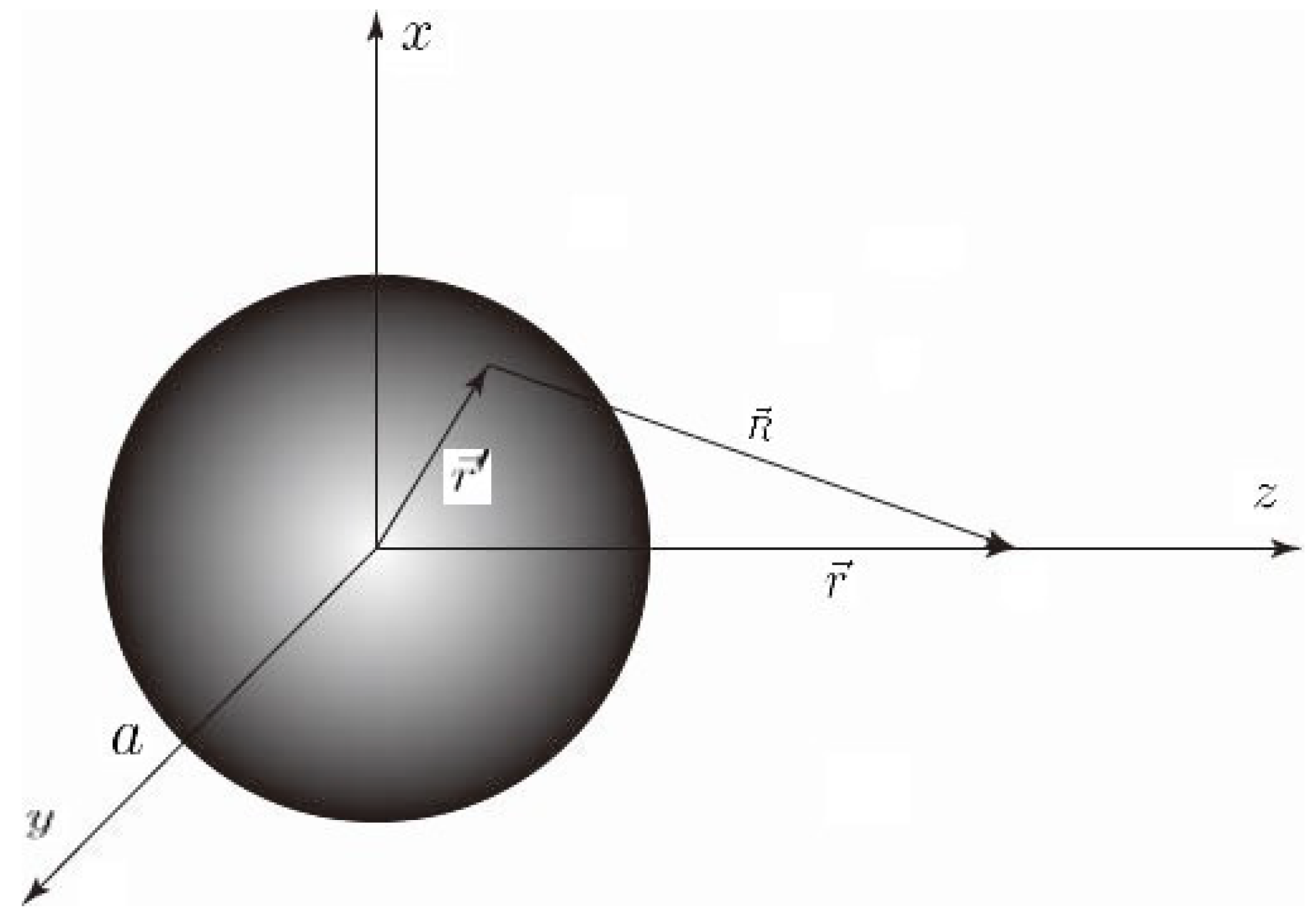
Secondly, we consider a solid sphere of mass M and radius a spinning with angular velocity (), as shown in Figure 1. Note that produces
Figure 1.
The geometry of a solid sphere of mass (M) and radius (a) spinning with angular velocity (, where is the unit vector along ). Here, and , with being the polar angle between and .
Inserting (28) into (26), we find the mass vector potential () as follows:
where we have use the relation expressed as . Next, on the equatorial plane of the solid sphere, we arrive at at with r2
Exploiting (30), we finally formulate the mass magnetic field () in the following form:
where t is the rotational period of the spinning solid sphere. Note that outside the spinning solid sphere, the direction of is parallel to on the equatorial plane. Note also that in EM, the direction of circles around the charge current, following the right-hand thumb rule, since the charges interact repulsively [18,19]. In contrast, in gravitomagnetism, the direction of circles around the mass current, following the left-hand thumb rule due to the fact that the masses interact attractively. Explicitly these features can be explained by the comparison of (26) and (A11).
3. Phenomenology of Astrophysical Systems in Gravitomagnetism
3.1. Earth and Moon
Now, in gravitomagnetism, we consider the isolated two-body system of the Earth of mass and the spinning Moon of mass orbiting the spinning Earth to find the phenomenological prediction for the mass magnetic field () on the surface of the Earth, where is the unit vector along the axis direction of the spinning Earth. Note that is also the unit vector along both the axis direction of the spinning Moon and the orbital-axis direction of the Moon orbiting the Earth. The mass magnetic field on the surface of the Moon is considered later. Exploiting (27) and (31), we construct the expression of the mass magnetic field () for the isolated system of the Earth and Moon, both of which possess rotational DOFs, for an observer located on the surface of the Earth3
where the first, second and third terms originate from the contributions of the spinning effect of the Earth and the orbital and spinning effects of the Moon, respectively. Here, subscript m denotes the physical quantities of the Moon. and are the radius and rotational period of the spinning Earth, respectively, while , , and are the radius, average orbital distance, rotational period and average orbital period of the spinning Moon orbiting the Earth, respectively.4 Note that the contributions from the orbital and spinning effects of the Moon are negligible. The contributions of the other solar system planets to are discussed in (39).
Next, we evaluate the mass magnetic field () for an observer located on the surface of the Moon using (31). To do this, we obtain the expression of the mass magnetic field () for the isolated system of the Earth and Moon as
where the first and second terms originate from the contributions of the spinning Moon and the spinning Earth, respectively.
Now, we investigate the force acting on the spinning Moon of mass due to the spinning Earth of mass . Exploiting in (25), we are left with , with being the radial direction from the Earth5
Next, making use of in (24) and in (25), one can readily construct the mass electric Newtonian force acting on the Moon () for the isolated system of the Earth and Moon for an observer located on the surface of the Moon as follows6:
from which we arrive at the characteristic ratio () in the following form:
The ratio of in (36) implies that gravitomagnetic correction, namely in gravitomagnetism, to the Newtonian classical prediction () is extremely small but non-vanishing.
3.2. Sun and Solar System Planets
In gravitomagnetism, we now investigate the isolated system of the Sun and the solar system planets orbiting the spinning Sun to evaluate the mass magnetic field () for an observer located on the surface of the Sun, where is the unit vector along the axis direction of the spinning Sun. Here, for simplicity, we assume that the rotation axes of the solar system planets, except those of Venus and Uranus, are approximately parallel to that of the Sun to produce the vanishing obliquities, and that these axes reside on the equatorial plane of the Sun. We also assume that on the equatorial plane of the Sun, the rotation axes of Venus and Uranus are anti-parallel to and perpendicular to that of the Sun, respectively.
Similar to (32), exploiting (27) and (31), we find the formula of the mass magnetic field () for the isolated system of the Sun and solar system planets for an observer located on the surface of the Sun as follows:
where the first, second and third terms come from contributions from the spinning effect of the Sun, orbital effects of the solar system planets and spinning effects of the solar system planets, respectively. Here, , and are the mass, radius and rotational period of the spinning Sun, while , , , and are the mass, radius, average orbital distance, rotational period and average orbital period of the i-th solar system planet orbiting the Sun, respectively. In treating in (37), we ignore the effect of the Sun’s radius () which is negligible compared to due to the factor of [20], for instance, in calculating the second term in (37). From now on, we ignore the contributions from the spinning effects of the solar system planets in the third term, since these effects are extremely small, as shown in (32) for the case of the system of the Earth and Moon.
Now, we investigate the mass magnetic fields () for the solar system planets with for an observer located on the surface of the planets, where is the unit vector along the axis direction of the spinning Sun. To do this, using (31), we formulate as follows:
where the first, second and third terms originate from the contributions from the spinning effect of the i-th planet, the spinning effect of the Sun and the spinning effect of the j-th other planet, respectively. Here, we assume that all the solar system planets are approximately aligned on a straight line in planetary order for simplicity, and that for the case of Uranus, is along the centripetal direction ().
Making use of (38), for the case of the Earth, we arrive at
where, for simplicity, we do not include the contribution of originating from Uranus, since is perpendicular to the directions of for the other solar system planets. Note that in (39), we can ignore the negligible contributions of the spinning effect of the Sun and spinning effects of the other solar system planets. In (39), we also exclude the negligible contributions of the orbital effect of the Moon and the spinning effect of Moon, which are listed in in (32). Moreover, since the contributions of the spinning effects of the other solar system planets with are negligible, as shown in (39), in evaluating in (38), we effectively do not need the constraint that all the solar system planets are aligned on a straight line in planetary order.
Next, similar to (34) for the case of the Moon, we evaluate the mass magnetic GR force acting on the Earth (, with being the unit radial vector from the Sun). Exploiting (25), one can readily evaluate
where is given below. Now, we readily formulate the mass electric Newtonian force acting on the Earth as , where is, again, the unit radial vector from the Sun and is given by
where the first, second and third terms come from the contributions from the Sun, the solar system planets inside the Earth’s orbital radius and the solar system planets outside the Earth’s orbital radius, respectively. Here, for simplicity, we, again, assume that all the solar system planets are approximately aligned on a straight line in planetary order and that, in evaluating , the Sun and the solar system planets do not have rotational DOFs. Note that the leading-order prediction in in (41) is dominant compared to the corresponding sub-leading-order predictions. Since the contributions of the spinning effects of the other solar system planets with are negligible, as shown in (41), as in the case of the evaluation of in (39), for the leading-order prediction of in (41), we can, again, effectively remove the constraint that all the solar system planets are aligned on a straight line in planetary order.
Next, even the sub-leading-order contributions of an order of about in in (41) are greater than the total contribution in in (40), implying that is hidden in Newtonian gravity. From (40) and (41), we arrive at the characteristic ratio () in the following form:
implying that the correction of to the Newtonian classical prediction () is extremely small but non-vanishing, as in the case of (36) for the isolated system of the Earth and the spinning Moon orbiting the spinning Earth.
Now, we investigate the general cases of the solar system planets with masses of , including the Earth, with a mass of . The predictions of in (38) for the solar system planets with masses of are given in Table 1. Exploiting (25), we can readily construct , where is listed in Table 1.7 Next, in order to find the characteristic ratios, we construct the mass electric Newtonian forces acting on the solar system planets as , where is given by
Table 1.
, , and are listed for the i-th planet . Here, and are the unit vector along the axis direction of the spinning Sun and that along the radial vector from the Sun, respectively. The magnitudes of and are given in units of . For the case of Venus, the direction of is along to produce the centripetal force (), while for the case of Uranus, the direction of is along to yield the force () along . The predictions for the exceptional cases of Venus and Uranus are indicated by *.
Furthermore, the predictions for the mass magnetic GR forces () associated with in (38), the mass electric Newtonian forces in (43), and the corresponding characteristic ratios, i.e.,
are also listed in Table 1. Here, we observe that and acting on the solar system planets with show magnitudes of orders of about and , respectively. Note that for the case of Jupiter (), and have the largest predicted values among those of the solar system planets because Jupiter has the heaviest mass.
Note that the smallness of these characteristic ratios ( and ) originate from the factor involved in in (33) and in (38), with which in (34) and are constructed. In contrast, and possess the G factor only as shown in (35) and (43). Note also that, for the case of Venus, the direction of is along to produce the centripetal force (). Next, for the case of Uranus, the direction of is along to yield the force () along .
3.3. B Ring of Saturn
Now, it seems appropriate to address some comments on the rings of Saturn to investigate the corresponding mass magnetic dipole moments. It is well known that the B ring of Saturn is the brightest, most opaque and—most likely—most massive of Saturn’s rings [24]. Motivated by this, we study the isolated system of the B ring of Saturn for simplicity. Making use of a multipole expansion valid at a distant observation point, we find in terms of the dominant mass magnetic dipole moment contribution8
where and the mass magnetic dipole moment is given by
Note that the mass magnetic dipole moment () in (46) is the analog of the charge magnetic dipole moment () [18,19], and the direction of is opposite to that of because of the difference in the interaction patterns between repulsive EM and attractive mass gravitational forces.
Now, we construct the mass magnetic dipole moment of the B ring orbiting Saturn. To do this, we first find the period () of the B ring orbiting Saturn. In the absence of non-gravitational fields, the B ring of Saturn moves in a circular orbit according to the Kepler’s third law to a high degree of approximation [25], where the period () is given by [26]
Here, is the orbital radius of the B ring. Note that in (47), we neglect the effect of the B-ring mass () which is extremely small compared to the mass (). Combining the formulas for in (46) and in (47), for the B ring of Saturn, we finally arrive at the mass magnetic dipole moment (), where9
Note that the direction of this mass magnetic dipole moment is opposite to that of the charge magnetic dipole moment in the electromagnetic interaction because of the differences in the interaction patterns between charge-repulsive electromagnetic and mass-attractive gravitational forces. Now, the predicted value for in (48) is intrinsically associated with the Cassini data [16] concerning the total mass of the rings of Saturn via the explicit formula possessing in (48), which is the approximated total mass of Saturn’s rings [24].
Next, we investigate the recent Cassini data [17] on the formation of the young rings through a grazing encounter of an additional satellite, named Chrysalis, which is assumed to be predominantly composed of water ice. This encounter of Chrysalis with Saturn would have caused Chrysalis to break apart to yield debris, which could have developed into Saturn’s young rings [17,27]. The loss of the hypothetical satellite Chrysalis can explain the obliquity of Saturn and the young age of its rings. Moreover the value of in (48), which could come from the debris mass of Chrysalis via (48), could be related to the formation mechanism [17] of Saturn’s rings.
4. Conclusions
In summary, we have constructed a formalism of gravitomagnetism by making use of MLGR. Exploiting gravitomagnetism, we have numerically evaluated astrophysical quantities such as the mass magnetic GR force and the mass magnetic dipole moment of Saturn’s B ring, for instance. To be more specific, in order to identify the effectiveness of gravitomagnetism, we treated the astrophysical observables such as the mass magnetic fields for both the isolated system of the Moon orbiting the spinning Earth and that of the solar system planets orbiting the spinning Sun. Exploiting the mass magnetic fields, we predicted the ensuing Lorentz-type mass magnetic GR forces for these systems. Note that in investigating gravitomagnetism, we used MLGR associated with the Wald approximation, in contrast to LGR possessing the TT gauge. Note also that in MLGR related to gravitomagnetism, dependence of the angle of GW radiation can be explained by the vectorial formalism [10]. In contrast, LGR is mathematically defined differently in the second-rank tensorial formalism from in the vectorial formalism in MLGR, and LGR cannot present the angle dependence of GW radiation [10]. In this paper, gravitomagnetism predicted the existence and ensuing numerical estimates of physical observables such as the mass magnetic GR force hidden in the Newtonian gravity. Note that LGR cannot predict astrophysical physical quantities such as the mass magnetic fields and the mass magnetic GR forces, for instance.
Next, exploiting the Maxwell-type gravitational equations in gravitomagnetism we obtained the mass electric and mass magnetic fields ( and , respectively), with which we constructed the corresponding mass electric Newtonian and Lorentz-type mass magnetic GR forces ( and , respectively). One of the advantages of gravitomagnetism is to evaluate the mass magnetic field (), whose phenomenological value is hidden in Newtonian gravity, as newly predicted in this paper. For instance, in the isolated Earth of mass and the Moon of mass , we found acting on the Earth, while in the isolated system of the Sun of mass and solar system planets of masses , we obtained acting on the Sun, which is about . Moreover, we noticed that the mass magnetic GR force () is relatively small compared with . To be specific, considering the isolated system of the Moon and Earth, in gravitomagnetism we estimated acting on the Moon, which is approximately of the mass of electric Newtonian force (). For the case of the Earth and the Sun, we found that is about of the corresponding mass electric Newtonian force (). Next, for the isolated Sun and solar system planets, in gravitomagnetism, we have evaluated acting on the solar system planets, which are of an order of about of the corresponding mass electric Newtonian forces (), as shown in Table 1. This feature implies that gravitomagnetic correction, namely , to the Newtonian classical prediction () is extremely small but non-vanishing. To be specific, this gravitomagnetic correction has been hidden in astrophysical phenomenology until now. The theoretical prediction of the mass magnetic GR force in gravitomagnetism is one of the main points of this paper. Note that possesses the leading-order correction, which originates from the spinning effects of the solar system planets of , and this correction is dominant compared to the other next-order effects. Note also that the directions of for the solar system planets (except Venus of mass and Uranus of mass ) are anti-parallel to those of , while the directions of and for Venus and Uranus are parallel to and perpendicular to those of , respectively.
Now, as a typical example of the mass magnetic dipole moment () in gravitomagnetism, we investigated Saturn’s B ring to predict . Note that the prediction of has been shown to be closely related to the Cassini data [16] on the total mass of the rings of Saturn. Next, , which could originate from the debris mass of hypothetical satellite Chrysalis [17], also could be associated with the formation of the young rings of Saturn. Note that the mass magnetic GR force () acting on the B ring of Saturn contributes, in small amounts, to the formation of the width of the B ring.
Next in this paper, we phenomenologically predicted physical quantities such as the mass magnetic fields and their ensuing mass magnetic GR forces, which exist in the Universe according to gravitomagnetism (or MLGR) proposal. It will be interesting to search for observational evidence for these physical quantities in the Universe. Once this is done, the theoretical formalism developed in this paper could have some progressive impacts on precision astrophysics phenomenology. Note that research on GR effects such as the relativistic precision and frame dragging conducted saliently by the Gravity Probe B satellite has been conducted, as is well documented in Refs. [2,3,28] and references therein.
Funding
This work was supported by the Basic Science Research Program through the National Research Foundation of Korea, funded by the Ministry of Education, Science and Technology (RS-2020-NR049598).
Data Availability Statement
No data were used in this work.
Acknowledgments
The author would like to thank the anonymous editor and referees for helpful comments.
Conflicts of Interest
The author declares no conflicts of interest.
Appendix A. Sketch of EM
In order to construct the gravitomagnetism formalism discussed in Section 2, we digress to pedagogically recapitulate the EM associated with charge (Q) [18,19]. To do this, we start with the charge electric and charge magnetic fields in EM, where we find the Maxwell equations in EM:
where and are the volume charge density and volume charge current, respectively. Here, we use , where , and c are the permittivity, permeability and speed of light of free space, respectively. Note that the charge electric and mass magnetic fields ( and , respectively) are given in terms of the four charge vector potentials () as
We also find that the charge vector potentials () fulfill
where we exploit the Lorentz gauge condition:
In vacuum, inserting into (A3), we find the wave equation for :
which implies a massless spin-one photon propagating in flat space time.
Next, we investigate the gauge invariance and U(1) transformation in EM. To do this, we start with the Dirac equation for the electron wave function () and the charge-vector potentials () in units of , i.e.,
where and e are the electron mass and charge, respectively. Next, the QED describes the interactions between electrons and photons. Now, we introduce the QED Lagrangian [21]:
where and the third term denotes the interaction between the electron and the electromagnetic wave (or spin-one photon). Note that the QED Lagrangian is invariant under the gauge transformations:
where the first relation is the U(1) transformation.
Next, for the cases of charge electrostatics and charge magnetostatics, corresponding to and , respectively, inside a given volume, we obtain the charge electric and charge magnetic fields as
where is the vector from to the field point () and with . Exploiting the charge electric and magnetic fields ( and , respectively) in (A9), we end up with the corresponding force acting on a test charge () moving with a velocity of v:
Moreover, in charge magnetostatics, we construct the charge-vector potential () as follows:
Making use of a multipole expansion valid at a distant observation point, we reformulate in terms of the dominant charge magnetic dipole moment contribution as
where and the charge magnetic dipole moment () is given by
Notes
| 1 | Superscripts E and B stand for the mass electric Newtonian force and the mass magnetic force, respectively. |
| 2 | Here, we have exploited the identity . |
| 3 | Here, we assume that this observer resides on a space-fixed frame and does not co-rotate together with the Earth so that we can include the spinning effect of the Earth. The same statement is applied to the observers who are located on the surfaces of the Moon, the Sun and the solar system planets. |
| 4 | For the observational data for , , , and , we exploit [20,22,23]. Similarly, we use [20,22,23] for the observational data for , , , and for the i-th planet in the solar system, as discussed in the next subsections. |
| 5 | From now on, denotes the force () acting on the position at under the field at , for instance. Here, the argument expressed as indicates the vector of the direction from to with a magnitude of . |
| 6 | From now on, the minus sign in indicates the attractive Newtonian force between and , for example. |
| 7 | In Table 1, the magnitudes of and are given in units of , and these values are dimensionless. The minus signs in , again, denote the attractive Newtonian forces between and . |
| 8 | Here, we exploit the approximation at a distant observation point of , where the ellipsis stands for the higher-order terms that can be ignored for the mass-vector potential of a localized mass-current distribution. Note that the first term denotes the mass magnetic monopole term, which vanishes for the closed-loop integral, as expected. Thus, in this paper, we exclude the possibility of a mass magnetic monopole, in addition to that of a charge magnetic monopole. |
| 9 | The recent Cassini data show that the total mass of the rings of Saturn is [16]. In evaluating (48), we exploit this value for the B-ring mass () for simplicity, since the B ring is known to probably be the most massive of Saturn’s rings [24]. Next the orbital radius of the B ring is given by [20]; thus, we use the average value of . Moreover, we ignore the effect of the width of the B ring of Saturn in the evaluation in (48) for simplicity. |
References
- Deriglazov, A.A.; Ramirez, W.G. Frame-dragging effect in the field of non rotating body due to unit gravimagnetic moment. Phys. Lett. B 2018, 779, 210–213. [Google Scholar] [CrossRef]
- Everitt, C.W.F.; Muhlfelder, B.; DeBra, D.B.; Parkinson, B.W.; Turneaure, J.P.; Silbergleit, A.S.; Acworth, E.B.; Adams, M.; Adler, R.; Bencze, W.J.; et al. The Gravity Probe B test of general relativity. Class. Quantum Gravity 2015, 32, 224001. [Google Scholar] [CrossRef]
- Lense, J.; Thirring, H. Ueber den Einfluss der Eigenrotation der Zentralkoerper auf die Bewegung der Planeten und Monde nach der Einsteinschen Gravitationstheorie. Phys. Z. 1918, 19, 156, English translation of this paper appears in Mashhoon, B.; Hehl, F.W.; Theiss, D.S. Gen. Relativ. Gravit. 1984, 16, 711. [Google Scholar]
- Iorio, L. Will the recently approved LARES mission be able to measure the Lense-Thirring effect at 1%? Gen. Relativ. Gravit. 2009, 41, 1717–1724. [Google Scholar] [CrossRef]
- Hobson, M.P.; Efstathiou, G.; Lasenby, A.N. General Relativity: An Introduction for Physicists; Cambridge University Press: Cambridge, UK, 2006. [Google Scholar]
- Ludwig, G.O. Galactic rotation curve and dark matter according to gravitomagnetism. Eur. Phys. J. C 2021, 81, 186. [Google Scholar] [CrossRef]
- Ruggiero, M.L.; Ortolan, A.; Speake, C.C. Galactic dynamics in general relativity: The role of gravitomagnetism. Class. Quantum Gravity 2022, 39, 225015. [Google Scholar] [CrossRef]
- Glampedakis, K.; Jones, D.I. Pitfalls in applying gravitomagnetism to galactic rotation curve modelling. Class. Quantum Gravity 2023, 40, 147001. [Google Scholar] [CrossRef]
- Lasenby, A.N.; Hobson, M.P.; Barker, W.E.V. Gravitomagnetism and galaxy rotation curves: A cautionary tale. Class. Quantum Gravity 2023, 40, 215014. [Google Scholar] [CrossRef]
- Hong, S.T. New algorithm of measuring gravitational wave radiation from rotating binary system. Phys. Scripta 2024, 99, 105030. [Google Scholar] [CrossRef]
- Wald, R.M. General Relativity; University of Chicago Press: Chicago, IL, USA, 1984. [Google Scholar]
- Landau, L.D.; Lifschits, E.M. The Classical Theory of Fields; Pergamon Press: Oxford, UK, 1975. [Google Scholar]
- Ward, W.R.; Hamilton, D.P. Tilting Saturn. I. analytic model. Astrophys. J. 2004, 128, 2501. [Google Scholar] [CrossRef]
- Goldreich, P.; Tremaine, S. The dynamics of planetary rings. Ann. Rev. Astron. Astrophys. 1982, 20, 249–283. [Google Scholar] [CrossRef]
- Zhang, Z.; Hayes, A.G.; Janssen, M.A.; Nicholson, P.D.; Cuzzi, J.N.; de Pater, I.; Dunn, D.E. Exposure age of Saturn’s A and B rings, and the Cassini Division as suggested by their non-icy material content. Icarus 2017, 294, 14–42. [Google Scholar] [CrossRef]
- Iess, L.; Militzer, B.; Kaspi, Y.; Nicholson, P.; Durante, D.; Racioppa, P.; Anabtawi, A.; Galanti, E.; Hubbard, W.; Mariani, M.J.; et al. Measurement and implications of Saturn’s gravity field and ring mass. Science 2019, 364, 2965. [Google Scholar] [CrossRef] [PubMed]
- Wisdom, J.; Dbouk, R.; Militzer, B.; Hubbard, W.B.; Nimmo, F.; Downey, B.G.; French, R.G. Loss of a satellite could explain Saturn’s obliquity and young rings. Science 2022, 377, 1285. [Google Scholar] [CrossRef] [PubMed]
- Jackson, J.D. Classical Electrodynamics; John Wiley & Sons: Danvers, MA, USA, 1999. [Google Scholar]
- Griffiths, D. Introduction to Electrodynamics; Prentice Hall: Upper Saddle River, NJ, USA, 1999. [Google Scholar]
- Carroll, B.W.; Ostlie, D.A. Modern Astrophysics; Addison-Wesley: New York, NY, USA, 1996. [Google Scholar]
- De Wit, B.; Smith, J. Field Theory in Particle Physics; North-Holland: Amsterdam, The Netherlands, 1986. [Google Scholar]
- Navas, S.; Amsler, C.; Gutsche, T.; Hanhart, C.; Hernández-Rey, J.J.; Lourenço, C.; Masoni, A.; Mikhasenko, M.; Mitchell, R.E.; Patrignani, C.; et al. [Particle Data Group] Review of particle physics. Phys. Rev. D 2024, 110, 030001. [Google Scholar] [CrossRef]
- Padmanabhan, T. Theoretical Astrophysics; Cambridge University Press: Cambridge, UK, 2001; Volume II. [Google Scholar]
- Hedman, M.M.; Nicholson, P.D. The B-rings’s surface mass density from hidden density waves: Less than meets the eye? Icarus 2016, 279, 109. [Google Scholar] [CrossRef]
- Bastin, J.A. Note on the rings of Saturn. Moon Planets 1981, 24, 467. [Google Scholar] [CrossRef]
- Goldstein, H. Classical Mechanics; Addison-Wesley: Boston, MA, USA, 1980. [Google Scholar]
- Dones, L. A recent cometary origin for Saturn’s rings? Icarus 1991, 92, 194–203. [Google Scholar] [CrossRef]
- Iorio, L. Is there still something left that Gravity Probe B can measure? Universe 2020, 6, 85. [Google Scholar] [CrossRef]
Disclaimer/Publisher’s Note: The statements, opinions and data contained in all publications are solely those of the individual author(s) and contributor(s) and not of MDPI and/or the editor(s). MDPI and/or the editor(s) disclaim responsibility for any injury to people or property resulting from any ideas, methods, instructions or products referred to in the content. |
© 2025 by the author. Licensee MDPI, Basel, Switzerland. This article is an open access article distributed under the terms and conditions of the Creative Commons Attribution (CC BY) license (https://creativecommons.org/licenses/by/4.0/).



