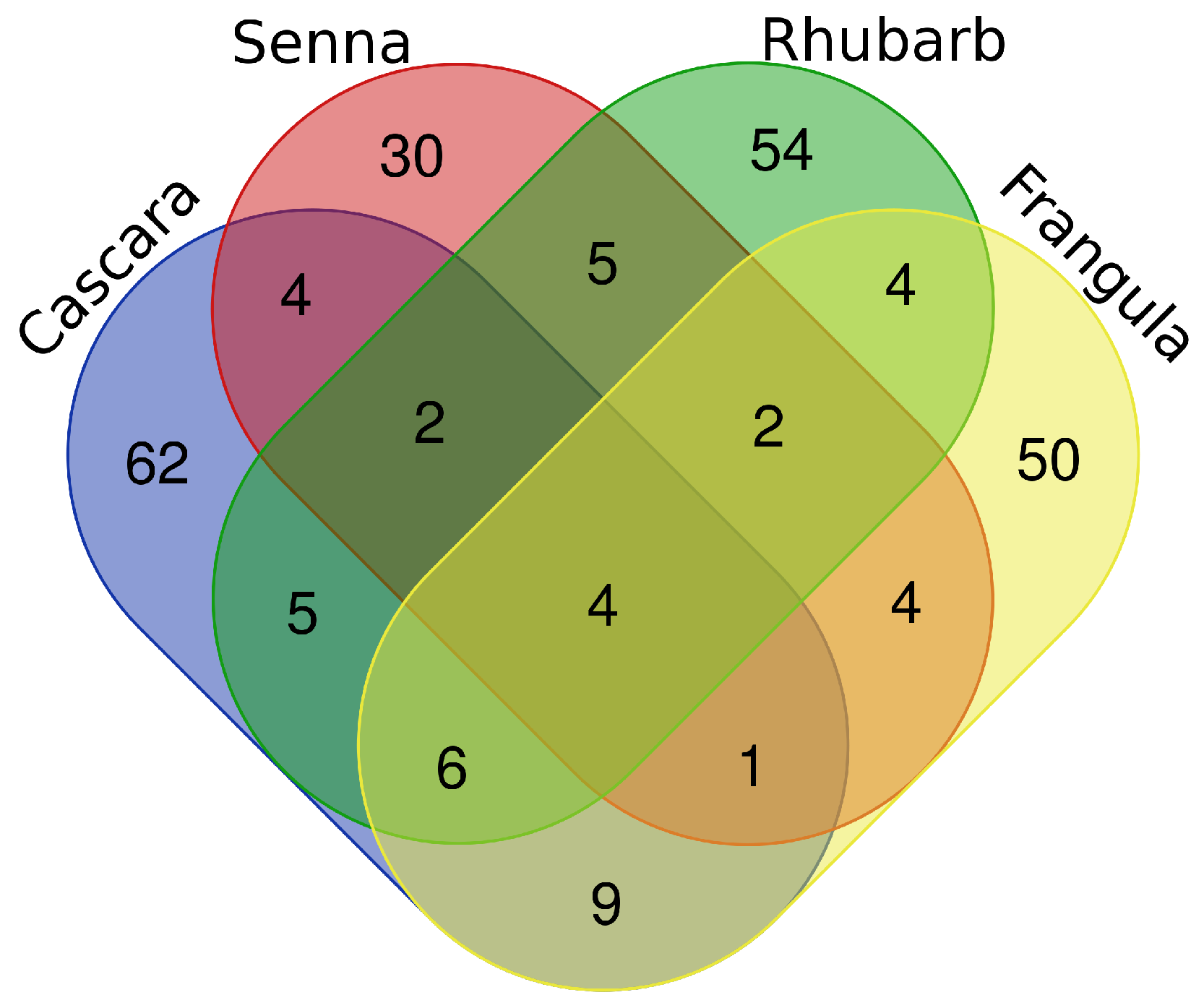
Untargeted Metabolomics for Profiling of Cascara, Senna, Rhubarb, and Frangula Metabolites
 , , , , , and
Abstract
1. Introduction
2. Materials and Methods
2.1. Feature Extraction and Metabolite Annotation
2.2. Metabolite Screening Process
- Database Confirmation: Compounds showing full or partial correspondence in at least one of five reference databases (m/z Cloud, m/z Vault, Metabolika, ChemSpider, or Mass List) were included.
- Mass Accuracy: Deviation within ppm from theoretical m/z.
- RT (Retention Time): Compounds eluting between 5 and 50 min were selected, although the range could be extended (0–120 min) to accommodate specific analytical requirements.
- Peak Area: Features with areas below 1.0 × were excluded in order to minimize low-intensity background signals.
- Availability: Only compounds with corresponding spectra were retained for annotation.
2.3. Classification of Natural Products
2.4. Statistical Analysis
3. Results
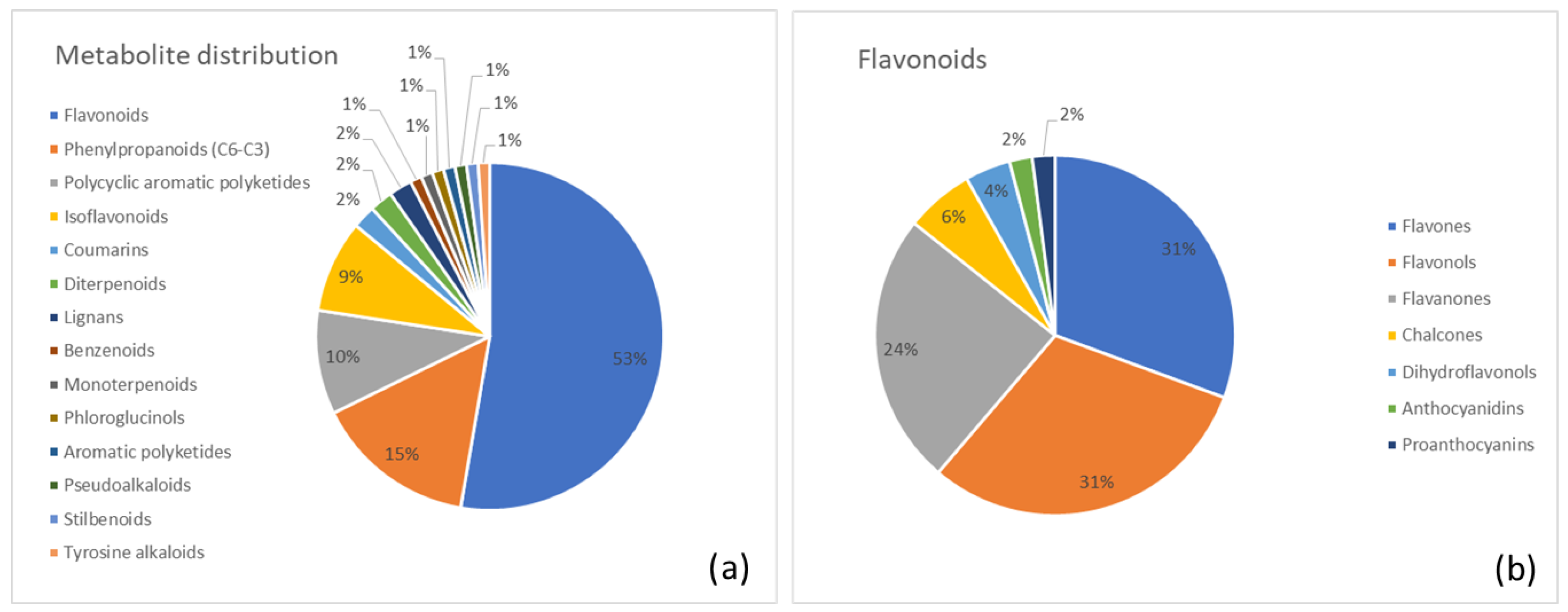
3.1. Distinctive Metabolites in Cascara
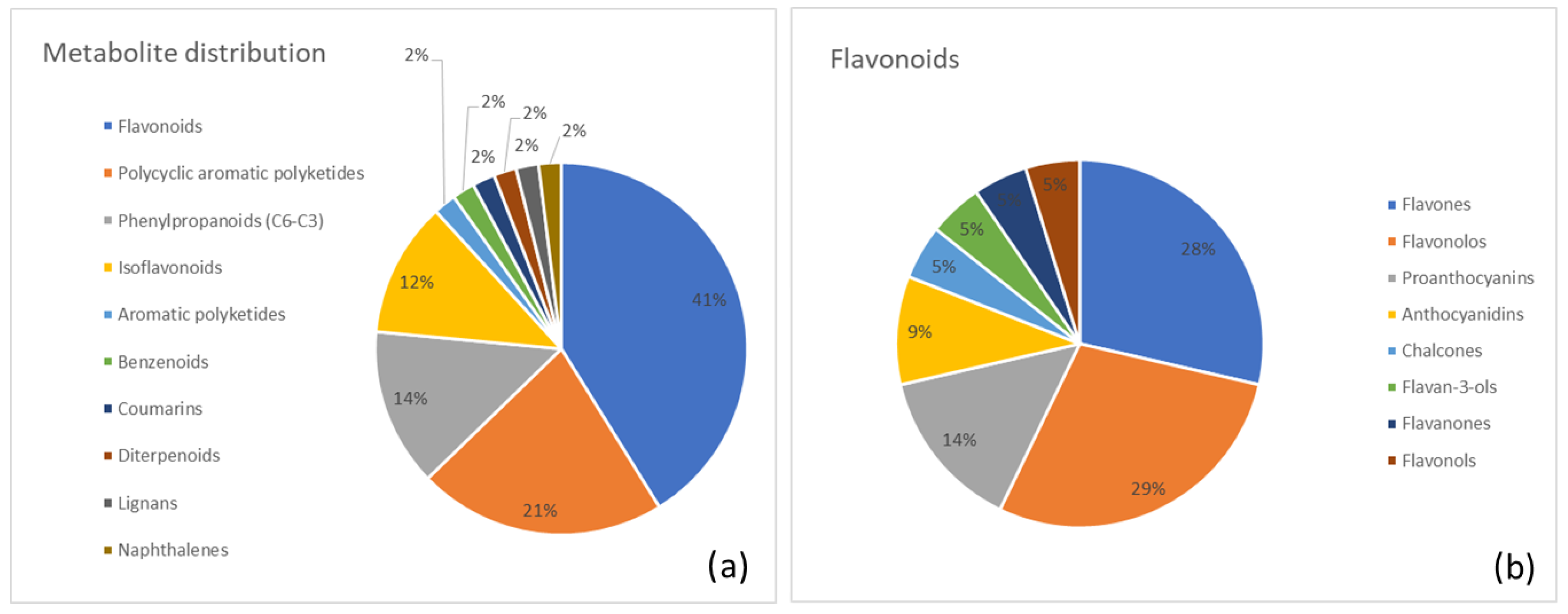
- Polycyclic Aromatic Polyketides: This superclass is represented exclusively by anthraquinones and anthrones, including Emodin (C15H10O5), Aloin A (C21H22O9), Aloin B (C21H22O9), and Cascaroside A (C27H32O14).
- Flavonoids: Abundant representatives include Nobiletin (C21H22O8), Isoliquiritigenin (C15H12O4), Primuletin (C15H10O3), Myrciacitrin V (C30H30O13), Naringin (C27H32O14), and Cirsimarin (C23H24O11).
- Isoflavonoids: Detected examples include Genistein (C15H10O5) and Formononetin (C16H12O4).
- Phenylpropanoids (C6–C3): Represented by Chlorogenic acid (C16H18O9) and Caffeic acid (C9H8O4).
- Tyrosine Alkaloids: Exemplified by Pavine (C20H23NO4).
- Benzenoids: Including 4-Ethylcatechol (C8H10O2).
- Monoterpenoids: Including Demethyloleuropein (C24H30O13).
- Phloroglucinols: Represented by 2,4,6-Trimethoxybenzophenone (C16H16O4).
- Aromatic Polyketides: Including 4-Heptyloxyphenol (C13H20O2).
- Trace compounds: Additional minor representatives of coumarins, diterpenoids, and lignans were also detected.
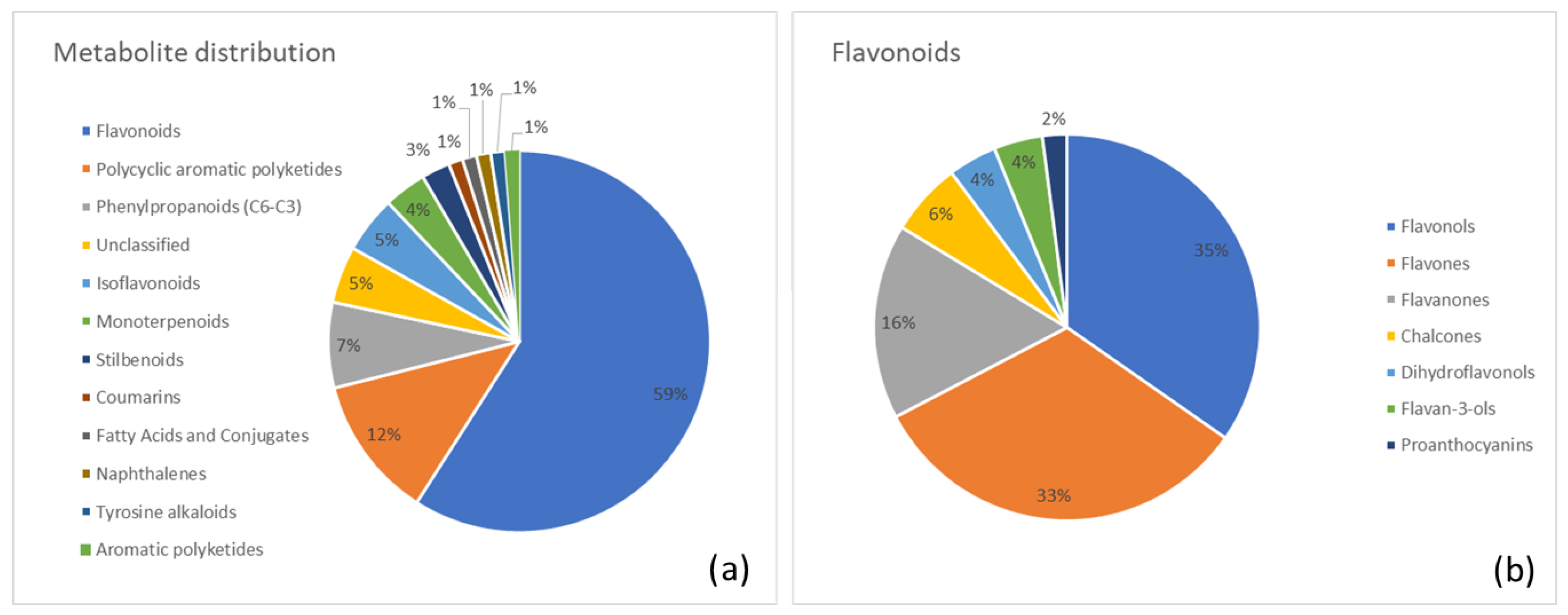
3.2. Distinctive Metabolites in Frangula
- Polycyclic Aromatic Polyketides: Mainly represented by anthraquinones/anthrones, including Emodin (C15H10O5), Glucofrangulin A (C27H30O14), Glucofrangulin B (C26H28O14), Frangulin A (C21H20O9), and Frangulin B (C20H18O9).
- Flavonoids: Liquiritin (C21H22O9), Isoliquiritigenin (C15H12O4), Kaempferol (C15H10O6).
- Isoflavonoids: Genistein (C15H10O5) and Daidzein (C15H10O4).
- Phenylpropanoids (C6–C3): Caffeic acid (C9H8O4), 3-Caffeoylquinic acid (C16H18O9), and Methyl chlorogenate (C17H20O9).
- Monoterpenoids: Oleuropein (C25H32O13), Demethyloleuropein (C24H30O13), and Loganin (C17H26O10) in trace amounts.
- Stilbenoids: Piceatannol (C14H12O4) and Piceid (C20H22O8) in trace amounts.
- Coumarins: 5,6-O--D-diglucopyranosylangelicin (C23H26O15).
- Aromatic Polyketides: 4-Heptyloxyphenol (C13H20O2).
- Naphthalenes: Nepodin (C13H12O3).
- Fatty Acids and Conjugates: Oleic acid (C18H34O2) detected in trace amounts (observed only in Frangula).
- Unclassified: Four highly prevalent features grouped as “Other” remained unclassified; accurate m/z values were observed but spectral/database evidence was insufficient to assign definitive molecular formulas.
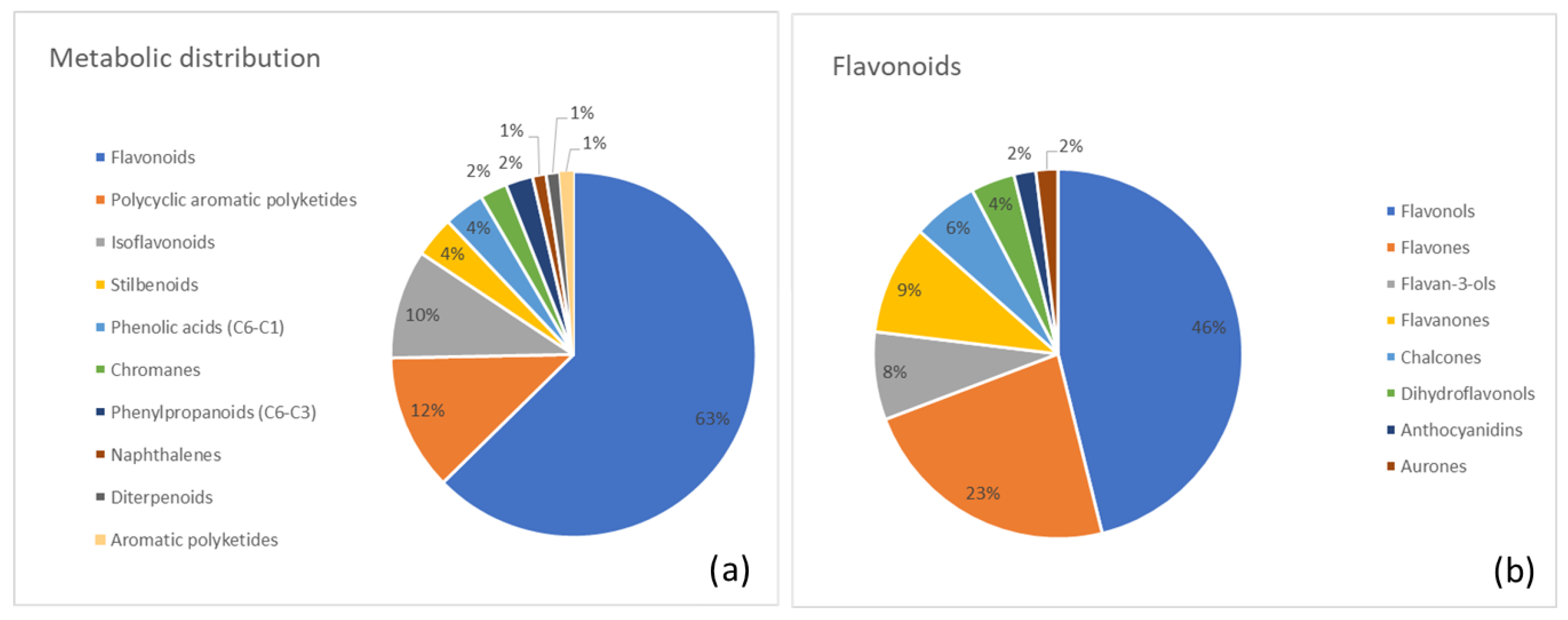
3.3. Distinctive Metabolites in Rhubarb
Superclass-Level Overview
- Polycyclic Aromatic Polyketides: Mainly represented by anthraquinones such as Emodin (C15H10O5), Rhein (C15H8O6), 1,4-Dihydroxyanthraquinone (C14H8O4), and Rhein-8-glucoside (C21H18O11).
- Flavonoids: Abundant representatives include Catechin (C15H14O6).
- Isoflavonoids: Genistein (C15H10O5) and Daidzein (C15H10O4).
- Stilbenoids: Examples are Piceatannol (C14H12O4), Resveratrol (C14H12O3), and Resveratrol 3-O-glucoside (C20H22O8).
- Phenolic Acids: Protocatechuic aldehyde (C7H6O3), Gallic acid (C7H6O5), and Ellagic acid (C14H6O8).
- Chromanes: Including 5-Acetonyl-7-hydroxy-2-methylchromone (C13H12O4) and Aloesin (C19H22O9).
- Naphthalenes: Exemplified by Torachrysone 8-O--D-glucoside (C20H24O9).
- Aromatic Polyketides: Including 4-Heptyloxyphenol (C13H20O2).
- Trace Compounds: Minor representatives of diterpenoids and additional phenylpropanoids were also detected.
3.4. Distinctive Metabolites in Senna
Superclass-Level Overview
- Flavonoids: Abundant representatives include Vicenin 2 (C27H30O15), 2′,2 Bisepigallocatechin digallate (C44H34O22), and Luteolin (C15H10O6).
- Isoflavonoids: Demethylwedelolactone (C15H8O7) and Irilone (C16H6O3).
- Polycyclic Aromatic Polyketides: Represented by anthraquinones distinctive of Senna, including Rhein (C15H8O6), Rhein-8-glucoside (C21H18O11), Sennoside A (C42H38O20), and Sennoside B (C42H38O20).
- Phenylpropanoids (C6–C3): Examples include Guaethol (C8H10O2) and Eugenol (C10H12O2).
- Coumarins: Exemplified by 11-O-Galloylbergenin (C21H20O13).
- Benzenoids: Including Creosol (C8H10O2).
- Aromatic Polyketides: Including 4-Heptyloxyphenol (C13H20O2), also observed in the other species.
- Trace Compounds: Minor representatives of diterpenoids, lignans, and naphthalenes were also detected.
4. Discussion
5. Conclusions
Supplementary Materials
Author Contributions
Funding
Institutional Review Board Statement
Informed Consent Statement
Data Availability Statement
Acknowledgments
Conflicts of Interest
Abbreviations
| HADs | Hydroxyanthracene Derivatives |
| UPLC–MS/MS | Ultra-High-Performance Liquid Chromatography–Tandem Mass Spectrometry |
| HCA | Hierarchical Cluster Analysis |
| GIN | Graph Isomorphism Network |
Appendix A
Appendix A.1. Model Architecture

| Model | Pathway | Superclass | Class | |||
|---|---|---|---|---|---|---|
| Layer | Params | Layer | Params | Layer | Params | |
| GINConv | (23, 512) | GINConv | (23, 512) | GINConv | (23, 512) | |
| BatchNorm1d | (512) | BatchNorm1d | (512) | BatchNorm1d | (512) | |
| GINConv ×3 | (512, 512) | GINConv ×3 | (512, 512) | GINConv ×2 | (512, 512) | |
| BatchNorm1d | (512) | BatchNorm1d | (512) | BatchNorm1d | (512) | |
| GIN | Linear | (2560, 1024) | Linear | (2560, 1024) | Linear | (2048, 1024) |
| BatchNorm1d | (1024) | BatchNorm1d | (1024) | BatchNorm1d | (1024) | |
| Output layer | (1024, 7) | Output layer | (1024, 70) | Output layer | (1024, 653) | |
Appendix A.2. Cascara
| Component | Formula | Molecular Weight | Superclass |
|---|---|---|---|
| Pavine | C20H23NO4 | 341.16 | Tyrosine alkaloids |
| Emodin | C15H10O5 | 270.05 | Polycyclic aromatic polyketides |
| Aloin A | C21H22O9 | 418.13 | Polycyclic aromatic polyketides |
| Nobiletin | C21H22O8 | 402.13 | Flavonoids |
| Aloin B | C21H22O9 | 418.13 | Polycyclic aromatic polyketides |
| Isoliquiritigenin | C15H12O4 | 256.07 | Flavonoids |
| 2-Ethyl-9,10-anthraquinone | C16H12O2 | 236.08 | Polycyclic aromatic polyketides |
| Primuletin | C15H10O3 | 238.06 | Flavonoids |
| Cascaroside A | C27H32O14 | 580.18 | Polycyclic aromatic polyketides |
| myrciacitrin V | C30H30O13 | 598.17 | Flavonoids |
| Naringin | C27H32O14 | 580.18 | Flavonoids |
| Cascaroside C/Cascaroside D | C27H32O13 | 564.19 | Polycyclic aromatic polyketides |
| Cirsimarin | C23H24O11 | 476.13 | Flavonoids |
| myrciacitrin IV | C32H32O13 | 624.19 | Flavonoids |
| Demethyloleuropein | C24H30O13 | 526.17 | Monoterpenoids |
| Flavone | C15H10O2 | 222.07 | Flavonoids |
| 1,8-Dihydroxy-9(10H)-anthracenone | C14H10O3 | 226.06 | Polycyclic aromatic polyketides |
| Kaempferol | C15H10O6 | 286.05 | Flavonoids |
| Chrysoeriol 7-O-glucoside | C22H22O11 | 462.12 | Flavonoids |
| Narirutin -O-glucoside | C33H42O19 | 742.23 | Flavonoids |
| Narirutin | C27H32O14 | 580.18 | Flavonoids |
| Chlorogenic acid | C16H18O9 | 354.09 | Phenylpropanoids (C6–C3) |
| Caffeic acid | C9H8O4 | 180.04 | Phenylpropanoids (C6–C3) |
| Aloe emodin | C15H10O5 | 254.06 | Polycyclic aromatic polyketides |
| 3-Feruloylquinic acid | C17H20O9 | 368.11 | Phenylpropanoids (C6–C3) |
| Genistein | C15H10O5 | 270.05 | Isoflavonoids |
| Rhoifolin -O-glucoside | C33H40O19 | 740.22 | Flavonoids |
| Procyanidin dimer B1 | C30H26O12 | 578.14 | Flavonoids |
| Formononetin | C16H12O4 | 268.07 | Isoflavonoids |
| Luteolin | C15H10O6 | 286.05 | Flavonoids |
| Prunin | C21H22O10 | 434.12 | Flavonoids |
| Kaempferol 3-O-glucosyl-rhamnosyl-galactoside | C33H40O20 | 756.21 | Flavonoids |
| Nepetin | C16H12O7 | 316.06 | Flavonoids |
| 3-Caffeoylquinic acid | C16H18O9 | 354.10 | Phenylpropanoids (C6–C3) |
| -O-Acetylglycitin | C24H24O11 | 488.13 | Isoflavonoids |
| 2,4,6-Trimethoxybenzophenone | C16H16O4 | 272.11 | Phloroglucinols |
| Daidzin | C21H20O9 | 416.11 | Isoflavonoids |
| Geraldone | C16H12O5 | 284.07 | Flavonoids |
| 6-Methoxyflavonol | C16H12O4 | 268.07 | Flavonoids |
| 1-Sinapoyl-2-feruloylgentiobiose | C33H40O18 | 724.22 | Phenylpropanoids (C6–C3) |
| 3-Methoxynobiletin | C22H24O9 | 432.14 | Flavonoids |
| 1,2-Diferuloylgentiobiose | C32H38O17 | 694.21 | Phenylpropanoids (C6–C3) |
| Quercetin | C15H10O7 | 302.04 | Flavonoids |
| Phloretin | C15H14O5 | 274.08 | Flavonoids |
| Galangin | C15H10O5 | 270.05 | Flavonoids |
| Coumestrol | C15H8O5 | 268.04 | Isoflavonoids |
| Apocynin | C9H10O3 | 166.06 | Phenylpropanoids (C6–C3) |
| Phloridzin | C21H24O10 | 436.14 | Flavonoids |
| Sinensetin | C20H20O7 | 372.12 | Flavonoids |
| Eriodictyol | C15H12O6 | 288.06 | Flavonoids |
| Tectoridin | C22H22O11 | 462.12 | Isoflavonoids |
| Chrysin | C15H10O4 | 254.06 | Flavonoids |
| Taxifolin | C15H12O7 | 304.06 | Flavonoids |
| Vanillin | C8H8O3 | 152.05 | Phenylpropanoids (C6–C3) |
| Cyanidin 3-O-glucosyl-rutinoside | C33H41O20 | 757.22 | Flavonoids |
| Sinapaldehyde | C11H12O4 | 208.07 | Phenylpropanoids (C6–C3) |
| 3-hydroxyflavanone | C15H12O3 | 240.08 | Flavonoids |
| Eugenol | C10H12O2 | 164.08 | Phenylpropanoids (C6–C3) |
| p-Coumaric acid ethyl ester | C11H12O3 | 192.08 | Phenylpropanoids (C6–C3) |
| Carnosol | C20H26O4 | 330.18 | Diterpenoids |
| isoquercetin | C21H20O12 | 464.10 | Flavonoids |
| 3-p-Coumaroylquinic acid | C16H18O8 | 338.10 | Phenylpropanoids (C6–C3) |
| Morin | C15H10O7 | 302.04 | Flavonoids |
| p-Coumaroyl glycolic acid | C11H10O5 | 222.05 | Phenylpropanoids (C6–C3) |
| Homoeriodictyol | C16H14O6 | 302.08 | Flavonoids |
| 4-Vinylguaiacol | C9H10O2 | 150.07 | Phenylpropanoids (C6–C3) |
| Apigenin 7-O-(-malonyl-apiosyl-glucoside) | C29H30O17 | 650.15 | Flavonoids |
| Kaempferitrin | C27H30O14 | 578.16 | Flavonoids |
| olmelin | C16H12O5 | 284.07 | Isoflavonoids |
| Coumarin | C9H6O2 | 146.04 | Coumarins |
| Hesperetin | C16H14O6 | 302.08 | Flavonoids |
| m-Coumaric acid | C9H8O3 | 164.05 | Phenylpropanoids (C6–C3) |
| 3,4,7,8-TETRAHYDROXYFLAVONE | C15H10O6 | 286.05 | Monoterpenoids |
| -O-Malonyldaidzin | C24H22O12 | 502.11 | Isoflavonoids |
| Hispidulin | C16H12O6 | 300.06 | Flavonoids |
| Apigenin | C15H10O5 | 270.05 | Flavonoids |
| Syringaresinol | C22H26O8 | 418.16 | Lignans |
| Secoisolariciresinol | C20H26O6 | 362.17 | Lignans |
| Kalambroside B | C30H34O17 | 666.18 | Flavonoids |
| Naringenin 7-O-glucoside | C21H22O10 | 434.12 | Flavonoids |
| Scopoletin | C10H8O4 | 192.04 | Coumarins |
| Kaempferol 3-O--rutinoside | C27H30O15 | 594.16 | Flavonoids |
| Acetyl eugenol | C12H14O3 | 206.09 | Phenylpropanoids (C6–C3) |
| Didymin/Poncirin | C28H34O14 | 594.20 | Flavonoids |
| 1,2-Disinapoylgentiobiose | C34H42O19 | 754.23 | Phenylpropanoids (C6–C3) |
| Carnosic acid | C20H28O4 | 332.20 | Diterpenoids |
| Dihydroquercetin 3-O-rhamnoside | C21H22O11 | 450.12 | Flavonoids |
| Isorhamnetin 3-O-glucoside 7-O-rhamnoside | C28H32O16 | 624.17 | Flavonoids |
| Quercetin 3-O-xylosyl-rutinoside | C32H38O20 | 742.20 | Flavonoids |
| 2-O-Rhamnosylvitexin | C27H30O14 | 578.16 | Flavonoids |
| 4-Ethylcatechol | C8H10O2 | 138.07 | Benzenoids |
| 9,10-Dihydroxyanthracene | C14H10O2 | 210.07 | Polycyclic aromatic polyketides |
| 4-Heptyloxyphenol | C13H20O2 | 208.15 | Aromatic polyketides |
| Component | Pathway | Acc.% | Superclass | Acc.% | Class | Acc.% |
|---|---|---|---|---|---|---|
| Pavine | Alkaloids | 99.99 | Tyrosine alkaloids | 100.00 | Isoquinoline alkaloids | 88.90 |
| Emodin | Polyketides | 99.90 | Polycyclic aromatic polyketides | 100.00 | Anthraquinones and anthrones | 99.90 |
| Aloin A | Polyketides | 99.80 | Polycyclic aromatic polyketides | 99.90 | Anthraquinones and anthrones | 99.90 |
| Nobiletin | Shikimates and Phenylpropanoids | 99.97 | Flavonoids | 100.00 | Flavones | 99.98 |
| Aloin B | Polyketides | 99.80 | Polycyclic aromatic polyketides | 99.90 | Anthraquinones and anthrones | 99.90 |
| Isoliquiritigenin | Shikimates and Phenylpropanoids | 99.99 | Flavonoids | 100.00 | Chalcones | 100.00 |
| 2-Ethyl-9,10-anthraquinone | Polyketides | 100.00 | Polycyclic aromatic polyketides | 100.00 | Anthraquinones and anthrones | 100.00 |
| Primuletin | Shikimates and Phenylpropanoids | 98.60 | Flavonoids | 100.00 | Flavones | 100.00 |
| Cascaroside A | Polyketides | 99.70 | Polycyclic aromatic polyketides | 99.90 | Anthraquinones and anthrones | 99.70 |
| myrciacitrin V | Shikimates and Phenylpropanoids | 98.70 | Flavonoids | 100.00 | Flavanones | 100.00 |
| Naringin | Shikimates and Phenylpropanoids | 100.00 | Flavonoids | 100.00 | Flavanones | 100.00 |
| Cascaroside C/Cascaroside D | Polyketides | 99.60 | Polycyclic aromatic polyketides | 100.00 | Anthraquinones and anthrones | 99.70 |
| Cirsimarin | Shikimates and Phenylpropanoids | 100.00 | Flavonoids | 100.00 | Flavones | 100.00 |
| myrciacitrin IV | Shikimates and Phenylpropanoids | 99.80 | Flavonoids | 100.00 | Flavanones | 100.00 |
| Demethyloleuropein | Terpenoids | 100.00 | Monoterpenoids | 100.00 | Secoiridoid monoterpenoids | 100.00 |
| Flavone | Shikimates and Phenylpropanoids | 99.50 | Flavonoids | 100.00 | Flavones | 100.00 |
| 1,8-Dihydroxy-9(10H)-anthracenone | Polyketides | 100.00 | Polycyclic aromatic polyketides | 100.00 | Anthraquinones and anthrones | 100.00 |
| Kaempferol | Shikimates and Phenylpropanoids | 100.00 | Flavonoids | 100.00 | Flavonols | 100.00 |
| Chrysoeriol 7-O-glucoside | Shikimates and Phenylpropanoids | 100.00 | Flavonoids | 100.00 | Flavones | 100.00 |
| Narirutin -O-glucoside | Shikimates and Phenylpropanoids | 100.00 | Flavonoids | 100.00 | Flavanones | 100.00 |
| Narirutin | Shikimates and Phenylpropanoids | 100.00 | Flavonoids | 100.00 | Flavanones | 100.00 |
| Chlorogenic acid | Shikimates and Phenylpropanoids | 99.80 | Phenylpropanoids (C6–C3) | 97.10 | Cinnamic acids and derivatives | 99.50 |
| Caffeic acid | Shikimates and Phenylpropanoids | 98.70 | Phenylpropanoids (C6–C3) | 96.30 | Cinnamic acids and derivatives | 98.20 |
| Aloe emodin | Polyketides | 100.00 | Polycyclic aromatic polyketides | 100.00 | Anthraquinones and anthrones | 100.00 |
| 3-Feruloylquinic acid | Shikimates and Phenylpropanoids | 99.70 | Phenylpropanoids (C6–C3) | 98.70 | Cinnamic acids and derivatives | 99.80 |
| Genistein | Shikimates and Phenylpropanoids | 99.80 | Isoflavonoids | 100.00 | Isoflavones | 99.90 |
| Rhoifolin -O-glucoside | Shikimates and Phenylpropanoids | 100.00 | Flavonoids | 100.00 | Flavones | 100.00 |
| Procyanidin dimer B1 | Shikimates and Phenylpropanoids | 100.00 | Flavonoids | 100.00 | Proanthocyanins | 99.90 |
| Formononetin | Shikimates and Phenylpropanoids | 99.90 | Isoflavonoids | 100.00 | Isoflavones | 99.90 |
| Luteolin | Shikimates and Phenylpropanoids | 99.90 | Flavonoids | 100.00 | Flavones | 100.00 |
| Prunin | Shikimates and Phenylpropanoids | 100.00 | Flavonoids | 100.00 | Flavanones | 100.00 |
| Kaempferol 3-O-glucosyl-rhamnosyl-galactoside | Shikimates and Phenylpropanoids | 100.00 | Flavonoids | 100.00 | Flavonols | 100.00 |
| Nepetin | Shikimates and Phenylpropanoids | 100.00 | Flavonoids | 100.00 | Flavones | 100.00 |
| 3-Caffeoylquinic acid | Shikimates and Phenylpropanoids | 99.80 | Phenylpropanoids (C6–C3) | 97.10 | Cinnamic acids and derivatives | 99.50 |
| -O-Acetylglycitin | Shikimates and Phenylpropanoids | 100.00 | Isoflavonoids | 100.00 | Isoflavones | 100.00 |
| 2,4,6-Trimethoxybenzophenone | Polyketides | 99.60 | Phloroglucinols | 100.00 | Acyl phloroglucinols | 99.90 |
| Daidzin | Shikimates and Phenylpropanoids | 100.00 | Isoflavonoids | 100.00 | Isoflavones | 100.00 |
| Geraldone | Shikimates and Phenylpropanoids | 100.00 | Flavonoids | 100.00 | Flavones | 100.00 |
| 6-Methoxyflavonol | Shikimates and Phenylpropanoids | 99.90 | Flavonoids | 100.00 | Flavonols | 100.00 |
| 1-Sinapoyl-2-feruloylgentiobiose | Shikimates and Phenylpropanoids | 94.00 | Phenylpropanoids (C6–C3) | 99.70 | Cinnamic acids and derivatives | 99.90 |
| 3-Methoxynobiletin | Shikimates and Phenylpropanoids | 100.00 | Flavonoids | 100.00 | Flavonols | 100.00 |
| 1,2-Diferuloylgentiobiose | Shikimates and Phenylpropanoids | 92.90 | Phenylpropanoids (C6–C3) | 99.80 | Cinnamic acids and derivatives | 100.00 |
| Quercetin | Shikimates and Phenylpropanoids | 99.90 | Flavonoids | 100.00 | Flavonols | 100.00 |
| Phloretin | Shikimates and Phenylpropanoids | 99.10 | Flavonoids | 100.00 | Chalcones | 100.00 |
| Galangin | Shikimates and Phenylpropanoids | 99.70 | Flavonoids | 100.00 | Flavonols | 100.00 |
| Coumestrol | Shikimates and Phenylpropanoids | 99.90 | Isoflavonoids | 99.80 | Coumestan | 99.80 |
| Apocynin | Shikimates and Phenylpropanoids | 98.80 | Phenylpropanoids (C6–C3) | 56.60 | Simple phenolic acids | 31.00 |
| Phloridzin | Shikimates and Phenylpropanoids | 99.60 | Flavonoids | 100.00 | Chalcones | 99.90 |
| Sinensetin | Shikimates and Phenylpropanoids | 100.00 | Flavonoids | 100.00 | Flavones | 100.00 |
| Eriodictyol | Shikimates and Phenylpropanoids | 100.00 | Flavonoids | 100.00 | Flavanones | 99.80 |
| Tectoridin | Shikimates and Phenylpropanoids | 100.00 | Isoflavonoids | 100.00 | Isoflavones | 99.90 |
| Chrysin | Shikimates and Phenylpropanoids | 99.50 | Flavonoids | 100.00 | Flavones | 100.00 |
| Taxifolin | Shikimates and Phenylpropanoids | 100.00 | Flavonoids | 100.00 | Dihydroflavonols | 99.80 |
| Cyanidin 3-O-glucosyl-rutinoside | Shikimates and Phenylpropanoids | 100.00 | Flavonoids | 100.00 | Anthocyanidins | 100.00 |
| Sinapaldehyde | Shikimates and Phenylpropanoids | 98.00 | Phenylpropanoids (C6–C3) | 91.40 | Cinnamic acids and derivatives | 29.20 |
| 3-hydroxyflavanone | Shikimates and Phenylpropanoids | 100.00 | Flavonoids | 100.00 | Flavanones | 99.90 |
| Eugenol | Shikimates and Phenylpropanoids | 100.00 | Phenylpropanoids (C6–C3) | 98.80 | Cinnamic acids and derivatives | 96.30 |
| p-Coumaric acid ethyl ester | Shikimates and Phenylpropanoids | 98.70 | Phenylpropanoids (C6–C3) | 97.00 | Cinnamic acids and derivatives | 95.90 |
| Carnosol | Terpenoids | 100.00 | Diterpenoids | 100.00 | Abietane diterpenoids | 99.90 |
| isoquercetin | Shikimates and Phenylpropanoids | 100.00 | Flavonoids | 100.00 | Flavonols | 100.00 |
| 3-p-Coumaroylquinic acid | Shikimates and Phenylpropanoids | 100.00 | Phenylpropanoids (C6–C3) | 94.20 | Cinnamic acids and derivatives | 99.60 |
| Morin | Shikimates and Phenylpropanoids | 99.70 | Flavonoids | 100.00 | Flavonols | 100.00 |
| p-Coumaroyl glycolic acid | Shikimates and Phenylpropanoids | 99.10 | Phenylpropanoids (C6–C3) | 15.60 | Cinnamic acids and derivatives | 57.70 |
| Homoeriodictyol | Shikimates and Phenylpropanoids | 100.00 | Flavonoids | 99.90 | Flavanones | 99.80 |
| 4-Vinylguaiacol | Shikimates and Phenylpropanoids | 100.00 | Phenylpropanoids (C6–C3) | 90.00 | Cinnamic acids and derivatives | 60.60 |
| Apigenin 7-O-(-malonyl-apiosyl-glucoside) | Shikimates and Phenylpropanoids | 100.00 | Flavonoids | 100.00 | Flavones | 99.90 |
| Kaempferitrin | Shikimates and Phenylpropanoids | 100.00 | Flavonoids | 100.00 | Flavonols | 100.00 |
| olmelin | Shikimates and Phenylpropanoids | 99.80 | Isoflavonoids | 100.00 | Isoflavones | 99.90 |
| Coumarin | Shikimates and Phenylpropanoids | 99.90 | Coumarins | 99.80 | Simple coumarins | 90.80 |
| Hesperetin | Shikimates and Phenylpropanoids | 100.00 | Flavonoids | 99.90 | Flavanones | 99.80 |
| m-Coumaric acid | Shikimates and Phenylpropanoids | 99.30 | Phenylpropanoids (C6–C3) | 91.90 | Cinnamic acids and derivatives | 99.00 |
| 3,4,7,8-TETRAHYDROXYFLAVONE | Terpenoids | 48.10 | Monoterpenoids | 70.20 | Simple diketopiperazine alkaloids | 7.80 |
| -O-Malonyldaidzin | Shikimates and Phenylpropanoids | 100.00 | Isoflavonoids | 99.90 | Isoflavones | 99.90 |
| Hispidulin | Shikimates and Phenylpropanoids | 100.00 | Flavonoids | 100.00 | Flavones | 100.00 |
| Apigenin | Shikimates and Phenylpropanoids | 99.90 | Flavonoids | 100.00 | Flavones | 100.00 |
| Syringaresinol | Shikimates and Phenylpropanoids | 100.00 | Lignans | 100.00 | Furofuranoid lignans | 100.00 |
| Secoisolariciresinol | Shikimates and Phenylpropanoids | 100.00 | Lignans | 100.00 | Dibenzylbutane lignans | 100.00 |
| Kalambroside B | Shikimates and Phenylpropanoids | 100.00 | Flavonoids | 100.00 | Flavonols | 100.00 |
| Naringenin 7-O-glucoside | Shikimates and Phenylpropanoids | 100.00 | Flavonoids | 100.00 | Flavanones | 100.00 |
| Scopoletin | Shikimates and Phenylpropanoids | 100.00 | Coumarins | 99.80 | Simple coumarins | 95.60 |
| Kaempferol 3-O--rutinoside | Shikimates and Phenylpropanoids | 100.00 | Flavonoids | 100.00 | Flavonols | 100.00 |
| Acetyl eugenol | Shikimates and Phenylpropanoids | 99.90 | Phenylpropanoids (C6–C3) | 99.30 | Cinnamic acids and derivatives | 95.80 |
| Didymin/Poncirin | Shikimates and Phenylpropanoids | 100.00 | Flavonoids | 99.90 | Flavanones | 99.90 |
| 1,2-Disinapoylgentiobiose | Shikimates and Phenylpropanoids | 95.40 | Phenylpropanoids (C6–C3) | 99.50 | Cinnamic acids and derivatives | 100.00 |
| Carnosic acid | Terpenoids | 100.00 | Diterpenoids | 100.00 | Abietane diterpenoids | 99.70 |
| Dihydroquercetin 3-O-rhamnoside | Shikimates and Phenylpropanoids | 100.00 | Flavonoids | 99.90 | Dihydroflavonols | 99.70 |
| Isorhamnetin 3-O-glucoside 7-O-rhamnoside | Shikimates and Phenylpropanoids | 100.00 | Flavonoids | 100.00 | Flavonols | 100.00 |
| Quercetin 3-O-xylosyl-rutinoside | Shikimates and Phenylpropanoids | 100.00 | Flavonoids | 100.00 | Flavonols | 100.00 |
| 2-O-Rhamnosylvitexin | Shikimates and Phenylpropanoids | 100.00 | Flavonoids | 100.00 | Flavones | 100.00 |
| 4-Ethylcatechol | Shikimates and Phenylpropanoids | 76.80 | Phenylethanoids (C6–C2) | 9.60 | Phenylethanoids | 11.20 |
| 9,10-Dihydroxyanthracene | Polyketides | 91.50 | Naphthalenes | 98.10 | Naphthoquinones | 85.20 |
| 4-Heptyloxyphenol | Shikimates and Phenylpropanoids | 24.30 | Phenolic acids (C6–C1) | 2.90 | Hydrocarbons | 3.10 |
| Component | Validated Superclass | Predicted Superclass | Acc.% |
|---|---|---|---|
| 4-Ethylcatechol | Benzenoids | Phenylethanoids (C6–C2) | 9.6 |
| 9,10-Dihydroxyanthracene | Polycyclic aromatic polyketides | Naphthalenes | 98.10 |
| 4-Heptyloxyphenol | Aromatic polyketides | Phenolic acids (C6–C1) | 2.9 |
Appendix A.3. Frangula
| Component | Formula | Molecular Weight | Superclass |
|---|---|---|---|
| Pavine | C20H23NO4 | 341.16 | Tyrosine alkaloids |
| Emodin | C15H10O5 | 270.05 | Polycyclic aromatic polyketides |
| Liquiritin | C21H22O9 | 418.13 | Flavonoids |
| Genistein | C15H10O5 | 270.05 | Isoflavonoids |
| Glucofrangulin A | C27H30O14 | 578.17 | Polycyclic aromatic polyketides |
| Unknown compound | – | 528.19 | – |
| Unknown compound | – | 484.16 | – |
| Oleuropein | C25H32O13 | 540.19 | Monoterpenoids |
| Demethyloleuropein | C24H30O13 | 526.17 | Monoterpenoids |
| Unknown compound | – | 510.18 | – |
| Unknown compound | – | 496.16 | – |
| Glucofrangulin B | C26H28O14 | 564.15 | Polycyclic aromatic polyketides |
| Isoliquiritigenin | C15H12O4 | 256.07 | Flavonoids |
| 5,6-O--D-diglucopyranosylangelicin | C23H26O15 | 542.13 | Coumarins |
| Kaempferol | C15H10O6 | 286.05 | Flavonoids |
| Frangulin A | C21H20O9 | 416.11 | Polycyclic aromatic polyketides |
| Frangulin B | C20H18O9 | 402.10 | Polycyclic aromatic polyketides |
| Lespedin | C27H30O14 | 578.17 | Flavonoids |
| Phloretin | C15H14O5 | 274.08 | Flavonoids |
| 2-Ethyl-9,10-anthraquinone | C16H12O2 | 236.08 | Polycyclic aromatic polyketides |
| Neohesperidin dihydrochalcone | C28H36O15 | 612.21 | Flavonoids |
| Nepodin | C13H12O3 | 216.08 | Naphthalenes |
| Daidzein | C15H10O4 | 254.06 | Isoflavonoids |
| Piceatannol | C14H12O4 | 244.07 | Stilbenoids |
| trans-Caffeic acid | C9H8O4 | 180.04 | Phenylpropanoids (C6–C3) |
| 6-Methoxyflavonol | C16H12O4 | 268.07 | Flavonoids |
| Gossypetin 3-sophoroside-8-glucoside | C33H40O23 | 804.20 | Flavonoids |
| 3-Caffeoylquinic acid | C16H18O9 | 354.09 | Phenylpropanoids (C6–C3) |
| Laricitrin 3,7,-triglucoside | C34H42O23 | 818.21 | Flavonoids |
| Patuletin 3-(-acetylrhamnoside)-7-(,-diacetylrhamnoside) | C34H38O19 | 750.20 | Flavonoids |
| Acaciin | C28H32O14 | 592.18 | Flavonoids |
| Pinocembrin | C15H12O4 | 256.07 | Flavonoids |
| Quercitrin | C21H20O11 | 448.10 | Flavonoids |
| Isoschaftoside | C26H28O14 | 564.15 | Flavonoids |
| Methyl chlorogenate | C17H20O9 | 368.11 | Phenylpropanoids (C6–C3) |
| Caffeic acid 3-glucoside | C15H18O9 | 342.10 | Phenylpropanoids (C6–C3) |
| Luteolin | C15H10O6 | 286.05 | Flavonoids |
| Kaempferide | C16H12O6 | 300.06 | Flavonoids |
| Methyl 4-methoxycinnamate | C11H12O3 | 192.08 | Phenylpropanoids (C6–C3) |
| Narirutin | C27H32O14 | 580.18 | Flavonoids |
| Loganin | C17H26O10 | 390.15 | Monoterpenoids |
| Apiin | C26H28O14 | 564.15 | Flavonoids |
| Taxifolin | C15H12O7 | 304.06 | Flavonoids |
| Afzelechin | C15H14O5 | 274.08 | Flavonoids |
| Diosmetin 7-O--D-glucoside | C22H22O11 | 462.12 | Flavonoids |
| isorhamnetin 3-O-alpha-L-[-p-coumaroyl--D-glucopyranosyl-(1→2)-rhamnopyranoside] | C37H38O18 | 770.21 | Flavonoids |
| Oleic acid | C18H34O2 | 282.26 | Fatty acids and conjugates |
| ,,5,7-Tetramethyldihydroquercetin | C19H20O7 | 360.12 | Flavonoids |
| 3-Methoxynobiletin | C22H24O9 | 432.14 | Flavonoids |
| Epigallocatechin-(4)--O-methylgallocatechin | C31H28O14 | 624.15 | Flavonoids |
| Primuletin | C15H10O3 | 238.06 | Flavonoids |
| -Acetylpaeonoside | C29H32O17 | 652.16 | Flavonoids |
| 2,3-Dihydro-,-di-O-methylamentoflavone | C32H24O10 | 568.14 | Flavonoids |
| Piceid | C20H22O8 | 390.13 | Stilbenoids |
| Vicenin-2 | C27H30O15 | 594.16 | Flavonoids |
| Chrysoeriol 7-(-feruloylglucuronosyl)-(1→2)-glucuronide | C38H36O21 | 828.17 | Flavonoids |
| ,5,7-Trimethoxyflavone | C18H16O5 | 312.10 | Flavonoids |
| Catechin | C15H14O6 | 290.08 | Flavonoids |
| Rutin | C27H30O16 | 610.15 | Flavonoids |
| Sakuranetin | C16H14O5 | 286.08 | Flavonoids |
| Hesperetin | C16H14O6 | 302.08 | Flavonoids |
| Flavanol | C15H14O6 | 290.08 | Flavonoids |
| Hispidulin | C16H12O6 | 300.06 | Flavonoids |
| 7-Methoxyflavone | C16H12O3 | 252.08 | Flavonoids |
| Diosmin | C28H32O15 | 608.17 | Flavonoids |
| Schaftoside | C26H28O14 | 564.15 | Flavonoids |
| (E)-4-Methoxycinnamic acid | C10H10O3 | 178.06 | Phenylpropanoids (C6–C3) |
| Isoformononetin | C16H12O4 | 268.07 | Isoflavonoids |
| Isoquercetin | C21H20O12 | 464.10 | Flavonoids |
| Malonyldaidzin | C24H22O12 | 502.11 | Isoflavonoids |
| Quercetin 3-O-xylosyl-rutinoside | C32H38O20 | 742.20 | Flavonoids |
| Liquiritin apioside | C26H30O13 | 550.17 | Flavonoids |
| Isovitexin 7-O-[feruloyl]-glucoside | C37H38O18 | 770.20 | Flavonoids |
| Isoquercitrin | C21H20O12 | 464.10 | Flavonoids |
| 1,2,4-Trihydroxyanthraquinone | C14H8O5 | 256.04 | Polycyclic aromatic polyketides |
| Kaempferol 3-(-rhamnosyl--(6-malyl-glucosyl)-glucoside) | C37H44O24 | 872.22 | Flavonoids |
| Quercetin-3-O-(-trans-p-coumaroyl--glucosyl)rhamnoside | C36H36O18 | 756.19 | Flavonoids |
| 1,2,8-Trihydroxyanthraquinone | C14H8O5 | 256.04 | Polycyclic aromatic polyketides |
| 4-Heptyloxyphenol | C13H20O2 | 208.15 | Aromatic polyketides |
| 5,7-DIHYDROXY-,,-TRIMETHOXYFLAVANONE | C18H18O7 | 346.11 | Flavonoids |
| 7-[(6-Deoxy--L-mannopyranosyl)oxy]-2-(4-hydroxyphenyl)-4-oxo-4H-chromen-3-yl 6-O-(6-deoxy--L-mannopyranosyl)--D-glucopyranoside | C33H40O18 | 724.22 | Flavonoids |
| 4-Hydroxy-3-methyl-9,10-dioxo-9,10-dihydro-2-anthracenyl 6-O-acetyl-2-O-(6-deoxy--L-mannopyranosyl)--D-glucopyranoside | C29H32O14 | 604.18 | Polycyclic aromatic polyketides |
| 5-Hydroxy-3,6,7,8,,-hexamethoxyflavone | C21H22O9 | 418.13 | Flavonoids |
| Component | Pathway | Acc.% | Superclass | Acc.% | Class | Acc.% |
|---|---|---|---|---|---|---|
| Pavine | Tyrosine alkaloids | 99.90 | Tyrosine alkaloids | 99.90 | Isoquinoline alkaloids | 88.80 |
| Emodin | Polycyclic aromatic polyketides | 99.90 | Polycyclic aromatic polyketides | 99.90 | Anthraquinones and anthrones | 99.90 |
| Liquiritin | Flavonoids | 99.90 | Flavonoids | 99.90 | Flavanones | 99.90 |
| Genistein | Isoflavonoids | 99.90 | Isoflavonoids | 99.90 | Isoflavones | 99.80 |
| Glucofrangulin A | Polycyclic aromatic polyketides | 99.90 | Polycyclic aromatic polyketides | 99.90 | Anthraquinones and anthrones | 99.90 |
| Unknown compound | – | – | – | |||
| Unknown compound | – | – | – | |||
| Oleuropein | Monoterpenoids | 99.90 | Monoterpenoids | 99.90 | Secoiridoid monoterpenoids | 100.00 |
| Demethyloleuropein | Monoterpenoids | 99.90 | Monoterpenoids | 99.90 | Secoiridoid monoterpenoids | 100.00 |
| Unknown compound | – | – | – | |||
| Unknown compound | – | – | – | |||
| Glucofrangulin B | Polycyclic aromatic polyketides | 99.90 | Polycyclic aromatic polyketides | 99.90 | Anthraquinones and anthrones | 99.90 |
| Isoliquiritigenin | Flavonoids | 99.90 | Flavonoids | 99.90 | Chalcones | 100.00 |
| 5,6-O--D-diglucopyranosylangelicin | Coumarins | 99.90 | Coumarins | 99.90 | Furocoumarins | 99.90 |
| Kaempferol | Flavonoids | 99.90 | Flavonoids | 99.90 | Flavonols | 99.90 |
| Frangulin A | Polycyclic aromatic polyketides | 99.90 | Polycyclic aromatic polyketides | 99.90 | Anthraquinones and anthrones | 99.90 |
| Frangulin B | Polycyclic aromatic polyketides | 99.90 | Polycyclic aromatic polyketides | 99.90 | Anthraquinones and anthrones | 99.90 |
| Lespedin | Flavonoids | 99.90 | Flavonoids | 99.90 | Flavonols | 99.90 |
| Phloretin | Flavonoids | 99.90 | Flavonoids | 99.90 | Chalcones | 99.90 |
| 2-Ethyl-9,10-anthraquinone | Polycyclic aromatic polyketides | 99.90 | Polycyclic aromatic polyketides | 99.90 | Anthraquinones and anthrones | 99.90 |
| Neohesperidin dihydrochalcone | Flavonoids | 99.90 | Flavonoids | 99.90 | Chalcones | 99.90 |
| Nepodin | Naphthalenes | 99.90 | Naphthalenes | 99.90 | Naphthalenes and derivatives | 99.90 |
| Daidzein | Isoflavonoids | 99.90 | Isoflavonoids | 99.90 | Isoflavones | 99.90 |
| Piceatannol | Stilbenoids | 99.90 | Stilbenoids | 99.90 | Monomeric stilbenes | 98.70 |
| trans-caffeic acid | Phenylpropanoids (C6–C3) | 96.20 | Phenylpropanoids (C6–C3) | 96.20 | Cinnamic acids and derivatives | 98.20 |
| 6-Methoxyflavonol | Flavonoids | 99.90 | Flavonoids | 99.90 | Flavonols | 99.90 |
| Gossypetin 3-sophoroside-8-glucoside | Flavonoids | 99.90 | Flavonoids | 99.90 | Flavonols | 99.90 |
| 3-Caffeoylquinic acid | Phenylpropanoids (C6–C3) | 97.40 | Phenylpropanoids (C6–C3) | 97.10 | Cinnamic acids and derivatives | 99.90 |
| Laricitrin 3,7,-triglucoside | Flavonoids | 99.90 | Flavonoids | 99.90 | Flavonols | 99.90 |
| Patuletin 3-(-acetylrhamnoside)-7-(,-diacetylrhamnoside) | Flavonoids | 99.90 | Flavonoids | 99.90 | Flavonols | 99.90 |
| Acaciin | Flavonoids | 99.90 | Flavonoids | 99.90 | Flavones | 99.90 |
| Pinocembrin | Flavonoids | 99.90 | Flavonoids | 99.90 | Flavanones | 99.70 |
| Quercitrin | Flavonoids | 99.90 | Flavonoids | 99.90 | Flavonols | 99.90 |
| Isoschaftoside | Flavonoids | 99.90 | Flavonoids | 99.90 | Flavones | 99.90 |
| Methyl chlorogenate | Phenylpropanoids (C6–C3) | 98.50 | Phenylpropanoids (C6–C3) | 98.50 | Cinnamic acids and derivatives | 99.50 |
| Caffeic acid 3-glucoside | Phenylpropanoids (C6–C3) | 98.10 | Phenylpropanoids (C6–C3) | 98.10 | Cinnamic acids and derivatives | 99.00 |
| Luteolin | Flavonoids | 99.90 | Flavonoids | 99.90 | Flavones | 99.90 |
| Kaempferide | Flavonoids | 99.90 | Flavonoids | 99.90 | Flavones | 99.90 |
| Methyl 4-methoxycinnamate | Phenylpropanoids (C6–C3) | 98.50 | Phenylpropanoids (C6–C3) | 98.50 | Cinnamic acids and derivatives | 98.00 |
| Narirutin | Flavonoids | 99.90 | Flavonoids | 99.90 | Flavanones | 99.90 |
| Loganin | Monoterpenoids | 99.90 | Monoterpenoids | 99.90 | Iridoids monoterpenoids | 99.90 |
| Apiin | Flavonoids | 99.90 | Flavonoids | 99.90 | Flavones | 99.90 |
| Taxifolin | Flavonoids | 99.90 | Flavonoids | 99.90 | Dihydroflavonols | 99.90 |
| Afzelechin | Flavonoids | 99.90 | Flavonoids | 99.90 | Flavan-3-ols | 99.80 |
| Diosmetin 7-O--D-glucoside | Flavonoids | 99.90 | Flavonoids | 99.90 | Flavones | 99.90 |
| isorhamnetin 3-O--L-[-p-coumaroyl--D-glucopyranosyl-()-rhamnopyranoside] | Flavonoids | 100.00 | Flavonoids | 100.00 | Flavonols | 99.90 |
| Oleic acid | Fatty Acids and Conjugates | 97.20 | Fatty Acids and Conjugates | 97.20 | Unsaturated fatty acids | 90.30 |
| ,,5,7-tetramethyldihydroquercetin | Flavonoids | 99.90 | Flavonoids | 99.90 | Dihydroflavonols | 99.70 |
| 3-Methoxynobiletin | Flavonoids | 99.90 | Flavonoids | 99.90 | Flavonols | 99.90 |
| epigallocatechin-()--O-methylgallocatechin | Flavonoids | 99.90 | Flavonoids | 99.90 | Proanthocyanins | 99.60 |
| Primuletin | Flavonoids | 99.90 | Flavonoids | 99.90 | Flavones | 99.90 |
| -acetylpaeonoside | Flavonoids | 99.90 | Flavonoids | 99.90 | Flavonols | 99.90 |
| 2,3-dihydro-,-di-O-methylamentoflavone | Flavonoids | 100.00 | Flavonoids | 100.00 | Flavanones;Flavones | 99.40 |
| Piceid | Stilbenoids | 99.90 | Stilbenoids | 99.90 | Monomeric stilbenes | 98.90 |
| vicenin 2 | Flavonoids | 99.90 | Flavonoids | 99.90 | Flavones | 99.90 |
| Chrysoeriol 7- (-feruloylglucuronosyl) - (1→2) -glucuronide | Flavonoids | 99.90 | Flavonoids | 99.90 | Flavones | 99.90 |
| ,5,7-TRIMETHOXYFLAVONE | Flavonoids | 99.90 | Flavonoids | 99.90 | Flavones | 99.90 |
| Catechin | Flavonoids | 99.90 | Flavonoids | 99.90 | Flavan-3-ols | 99.80 |
| Rutin | Flavonoids | 99.90 | Flavonoids | 99.90 | Flavonols | 99.90 |
| Sakuranetin | Flavonoids | 99.90 | Flavonoids | 99.90 | Flavanones | 99.90 |
| Hesperetin | Flavonoids | 99.90 | Flavonoids | 99.90 | Flavanones | 99.80 |
| Flavanol | Flavonoids | 99.90 | Flavonoids | 99.90 | Flavanones;Flavans | 74.50 |
| Hispidulin | Flavonoids | 99.90 | Flavonoids | 99.90 | Flavones | 99.90 |
| 7-methoxyflavone | Flavonoids | 99.90 | Flavonoids | 99.90 | Flavones | 99.90 |
| Diosmin | Flavonoids | 99.90 | Flavonoids | 99.90 | Flavones | 99.90 |
| schaftoside | Flavonoids | 99.90 | Flavonoids | 99.90 | Flavones | 99.90 |
| (E)-4-Methoxycinnamic acid | Phenylpropanoids (C6–C3) | 97.90 | Phenylpropanoids (C6–C3) | 97.90 | Cinnamic acids and derivatives | 97.30 |
| isoformononetin | Isoflavonoids | 99.90 | Isoflavonoids | 99.90 | Isoflavones | 99.90 |
| isoquercetin | Flavonoids | 99.90 | Flavonoids | 99.90 | Flavonols | 99.90 |
| malonyldaidzin | Isoflavonoids | 99.90 | Isoflavonoids | 99.90 | Isoflavones | 99.90 |
| Quercetin 3-O-xylosyl-rutinoside | Flavonoids | 99.90 | Flavonoids | 99.90 | Flavonols | 99.90 |
| LIQUIRITIN APIOSIDE | Flavonoids | 99.90 | Flavonoids | 99.90 | Flavanones | 99.90 |
| isovitexin 7-O-[feruloyl]-glucoside | Flavonoids | 100.00 | Flavonoids | 100.00 | Flavones | 99.90 |
| Isoquercitrin | Flavonoids | 99.90 | Flavonoids | 99.90 | Flavonols | 99.90 |
| 1,2,4-Trihydroxyanthraquinone | Polycyclic aromatic polyketides | 99.90 | Polycyclic aromatic polyketides | 99.90 | Anthraquinones and anthrones | 99.90 |
| Kaempferol 3- (-rhamnosyl-- (6-malyl-glucosyl) -glucoside) | Flavonoids | 99.90 | Flavonoids | 99.90 | Flavonols | 99.90 |
| Quercetin-3-O-(-trans-p-coumaroyl--glucosyl)rhamnoside | Flavonoids | 100.00 | Flavonoids | 100.00 | Flavonols | 99.90 |
| 1,2,8-Trihydroxyanthraquinone | Polycyclic aromatic polyketides | 99.90 | Polycyclic aromatic polyketides | 99.90 | Anthraquinones and anthrones | 99.80 |
| 4-Heptyloxyphenol | Phenolic acids (C6–C1) | 2.90 | Phenolic acids (C6–C1) | 2.90 | Hydrocarbons | 3.00 |
| 5,7-DIHYDROXY-,,-TRIMETHOXYFLAVANONE | Anthranilic acid alkaloids | 1.30 | Anthranilic acid alkaloids | 1.30 | Pyridine alkaloids | 70.70 |
| 7-[(6-Deoxy--L-mannopyranosyl)oxy]-2-(4-hydroxyphenyl)-4-oxo-4H-chromen-3-yl 6-O-(6-deoxy-alpha-L-mannopyranosyl)--D-glucopyranoside | - | |||||
| 4-Hydroxy-3-methyl-9,10-dioxo-9,10-dihydro-2-anthracenyl 6-O-acetyl-2-O-(6-deoxy--L-mannopyranosyl)--D-glucopyranoside | – | – | – | |||
| 5-hydroxy-3,6,7,8,,-hexamethoxyflavone | – | – | – |
| Component | Validated Superclass | Predicted Superclass | Acc.% |
|---|---|---|---|
| 4-Heptyloxyphenol | Aromatic polyketides | Phenolic acids (C6–C1) | 2.9 |
| 5,7-DIHYDROXY-,,-TRIMETHOXYFLAVANONE | Flavonoids | Anthranilic acid alkaloids | 1.3 |
| 7-[(6-Deoxy--L-mannopyranosyl)oxy]-2-(4-hydroxyphenyl)-4-oxo-4H-chromen-3-yl 6-O-(6-deoxy-alpha-L-mannopyranosyl)--D-glucopyranoside | Flavonoids | – | – |
| 4-Hydroxy-3-methyl-9,10-dioxo-9,10-dihydro-2-anthracenyl 6-O-acetyl-2-O-(6-deoxy--L-mannopyranosyl)--D-glucopyranoside | Anthraquinones and anthrones | – | – |
| 5-hydroxy-3,6,7,8,,-hexamethoxyflavone | Flavonoids | – | – |
Appendix A.4. Rhubarb
| Component | Formula | Molecular Weight | Superclass |
|---|---|---|---|
| Emodin | C15H10O5 | 270.05 | Polycyclic aromatic polyketides |
| Piceatannol | C14H12O4 | 244.07 | Stilbenoids |
| Rhein | C15H8O6 | 284.03 | Polycyclic aromatic polyketides |
| Daidzein | C15H10O4 | 254.06 | Isoflavonoids |
| Catechin | C15H14O6 | 290.08 | Flavonoids |
| Rhein-8-glucoside | C21H18O11 | 446.08 | Polycyclic aromatic polyketides |
| Genistein | C15H10O5 | 270.05 | Isoflavonoids |
| (2Z)-6-hydroxy-2-[(4-hydroxy-3-methoxyphenyl) methylidene]-2,3-dihydro-1-benzofuran-3-one | C16H12O5 | 284.07 | Flavonoids |
| 3-O-Methylquercetintetraacetate | C24H20O11 | 484.10 | Flavonoids |
| (+)-Catechin 3-O-gallate | C22H18O10 | 442.09 | Flavonoids |
| Torachrysone 8-O--D-glucoside | C20H24O9 | 408.14 | Naphthalenes |
| spectaflavoside A | C46H42O22 | 946.22 | Flavonoids |
| 1,4-Dihydroxy-5,8-bis(p-toluidino)anthraquinone | C28H22N2O4 | 450.16 | Polycyclic aromatic polyketides |
| 5-Acetonyl-7-hydroxy-2-methylchromone | C13H12O4 | 232.07 | Chromanes |
| aloesin | C19H22O9 | 394.13 | Chromanes |
| Protocatechuic aldehyde | C7H6O3 | 138.03 | Phenolic acids (C6–C1) |
| Kaempferol | C15H10O6 | 286.05 | Flavonoids |
| Limocitrol 3- [ -L-arabinopyranosyl- () [ galactosyl- () ] -galactoside ] | C35H44O23 | 832.23 | Flavonoids |
| Irilone | C16H10O6 | 298.05 | Isoflavonoids |
| Afzelechin | C15H14O5 | 274.08 | Flavonoids |
| Cassialoin | C21H22O9 | 418.13 | Polycyclic aromatic polyketides |
| Isoliquiritigenin | C15H12O4 | 256.07 | Flavonoids |
| Vitexin | C21H20O10 | 432.11 | Flavonoids |
| Eriodictyol | C15H12O6 | 288.06 | Flavonoids |
| ,-DIMETHYLEPIGALLOCATECHIN GALLATE | C24H22O11 | 486.12 | Flavonoids |
| Resveratrol | C14H12O3 | 228.08 | Stilbenoids |
| Chrysin | C15H10O4 | 254.06 | Flavonoids |
| Resveratrol 3-O-glucoside | C20H22O8 | 390.13 | Stilbenoids |
| Kaempferol 3-O-glucosyl-rhamnosyl-galactoside | C33H40O20 | 756.21 | Flavonoids |
| 1,2,4-Trihydroxyanthraquinone | C14H8O5 | 256.04 | Polycyclic aromatic polyketides |
| Gallic acid | C7H6O5 | 170.02 | Phenolic acids (C6–C1) |
| aescuflavoside | C38H48O25 | 904.25 | Flavonoids |
| Hispidulin | C16H12O6 | 300.06 | Flavonoids |
| ,,7-Trihydroxyflavanone | C15H12O5 | 272.07 | Flavonoids |
| Apigenin | C15H10O5 | 270.05 | Flavonoids |
| Pinocembrin | C15H12O4 | 256.07 | Flavonoids |
| HEXAMETHYLQUERCETAGETIN | C21H22O8 | 402.13 | Flavonoids |
| 3-Hydroxyflavone | C15H10O3 | 238.06 | Flavonoids |
| Primuletin | C15H10O3 | 238.06 | Flavonoids |
| Quercetin 3-sambubioside--glucoside | C32H38O21 | 758.19 | Flavonoids |
| Phloretin | C15H14O5 | 274.08 | Flavonoids |
| 3-hydroxyflavanone | C15H12O3 | 240.08 | Flavonoids |
| Taxifolin | C15H12O7 | 304.06 | Flavonoids |
| Quercetin 3-O-xylosyl-rutinoside | C32H38O20 | 742.19 | Flavonoids |
| Asebogenin | C16H16O5 | 288.10 | Flavonoids |
| Formononetin | C16H12O4 | 268.07 | Isoflavonoids |
| calabricoside A | C32H38O20 | 742.20 | Flavonoids |
| tricin 7-O-(-O-malonyl)--D-glucopyranoside | C26H26O15 | 578.13 | Flavonoids |
| Acacetin | C16H12O5 | 284.07 | Flavonoids |
| chrysoobtusin | C19H18O7 | 358.11 | Polycyclic aromatic polyketides |
| 1-AMINO-4-BENZAMIDOANTHRAQUINONE | C21H14N2O3 | 342.10 | Polycyclic aromatic polyketides |
| Quercetin 3-rutinoside-7-glucuronide | C33H38O22 | 786.19 | Flavonoids |
| Kaempferol 3-O-glucosyl-rhamnosyl-galactoside | C33H40O20 | 756.21 | Flavonoids |
| Syringetin-3-glucoside | C23H24O13 | 508.12 | Flavonoids |
| quercetin 3-O-(3-O-p-coumaroyl, 6-O-feruloyl)-glucoside | C40H34O17 | 786.18 | Flavonoids |
| 1-Formyl-4-hydroxyanthraquinone | C15H8O4 | 252.04 | Polycyclic aromatic polyketides |
| quercetin 3-O-gentiobioside-7-O-rhamnoside | C33H40O21 | 772.20 | Flavonoids |
| kaempferol 3-O-gentiobioside-7-O-rhamnoside | C33H40O20 | 756.21 | Flavonoids |
| Quercetin 3-glucosyl-()-rhamnosyl-()-galactoside | C33H40O21 | 772.21 | Flavonoids |
| Quercetin 3-rutinoside-7,-diglucoside | C39H50O26 | 934.26 | Flavonoids |
| Ononin | C22H22O9 | 430.13 | Isoflavonoids |
| Tetramethylscutellarein | C19H18O6 | 342.11 | Flavonoids |
| Carnosol | C20H26O4 | 330.18 | Diterpenoids |
| KAEMPFEROL-3-O-(-TRANS-P-COUMAROYL--GLUCOSYL)RHAMNOSIDE | C36H36O17 | 740.20 | Flavonoids |
| aromadendrin | C15H12O6 | 288.06 | Flavonoids |
| Biochanin A | C16H12O5 | 284.07 | Isoflavonoids |
| Glycitein | C16H12O5 | 284.07 | Flavonoids |
| (-)-L-Chicoric acid | C22H18O12 | 474.08 | Phenylpropanoids (C6–C3) |
| Scutellarin | C21H18O12 | 462.08 | Flavonoids |
| Ellagic acid | C14H6O8 | 302.01 | Phenolic acids (C6–C1) |
| Myricetin | C15H10O8 | 318.04 | Flavonoids |
| Luteolinidin | C15H11O5 | 271.06 | Flavonoids |
| (E)-Ferulic acid | C10H10O4 | 194.06 | Phenylpropanoids (C6–C3) |
| quercetin 3-O-sophoroside-7-O-rhamnoside | C33H40O21 | 772.21 | Flavonoids |
| Glycitin | C22H22O10 | 446.12 | Isoflavonoids |
| 4-Heptyloxyphenol | C13H20O2 | 208.15 | Aromatic polyketides |
| -HYDROXYFLAVONE | C15H10O3 | 238.06 | Flavonoids |
| ,-O-diacetyloninin | C26H26O11 | 514.15 | Isoflavonoids |
| ANTRAQUINONE DERIVATIVE | C14H8O4 | 240.04 | Polycyclic aromatic polyketides |
| 6-(-D-Glucopyranuronosyloxy)-5,7-dihydroxy-2-(4-hydroxyphenyl)-4-oxo-4H-chromen-8-yl -D-glucopyranosiduronic acid | C27H26O19 | 654.11 | Flavonoids |
| 2-(3,4-Dihydroxyphenyl)-7- (-D-glucopyranosyloxy)-5-hydroxy-4-oxo-4H-chromen-3-yl 6-deoxy--L-mannopyranosyl-()-[6-deoxy--L-mannopyranosyl-()]--D-galactopyranoside | C39H50O25 | 918.26 | Flavonoids |
| 5,7-Dihydroxy-2-(4-hydroxy-3-methoxyphenyl) -4-oxo-4H-chromen-3-yl -D-glucopyranosyl-()-6-deoxy--L-mannopyranosyl-()--D-glucopyranoside | C34H42O21 | 786.22 | Flavonoids |
| Kaempferol 7-methyl ether 3- (6- (E) -3,5- dimethoxy-4-hydroxycinnamoylglucosyl) - () - [ rhamnosyl- () -glucoside ] | C45H52O24 | 976.29 | Flavonoids |
| Component | Pathway | Acc.% | Superclass | Acc.% | Class | Acc.% |
|---|---|---|---|---|---|---|
| Emodin | Polyketides | 99.90 | Polycyclic aromatic polyketides | 99.90 | Anthraquinones and anthrones | 99.90 |
| Piceatannol | Shikimates and Phenylpropanoids | 99.80 | Stilbenoids | 99.90 | Monomeric stilbenes | 98.70 |
| Rhein | Polyketides | 99.90 | Polycyclic aromatic polyketides | 99.90 | Anthraquinones and anthrones | 99.90 |
| Daidzein | Shikimates and Phenylpropanoids | 99.90 | Isoflavonoids | 99.90 | Isoflavones | 99.90 |
| Catechin | Shikimates and Phenylpropanoids | 99.80 | Flavonoids | 99.90 | Flavan-3-ols | 99.80 |
| Rhein-8-glucoside | Polyketides | 99.90 | Polycyclic aromatic polyketides | 99.90 | Anthraquinones and anthrones | 99.90 |
| Genistein | Shikimates and Phenylpropanoids | 99.80 | Isoflavonoids | 99.90 | Isoflavones | 99.80 |
| (2Z)-6-hydroxy-2-[(4-hydroxy-3-methoxyphenyl)methylidene]-2,3-dihydro-1-benzofuran-3-one | Shikimates and Phenylpropanoids | 99.80 | Flavonoids | 99.90 | Aurones | 99.90 |
| 3-O-Methylquercetintetraacetate | Shikimates and Phenylpropanoids | 99.30 | Flavonoids | 99.90 | Flavonols | 99.90 |
| (+)-Catechin 3-O-gallate | Shikimates and Phenylpropanoids | 99.60 | Flavonoids | 99.90 | Flavan-3-ols | 99.90 |
| Torachrysone 8-O--D-glucoside | Polyketides | 99.00 | Naphthalenes | 99.80 | Naphthalenes and derivatives | 99.90 |
| spectaflavoside A | Shikimates and Phenylpropanoids | 100.00 | Flavonoids | 99.90 | Flavonols | 100.00 |
| 1,4-Dihydroxy-5,8-bis(p-toluidino)anthraquinone | Polyketides | 99.90 | Polycyclic aromatic polyketides | 99.90 | Anthraquinones and anthrones | 93.40 |
| 5-Acetonyl-7-hydroxy-2-methylchromone | Polyketides | 99.60 | Chromanes | 99.90 | Chromones | 99.90 |
| aloesin | Polyketides | 99.80 | Chromanes | 99.90 | Chromones | 99.90 |
| Protocatechuic aldehyde | Terpenoids | 52.00 | Phenolic acids (C6–C1) | 83.80 | Simple phenolic acids | 45.00 |
| Kaempferol | Shikimates and Phenylpropanoids | 99.90 | Flavonoids | 99.90 | Flavonols | 99.90 |
| Limocitrol 3- [ -L-arabinopyranosyl- () [ galactosyl- () ] -galactoside ] | Shikimates and Phenylpropanoids | 99.90 | Flavonoids | 99.90 | Flavonols | 99.90 |
| Irilone | Shikimates and Phenylpropanoids | 99.90 | Isoflavonoids | 99.90 | Isoflavones | 99.70 |
| Afzelechin | Shikimates and Phenylpropanoids | 99.80 | Flavonoids | 99.90 | Flavan-3-ols | 99.80 |
| Cassialoin | Polyketides | 99.90 | Polycyclic aromatic polyketides | 99.90 | Anthraquinones and anthrones | 99.90 |
| Isoliquiritigenin | Shikimates and Phenylpropanoids | 99.90 | Flavonoids | 99.90 | Chalcones | 100.00 |
| Vitexin | Shikimates and Phenylpropanoids | 99.90 | Flavonoids | 99.90 | Flavones | 99.90 |
| Eriodictyol | Shikimates and Phenylpropanoids | 99.90 | Flavonoids | 99.90 | Flavanones | 99.70 |
| ,-DIMETHYL EPIGALLOCATECHIN GALLATE | Shikimates and Phenylpropanoids | 99.90 | Flavonoids | 99.90 | Flavan-3-ols | 99.70 |
| Resveratrol | Shikimates and Phenylpropanoids | 99.80 | Stilbenoids | 99.90 | Monomeric stilbenes | 98.00 |
| Chrysin | Shikimates and Phenylpropanoids | 99.40 | Flavonoids | 99.90 | Flavones | 100.00 |
| Resveratrol 3-O-glucoside | Shikimates and Phenylpropanoids | 99.90 | Stilbenoids | 99.90 | Monomeric stilbenes | 98.90 |
| Kaempferol 3-O-glucosyl-rhamnosyl-galactoside | Shikimates and Phenylpropanoids | 99.90 | Flavonoids | 99.90 | Flavonols | 99.90 |
| 1,2,4-Trihydroxyanthraquinone | Polyketides | 99.90 | Polycyclic aromatic polyketides | 99.90 | Anthraquinones and anthrones | 99.90 |
| Gallic acid | Shikimates and Phenylpropanoids | 97.90 | Phenolic acids (C6–C1) | 97.90 | Simple phenolic acids | 97.00 |
| aescuflavoside | Shikimates and Phenylpropanoids | 99.90 | Flavonoids | 99.90 | Flavonols | 99.90 |
| Hispidulin | Shikimates and Phenylpropanoids | 99.90 | Flavonoids | 99.90 | Flavones | 99.90 |
| ,,7-Trihydroxyflavanone | Shikimates and Phenylpropanoids | 99.90 | Flavonoids | 99.90 | Flavanones | 99.80 |
| Apigenin | Shikimates and Phenylpropanoids | 99.90 | Flavonoids | 99.90 | Flavones | 99.90 |
| Pinocembrin | Shikimates and Phenylpropanoids | 99.90 | Flavonoids | 99.90 | Flavanones | 99.70 |
| HEXAMETHYL QUERCETAGETIN | Shikimates and Phenylpropanoids | 99.90 | Flavonoids | 99.90 | Flavonols | 99.90 |
| 3-Hydroxyflavone | Shikimates and Phenylpropanoids | 99.80 | Flavonoids | 99.90 | Flavonols | 99.90 |
| Primuletin | Shikimates and Phenylpropanoids | 98.60 | Flavonoids | 99.90 | Flavones | 99.90 |
| Quercetin 3-sambubioside--glucoside | Shikimates and Phenylpropanoids | 99.90 | Flavonoids | 99.90 | Flavonols | 99.90 |
| Phloretin | Shikimates and Phenylpropanoids | 99.10 | Flavonoids | 99.90 | Chalcones | 99.90 |
| 3-hydroxyflavanone | Shikimates and Phenylpropanoids | 99.90 | Flavonoids | 99.90 | Flavanones | 99.90 |
| Taxifolin | Shikimates and Phenylpropanoids | 99.90 | Flavonoids | 99.90 | Dihydroflavonols | 99.90 |
| Quercetin 3-O-xylosyl-rutinoside | Shikimates and Phenylpropanoids | 99.90 | Flavonoids | 99.90 | Flavonols | 99.90 |
| Asebogenin | Shikimates and Phenylpropanoids | 98.30 | Flavonoids | 99.90 | Chalcones | 99.90 |
| Formononetin | Shikimates and Phenylpropanoids | 99.90 | Isoflavonoids | 99.90 | Isoflavones | 99.90 |
| calabricoside A | Shikimates and Phenylpropanoids | 99.90 | Flavonoids | 99.90 | Flavonols | 99.90 |
| tricin 7-O-(-O-malonyl)--D-glucopyranoside | Shikimates and Phenylpropanoids | 99.90 | Flavonoids | 99.90 | Flavones | 99.90 |
| Acacetin | Shikimates and Phenylpropanoids | 99.90 | Flavonoids | 99.90 | Flavones | 99.90 |
| chrysoobtusin | Polyketides | 99.60 | Polycyclic aromatic polyketides | 99.80 | Anthraquinones and anthrones | 98.30 |
| 1-AMINO-4-BENZAMIDO ANTHRAQUINONE | Polyketides | 99.80 | Polycyclic aromatic polyketides | 99.90 | Anthraquinones and anthrones | 99.90 |
| Quercetin 3-rutinoside-7-glucuronide | Shikimates and Phenylpropanoids | 99.90 | Flavonoids | 99.90 | Flavonols | 99.90 |
| Kaempferol 3-O-glucosyl-rhamnosyl-galactoside | Shikimates and Phenylpropanoids | 99.90 | Flavonoids | 99.90 | Flavonols | 99.90 |
| Syringetin-3-glucoside | Shikimates and Phenylpropanoids | 99.90 | Flavonoids | 99.90 | Flavonols | 99.90 |
| quercetin 3-O-(3-O-p-coumaroyl, 6-O-feruloyl)-glucoside | Shikimates and Phenylpropanoids | 99.90 | Flavonoids | 100.00 | Flavonols | 99.90 |
| 1-Formyl-4-hydroxyanthraquinone | Polyketides | 99.90 | Polycyclic aromatic polyketides | 99.90 | Anthraquinones and anthrones | 99.90 |
| quercetin 3-O-gentiobioside-7-O-rhamnoside | Shikimates and Phenylpropanoids | 99.90 | Flavonoids | 99.90 | Flavonols | 99.90 |
| kaempferol 3-O-gentiobioside-7-O-rhamnoside | Shikimates and Phenylpropanoids | 99.90 | Flavonoids | 99.90 | Flavonols | 99.90 |
| Quercetin 3-glucosyl-()-rhamnosyl-()-galactoside | Shikimates and Phenylpropanoids | 99.90 | Flavonoids | 99.90 | Flavonols | 99.90 |
| Quercetin 3-rutinoside-7,-diglucoside | Shikimates and Phenylpropanoids | 99.90 | Flavonoids | 99.90 | Flavonols | 99.90 |
| Ononin | Shikimates and Phenylpropanoids | 99.90 | Isoflavonoids | 99.90 | Isoflavones | 99.90 |
| Tetramethylscutellarein | Shikimates and Phenylpropanoids | 99.90 | Flavonoids | 99.90 | Flavones | 99.90 |
| Carnosol | Terpenoids | 99.90 | Diterpenoids | 99.90 | Abietane diterpenoids | 99.90 |
| KAEMPFEROL-3-O-(-TRANS-P-COUMAROYL--GLUCOSYL)RHAMNOSIDE | Shikimates and Phenylpropanoids | 99.90 | Flavonoids | 99.90 | Flavonols | 99.90 |
| aromadendrin | Shikimates and Phenylpropanoids | 99.90 | Flavonoids | 99.90 | Dihydroflavonols | 99.90 |
| Biochanin A | Shikimates and Phenylpropanoids | 99.70 | Isoflavonoids | 99.90 | Isoflavones | 99.80 |
| Glycitein | Shikimates and Phenylpropanoids | 99.90 | Flavonoids | 100.00 | Flavones | 99.90 |
| (-)-L-Chicoric acid | Shikimates and Phenylpropanoids | 97.30 | Phenylpropanoids (C6–C3) | 98.90 | Cinnamic acids and derivatives | 99.90 |
| Scutellarin | Shikimates and Phenylpropanoids | 99.90 | Flavonoids | 99.90 | Flavones | 99.90 |
| Ellagic acid | Shikimates and Phenylpropanoids | 99.90 | Phenolic acids (C6–C1) | 99.90 | Gallotannins | 99.90 |
| Myricetin | Shikimates and Phenylpropanoids | 99.80 | Flavonoids | 99.90 | Flavonols | 99.90 |
| Luteolinidin | Shikimates and Phenylpropanoids | 99.80 | Flavonoids | 99.90 | Anthocyanidins | 99.10 |
| (E)-Ferulic acid | Shikimates and Phenylpropanoids | 99.60 | Phenylpropanoids (C6–C3) | 99.10 | Cinnamic acids and derivatives | 99.20 |
| quercetin 3-O-sophoroside-7-O-rhamnoside | Shikimates and Phenylpropanoids | 99.90 | Flavonoids | 99.90 | Flavonols | 99.90 |
| Glycitin | Shikimates and Phenylpropanoids | 99.90 | Isoflavonoids | 99.90 | Isoflavones | 99.90 |
| 4-Heptyloxyphenol | Shikimates and Phenylpropanoids | 24.30 | Phenolic acids (C6–C1) | 2.90 | Hydrocarbons | 3.00 |
| -HYDROXYFLAVONE | Polyketides | 93.30 | Monoterpenoids | 13.10 | Oblogolides | 16.70 |
| ,-O-diacetyloninin | – | – | – | |||
| ANTRAQUINONE DERIVATIVE | – | – | – | |||
| 6-(-D-Glucopyranuronosyloxy)-5,7-dihydroxy-2-(4-hydroxyphenyl)-4-oxo-4H-chromen-8-yl -D-glucopyranosiduronic acid | – | – | – | |||
| 2-(3,4-Dihydroxyphenyl)-7-(-D-glucopyranosyloxy)-5-hydroxy-4-oxo-4H-chromen-3-yl 6-deoxy--L- mannopyranosyl-()-[6-deoxy--L-mannopyranosyl-()]--D-galactopyranoside | – | – | – | |||
| 5,7-Dihydroxy-2-(4-hydroxy-3-methoxyphenyl)-4-oxo-4H-chromen-3-yl -D-glucopyranosyl-()-6-deoxy--L-mannopyranosyl-()--D-glucopyranoside | – | – | – | |||
| Kaempferol 7-methyl ether 3- (6- (E) -3,5-dimethoxy-4-hydroxycinnamoylglucosyl) - () - [ rhamnosyl- () -glucoside ] | – | – | – |
| Component | Validated Superclass | Predicted Superclass | Acc.% |
|---|---|---|---|
| 4-Heptyloxyphenol | Aromatic polyketides | Phenolic acids (C6–C1) | 2.9 |
| -HYDROXYFLAVONE | Flavonoids | Monoterpenoids | 13.1 |
| ,-O-diacetyloninin | Flavonoids | – | |
| ANTRAQUINONE DERIVATIVE | Polycyclic aromatic polyketides | – | |
| 6-(-D-Glucopyranuronosyloxy)-5,7-dihydroxy-2-(4-hydroxyphenyl)-4-oxo-4H-chromen-8-yl -D-glucopyranosiduronic acid | Flavonoids | – | |
| 2-(3,4-Dihydroxyphenyl)-7-(-D-glucopyranosyloxy)-5-hydroxy-4-oxo-4H-chromen-3-yl 6-deoxy--L-mannopyranosyl-()-[6-deoxy--L-mannopyranosyl-()]--D-galactopyranoside | Flavonoids | – | |
| 5,7-Dihydroxy-2-(4-hydroxy-3-methoxyphenyl)-4-oxo-4H-chromen-3-yl -D-glucopyranosyl-()-6-deoxy--L-mannopyranosyl-()--D-glucopyranoside | Flavonoids | – | |
| Kaempferol 7-methyl ether 3- (6- (E) -3,5-dimethoxy-4-hydroxycinnamoylglucosyl) - () - [ rhamnosyl- () -glucoside ] | Flavonoids | – |
Appendix A.5. Senna
| Component | Formula | Molecular Weight | Superclass |
|---|---|---|---|
| vicenin 2 | C27H30O15 | 594.16 | Flavonoids |
| Rhein | C15H8O6 | 284.03 | Polycyclic aromatic polyketides |
| Guaethol | C8H10O2 | 138.07 | Phenylpropanoids (C6–C3) |
| 1,2,4-Trihydroxyanthraquinone | C14H8O5 | 256.04 | Polycyclic aromatic polyketides |
| Rhein-8-glucoside | C21H18O11 | 446.08 | Polycyclic aromatic polyketides |
| 11-o-Galloylbergenin | C21H20O13 | 480.09 | Coumarins |
| Emodic acid | C15H8O7 | 300.03 | Polycyclic aromatic polyketides |
| demethylwedelolactone | C15H8O7 | 300.03 | Isoflavonoids |
| Sennoside A | C42H38O20 | 862.20 | Isoflavonoids |
| Sennoside B | C42H38O20 | 862.20 | Isoflavonoids |
| Sennidin B | C30H18O10 | 538.10 | Isoflavonoids |
| Aloe emodin | C15H10O5 | 270.05 | Isoflavonoids |
| Sennidin A | C30H18O10 | 538.10 | Isoflavonoids |
| Luteolin | C15H10O6 | 286.05 | Flavonoids |
| Eugenol | C10H12O2 | 164.08 | Phenylpropanoids (C6–C3) |
| creosol | C8H10O2 | 138.07 | Benzenoids |
| Myricetin | C15H10O8 | 318.04 | Flavonoids |
| Coumesterol | C15H8O5 | 268.04 | Isoflavonoids |
| Prodelphinidin T1 | C45H38O20 | 898.20 | Isoflavonoids |
| Quercitrin | C21H20O11 | 448.10 | Isoflavonoids |
| Kaempferol | C15H10O6 | 286.05 | Isoflavonoids |
| Rutin | C27H30O16 | 610.15 | Isoflavonoids |
| (E)-Ferulic acid | C10H10O4 | 194.06 | Isoflavonoids |
| Phloretin | C15H14O5 | 274.08 | Flavonoids |
| Eriodictyol | C15H12O6 | 288.06 | Flavonoids |
| Sinapinic acid | C11H12O5 | 224.07 | Phenylpropanoids (C6–C3) |
| malonyldaidzin | C24H22O12 | 502.11 | Isoflavonoids |
| Cinnamic acid | C9H8O2 | 148.05 | Isoflavonoids |
| Daidzein | C15H10O4 | 254.06 | Isoflavonoids |
| Cyanidin 3-O-sambubioside 5-O-glucoside | C32H39O20 | 743.20 | Isoflavonoids |
| Carnosol | C20H26O4 | 330.18 | Isoflavonoids |
| Irilone | C16H10O6 | 298.05 | Isoflavonoids |
| olmelin | C16H12O5 | 284.07 | Isoflavonoids |
| (±)-Naringenin | C15H12O5 | 272.07 | Isoflavonoids |
| Peonidin 3-O-glucoside | C22H23O11 | 463.12 | Isoflavonoids |
| Secoisolariciresinol | C20H26O6 | 362.17 | Isoflavonoids |
| 3,4-Dicaffeoylquinic acid | C25H24O12 | 516.13 | Isoflavonoids |
| Sennoside C | C42H40O19 | 848.22 | Polycyclic aromatic polyketides |
| Tectochrysin | C16H12O4 | 268.07 | Flavonoids |
| Xanthorin | C16H12O6 | 300.06 | Polycyclic aromatic polyketides |
| Miquelianin | C21H18O13 | 478.08 | Flavonoids |
| Theaflavine | C29H24O12 | 564.13 | Flavonoids |
| Rubrofusarin | C15H12O5 | 272.07 | Naphthalenes |
| Procyanidin C1 | C45H38O18 | 866.21 | Flavonoids |
| Isorhamnetin 3-glucoside | C22H22O12 | 478.11 | Flavonoids |
| (E)-p-coumaric acid | C9H8O3 | 164.05 | Phenylpropanoids (C6–C3) |
| Hispidulin | C16H12O6 | 300.06 | Flavonoids |
| 4-Heptyloxyphenol | C13H20O2 | 208.15 | Aromatic polyketides |
| ,-BISEPIGALLOCATECHIN DIGALLATE | C44H34O22 | 914.15 | Flavonoids |
| Diosmetin-O-glucoside | C22H22O11 | 462.12 | Flavonoids |
| Quercetin 3-O-(2,6-di-O-rhamnosyl) galactoside | C33H40O20 | 756.21 | Isoflavonoids |
| Component | Pathway | Acc.% | Superclass | Acc.% | Class | Acc.% |
|---|---|---|---|---|---|---|
| vicenin 2 | Shikimates and Phenylpropanoids | 99.90 | Flavonoids | 99.90 | Flavones | 99.90 |
| Rhein | Polyketides | 99.90 | Polycyclic aromatic polyketides | 99.90 | Anthraquinones and anthrones | 99.90 |
| Guaethol | Shikimates and Phenylpropanoids | 66.30 | Phenylpropanoids (C6–C3) | 30.90 | Cinnamic acids and derivatives | 3.06 |
| 1,2,4-Trihydroxyanthraquinone | Polyketides | 99.90 | Polycyclic aromatic polyketides | 99.90 | Anthraquinones and anthrones | 99.90 |
| Rhein-8-glucoside | Polyketides | 99.90 | Polycyclic aromatic polyketides | 99.90 | Anthraquinones and anthrones | 99.90 |
| 11-o-Galloylbergenin | Shikimates and Phenylpropanoids | 96.60 | Coumarins | 96.40 | Isocoumarins | 95.10 |
| Emodic acid | Polyketides | 99.90 | Polycyclic aromatic polyketides | 99.90 | Anthraquinones and anthrones | 99.90 |
| demethylwedelolactone | Shikimates and Phenylpropanoids | 99.80 | Isoflavonoids | 98.70 | Coumestan | 99.90 |
| Sennoside A | Polyketides | 99.90 | Polycyclic aromatic polyketides | 99.90 | Anthraquinones and anthrones | 99.90 |
| Sennoside B | Polyketides | 99.90 | Polycyclic aromatic polyketides | 99.90 | Anthraquinones and anthrones | 99.90 |
| Sennidin B | Polyketides | 99.90 | Polycyclic aromatic polyketides | 99.90 | Anthraquinones and anthrones | 99.90 |
| Aloe emodin | Polyketides | 99.90 | Polycyclic aromatic polyketides | 99.90 | Anthraquinones and anthrones | 99.90 |
| Sennidin A | Polyketides | 99.90 | Polycyclic aromatic polyketides | 99.90 | Anthraquinones and anthrones | 99.90 |
| Luteolin | Shikimates and Phenylpropanoids | 99.90 | Flavonoids | 99.90 | Flavones | 99.90 |
| Eugenol | Shikimates and Phenylpropanoids | 99.90 | Phenylpropanoids (C6–C3) | 98.80 | Cinnamic acids and derivatives | 96.20 |
| creosol | Shikimates and Phenylpropanoids | 51.10 | Phenylpropanoids (C6–C3) | 11.00 | Simple phenolic acids | 22.90 |
| Myricetin | Shikimates and Phenylpropanoids | 99.80 | Flavonoids | 99.90 | Flavonols | 99.90 |
| Coumesterol | Shikimates and Phenylpropanoids | 99.90 | Isoflavonoids | 99.80 | Coumestan | 99.80 |
| Prodelphinidin T1 | Shikimates and Phenylpropanoids | 100.00 | Flavonoids | 99.90 | Proanthocyanins | 99.90 |
| Quercitrin | Shikimates and Phenylpropanoids | 99.90 | Flavonoids | 99.90 | Flavonols | 99.90 |
| Kaempferol | Shikimates and Phenylpropanoids | 99.90 | Flavonoids | 99.90 | Flavonols | 99.90 |
| Rutin | Shikimates and Phenylpropanoids | 99.90 | Flavonoids | 99.90 | Flavonols | 99.90 |
| (E)-Ferulic acid | Shikimates and Phenylpropanoids | 99.60 | Phenylpropanoids (C6–C3) | 99.10 | Cinnamic acids and derivatives | 99.20 |
| Phloretin | Shikimates and Phenylpropanoids | 99.10 | Flavonoids | 99.90 | Chalcones | 99.90 |
| Eriodictyol | Shikimates and Phenylpropanoids | 99.90 | Flavonoids | 99.90 | Flavanones | 99.70 |
| Sinapinic acid | Shikimates and Phenylpropanoids | 99.70 | Phenylpropanoids (C6–C3) | 98.00 | Cinnamic acids and derivatives | 97.80 |
| malonyldaidzin | Shikimates and Phenylpropanoids | 99.90 | Isoflavonoids | 99.90 | Isoflavones | 99.90 |
| Cinnamic acid | Shikimates and Phenylpropanoids | 99.00 | Phenylpropanoids (C6–C3) | 95.20 | Cinnamic acids and derivatives | 91.70 |
| Daidzein | Shikimates and Phenylpropanoids | 99.90 | Isoflavonoids | 99.90 | Isoflavones | 99.90 |
| Cyanidin 3-O-sambubioside 5-O-glucoside | Shikimates and Phenylpropanoids | 99.90 | Flavonoids | 99.90 | Anthocyanidins | 99.90 |
| Carnosol | Terpenoids | 99.90 | Diterpenoids | 99.90 | Abietane diterpenoids | 99.90 |
| Irilone | Shikimates and Phenylpropanoids | 99.90 | Isoflavonoids | 99.90 | Isoflavones | 99.70 |
| olmelin | Shikimates and Phenylpropanoids | 99.70 | Isoflavonoids | 99.90 | Isoflavones | 99.80 |
| (±)-Naringenin | Shikimates and Phenylpropanoids | 99.90 | Flavonoids | 99.90 | Flavones | 99.90 |
| Peonidin 3-O-glucoside | Shikimates and Phenylpropanoids | 99.90 | Flavonoids | 99.90 | Anthocyanidins | 99.90 |
| Secoisolariciresinol | Shikimates and Phenylpropanoids | 99.90 | Lignans | 100.00 | Dibenzylbutane lignans | 99.90 |
| 3,4-Dicaffeoylquinic acid | Shikimates and Phenylpropanoids | 99.30 | Phenylpropanoids (C6–C3) | 99.40 | Cinnamic acids and derivatives | 99.90 |
| Sennoside C | Polyketides | 99.90 | Polycyclic aromatic polyketides | 99.90 | Anthraquinones and anthrones | 99.90 |
| Tectochrysin | Shikimates and Phenylpropanoids | 99.30 | Flavonoids | 99.90 | Flavones | 99.90 |
| Xanthorin | Polyketides | 99.90 | Polycyclic aromatic polyketides | 99.90 | Anthraquinones and anthrones | 99.90 |
| Miquelianin | Shikimates and Phenylpropanoids | 99.90 | Flavonoids | 99.90 | Flavonols | 99.90 |
| Theaflavine | Shikimates and Phenylpropanoids | 99.90 | Flavonoids | 99.90 | Flavan-3-ols | 99.90 |
| Rubrofusarin | Polyketides | 99.60 | Naphthalenes | 77.90 | Naphthalenes and derivatives | 98.30 |
| Procyanidin C1 | Shikimates and Phenylpropanoids | 100.00 | Flavonoids | 99.90 | Proanthocyanins | 99.90 |
| Isorhamnetin 3-glucoside | Shikimates and Phenylpropanoids | 99.90 | Flavonoids | 99.90 | Flavonols | 99.90 |
| (E)-p-coumaric acid | Shikimates and Phenylpropanoids | 99.00 | Phenylpropanoids (C6–C3) | 95.10 | Cinnamic acids and derivatives | 97.50 |
| Hispidulin | Shikimates and Phenylpropanoids | 99.90 | Flavonoids | 99.90 | Flavones | 99.90 |
| 4-Heptyloxyphenol | Shikimates and Phenylpropanoids | 24.30 | Phenolic acids (C6–C1) | 2.90 | Hydrocarbons | 3.10 |
| ,-BISEPIGALLOCATECHIN DIGALLATE | Shikimates and Phenylpropanoids | 99.90 | Phenolic acids (C6–C1) | 99.70 | Flavan-3-ols | 94.60 |
| Diosmetin-O-glucoside | Shikimates and Phenylpropanoids | 99.70 | Coumarins | 91.40 | Furocoumarins | 21.60 |
| Quercetin 3-O-(2,6-di-O-rhamnosyl) galactoside | – | – | – |
| Component | Validated Superclass | Predicted Superclass | Acc.% |
|---|---|---|---|
| 4-Heptyloxyphenol | Aromatic polyketides | Phenolic acids (C6–C1) | 2.9 |
| ,-BISEPIGALLOCATECHIN DIGALLATE | Flavonoids | Phenolic acids (C6–C1) | 99.7 |
| Diosmetin-O-glucoside | Flavonoids | Coumarins | 91.4 |
| Quercetin 3-O-(2,6-di-O-rhamnosyl) galactoside | Isoflavonoids | – |
References
- Newman, D.J.; Cragg, G.M. Natural products as sources of new drugs from 1981 to 2014. J. Nat. Prod. 2016, 79, 629–661. [Google Scholar] [CrossRef]
- Gonfa, Y.H.; Beshah, F.; Tadesse, M.G.; Bachheti, A.; Bachheti, R.K. Phytochemical Investigation and Potential Pharmacologically Active Compounds of Rumex Nepalensis: An Appraisal. J. Basic Appl. Sci. 2021, 10, 18. [Google Scholar] [CrossRef]
- Loschi, F.; Faggian, M.; Sut, S.; Ferrarese, I.; Maccari, E.; Peron, G.; Dall’Acqua, S. Development of an LC–DAD–MS-Based method for the analysis of hydroxyanthracene derivatives in food supplements and plant materials. Molecules 2022, 27, 1932. [Google Scholar] [CrossRef]
- Pandith, S.A.; Hussain, A.; Bhat, W.W.; Dhar, N.; Qazi, A.K.; Rana, S.; Razdan, S.; Wani, T.A.; Shah, M.A.; Bedi, Y.; et al. Evaluation of anthraquinones from Himalayan rhubarb (Rheum emodi Wall. ex Meissn.) as antiproliferative agents. S. Afr. J. Bot. 2014, 95, 1–8. [Google Scholar] [CrossRef]
- Huang, Q.; Lu, G.; Shen, H.M.; Chung, M.C.; Ong, C.N. Anti-cancer properties of anthraquinones from rhubarb. Med. Res. Rev. 2007, 27, 609–630. [Google Scholar] [CrossRef]
- Malik, E.M.; Müller, C.E. Anthraquinones as pharmacological tools and drugs. Med. Res. Rev. 2016, 36, 705–748. [Google Scholar] [CrossRef] [PubMed]
- Chien, S.C.; Wu, Y.C.; Chen, Z.W.; Yang, W.C. Naturally Occurring Anthraquinones: Chemistry and Therapeutic Potential in Autoimmune Diabetes. Evid.-Based Complement. Altern. Med. 2015, 2015, 357357. [Google Scholar] [CrossRef] [PubMed]
- Guo, X.; Mei, N. Aloe vera: A Review of Toxicity and Adverse Clinical Effects. J. Environ. Sci. Health C 2016, 34, 77–96. [Google Scholar] [CrossRef] [PubMed]
- Sonnenberg, A.; Müller, A.D. Constipation and Cathartics as Risk Factors of Colorectal Cancer: A Meta-Analysis. Pharmacology 1993, 47, 224–233. [Google Scholar] [CrossRef]
- Nusko, G.; Schneider, B.; Müller, G.; Kusche, J.; Hahn, E.G. Retrospective Study on Laxative Use and Melanosis Coli as Risk Factors for Colorectal Neoplasma. Pharmacology 1993, 47, 234–241. [Google Scholar] [CrossRef]
- Siegers, C.P.; Siemers, J.; Baretton, G. Sennosides and Aloin Do Not Promote Dimethylhydrazine-Induced Colorectal Tumors in Mice. Pharmacology 1993, 47, 205–208. [Google Scholar] [CrossRef] [PubMed]
- Lombardi, N.; Bettiol, A.; Crescioli, G.; Maggini, V.; Gallo, E.; Sivelli, F.; Sofi, F.; Gensini, G.F.; Vannacci, A.; Firenzuoli, F. Association between Anthraquinone Laxatives and Colorectal Cancer: Protocol for a Systematic Review and Meta-Analysis. Syst. Rev. 2020, 9, 19. [Google Scholar] [CrossRef]
- EFSA Panel on Food Additives and Nutrient Sources added to Food (ANS); Younes, M.; Aggett, P.; Aguilar, F.; Crebelli, R.; Filipič, M.; Frutos, M.J.; Galtier, P.; Gott, D.; Gundert-Remy, U.; et al. Safety of Hydroxyanthracene Derivatives for Use in Food. EFSA J. 2018, 16, e05090. [Google Scholar] [CrossRef]
- Commission Regulation (EU) 2021/468 of 18 March 2021. 2021. Available online: https://eur-lex.europa.eu/eli/reg/2021/468/oj (accessed on 7 October 2021).
- Tinti, L.; Cicaloni, V.; Nezi, P.; Isoldi, G.; Etiope, P.; Barlozzini, B.; Pecorari, R.; Salvini, L. Hydroxyanthracene derivates cytotoxicity: A differential evaluation between single molecule and whole plant extract. Front. Plant Sci. 2023, 14, 1166075. [Google Scholar] [CrossRef]
- Cheng, Y.; Zhang, H.; Qu, L.; He, Y.; Routledge, M.N.; Gong, Y.Y.; Qiao, B. Identification of rhein as the metabolite responsible for toxicity of rhubarb anthraquinones. Food Chem. 2020, 331, 127282. [Google Scholar] [CrossRef]
- Coates, P.M.; Betz, J.M.; Blackman, M.R.; Cragg, G.M.; Levine, M.; Moss, J.; White, J.D. Encyclopedia of Dietary Supplements, Online edition; CRC Press: Boca Raton, FL, USA, 2004. [Google Scholar]
- Migues, V.H.; Mauricio, J.; Gomes, A.F.; David, J.P. Determination of anthraquinones in Rhamnus purshiana using high-performance liquid chromatography coupled to diode array detector and simple ultraviolet spectroscopic analysis. J. Sep. Sci. 2022, 45, 2588–2596. [Google Scholar] [CrossRef]
- Demarque, D.P.; Pinho, D.R.; Callejon, D.R.; de Oliveira, G.G.; Silva, D.B.; Carollo, C.A.; Lopes, N.P. New cascarosides from Rhamnus purshiana and fragmentation studies of the class by ion trap mass spectrometry. Rapid Commun. Mass Spectrom. 2017, 31, 1185–1193. [Google Scholar] [CrossRef]
- Van den Berg, A.J.J.; Labadie, R.P. Anthraquinones, Anthrones and Dianthrones in Callus Cultures of Rhamnus frangula and Rhamnus purshiana. Planta Medica 1984, 50, 434–437. [Google Scholar] [CrossRef]
- Kremer, D.; Kosalec, I.; Locatelli, M.; Epifano, F.; Genovese, S.; Carlucci, G.; Končić, M.Z. Anthraquinone profiles, antioxidant and antimicrobial properties of Frangula rupestris (Scop.) Schur and Frangula alnus Mill. Bark. Food Chem. 2012, 131, 1174–1180. [Google Scholar] [CrossRef]
- Wang, Z.; Ma, P.; Xu, L.; He, C.; Peng, Y.; Xiao, P. Evaluation of the content variation of anthraquinone glycosides in rhubarb by UPLC-PDA. Chem. Cent. J. 2013, 7, 170. [Google Scholar] [CrossRef] [PubMed]
- Wei, S.; Yao, W.; Ji, W.; Wei, J.; Peng, S. Qualitative and quantitative analysis of anthraquinones in rhubarbs by high-performance liquid chromatography with diode array detector and mass spectrometry. Food Chem. 2013, 141, 1640–1648. [Google Scholar] [CrossRef] [PubMed]
- Aichner, D.; Ganzera, M. Analysis of anthraquinones in rhubarb (Rheum palmatum and Rheum officinale) by supercritical fluid chromatography. Talanta 2015, 144, 1239–1244. [Google Scholar] [CrossRef] [PubMed]
- Al-Marzoqi, A.H.; Hadi, M.Y.; Hameed, I.H. Determination of metabolites products by Cassia angustifolia and evaluate antimicobial activity. J. Pharmacogn. Phytother. 2016, 8, 25–48. [Google Scholar]
- Farag, M.A.; El Senousy, A.S.; El-Ahmady, S.H.; Porzel, A.; Wessjohann, L.A. Comparative metabolome-based classification of Senna drugs: A prospect for phyto-equivalency of its different commercial products. Metabolomics 2019, 15, 80. [Google Scholar] [CrossRef] [PubMed]
- Cunha, L.F.; Costa, C.M.; Barroso, P.R.; Kato, K.C.; Oliveira, F.d.; Mendonça Filho, C.V.; Grael, C.F.F.; Gregório, L.E.; Campos, F.F.; Oliveira, P.M.d.; et al. Phytochemical screening and biological assays of ethanolic leaf extract of Senna rugosa. Rodriguésia 2020, 71, e00912019. [Google Scholar] [CrossRef]
- de O. Maia, I.R.; Trevisan, M.T.S.; de V. Silva, M.G.; Klika, K.D.; de Brito, E.; Silva, L.M.A.e.; Pinto, F.d.C.L.; Breuer, A.; Owen, R.W. Characterization and quantitation of polyphenolic compounds in Senna splendida from the northeast of Brazil. Nat. Prod. Commun. 2018, 13, 1934578X1801300614. [Google Scholar] [CrossRef]
- Kim, H.W.; Wang, M.; Leber, C.A.; Nothias, L.F.; Reher, R.; Kang, K.B.; Van Der Hooft, J.J.; Dorrestein, P.C.; Gerwick, W.H.; Cottrell, G.W. NPClassifier: A deep neural network-based structural classification tool for natural products. J. Nat. Prod. 2021, 84, 2795–2807. [Google Scholar] [CrossRef]
- Prete, A.L.; Corradini, B.T.; Costanti, F.; Scarselli, F.; Bianchini, M. Leveraging molecular graphs for natural product classification. Comput. Struct. Biotechnol. J. 2025, 27, 3837–3884. [Google Scholar] [CrossRef]
- Q/1765/24; Ricerca, Sviluppo, Progettazione ed Esecuzione di Servizi (Prove Analitiche) Basate su Spettrometria di Massa e Test In Vitro e Relative Elaborazioni di Dati Bioinformatici [Research, Development, Design and Execution of Services (Analytical Tests) Based on Mass Spectrometry and in Vitro Tests and Related Bioinformatics Data Processing], 2024-03-07. Centro Certificazione Qualità S.r.l.: San Felice a Cancello, Italy, 2024.
- Xia, J.; Psychogios, N.; Young, N.; Wishart, D.S. MetaboAnalyst: A web server for metabolomic data analysis and interpretation. Nucleic Acids Res. 2009, 37, W652–W660. [Google Scholar] [CrossRef]
- Ma, Q.; Wang, C.Z.; Sawadogo, W.R.; Bian, Z.X.; Yuan, C.S. Herbal medicines for constipation and phytochemical comparison of active components. Am. J. Chin. Med. 2022, 50, 723–732. [Google Scholar] [CrossRef]
- Chen, G.L.; Li, X.; Saleri, F.D.; Guo, M.Q. Analysis of flavonoids in Rhamnus davurica and its antiproliferative activities. Molecules 2016, 21, 1275. [Google Scholar] [CrossRef]
- Chen, G.-L.; Munyao Mutie, F.; Xu, Y.-B.; Saleri, F.D.; Hu, G.-W.; Guo, M.-Q. Antioxidant, anti-inflammatory activities and polyphenol profile of Rhamnus prinoides. Pharmaceuticals 2020, 13, 55. [Google Scholar] [CrossRef]
- Elansary, H.O.; Szopa, A.; Kubica, P.; Ekiert, H.; Al-Mana, F.A.; El-Shafei, A.A. Polyphenols of Frangula alnus and Peganum harmala leaves and associated biological activities. Plants 2020, 9, 1086. [Google Scholar] [CrossRef] [PubMed]
- Omer, H.A.A.; Caprioli, G.; Abouelenein, D.; Mustafa, A.M.; Uba, A.I.; Ak, G.; Ozturk, R.B.; Zengin, G.; Yagi, S. Phenolic profile, antioxidant and enzyme inhibitory activities of leaves from two Cassia and two Senna species. Molecules 2022, 27, 5590. [Google Scholar] [CrossRef]
- Ye, M.; Han, J.; Chen, H.; Zheng, J.; Guo, D. Analysis of phenolic compounds in rhubarbs using liquid chromatography coupled with electrospray ionization mass spectrometry. J. Am. Soc. Mass Spectrom. 2007, 18, 82–91. [Google Scholar] [CrossRef] [PubMed]
- Xiong, F.; Nie, X.; Yang, L.; Wang, L.; Li, J.; Zhou, G. Non-target metabolomics revealed the differences between Rh. tanguticum plants growing under canopy and open habitats. BMC Plant Biol. 2021, 21, 119. [Google Scholar] [CrossRef] [PubMed]
- Bernardi, S.; Del Bo’, C.; Marino, M.; Gargari, G.; Cherubini, A.; Andrés-Lacueva, C.; Hidalgo-Liberona, N.; Peron, G.; González-Dominguez, R.; Kroon, P.; et al. Polyphenols and intestinal permeability: Rationale and future perspectives. J. Agric. Food Chem. 2019, 68, 1816–1829. [Google Scholar] [CrossRef]

| Class | Cascara | Frangula | Rhubarb | Senna |
|---|---|---|---|---|
| Flavonoids | 50 | 49 | 52 | 21 |
| Phenylpropanoids (C6–C3) | 14 | 6 | 2 | 7 |
| Polycyclic aromatic polyketides | 9 | 10 | 10 | 11 |
| Isoflavonoids | 7 | 4 | 8 | 6 |
| Coumarins | 2 | 1 | – | 1 |
| Diterpenoids | 2 | – | 1 | 1 |
| Lignans | 2 | – | – | 1 |
| Benzenoids | 1 | – | – | 1 |
| Monoterpenoids | 1 | 3 | – | – |
| Phloroglucinols | 1 | – | – | – |
| Aromatic polyketides | 1 | 1 | 1 | 1 |
| Pseudoalkaloids | 1 | – | – | – |
| Stilbenoids | 1 | 2 | 3 | – |
| Tyrosine alkaloids | 1 | 1 | – | – |
| Fatty acids and conjugates | – | 1 | – | – |
| Naphthalenes | – | 1 | 1 | 1 |
| Phenolic acids (C6–C1) | – | – | 3 | – |
| Chromanes | – | – | 2 | – |
| Unclassified | – | 4 | – | – |
Disclaimer/Publisher’s Note: The statements, opinions and data contained in all publications are solely those of the individual author(s) and contributor(s) and not of MDPI and/or the editor(s). MDPI and/or the editor(s) disclaim responsibility for any injury to people or property resulting from any ideas, methods, instructions or products referred to in the content. |
© 2025 by the authors. Licensee MDPI, Basel, Switzerland. This article is an open access article distributed under the terms and conditions of the Creative Commons Attribution (CC BY) license (https://creativecommons.org/licenses/by/4.0/).
Share and Cite
Nezi, P.; Prete, A.L.; Costanti, F.; Cicaloni, V.; Cicogni, M.; Tinti, L.; Salvini, L.; Bianchini, M. Untargeted Metabolomics for Profiling of Cascara, Senna, Rhubarb, and Frangula Metabolites. Metabolites 2025, 15, 779. https://doi.org/10.3390/metabo15120779
Nezi P, Prete AL, Costanti F, Cicaloni V, Cicogni M, Tinti L, Salvini L, Bianchini M. Untargeted Metabolomics for Profiling of Cascara, Senna, Rhubarb, and Frangula Metabolites. Metabolites. 2025; 15(12):779. https://doi.org/10.3390/metabo15120779
Chicago/Turabian StyleNezi, Paola, Alessia Lucia Prete, Filippo Costanti, Vittoria Cicaloni, Mattia Cicogni, Laura Tinti, Laura Salvini, and Monica Bianchini. 2025. "Untargeted Metabolomics for Profiling of Cascara, Senna, Rhubarb, and Frangula Metabolites" Metabolites 15, no. 12: 779. https://doi.org/10.3390/metabo15120779
APA StyleNezi, P., Prete, A. L., Costanti, F., Cicaloni, V., Cicogni, M., Tinti, L., Salvini, L., & Bianchini, M. (2025). Untargeted Metabolomics for Profiling of Cascara, Senna, Rhubarb, and Frangula Metabolites. Metabolites, 15(12), 779. https://doi.org/10.3390/metabo15120779