


Abstract
This present research examines the behavioral intentions of Filipinos to use online grocery applications during the novel COVID-19 pandemic. The study proposes an integration of the health belief model (HBM) and the Unified Theory of Acceptance and Use of Technology (UTAUT2) to identify the factors affecting the acceptance and usage of Filipinos of online grocery applications in terms of the impact of health risk for COVID-19. To accurately measure the factors and their relationship to behavioral intentions and usage behavior, a questionnaire was developed and distributed to 373 residents in the Philippines. Partial least squares structural equation modeling (PLS-SEM) was applied as an analytical method for this study. The results revealed that performance expectancy, perceived benefits, perceived severity, and cues to action significantly influenced the behavioral intentions and usage of online grocery apps during the COVID-19 pandemic. The study’s findings can be utilized as a theoretical framework for future researchers of consumer behavior; e-commerce developers; and grocery industry retailers, to enhance the innovation and services of online grocery applications. The results of this study may also be used and capitalized on by investors and managers to apply in strategizing when developing and marketing online grocery applications among consumers. Moreover, the framework of this study may be adopted and utilized by other online markets, even in different counties. Further theoretical and practical aspects are discussed in this paper.
1. Introduction
In the recent decade, electronic commerce and online retailing have unquestionably happened to be essential components of the global retail landscape. Such as various other businesses, the retail scene has changed dramatically with the advent of the internet. The number of digital buyers proliferates worldwide as internet access and adoption rise rapidly, leading to online shopping increasing year after year [1]. One of the most popular e-commerce activities worldwide is online shopping, with global e-commerce sales expected to surpass 3.5 trillion dollars in 2019. According to Chevalier [2], over two billion people will have made online purchases in 2020, with global e-commerce earnings exceeding $4.2 trillion. Mobile shopping is also trendy in Asia, given the region’s growing digital development. With that, international retailers have been catching up on online retailing sales [1]. One of the online markets is the food sector, which has been trying to penetrate the market by providing online groceries.
Food and groceries are some of the less established industries for online retailing. This industry accounts for only 5% of total consumption compared to 18.9% of apparel and 10% of homeware purchases in the digital market [3]. Several factors can account for the weak attributes of the digital market of food and groceries. According to the food marketing institute (FMI) survey, online grocery apps are not that widely used compared to other online retailing apps because customers want to touch and see the foods they purchase. Customers find online grocery delivery times and delivery methods inconvenient [4].
In addition, Saunders [5] explained how consumers believe that shopping for food online is more complicated than physical purchases. Therefore, the food sector has been imperceptive in creating an online service or application compared to other retail industries. However, food retailers were forced to adapt quickly to online services due to the COVID-19 pandemic, which changed consumer habits and took a definite online turn to buy necessities, even groceries.
According to Alaimo [6], the COVID-19 pandemic boosted food hoarding and food shopping over the internet. The pandemic led people to purchase items and food online to follow government-implemented rules such as social distancing and lockdowns, which led to the increase of e-commerce. Customers buy online to guarantee they will receive the needs they desire rather than risking contracting COVID-19 infection at the point of retail. Purchasing items online has become a requirement for the community due to the COVID-19 pandemic. According to Saunders [5], by 2022, online sales will likely account for more than 10% of all supermarket sales and propel the market to higher growth in the coming years.
In the Philippines, online groceries have become a vital component for customer’s since they provide a safer means to procure basic needs in the household. Since traditional retail stores are potential super-spreaders of the virus, numerous supermarket chains and third-party marketplaces have entered the e-commerce landscape [7]. As a newly established e-store, online grocery stores have a lot to improve on in terms of services, especially as the competition among different brands increases [8]. Various brands such as MetroMart, LazMart, SM Supermarkets, WalterMart, Pushkart PH, Landers, and others have started establishing their names in online grocery applications in the country [9]. As food retailers consistently expand the readiness of groceries on e-commerce platforms, major markets have started to focus on improving the quality of online groceries due to their high profitability, which benefits both customers and retailers. The companies need to have the best online services as their competitive advantage. Thus, it is important to understand digital consumers’ motivations and behavioral intentions to adapt their brands and services.
This is the first study to investigate the issue of online grocery acceptance and usage among Filipino consumers during the COVID-19 pandemic. The findings of this study can be used as a theoretical framework for future researchers of consumer behavior; e-commerce developers; and retailers of the grocery industry, to enhance the innovation and services of online grocery applications. The results of this study may also be used and capitalized on by investors and managers to apply when strategizing, developing, and marketing with regard to online grocery consumers. Moreover, the framework of this study may be adopted and utilized by other online markets, even in different counties.
2. Review of Related Literature
2.1. Technology Acceptance Model (TAM)
Several academic works of literature covered behavioral intentions and the use of online groceries worldwide. One is the technology acceptance model (TAM), developed by Davis in 1989 [10]. According to the model, the perceived ease of use and usefulness of a technological tool determines the extent of consumer acceptance. In Thailand, Driediger and Bhatiasevi [11] proposed an extension of the technology acceptance model (TAM) to understand the factors that determine whether online grocery shopping is accepted or rejected. Factors considered in the study include subjective norm, risk perception, fun and enjoyment, and visibility. The result showed a statistically significant link between these factors and consumers’ online grocery buying acceptability in Thailand. A similar study was performed in Malaysia to investigate the customer intention to shop for groceries online. Five factors of extended TAM were used, such as perceived usefulness, ease of use, risk, visibility, and social influence. In the study, the most critical factor impacting consumer purchase intention in online grocery shopping was social influence, while perceived ease of use was insignificant [12].
Moreover, in Europe, Bauerova and Klepek [13] employed TAM in the online grocery industry based on the premise that buyers see online grocery buying as a system interaction. According to the findings, perceived utility and convenience of use directly impact online grocery behavioral intentions. Therefore, they play a critical role in generating great interest in buying food online. The technology acceptance model (TAM) developed by Davis [10] is one of the most significant technology-adoption models. According to this model, a person’s willingness to use new technology is influenced by two significant factors: perceived usefulness and perceived ease of use [14]. However, a more advantageous model that may be utilized for new technology such as online grocery applications is the UTAUT2.
2.2. Unified Theory of Acceptance and Use of Technology (UTAUT2)
According to Ul-Ain et al. [15], the Unified Theory of Acceptance and Use of Technology (UTAUT2) framework combines four existing constructs from the UTAUT model: expectations of performance; effort; social influence; and facilitating conditions. Three additional constructs, such as hedonic motivation, price value, and habit, were added as indicators of behavioral intentions and use behavior by Venketesh et al. [16]. Different studies utilized the UTAUT2 model to analyze the behavioral intentions and usage of online applications, such as online grocery applications.
In Belgium, Van Droogenbroeck and Van Hove [17] validated the UTAUT2 in the context of online grocery buying and expanded it with four constructs: perceived risk, perceived time pressure, perceived in-store shopping delight, and innovativeness. The study showed that perceived time pressure and innovativeness are identified drivers of behavioral intentions to use e-grocery services. Another study in Mauritius used the UTAUT2 model to investigate the behavioral intentions of consumers to adopt online groceries by integrating perceived risk and perceived trust as added indicators. Contrary to the findings of other studies, social influence, effort expectancy, facilitating conditions, perceived trust, and perceived risk did not prove to have a significant influence on Mauritian behavioral intentions to use online groceries [18]. However, the results from the case studies from one country to another may differ due to different situations such as culture, infrastructure, and any other external dimensions that may change the consumers’ perception.
2.3. Health Belief Model (HBM)
Numerous studies have used the basic model of acceptance with regard to new technologies. However, health-driven theories must also be considered to advance the theoretical research on consumer behavior, particularly during the COVID-19 pandemic. One of the most popular models for understanding consumers’ health behaviors is the health belief model (HBM).
According to the health belief model, the possibility of an individual choosing a recommended health activity or action is influenced by their belief in the effectiveness of the guided health activity or action and their own perceived risk of illness or disease [19]. During this COVID-19 pandemic, several studies have employed the health belief model to determine consumers’ health behaviors. One example is a study conducted in Singapore by Chua et al. [20], in which HBM variables were connected to the predictors of panic buying during COVID-19. According to the findings, consumers’ perceptions of product scarcity play a role in panic buying. Furthermore, consumers’ anticipation of regret mediates the outcome of scarcity in panic buying. Based on indicators from the health belief model, preventive strategies for COVID-19 disease were identified in a study in Iran. According to the findings, perceived barriers, self-efficacy, interests, and fatalistic beliefs significantly influence COVID-19 preventative actions [21]. In Belgium, a study by Walrave et al. [22] also utilized the health belief model to accept contact-tracing applications for COVID-19. The results showed that the perceived advantages of the app were found to be the strongest indicators for the acceptance of the contract-tracing app, followed by self-efficacy and perceived barriers. On the other hand, the contact-tracing app uptake intention was unrelated to the perceived severity and susceptibility of COVID-19. The summary of related studies that extended and integrated several frameworks to support the hypotheses considered in this study is presented in Table 1.

Table 1.
The summary of related studies.
Although the availability of the literature for identifying the indicators influencing the behavioral intentions of consumers to use online grocery apps may be found in current works, a lack of study has integrated the factors of the health belief model (HBM) and the UTAUT2 model. Moreover, the consideration of the COVID-19 pandemic was not evaluated and considered among the different available studies.
Thus, this study is the first study to look into the issue of the acceptance and usage of online grocery apps integrating the UTAUT2 and the HBM among consumers amid the COVID-19 pandemic in the Philippines. The Philippines recently had the worst outbreak globally, together with Indonesia, Thailand, Malaysia, and Vietnam, due to the onslaught of Delta variants over 2021 [23]. Southeast Asia has been affected by the Delta variant, which is particularly difficult to suppress and has a highly contagious strain. As an outcome of the COVID-19 pandemic, people in numerous countries have curtailed their physical interactions. Preventive measures to contain the virus have been implemented in many countries, including self-imposed social distancing, community lockdowns, and strict confinement measures. As a result, traditional brick-and-mortar retails have been virtually put on hold, resulting in consumers’ significant shift to online retailing and e-commerce [24]. Thus, the objective of this study is to understand consumers’ behavioral intentions in the Philippines regarding the use of online groceries during the COVID-19 pandemic by integrating the UTAUT2 and the health belief model using the PLS-SEM approach.
3. Conceptual Framework
The study’s theoretical framework is based on integrating elements of the Unified Theory of Acceptance and Use Technology (UTAUT2) and the health belief model (HBM) to determine online grocery application’s behavioral intentions and usage behavior during the COVID-19 pandemic in the Philippines. In times of global crises, several past research studies have highlighted the importance of looking at consumer behavior [25,26].
The UTAUT2 has been used in various industries, although it has only been tested in an emerging country setting in the context of online grocery. The UTAUT2 is an extension of the UTAUT model given by Venkatesh et al. in 2003 [27]. In the present study, the factors considered for the UTAUT2 model are composed of the five core integrated constructs, namely, performance expectancy, effort expectancy, social influence, facilitating conditions, and hedonic motivation, and their influence on the dependent variables, behavioral intentions, and usage behavior. The use of the UTAUT2 model in this paper supports the call of Venkatesh [27] to apply it in different countries and technologies and expand it with other relevant key factors to make it applicable to a wide range of consumers contexts.
In addition, the HBM was added to determine how the ongoing health crisis brought about by the COVID-19 virus affects the behavioral intentions to use online groceries. The health belief model is a theoretical framework for guiding health promotion and disease-prevention initiatives. It is used to describe and predict how people’s health behaviors evolve. It is one of the most used models for analyzing health-related behaviors. The health belief model has been applied in numerous community-based health intervention contexts, and its elements explain the determinants of health behavior during the COVID-19 pandemic [28,29,30]. In this study, factors of the HBM are comprised of cues to action, perceived benefits, perceived barriers, perceived severity, and perceived susceptibility.
Furthermore, because this is one of the exploratory studies to determine the impact of some key factors on consumers’ online grocery purchase intentions, no moderators have been included in the proposed model. Furthermore, it might be claimed that moderators are not universally applicable to all various perspectives, causing them to be considered irrelevant in some situations [31]. Figure 1 illustrates the theoretical framework for the study.
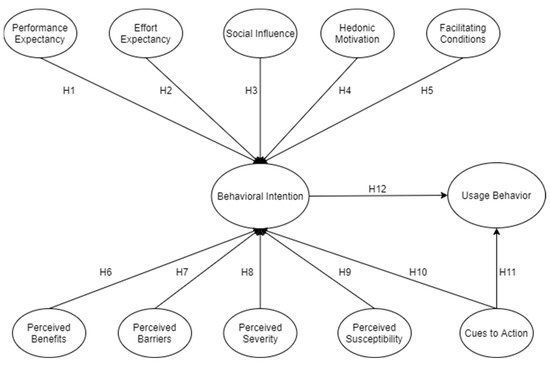
Figure 1.
The proposed conceptual framework.
3.1. Determinants of Behavioral Intentions and Usage of Online Grocery Apps Based on the UTAUT2 Model
Performance expectancy (PE) refers to the extent to which the use of technology will benefit customers in accomplishing specific activities. According to Venkatesh et al. [16], when new information technology is presented to a user and the user immediately learns how to use it, it improves performance. The user is more inclined to use this technology in the future. In a study by Chopdar et al. [32], performance expectancy was found to be the most significant factor in behavioral intentions to use shopping apps, validating the result of other studies [33]. Similarly, in the study of Chang et al. [34], it was found that performance expectancy has a significant effect on the behavioral intentions to use online hotel booking apps. Therefore, it was hypothesized that:
Hypothesis 1 (H1).
Performance expectancy (PE) would positively influence consumers’ behavioral intentions regarding the purchase of online groceries during the COVID-19 pandemic.
Effort expectancy (EE) refers to the level of effort required by users to use technology. According to Sun et al. [35], if new technology has a user-friendly design and can provide learning guidance, users are more likely to embrace and use it. Previous studies also proved that perceived ease of use is a major deciding factor for users to employ a new technology [33]. Considering these findings, it was hypothesized that:
Hypothesis 2 (H2).
Effort expectancy (EE) would positively influence consumers’ behavioral intentions regarding the purchase of online groceries during the COVID-19 pandemic.
Social influence (SI) refers to the consumer’s perception of the influence and power of other people (family, friends, and colleagues) on the use of new technology. Moore and Benbasat [36] explained that when a person perceives that new technology will influence the user to retain or improve his status or position in a group, he is more inclined to employ the technology. This claim was also proved by Chopdar et al. [32] that family members, peers, colleagues, celebrities, and other experienced users are likely to affect users’ behavioral intentions to use technology such as shopping apps. With this context, it was hypothesized that:
Hypothesis 3 (H3).
Social influence (SI) would positively influence consumers’ behavioral intentions regarding the purchase of online groceries during the COVID-19 pandemic.
Hedonic motivation (HM) refers to the enjoyment or delight obtained from employing the technology. According to Brown and Venkatesh [37], fun and enjoyment are two essential elements that encourage people to accept and use new technology. Similarly, in a study by Thong et al. [38], it was found that hedonic motivation could be managed and changed into a sense of pleasure, which had a positive effect on consumer adoption and the use of new technology. With this, it was hypothesized that:
Hypothesis 4 (H4).
Hedonic motivation (HM) would positively influence consumers’ behavioral intentions regarding the purchase of online groceries during the COVID-19 pandemic.
Facilitating conditions (FC) refers to the perception of consumers regarding the resources and assistance accessible to them to carry out a behavior. According to studies, users’ attitudes, experiences, and understanding of technology influence their desire to utilize it. This is also confirmed by the analysis of Oliveira et al. [39] that a good set of facilitating conditions such as resources and skills, related to the internet, will increase the likelihood of users using technology and applications. Several works of literature validate Venkatesh et al.’s findings that facilitating conditions influence the behavioral intentions to use online shopping apps in emerging market conditions. Tak and Panwar [40] found that favorable conditions aid in the use of mobile apps for shopping in India. Similarly, Alwahaishi and Snael [41] discovered a link between facilitating conditions and e-commerce adoption, later verified by Susanto et al. [42] in their UTAUT2 study in Indonesia. With this context, it was hypothesized that:
Hypothesis 5 (H5).
The facilitating condition (FC) would positively influence consumers’ behavioral intentions regarding purchasing online groceries during the COVID-19 pandemic.
3.2. The Determinants of Behavioral Intentions and the Usage of Online Grocery Apps Based on the Health Belief Model
Perceived benefits (PBN) refer to a person’s assessment of the efficacy of various approaches to reducing the risk of illness or disease. A person’s precautions to avoid contracting COVID-19 disease are determined by considering and evaluating both perceived benefit and vulnerability. The person accepts the recommended health intervention if it is regarded as beneficial, such as using online grocery apps instead of going to a brick-and-mortar grocery store. It was proven in a study by Walrave et al. [22] that the perceived benefits of COVID-19-related apps are associated with the respondents’ behavioral intentions. Therefore, it was hypothesized that:
Hypothesis 6 (H6).
The perceived benefits (PBN) would positively influence consumers’ behavioral intentions regarding the purchase of online groceries during the COVID-19 pandemic.
Perceived barriers (BR) refer to a person’s sentiments about the challenges of putting a recommended health practice into action. When promoting health-related behaviors such as using online groceries to prevent COVID-19 infection, it is critical to identify solutions to assist people in overcoming perceived barriers. According to Walrave et al. [22], perceived barriers are one type of factor that influences respondents’ willingness to utilize a contact-tracing app to contain COVID-19. Therefore, it was hypothesized that:
Hypothesis 7 (H7).
Perceived barriers (BR) would positively influence consumers’ behavioral intentions regarding the purchase of online groceries during the COVID-19 pandemic.
Perceived severity (SV) refers to a person’s sentiments about the seriousness of developing a disease or illness. The severity of a condition significantly affects health outcomes [43]. The study’s findings revealed that it is required to improve the severity perception of the condition to prevent and control the disease. Thus, perceived severity significantly contributed to protective behaviors such as using new technology during the COVID-19 pandemic [44]. Therefore, it was hypothesized that:
Hypothesis 8 (H8).
Perceived severity (SV) would positively influence consumers’ behavioral intentions regarding the purchase of online groceries during the COVID-19 pandemic.
Perceived susceptibility (SS) refers to a person’s assessment of the likelihood of developing an illness or disease. According to the WHO [45], the risk factors for COVID-19 include older people, pregnant women, and people with comorbidities and underlying conditions. The COVID-19 pandemic has unavoidably resulted in a significant increase in digital technologies [46]. According to Wong and Tang [47], perceived susceptibility has significantly affected the acceptance and usage of technologies and applications related to COVID-19. In similar studies used to measure the COVID-19 risk perception in populations involved with this pandemic, the perceived susceptibility is proven to have a high correlation with the usage of new technology as a protective behavior for COVID-19 [48,49,50]. Therefore, it was hypothesized that:
Hypothesis 9 (H9).
Perceived susceptibility (SS) would positively influence consumers’ behavioral intentions regarding the purchase of online groceries during the COVID-19 pandemic.
Cues to Action (CA) refers to the stimulus that must be present for a person to accept a recommended health action. In HBM, a signal or trigger is required to motivate people to engage in healthy behaviors [44]. According to Walrave et al. [22], cues to action would influence individuals to use an application or technology during the COVID-19 crisis. In a study by Wong and Tang [47], cues to action are among the major determining factors of SARS-preventive behaviors. Cues to action were also positively correlated with COVID-19 contact-tracing app use intention [22]. With this, it was hypothesized that:
Hypothesis 10 (H10).
Cues to Action (CA) would positively influence consumers’ behavioral intentions regarding the purchase of online groceries during the COVID-19 pandemic.
Hypothesis 11 (H11).
Cues to Action (CA) would positively influence consumers’ usage behavior regarding the purchase of online groceries during the COVID-19 pandemic.
Behavioral intentions (BI) refer to a user’s intentional plans to adopt or use a new technology or system, and they are thought to influence the actual usage behavior of users. Previous studies have demonstrated that behavioral intentions are the primary determinant and strongly influence the actual use behavior of users, especially in terms of new technology and systems [10,47,50]. Therefore, it was hypothesized that:
Hypothesis 12 (H12).
Behavioral intentions would positively influence consumers’ online grocery usage behavior during the COVID-19 pandemic.
4. Methodology
As presented in Figure 2, research conceptualization was performed to achieve the aim of the study. A critical review of the literature was performed for the preparation stage, and factors influencing the intention to accept and use online grocery shopping were identified. The reviewed literature provided a theoretical foundation for the study and laid the groundwork for developing the structured questionnaire. Before a complete distribution of the questionnaire, a preliminary run of 50 respondents through purposive sampling was done to determine the validity and reliability of the questionnaire. Moreover, Harman’s Single Factor Test was utilized to determine if there was a common method bias (CMB). The results showed no CMB and a value of 28.32%, from which the questionnaire was distributed for final data collection. The final stage involved the interpretation of results by analyzing the data to determine consumers’ behavioral intentions on the use of online groceries during the COVID-19 pandemic by integrating the UTAUT2 and health belief model.
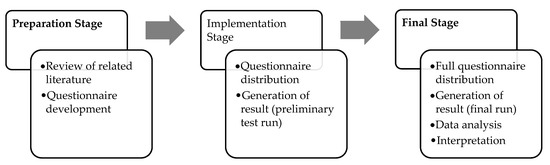
Figure 2.
The research conceptualization.
4.1. Measurement
The non-probability sampling method, a specifically purposive sampling using an online survey, was conducted in this study. The target respondents were users of online groceries during the COVID-19 pandemic. The online survey was conducted by self-administered type and distributed via a google form. The questionnaire was distributed with multiple cross-sectional designs, and the survey link was sent to the target respondents for two months (Aug–Sep 2021). The expected minimum number of respondents was 100, as suggested by the study of Yamane [51], where the level margin of error was set at 10. The present study, however, has collected 373 respondents. Thus, the gathered sample size is acceptable.
4.2. Questionnaire
The survey consists of 67-item questions. The demographics of the respondent were determined in the first section of the questionnaire using 10-item questions, including age, gender, area of residence, educational level, number of family members, total household monthly income, frequency of buying groceries, average amount spent on groceries, and preferred mode of payment for buying groceries.
The descriptive statistics of the respondents’ demographic information are shown in Table 2. Among the respondents, the majority are female (61%), between 31 and 40 years of age (34%), and have finished college or have a graduate degree (52%). In terms of location, it can be observed that the vast majority of the respondents reside in the city (68%). Regarding household income, most of the respondents earn a total household income of more than PHP 100,000 a month (52%), with a household size of 5 or more (52%). They purchase groceries twice a month (43%) and spend an average of PHP 8000–PHP 11,000 monthly (26%); their preferred mode of payment is usually cash (63%).
Table 2.
The respondents’ descriptive statistics (n = 373).
The result of the three-way cross-tabulation (see Table 3) of the demographic profile of respondents between age, gender, and household income suggests that the majority of users of online grocery apps are female adults with a total household monthly income of PHP 100,000 and above. This finding is supported by numerous studies that proved a significant gender gap in consumers’ purchasing behavior between males and females [52,53,54]. A study by Gutierrez and Jegasothy [55] found that for a typical Filipino family, female adults are the primary grocery shopper in the household. Similarly, the market research firm Food Dive [56] also found that females are taking the lead role as grocery shoppers (51%) compared to males (49%). The result also implies that the majority of the users of online grocery apps are middle-class consumers. This is because middle-class consumers have more access to technology and the internet. This also proves that increased affluence and mobile technology give consumers more connected buying experiences using online platforms such as online grocery apps.
Table 3.
The cross tabulation of age vs. gender vs. monthly income.
The second part of the questionnaire consists of the indicators based on the UTAUT2 model. It consists of 23-item questions where all answers are on a 5-point Likert scale ranging from strongly disagree to strongly agree. Five latent factors are used in the survey: performance expectancy, effort expectancy, social influence, facilitating conditions, and hedonic motivation. The measures for each latent factor are based on previous studies [11,17,32,57,58].
The indicators based on the health belief model make up the third section of the questionnaire. This is used to measure the acceptance and usage of online groceries during the COVID-19 pandemic. The survey consists of 34-item questions, where the responses range from strongly disagree to strongly agree on a 5-point Likert scale. Five latent factors are used in the survey, including perceived susceptibility, severity, barrier, benefits, and action cues. The measures for each latent factor are developed based on previous studies [21,59,60,61,62].
The last part of the questionnaire consists of the indicators regarding the purchase of online groceries apps’ behavioral intentions and usage behavior. The survey consists of 8-item questions where the responses ranges from strongly disagree to strongly agree on a 5-point Likert scale. The measures for behavioral intentions and usage behavior latency were developed following the studies of Driediger and Bhatiasevi [11], Chopdar et al. [32], and Yuen et al. [60]. The constructs and measurement items of the questionnaire are presented in Table 4.
Table 4.
The construct and measurement items.
4.3. Structural Equation Modeling
The data collected from the survey were analyzed using multivariate analysis. The data collected from the survey were analyzed using multivariate analysis. In this study, the SEM used is a variance-based partial least squares SEM (PLS-SEM) with maximum likelihood estimation. PLS-SEM is a tool for investigating the relationships between abstract concepts [64] that deals with complex constructs with higher levels of abstraction and produces higher construct reliability and validity, making it ideal for prediction [65] and applicable in this present study. Its primary goal is to maximize explained variance in the dependent constructs, but the data quality is also evaluated based on measurement model characteristics. According to Ouellette and Wood [66], PLS-SEM is different from previous modeling approaches since it considers both direct and indirect effects on presumptive causal links and is increasingly found in scientific investigations and studies. Moreover, PLS-SEM is the method of choice for theory development and prediction purposes, while CB-SEM is better for testing and confirming existing theories [64].
Several fit indices were utilized to justify the model fit in this study using PLS-SEM, such as standardized root mean square residual (SRMR), normal fit index (NFI), and Chi-square. For SRMS, a value of less than 0.08 is considered a good fit [67]. For NFI, according to Baumgartner and Homburg [68], a value of 0.80 and above represents an acceptable fit, while for Chis-square, a value below 5.0 indicates a well-fitting model.
Additionally, the R2 measures and the significance level of path coefficients are also determined. According to Hair et al. [64], an R2 value of 0.20 is considered high. By drawing a path diagram, path analysis was used to discover the causal relationship between the variables and quantify the relationship among multiple variables. The assumption that a variable can impact an outcome directly or indirectly via different variables is a typical function of path analysis [64].
5. Results
The graphical representation of a model in determining the factors affecting the behavioral intentions and usage of Filipinos for online groceries during the COVID-19 pandemic is presented in Figure 3. The model is comprised of 12 latent factors and 57 indicators. The model’s factor loading, reliability, and validity indicators are shown in Table 5. A reliability analysis needs to be carried out before structural equation modeling (SEM) is carried out. In analyzing behavioral intentions models, Cronbach’s alpha, composite reliability (CR), and average variance extracted (AVE) are used. Cronbach’s α and CR require a value higher than 0.7 [69], and AVE should be higher than 0.5 [70]. Since all values surpass the needed standards, each construct from this model can be considered valid and reliable.
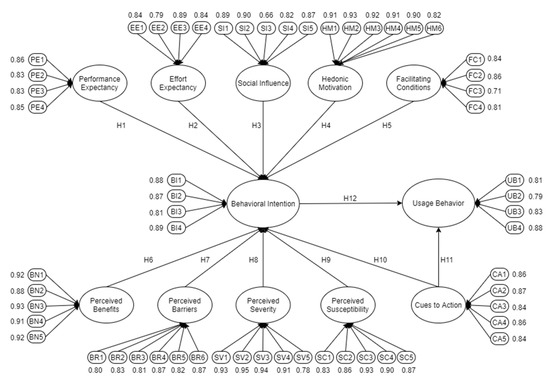
Figure 3.
The SEM for determining the factors affecting the intention to use online grocery apps.
Table 5.
The reliability and convergent validity results.
The PLS-SEM was performed to test the proposed hypotheses using Smart PLS v3.3.3. The results are shown in Table 6. It could be seen that usage behavior was significantly influenced by behavioral intentions (β = 0.454, p = 0.000) and cues to action (β = 0.227, p = 0.000). Moreover, the factors that positively influence the behavioral intentions to use online grocery apps are performance expectancy (β = 0.168, p = 0.002), perceived benefits (β = 0.239, p = 0.006), cues to action (β = 0.166, p = 0.028), and perceived severity (β = 0.210, p = 0.012). On the contrary, perceived barriers are found to have a negative influence on behavioral intentions (β = −0.136, p = 0.006).
Table 6.
The respondents’ hypothesis test.
It can be seen in the result of Table 6 that seven constructs were proven to have a positive influence on behavioral intentions (BI), and two constructs have a positive impact on usage behavior (UB). In contrast, three constructs were proven to negatively influence behavioral intentions (BI). Of the 12 proposed hypotheses, 7 were proven to significantly affect the behavioral intentions and usage behavior, indicating that the proposed model is robust [70]. The key determinants influencing behavioral intentions (BI) are perceived benefits (PBN), having the highest direct correlation value, followed by perceived severity (PSV) and performance expectancy (PE).
To prove the significant correlation between each factor and evaluate the measurement model, discriminant validity using the Fornell–Lacker criterion, and the Heterotrait–Monotrait ratio of correlation is performed as proposed by Henseler [71]. According to Hair et al. [64], discriminant validity has been confirmed when a value between two reflective constructs falls below 0.85 when using variance-based SEM for the Heterotrait–Monotrait ratio and when assigned constructs have a higher value than all the loadings of the other constructs for Fornell–Lacker. As reported in Table 7 and Table 8, the values are within the desired range, and the results indicate satisfactory reliability and convergent validity. Thus, the overall results among the constructs are accepted.
Table 7.
Discriminant validity: the Fornell–Lacker criterion.
Table 8.
The Heterotrait–Monotrait (HTMT) ratio.
The final SEM model is shown in Figure 4. To assess the hypothesis model, the beta coefficients and R2 value were determined. The model allocates 38.7% of the variation to intention to use and 36.9% of the variance to usage behavior. An R2 score of 0.20 is deemed high in this paper since it describes the behavioral intentions and usage behavior [64].
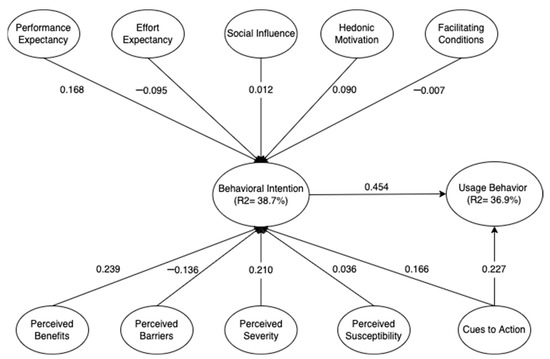
Figure 4.
The final SEM for determining the factors affecting the intention to use online grocery apps.
The model fit analysis was performed to show the validity of the suggested model. In this study, the model fit consisted of SRMR, Chi-square, and NFI, using model fit parameters from previous studies as a guide [67,68]. As reported in Table 9, all parameter estimates exceeded the minimum threshold value, confirming the proposed model to be valid.
Table 9.
The model fit.
Bootstrap samples are also drawn from modified sample data. This modification entails an orthogonalization of all variables and a subsequent imposition of the model-implied correlation matrix. According to Djisktra and Henseler [72], if more than 5% of the bootstrap samples produce discrepancy values greater than those of the actual model, it is plausible that the sample data come from a population that behaves under the hypothesized model. Thus, to show the model’s overall quality, dG and dULS were considered. These distance measurements relate more than one way to calculate the difference between two matrices to contribute to the model fitness index in PLS-SEM. The results showed the dG and dULS values of 1.449 and 4.830, respectively, reflecting a perfectly matched measurement model. This suggested that the quality of the model was appropriate and efficient to use for explaining the data [72].
6. Discussion
6.1. The Intention to Use Online Grocery Applications during the COVID-19 Pandemic
Physical interactions have decreased in several affected countries due to the COVID-19 pandemic. As a result, traditional brick-and-mortar retail was effectively halted, resulting in a substantial shift in consumer preference for online retailing and e-commerce. As newly established e-stores, online grocery stores still have a lot of room to improve regarding services, especially as the competition among different brands increases. To maintain a competitive advantage, having an understanding of digital consumers’ motivations and behavioral intentions to adapt their brands and services is necessary. Thus, the objective of this study is to understand consumers’ behavioral intentions in the Philippines regarding the use of online groceries during the COVID-19 pandemic by integrating the UTAUT2 and health belief model. Structural equation modeling (SEM) was utilized to determine factors affecting Filipinos’ behavioral intentions and usage of online grocery apps. Numerous latent factors were used in the analysis, such as performance expectancy (PE), effort expectancy (EE), social influence (SI), facilitating conditions (FC), hedonic motivation (HM), cues to action (CA), perceived benefits (BN), perceived barriers (BR), perceived severity (SV), and perceived susceptibility (SS).
From the results, it can be seen that behavioral intentions (BI) have the highest significant and direct effect on usage behavior (UB) (β = 0.454, p = 0.000), thereby supporting H12. This explains that users who have a strong intention to use online grocery apps are more likely to use such apps. According to the previous technology adoption literature, behavioral intentions are the primary determinants and strongly influence the actual usage behavior of users in terms of new technology and systems such as online grocery apps [10,50,73].
Cues to action (CA) were also proved to have a significant and direct effect on behavioral intentions (BI) (β = 0.156, p = 0.048) and usage behavior (UB) (β = 0.227, p = 0.000), thereby supporting H10 and H11, respectively. This explains that triggers such as COVID-19 infection may influence consumers to engage in health-promoting behaviors such as using online grocery apps instead of going to brick-and-mortar grocery stores. This finding is supported by several health-related studies that proved that cues to action significantly contribute to behavioral intentions and usage behavior. In a study by Walrave et al. [22], it was found that cues to action were found to positively correlate with the usage intention of contact-tracing apps in Belgium. Chua et al. [20] also proved that cues to action are directly associated with consumer behavioral intentions during the COVID-19 pandemic in Singapore. This finding implies that the risk of COVID-19 is one of the triggers for accepting online grocery apps. Thus, this finding could help retail businesses offer convenient services such as online grocery shopping combined with in-store pickup to improve both in-store and online transactions, especially during this pandemic.
Perceived benefit (BN) was also proved to have a significant direct effect on behavioral intentions (BI) (β = 0.234, p = 0.009), thereby supporting H8. This means that users believe that online grocery apps could help them prevent COVID-19 infection and reduce their risk of illness and disease. In addition, online grocery apps help promote safety and enable users to see better shopping alternatives that could help save them time and money. This was also proven in a study by Walrave et al. [22] that showed that the perceived benefits of COVID-19 related apps are associated with respondents’ usage behavior. The result implies that due to the COVID-19 quarantine, consumers’ way of buying items has changed. People will grow more cautious due to the COVID-19 pandemic, and many will continue to prefer purchasing online from the comfort of their own homes. Thus, this finding could influence businesses to offer flexible services to their customers by providing many choices regarding customer service, shipping, payment options, and other forms of transactions.
Performance expectancy (PE) was also proved to have a significant and direct effect on behavioral intentions (BI) (β = 0.179, p = 0.021), thereby supporting H1. This explains the fact that users find online grocery apps beneficial because they save them more time buying groceries and increase their chances of accomplishing things and tasks that are more important to them. Furthermore, they find online grocery favorable since it makes them less dependent on opening hours, especially in this pandemic where most establishments have shorter operating hours. The study by Chong [74] also supports this finding. Performance expectancy is the most influential factor in behavioral intentions toward shopping apps, validating the result of other studies [33]. Another study proved individuals’ performance expectations substantially impact their decision to use mobile services.
Similarly, in the study of Chopdar et al. [32], it was found that performance expectancy was a significant contributor to behavioral intentions to use mobile shopping apps. As a result, people now value the convenience of online shopping. While COVID-19’s limits may have made internet buying more tempting, this long-term trend will almost certainly continue. To take advantage of this, retail businesses must provide consumers with flexible policies and convenient omnichannel solutions.
Perceived severity (SV) was also proved to have a significant direct effect on behavioral intentions (BI) (β = 0.183, p = 0.093), thereby supporting H8. This suggests that people who think COVID-19 is more severe are more inclined to employ technology or systems that will promote health protection, such as using online groceries. This is an interesting finding since this study was conducted during the surge of Delta variants in the Philippines. The users perceived the strain of delt-variant as more severe, more contagious, and having a relatively high mortality rate; thus, users were more inclined to use online groceries due to the perceived severity of COVID-19. This finding is also supported by Wong et al. [47], who found that perceived higher severity of COVID-19 to the user’s health was significantly more likely to indicate the acceptance and usage of technology or apps to prevent the disease. As a result, even amid the epidemic, firms must continue to support marketing methods that drive consumer shopping desires by providing more purchase options, particularly policies that allow customers to obtain things with little contact.
On the other hand, perceived barriers (BR) were proved to have a negative direct effect on usage behavior (UB) (β = −0.140, p = 0.006), thereby not supporting H9. This implies that consumers do not find it hard to follow health-related behaviors to prevent COVID-19 infection, such as social distancing, regular hand sanitizing, and wearing of a face mask and face shield. This means that consumers are still willing to buy groceries from brick-and-mortar stores despite the inconvenience of safety restrictions and safety protocols.
On the contrary, effort expectancy (EE) was found to have no significant direct effect on behavioral intentions (BI) (β = −0.071, p > 0.05), thereby not supporting H2. This means that the perceived ease of use and interface design of online grocery shopping does not affect the intention of users to adopt the app. This is similar to Chang et al.’s [34] findings that proved that effort expectancy is insignificant to behavioral intentions to use online hotel booking. This is also supported by Human et al.’s [18] findings that demonstrated that effort expectancy did not have a significant influence on Mauritian behavioral intentions to adopt online grocery apps.
Social influence (SI) was also proved to have no significant and direct effect on behavioral intentions (B) (β = 0.012, p = 0.874), thereby not supporting H3. This shows that the influence of other people such as family members, friends, colleagues, and different influential personalities cannot affect an individual’s decision to use online grocery apps. This finding contradicts the results of Yang and Kim [75], who proved that social influence is one of the critical drivers of usage intentions towards mobile shopping services. This finding is noteworthy because online grocery apps are just an emerging technology in the Philippines. Thus, online grocery brands must invest in promoting and advertising their services to build better customer awareness. This finding is also supported by Chopdar et al. [32], who proved that social influence plays an insignificant role in influencing the intention to utilize mobile shopping apps.
Facilitation condition (FC) was also found to have no significant direct effect on behavioral intentions (BI) (β = −0.007, p > 0.05), thereby not supporting H5. This means that the available resources and assistance accessible to the users of online grocery do not affect their intention to use the app. This contrasts with Oliveira et al.’s [39] findings that a good set of facilitating conditions, such as resources and skills related to the internet, will increase users’ likelihood of using technology and applications. However, a similar finding supporting this result was observed by Human et al. [18], who proved that facilitating conditions do not significantly influence behavioral intentions to adopt online grocery apps.
Hedonic motivation (HM) was also found to have no significant direct effect on behavioral intentions (BI) (β = 0.090, p > 0.05), thereby not supporting H4. This implies that pleasure or enjoyment derived from using technology or apps such as online grocery apps does not affect the intention of users to adopt and use such apps. This means that consumers are still seeking pleasure and enjoyment in shopping in brick-and-mortar grocery stores compared to online grocery stores. This finding is also similar to the study of Piarna et al. [76], who found hedonic motivation to be an insignificant contributor to the behavioral intentions of Indonesian consumers to use online shopping.
Perceived susceptibility (SS) was also found to have no significant direct effect on usage behavior (UB) (β = 0.036, p > 0.05), thereby not supporting H9. This shows that users’ subjective perception of the risk of contracting COVID-19 does not affect their usage behavior of online grocery apps. This might imply that users of online grocery are not susceptible to COVID-19 since the majority of the respondents are of the younger generation between 31–40 y/o and are less susceptible to the risk of COVID, unlike older people, pregnant women, and individuals with comorbidities and underlying diseases.
In this study, several factors influenced the acceptance and usage of online groceries during the COVID-19 pandemic. The study’s findings were similar to the results of previous studies. In Indonesia, it was discovered that ease of use, usefulness, attitude, and reference group all had a statistically significant relationship with the intention and actual use of online grocery shopping platforms. However, perceived health risks were not found to be significantly correlated with respondents’ purchasing intent [77]. In Slovenia, behavioral intentions toward online shopping were analyzed under the COVID-19 pandemic and social isolation circumstances. The main findings show that performance expectancy continues to have the most significant influence on behavioral intentions, whereas the impact of social influence was not supported under these conditions [78]. In India, it was found that the spread of the COVID-19 pandemic had a significant impact on customers’ online purchasing behavior. The study’s findings will help businesses understand the impact of consumer technology adaptation, the perceived risk associated with online transactions, consumers’ level of trust in online technologies, and consumers’ online purchase intentions regarding grocery products [79].
The present study supports previous research recommendations for integrating the UTAUT2 model with other theories and identifying new context effects [16]. Furthermore, the study aligns with the call for future research into how the COVID-19 pandemic influences customer behavior in technology adoption [80]. The COVID-19 pandemic has created unique conditions in which researchers can address the complexity of technology adoption and use during the pandemic and advance theories and practices of individuals’ technology adoption and use after the pandemic.
6.2. The Relationship between Using Online Applications and Open Innovation
From the standpoint of the open innovation concept, the interaction of the customer and the retail market based on digital technologies can be described [81]. Open innovation is a concept that establishes a collaborative and open method for developing and delivering a new or considerably enhanced product or service [82]. New online company models adopt open innovation approaches to boost their sales channels through technological capability. Open innovation is also a critical component of retail firm distinction and relative appeal because it impacts people’s behaviors and attitudes [83,84]. Entrepreneurs are being drawn to a dynamic, cyclical, creative, and inventive company culture by new business models based on new technology in a fully capitalist and collaborative economy [85]. Technological capabilities are a critical component of new business models based on an open innovation strategy, and they are one of the most vital variables impacting online consumer pleasure [86]. According to Bolton et al. [87], minor changes over time are essential for open innovation. They can make a massive difference for retailers looking to distinguish their customer experience and improve relative attractiveness.
Businesses have used their innovation to address the challenges posed by the COVID-19 epidemic while also improving their relative appeal [88]. Due to the rapid spread of the COVID-19 epidemic and the advent of mobile internet technology, the e-commerce business has seen tremendous growth worldwide, with consumers quickly adapting to online buying methods. The COVID-19 pandemic has prompted customers to embrace technology and shop for groceries online. Online grocery shopping has risen tremendously in terms of volume and use as a result of technology’s pervasiveness and consumer convenience [79]. Consumer expectations and technical advancements in e-commerce necessitate that online businesses be at the forefront of technology innovation and constantly explore innovation techniques extending beyond their borders. Thus, online grocery businesses should be equipped with modern technologies such as cloud computing, the Internet of Things (IoT), and blockchain technology so that online retail businesses could have an innovative culture and consolidate their image, reputation, and consumer trust in the internet. Furthermore, an organizational culture’s foundation in open innovation provides business leadership capacity, allowing an organization to excel and become more competitive.
7. Conclusions
This is the first study to investigate the acceptance and use of online grocery shopping integrating UTAUT2 and HBM among consumers in the Philippines during the COVID-19 pandemic. Due to the COVID-19 pandemic, people in numerous countries restricted their physical interactions by imposing preventive measures to contain the virus, including social distancing, community lockdowns, and strict confinement measures. As a result, traditional brick-and-mortar retail was virtually put on hold, resulting in consumers’ significant shift to online retailing and e-commerce [24]. Thus, it is essential to understand consumers’ behavioral intentions in the Philippines regarding the use of online grocery apps during the COVID-19 pandemic by integrating the UTAUT2 and health belief model. A questionnaire was developed and distributed using the purposive sampling method to 373 Filipino consumers to determine factors affecting their intention to use and adopt online grocery apps.
By utilizing partial least square structural equation modeling (PLS-SEM), it was found that behavioral intentions and cues to action significantly influenced usage behavior. Moreover, the factors that positively influenced behavioral intentions to use online grocery apps were performance expectancy, perceived benefits, cues to action, and perceived severity. On the contrary, perceived barriers were found to negatively influence behavioral intentions. Furthermore, effort expectancy, social influence, hedonic motivation, facilitating condition, and perceived susceptibility were found to have no significant influence on behavioral intentions to use online grocery apps. Compared to previous research, this paper proposes a more comprehensive framework for explaining the intention to use online grocery apps.
The findings of this study can be used as a theoretical framework for future researchers of consumer behavior, e-commerce developers, and retailers of the grocery industry to enhance the innovation and services of online grocery applications. The results of this study may also be used and capitalized on by investors and managers to apply in strategizing when developing and marketing online grocery apps among consumers. Moreover, the framework of this study may be adopted and utilized by other online markets, even in different counties.
7.1. Practical and Managerial Implication
Understanding consumer behavior is critical for considering their decisions to buy groceries online. As a result, providing insights to producers and retailers of the grocery industry may aid in the discovery of significant ways to improve e-commerce technologies. The findings of this study may assist marketers and online retailers in improving their marketing strategies and sales performance, especially during COVID-19. The results may also assist online marketers in targeting existing and potential customers via an effective and efficient e-commerce platform system that provides convenience and lower costs. If online marketers provide user-friendly and engaging website interfaces, customers should easily control and understand their purchases. The findings of this study may also help the government better understand how to motivate people to meet their daily needs through online shopping platforms, reducing physical contact and slowing the spread of the virus. The results of this study may also be used and capitalized on by investors and managers to apply in strategizing when developing and marketing online grocery among consumers. Moreover, the framework of this study may also be adopted and utilized by other online markets, even in different counties.
7.2. Theoretical Implication
Research on known predictors of online purchasing behavior of consumers is critical during the COVID-19 pandemic because businesses must anticipate consumer behavior to gain a competitive edge throughout this worldwide crisis [89]. The present study integrated the UTAUT2 and HBM to determine factors affecting the behavioral intentions of Filipinos to use online grocery apps during the COVID-19 pandemic. Compared to previous research, this paper proposes a more comprehensive framework for explaining the intention to use online groceries. Compared to the findings in developed countries, the present study’s findings are novel and contradict the existing literature, which shows that some factors have significant effects on intention and usage behavior. Prior studies [18,76,78,90] found that effort expectancy, social influence, hedonic motivation, facilitating condition, and perceived susceptibility had a considerable impact on the decision-making process of customers when purchasing groceries from online applications. As a result, the present study’s findings add new insights by demonstrating that those factors had no significant effect on customers’ online grocery shopping purchase intention.
The findings of this study can be used as a theoretical framework for future researchers of consumer behavior [91,92], allowing for the implementation of e-commerce technologies for grocery shopping apps in the Philippines as part of an emerging economy.
7.3. Limits and Future Research Topics
This study has limitations that can be explored further in the future. The first is related to the issue of the distribution of respondents, which urban residents dominate. To better understand the consumer acceptance and usage of online grocery, it is recommended that future studies include more samples from diverse geographic backgrounds, providing a more accurate representation of Filipino consumers. Second, a non-probability sampling method was used in the study. Thus, future researchers could investigate differences in adaptive shopping during the COVID-19 pandemic based on psychographic segments across different product categories and store formats [93]. Lastly, the study did not consider moderating effects of socio-economic factors such as age, gender, income, and employment status. Hence, future researchers could replicate this study and consider these factors as moderators to confirm the hypotheses proposed in the study.
Author Contributions
Conceptualization, M.J.J.G., Y.T.P., S.F.P. and A.K.S.O.; methodology, M.J.J.G., Y.T.P., S.F.P. and A.K.S.O.; software, M.J.J.G., Y.T.P., S.F.P. and A.K.S.O.; validation; M.N.Y.; formal analysis, M.J.J.G., Y.T.P., S.F.P. and A.K.S.O.; investigation, M.J.J.G., Y.T.P., S.F.P. and A.K.S.O.; resources, M.J.J.G.; writing—original draft preparation, M.J.J.G., Y.T.P., S.F.P. and A.K.S.O.; writing—review and editing, M.N.Y., R.N. and A.A.N.P.R.; supervision, Y.T.P., S.F.P., M.N.Y., R.N. and A.A.N.P.R.; and funding acquisition, Y.T.P. and M.N.Y. All authors have read and agreed to the published version of the manuscript.
Funding
This research was funded by Mapúa University Directed Research for Innovation and Value Enhancement (DRIVE) (Funding No. FM-RS-03-02).
Institutional Review Board Statement
This study was approved by Mapua University Research Ethics Committees.
Informed Consent Statement
Informed consent was obtained from all subjects involved in the study.
Data Availability Statement
The data presented in this study are available on request from the corresponding author.
Acknowledgments
The researchers would like to extend their deepest gratitude to the respondents of this study despite the current COVID-19 inflation rate.
Conflicts of Interest
The authors declare no conflict of interest.
References
- Coppola, D. E-Commerce Worldwide—Statistics & Facts. Available online: https://www.statista.com/topics/871/online-shopping/ (accessed on 20 May 2021).
- Chevalier, S. Global Retail e-Commerce Sales 2014–2024. Available online: https://www.statista.com (accessed on 20 May 2021).
- Store, G.R. Company Insight—Top 50 Global Online Retailers 2019. Available online: https://store.globaldata.com/report/gdrt00012rl--company-insight-top-50-global-online-retailers-2019/ (accessed on 20 May 2021).
- Institute, F.M. The e-Tail Experience: What Grocery Shoppers Think about Online Shopping 2000—Executive Summary. Available online: http://www.fmi.org/e_business.etailexperience.htm (accessed on 20 May 2021).
- Saunders, N. Online Grocery & Food Shopping Statistics. Available online: https://www.onespace.com/blog/2018/08/online-grocery-food-shopping-statistics/ (accessed on 28 May 2021).
- Alaimo, L.S.; Fiore, M.; Galati, A. How the COVID-19 pandemic is changing online food shopping human behaviour in Italy. Sustainability 2020, 12, 9594. [Google Scholar] [CrossRef]
- Efrati, A. Instacart Swings to First Profit as Pandemic Fuels Surge in Grocery Delivery. Available online: https://www.theinformation.com/articles/instacart-swings-to-first-profit-as-pandemic-fuels-surgein-grocery-delivery (accessed on 27 April 2021).
- Kamiak, M.; Fox, M. Online Grocery Shopping: Consumer Motives, Concerns, and Business Models. Available online: http://firstmonday.org/issues/issue7_9/fox/index.html (accessed on 20 May 2021).
- Adalid, A. Top Online Grocery Delivery Manila Sites & Apps (Philippines). Available online: https://iamaileen.com/grocery-delivery-manila/ (accessed on 20 May 2021).
- Davis, F.D. Perceived usefulness, perceived ease of use, and user acceptance of information technology. MIS Q. 1989, 13, 319–340. [Google Scholar] [CrossRef] [Green Version]
- Driediger, F.; Bhatiasevi, V. Online grocery shopping in Thailand: Consumer acceptance and usage behavior. J. Retail. Consum. Serv. 2019, 48, 224–237. [Google Scholar] [CrossRef]
- Kian, T.P.; Loong, A.C.W.; Fong, S.W.L. Customer purchase intention on online grocery shopping. Int. J. Acad. Res. Bus. Soc. Sci. 2018, 8, 1579–1595. [Google Scholar] [CrossRef] [Green Version]
- Bauerová, R.; Klepek, M. Technology acceptance as a determinant of online grocery shopping adoption. Acta Univ. Agric. Silvic. Mendel. Brun. 2018, 66, 737–746. [Google Scholar] [CrossRef] [Green Version]
- Charness, N.; Boot, W.R. Technology, gaming, and social networking. In Handbook of the Psychology of Aging; Elsevier: Amsterdam, The Netherlands, 2016; pp. 389–407. [Google Scholar]
- Ain, N.; Kaur, K.; Waheed, M. The influence of learning value on learning management system use: An extension of UTAUT2. Inf. Dev. 2016, 32, 1306–1321. [Google Scholar] [CrossRef]
- Venkatesh, V.; Thong, J.Y.; Xu, X. Consumer acceptance and use of information technology: Extending the unified theory of acceptance and use of technology. MIS Q. 2012, 36, 157–178. [Google Scholar] [CrossRef] [Green Version]
- Van Droogenbroeck, E.; Van Hove, L. Adoption and usage of E-grocery shopping: A context-specific UTAUT2 model. Sustainability 2021, 13, 4144. [Google Scholar] [CrossRef]
- Human, G.; Ungerer, M.; Azémia, J.-A.J. Mauritian consumer intentions to adopt online grocery shopping: An extended decomposition of UTAUT2 with moderation. Manag. Dyn. J. South. Afr. Inst. Manag. Sci. 2020, 29, 15–37. [Google Scholar]
- LaMorte, W. The Health Belief Model. Available online: https://sphweb.bumc.bu.edu/otlt/mphmodules/sb/behavioralchangetheories/behavioralchangetheories2.html (accessed on 20 May 2021).
- Chua, G.; Yuen, K.F.; Wang, X.; Wong, Y.D. The Determinants of Panic Buying during COVID-19. Int. J. Environ. Res. Public Health 2021, 18, 3247. [Google Scholar] [CrossRef]
- Shahnazi, H.; Ahmadi-Livani, M.; Pahlavanzadeh, B.; Rajabi, A.; Hamrah, M.S.; Charkazi, A. Assessing preventive health behaviors from COVID-19: A cross sectional study with health belief model in Golestan Province, Northern of Iran. Infect. Dis. Poverty 2020, 9, 91–99. [Google Scholar] [CrossRef] [PubMed]
- Walrave, M.; Waeterloos, C.; Ponnet, K. Ready or not for contact tracing? Investigating the adoption intention of COVID-19 contact-tracing technology using an extended unified theory of acceptance and use of technology model. Cyberpsychol. Behav. Soc. Netw. 2021, 24, 377–383. [Google Scholar] [CrossRef]
- Bloomberg. Why the Philippines Just Became the Worst Place to be in Covid. Available online: https://www.bloomberg.com/news/articles/2021-09-29/why-the-philippines-just-became-the-worst-place-to-be-in-covid (accessed on 20 May 2021).
- OECD. E-Commerce in the Time of Covid-19. Available online: https://www.oecd.org/coronavirus/policy-responses/e-commerce-in-the-time-of-covid-19-3a2b78e8/ (accessed on 2 December 2021).
- Loxton, M.; Truskett, R.; Scarf, B.; Sindone, L.; Baldry, G.; Zhao, Y. Consumer Behaviour during Crises: Preliminary Research on How Coronavirus Has Manifested Consumer Panic Buying, Herd Mentality, Changing Discretionary Spending and the Role of the Media in Influencing Behaviour. J. Risk Financ. Manag. 2020, 13, 166. [Google Scholar] [CrossRef]
- O’Meara, L.; Turner, C.; Coitinho, D.C.; Oenema, S. Consumer experiences of food environments during the Covid-19 pandemic: Global insights from a rapid online survey of individuals from 119 countries. Glob. Food Secur. 2021, 32, 100594. [Google Scholar] [CrossRef] [PubMed]
- Venkatesh, V.; Morris, M.G.; Davis, G.B.; Davis, F.D. User acceptance of information technology: Toward a unified view. MIS Q. 2003, 27, 425–478. [Google Scholar] [CrossRef] [Green Version]
- Tong, K.K.; Chen, J.H.; Yu, E.W.y.; Wu, A.M. Adherence to COVID-19 Precautionary Measures: Applying the Health Belief Model and Generalised Social Beliefs to a Probability Community Sample. Appl. Psychol. Health Well-Being 2020, 12, 1205–1223. [Google Scholar] [CrossRef]
- Al-Sabbagh, M.Q.; Al-Ani, A.; Mafrachi, B.; Siyam, A.; Isleem, U.; Massad, F.I.; Alsabbagh, Q.; Abufaraj, M. Predictors of adherence with home quarantine during COVID-19 crisis: The case of health belief model. Psychol. Health Med. 2021, 27, 215–227. [Google Scholar] [CrossRef]
- Sharifikia, I.; Rohani, C.; Estebsari, F.; Matbouei, M.; Salmani, F.; Hossein-Nejad, A. Health belief model-based intervention on women’s knowledge and perceived beliefs about warning signs of cancer. Asia-Pac. J. Oncol. Nurs. 2019, 6, 431. [Google Scholar] [CrossRef]
- Qureshi, I.; Fang, Y.; Ramsey, E.; McCole, P.; Ibbotson, P.; Compeau, D. Understanding online customer repurchasing intention and the mediating role of trust–an empirical investigation in two developed countries. Eur. J. Inf. Syst. 2009, 18, 205–222. [Google Scholar] [CrossRef]
- Chopdar, P.K.; Korfiatis, N.; Sivakumar, V.; Lytras, M.D. Mobile shopping apps adoption and perceived risks: A cross-country perspective utilizing the Unified Theory of Acceptance and Use of Technology. Comput. Hum. Behav. 2018, 86, 109–128. [Google Scholar] [CrossRef] [Green Version]
- Lai, I.K.; Lai, D.C. User acceptance of mobile commerce: An empirical study in Macau. Int. J. Syst. Sci. 2014, 45, 1321–1331. [Google Scholar] [CrossRef]
- Chang, C.-M.; Liu, L.-W.; Huang, H.-C.; Hsieh, H.-H. Factors influencing online hotel booking: Extending UTAUT2 with age, gender, and experience as moderators. Information 2019, 10, 281. [Google Scholar] [CrossRef] [Green Version]
- Sun, S.; Lou, Y.; Chao, P.; Wu, C. A study on the factors influencing the users’ intention in human recruiting sites. J. Hum. Resour. Manag. 2008, 8, 1–23. [Google Scholar]
- Moore, G.C.; Benbasat, I. Development of an instrument to measure the perceptions of adopting an information technology innovation. Inf. Syst. Res. 1991, 2, 192–222. [Google Scholar] [CrossRef] [Green Version]
- Brown, S.A.; Venkatesh, V. Model of adoption of technology in households: A baseline model test and extension incorporating household life cycle. MIS Q. 2005, 29, 399–426. [Google Scholar] [CrossRef]
- Thong, J.Y.; Hong, S.-J.; Tam, K.Y. The effects of post-adoption beliefs on the expectation-confirmation model for information technology continuance. Int. J. Hum. -Comput. Stud. 2006, 64, 799–810. [Google Scholar] [CrossRef]
- Oliveira, T.; Faria, M.; Thomas, M.A.; Popovič, A. Extending the understanding of mobile banking adoption: When UTAUT meets TTF and ITM. Int. J. Inf. Manag. 2014, 34, 689–703. [Google Scholar] [CrossRef]
- Tak, P.; Panwar, S. Using UTAUT2 model to predict mobile app based shopping: Evidences from India. J. Indian Bus. Res. 2017, 9, 248–264. [Google Scholar] [CrossRef]
- Alwahaishi, S.; Snášel, V. Consumers’ acceptance and use of information and communications technology: A UTAUT and flow based theoretical model. J. Technol. Manag. Innov. 2013, 8, 61–73. [Google Scholar] [CrossRef] [Green Version]
- Susanto, P.; Abdullah, N.L.; Rela, I.Z.; Wardi, Y. Understanding e-money adoption: Extending the unified theory of acceptance and use of technology (UTAUT). Int. J. Appl. Bus. Econ. Res. 2017, 15, 335–345. [Google Scholar]
- Boskey, E. How the Health Belief Model Influences Your Health Choices. Available online: https://www.verywellmind.com/health-belief-model-3132721 (accessed on 20 May 2021).
- Mirzaei, M.; Mirzaei, M.; Mirzaei, M.; Bagheri, B. Changes in the prevalence of measures associated with hypertension among Iranian adults according to classification by ACC/AHA guideline 2017. BMC Cardiovasc. Disord. 2020, 20, 372. [Google Scholar] [CrossRef] [PubMed]
- World Health Organization. COVID-19 High Risk Groups. Available online: https://www.who.int/westernpacific/emergencies/covid-19/information/high-risk-groups#:~:text=COVID%2D19%20is%20often%20more%20severe%20in%20people%2060%2Byrs,who%20are%20at%20most%20risk (accessed on 2 December 2021).
- Pandey, N.; Pal, A. Impact of digital surge during Covid-19 pandemic: A viewpoint on research and practice. Int. J. Inf. Manag. 2020, 55, 102171. [Google Scholar]
- Wong, C.-Y.; Tang, C.S.-K. Practice of habitual and volitional health behaviors to prevent severe acute respiratory syndrome among Chinese adolescents in Hong Kong. J. Adolesc. Health 2005, 36, 193–200. [Google Scholar] [CrossRef] [PubMed] [Green Version]
- Kwok, K.O.; Li, K.-K.; Chan, H.; Yi, Y.Y.; Tang, A.; Wei, W.I.; Wong, Y. Community response during the early phase of COVID 19 epidemic in Hong Kong: Risk perception, information exposure and preventive measures. MedRxiv 2020, 26, 1574. [Google Scholar]
- Qian, M.; Wu, Q.; Wu, P.; Hou, Z.; Liang, Y.; Cowling, B.J.; Yu, H. Anxiety levels, precautionary behaviours and public perceptions during the early phase of the COVID-19 outbreak in China: A population-based cross-sectional survey. BMJ Open 2020, 10, e040910. [Google Scholar] [CrossRef]
- Taylor, S.; Todd, P.A. Understanding information technology usage: A test of competing models. Inf. Syst. Res. 1995, 6, 144–176. [Google Scholar] [CrossRef]
- Yamane, T. Statistics: An Introductory Analysis; Harper & Row: Manhattan, NY, USA, 1967. [Google Scholar]
- Bae, S.; Lee, T. Gender differences in consumers’ perception of online consumer reviews. Electron. Commer. Res. 2011, 11, 201–214. [Google Scholar] [CrossRef]
- Yang, B.; Lester, D. Gender differences in e-commerce. Appl. Econ. 2005, 37, 2077–2089. [Google Scholar] [CrossRef]
- Yang, C.; Wu, C.C. Gender differences in online shoppers’ decision-making styles. In e-Business and Telecommunication Networks; Springer: Berlin/Heidelberg, Germany, 2006; pp. 108–115. [Google Scholar]
- Gutierrez, B.P.B.; Jegasothy, K. Identifying shopping problems and improving retail patronage among urban filipino customers. Philipp. Manag. Rev. 2010, 17, 66–79. [Google Scholar]
- Macdonald, C. Study: Men Now Shop for Groceries as often as Women. Available online: https://www.fooddive.com/news/study-men-now-shop-for-groceries-as-often-as-women/441187/ (accessed on 2 December 2021).
- Prasetyo, Y.T.; Roque, R.A.C.; Chuenyindee, T.; Young, M.N.; Diaz, J.F.T.; Persada, S.F.; Miraja, B.A.; Perwira Redi, A.A.N. Determining Factors Affecting the Acceptance of Medical Education eLearning Platforms during the COVID-19 Pandemic in the Philippines: UTAUT2 Approach. Healthcare 2021, 9, 780. [Google Scholar] [CrossRef]
- Yuan, S.; Ma, W.; Kanthawala, S.; Peng, W. Keep using my health apps: Discover users’ perception of health and fitness apps with the UTAUT2 model. Telemed. E-Health 2015, 21, 735–741. [Google Scholar] [CrossRef] [PubMed]
- Tadesse, T.; Alemu, T.; Amogne, G.; Endazenaw, G.; Mamo, E. Predictors of Coronavirus Disease 2019 (COVID-19) prevention practices using health belief model among employees in Addis Ababa, Ethiopia. Infect. Drug Resist. 2020, 13, 3751. [Google Scholar] [CrossRef] [PubMed]
- Yuen, K.F.; Li, K.X.; Ma, F.; Wang, X. The effect of emotional appeal on seafarers’ safety behaviour: An extended health belief model. J. Transp. Health 2020, 16, 100810. [Google Scholar] [CrossRef]
- Bechard, L.E.; Bergelt, M.; Neudorf, B.; DeSouza, T.C.; Middleton, L.E. Using the Health Belief Model to Understand Age Differences in Perceptions and Responses to the COVID-19 Pandemic. Front. Psychol. 2021, 12, 1216. [Google Scholar] [CrossRef]
- Kamran, K.; Ali, A.; Villagra, C.; Siddiqui, S.; Alouffi, A.S.; Iqbal, A. A cross-sectional study of hard ticks (acari: Ixodidae) on horse farms to assess the risk factors associated with tick-borne diseases. Zoonoses Public Health 2021, 68, 247–262. [Google Scholar] [CrossRef]
- Bults, M.; Beaujean, D.J.; Richardus, J.H.; Voeten, H.A. Perceptions and behavioral responses of the general public during the 2009 influenza A (H1N1) pandemic: A systematic review. Disaster Med. Public Health Prep. 2015, 9, 207–219. [Google Scholar] [CrossRef]
- Hair, J.F.; Sarstedt, M.; Ringle, C.M.; Mena, J.A. An assessment of the use of partial least squares structural equation modeling in marketing research. J. Acad. Mark. Sci. 2012, 40, 414–433. [Google Scholar] [CrossRef]
- Dash, G.; Paul, J. CB-SEM vs PLS-SEM methods for research in Social Sciences and Technology forecasting. Technol. Forecast. Soc. Change 2021, 173, 121092. [Google Scholar] [CrossRef]
- Ouellette, J.A.; Wood, W. Habit and intention in everyday life: The multiple processes by which past behavior predicts future behavior. Psychol. Bull. 1998, 124, 54. [Google Scholar] [CrossRef]
- Hu, L.-t.; Bentler, P.M. Fit indices in covariance structure modeling: Sensitivity to underparameterized model misspecification. Psychol. Methods 1998, 3, 424. [Google Scholar] [CrossRef]
- Baumgartner, H.; Homburg, C. Applications of structural equation modeling in marketing and consumer research: A review. Int. J. Res. Mark. 1996, 13, 139–161. [Google Scholar] [CrossRef] [Green Version]
- Alarcón, D.; Sánchez, J.A.; De Olavide, U. Assessing convergent and discriminant validity in the ADHD-R IV rating scale: User-written commands for Average Variance Extracted (AVE), Composite Reliability (CR), and Heterotrait-Monotrait ratio of correlations (HTMT). In Proceedings of the Spanish STATA Meeting, Madrid, Spain, 22 October 2015. [Google Scholar]
- Bradley, J.V. Robustness? Br. J. Math. Stat. Psychol. 1978, 31, 144–152. [Google Scholar] [CrossRef]
- Henseler, J.; Ringle, C.M.; Sarstedt, M. A new criterion for assessing discriminant validity in variance-based structural equation modeling. J. Acad. Mark. Sci. 2015, 43, 115–135. [Google Scholar] [CrossRef] [Green Version]
- Dijkstra, T.K.; Henseler, J. Consistent and asymptotically normal PLS estimators for linear structural equations. Comput. Stat. Data Anal. 2015, 81, 10–23. [Google Scholar] [CrossRef] [Green Version]
- Venkatesh, V.; Davis, F.D. A theoretical extension of the technology acceptance model: Four longitudinal field studies. Manag. Sci. 2000, 46, 186–204. [Google Scholar] [CrossRef] [Green Version]
- Chong, A.Y.-L. A two-staged SEM-neural network approach for understanding and predicting the determinants of m-commerce adoption. Expert Syst. Appl. 2013, 40, 1240–1247. [Google Scholar] [CrossRef]
- Yang, K.; Kim, H.Y. Mobile shopping motivation: An application of multiple discriminant analysis. Int. J. Retail Distrib. Manag. 2012, 40, 778–789. [Google Scholar] [CrossRef]
- Piarna, R.; Fathurohman, F.; Purnawan, N.N. Understanding online shopping adoption: The unified theory of acceptance and the use of technology with perceived risk in millennial consumers context. JEMA J. Ilmiaj Bid. Akunt. Dan Manaj. 2020, 17, 51–66. [Google Scholar] [CrossRef] [Green Version]
- Warganegara, D.L.; Babolian Hendijani, R. Factors that drive actual purchasing of groceries through e-commerce platforms during COVID-19 in Indonesia. Sustainability 2022, 14, 3235. [Google Scholar] [CrossRef]
- Erjavec, J.; Manfreda, A. Online shopping adoption during COVID-19 and social isolation: Extending the UTAUT model with herd behavior. J. Retail. Consum. Serv. 2022, 65, 102867. [Google Scholar] [CrossRef]
- Habib, S.; Hamadneh, N.N. Impact of perceived risk on consumers technology acceptance in online grocery adoption amid covid-19 pandemic. Sustainability 2021, 13, 10221. [Google Scholar] [CrossRef]
- Naeem, M.; Ozuem, W. The role of social media in internet banking transition during COVID-19 pandemic: Using multiple methods and sources in qualitative research. J. Retail. Consum. Serv. 2021, 60, 102483. [Google Scholar] [CrossRef]
- Mikheev, A.A.; Krasnov, A.; Griffith, R.; Draganov, M. The interaction model within Phygital environment as an implementation of the open innovation concept. J. Open Innov. Technol. Mark. Complex. 2021, 7, 114. [Google Scholar] [CrossRef]
- Turoń, K. Open innovation business model as an opportunity to enhance the development of sustainable shared mobility industry. J. Open Innov. Technol. Mark. Complex. 2022, 8, 37. [Google Scholar] [CrossRef]
- Valdez-Juárez, L.E.; Gallardo-Vázquez, D.; Ramos-Escobar, E.A. Online buyers and open innovation: Security, experience, and satisfaction. J. Open Innov. Technol. Mark. Complex. 2021, 7, 37. [Google Scholar] [CrossRef]
- Illescas-Manzano, M.D.; Vicente López, N.; Afonso González, N.; Cristofol Rodríguez, C. Implementation of chatbot in online commerce, and open innovation. J. Open Innov. Technol. Mark. Complex. 2021, 7, 125. [Google Scholar] [CrossRef]
- van de Vrande, V.; de Jong, J.P.J.; Vanhaverbeke, W.; de Rochemont, M. Open innovation in smes: Trends, Motives and Management Challenges. Technovation 2009, 29, 423–437. [Google Scholar] [CrossRef] [Green Version]
- Yun, J.H.J.; Won, D.K.; Park, K.B. Entrepreneurial cyclical dynamics of open innovation. J. Evol. Econ. 2018, 28, 1151–1174. [Google Scholar] [CrossRef]
- Bolton, R.; Gustafsson, A.; McColl-Kennedy, J.J.; Sirianni, N.; Tse, D.K. Small details that make big differences. J. Serv. Manag. 2014, 25, 253–274. [Google Scholar] [CrossRef] [Green Version]
- Pilawa, J.; Witell, L.; Valtakoski, A.; Kristensson, P. Service innovativeness in retailing: Increasing the relative attractiveness during the COVID-19 pandemic. J. Retail. Consum. Serv. 2022, 67, 102962. [Google Scholar] [CrossRef]
- Prasetyo, Y.T.; Tanto, H.; Mariyanto, M.; Hanjaya, C.; Young, M.N.; Persada, S.F.; Miraja, B.A.; Redi, A.A. Factors affecting customer satisfaction and loyalty in online food delivery service during the COVID-19 pandemic: Its relation with open innovation. J. Open Innov. Technol. Mark. Complex. 2021, 7, 76. [Google Scholar] [CrossRef]
- Chin, S.-L.; Goh, Y.-N. Consumer Purchase Intention Toward Online Grocery Shopping: View from Malaysia. Glob. Bus. Manag. Res. Int. J. 2017, 9, 221–238. [Google Scholar]
- Balinado, J.R.; Prasetyo, Y.T.; Young, M.N.; Persada, S.F.; Miraja, B.A.; Perwira Redi, A.A. The effect of service quality on customer satisfaction in an automotive after-sales service. J. Open Innov. Technol. Mark. Complex. 2021, 7, 116. [Google Scholar] [CrossRef]
- German, J.D.; Redi, A.A.; Prasetyo, Y.T.; Persada, S.F.; Ong, A.K.; Young, M.N.; Nadlifatin, R. Choosing a package carrier during COVID-19 pandemic: An integration of pro-environmental planned behavior (PEPB) theory and Service Quality (SERVQUAL). J. Clean. Prod. 2022, 346, 131123. [Google Scholar] [CrossRef]
- Prasetyo, Y.T.; Dewi, R.S.; Balatbat, N.M.; Antonio, M.L.; Chuenyindee, T.; Perwira Redi, A.A.; Young, M.N.; Diaz, J.F.; Kurata, Y.B. The evaluation of preference and perceived quality of health communication icons associated with covid-19 prevention measures. Healthcare 2021, 9, 1115. [Google Scholar] [CrossRef] [PubMed]
Publisher’s Note: MDPI stays neutral with regard to jurisdictional claims in published maps and institutional affiliations. |
© 2022 by the authors. Licensee MDPI, Basel, Switzerland. This article is an open access article distributed under the terms and conditions of the Creative Commons Attribution (CC BY) license (https://creativecommons.org/licenses/by/4.0/).