


Abstract
Artificial intelligence (AI) is a powerful technology that can be utilized throughout a construction project lifecycle. Transition to incorporate AI technologies in the construction industry has been delayed due to the lack of know-how and research. There is also a knowledge gap regarding how the public perceives AI technologies, their areas of application, prospects, and constraints in the construction industry. This study aims to explore AI technology adoption prospects and constraints in the Australian construction industry by analyzing social media data. This study adopted social media analytics, along with sentiment and content analyses of Twitter messages (n = 7906), as the methodological approach. The results revealed that: (a) robotics, internet-of-things, and machine learning are the most popular AI technologies in Australia; (b) Australian public sentiments toward AI are mostly positive, whilst some negative perceptions exist; (c) there are distinctive views on the opportunities and constraints of AI among the Australian states/territories; (d) timesaving, innovation, and digitalization are the most common AI prospects; and (e) project risk, security of data, and lack of capabilities are the most common AI constraints. This study is the first to explore AI technology adoption prospects and constraints in the Australian construction industry by analyzing social media data. The findings inform the construction industry on public perceptions and prospects and constraints of AI adoption. In addition, it advocates the search for finding the most efficient means to utilize AI technologies. The study helps public perceptions and prospects and constraints of AI adoption to be factored in construction industry technology adoption.
Keywords:
industry 4.0; automation; robotics; digital twin; machine learning; big data; social media analytics 1. Introduction
Artificial intelligence (AI) technologies have been widely adopted in many industry sectors [1,2,3]. Among those, the adoption level is significantly lower in the Australian construction industry. The Australian construction industry generates approximately 360 billion in revenue, accounting for 9% of the country’s gross domestic product (GDP), and it is expected to grow to 11.5% of the total GDP in the next five years [4]. Nonetheless, its productivity has only increased by 1% over the past two decades. Thus, there are growing concerns regarding efficiency in the industry [5]. The slow growth is a direct result of the fundamental rules and characteristics of the construction market. The cyclical demand is further compounded, leading to low capital investment and limited standardization [6].
In response to the slow growth, the need for investment and research into AI technologies is being explored to streamline the processes and increase productivity [1,2,3]. The benefits that AI can bring to the construction industry include preventing cost overruns, improving site safety, and managing projects efficiently [7,8,9,10,11]. There has already been substantial growth in the following AI areas of big data and analytics, robotics, automation, data integration, and wearable technology [12,13].
Implementing AI technologies and realizing the benefits it may bring is difficult. Most algorithms require accurate data for training, and collecting data is costly and time-consuming at the beginning [2,14,15]. The implementation of AI in construction remains in the initial stages, even though some larger construction companies have already begun to enjoy the benefits of these technologies. This has resulted in an increased debate on the future of the construction workforce and how AI will impact jobs [16].
Despite the increasing importance of AI for the construction industry, there are only limited studies investigated the AI adoption prospects and constraints in the construction industry [17,18,19]. Although the industry transforms slowly to digitalize the construction process, firms have an increasing interest when they realize the benefits of AI-powered algorithms and analytics [20,21]. Nonetheless, there are growing but still limited studies reported in the international literature [22,23,24,25], and only a few of them look at this issue in the context of Australia [26,27].
A knowledge gap remains regarding how the public perceives the implementation of AI technologies. In addition, how they feel about the extensive application of automated technologies producing sustainable outcomes and making traditional jobs obsolete [7,28,29,30]. A good understanding of the public perception of AI technologies will inform governing bodies how to respond adequately to public demands and figure out the most efficient ways to implement AI without disrupting traditional work processes [31]. Therefore, it is necessary to study how AI directly interacts with individuals and how different AI technologies can positively or negatively impact individuals or companies in the construction industry.
This study, hence, focuses on the public perception of AI technologies and discusses the prospects and constraints that AI technologies may bring in Australia. We use the social media analytics method and conduct an opinion and content analysis of location-based Twitter messages from Australia. Following this introduction section, Section 2 introduces the methodological approach of the study. Section 3 presents the results of the analysis and observes the data that were collected. Section 4 discusses the study findings, general insights, research limitations, and future research recommendations. Lastly, Section 5 states the final remarks of the paper.
2. Methodology
We investigated the public perception of AI as it becomes more frequently used on construction sites, and project success in the future will be highly dependent on the efficient use of these technologies. The reasons behind this selection include: (a) some of Australia’s major construction firms have begun to realize the benefits of AI. These firms successfully adopt AI for their projects to save costs and time; (b) Australia is developing a national AI strategy and roadmap, meaning that AI uptake in cities and industries is planned to avoid solely organic occurrence; (c) the use of social media in Australia is very popular, making it a source of information that can provide a generalized perception of AI in the construction industry. The number of internet users who use social media daily continues to grow in 2021; at present, 79.9% of the Australian population uses social media. This saw an increase of 8.8% in social media usage from 2020. Around 56% of people go online more than 10 times a day, and 26% of people go online more than 20 times a day. Among 79.9% of internet users that use social media, 20% of them have accessed Twitter, and one-third of them tweet daily [32]; (d) Although social media produce an abundance of data regarding AI in Australia, there are not any, to our knowledge, studies investigate the public perception of AI in the construction industry.
Instead of using a traditional data collection method, we employ the social media analysis for this research. As more people use social media to communicate and express their opinions, it has become a source of qualitative data [33]. This data collection method has been used in a wide range of research. Social media allows researchers to engage with a large group of people in an unbiased setting [34]. In addition, researchers can engage with people from a broad geographic area according to user locations, which are tagged in their posts [35].
Twitter was the only social media platform used to obtain data as it’s a micro-blogging site. Among the four types of social media services, micro-blogging sites, specifically Twitter, collect information for sentiment analysis [36]. Twitter is one of the ten most visited websites that enable users to post and interact with short messages. The platform allows for opinion and provides very valuable information to scholars. Conducting a sentiment analysis on other social media platforms is not favorable as data are not readily available, unstructured, and often used in short form. This makes the data harder to be analyzed.
A geo-Twitter analysis has proven to be a successful data collection method. The research method is efficient in analyzing public opinions [37]. It offers an insight into new AI technologies that are developing and/or currently being used on construction sites through real-time information [38]. For instance, social media analytics safeguards Australian cities and their residents from the coronavirus outbreak (COVID-19) in 2020 [39].
Initially, sentiment and content analysis were computed for the total number of location-based Twitter messages. To do this, the original dataset was obtained from the QUT Digital Observatory on 5 April 2021 (https://www.qut.edu.au/research/why-qut/infrastructure/digital-observatory). By using five data filtering processes—i.e., frequency analysis, location, date, bot, and relevance filters—11,365 tweets were filtered down to 7906 tweets.
We selected a two-year period from 1 July 2019 to 1 July 2021 for analysis and removed all tweets outside Australia. The reason behind a two-year period was that a one-year period could not provide enough data for analysis or derive objective quantitative results from texts. In addition, a three-year period would not be able to capture the latest trends, as AI in construction is developing fast and public perception changes rapidly. Thus, a two-year period reflected more accurately people’s sentiment towards AI in construction. The bot filter is employed to remove tweet repetition.
Secondly, to identify the main themes of tweets about AI applications in the construction industry, NVivo was also used to undertake the content analysis and to analyze word frequency, concepts, and technologies. Next, we conduct a word co-occurrence analysis on tweets that discuss AI technologies and construction-related ideas (or AI application areas).
Fourthly, we conducted a spatial analysis to complement the content analysis. The tweets are classified according to themes, concepts, and technologies based on locations. This allows us to know more about Australia’s most popular themes, concepts, and technologies in each state/territory. We used ArcGIS Pro software to visualize the spatial information. The relevance criteria were used to identify tweets related to or discussed AI technologies in construction-related concepts, noting key sentiment words. The scale adopted was as follows: 1 = very positive sentiment, 2 = positive sentiment, 3 = neutral sentiment, 4 = negative sentiment, 5 = very negative sentiment. We then processed these words via Weka software, which created a dataset for further analysis. We showcased the sensitivity of these specific words via Random Tree and Random Forest functions.
Finally, a network analysis was created to present the relationship between AI themes, concepts, and the relationships between AI technologies. In this analysis, we used Gephi software to understand the nodes and edges relationship found in the tweets. Figure 1 shows the research process that was used as the research model.
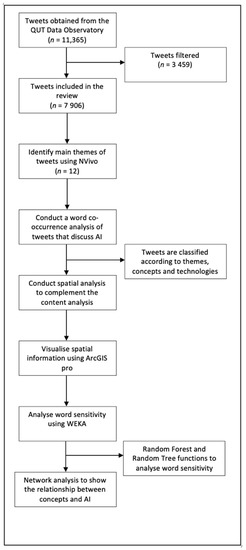
Figure 1.
Process of conducting a sentiment analysis.
3. Results
3.1. General Observations
Among 7906 tweets, 39% (n = 2997) were from New South Wales (NSW), followed by 28% (n = 2214) from Victoria (VIC), 19% (n = 1540) from Queensland (QLD), 5% (n = 426) from Western Australia (WA), 5% (n = 364) from South Australia (SA), 3% (n = 258) from Australian Capital Territory (ACT), 1% (n = 55) from Tasmania (TAS), and 1% (n = 52) from Northern Territory (NT) (Figure 2). Compared to other states and territories, ACT and TAS only recorded 55 and 52 tweets, which represented a negligible percentage of 1%. This reveals a low public interest in ACT and TAS community regarding AI-related technologies in the construction industry. A wide range of hashtags was used in the circulated tweets. Among them, tags such as #Industry4.0, #AIconstruction, #IoT, #Predictiveanalytics, #Robotics, #MachineLearning, #Bigdata, #BIM, #Fourththindustryrevolution, #Datamining, and #Automation were the most popular keywords.
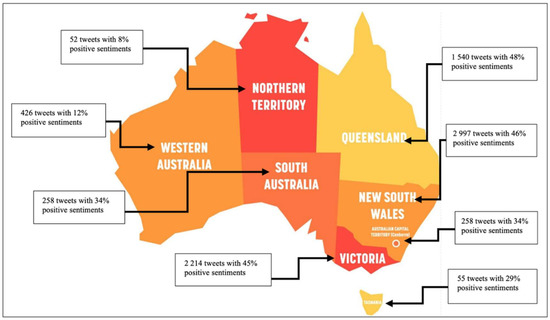
Figure 2.
Tweet numbers and positive sentiment percentages by states and territories.
3.2. Community Sentiments
Out of the 7907 tweets, 49% (n = 3396) of them were positive about AI technologies and application within the context of construction. An analysis of positive sentiment in each state and territory is shown in Figure 2.
Around 37% (n = 3085) were negative towards AI in construction. An analysis of negative sentiment in each state and territory is shown in Figure 3.
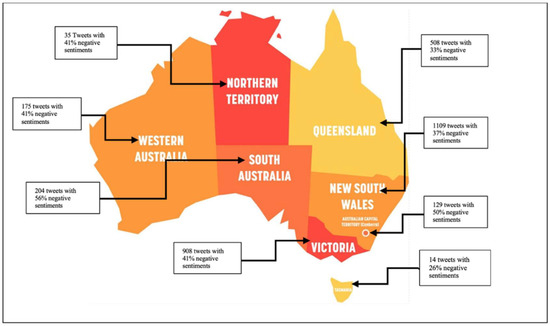
Figure 3.
Tweet numbers and negative sentiment percentages by states and territories.
Furthermore, around 14% (n = 1425) of tweets were neutral, where such tweets only used a set of hashtags to express their ideas rather than comments with elaboration. An analysis of neutral sentiment in each state and territory is shown in Figure 4. In addition, Table 1 is an overview of the sentiment analysis of each state and territory, from very positive sentiment to very negative sentiment.
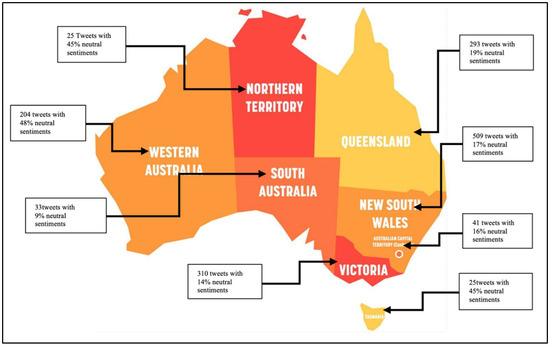
Figure 4.
Tweet numbers and neutral sentiment percentages by states and territories.

Table 1.
Tweet sentiment in percentages per state/territory.
The tweets from NSW (n = 2997) and QLD (n = 1540) recorded positive sentiment of 46% and 48%, respectively. Both states were the most positive towards AI. VIC had the second-highest number of tweets (n = 2214) with 45% (n = 996) positive and 41% (n = 908) negative, respectively. Out of the 55 tweets from TAS, 45% (n = 25) were neutral. The remaining states perceived AI in construction as negative. From the tweets originating from WA (n = 426) and ACT (n = 258), 41% and 50% were negative, respectively. Out of the 364 tweets from SA, 35% (n = 127) were positive, and 204 (56%) were negative. NT had the lowest number of tweets relating to AI in construction. Among them, 8% (n = 4) were positive, and 74% (n = 38) were negative. NT was the state with the highest percentage of negative sentiment as it was viewed as disruptive to the industry. Example tweets for each sentiment category are given in Table 2.
Table 2.
Example tweets from each sentiment category.
3.3. Artificial Intelligent Technologies in Construction
By counting word frequency, we identified 12 key AI-related construction technologies (Figure 5 and Table 3), including ‘artificial intelligence’ (n = 341), ‘automation’ (n = 475), ‘big data’ (n = 457), ‘blockchain’ (n = 147), ‘deep learning’ (n = 406), ‘digital twin’ (n = 44), ‘IoT’ (n = 562), ‘machine leaning’ (n = 522), ‘robotics’ (n = 931), ‘risk predictive modelling’ (n = 55), ‘simulation’ (n = 13), and ‘virtual learning’ (n = 75).
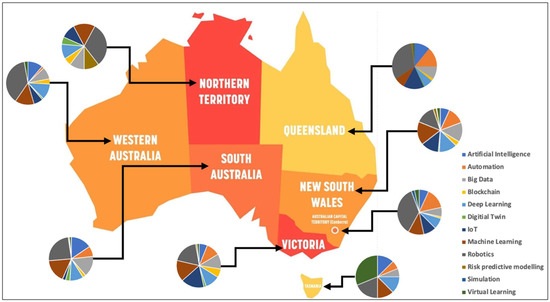
Figure 5.
Distribution of tweets about AI technologies in construction per state/territory.
Table 3.
Distribution of tweets by AI technologies in construction per state/territory.
The popularity of each construction technology is different in each state and territory. For instance, there were more tweets in NSW about ‘big data’ (n = 169) than QLD (n = 123). Conversely, ‘robotics’ was around three times more popular (n = 431) in QLD than in VIC (n = 198). Furthermore, different states had different popular topics of AI technologies. For example, ‘machine learning’ (n = 194) was the most popular tweet related to AI construction technology in NSW. While ‘robotics’ (n = 198) was the most tweets AI construction technology in VIC, ‘robotics’ was the most tweeted technology in WA (n = 67), SA (n = 31), ACT (n = 31), and NT (n = 6). ‘Virtual Learning’ (n = 6) was comparatively high among the tweets circulated in TAS. Table 4 provides examples of tweets that were related to each technology.
Table 4.
Example tweets for AI technologies in construction.
3.4. Prospects of Artificial Intelligence Technologies in Construction
Based on word frequency, 12 prospects that AI technologies will bring to a construction site were identified from AI related tweets (Figure 6 and Table 5). These include ‘accountability’ (n = 51), ‘accuracy’ (n = 66), ‘consistency’ (n = 37), ‘cost reduction’ (n = 138), ‘digitalization’ (n = 767), ‘efficiency’ (n = 109), ‘innovation’ (n = 691), ‘productivity’ (n = 232), ‘quality’ (n = 73), ‘reliability’ (n = 35), ‘safety’ (n = 84), and ‘time saving’ (n = 294).
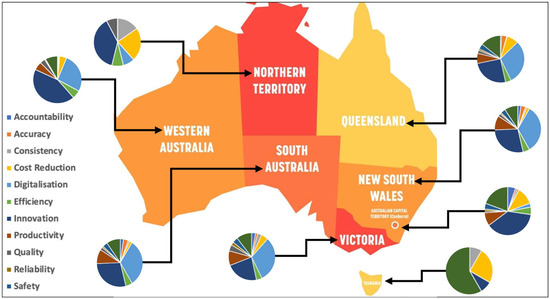
Figure 6.
Distribution of tweets by the prospects of AI technologies in construction per state/territory.
Table 5.
Distribution of tweets by the prospects of AI technologies in construction per state/territory.
Digitalization (n = 767) was the most discussed construction prospect derived from AI-related tweets, but its usability differed from one state/territory to another. While digitalization was the most popular tweets technology concept in NSW (n = 317), QLD (n = 156), VIC (n = 246), and SA (n = 37), TAS’s most tweeted technology prospect was ‘timesaving’ (n = 7). ‘Innovation’ was the most tweeted concept in ACT (n = 15) and WA (n = 62). Although there were fewer tweets in NT, most were related to the prospect of ‘innovation’ (n = 5). Table 6 provides examples of tweets related to AI technologies and prospects.
Table 6.
Example tweets of prospects of AI technologies in construction per state/territory.
3.5. Constraints of Artificial Intelligence Technologies in Construction
A word frequency analysis was also conducted for the 12 constraints that derived from AI related tweets (Figure 7 and Table 7). These included ‘complexity’ (n = 96), ‘disruptiveness’ (n = 90), ‘higher initial costs’ (n = 48), ‘higher variability’ (n = 53), ‘implementation’ (n = 76), ‘lack of capabilities’ (n = 110), ‘lack of cohesion’ (n = 33, ‘project risk’ (n = 93), ‘resistance’ (n = 73), ‘security of data’ (n = 156), and ‘unstructured environment’ (n = 95).
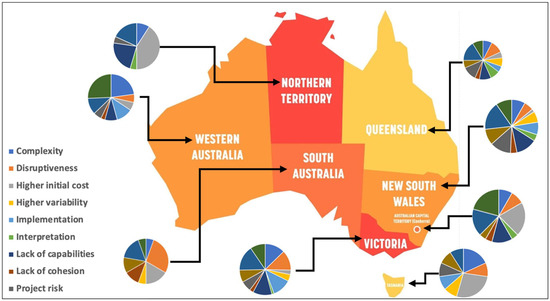
Figure 7.
Distribution of tweets by the constraints of AI technologies in construction per state/territory.
Table 7.
Distribution of tweets by the constraints of AI technologies in construction per state/territory.
Security of data was the most discussed constraint in AI-related tweets, but its usability differed from one state/territory to another. While ‘security of data’ (n = 156) was the most tweeted AI constraint in NSW (n = 32), VIC (n = 21) and QLD (n = 27), ‘unstructured environment’ was the most popular constraint concept in WA (n = 9) and ACT (n = 5). Tweets from SA had more discussions related to ‘disruptiveness’ (n = 5), while ‘higher initial costs’ were predominately discussed in TAS (n = 3) and NT (n = 9). Table 8 provides examples of tweets related to AI technologies and prospects.
Table 8.
Example tweets of constraints of AI technologies in construction per state/territory.
3.6. Prospects and Constraints of AI Technologies in Australian States/Territories
Understanding the public perception of prospects and constraints that AI technologies may bring onto a construction site was at the forefront of this study. A word co-occurrence analysis was conducted, which identified the number of tweets that mentioned an AI technology and prospect or constraint.
Figure 8 and Figure 9 represent the network topography developed based on word co-occurrence analysis. This network typology was initially generated by using Gephi software. Nonetheless, due to the crowdedness of the original figure, a less complex version was recreated by only showing the stronger relationships that occurred between AI technologies and prospect or constraints concepts. As the number of total tweets from prospects was 1319 and constraints was 609, we made two separate connection measurements. We identified a connection between 20 and 29 as more as semi-strong, from 30 to 39 as strong, and 40 or more as very strong. Furthermore, for constraints, we identified between 10 to 15 as semi-strong, from 16 to 20 as strong, and 20 or more as very strong.
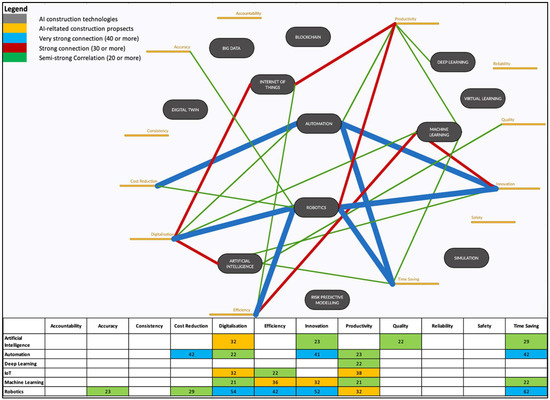
Figure 8.
Relationship between AI technologies and their prospects.
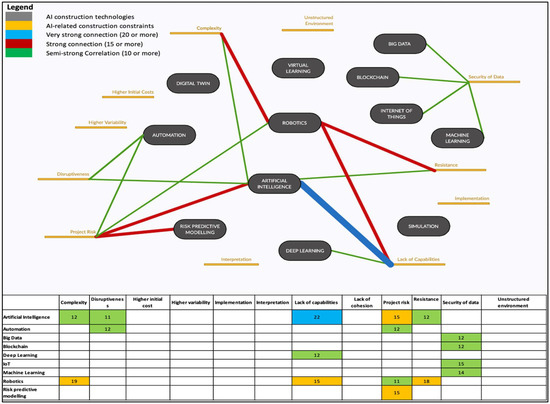
Figure 9.
Relationship between AI technologies and their constraints.
3.6.1. Prospects in Relations to AI Technologies
As shown in Table 9, ‘robotics’ (n = 325) was the AI technology that will have the most positive influence over a construction site. This technology has a close relationship with the following prospects: ‘time saving’ (n = 62), ‘digitalization’ (n = 54), ‘innovation’ (n = 52), and ‘efficiency’ (n = 42). Secondly, the AI technology that was discussed most was ‘automation’ (n = 222), which had a close relationship with ‘digitalization’ (n = 32), ‘time saving’ (n = 29), innovation (n = 23), and ‘quality’ (n = 22). The third popular technology was ‘machine learning’ (n = 162) as it will have a positive impact in construction by increased ‘efficiency’ (n = 36), ‘innovation’ (n = 32), ‘timesaving’ (n = 22), ‘digitalization’ (n = 21), and ‘productivity’ (n = 21).
Table 9.
Distribution of tweets by the prospects of AI technologies.
The relationship among the AI-related technologies and prospect—such as ‘reliability’ (n = 26), ‘consistency’ (n = 28), ‘safety’ (n = 40), ‘quality’ (n = 45), and ‘accountability’ (n = 46)—were frequently identified in relation to positive attributes that AI technologies can bring to the urban built environment. The tweets related to ‘IoT’ (n = 160) and the prospects of ‘productivity’ (n = 38), ‘digitalization’ (n = 32), ‘efficiency’ (n = 22), ‘time saving’ (n = 18), and ‘innovation’ (n = 17) highlights the positive attributes that IoT will bring to the construction industry in public and private sectors. Nevertheless, AI technology tweets related to the prospects of ‘simulation’ (n = 9), ‘digital twin’ (n = 12), ‘virtual learning’ (n = 20), ‘risk predictive modelling’ (n = 32), and ‘blockchain’ (n = 48) were comparatively low.
3.6.2. Constraints in Relations to AI Technologies
As shown in Table 10, ‘robotics’ (n = 112) was the AI technology that will have the most negative influence over a construction site. The technology has a close relationship with ‘complexity’ (n = 19), ‘resistance’ (n = 18), ‘lack of capabilities’ (n = 15), and ‘project risk’ (n = 11). Secondly, ‘artificial intelligence’ (n = 98) had a close relationship with ‘lack of capabilities’ (n = 22), ‘project risk’ (n = 12), ‘resistance’ (n = 12), ‘complexity’ (n = 12), and ‘disruptiveness’ (n = 11). The third popular relationship was ‘automation’ (n = 71) as it was perceived to have a negative influence over a construction site by being highly ‘disruptive’ (n = 12), ‘project risk’ (n = 12), and will be difficult to ‘implement’ (n = 9).
Table 10.
Distribution of tweets by the constraints of AI technologies.
Although there was also a relationship between AI-related technologies and constraints such as ‘interpretation’ (n = 22), ‘lack of cohesion’ (n = 26), ‘unstructured environment’ (n = 30), and ‘higher initial costs’ (n = 34) were not as frequently used concerning negative attributes that AI technologies can bring to the urban built environment. Discussions related to AI technologies were 69% less than the prospect that technologies can bring to a construction site. The tweets related to ‘machine learning’ (n = 62) and the constraints of ‘security of data’ (n = 14), ‘lack of capabilities’ (n = 8), ‘complexity’ (n = 8), and ‘disruptiveness’ (n = 8) highlight the negative attributes that machine learning will bring to the construction industry in the public and private sectors. Nevertheless, AI technology tweets related to ‘simulation’ (n = 3), ‘virtual learning’ (n = 7), ‘risk predictive modelling’ (n = 21), and ‘digital twin’ (n = 23) were comparatively low. These four constraints were the same as the four prospects, which shows that they were not discussed frequently on Twitter and can be perceived as a neutral impact that they will bring to the construction industry.
4. Discussion
The last five years have seen major advancements in AI, and it is beginning to gain traction in the construction industry from planning to construction. The potential of AI in the planning and design stages is an increase in the accuracy of cost estimates, accurate milestones, and reduction of onsite risk by using constructive alternative analysis. Furthermore, the benefits of AI in the construction stage are increasing productivity, improving work processes, and reducing the probability of onsite accidents.
Construction firms analyze vast amounts of internal and external unstructured data to provide insights from previous projects. This will allow businesses to generate more accurate estimates, reduce budgets and timeline deviation by an estimated 10–20% and engineering hours by 10–30% [40,41]. AI’s potential in construction is to provide real-time insight that will help project managers ensure efficient use of resources, anticipate potential risk, and increase safety. Potential savings from data analytics and related technologies can reduce 10–15% of total construction costs [21,42].
The sentiment towards AI in Australia is becoming more positive, as evident in the findings. The public’s opinion has been highly influenced by the Australian government as they have committed $125 million through an ‘AI Action Plan’ to operate the digital frontier. Furthermore, through this plan, the government has attempted to address the issues identified in this study by investing in the R&D of AI [43]. Additionally, the AI Roadmap also outlines Australia’s direction in implementing AI in construction by stating the direction for utilizing AI in Australia to improve the built environment by capturing social, economic, and environmental benefits. This includes improving design, planning, construction, operational, and maintenance of infrastructure and buildings [44]. High construction costs and unplanned cost overruns will be fundamental in AI development, limiting the ability to improve Australian cities and infrastructure.
4.1. Sentiment Analysis
The sentiment analysis found that AI in construction is a growing ecosystem of hardware and software. It has recently gained popularity, and the public perception regarding the use of technology is an understudied area of research [9,10]. AI is a powerful tool that has the power to reshape and disrupt the construction industry. Today, there is limited understanding of the trending construction technologies and their application areas. This is evidenced in the low number of tweets (n = 7907). In addition, there is limited knowledge on the public perception of AI technologies, their application area, and the AI-related policies that businesses need to follow when we incorporate AI. Hence, the study aimed to understand the relationship between AI technologies, their key prospects, and constraints in the construction industry.
Overall, the location-based twitter analysis identifies that ‘robotics’ (n = 931), ‘IoT’ (n = 562), ‘machine learning’ (n = 522), and ‘big data’ (n = 467) are the most discussed topics of AI technologies for the construction industry across the entire Australia, despite their popularity differs by state and territory. The analysis also revelated that the public perception from the three largest states, NSW, QLD and VIC, were primarily favorable towards AI being implemented in a construction project. While tweets in WA and TA were neutral, and SA, ACT, and NT were mostly negative.
4.1.1. Positive Sentiments
The overall Australian public was positive regarding AI in the construction industry (43% positive sentiment), which is evident in the presented findings. From the identified AI technologies, a prospect analysis was conducted and found that ‘timesaving’ (n = 214), ‘innovation’ (n = 207), ‘digitalization’ (n = 206), and ‘efficiency’ (n = 187) are the most discussed benefits of AI in construction.
This positive sentiment is driven mainly by the three larger states by population (QLD, VIC, NSW), as they have already invested in the research and development (R&D) of potential AI technologies. In addition, there is a common agreeance between larger construction companies that operate in these states that inadequate project selection is a major challenge. To limit the risk that this challenge may impose, AI technology will need to be implemented into their projects as it will increase efficiency substantially. This has been the key driver that has influenced the construction landscape and increased positive opinion.
4.1.2. Negative Sentiments
Meanwhile, the public also raised concerns about the use of AI in construction, such as data security and a lack of capabilities to incorporate AI technologies. While many AI technologies remain in the R&D phase, they may impose a project risk that has cost implications. Reducing the impact of these three constraints will be necessary for the continuing development of AI in construction. Moreover, a constraint analysis was conducted and found that ‘project risk’ (n = 81), ‘security of data’ (n = 76), ‘lack of capabilities’ (n = 76), and ‘disruptiveness (n = 69) were the most discussed disadvantages of AI in the construction industry. It is also noted that both the perceptions on the prospects and constraints were differed by states and territories.
The negative sentiment was driven mainly by the smaller states by population (NT, WA, SA, ACT), as AI technology is still in the initial phase. These states are highly fragmented with smaller construction companies, and there is limited knowledge on the potential technologies may bring. AI is predominately seen as a disruption, as smaller companies cannot compete with larger companies to obtain data to train models. There is a strong focus on the disadvantages that technologies may bring and how they will directly impact the workforce negatively.
4.2. Research Limitations
The study has the following limitations:
- The scope of the research constrains the paper in itself.
- AI in construction is still a broad concept; the relationship between technologies, constraints, and prospects is constantly changing. There is a lack of resemblance between companies.
- The study did not conduct strengths, weaknesses, opportunities, and threats (SWOT).
- The study was only able to analyze 7906 tweets due to data availability limitations.
- The Random Forest and Random Tree software has difficulty detecting positive or negative words when looked at in isolation. For example, it struggles if the general user is sarcastic, ironic, or hyperbolic.
Our prospective research, nevertheless, will focus on addressing these constraints.
4.3. Future Research
In the light of the analysis conducted in this study, the directions for future research are related to the barriers are identified as follows:
- Expanding on the current findings of the research and developing a better understanding of the relationship between AI technologies, prospects, and constraints.
- Using other social media big data. The sentiment analysis only gathered Twitter data from the Australian public. Future studies could obtain Twitter data from various countries to expand on the scope of the paper.
- Expanding on the search parameters and including data obtained from other social media platforms.
- Supplementing the study with mixed methods. Future studies could conduct interviews with construction professionals and gather qualitative data to expand on current literature findings.
- Expanding on the current empirical studies and analysis is needed to further understand public perception towards AI in construction.
- Extending on the current research and assimilating the practical aspect of the technologies to enable guidelines to be produced within the industry for the construction community.
5. Conclusions
There is limited knowledge on the public perception of AI technologies, their application area, and the AI-related policies that businesses need to follow when we incorporate AI [45]. Hence, the study aimed to understand the relationship between AI technologies, their key prospects, and constraints in the construction industry.
Among all states and territories in Australia, QLD (46%), NSW (46%), and VIC (45%) had the highest degree of satisfaction regarding AI in the construction industry. In contrast, given that most states and territories had a positive sentiment, NT (74%), SA (56%), and ACT (50%) had the lowest degree of satisfaction. The states and territories that had the lowest interest in sharing their views on social media channels (i.e., Twitter) showed primarily neutral or negative sentiment. Furthermore, AI ‘prospects’ (n = 1319) were mentioned twice the amount of ‘constraints’ (n = 609). We also justified the close relationship between AI technologies and prospects in several analysis procedures, that is, sentiment and content analysis, frequency analysis, content analysis, co-occurrence analysis, and spatial analysis.
This study also highlighted AI as a powerful technology and has the power to reshape and disrupt the construction industry. Today, there is limited understanding of the trending construction technologies and their application areas. This is evidenced in the low number of tweets (n = 7907). AI technologies received less attention on Twitter; additional empirical studies and analysis are needed to further understand public perception towards AI in construction. This will allow construction bodies to ease the transition from traditional management methods to management that incorporates machine and deep learning components to automate various construction stages. We believe the findings of this study inform the construction industry on public perceptions and prospects and constraints of AI adoption and advocate the search for finding the most efficient means to utilize AI technologies. This study captured the general public’s perceptions of AI technologies in the construction industry, while our prospective research will concentrate on expanding and consolidating the understanding and relationship between AI technologies and the key actors of the construction industry.
Author Contributions
Methodology, data curation, resources, formal analysis, project administration, and writing—original draft preparation, M.R.; Conceptualization, supervision, and writing—review and editing, T.Y.; supervision and writing—review and editing, B.X. and R.Y.M.L. All authors have read and agreed to the published version of the manuscript.
Funding
This research received no external funding.
Data Availability Statement
The data for this study were obtained from QUT Digital Observatory, https://www.qut.edu.au/institute-for-future-environments/facilities/digital-observatory/digital-observatory-databank, accessed 19 September 2021. An ethical approval was obtained from Queensland University of Technology’s Human Research Ethics Committee (#1900000214) to access and analyze the data. This dataset is not openly available from QUT Digital Observatory; however, the data can be obtained using Twitter API; see https://developer.twitter.com/en/products/twitter-api, accessed 19 September 2021.
Acknowledgments
The authors thank the managing editor and anonymous referees for their constructive comments.
Conflicts of Interest
The authors declare no conflict of interest.
References
- Zhou, Z.; Goh, Y.; Shen, L. Overview and analysis of ontology studies supporting development of the construction industry. J. Comput. Civil Eng. 2016, 30, 04016026. [Google Scholar] [CrossRef]
- Yigitcanlar, T.; Butler, L.; Windle, E.; Desouza, K.; Mehmood, R.; Corchado, J. Can building “artificially intelligent cities” safeguard humanity from natural disasters, pandemics, and other catastrophes? An urban scholar’s perspective. Sensors 2020, 20, 2988. [Google Scholar] [CrossRef]
- Yun, J.; Lee, D.; Ahn, H.; Park, K.; Yigitcanlar, T. Not deep learning but autonomous learning of open innovation for sustainable artificial intelligence. Sustainability 2016, 8, 797. [Google Scholar] [CrossRef] [Green Version]
- Hong, Y.; Hammad, A.; Zhong, X.; Wang, B.; Akbarnezhad, A. Comparative modeling approach to capture the differences in BIM adoption decision-making process in Australia and China. J. Constr. Eng. Manag. 2020, 146, 04019099. [Google Scholar] [CrossRef]
- The Next Normal in Construction. Available online: https://www.mckinsey.com/~/media/McKinsey/Industries/Capital%20Projects%20and%20Infrastructure/Our%20Insights/The%20next%20normal%20in%20construction/The-next-normal-in-construction.pdf (accessed on 5 May 2021).
- Adwan, E.; Al-Soufi, A. A review of ICT applications in construction. Inter. J. Infom. Visual. 2018, 2, 1–12. [Google Scholar] [CrossRef]
- Koskela, L.; Ballard, G.; Howell, G. Achieving change in construction. In Proceedings of the International Group of Lean Construction 11th Annual Conference, Blacksburg, VA, USA, 5 June 2003. [Google Scholar]
- Irani, Z.; Kamal, M.M. Intelligent systems research in the construction industry. Expert Syst. Appl. 2014, 41, 934–950. [Google Scholar] [CrossRef] [Green Version]
- McKinsey State of Machine Learning and AI. Available online: https://www.Forbes.com/sites/louiscolumbus/2017/07/09/mckinseys-state-of-machine-learning-and-ai-2017 (accessed on 21 June 2021).
- Lv, Z.; Chen, D.; Lou, R.; Alazab, A. Artificial intelligence for securing industrial-based cyber–physical systems. Future Gener. Comput. Syst. 2021, 117, 291–298. [Google Scholar] [CrossRef]
- Yigitcanlar, T.; Kankanamge, N.; Regona, M.; Ruiz Maldonado, A.; Rowan, B.; Ryu, A.; Li, R. Artificial intelligence technologies and related urban planning and development concepts: How are they perceived and utilized in Australia? J Open Innov. Tech. Market Complex. 2020, 6, 187. [Google Scholar] [CrossRef]
- Akinosho, T.D.; Oyedele, L.O.; Bilal, M.D.; Ajayi, A.O.; Delgado, M.D.; Akinade, O.O.; Ahmed, A.A. Deep learning in the construction industry: A review of present status and future innovations. J. Build. Eng. 2020, 5, 101827. [Google Scholar] [CrossRef]
- Darko, A.; Chan, A.P.; Adabre, M.A.; Edwards, D.J.; Hosseini, M.R.; Ameyaw, E.E. Artificial intelligence in the AEC industry: Scientometrics analysis and visualisation of research activities. Autom. Constr. 2020, 112, 103081. [Google Scholar] [CrossRef]
- Blanco, J.; Fuchs, S.; Parsons, M.; Ribeirinho, M.J. Artificial intelligence: Construction technology’s next frontier. Build. Econ. 2018, 9, 7–13. [Google Scholar]
- Yigitcanlar, T. Greening the artificial intelligence for a sustainable planet: An editorial commentary. Sustainability 2021, 13, 13508. [Google Scholar] [CrossRef]
- Howard, J. Artificial intelligence: Implications for the future of work. Am. J. Ind. Med. 2019, 62, 917–926. [Google Scholar] [CrossRef] [PubMed]
- Baker, H.; Hallowell, M.R.; Tixier, A.J. AI-based prediction of independent construction safety outcomes from universal attributes. Autom. Constr. 2020, 118, 103146. [Google Scholar] [CrossRef]
- Yaseen, Z.M.; Ali, Z.H.; Salih, S.Q.; Al-Ansari, N. Prediction of risk delay in construction projects using a hybrid artificial intelligence model. Sustainability 2020, 12, 1514. [Google Scholar] [CrossRef] [Green Version]
- Choi, S.J.; Choi, S.W.; Kim, J.H.; Lee, E.B. AI and text-mining applications for analyzing contractor’s risk in invitation to bid (ITB) and contracts for engineering procurement and construction (EPC) projects. Energies 2021, 14, 4632. [Google Scholar] [CrossRef]
- Grover, P.; Kar, A.K.; Dwivedi, Y.K. Understanding artificial intelligence adoption in operations management: Insights from the review of academic literature and social media discussions. Ann. Oper. Res. 2020, 308, 177–213. [Google Scholar] [CrossRef]
- Abdirad, H.; Mathur, P. Artificial intelligence for BIM content management and delivery: Case study of association rule mining for construction detailing. Adv. Eng. Inform. 2021, 50, 101414. [Google Scholar] [CrossRef]
- Mahbub, R. An investigation into the barriers to the implementation of automation and robotics technologies in the construction industry. Ph.D. Thesis, Queensland University of Technology, Brisbane, QLD, Australia, 2008. [Google Scholar]
- Oprach, S.; Bolduan, T.; Steuer, D.; Vössing, M.; Haghsheno, S. Building the future of the construction industry through artificial intelligence and platform thinking. Digit Welt. 2019, 3, 40–44. [Google Scholar] [CrossRef]
- Abioye, S.O.; Oyedele, L.O.; Akanbi, L.; Ajayi, A.; Delgado, J.M.; Bilal, M.; Ahmed, A. Artificial intelligence in the construction industry: A review of present status, opportunities, and future challenges. J. Build. Eng. 2021, 44, 103299. [Google Scholar] [CrossRef]
- Mohamed, M.A.; Ahmad, A.B.; Mohamad, D. The implementation of artificial intelligence (AI) in the Malaysia construction industry. AIP Conf. Proc. 2021, 2339, 020136. [Google Scholar] [CrossRef]
- Atuahene, B.T.; Kanjanabootra, S.; Gajendra, T. Benefits of Big Data Application Experienced in the Construction Industry: A Case of an Australian Construction Company. In Proceedings of the 36th Annual Association of Researchers in Construction Management Conference, London, UK, 7 September 2020. [Google Scholar]
- Palaniappan, K.; Kok, C.L.; Kato, K. Artificial Intelligence (AI) Coupled with the Internet of Things (IoT) for the Enhancement of Occupational Health and Safety in the Construction Industry. Int. Conf. Appl. Hum. Factors Ergon. 2021, 31–38. [Google Scholar] [CrossRef]
- Kankanamge, N.; Yigitcanlar, T.; Goonetilleke, A.; Kamruzzaman, M. Can volunteer crowdsourcing reduce disaster risk? A systematic review of the literature. Int. J. Disaster Risk Reduct. 2019, 35, 101097. [Google Scholar] [CrossRef]
- Yigitcanlar, T.; Cugurullo, F. The sustainability of artificial intelligence: An urbanistic viewpoint from the lens of smart and sustainable cities. Sustainability 2020, 12, 8548. [Google Scholar] [CrossRef]
- Yigitcanlar, T.; Mehmood, R.; Corchado, J.M. Green artificial intelligence: Towards an efficient, sustainable and equitable technology for smart cities and futures. Sustainability 2021, 13, 8952. [Google Scholar] [CrossRef]
- Eber, W. Potentials of artificial intelligence in construction management. Organ. Technol. Manag. Constr. Int. J. 2020, 12, 2053–2063. [Google Scholar] [CrossRef]
- Consumer Statistics. Available online: https://www.yellow.com.au/wp-content/uploads/sites/2/2020/07/Yellow-Social-Media-Report-2020-Consumer-Statistics.pdf (accessed on 8 September 2021).
- Kankanamge, N.; Yigitcanlar, T.; Goonetilleke, A.; Kamruzzaman, M. Determining disaster severity through social media analysis: Testing the methodology with Southeast Queensland Flood tweets. Int. J. Disaster Risk Reduct. 2020, 42, 101360. [Google Scholar] [CrossRef]
- Kankanamge, N.; Yigitcanlar, T.; Goonetilleke, A. How engaging are disaster management-related social media channels? The case of Australian state emergency organisations. Int. J. Disaster Risk Reduct. 2020, 48, 101571. [Google Scholar] [CrossRef]
- Kankanamge, N.; Yigitcanlar, T.; Goonetilleke, A. Public perceptions on artificial intelligence driven disaster management: Evidence from Sydney, Melbourne and Brisbane. Telemat. Inform. 2021, 65, 101729. [Google Scholar] [CrossRef]
- Drus, Z.; Khalid, H. Sentiment analysis in social media and its application: Systematic literature review. Procedia Comput. Sci. 2019, 161, 707–714. [Google Scholar] [CrossRef]
- Alomari, E.; Katib, I.; Mehmood, R. A big data road-traffic event detection tool using Twitter and spark machine learning. Mob. Netw. Appl. 2020, 1–16. [Google Scholar] [CrossRef]
- Alomari, E.; Katib, I.; Albeshri, A.; Yigitcanlar, T.; Mehmood, R. A big data tool with automatic labeling for road traffic social sensing and event detection using distributed machine learning. Sensors 2021, 21, 2993. [Google Scholar] [CrossRef] [PubMed]
- Yigitcanlar, T.; Kankanamge, N.; Preston, A.; Gill, P.S.; Rezayee, M.; Ostadnia, M.; Ioppolo, G. How can social media analytics assist authorities in pandemic-related policy decisions? Insights from Australian states and territories. Health Information Science. Systems 2020, 8, 1–21. [Google Scholar]
- Artificial Intelligence in the Construction Industry. Available online: https://www.rolandberger.com/en/Insights/Publications/Artificial-intelligence-in-the-construction-industry.html (accessed on 19 September 2021).
- You, Z.; Feng, L. Integration of industry 4.0 related technologies in construction industry: A framework of cyber-physical system. IEEE Access 2020, 8, 122908–122922. [Google Scholar] [CrossRef]
- Pillai, V.S.; Matus, K.J. Towards a responsible integration of artificial intelligence technology in the construction sector. Sci. Public Policy 2020, 47, 689–704. [Google Scholar] [CrossRef]
- Data61. Artificial Intelligence Roadmap. Available online: https://data61.csiro.au/en/Our-Research/Our-Work/AI-Roadmap (accessed on 2 October 2021).
- Australian Government. Australia’s Artificial Intelligence Action Plan. Available online: https://www.industry.gov.au/data-and-publications/australias-artificial-intelligence-action-plan (accessed on 2 October 2021).
- Kassens-Noor, E.; Wilson, M.; Kotval-Karamchandani, Z.; Cai, M.; Decaminada, T. Living with autonomy: Public perceptions of an AI-mediated future. J. Plan. Educ. Res. 2021. [Google Scholar] [CrossRef]
Publisher’s Note: MDPI stays neutral with regard to jurisdictional claims in published maps and institutional affiliations. |
© 2022 by the authors. Licensee MDPI, Basel, Switzerland. This article is an open access article distributed under the terms and conditions of the Creative Commons Attribution (CC BY) license (https://creativecommons.org/licenses/by/4.0/).