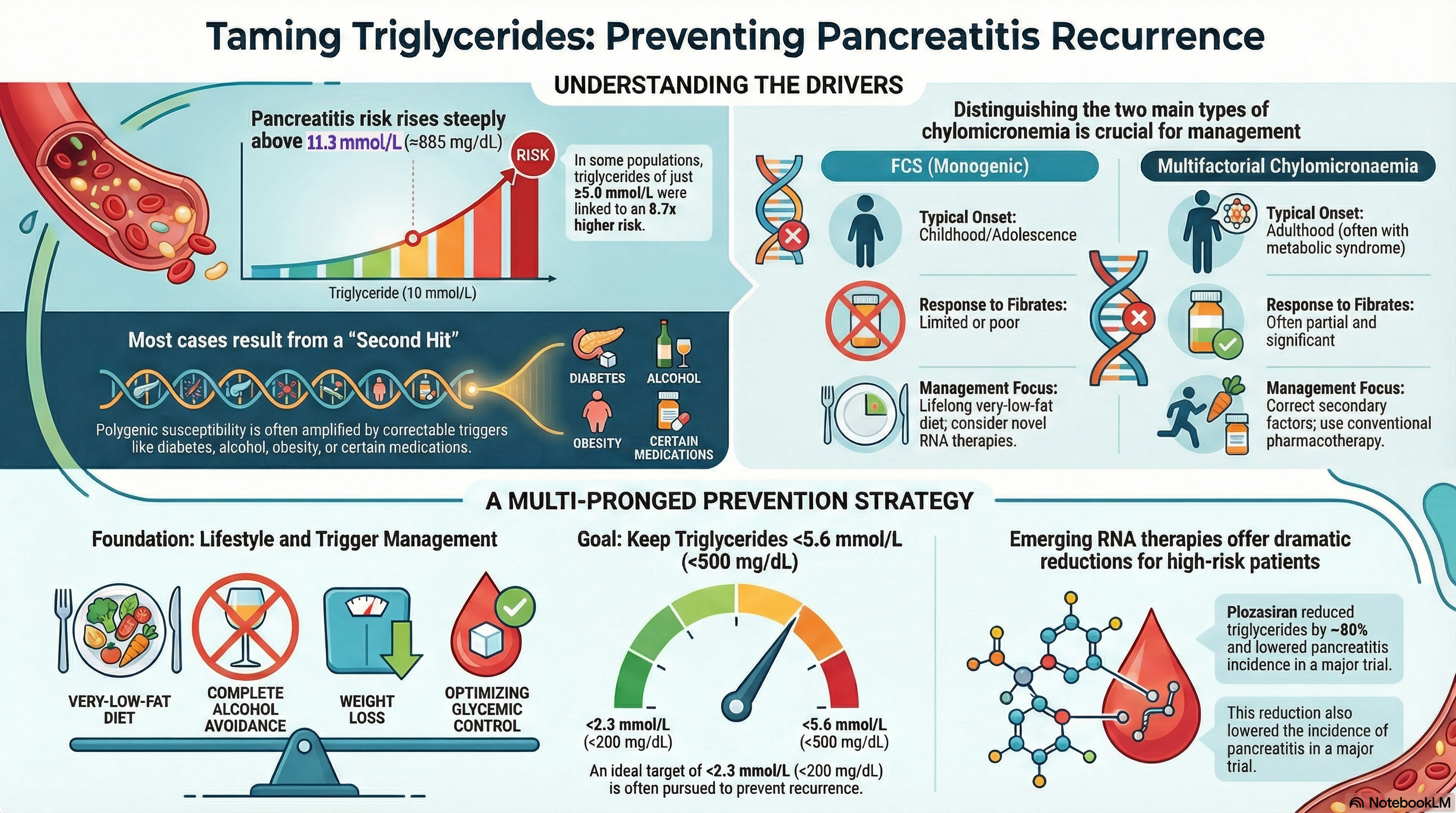

Hypertriglyceridaemia-Associated Acute Pancreatitis: Risk Stratification, Drivers, and Prevention of Recurrence



Abstract
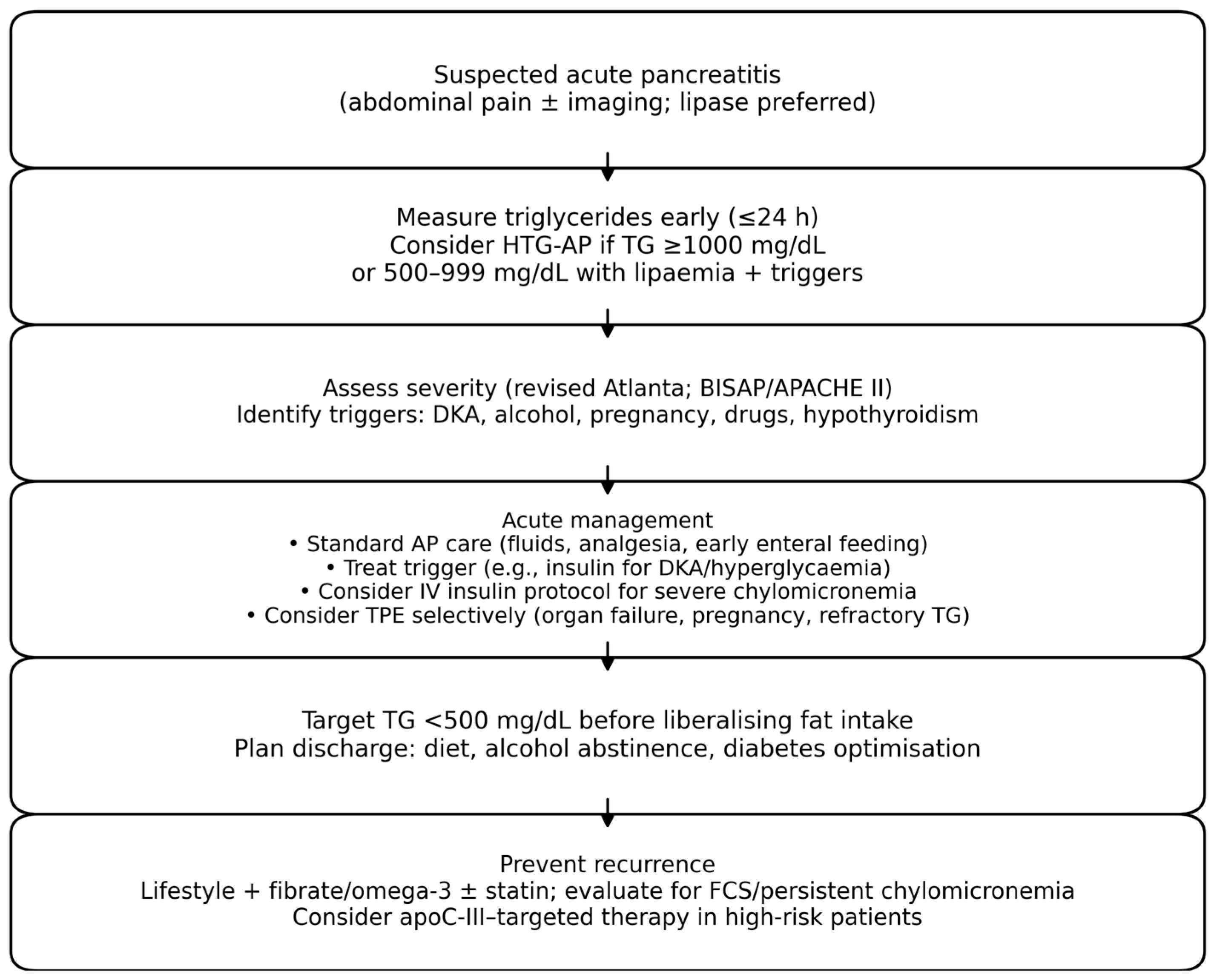
1. Introduction
2. Materials and Methods
3. Epidemiology and Risk Gradient
4. Pathophysiological Links Between Triglyceride-Rich Lipoproteins and Pancreatic Injury
5. Drivers of Severe Hypertriglyceridaemia and Pancreatitis Risk: Acquired and Genetic Contributors
6. Acute Management of HTG-AP
7. Long-Term Prevention of Recurrence
7.1. Conventional Pharmacotherapy
7.2. Emerging and Recently Approved Therapies Targeting ApoC-III and ANGPTL3
8. A Special Situation: The Pregnancy-Associated Severe Hypertriglyceridaemias
9. Discussion
10. Conclusions
Author Contributions
Funding
Institutional Review Board Statement
Informed Consent Statement
Data Availability Statement
Acknowledgments
Conflicts of Interest
References
- Tenner, S.; Vege, S.S.; Sheth, S.G.; Sauer, B.; Yang, A.; Conwell, D.L.; Yadlapati, R.H.; Gardner, T.B. American College of Gastroenterology Guidelines: Management of Acute Pancreatitis. Am. J. Gastroenterol. 2024, 119, 419–437. [Google Scholar] [CrossRef]
- de Pretis, N.; Amodio, A.; Frulloni, L. Hypertriglyceridemic pancreatitis: Epidemiology, pathophysiology and clinical management. United Eur. Gastroenterol. J. 2018, 6, 649–655. [Google Scholar] [CrossRef]
- Pedersen, S.B.; Langsted, A.; Nordestgaard, B.G. Nonfasting Mild-to-Moderate Hypertriglyceridemia and Risk of Acute Pancreatitis. JAMA Intern. Med. 2016, 176, 1834–1842. [Google Scholar] [CrossRef]
- Yang, A.L.; McNabb-Baltar, J. Hypertriglyceridemia and acute pancreatitis. Pancreatology 2020, 20, 795–800. [Google Scholar] [CrossRef] [PubMed]
- Lindkvist, B.; Appelros, S.; Regnér, S.; Manjer, J. A prospective cohort study on risk of acute pancreatitis related to serum triglycerides, cholesterol and fasting glucose. Pancreatology 2012, 12, 317–324. [Google Scholar] [CrossRef]
- Buxbaum, J.L.; Gardner, T.B.; Chari, S.T. Updates from the 2025 IAP Acute Pancreatitis Guidelines. Pancreas 2026, 55, e147–e149. [Google Scholar] [CrossRef]
- Párniczky, A.; Mikó, A.; Uc, A.; Singh, A.N.; Elhence, A.; Saluja, A.; Masamune, A.; Abu Dayyeh, B.K.; Davidson, B.; Wilcox, C.M.; et al. IAP/APA/EPC/IPC/JPS Working Group. International Association of Pancreatology Revised Guidelines on Acute Pancreatitis 2025: Supported and Endorsed by the American Pancreatic Association, European Pancreatic Club, Indian Pancreas Club, and Japan Pancreas Society. Pancreatology 2025, 25, 770–814. [Google Scholar] [CrossRef]
- Virani, S.S.; Morris, P.B.; Agarwala, A.; Ballantyne, C.M.; Birtcher, K.K.; Kris-Etherton, P.M.; Ladden-Stirling, A.B.; Miller, M.; Orringer, C.E.; Stone, N.J. 2021 ACC Expert Consensus Decision Pathway on the management of ASCVD risk reduction in patients with persistent hypertriglyceridemia. J. Am. Coll. Cardiol. 2021, 78, 960–993. [Google Scholar] [CrossRef] [PubMed]
- Gagnon, A.L.; Lavoie, A.; Frigon, M.P.; Michaud-Herbst, A.; Tremblay, K. A Drug-Induced Acute Pancreatitis Retrospective Study. Can. J. Gastroenterol. Hepatol. 2020, 2020, 1516493. [Google Scholar] [CrossRef]
- Goraya, M.H.N.; Abbasi, E.U.H.; Amin, M.K.; Inayat, F.; Ashraf, M.J.; Qayyum, M.; Hussain, N.; Nawaz, G.; Zaman, M.A.; Malik, A. Acute pancreatitis secondary to tamoxifen-associated hypertriglyceridemia: A clinical update. J. Oncol. Pharm. Pract. 2023, 29, 218–225. [Google Scholar] [CrossRef]
- Devlin, J.W.; Lau, A.K.; Tanios, M.A. Propofol-Associated Hypertriglyceridemia and Pancreatitis in the Intensive Care Unit: An Analysis of Frequency and Risk Factors. Pharmacother. J. Hum. Pharmacol. Drug Ther. 2005, 25, 1348–1352. [Google Scholar] [CrossRef]
- Heybati, K.; Deng, J.; Xie, G.; Poudel, K.; Zhou, F.; Rizwan, Z.; Brown, C.S.; Acker, C.T.; Gajic, O.; Yadav, H. Propofol, Hypertriglycerridemia, and Acute Pancreatitis: A Multicenter Epidemiologic Analysis. Ann. Am. Thor. Soc. 2025, 22, 235–246. [Google Scholar] [CrossRef]
- Alabdul Razzak, I.; Korchemny, N.; Smoot, D.; Jose, A.; Jones, A.; Price, L.L.; Jaber, B.L.; Moraco, A.H. Parameters Predictive of Propofol-Associated Acute Pancreatitis in Critically Ill Patients with COVID-19 Pneumonia: A Retrospective Cohort Study. J. Intens. Care Med. 2025, 40, 67–73. [Google Scholar] [CrossRef] [PubMed]
- De Luca, C.; Ciciola, P.; D’Errico, G.; Di Taranto, M.D.; Fortunato, G.; Gross, C.; Garn, J.; Iannuzzo, G.; Di Minno, M.; Calcaterra, I. Genetic Assessment and Clinical Correlates in Severe Hypertriglyceridemia: A Systematic Review. Genes 2025, 16, 1377. [Google Scholar] [CrossRef] [PubMed]
- Saadatagah, S.; Larouche, M.; Naderian, M.; Nambi, V.; Brisson, D.; Kullo, I.J.; Duell, P.B.; Michos, E.D.; Shapiro, M.D.; Watts, G.F.; et al. Recognition and management of persistent chylomicronemia: A joint expert clinical consensus by the National Lipid Association and the American Society for Preventive Cardiology. J. Clin. Lipidol. 2025, 19, 723–736. [Google Scholar] [CrossRef] [PubMed]
- Moulin, P.; Dufour, R.; Averna, M.; Arca, M.; Cefalù, A.B.; Noto, D.; D’Erasmo, L.; Di Costanzo, A.; Marçais, C.; Walther, L.A.A.-S.; et al. Identification and diagnosis of patients with familial chylomicronaemia syndrome (FCS): Expert panel recommendations and proposal of an “FCS score”. Atherosclerosis 2018, 275, 265–272. [Google Scholar] [CrossRef]
- Gubensek, J.; Andonova, M.; Jerman, A.; Persic, V.; Vajdic-Trampuz, B.; Zupunski-Cede, A.; Sever, N.; Plut, S. Comparable Triglyceride Reduction with Plasma Exchange and Insulin in Acute Pancreatitis—A Randomized Trial. Front. Med. 2022, 9, 870067. [Google Scholar] [CrossRef]
- Cao, L.; Chen, Y.; Liu, S.; Huang, W.; Wu, D.; Hong, D.; Wang, Z.; Sun, Y.; Qin, K.; Guo, F.; et al. Early Plasmapheresis Among Patients with Hypertriglyceridemia-Associated Acute Pancreatitis. JAMA Netw. Open 2023, 6, e2320802. [Google Scholar] [CrossRef]
- He, W.; Cai, W.; Yang, X.; Camilleri, G.; Zheng, X.; Wang, Q.; Li, Y.; Mukherjee, R.; Huang, W.; Sutton, R. Insulin or blood purification treatment for hypertriglyceridaemia-associated acute pancreatitis: A systematic review and meta-analysis. Pancreatology 2022, 22, 846–857. [Google Scholar] [CrossRef]
- Connelly-Smith, L.; Alquist, C.R.; Aqui, N.A.; Hofmann, J.C.; Klingel, R.; Onwuemene, O.A.; Patriquin, C.J.; Pham, H.P.; Sanchez, A.P.; Schneiderman, J.; et al. Guidelines on the Use of Therapeutic Apheresis in Clinical Practice—Evidence-Based Approach from the Writing Committee of the American Society for Apheresis: The Ninth Special Issue. J. Clin. Apher. 2023, 38, 77–278. [Google Scholar] [CrossRef]
- Ding, L.; Guan, L.; Li, X.; Xu, X.; Zou, Y.; He, C.; Hu, Y.; Wan, J.; Huang, X.; Lei, Y.; et al. Recurrence for patients with first episode of hypertriglyceridemia-induced acute pancreatitis: A prospective cohort study. J. Clin. Lipidol. 2023, 17, 94–102. [Google Scholar] [CrossRef]
- Xu, X.; Ma, L.; Wang, H.; Liu, G.; Deng, L.; Sheng, J.; Zhu, C.; Sheng, J.; Zhang, H.; Wu, D.; et al. Prevention of recurrence of hypertriglyceridemia-associated acute pancreatitis by controlling triglyceride levels: Protocol for a multicentre, randomised controlled trial (REDUCE). BMJ Open 2025, 15, e093011. [Google Scholar] [CrossRef]
- Laufs, U.; Parhofer, K.G.; Ginsberg, H.N.; Hegele, R.A. Clinical review on triglycerides. Eur. Heart J. 2020, 41, 99–109c. [Google Scholar] [CrossRef]
- Raschi, E.; Casula, M.; Cicero, A.F.G.; Corsini, A.; Borghi, C.; Catapano, A. Beyond statins: New pharmacological targets to decrease LDL-cholesterol and cardiovascular events. Pharmacol. Therap 2023, 250, 108507. [Google Scholar] [CrossRef]
- Pirillo, A.; Zambon, A.; Catapano, A.L. Fibrates: Do They Still Have a Role in Therapy in 2025? Curr. Atheroscler. Rep. 2025, 28, 4. [Google Scholar] [CrossRef]
- Wang, T.; Zhang, X.; Zhou, N.; Shen, Y.; Li, B.; Chen, B.E.; Li, X. Association Between Omega-3 Fatty Acid Intake and Dyslipidemia: A Continuous Dose-Response Meta-Analysis of Randomized Controlled Trials. J. Am. Heart Ass. 2023, 12, e029512. [Google Scholar] [CrossRef] [PubMed]
- Chaudhry, R.; Viljoen, A.; Wierzbicki, A.S. Pharmacological treatment options for severe hypertriglyceridemia and familial chylomicronemia syndrome. Expert Rev. Clin. Pharmacol. 2018, 11, 589–598. [Google Scholar] [CrossRef] [PubMed]
- Mach, F.; Baigent, C.; Catapano, A.L.; Koskinas, K.C.; Casula, M.; Badimon, L.; Chapman, M.J.; De Backer, G.G.; Delgado, V.; Ference, B.A.; et al. 2019 ESC/EAS Guidelines for the management of dyslipidaemias: Lipid modification to reduce cardiovascular risk: The Task Force for the management of dyslipidaemias of the European Society of Cardiology (ESC) and European Atherosclerosis Society (EAS). Eur. Heart J. 2020, 41, 111–188. [Google Scholar] [CrossRef]
- Preiss, D.; Tikkanen, M.J.; Welsh, P.; Ford, I.; Lovato, L.C.; Elam, M.B.; LaRosa, J.C.; DeMicco, D.A.; Colhoun, H.M.; Goldenberg, I.; et al. Lipid-Modifying Therapies and Risk of Pancreatitis. JAMA 2012, 308, 804–811. [Google Scholar] [CrossRef] [PubMed]
- Sahebkar, A.; Simental-Mendía, L.E.; Mikhailidis, D.P.; Pirro, M.; Banach, M.; Sirtori, C.R.; Ruscica, M.; Reiner, Ž. Effect of statin therapy on plasma apolipoprotein CIII concentrations: A systematic review and meta-analysis of randomized controlled trials. J. Clin. Lipidol. 2018, 12, 801–809. [Google Scholar] [CrossRef]
- Sahebkar, A.; Simental-Mendía, L.E.; Katsiki, N.; Reiner, Ž.; Banach, M.; Pirro, M.; Atkin, S.L. Effect of fenofibrate on plasma apolipoprotein C-III levels: A systematic review and meta-analysis of randomised placebo-controlled trials. BMJ Open 2019, 8, e021508. [Google Scholar] [CrossRef]
- Witztum, J.L.; Gaudet, D.; Freedman, S.D.; Alexander, V.J.; Digenio, A.; Williams, K.R.; Yang, Q.; Hughes, S.G.; Geary, R.S.; Arca, M.; et al. Volanesorsen and Triglyceride Levels in Familial Chylomicronemia Syndrome. N. Engl. J. Med. 2019, 381, 531–542. [Google Scholar] [CrossRef]
- Stroes, E.S.; Alexander, V.J.; Karwatowska-Prokopczuk, E.; Hegele, R.A.; Arca, M.; Ballantyne, C.M.; Soran, H.; Prohaska, T.A.; Xia, S.; Ginsberg, H.N.; et al. Balance Investigators. Olezarsen, Acute Pancreatitis, and Familial Chylomicronemia Syndrome. N. Engl. J. Med. 2024, 390, 1781–1792. [Google Scholar] [CrossRef]
- Watts, G.F.; Rosenson, R.S.; Hegele, R.A.; Goldberg, I.J.; Gallo, A.; Mertens, A.; Baass, A.; Zhou, R.; Muhsin, M.; Hellawell, J.; et al. Plozasiran for Managing Persistent Chylomicronemia and Pancreatitis Risk. N. Engl. J. Med. 2025, 392, 127–137. [Google Scholar] [CrossRef] [PubMed]
- Rosenson, R.S.; Gaudet, D.; Ballantyne, C.M.; Baum, S.J.; Bergeron, J.; Kershaw, E.E.; Moriarty, P.M.; Rubba, P.; Whitcomb, D.C.; Banerjee, P.; et al. Evinacumab in severe hypertriglyceridemia with or without lipoprotein lipase pathway mutations: A phase 2 randomized trial. Nat. Med. 2023, 29, 729–737. [Google Scholar] [CrossRef] [PubMed]
- Fogacci, F.; Norata, G.D.; Toth, P.P.; Arca, M.; Cicero, A.F.G. Efficacy and Safety of Volanesorsen (ISIS 304801): The Evidence from Phase 2 and 3 Clinical Trials. Curr. Atheroscl. Rep. 2020, 22, 18. [Google Scholar] [CrossRef]
- Tsimikas, S.; Ginsberg, H.N.; Alexander, V.J.; Karwatowska-Prokopczuk, E.; Dibble, A.; Li, L.; Witztum, J.L.; Hegele, R.A. Differential effects of volanesorsen on apoC-III, triglycerides, and pancreatitis in familial chylomicronemia syndrome diagnosed by genetic or nongenetic criteria. J. Clin. Lipidol. 2025, 19, 422–431. [Google Scholar] [CrossRef] [PubMed]
- U.S. Food and Drug Administration. TRYNGOLZA (Olezarsen) Injection, for Subcutaneous Use: Prescribing Information. 2024. Available online: https://www.accessdata.fda.gov/drugsatfda_docs/label/2024/218614s000lbl.pdf (accessed on 30 December 2025).
- European Medicines Agency. Tryngolza (Olezarsen): EPAR—Medicine Overview. Available online: https://www.ema.europa.eu/en/medicines/human/EPAR/tryngolza (accessed on 30 December 2025).
- Sydhom, P.; Al-Quraishi, B.; Gohar, A.; El-Shawaf, M.; Shehata, N.; Ataya, M.; Sydhom, M.; Awwad, N.; Motawade, H.; Naji, N.; et al. The Efficacy and Safety of Plozasiran on Lipid Profile in Dyslipidemic Disorders: A Systematic Review and Meta-Analysis. Cardiovasc. Drugs Ther. 2025. Advance online publication. [Google Scholar] [CrossRef]
- Corral, P.M.; Nardelli, N.; Schreier, L. Inhibition of angiopoietin-like protein 3 as a target for managing hypertriglyceridemia. Curr. Opin. Endocrinol. Diab. Obes. 2025. Advance online publication. [Google Scholar] [CrossRef]
- Bergmark, B.A.; Marston, N.A.; Bramson, C.R.; Curto, M.; Ramos, V.; Jevne, A.; Kuder, J.F.; Park, J.G.; Murphy, S.A.; Verma, S.; et al. Effect of Vupanorsen on Non–High-Density Lipoprotein Cholesterol Levels in Statin-Treated Patients with Elevated Cholesterol: TRANSLATE-TIMI 70. Circulation 2022, 145, 1377–1386. [Google Scholar] [CrossRef]
- Preda, A.; Preda, S.D.; Mota, M.; Iliescu, D.G.; Zorila, L.G.; Comanescu, A.C.; Mitrea, A.; Clenciu, D.; Mota, E.; Vladu, I.M. Dyslipidemia in Pregnancy: A Systematic Review of Molecular Alterations and Clinical Implications. Biomedicines 2024, 12, 2252. [Google Scholar] [CrossRef] [PubMed]
- Frise, C.J.; Ashcroft, A.; Jones, B.A.; Mackillop, L. Pregnancy and ketoacidosis: Is pancreatitis a missing link? Obstet. Med. 2016, 9, 60–63. [Google Scholar] [CrossRef] [PubMed]
- Larouche, M.; Bergeron, J.; Brisson, D.; Laflamme, N.; Audet-Verreault, N.; Sharon, C.; Charrière, S.; Rama, M.; Collin-Chavagnac, D.; Moulin, P.; et al. Course of Pregnancies and Occurrence of Acute Pancreatitis in Women with Chylomicronemia. J. Clin. Endocrinol. Metab. 2026, 111, e455–e461. [Google Scholar] [CrossRef]
- Zheng, X.; Xia, P.; Yue, C.; Xia, J.; Zhou, Y.; Chen, L.; Song, Y.; Gao, J.; Li, N.; Li, X.; et al. A multidisciplinary management model for severe gestational hypertriglyceridemia: Using plasmapheresis to prevent pancreatitis in pregnancy. BMC Pregnancy Childbirth 2025, 25, 1090. [Google Scholar] [CrossRef]
- Trikudanathan, G.; Yazici, C.; Phillips, A.E.; Forsmark, C.E. Diagnosis and Management of Acute Pancreatitis. Gastroenterology 2024, 167, 673–688. [Google Scholar] [CrossRef]
- Lan, N.S.R.; Nelson, A.J.; Brett, T.; Hespe, C.M.; Watts, G.F.; Nicholls, S.J. Hypertriglyceridaemia: A practical approach for primary care. Austr. J. Gen. Pract. 2025, 54, 800–806. [Google Scholar] [CrossRef]
- Hegele, R.A. Approach to the Adult Patient with Chylomicronemia. J. Clin. Endocrinol. Metab. 2025, dgaf701, Advance online publication. [Google Scholar] [CrossRef]
- Javed, F.; Hegele, R.A.; Garg, A.; Patni, N.; Gaudet, D.; Williams, L.; Khan, M.; Li, Q.; Ahmad, Z. Familial chylomicronemia syndrome: An expert clinical review from the National Lipid Association. J. Clin. Lipidol. 2025, 19, 382–403. [Google Scholar] [CrossRef]
- Hegele, R.A.; Ahmad, Z.; Ashraf, A.; Baldassarra, A.; Brown, A.S.; Chait, A.; Freedman, S.D.; Kohn, B.; Miller, M.; Patni, N.; et al. Development and validation of clinical criteria to identify familial chylomicronemia syndrome (FCS) in North America. J. Clin. Lipidol. 2025, 19, 83–94. [Google Scholar] [CrossRef]
- Brown, A.S.; Moulin, P.; Dibble, A.; Alexander, V.J.; Li, L.; Gaudet, D.; Witztum, J.L.; Tsimikas, S.; Hegele, R.A. Brief communication: Strong concordance of the North American Familial Chylomicronemia Syndrome Score with a positive genetic diagnosis in patients from the Balance study. J. Clin. Lipidol. 2025, 19, 1451–1456. [Google Scholar] [CrossRef] [PubMed]
- National Lipid Association. North American Familial Chylomicronemia Calculator (NAFCS Scoring Tool). Available online: https://www.lipid.org (accessed on 30 December 2025).
- Bashir, B.; Kwok, S.; Wierzbicki, A.S.; Jones, A.; Dawson, C.; Downie, P.; Jenkinson, F.; Delaney, H.; Mansfield, M.; Datta, D.; et al. Validation of the familial chylomicronaemia syndrome (FCS) score in an ethnically diverse cohort from UK FCS registry: Implications for diagnosis and differentiation from multifactorial chylomicronaemia syndrome (MCS). Atherosclerosis 2024, 391, 117476. [Google Scholar] [CrossRef]
- Sindato, E.M. Acute Pancreatitis: A Narrative Review. Cureus 2025, 17, e99233. [Google Scholar] [CrossRef]
- Wolfe, D.; Kanji, S.; Yazdi, F.; Barbeau, P.; Rice, D.; Beck, A.; Butler, C.; Esmaeilisaraji, L.; Skidmore, B.; Moher, D.; et al. Drug induced pancreatitis: A systematic review of case reports to determine potential drug associations. PLoS ONE 2020, 15, e0231883. [Google Scholar] [CrossRef]
- Saini, J.; Marino, D.; Badalov, N.; Vugelman, M.; Tenner, S. Drug-Induced Acute Pancreatitis: An Evidence-Based Classification (Revised). Clin. Transl. Gastroenterol. 2023, 14, e00621. [Google Scholar] [CrossRef]
- Zhou, J.; Wang, Z.; Liu, Q.; Cao, L.; De-Madaria, E.; Capurso, G.; Stoppe, C.; Wu, D.; Huang, W.; Chen, Y.; et al. Triglyceride-lowering therapies in hypertriglyceridemia-associated acute pancreatitis in China: A multicentre prospective cohort study. BMC Med. 2024, 22, 535. [Google Scholar] [CrossRef]
- Miyamoto, K.; Horibe, M.; Sanui, M.; Sasaki, M.; Sugiyama, D.; Kato, S.; Yamashita, T.; Goto, T.; Iwasaki, E.; Shirai, K.; et al. Plasmapheresis therapy has no triglyceride-lowering effect in patients with hypertriglyceridemic pancreatitis. Intensiv. Care Med. 2017, 43, 949–951. [Google Scholar] [CrossRef]
- He, W.H.; Yu, M.; Zhu, Y.; Xia, L.; Liu, P.; Zeng, H.; Zhu, Y.; Lv, N.H. Emergent Triglyceride-lowering Therapy with Early High-volume Hemofiltration Against Low–Molecular-Weight Heparin Combined with Insulin in Hypertriglyceridemic Pancreatitis. J. Clin. Gastroenterol. 2016, 50, 772–778. [Google Scholar] [CrossRef] [PubMed]
- Jin, M.; Peng, J.M.; Zhu, H.D.; Zhang, H.M.; Lu, B.; Lii, Y.; Qian, J.M.; Yu, X.Z.; Yang, H.; Wu, D. Continuous intravenous infusion of insulin and heparin vs plasma exchange in hypertriglyceridemia-induced acute pancreatitis. J. Dig. Dis. 2018, 19, 766–772. [Google Scholar] [CrossRef] [PubMed]
- Araz, F.; Bakiner, O.S.; Bagir, G.S.; Soydas, B.; Ozer, B.; Kozanoglu, I. Continuous insulin therapy versus apheresis in patients with hypertriglyceridemia-associated pancreatitis. Eur. J. Gastroenterol. Hepatol. 2022, 34, 146–152. [Google Scholar] [CrossRef] [PubMed]
- Dichtwald, S.; Meyer, A.; Zohar, E.; Ifrach, N.; Rotlevi, G.; Fredman, B. Hypertriglyceridemia Induced Pancreatitis: Plasmapheresis or conservative management? J. Intensiv. Care Med. 2022, 37, 1174–1178. [Google Scholar] [CrossRef]
- Webb, C.B.; Leveno, M.; Quinn, A.M.; Burner, J. Effect of TPE vs medical management on patient outcomes in the setting of hypertriglyceridemia-induced acute pancreatitis with severely elevated triglycerides. J. Clin. Apher. 2021, 36, 719–726. [Google Scholar] [CrossRef] [PubMed]
- Lin, Y.; Yu, S.; Wu, X.; Huang, L.; Huang, S.; Huang, Y.; Ding, J.; Li, D. Clinical analysis of the therapeutic effect of plasma exchange on hypertriglyceridemic acute pancreatitis: A retrospective study. Transfusion 2022, 62, 72–81. [Google Scholar] [CrossRef]
- Mederos, M.A.; Reber, H.A.; Girgis, M.D. Acute Pancreatitis. JAMA 2021, 325, 382–390. [Google Scholar] [CrossRef]
- Zhou, J.; Wang, L.; Chen, T.; Li, C.; Long, Y.; Zou, X.; Dong, Z.; Sun, Y.; Zhang, G.; Zeng, Z.; et al. Effect of plasmapheresis versus standard medical treatment in patients with hypertriglyceridemia-associated acute pancreatitis complicated by early organ failure (PERFORM-R): Study design and rationale of a multicenter, pragmatic, registry-based randomized controlled trial. Pancreatology 2025, 25, 221–227. [Google Scholar] [CrossRef] [PubMed]
- Wu, B.U.; Johannes, R.S.; Sun, X.; Tabak, Y.; Conwell, D.L.; Banks, P.A. The early prediction of mortality in acute pancreatitis: A large population-based study. Gut 2008, 57, 1698–1703. [Google Scholar] [CrossRef] [PubMed]


| Driver | Examples, Mechanisms, and Practical Notes |
|---|---|
| Glycaemic decompensation | Uncontrolled type 2 diabetes, diabetic ketoacidosis, hyperosmolar state; insulin deficiency increases VLDL production and reduces lipoprotein lipase activity; treat aggressively (insulin, fluids), as triglycerides often fall rapidly. |
| Alcohol | Increases hepatic VLDL production and can directly injure the pancreas; binge patterns are particularly relevant; counsel on abstinence, especially after an HTG-AP episode. |
| Dietary excess/obesity | High refined carbohydrates and saturated fat amplify VLDL output; weight loss and carbohydrate restriction can yield substantial triglyceride reductions. |
| Pregnancy | Physiological hypertriglyceridaemia is accentuated in women with genetic predisposition; monitor closely in the third trimester; management may require specialist input and, rarely, apheresis. |
| Hypothyroidism | Reduces lipid clearance; screen with TSH in severe hypertriglyceridaemia and treat when present. |
| Renal disease/nephrotic syndrome | Impaired clearance of triglyceride-rich lipoproteins; consider in unexplained or refractory cases. |
| Medications | Examples include oestrogens, isotretinoin, certain antipsychotics, protease inhibitors, systemic corticosteroids, propofol, and others; switch or deprescribe where feasible. |
| Other | Sepsis and systemic inflammation, autoimmune disease activity, and rare endocrine disorders can contribute; manage underlying conditions. |
| Feature | FCS (Monogenic) | Multifactorial/Persistent Chylomicronaemia |
|---|---|---|
| Typical onset | Childhood/adolescence | Adulthood (often with metabolic syndrome) |
| Triglycerides | Usually persistently very high; often >20–30 mmol/L | Variable; may spike with ‘second hits’ |
| ApoB/LDL-C | Often very low (few VLDL/LDL particles) | Often normal/high (VLDL overproduction common) |
| Clinical features | Eruptive xanthomata, lipaemia retinalis, recurrent abdominal pain, frequent pancreatitis | Metabolic comorbidities; pancreatitis risk increases with severe peaks |
| Response to fibrates/omega-3 | Limited | Often partial |
| Genetics | Biallelic loss-of-function variants in LPL pathway genes | Polygenic susceptibility ± heterozygous rare variants |
| Management emphasis | Very-low-fat diet lifelong; consider apoC-III/siRNA therapies when available | Correct secondary factors; pharmacotherapy (fibrates, omega-3, statins if indicated); consider emerging therapies for persistent high-risk cases |
| Agent (Trade Name) | Target/Modality | Key Population/Trial | TG Reduction | Approval Status (January 2026) | Key References |
|---|---|---|---|---|---|
| Volanesorsen (Waylivra) | ApoC-III antisense oligonucleotide (ASO) | FCS (APPROACH) | ~77% at 3 months | EU/UK: conditionally authorized for FCS; requires platelet monitoring | [36,37] |
| Olezarsen (Tryngolza) | ApoC-III GalNAc-conjugated ASO | FCS (phase 2b/pivotal trial) | 43.5% at 6 months | FDA-approved for FCS (Dec 2024); EMA authorized (2025) | [38,39] |
| Plozasiran | ApoC-III GalNAc-siRNA | Persistent chylomicronemia/PALISADE | 80.2% at 10 months | Investigational/late-stage development (region-dependent) | [40] |
| Evinacumab (Evkeeza) | ANGPTL3 monoclonal antibody | Severe HTG (phase 2) | Variable; attenuated in classic FCS | Approved for HoFH (not specifically for HTG-AP) | [41] |
| Vupanorsen | ANGPTL3 antisense oligonucleotide (ASO) | Mixed dyslipidaemia (TRANSLATE-TIMI 70) | TG lowering; development limited by hepatic steatosis | Development discontinued/not approved for HTG | [42] |
|
Disclaimer/Publisher’s Note: The statements, opinions and data contained in all publications are solely those of the individual author(s) and contributor(s) and not of MDPI and/or the editor(s). MDPI and/or the editor(s) disclaim responsibility for any injury to people or property resulting from any ideas, methods, instructions or products referred to in the content. |
© 2026 by the authors. Licensee MDPI, Basel, Switzerland. This article is an open access article distributed under the terms and conditions of the Creative Commons Attribution (CC BY) license.
Share and Cite
Fogacci, F.; Cicero, A.F.G. Hypertriglyceridaemia-Associated Acute Pancreatitis: Risk Stratification, Drivers, and Prevention of Recurrence. Diseases 2026, 14, 47. https://doi.org/10.3390/diseases14020047
Fogacci F, Cicero AFG. Hypertriglyceridaemia-Associated Acute Pancreatitis: Risk Stratification, Drivers, and Prevention of Recurrence. Diseases. 2026; 14(2):47. https://doi.org/10.3390/diseases14020047
Chicago/Turabian StyleFogacci, Federica, and Arrigo F. G. Cicero. 2026. "Hypertriglyceridaemia-Associated Acute Pancreatitis: Risk Stratification, Drivers, and Prevention of Recurrence" Diseases 14, no. 2: 47. https://doi.org/10.3390/diseases14020047
APA StyleFogacci, F., & Cicero, A. F. G. (2026). Hypertriglyceridaemia-Associated Acute Pancreatitis: Risk Stratification, Drivers, and Prevention of Recurrence. Diseases, 14(2), 47. https://doi.org/10.3390/diseases14020047