Preoperative Surgical Planning for Lumbar Spine Pedicle Screw Placement Using PointNet

Abstract
1. Introduction
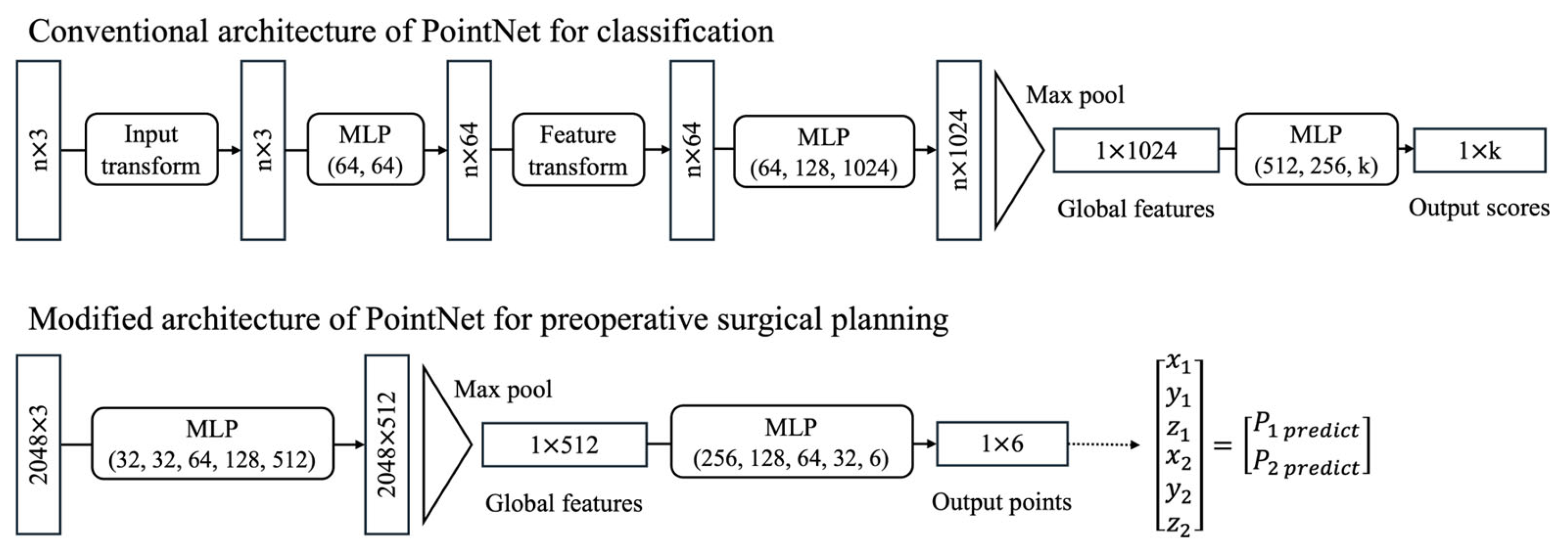
- Modification of the PointNet architecture to optimize for determining the pedicle screw trajectories.
- Development of a loss function tailored for linear screw trajectories.
2. Materials and Methods
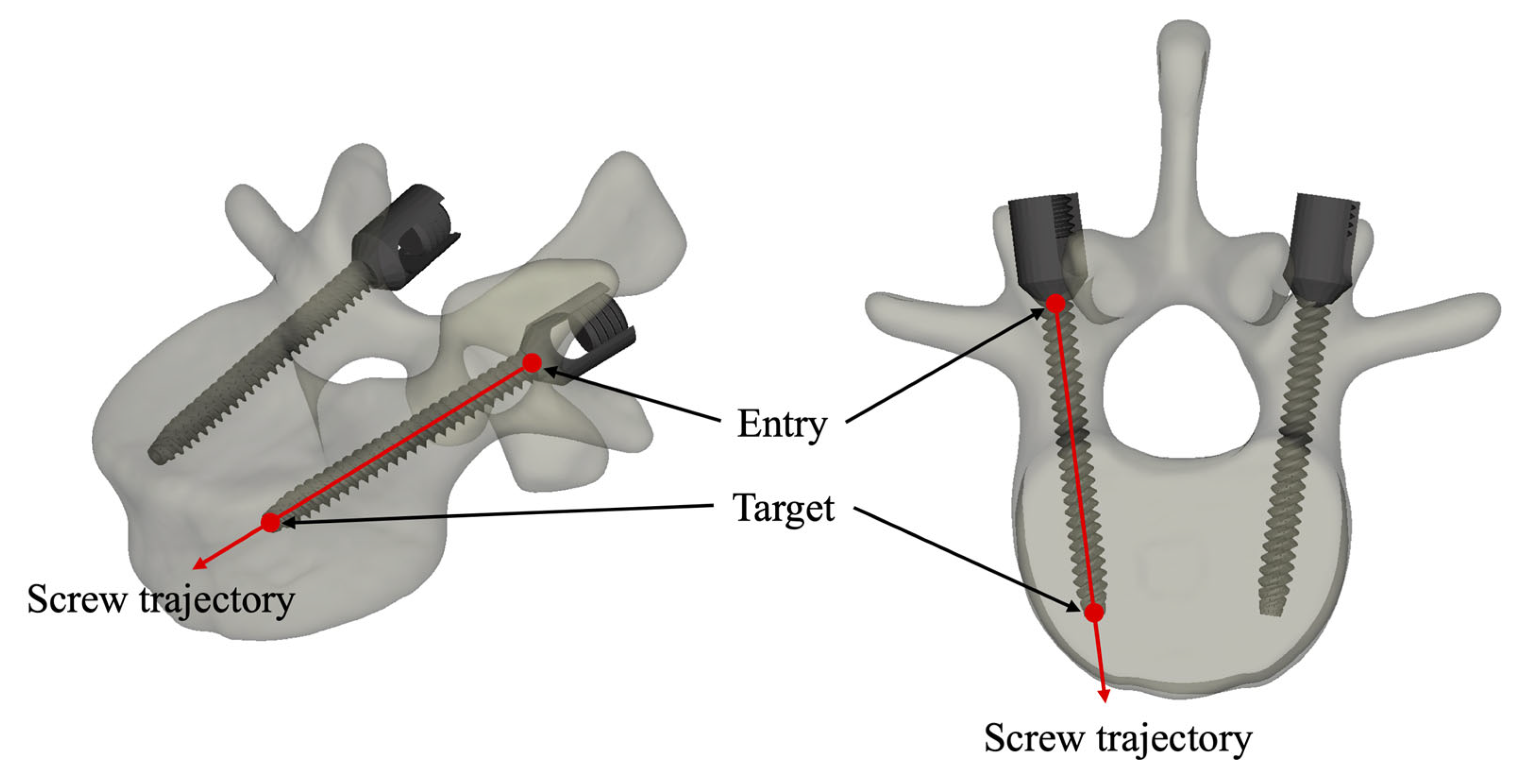
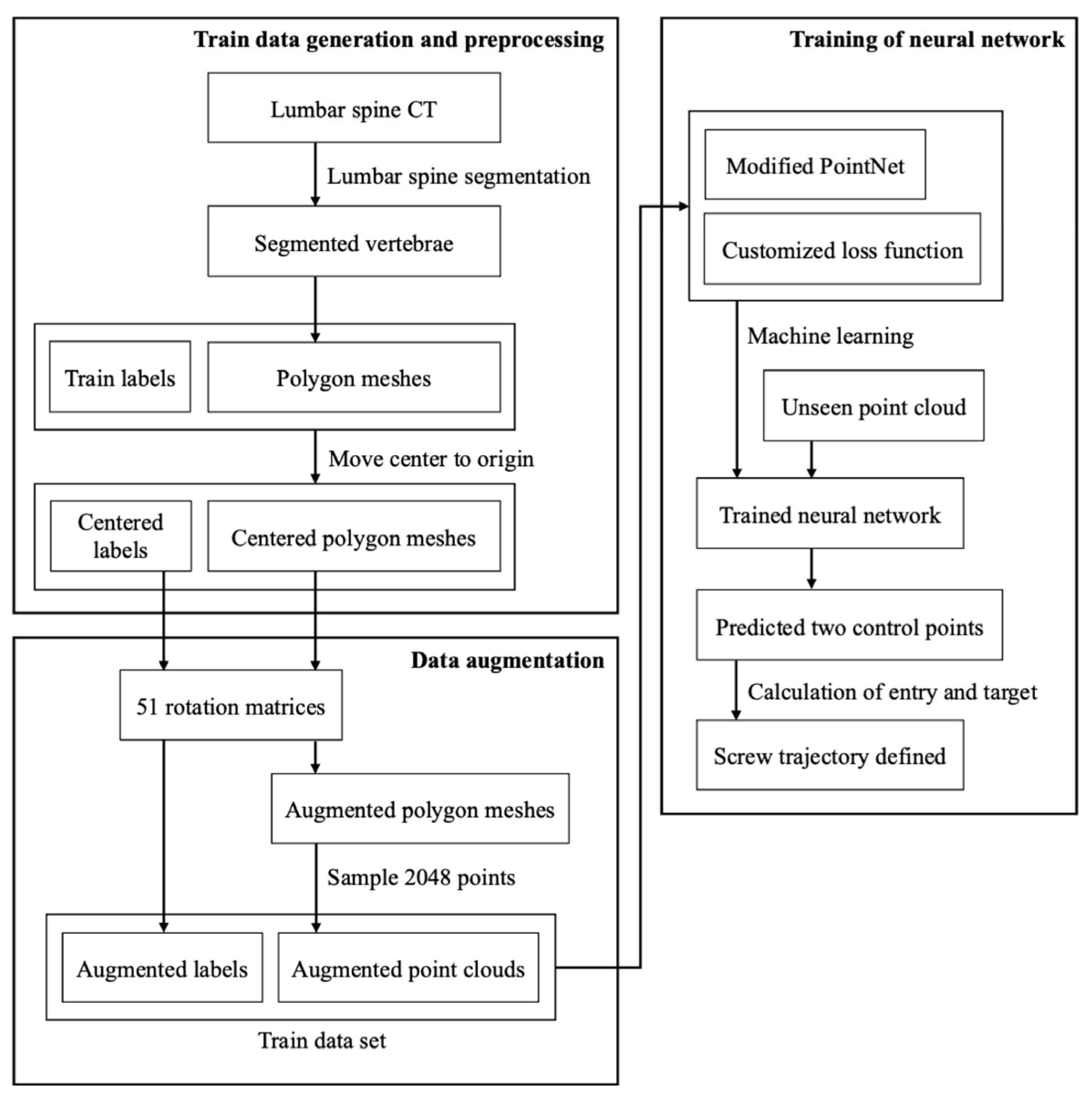
- Training Data Preparation and Preprocessing: Training data included polygonal models of each vertebra along with control points for the screw trajectory, which were created and preprocessed.
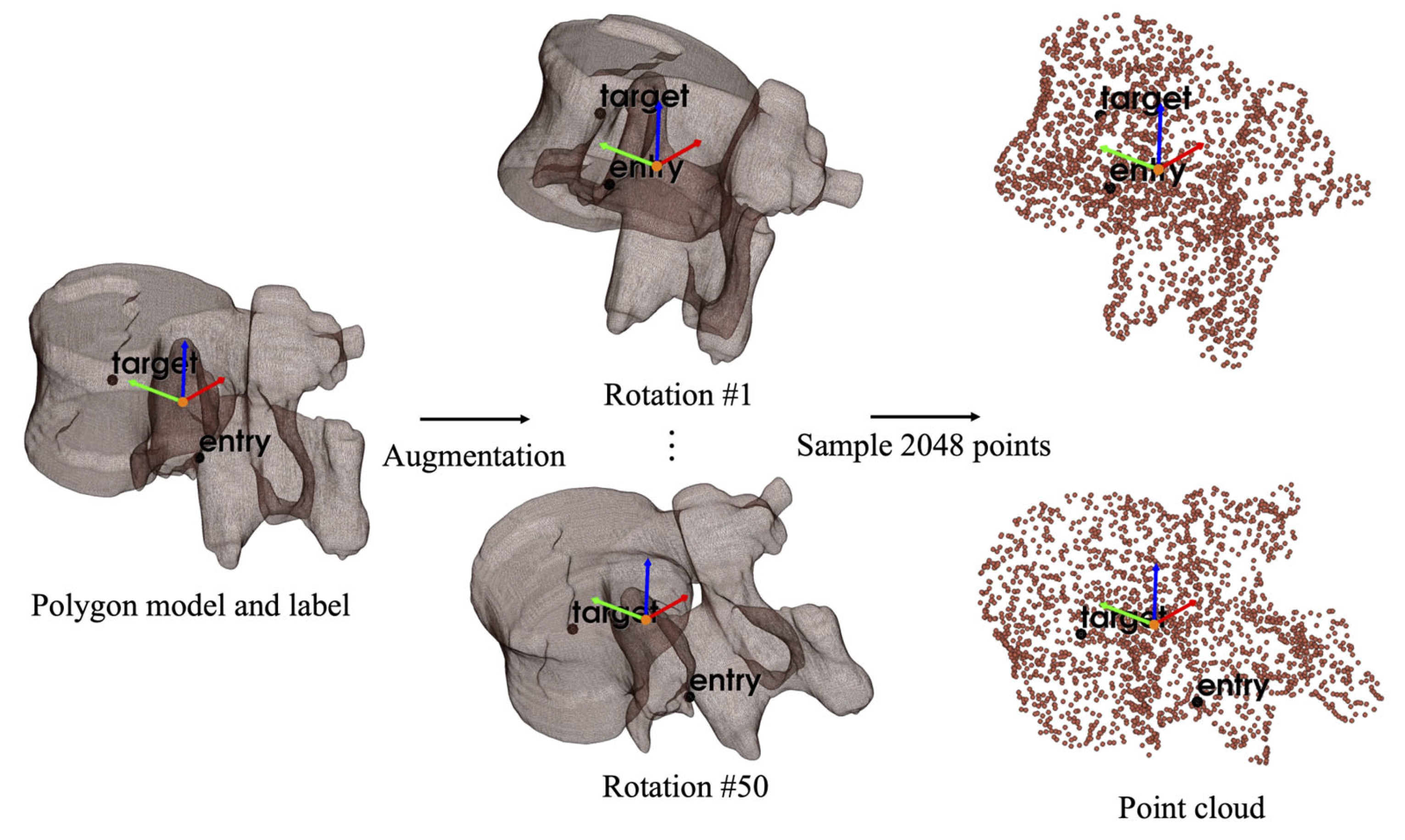
- Data Augmentation: We enhanced the robustness of the neural network by increasing the variety of vertebral models using three-dimensional affine rotation transformations. A total of 2048 points were sampled from the surface of each augmented vertebra model to form a point cloud.
- Neural Network Architecture and Training: The neural network was created by modifying the standard PointNet architecture and was trained with a customized loss function to align the predicted trajectory with the ground-truth trajectory. The network’s output was then used to calculate entry and target points for screw insertion.
2.1. Training Data Generation and Preprocessing
2.2. Data Augmentation
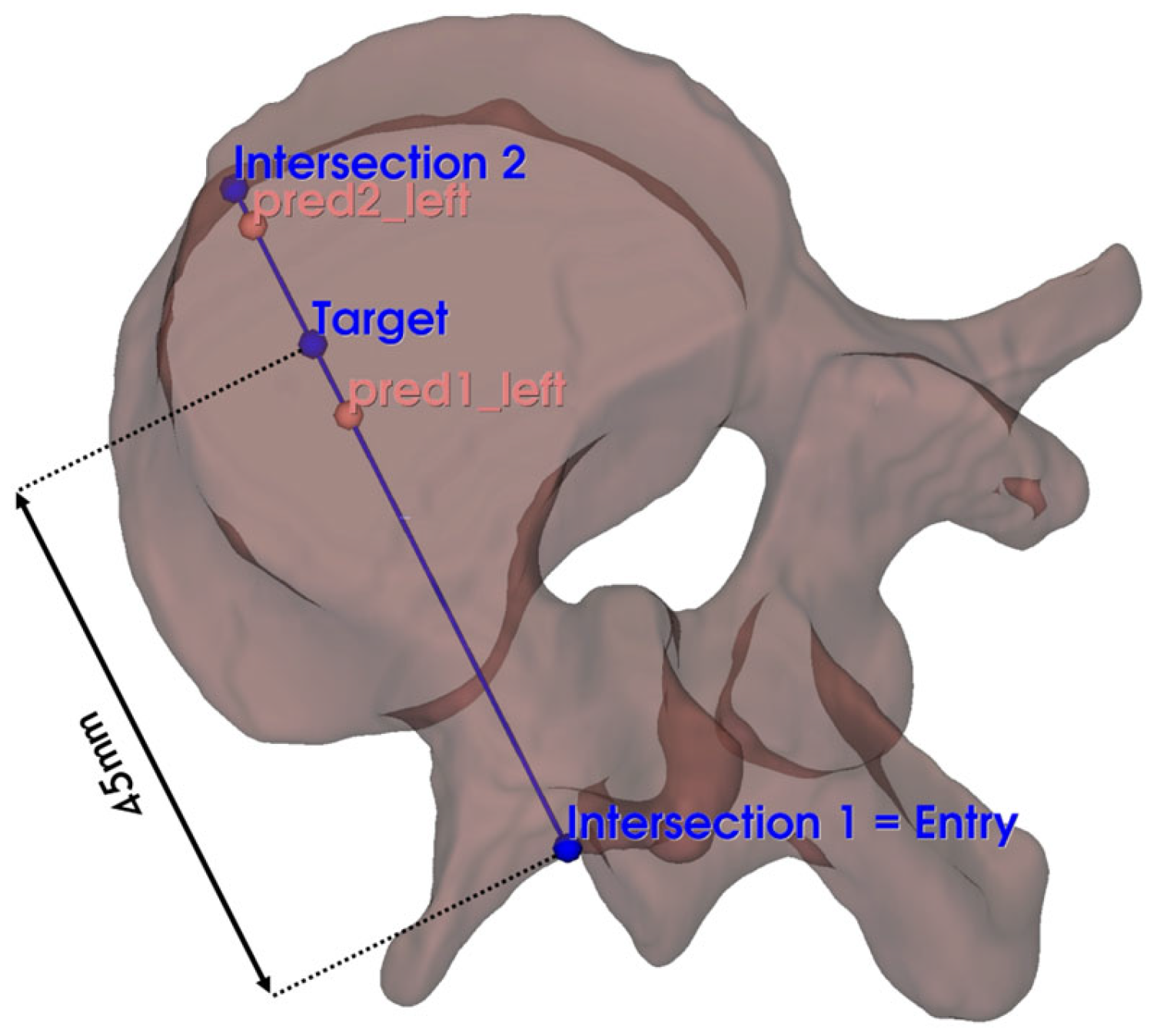
2.3. Training of the Neural Network and Determination of Screw Trajectory
2.4. Data Acquisition and Training Configuration
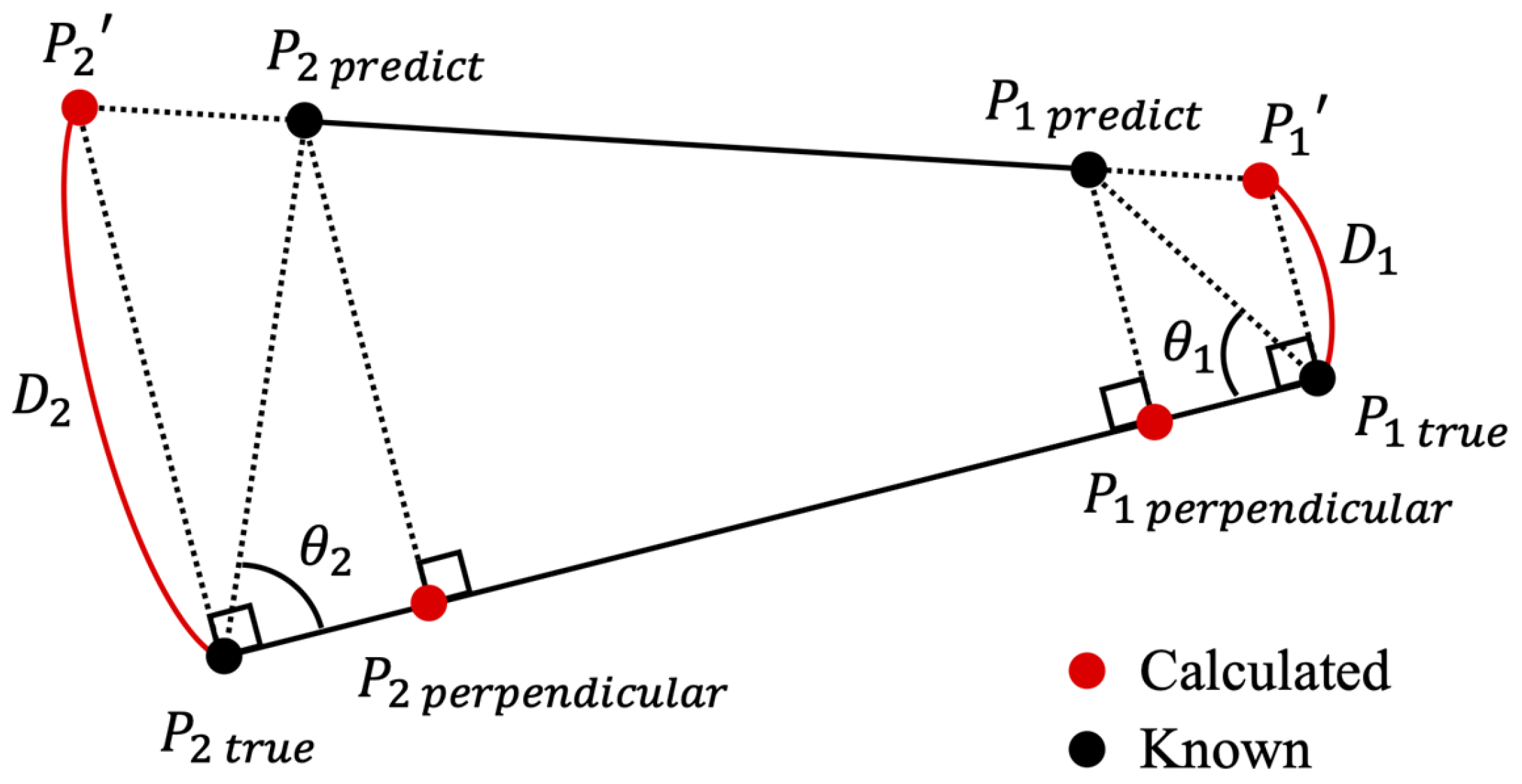
2.5. Evaluation
- Grade A: Intrapedicular insertion
- Grade B: Violation of <2 mm
- Grade C: Violation between 2 and 4 mm
- Grade D: Violation between 4 and 6 mm
- Grade E: Violation > 6 mm
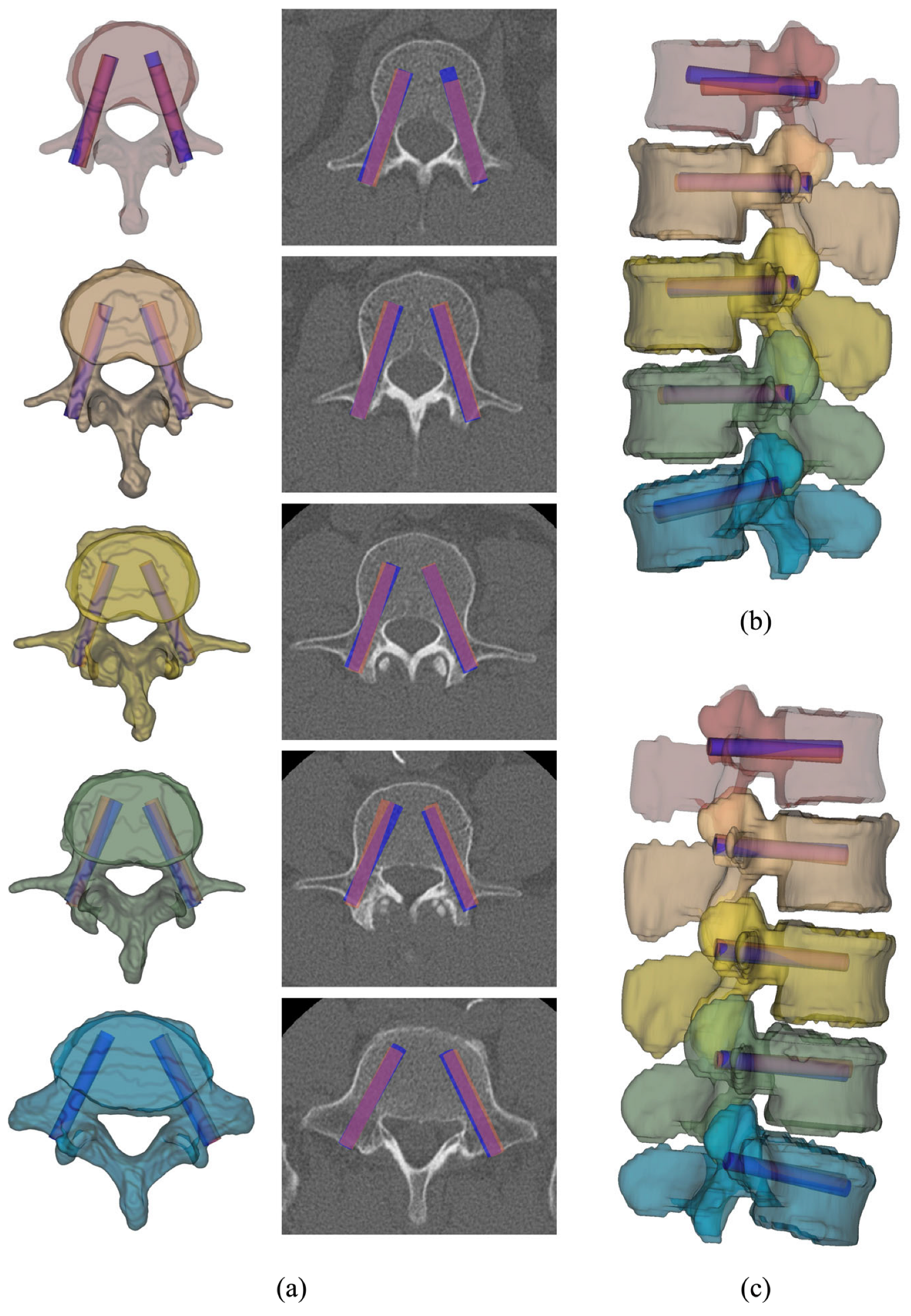
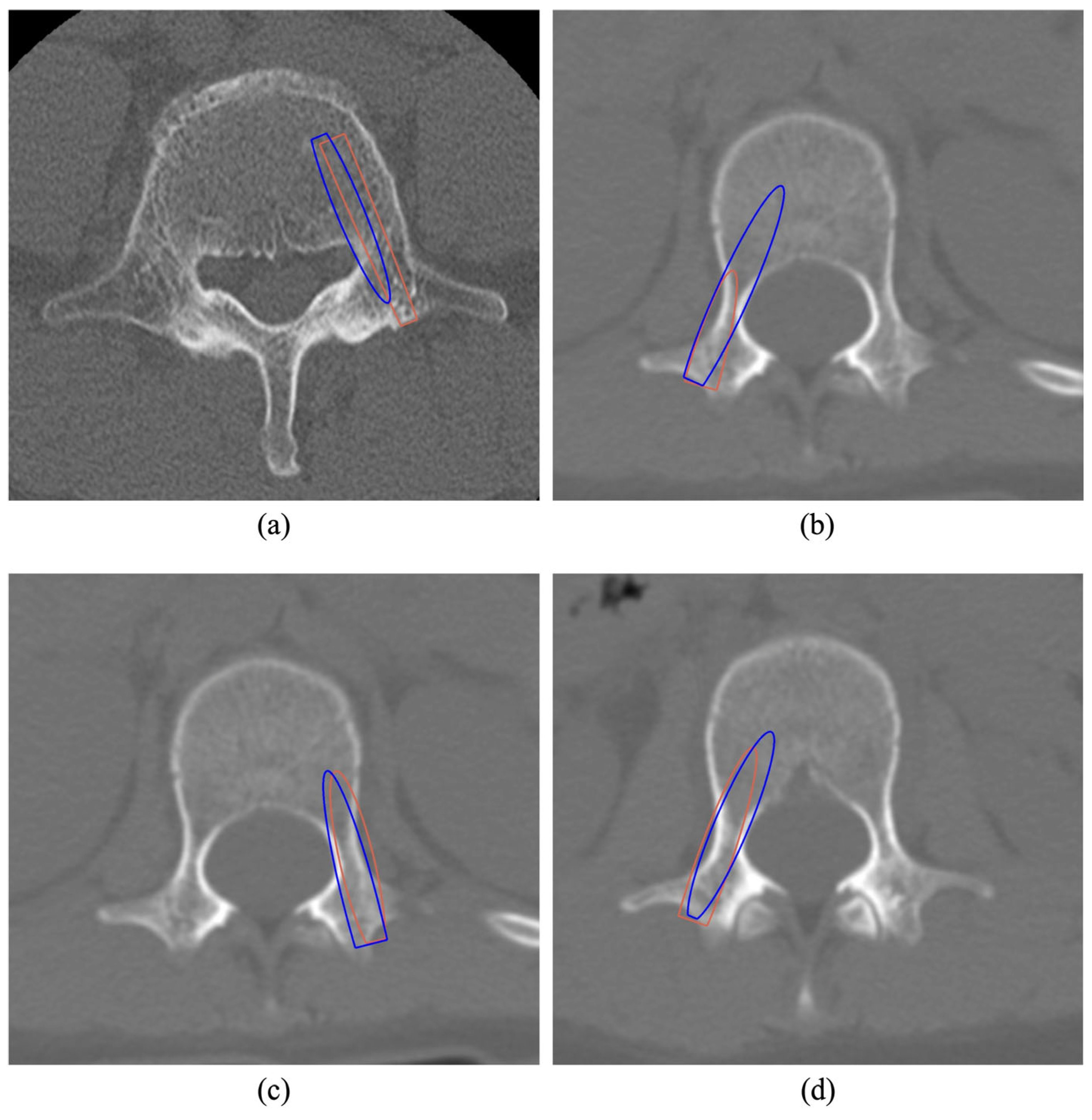
3. Results
4. Discussion
5. Conclusions
Author Contributions
Funding
Data Availability Statement
Conflicts of Interest
References
- Lee, Y.S.; Cho, D.C.; Kim, K.T. Navigation-guided/robot-assisted spinal surgery: A review article. Neurospine 2024, 21, 8–17. [Google Scholar] [CrossRef] [Scilit] [PubMed]
- Yamout, T.; Orosz, L.D.; Good, C.R.; Jazini, E.; Allen, B.; Gum, J.L. Technological advances in spine surgery: Navigation, robotics, and augmented reality. Orthop. Clin. N. Am. 2023, 54, 237–246. [Google Scholar] [CrossRef] [Scilit] [PubMed]
- Li, Y.; Wang, Y.; Ma, X.; Ma, J.; Dong, B.; Yang, P.; Sun, Y.; Zhou, L.; Shen, J. Comparison of short-term clinical outcomes between robot-assisted and freehand pedicle screw placement in spine surgery: A meta-analysis and systematic review. J. Orthop. Surg. Res. 2023, 18, 359. [Google Scholar] [CrossRef] [Scilit] [PubMed]
- Al-Naseem, A.O.; Al-Muhannadi, A.; Ramadhan, M.; Alfadhli, A.; Marwan, Y.; Shafafy, R.; Abd-El-Barr, M.M. Robot-assisted pedicle screw insertion versus navigation-based and freehand techniques for posterior spinal fusion in scoliosis: A systematic review and meta-analysis. Spine Deform. 2024, 12, 1203–1215. [Google Scholar] [CrossRef] [Scilit] [PubMed]
- Mobbs, R.J.; Sivabalan, P.; Li, J. Technique, challenges and indications for percutaneous pedicle screw fixation. J. Clin. Neurosci. 2011, 18, 741–749. [Google Scholar] [CrossRef] [Scilit] [PubMed]
- Lu, J.; Chen, Y.; Hu, M.; Sun, C. Systematic review and meta-analysis of the effect of using percutaneous pedicle screw internal fixation for thoracolumbar fractures. Ann. Palliat. Med. 2022, 11, 250–259. [Google Scholar] [CrossRef] [Scilit] [PubMed]
- Mezger, U.; Jendrewski, C.; Bartels, M. Navigation in surgery. Langenbecks Arch. Surg. 2013, 398, 501–514. [Google Scholar] [CrossRef] [Scilit] [PubMed]
- Ewurum, C.H.; Guo, Y.; Pagnha, S.; Feng, Z.; Luo, X. Surgical navigation in orthopedics: Workflow and system review. Adv. Exp. Med. Biol. 2018, 1093, 47–63. [Google Scholar] [PubMed]
- Gharagozloo, F.; Patel, V.R.; Giulianotti, P.C.; Poston, R.; Gruessner, R.; Meyer, M. Robotic Surgery, 2nd ed.; Springer: Berlin/Heidelberg, Germany, 2021. [Google Scholar]
- Knez, D.; Likar, B.; Pernus, F.; Vrtovec, T. Computer-assisted screw size and insertion trajectory planning for pedicle screw placement surgery. IEEE Trans. Med. Imaging 2016, 35, 1420–1430. [Google Scholar] [CrossRef] [Scilit] [PubMed]
- Knez, D.; Mohar, J.; Cirman, R.J.; Likar, B.; Pernuš, F.; Vrtovec, T. Variability analysis of manual and computer-assisted preoperative thoracic pedicle screw placement planning. Spine 2018, 43, 1487–1495. [Google Scholar] [CrossRef] [Scilit] [PubMed]
- Cai, D.; Wang, Z.; Liu, Y.; Zhang, Q.; Han, X.; Liu, W. Automatic path planning for navigated pedicle screw surgery based on deep neural network. In Proceedings of the 2nd WRC Symposium on Advanced Robotics and Automation, Beijing, China, 21–22 August 2019. [Google Scholar]
- Qi, X.; Meng, J.; Li, M.; Yang, Y.; Hu, Y.; Li, B. An automatic path planning method of pedicle screw placement based on preoperative CT images. IEEE Trans. Med. Robot. Bionics. 2022, 4, 403–413. [Google Scholar] [CrossRef] [Scilit]
- Zhang, Y.; Liu, W.; Zhao, J.; Wang, D.; Peng, F.; Cui, S.; Wang, B.; Shi, Z.; Liu, B.; He, D.; et al. Improving pedicle screw path planning by vertebral posture estimation. Phys. Med. Biol. 2023, 68, 185011. [Google Scholar] [CrossRef] [Scilit] [PubMed]
- Massalimova, A.; Bauer, D.; Cavalcanti, N.; Carrillo, F.; Mazda, F.; Fuernstahl, P. Feasibility of automatic screw planning via transformer-based shape completion from RGB-D imaging. Sci. Rep. 2025, 15, 37617. [Google Scholar] [CrossRef] [Scilit] [PubMed]
- Schroeder, W.; Maynard, R.; Geveci, B. Flying edges: A high-performance scalable isocontouring algorithm. In Proceedings of the 2015 IEEE 5th Symposium on Large Data Analysis and Visualization (LDAV), Chicago, IL, USA, 25–26 October 2015. [Google Scholar]
- Lorensen, W.E.; Cline, H.E. Marching Cubes: A high resolution 3D surface construction algorithm. In Proceedings of the 14th Annual Conference on Computer Graphics and Interactive Techniques (SIGGRAPH ’87), Anaheim, CA, USA, 27–31 July 1987; Volume 21, pp. 163–169. [Google Scholar]
- Qi, C.R.; Su, H.; Mo, K.; Guibas, L.J. PointNet: Deep learning on point sets for 3D classification and segmentation. In Proceedings of the IEEE Conference on Computer Vision and Pattern Recognition (CVPR), Honolulu, HI, USA, 21–26 July 2017. [Google Scholar]
- Hwang, S.; Lee, S.J.; Kim, S. Surgical navigation system for pedicle screw placement based on mixed reality. Int. J. Control Autom. Syst. 2023, 21, 3983–3993. [Google Scholar] [CrossRef] [Scilit]
- Zhu, Q.; Fan, L.; Weng, N. Advancements in point cloud data augmentation for deep learning: A survey. Pattern Recognit. 2024, 153, 110532. [Google Scholar] [CrossRef] [Scilit]
- Fedorov, A.; Beichel, R.; Kalpathy-Cramer, J.; Finet, J.; Fillion-Robin, J.; Pujol, S.; Bauer, C.; Jennings, D.; Fennessy, F.; Sonka, M.; et al. 3D Slicer as an image computing platform for the quantitative imaging network. Magn. Reson. Imaging 2012, 30, 1323–1341. [Google Scholar] [CrossRef] [Scilit] [PubMed]
- Gertzbein, S.D.; Robbins, S.E. Accuracy of pedicular screw placement in vivo. Spine 1990, 15, 11–14. [Google Scholar] [CrossRef] [Scilit] [PubMed]
- Chang, Y.-Z.; Sahani, S.K.; Wu, C.-T. Automated Patient-Specific C1–C2 Posterior Cervical Fusion Screw Trajectory Planning Using 3D Deep Learning. In Proceedings of the International Joint Conference on Neural Networks (IJCNN), Yokohama, Japan, 30 June–5 July 2024; pp. 1–6. [Google Scholar]
- Janssens, R.; Zeng, G.; Zheng, G. Fully automatic segmentation of lumbar vertebrae from CT images using cascaded 3D fully convolutional networks. In Proceedings of the 2018 IEEE 15th International Symposium on Biomedical Imaging (ISBI 2018), Washington, DC, USA, 4–7 April 2018. [Google Scholar]
- Lu, J.T.; Pedemonte, S.; Bizzo, B.; Doyle, S.; Andriole, K.P.; Michalski, M.H.; Gilberto Gonzalez, R.; Pomerantz, S.R. Deep spine: Automated lumbar vertebral segmentation, disc-level designation, and spinal stenosis grading using deep learning. In Proceedings of the Machine Learning for Healthcare Conference, Palo Alto, CA, USA, 17–18 August 2018. [Google Scholar]
- Lee, J.; Kim, S.; Kim, Y.S.; Chung, W.K. Optimal surgical planning guidance for lumbar spinal fusion considering operational safety and vertebra-screw interface strength. Int. J. Med. Robot. 2012, 8, 261–272. [Google Scholar] [CrossRef] [Scilit] [PubMed]
- Cho, W.; Cho, S.K.; Wu, C. The biomechanics of pedicle screw-based instrumentation. J. Bone Jt. Surg. Br. 2010, 92, 1061–1065. [Google Scholar] [CrossRef] [Scilit] [PubMed]



| Left | Right | ||||
|---|---|---|---|---|---|
| Vertebra | n | Entry (mm) | Target (mm) | Entry (mm) | Target (mm) |
| L1 | 6 | 1.9 ± 1.1 | 2.6 ± 1.6 | 1.1 ± 0.7 | 2.0 ± 0.3 |
| L2 | 6 | 1.2 ± 0.6 | 1.9 ± 0.7 | 1.5 ± 0.9 | 2.0 ± 0.9 |
| L3 | 6 | 1.5 ± 0.9 | 2.2 ± 1.5 | 1.8 ± 0.7 | 2.4 ± 1.4 |
| L4 | 5 | 1.4 ± 1.0 | 2.4 ± 1.5 | 1.8 ± 0.8 | 3.1 ± 0.8 |
| L5 | 5 | 1.3 ± 0.5 | 2.1 ± 0.9 | 1.2 ± 0.6 | 1.9 ± 1.4 |
| Total | 28 | 1.5 ± 0.8 | 2.3 ± 1.2 | 1.5 ± 0.7 | 2.3 ± 1.0 |
| Vertebra | n | Left (deg) | Right (deg) |
|---|---|---|---|
| L1 | 6 | 4.4 ± 2.9 | 2.9 ± 0.8 |
| L2 | 6 | 2.7 ± 1.2 | 3.8 ± 1.7 |
| L3 | 6 | 3.5 ± 3.2 | 4.5 ± 2.2 |
| L4 | 5 | 5.2 ± 2.1 | 5.3 ± 1.0 |
| L5 | 5 | 3.1 ± 1.8 | 2.8 ± 1.3 |
| Total | 28 | 3.5 ± 2.3 | 3.9 ± 1.7 |
| Grade | Left (n) | Right (n) |
|---|---|---|
| A | 26 | 26 |
| B | 2 | 2 |
| C | 0 | 0 |
| D | 0 | 0 |
| E | 0 | 0 |
| Total | 28 | 28 |
Disclaimer/Publisher’s Note: The statements, opinions and data contained in all publications are solely those of the individual author(s) and contributor(s) and not of MDPI and/or the editor(s). MDPI and/or the editor(s) disclaim responsibility for any injury to people or property resulting from any ideas, methods, instructions or products referred to in the content. |
© 2026 by the authors. Licensee MDPI, Basel, Switzerland. This article is an open access article distributed under the terms and conditions of the Creative Commons Attribution (CC BY) license.
Share and Cite
Hwang, S.; Lee, S.-J.; Kim, S. Preoperative Surgical Planning for Lumbar Spine Pedicle Screw Placement Using PointNet. Electronics 2026, 15, 468. https://doi.org/10.3390/electronics15020468
Hwang S, Lee S-J, Kim S. Preoperative Surgical Planning for Lumbar Spine Pedicle Screw Placement Using PointNet. Electronics. 2026; 15(2):468. https://doi.org/10.3390/electronics15020468
Chicago/Turabian StyleHwang, Seokbin, Suk-Joong Lee, and Sungmin Kim. 2026. "Preoperative Surgical Planning for Lumbar Spine Pedicle Screw Placement Using PointNet" Electronics 15, no. 2: 468. https://doi.org/10.3390/electronics15020468
APA StyleHwang, S., Lee, S.-J., & Kim, S. (2026). Preoperative Surgical Planning for Lumbar Spine Pedicle Screw Placement Using PointNet. Electronics, 15(2), 468. https://doi.org/10.3390/electronics15020468