You are currently viewing a new version of our website. To view the old version click .
Electronics
  • Article
  • Open Access

23 February 2025

Reference Phone Number: A Secure and Quality of Service-Improved SIP-Based Phone System

Department of Green Energy and Information Technology, National Taitung University, Taitung 95092, Taiwan
This article belongs to the Section Computer Science & Engineering

Abstract

With the improvement of the internet and the widespread adoption of digital communication devices such as smartphones, VoIP has largely replaced traditional telephone systems. Many companies are deploying VoIP systems due to their scalability and low cost. In this paper, we address the issue of remote clients or traveling employees being unable to contact business partners due to specific phone numbers. We propose a reference phone number mechanism that combines a set of related business partners’ phone numbers to enhance call availability. To ensure the confidentiality of calls, we also designed an algorithm to integrate key exchange protocols into the proposed mechanism. The mechanism can flexibly customize the required security protocols. A performance analysis was conducted by deploying the proposed mechanism in a medium-sized company. The results prove that the mechanism is feasible and the effect is satisfactory.

1. Introduction

With the widespread deployment of optical fiber lines in wired networks and the vigorous development of 4G/5G mobile networks, the bandwidth of networks has increased significantly. Voice over Internet Protocol (VoIP) has almost replaced traditional phone systems such as the analog PBX phone system. People who own smartphones have mobile numbers, but in order to save communication costs, they still prefer to communicate through VoIP applications installed in their smartphones. Many companies have also deployed VoIP systems to reduce operating costs, especially for multinational companies that require overseas phone calls or video conferencing. Moreover, VoIP also provides scalability, allowing growing businesses to expand their branches and employees. The portability of virtual phone numbers like in VoIP applications also brings convenience to employees who frequently travel. In order to provide a stable and versatile method to perform the VoIP, many protocols have been invented to support VoIP services, such as H.323 [1], the Media Gateway Control Protocol (MGCP) [2], and SIP. Among all these protocols, 3GPP defines SIP [3] as one of the most important signaling protocols for the VoIP, because SIP has many advantages such as ease of implementation, support for multimedia communications, modularity, and extensibility. SIP has user-friendly syntax and operations similar to HTTP, making it rapid to understand and deploy. SIP supports multimedia communication sessions, including voice, video, instant messaging, and presence. The modular architecture of SIP allows for the addition of new features and functionalities through extensions and adjustments.

2. Background and Motivation

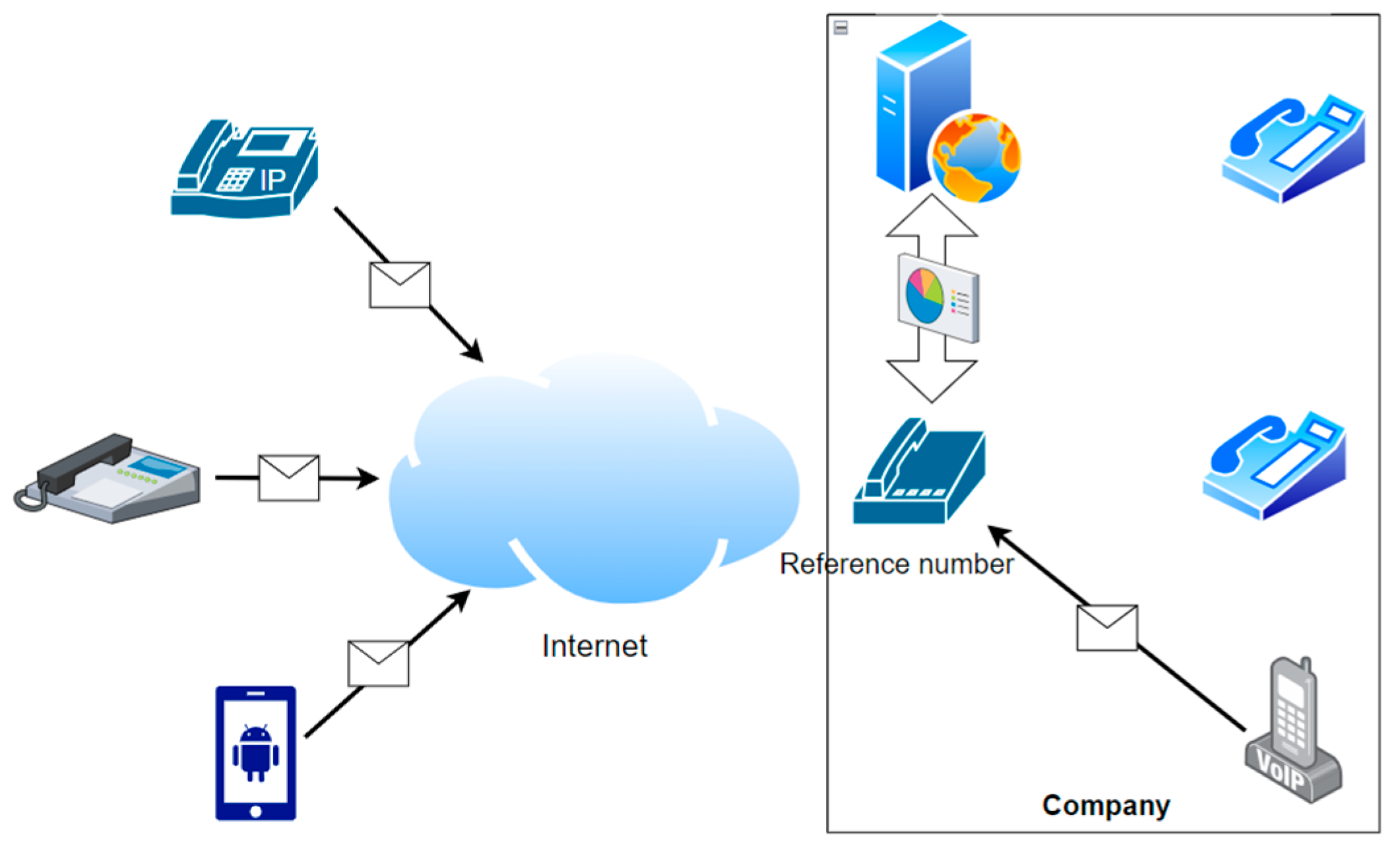
There has been a long-standing demand for secure VoIP communication between private companies and public institutions. Therefore, numerous encryption mechanisms have been designed and adopted to protect end-to-end communication. These encryption mechanisms require the establishment of a session between two user agents, in which the two user agents exchange certificates containing their public keys. That is, callers must remember the callee’s phone number to initiate a dial-up call. This presents a significant inconvenience for users who must communicate with a large number of customers or colleagues, as well as for engineers who are traveling or working remotely and need to temporarily reach out to operators in the data center. To offer users more convenient VoIP services, the need for virtual reference phone numbers arises. Figure 1 illustrates the demand structure. The diagram is drawn based on our real-world application scenario. Incoming and outgoing calls will be routed through a VoIP exchange, which manages reference numbers to efficiently establish calls. Within the company, the deployment is straightforward, as all telephone devices are wired to VoIP gateways, which connect to the exchange. Outside the company, users can initiate call setup using wired or wireless VoIP devices. Wired phone devices communicate through the internet provided by the local ISP, which is generally more stable. However, although wireless phone devices also rely on the internet provided by the local ISP, their operating environments are more complex, such as basements, elevators, vessels, and mountainous areas, which may increase the risk of call setup failure. Therefore, this paper focuses on the effectiveness of the reference number mechanism, while the influence of wireless end devices is beyond the scope of discussion. The reference phone numbers are virtual, meaning corresponding physical certificates cannot be exchanged to negotiate session keys. Therefore, to address this need, this article makes the following contributions:
Figure 1. A virtual reference phone number to physical VoIP numbers.
  • We propose a mechanism for converting reference phone numbers to physical phone numbers and demonstrated its feasibility by implementing the mechanism.
  • After deployment and application, as well as the statistical data analysis in this paper, the call success rate proves to be efficient and meets users’ expectations.
  • The proposed mechanism is universal, meaning users have the flexibility to replace the key agreement algorithm or VoIP protocol with their preferred choices.
The structure of this article is as follows. Section 3 describes the necessary knowledge and related work. In Section 4, we propose architecture employing algorithmic reference phone numbers. The performance of the proposed approach is shown in Section 5, along with a discussion of its benefits and drawbacks. Section 6 concludes the work as well as some ideas for future research.

4. Proposed Method

4.1. The Architecture

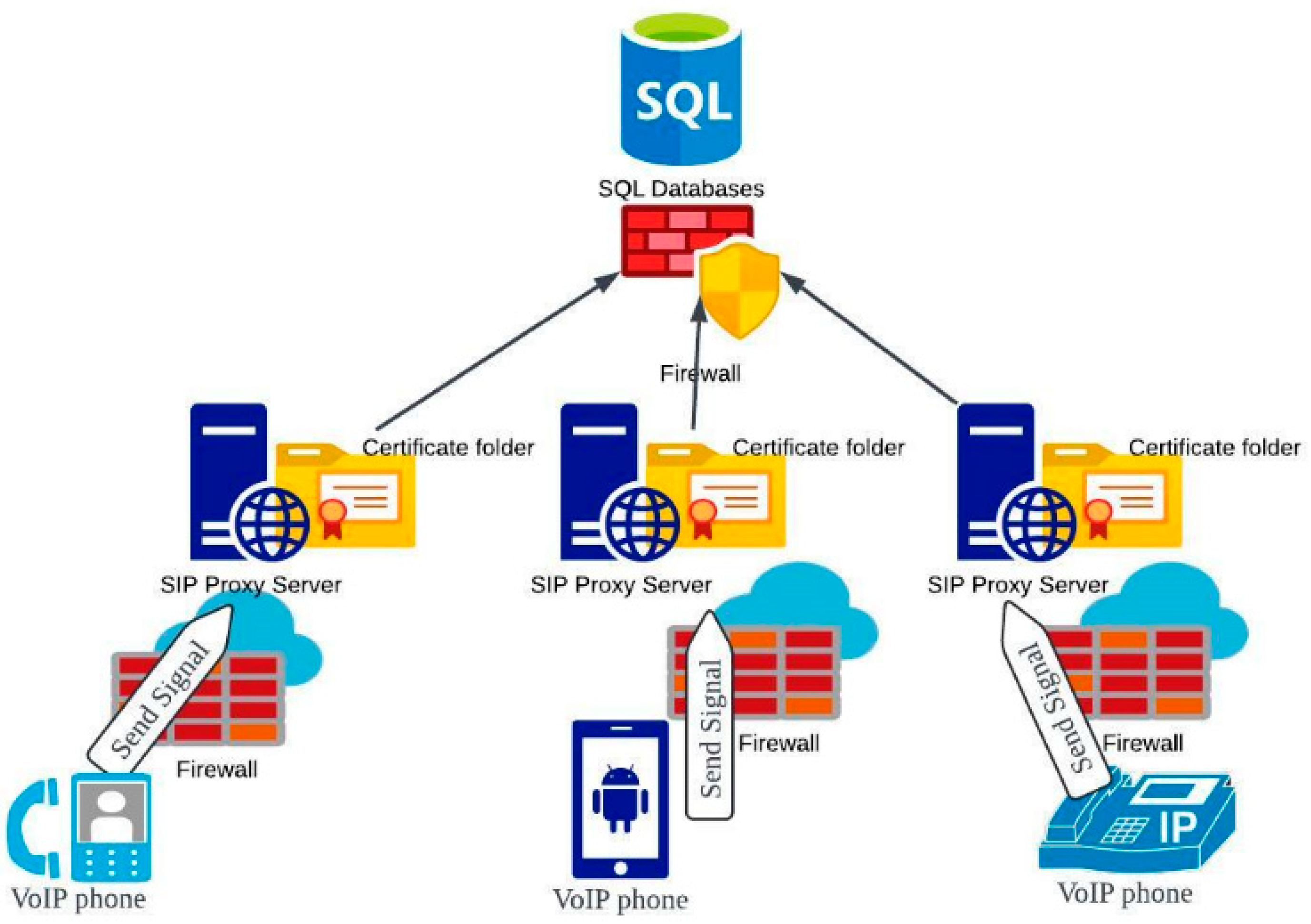
We implemented a realistic framework, as shown in Figure 4, to verify the practicality of the proposed mechanism and analyze its performance. The fundamental idea is comparable to that of a SIP proxy server that is commonly deployed. In order to establish a call session, each SIP proxy server provides authentication, grants access, and routes call setup signals to other servers where the callee is registered. Additionally, each SIP proxy server contains a directory that houses all user certificates, including the public key. The database containing information on SIP servers, agents, and related data is protected by a firewall. Communication ports have been modified to help prevent attacks targeted to compromise standard SQL and SIP settings. VoIP end devices register with the SIP proxy server over the Internet and set up a Transport Layer Security (TLS) tunnel before sending SIP signals. Additionally, each VoIP end device has a private key stored in secure memory.
Figure 4. A realistic operational framework.

4.2. Algorithms

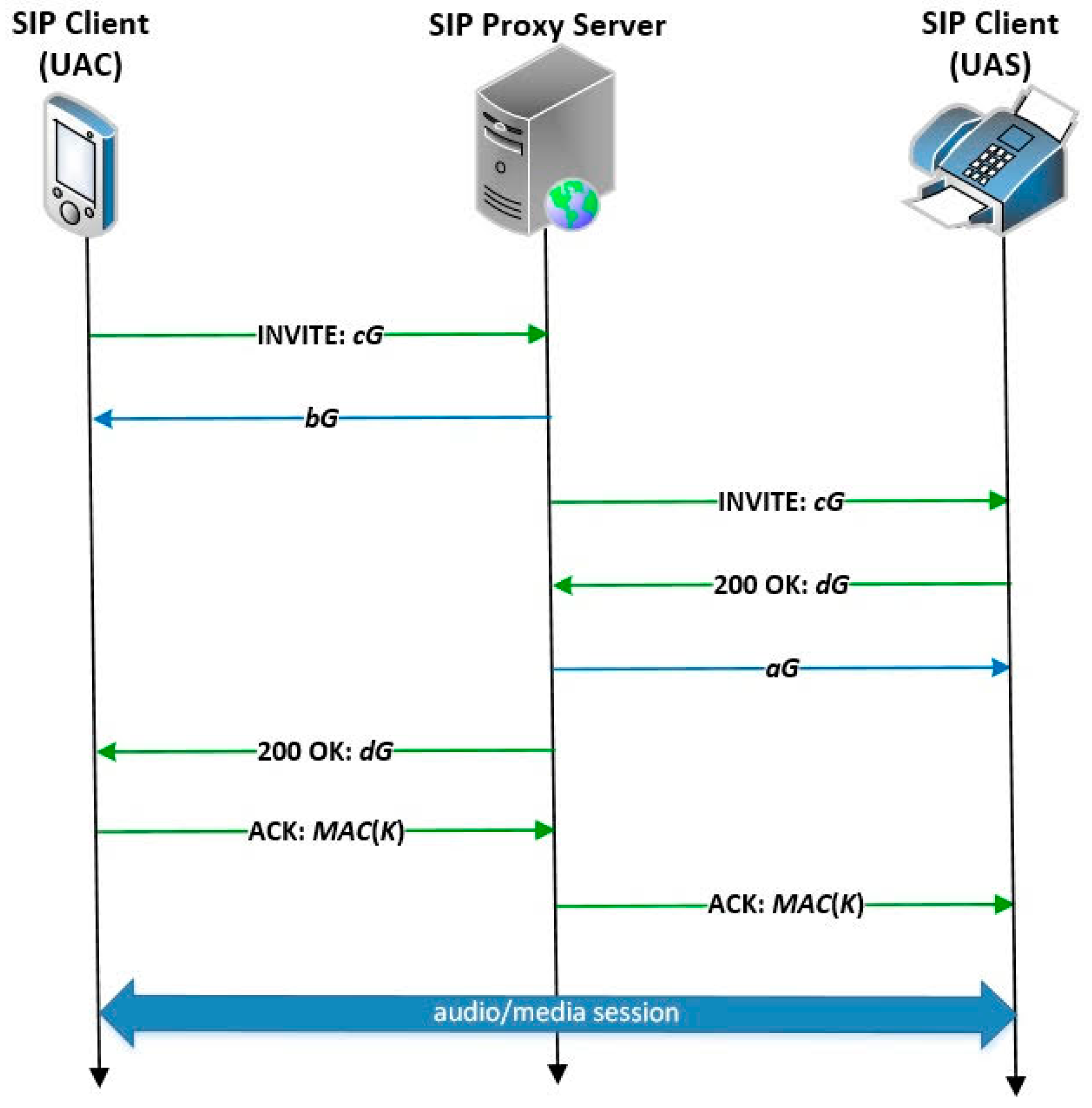
In order to protect the confidentiality of the session, we referred to [26] and adopted the ECMQV algorithm [29] to be integrated into the SIP protocol. The symbols, algorithm, and integrated protocol are illustrated in Table 1, Algorithm 1, and Figure 5, respectively.
Algorithm 1: ECMQV algorithm
Input: A set of domain parameters (#E(Fp), q, h, G),
    private keys (a, c), and
  public keys (aG, cG, bG, dG)
Output: A session key K
  • l o g 2 # E ( F q ) / 2 n
  • x c G m o d   2 n + 2 n u
    #The x coordinate of the public key ( c G ) is converted to an integer
  • c + u a   m o d   q s
  • x d G m o d   2 n + 2 n v
    #The x coordinate of the public key ( d G ) is converted to an integer
  • s ( d G + v b G ) Q
  • return K = H a s h ( Q x )
Table 1. Domain parameters in elliptic curve cryptography.
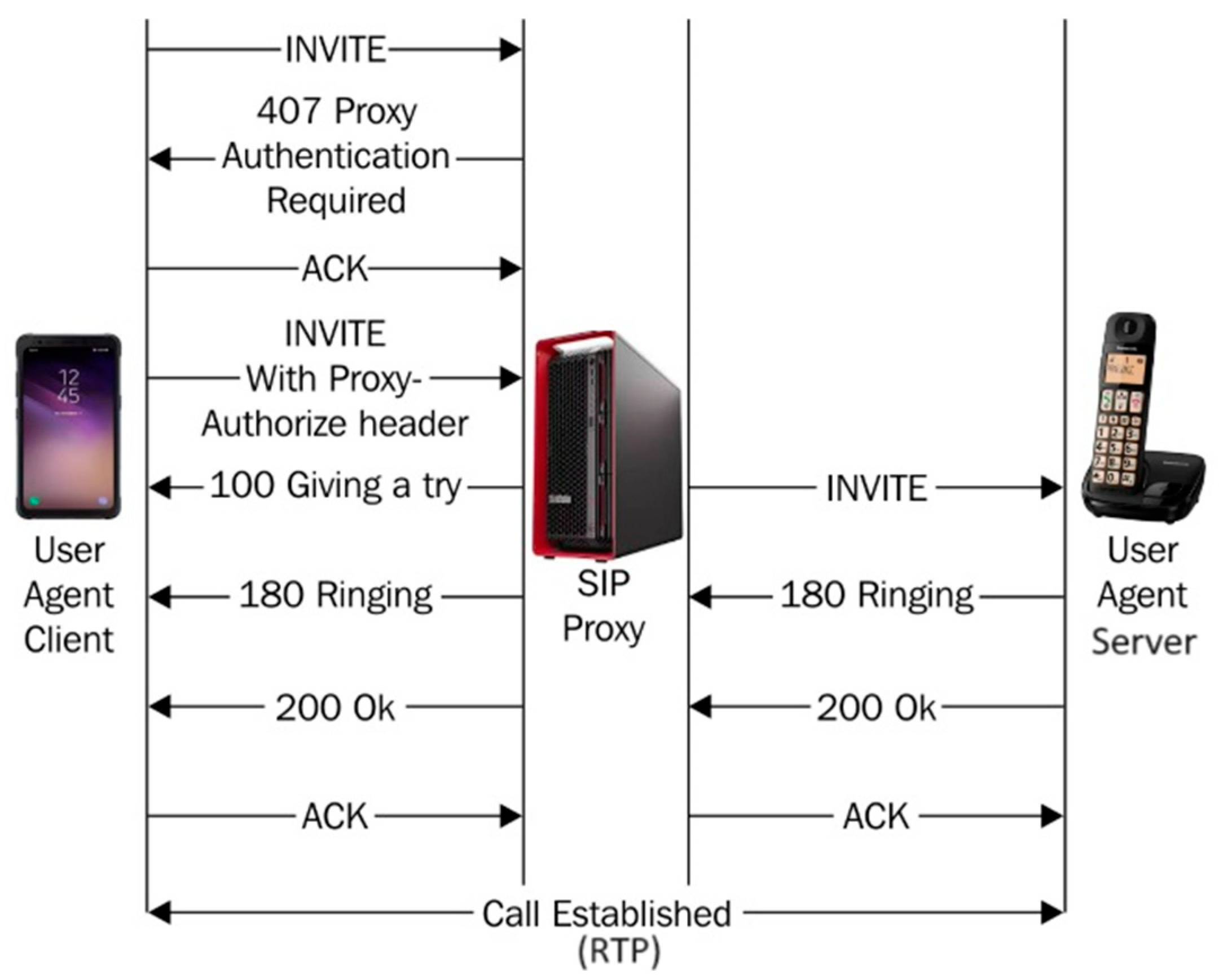
Figure 5. The standard SIP protocol integrates the ECMQV algorithm.
As shown in Figure 5, the caller sends a SIP invite message containing his/her ephemeral public key cG. A SIP proxy server checks its database and the directory containing public keys. If the callee exists, the SIP proxy server will respond to the caller with the callee’s static public key (bG) and forward the INVITE message to the callee. After receiving the INVITE message, the callee will reply with a SIP 200 OK message including his/her ephemeral public key dG. The SIP proxy server will return the caller’s static public key (aG) to the callee and transfer the 200 OK message to the caller. The caller uses the callee’s temporary and static public key received from the SIP proxy server paired with its own long- and short-term private key to calculate the Q-point. The session key K is then generated by hashing the extracted x-coordinate of the Q point. Finally, the caller sends the message authentication code of the session key MAC(K) which is produced by encrypting 16 bytes of zeros. The callee verifies the MAC by calculating the common session key.
Next, the pseudocode proposed in Algorithm 2 is used to solve the virtual reference phone number that does not have a corresponding public key. When a caller dials a reference phone number, the SIP proxy server searches for the group it represents. For example, a reference phone number 77777 may represent a group of numbers (70001, 70002, 70003, or 70004) with related services. If the SIP proxy server cannot find its group, the number may be wrong, and Algorithm 2 returns 0, which will be converted into an SIP 404 Not Found message to the caller. If the group exists, the algorithm checks the status of the numbers in the group one by one. When the algorithm finds an available number, then it searches the directory for the corresponding certificate. If the certificate is not found, −1 is returned, which is converted into an SIP 403 Forbidden message. If all the conditions are met, the number is passed back to the SIP proxy server; otherwise, the SIP proxy server will obtain 1 and interpret it as an SIP 486 Busy message. As a result, when the SIP proxy server obtains an available number n, it will send the static public key of n to the caller and proceed with the process, as illustrated in Figure 5.
Algorithm 2: Reference Phone Number algorithm
Input: A reference phone number R
Output: A real number n or 1 or 0
  • S e a r c h _ G r o u p ( R ) N
  • i f   N   e x i s t s
  • f o r   n   i n   N
  •     C h e c k _ S t a t u s ( n ) s
  •     i f   s   b u s y
  •       i f   f i l e _ e x i s t ( s e a r c h _ c e r t ( n ) )
  •         r e t u r n   n
  •       e l s e
  •         r e t u r n 1
  •    r e t u r n   1
  • e l s e
  • r e t u r n   0

5. Result Analysis and Performance Comparison

5.1. Result Analysis

The experimental environment was set up as follows. A hypervisor VMware ESXi 6.5 was installed and configured on a 1U rack Dell PowerEdge R450 server with DDR4-2400 64 GB Memory and Intel Xeon Silver 4210 2.20 GHz, 10 cores. Then, we created and configured five virtual machines on the ESXi management console, including four SIP proxy servers and one RTP relay server running on the Ubuntu 18.04 operating system. The SIP proxy server was developed and modified from the free open-source framework—Asterisk. A MySQL database virtual machine was created using a 1U rack Dell PowerEdge R350 server with Intel Xeon E-2300 3.1G 8 cores and DDR4-3200 16 GB, and the virtual machine hypervisor VMware ESXi 6.5 was installed.
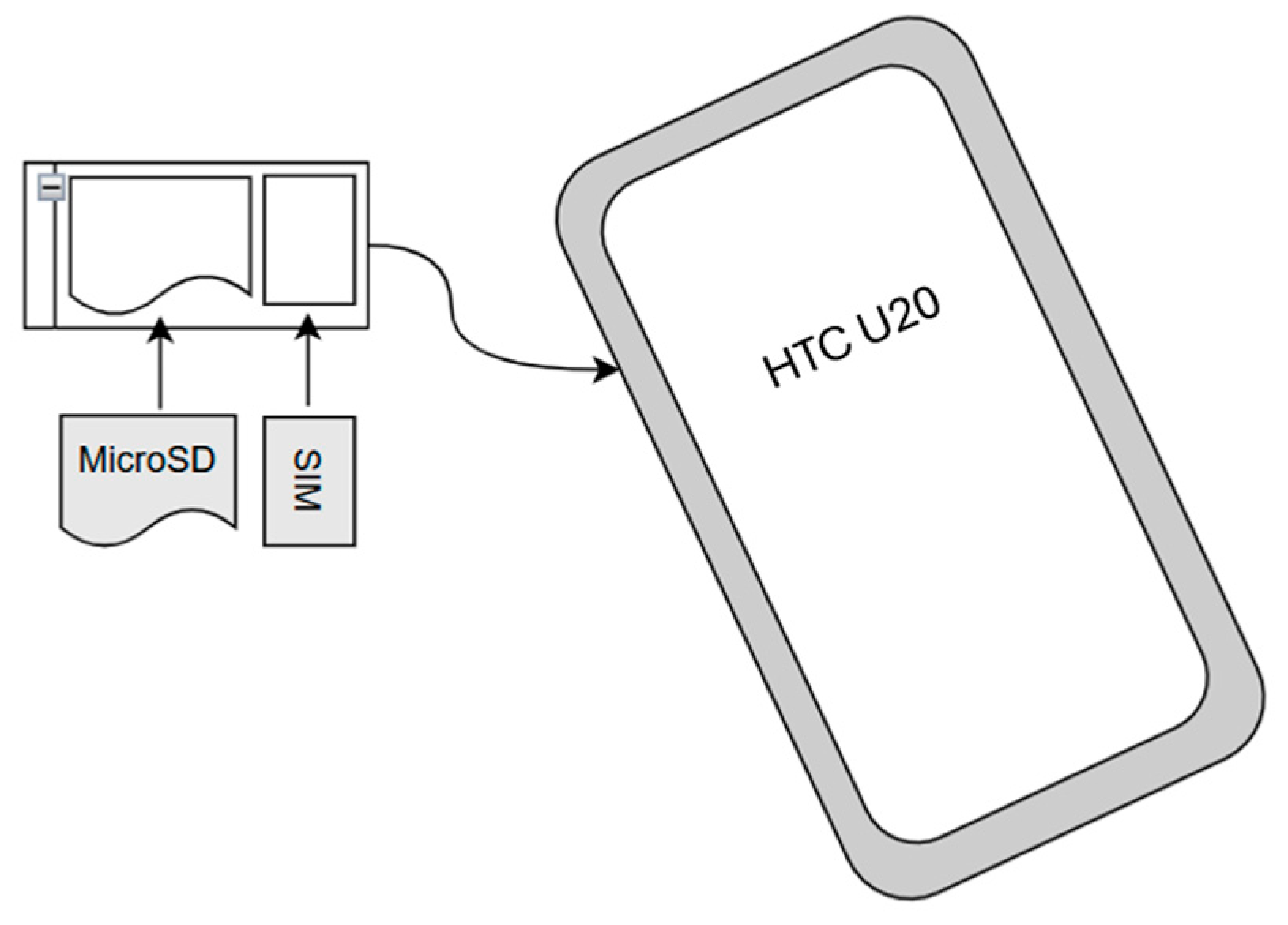
The deployment of terminal devices has become complex due to the presence of wired and wireless (mobile) equipment. The smartphone model was the HTC U20, equipped with a MicroSD card that has encryption capabilities, and we installed a customized VoIP application designed by us. The conceptual diagram is illustrated in Figure 6.
Figure 6. This schematic illustrates that the smartphone is equipped with a MicroSD card featuring encryption capabilities. For details, refer to [30].
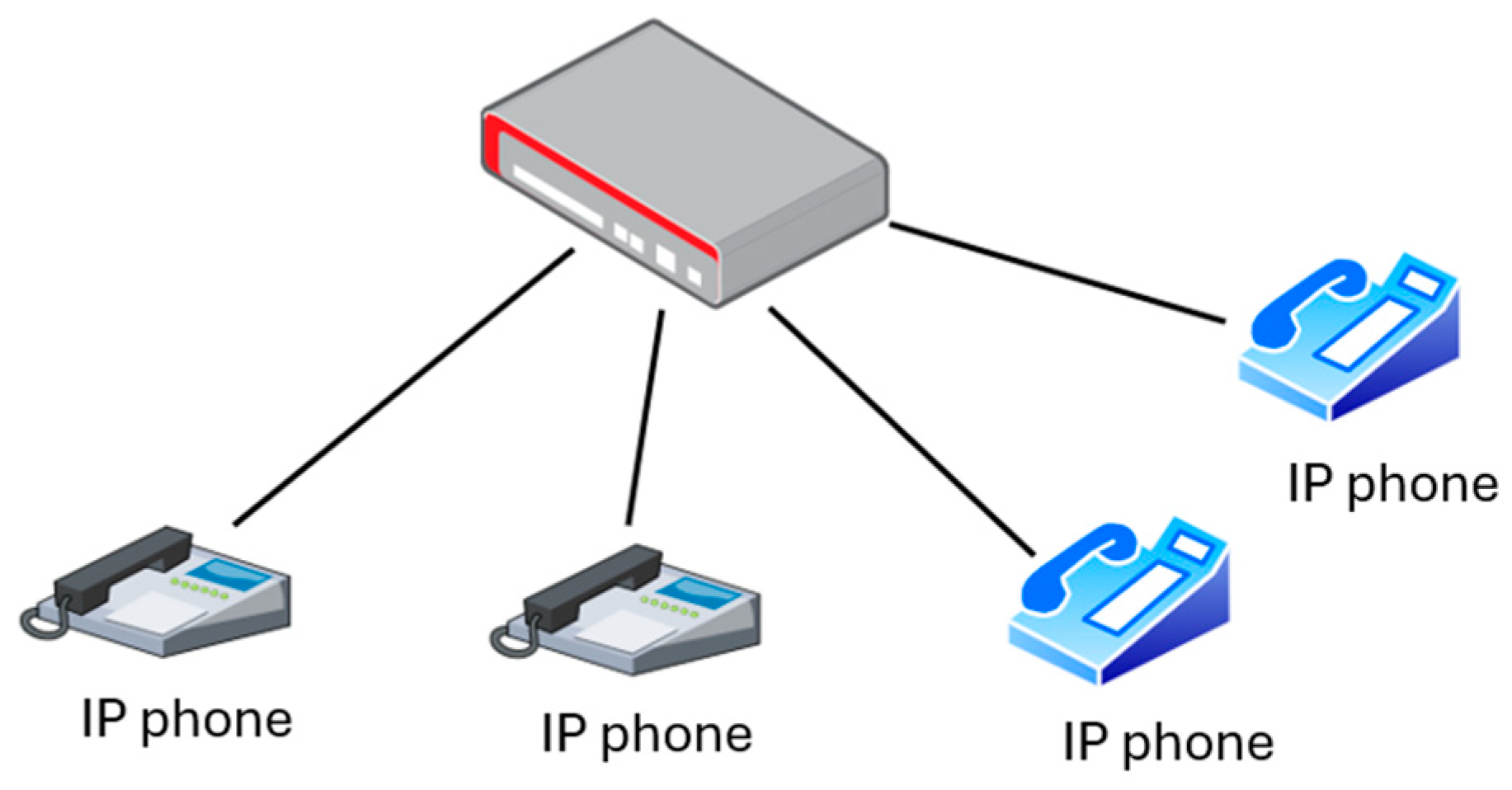
A wired desk phone connects to a custom VoIP gateway equipped with a Hardware Security Module (HSM) for key exchange and encryption. The conceptual diagram is shown in Figure 7.
Figure 7. This schematic illustrates a VoIP phone connecting to a VoIP gateway equipped with HSM. For details, refer to [31].
The proposed system was deployed in an organization with more than 200 employees. The statistical results of call establishment success are presented in Table 2. The author divided the status of calls into 12 categories. “Successful Call Setup” means that the communicating parties successfully conducted a conversation. “Missed Call” means the called party did not answer the call. “Line Busy” indicates that the callee’s line was currently in use or occupied. “Offline” means that the callee was not registered to the SIP proxy server. “Callee No Response” means that the SIP proxy server forwarded the INVITE signal to the callee, but the callee did not respond for some unknown reason. “Wrong Number” means the caller dialed a phone number that does not exist. “Call Rejected” means the callee hung up the phone directly. “Call Forbidden” means the callee’s account was illegal or the callee’s certificate did not exist. “System Service Abnormality” means that the SIP proxy server could not process SIP signals normally. “ACK timeout” refers to the situation where, after receiving an SIP 200 OK response, the system waited for the final SIP ACK signal for a duration that exceeded the specified time limit. “Unstable Network, Msg Lost” indicates that the SIP signal was lost or could not be successfully delivered due to unstable network conditions. All remaining cases are classified as “Other” status. The statistical data collection period was from 15 to 19 January. In order to evaluate the trend changes, the “Connection Success Rate” is defined as the following equation,
S u c c e s s f u l   C a l l   S e t u p + M i s s e d   C a l l + L i n e   B u s y   + W r o n g   N u m b e r + C a l l   R e j e c t e d t o t a l c a l l s
and the equation for “Call Setup Rate” is defined as follows.
C a l l e e   N o   R e s p o n s e + L i n e   B u s y t o t a l   c a l l s
Table 2. Statistics of call status.
Additionally, the equation of “System Abnormality Rate” is defined below.
S u c c e s s f u l   C a l l   S e t u p + C a l l   F o r b i d d e n   +   S y s t e m   S e r v i c e   A b n o r m a l i t y + U n s t a b l e   N e t w o r k ,   M s g   L o s t t o t a l   c a l l s
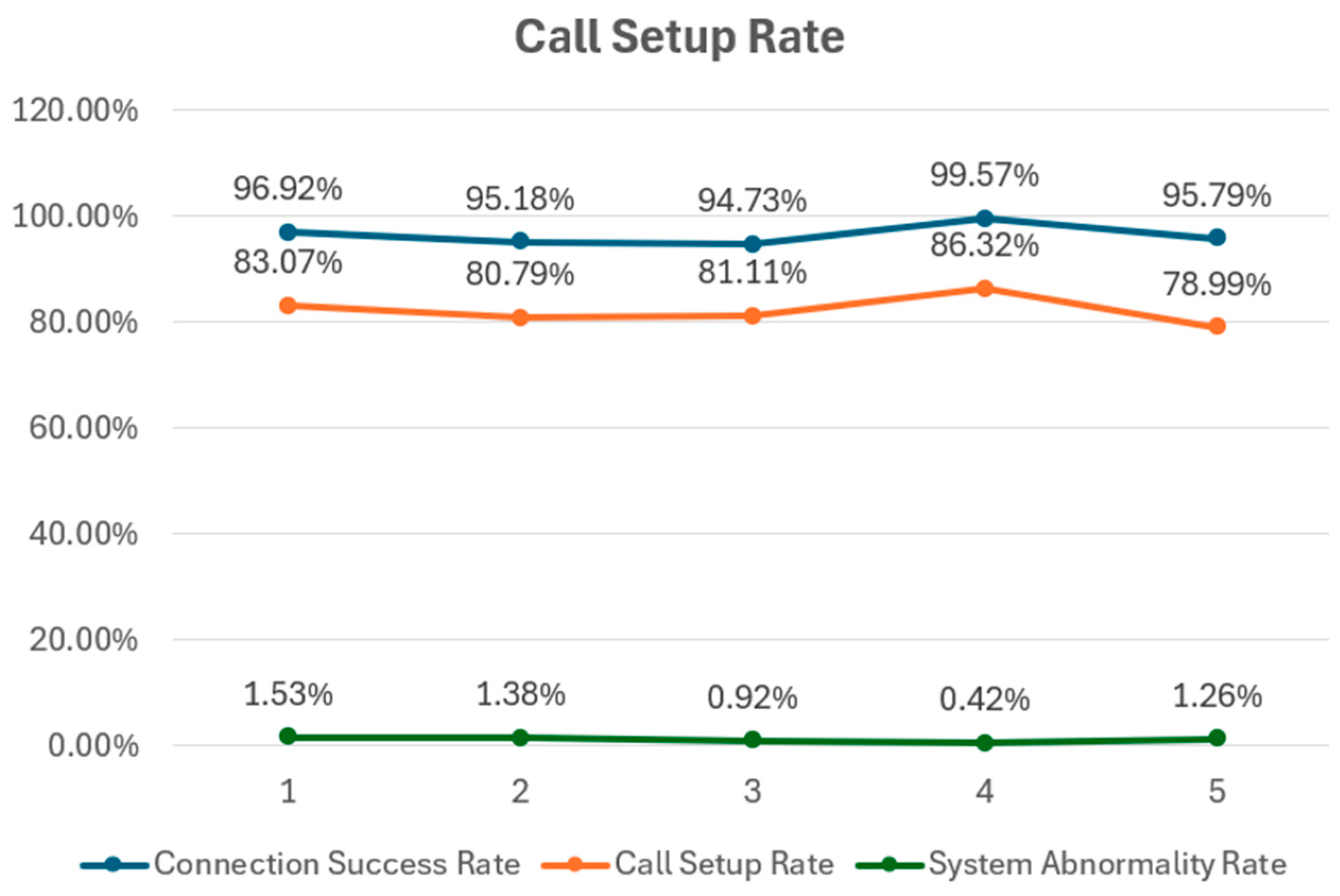
The trend of call success rate is shown in Figure 8, the call connection success rate is as high as over 95%, which means users could smoothly access services and initiate calls. As we can see, the call was not dialed to a specific callee, but to a reference phone number that multiple callees could respond to. As a result, callers experienced fewer busy lines. However, an idle number does not guarantee that the callee was necessarily available at their seat, so there is still a possibility that missed calls happened. Since the caller may have been in an unstable or poor network environment, and SIP signals may have sometimes been lost. States 4 and 10 can be classified as the aforementioned situations. Definitely, even with a reference phone number, callers may have still dialled the wrong number. Overall, the probability that users were able to find the callee and establish a call is about 80%, indicating that customers or employees traveling abroad would usually be able to reach a business partner when making a phone call, thereby improving service satisfaction.
Figure 8. Statistical trend line chart.

5.2. Performace Comparison

(1)
Call success rate
In [26], the percentage of successful calls is simply defined as follows:
S u c c e s s   % = 100 · C a l l s s u c c e e d e d C a l l s a c c e p t e d + C a l l s r e j e c t e d
where C a l l s s u c c e e d e d is the number of successful/acceptable calls, C a l l s a c c e p t e d is the number of calls admitted by call admission control (CAC), and C a l l s r e j e c t e d is the number of calls rejected by CAC.
The result shows that CAC mechanisms significantly improve call success rates compared to systems without admission control. With a unified CAC in basic mode, it maintained a 40% success rate for 80 users. With a unified CAC in advanced mode, there was a 0% call failure for 80 users, meaning all calls succeeded.
In [27], the call success rate is calculated as follows:
S u c c e s s = 100 · A c c e p t e d D e g r a d e d O f f e r e d
where A c c e p t e d refers to the number of calls accepted by CO-CAC, D e g r a d e d refers to calls canceled due to falling below the minimum speech quality threshold, and O f f e r e d is the total number of calls made during the simulation.
The results indicate that for 0 to 50 users, the success rate remained at nearly 100%, as the network was not congested. In the range of 50 to 100 users, the system maintained an almost perfect success rate by dynamically adjusting bandwidth allocation. However, as the number of users increased to 100–200, the success rate gradually declined due to call rejections caused by network limitations. Beyond 200 users, approximately 30% of call attempts were rejected as the system reached its capacity limits.
U-CAC [26] and CO-CAC [27] operate in fundamentally different environments—CO-CAC is optimized for UAV-based VoWiFi-5G networks, whereas U-CAC is designed for corporate VoIP infrastructures. Due to the differences in application scenarios, a direct comparison is not entirely meaningful. However, we provide an analysis based on a common evaluation criterion, namely the call success rate. The results indicate that our mechanism maintained a higher success rate even with over 200 users. Furthermore, both mechanisms [26,27] remain at the academic research stage and have not yet been deployed in real-world environments. In contrast, our mechanism has been implemented in practical settings, demonstrating its feasibility.
(2)
Latency and Computational cost
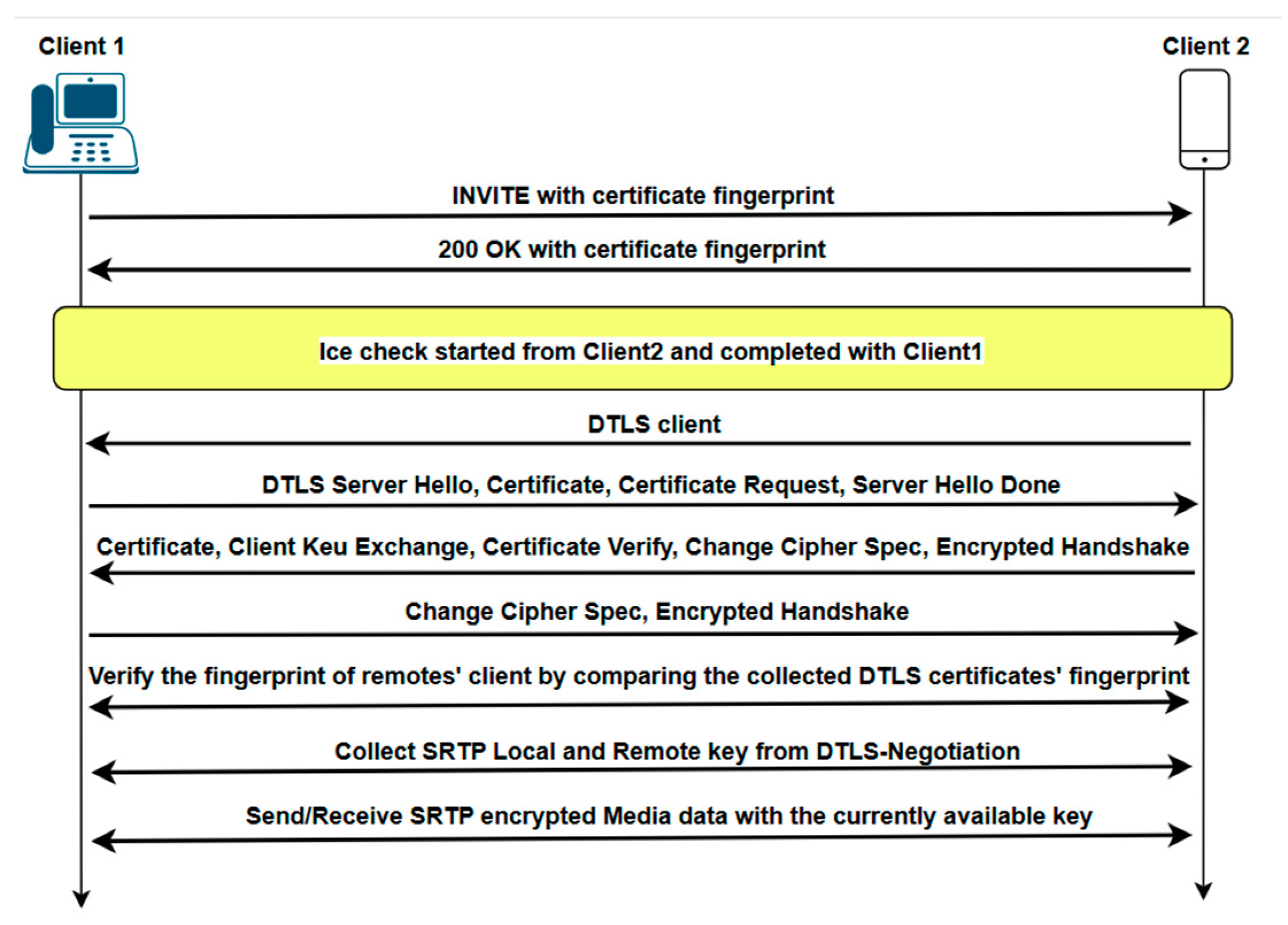
We used DTLS-SRTP as the comparative benchmark to explain the theoretical latency and computational overhead, as practical results vary in real-world scenarios. As you can see in the following flowchart (Figure 9), DTLS-SRTP requires an additional process, which involves a complete TLS protocol to negotiate the cipher suite. Additionally, after receiving certificates, clients must validate them by querying a Certificate Authority (CA). These signaling messages introduce greater overhead compared to the proposed mechanism. In the proposed mechanism, the protocol adds only two additional signal messages (see Figure 5), which can be considered equivalent to the certificate signal message in the TLS protocol. Therefore, the additional overhead introduced by this component is considered to be negligible. To generalize this concept into a mathematical formulation, latency is defined as follows:
L = i = 1 n τ i
where n denotes the total number of signal messages, and τi represents the transmission time of the i-th signal message.
According to [32], prior research has shown that the primary overhead incurred during SSL processing occurs in the session negotiation phase. Approximately 70% of the total processing time of an HTTPS transaction is attributed to SSL processing. For simplification, assuming each τi is 20 ms, the total overhead amounts to 140 ms when considering the following flowchart, which includes seven additional signal messages. Compared to DTLS-SRTP, the proposed mechanism introduces only two additional signal messages, resulting in an increased latency of 40 ms, as calculated using Equation (1) under the same assumption.
Figure 9. DTLS-SRTP flowchart. For details, refer to [33].
According to [26], the proposed mechanism, which utilizes ECMQV with the Secp521r1 elliptic curve, incurs a computational cost of approximately 0.9875 s to complete the key agreement process. In contrast, DTLS-SRTP is assumed to generate a key using ECDH, requiring approximately 0.806 s. However, DTLS-SRTP incurs additional computational overhead for certificate validation, cipher suite negotiation, and other related operations. Consequently, the proposed mechanism demonstrates greater efficiency.

6. Conclusions

In order to solve the issue of not being able to reach the relevant business personnel by phone while other personnel are available to answer the call, this study presents a practical VoIP service that improves call availability by utilizing reference phone numbers. The system can be built on the traditional SIP VoIP framework. By incorporating the proposed algorithms into existing servers and terminals, upgrading services can be seamlessly integrated. We also analyzed the performance of the reference phone number mechanism through actual deployment, and the mechanism showed satisfactory results, proving its practicality. As future work, research will be conducted on transferring calls from landline numbers to mobile numbers while implementing the corresponding key exchange mechanisms to ensure call security.

Funding

There is no funding for this research.

Data Availability Statement

All research data are included within the content of the research.

Acknowledgments

I acknowledge the support provided to all users of this system.

Conflicts of Interest

The author declares no conflict of interest.

References

  1. ITU-T. Packet-Based Multimedia Communications Systems; ITU-T Recommendation H.323; International Telecommunication Union: Geneva, Switzerland, 2009. [Google Scholar]
  2. ITU-T. Gateway Control Protocol; ITU-T Recommendation H.248; International Telecommunication Union: Geneva, Switzerland, 2015. [Google Scholar]
  3. Rosenberg, J.; Schulzrinne, H.; Camarillo, G.; Johnston, A.; Peterson, J.; Sparks, R.; Handley, M.; Schooler, E. SIP: Session Initiation Protocol; RFC 3261; Internet Engineering Task Force: Fremont, California, USA, 2002. [Google Scholar]
  4. Shen, C.; Nahum, E.; Schulzrinne, H.; Wright, C. The Impact of TLS on SIP Server Performance. In Proceedings of the Principles, Systems and Applications of IP Telecommunications (IPTComm’10), New York, NY, USA, 2–3 August 2010; pp. 59–70. [Google Scholar]
  5. Zourzouvillys, T.; Rescorla, E. An Introduction to Standards-Based VoIP: SIP, RTP, and Friends. IEEE Internet Comput. 2010, 14, 69–73. [Google Scholar] [CrossRef]
  6. Rivest, R. The MD5 Message-Digest Algorithm; RFC 1321; Internet Engineering Task Force: Fremont, California, USA, 1992. [Google Scholar]
  7. Schulzrinne, H.; Casner, S.; Frederick, R.; Jacobson, V. RTP: A Transport Protocol for Real-Time Applications; RFC 3550; Internet Engineering Task Force: Bangkok, Thailand, 2003. [Google Scholar]
  8. Paul, S. Real-Time Transport Protocol (RTP). In Multicasting on the Internet and Its Applications; Springer: Berlin/Heidelberg, Germany, 1998; pp. 193–201. [Google Scholar]
  9. Liping, Z.; Shanyu, T.; Shaohui, Z. An Energy Efficient Authenticated Key Agreement Protocol for SIP-Based Green VoIP Networks. J. Netw. Comput. Appl. 2016, 59, 126–133. [Google Scholar]
  10. Azrour, M.; Ouanan, M.; Farhaoui, Y. A New Efficient SIP Authentication and Key Agreement Protocol Based on Chaotic Maps and Using Smart Card. In Proceedings of the 2nd International Conference on Computing and Wireless Communication Systems (ICCWCS’17), New York, NY, USA, 14–16 November 2017; pp. 1–8. [Google Scholar]
  11. Chaudhry, S.A.; Naqvi, H.; Sher, M.; Farash, M.S.; Hassan, M.U. An Improved and Provably Secure Privacy-Preserving Authentication Protocol for SIP. Peer-Peer Netw. Appl. 2017, 10, 1–15. [Google Scholar] [CrossRef]
  12. Nikooghadam, M.; Jahantigh, R.; Arshad, H. A Lightweight Authentication and Key Agreement Protocol Preserving User Anonymity. Multimed. Tools Appl. 2017, 76, 13401–13423. [Google Scholar] [CrossRef]
  13. Burrows, M.; Abadi, M.; Needham, R. A Logic of Authentication. ACM Trans. Comput. Syst. 1990, 8, 18–36. [Google Scholar] [CrossRef]
  14. Ravanbakhsh, N.; Mohammadi, M.; Nikooghadam, M. Perfect Forward Secrecy in VoIP Networks through Designing a Lightweight and Secure Authenticated Communication Scheme. Multimed. Tools Appl. 2019, 78, 11129–11153. [Google Scholar] [CrossRef]
  15. Diffie, W.; Van Oorschot, P.C.; Wiener, M.J. Authentication and Authenticated Key Exchanges. Des. Codes Cryptogr. 1992, 2, 107–125. [Google Scholar] [CrossRef]
  16. Armando, A.; Basin, D.; Boichut, Y.; Chevalier, Y.; Compagna, L.; Cuéllar, J.; Drielsma, P.H.; Héam, P.C.; Kouchnarenko, O.; Mantovani, J. The AVISPA Tool for the Automated Validation of Internet Security Protocols and Applications. In Proceedings of the International Conference on Computer Aided Verification, Edinburgh, UK, 6–10 July 2005; Springer: Berlin/Heidelberg, Germany, 2005; pp. 281–285. [Google Scholar]
  17. Nikooghadam, M.; Amintoosi, H. Perfect Forward Secrecy via an ECC-Based Authentication Scheme for SIP in VoIP. J. Supercomput. 2020, 76, 3086–3104. [Google Scholar] [CrossRef]
  18. Cremers, C. Scyther, Semantics and Verification of Security Protocols. Ph.D. Thesis, Eindhoven University of Technology, Eindhoven, The Netherlands, 2006. [Google Scholar]
  19. Xu, D.; Zhang, S.; Chen, J.; Ma, M. A Provably Secure Anonymous Mutual Authentication Scheme with Key Agreement for SIP Using ECC. Peer-Peer Netw. Appl. 2018, 11, 837–847. [Google Scholar] [CrossRef]
  20. Ul Hassan, M.; Chaudhry, S.; Irshad, A. An Improved SIP Authenticated Key Agreement Based on Dongqing et al. Wirel. Pers. Commun. 2020, 110, 2087–2107. [Google Scholar] [CrossRef]
  21. Vocal Technologies Ltd. Secure SIP. Available online: https://vocal.com/sip/secure-sip/ (accessed on 20 March 2024).
  22. Roach, A.B. Security Mechanism Agreement for the Session Initiation Protocol (SIP); RFC 3329; Internet Engineering Task Force: Bangkok, Thailand, 2003. [Google Scholar]
  23. SIPTRUNK. A Brief Guide to SIP Security. Available online: https://www.siptrunk.com/2019/08/a-brief-guide-to-sip-security/ (accessed on 23 March 2024).
  24. Carrara, T.T.; Housley, R.; Kalt, C.J.; Lazzaro, J.C.R. The Secure Real-time Transport Protocol (SRTP); RFC 3711; Internet Engineering Task Force: Bangkok, Thailand, 2004. [Google Scholar]
  25. Hsieh, W.-B.; Leu, J.-S. Implementing a Secure VoIP Communication over SIP-Based Networks. Wirel. Netw. 2018, 24, 2915–2926. [Google Scholar] [CrossRef]
  26. Mayor, V.; Estepa, R.; Estepa, A.; Madinabeitia, G. Unified Call Admission Control in Corporate Domains. Comput. Commun. 2020, 150, 589–602. [Google Scholar] [CrossRef]
  27. Mayor, V.; Estepa, R.; Estepa, A. O-CAC: A New Approach to Call Admission Control for VoIP in 5G/WiFi AV-Based Relay Networks. Comput. Commun. 2023, 197, 284–293. [Google Scholar] [CrossRef]
  28. Hasan, M.M.; Kwon, S. Joint Call Admission Control and Load-Balancing in Ultra-Dense Cellular Networks: A Proactive Approach. Wirel. Netw. 2024, in press. [Google Scholar] [CrossRef]
  29. Blake, I.; Seroussi, G.; Smart, N. Advances in Elliptic Curve Cryptography; London Mathematical Society Lecture Note Series; Cambridge University Press: Cambridge, UK, 2005; Volume 317. [Google Scholar]
  30. HTC. Inserting SIM and SD—HTC U20 5G. Available online: https://www.htc.com/tw/support/htc-u20-5g/howto/inserting-sim-and-sd.html (accessed on 8 April 2024).
  31. Yeastar. VoIP Gateways. Available online: https://www.yeastar.com/voip-gateways/ (accessed on 8 April 2024).
  32. Kulin, M.; Kazaz, T.; Mrdovic, S. SIP Server Security with TLS: Relative Performance Evaluation. In Proceedings of the 2012 IX International Symposium on Telecommunications (BIHTEL), Sarajevo, Bosnia and Herzegovina, 25–27 October 2012; pp. 1–6. [Google Scholar]
  33. Sharma, R. WebRTC: Overview and Analysis of WebRTC Security. MatrixSust Blog. 2014. Available online: https://matrixsust.blogspot.com/2014/05/webrtc-overview-and-analysis-of-webrtc.html (accessed on 8 February 2025).
Disclaimer/Publisher’s Note: The statements, opinions and data contained in all publications are solely those of the individual author(s) and contributor(s) and not of MDPI and/or the editor(s). MDPI and/or the editor(s) disclaim responsibility for any injury to people or property resulting from any ideas, methods, instructions or products referred to in the content.

Article Metrics

Citations

Article Access Statistics

Multiple requests from the same IP address are counted as one view.