3.1. Scenario 1: Balanced +100 MW Load Step at N3
Scenario 1 uses the +100 MW step at N3 defined in
Section 2.3.1. Configuration C3 is calibrated via one-at-a-time sweeps of the governor gain
k, the AVR gain
, and the GFMI active-power droop
over the ranges in
Table 5, targeting improved frequency nadir and voltage recovery while avoiding excessive mechanical-power overshoot, reactive oscillations, and converter loading.
The influence of the governor gaining
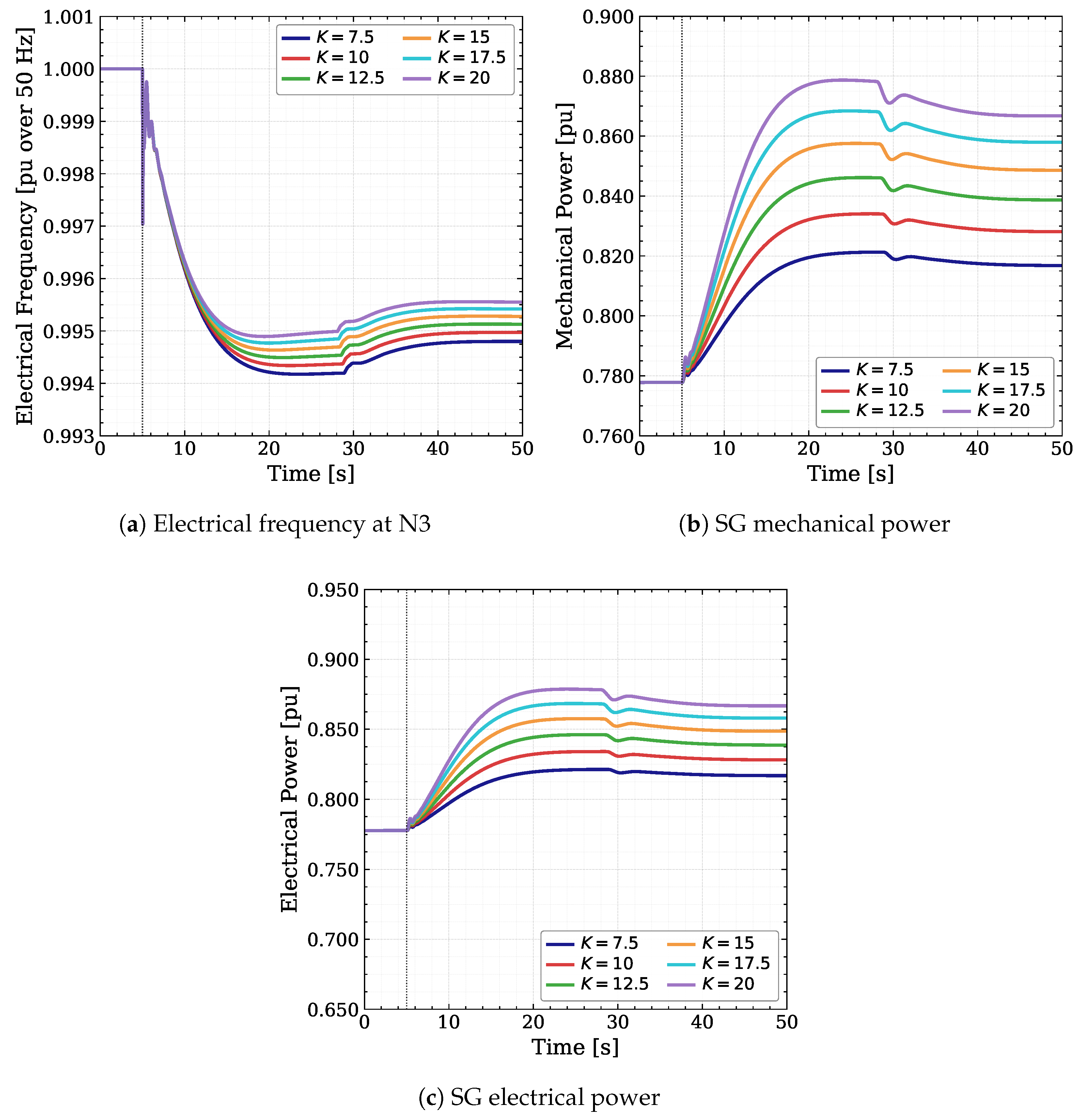
k in C3 is shown in
Figure 2. Electrical frequency at N3 (
Figure 2a) varies only slightly across
, with nadir values separated by about 0.002 pu (
Hz) between the lowest and highest settings. For the adopted droop and inertia, the governor gain mainly shapes the approach to steady state rather than the depth of the first frequency dip, accelerating post-event recovery but providing only marginal improvement in nadir, consistent with the classical swing-equation picture.
In contrast, SG mechanical power (
Figure 2b) shows a stronger dependence: the peak rises from roughly 0.82 pu to about 0.88 pu as
k increases, indicating larger turbine overshoot and more aggressive extraction of mechanical reserve. SG electrical power (
Figure 2c) mirrors this behaviour, with sharper oscillations at higher
k. These overshoots are physically plausible under a fast proportional governor but are less conservative from a turbine and shaft-loading standpoint. A compromise value of
is, therefore, retained. Larger gains provide negligible nadir improvement (about 0.1 Hz across the full sweep) but significantly increase mechanical-power overshoot and electrical-power ripple.
The impact of the AVR gain
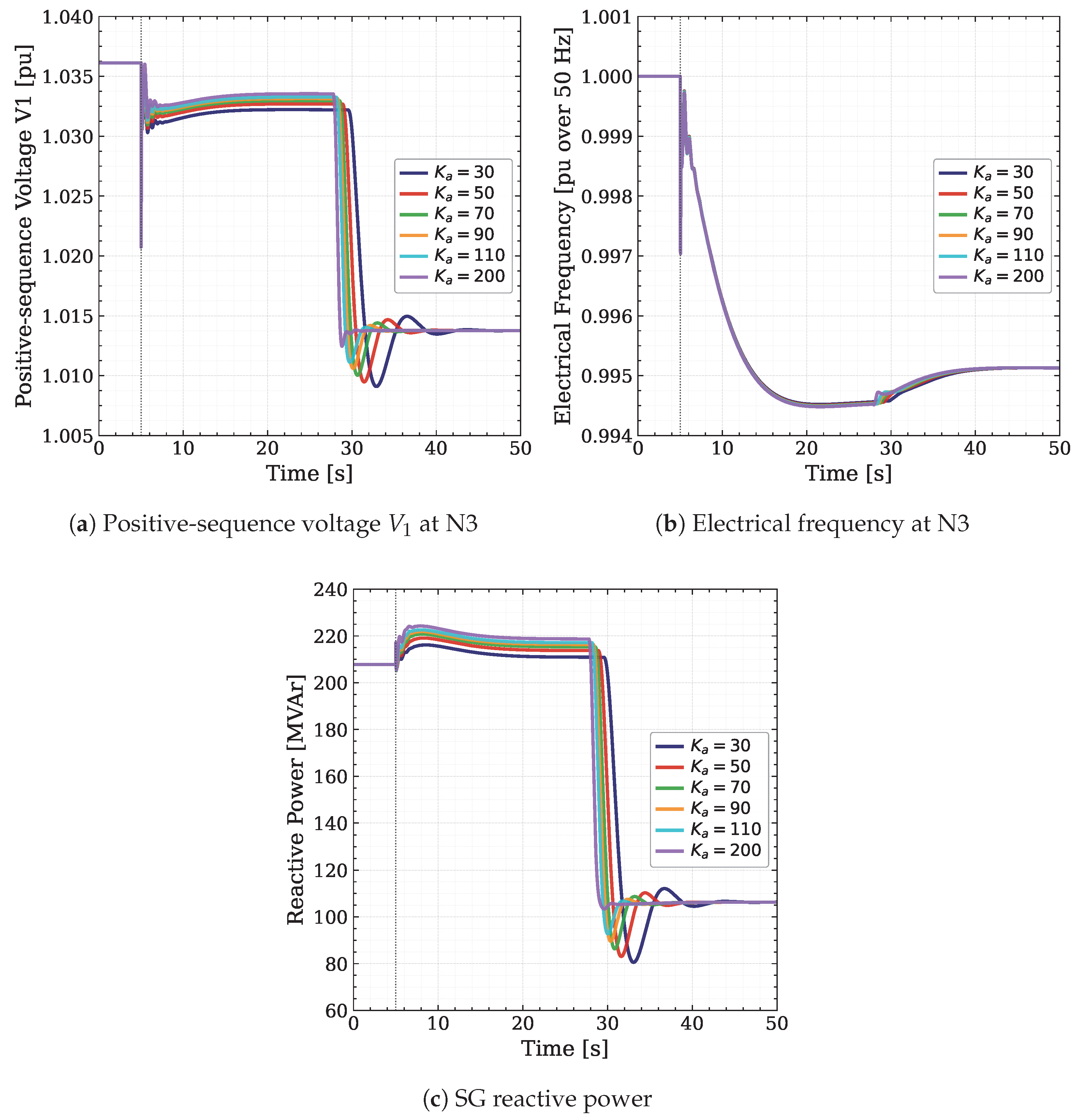
is reported in
Figure 3. The positive-sequence voltage
at N3 (
Figure 3a) improves as
increases: as
rises from 30 to 200, the voltage depression following the load step is reduced and recovery accelerates, with the post-event minimum during the first swing, improving from about 1.008 pu at
to roughly 1.014 pu for
–110. For all tested gains, the voltage trajectory settles within a few seconds after the step, as expected from the stronger voltage-regulation loop compensating the additional reactive demand induced by the +100 MW step.
Frequency (
Figure 3b) remains almost unchanged across the same range, reflecting the intended decoupling between the active-power/frequency and reactive-power/voltage control loops in the RMS model. SG reactive power (
Figure 3c) exhibits modest oscillations (ripple below about 15 MVAr), indicating that the faster AVR action does not destabilise reactive support. Very high gains (
) yield slightly more oscillatory
Q trajectories without a clear benefit in
nadir. A setting of
is, therefore, adopted as a compromise between reducing the initial dip and avoiding the more oscillatory responses observed at the upper end of the range.
The role of the GFMI active-power droop
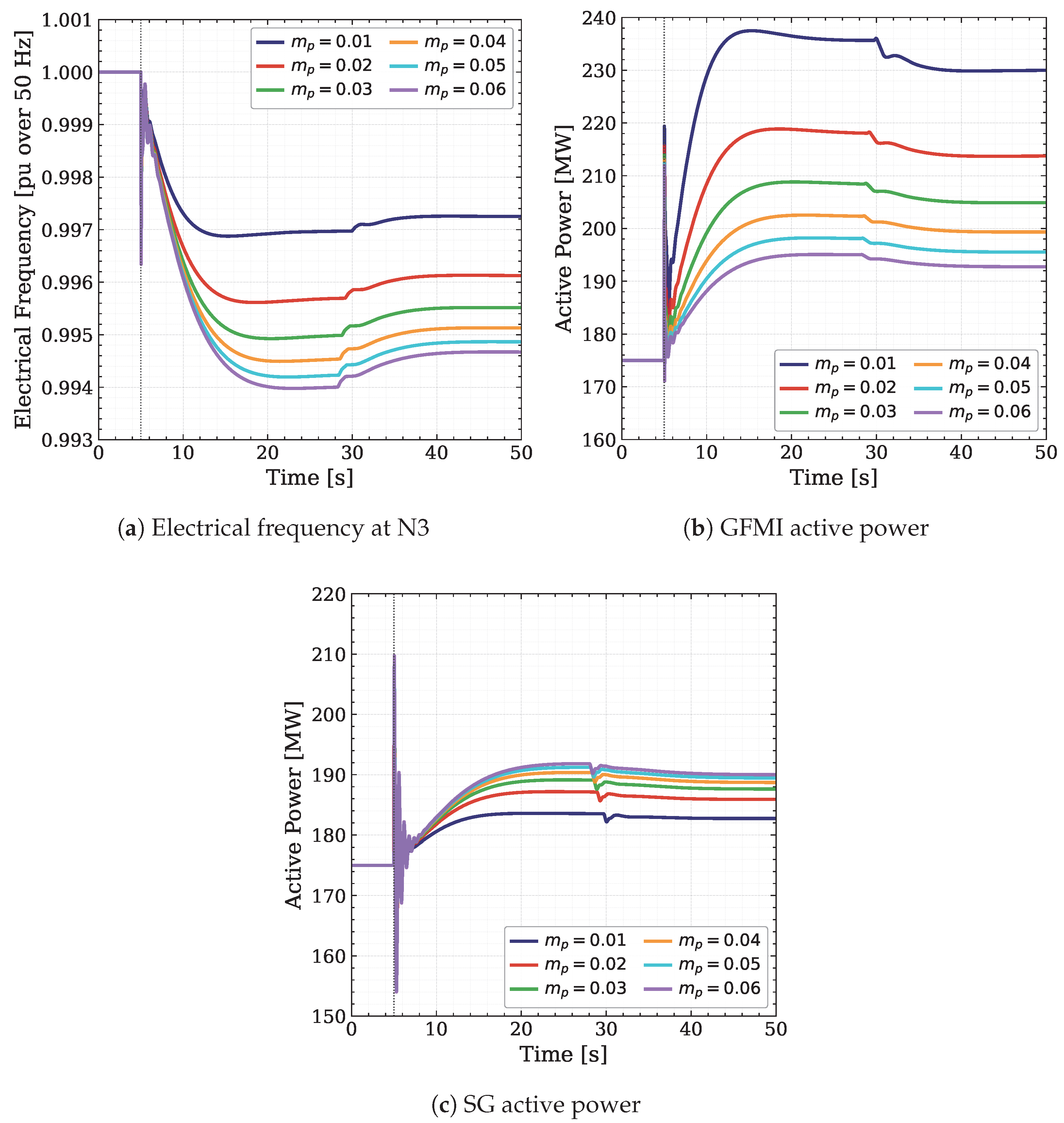
is illustrated in
Figure 4. Electrical frequency at N3 (
Figure 4a) improves at lower droop values, as stronger GFMI participation raises the nadir from its lowest values at
to visibly higher values at
. This follows from Equation (
2): a smaller
(stiffer droop) yields more active-power response for a given frequency deviation and a shallower dip.
GFMI active power (
Figure 4b) increases from about 190 MW at
to around 230 MW at
, with a transient peak close to 235 MW (approximately 1.18 pu on the 200 MVA converter base). SG active power (
Figure 4c) complements this behaviour and supplies the remainder of the +100 MW increment. A lower
, therefore, strengthens frequency containment but shifts a larger fraction of the active-power effort to the converter, whereas a higher
relaxes converter effort at the expense of a deeper nadir. A setting of
is selected as it provides a nadir close to the best case while keeping GFMI active-power peaks at a moderate overload (about 1.18 pu on the 200 MVA base) that remains well below the per-axis current limits and maintains a balanced SG–GFMI sharing for this benchmark.
A cross-configuration comparison is provided in
Figure 5 and
Figure 6, using the calibrated values
,
, and
in C3. The frequency nadir (
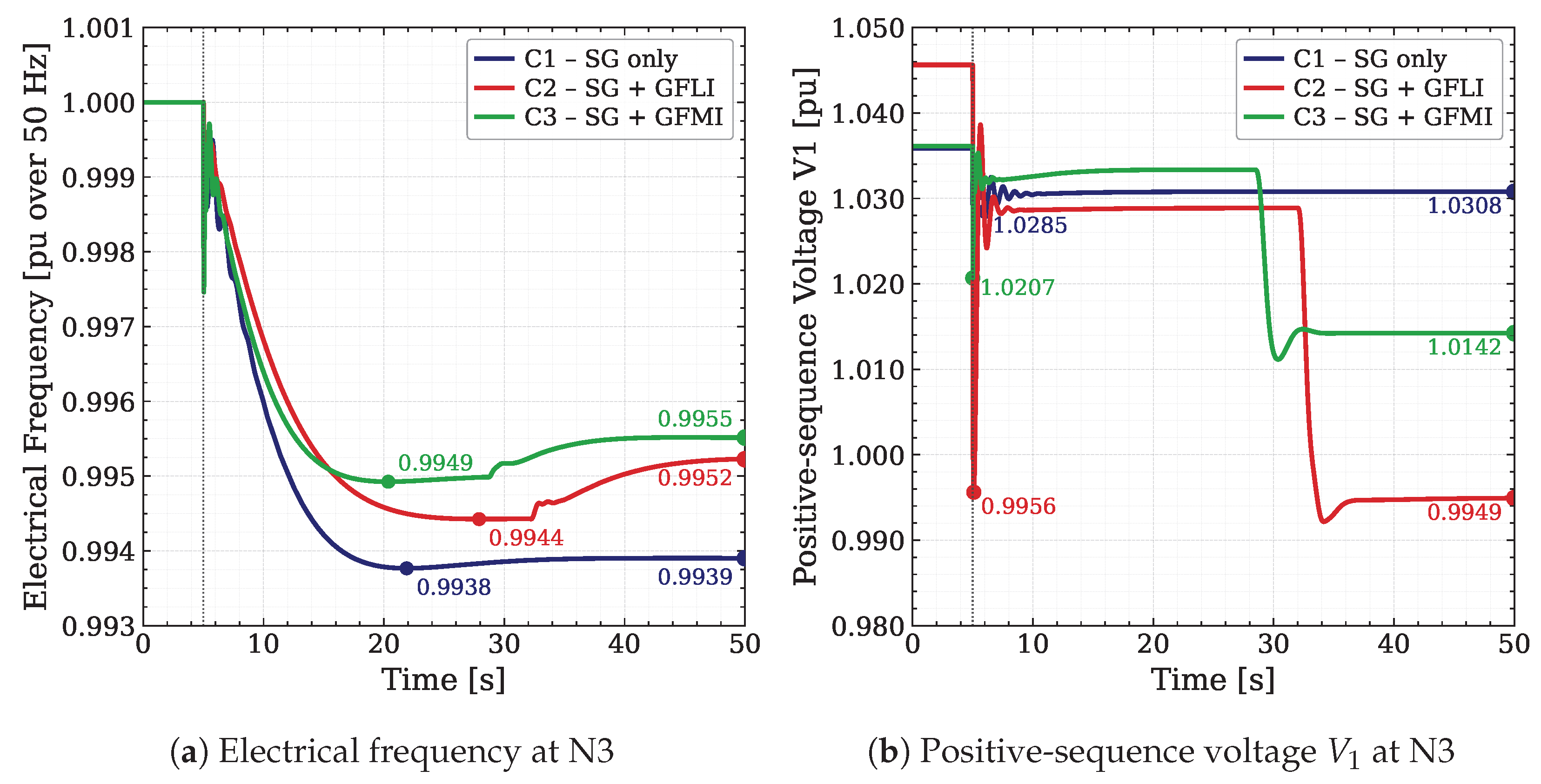
Figure 5a) is lowest in C1 (0.9938 pu; 49.69 Hz), reflecting the limited primary control provided by the single SG. C2 shows a slightly higher nadir (0.9944 pu; 49.72 Hz), but the improvement is modest because the GFLI does not provide deliberate primary-frequency support under the adopted unity-power-factor settings, and the SG still carries almost all the incremental effort. C3 achieves the highest nadir (0.9949 pu; 49.75 Hz), corresponding to roughly 0.06 Hz of additional nadir support relative to C1 and consistent with earlier active-power participation from the GFMI. At longer times, all three traces converge to steady-state values only slightly above their respective nadirs; thus, Scenario 1 mainly differentiates the short-term containment of the initial frequency dip.
The positive-sequence voltage at N3 (
Figure 5b) remains near its pre-event value (about 1.03 pu) in C1, exhibiting a relatively smooth and well-damped trajectory under the action of the SG AVR. In C2,
experiences a brief dip (to approximately 0.995 pu immediately after the step) followed by a slower approach to a lower steady-state level of about 0.995 pu. This is consistent with the SG having to provide almost all reactive support while the GFLI operates close to unity power factor; the additional active-power demand increases reactive consumption at the load, and the SG alone compensates the resulting voltage drop. In C3, a small transient overshoot is observed immediately after the step, followed by a settling value around 1.014 pu. Between roughly 10 and 30 s, the C3 voltage lies slightly above the C1 trace; this is consistent with additional local reactive support provided by the GFMI on top of the SG under the constant active-power/reactive-power load at N4.
Around s, all three configurations experience a small discrete change in and converge towards their final steady-state values. This feature arises from the constant-reactive-power load at N4 and the redistribution of reactive power between SG and GFMI as frequency and voltages settle; in sensitivity runs with , it disappears, confirming that it is a P–Q load-model artefact rather than a protection or EMT phenomenon.
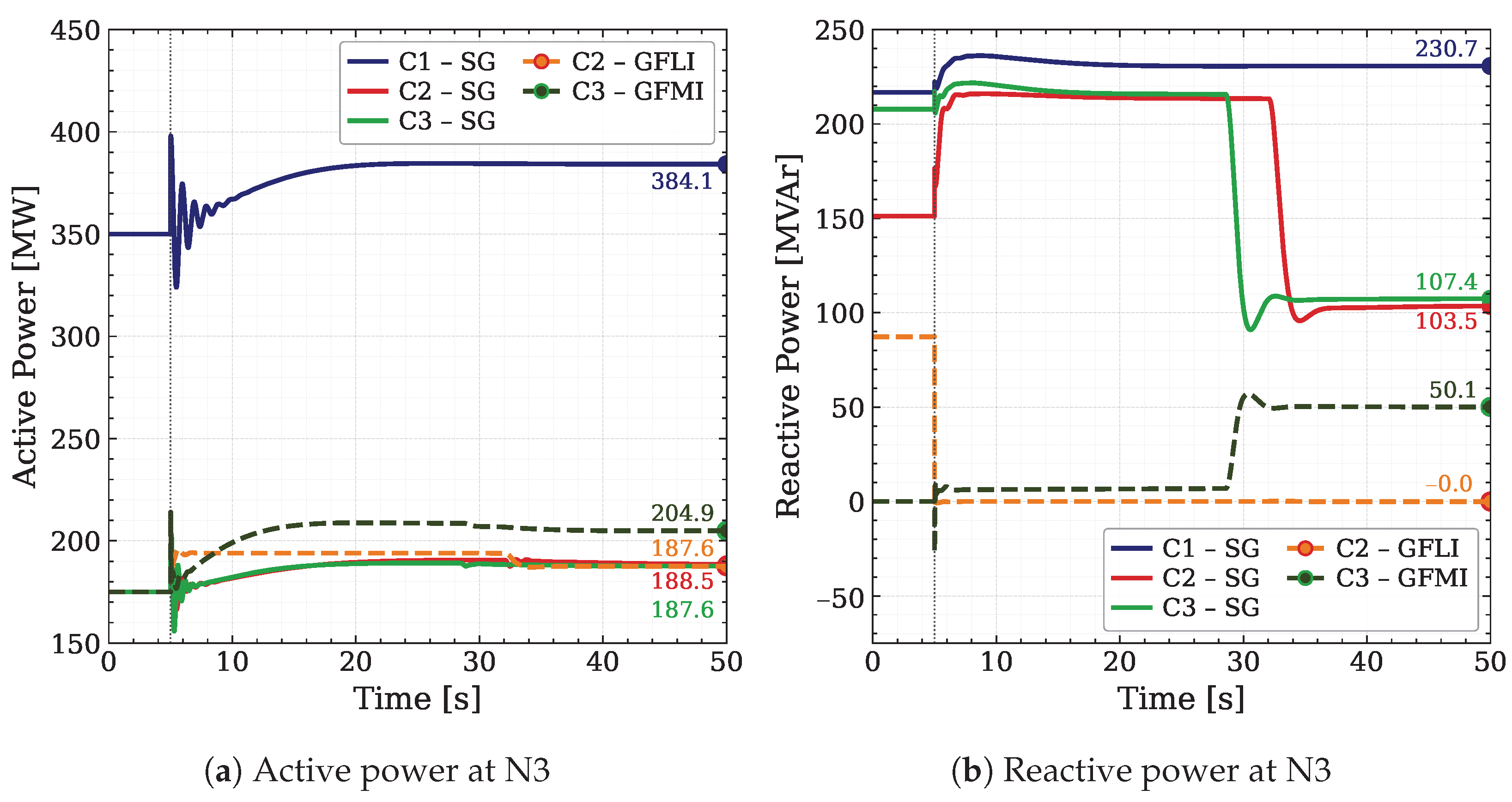
Figure 6 summarises active and reactive power at N3. In C1, the SG carries essentially the full local increment: its active power increases from 350 to about 384 MW, and it provides almost all the reactive support (around 231 MVAr), while the slack at N1 supplies the remaining power through the tie-lines. In C2, the GFLI remains close to its pre-event active-power/reactive-power target; thus, the SG again carries almost all of the local incremental effort, whereas the GFLI does not provide deliberate primary-frequency or voltage support under the adopted unity power factor settings.
In C3, the GFMI delivers the fastest active response (peak close to 205 MW, steady value around 205 MW), while the SG settles near 188 MW. Reactive sharing is also more balanced, with the SG supplying about 107 MVAr and the GFMI about 50 MVAr once the response has settled. In all three configurations, the SG remains the main source of reactive power, but only in C3 does the converter participate meaningfully in both active and reactive support. This illustrates how the choice of droop parameter on this benchmark shapes SG–GFMI sharing of the 100 MW step.
Table 10 summarises the main performance indicators at N3 for the three configurations, using the calibrated parameters
,
, and
in C3. The values are consistent with the markers in
Figure 5 and
Figure 6.
On this four-bus RMS benchmark, C3 achieves the highest frequency nadir and the most balanced SG–converter sharing, C2 remains constrained by the GFLI close to its active-power/reactive-power target, and C1 provides the lowest nadir while relying entirely on synchronous response. These differences should be interpreted as benchmark-specific, RMS-level comparisons; quantifying device-level stress or protection margins would require EMT validation.
3.2. Scenario 2: Weak-Grid 2LG Fault, Islanding, and Auto-Reclose at N3
Scenario 2 uses the weak-grid 2LG fault, islanding, and auto-reclose sequence in
Table 7, with SCR = 12.8, as in
Table 6. All C2 results refer to the weak-grid retuning of the GFLI described in
Section 2.3.2; the baseline tuning loses RMS convergence and is, therefore, not reported. The sequence evaluates how SG-only (C1), SG+GFLI (C2), and SG+GFMI (C3) configurations share fault currents and reactive support and restore positive- and negative-sequence voltages on the same four-bus RMS benchmark.
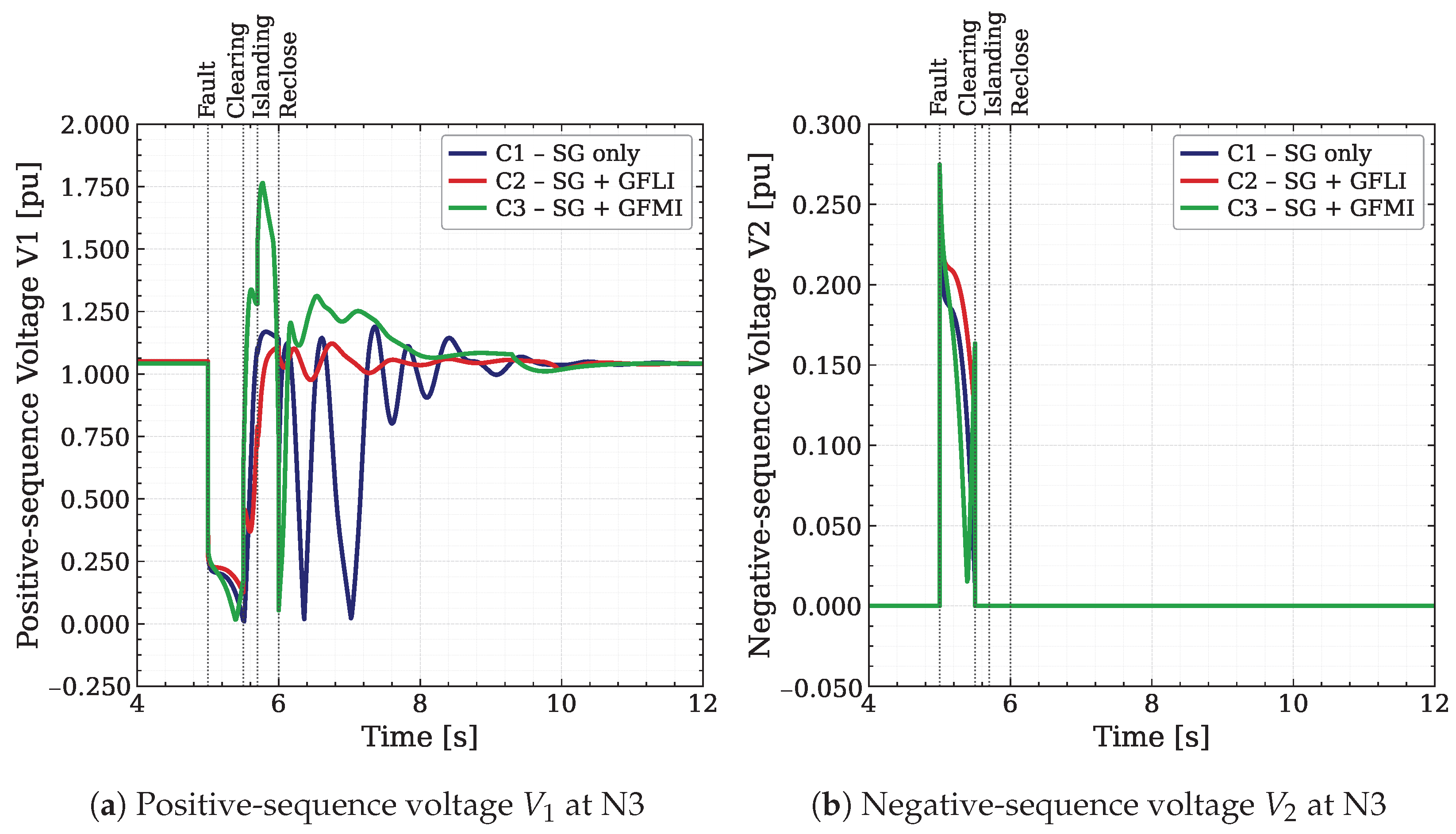
Figure 7 shows the positive- and negative-sequence voltages at N3. During the fault, the positive-sequence component
(
Figure 7a) drops towards low values in all cases, with minima between about 0.01 pu (C1 and C3) and 0.13 pu (C2;
Table 11), as expected for a severe unbalance applied directly at the PCC. After clearing, C3 exhibits the fastest recovery:
overshoots briefly above 1.7 pu and then returns to values close to 1.0 pu over the following one to two seconds. C2 follows with a slightly slower but well-damped rebound, whereas C1 is slowest and shows the most pronounced oscillations, consistent with comparatively sluggish excitation dynamics in the SG-only case. The negative-sequence voltage
(
Figure 7b) peaks highest in C3 (about 0.27–0.28 pu) and somewhat lower in C1 and C2 (around 0.25–0.26 pu;
Table 11), but in C3 it also decays fastest, dropping below 0.05 pu shortly after clearing. This behaviour reflects the stiff local voltage reference provided by the GFMI: once the fault is removed, the converter rapidly corrects both positive- and negative-sequence components, whereas the SG-dominated configurations rely on slower AVR action. The subsequent islanding and auto-reclose around
–6.0 s do not trigger additional large sequence-voltage excursions in any configuration, indicating that all three retain synchronism in the RMS sense.
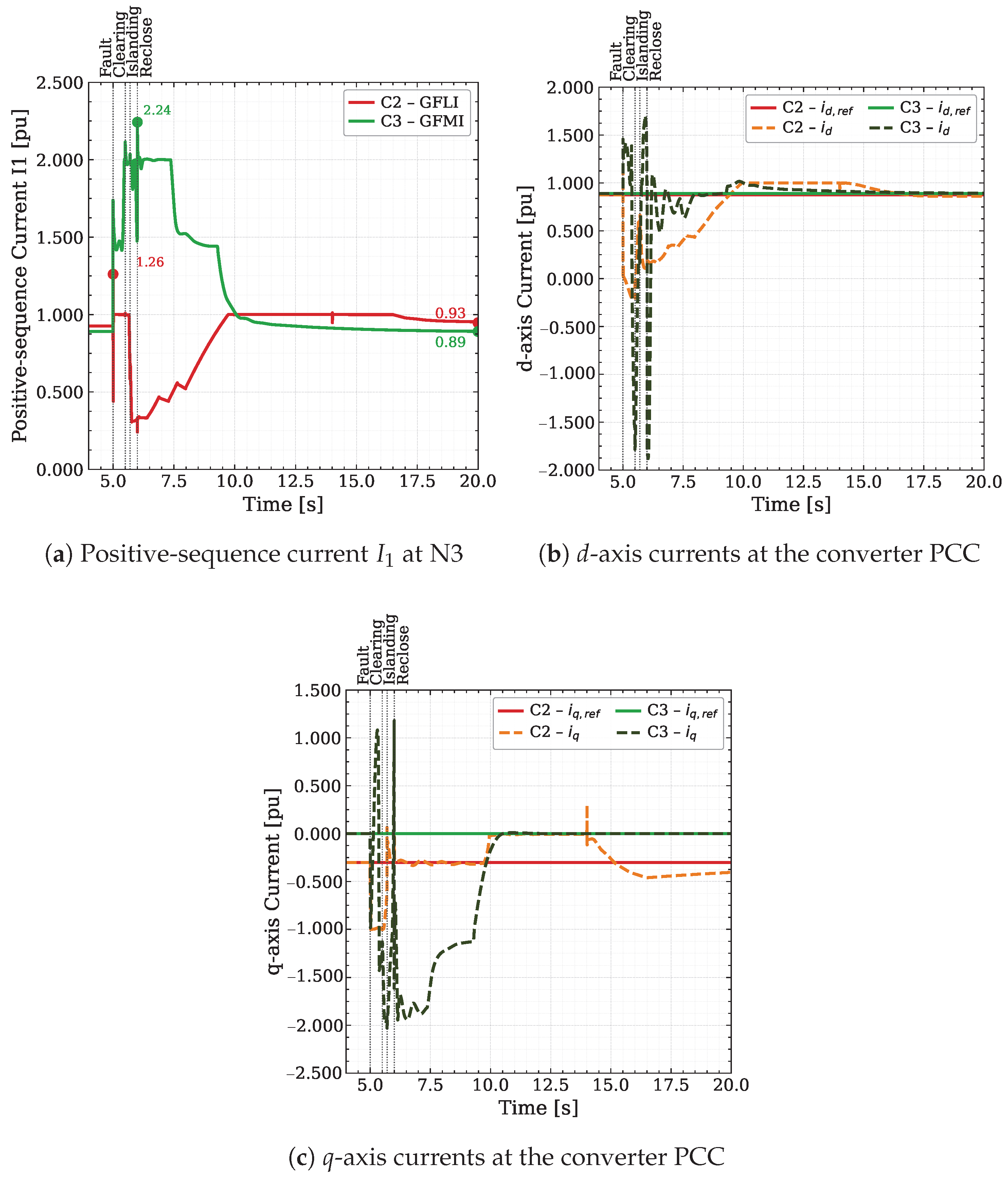
Converter currents at N3 are reported in
Figure 8. The positive-sequence RMS envelope
(
Figure 8a) highlights a clear contrast between the retuned GFLI in C2 and the GFMI in C3. In C2,
first dips during the fault, falling well below its pre-fault value as the current controller and PLL react to the unbalance, then exhibits a brief overshoot around 1.25 pu shortly after clearing (1.26 pu in
Table 11) and finally settles close to its RMS ceiling at approximately 1.0 pu a few seconds after the event. This is consistent with a converter that is constrained by a magnitude limit and primarily tasked with delivering a prescribed active power at near-unity power factor.
In C3, the GFMI envelope rises above 2.0 pu during the fault, with peaks around 2.2 pu (2.24 pu in
Table 11), and decays back to rated current over approximately 3–4 s after clearing. At first sight, this could suggest an excessive overcurrent. However, the
d- and
q-axis traces (
Figure 8b,c) show that instantaneous per-axis currents remain within the imposed limits of the model. Both
and
saturate close to their clamps (around 2 pu) and remain there only during a short interval around fault clearing and reclosing. Under the unbalanced 2LG condition, the positive-sequence RMS envelope
combines the effect of these saturated
d–
q currents with the negative-sequence component; thus, it can temporarily exceed 2 pu even though the internal per-axis limiter is respected at every instant in the RMS model. In practice, the admissible magnitude and duration of such peaks depend on hardware ratings and protection settings; a rigorous assessment, therefore, requires EMT simulations combined with manufacturer current–time curves. The RMS envelopes reported here should thus be interpreted as system-level support indicators rather than direct measures of semiconductor stress.
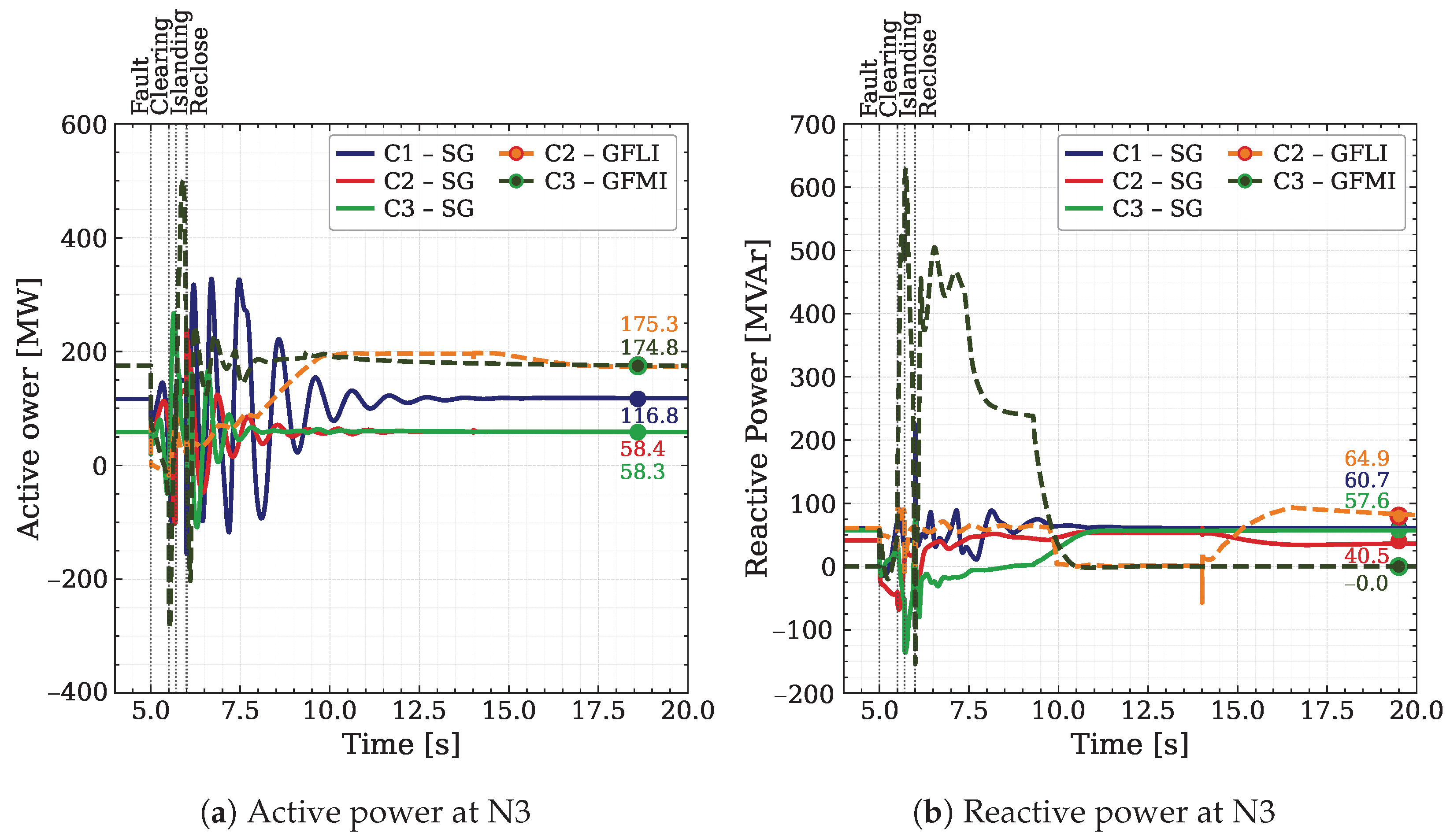
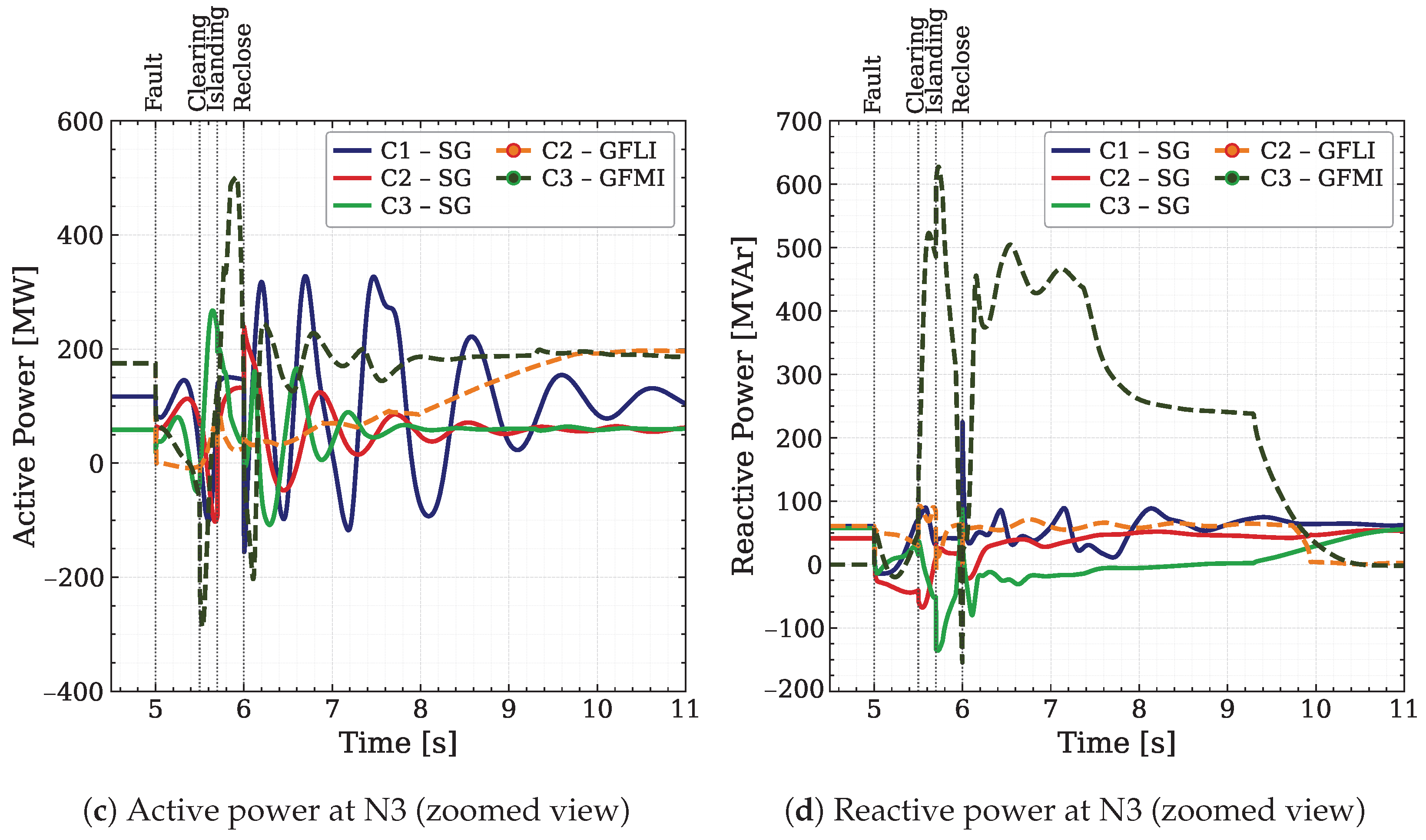
Active and reactive powers at N3 are plotted in
Figure 9. Following fault inception, the SG in C1 experiences sizeable oscillations in both
P and
Q, with a relatively slow return to its pre-fault operating point. In C2, the GFLI contribution remains moderate: active power peaks just below 200 MW (about 1.0 pu on the converter base), and reactive power excursions remain within roughly
MVAr before settling close to their pre-fault values (
Table 11). This is again consistent with a converter that mainly delivers a prescribed active power at near-unity power factor, while the SG supplies most of the dynamic support.
In C3, the GFMI produces the strongest transient injections. The active-power trace exhibits a short dip of the order of to MW, followed by a peak close to 500 MW (about 2.5 pu on the 200 MVA base). The reactive-power trace shows an inductive surge of about 627 MVAr. These impulses occur during the brief period in which the converter currents are saturated, and the GFMI prioritises voltage restoration at the island PCC. Once the fault is cleared and the islanded system re-stabilises, GFMI power settles back near its pre-fault setpoint; in the final operating point, the SG carries most of the steady-state reactive demand in C1 and C3, whereas in C2 the GFLI shares a higher fraction of Q. The largest surges in P and Q are confined to the 5.0–6.0 s interval around fault clearing and reclosing; beyond approximately 10–15 s, all configurations have returned close to their pre-fault operating points. These power surges are reported as RMS envelopes; EMT simulations are required to assess admissible device-level limits.
Table 11 summarises the main performance indicators at N3. Minimum and maximum sequence voltages and currents are read from the waveforms in
Figure 7 and
Figure 8, and converter power peaks from
Figure 9. Three conclusions follow for this benchmark. First, C3 (SG+GFMI) restores
and damps
fastest, owing to the stiff local voltage reference and the short overcurrent burst. Second, C2 (SG+GFLI) remains close to its RMS current ceiling and contributes only limited dynamic support, even with the weak-grid retuning; thus, voltage recovery is slower than in C3 and only modestly better than in C1. Third, the transient current and power envelopes of the GFMI are significantly higher than those of the GFLI; they are reported here as system-level RMS quantities, while EMT simulations would be required to assess device-level limits.
3.3. Scenario 3: Double-Circuit Islanding with UFLS, Partial Resynchronisation, and Staged Load Restoration
Scenario 3 is evaluated only for configuration C3, where the GFMI provides the local voltage–frequency reference once disconnected from the main grid. Droop settings are fixed at and , prioritising voltage support after islanding. This implies softer active-power participation from the GFMI than in Scenario 1, where was used. Frequency and voltage are monitored at N4, where the UFLS relays act, rather than at the PCC N3.
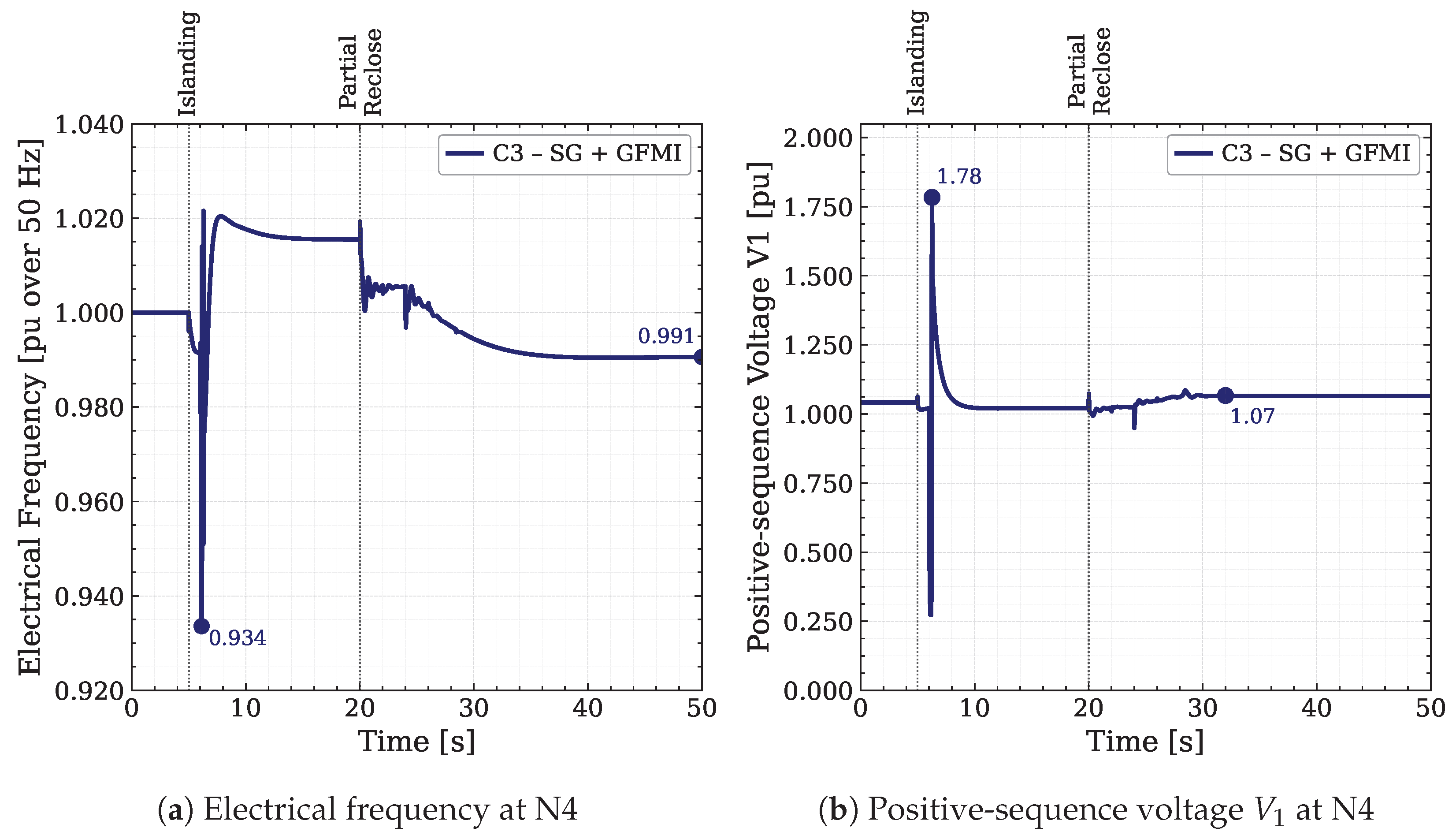
Figure 10 reports the electrical frequency and positive-sequence voltage at N4. Immediately after double-circuit islanding at
s, the frequency exhibits a deep nadir of about 0.934 pu (46.7 Hz) around 6–7 s. This reflects the sudden loss of grid support together with the relatively soft
assigned to the GFMI. In this setting, the SG carries most of the initial active-power mismatch. As the GFMI and SG droop act against the imbalance, frequency overshoots slightly above 1.02 pu and then settles to an islanded value near 1.017 pu. After partial resynchronisation at
s, the island frequency steps slightly upwards, undergoes a short oscillatory transient, and gradually converges towards the main-grid trajectory, reaching a steady value close to 0.991 pu (49.55 Hz) by the end of the simulation.
In parallel, the positive-sequence voltage undergoes a sharp depression to roughly 0.3 pu, followed by a fast overshoot that peaks near 1.78 pu shortly after islanding. It then decays towards a slightly elevated level around 1.05–1.07 pu. The initial dip stems from the sudden removal of the upstream grid strength, while the large overshoot reflects the strongly capacitive response of the GFMI under , which pushes the island voltage back up once the tie-lines open. Under these conditions, UFLS operates as intended: non-critical feeders NCL2 and NCL1 are disconnected when the local frequency crosses their respective thresholds. After partial resynchronisation and staged load restoration, both frequency and voltage remain within a narrow band around their new steady states.
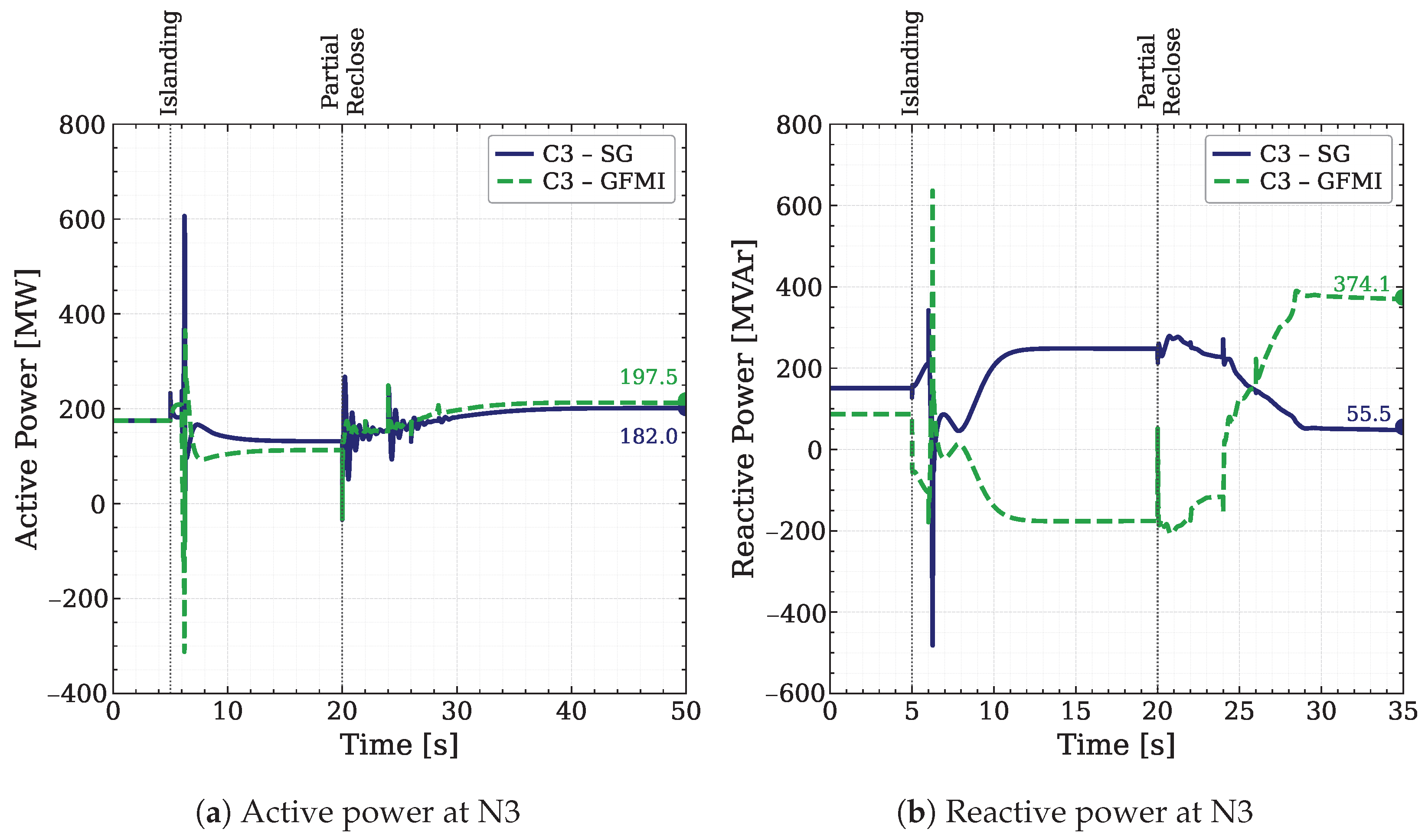
Active and reactive powers at N3 are plotted in
Figure 11, clarifying SG–GFMI effort sharing throughout the sequence. Immediately after islanding, the SG provides most of the active-power response, with a peak close to 600 MW, while the GFMI briefly absorbs about
to
MW before reversing sign and contributing positively. This pattern is consistent with the larger
adopted in Scenario 3: the converter responds more softly in active power, and the SG governs the initial frequency transient, which helps explain the deep nadir observed at N4 before UFLS acts. As UFLS trips NCL2 and NCL1 and the island settles, both sources gradually converge towards a nearly balanced sharing after reconnection, with the SG supplying about 182 MW and the GFMI around 198 MW at
s. The sequence suggests that, for the chosen droop settings, the GFMI is used not to maximise frequency containment but to enable feasible islanded operation with UFLS and to support the subsequent reconnection.
In reactive power, the roles are almost reversed. Before the partial resynchronisation, the GFMI operates predominantly capacitive, with Q around MVAr, providing the bulk of the dynamic voltage support at N4. Over the same interval, SG reactive power rises towards 250 MVAr (inductive); thus, both sources jointly stabilise the island voltage. From about 24–30 s onward, once the subsystem is re-coupled and non-critical loads are restored, the GFMI transitions to sustained inductive support of approximately 375 MVAr, while SG reactive output reduces from roughly 250 MVAr down to about 55 MVAr. Short spikes at the islanding and resynchronisation instants (GFMI up to about 630 MVAr, SG down to about MVAr) are brief and low in energy in the RMS sense, occurring in narrow windows around the switching events. From the RMS perspective, these high-magnitude but short-duration excursions are consistent with the adopted modelling assumptions; EMT simulations, including protection relays and converter overcurrent characteristics, would be required to assess compliance with protection and thermal limits.
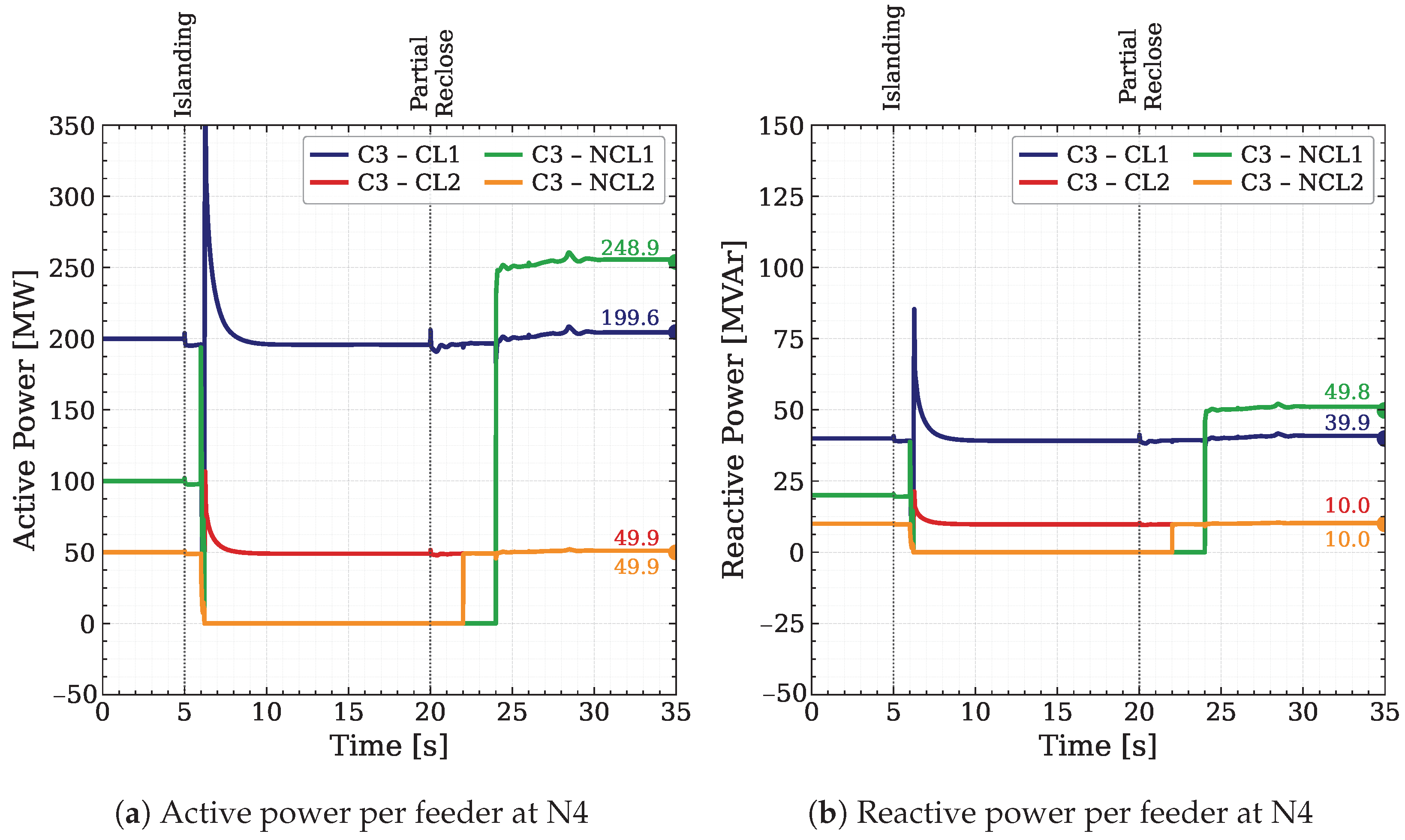
Per-feeder trajectories at N4, shown in
Figure 12, confirm the intended UFLS and restoration sequence. Critical feeders CL1 (200 MW/40 MVAr) and CL2 (50 MW/10 MVAr) remain energised throughout, representing loads that must be maintained even under deep frequency excursions. NCL2 (50 MW/10 MVAr) is shed first when the frequency crosses 49.5 Hz, and NCL1 (100 MW/20 MVAr, ramped to 150/30 MW/MVAr) follows at its lower 49.3 Hz threshold. Active- and reactive-power traces show both feeders dropping to zero shortly after islanding, in agreement with the ANSI device 81 thresholds implemented in
Section 2.3.3. After partial resynchronisation at
s, NCL2 and NCL1 are restored between 22 and 24 s, with NCL2 reconnected first and NCL1 then ramping towards its programmed 150/30 MW/MVAr target. The absence of sustained oscillations during these reconnections is, at the RMS level, consistent with the combined UFLS logic and droop settings providing adequate dynamic margins for staged restoration: each reconnection produces a bounded transient in
P,
Q, frequency, and voltage, which decays within a few seconds on this benchmark.
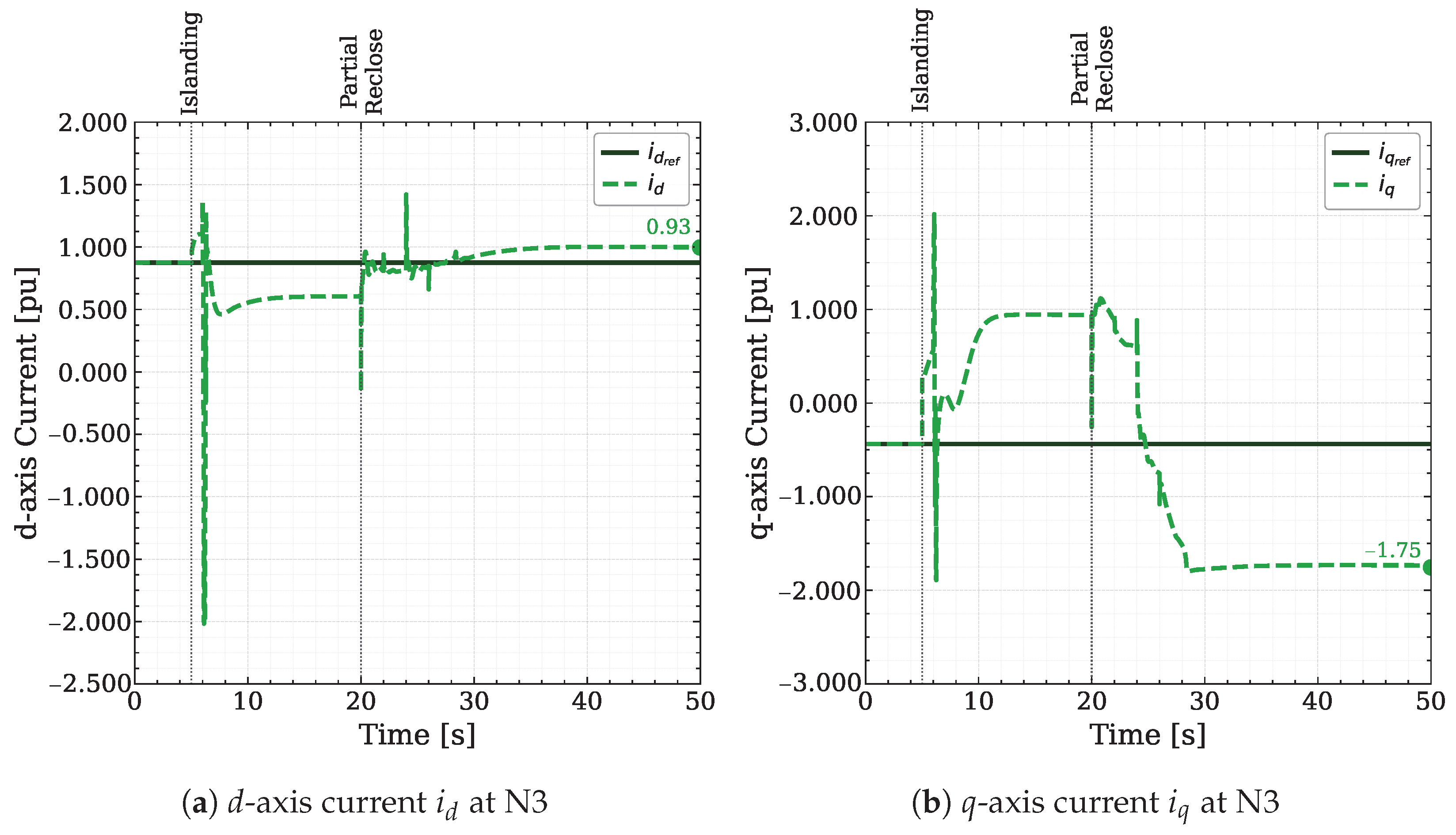
The GFMI
d–
q currents at N3 (
Figure 13) are consistent with the observed power exchanges and the imposed per-axis limits. The
d-axis current
shows a transient excursion with a minimum close to
pu and a peak around 1.4 pu during islanding and resynchronisation events, but it settles near
–1.0 pu during steady operation, in agreement with the post-reconnection active power of about 200 MW on a 200 MVA base. The
q-axis current
mirrors the transition from capacitive support immediately after islanding to predominantly inductive support once the system is re-coupled and non-critical loads are restored: its magnitude remains close to the current limit during the large reactive surges in
Figure 11b and settles near
pu in steady state, consistent with the
MVAr GFMI contribution and the convention
inductive. In all cases, the currents remain close to, but not persistently beyond, the per-axis limits
pu imposed in the RMS model, and the time spent at or near the limiter is confined to short intervals around the switching events.
Table 12 summarises the main indicators for Scenario 3. Frequency nadir, voltage overshoot, steady reactive support, post-reclose
d–
q currents, and feeder sequence are read directly from
Figure 10,
Figure 11,
Figure 12 and
Figure 13. On this four-bus RMS benchmark, the results show that a single SG combined with a GFMI can sustain autonomous islanded operation under a deep frequency nadir, execute selective UFLS, and complete partial resynchronisation plus staged restoration, with the GFMI ultimately assuming the dominant role in reactive support once the island is reconnected. As in the previous scenarios, these conclusions are valid at the RMS level; any assessment of device-level stress, protection margins, or detailed power-quality indices would require complementary EMT studies.