Article

MambaDPF-Net: A Dual-Path Fusion Network with Selective State Space Modeling for Robust Low-Light Image Enhancement

1
Electronic Engineering Institute, National University of Defense Technology, Hefei 230601, China
2
Hefei Institute for Public Safety Research, Tsinghua University, Hefei 230601, China
*
Author to whom correspondence should be addressed.
Electronics 2025, 14(22), 4533; https://doi.org/10.3390/electronics14224533

Submission received: 2 September 2025 / Revised: 25 September 2025 / Accepted: 25 September 2025 / Published: 19 November 2025
(This article belongs to the Special Issue 2D/3D Industrial Visual Inspection and Intelligent Image Processing)

Abstract

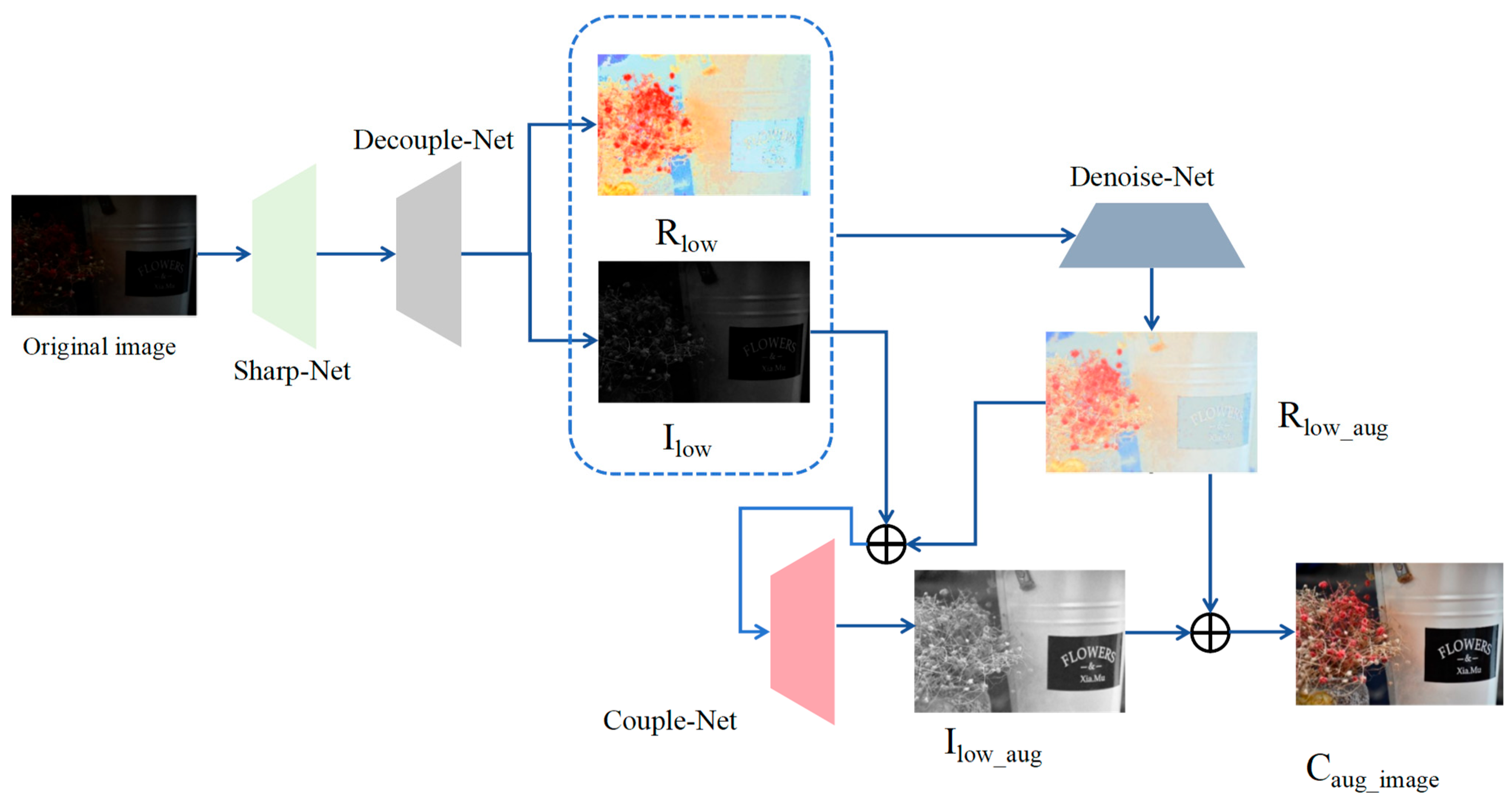
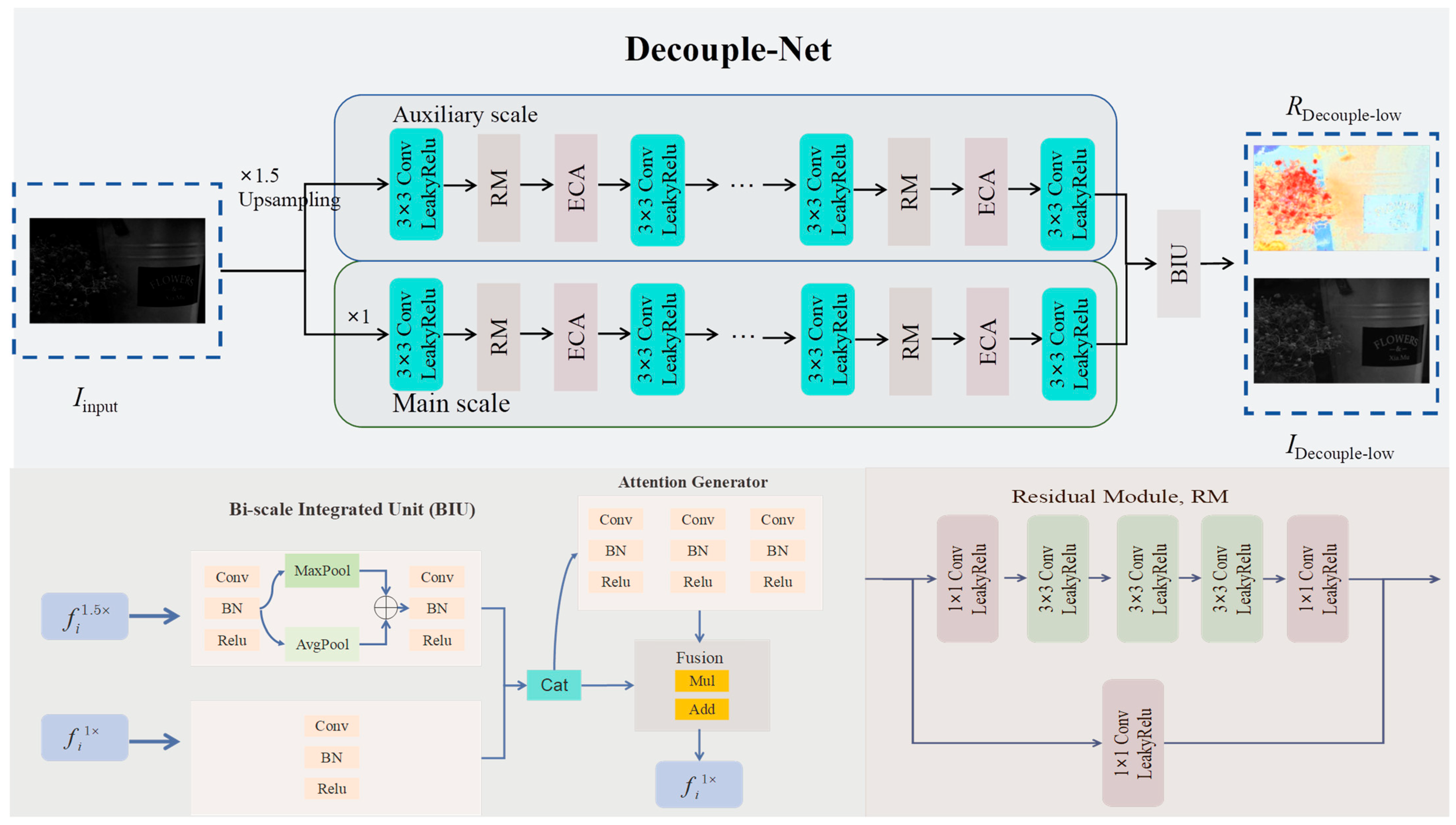
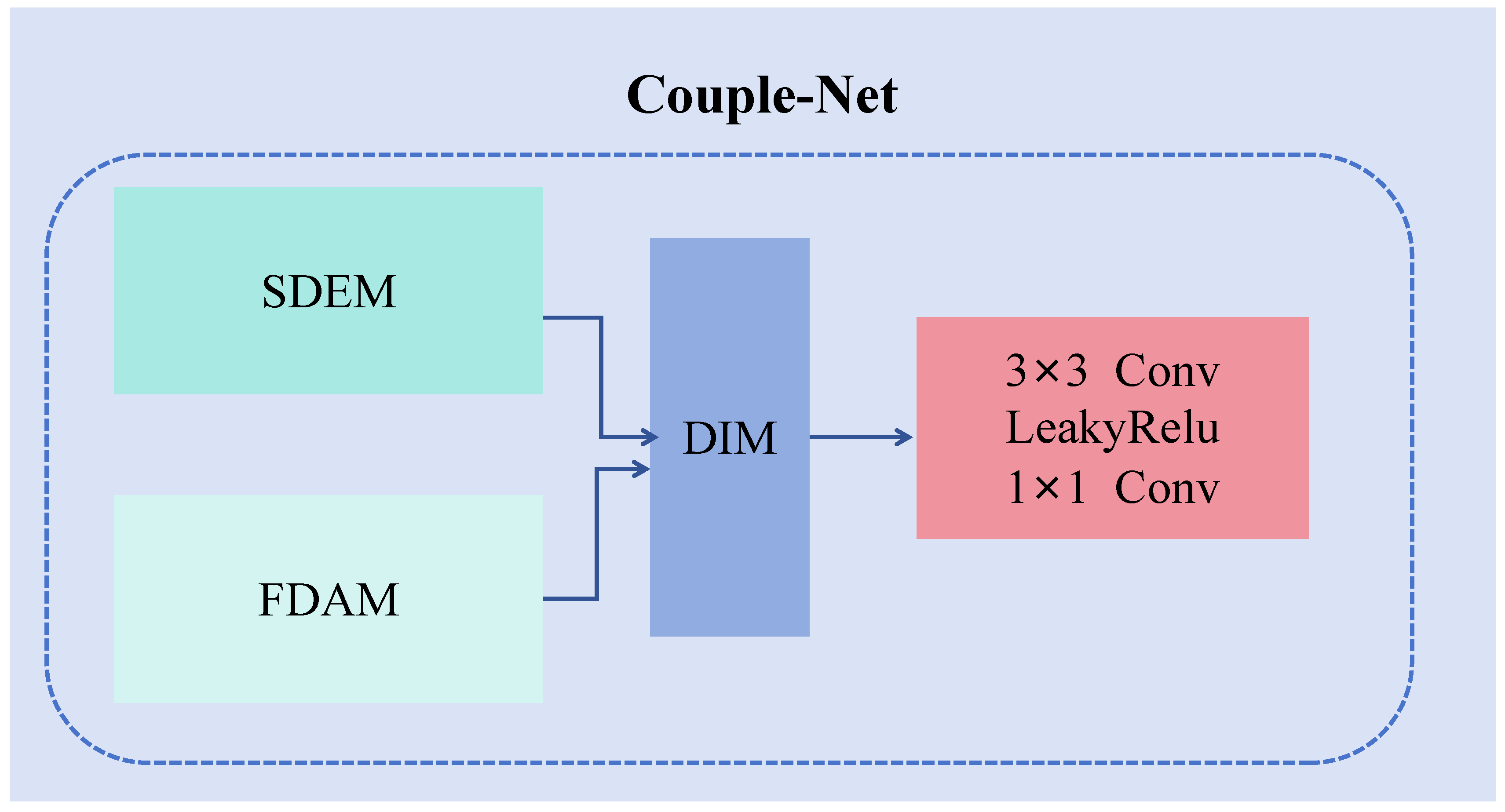
Low-light images commonly suffer from insufficient contrast, noise accumulation, and colour shifts, which impair human perception and subsequent visual tasks. We propose MambaDPF-Net—a dual-path fusion framework based on the retinal effect, adhering to a ‘decoupling–denoising–coupling’ paradigm while incorporating sharpening priors for texture stabilisation. Specifically, the decoupling branch estimates illumination and reflectance through dual-scale feature aggregation with physically interpretable constraints; the denoising branch primarily performs noise reduction in the reflectance domain, employing an illumination-aware modulation mechanism to prevent excessive smoothing in low-SNR regions; the coupling branch utilises a selective state space module (Mamba) to adaptively fuse spatio-temporal representations, achieving non-local interactions and cross-region long-range dependency modelling with near-linear complexity. Extensive experiments on public datasets demonstrate that this method achieves state-of-the-art performance on metrics such as PSNR and SSIM, excels in non-reference evaluations, and produces natural colours with enhanced details. This validates the proposed approach’s effectiveness and robustness.
Keywords: low-light image enhancement; Retinex; dual-path fusion; frequency–spatial fusion; Mamba low-light image enhancement; Retinex; dual-path fusion; frequency–spatial fusion; Mamba