


Abstract
Robots assist emergency responders by collecting critical information remotely. Deploying multiple cooperative unmanned ground vehicles (UGVs) for a response can reduce the response time, improve situational awareness, and minimize costs. Reliable communication is critical for multiple UGVs for environmental response because multiple robots need to share information for cooperative navigation and data collection. In this work, we investigate a control policy for optimal communication among multiple UGVs and base stations (BSs). A multi-agent deep deterministic policy gradient (MADDPG) algorithm is proposed to update the control policy for the maximum signal-to-interference ratio. The UGVs communicate with both the fixed BSs and a mobile BS. The proposed control policy can navigate the UGVs and mobile BS to optimize communication and signal strength. Finally, a genetic algorithm (GA) is proposed to optimize the hyperparameters of the MADDPG-based training. Simulation results demonstrate the computational efficiency and robustness of the GA-based MADDPG algorithm for the control of multiple UGVs.
1. Introduction
A network of distributed unmanned ground vehicles (UGVs) and a central controller is known as a multi-UGV control system [1]. This system enables autonomous domination, autonomous navigation, and autonomous collaboration. It can operate either within a restricted area or as part of a broader transportation system. Multi-UGV control systems offer a unique approach to navigation that is highly reliable, more economical, and conducive to energy savings. In recent years, the urgent demand for multi-UGV navigation systems has encouraged an increasing amount of discussion from academia [2,3,4,5].
The navigation of UGVs in a communication environment has been the subject of research [6], and traditional optimization methods have yielded good results [7]. To create an autonomous navigation system, D. Chen et al. [8] developed a heuristic Monte Carlo algorithm that depends on a discrete Hough transform and Monte Carlo localization, which ensures low complexity for processing in real-time. Different from the innovation of algorithms, to perform robustly in unknown and cluttered environments, H. U. Unlu et al. [9] created a robust approach for vision-assisted inertial navigation that can withstand uncertainties. Different from using visual aids, X. Lyu et al. [10] was inspired by a geometric point of view, and they designed a new adaptive sharing factor-integrated navigation information fusion technology scheme that has adaptive navigation in the case of nonlinear systems and uses a non-Gaussian distribution. These traditional optimization methods mentioned above are easy to implement. However, these methods need to be presented with preconditions, which makes them suitable only for static environments. Moreover, in reality, the majority of scenarios involve the collaborative operation of multi-UGVs [11]. Consequently, multi-UGV systems will encounter these two challenges when handling complex scenarios, and it necessitates the incorporation of machine learning (ML) to effectively address them [12,13,14].
There is a strong rationale for employing ML techniques in UGV navigation, considering the rapid advancements in the field of ML. To achieve improved better-ranging performance, H. Lee et al. [15] provided a ML technique to calculate the distance between the BS and UGVs, which enables localization without any additional infrastructure. Rather than relying on direct ranging, H. T. Nguyen et al. developed a coordination system between unmanned aerial vehicles and UGVs, enabling effective collaborative navigation [15]. However, as the simulation environment becomes more complex, the effectiveness of the proposed solution decreases rapidly. To address this challenge, employing reinforcement learning (RL) algorithms is a promising choice. RL emphasizes how agents can discover the best policy to maximize all rewards when interacting with the environment, which makes it well-suited for exploring and adapting to increasingly complex environments [16].
Research has been driven by discussions on using RL to solve the multi-UGV cooperative navigation issue recently [17]. To avoid collisions with obstacles, X. Huang et al. [18] proposed an innovative deep RL-based UGV local path planning navigation system that leverages multi-modal perception to facilitate policy learning to generate flexible navigation actions. Different from single UGV navigation, to improve the average spectral efficiency, S. Wu et al. [19] proposed trajectory optimization technology based on a joint multi-agent deep deterministic policy gradient (F-MADDPG), which inherits the ability of MADDPG to drive multi-UGVs cooperatively and uses joint averaging to eliminate data isolation and to accelerate convergence. Significant progress has been achieved by these RL-based UGV navigation methods. However, they overlook the limitations of static communication environments and convergence issues arising from the complexity of the environment. These two elements are crucial to take into account while planning cooperative navigation in a communication setting.
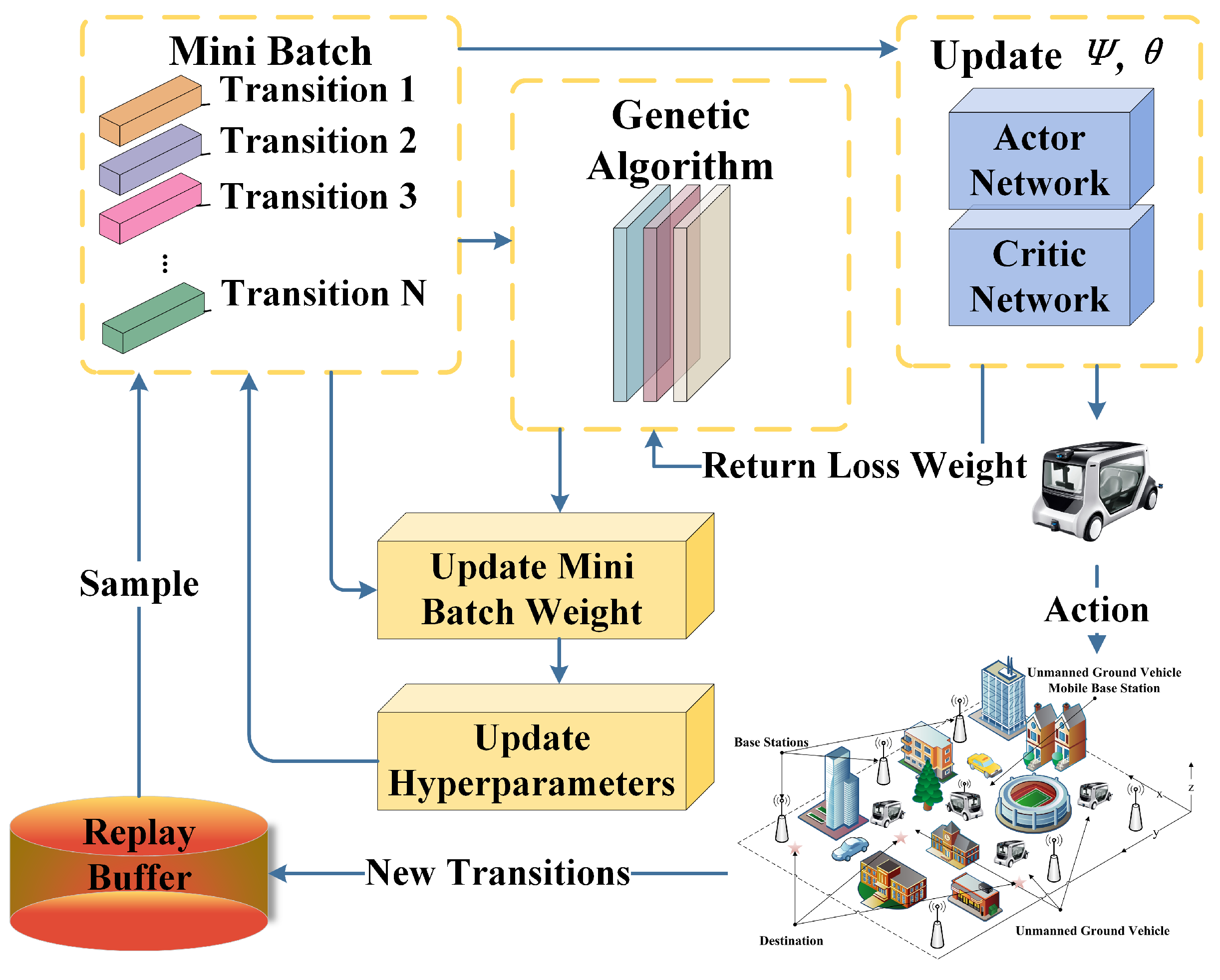
Considering the constraints of cooperative communication coverage navigation for UGVs, there are three main challenges to overcome, such as the difficulty of simultaneous control of UGVs, the variation in communication coverage, and the complexity of the cooperative control environment for UGVs. Firstly, traditional control methods such as Q-learning [20], proportional-integral-derivative (PID) control [21], and deep Q-network [22] often yield suboptimal performance in terms of communication coverage when multi-agents require simultaneous control. Secondly, considering the variability in the communication environment during multi-UGV navigation, it is common to encounter areas with poor communication, which hinders effective collaboration among multi-UGVs. However, a promising solution to tackle the challenges of multi-agent cooperative control is offered by multi-agent RL algorithms [23]. These algorithms guide multi-agent collaboration through the centralized training–decentralized execution (CTDE) paradigm [24]. Additionally, in our proposed approach, we introduce a movable UGV BS integrated with the UGVs, allowing for dynamic changes to the fixed communication environment. This collaboration effectively supports the navigation tasks of the UGVs. However, the increased complexity of the constructed environment may pose challenges to algorithm effectiveness and convergence. Fortunately, we mitigate convergence difficulties by adaptive update dynamic hyperparameters using a genetic algorithm (GA) [25]. More fortunately, there has been some research on integrating GA for hyperparameter tuning in RL frameworks. A. Sehgal et al. used a GA to find the hindsight experience replay (HER) used in a deep deterministic policy gradient (DDPG) in a robot manipulation task to help the agent accelerate learning [26]. Different from modifying a single parameter, for the flexible job shop scheduling problem (FJSP), Chen R et al. proposed a GA parameter adjustment method based on Q-learning that changes several key parameters in Q-learning to obtain higher reward values [27]. However, this rewards-based approach is prone to falling into local optimality. Moreover, these methods are not suitable for scenarios where the number of agents increases. To address these issues, Alipour et al. proposed hybridizing a GA with a multi-agent RL heuristic for solving the traveling salesman problem. In this way, a GA with a novel crossover operator acts as a travel improvement heuristic, while MARL acts as a construction heuristic [28]. Although this approach avoids the risk of local optimality, it abandons the learning process of MARL and only uses it as a heuristic, instead using GA for training, which means that the algorithm will not pay too much attention to the collaboration between intelligent agents. Liu et al. used a decentralized partially observable multi-agent path planning method based on evolutionary RL (MAPPER) to learn effective local planning strategies in mixed dynamic environments. Based on multi-agent reinforcement learning training, they used GA to iteratively extend the originally trained algorithm to a more complex model. Although this method avoids performance degradation in long-term tasks, iterative GA may not necessarily adapt well to more complex environments [29]. In our research, we combine the advantages of the above-mentioned GA papers and adopt the CTDE paradigm to conduct research in a multi-agent RL framework. The GA assigns different weights to algorithm updates based on the transition’s contribution, which means that we pay more attention to the hyperparameters that contribute more to model updating rather than those that achieve greater reward values. This allows us to avoid falling into local optimality while increasing the number of agents.
To address these three challenges and achieve cooperative navigation in complex environments, a new multi-UGV communication coverage navigation method is proposed, which is based on a multi-agent deep deterministic policy gradient with GA (GA-MADDPG). The following summarizes the key contributions of the multi-UGV communication coverage navigation method:
- A comprehensive multi-agent pattern is combined into the multi-UGV collaborative navigation system, and the optimal coordination of multi-UGVs within the communication coverage area is formulated as a real-time multi-agent Markov decision process (MDP) model. All UGVs are set as independent agents with self-control capabilities.
- A multi-agent collaborative navigation method with enhanced communication coverage is proposed. By introducing a mobile base station, the communication coverage environment is dynamically changed. Simulation results show that this method effectively improves the communication quality during navigation.
- A GA-based hyperparameter adaptive approach is presented for optimizing UGV communication coverage and navigation. It assigns weights to hyperparameters according to the degree of algorithm updating and makes a choice based on the size of the weight at the next selection, which is different from the traditional fixed-hyperparameter strategy and can escape local optima.
The essay is organized as follows for the remaining portions. The modeling of multi-UGV communication and navigation systems is thoroughly explained in Section 2. The details of the RL method we present is outlined in Section 3. Several experimental comparisons in Section 4 serve to verify the efficacy of our approach. Eventually, we discuss future research directions and summarize the key points of the article in the conclusion Section 5.
4. Simulation Results
In this section, we present illustrative examples to depict the experimental setup of this paper. Based on these examples, we propose several metrics to assess the effectiveness of the algorithm and perform a quantitative analysis to clarify the advantages of our represented modeling approach and policy. Subsequently, we present numerical simulation results to showcase the effectiveness and efficiency of the algorithms. Additionally, we provide insightful comments on the results.
4.1. Settings of the Experiments
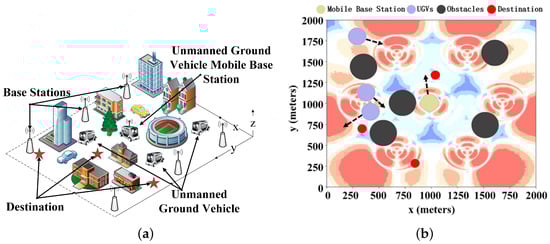
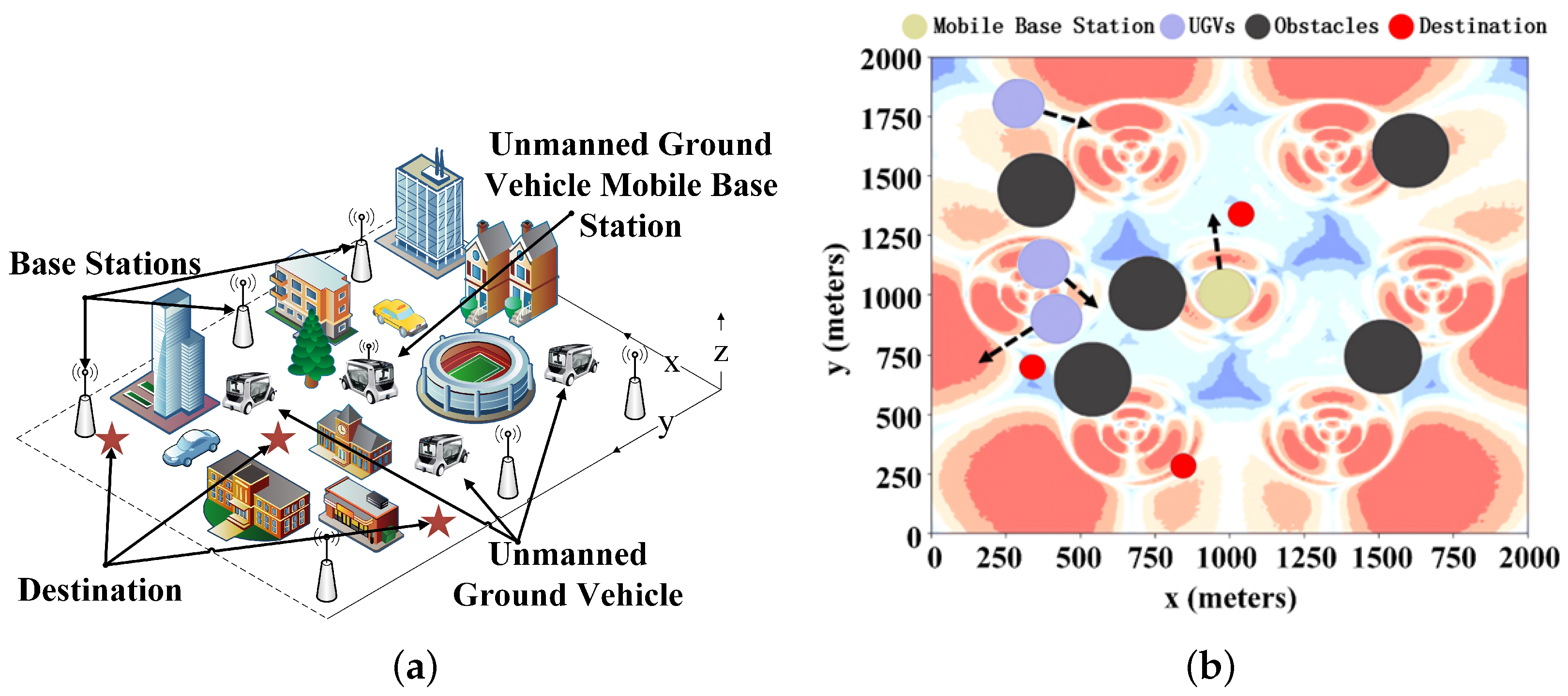
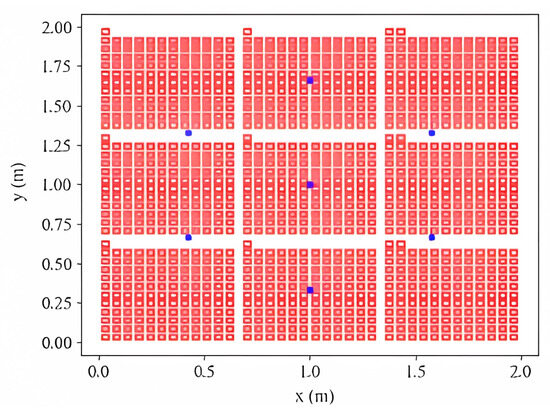
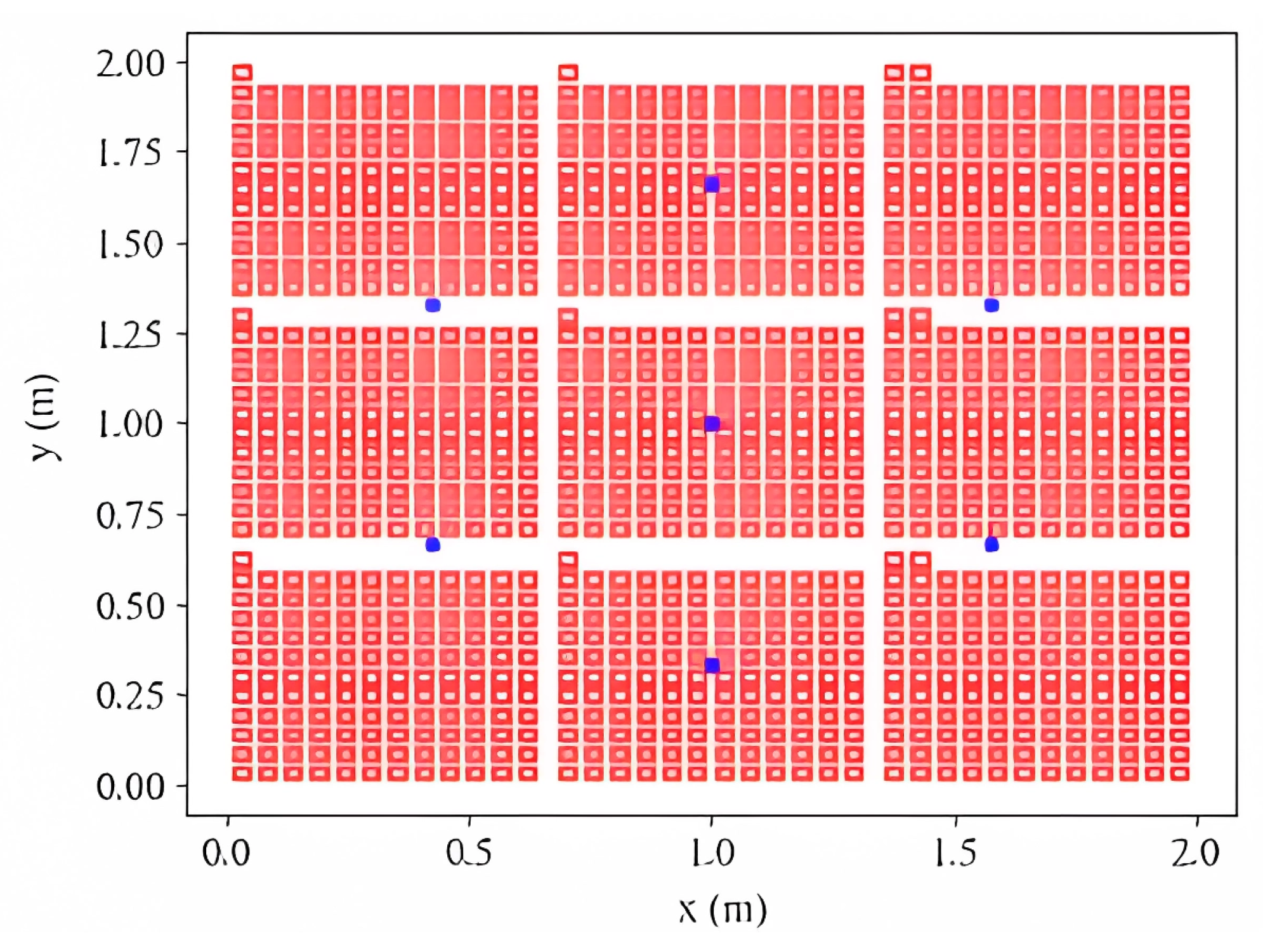
In this subsection, we present the precise experimental coefficient settings. The simulated area is a dense urban region of 2 × 2 km2 with seven cellular BS sites. In Figure 4, a top view of the channel model in this paper is shown, where seven ground base stations are represented by blue five-pointed stars, and the blue five-pointed star in the middle represents the movable base station. Each base station has three unit groups. Since there are seven base stations in total, the number of units is 21. The transmission power of the unit cell is set to = 20 dBm, the communication interruption threshold is set to = 0 dB, and the noise power is defined as dBm. This paper adopts the base station antenna model required by the 3GPP specification. For simplicity, we assume that the UGVs’ operational height is set at 0 m, disregarding the influence of terrain ups and downs. The specific values of the parameters involved in the simulated environment are as follows: the number of UGVs is set to four (including one movable BS), the number of obstacles is set to five in the main areas, and there are three target points. The positions of these elements are randomized each time they appear. As we employ a dynamic update mechanism for hyperparameters, we list the common parameters of the baseline algorithm and the GA-MADDPG algorithm in Table 1, and we also list the initial hyperparameter population of the GA-MADDPG algorithm in Table 2.
Figure 4.
Plan view of base station model distribution.
Table 1.
GA-MADDPG parameter settings.
Table 2.
Initial hyperparameter population of GA-MADDPG algorithm.
In this study, it is important to note that the communication environment is solely determined by the positioning of each UGV. The quality of communication among multiple UGVs does not influence their collaborative navigation. This is because the collaborative navigation process relies exclusively on a multi-agent algorithm to coordinate the UGVs in environmental exploration.
4.2. Indicators of Evaluation for UGV Navigation
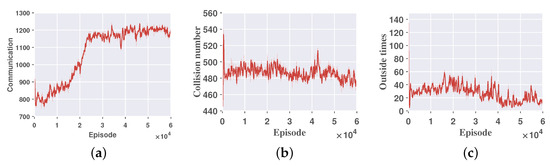
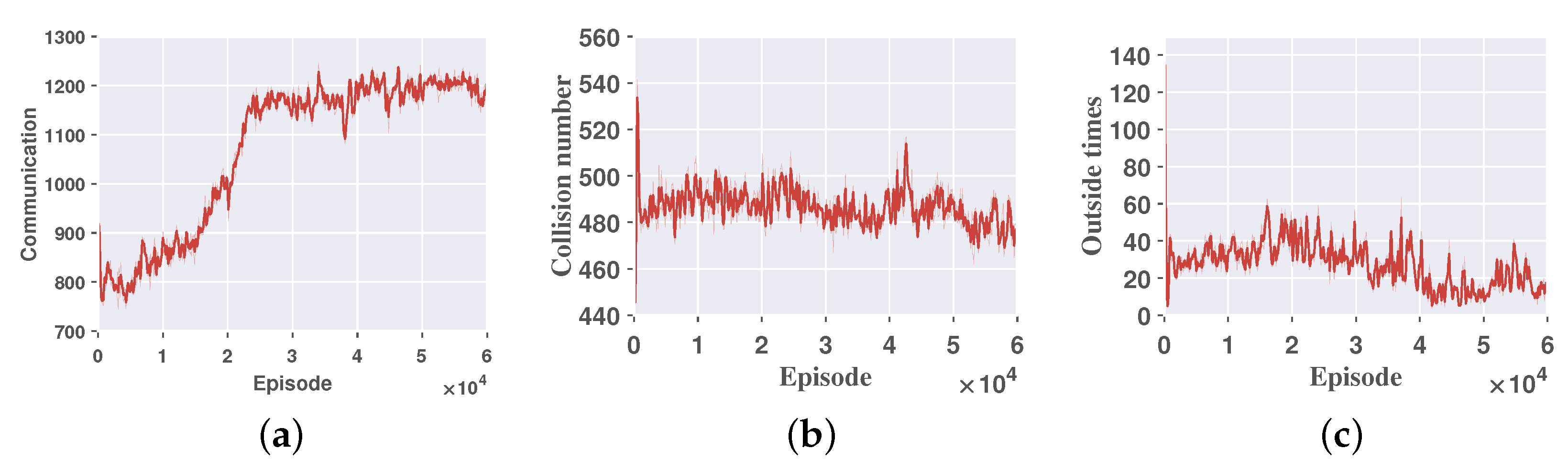
To objectively measure the navigational safety, effectiveness, robustness, and communication connection of UGVs, we have developed specific assessment indicators, which are detailed below. We also recorded the changing state of the evaluation metrics, as shown in Figure 5.
Figure 5.
Three evaluation indicators for UGV navigation. (a) Communication return. (b) Collision number. (c) Outside times.
- Communication return.The communication return is the average communication quality per episode for the UGVs and is calculated based on Equation (1). The communication returns converge quickly from the initial –800 to –300 as shown by Figure 5a, which indicates that the communication quality has been improved and has stabilized in an interval.
- Collision times: The collision times are the sum of collisions between UGVs and obstacles and between drones and drones in an average round. The collision indicator converges from 540 to below 480, as shown by Figure 5b, indicating that the number of collisions has also been reduced somewhat, and since this study allows UGVs to have a certain number of collisions, the collision indicator is not the main optimization objective.
- Outside times: The outside times are the number of times the UGVs go out of bounds and run out of the environment we set. From Figure 5c, the rapid reduction in the number of times going out of bounds indicates that our research has significantly limited ineffective boundary violations, demonstrating that our study effectively operates within the designated area.
4.3. Comparative GA-MADDPG Experimentation
To compare with the suggested algorithm and determine whether the algorithm works better, we provide seven RL approaches that are thought of as baselines. The methods are MADDPG [24]: a classic multi-agent deep deterministic policy gradient, R-MADDPG [38]: a deep recurrent multi-agent actor–critic, MAPPO [39]: multi-agent proximal policy optimization, RMAPPO [39]: a deep recurrent multi-agent proximal policy optimization, MQMIX [40]: mellow–max monotonic value function factorization for deep multi-agent, MASAC [41]: a classic multi-agent soft actor–critic, MAD3PG [42]: a multi-agent deep distributional deterministic policy gradient, MATD3 [43]: the twin delayed deep deterministic policy gradient, and RMATD3 [44]: the twin delayed deep deterministic policy gradient with a deep recurrent. Notably, we replicate these baselines using the same simulation environment to guarantee the experiment is fair.
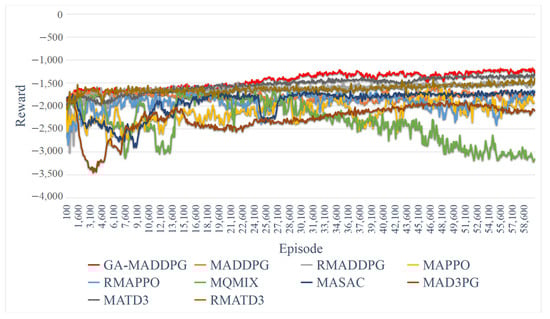
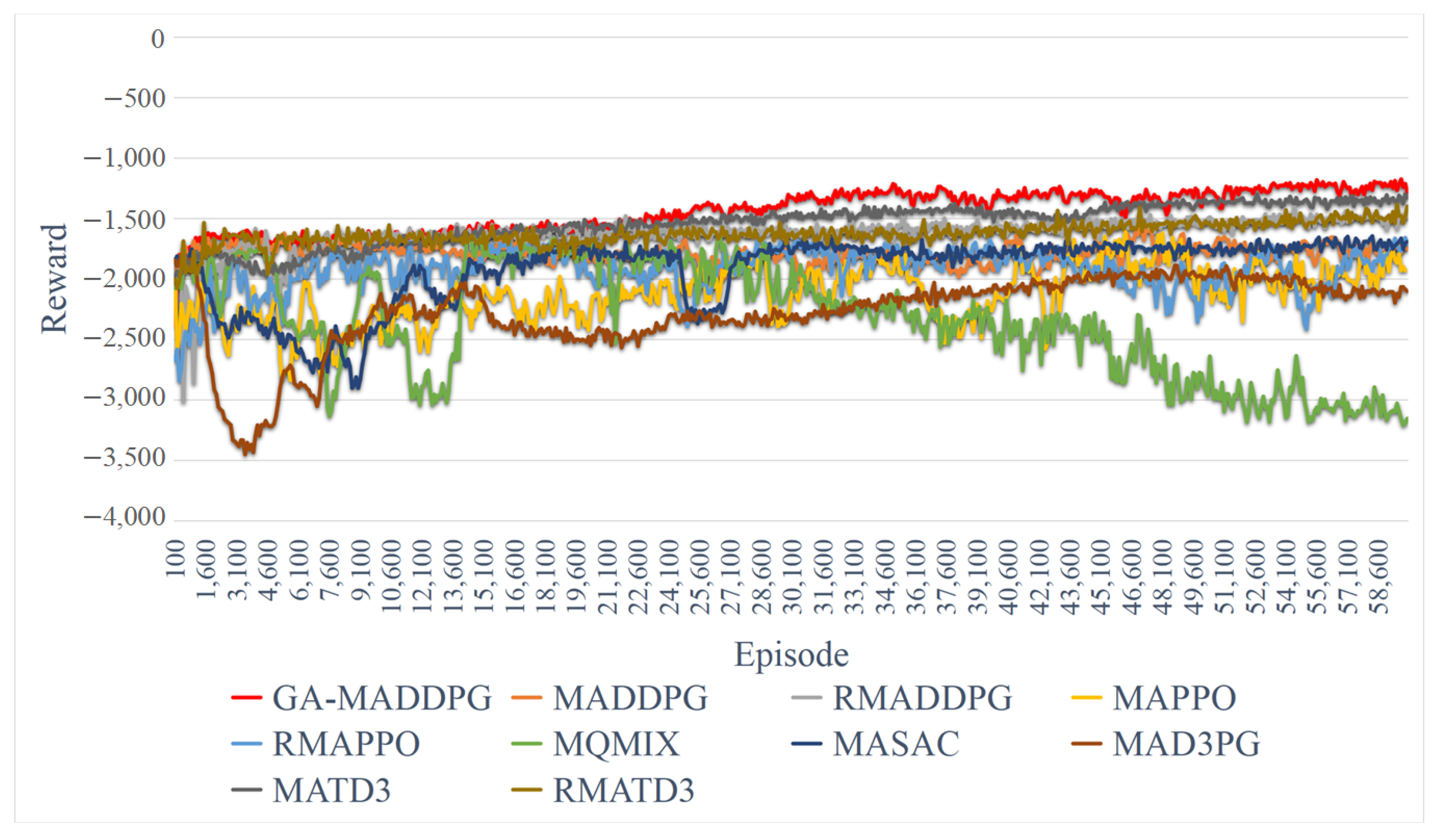
The cumulative return of the GA-MADDPG and other algorithms, which is displayed in Figure 6, indicates the experimental comparison findings and highlights the potency of GA-MADDPG algorithms. GA-MADDPG outperforms the other algorithms by achieving a considerably higher reward return of about −1200 with 60,000 episodes, reaching its convergence point. Furthermore, as shown in Figure 6, both MADDPG and R-MADDPG achieve lower rewards of around −1600 compared to GA-MADDPG, providing strong evidence for the effectiveness of our contribution: the use of GA adaptive hyperparameters allows for better jumps out of the local optima and higher rewards. As shown in Figure 6, in the specific environment we configured, neither the original MADDPG algorithm nor its variant incorporating deep recurrent networks outperforms GA-MADDPG in areas of convergence speed and final convergence outcomes: GA-MADDPG converges in about 2000 episodes, while R-MADDPG converges in about 5000 episodes, and the original algorithm MADDPG converges even worse. Of greater significance, our experimental findings reveal that MASAC, MAPPO, MAD3PG, MQMIX, and RMAPPO encounter challenges in achieving a desirable convergence state within the multi-agent cooperative environment we constructed. MASAC required approximately 25,000 episodes to converge, ultimately stabilizing at a reward value of approximately −1800. MAPPO and RMAPPO exhibited less stable convergence, with rewards fluctuating between −2000 and −2500. Meanwhile, MAD3PG’s reward converged to approximately −2100. Regarding MQMIX, its reward demonstrated initial oscillation over the first 25,000 episodes, followed by a steady decline thereafter. This further emphasizes the superiority of GA-MADDPG in terms of performance and effectiveness.
Figure 6.
Average cost of the GA-MADDPG and other advanced algorithms.
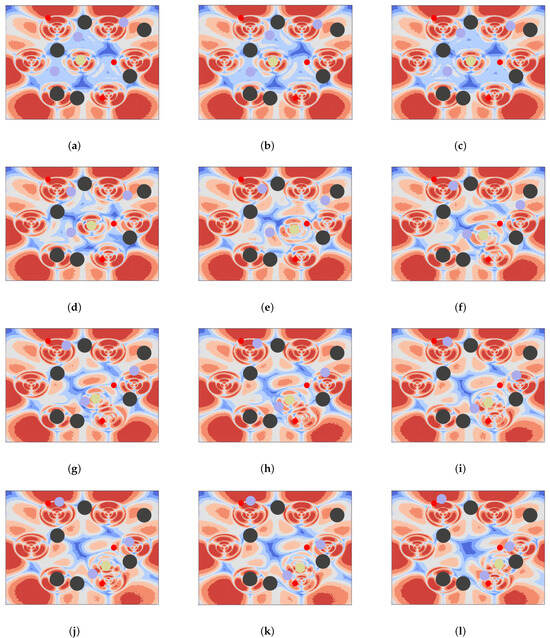
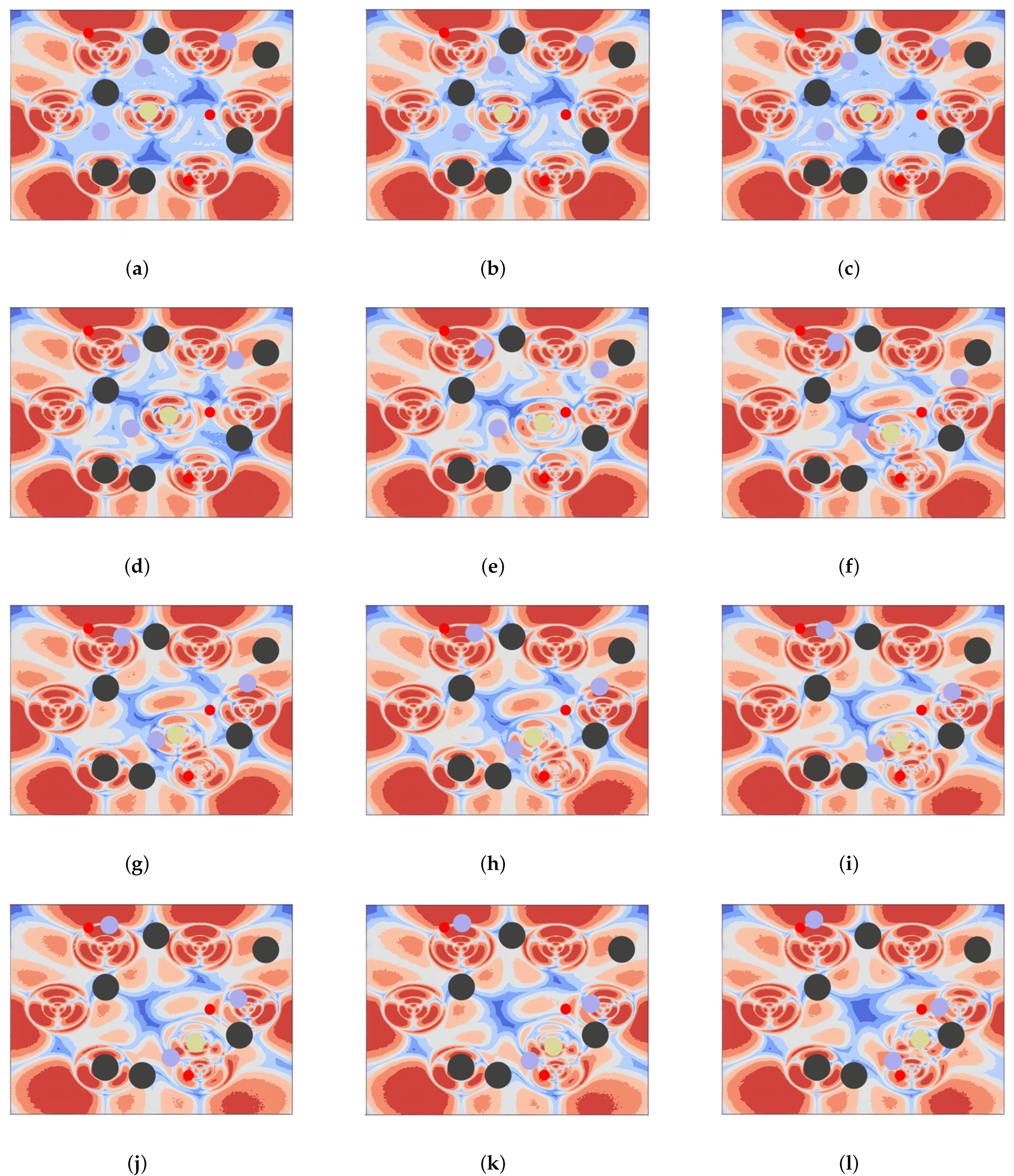
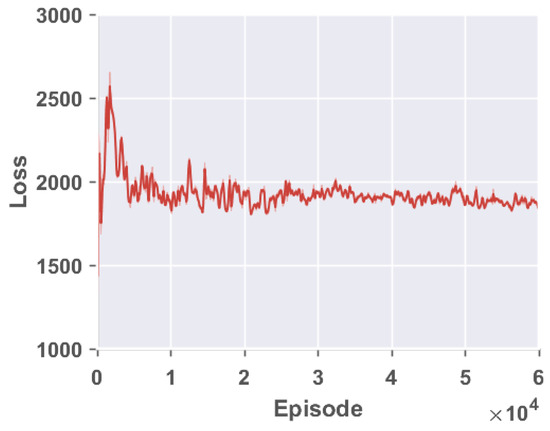
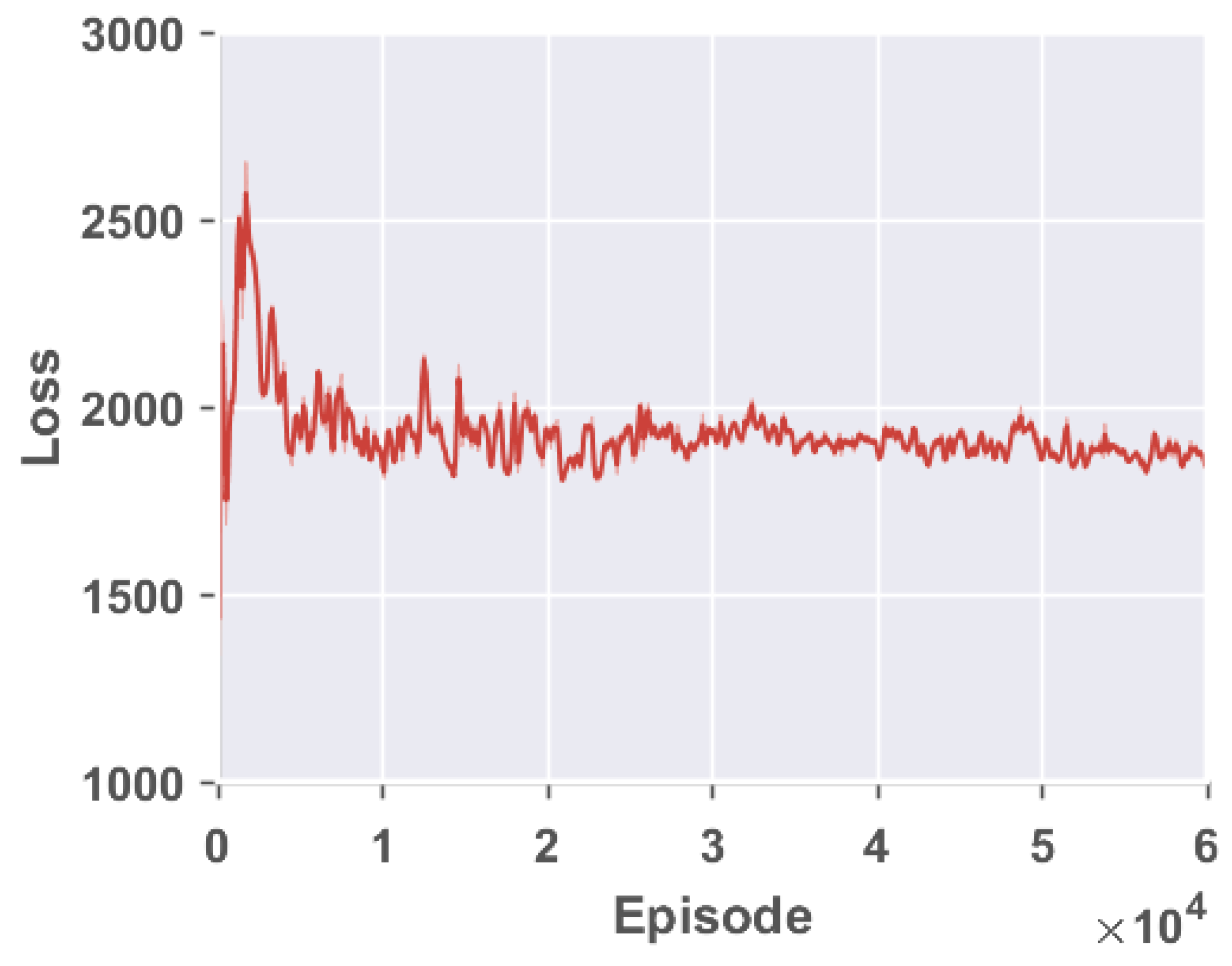
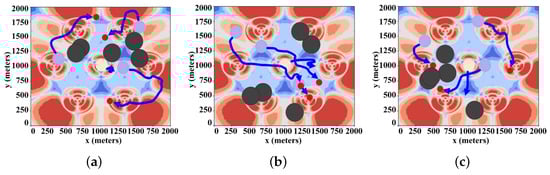
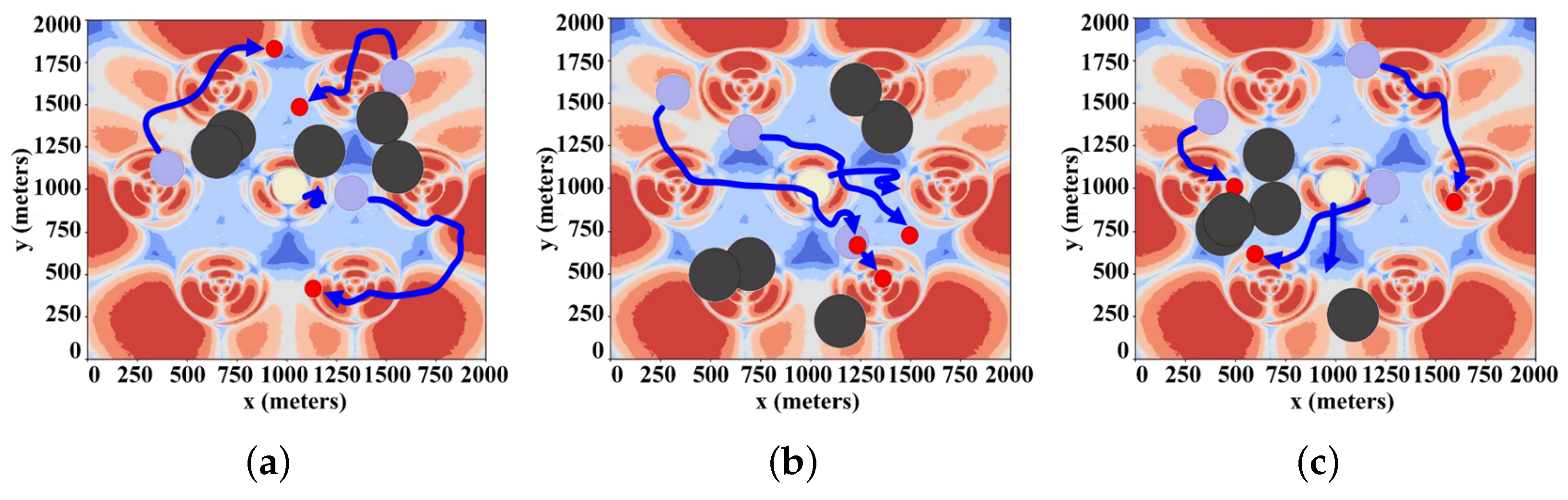
Furthermore, certain algorithms tend to converge to local optima, which further reinforces the effectiveness of our decision to adopt the MADDPG algorithm and enhance it. As depicted in Figure 6, in the initial 25,000 episodes, GA-MADDPG may succumb to local optimality. However, the incorporation of the GA mechanism enables GA-MADDPG to attain elevated rewards beyond this threshold. Notably, MAPPO and MQMIX demonstrate subpar performance, possibly due to the lack of adaptive hyperparameter updates, hindering their effective cooperation within the multi-agent environment and leading to convergence challenges. Therefore, this observation naturally demonstrates the high effectiveness of incorporating GA into multi-agent RL algorithms. By introducing GA, multi-agent algorithms can more effectively avoid falling into local optima, resulting in improved convergence speed and outcomes. And the variation of the loss calculated by Equation (21) is represented by Figure 7, from which we can see the constant convergence of the loss to near 1800, which can prove the convergence of the algorithm. During the validation process, Figure 8 displays several simulated paths of UGVs. Under optimal communication conditions, the BS UGV might remain stationary to prevent potential losses due to collisions. However, in situations with less than excellent communication, the BS UGV proactively moves to compensate for communication limitations. Additionally, statistics for the three evaluation indicators (Figure 5) show the improvement in communication return, the reduction in collision number, and the decrease in outside number as the algorithm converges. The return on communications exhibited an improvement from an initial value of −800 to −300 towards the conclusion of the experiment. Concurrently, the frequency of collisions decreased from 540 to 470, and the occurrences of external events diminished from 100 to nearly zero. This suggests that as the algorithm converges, the three evaluation metrics also reach optimality.
Figure 7.
Evolution of loss function.
Figure 8.
Some UGV path maps based on GA-MADDPG.
4.4. Generalization Experiment of GA-MADDPG
4.4.1. Simulation with Different Numbers of UGVs
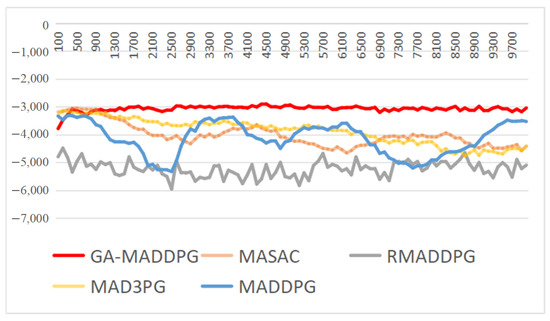
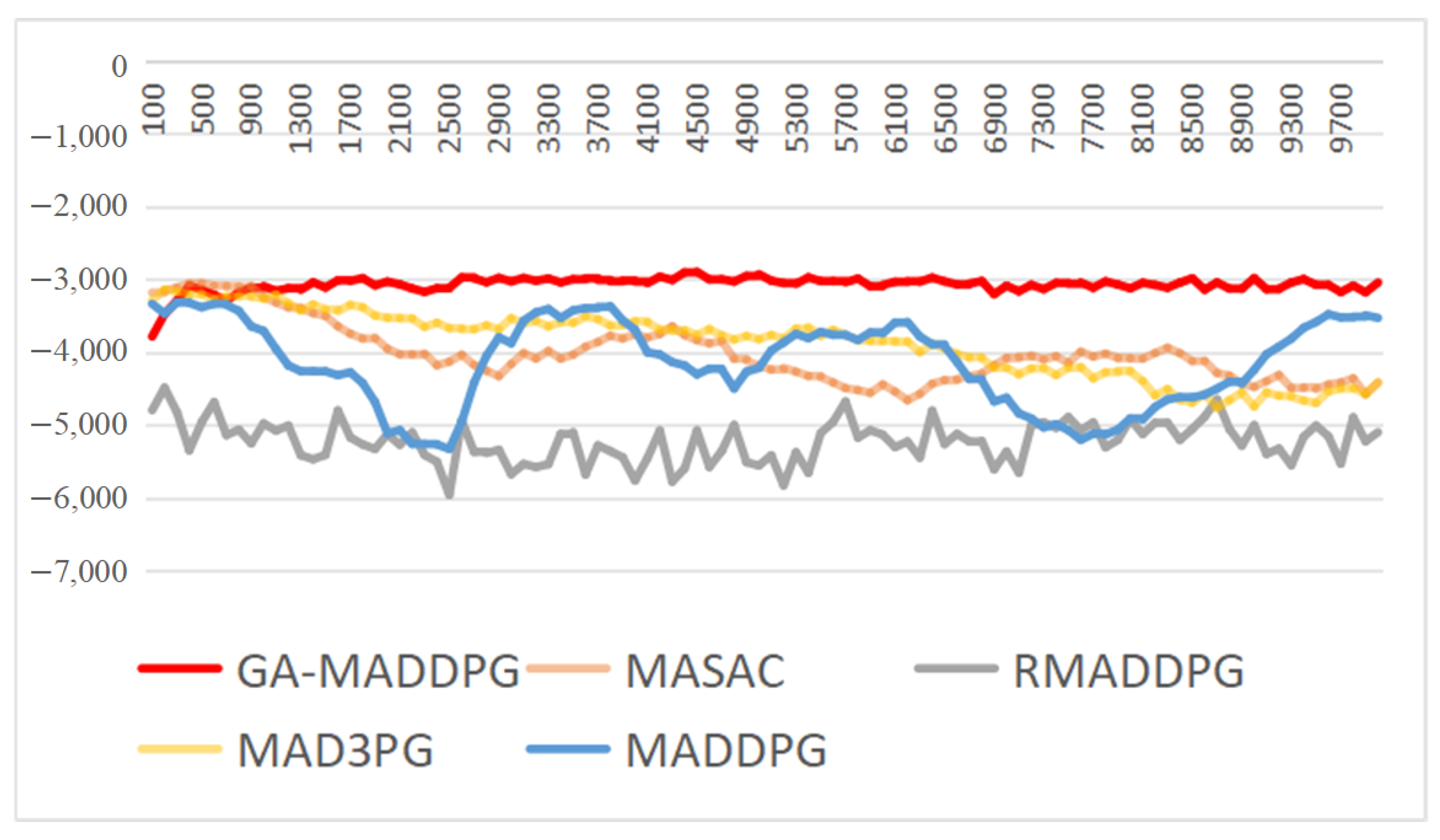
To further prove the universality of the proposed GA-MADDPG algorithm in the set environment, this study also designed two other generalization experiments for the scene. The experiment set different numbers of UGVs, target points, and obstacles in the scene to determine whether the algorithm GA-MADDPG can continue to perform superiorly. It should be noted that since some baseline algorithms in Section 4.3 have performed poorly or even have difficultly converging, the generalization experiment uses four baseline algorithms that are relatively stable in Section 4.3, including MASAC, MAD3PG, MADDPG, and its variant, RMADDPG. Generalization environment 1: The number of UGVs increases to four, the number of mobile base stations is one, the number of target points increases to four, and the number of obstacles increases to seven. The significance of setting up the environment in this way is to increase the severity of the environment by increasing the number of UGVs and the number of obstacles.
From Figure 9, we can see that despite the increased complexity of the environment, the GA-MADDPG algorithm always has a higher convergence value in harsh environments and can converge to a high value well. The GA-MADDPG algorithm can maintain convergence to a reward value of −3000, while the other baseline algorithms do not perform well or even find it difficult to converge in complex environments, and the highest reward value is only around −3300. This fully demonstrates that the GA-MADDPG algorithm still has better performance than other algorithms after the environmental complexity increases.
Figure 9.
Average cost comparison of generalization environment 1.
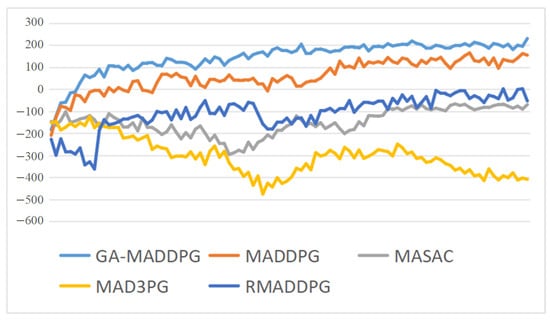
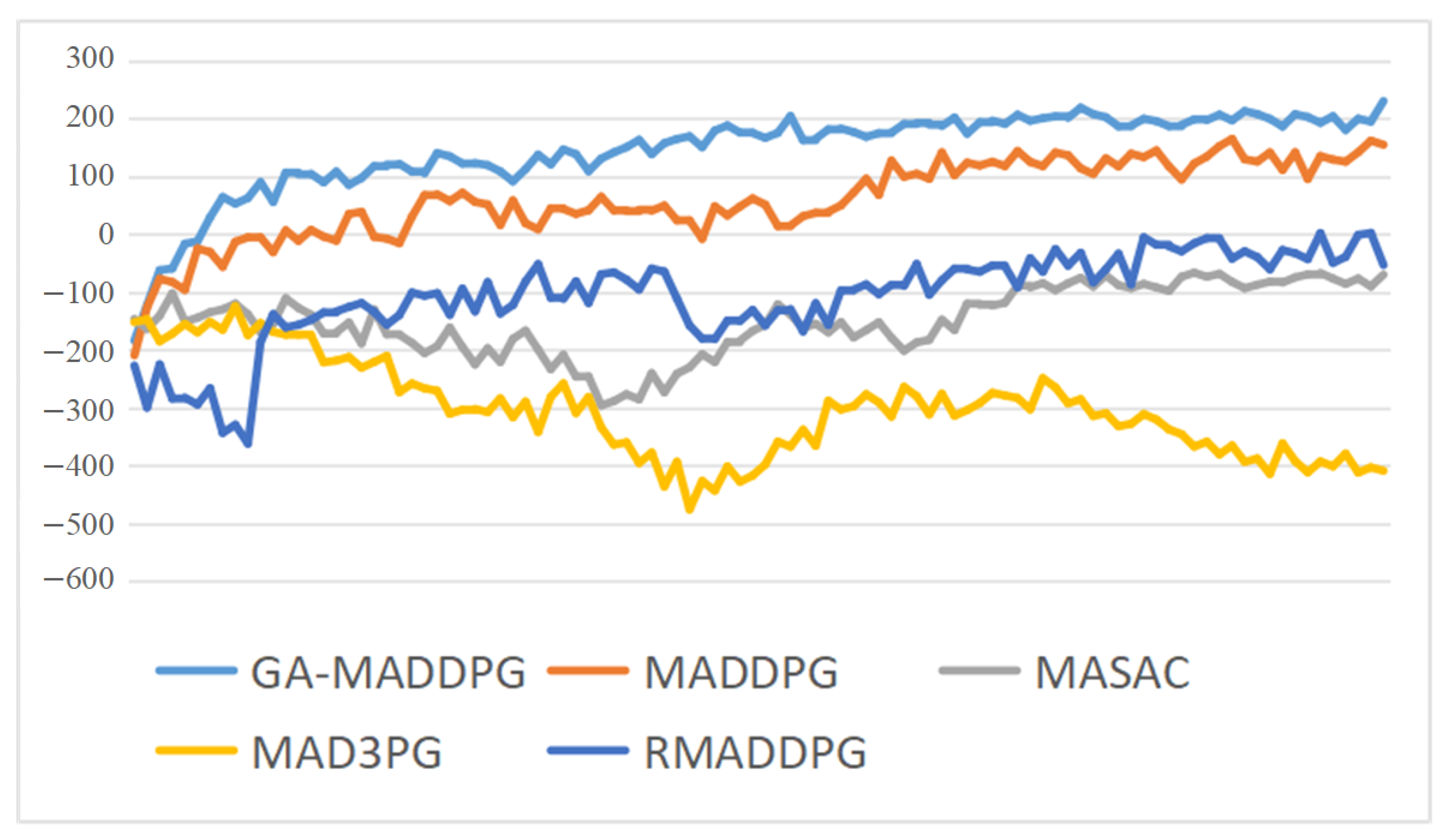
Generalized environment 2: The number of UGVs is reduced to two, the number of mobile base stations is one, the number of target points is reduced to two, and the number of obstacles is reduced to three. The significance of setting up the environment in this way is to improve the simplicity of the environment by simplifying the number of UGVs and obstacles so that the UGV can complete the goal with a greater reward.
As can be seen from Figure 10, the rewards of most algorithms show a good upward trend. This is because the generalized environment uses a simpler three UGVs (including a UGV base station), three obstacles, and two target points. The algorithm performs better in a simple environment and convergence is easier than for the generalized environment. As the number of vehicles decreases, the number of collisions and out-of-bounds also decrease accordingly. It should be noted that since the communication environment parameters remain unchanged, the reward value of the overall algorithm is positive, which is normal. From Figure 10, it can be seen that in this generalized environment, the reward of the GA-MADDPG algorithm always remains ahead, both in terms of convergence speed and final convergence value, which are much higher than for the other algorithms, and the final reward value can converge to about 200. As a basic algorithm, MADDPG also has a higher convergence value of about 150. This fully demonstrates that the GA-MADDPG algorithm can also perform well in a simple environment.
Figure 10.
Average cost comparison of generalization environment 2.
It can be seen from Figure 9 and Figure 10 that in the experimental environments with two different parameter settings, despite changes in the number of UGVs, the number of target points, and the number of obstacles, the GA-MADDPG algorithm can still perform better than the other algorithms, which fully demonstrates the robustness of the GA-MADDPG algorithm and its universality to environmental scenarios.
4.4.2. Experiments on the Effectiveness of the Mobile BS
The previous subsections prove the stability and convergence of our proposed algorithm. Also, the last section proves that our proposed algorithm is superior in the same scenario. To better demonstrate the effectiveness of the mobile base station proposed in this paper, we add an extra experiment: only changing the mobile BS to a fixed BS but using the same algorithm.
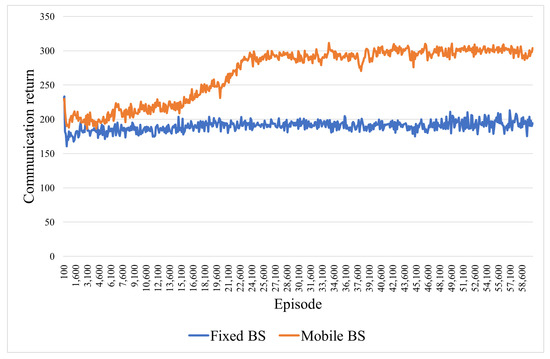
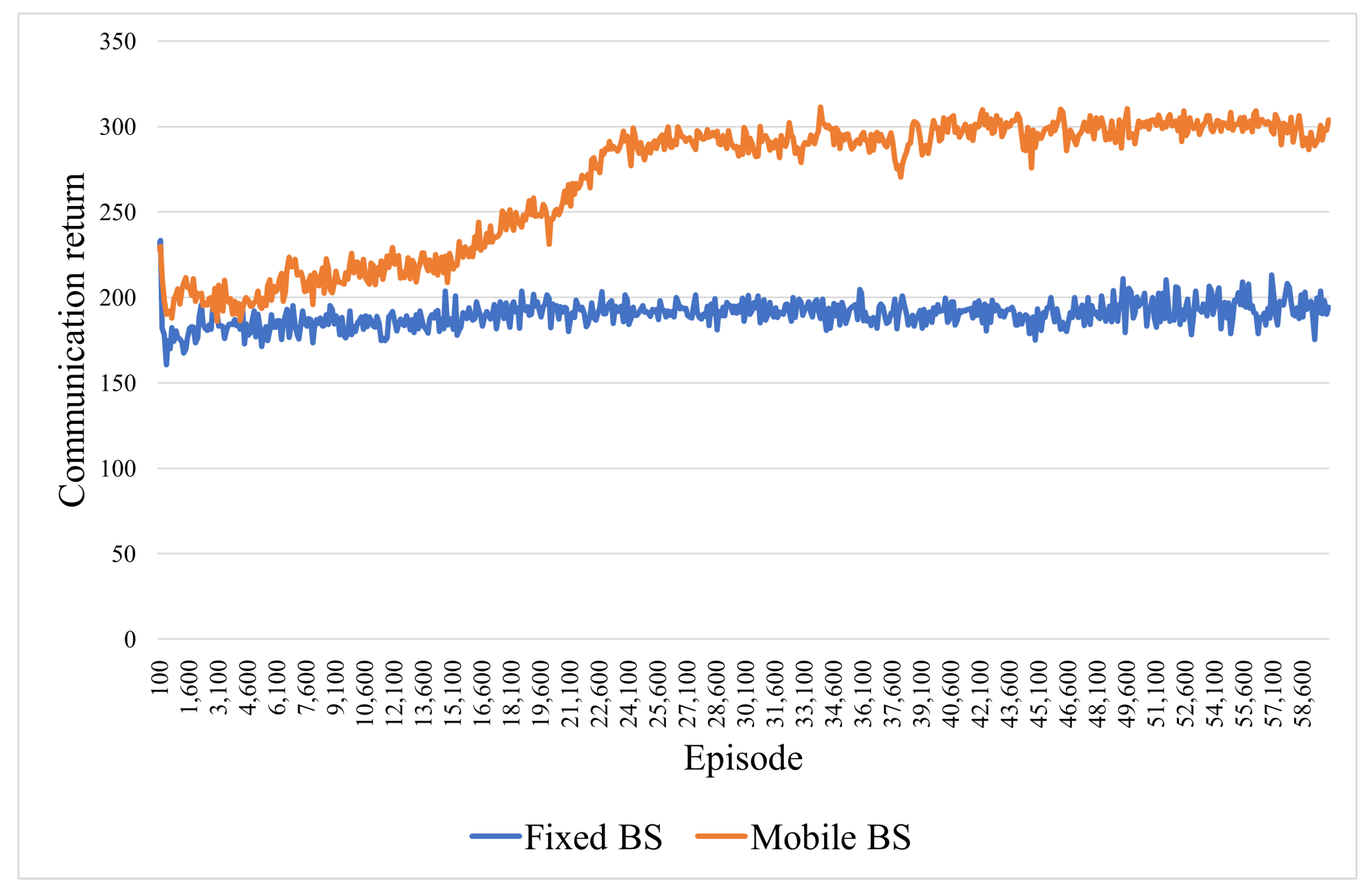
We use the communication return as an evaluation metric, and the communication return with a mobile base station is better than that of the fixed base station from the beginning of training, as shown by Figure 11. The communication return of a single UGV can eventually converge to around 300, while that of the fixed base station hovers around 200 feet, which fully proves the effectiveness of our proposed mobile base station.
Figure 11.
Comparison of communication returns between mobile BS and fixed BS.
5. Conclusions
In this article, a cooperative system for multi-UGV cooperative navigation within a communication coverage area is proposed. The system is formulated as an MDP to determine an optimal navigation policy for the UGVs, with the aim of maximizing the total reward. In contrast to prior studies focusing on fixed coverage-aware navigation, this paper introduces a novel approach by incorporating a mobile BS into the multi-intelligent-body algorithm. This innovation aims to enhance communication coverage and expand the solution space available for intelligent agents. To mitigate the risk of local optima, this study introduces a GA hyperparameter adaptive updating mechanism to address the multi-UGV navigation problem. We coin the term GA-MADDPG to refer to this novel RL algorithm. The simulation results demonstrate that GA-MADDPG exhibits favorable performance, convergence rates, and effectiveness compared to other RL algorithms.
In our future research, we would like to address the following points: (1) To enhance model realism, one can combine a traditional PID control with multi-agent RL and further optimize the navigation policy by taking control of the machine operation. (2) One can try to use a new architecture to learn policies, such as by using LSTM (long short-term memory) and the transformer architecture. LSTM can solve the problem of gradient vanishing and gradient explosion during the training of long sequences; the advantage of the transformer architecture is that its attention layer can learn a sequence of actions very well.
Author Contributions
Research design, X.L. and M.H.; data acquisition, X.L.; writing—original draft preparation, X.L.; writing—review and editing, X.L. and M.H.; supervision, M.H.; funding acquisition, M.H. All authors have read and agreed to the published version of the manuscript.
Funding
This work was supported by the Academician Innovation Platform Special Project of Hainan Province (YSPTZX202209).
Data Availability Statement
The original contributions presented in the study are included in the article, further inquiries can be directed to the corresponding author.
Conflicts of Interest
The authors declare no conflicts of interest.
References
- Afzali, S.R.; Shoaran, M.; Karimian, G. A Modified Convergence DDPG Algorithm for Robotic Manipulation. Neural Process. Lett. 2023, 55, 11637–11652. [Google Scholar] [CrossRef] [Scilit]
- Chai, R.; Niu, H.; Carrasco, J.; Arvin, F.; Yin, H.; Lennox, B. Design and experimental validation of deep reinforcement learning-based fast trajectory planning and control for mobile robot in unknown environment. IEEE Trans. Neural Netw. Learn. Syst. 2022, 35, 5778–5792. [Google Scholar] [CrossRef] [Scilit]
- Dong, X.; Wang, Q.; Yu, J.; Lü, J.; Ren, Z. Neuroadaptive Output Formation Tracking for Heterogeneous Nonlinear Multiagent Systems with Multiple Nonidentical Leaders. IEEE Trans. Neural Netw. Learn. Syst. 2022, 35, 3702–3712. [Google Scholar] [CrossRef] [Scilit]
- Wang, Y.; Zhao, C.; Liang, J.; Wen, M.; Yue, Y.; Wang, D. Integrated Localization and Planning for Cruise Control of UGV Platoons in Infrastructure-Free Environments. IEEE Trans. Intell. Transp. Syst. 2023, 24, 10804–10817. [Google Scholar] [CrossRef] [Scilit]
- Tran, V.P.; Perera, A.; Garratt, M.A.; Kasmarik, K.; Anavatti, S.G. Coverage Path Planning with Budget Constraints for Multiple Unmanned Ground Vehicles. IEEE Trans. Intell. Transp. Syst. 2023, 24, 12506–12522. [Google Scholar] [CrossRef] [Scilit]
- Wu, Y.; Li, Y.; Li, W.; Li, H.; Lu, R. Robust Lidar-Based Localization Scheme for Unmanned Ground Vehicle via Multisensor Fusion. IEEE Trans. Neural Netw. Learn. Syst. 2021, 32, 5633–5643. [Google Scholar] [CrossRef] [Scilit]
- Zhang, W.; Zuo, Z.; Wang, Y. Networked multiagent systems: Antagonistic interaction, constraint, and its application. IEEE Trans. Neural Netw. Learn. Syst. 2021, 33, 3690–3699. [Google Scholar] [CrossRef] [Scilit] [PubMed]
- Chen, D.; Weng, J.; Huang, F.; Zhou, J.; Mao, Y.; Liu, X. Heuristic Monte Carlo algorithm for unmanned ground vehicles realtime localization and mapping. IEEE Trans. Veh. Technol. 2020, 69, 10642–10655. [Google Scholar] [CrossRef] [Scilit]
- Unlu, H.U.; Patel, N.; Krishnamurthy, P.; Khorrami, F. Sliding-window temporal attention based deep learning system for robust sensor modality fusion for UGV navigation. IEEE Robot. Autom. Lett. 2019, 4, 4216–4223. [Google Scholar] [CrossRef] [Scilit]
- Lyu, X.; Hu, B.; Wang, Z.; Gao, D.; Li, K.; Chang, L. A SINS/GNSS/VDM integrated navigation fault-tolerant mechanism based on adaptive information sharing factor. IEEE Trans. Instrum. Meas. 2022, 71, 1–13. [Google Scholar] [CrossRef] [Scilit]
- Sun, C.; Ye, M.; Hu, G. Distributed optimization for two types of heterogeneous multiagent systems. IEEE Trans. Neural Netw. Learn. Syst. 2020, 32, 1314–1324. [Google Scholar] [CrossRef] [Scilit]
- Shan, Y.; Fu, Y.; Chen, X.; Lin, H.; Lin, J.; Huang, K. LiDAR based Traversable Regions Identification Method for Off-road UGV Driving. IEEE Trans. Intell. Veh. 2023, 9, 3544–3557. [Google Scholar] [CrossRef] [Scilit]
- Garaffa, L.C.; Basso, M.; Konzen, A.A.; de Freitas, E.P. Reinforcement learning for mobile robotics exploration: A survey. IEEE Trans. Neural Netw. Learn. Syst. 2021, 34, 3796–3810. [Google Scholar] [CrossRef] [Scilit]
- Huang, C.Q.; Jiang, F.; Huang, Q.H.; Wang, X.Z.; Han, Z.M.; Huang, W.Y. Dual-graph attention convolution network for 3-D point cloud classification. IEEE Trans. Neural Netw. Learn. Syst. 2022, 35, 4813–4825. [Google Scholar] [CrossRef] [Scilit]
- Nguyen, H.T.; Garratt, M.; Bui, L.T.; Abbass, H. Supervised deep actor network for imitation learning in a ground-air UAV-UGVs coordination task. In Proceedings of the 2017 IEEE Symposium Series on Computational Intelligence (SSCI), Honolulu, HI, USA, 27 November–1 December 2017; IEEE: Piscataway, NJ, USA, 2017; pp. 1–8. [Google Scholar]
- Han, Z.; Yang, Y.; Wang, W.; Zhou, L.; Gadekallu, T.R.; Alazab, M.; Gope, P.; Su, C. RSSI Map-Based Trajectory Design for UGV Against Malicious Radio Source: A Reinforcement Learning Approach. IEEE Trans. Intell. Transp. Syst. 2022, 24, 4641–4650. [Google Scholar] [CrossRef] [Scilit]
- Feng, Z.; Huang, M.; Wu, Y.; Wu, D.; Cao, J.; Korovin, I.; Gorbachev, S.; Gorbacheva, N. Approximating Nash equilibrium for anti-UAV jamming Markov game using a novel event-triggered multi-agent reinforcement learning. Neural Netw. 2023, 161, 330–342. [Google Scholar] [CrossRef] [Scilit]
- Huang, X.; Deng, H.; Zhang, W.; Song, R.; Li, Y. Towards multi-modal perception-based navigation: A deep reinforcement learning method. IEEE Robot. Autom. Lett. 2021, 6, 4986–4993. [Google Scholar] [CrossRef] [Scilit]
- Wu, S.; Xu, W.; Wang, F.; Li, G.; Pan, M. Distributed federated deep reinforcement learning based trajectory optimization for air-ground cooperative emergency networks. IEEE Trans. Veh. Technol. 2022, 71, 9107–9112. [Google Scholar] [CrossRef] [Scilit]
- Watkins, C.J.; Dayan, P. Q-learning. Mach. Learn. 1992, 8, 279–292. [Google Scholar] [CrossRef] [Scilit]
- Tran, T.H.; Nguyen, M.T.; Kwok, N.M.; Ha, Q.P.; Fang, G. Sliding mode-PID approach for robust low-level control of a UGV. In Proceedings of the 2006 IEEE International Conference on Automation Science and Engineering, Shanghai, China, 8–10 October 2006; IEEE: Piscataway, NJ, USA, 2006; pp. 672–677. [Google Scholar]
- Schaul, T.; Quan, J.; Antonoglou, I.; Silver, D. Prioritized experience replay. arXiv 2015, arXiv:1511.05952. [Google Scholar]
- Sutton, R.S.; Barto, A.G. Reinforcement Learning: An Introduction. IEEE Trans. Neural Netw. 1998, 9, 1054. [Google Scholar] [CrossRef] [Scilit]
- Lowe, R.; Wu, Y.I.; Tamar, A.; Harb, J.; Pieter Abbeel, O.; Mordatch, I. Multi-agent actor-critic for mixed cooperative-competitive environments. arXiv 2017, arXiv:1706.02275. [Google Scholar]
- Mirjalili, S.; Mirjalili, S. Genetic algorithm. Evolutionary Algorithms and Neural Networks: Theory and Applications; Springer: Berlin/Heidelberg, Germany, 2019; pp. 43–55. [Google Scholar]
- Sehgal, A.; La, H.; Louis, S.; Nguyen, H. Deep reinforcement learning using genetic algorithm for parameter optimization. In Proceedings of the 2019 Third IEEE International Conference on Robotic Computing (IRC), Naples, Italy, 25–27 February 2019; IEEE: Piscataway, NJ, USA, 2019; pp. 596–601. [Google Scholar]
- Chen, R.; Yang, B.; Li, S.; Wang, S. A self-learning genetic algorithm based on reinforcement learning for flexible job-shop scheduling problem. Comput. Ind. Eng. 2020, 149, 106778. [Google Scholar] [CrossRef] [Scilit]
- Alipour, M.M.; Razavi, S.N.; Feizi Derakhshi, M.R.; Balafar, M.A. A hybrid algorithm using a genetic algorithm and multiagent reinforcement learning heuristic to solve the traveling salesman problem. Neural Comput. Appl. 2018, 30, 2935–2951. [Google Scholar] [CrossRef] [Scilit]
- Liu, Z.; Chen, B.; Zhou, H.; Koushik, G.; Hebert, M.; Zhao, D. Mapper: Multi-agent path planning with evolutionary reinforcement learning in mixed dynamic environments. In Proceedings of the 2020 IEEE/RSJ International Conference on Intelligent Robots and Systems (IROS), Las Vegas, NV, USA, 25–29 October 2020; IEEE: Piscataway, NJ, USA, 2020; pp. 11748–11754. [Google Scholar]
- Huang, M.; Lin, X.; Feng, Z.; Wu, D.; Shi, Z. A multi-agent decision approach for optimal energy allocation in microgrid system. Electr. Power Syst. Res. 2023, 221, 109399. [Google Scholar] [CrossRef] [Scilit]
- Qiu, C.; Hu, Y.; Chen, Y.; Zeng, B. Deep deterministic policy gradient (DDPG)-based energy harvesting wireless communications. IEEE Internet Things J. 2019, 6, 8577–8588. [Google Scholar] [CrossRef] [Scilit]
- Littman, M.L. Markov games as framework for multi-agent reinforcement learning. In Proceedings of the Proc International Conference on Machine Learning, New Brunswick, NJ, USA, 10–13 July 1994; pp. 157–163. [Google Scholar]
- Feng, Z.; Huang, M.; Wu, D.; Wu, E.Q.; Yuen, C. Multi-Agent Reinforcement Learning with Policy Clipping and Average Evaluation for UAV-Assisted Communication Markov Game. IEEE Trans. Intell. Transp. Syst. 2023, 24, 14281–14293. [Google Scholar] [CrossRef] [Scilit]
- Liu, H.; Zong, Z.; Li, Y.; Jin, D. NeuroCrossover: An intelligent genetic locus selection scheme for genetic algorithm using reinforcement learning. Appl. Soft Comput. 2023, 146, 110680. [Google Scholar] [CrossRef] [Scilit]
- Köksal Ahmed, E.; Li, Z.; Veeravalli, B.; Ren, S. Reinforcement learning-enabled genetic algorithm for school bus scheduling. J. Intell. Transp. Syst. 2022, 26, 269–283. [Google Scholar] [CrossRef] [Scilit]
- Chen, Q.; Huang, M.; Xu, Q.; Wang, H.; Wang, J. Reinforcement Learning-Based Genetic Algorithm in Optimizing Multidimensional Data Discretization Scheme. Math. Probl. Eng. 2020, 2020, 1698323. [Google Scholar] [CrossRef] [Scilit]
- Yang, J.; Sun, Z.; Hu, W.; Steinmeister, L. Joint control of manufacturing and onsite microgrid system via novel neural-network integrated reinforcement learning algorithms. Appl. Energy 2022, 315, 118982. [Google Scholar] [CrossRef] [Scilit]
- Shi, H.; Liu, G.; Zhang, K.; Zhou, Z.; Wang, J. MARL Sim2real Transfer: Merging Physical Reality with Digital Virtuality in Metaverse. IEEE Trans. Syst. Man Cybern. Syst. 2023, 53, 2107–2117. [Google Scholar] [CrossRef] [Scilit]
- Yu, C.; Velu, A.; Vinitsky, E.; Gao, J.; Wang, Y.; Bayen, A.; Wu, Y. The surprising effectiveness of ppo in cooperative multi-agent games. Adv. Neural Inf. Process. Syst. 2022, 35, 24611–24624. [Google Scholar]
- Rashid, T.; Farquhar, G.; Peng, B.; Whiteson, S. Weighted qmix: Expanding monotonic value function factorisation for deep multi-agent reinforcement learning. Adv. Neural Inf. Process. Syst. 2020, 33, 10199–10210. [Google Scholar]
- Wu, T.; Wang, J.; Lu, X.; Du, Y. AC/DC hybrid distribution network reconfiguration with microgrid formation using multi-agent soft actor-critic. Appl. Energy 2022, 307, 118189. [Google Scholar] [CrossRef] [Scilit]
- Yan, C.; Xiang, X.; Wang, C.; Li, F.; Wang, X.; Xu, X.; Shen, L. PASCAL: PopulAtion-Specific Curriculum-based MADRL for collision-free flocking with large-scale fixed-wing UAV swarms. Aerosp. Sci. Technol. 2023, 133, 108091. [Google Scholar] [CrossRef] [Scilit]
- Ackermann, J.J.; Gabler, V.; Osa, T.; Sugiyama, M. Reducing Overestimation Bias in Multi-Agent Domains Using Double Centralized Critics. arXiv 2019, arXiv:1910.01465. [Google Scholar]
- Xing, X.; Zhou, Z.; Li, Y.; Xiao, B.; Xun, Y. Multi-UAV Adaptive Cooperative Formation Trajectory Planning Based on an Improved MATD3 Algorithm of Deep Reinforcement Learning. IEEE Trans. Veh. Technol. 2024. [Google Scholar] [CrossRef] [Scilit]

Disclaimer/Publisher’s Note: The statements, opinions and data contained in all publications are solely those of the individual author(s) and contributor(s) and not of MDPI and/or the editor(s). MDPI and/or the editor(s) disclaim responsibility for any injury to people or property resulting from any ideas, methods, instructions or products referred to in the content. |
© 2024 by the authors. Licensee MDPI, Basel, Switzerland. This article is an open access article distributed under the terms and conditions of the Creative Commons Attribution (CC BY) license (https://creativecommons.org/licenses/by/4.0/).