1. Introduction
The advent of the digital revolution has facilitated substantial economic expansion and democratized media production, allowing individuals and businesses to utilize internet platforms as significant sources of income. The internet has enabled unprecedented potential for digital media creation, distribution, and consumption. However, the convenience and widespread availability of digital media have also increased the risks associated with protecting them from copyright infringement [
1]. This issue not only has legal implications but also significant economic consequences. The core of digital media security issues lies in the unauthorized reproduction and alteration of content, commonly referred to as “piracy”. This illicit activity persists as a significant challenge, affecting creators and copyright holders across various media, including video, audio, text, and more. Recent studies, such as those referenced in [
2], estimate that over three billion individuals engage in the unauthorized downloading of recorded music monthly, underscoring the vast scale of this problem.
Video and images disseminated on social media platforms are particularly popular with younger demographics, as well as older individuals. Advertising companies are increasingly recognizing the growing popularity of social networks as a means to contact their target demographic and promote their products. They offer a generous compensation package based on viewership and other factors, which motivates content creators to produce more captivating and unique material. Nevertheless, not all content creators exhibit equitable behavior. Frequently, individuals create profiles on social networks with the intention of generating income by uploading pilfered content. Copyright laws are violated when you plagiarize someone else’s content and claim it as your own [
3]. Although digital media security solutions are present on social networking platforms to detect and alert content authors about duplicate content, they generally do not prevent content misappropriation, such as copying a post from one platform and uploading it on another.
As long as uploading and sharing data does not violate copyright laws, it is legally permissible. However, instances of unauthorized copying and distribution of files are frequently observed [
4]. In this case, the copyright violator uploads the file to a file upload platform, then shares the download URL on the internet for others to access. Individuals who come across this hyperlink have the ability to acquire the unlawfully obtained information without being aware of its illicit origin. This distribution of files constitutes a breach of digital file security as it infringes upon the copyright of the rightful owners. It may potentially be considered a copyright violation to distribute a hyperlink to anything. This pertains to instances where you incorporate digital media content, like a photograph or video, into your personal blog or social media account. While the provided link directs you to the genuine author’s page, sharing another author’s photographs or movies with other parties without their permission is also a violation of copyright laws. While not directly related to digital media safety, this issue is primarily about piracy. The harm occurs when audiences outside the intended region access the content, resulting in a loss of income for the author. Obtaining the author’s permission is necessary in order to mention their name and include complete links to their social media profiles when sharing the content they have produced.
Given these challenges, enhancing digital media protection has become imperative. It is almost impossible to trace every illegal use on the internet, so individuals accused of piracy are often invisible in court due to the unreasonable time and financial costs involved. Encrypting sensitive data can help prevent unauthorized use. Cryptography enables the encryption of a wide range of files. Cryptographic encryption restricts unauthorized downloads of copyrighted content to the author’s defined environment, which can decode the file upon authorization. Cryptographic signatures can also be used to verify copyright [
5]. To protect digital content from unauthorized use, cryptographic signatures establish ownership.
Tags are a simple yet effective approach to securing content. Tags are widespread on online videos and images. The organization’s emblem often appears as a hard-to-translucent layer over photographs and videos. Viewers avoid duplicating and unlawfully using tagged content because it makes them uncomfortable. This method protects digital media files from small-scale piracy, but more advanced users can get around it by using graphic design tools to remove the markings. On the other hand, Blockchain technology tags digital media files and preserves ownership rights via customized contracts [
6]. Blockchain contracts are publicly available but unchangeable. However, if the content’s copyright changes or infringes on another work’s copyright, the Blockchain entry will not be deleted, and the content’s appropriation information will be kept.
The current methods, including traditional digital rights management systems [
7], are often circumvented, leaving content vulnerable. The advancement of steganography—the art of hiding information within other information—is one promising avenue. Digital watermarks track copyrighted content by employing steganographic methods [
8]. Digital watermarks can prove copyright and track unlawful distributors, but they do not immediately prevent content copying. Copyists may not see digitally watermarked work, making it easier to track and take legal action to preserve copyright [
9]. Conversely, steganography can serve as a covert mechanism to embed copyright data within the media itself, making unauthorized use more detectable and traceable without affecting the quality or integrity of the content [
10]. Steganography is focused on the concealment of a message within another medium, ensuring that the existence of the embedded information remains undetected except for the intended parties [
11]. However, the application of steganography brings its own set of challenges. While there are many steganography-driven solutions, most of them only provide a legal basis for compensation. The protection of digital content against unauthorized use is still an open area for research. In relation to this, the main aim of this paper is to propose a cutting-edge steganographic method called F5A for enhanced security of digital media, particularly focusing on digital images. The authors’ main contributions are as follows:
A new steganographic method called F5A has been proposed, which is based on the F5 algorithm and extends its capacity by using generated quantization tables, as well as adding new features such as protection against reconstruction of the carrier’s content and notification of copyright infringement during decryption.
A copyright protection solution capable of identifying infringing content and notifying the copyright owner.
Implemented cryptography-based protection of identified content against unauthorized use.
The proposed method allows for hiding of as much information as possible, as the original image hides the entire image copy, which must remain of the best possible quality. It can also be easily combined with an embedded cryptographic key to encrypt the information in order to reliably protect the hidden content from disclosure. The F5A method is resistant to file modifications such as stretching, cutting, compression, or other processing. This approach not only facilitates the tracing and identification of unauthorized content distribution but also guarantees the preservation of the original media’s quality.
This paper is organized in the following structured format.
Section 2 provides a comprehensive review of existing steganographic methods and algorithms utilized in copyright protection. The proposed F5A method is detailed in
Section 3, along with the corresponding experimental methodology and analysis of the results presented in
Section 4.
Section 5 elucidates the merits and limitations of the proposed approach. Finally,
Section 6 summarizes the main findings and delineates directions for future research.
2. Related Works on Image Steganography
Steganography is a way of hiding sensitive information in plain sight by deceiving the observer of an image or other file [
12]. This method of information concealment enables private communication between individuals who understand the hidden messages and their interpretation. Steganography is not a form of cryptography; instead, cryptography and other techniques are used to hide information, depending on the size and type of data file chosen. The chosen format will determine the maximum amount of encrypted information and the methods used to conceal it.
This section reviews various traditional and contemporary steganographic methods, emphasizing their applicability and limitations in digital copyright protection. It compares different techniques’ effectiveness and introduces the concept of embedding hidden information in digital media, which serves as a prelude to the innovative F5A method detailed later. The section aims to contextualize the F5A method within the broader landscape of steganography and digital rights management, highlighting the ongoing challenges and developments in the field.
Image steganography is one of the most popular types of steganography [
13]. Sensitive information posted in images can easily circulate on social networks and forums without arousing much suspicion. The vast amount of visual information on the internet allows secret messages to go unnoticed, and by blending in with regular content, they can remain hidden for a very long time. To hide a message in an image without causing a noticeable difference to the original version of the image, it is possible to cover the image with noise, use color variations, or use other techniques to hide the message. The authors in [
14] explore multiple deep learning techniques applied to image steganography, encompassing conventional approaches, CNN-based strategies, and GAN-based techniques. Additionally, they detail the data sets, experimental configurations, and evaluation criteria frequently utilized in this domain.
Data security is ensured in [
15] through an innovative steganography technique that incorporates generative adversarial networks. This method primarily focuses on embedding concealed information during the creation of art-style images, thereby making it challenging for adversaries to detect steganographic content. It is capable of embedding up to three bits per pixel in a color image, significantly increasing the amount of secret data that can be hidden within a single image. However, the GAN-based approach entails intricate neural network architectures and training processes, necessitating considerable computational resources and time.
The computational resource-constrained hybrid security system proposed in [
16] for encrypting color images employs a combination of SHA256-MD5 hash functions, DNA permutation, and diffusion with a 5D hyper-chaotic system to enhance security. This approach specifically shows high resistance to noise and differential attacks while maintaining speed due to its lower computational complexity.
The proposed solutions in [
17,
18] enhance RGB color image encryption by combining the spatial and transformation approaches using a hybrid optimization algorithm that integrates the Salp Swarm algorithm and the arithmetic optimization algorithm. This gives higher security through complex chaotic systems, improved robustness against various attacks, optimized encryption parameters, and the integration of dual encryption approaches. However, it is more focused on encryption rather than embedding capacity.
The least significant bit (LSB) is the most popular method for steganography of visual material. This method embeds information into an image using the least significant bits of the image, and the least significant bits of an image are those whose value, when changed by the image observer, makes the processed image least different from the original. Pixel Value Differencing (PVD) with a quantized range table approach is one of the examples of this type of image steganography. The authors in [
19] proposed a technique that takes advantage of humans’ limited ability to discern minor changes in pixel values, particularly in areas of high visual complexity. This methodology uses the quantized range table method to improve resilience against unauthorized detection and decoding while maintaining the visual integrity of the stego-image. However, the approach has drawbacks, including the possibility of being vulnerable to advanced steganalysis tools that rely on knowledge of PVD-based steganography properties. The work emphasizes the need for additional research to fine-tune the technique, particularly to expand its use to 3D images and improve its security features to prevent advanced analytical attacks. Other researchers employ a pixel locator sequence (PLS) combined with AES encryption [
20]. The PLS distributes data randomly across image pixels, enhancing security. However, the space-efficient nature of conveying meta-data (PLS) and the need to balance security and space efficiency pose limitations in this context.
The authors in [
21] improve the LSB with matching revisited technique by efficiently hiding messages with more than two bits while minimizing alterations to the image. However, this method could lead to increased computational demands due to the complexity of the operations required for embedding and retrieving messages. Additionally, despite its improved capacity, the technique could remain vulnerable to sophisticated steganalysis methods if not executed with precision, particularly as detection technologies for steganography continue to advance. In [
22], a changed multiway pixel-value differencing method using universal quantization ranges to make image steganography better was explained. This approach boosts embedding rates while maintaining high image quality. However, its drawbacks include additional complexity and potential security trade-offs under certain structural analysis scenarios.
Only the steganography of 24-bit or black-and-white images typically uses the masking and filtering method. Masking and filtering techniques are similar in principle to watermarks or a specific scribble on an image. This method, unlike LSB, visually represents the changes, making it possible for the image’s observer to notice them, but proper use would make it difficult to discern the differences. However, this method has advantages over LSB in that the masking and filtering method makes the image resistant to compression, cropping, or other modifications to the image size. It is more suitable for the steganography of JPEG files than the LSB method because it visually modifies the image and makes it resistant to compression. The study in [
23] introduces an automated method for categorizing digital images by noise levels using the Canny filter, aimed at optimizing the selection of images for steganographic data embedding. However, the approach may face challenges in accurately assessing noise levels, potentially impacting the efficacy of steganographic techniques.
The transformation method is more complicated than the previous methods because it uses complex mathematical functions, such as the discrete cosine transform. The JPEG compression algorithm employs the discrete cosine transform (DCT). This algorithm can compress not only the image but also the generated secret message together, thus hiding the message information in the already compressed file. The authors in [
24] scattered the cover image to broadly disperse energy, increasing the number of DCT coefficients available for embedding data. The quantization table values then modify the underlying capacity of each DCT block, yielding varying results across different tables.
The proposed approach in [
25] improves JPEG steganography by using a quantized Gaussian model that takes into account embedding costs or residual variances measured in both the spatial and DCT domains. It greatly enhances security for various payloads. However, because of its advanced statistical computations, the method may add increased complexity and, therefore, reduced practicality for real-time applications.
The study in [
26] presents the robust adaptive steganography method based on postprocessing and accurate dither modulation. The method specifically caters to images of exceptional quality. This technique leverages accurate dither modulation to minimize the scope of alterations and utilizes postprocessing to improve robustness against JPEG recompression. However, these essential alterations have the potential to increase security risks.
Digital file formats, including text file formats, use steganographic coding algorithms, also known as stegosystems, to embed various types of data, such as code, images, or audio. Steganographic encoding can be applied to almost all file formats, but it is more practical to apply steganographic encoding to some formats than others. The paper in [
27] presents a method to improve the JPHide steganography system by advancing the techniques for retrieving the check matrix and shuffling key. It achieves this by analyzing embedding ratios and distinguishing genuine from counterfeit keys using the distribution of bit sequences. Nonetheless, the approach may face difficulties in effectively retrieving keys when embedding ratios are at their extremes, potentially reducing the robustness of the stegosystem under certain conditions.
Jsteg replaces the least significant bits of the DCT coefficients with the secret message bits, omitting those coefficients with values of 0 or 1. The algorithm reads the file sequentially and does not allow for random bit selection. Before embedding, a steganographic key encrypts the message. The research in [
28] adds a robustness cost function to improve the security of JPEG steganography. This makes the message more reliable after it has been compressed. However, this method slightly sacrifices security effectiveness. Another study in [
29] focuses on employing co-frequency sub-image filtering to predict cover images for payload location. This method improves accuracy in determining stego positions in JPEG images. Using multiple JPEG compression factors can lead to inaccuracies in predicting cover pictures, which is a major issue.
The JPHide algorithm also relies on replacing the least significant bits of the DCT coefficients, but it does not do so consistently. Instead, it employs a fixed table to determine the next coefficient to change. The tool also employs a semi-random number generator to omit some of the coefficients, with the probability of omission varying based on the number of inserted bits and the remaining bits. The study in [
30] looks at how resistant JPHide steganography is to different image processing changes. It shows how hard it is to find JPHide in all of these different processing situations. Limitations include the method’s decreased effectiveness due to variations in JPEG compression and image enhancement, which complicates the consistent detection of hidden data.
The OutGuess steganographic encoding algorithm is another JPEG stegosystem that uses least significant bit encoding for DCT coefficients. In contrast to the two previous algorithms, OutGuess chooses the coefficients randomly using semi-random number generation with a user-supplied password. In [
31], the authors focus on utilizing the stability characteristics of JPEG-quantified DCT parameters. Their research provides a new embedding solution based on the position consistency of the last nonzero DCT coefficients, which is particularly susceptible to JPEG compression. Limitations include potential security trade-offs, as the process may be more detectable using specific steganalysis tools.
The F5 algorithm can be seen as an improved version of the stegosystems described above. It introduces a number of new ideas, including the use of matrix coding to reduce the number of changes required. Additionally, it incorporates permutation switching to guarantee an even distribution of modifications throughout the data. F5 reduces the propagation of steganographic information through the carrier. The method described in [
32] aims to get the check matrix and shuffling key of F5 steganography by guessing the embedding ratios and telling the difference between real and fake keys by looking at the bit sequence distributions. Notably, it may encounter challenges in accurately recovering keys at particularly high or low embedding ratios.
The study in [
33] improves the F5 steganography method by making it easier to obtain the check matrix and shuffle the key. It does this by using estimates of embedding ratios and bit sequence distributions to tell the difference between real and fake keys. The method’s reduced efficacy at very high or low embedding ratios is the primary limitation noted, potentially compromising key recovery accuracy.
The research in [
34] examines four distinct image steganography techniques—LSB embedding, pseudo-random LSB (PRLSB) embedding, EzStego, and F5—applied to five images and evaluated using various metrics, including the Chi-Square Test, peak signal-to-noise ratio (PSNR), and computational complexity. The findings indicate that the F5 algorithm outperforms the others in most assessments, except in the structural similarity index test, where LSB embedding shows the best results. The study highlights the variable efficacy of each method depending on the context, underscoring the absence of a universally optimal approach in image steganography.
3. F5A Steganographic Method
This section details the newly developed F5A steganographic method, which improves upon the traditional F5 algorithm by utilizing optimized quantization tables. It describes the methodological enhancements, including increased steganographic capacity and resistance to unauthorized decryption, which are critical for effective digital copyright protection. This segment serves as a technical core of the document, explaining the innovations and cryptographic integrations of the F5A method.
The F5 method is characterized by a reduction in steganographic information propagation and increased resilience to file modifications such as stretching, cutting, compression, or other processing. However, it has a low capacity for embedded data. The F5A, also known as the F5 Advanced, steganographic method aims to ensure a large amount of embeddable secret information, not to maintain image quality using standard JPEG quantization tables. The proposed F5A steganography method provides copyright protection and can identify copyright-infringing content (stolen image). The F5A method, once implemented, will function as a search engine for copyrighted content, scrutinizing the user’s opened web page for potential infringements and promptly notifying the user. The list of copyright documents is stored in the API, so when images are found, the data of the found images is sent to the API, and a response is received about the infringement status of the image. When the search engine detects a copyright infringement, it notifies the author via email or message, ensuring the infringement data remain current.
Optimized quantization tables can be employed to enhance the capacity of DCT-based steganographic methods, thereby creating more space for the insertion of secret information following the discrete cosine transform. This is possible because a significant proportion of the coefficients remain at 0 values after the DCT. The original F5 method does not utilize these 0 values to encode secret information. However, by increasing the number of non-zero values through the use of a modified quantization table, the capacity of the steganographic algorithm can be significantly enhanced. This principle forms the foundation of the F5A method, which leverages this increased capacity to improve steganographic performance. Given the F5 algorithm’s capacity constraints, the proposed F5A solution generates optimal quantization tables using a selectable compression ratio to increase the hidden information’s capacity.
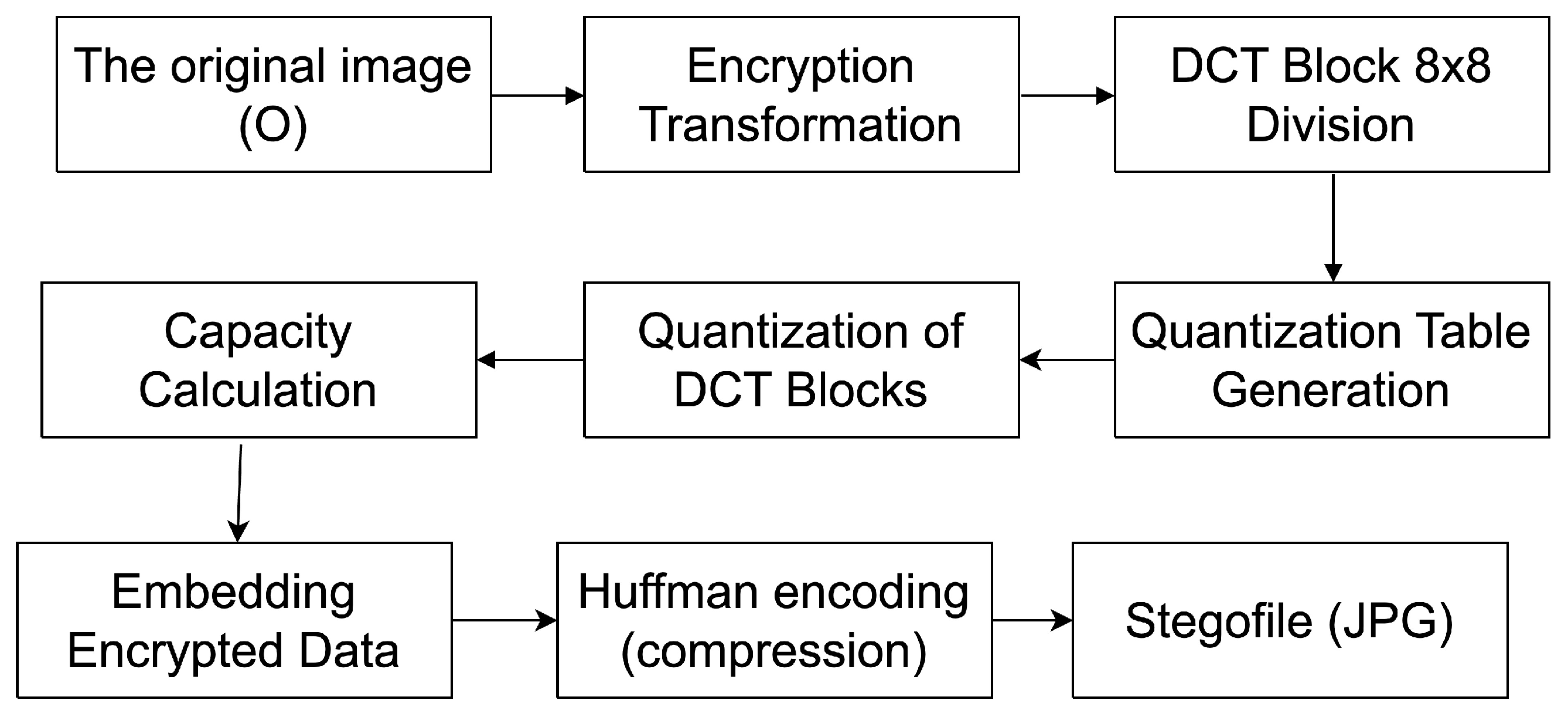
Figure 1 shows the encoding steps of the F5A method:
Specification of the initial data required:
- -
The desired compression ratio (semi-secret component);
- -
The data to be encoded (original image (O));
- -
The encoding key—the name of the website where the image will be hosted.
The carrier-image data (RGB pixels) are read.
The scanned data are divided into non-overlapping blocks of 8 × 8 and a discrete cosine transform (DCT) is used to split the blocks into coefficient matrices.
A quantization coefficient matrix is generated based on the given compression ratio.
Quantization is performed on the basis of the generated quantization coefficient matrix.
The available capacity is calculated and compared with the capacity of the secret data (the original image).
The data of the original image are encrypted with a key.
A cryptographically strong random number generator is generated from the given key.
A permutation is performed (allocating the locations where the sensitive information will be stored according to the random number generator).
The secret information is written to the allocated locations (encrypted original image).
Hofmann encoding is performed, and the image is compressed.
A JPG stegofile is obtained.
In DCT, a large proportion of the coefficients remain with 0 values, and the F5 algorithm does not use 0 values to encode secret information, so extending F5A to non-zero values using a modified quantization table increases the steganographic method’s capacity.
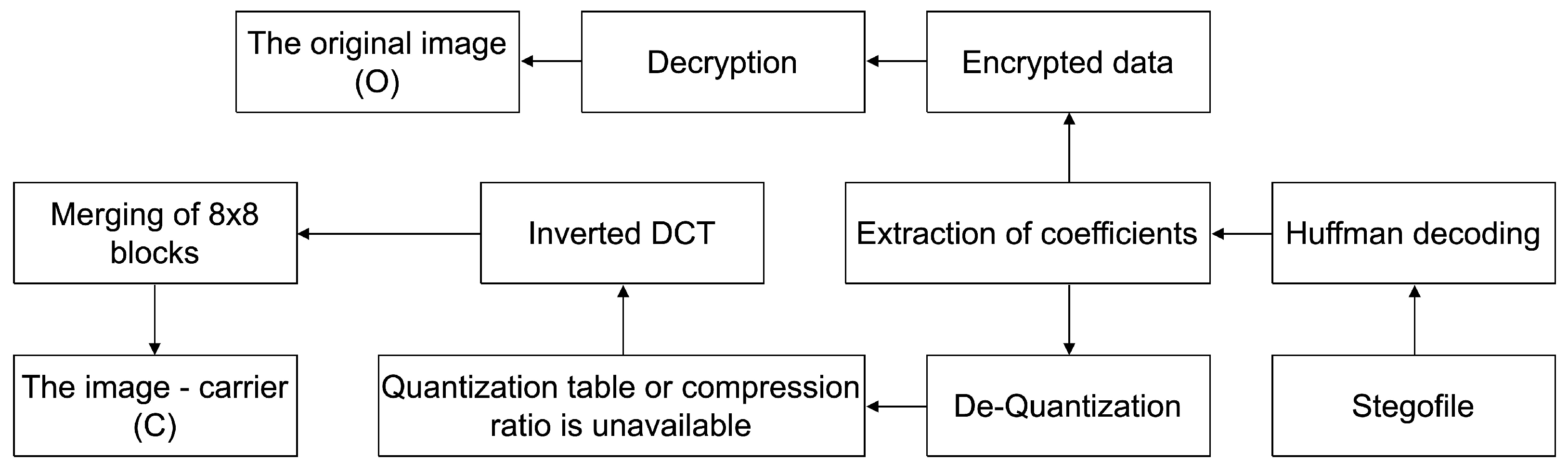
The decoding process is also different from the normal operation of F5. The steps for F5A decoding are as follows (
Figure 2):
Specification of the data required for the encoding:
- -
A stegofile in JPG format;
- -
The decoding key—the name of the website where the image will be hosted.
Huffman decoding is executed.
The key is used to find the locations where sensitive information is embedded and decode it using the available key.
The original image is obtained.
Further steps can be performed to extract the raw image of the carrier: de-quantization, inverse DCT function, and 8 × 8 block merging. However, it is advisable to make this step more difficult since it is the reconstruction of the exact carrier image that would reduce the eligibility of the proposed method for copyright protection. This step is already complicated by the fact that in order to properly decode the carrier image, it is necessary to know what compression ratio was used, so this component must remain partly secret.
By integrating the F5A method into the browser, many users will only be able to see content that has not been obtained through copyright infringement. It would check the incoming image, and if it is not allowed on the page or does not match the author’s domain, the content can be masked, altered, or blocked at will. The method’s steganographic function allows for the image to be hidden within another image. The idea is to allow the user to upload the original document and then protect it by masking, replacing it with another, or blocking it. The process of steganographic hiding also involves the inclusion of a key, which is essential for viewing the image. The processed image is then returned to the user, along with the key that reveals the real image.
In the F5A method, the image is encoded in such a way that the real image cannot be extracted from it, but it is not visually apparent to the user. The initial data parameters are as follows:
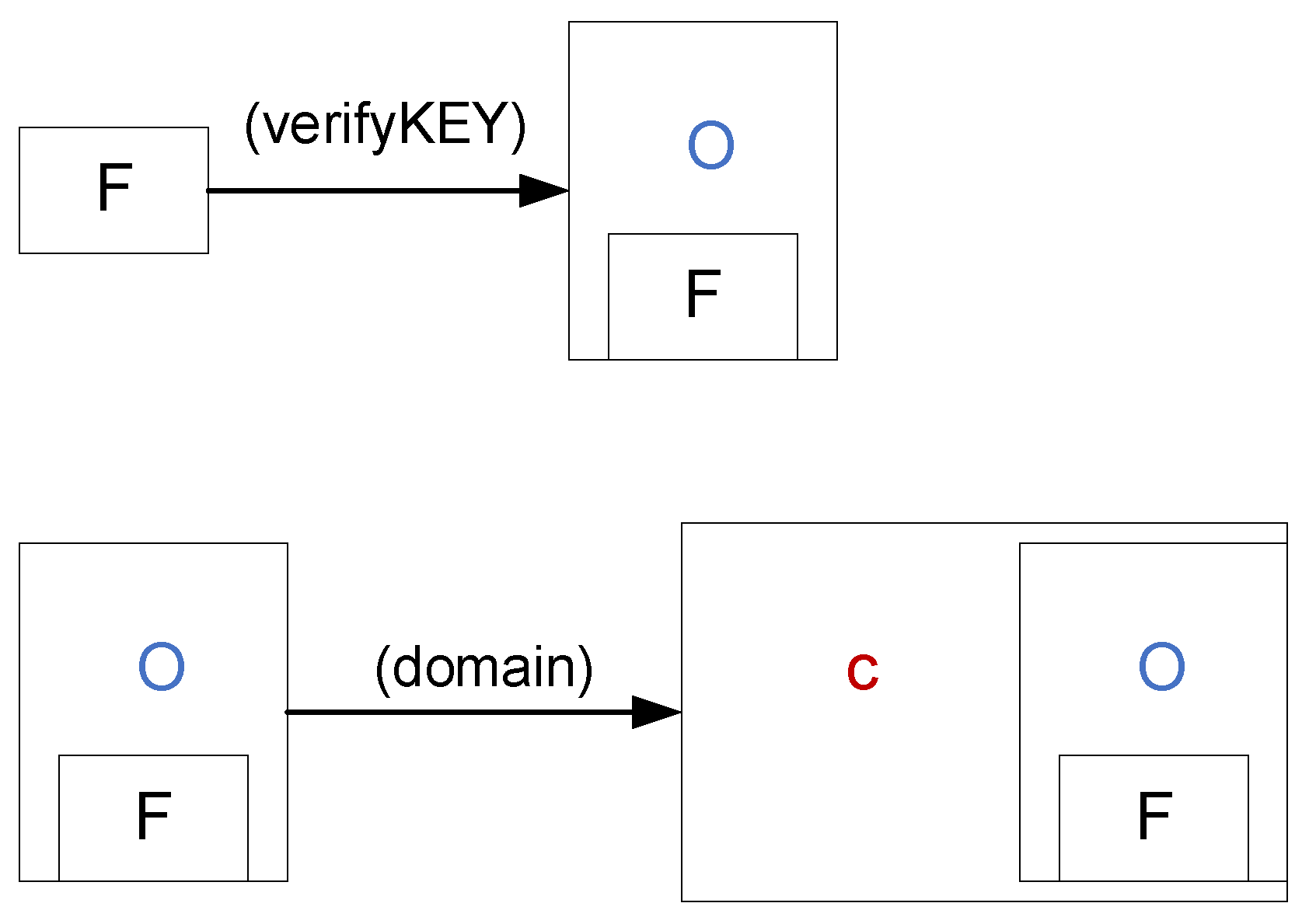
F is the data known to all to confirm that the steganographic method is used.
O is the original image that needs protection from unauthorized use.
C stands for carrier, which refers to any image that is not relevant.
O(F) is the validation data file embedded in the original image.
C(O(F)) is the original image embedded in the carrier, encoding the validation data file.
A is a normal, unprocessed image.
Using the new F5A method, a validation data file is steganographically inserted into the original image O. The embedding uses a key (verifyKEY), which is known to all. The result is O(F) (
Figure 3). The O(F) obtained is then inserted into the carrier file C in the same way using F5A, this time using the domain name as the key. After inserting O(F) into C, the result is C(O(F)).
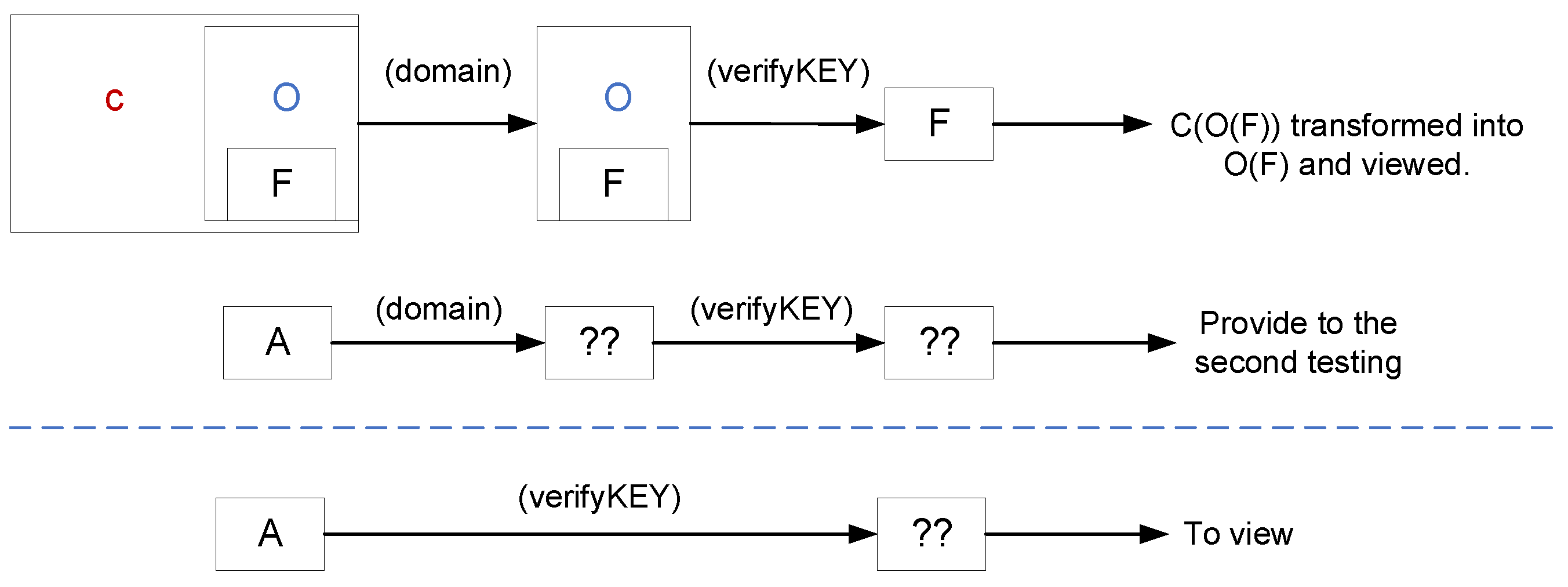
Checking whether the image is regular or processed using the F5A method is necessary during the decoding process to determine its displayability on the website. This is performed by first checking that the image is encoded according to the C(O(F)) scheme (
Figure 4), that is, whether it can be decoded using the domain name of the website (first decoding test) and the verification key (verifyKEY) (second decoding test). If so, it will be decoded from C(O(F)) to O(F), and the original image will be presented to the user with the validation data token inserted. Visually, there is no difference from the original image.
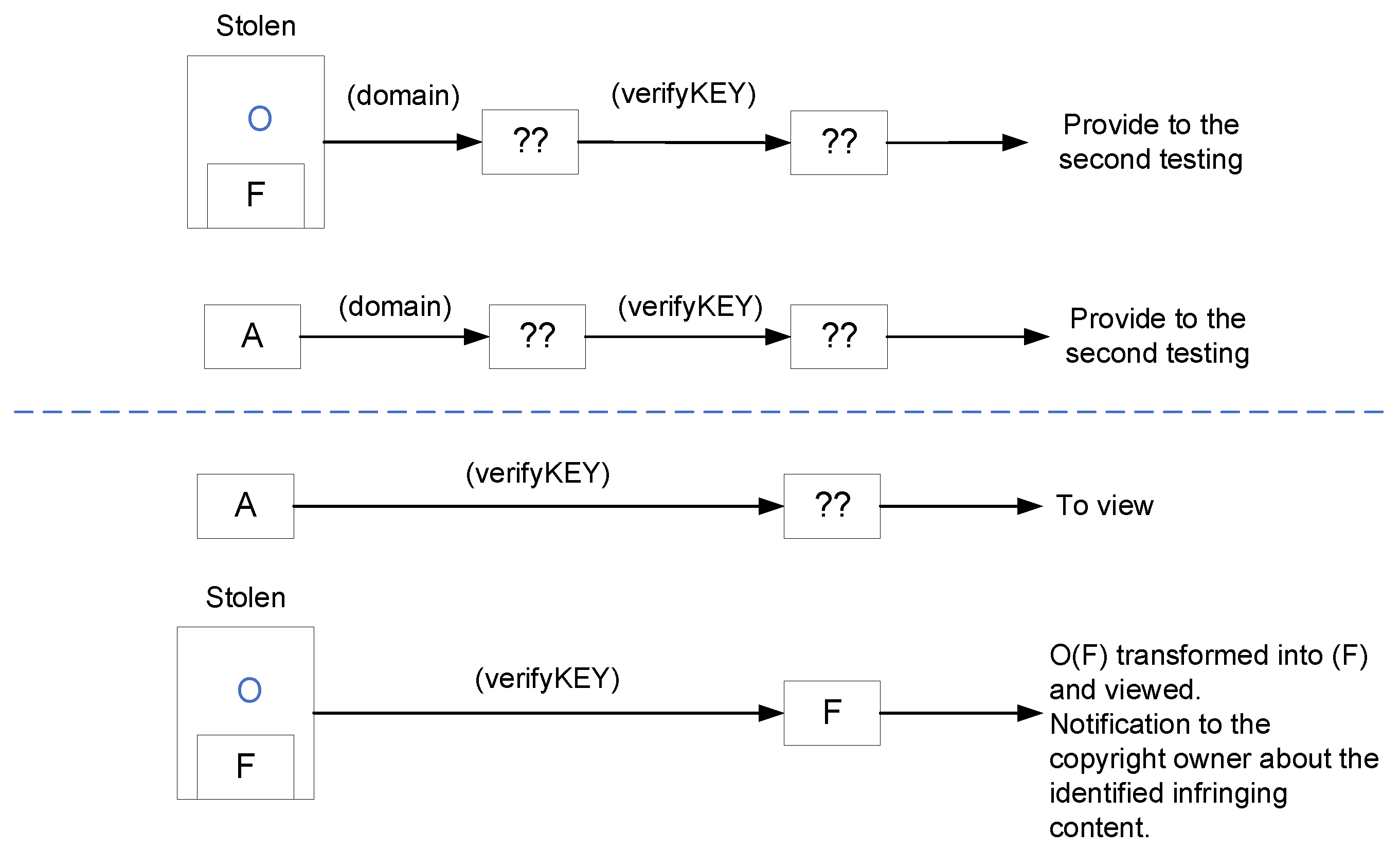
If content thieves tried to download the image, they would receive C(O(F)). And if an already decoded O(F) image is visible, it is possible to take a screenshot to obtain O(F). However, these cases have been thought about, and safeguards have been put in place. It is crucial to consider standard website images, identify and permit their display, and prevent the unauthorized display of O(F). If the first test fails, a second one is necessary to verify if the file has undergone processing using the F5A method. It is attempted to decode with verifyKEY, and if this succeeds, it can be concluded that the content is stolen. The “??” in the middle and bottom sections of the diagram indicates processes or transformations that are either unknown, or the first check that the file is processed by the F5A algorithm failed or not specified in the given context. However, if decoding with verifyKEY fails, the image is normal, and its display is allowed (
Figure 5).
Copyrighted content can also be used for its intended purpose. By entering into a contract, or informal agreement, with the owner of the other domain for the use of the content, the F5A approach would allow third parties to use the content. The creation of a whitelisting function would allow the author to indicate which domains have consent to use the content and not be subject to the usual restrictions on these domains.
Often, copyrighted content is of particular importance to a company and can cause a lot of financial damage if it falls into the wrong hands. Consider a scenario where a company possesses confidential drawings that must remain within the company’s boundaries. In such a case, there is a need to track the path of this content and identify exactly who leaked the information. The leak protection function of the F5A method will allow us to indicate to whom the copyright file was sent and, in the event of a security breach, pinpoint the offender.
4. Experimental Evaluation
In this section, the experimental setup and evaluation results are presented that demonstrate the efficacy of the F5A method compared to the traditional F5 algorithm. It covers empirical experiments and results, detailing the methodology, tools, and metrics used to assess the performance of the steganographic enhancements. The section aims to validate the improvements claimed by the F5A method through rigorous testing and analysis.
4.1. Empirical Experiments
4.1.1. Implementation of F5A Steganographic Method as the StegoGuard Tool
The StegoGuard plugin, a copyright protection tool based on the F5A method’s principles, implemented the proposed F5A steganographic method. The main requirements for implementing the proposed method were as follows:
The selected compression ratio specifies the size of compression to be applied for data embedding. It is defined as a ratio and referred to as a semi-secret component, as it is not completely public yet not entirely secret.
The encoded data contain a specific image that will be concealed through the steganography process.
An encoding key is any phrase or word used as a secret key necessary for the decryption of the data. This adds an additional layer of security.
The carrier is the image into which the data to be encoded will be embedded. It acts as a data repository.
These requirements define the function of the F5A method, which protects digital information by integrating it into other media, ensuring data secrecy and copyright protection.
Table 1 provides the initial JPEG data that were used for the experimental research.
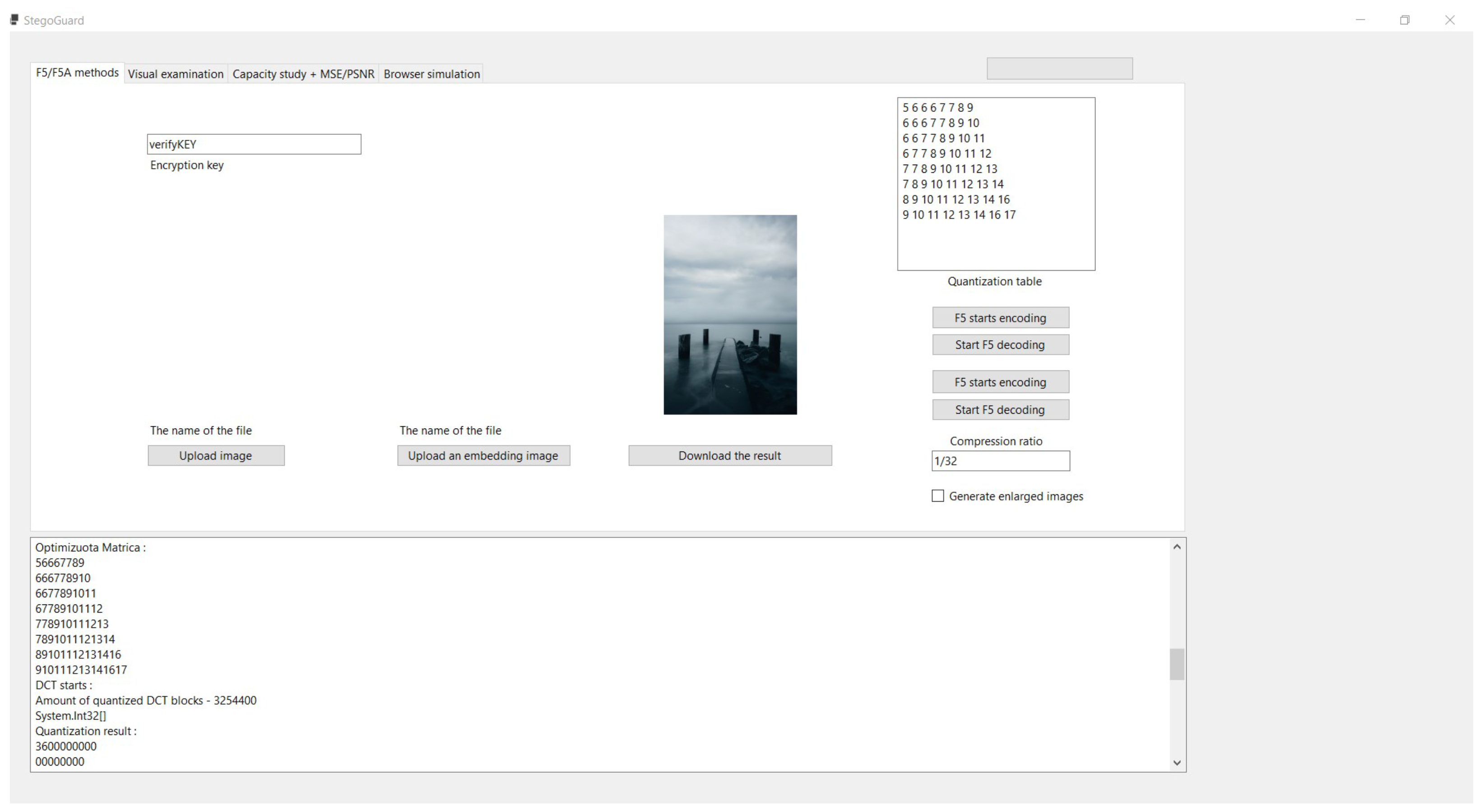
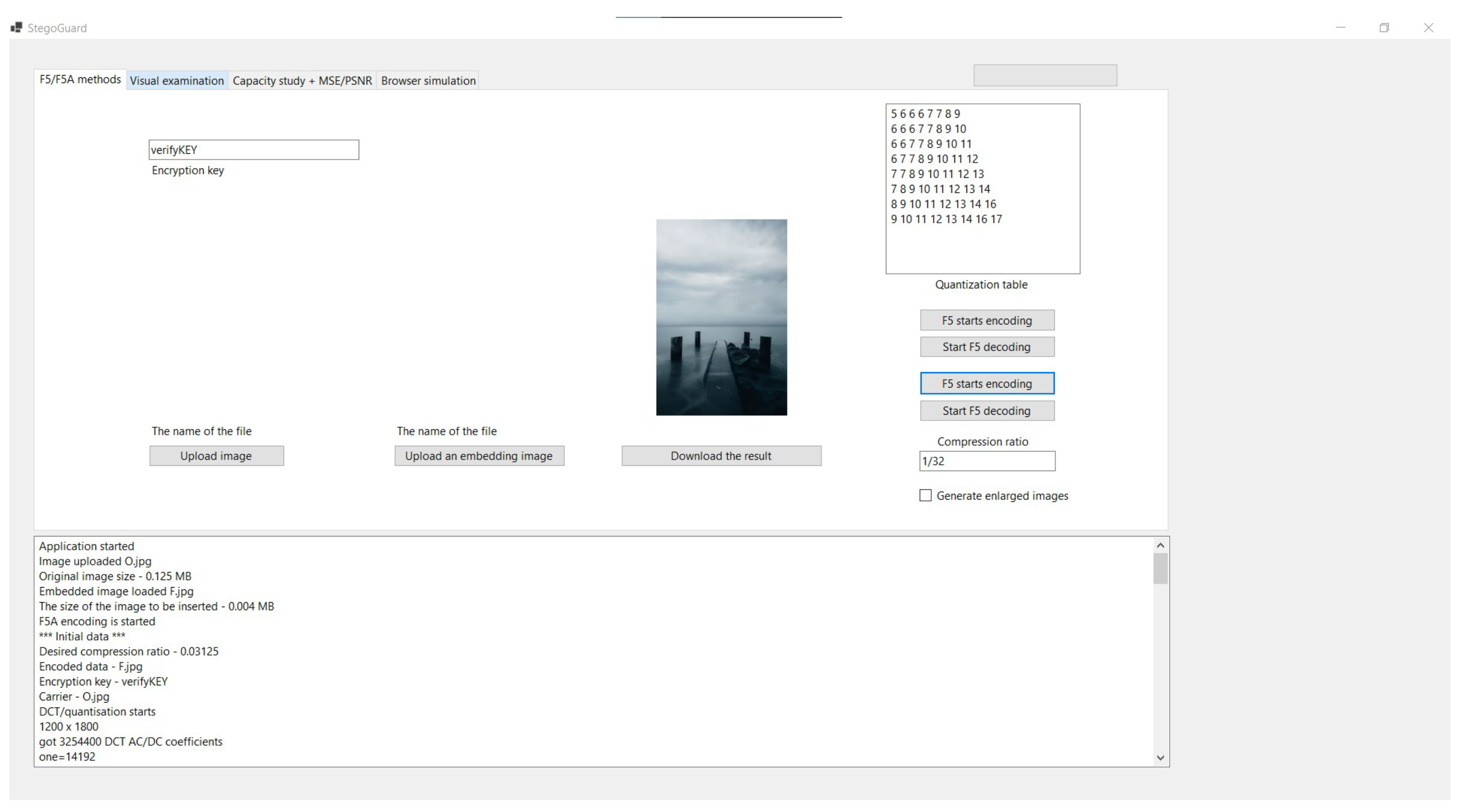
Firstly, the carrier data were read. The file in C# was read because a StegoGuard tool will be used as a browser plugin. The reading of data was performed from the uploaded file into a bit array structure. This structure exists in various languages, but in C# it is available in the language file’s I/O API. The bit array type object was obtained from the scanned file using an implementation of the F5 algorithm. In the same way, it can read the actual image’s data. After that, the scanned data (RGB pixel values) were divided into 8 × 8 blocks (
Figure 6).
After splitting the data into blocks, the transformation of these blocks using the DCT was performed. This process mirrors the JPEG compression algorithm and Andreas Westfeld’s F5 algorithm. This transformation produces blocks measuring 8 × 8 with pixel frequency coefficients.
Given a selected original image [
35] and F5 encoding, the implemented StegoGuard tool outputs the following parameters:
Initial data:
Desired compression ratio - 0.03125
Encoded data - F.jpg
Encryption key - verifyKEY
Carrier - O.jpg
4.1.2. Generation of Optimized Quantization Tables
The generation of optimized quantization tables is a distinct feature of the F5A method. This process is undertaken to enhance the capacity of the existing F5 method and to introduce an additional feature that complicates the extraction of the carrier from the stegofile without knowledge of the compression ratio (
Figure 7).
The F5 method uses standard JPEG quantization tables (
Table 2), which maintain image quality according to the standard use of JPEG compression [
36].
Subsequently, the optimized quantization table is calculated according to the following Equation (
1) [
37] specified below, utilizing the desired compression ratio. This step involves applying the specified compression ratio. This equation shows that the optimal quantization table for the desired compression ratio (
CR) can be constructed by calculating the values of the coefficients
A,
D, and
F.
The resulting values of the coefficients
should then be substituted for each coefficient
, using the Equation (
2) [
37].
In this equation,
x and
y are the coordinates of the coefficients of the quantization table, and
is the Manhattan distance from coordinate (0, 0).
The output of the generated optimized quantization table using a StegoGuard tool, which was specially programmed by the author for this experiment. is provided in
Table 3.
The step for the generation of the quantization tables is critical as it directly impacts the efficiency and security of the steganographic process by adjusting the granularity of the quantization, thereby affecting the embedded data’s perceptibility and resilience against extraction attempts.
4.1.3. Quantization
Quantization is a compression method applied following the DCT, where the resulting matrix of coefficients is divided by the values in a quantization table on an element-wise basis. To perform this operation, one can utilize the existing implementation of the F5 algorithm. It is crucial that during the quantization process, there is an option to specify a custom quantization table, as using a standard table is unsuitable for the implementation of the F5A method. Following the quantization step, the resulting matrices typically display the majority of significant values clustered in the upper left corner, while many other coefficients are reduced to zero (see the output below). This distribution is key to maximizing data hiding effectiveness while minimizing the perceptual impact on the carrier image.
Quantization result :
3600000000
00000000
00000000
00000000
00000000
00000000
00000000
00000000
4.1.4. Matrix Encoding
Before proceeding with further steps, it is essential to perform a calculation of the potential capacity within the quantized matrices. The purpose of this step is to determine whether it is possible to embed the original file into the carrier. The existing implementation of the F5 algorithm in the C# language can execute this operation by calculating the number of bytes and comparing it with the number of possible encoded values in the quantized matrices. The length of the message to be embedded (in bytes) will be denoted as K. This makes sure that the embedding process can work without using up too much of the quantized matrix’s storage space. This maintains the steganographic embedding’s integrity and effectiveness.
Prior to performing the permutation—the distribution of encrypted image values across quantized matrix positions—a cryptographically strong random number generator is generated from the encoding key. The permutation is then executed with these randomly generated numbers and the count of coefficients (including zeros). During the permutation, the identification of locations within the matrix is performed in order to determine where it is needed to insert encrypted image values.
Ultimately, the quantized matrices embed the encrypted image information. Before starting the encoding, the calculation of the length of the buffer (BUFF), which will be involved in the encoding process, has to be performed (Equation (
3)).
The embedding is executed in the following manner:
BUFF filled with N non-zero coefficients from the coefficient matrix.
XOR type hash function performed on the BUFF array. After the hash function, we should obtain a value, HASH, with a length of K (occupying that many bit positions).
Sequentially K quantities of encrypted file values added to HASH in order to obtain the value SUM.
If adding the bit results in SUM = 0, BUFF is left unchanged; otherwise, the values of SUM need to be assigned to the BUFF array. SUM[0...end] arranged into BUFF[0...N].
Zero values are checked in the BUFF array. If present, zeros will be replaced with further values from non-zero coefficients (repeated from first step). If there are no zero values, then a new quantity of non-zero coefficients are taken and repeated from step 1 until there is no more information to encode.
The matrix encoding produces a complete buffer of values. This process will utilize the existing implementations of the F5 algorithm.
The final step is Huffman encoding. This step allows us to convert the buffer filled with matrix values into binary code, from which we retrieve our file data in JPEG format. This step was conducted using existing tools for the F5 algorithm implementation. After Huffman encoding, the final JPEG stegofile was produced.
4.1.5. F5A Decoding
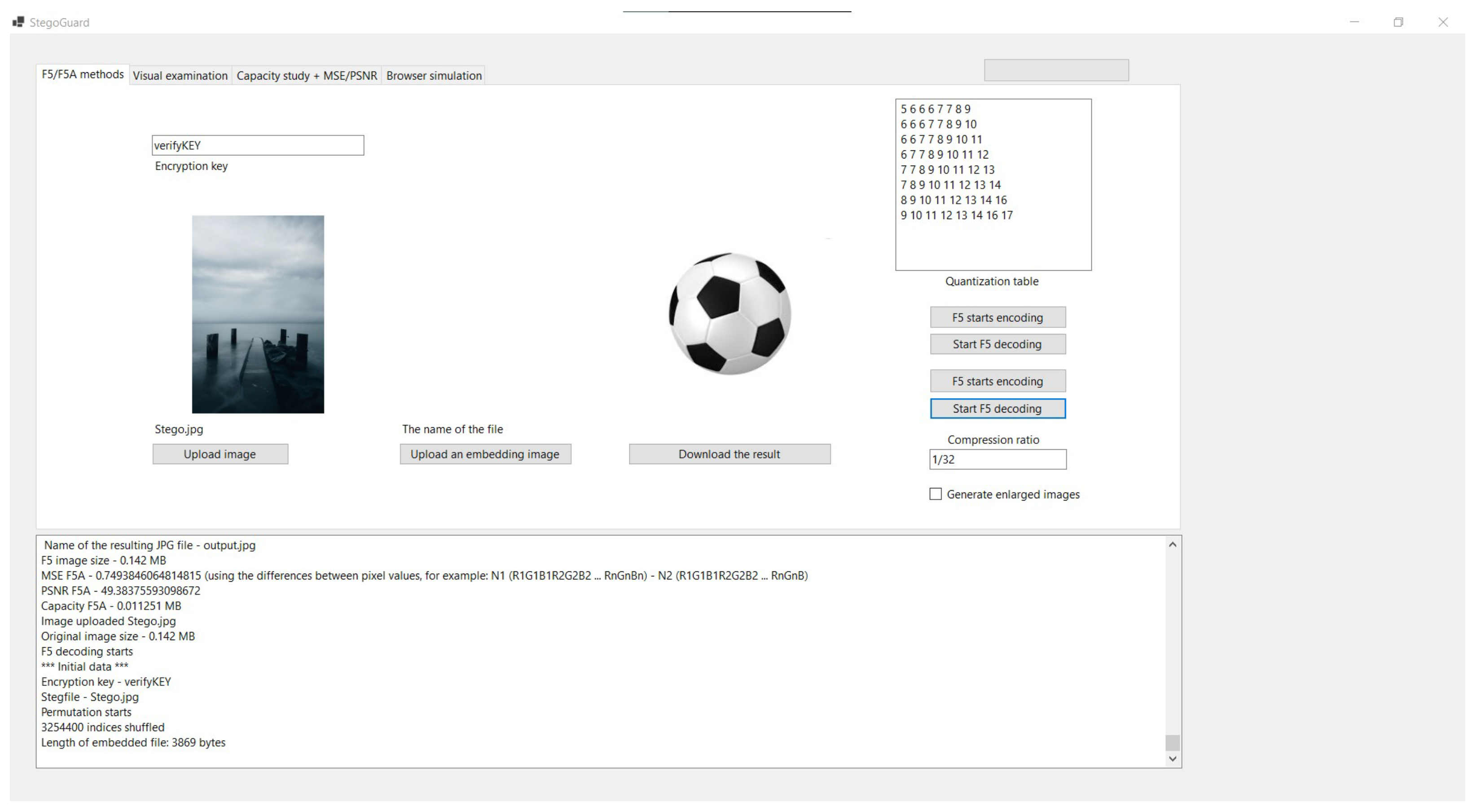
Huffman decoding can also be used to reproduce the previous values of the buffer, from which the original information in the decoding algorithm can be reconstructed. This step was conducted using the existing tools of the F5 algorithm implementation. The Huffman decoding requires the stegofile produced by the F5A method (
Figure 8).
In order to extract the hidden information, it is necessary to know the encoding key (see below). Based on this key, a pseudo-random number generator is regenerated, and the positions within the file where information is encoded are determined.
Initial data:
Encryption key - verifyKEY
Stegfile - Stego.jpg
Permutation starts
3254400 indices shuffled
Length of embedded file: 3869 bytes
Then, information is extracted from these positions, resulting in the recovery of the actual image. This process ensures that only individuals with access to the correct encoding key can retrieve the concealed information, maintaining the confidentiality and integrity of the data embedded within the stegofile.
4.1.6. Testing Scenario for StegoGuard Usage for Copyright Protection
The author encrypts the publicly known image F with the universally known key verifyKEY to produce O(F) (
Figure 9). Then, O(F)—the original image with embedded verification data F—is embedded into the carrier file C. The domain name where the image will be displayed is used as the key.
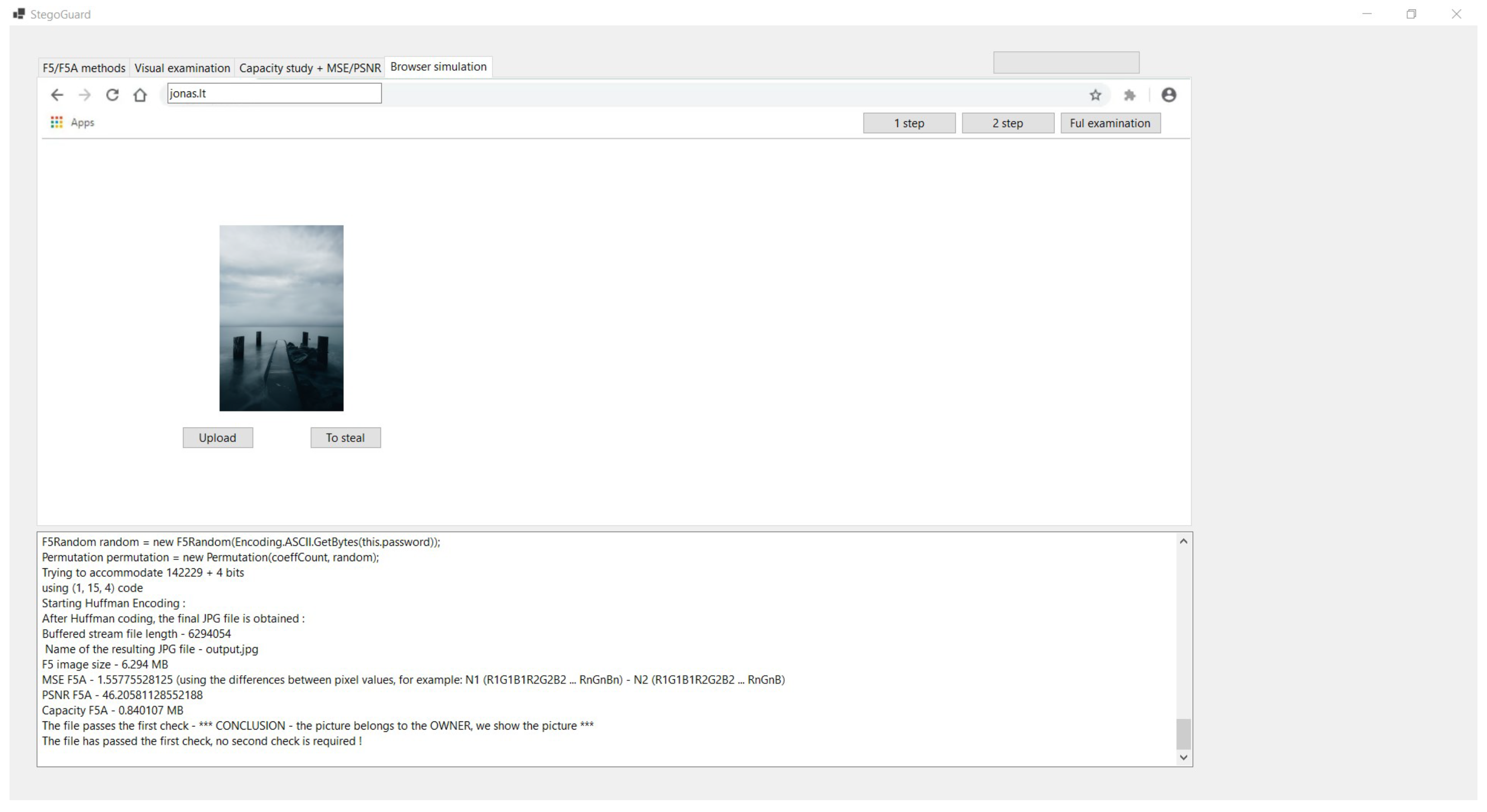
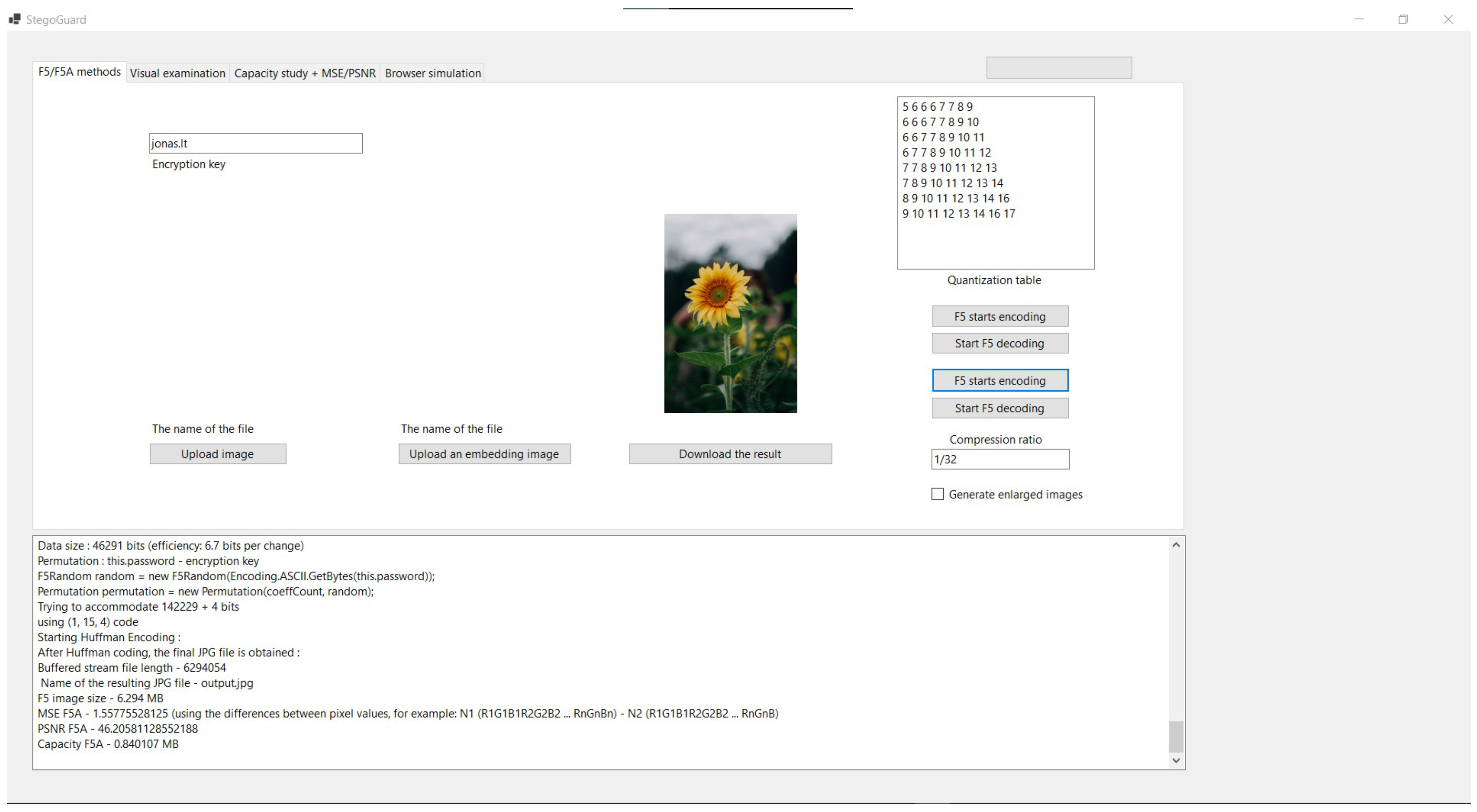
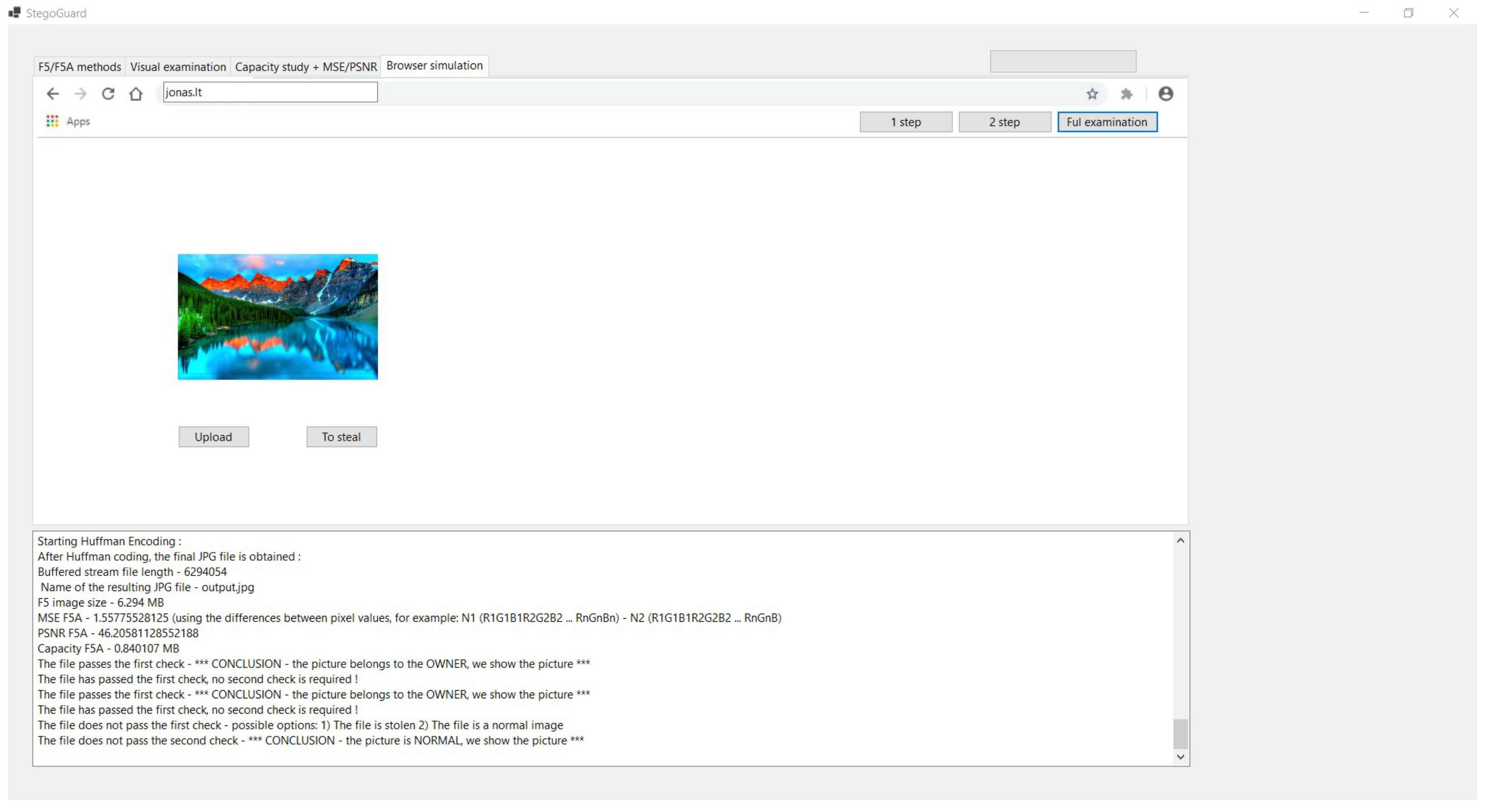
Scenario for legally used content. The StegoGuard operation is based on two checks—attempts to decrypt and conclusions drawn from the results. Below is the part of the output after Huffman encoding:
F5 image size - 6.294 MB
MSE F5A - 1.55775528125 (using the differences between pixel values,
for example: N1 (R1G1B1R2G2B2 ... RnGnBn) - N2 (R1G1B1R2G2B2 ... RnGnB)
PSNR F5A - 46.20581128552188
Capacity F5A - 0.840107 MB
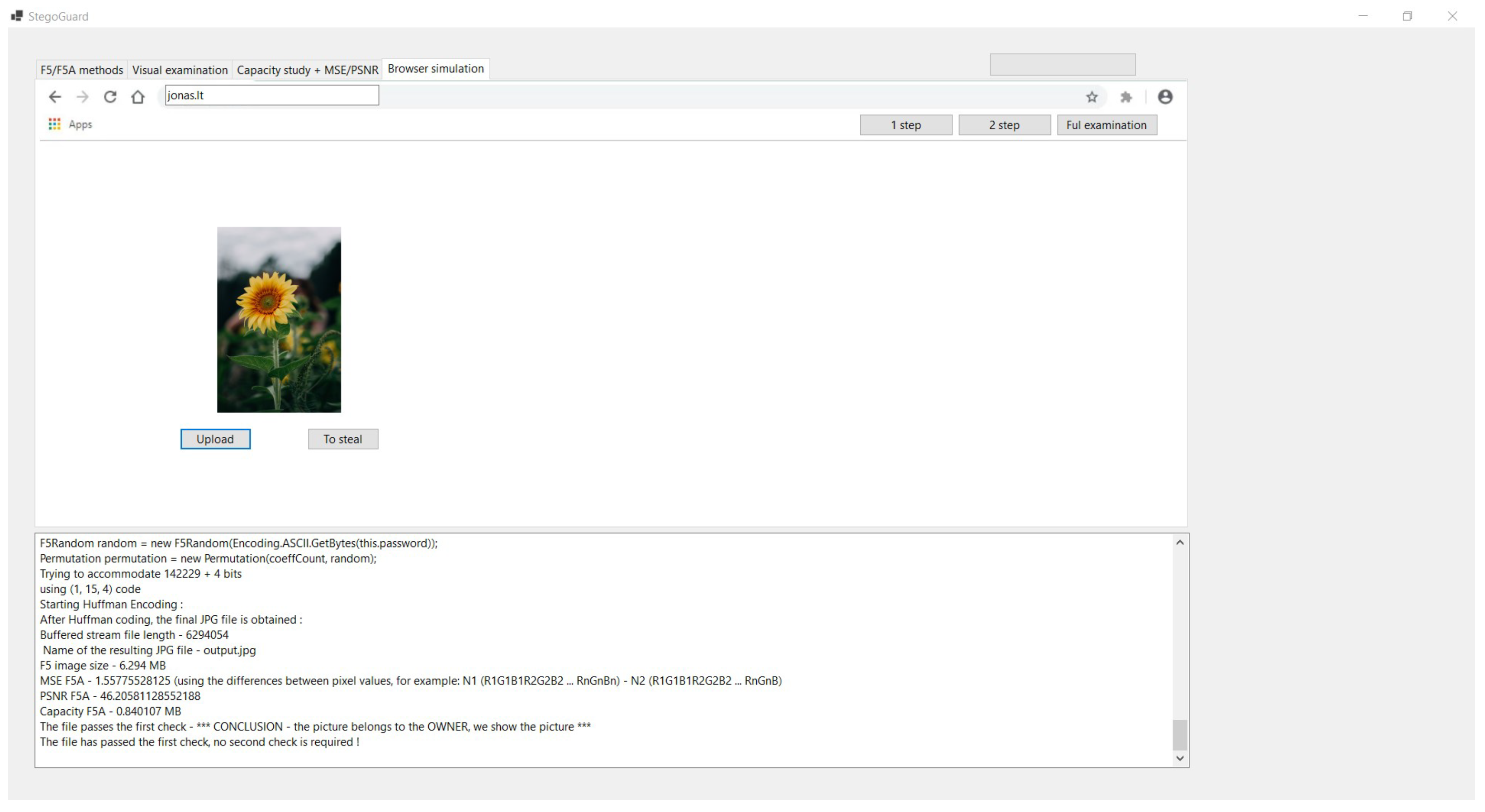
Checking if decryption can be performed based on the domain and then by the key verifyKEY can be performed by retrieving the publicly known image F (
Figure 10). If successful, the content is confirmed to be legitimate (
Figure 11).
The file passes the first check - *** CONCLUSION - the picture belongs to
the OWNER, we show the picture ***
The file has passed the first check, no second check is required !
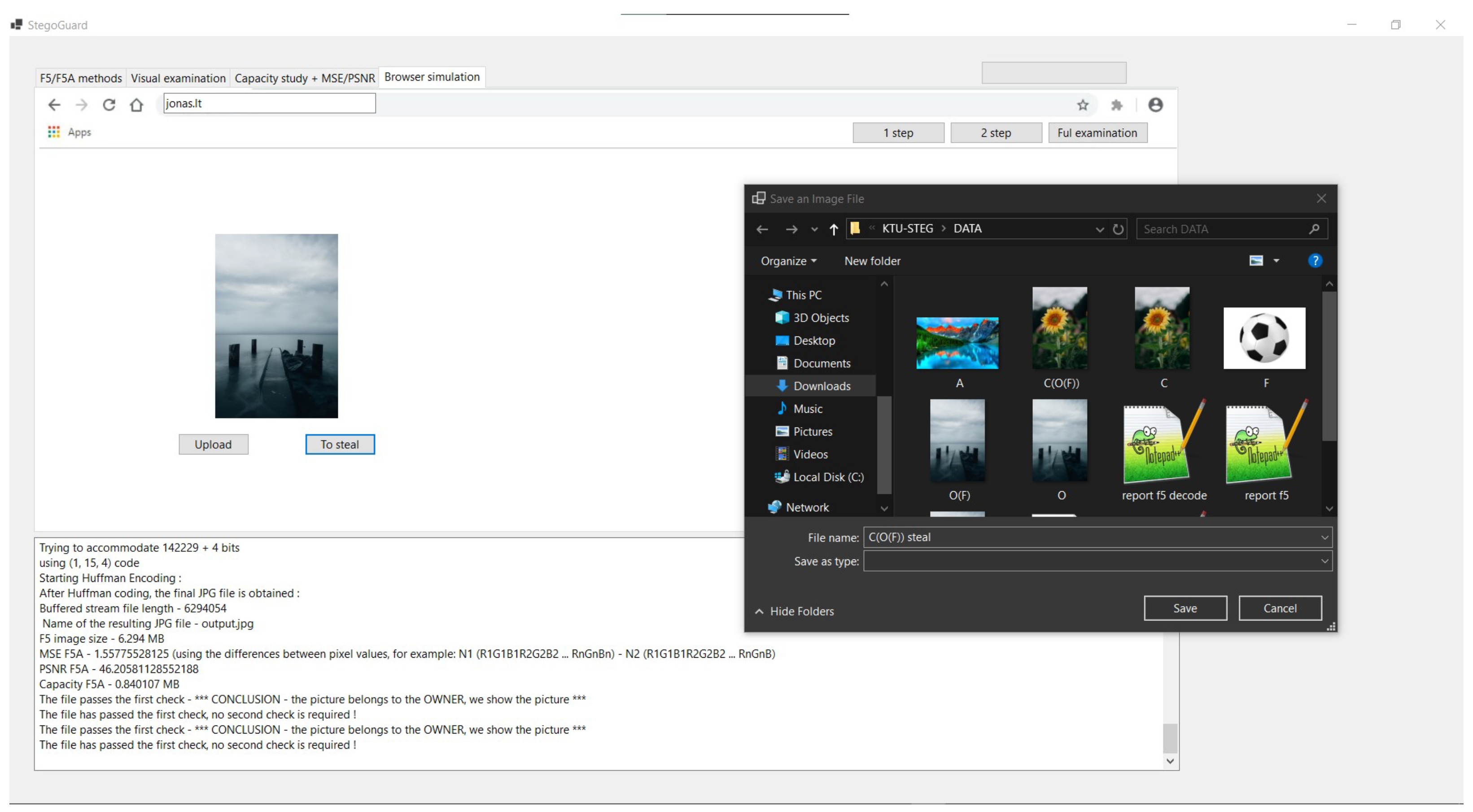
During testing, it was observed that the first check is usually sufficient. The second decryption is not necessary to ensure the image belongs to the owner. If content decrypts with both keys, it is displayed; i.e., O(F) is shown (decrypted by domain) (
Figure 12). This image is recognized as stolen and will be used in another scenario.
It is also important that the user’s website can display simple, unencrypted images, so we must also check the operation of A (
Figure 13). It should not decrypt with either key—domain or verifyKEY.
The file does not decrypt with either key, so it is a standard unprocessed image and should be displayed on the website:
The file does not pass the first check - possible options:
(1) The file is stolen (2) The file is a normal image
The file does not pass the second check -
*** CONCLUSION - the picture is NORMAL, we show the picture ***
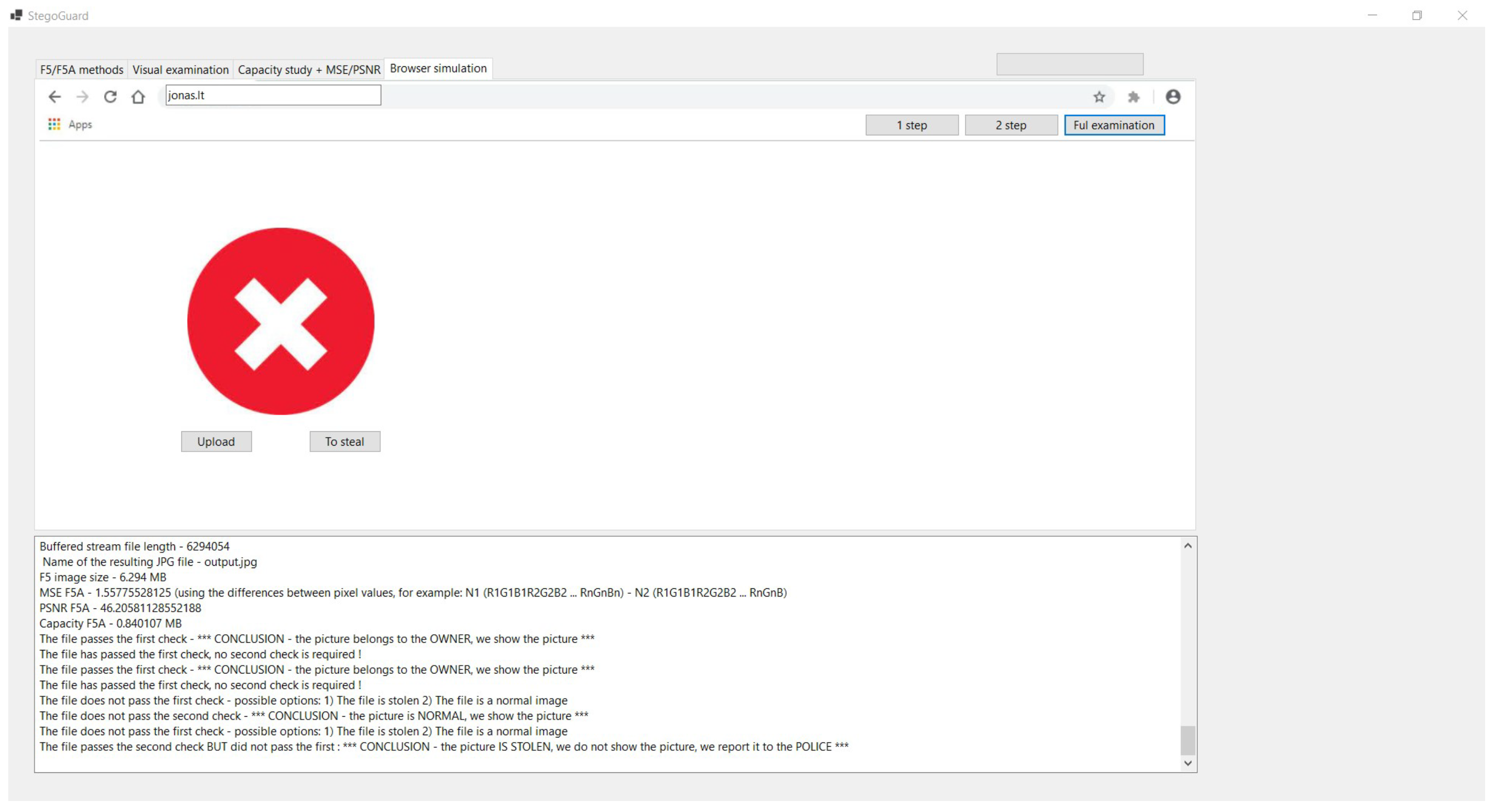
Scenario for stolen content (
Figure 14). The StegoGuard operation is based on two checks:
The operation of A.jpg file is similar to the above. An unprocessed image will be displayed. (It will not decrypt with either key.)
The case of a stolen image placed on the thief “vagis.lt” website then can be examined.
The crucial difference from an unprocessed image is that it decrypts with the publicly known key verifyKEY. This indicates that the image is indeed stolen:
The file does not pass the first check - possible options:
(1) The file is stolen (2) The file is a normal image
The file passes the second check BUT did not pass the first:
*** CONCLUSION - the picture IS STOLEN,
we do not show the picture, we report it to the POLICE ***
4.2. Experimental Results of F5A Method
The proposed steganographic method, F5A, has the following validation criteria: (a) capacity—the method must be able to hide as much information as possible. As the image will hide a full copy of the image, it must remain of the best quality, so the amount of data to be hidden is particularly important for this scenario and (b) to reliably protect the hidden content from disclosure, the method must easily combine with an embeddable key to encrypt the information. The goal of the research is to determine:
The developed F5A steganographic method will be validated and compared with the F5 steganographic algorithm by means of steganographic evaluation methods that meet the set criteria. Both solutions use an embeddable key, so the embeddable key criterion is not evaluated. The following are used to determine the impact of the use of optimized quantization tables: the process calculates the file size after steganographic encoding; calculation of the mean square error (MSE); calculation of the peak signal-to-noise ratio (PSNR); and calculation of the maximum amount of hidden data. Modifications to the image are made in order to determine the robustness of F5 and F5A algorithms. MSE and PSNR are fundamental metrics in image steganography that help evaluate the trade-offs between the amount of hidden data, the perceptibility of changes, and the overall security and efficiency of the steganographic method. Mathematically, MSE is defined as [
38]
where
represents the pixel value at position
in the original image;
represents the pixel value at position
in the stenographic image;
M and
N are the dimensions of the image.
PSNRis defined as presented in Equation (
5) [
38], where
is the maximum value of pixels in the image.
Table 4 and
Table 5 provide the main results obtained during the validation.
During O(F) encoding, increasing the compression ratio decreases the size of the steganogram file. F5A—from compression ratio 16 onwards, no values are available because the encoding is no longer possible, and the embedded file no longer fits. With a compression ratio of 8, the steganographic algorithm could be optimized to obtain the smallest possible steganogram file size, thus improving the F5 algorithm. The F5A algorithm, with a compression ratio of 1/128, increases the steganogram file size by a factor of 1.577 in the O(F) case compared to the F5 algorithm (the F5 algorithm results in a file size of 4.075 MB, an MSE of 4.9168, a PSNR of 41.24, and a storage capacity of 0.5458 MB).
As the compression ratio increases during O(F) coding, the MSE value increases. An increasing MSE value may indicate that more information is being hidden or may indicate an inefficiency of the method or a greater discrepancy with the original image. Given that the study consistently hid the same amount of information in all cases, we can conclude that an increase in the compression ratio leads to an increase in the mean squared error (MSE), thereby reducing the efficiency of the method. However, the performance of the F5 method using the standard JPG quantization table is lower than that of the F5A method with a compression ratio lower than 4. At a compression ratio of 1/128, the F5A method successfully increases the steganogram efficiency, and in the case of O(F), we observe a 1.716-fold increase in the steganogram efficiency in terms of the MSE value compared to the F5 algorithm.
A higher PSNR value typically indicates a better quality of the file processed by steganographic methods. For a typical JPG file, PSNR values between 30 and 50 dB are common, and values above 40 dB indicate very good image quality. Therefore, although there is a visible difference between the F5 and F5A methods, they both fall within the range of very good image quality. The F5A successfully enhances image quality at a compression ratio of 1/128, achieving a 1.121-fold increase in PSNR value for O(F) compared to the F5 algorithm.
The F5A method, with a compression ratio of 1/128, can successfully increase the capacity of the steganographic algorithm, and in the case of O(F), we observe a 1.693-fold increase in the method’s capacity compared to the F5 algorithm.
C(O(F)) at encoding time F5A—from compression ratio 32, no values are available because the encoding is no longer possible and the inserted file no longer fits. When encoding a larger image size, C(O(F)) can be encoded with a compression ratio of 16, but this compression ratio, although it is able to reduce the final size of the steganogram file to a very significant extent, also makes the steganogram inefficient, with a large discrepancy between the steganogram and the original image. At a compression ratio of 1/128, the F5A method successfully increases the steganogram’s efficiency, and for C(O(F)), we observe a 3.156-fold increase in the steganogram’s efficiency in terms of the MSE compared to the F5 algorithm. (The F5 algorithm results in a file size of 4.075 MB, an MSE of 4.9168, a PSNR of 41.214, and a storage capacity of 0.5458 MB.)
When encoding a larger image size, C(O(F)) can be encoded with a compression ratio of 16. Similarly, when encoding the larger image size C(O(F)), the PSNR values for the F5 and F5A methods are relatively lower, and there is also a larger gap between the F5 and F5A methods. When the compression ratio reaches a value of 16, the quality of the image is no longer classified as very good quality, as the value is not higher than 40 dB.
When encoding a larger image size, C(O(F)) can be encoded with a compression ratio of 16. However, this greatly reduces the capacity of the steganographic algorithm. In the case of encoding a larger image size with C(O(F)), a capacity increase is also observed. It can be seen that the F5A algorithm, at a compression ratio of 1/128, is also able to successfully increase the capacity of the steganographic algorithm, with an increase of 1.539 times the capacity of the steganographic algorithm in the case of the C(O(F)) algorithm compared to the F5 algorithm.
The security aspect is evident through the method’s performance across different metrics, particularly MSE and PSNR, which are crucial for maintaining the secrecy and integrity of the embedded data. Lower MSE and higher PSNR at strategic compression levels suggest that the method is robust against potential steganalysis.
5. Discussion
This study’s findings underscore the robustness and versatility of the F5A steganographic method for enhancing digital copyright protection. The integration of Huffman coding within the F5A framework notably advances the security and efficiency of data embedding processes. By leveraging Huffman’s ability to minimize file size without compromising data integrity, the F5A method facilitates the embedding of larger amounts of data into digital images, thus significantly reducing the risk of detection.
The dual-level encryption mechanism—first using a domain-specific key and secondarily through the widely recognized “verifyKEY”—provides a comprehensive security layer that deters unauthorized access and extraction of embedded data. Our tests confirmed that content is only displayed or accessible when both keys validate the decryption process, ensuring that the data remains secure against unauthorized decryption attempts.
Moreover, the application of the F5A method within a browser plugin context has demonstrated practical viability and effectiveness. The method’s capability to adapt to different operational scenarios—whether the content is legally used or potentially stolen—highlights its potential for real-world applications in safeguarding digital copyrights. The scenario-based validation, particularly the ability to differentiate between legitimately used and stolen content, reinforces the algorithm’s utility in forensic and copyright enforcement contexts.
The challenges remain, particularly concerning the method’s performance in environments with varying data sizes and types. Future research could explore the scalability of the F5A method, assessing its effectiveness across different media formats and larger data sets. Additionally, investigating the impact of more complex encryption keys and enhancing the method’s resistance to sophisticated steganalysis techniques would further solidify its applicability in digital copyright protection.
The F5A method represents a significant step forward in digital steganography, offering a nuanced and powerful tool for copyright holders to protect their assets while maintaining control over their distribution and use in the digital domain. Further exploration and development of this technology will undoubtedly enrich the field of digital media security.