You are currently viewing a new version of our website. To view the old version click .
Electronics
  • Article
  • Open Access

22 March 2023

Two-Stage Generator Network for High-Quality Image Inpainting in Future Internet

,
,
and
1
School of Computer Science, Qinghai Normal University, Xining 810008, China
2
School of Information Technology, Luoyang Normal University, Luoyang 471022, China
3
Academy of Plateau Science and Sustainability, People’s Government of Qinghai Province & Beijing Normal University, Xining 810004, China
4
The State Key Laboratory of Tibetan Intelligent Information Processing and Application, Qinghai Normal University, Xining 810008, China
This article belongs to the Topic Future Internet Architecture: Difficulties and Opportunities

Abstract

Sharpness is an important factor for image inpainting in future Internet, but the massive model parameters involved may produce insufficient edge consistency and reduce image quality. In this paper, we propose a two-stage transformer-based high-resolution image inpainting method to address this issue. This model consists of a coarse and a fine generator network. A self-attention mechanism is introduced to guide the transformation of higher-order semantics across the network layers, accelerate the forward propagation and reduce the computational cost. An adaptive multi-head attention mechanism is applied to the fine network to control the input of the features in order to reduce the redundant computations during training. The pyramid and perception are fused as the loss function of the generator network to improve the efficiency of the model. The comparison with Pennet, GapNet and Partial show the significance of the proposed method in reducing parameter scale and improving the resolution and texture details of the inpainted image.

1. Introduction

Image inpainting originated from manual trimming in the Renaissance, which repairs the damaged image by filling the defective areas with adequate information. It infers the unknown area from known information such as structural, statistical, semantic, etc. [1,2,3]. Image inpainting can be applied to image super resolution, obstruction removal and damaged image repair, and has been a popular research area in computer vision and digital image processing.
Traditional image inpainting algorithms usually attack the image blurring or incomplete information caused by various types of noise during image acquisition. They can be divided into the structure-based methods, the texture-based methods and the sparse-representation-based method [4,5,6]. The PDE is the core of structured image inpainting, also known as diffusion image inpainting. The PDE equation method [7] was first proposed by Bertalmio et al. to perform diffusion-based restoration of images in pixels. However, the consistency between the local and the global semantics in defective area is ignored, not to mention the consideration of the constraint of the high-level semantics. Therefore, this method is only suitable for restoring pictures with minor local defects, while texture misalignment often occurs for large areas of defects. Texture-based image inpainting algorithms [8,9] search for the optimal texture pixels in intact areas and fill them to the defective area. This method can better preserve texture and structure information in images. The image-block-based Criminisi algorithm [10] proposed by Criminisi greatly improves the speed of restoration by searching for the target pixel blocks around the defective area. Sparse representations more effectively express known information in image inpainting algorithms. Guleryuz et al. obtained the best estimation of the defect area by incorporating an adaptive technique [11,12] into the sparse reconstruction algorithm. However, regardless of whichever traditional image inpainting method is applied, the restoration of defective images with large missing areas is unsatisfactory. Thus far, they have mainly been applied to low-resolution images. The quality of the restored images cannot meet the demanding needs due to the complexity of damaged images and the inherent ambiguity of methods. The traditional methods encounter a major challenge, especially for high-resolution images.
With the rapid development of deep-learning technology recently, the image inpainting network has much ameliorated the long-standing deficiencies of traditional approaches and significantly improved the output quality [5]. The main aspect here is to extract the relevant contextual information from various receptive fields. Since Goodfellow et al. proposed the GAN model [13,14] in 2014, it [15,16,17] has become one of the mainstream methods for computer image processing. It has made many achievements in the field of image inpainting and greatly promoted the development of this technology. GAN consists of a generation model and a discrimination model. The discrimination is essentially a classifier that distinguishes between real pictures and fake pictures generated by the generator network, whose function is to convert the input defective image into the output restored image. As GAN methods suffer from unstable network training and model convergence, a series of improvements have been proposed. DCGAN [18,19], proposed by Radford et al., optimizes the learning representation performance by combining a deep convolutional network and GAN. The pooling layer of DCGAN is replaced by strided convolution to optimize the learning characterization performance of GAN. In addition, partial pooling layers are also replaced by transposed convolutions so that the entire network can be differentiated. Moreover, batch normalization can improve the model performance. However, for images with large defect areas, it is not effective.
The early use of attention mechanisms [20,21] in image inpainting was inspired by the traditional idea of fast matching. Yan et al. introduced shift connection, based on the UNet structure [22,23], to move the priori image information into the decoding network layer holding the corresponding features so as to complete the missing information, which improves the image inpainting capability. Yu et al. formally introduced the attention mechanism [24] to enhance image inpainting by finding the most similar feature blocks from the background and foreground image by convolution to search for feature matching blocks at a distance. However, current computer memory and processing resources are limited, and existing deep-learning algorithms can only perform restoration of low-resolution images. Zeng et al. proposed a high-resolution image inpainting technique that includes an iterative restoration model with a feedback mechanism [25]. It divides the inpainting task into two processes: low-resolution image inpainting and upsampling. Attention networks are also incorporated, using a guided upsampling network of attention mechanisms to calculate the feature similarity of low-resolution image feature blocks and guide the reconstruction process. The above attention-mechanism-based approach improves the performance of the network and proves the effectiveness of the attention mechanism. The attention mechanism can effectively enhance the conversion of higher order image semantics across the network, so that the overall structure is more sensitive to the restoration of detailed image texture. The Transformer model [26,27] was proposed in 2017 by the Google machine translation team [28], which has an outstanding performance in the field of natural language processing. The full-attention mechanism model is used by the Transformer to replace the traditional CNN [29,30,31] simply through a self-attention mechanism and a forward neural network. The Transformer increases the learning capability of the model while reducing the number of computational parameters, which makes its use in high-resolution image inpainting a promising topic.
The increase in Internet transmission capacity and wide use of mobile cameras result in an increasing demand for high-resolution images and videos. However, traditional image inpainting methods for high-resolution images often yield a limited result. Although there has been a proliferation of techniques in this field recently, many methods still suffer from a lack of model edge consistency and unclear output images. In this work, we aim to produce sufficient edge consistency and high-quality images. The main contribution of this work are:
(1)
We present a high-quality image inpainting network derived from Transformer, which is a two-stage generator model based on the encoder-decoder network.
(2)
We apply the adaptive multi-head attention mechanism to the fine network to control the input of the features in order to reduce the computation overhead.
(3)
We fuse the pyramid and perception as the loss function of the generator network to improve the overall efficiency.
With the involvement of the adaptive multi-head attention mechanism, the computation is reduced, and the forward propagation is significantly accelerated. Pyramid loss and perceptual loss are fused to improve model learning and speed up model restoration. After a comprehensive experimental comparison, the improved algorithm has better restoration performance. The edge and semantic information is more consistent and the resolution of the restored image is sharper.
The paper is structured as follows: The architecture of GAN, self-attentive mechanisms and image inpainting are presented in Section 2. The adaptive multi-head self-attention mechanism is presented in Section 3. The network structure of the method and the loss functions of the paper are also mentioned. Section 4 is devoted to the analysis of the experimental part. Section 5 concludes the paper as a whole.

3. Methodology

3.1. Adaptive Multi-Head Attention Mechanism

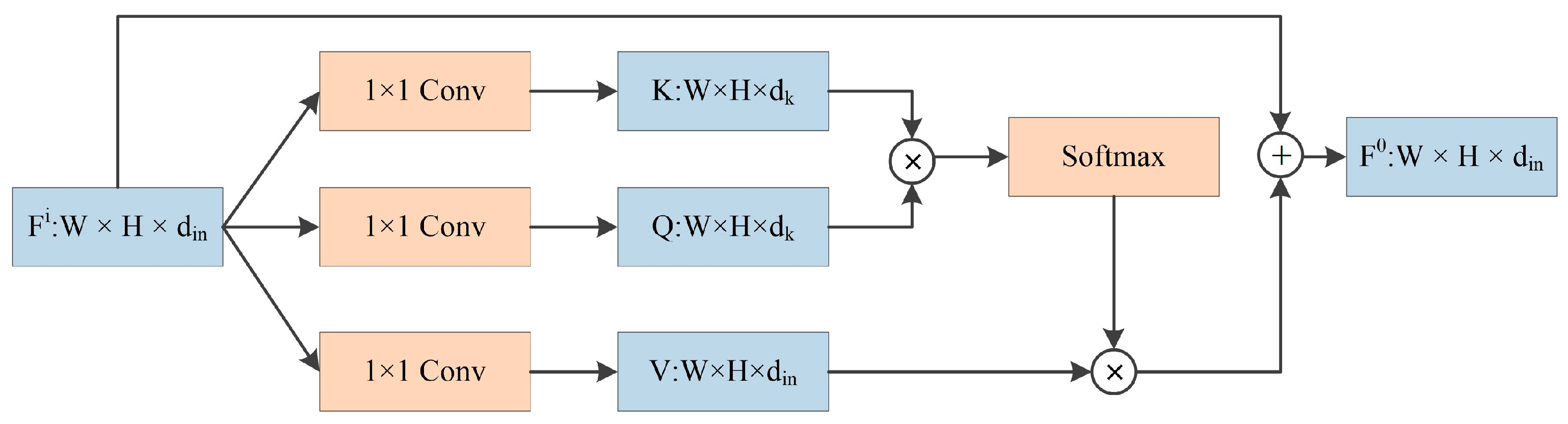
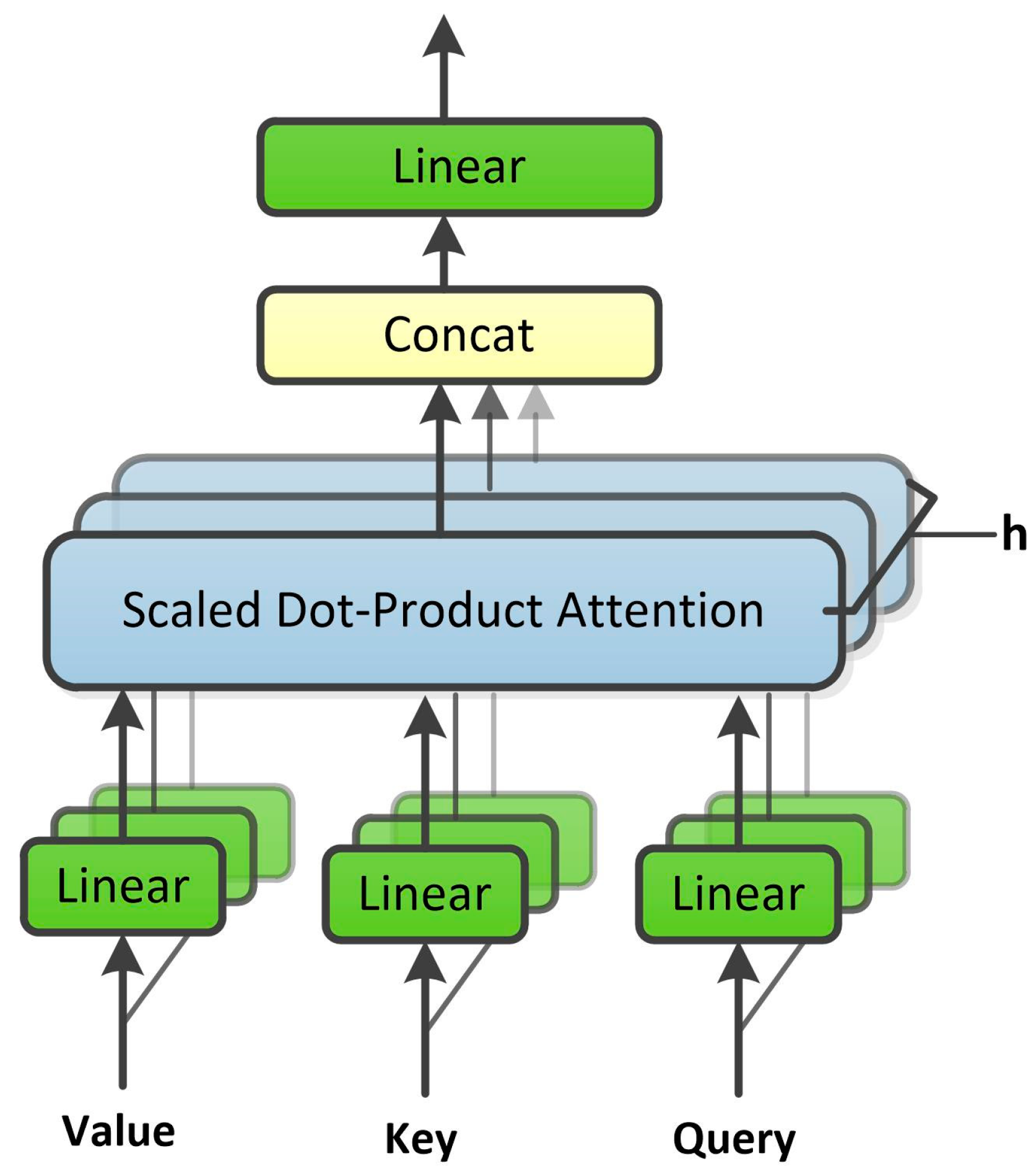
The self-attention mechanism can be treated as an interaction between different forms of the input vector in a linear projection space. The multi-head attention mechanism [41] creates projection information on the same input in several different projection spaces. The projections of the input matrix in different spaces are stitched together to enable the collection of features at multiple dimensions and directions. As shown in Figure 3, Value, Key and Query are fixed single values. There are three groups of both linear layers and scaled dot product attention units. This means that the input will be projected in 3 feature spaces. Finally, different weight coefficients are assigned to different self-attention mechanism heads to concatenate the projection results together for result integration. However, the feature extraction method changes for different heads. Because of the decay of the attention features, the weight of the head is changed during the learning process of the model. The magnitude of change varies greatly for different heads. Therefore, the adaptive multi-head attention mechanism can adapt to the changes in weights generated by the model during the learning process. By adding a mask to the features at different locations, we can effectively lower the computation burden. Training produces a continuous mask so that the model can apply different weights for different heads, which reduces the computational burden and also allows different features to be learned.
Figure 3. Architecture of the multi-head attention mechanism.
The Softmask function is shown below.
m z ( x ) = min [ max [ 1 R ( R + z x ) , 0 ] , 1 ]
where  m z ( x )  represents the function of the adaptive mask,  z  is the given attention weight,  R  is a hyperparameter that controls the adaptive mechanism and  x  is the input tensor.
Therefore, the formula for calculating the attention weight is as follows.
a t r = m z ( t r ) exp ( s t r ) q = t s t 1 m z ( t q ) exp ( s t q )
where atr represents the attention weight formula, Str represents the result of the self-attention mechanism before self-adaptation and  t  and  r  represent the feature information used to calculate similarity. Stq represents the similarity score calculated at t and q.
The formula of  s t r  is shown below.
s t r = x t T W q T ( W k x r + p t r )
where  W k  and  W q  are the k, q feature matrices, respectively, and  p t r  is the embedding result for the relevant position.

3.2. Network Structure Based on Transformer

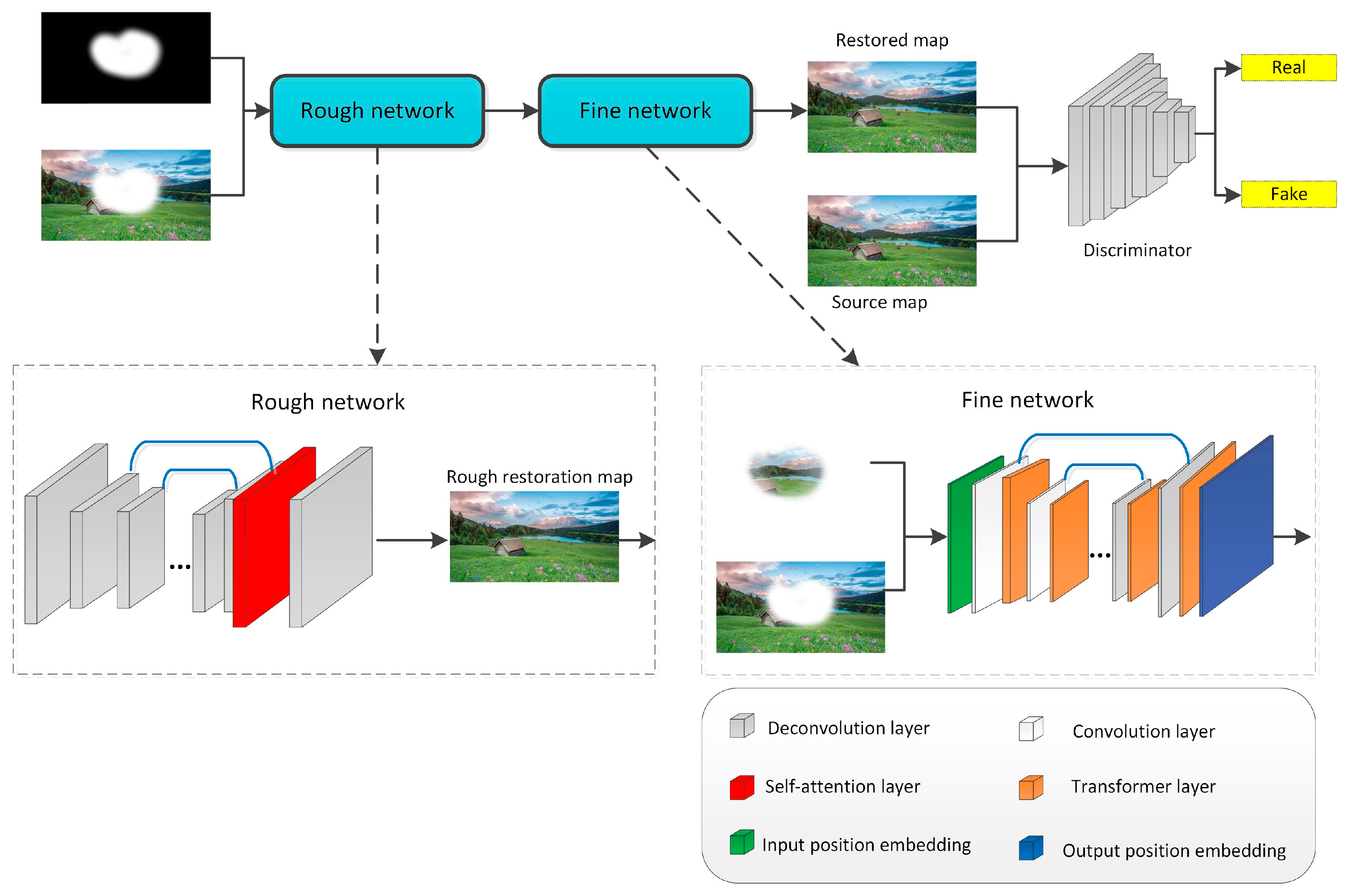
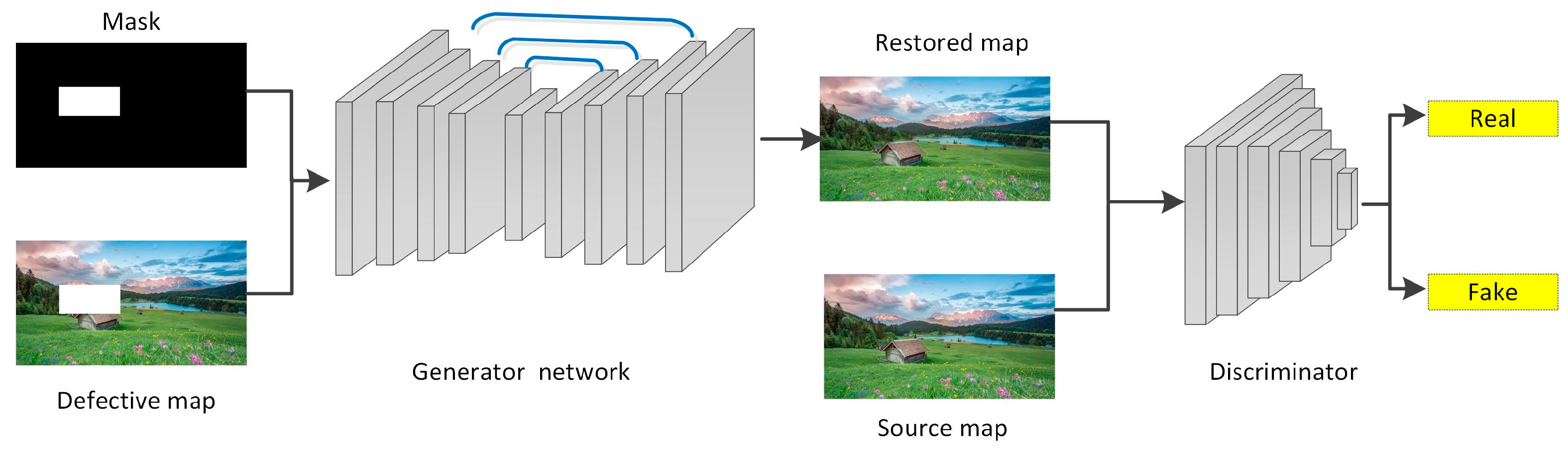
The network structure proposed in this study is shown in Figure 4. The network includes a generator and a discriminator, where the input of the generator is a defective image and a binary mask of the defective area. The two-stage restoration network is used, which is divided into rough network and fine network. Rough network can generate roughly restored images, and the filled content is roughly consistent with the intact area. However, there are some flaws in the texture and semantic details of the image. The input of the fine network is composed of the padding content of the rough network for the defect area and the original defect image. Fine networks can predict more detailed content in areas of image defects. The rough network consists of a convolutional layer and a self-attention mechanism layer. First, the defect image and the mask binary image are the input data to the network. The layer of self-attention mechanism in rough network can guarantee the preservation of useful information across layers. The fine network is a combination of transformer and convolution layers. First, the image and mask will pass through the position embedding layer for information embedding at the corresponding location. After the transition of four-dimensional image information to 3D features, a compression of the feature information is performed by downsampling convolution. The transformer layer computes the similarity between the features and attaches an adaptive mask to them to realize the dynamic multi-attention mechanism. The redundant calculation of the model is reduced. The last layer in the model is an embedding input. The feature map with position information is parsed into image features, and the number of layers of rough network is less than that of the fine network. In comparison, the span of up and down sampling between each two layers of the rough network is larger.
Figure 4. Network structure of the proposed method.
The discriminator is a full convolutional network consisting of five convolutional layers. Each convolutional layer is immediately followed by a normalization layer and finally by an activation layer. The role of the discriminator is to distinguish between the generated fake ones and the original true intact image, which is essentially a classification network. The resulting low-quality restored images are marked as false during the training process. The iteration process guarantees that the restored images are close to the real original image in terms of texture and content.

3.3. Loss Functions

The loss function is a key component whose choice determines the learning efficiency and direction of the model. It has three parts: the loss function of discriminator, the coarse network and the fine network. The loss function of the discriminator is the MSE loss function. In the generator loss, the L1 loss was chosen by the rough generative network because of the feature that L1 loss can increase the stability of the model learning process. The loss function of the fine generative network consists of four components, including perceptual loss, pyramidal loss, adversarial loss and L1 loss. The pre-trained VGG-19 network is responsible for extracting the higher order information and calculating the perceptual loss. The perceptual loss is calculated as shown below.
L j = 1 C j H j W j | | V j ( Y ^ ) V j ( Y ) | | 2 2
where  C j H j W j  denote the number of feature channels, feature length and width of the jth layer feature  Y , respectively.  V j  denotes the pre-trained VGG19 model.
The overall loss function of the generator network is shown below.
L g = α L c + β L r
where  L c  denotes the rough generator network losses, while  L r  represents the losses of the fine network.  α  and  β  are the parameters given to adjust the weights of each loss function in the overall loss.
The loss function of the coarse network is shown below.
L c = γ L 1
where  γ  is the parameter given to adjust the corresponding weight.
The loss function of the fine network is shown below.
L r = δ L a + ε L p + η L p d + λ L 1
where  L a  is the antagonistic loss,  L p  is the perceptual loss and  L p d  is the pyramidal loss.  δ ε , η and  λ  are the parameters given to adjust the weights of each loss function in the overall loss.

4. Experiments

4.1. Experimental Settings

The dataset used for the experiments in this work is the public dataset CelebA [42], and all experiments were conducted using the selected training data on CelebA. The selected training set is 1500 and the test set is 500.
The model is compared with Partial [43], Pennet [38] and GapNet [44]. Partial is the use of partial convolutions, where the convolution is masked and conditioned on only valid pixels by renormalization. Pennet is a pyramid context encoder network for image inpainting by deep generative models. A novel neural network for point cloud, dubbed GapNet, learns local geometric representations by embedding graph-attention mechanisms within stacked multi-layer-perceptron layers.
In order to objectively evaluate the experimental results, we use the peak signal to noise ratio (PSNR) and structural similarity (SSIM) [45] metrics.

4.2. Quality Assessment

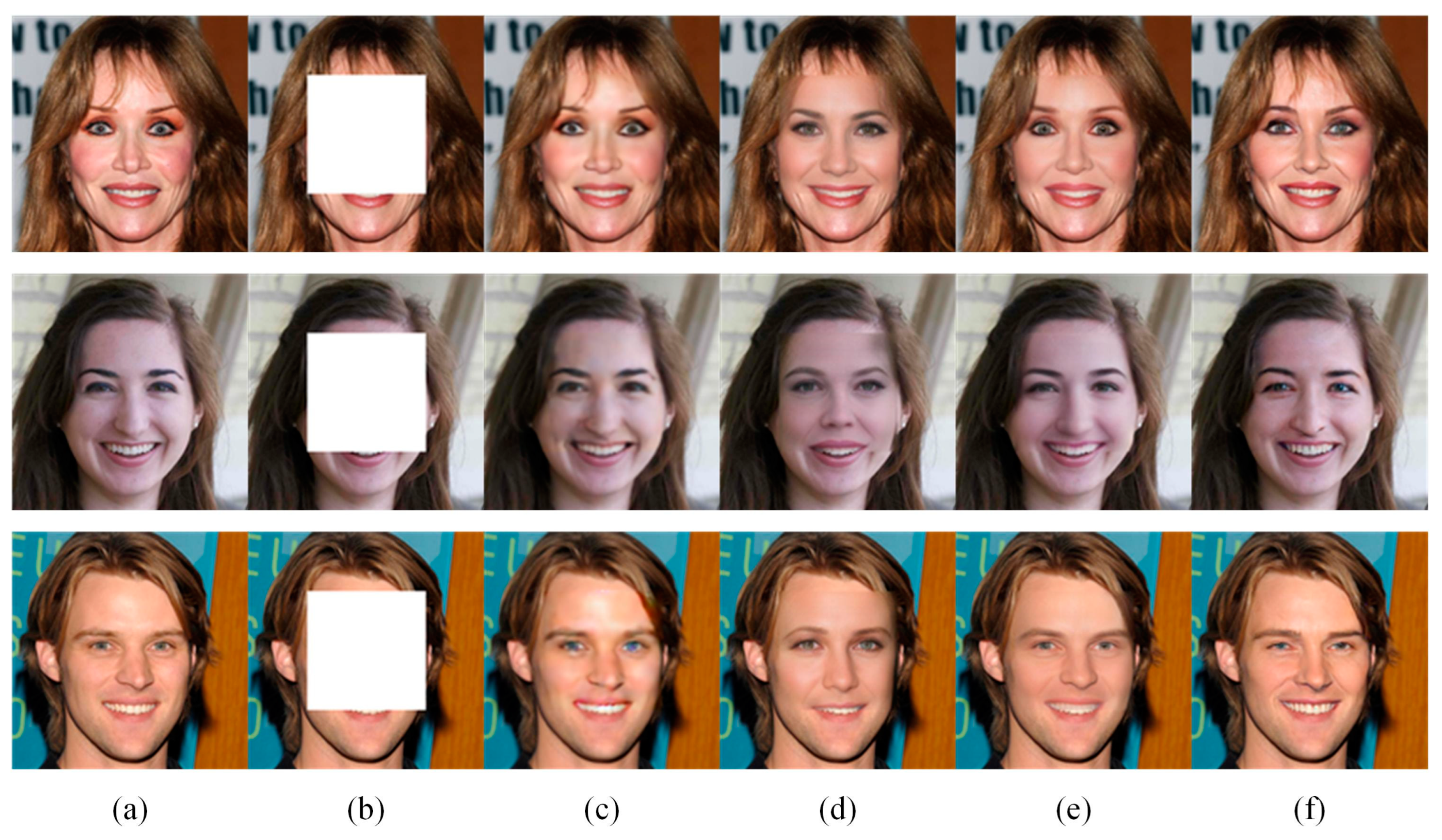
In the same experimental setting, the ablation experiments of the algorithms in this paper are essential and the results are shown in Figure 5.
Figure 5. Ablation experiment on randomly masked square: (a) Ground truth; (b) Input image; (c) Non-transformer two-layer network + loss function; (d) Two-layer transformer + loss function; (e) Two-layer transformer + adaptive multi-head attention mechanism; (f) Two-layer transformer + adaptive multi-head attention mechanism + loss function.
From the comparison graph of the ablation experimental results in Figure 5, it can be found that the four superimposed items of two-stage transformer, adaptive multi-head attention mechanism, pyramidal loss and perceptual loss are the most effective parts and generate the highest-resolution restored images. The two-stage transformer and the adaptive multi-head attention mechanism approaches lack perceptual loss and pyramidal loss, respectively. Some colour flaws were created in the restored parts. The other combined approach has an increased computation of redundant information due to the lack of an adaptive multi-head attention mechanism. Therefore, the details of the partial restoration from the model do not match the semantic information and some colour defects are present. When all transformer layers in the restoration model are removed, the resulting non-transformer bilayer networks can obtain the perceptual loss and pyramidal loss. The lack of a full-attention mechanism model transformer and a multi-head attention mechanism results in poor repair results where pixel-level imperfections are present.
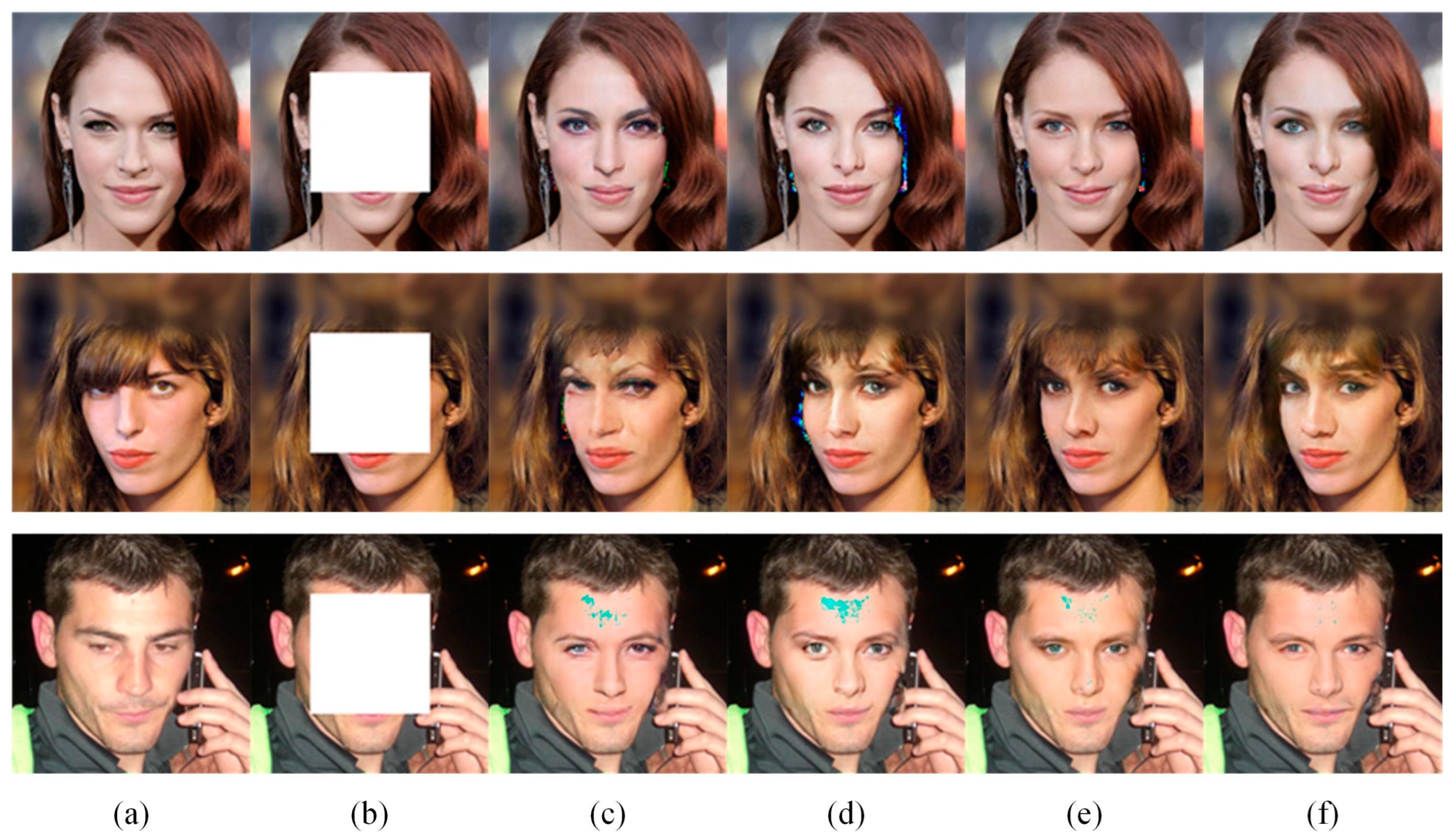
In the same experimental environment, the method of this paper was compared with Partial, Pennet and GapNet on the same set of test images, and the experimental results are shown in Figure 6.
Figure 6. Results on randomly masked square: (a) Ground truth; (b) Input image; (c) Partial; (d) Pennet; (e) GapNet; (f) Ours.
As shown in Figure 6, the experimental results of all methods performed well in the restoration of semantic information. Among them, the overall restoration and clearness of Partial’s is not as good as others. With regard to edge consistency, the gap between the processing results of Pennet compared with GapNet and the proposed method is large. The difference in colour and semantic information between the restored and intact areas of the Pennet creates a distinct edge. However, the edges of the defective regions of GapNet and our method are not obvious. The proposed method incorporates an adaptive multi-head self-attentive mechanism with the involvement of pyramidal and perceptual losses. Thus, the model reduces the computation of redundant information. The model focuses more on the generation of semantic information. In terms of edge consistency of the restoration results, our method outperforms GapNet. Regarding face details, the method proposed in this paper uses a two-stage network structure and the resolution quality of the image has strong performance compared with the other methods. Other methods do not highlight the details of the face, whereas the results from ours reveal detailed information such as wrinkles on the face.

4.3. Quantitative Analysis

The algorithm reduces the model’s computation of redundant information through an adaptive multi-head self-attention mechanism. This boosts the calculation and alleviates the edge inconsistency arising from the model restoration results, while improving the model’s restoration capability for semantic information. The transformer-based two-stage network enables the model to generate sharper images and enhances the quality of the restored images. Incorporating pyramidal loss and perceptual loss enhances the learning performance and efficiency of the model. The comparisons are implemented on the same set of test images. The experimental data are shown in Table 1 and Table 2. The analysis of the experimental data shows that the algorithm in this paper is preferred in PSNR and SSIM metrics compared with other methods.
Table 1. PSNR comparison result.
Table 2. Comparison of SSIM metrics.
Table 1 shows the results of the PSNR metric evaluation for various image inpainting contents. Our method has the highest scores in both MAX PSNR and AVE PSNR compared with other methods. Our method improves by 3.11 dB (9.0%) and 2.58 dB (7.6%), respectively, compared with the GapNet method. Compared with the Pennet method, the improvement is 4.63 dB (14.1%) and 4.41 dB (13.9%). This is an improvement of 6.63 dB (21.6%) and 7.01 dB (24.1%) compared with the Partial method.
Table 2 shows the results of the experiments on the SSIM evaluation metrics. Our method also has the highest scores on both the maximum and the mean. In particular, our method improved by 4.88 (5.4%) and 3.96 (4.5%) on the mean and maximum values compared with the GapNet method, respectively. Compared with the Pennet method it improved by 16.94 (21.7%) and 16.34 (21.6%). Compared with the Partial method, the improvement was 25.35 (36.4%) and 23.86 (35.0%).
A quantitative analysis of the experimental data shows that our method is more effective than other methods of restoration. The restoration performance is stable and there is not much difference between the maximum and minimum values. Therefore, the image inpainting model in this paper has stronger and more stable restoration performance.
Table 3 shows the results of the PSNR and SSIM metrics analysis for the ablation experiments. The analysis of the experimental data revealed that the best performance was obtained by the combination of the two-stage transformer, the adaptive multi-head attention mechanism and the loss function. The highest values were obtained on both MAX PSNR and AVE SSIM. Compared with the combination of the two-stage transformer and the adaptive multi-head attention mechanism, the improvement is 1.59 dB (4.4%) and 0.84 dB (2.4%), respectively. Compared with the two-stage transformer and loss function combination, the improvement is 0.18 dB (0.5%) and 0.86 dB (2.4%), respectively. The improvement is 4.54 dB (13.8%) and 4.18 dB (13.1%) compared with the non-transformer two-stage network and loss function combination.
Table 3. Comparison of PSNR metric for ablation experiments.
Table 4 shows the SSIM metrics for the ablation experiments. The combination of the two-stage transformer, adaptive multi-head attention mechanism and loss function yielded the highest figures for all metrics. In the maximum and mean values, compared with the combination of the two-stage transformer and adaptive multi-head attention mechanism, there is an improvement of 3.87 (4.2%) and 2.82 (3.2%), respectively. This is an increase of 1.71 (1.8%) and 2.90 (3.3%) compared with the two-stage transformer and loss function combinations. The improvement is 10.84 (12.9%) and 9.98 (12.2%) compared with the non-transformer two-stage network and loss function combination.
Table 4. Comparison of SSIM metric for ablation experiments.
Quantitative analysis of the ablation experiments demonstrates that the restoration results of our model using combination of a two-stage transformer, an adaptive multi-head attention mechanism and a loss function have a better restoration performance compared with a method using only some of these.

5. Conclusions

For the problem of edge consistency and the blurred resolution of image inpainting, this paper proposes a transformer-based image restoration method with a two-stage generator restoration network. A self-attentive mechanism in the rough network is used to guide the transfer of higher-order semantic information across the network. It can effectively reduce the loss of image information during the transduction process. The improved transformer model and designed adaptive multi-head self-attention mechanism in the fine network reduce the number of parameters effectively in the model. The learning ability of the model and the resolution of the generated images have been improved. The fusion of pyramidal loss and perceptual loss improves the training performance of the model. Edge and semantic consistency problems in inpainted images are effectively solved. The proposed method has obtained good experimental results on CelebA compared with other methods. The applicability of the proposed method is less prominent on other datasets. Future work will involve optimizing the current inpainting framework for better performance by working on enriching the testing dataset. The developed method will be applied to other applications in the future.

Author Contributions

Conceptualization, M.Z.; methodology, D.Z.; software, P.Z.; validation, P.Z.; formal analysis, P.Z.; investigation, P.Z.; resources, P.Z.; data curation, S.G.; writing—original draft preparation, P.Z.; writing—review and editing, D.Z.; visualization, P.Z.; supervision, M.Z.; project administration, S.G.; funding acquisition, S.G. All authors have read and agreed to the published version of the manuscript.

Funding

This work was partially supported by the Natural Science Youth Foundation of Qinghai Province: 2023ZJ947Q; National Nature Science Foundation of China: 62102213; National Nature Science Foundation of China: 62262056; Independent project fund of State Key lab of Tibetan Intelligent Information Processing and Application (Coestablished by province and ministry): 2022SKL014; Key R&D and transformation plan of Qinghai Province: 2022QY203; Program for Innovative Research Team (in Science and Technology) in University of Henan Province: 22IRTSTHN016; funding scheme of Key scientific research of Henan’s higher education institutions: 23A520010; Key R&D and promotion Special Project of Science and Technology Department of Henan Province: 222102210104; teaching reform research and practice project of higher education in Henan Province: 2021SJGLX502.

Data Availability Statement

All data generated or analyzed during this study are included in this article.

Acknowledgments

The authors would like to express their gratitude to the editors and anonymous reviewers for their comments and suggestions.

Conflicts of Interest

The authors declare no conflict of interest. The funders had no role in the design of the study; in the collection, analyses, or interpretation of data; in the writing of the manuscript; or in the decision to publish the results.

References

  1. Huang, J.; Kang, S.; Ahuja, N.; Kopf, J. Image completion using planar structure guidance. ACM Trans. Graph. (TOG) 2014, 33, 1–10. [Google Scholar] [CrossRef]
  2. He, K.; Sun, J. Image completion approaches using the statistics of similar patches. IEEE Trans. Pattern Anal. Mach. Intell. 2014, 36, 2423–2435. [Google Scholar] [CrossRef]
  3. Li, H.; Hu, L.; Hua, Q.; Yang, M.; Li, X. Image Inpainting Based on Contextual Coherent Attention GAN. J. Circuits Syst. Comput. 2022, 31, 2250209. [Google Scholar] [CrossRef]
  4. Jam, J.; Kendrick, C.; Walker, K.; Drouard, V.; Hsu, J.G.S.; Yap, M. A comprehensive review of past and present image inpainting methods. Comput. Vis. Image Underst. 2021, 203, 103147. [Google Scholar] [CrossRef]
  5. Qin, Z.; Zeng, Q.; Zong, Y.; Xu, F. Image inpainting based on deep learning: A review. Displays 2021, 69, 102028. [Google Scholar] [CrossRef]
  6. Zhang, X.; Zhai, D.; Li, T.; Zhou, Y.; Yang, L. Image inpainting based on deep learning: A review. Inf. Fusion 2023, 90, 74–94. [Google Scholar] [CrossRef]
  7. Bertalmio, M.; Sapiro, G.; Caselles, V.; Ballester, C. Image inpainting. In Proceedings of the 27th Annual Conference on Computer Graphics and Interactive Techniques, SIGGRAPH ’00, New Orleans, LA, USA, 23–28 July 2000; pp. 417–424. [Google Scholar] [CrossRef]
  8. Yan, J.; Chen, B.; Guo, R.; Zeng, M.; Yan, H.; Xu, Z.; Wang, Y. Tongue Image Texture Classification Based on Image Inpainting and Convolutional Neural Network. Comput. Math. Methods Med. 2022, 2022, 6066640. [Google Scholar] [CrossRef]
  9. Pathak, A.; Karmakar, J.; Nandi, D.; Mandal, M.K. Feature enhancing image inpainting through adaptive variation of sparse coefficients. Signal Image Video Process. 2022, 1–9. [Google Scholar] [CrossRef]
  10. Criminisi, A.; Pérez, P.; Toyama, K. Region filling and object removal by exemplar-based image inpainting. IEEE Trans. Image Process. 2004, 13, 1200–1212. [Google Scholar] [CrossRef] [PubMed]
  11. Guleryuz, O. Nonlinear approximation based image recovery using adaptive sparse reconstructions and iterated denoising-part I: Theory. IEEE Trans. Image Process. 2006, 15, 539–554. [Google Scholar] [CrossRef]
  12. Li, Z.; Chen, A.; Miao, T. A fingerprint removal method based on fractal–criminisi technology. Fractals 2022, 30, 2250157. [Google Scholar] [CrossRef]
  13. Goodfellow, I.; Pouget-Abadie, J.; Mirza, M.; Xu, B.; Warde-Farley, D.; Ozair, S.; Courville, A.; Bengio, Y. Generative adversarial nets. In Neural Information Processing Systems; MIT Press: Montreal, QC, Canada, 2014. [Google Scholar]
  14. Goodfellow, I.; Pouget-Abadie, J.; Mirza, M.; Xu, B.; Warde-Farley, D.; Ozair, S.; Courville, A.; Bengio, Y. Generative adversarial networks. Commun. ACM 2020, 63, 139–144. [Google Scholar] [CrossRef]
  15. Zhang, X.; Wang, X.; Shi, C.; Yan, Z.; Li, X.; Kong, B. De-gan: Domain embedded gan for high quality face image inpainting. Pattern Recognit. 2022, 124, 108415. [Google Scholar] [CrossRef]
  16. Zeng, Y.; Fu, J.; Chao, H.; Guo, B. Aggregated contextual transformations for high-resolution image inpainting. IEEE Trans. Vis. Comput. Graph. 2022. [Google Scholar] [CrossRef]
  17. Sun, T.; Fang, W.; Chen, W.; Yao, Y.; Bi, F.; Wu, B. High-resolution image inpainting based on multi-scale neural network. Electronics 2019, 8, 1370. [Google Scholar] [CrossRef]
  18. Radford, A.; Metz, L.; Chintala, S. Unsupervised representation learning with deep convolutional generative adversarial networks. Comput. Ence 2015, 1511, 06434. [Google Scholar]
  19. Chen, X.; Zhao, J. Improved semantic image inpainting method with deep convolution generative adversarial networks. Big Data 2022, 10, 506–514. [Google Scholar] [CrossRef] [PubMed]
  20. Hu, J.; Wang, H.; Wang, J.; Wang, Y.; He, F.; Zhang, J. SA-Net: A scale-attention network for medical image segmentation. PLoS ONE 2021, 16, e0247388. [Google Scholar] [CrossRef]
  21. Rong, L.; Li, C. Coarse-and fine-grained attention network with background-aware loss for crowd density map estimation. In Proceedings of the IEEE/CVF Winter Conference on Applications of Computer Vision, Snowmass Village, CO, USA, 1–5 March 2020; pp. 3675–3684. [Google Scholar]
  22. Guan, S.; Hsu, K.T.; Eyassu, M.; Chitnis, P.V. Dense dilated UNet: Deep learning for 3D photoacoustic tomography image reconstruction. arXiv 2021, arXiv:2104.03130. [Google Scholar]
  23. Jing, J.; Wang, Z.; Rätsch, M.; Zhang, H. Mobile-Unet: An efficient convolutional neural network for fabric defect detection. Text. Res. J. 2020, 92, 30–42. [Google Scholar] [CrossRef]
  24. Yu, J.; Lin, Z.; Yang, J.; Shen, X.; Lu, X.; Huang, T.S. Generative image inpainting with contextual attention. In Proceedings of the IEEE Conference on Computer Vision and Pattern Recognition (CVPR), Salt Lake City, UT, USA, 18–23 June 2018; pp. 5505–5514. [Google Scholar]
  25. Zeng, Y.; Lin, Z.; Yang, J.; Zhang, J.; Shechtman, E. High-resolution image inpainting with iterative confidence feedback and guided upsampling. In European Conference on Computer Vision 2020; Springer: Cham, Switzerland, 2020; pp. 1–17. [Google Scholar]
  26. Liu, Z.; Lin, Y.; Cao, Y.; Hu, H.; Wei, Y.; Zhang, Z.; Lin, S.; Guo, B. Swin transformer: Hierarchical vision transformer using shifted windows. In Proceedings of the IEEE/CVF International Conference on Computer Vision, Montreal, BC, Canada, 11–17 October 2021; pp. 10012–10022. [Google Scholar]
  27. Arnab, A.; Dehghani, M.; Heigold, G.; Sun, C.; Lui, M.; Schmid, C. Vivit: A video vision transformer. In Proceedings of the IEEE/CVF International Conference on Computer Vision, Montreal, BC, Canada, 11–17 October 2021; pp. 6836–6846. [Google Scholar]
  28. Vaswani, A.; Shazeer, N.; Parmar, N.; Uszkoreit, J.; Jones, L.; Gomez, A.N.; Kaiser, L.; Polosukhin, I. Attention is all you need. In Proceedings of the 31st Conference on Neural Information Processing Systems (NIPS 2017), Long Beach, CA, USA, 4–9 December 2017. [Google Scholar]
  29. Kaur, G.; Sinha, R.; Tiwari, P.K.; Yadav, S.K.; Pandey, P.; Raj, R.; Rakhra, M. Face mask recognition system using CNN model. Neurosci. Inform. 2022, 2, 100035. [Google Scholar] [CrossRef] [PubMed]
  30. Yuan, F.; Zhang, Z.; Fang, Z. An effective CNN and Transformer complementary network for medical image segmentation. Pattern Recognit. 2023, 136, 109228. [Google Scholar] [CrossRef]
  31. Han, Q.; Liu, J.; Jung, C. Lightweight generative network for image inpainting using feature contrast enhancement. IEEE Access 2022, 10, 86458–86469. [Google Scholar] [CrossRef]
  32. Maeda, H.; Kashiyama, T.; Sekimoto, Y.; Seto, T.; Omata, H. Generative adversarial network for road damage detection. Comput.-Aided Civ. Infrastruct. Eng. 2021, 36, 47–60. [Google Scholar] [CrossRef]
  33. Li, H.; Zheng, Q.; Yan, W.; Tao, R.; Wen, Z. Image super-resolution reconstruction for secure data transmission in Internet of Things environment. Math. Biosci. Eng. 2021, 18, 6652–6672. [Google Scholar] [CrossRef]
  34. Lu, Y.; Chen, D.; Olaniyi, E.; Huang, Y. Generative adversarial networks (GANs) for image augmentation in agriculture: A systematic review. Comput. Electron. Agric. 2022, 200, 107208. [Google Scholar] [CrossRef]
  35. Xiang, H.; Zou, Q.; Nawaz, M.A.; Huang, X.; Zhang, F.; Yu, H. Deep learning for image inpainting: A survey. Pattern Recognit. 2023, 134, 109046. [Google Scholar] [CrossRef]
  36. Sun, Q.; Zhai, R.; Zuo, F.; Zhong, Y.; Zhang, Y. A Review of Image Inpainting Automation Based on Deep Learning. In Journal of Physics: Conference Series; IOP Publishing: Bristol, UK, 2022; Volume 2203, p. 012037. [Google Scholar]
  37. Zhang, H.; Goodfellow, I.; Metaxas, D.; Odena, A. Self-attention generative adversarial networks. In Proceedings of the 36th International Conference on Machine Learning, Long Beach, CA, USA, 10–15 June 2019; pp. 7354–7363. [Google Scholar]
  38. Zeng, Y.; Fu, J.; Chao, H.; Guo, B. Learning pyramid-context encoder network for high-quality image inpainting. In Proceedings of the IEEE/CVF Conference on Computer Vision and Pattern Recognition, Long Beach, CA, USA, 15–20 June 2019. [Google Scholar]
  39. Xue, Y.; Xu, T.; Zhang, H.; Long, L.R.; Huang, X. SegAN: Adversarial network with multi-scale L1 loss for medical image segmentation. Neuroinformatics 2018, 16, 383–392. [Google Scholar] [CrossRef]
  40. Johnson, J.; Alahi, A.; Fei-Fei, L. Perceptual losses for real-time style transfer and super-resolution. In European Conference on Computer Vision; Springer: Cham, Switzerland, 2016; pp. 694–711. [Google Scholar]
  41. Tao, C.; Gao, S.; Shang, M.; Wu, W.; Zhao, D.; Yan, R. Get The Point of My Utterance! Learning Towards Effective Responses with Multi-Head Attention Mechanism. In Proceedings of the 27th International Joint Conference on Artificial Intelligence, Stockholm, Sweden, 13–19 July 2018; pp. 4418–4424. [Google Scholar]
  42. Liu, Z.; Luo, P.; Wang, X.; Tang, X. Deep Learning Face Attributes in the Wild. In Proceedings of the IEEE International Conference on Computer Vision, Santiago, Chile, 7–13 December 2015; pp. 3730–3738. [Google Scholar]
  43. Liu, G.; Reda, F.; Shih, K. Image inpainting for irregular holes using partial convolutions. In Proceedings of the European Conference on Computer Vision (ECCV), Munich, Germany, 8–14 September 2018; pp. 85–100. [Google Scholar]
  44. Chen, C.; Fragonara, L.; Tsourdos, A. GapNet: Graph attention based point neural network for exploiting local feature of point cloud. arXiv 2019, arXiv:1905.08705. [Google Scholar]
  45. Hore, A.; Ziou, D. Image quality metrics: PSNR vs. SSIM. In Proceedings of the 2010 20th International Conference on Pattern Recognition, Istanbul, Turkey, 23–26 August 2010; pp. 2366–2369. [Google Scholar]
Disclaimer/Publisher’s Note: The statements, opinions and data contained in all publications are solely those of the individual author(s) and contributor(s) and not of MDPI and/or the editor(s). MDPI and/or the editor(s) disclaim responsibility for any injury to people or property resulting from any ideas, methods, instructions or products referred to in the content.

Article Metrics

Citations

Article Access Statistics

Multiple requests from the same IP address are counted as one view.