


Abstract
The valuation of time is one of the most important public policy issues in project cost-benefit analysis. This paper estimates the value of airport access time and time variability in developing countries with a case study of Nanjing, China. An international meta-analysis is being used to identify the factors that may affect heterogeneity in the value of travel time. Regression models are then established for the prediction of the value of travel time. The results provide some new insights into the impacts of survey region, traffic mode, and trip purpose on the value of travel time. Considering the significant influencing factors that were obtained, stated preference surveys are designed and used to collect data on preferred arrival time and decision choice under various hypothetical situations. A multivariate regression model is used with the data to explore the significant factors that influence the travelers’ preferred arrival time. Mixed logit models are developed to estimate the value of airport access time, value of schedule delay early, and value of schedule delay late by incorporating the effects of travel delay variability on users’ scheduling costs. The tax system is being used to illustrate the contribution of different income groups to social funds, which also calculates the social value of airport access time, social value of schedule delay early, and social value of schedule delay late. The results identify the significant factors that may affect the valuation of airport access time and provide reasonable estimates for these values. The findings also bring new enlightenment on the effects of the variation of airport access time.
1. Introduction
With the rapid development of the social economy and transport industry in China, increasing attention is being paid to improving the efficiency of the transport system. For air travelers, airport access time plays an important role in measuring transport system efficiency and airport accessibility as a performance indicator. The valuation of access time for air travelers is useful for two different purposes. On the one hand, it is vital for the choice of airport and decision on departure time from origin (e.g., home). On the other hand, it can be used as an input for cost-benefit analysis of projects concerning airport accessibility [1]. Thus, the valuation of airport access time is regarded as an important process for policymakers in airport ground transportation system planning. The value captures a number of costs, including travel time and parking and fuel or ticket expenses, referred to as the generalized access cost [2]. Since DeSerpa proposed the time allocation theory [3], lots of studies have been led to assess the value of travel time (VTT) in various countries, for example, the Dutch national VTT study [4,5], the Swedish national VTT study [6], the Norwegian national VTT study [7], the Swiss national VTT study [8], and the VTT research of the United Kingdom [9,10]. The estimates of VTT are very different from nation to nation. Shires et al. carried out an international meta-analysis of the values of travel time savings, and the result summarized the previous research. The study gave an account of VTT for 25 European counties, in which the mean value of air traffic is 33.05 €/h, the mean value of bus is 19.26 €/h, and the mean value of other modes is 24.00 €/h (value in 2003) [11].
In recent years, a series of studies have been conducted to estimate VTT considering the variation of country, travel purpose, travel distance, etc. Among the current research, various types of discrete choice models such as MNL and Mixed logit (ML) models have been proposed to estimate VTT. The models are based on the maximum utility theory. It is assumed that the original time spent on traveling can be utilized to do something else. Rational decision makers would like to pay a specific amount of money to reduce travel time if their utilities can be increased by doing so. Usually, stated preference (SP) surveys or revealed preference (RP) surveys are conducted to obtain the VTT for a specific region or a chosen group. The respondents are invited to make choices among several alternatives, i.e., a path with less cost and more travel time vs. another path with more cost and less travel time. The value of travel time savings can be computed as the marginal rate of substitution of the estimated coefficient values of time and cost.
With the increasing emphasis on intermodal connections for airports, among the various literature to estimate VTT for different traffic modes, a few studies are conducted with regard to the accessibility of airports and the value of travel time for air travelers. For example, a report has been undertaken to document the state of practice for airport ground access mode choice models [12]. Thierry and Anne established both linear and nonlinear models to estimate the value of time for airplane users. The synthesis stresses the statistical superiority of nonlinear form and emphasizes the big differences in economic parameters (value of time, elasticity), which are caused by the a priori selected specification [13]. Koster et al. analyzed the cost of access travel time variability for air travelers. The willingness to pay method was used to estimate the value of a reduction in access travel time at the airport and the probability of missing a flight. The results of the numerical exercise display that the cost of access travel time variability for business travelers account for 3–36% of total access travel cost, and for non-business travelers account for 3–30% [14]. Recently, Birolini et al. investigated air passengers’ choice of the access mode at low-cost airports. The study provided estimated values of time measures for traffic, out-of-vehicle travel time, and in-vehicle travel time, respectively. It was also revealed that low-cost airline passengers are not exclusively cost-driven when confronted with the access mode choice but do place considerable value on access time savings [15]. Gunay and Gokasar investigated the effect of destination type of mode choice using mixed logit, using a market segmentation approach. Their study showed that there were significant differences between domestic and international travel markets in terms of airport access mode choice [16].
Although several studies have been conducted with respect to VTT for air travelers, until recently, the research estimating the value of airport access time in developing countries such as China is still limited. Sun et al. conducted a comparative accessibility study of Chinese airports and high-speed railway stations. Their research indicated that with the massive infrastructure expansions in airports and high-speed railways in China, the passengers’ perspective has yet to be clearly analyzed and compared [17]. Also, people’s willingness to pay has yet to be discovered. Because of the socioeconomic and demographic disparities across different nations, people’s choices may be quite different. The heterogeneity of travelers may lead to the analyses being more complicated, considering the existence of various travel purposes and trip modes [18]. Additionally, different air travelers may have different choices of preferred arrival times at the airport. Research is needed to investigate travelers’ preferences to have a clear understanding of their behaviors. In addition, considering the variation of access time, early arrivals may cause travelers to wait at the airport to kill time, while late arrivals may increase the probability of missing a flight. It is expected that the value of schedule delay early and the value of schedule delay late would vary significantly.
This paper estimates the subjective and social value of access time for air travelers through the application of China’s experience. More specifically, this paper: (a) explores the significant factors that may affect the value of travel time as presented in previous research, through an international meta-analysis; (b) identifies how the various factors influence people’s preferred arrival time at the airport and estimates the subjective value of access time (VOAT), the value of schedule delay early (VSDE), and the value of schedule delay late (VSDL) for air travelers using discrete choice models, at the same time, the random tastes that may exist among different respondents are considered; and (c) estimates the social value of access time (SVOAT), the social value of schedule delay early (SVSDE), and the social value of schedule delay late (SVSDL) for air travelers that can be used in the transportation-related project evaluation.
2. An International Meta-Analysis of Values of Travel Time
This section explores the significant factors that affect the value of travel time in previous research and determines their relevance to the value of access time for air travelers.
2.1. The Datasets Used
The data used for this meta-analysis come from previous research published in the period 2000 to 2021. A total of 240 values of travel time were originally collected. The original dataset is provided in Appendix A. The data includes survey region (country), trip purpose (e.g., business, commute, private, leisure, shopping), traffic mode (e.g., car, bus, train, subway, air), research methods (e.g., stated versus revealed preference), sample size, travel distance (short distance, long distance), and the value of travel time savings. To ensure comparability, all the data of value of travel time savings were transformed into US dollars accounting for the currency rates and inflation factors as of 2021. A summary of the dataset is shown in Table 1.

Table 1.
Summary of the dataset.
2.2. Test of Heterogeneity
In this paper, the Q and I2 statistic tests are used, which are effective and recognized methods for the test of heterogeneity. The Q statistic estimates the degree of deviation between the actual observation value of statistical samples and the theoretically inferred mean value, and is determined as:
where wi is the weight of the i-th study, which is related to its sample size. The larger the sample size, the higher the weight. Ti is the effect size of the ith study. is the mean effect size of all the studies, calculated as:
Thus, the value of Q can be determined as:
Q follows the chi-squared statistical distribution with degrees of freedom of n−1. The smaller the Q value, the smaller the deviation. Generally, if the p value corresponding to the Q value is less than 0.1, there is heterogeneity. Otherwise, heterogeneity can be not considered. Based on the Q value, the I2 statistic is calculated as:
The value of I2 varies from 0% to 100%. The higher the I2 value, the greater the heterogeneity. I2 values up to 25% represent a mild heterogeneity, with 50% being moderate and 75% being high. In this paper, both the Q value and the I2 value are calculated using the STATA software. The Q value is 181.01 (p = 0.006), Tau2 is 0.517, and the value of I2 is 24.9% (p = 0.000), which is between mild and moderate heterogeneities. Previous research indicated that segmentations (e.g., by income or mode) act a pivotal part in capturing the heterogeneity in these values.
2.3. Regression Models for the Prediction of Value of Travel Time
To better understand the impacts of various factors on the value of travel time savings, a general multivariate regression model is tested. The model estimation results are shown in Table 2. Different segmentations are tried. It is found that the survey region (Asia, Europe, Oceania), trip purpose (business, commute, and other), traffic mode (air, surface and public transport), trip distance (short distance), other attributes (out-of-vehicle), and per capital GDP are the crucial factors that may affect heterogeneity [19,20,21]. The model estimation results are summarized in Table 2.
Table 2.
Model estimation results.
According to the model estimation results, the general multivariate regression model can be obtained to predict the value of travel time for different countries:
where
VTT = value of travel time ($/h);
RA = geographic location for Asia;
RE = geographic location for Europe;
RO = geographic location for Oceania;
PB = trip purpose for business;
PC = trip purpose for commute;
PO = trip purpose for other (private/leisure/shopping);
MA = transportation mode for airplane;
Ms = transportation mode for surface;
MP = transportation mode for public transport;
Ds = trip distance for short distance;
AO = out of vehicle trip;
G = gross domestic product per capita of the target region.
The regression model provides an R2 of 0.633. As compared with the findings from previous research, the regression model provides some new insights in the impacts of survey region, traffic mode, trip purpose, and GDP on the value of travel time.
3. Subjective Values of Airport Access Time
The results from Section 2 indicate that the survey region and traffic mode are important in capturing the heterogeneity in the value of travel time, which means that the value of access time for air travelers can be quite different from that of travelers with other traffic modes, and the values for air travelers may distinguish among countries. This section provides a methodology for estimating the values with a case study of Nanjing city, China.
3.1. Model Formulations
Figure 1 shows the assumed structure of the deterministic access cost function of an air traveler. The x-axis represents the time of day, and the y-axis indicates the cost. A traveler decides when to depart from home according to the intended traffic mode, the corresponding access time, the final check-in time, and preferred arrival time. The preferred arrival time may vary from person to person, which may be affected by factors including socioeconomic characteristics, trip purpose (business/non-business), traffic mode that he/she intends to use and trip cost. Travelers expect that they can arrive at the airport accurately at their preferred arrival time. However, due to the variation of access time, this is not often the case. Early arrivals may cause the travelers to wait at the airport to kill time, e.g., a traveler arrives at time TA. Late arrivals may increase the probability of missing a flight, e.g., a traveler arrives at time TB, which may incur a large penalty of cost, including the cost of the flight ticket, re-booking, and waiting. The schedule delay early (SDE) is defined as the duration from early arrival time to the preferred arrival time. The schedule delay late (SDL) is defined as the duration from the preferred arrival time to actual arrival time. The travelers make a trade-off between being early and late and whether they arrive early or late compared to their preferred arrival time [22,23,24,25]. According to the rational choice theory, if a decision maker (k) faces two options (i and j), and the utilities Ui is higher than Uj, the decision maker always chooses option i, expressed as [26]:
where
Pik = the probability of choosing option i for decision maker k;
Uik = the utility that k obtains from choosing option i;
Ujk = the utility that k obtains from choosing option j.
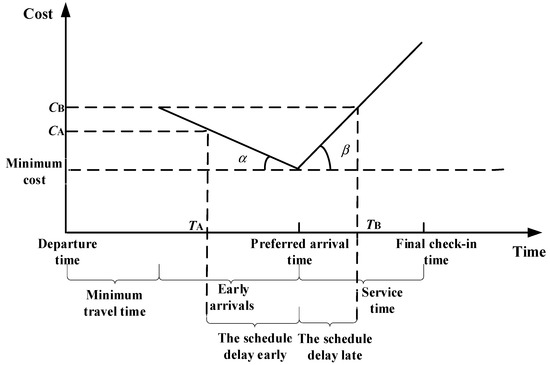
Figure 1.
Diagram of the relationship between travel time and cost for air travelers.
The random utility can be represented as the sum of the systematic utility and an unobserved error term, which is shown as:
where
Vik = the systematic utility that k obtains from choosing option i;
Vjk = the systematic utility that k obtains from choosing option j;
ε = the unobserved error term;
F = the ‘if’ statement that the difference between the error terms εjk and εik is lower than the difference between the systematic utility Vik and Vjk is true or not (=1 if the statement is true, 0 if the statement is false);
f(ε) = the priori assumed density function of the unobserved error term ε.
The systematic utility Vik and Vjk can be expressed as a linear function of the various attributes of an alternative, such as access travel time, schedule delay early, schedule delay late, and travel cost, multiplied by their coefficients.
where
E(cik) = the expected travel cost for k choosing option i;
E(cjk) = the expected travel cost for k choosing option j;
E(Tik) = the expected access time for k choosing option i;
E(Tjk) = the expected access time for k choosing option j;
E(SDEik) = the expected schedule time early for k choosing option i;
E(SDEjk) = the expected schedule time early for k choosing option j;
E(SDLik) = the expected schedule time late for k choosing option i;
E(SDLjk) = the expected schedule time late for k choosing option j;
βCOST = the coefficient of cost;
βTIME = the coefficient of access travel time;
βSDE = the coefficient of schedule time early;
βSDL = the coefficient of schedule time late;
αi, αj = the other known factors influencing the decision making.
As travel cost and travel time are both undesirable variables, their coefficients should be negative. The value of access time (VOAT) is the ratio of the marginal utility of time to the marginal utility of cost, which can be estimated as the ratio of the access time coefficient βTIME to the cost coefficient βCOST:
where VAT represents the value of access time (RMB/h, where RMB is the Chinese currency unit). Similarly, the value of schedule delay early (VSDE) can be estimated as the ratio of the schedule delay early coefficient (βSDE) to the cost coefficient (βCOST); and the value of schedule delay late (VSDL) can be estimated as the ratio of the schedule delay early coefficient (βSDL) to the cost coefficient (βCOST), which are shown as follows:
where
VSDE = the value of schedule delay early (RMB/h),
VSDL = the value of schedule delay late (RMB/h).
3.2. The Stated Preference Survey
For the purpose of estimating VOAT, VSDE and VSDL, a stated preference (SP) survey was conducted in the city of Nanjing from October 2016 to July 2020. A questionnaire is designed for collecting the respondents’ information. The survey consists of three parts. The first is about the respondents’ socioeconomic characteristics, including gender, age, education, occupation, personal monthly income, family monthly income, and number of missed flights and reasons. The second part is about the information about the respondents’ recent air travel, including questions about travel purpose, travel distance, travel mode, time and money spent, and whether the travel expenses could be reimbursed. The third part presents a series of assumed choice situations. The respondents were first asked about their preferred arrival time. Then they were asked to make some choices among different scenarios. These scenarios are distinguished in terms of expected access time to the airport, transportation fees, schedule delay early, or schedule delay late as compared with their expected arrival time. An illustration of the SP survey is listed in Table 3. There are some slight differences in values of different questionnaires for traffic mode, fare, trip time, and the actual arrival time as compared with the preferred arrival time. The questionnaires are randomly selected by the respondents.
Table 3.
Illustration of the SP survey.
Both internet surveys and face-to-face interviews were conducted. The former involved air travelers in Nanjing to collect the data necessary for the analysis of the access utility function. In the initial sample of 1500 respondents, 894 responded, indicating a total response rate of 59.6%. To ensure that the sample is representative of the entire population, a second stage face-to-face interview was conducted in Nanjing Lukou airport, collecting another 281 effective questionnaires to ensure that the proportion of each group in the survey conforms to the mean occupancy ratio from the yearbook. A comparison of the two ratios is shown in Table 4. Together with the questionnaires collected in the first stage, a total of 1175 questionnaires were collected. As each respondent is invited to make choices in 6 scenarios, the total number of choice samples is 7050. Table 4 describes the social-economic characteristics of the respondents.
Table 4.
Comparison of the proportion of each group in the survey and the mean occupancy ratio from the yearbook.
3.3. Preferred Arrival Time for Air Travelers
Each air traveler may have a preferred arrival time at the airport. Some travelers prefer to arrive early to ensure that they have ample time for checking and registering luggage. Others prefer to arrive on time, as long as they do not miss the flight. Thus, the preferred arrival may vary from person to person. In this paper, a multivariate regression model is used to explore the significant factors that may affect the travelers’ preferred arrival time. The dependent variable is the duration from travelers’ preferred arrival time to the departure time of the flight. The independent variables are the various potential influencing factors, shown in Table 5.
Table 5.
Definition of candidate explanatory variables.
The model can be explained as follows:
where
TPAT = the duration from travelers’ preferred arrival time to departure time of the flight;
β0 = a constant;
xGENDER, xAGE, xEDUCATION, xCAREER, xPMI, xFMI, xTRAN, xREIM, xPURPOSE, xLUGGAGE, xMISS, xREASON, xAIR = independent variables;
βGENDER, βAGE, βEDUCATION, βCAREER, βPMI, βFMI, βTRAN, βREIM, βPURPOSE, βLUGGAGE, βMISS, βREASON, βAIR = the coefficients of independent variables;
ε = the random error.
The results are shown in Table 6.
Table 6.
Analysis of preferred arrival time.
As seen from Table 6, the significant variables include age, education, personal monthly income, number of missed flights, and amount of luggage. The coefficients of AGE and EDUCATION are positive, indicating that the elderly and people with higher education tend to arrive earlier at the airport. The coefficient of PMI is negative, indicating that people with higher income are more willing to arrive just on time. The coefficients of MISS and BAGGAGE are positive. Travelers with the experience of missing a flight tend to arrive earlier. In addition, those with luggage prefer to arrive earlier to ensure that they have enough time for luggage registration. According to the estimation results, the following model is derived to estimate the preferred arrival time for air travelers:
where
TPAT = preferred arrival time;
xAGE = age variable;
xEDU = education variable;
xPMI = personal monthly income variable;
xMISS = miss flight variable;
xBAG = luggage variable.
The regression model provides a R2 of 0.862, indicating that the regression models have reasonable goodness-of-fit to collected data.
3.4. Results of Subjective Values of Airport Access Time
With the collected data of respondents’ choices, discrete choice models can be developed to estimate the value of access time (VOAT), the value of schedule delay early (VSDE), and the value of schedule delay late (VSDL). In this research, both the Multinomial Logit (MNL) model and Mixed Logit (ML) models are established. Using the software package STATA, the coefficients of the discrete choice model are estimated. Considering the diversity in the marginal utility of each independent variable across individuals, the selected variables may have random coefficients. The variables with random parameters are determined by allowing each variable to have a random parameter and checking the t-statistic of the standard deviation of the distribution of each parameter. The results show that SDE TIME and SDL TIME have random parameters. Different types of distributions for coefficients are proved, including the normal and lognormal. The results are summarized in Table 7.
Table 7.
Results of the MNL and ML models.
The likelihood ratio test is carried out, and the relative quality of statistical models are compared according to Akaike information criterion (AIC) and the relative likelihood (RL) of different models.
where AICmin represents the lowest AIC value among the models. The value of RL varies from 0 to 1. The closer to 1, the better the model is. According to Table 7, it can be seen that, generally, the ML models outperform the MNL model. The best estimation is when the coefficient of SDE TIME (βSDE) follows the normal distribution and the coefficient of SDL TIME (βSDL) follows the lognormal distribution; results can be obtained. However, the difference in log likelihood values is not significant in percentage terms. Eighteen explanatory variables are included in the model, including gender, age, education, income, reimbursement, number of luggage, number of missed flights, domestic or international flights, schedule delay early, schedule delay late, and travel cost. According to the estimated coefficients, females tend to arrive at the airport earlier than males. The elderly also preferred to arrive earlier than younger travelers. Lower education (lower diploma) also has negative impacts on schedule delay late. Personal monthly income has a positive effect on schedule delay late, meaning that people with lower income tend to arrive earlier to avoid economic loss due to late arrivals. If the ticket can be reimbursed, travelers tend to arrive just on time. When it comes to the amount of luggage and number of missed flights, as expected, the former has a positive effect on schedule delay early, while the latter has a negative impact. Compared with domestic flights, people who take international flights tend to arrive earlier at the airport. The result is intuitive, although this factor has rarely been mentioned in previous studies. By using the model estimation results, the subjective values of access travel time can be obtained. The Monte Carlo simulation method is used to conduct uncertainty analysis by randomly sampling from probability descriptions of the coefficients (βSDE, βSDL, βTIME, and βCOST) to generate a probability description of results. The results determine that the values of access time, schedule delay early, and schedule delay late are 78.46 RMB/h, 41.19 RMB/h (std. 37.22 RMB/h), and 104.32 RMB/h (std. 95.40 RMB/h), respectively.
4. Social Values of Airport Access Time
As shown in the previous section, the values of access time, schedule delay early, and schedule delay late can be calculated using the individual willingness-to-pay figures. However, as indicated in Jara-Díaz’s research, the social view of individual benefits is not necessarily equal to the private view. The estimation of social benefits and social prices requires further elaboration [16]. Thus, this section aims to propose and apply experimentally an approach to determine the social values of access time that result from transport investments funded with money collected through taxes; that is social investment.
4.1. Model Formulations
The social welfare that benefits from saving travel time can be estimated as the sum of the utility of each individual group.
where
U = the total social utility obtained from travel time savings;
Uk = the social utility for individual group k (k = 1,…,n). The individual utility is can be expressed as the function of individual monthly income (Ik), travel cost©) and travel time (T), which is shown as follows:
When the travel time changes result from airport ground tranportation system (dt), the change in social welfare (dU) can be estimated as:
where
λk = the marginal utility of income for individual group k;
dUk = the benefit for individual group k.
According to expression (18), the social welfare (dU) result from saving of access travel time (in terms of utility) is the weighted sum of all individual benefits (in terms of monetary values). The weight is calculated as λk multiplied by , where λk represents the importance in terms of utility that individual k that assigns to a variation in income; is the social welfare for individual k. Assuming that the contribution of individual utility to society can be reflected by taxation, when the marginal tax paid by air passenger k is dTk, the total tax is:
Meanwhile, due to the payment of taxes, the total utility changes as:
It can be obtained that:
where
λs = the social utility of a unit of money, which is the ratio of the change in social marginal benefits to the marginal tax paid by all groups;
θk = the marginal tax rate for income of individual group k. θk can be estimated as:
where
dTk = the marginal tax amount of individual group k;
dT = the total marginal tax amount;
εk = the average tax amount of individual group k as a percentage of the social group income;
ηk = represents the average income of individual k as a percentage of Gross National Product (GNP).
It can be obtained that:
where
VOATk = the subjective value of ravel time savings for individual k, that is, the ratio of the marginal utility of travel cost to the marginal utility of travel time, and can also be expressed as the ratio of travel time coefficient (βTIME) to travel cost coefficient (βCOST).
Therefore, the social value of travel time savings is estimated as:
where
SVOAT = the social value of travel time savings;
λs = the social utility of a unit of money.
Similarly, the social value of schedule delay early (SVSDE) and social value of schedule delay late (SVSDL) can be calculated as:
4.2. Results of Social Values of Airport Access Time
Considering that people of different income levels contribute different marginal wage ratios to society as taxes, the collected data is divided into five groups, including “PMI-1” (monthly income < 3500 RMB), “PMI-2” (3500 RMB ≤ monthly income < 5000 RMB), “PMI-3” (5000 RMB ≤ monthly income < 8000 RMB), “PMI-4” (8000 RMB ≤ monthly income < 12,500 RMB), and “PMI-5” (monthly income ≥ 12,500 RMB). According to the Statistical Yearbook of Jiangsu Province, it can be found that the GNP of Nanjing is 54,198 RMB. Based on the collected data, the average income and tax payment for each group is calculated, as shown in Table 8.
Table 8.
Tax payments as a percentage of income in China.
The marginal tax rate for income of individual group k (θk) is calculated according to Equation (22), which are shown as follows.
According to Equation (21), the social utility of a unit of money (λs) can be calculated as:
According to the model estimation results, the best results can be obtained when the coefficient βSDE follows the normal distribution, the coefficient βSDL follows the lognormal distribution and βTIME is a constant. Therefore, the social value of access time (SVOAT), schedule delay early (SVSDE) and schedule delay late (SVSDL), which can be estimated as the ratio of βSDE, βSDL, and βTIME to λs, are 105.88 RMB/h, 98.82 RMB/h (std 30.94 RMB/h), and 151.76 RMB/h (std 155.87 RMB/h), respectively. The results are shown in Table 9.
Table 9.
Income distribution and contribution of each income group to social funds.
5. Conclusions and Discussion
This paper estimates the subjective and social value of access travel time for air passengers through an empirical application in Nanjing, China. An international meta-analysis is conducted to identify the significant factors that may affect the value of travel time. SP surveys are designed to collect data on the travelers’ preferred arrival time and decision choice under various hypothetical situations. Discrete choice models are built to estimate how various parameters influence traveler choice. Considering that there are random tastes among different respondents, this paper uses mixed logit models to estimate the coefficients of various parameters. Based on the model estimation results, the following conclusions can be made:
- (1)
- According to the meta-analysis results from 240 studies, the survey region (Asia, Europe, Oceania), trip purpose (business, commute, and other), traffic mode (air, surface, and public transport), trip distance (short distance), other attributes (out-of-vehicle), and per capital GDP are the crucial factors that may affect heterogeneity. A multivariate regression model is then established for the prediction of value of access travel time.
- (2)
- With the collected data from SP surveys in Nanjing, a linear regression model is used to explore the significant factors that may affect the travelers’ preferred arrival time. The significant variables include age, education, personal monthly income, number of missed flights, and amount of luggage. According to the estimation results, a prediction model is then obtained to estimate the preferred arrival time for air travelers.
- (3)
- Mixed logit models are developed to estimate the value of access travel time (VOAT), value of schedule delay early (VSDE) and value of schedule delay late (VSDL). Eighteen explanatory variables are included in the model, gender, age, education, income, reimbursement, amount of luggage, number of missed flights, domestic or international flights, schedule delay early, schedule delay late, and travel cost. The results determine that the values of access time, schedule delay early, and schedule delay late are 78.46 RMB/h, 41.19 RMB/h (std. 37.22 RMB/h), and 104.32 RMB/h (std. 95.40 RMB/h), respectively. While comparable to those in other countries, these values are significantly lower than in developed countries.
- (4)
- Using the tax system to illustrate the contribution of different income groups to social funds, the social value of access travel time (SVOAT), schedule delay early (SVSDE) and schedule delay late (SVSDL) are calculated also. The values are 105.88 RMB/h, 98.82 RMB/h (std 30.94 RMB/h), and 151.76 RMB/h (std 155.87 RMB/h), respectively. The estimated values can be directly used in the cost-benefit analysis of operational related projects in China.
Although there is a lot of research that provides quantification of the value of travel time, estimating the values and using them in the cost-benefit analysis of projects may result in greater challenges than expected. This study summarizes these challenges faced by other researchers:
- (1)
- The value of travel time may vary significantly across different survey regions, traffic modes, trip purposes, etc. Proper selection of these values can lead to more accurate results in economic evaluation of projects. For example, this paper estimates the value of airport access time with a case study of Nanjing, China. The value can be used in cost-benefit analysis of projects concerning airport accessibility in this region. Local program managers should also select relative values based on the project types and data available.
- (2)
- When estimating the value of time, the impacts of time variability should be considered together since the impacts of early arrivals and late arrivals may be quite different. In addition, although the value of schedule delay late is much higher than the value of schedule delay early, the user costs of early arrival time may also constitute a large part of the total costs.
- (3)
- The social value of travel time, instead of the subjective value of time should be used in the cost-benefit analysis of related projects. Estimating social value includes two main elements, which are the formulation of the social welfare change which can be estimated as a weighted sum of individual benefits, as well as the conversion of social welfare to monetary terms. The framework implemented in the study can also be used to estimate the economic benefits of projects in other countries by incorporating the corresponding tax collection policy.
One of the limitations of this study is that due to the lack of data in collected documentation, results from a few studies that do not have complete data sets are not included in the meta-analysis process. Further research is still needed in order to better understand those factors affecting the value of travel time, as well as the heterogeneity across nations by enlarging the sample size. Besides, the seasonal effects on the estimated values are not considered, as the season associated variables were not provided from the survey. It is expected that the value of access time may be affected by the weather conditions, as most travelers would not like to be exposed to extreme hot or cold days. Further research needs to be conducted to obtain more accurate results. Additional studies are also needed to test the transferability of the presented procedure and selected models using data collected from other cities or other countries. The authors suggest that future studies focus on these issues.
Author Contributions
Conceptualization, R.Z. and Z.Y.; methodology, R.Z. and Z.Y.; software, R.Z.; validation, Z.Y. and J.C.; formal analysis, Z.Y.; investigation, R.Z.; resources, J.C.; data curation, Z.Y.; writing—original draft preparation, R.Z.; writing—review and editing, Z.Y.; visualization, R.Z.; supervision, J.C.; project administration, Z.Y.; funding acquisition, Z.Y. All authors have read and agreed to the published version of the manuscript.
Funding
This research was funded by National Natural Science Foundation of China (52172328, 62076126, 52002179) and the Fundamental Research Funds for the Central Universities of China (NS20220093).
Data Availability Statement
Not applicable.
Conflicts of Interest
The authors declare no conflict of interest.
Appendix A
| Author(s) | Country | Region | Trip Purpose | Trip Distance | Mode | Survey Type | VTTS | Per Capita GDP ($) | VTTS in 2021 ($/h) | |
| 1 | Blayac and Causse (2001) [27] | France | Europe | Train | SP | 133.0 FF/h | 22,433 | 36.68 | ||
| 2 | France | Europe | Air | SP | 223.0 FF/h | 22,433 | 61.50 | |||
| 3 | Ghosh (2001) [28] | USA | North America | Commute | SP | 17.82 $/h | 37,133 | 27.23 | ||
| 4 | USA | North America | Commute | RP | 26.21 $/h | 37,133 | 40.06 | |||
| 5 | Kenneth et al. (2001) [29] | USA | North America | Commute | Highway | SP | 20.63 $/h | 37,133 | 31.53 | |
| 6 | Lam and Small (2001) [30] | USA | North America | Commute | Highway | RP | 22.87 $/h | 37,133 | 34.95 | |
| 7 | Hensher (2001) [31] | New Zealand | Oceania | Non-business | Long | Car | SP | 9.42 $NZ/h | 13,882 | 10.19 |
| 8 | Mackie et al. (2003) [9] | United Kingdom | Europe | Commute | Car | 8.17 €/h | 34,487 | 14.22 | ||
| 9 | United Kingdom | Europe | Other | Car | 7.25 €/h | 34,487 | 12.62 | |||
| 10 | United Kingdom | Europe | Business | Car | 32.47 €/h | 34,487 | 56.52 | |||
| 11 | United Kingdom | Europe | Business | Train | 38.35 €/h | 34,487 | 66.75 | |||
| 12 | Brownstone and Small (2005) [25] | USA | North America | Commute | Highway | SP & RP | 12.55 $/h | 44,114 | 17.38 | |
| 13 | Small et al. (2005) [32] | USA | North America | Commute | Car | RP | 21.46 $/h | 44,114 | 29.71 | |
| 14 | USA | North America | Commute | Car | SP | 11.92 $/h | 44,114 | 16.50 | ||
| 15 | Hess et al. (2005) [33] | Canada | North America | SP | 108.72 $Aud/h | 36,382 | 113.24 | |||
| 16 | Bhat and Sardesai (2006) [34] | USA | North America | Commute | Highway | RP | 15.08 $/h | 46,298 | 20.23 | |
| 17 | USA | North America | Commute | Highway | SP | 11.59 $/h | 46,298 | 15.55 | ||
| 18 | USA | North America | Commute | Highway | SP & RP | 12.31 $/h | 46,298 | 16.52 | ||
| 19 | Cirillo and Axhausen (2006) [35] | Germany | Europe | Commute | Highway | RP | 13.6 DM/h | 36,323 | 10.80 | |
| 20 | Germany | Europe | Other | Highway | RP | 19.6 DM/h | 36,323 | 15.57 | ||
| 21 | Hensher (2006) [36] | Australia | Oceania | Commute | Car | SP | 22.71 $/h | 36,117 | 30.47 | |
| 22 | Fosgerau (2006) [37] | Denmark | Europe | Non-business | Car | SP | 89.2 DKK/h | 52,026 | 19.04 | |
| 23 | Axhausen et al. (2006) [38] | Switzerland | Europe | Business | Car | 37.87 €/h | 59,300 | 60.15 | ||
| 24 | Switzerland | Europe | Business | PT (bus/train) | 35.31 €/h | 59,300 | 56.08 | |||
| 25 | Asensio and Matas (2007) [39] | Spain | Europe | Commute | Car | SP | 14.7 €/h | 32,549 | 22.71 | |
| 26 | Fosgerau et al. (2007) [40] | Denmark | Europe | Commute | Car | SP | 11.87 €/h | 58,487 | 18.34 | |
| 27 | Denmark | Europe | Other | Car | SP | 11.87 €/h | 58,487 | 18.34 | ||
| 28 | Denmark | Europe | Commute | PT (bus/train) | SP | 11.87 €/h | 58,487 | 18.34 | ||
| 29 | Denmark | Europe | Other | PT (bus/train) | SP | 11.87 €/h | 58,487 | 18.34 | ||
| 30 | Axhausen et al. (2008) [41] | Switzerland | Europe | Business | PT | SP | 25.18 CHF/h | 74,572 | 34.66 | |
| 31 | Switzerland | Europe | Commute | PT | SP | 18.93 CHF/h | 74,572 | 26.05 | ||
| 32 | Switzerland | Europe | Leisure | PT | SP | 11.90 CHF/h | 74,572 | 16.38 | ||
| 33 | Switzerland | Europe | Shopping | PT | SP | 13.10 CHF/h | 74,572 | 18.03 | ||
| 34 | Switzerland | Europe | All | PT | SP | 14.10 CHF/h | 74,572 | 19.41 | ||
| 35 | Switzerland | Europe | Business | Car | SP | 27.66 CHF/h | 74,572 | 38.07 | ||
| 36 | Switzerland | Europe | Commute | Car | SP | 19.04 CHF/h | 74,572 | 26.21 | ||
| 37 | Switzerland | Europe | Leisure | Car | SP | 18.83 CHF/h | 74,572 | 25.92 | ||
| 38 | Switzerland | Europe | Shopping | Car | SP | 17.84 CHF/h | 74,572 | 24.55 | ||
| 39 | Switzerland | Europe | All | Car | SP | 20.98 CHF/h | 74,572 | 28.88 | ||
| 40 | Steimetz (2008) [42] | USA | North America | Commute | Short | Car | SP | 21.02 $/h | 48,382 | 26.43 |
| 41 | Swiss Association of Road and Transportation Experts (2009) [43] | Switzerland | Europe | Commute | Car | 26.70 €/h | 72,083 | 39.90 | ||
| 42 | Switzerland | Europe | Other | Car | 6.19 €/h | 72,083 | 9.25 | |||
| 43 | Switzerland | Europe | Commute | PT (bus/train) | 16.19 €/h | 72,083 | 24.20 | |||
| 44 | Switzerland | Europe | Other | PT (bus/train) | 8.72 €/h | 72,083 | 13.03 | |||
| 45 | Shires and de Jong (2009) [11] | Netherlands | Europe | Commute | Car | 11.05 €/h | 52,514 | 16.51 | ||
| 46 | Netherlands | Europe | Commute | Train | 11.05 €/h | 52,514 | 16.51 | |||
| 47 | Netherlands | Europe | Commute | BTM | 9.14 €/h | 52,514 | 13.66 | |||
| 48 | Netherlands | Europe | Business | Car | 30.94 €/h | 52,514 | 46.24 | |||
| 49 | Netherlands | Europe | Business | Train | 30.94 €/h | 52,514 | 46.24 | |||
| 50 | Netherlands | Europe | Business | BTM | 24.83 €/h | 52,514 | 37.11 | |||
| 51 | Netherlands | Europe | Other | Car | 8.85 €/h | 52,514 | 13.23 | |||
| 52 | Netherlands | Europe | Other | Train | 8.85 €/h | 52,514 | 13.23 | |||
| 53 | Netherlands | Europe | Other | BTM | 6.21 €/h | 52,514 | 9.28 | |||
| 54 | Ramjerdi and Flügel (2010) [44] | Norway | Europe | Commute | Short | Car | 11.7 €/h | 87,693 | 17.21 | |
| 55 | Norway | Europe | Other | Short | Car | 10.01 €/h | 87,693 | 14.72 | ||
| 56 | Norway | Europe | Business | Short | Car | 49.40 €/h | 87,693 | 72.66 | ||
| 57 | Norway | Europe | Commute | Long | Car | 26.00 €/h | 87,693 | 38.24 | ||
| 58 | Norway | Europe | Other | Long | Car | 18.98 €/h | 87,693 | 27.92 | ||
| 59 | Norway | Europe | Business | Long | Car | 49.40 €/h | 87,693 | 72.66 | ||
| 60 | Norway | Europe | Commute | Short | PT (bus/train) | 7.80 €/h | 87,693 | 11.47 | ||
| 61 | Norway | Europe | Other | Short | PT (bus/train) | 5.98 €/h | 87,693 | 8.80 | ||
| 62 | Norway | Europe | Business | Short | PT (bus/train) | 49.40 €/h | 87,693 | 72.66 | ||
| 63 | Norway | Europe | Commute | Long | Train | 20.28 €/h | 87,693 | 29.83 | ||
| 64 | Norway | Europe | Other | Long | Train | 11.96 €/h | 87,693 | 17.59 | ||
| 65 | Norway | Europe | Business | Long | Train | 49.40 €/h | 87,693 | 72.66 | ||
| 66 | Norway | Europe | Commute | Long | Bus | 13.39 €/h | 87,693 | 19.70 | ||
| 67 | Norway | Europe | Other | Long | Bus | 9.49 €/h | 87,693 | 13.96 | ||
| 68 | Norway | Europe | Business | Long | Bus | 49.40 €/h | 87,693 | 72.66 | ||
| 69 | Norway | Europe | Commute | Long | Air | 37.44 €/h | 87,693 | 55.07 | ||
| 70 | Norway | Europe | Other | Long | Air | 23.40 €/h | 87,693 | 34.42 | ||
| 71 | Norway | Europe | Business | Long | Air | 57.85 €/h | 87,693 | 85.09 | ||
| 72 | Li et al. (2010) [45] | Australia | Oceania | Commute | Car | SP | 30.04 $Aud/h | 52,087 | 28.08 | |
| 73 | Australia | Oceania | Non-commute | Car | SP | 12.22 $Aud/h | 52,087 | 11.42 | ||
| 74 | Hanssen (2011) [46] | Norway | Europe | Ferry | SP | 131.6 NOK/h | 100,600 | 18.44 | ||
| 75 | Norway | Europe | Ferry | SP | 101.7 NOK h | 100,600 | 14.25 | |||
| 76 | Norway | Europe | Ferry | SP | 67.5 NOK/h | 100,600 | 9.46 | |||
| 77 | Norway | Europe | Ferry | SP | 88.4 NOK/h | 100,600 | 12.39 | |||
| 78 | Börjesson et al. (2012) [47] | Sweden | Europe | Commute | PT (Metro/train) | SP | 6.00 €/h | 58,037 | 8.38 | |
| 79 | Devarasetty et al. (2012) [48] | USA | North America | Highway | SP & RP | 51.0 $/h | 51,602 | 60.14 | ||
| 80 | Mickaël et al. (2012) [13] | USA | North America | Train | SP | 42.89 €/h | 51,602 | 59.87 | ||
| 81 | Trafikverket (2012) [49] | Sweden | Europe | Commute | Long | Car | 10.96 €/h | 58,037 | 15.30 | |
| 82 | Sweden | Europe | Other | Long | Car | 10.96 €/h | 58,037 | 15.30 | ||
| 83 | Sweden | Europe | Business | Long | Car | 29.54 €/h | 58,037 | 41.24 | ||
| 84 | Sweden | Europe | Commute | Long | Bus | 3.96 €/h | 58,037 | 5.53 | ||
| 85 | Sweden | Europe | Other | Long | Bus | 3.96 €/h | 58,037 | 5.53 | ||
| 86 | Sweden | Europe | Business | Long | Bus | 29.54 €/h | 58,037 | 41.24 | ||
| 87 | Sweden | Europe | Commute | Long | Train | 7.41 €/h | 58,037 | 10.34 | ||
| 88 | Sweden | Europe | Other | Long | Train | 7.41 €/h | 58,037 | 10.34 | ||
| 89 | Sweden | Europe | Business | Long | Train | 25.07 €/h | 58,037 | 35.00 | ||
| 90 | Sweden | Europe | Other | Long | Air | 17.56 €/h | 58,037 | 24.51 | ||
| 91 | Sweden | Europe | Business | Long | Air | 29.54 €/h | 58,037 | 41.24 | ||
| 92 | Sweden | Europe | Commute | Short | Car | 8.83 €/h | 58,037 | 12.33 | ||
| 93 | Sweden | Europe | Other | Short | Car | 5.99 €/h | 58,037 | 8.36 | ||
| 94 | Sweden | Europe | Business | Short | Car | 29.54 €/h | 58,037 | 41.24 | ||
| 95 | Sweden | Europe | Commute | Short | Bus | 5.38 €/h | 58,037 | 7.51 | ||
| 96 | Sweden | Europe | Other | Short | Bus | 3.35 €/h | 58,037 | 4.68 | ||
| 97 | Sweden | Europe | Business | Short | Bus | 29.54 €/h | 58,037 | 41.24 | ||
| 98 | Sweden | Europe | Commute | Short | Train | 7.00 €/h | 58,037 | 9.77 | ||
| 99 | Sweden | Europe | Other | Short | Train | 5.38 €/h | 58,037 | 7.51 | ||
| 100 | Sweden | Europe | Business | Short | Train | 25.07 €/h | 58,037 | 35.00 | ||
| 101 | Douglas and Jones (2013) [50] | Australia | Oceania | Education | PT (bus/train) | 7.5 $/h | 68,156 | 8.71 | ||
| 102 | Australia | Oceania | Other | PT (bus/train) | 8.7 $/h | 68,156 | 10.11 | |||
| 103 | Australia | Oceania | Commute | PT (bus/train) | 15.7 $/h | 68,156 | 18.24 | |||
| 104 | Australia | Oceania | Business | PT (bus/train) | SP | 12.8 $/h | 68,156 | 14.87 | ||
| 105 | CGSP (2013) [51] | France | Europe | Commute | Car & bus | 10.0 €/h | 42,592 | 13.75 | ||
| 106 | France | Europe | Other | Car & bus | 6.8 €/h | 42,592 | 9.35 | |||
| 107 | France | Europe | Business | Car & bus | 17.5 €/h | 42,592 | 24.07 | |||
| 108 | France | Europe | Commute | Car & train | 12.6 €/h | 42,592 | 17.33 | |||
| 109 | France | Europe | Other | Car & train | 8.7 €/h | 42,592 | 11.97 | |||
| 110 | France | Europe | Business | Car & train | 22.3 €/h | 42,592 | 30.67 | |||
| 111 | France | Europe | Other | Car | 14.4 €/h | 42,592 | 19.81 | |||
| 112 | France | Europe | Business | Car | 32.7 €/h | 42,592 | 44.97 | |||
| 113 | France | Europe | Other | Coach | 12.1 €/h | 42,592 | 16.64 | |||
| 114 | France | Europe | Business | Coach | 27.6 €/h | 42,592 | 37.96 | |||
| 115 | France | Europe | Other | Train | 22.7 €/h | 42,592 | 31.22 | |||
| 116 | France | Europe | Business | Train | 43.3 €/h | 42,592 | 59.55 | |||
| 117 | France | Europe | Other | Air | 53.4 €/h | 42,592 | 73.44 | |||
| 118 | France | Europe | Business | Air | 72.9 €/h | 42,592 | 100.26 | |||
| 119 | Signifificance et al. (2013) [52] | Netherlands | Europe | Commute | Car | 9.25 €/h | 52,184 | 12.72 | ||
| 120 | Netherlands | Europe | Other | Car | 7.5 €/h | 52,184 | 10.32 | |||
| 121 | Netherlands | Europe | Business | Car | 26.25 €/h | 52,184 | 36.10 | |||
| 122 | Netherlands | Europe | Commute | Train | 11.5 €/h | 52,184 | 15.82 | |||
| 123 | Netherlands | Europe | Other | Train | 7.00 €/h | 52,184 | 9.63 | |||
| 124 | Netherlands | Europe | Business | Train | 19.75 €/h | 52,184 | 27.16 | |||
| 125 | Netherlands | Europe | Commute | PT (Bus/Train) | 7.75 €/h | 52,184 | 10.66 | |||
| 126 | Netherlands | Europe | Other | PT (Bus/Train) | 6.00 €/h | 52,184 | 8.25 | |||
| 127 | Netherlands | Europe | Business | PT (Bus/Train) | 19.00 €/h | 52,184 | 26.13 | |||
| 128 | Netherlands | Europe | Other | Air | 47.00 €/h | 52,184 | 64.64 | |||
| 129 | Netherlands | Europe | Business | Air | 85.75 €/h | 52,184 | 117.94 | |||
| 130 | Axhausen et al. (2014) [53] | Germany | Europe | Commute | Short | Car | 4.20 €/h | 47,959 | 5.69 | |
| 131 | Germany | Europe | Other | Short | Car | 3.49 €/h | 47,959 | 4.72 | ||
| 132 | Germany | Europe | Business | Short | Car | 6.01 €/h | 47,959 | 8.14 | ||
| 133 | Germany | Europe | Commute | Short | PT (Bus/Train) | 3.89 €/h | 47,959 | 5.27 | ||
| 134 | Germany | Europe | Other | Short | PT (Bus/Train) | 3.85/ €/h | 47,959 | 5.21 | ||
| 135 | Germany | Europe | Business | Short | PT (Bus/Train) | 4.65 €/h | 47,959 | 6.29 | ||
| 136 | Germany | Europe | Commute | Long | Car | 9.58 €/h | 47,959 | 12.97 | ||
| 137 | Germany | Europe | Other | Long | Car | 9.26 €/h | 47,959 | 12.54 | ||
| 138 | Germany | Europe | Business | Long | Car | 12.11 €/h | 47,959 | 16.39 | ||
| 139 | Germany | Europe | Commute | Long | Train | 8.21 €/h | 47,959 | 11.11 | ||
| 140 | Germany | Europe | Other | Long | Train | 8.44 €/h | 47,959 | 11.43 | ||
| 141 | Germany | Europe | Business | Long | Train | 11.06 €/h | 47,959 | 14.97 | ||
| 142 | Germany | Europe | Other | Long | Air | 22.89 €/h | 47,959 | 30.99 | ||
| 143 | Germany | Europe | Business | Long | Air | 33.87 €/h | 47,959 | 45.85 | ||
| 144 | Börjesson & Eliasson (2014) [54] | Sweden | Europe | Commute | Car | 10.65 €/h | 60,020 | 14.42 | ||
| 145 | Sweden | Europe | Commute | Train | 7.2 €/h | 60,020 | 9.75 | |||
| 146 | Sweden | Europe | Commute | BTM(Bus, Train, Metro) | 5.3 €/h | 60,020 | 7.17 | |||
| 147 | Sweden | Europe | Other | Car | 6.4 €/h | 60,020 | 8.66 | |||
| 148 | Sweden | Europe | Other | Train | 5.0 €/h | 60,020 | 6.77 | |||
| 149 | Sweden | Europe | Other | BTM | 2.8 €/h | 60,020 | 3.79 | |||
| 150 | Kouwenhoven et al. (2014) [55] | Netherlands | Europe | Commute | Car | 9.25 €/h | 52,830 | 12.52 | ||
| 151 | Netherlands | Europe | Commute | Train | 11.5 €/h | 52,830 | 15.57 | |||
| 152 | Netherlands | Europe | Commute | BTM | 7.75 €/h | 52,830 | 10.49 | |||
| 153 | Netherlands | Europe | Business | Car | 26.25 €/h | 52,830 | 35.53 | |||
| 154 | Netherlands | Europe | Business | Train | 19.75 €/h | 52,830 | 26.74 | |||
| 155 | Netherlands | Europe | Business | BTM | 19.00 €/h | 52,830 | 25.72 | |||
| 156 | Netherlands | Europe | Other | Car | 7.50 €/h | 52,830 | 10.15 | |||
| 157 | Netherlands | Europe | Other | Train | 7.00 €/h | 52,830 | 9.48 | |||
| 158 | Netherlands | Europe | Other | BTM | 6.00 €/h | 52,830 | 8.12 | |||
| 159 | Netherlands | Europe | All | Car | 9.00 €/h | 52,830 | 12.18 | |||
| 160 | Netherlands | Europe | All | Train | 9.25 €/h | 52,830 | 12.52 | |||
| 161 | Netherlands | Europe | All | BTM | 6.75 €/h | 52,830 | 9.14 | |||
| 162 | Sheikh et al. (2014) [56] | USA | North America | Car | RP | 36.0 $/h | 55,049 | 41.17 | ||
| 163 | USA | North America | Car | RP | 26.0 $/h | 55,049 | 29.73 | |||
| 164 | Chinh et al. (2015) [57] | Australia | Oceania | Car | SP | 13.5 $/h | 56,707 | 15.42 | ||
| 165 | Department for Transport (2015) [58] | United Kingdom | Europe | Commute | All | 12.51 €/h | 45,404 | 16.92 | ||
| 166 | United Kingdom | Europe | Other | All | 5.71 €/h | 45,404 | 7.72 | |||
| 167 | United Kingdom | Europe | Business | Short | Car | 12.60 €/h | 45,404 | 17.04 | ||
| 168 | United Kingdom | Europe | Business | Medium | Car | 20.38 €/h | 45,404 | 27.56 | ||
| 169 | United Kingdom | Europe | Business | Long | Car | 31.40 €/h | 45,404 | 42.46 | ||
| 170 | United Kingdom | Europe | Business | Short | Train | 12.60 €/h | 45,404 | 17.04 | ||
| 171 | United Kingdom | Europe | Business | Medium | Train | 20.38 €/h | 45,404 | 27.56 | ||
| 172 | United Kingdom | Europe | Business | Long | Train | 45.24 €/h | 45,404 | 61.18 | ||
| 173 | United Kingdom | Europe | Business | Bus/LRT | 12.60 €/h | 45,404 | 17.04 | |||
| 174 | USDOT (2016) [59] | USA | North America | Non-business | Local | Surface | 13.60 $/h | 58,021 | 15.34 | |
| 175 | USA | North America | Business | Local | Surface | 25.40 $/h | 58,021 | 28.64 | ||
| 176 | USA | North America | All | Local | Surface | 14.10 $/h | 58,021 | 15.90 | ||
| 177 | USA | North America | Non-business | Intercity | Surface | 19.00 $/h | 58,021 | 21.43 | ||
| 178 | USA | North America | Business | Intercity | Surface | 25.40 $/h | 58,021 | 28.64 | ||
| 179 | USA | North America | All | Intercity | Surface | 20.40 $/h | 58,021 | 23.01 | ||
| 180 | USA | North America | Non-business | Intercity | Air & High-speed Rail | 36.10 $/h | 58,021 | 40.71 | ||
| 181 | USA | North America | Business | Intercity | Air & High-speed Rail | 63.20 $/h | 58,021 | 71.27 | ||
| 182 | USA | North America | All | Intercity | Air & High-speed Rail | 47.10 $/h | 58,021 | 53.12 | ||
| 183 | Kou et al. (2017) [60] | China | Asia | Commute | PT | SP | 11.34 ¥/h | 8094 | 1.94 | |
| 184 | China | Asia | Commute | Car | SP | 17.81 ¥/h | 8094 | 3.05 | ||
| 185 | Ojeda-Cabral et al. (2016) [61] | United Kingdom | Europe | Non-business | Car | SP | 8.61 pence/min | 41,499 | 8.02 | |
| 186 | United Kingdom | Europe | Non-business | Car | SP | 6.72 pence/min | 41,499 | 6.26 | ||
| 187 | Denmark | Europe | Non-business | SP | 112.08 DKK/h | 54,663 | 20.10 | |||
| 188 | Denmark | Europe | Non-business | SP | 86.45 DKK/h | 54,663 | 15.51 | |||
| 189 | Beck et al. (2017) [62] | Sweden | Europe | Commute | Car | SP & RP | 43.08 KR/h | 53,791 | 5.55 | |
| 190 | Sweden | Europe | Commute | PT | SP & RP | 19.16 KR/h | 53,791 | 2.47 | ||
| 191 | Yang et al. (2018) [18] | China | Asia | Commute | All | SP | 35.8 ¥/h | 8016 | 6.34 | |
| 192 | Börjesson et al. (2019) [63] | Sweden | Europe | Commute | Short | Car | 9.8 €/h | 54,589 | 12.51 | |
| 193 | Sweden | Europe | Commute | Short | Bus | 5.3 €/h | 54,589 | 6.77 | ||
| 194 | Sweden | Europe | Commute | Short | Train | 7.2 €/h | 54,589 | 9.19 | ||
| 195 | Sweden | Europe | Other | Short | Car | 6.1 €/h | 54,589 | 7.79 | ||
| 196 | Sweden | Europe | Other | Short | Bus | 2.8 €/h | 54,589 | 3.58 | ||
| 197 | Sweden | Europe | Other | Short | Train | 5.0 €/h | 54,589 | 6.38 | ||
| 198 | Sweden | Europe | Other | Long | Car | 11.7 €/h | 54,589 | 14.94 | ||
| 199 | Sweden | Europe | Other | Long | Bus | 3.8 €/h | 54,589 | 4.85 | ||
| 200 | Sweden | Europe | Other | Long | Train | 7.3 €/h | 54,589 | 9.32 | ||
| 201 | Varghese et al. (2018) [64] | India | Asia | RP | 179.2 INR | 2030 | 2.62 | |||
| 202 | India | Asia | RP | 132.2 INR | 2030 | 1.93 | ||||
| 203 | India | Asia | RP | 157.3 INR | 2030 | 2.30 | ||||
| 204 | India | Asia | RP | 84.7 INR | 2030 | 1.24 | ||||
| 205 | India | Asia | RP | 184.1 INR | 2030 | 2.69 | ||||
| 206 | India | Asia | RP | 96.6 INR | 2030 | 1.41 | ||||
| 207 | India | Asia | RP | 133.9 INR | 2030 | 1.95 | ||||
| 208 | India | Asia | RP | 113.5 INR | 2030 | 1.66 | ||||
| 209 | India | Asia | RP | 223.6 INR | 2030 | 3.26 | ||||
| 210 | India | Asia | RP | 150.2 INR | 2030 | 2.19 | ||||
| 211 | India | Asia | RP | 158.0 INR | 2030 | 2.31 | ||||
| 212 | Birolini et al. (2019) [15] | Italy | Europe | All | Train | RP | €24.02/h | 32,657 | 30.13 | |
| 213 | Italy | Europe | All | Train | RP | €18.76/h | 32,657 | 23.53 | ||
| 214 | Italy | Europe | Business | Train | RP | €37.3/h | 32,657 | 46.79 | ||
| 215 | Italy | Europe | Business | Train | RP | €23.95/h | 32,657 | 30.04 | ||
| 216 | Italy | Europe | Non-business | Train | RP | €37.48/h | 32,657 | 47.01 | ||
| 217 | Italy | Europe | Non-business | Train | RP | €19.38/h | 32,657 | 24.31 | ||
| 218 | Alonso-González et al. (2020) [65] | Dutch | Europe | Leisure | direct flexi | 11.18 €/h | 52,304 | 13.86 | ||
| 219 | Dutch | Europe | Leisure | flexibus1 | 7.76 €/h | 52,304 | 9.62 | |||
| 220 | Dutch | Europe | Leisure | flexibus2 | 8.01 €/h | 52,304 | 9.93 | |||
| 221 | Dutch | Europe | Leisure | busbus1 | 7.89 €/h | 52,304 | 9.78 | |||
| 222 | Dutch | Europe | Leisure | busbus2 | 6.60 €/h | 52,304 | 8.18 | |||
| 223 | Dutch | Europe | Leisure | waiting transfer flexibus | 7.40 €/h | 52,304 | 9.17 | |||
| 224 | Dutch | Europe | Leisure | waiting transfer busbus | 5.77 €/h | 52,304 | 7.15 | |||
| 225 | Dutch | Europe | Commute | direct flexi | 12.54 €/h | 52,304 | 15.54 | |||
| 226 | Dutch | Europe | Commute | flexibus1 | 8.24 €/h | 52,304 | 10.21 | |||
| 227 | Dutch | Europe | Commute | flexibus2 | 7.84 €/h | 52,304 | 9.72 | |||
| 228 | Dutch | Europe | Commute | busbus1 | 8.94 €/h | 52,304 | 11.08 | |||
| 229 | Dutch | Europe | Commute | busbus2 | 9.30 €/h | 52,304 | 11.53 | |||
| 230 | Dutch | Europe | Commute | waiting transfer flexibus | 8.99 €/h | 52,304 | 11.14 | |||
| 231 | Dutch | Europe | Commute | waiting transfer busbus | 9.12 €/h | 52,304 | 11.30 | |||
| 232 | Gunay et al. (2021) [16] | Turkey | Europe | Auto | SP | 0.294 $/min | 9539 | 17.64 | ||
| 233 | Turkey | Europe | Drop-off | SP | 0.332 $/min | 9539 | 19.92 | |||
| 234 | Turkey | Europe | Public Transit | SP | 0.246 $/min | 9539 | 14.76 | |||
| 235 | Turkey | Europe | Auto | SP | 0.262 $/min | 9539 | 15.72 | |||
| 236 | Turkey | Europe | Drop-off | SP | 0.314 $/min | 9539 | 18.84 | |||
| 237 | Turkey | Europe | Public Transit | SP | 0.227 $/min | 9539 | 13.62 | |||
| 238 | Turkey | Europe | Auto | SP | 0.345 $/min | 9539 | 20.70 | |||
| 239 | Turkey | Europe | Drop-off | SP | 0.383 $/min | 9539 | 22.98 | |||
| 240 | Turkey | Europe | Public Transit | SP | 0.338 $/min | 9539 | 20.28 |
References
- Mackie, P.J.; Jara-Diaz, S.R.; Fowkes, A. The value of travel time savings in evaluation. Transp. Res. Part E 2001, 37, 91–106. [Google Scholar] [CrossRef]
- Kouwenhoven, M. The Role of Accessibility in Passengers’ Choice of Airports; OECD Discussion Paper No. 2008-14; OECD: Paris, France, 2008. [Google Scholar]
- Deserpa, A.C. A Theory of the Economics of Time. Econ. J. 1971, 81, 828–846. [Google Scholar] [CrossRef]
- Gunn, H.F.; Bradley, M.A.; Rohr, C.L. The 1994 national value of travel time savings study of road traffic in England. In Paper for the Course and Seminar on Value of Travel Time Savings; Easthampstead: Berkshire, UK, 1996. [Google Scholar]
- Gunn, H.F.; Rohr, C.L. Dutch value of travel time savings studies. In Paper for the Course and Seminar on Value of Travel Time Savings; Easthampstead: Berkshire, UK, 1996. [Google Scholar]
- Algers, S.; Lindqvist-Dillen, J.; Widlert, S. The National Swedish Value of travel time savings study. In Paper for the Course and Seminar on Value of Travel Time Savings; Easthampstead: Berkshire, UK, 1996. [Google Scholar]
- Ramjerdi, F.; Rand, L.; Salensminde, K. The Norwegian Value of Travel Time Savings Study; Report 397/1997; Institute of Transport Economics: Oslo, Norway, 1997. [Google Scholar]
- Axhausen, K.W.; König, A.; Abay, G.; Bates, J.J.; Bierlaire, M. Swiss Value of Travel Time Savings; Institute of Transport Planning and Systems, Swiss Federal Institute of Technology: Zurich, Switzerland, 2003. [Google Scholar]
- Mackie, P.J.; Wardman, M.; Fowkes, A.S.; Whelan, G.A.; Nellthorp, J.; Bates, J. Value of travel time savings in the UK. In Report to the Department for Transport; Institute for Transport Studies, University of Leeds: Leeds, UK, 2003. [Google Scholar]
- Abrantes, P.; Wardman, M. Meta-analysis of UK values of travel time: An update. Transp. Res. Part A 2011, 45, 1–17. [Google Scholar] [CrossRef]
- Shires, J.D.; De Jong, G.C. An international meta-analysis of value of time studies. Eval. Program Plan. 2009, 32, 315–325. [Google Scholar] [CrossRef] [PubMed]
- National Academies of Sciences, Engineering, and Medicine. Airport Ground Access Mode Choice Models; The National Academies Press: Washington, DC, USA, 2008. [Google Scholar] [CrossRef]
- Mickaël, B.; Thierry, B.; Maïté, S. Value of travel time reliability: Two alternative measures. In Proceedings of the 15th Meeting of the EURO Working Group on Transportation, Paris, France, 10–13 September 2012. [Google Scholar]
- Koster, P.; Krose, E.; Verhoef, E. Travel time variability and airport accessibility. Transp. Res. Part B 2010, 45, 1545–1559. [Google Scholar] [CrossRef]
- Birolini, S.; Malighetti, P.; Redondi, R.; Deforza, P. Access mode choice to low-cost airports: Evaluation of new direct rail services at Milan-Bergamo airport. Transp. Policy 2019, 73, 113–124. [Google Scholar] [CrossRef]
- Gunay, G.; Gokasar, I. Market segmentation analysis for airport access mode choice modeling with mixed logit. J. Air Transp. Manag. 2021, 91, 102001. [Google Scholar] [CrossRef]
- Sun, X.; Wandelt, S.; Zhang, A. Comparative accessibility of Chinese airports and high-speed railway stations: A high-resolution, yet scalable framework based on open data. J. Air Transp. Manag. 2021, 92, 102014. [Google Scholar] [CrossRef]
- Yang, Z.; Zhang, Y.; Bai, X.; Wu, D. Estimation of Value of Travel Time Savings Using Willingness-to-Pay Method. In Proceedings of the 18th COTA International Conference of Transportation, Beijing, China, 5–8 July 2018. [Google Scholar]
- Flügel, S.; Halse, A.H.; Hartveit, K.J.; Ukkonen, A. Value of travel time by road type. Eur. Transp. Res. Rev. 2022, 14, 35. [Google Scholar] [CrossRef]
- Su, Y. The Rising Value of Time and the Origin of Urban Gentrification. Am. Econ. J. Econ. Policy 2022, 14, 402–439. [Google Scholar] [CrossRef]
- Fu, M.; Rothfeld, R.; Antoniou, C. Exploring Preferences for Transportation Modes in an Urban Air Mobility Environment: Munich Case Study. Transp. Res. Rec. J. Transp. Res. Board 2019, 2673, 10. [Google Scholar] [CrossRef]
- Jara-Díaz, S.; Galvez, T.; Vergara, C. Social valuation of road accident reductions. J. Transp. Econ. Policy 2000, 34, 215–232. [Google Scholar]
- Noland, R.B.; Small, K.A. Travel-time uncertainty, Departure time choice, and the cost of morning commutes. Transp. Res. Rec. 1995, 1493, 150–158. [Google Scholar]
- Vickrey, W.S. Congestion theory and transport investment. Am. Econ. Rev. 1969, 59, 251–261. [Google Scholar]
- Brownstone, D.; Small, K.A. Valuing time and reliability: Assessing the evidence from road pricing demonstrations. Transp. Res. Part A 2005, 39, 279–293. [Google Scholar] [CrossRef]
- Train, K. Discrete Choice Methods with Simulation; Cambridge University Press: Cambridge, MA, USA, 2003. [Google Scholar]
- Blayac, T.; Causse, A. Value of travel time: A theoretical legitimization of some nonlinear representative utility in discrete choice models. Transp. Res. Part B 2001, 35, 391–400. [Google Scholar] [CrossRef]
- Ghosh, A. Valuing time and reliability: Commuters’ mode choice from a real time congestion pricing experiment. In University of California Transportation Center Working Papers; University of California: Berkeley, CA, USA, 2001. [Google Scholar]
- Small, K.A.; Yan, J. The value of “value pricing” of roads: Second-best pricing and product differentiation. J. Urban Econ. 2001, 49, 310–336. [Google Scholar] [CrossRef]
- Lam, T.C.; Small, K.A. The value of time and reliability: Measurement from a value pricing experiment. Transp. Res. Part E 2001, 37, 231–251. [Google Scholar] [CrossRef]
- Hensher, D.A. Measurement of the valuation of travel time savings. J. Transp. Econ. Policy 2001, 35, 71–98. [Google Scholar]
- Small, K.A.; Winston, C.; Yan, J. Uncovering the distribution of motorists’ preferences for travel time and reliability. Econometrica 2005, 73, 1367–1382. [Google Scholar] [CrossRef]
- Hess, S.; Bierlaire, M.; Polak, J.W. Estimation of value of travel-time savings using mixed logit models. Transp. Res. Part A Policy Pract. 2005, 39, 221–236. [Google Scholar] [CrossRef]
- Bhat, C.R.; Sardesai, R. The impact of stop-making and travel time reliability on commute mode choice. Transp. Res. Part B 2006, 40, 709–730. [Google Scholar] [CrossRef]
- Cirillo, C.; Axhausen, K.W. Evidence on the distribution of values of travel time savings from a six-week diary. Transp. Res. Part A Policy Pract. 2006, 40, 444–457. [Google Scholar] [CrossRef]
- Hensher, D. Revealing Differences in Willingness to Pay due to the Dimensionality of Stated Choice Designs: An Initial Assessment. Environ. Resour. Econ. 2006, 34, 7–44. [Google Scholar] [CrossRef]
- Fosgerau, M. Investigating the distribution of the value of travel time savings. Transp. Res. Part B 2006, 40, 688–707. [Google Scholar] [CrossRef]
- Axhausen, K.W.; Hess, S.; König, A.; Abay, G.; Bates, J.; Bierlaire, M. State of the Art Estimates of the Swiss Value of Travel Time Savings; Institute of Transport Planning and Systems (IVT), ETH: Zurich, Switzerland, 2006. [Google Scholar]
- Asensio, J.; Matas, A. Commuters’ Valuation of Travel Time Variability in Barcelona; Department of Applied Economics at Universitat Autonoma of Barcelona: Barcelona, Spain, 2007. [Google Scholar]
- Fosgerau, M.; Hjorth, K.; Lyk-Jensen, S.V. The Danish Value of Time Study: Final Report; Danish Transport Research Institute: Lyngby, Denmark, 2007. [Google Scholar]
- Axhausen, K.W.; Hess, S.; König, A.; Abay, G.; Bates, J.J.; Bierlaire, M. Income and distance elasticities of values of travel time savings: New swiss results. Transp. Policy 2008, 15, 173–185. [Google Scholar] [CrossRef]
- Steimetz, S.S.C. Defensive driving and the external costs of accidents and travel delays. Transp. Res. Part B Methodol. 2008, 42, 703–724. [Google Scholar] [CrossRef]
- Swiss Association of Road and Transportation Experts. Kosten-Nutzen-Analysen im Strassenverkehr; Zeitkosten im Personenverkehr: Zurich, Switzerland, 2009. [Google Scholar]
- Ramjerdi, F.; Flügel, S. Value of time, safety and environment in passenger transport—Time; TØI report 1053B/2010; Institute of Transport Economics: Oslo, Norway, 2010. [Google Scholar]
- Li, R.R.; Zhong, S. Discussion on the rationality of public transport network density based on general travel cost. Transp. Res. 2010, 13, 38–42. [Google Scholar]
- Hanssen, T.E.S. The influence of interview location on the value of travel time savings. Transportation 2011, 39, 1133–1145. [Google Scholar] [CrossRef]
- Börjesson, M.; Eliasson, J.; Franklin, J.P. Valuations of travel time variability in scheduling versus mean–variance models. Transp. Res. Part B 2012, 46, 855–873. [Google Scholar] [CrossRef]
- Devarasetty, P.C.; Burris, M.; Shaw, W.D. The value of travel time and reliability-evidence from a stated preference survey and actual usage. Transp. Res. Part A 2012, 46, 1227–1240. [Google Scholar] [CrossRef]
- Trafikverket. Samhalsekonomiska Principer och Kalkylvaden for Transportsektorn: ASEK 5; Trafikverket: Borlänge, Sweden, 2012.
- Douglas, N.J.; Jones, M. Estimating Transfer Penalties & Standardised Income Values of Time by Stated Preference Survey. In Proceedings of the ATRF Conference, Brisbane, Australia, 2–4 October 2013. [Google Scholar]
- CGSP Commissariat Général à la Stratégie et à la Prospective. Cost Benefifit Analysis of Public Investment. In Final Report—Summary and Recommendations; Commission Quinet: Paris, France, 2013. [Google Scholar]
- University Amsterdam and John Bates Services. Value of Time and Reliability in Passenger and Freight Transport in the Netherlands; Report for the Ministry of Infrastructure and the Environment, Significance; John Bates: Amsterdam, The Netherlands, 2013. [Google Scholar]
- Axhausen, K.; Ehreke, I.; Glemser, A.; Hess, S.; Jödden, C.; Nagel, K.; Sauer, A.; Weis, C. Ermittlung von Bewertungsansätzen für Reisezeiten und Zuverlässigkeit auf der Basis Eines Modells für Modale Verlagerungen im Nicht-Gewerblichen und Gewerblichen Personenverkehr für die Bundesverkehrswegeplanung, Entwurf Schlussbericht; TNS Infratest and ETH Zurich: Zurich, Switzerland, 2014. [Google Scholar]
- Börjesson, M.; Eliasson, J. Experiences from the Swedish Value of Time study. Transp. Res. Part A 2014, 59, 144–158. [Google Scholar] [CrossRef]
- Kouwenhoven, M.; de Jong, G.C.; Koster, P.; van den Berg, V.A.; Verhoef, E.T.; Bates, J.; Warffemius, P.M. New values of time and reliability in passenger transport in the Netherlands. Res. Transp. Econ. 2014, 47, 37–49. [Google Scholar] [CrossRef]
- Sheikh, A.; Guin, A.; Guensler, R. Value of Travel Time Savings: Evidence from I-85 Express Lanes in Atlanta, Georgia. Transp. Res. Rec. 2014, 2470, 161–168. [Google Scholar] [CrossRef]
- Ho, C.Q.; Mulley, C.; Shiftan, Y.; Hensher, D.A. Value of travel time savings for multiple occupant car: Evidence from a group-based modelling approach. In Proceedings of the Australasian Transport Research Forum 2015 Proceedings, Oulu, Finland, 15–18 November 2015. [Google Scholar]
- Department for Transport. Understanding and Valuing Impacts of Transport Investment: Values of Travel Time Savings. 2015. Available online: https://www.gov.uk/government/uploads/system/uploads/attachment_data/fifile/470998/Understanding_and_Valuing_Impacts_of_Transport_Investment.pdf (accessed on 1 January 2023).
- US Department of Transportation-Revised Value of Travel Time Guidance. 2016. Available online: https://www.transportation.gov/office-policy/transportation-policy/revised-departmental-guidance-valuation-travel-time-economic (accessed on 1 January 2023).
- Kou, W.; Chen, X.; Yu, L.; Qi, Y.; Wang, Y. Urban commuters’ valuation of travel time reliability based on stated preference survey: A case study of Beijing. Transp. Res. Part A Policy Pract. 2017, 95, 372–380. [Google Scholar] [CrossRef]
- Ojeda-Cabral, M.; Batley, R.; Hess, S. The value of travel time: Random utility versus random valuation. Transp. Metr. 2016, 12, 230–248. [Google Scholar] [CrossRef]
- Beck, M.J.; Hess, S.; Cabral, M.O.; Dubernet, I. Valuing travel time savings: A case of short-term or long term choices? Transp. Res. Part E Logist. Transp. Rev. 2017, 100, 133–143. [Google Scholar] [CrossRef]
- Börjesson, M.; Eliasson, J. Should values of time be differentiated? Transp. Rev. 2019, 39, 357–375. [Google Scholar] [CrossRef]
- Varghese, V.; Jana, A. Impact of ICT on multitasking during travel and the value of travel time savings: Empirical evidences from Mumbai, India. Travel Behav. Soc. 2018, 12, 11–22. [Google Scholar] [CrossRef]
- Alonso-González, M.J.; van Oort, N.; Cats, O.; Hoogendoorn-Lanser, S.; Hoogendoorn, S. Value of time and reliability for urban pooled on-demand services. Transp. Res. Part C 2020, 115, 102621. [Google Scholar] [CrossRef]
Disclaimer/Publisher’s Note: The statements, opinions and data contained in all publications are solely those of the individual author(s) and contributor(s) and not of MDPI and/or the editor(s). MDPI and/or the editor(s) disclaim responsibility for any injury to people or property resulting from any ideas, methods, instructions or products referred to in the content. |
© 2023 by the authors. Licensee MDPI, Basel, Switzerland. This article is an open access article distributed under the terms and conditions of the Creative Commons Attribution (CC BY) license (https://creativecommons.org/licenses/by/4.0/).