You are currently viewing a new version of our website. To view the old version click .
Electronics
  • Feature Paper
  • Article
  • Open Access

20 February 2023

MWIRGAN: Unsupervised Visible-to-MWIR Image Translation with Generative Adversarial Network

,
and
1
Department of Electrical and Computer Engineering, Old Dominion University, Norfolk, VA 23625, USA
2
Applied Research LLC, Rockville, MD 20850, USA
*
Author to whom correspondence should be addressed.
This article belongs to the Special Issue Feature Papers in Circuit and Signal Processing

Abstract

Unsupervised image-to-image translation techniques have been used in many applications, including visible-to-Long-Wave Infrared (visible-to-LWIR) image translation, but very few papers have explored visible-to-Mid-Wave Infrared (visible-to-MWIR) image translation. In this paper, we investigated unsupervised visible-to-MWIR image translation using generative adversarial networks (GANs). We proposed a new model named MWIRGAN for visible-to-MWIR image translation in a fully unsupervised manner. We utilized a perceptual loss to leverage shape identification and location changes of the objects in the translation. The experimental results showed that MWIRGAN was capable of visible-to-MWIR image translation while preserving the object’s shape with proper enhancement in the translated images and outperformed several competing state-of-the-art models. In addition, we customized the proposed model to convert game-engine-generated (a commercial software) images to MWIR images. The quantitative results showed that our proposed method could effectively generate MWIR images from game-engine-generated images, greatly benefiting MWIR data augmentation.

1. Introduction

Unsupervised image-to-image translation involves translating an image from one domain to another without labels or image pairs. Infrared (IR) images are very useful in the research areas of defense, but very little research has been conducted in this domain. In addition, there is a scarcity of data challenge in this domain which has a negative effect on the research related to the IR domain. Therefore, there is a need to explore visible/IR image translation to benefit these applications.
There are some research papers in the literature on visible-to-LWIR (Long-Wave Infrared) image conversion [1,2], but much fewer efforts were focused on visible-to-MWIR (Mid-Wave Infrared) image translation. LWIR is less effective for long-range target identification, and it is more prone to be influenced by humidity than MWIR. In addition, MWIR has better thermal contrast than LWIR, and MWIR images are preferred for long-distance applications, including coastal surveillance. MWIR is very effective for the detection of airplanes or missiles. In this paper, we focus on visible-to-MWIR image translation with the generative adversarial network (GAN) to advance research in this domain. Our main contributions are summarized as follows:
  • We proposed a GAN-based model named MWIRGAN to perform visible-to-MWIR image translation, which utilizes perceptual loss to guide the translation. The learning is achieved in a fully unsupervised manner.
  • We proposed a novel technique to generate MWIR images from game-engine-generated images, which can greatly benefit data augmentation for MWIR image applications.

3. Method

3.1. Architecture

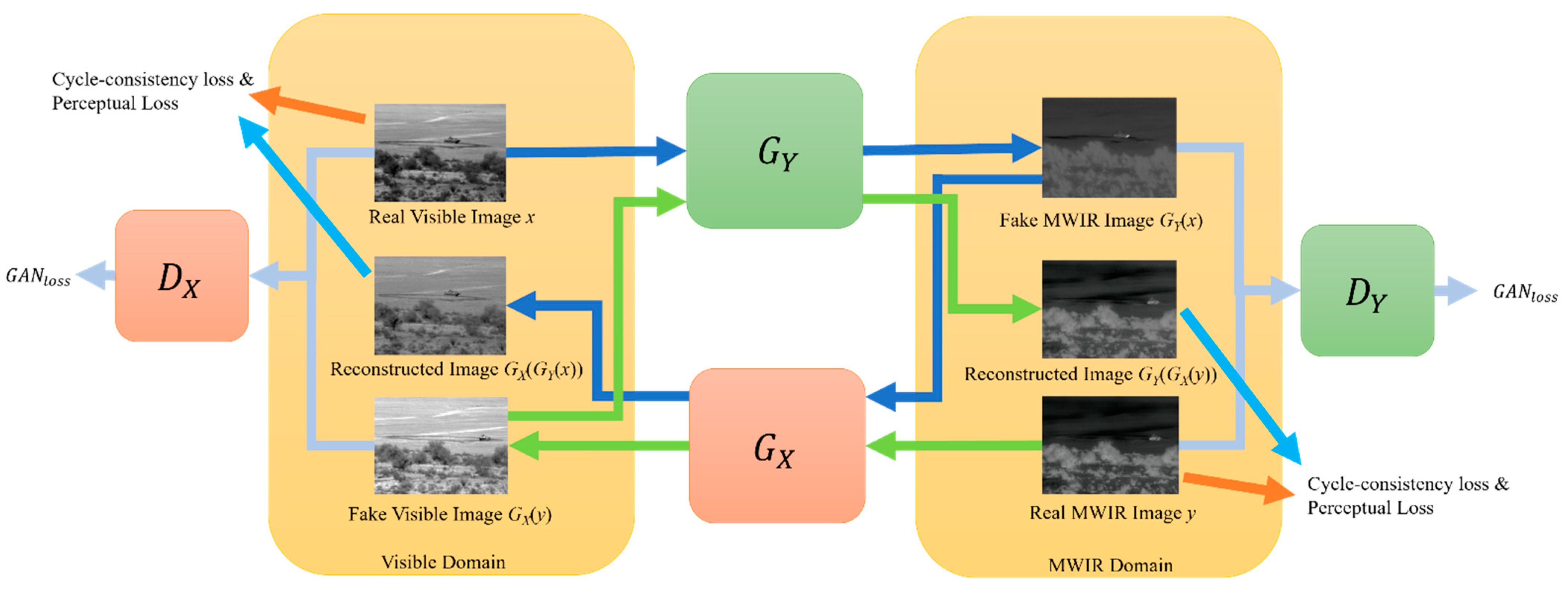
We used a model based on the architecture of CycleGAN [4]. The proposed model can perform unsupervised visible-to-MWIR image conversion using an unpaired dataset, as shown in Figure 1, which consists of two generators (GX and GY) and two discriminators (DX and DY). We used the ResNet [27] architecture for the generators proposed in CycleGAN with some modifications mentioned in [28]. Each generator has 9 residual blocks along with several convolution layers. The architecture of the generator is [c7s1-64, d128, d256, R256, R256, R256, R256, R256, R256, R256, R256, R256, u128, u64, c7s1-3], where c7s1-k represents a 7 × 7 Convolution-BatchNorm-ReLU layer having k filters with stride 1, dk represents a 3 × 3 Convolution-BatchNorm-ReLU layer having k filters with stride 2, Rk indicates a residual block containing two 3 × 3 convolutional layers with stride 1 and k filters in both layers, and uk is a 3 × 3 fractional-strided-Convolution-BatchNorm-ReLU layer having k filters with stride 1/2.
Figure 1. Framework of the proposed model for converting visible images to MWIR images. Our proposed model has two generators and two discriminators. We calculate the cycle-consistency loss and the perceptual loss using the real images (x, y) and the reconstructed images (GX(GY(x)), GY(GX(y))) along with the GAN loss during training our model. Arrows with different colors indicate signal flows through the generators and discriminators.
We used the architecture of the patch-based structure [29] for our discriminators, which achieved good performances in the previous work [3,8,28,29]. The architecture of our discriminators is [C64, C128, C256, C512, C512], where Ck represents a 4 × 4 Convolution-BatchNorm-LeakyReLU layer having k filters with stride 2. We used an adaptive average pooling layer and a convolution layer after the last layer to obtain one-dimensional output from the discriminators. A patch-based discriminator works with the image patches to determine whether the patches are real or fake. These patch-based discriminators have several advantages. They have fewer parameters than a global discriminator and can work on any image size in a fully convolutional manner [3,8]. In addition, a patch-based discriminator contributes to the fast convergence of the generator [8].

3.2. Loss Function

The overall loss function consists of three components: GAN loss, perceptual loss, and cycle consistency loss. In our model, there are two generators, GY and GX. Given the two domains, visible and MWIR, letting GY perform visible to MWIR mapping and GX MWIR to visible mapping, x is an image in the visible domain and y in the MWIR domain, GY(x) is then a generated MWIR image, and GX(y) is a generated visible image. During training, the discriminator DY discriminates y from GY(x) and DX discriminates x from GX(y).
The GAN loss component is defined as [5]
L G A N = L G A N G Y , D Y , X , Y + L G A N G X , D X , Y , X
GAN loss alone cannot generate good-quality images [5]. Since there are no paired images in the two domains, we used the cycle-consistency loss [4,24] to measure the differences between the original images (x, y) and the reconstructed images (GX(GY(x)),GY(GX(y))), encouraging the model to learn mappings that are both plausible and consistent with the input data:
L c y c = | | G X G Y x x | | 1 + | | G Y G X y y | | 1  
In our experiments, we noticed that GAN loss and cycle-consistency loss in CycleGAN cannot perform well during the translation between the two different modalities, though they worked great when two domains from the same modality were involved, which was also mentioned by the authors in [1] when they tried to perform a translation between RGB and LWIR. We also noticed that CycleGAN cannot translate the details of the objects from visible to MWIR, and the shapes of objects were often distorted. To tackle this challenge, we proposed to use the perceptual loss, LPIPS [26], by following the idea in [30]. Typically, researchers use the LPIPS loss to evaluate the perceptual similarity between two images. To calculate LPIPS, we need to collect the activations of two image patches from a pre-defined network, and LPIPS is computed based on the activations. A larger LPIPS stands for more differences that exist between the two images. Previous research shows that LPIPS matches human perception better than other metrics [26]. In our experiments, we used activations from the pre-trained AlexNet [31] model to calculate LPIPS. We calculated LPIPS between an image and its recovered version through the two translations to model geometric changes between the two images. Perceptual loss helps preserve the shape of the objects between visible images and MWIR images:
    L p e r c = LPIPS G X G Y x , x +   LPIPS G Y G X y , y
In summary, the overall loss function of our model is
  M W I R G A N l o s s = L G A N + α L c y c + β L p e r c
where α   and β   are two hyperparameters.

4. Experiment

4.1. Dataset

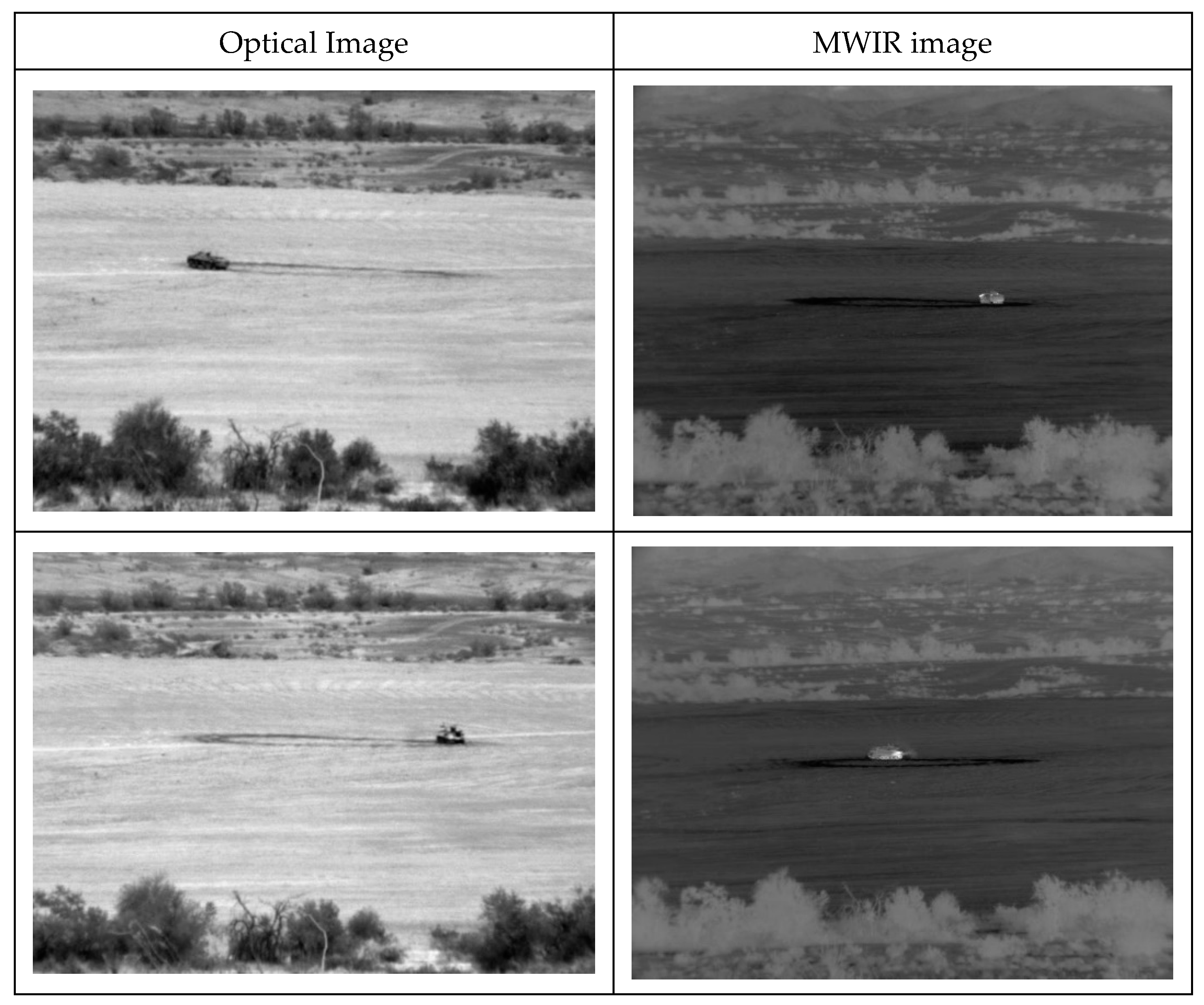
We used the ATR dataset [32], provided by the Defense Systems Information Analysis Center (DSIAC), to validate our method for visible-to-MWIR image translation. In this dataset, there are visible and MWIR videos of different vehicles taken at long distances. We extracted frames from the visible and MWIR videos to train our model. During training, 3600 frames from each domain were used to train our model. We extracted 1875 frames from the visible domain to test the trained model. The frame size of MWIR videos is 640 × 512, and the frame size of optical videos is 640 × 480. Figure 2 shows two training samples from both domains.
Figure 2. Unpaired training samples from optical and MWIR image domains.
This dataset is complex and challenging [25]. First, due to the very long distances, the sizes of the targets in the images are very small. Second, the orientation of the targets in the image changes drastically, and illuminations are different among the videos. Third, the cameras are not fixed and move during video capturing, making the video not stable. Finally, there are many differences between visible videos and MWIR videos including (1) the wavelength range of MWIR imagers is between 3 and 5 microns, but the range is between 0.4 and 0.8 microns for optical imagers; (2) MWIR cameras use heat radiation from objects for imaging and do not need any external illumination, while optical cameras need external illumination; and (3) MWIR images have many advantages including tolerance of smoke, dust, heat turbulence, and fog. Overall, MWIR is highly effective during the night for surveillance purposes, while optical cameras are preferred in the daytime.

4.2. Training Parameters

We randomly cropped 256 × 256 patches from the training images of both domains for training and used full images for testing. We noticed that using cropped patches for training achieved better results than using full images for training. We set batch sizes as 1 and 50 for the number of image buffers as suggested in [4]. We chose the hyperparameters as α = 6   and   β = 1 in Equation (4) after trial and error. We used the Adam optimizer [33] during training for optimization and trained our model for 30 epochs with a learning rate of 0.0001 which decayed to 0 after 8 epochs of training. The Pytorch framework was utilized to develop our model, and the model was trained and tested on an NVIDIA GPU with 12G memory.

5. Experiment Results

5.1. Qualitative Comparison

Figure 3 shows the MWIR images generated by the proposed model, CycleGAN [4] and AttentionGAN [25]. We can see that the MWIR images generated by AttentionGAN contain visible stripe artifacts. Overall, the quality of the images is not as good when compared to the real MWIR images. Moreover, we noticed several drawbacks of the CycleGAN model. MWIR images generated by CycleGAN lost the vehicle objects in the translated images, and the fine details of the objects were not preserved during this translation. On the other hand, our method performed better than the two competing models. The translated MWIR images preserved fine details of the objects, and the engine parts of the vehicles were appropriately highlighted due to high temperatures. Our proposed model resolved all the issues related to the MWIR images generated by AttentionGAN and CycleGAN.
Figure 3. MWIR images generated from visible images by different models. The proposed model generated best-quality MWIR images. MWIR images generated by the AttentionGAN have visible stripe artifacts. The vehicle objects are not visible in the MWIR images generated by the CycleGAN.

5.2. Quantitative Comparison

We utilized Fréchet Inception Distance (FID) [34,35] and Kernel Inception Distance (KID) [36] to quantitatively evaluate model performances in image translation. The FID and KID scores have been widely used to assess the quality of the generated images with respect to real images. For both FID and KID, smaller values denote a higher quality of synthetic images with respect to real images. Table 1 shows the FID and KID scores for the MWIR images generated by different models. It is observed that our proposed model (FID: 1.72, KID: 22.82) achieved the best results as compared to the CycleGAN model (FID: 3.28, KID: 49.69) and the AttentionGAN model (FID: 2.46, KID: 36.59) for visible-to-MWIR image translation, which is consistent with the qualitative observations in Figure 3. The FID and KID scores of the proposed model are the lowest among all the models considered.
Table 1. Quantitative comparison among different methods. Bold numbers indicate best-performing methods.

6. Ablation Study

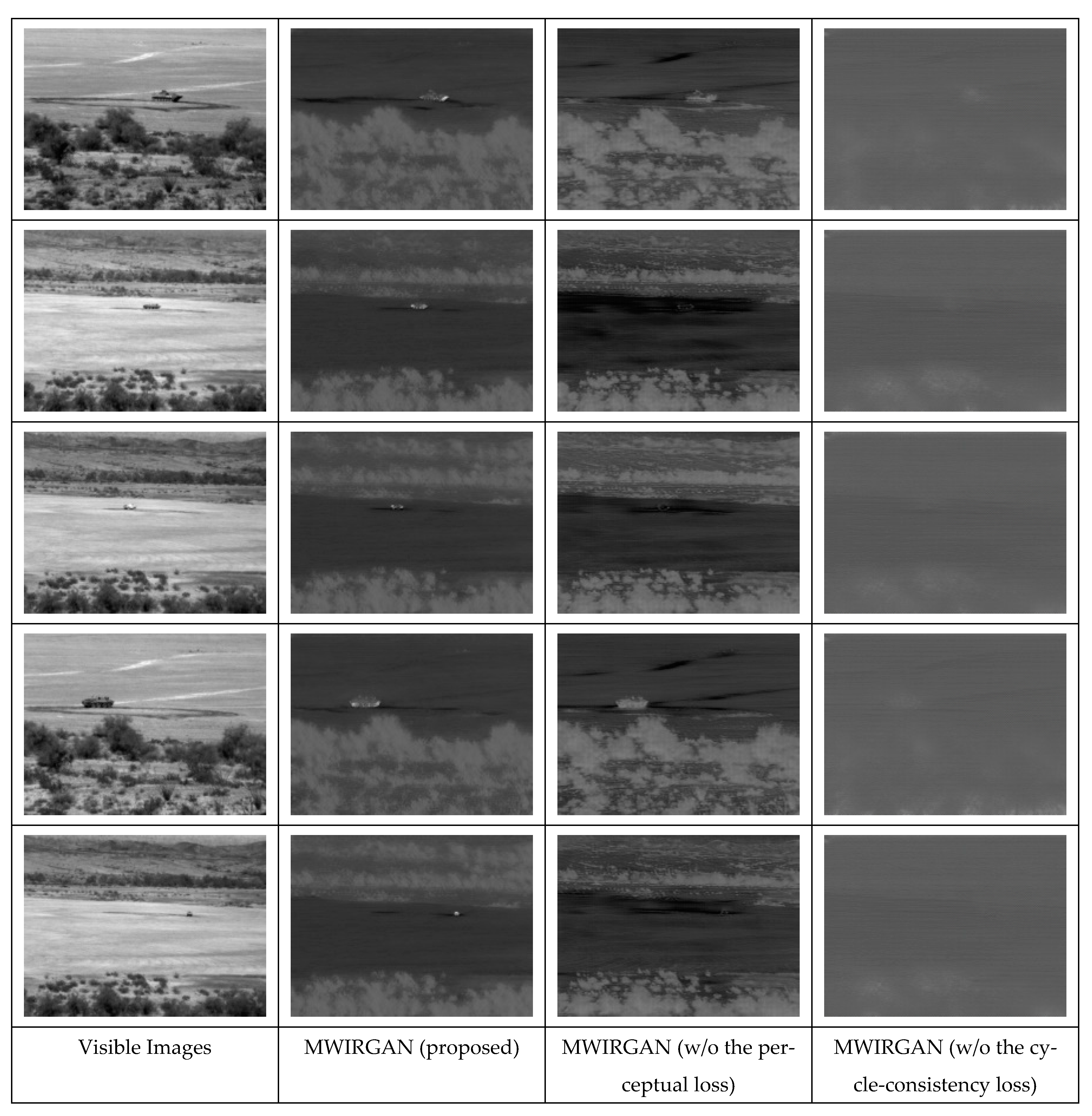
We conducted an ablation study to investigate the contribution of each of the loss function components in the proposed model. Figure 4 shows the results of the ablation study. First, we removed the perceptual loss from the overall loss function and kept the cycle-consistency loss and GAN loss. With this configuration, we noticed that the model experienced mode collapsed due to the absence of perceptual loss and could not translate objects in the visible domain to the MWIR domain. For visible images captured at the 1000 m distance, the model could not highlight vehicles properly (such as the engine part), and for the 2000 m distance images, the model totally omitted vehicles that were missed in the translated MWIR images. Second, we removed the cycle-consistency loss from the total loss and performed image translation with the modified model. This configuration achieved the worst result as it could not translate the visible image into the MWIR domain, keeping all objects intact. Table 2 shows the quantitative results of the ablation study. We can see that both loss function components are important, and the proposed model did not function properly without either of them.
Figure 4. Ablation study results. The results show that both perceptual loss and cycle-consistency loss are essential for obtaining good-quality MWIR images.
Table 2. Qualitative comparison of our ablation study. Bold numbers indicate best-performing methods.

7. Converting Game-Engine-Generated Images to MWIR Images

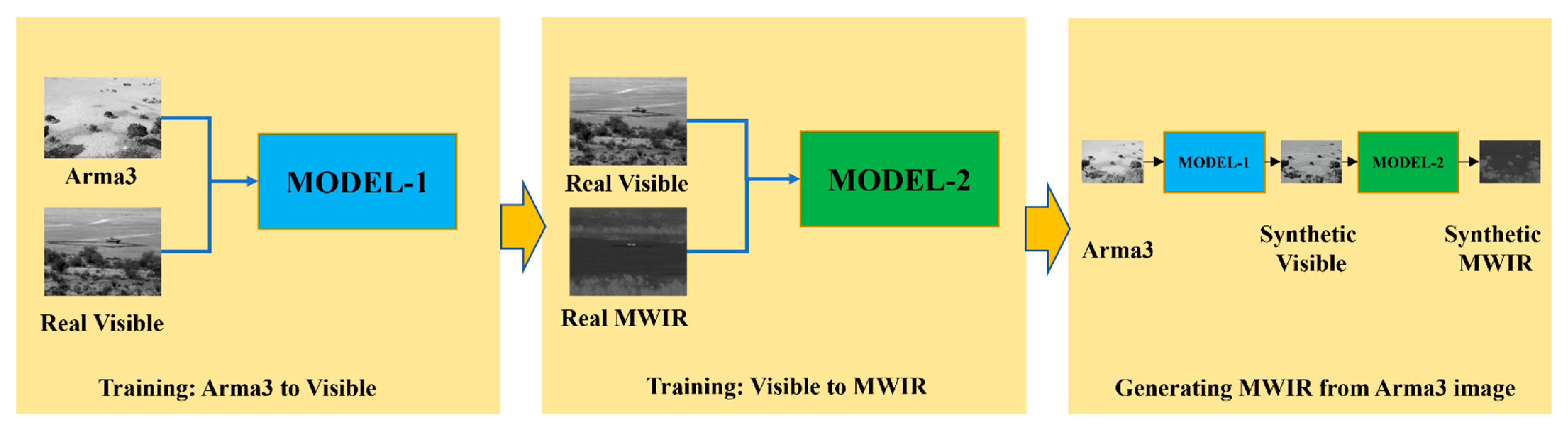
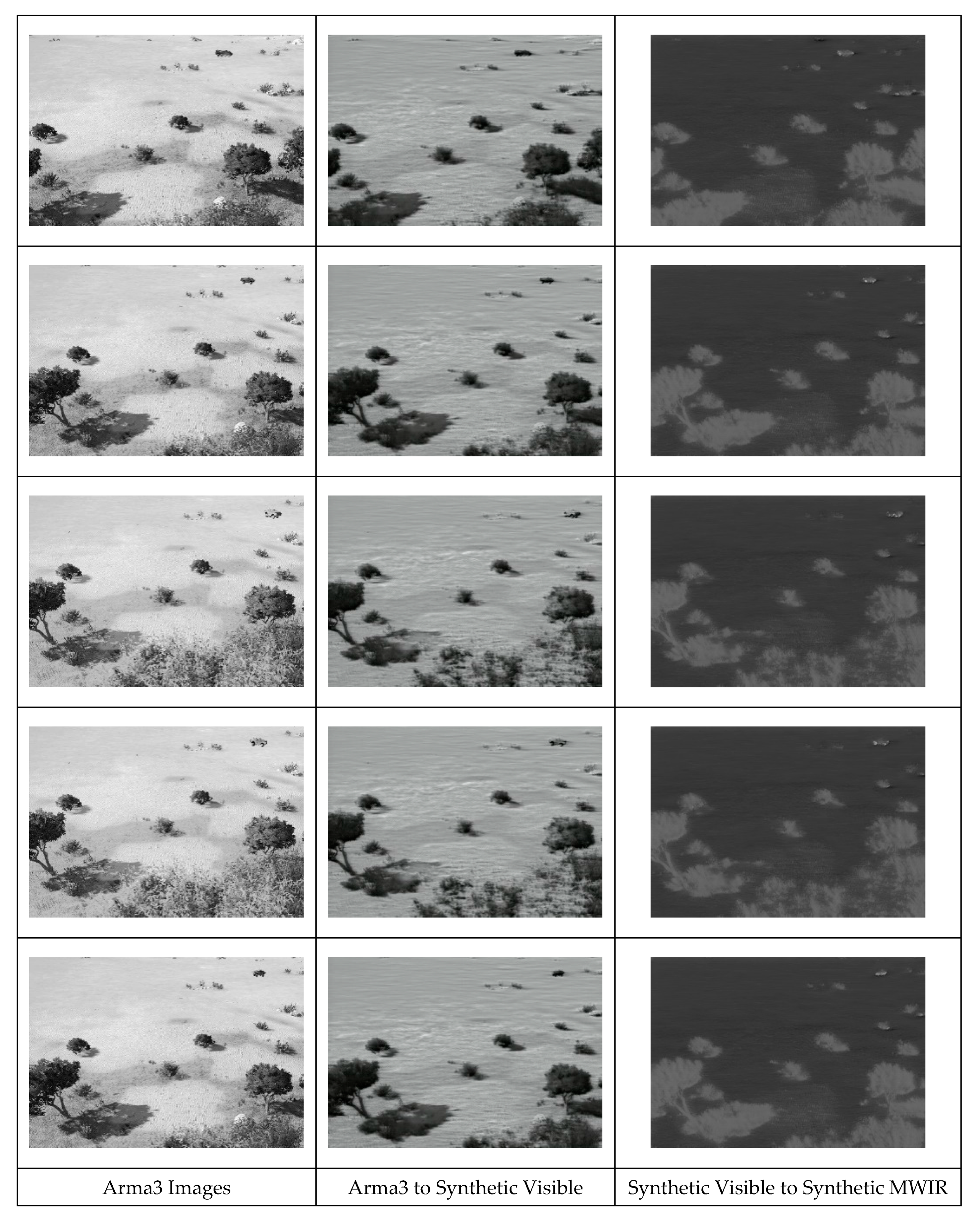
As a case study, we applied the proposed model to convert synthetic visible images from Arma 3 [37], generated by the Real Virtuality 4 engine [37], to MWIR images. This was a two-step process. First, we trained the proposed model to convert the game-engine-generated synthetic visible images to real visible images. We utilized 3600 unpaired game-engine-generated images and 3600 real visible images to train the model. Second, we applied our original trained model to convert the converted real visible images to MWIR images. Figure 5 shows the diagram of the two-step method for converting game-engine-generated images to MWIR images. Figure 6 shows the results of the proposed model. It is observed that our proposed technique could generate MWIR images from Arma-3-generated images. In the generated MWIR images, vehicles were correctly highlighted with engine parts being brighter than other objects. The quantitative results of the generated MWIR images from the game engine images are listed in Table 3. We also compared the generated MWIR images with those generated from real visible images. According to the quantitative results, the quality of synthetic MWIR images from Arma 3 (using our model) was better (FID: 2.72, KID: 41.84) than the MWIR image from the real visible image (FID: 3.28, KID: 49.69) generated by CycleGAN. As expected, the quality of the synthetic MWIR images from the Arma 3 images (FID: 2.72, KID: 41.84) was worse than that of the synthetic MWIR images from the real visible images (FID: 1.72, KID: 22.82).
Figure 5. Illustration of the proposed two-step technique for generating MWIR images from game-engine-generated images.
Figure 6. MWIR images generated from game-engine-generated synthetic images using our technique.
Table 3. Quantitative evaluation of the translation from game-engine-generated images to MWIR images.

8. Conclusions

In this paper, we proposed the MWIRGAN model for visible-to-MWIR image translation. We generated MWIR images from visible images in an unsupervised manner without using any paired datasets. Our proposed method was able to translate visible images into MWIR images successfully by keeping fine details and overall structures in the image. The proposed model outperformed several competing state-of-the-art methods. In addition, we customized the proposed model to convert game-engine-generated images to MWIR images in a two-step process. This work will mitigate the data scarcity challenge in the MWIR domain and will advance the research in this area.

Author Contributions

Conceptualization, C.K. and J.L.; methodology, M.S.U., C.K., and J.L.; software, M.S.U.; formal analysis, M.S.U., C.K., and J.L.; validation, M.S.U., C.K., and J.L.; investigation: M.S.U., C.K., and J.L.; resources, C.K. and J.L.; data curation, C.K. and M.S.U.; writing—original draft preparation, M.S.U., C.K., and J.L.; writing—review and editing, M.S.U. and J.L.; supervision, C.K. and J.L.; project administration, C.K. and J.L. All authors have read and agreed to the published version of the manuscript.

Funding

This research received no external funding.

Data Availability Statement

The ATR dataset is available on https://dsiac.org/databases/atr-algorithm-development-image-database/, accessed on 1 January 2020.

Conflicts of Interest

The authors declare no conflict of interest.

References

  1. Abbott, R.; Robertson, N.M.; Martinez del Rincon, J.; Connor, B. Unsupervised Object Detection via LWIR/RGB Translation. In Proceedings of the IEEE/CVF Conference on Computer Vision and Pattern Recognition Workshops, Seattle, WA, USA, 14–16 June 2020; pp. 90–91. [Google Scholar]
  2. Kniaz, V.V.; Knyaz, V.A.; Hladuvka, J.; Kropatsch, W.G.; Mizginov, V. Thermalgan: Multimodal color-to-thermal image translation for person re-identification in multispectral dataset. In Proceedings of the European Conference on Computer Vision (ECCV), Munich, Germany, 8–14 September 2018. [Google Scholar]
  3. Isola, P.; Zhu, J.-Y.; Zhou, T.; Efros, A.A. Image-to-image translation with conditional adversarial networks. In Proceedings of the IEEE Conference on Computer Vision and Pattern Recognition, Honolulu, HI, USA, 21–26 July 2017; pp. 1125–1134. [Google Scholar]
  4. Zhu, J.-Y.; Park, T.; Isola, P.; Efros, A.A. Unpaired image-to-image translation using cycle-consistent adversarial networks. In Proceedings of the IEEE International Conference on Computer Vision, Venice, Italy, 22–29 October 2017; pp. 2223–2232. [Google Scholar]
  5. Goodfellow, I.; Pouget-Abadie, J.; Mirza, M.; Xu, B.; Warde-Farley, D.; Ozair, S.; Courville, A.; Bengio, Y. Generative adversarial nets. In Advances in Neural Information Processing Systems; Ghahramani, Z., Welling, M., Cortes, C., Lawrence, N.D., Weinberger, K.Q., Eds.; Curran Associates, Inc.: Red Hook, NY, USA, 2014; Volume 27, pp. 2672–2680. [Google Scholar]
  6. Liu, M.-Y.; Tuzel, O. Coupled generative adversarial networks. arXiv 2016, arXiv:1606.07536. [Google Scholar]
  7. Brock, A.; Donahue, J.; Simonyan, K. Large scale GAN training for high fidelity natural image synthesis. arXiv 2018, arXiv:1809.11096. [Google Scholar]
  8. Kim, T.; Cha, M.; Kim, H.; Lee, J.K.; Kim, J. Learning to discover cross-domain relations with generative adversarial networks. In Proceedings of the International Conference on Machine Learning, Sydney, Australia, 6–11 August 2017. [Google Scholar]
  9. Hoffman, J.; Tzeng, E.; Park, T.; Zhu, J.Y.; Isola, P.; Saenko, K.; Efros, A.; Darrell, T. Cycada: Cycle-consistent adversarial domain adaptation. In International Conference on Machine Learning; PMLR: Grenoble, France, 2018; pp. 1989–1998. [Google Scholar]
  10. Zhang, R.; Isola, P.; Efros, A.A. October. Colorful image colorization. In European Conference on Computer Vision; Springer: Cham, Switzerland, 2016; pp. 649–666. [Google Scholar]
  11. Wu, B.; Duan, H.; Liu, Z.; Sun, G. SRPGAN: Perceptual generative adversarial network for single image super resolution. arXiv 2017, arXiv:1712.05927. [Google Scholar]
  12. Zhang, L.; Gonzalez-Garcia, A.; van de Weijer, J.; Danelljan, M.; Khan, F.S. Synthetic data generation for end-to-end thermal infrared tracking. IEEE Trans. Image Process. 2018, 28, 1837–1850. [Google Scholar] [CrossRef] [PubMed]
  13. Han, J.; Shoeiby, M.; Petersson, L.; Armin, M.A. Dual contrastive learning for unsupervised image-to-image translation. In Proceedings of the IEEE/CVF Conference on Computer Vision and Pattern Recognition, Online, 19–25 June 2021; pp. 746–755. [Google Scholar]
  14. Sun, T.; Jung, C.; Fu, Q.; Han, Q. NIR to RGB domain translation using asymmetric cycle generative adversarial networks. IEEE Access 2019, 7, 112459–112469. [Google Scholar] [CrossRef]
  15. Perera, P.; Abavisani, M.; Patel, V.M. In2i: Unsupervised multi-image-to-image translation using generative adversarial networks. In Proceedings of the 24th International Conference on Pattern Recognition (ICPR), Beijing, China, 20–24 August 2018. [Google Scholar]
  16. Uddin, M.S.; Li, J. Generative adversarial networks for visible to infrared video conversion. In Recent Advances in Image Restoration with Applications to Real World Problems; Kwan, C., Ed.; IntechOpen: London, UK, 2020; pp. 285–289. [Google Scholar] [CrossRef]
  17. Mehri, A.; Sappa, A.D. Colorizing near infrared images through a cyclic adversarial approach of unpaired samples. In Proceedings of the IEEE Conference on Computer Vision and Pattern Recognition Workshops (CVPRW), Long Beach, CA, USA, 16–17 June 2019. [Google Scholar]
  18. Suarez, P.; Sappa, A.; Vintimilla, B. Infrared image colorization based on a triplet DCGAN architecture. In Proceedings of the IEEE Conference on Computer Vision and Pattern Recognition Workshops (CVPRW), Honolulu, HI, USA, 21–26 July 2017; pp. 212–217. [Google Scholar]
  19. Liu, S.; John, V.; Blasch, E.; Liu, Z.; Huang, Y. IR2VI: Enhanced night environmental perception by unsupervised thermal image translation. In Proceedings of the IEEE/CVF Conference on Computer Vision and Pattern Recognition Workshops (CVPRW), Salt Lake City, UT, USA, 18–22 June 2018. [Google Scholar]
  20. Ahlberg, J.; Felsberg, M. Generating visible spectrum images from thermal infrared. In Proceedings of the IEEE/CVF Conference on Computer Vision and Pattern Recognition Workshops (CVPRW), Salt Lake City, UT, USA, 18–22 June 2018; pp. 1224–122409. [Google Scholar]
  21. Mizginov, V.A.; Danilov, S.Y. "Synthetic Thermal Background and Object Texture Generation Using Geometric Information and GAN. Int. Arch. Photogramm. Remote Sens. Spat. Inf. Sci. 2019, XLII-2/W12, 149–154. [Google Scholar] [CrossRef]
  22. Kniaz, V.V.; Mizginov, V.A. Thermal Texture Generation and 3D Model Reconstruction Using SFM and GAN. Int. Arch. Photogramm. Remote Sens. Spat. Inf. Sci. 2018, XLII-2, 519–524. [Google Scholar] [CrossRef]
  23. Yuan, X.; Tian, J.; Reiartz, P. Generating artificial near infrared spectral band from rgb image using conditional generative adversarial network. ISPRS Ann. Photogramm. Remote Sens. Spat. Inf. Sci. 2020, V-3-2020, 279–285. [Google Scholar] [CrossRef]
  24. Yun, K.; Yu, K.; Osborne, J.; Eldin, S.; Nguyen, L.; Huyen, A.; Lu, T. Improved visible to IR image transformation using synthetic data augmentation with cycle-consistent adversarial networks. In Pattern Recognition and Tracking XXX; International Society for Optics and Photonics: Bellingham, WA, USA, 2019; Volume 10995, p. 1099502. [Google Scholar]
  25. Uddin, M.S.; Hoque, R.; Islam, K.A.; Kwan, C.; Gribben, D.; Li, J. Converting optical videos to infrared videos using attention gan and its impact on target detection and classification performance. Remote Sens. 2021, 13, 3257. [Google Scholar] [CrossRef]
  26. Zhang, R.; Isola, P.; Efros, A.A.; Shechtman, E.; Wang, O. The unreasonable effectiveness of deep features as a perceptual metric. In Proceedings of the IEEE Conference on Computer Vision and Pattern Recognition, Salt Lake City, UT, USA, 18–23 June 2018; pp. 586–595. [Google Scholar]
  27. He, K.; Zhang, X.; Ren, S.; Sun, J. Deep residual learning for image recognition. In Proceedings of the IEEE Conference on Computer Vision and Pattern Recognition, Las Vegas, NV, USA, 27–30 June 2016; pp. 770–778. [Google Scholar]
  28. Tang, H.; Xu, D.; Sebe, N.; Yan, Y. Attention-guided generative adversarial networks for unsupervised image-to-image translation. In Proceedings of the 2019 International Joint Conference on Neural Networks (IJCNN), Budapest, Hungary, 14–19 July 2019; IEEE: Piscataway, NJ, USA, 2019; pp. 1–8. [Google Scholar]
  29. Radford, A.; Metz, L.; Chintala, S. Unsupervised Representation Learning with Deep Convolutional Generative Adversarial Networks. arXiv 2015, arXiv:1511.06434. [Google Scholar]
  30. He, J.; Uddin, M.S.; Canan, M.; Sousa-Poza, A.; Kovacic, S.; Li, J. Ship Deck Segmentation Using an Attention Based Generative Adversarial Network. In Proceedings of the 2022 IEEE 13th Annual Ubiquitous Computing, Electronics & Mobile Communication Conference (UEMCON), New York, NY, USA, 26–29 October 2022; IEEE: Piscataway, NJ, USA, 2022; pp. 367–372. [Google Scholar]
  31. Krizhevsky, A.; Sutskever, I.; Hinton, G.E. Imagenet classification with deep convolutional neural networks. Commun. ACM 2017, 60, 84–90. [Google Scholar] [CrossRef]
  32. ATR Dataset. Available online: https://www.dsiac.org/resources/available-databases/atr-algorithm-development-image-database/ (accessed on 1 January 2020).
  33. Kingma, D.; Ba, J. Adam: A method for stochastic optimization. In Proceedings of the ICLR, Banff, AB, Canada, 14–16 April 2014. [Google Scholar]
  34. Heusel, M.; Ramsauer, H.; Unterthiner, T.; Nessler, B.; Hochreiter, S. Gans trained by a two time-scale update rule converge to a local nash equilibrium. In Advances in Neural Information Processing Systems; MIT Press: Cambridge, MA, USA, 2017; pp. 6626–6637. [Google Scholar]
  35. Fréchet, M. Sur la distance de deux lois de probabilité. Comptes Rendus Hebd. Seances L Acad. Des Sci. 1957, 244, 689–692. [Google Scholar]
  36. Bińkowski, M.; Sutherland, D.J.; Arbel, M.; Gretton, A. Demystifying mmd gans. arXiv 2018, arXiv:1801.01401. [Google Scholar]
  37. Arma3. Available online: https://arma3.com/features/engine (accessed on 1 January 2020).
Disclaimer/Publisher’s Note: The statements, opinions and data contained in all publications are solely those of the individual author(s) and contributor(s) and not of MDPI and/or the editor(s). MDPI and/or the editor(s) disclaim responsibility for any injury to people or property resulting from any ideas, methods, instructions or products referred to in the content.

Article Metrics

Citations

Article Access Statistics

Multiple requests from the same IP address are counted as one view.