1. Introduction
Over recent years, the integration of artificial intelligence (AI) methodologies into educational frameworks has witnessed a substantial increase. The unforeseen educational disruptions caused by the COVID-19 pandemic have further hastened this trend. In this context, intelligent tutoring systems (ITS) have emerged as a focal point in AI-driven educational endeavors. The crux of ITS’s success lies in their capacity to ascertain the present knowledge levels of individual students and subsequently present pertinent questions, leveraging the vast datasets acquired from online learning environments.
The knowledge tracing (KT) task aims to predict future achievement by tracing learners’ current understanding of knowledge based on their past learning history. According to past correct/incorrect answers for each knowledge concept, it is determined to what extent the learner has acquired the knowledge [
1]. KT approaches are crucial in contemporary online learning platforms, where they play a vital role in automatically gauging the knowledge levels of numerous students [
2]. These platforms strive to enhance learning outcomes significantly by offering personalized feedback and recommendations tailored to each individual [
3]. Tracing the user’s knowledge state from the learning perspective is complex enough that numerous factors, such as the question’s difficulty, the order of problem-solving, and the process of forgetting, must be considered [
4].
Capturing cognitive relations among the learning materials, such as prerequisite relations, by leveraging a knowledge structure inspired by the existing pedagogical literature [
5] can be an alternative to the complexity. For example, the knowledge structure can be regarded as a chain-type directed acyclic graph based on the question difficulty for simplicity. In particular, it is essential to consider the difficulty of questions to track the user’s current knowledge state accurately. Without considering the difficulty of the question, if the user’s knowledge state is estimated only from the distribution of questions answered correctly versus questions responded to, an overestimation problem occurs in the case of difficulty imbalance [
6]. Furthermore, difficulty consideration is even more crucial in the field of foreign language learning, such as English proficiency assessment, because subtle differences in difficulty play a significant role in learners acquiring a foreign language.
Figure 1 shows test examples of the Test of English for International Communication (TOEIC). According to the examples, (a) is a question that can be solved within a short time if one knows that the gerund comes after ’after’, whereas (b) is a question that needs to capture subtle meaning differences in context while distinguishing intransitive/transitive verbs. Previous studies for the KT task that utilize the difficulty factor exist. However, they use the difficulty only for secondary purposes for augmenting data or adopt complicated model structures only for the difficulty, reducing versatility [
6,
7].
Therefore, we explore how to effectively reflect question difficulty in a general-purpose self-attentive KT model by applying various experimental methods, in order to serve as a reference indicator for the experimental aspect of future research. In particular, our methods are verified with a focus on tracing the learner’s knowledge state in the field of English proficiency assessment, which is designed by adequately arranging the difficulty level. The three experimental methods to ensure the model leverages the difficulty effectively are as follows; (i) input feature diversification: feeding difficulty information into the model as variants of input features; (ii) difficulty prediction: having the model predict the question difficulty to enhance understanding of the difficulty of the problem by employing the multi-task learning (MTL) manner; and (iii) representation enrichment: enriching the output representation in the latent vector dimension. In detail, the question sequence is organized in a specific order based on the probability of the correct answer computed from the training data. More complex structures can be readily adopted for the knowledge structure. Moreover, we provide additional analysis regarding the training time and dimensions of the model. The experimental results show that providing difficulty as a training feature and enriching the representation is consistent with performance improvement. In addition, as the learning time and model dimension increase, the gap in the positive effect on performance widens.
2. Related Works
2.1. E-learning and Cybernetic Pedagogy
E-learning, also referred to as electronic learning, is a structured educational system that utilizes electronic resources [
8]. Due to information technology (IT) advancements, e-learning has gained widespread acceptance within the education sector, particularly in higher education. Nearly 99% of institutions have implemented learning management systems (LMSs), with approximately 85% actively utilizing them [
9]. The recent challenges posed by the COVID-19 pandemic have prompted the expansion of online learning, encompassing diverse modalities such as intelligent tutoring systems and massive open online courses, all of which have become crucial in mitigating disruptions to the field of education [
10,
11].
In order to improve understanding of e-learning systems, it is necessary to describe existing research in the field of cybernetic pedagogy, a fundamental theory that explains the human learning process. The authors in [
12] developed a cybernetic pedagogy that was based on natural sciences, and [
13] set the cybernetic foundations for learning and teaching. Cybernetic pedagogy, which is a scientific discipline of how a learning process can be influenced, leads to significant updates and is a useful basis for modern intelligent learning environments.
In the realm of cybernetic pedagogy, the foundational premises encompass:
The delineation and examination of instructional and learning trajectories manifest in subsidiary systems, and their role in rendering the educational procedure objective. This entails the transition of all undertakings from human-operated domains to technological infrastructures or software applications.
Scrutiny of the interconnections and consequential impacts between objective (technological) and subjective (human) components of the educational mechanism, such as appraising the interplay between a human educator and digital instructional resources with an aim to fulfill established pedagogical objectives.
Elucidation of the ties amongst varying forms of subsidiary systems within a specified educational framework.
Within the academic sphere of online intelligent education, a learning process can be technologically manifested as an intelligent tutoring system. In this context, it necessitates the incorporation of a pedagogic algorithm, explicitly articulated through symbolic representations grounded in mathematical logic. This algorithm takes into consideration five conditional variables: L (learning material), M (media), P (psychological structure), S (social structure), and Z (setting learning goals). In other words, the learning process can be systematically represented as an integrative educational model, amalgamating all the previously mentioned components into a cohesive entity [
12,
14].
From an e-learning perspective, the teacher, students, learning process, and the organization of lessons collectively constitute a distinct subsystem within an educational system [
15]. Considering that an e-learning system is an information system that combines human elements (such as learners and instructors) with non-human components (such as learning management systems), it is essential to explore various aspects of success concerning both of these components [
16]. Since the spread of e-learning, research has been conducted on various aspects. Traditionally, earlier studies placed greater emphasis on the technology itself. However, with the growing reliability and accessibility of technology, contemporary research has increasingly centered on understanding the attitudes and interactions of both students and instructors, recognizing their pivotal roles in e-learning’s success [
17,
18].
2.2. Various Branches in Knowledge Tracing
The knowledge tracing (KT) task, which models the human cognitive process, encompasses concepts such as the knowledge concept, knowledge state, and interaction. A knowledge concept refers to a specific concept to which a question belongs, akin to a skill class. For instance, in the English education domain, knowledge concepts can consist of grammar, reading comprehension, and vocabulary. Knowledge state is an evaluative measure of a learner’s grasp and acquisition of knowledge concepts based on prior learning records. In addition, interaction in the KT task refers to a set of questions a user solves during a specific period, along with the outcomes for the questions.
A KT task is a long-standing task that has been studied since before the era when deep learning was prevalent, and the approach has branched into various streams based on perspectives on how to model human cognition. Before the advent of deep learning, the most conventional methodology was Bayesian knowledge tracing (BKT), which draws inspiration from mastery learning in educational psychology, representing a learner’s KS as binary latent variables [
1]. Building upon the methodology of BKT, subsequent research has expanded the tracing techniques by introducing features such as difficulty, cognitive factors, and multiple knowledge concepts into KT models [
19,
20,
21]. The initial deep learning-based methodology is deep knowledge tracing (DKT), which departs from analyzing users and extracting static features, instead utilizing problem-solving response records (correct/incorrect responses to questions) as sequential data within a recurrent neural network framework to predict the probability of correct answers for unseen questions [
22]. However, there is a problem in that the learning state is stored as a single hidden state without distinction for a specific concept, and the interpretability for individual students needs to be improved.
Inspired by the DKT model, various deep learning-based studies have emerged, such as attentive KT models and memory-augmented KT models [
4]. Zhang et al. [
20] introduced the dynamic key-value memory networks for KT, which model the knowledge state for individual students using key matrix-value matrix pairs with the concept of human memory. In addition, research to improve the tracing ability by advancing the model structure has emerged, including self-attention-based KT studies. Pandey and Karypis [
23] applied the self-attention mechanism for the first time in a KT task. This approach benefits the generalization to sparse data where only a few students interact with a given knowledge concept by assigning attention weights to the concept that are related to previously answered questions. In order to capture the relation between questions and answers even when prior learning records are limited, Somepalli et al. [
24] constructed the embedding of questions as input for the encoder and the embedding of responses (interactions) as input for the decoder. By extending this approach, Shin et al. [
25] further expanded the type of considered factors, including the temporal information, such as the time taken to solve the problem, resulting in enhanced model performance.
2.3. Question Difficulty in Knowledge Tracing
The question difficulty that we focus on is an essential factor to model the human learning process, not only within KT tasks but also to the extent that other downstream tasks that solely predict the question difficulty exist [
26,
27,
28]. Utilizing the difficulty levels associated with given questions and knowledge concepts plays a crucial role in tracking students’ knowledge states. This is because questions in the assessment cannot be of the same difficulty level, and the proper question distribution based on the question difficulty is important during test design [
29,
30]. Furthermore, without consideration of difficulty during the learning process, KT-based application tasks may prove challenging. For instance, in the student learning curricula, receiving only excessively challenging problems relative to students’ level can diminish the desire to achieve, whereas consistently encountering overly simple problems might lead to reduced interest [
31,
32].
Among KT studies, there have been attempts to modify the model with the difficulty factor or deliberately exploit it as a training feature. For example, [
6] designed a model structure for computing user knowledge acquisition, including the difficulty. In detail, the subjective difficulty that students perceive in the question is measured before the actual evaluation and used for initialization. After the evaluation, the student’s knowledge states are updated based on the newly obtained difficulty level. Lee et al. [
7] adopted a question replacement strategy according to the difficulty in terms of data augmentation. It is assumed that if a learner cannot solve a particular question, he or she will not be able to solve a more difficult question, and conversely, if they can solve it, they will be able to solve a more manageable problem.
However, the existing studies either build a complex model structure only for considering the difficulty factor or use difficulty only as a secondary factor, which hinders application to pre-trained language models (PLMs) with general-purpose yet powerful performance. It is necessary to explore how to dissolve desired features properly, i.e., difficulty factors based on a general-purpose model such as the already existing Transformers structure. Therefore, this study focuses on exploring methods enabling self-attention-based models to leverage the difficulty factor effectively.
3. Materials and Methods
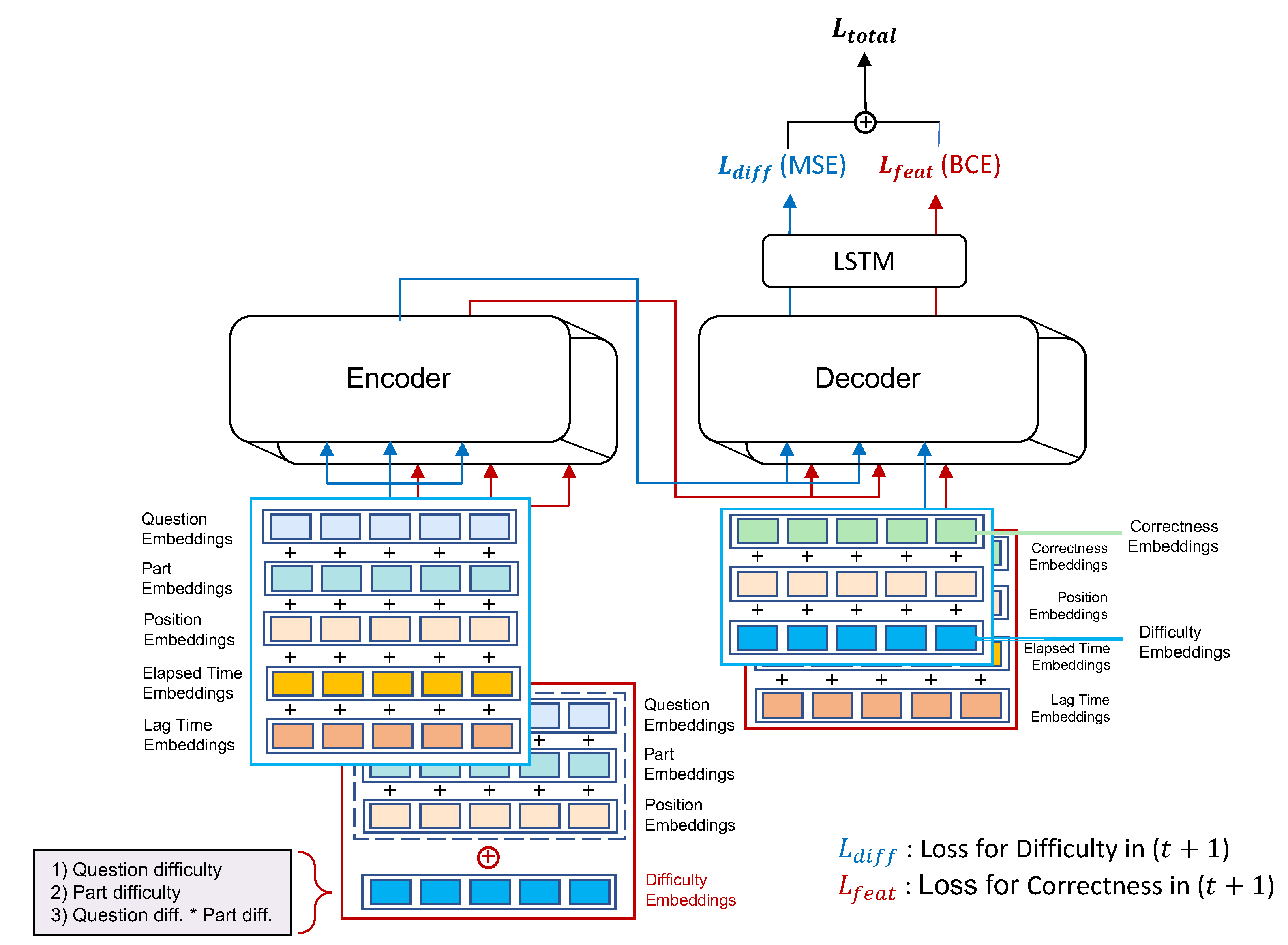
We introduce the following three approaches to allow the model to effectively leverage the difficulty factor: (i) feeding the variants of input features with difficulty to the model; (ii) learning the model using the MTL method, while adding an objective to predict the difficulty; and (iii) enriching the representation including the difficulty information output in the latent vector dimension through phases (i) and (ii).
Figure 2 illustrates the overall structure of the model to which our exploration methods are applied, and the Transformers model with an encoder–decoder structure that shows good performance in the KT task is used as the base model, following Shin et al. [
25]. In the original SAINT+ model, question and part information is fed into the encoder module, and correctness and temporal information (i.e., elapsed time, lag time) are fed into the decoder module. However, unlike the original SAINT+ model’s input structure, which is the baseline, we modify the input structure to account for the difficulty factor.
3.1. Notations and KT Task Statement
Let us first elaborate on the basic denotations for the KT task. We denote the user set as with different users, and the question set as with unique questions. A user’s learning interactions (i.e., previous learning history) are denoted as , where each interaction consists of (, ), a tuple of question and response correctness at time t. is the question answered at time step t and is the corresponding response correctness label. In other words, is 1 when the response is correct and 0 otherwise.
The KT task is formulated for predicting the probability of a student’s answer to a particular question being correct given their previous interaction histories. Therefore, the KT task aims to estimate the probability,
3.2. Input Features Diversification
First, to diversify the input features through difficulty information, the difficulty is computed based on learners’ response accuracy and provided together as input. Each input of the encoder and decoder is reconstructed, including configured difficulty embedding. Difficulty information is composed of question difficulty, part difficulty, or question difficulty weighted by a relevant part weight. The red boxes and lines in the bottom left of
Figure 2 indicate the input features fed into the model. In particular, followed by Shin et al. [
25]’s input structure, part information is included along with the question in the encoder part, and the obtained difficulty vector is concatenated together and provided as input.
3.2.1. Question Difficulty
The question difficulty level is computed through distributional knowledge estimated based on response correctness information for a specific question. In other words, when constructing the difficulty vector, the individual difficulty
D calculated based on
, which is the correct answer to question
, is used and can be formalized as follows:
where
is a set of users who answer the question
, and
is the i-th user’s response correctness corresponding to the j-th question. In addition,
is a k-th component from
P, a set of weights for each part relevant to a specific problem
q, and fixed to 1 if not used as a weight. When
is used as a weight,
P is a set of heuristically defined weights or part difficulties, and the method for obtaining it is described below.
3.2.2. Part Difficulty
Part difficulty p is calculated through distributional knowledge for each part instead of estimating the distribution for individual questions. In other words, the difficulty is obtained based on the corresponding part for each question, and the formula is calculated based on the response correctness r, in the same way as the question difficulty.
3.2.3. Question Difficulty Weighted by Part
A weighted question difficulty set is obtained by multiplying the weight for each part by the already calculated question difficulty. The type of weight set is divided into two cases. The first is ‘Heuristic’, which consists in setting the ratio fixedly according to the part. In particular, the English proficiency evaluation is divided into several parts, and although it may differ depending on the question, there is actually a more difficult part. In the case of TOEIC, in reading comprehension, part 7, which infers problems through reading long sentences, is more complicated than part 5, which consists of vocabulary and grammar problems such as idioms that can be solved quickly through memorization. In listening comprehension, part 4, where the questions should be answered by listening to a long monologue such as a phone recording, is more difficult than part 1, which one must match sentences describing the situation by looking at pictures. Part 3 is usually the most difficult of the parts, as the conversation between multiple speakers should be understood, and the details grasped. Therefore, based on this difficulty tendency for parts, pre-defined weights are multiplied according to the part to which the question belongs. The second case is ‘Distribution’, where the difficulty is calculated through the aggregation of the question difficulty and the part difficulty. As described above, the part difficulty set is calculated through distribution according to the correct answer rate for each part.
For the training objective, since the goal is to predict response correctness
for
, binary cross-entropy (BCE) loss is employed. The objective is formulated as follows:
where
is the correctness predicted by the model for the j-th question
.
3.3. Difficulty Prediction
We introduce a training objective that allows the model to predict the difficulty level of question
at time
, where response correctness must be predicted, verifying its effectiveness. In other words, by training the model in an MTL manner, we allow the model to learn information related to difficulty directly. The blue boxes and lines in
Figure 2 indicate input features employed for MTL. For the model to effectively predict the difficulty, the question, part, and temporal data are input into the encoder part, and the correct answer and difficulty data are used as input features of the decoder.
The difficulty feature is a vector composed of float-type labels, i.e., continuous distribution knowledge. Therefore, we compute the average of the squared differences between actual difficulty values and predicted difficulty values by adopting the mean squared error (MSE) loss. It is trained by utilizing the objective as follows:
where
and
are the actual difficulty and the difficulty value predicted by the model, respectively. The entire MTL model is trained as a joint loss between the loss
(
Section 3.2) of the model having the input structure including the difficulty feature and the loss
of the model predicting the difficulty as follows:
.
3.4. Representation Enrichment
This section explores how to enhance the quality of representations that reflect the difficulty factor output through
Section 3.2 and
Section 3.3. Since the user’s learning history information has a sequential data structure, we enrich the pooler output from the decoder of the backbone model by using an additional layer that can deal with these characteristics well. In detail, the output representation is improved by passing the vector from the Transformer model into the LSTM [
33] before being fed to the linear layer for label classification.
4. Experiments
4.1. Experimental Setup
The hyperparameters for the experiments are detailed in
Appendix A.
4.1.1. Dataset
As a dataset for our experiments, we experimented with actual user learning assessment data from TOEIC, a representative English language education assessment. The EdNet dataset is a comprehensive resource that captures various aspects of student actions in an intelligent tutoring system (ITS) [
34]. It encompasses a vast scale, with over 131 million interactions from more than 780,000 students since 2017. This dataset provides a diverse range of interactions, including learning materials consumption, responses, and time spent on tasks. It also offers a hierarchical structure, categorizing data points into four levels based on the complexity of actions. The EdNet dataset has multiple versions, and the EdNet-KT1 version is used in this experiment. Statistical information about EdNet-KT1 data is shown in
Table 1. We divided the data into train, validation, and test sets in a ratio of 8 to 1 to 1 and used them in the experiment.
4.1.2. Metrics
We utilized the accuracy (ACC) score as the evaluation metric. ACC, widely employed in classification tasks as an evaluation metric, can be defined as the ratio of correctly classified data instances to the total number of observations. In addition, we calculated the area under the receiver operating characteristic curve (AUC), which is frequently adopted for binary classification for discriminating between positive and negative target classes. AUC represents the degree or measure of separability, telling us to what extent is the model capable of distinguishing between classes [
35]. Our experimental performance measurement recorded the average value of performance calculated from five random seeds.
4.2. Experimental Results
Table 2 shows the experimental results of the model with the diversified input by considering the difficulty factor as a feature, the model trained in an MTL manner by adding the difficulty prediction objective, and the model with representation enrichment.
In the feature diversification part, providing difficulty in the question unit tends to yield better overall performance than providing part difficulty. It was observed that the additional consideration of the weight for each part also affected the performance, but this was marginal. The model trained with the MTL method performed slightly better when was 0.3 than when it was 0.5, achieving an improvement of 0.11%p in AUC and 0.08%p in ACC compared to the baseline. In addition, when replacing the type of loss for the learning objective that predicts difficulty with cross-entropy (CE) loss rather than the MSE loss presented earlier, we observed that performance actually decreased. In the representation enrichment part, the model with the question difficulty feature and the representation enhancement improved by 0.2%p in AUC and 0.11%p in ACC, indicating that enriching the representation by considering the sequential characteristic of the users’ learning history data leads to performance improvement.
In previous KT studies, the SAKT model [
23], which introduced self-attention into the KT task, achieved a 0.25%p improvement in AUC from 76.38 to 76.63 and a 0.13%p improvement in ACC from 70.60 to 70.73, compared to the initial deep learning-based KT model [
22]. Therefore, this study can interpret the AUC score improvement in the main results by integrating the difficulty factor in the same self-attentive model structure as significant.
5. Discussion
5.1. Efficacy based on Training Time and Model Dimension
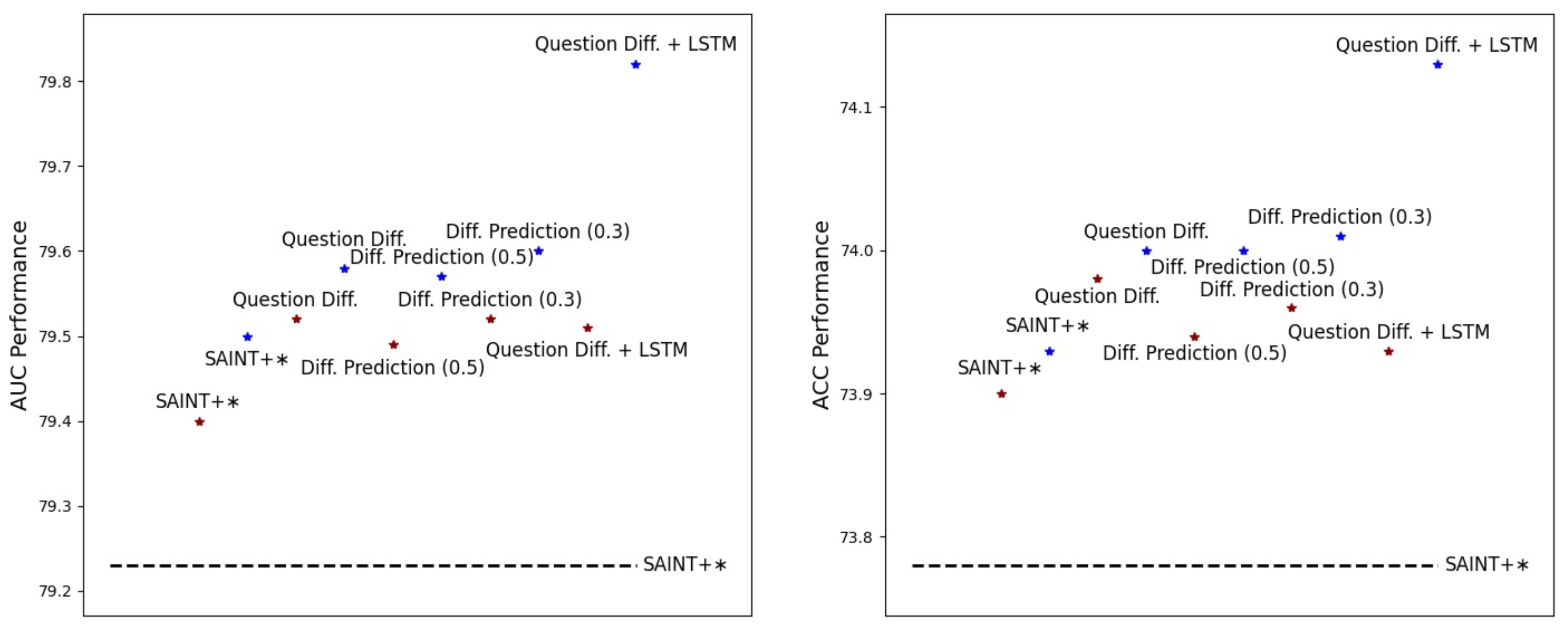
In this section, we verify whether training a self-attentive model considering the difficulty factor ensures consistent performance improvement, regardless of the increase in training time and model dimensions, and
Figure 3 illustrates the performance comparison (the table with detailed experimental results is provided in
Appendix A). In detail, we experimented by varying the number of epochs from 10 to 20 and the model dimension from 128 to 256. The baseline, SAINT+ [
25] with a model dimension of 128, was trained for ten epochs. Both increasing the model dimension and the number of epochs contributed to performance improvement, but the increase in epochs had a more significant impact. In other words, it was observed that performance improved as the training time for students’ interaction records lengthened, and also, the performance continuously increased in each epoch until the 20th epoch.
In particular, the model with the Question Diff. + LSTM methods, which showed the most substantial improvement in the main results (
Table 2) by 0.2%p of AUC, showed an improvement of 0.32%p of AUC compared to the SAINT+ model, which was trained for 20 epochs, showing a more significant increase than in the main experiment. Thus, this larger performance gap indicates that providing a difficulty factor positively impacts KT task, regardless of training hyperparameters such as training time.
5.2. Comparative Results on the Composition of Difficulty Values
Since the main focus of this study is the appropriate integration of difficulty into deep learning models, how to finely adjust the value of the initially estimated difficulty factor is a significant issue. Therefore, this section analyzes the results of experiments, providing variants for these values.
Variations on constructing the question difficulty vector as distributional information or rank information were provided to the model. Rank information is provided after being converted in a sorted order according to the size of the estimated distribution value. Distribution information estimated based on response correctness (Equation (
2) in
Section 3.2) consists of two cases. One is to express the difficulty level with a higher number as it is more difficult in the real world, and the other is to indicate that the higher the number, the easier it is (i.e., inverse).
According to the results in
Table 3, when the difficulty information was given similarly to reality, where the value is larger when a specific question is harder (dist. inverse), the performance of 0.11%p of AUC and 0.07%p of ACC improved. Additionally, in the case of the dist. round method, which consists of rounding the computed difficulty level to the first decimal place, the score slightly decreased. In particular, we observed that when we gave the difficulty vector for questions as a rank, the performance dropped by a large margin, implying that how one adjusts the value of the difficulty factor is also significant.
6. Conclusions
In English language learning assessment, accounting for difficulty is pivotal to understanding human learning trajectories. However, prior work in the KT task domain has often incorporated difficulty factors through intricate model architectures without delving into broader applications. Such methods sometimes grapple with integrating new information effectively while preserving an already successful general-purpose model architecture.
In this paper, we foreground a nuanced approach to incorporate difficulty metrics derived from users’ historical interactions. We systematically investigate three strategies: (i) input feature diversification, wherein difficulty is treated as a variant of input features, (ii) difficulty prediction, which tasks the model with predicting item difficulty via a multi-task learning (MTL) framework, and (iii) representation enrichment, aiming to augment the latent space.
Our empirical findings indicate that embedding difficulty as a training feature offers tangible performance gains. While the MTL strategy’s impact remains subtle, the strategy involving representation enrichment using an additional LSTM layer emerges as the most effective. Our supplemental analyses concerning training duration and model dimensions further corroborate these findings. Notably, as training time and model dimensions increase, the performance benefits of integrating the difficulty factor become more pronounced, suggesting its positive influence on model training dynamics. In addition, according to the analysis of KT performance changes depending on the difficulty factor’s value, a positive performance difference can be observed when selecting an appropriate value type, such as providing reverse order distribution knowledge.
Limitations and Future Works
The question difficulty is calculated based on the users’ past interactions, so there are still challenges regarding the natural language information of questions. In real-world learning and assessment procedures, humans utilize textual information, namely natural language information, within problem statements, to gauge the difficulty of questions. However, in the KT field, there have yet to be publicly available datasets containing natural language information as a form of textual data, which is a significant obstacle to the higher quality of difficulty estimation. Some studies with exercise-aware methods utilize natural language information from questions [
36]. However, these are conducted using proprietary corporate data and remain publicly inaccessible.
In the computer education domain, based on code examples written by users, there has recently been a study that generated codes that can be implemented according to the user’s knowledge level [
37]. Nonetheless, within the realm of education, the uniqueness of each learning domain—spanning subjects such as English, computer science, mathematics, and even secondary languages like Spanish—requires sufficient domain-specific data.
In particular, in English language assessment, only a few companies possessing commercial assessment systems hold valuable data, and natural language information is still not easily used by individual researchers. Therefore, we plan to adopt the natural language information released as a form of non-textual data of accessible benchmarks. For example, among the available KT datasets, the EEDI dataset [
38] provides some samples of learning questions in the form of images. We may exploit the natural language information in the images through optical character recognition techniques in order to improve the difficulty representation capability.
Author Contributions
Conceptualization, J.K. and S.K.; methodology, J.K.; software, J.K. and S.K.; validation, J.K.; formal analysis, J.K.; investigation, J.K. and S.K.; resources, J.K. and S.K.; data curation, S.K.; writing—original draft preparation/review and editing, J.K. and S.K.; visualization, J.K.; supervision/project administration/funding acquisition, H.L. All authors have read and agreed to the published version of the manuscript.
Funding
This research was supported by the MSIT (Ministry of Science and ICT), Korea, under the ITRC (Information Technology Research Center) support program (IITP- 2023-2018-0-01405) supervised by the IITP (Institute for Information and Communications Technology Planning and Evaluation) and was supported by an Institute of Information and communications Technology Planning and Evaluation (IITP) grant funded by the Korea government (MSIT) (No. 2020-0-00368, A Neural-Symbolic Model for Knowledge Acquisition and Inference Techniques). Also, this work was supported by the Core Research Institute Basic Science Research Program through the National Research Foundation of Korea (NRF) funded by the Ministry of Education (NRF-2021R1A6A1A03045425).
Institutional Review Board Statement
Not applicable.
Informed Consent Statement
Not applicable.
Data Availability Statement
Conflicts of Interest
The authors declare no conflict of interest.
Appendix A. Experimental Details
Appendix A.1. Hyperparameters
We defaulted the hyperparameters to the same as the SAINT+ model [
25]. The learning rate was 0.001, batch size was 512, dropout was 0.1, the number of epochs was 10, sequence length was 100, and the Noam scheduler [
39] and Adam optimizer [
40] were employed. The ratios for joint loss with multitask learning were
and
, respectively, and the
for the difficulty prediction task
was set as 0.3 or 0.5.
Appendix A.2. Detailed Results
Table A1.
Performance comparison according to the number of training epochs and the model dimension for EdNet-KT1 dataset. * indicates our re-implementation version. The highest performance is bolded.
Table A1.
Performance comparison according to the number of training epochs and the model dimension for EdNet-KT1 dataset. * indicates our re-implementation version. The highest performance is bolded.
| Method | Model dim. | Epoch | AUC | ACC |
|---|
| SAINT+ * | 128 | 10 | 79.23 | 73.78 |
| SAINT+ * | 256 | 10 | 79.40 | 73.90 |
| 128 | 20 | 79.50 | 73.93 |
| + Question Diff. | 256 | 10 | 79.52 | 73.98 |
| 128 | 20 | 79.58 | 74.00 |
| + Diff. Prediction (0.5) | 256 | 10 | 79.49 | 73.94 |
| 128 | 20 | 79.57 | 74.00 |
| + Diff. Prediction (0.3) | 256 | 10 | 79.52 | 73.96 |
| 128 | 20 | 79.60 | 74.01 |
| + Question Diff. + LSTM | 256 | 10 | 79.51 | 73.93 |
| 128 | 20 | 79.82 | 74.13 |
References
- Corbett, A.T.; Anderson, J.R. Knowledge tracing: Modeling the acquisition of procedural knowledge. User Model.-User-Adapt. Interact. 1994, 4, 253–278. [Google Scholar] [CrossRef]
- Shen, S.; Liu, Q.; Chen, E.; Huang, Z.; Huang, W.; Yin, Y.; Su, Y.; Wang, S. Learning process-consistent knowledge tracing. In Proceedings of the 27th ACM SIGKDD Conference on Knowledge Discovery & Data Mining, Virtual, 14–18 August 2021; pp. 1452–1460. [Google Scholar]
- Ritter, S.; Anderson, J.R.; Koedinger, K.R.; Corbett, A. Cognitive Tutor: Applied research in mathematics education. Psychon. Bull. Rev. 2007, 14, 249–255. [Google Scholar] [CrossRef] [PubMed]
- Abdelrahman, G.; Wang, Q.; Nunes, B. Knowledge tracing: A survey. ACM Comput. Surv. 2023, 55, 1–37. [Google Scholar]
- Doignon, J.P.; Falmagne, J.C. Knowledge Spaces; Springer Science & Business Media: Berlin/Heidelberg, Germany, 2012. [Google Scholar]
- Shen, S.; Huang, Z.; Liu, Q.; Su, Y.; Wang, S.; Chen, E. Assessing Student’s Dynamic Knowledge State by Exploring the Question Difficulty Effect. In Proceedings of the 45th International ACM SIGIR Conference on Research and Development in Information Retrieval, Madrid, Spain, 11–15 June 2022; pp. 427–437. [Google Scholar]
- Lee, W.; Chun, J.; Lee, Y.; Park, K.; Park, S. Contrastive learning for knowledge tracing. In Proceedings of the ACM Web Conference 2022, Lyon, France, 25–29 April 2022; pp. 2330–2338. [Google Scholar]
- Maatuk, A.M.; Elberkawi, E.K.; Aljawarneh, S.; Rashaideh, H.; Alharbi, H. The COVID-19 pandemic and E-learning: Challenges and opportunities from the perspective of students and instructors. J. Comput. High. Educ. 2022, 34, 21–38. [Google Scholar] [CrossRef] [PubMed]
- Al-Fraihat, D.; Joy, M.; Sinclair, J. Identifying success factors for e-learning in higher education. In Proceedings of the International Conference on e-Learning. Academic Conferences International Limited, Orlando, FL, USA, 1–2 June 2017; pp. 247–255. [Google Scholar]
- Romero, C.; Ventura, S. Educational data mining: A review of the state of the art. IEEE Trans. Syst. Man, Cybern. Part C Appl. Rev. 2010, 40, 601–618. [Google Scholar]
- Nguyen, T. The effectiveness of online learning: Beyond no significant difference and future horizons. MERLOT J. Online Learn. Teach. 2015, 11, 309–319. [Google Scholar]
- Frank, H.; Meder, B.S. Einführung in die Kybernetische Pädagogik; Dt. Taschenbuch Verlag: Munich, Germany, 1971. [Google Scholar]
- Cube, F.V. Kybernetische Grundlagen des Lernens und Lehrens, 4th ed.; Klett-Cotta: Stuttgart, Germany, 1982. [Google Scholar]
- Frank, H. Bildungskybernetik/Klerigkibernetiko. Bratislava und Nitra: Esprima und SAIS; Oxford University Press: Oxford, UK, 1996. [Google Scholar]
- Aberšek, B.; Dolenc, K.; Aberšek, M.K.; Pisano, R. Reflections on the relationship between cybernetic pedagogy, cognitive science & language. Pedagogika 2014, 115, 70–87. [Google Scholar]
- Al-Fraihat, D.; Joy, M.; Sinclair, J. Evaluating E-learning systems success: An empirical study. Comput. Hum. Behav. 2020, 102, 67–86. [Google Scholar]
- Liaw, S.S.; Huang, H.M.; Chen, G.D. Surveying instructor and learner attitudes toward e-learning. Comput. Educ. 2007, 49, 1066–1080. [Google Scholar] [CrossRef]
- Cheng, Y.M. Antecedents and consequences of e-learning acceptance. Inf. Syst. J. 2011, 21, 269–299. [Google Scholar]
- Khajah, M.; Lindsey, R.V.; Mozer, M.C. How deep is knowledge tracing? arXiv 2016, arXiv:1604.02416. [Google Scholar]
- Zhang, J.; Shi, X.; King, I.; Yeung, D.Y. Dynamic key-value memory networks for knowledge tracing. In Proceedings of the 26th international conference on World Wide Web, Perth, Australia, 3–7 April 2017; pp. 765–774. [Google Scholar]
- Ghosh, A.; Heffernan, N.; Lan, A.S. Context-aware attentive knowledge tracing. In Proceedings of the 26th ACM SIGKDD International Conference on Knowledge Discovery & Data Mining, Virtual, 6–10 July 2020; pp. 2330–2339. [Google Scholar]
- Piech, C.; Bassen, J.; Huang, J.; Ganguli, S.; Sahami, M.; Guibas, L.J.; Sohl-Dickstein, J. Deep knowledge tracing. Adv. Neural Inf. Process. Syst. 2015, 28, 1–9. [Google Scholar]
- Pandey, S.; Karypis, G. A self-attentive model for knowledge tracing. In Proceedings of the 12th International Conference on Educational Data Mining, EDM 2019, International Educational Data Mining Society, Montreal, QC, Canada, 2–5 July 2019; pp. 384–389. [Google Scholar]
- Somepalli, G.; Goldblum, M.; Schwarzschild, A.; Bruss, C.B.; Goldstein, T. Saint: Improved neural networks for tabular data via row attention and contrastive pre-training. arXiv 2021, arXiv:2106.01342. [Google Scholar]
- Shin, D.; Shim, Y.; Yu, H.; Lee, S.; Kim, B.; Choi, Y. Saint+: Integrating temporal features for ednet correctness prediction. In Proceedings of the LAK21: 11th International Learning Analytics and Knowledge Conference, Irvine, CA, USA, 12–16 April 2021; pp. 490–496. [Google Scholar]
- Fang, J.; Zhao, W.; Jia, D. Exercise difficulty prediction in online education systems. In Proceedings of the 2019 International Conference on Data Mining Workshops (ICDMW), Beijing, China, 8–11 November 2019; IEEE: Piscataway, NJ, USA, 2019; pp. 311–317. [Google Scholar]
- Zhou, Y.; Tao, C. Multi-task BERT for problem difficulty prediction. In Proceedings of the 2020 International Conference on Communications, Information System and Computer Engineering (CISCE), Kuala Lumpur, Malaysia, 3–5 July 2020; IEEE: Piscataway, NJ, USA, 2020; pp. 213–216. [Google Scholar]
- Benedetto, L.; Cremonesi, P.; Caines, A.; Buttery, P.; Cappelli, A.; Giussani, A.; Turrin, R. A survey on recent approaches to question difficulty estimation from text. ACM Comput. Surv. 2023, 55, 1–37. [Google Scholar] [CrossRef]
- Brassil, C.E.; Couch, B.A. Multiple-true-false questions reveal more thoroughly the complexity of student thinking than multiple-choice questions: A Bayesian item response model comparison. Int. J. STEM Educ. 2019, 6, 1–17. [Google Scholar] [CrossRef]
- Malikin, D.; Kyrychenko, I. Research of Methods for Practical Educational Tasks Generation Based on Various Difficulty Levels. In Proceedings of the CEUR Workshop Proceedings, Gilwice, Poland, 12–13 May 2022; Volume 3171, pp. 1030–1042. [Google Scholar]
- Beck, L. Flow: The psychology of optimal experience. Mihalyi Csikszentmihalyi. J. Leis. Res. 1992, 24, 93. [Google Scholar] [CrossRef]
- Bengio, Y.; Louradour, J.; Collobert, R.; Weston, J. Curriculum learning. In Proceedings of the 26th Annual International Conference on Machine Learning, Montreal, QC, Canada, 14–18 June 2009; pp. 41–48. [Google Scholar]
- Hochreiter, S.; Schmidhuber, J. Long short-term memory. Neural Comput. 1997, 9, 1735–1780. [Google Scholar] [CrossRef]
- Choi, Y.; Lee, Y.; Shin, D.; Cho, J.; Park, S.; Lee, S.; Baek, J.; Bae, C.; Kim, B.; Heo, J. Ednet: A large-scale hierarchical dataset in education. In Proceedings of the Artificial Intelligence in Education: 21st International Conference, AIED 2020, Ifrane, Morocco, 6–10 July 2020; Proceedings, Part II 21. Springer: Berlin/Heidelberg, Germany, 2020; pp. 69–73. [Google Scholar]
- Mandrekar, J.N. Receiver operating characteristic curve in diagnostic test assessment. J. Thorac. Oncol. 2010, 5, 1315–1316. [Google Scholar] [CrossRef]
- Liu, Q.; Huang, Z.; Yin, Y.; Chen, E.; Xiong, H.; Su, Y.; Hu, G. Ekt: Exercise-aware knowledge tracing for student performance prediction. IEEE Trans. Knowl. Data Eng. 2019, 33, 100–115. [Google Scholar] [CrossRef]
- Liu, N.; Wang, Z.; Baraniuk, R.; Lan, A. Open-ended knowledge tracing for computer science education. In Proceedings of the 2022 Conference on Empirical Methods in Natural Language Processing, Abu Dhabi, United Arab Emirates, 7–1 December 2022; pp. 3849–3862. [Google Scholar]
- Wang, Z.; Lamb, A.; Saveliev, E.; Cameron, P.; Zaykov, Y.; Hernández-Lobato, J.M.; Turner, R.E.; Baraniuk, R.G.; Barton, C.; Jones, S.P.; et al. Diagnostic questions: The neurips 2020 education challenge. arXiv 2020, arXiv:2007.12061. [Google Scholar]
- Vaswani, A.; Shazeer, N.; Parmar, N.; Uszkoreit, J.; Jones, L.; Gomez, A.N.; Kaiser, Ł.; Polosukhin, I. Attention is all you need. In Proceedings of the 31st Conference on Neural Information Processing Systems (NIPS 2017), Long Beach, CA, USA, 4–9 December 2017. [Google Scholar]
- Kingma, D.P.; Ba, J. Adam: A method for stochastic optimization. arXiv 2014, arXiv:1412.6980. [Google Scholar]
| Disclaimer/Publisher’s Note: The statements, opinions and data contained in all publications are solely those of the individual author(s) and contributor(s) and not of MDPI and/or the editor(s). MDPI and/or the editor(s) disclaim responsibility for any injury to people or property resulting from any ideas, methods, instructions or products referred to in the content. |
© 2023 by the authors. Licensee MDPI, Basel, Switzerland. This article is an open access article distributed under the terms and conditions of the Creative Commons Attribution (CC BY) license (https://creativecommons.org/licenses/by/4.0/).