You are currently viewing a new version of our website. To view the old version click .
Electronics
  • Article
  • Open Access

30 August 2023

ConKgPrompt: Contrastive Sample Method Based on Knowledge-Guided Prompt Learning for Text Classification


,
,
and
1
School of Computer Science and Information Engineering, Hubei University, Wuhan 430062, China
2
School of Artificial Intelligence, Hubei University, Wuhan 430062, China
3
Key Laboratory of Intelligent Sensing System and Security, Hubei University, Wuhan 430062, China
4
School of Computer Science, Wuhan University, Wuhan 430072, China
This article belongs to the Special Issue Emerging Theory and Applications in Natural Language Processing

Abstract

Text classification aims to classify text according to pre-defined categories. Despite the success of existing methods based on the fine-tuning paradigm, there is a significant gap between fine-tuning and pre-training. Currently, prompt learning methods can bring state of the art (SOTA) performance to pre-trained language models (PLMs) in text classification and transform a classification problem into a masked language modeling problem. The crucial step of prompt learning is to construct a map between original labels and the label extension words. However, most mapping construction methods consider only labels themselves; relying solely on a label is not sufficient to achieve accurate prediction of mask tokens, especially in classification tasks where semantic features and label words are highly interrelated. Therefore, the accurate prediction of mask tokens requires one to consider additional factors beyond just label words. To this end, we propose a contrastive sample method based on knowledge-guided prompt learning framework (ConKgPrompt) for text classification. Specifically, this framework utilizes external knowledge bases (KBs) to expand the label vocabulary of verbalizers at multiple granularities. In the contrastive sample module, we incorporate supervised contrastive learning to make representations more expressive. Our approach was validated on four benchmark datasets, and extensive experimental results and analysis demonstrated the effectiveness of each module of the ConKgPrompt method.

1. Introduction

In the era of the Internet, text is a crucial medium for the dissemination of information. The accurate classification of text based on semantic information is an important research direction, with significant implications for information utilization. Text classification is an important task in natural language processing. It is the foundation of many tasks [1,2] and has a wide range of applications in fields such as sentiment analysis [3], spam detection [4], and fake news detection [5]. Due to its expansive applicability, text classification demands substantial consideration and emphasis.
Traditional text classification methods utilize neural networks such as TextCNN [6] and TextRNN [7] to extract contextual features, leading to significant success in feature representation learning. Recently, pre-trained large language models such as BERT [8], RoBERTa [9], GPT [10], and ERNIE [11] have shown superior performance in NLP tasks. Researchers have attributed this to the prior knowledge accumulated during their pre-training. To take advantage of this prior knowledge and enhance classification performance, researchers have proposed a method of fine-tuning pre-trained language models (PLMs) for downstream tasks [12]. This method consists of adding a classification layer for feature classification to the top layers of PLMs; using network structure and network parameters, the top layer is modified to adapt the downstream task output layer. Since PLMs have memorized vast amounts of raw corpus, they can offer useful knowledge for downstream tasks.
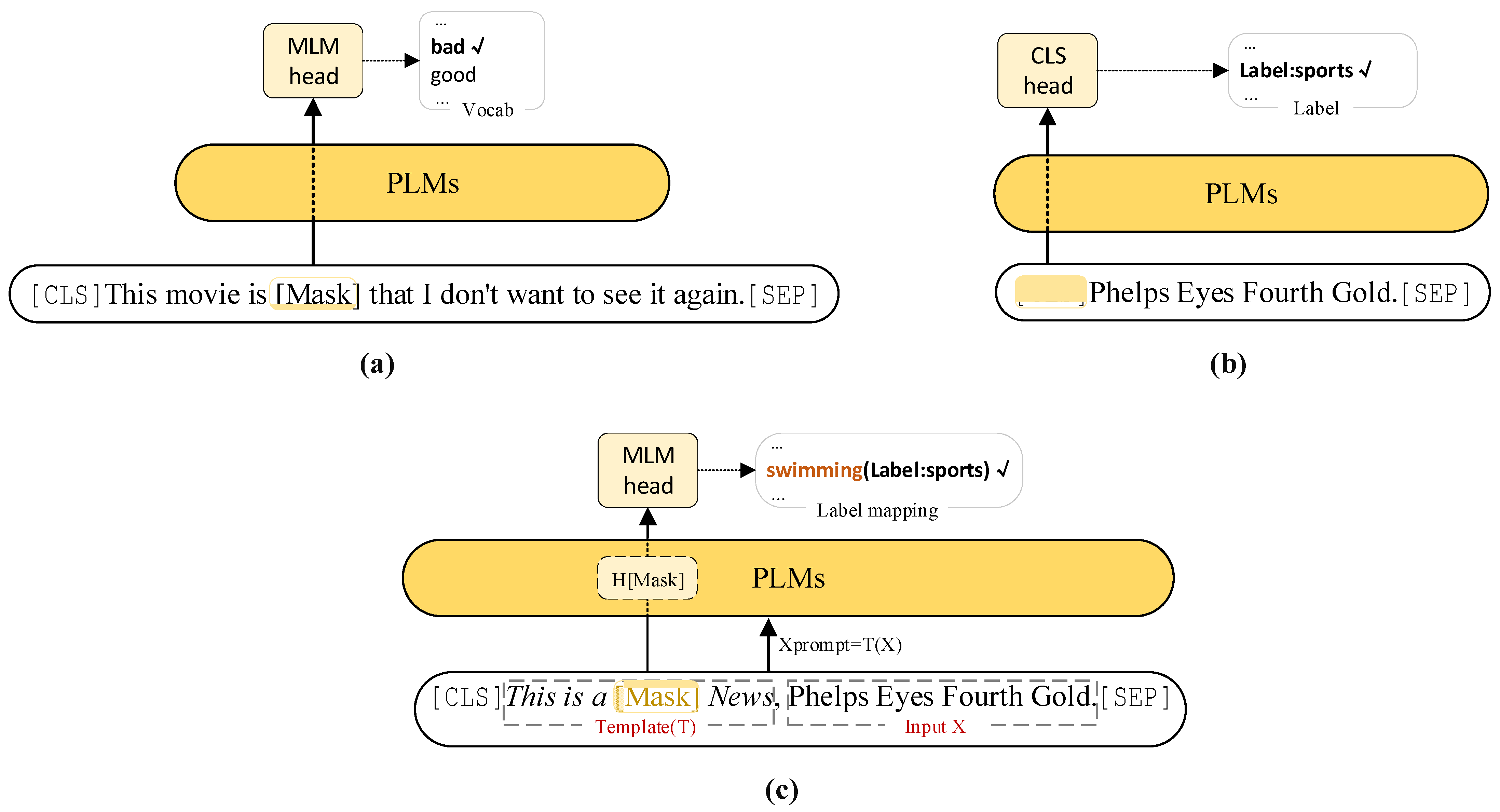
While the fine-tuning paradigm performs satisfactorily in downstream tasks that rely on large datasets, the increasing model size has raised the cost of fine-tuning a high-performing pre-trained language model (PLM) for downstream tasks. The performance bottleneck of fine-tuning has also hindered the ability of PLM-based text classification algorithms to be applied in real-world fields. To address this problem, prompt learning based on fine-tuning is proposed, inspired by GPT-3 [10]. This approach aims to promote consistency between the learning process and pre-trained objective via the usage of the corpus acquired during the pre-training process. As shown in Figure 1, compared with fine-tuning, prompt-tuning processes input text with a prompt template, converting it into a cloze-style phrase. During training, prompt-tuning only updates the template parameters to obtain supervised signals from downstream task training while keeping PLM parameters stable, which leads to higher prediction accuracy [13]. In prompt-tuning, mapping label words (such as “sport”) to specific categories (such as “swimming” or “football”) can efficiently decrease the disparities between the label and text spaces. This verbalizer construction strategy has been proven to be effective [14].
Figure 1. The general illustrations of pre-training, fine-tuning, and prompt-based learning. (a) The pre-training process uses mask strategies to pre-train PLMs; (b) the fine-tuning method uses a representation of the headers’ special token as a representation of the whole text for prediction; (c) the prompt-based fine-tuning (prompt-tuning) method allows the model to add a prompt template with a mask for prediction.
However, most existing work usually involves manually constructing the verbalizer, which is prone to errors during prediction. Some approaches combine optimization-based expansion words with a manual verbalizer [15], but in terms of label embedding, it only introduces words that are semantically close to the class name. KPT [16] is an efficient prompt-tuning method that combines external knowledge and various refinement techniques. However, this work on verbalizers has primarily been centered on the label corresponding to the text, whereas text classification deals with the complexity and variety of the language and its extensive vocabulary containing semantically similar yet different phrases. Therefore, the development of a verbalizer cannot ignore the text background and conceptual information. Additionally, the versatility of prompt-tuning for varying tasks and datasets is limited. For instance, pre-trained language models may lack adequate awareness of specific subject areas. As a result, more labeled data are required to enhance the PLM’s performance. Therefore, we attempt to use contrastive samples for knowledge-guided prompt-tuning.
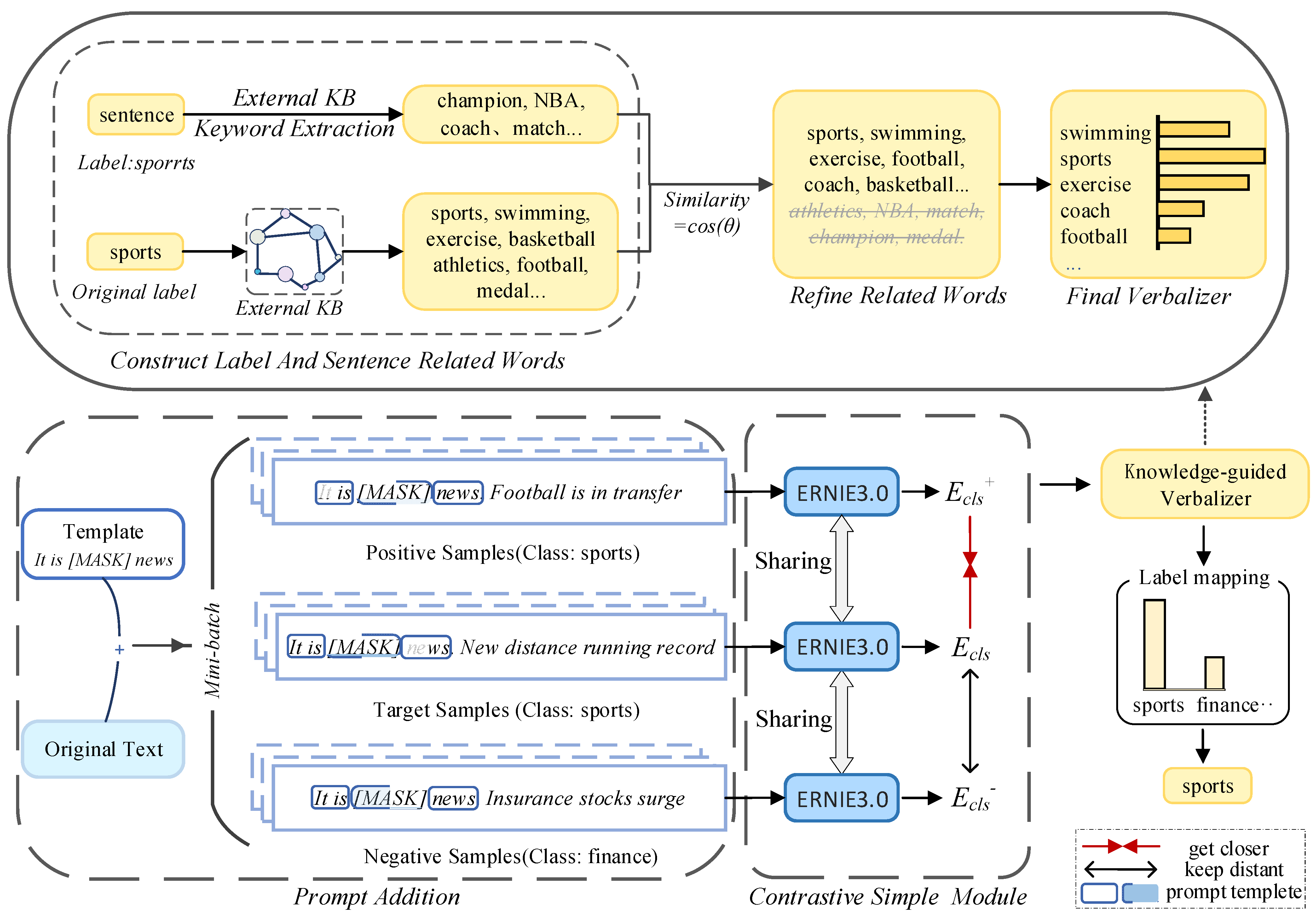
We propose our ConKgPrompt model (contrastive sample method based on knowledge-guided prompt learning), which is an effective method of text classification. Initially, we encapsulate the original text via prompt engineering and develop a method for constructing and optimizing a cross-granularity verbalizer by introducing external knowledge bases targeting the implicit notions of the text and label words. Subsequently, we use the pre-trained language model ERNIE 3.0 [17] to extract semantic features. Furthermore, we introduce SupCon [18] into the current prompt learning process. Finally, we validate the effectiveness of each module of our method in the full data and few-shot scenarios. Our main contributions can be summarized as follow:
(1) In this work, we propose a knowledge-guided prompt-tuning method based on supervised contrastive learning, which can fully utilize the advantages of prompt learning to unleash the potential of ERNIE 3.0. To the best of our knowledge, this is the first work to adopt knowledge-guided prompt-tuning for text classification tasks.
(2) Introduced supervised contrastive learning can increase the effectiveness of the sample’s learning during the training process. Moreover, integrated external knowledge bases can extract and integrate the knowledge information of sample and label words into an extended word set.
(3) We conducted extensive experiments on both real-world datasets and benchmark datasets. The experimental results demonstrate that our proposed model outperforms other methods in low-resource and full-data scenarios, highlighting the superiority and effectiveness of our method.

3. Preliminaries

This section provides some fundamental concepts on fine-tuning, prompt-tuning, and supervised contrastive learning before introducing our proposed method. We assume a text classification dataset, D = { X , Y } , where X represents a collection of input samples and Y are their respective labels. We will be utilizing this dataset as a foundation for the ensuing discussion.

3.1. Fine-Tuning Based on PLMs

For text classification tasks, the traditional fine-tuning method utilizes a language model M trained on a large corpus of text to initialize its own network parameters and then uses text data for training downstream tasks. Specifically, the input sample X is standardized into a sequence of [CLS] X [SEP], where [CLS] is the word vector of the first word of the input text, which is used by the output layer to predict the category of the text, and [SEP] indicates the end of the sentence to serve as a boundary between two sentences. Then, using M , the sequence is encoded as hidden vectors E . By using an MLM head, we can obtain the probability distribution of the label set Y , as follows:
P = softmax ( WE cls )

3.2. Prompt-Tuning Based on PLMs

Prompt tuning is a method that introduces adaptable prompts to enhance the performance of a pre-trained language model M for specific tasks. The method begins by developing a prompt template T that includes [Mask] and an answer mapping vocabulary V . T is combined with an input text x X to create the final input sequence x prompt , with the [Mask] token serving as a masked position for predicting the answer. Additionally, by creating a verbalizer function v ( ) : V Y , which can be defined as a map that links several individual words from the label word set V to the label space, the probability calculation for a specific label Y can be obtained:
P ( y x ) = P ( [ Mask ] = v ( y ) | x ) = softmax ( W v ( y ) × E cls ) = exp ( W v ( y ) × E cls ) y = Y exp ( W v ( y ) × E cls )
where W v and E represent the hidden vectors of [MASK] and label Word V , respectively. We employ a binary sentiment classification task to better explain prompt-tuning. For example, we construct a template T(·) = “This is [MASK].” We then define V as a transformation from the label space to several words in the vocabulary (e.g., v y = positive good , v y = negative bad ). Then, the input sequence is normalized to xprompt = [CLS] x This is [MASK][SEP] using T, where the underscore sequence is a template previously defined. Finally, we utilize the probability of the predicted answer word (good or bad) to represent the corresponding probability of the class (positive or negative). Compared with traditional fine-tuning, prompt-tuning reuses the pre-training weights and does not introduce any new parameters.

3.3. Supervised Contrastive Learning

SupCon [18] is a specific method of contrastive learning. This method combines two augmented batches at the class level in the feature space. The loss function is designed based on the idea of adversarial training: shrinking the distance between anchors and positive samples in the feature space while increasing the distance between anchors and negative samples. The contrastive loss function for supervised tasks is designed is as follows:
L sup = 1 N i I 1 | P ( i ) | p P i log exp ( z i × z p / γ ) a A i exp ( z i × z a / γ )
where γ is the temperature factor, P i is the set of positive simple indexes, ( ) represents the cosine similarity on the hypersphere, and I contains all samples in a batch view. A is the set of indexes for the contrastive sample.

5. Experiments

To verify the effectiveness of our proposed model, we conducted several experiments on both few-shot and full-data text classification tasks. This section provides detailed descriptions of our dataset construction process, experimental settings, baseline methods, main results, and ablation study.

5.1. Dataset and Templates

We conduct experiments using the following datasets. Specifically, we select four datasets with different tasks and sentence lengths to demonstrate the effectiveness of our approach, including topic classification, and question classification. The specific information for each dataset is provided in Table 1. Below, we introduce the sources and original sizes of each dataset, as well as our methods for processing the original datasets.
Table 1. Dataset statistics.
THUCNews: The THUCNews (http://thuctc.thunlp.org/THUCNews, accessed on 25 January 2016) dataset is sourced from historical data from Sina news subscription channels spanning the period from 2005 to 2011. Data cleaning is conducted on the massive dataset, resulting in 60,000 records which are integrated and categorized into 6 candidate categories: finance, stock, science, society, politics, and entertainment. Each category consists of 10,000 records.
Tnews: The Tnews Chinese text classification dataset is sourced from FewCLUE [35], a benchmark for evaluating natural language understanding in Chinese. It contains 15 categories, including military, sports, and education, and is derived from the news section of the Toutiao app. The single training set comprises 240 samples, while the complete training set includes 1185 samples.
Healthcare: We utilize a crawler tool to extract question texts from mainstream medical websites in China and manually annotate the resulting data. Based on this extensive collection of data, we construct the healthcare dataset, comprising 12,706 items categorized into five distinct categories: disease diet, seasonal diet, sports and fitness, weight loss and beauty, and dietary contraindications.
Onshop: The online shopping evaluation dataset (https://github.com/SophonPlus/ChineseNlpCorpus/blob/master/datasets/online_shopping_10_cats, accessed on 24 March 2018) comes from the review data of various e-commerce platforms and collates the review data from ten commodity categories: books, tablets, mobile phones, fruits, shampoo, water heaters, milk, clothes, computers, and hotels, totaling 56,495 pieces of data, with about 28,000 positive and negative reviews each.
In order to reduce the influence of template on experimental results, we design four templates for each data set, as shown in Table 2.
Table 2. The templates of each dataset.

5.2. Baselines

Fine-tuning. Traditional fine-tuning methods involve obtaining the hidden embedding of the [CLS] token via a pre-trained language model (PLM) and then using a classification layer for prediction.
DualCL. Chen et al. [36] propose a unique data augmentation method by adding corresponding labels to the input sentence, obtaining the label token embedding and [CLS] token embedding through pre-trained language models.
PET. Schick et al. [24] propose the use of manual templates to form prompts, add a prefix or suffix to the input text and mask out some token, and convert the input instances into fill-in-the-blank phrases to help the language model understand the previously given task.
P-tuning. Liu et al. [13] propose the learning of continuous prompts by inserting trainable variables for improving the performance of the model on specific tasks.
Soft Verbalizer (Soft). The Soft verbalizer is proposed by WARP [37], which uses continuous prompts for each class and uses an MLM head to output the dot product between the class vector and the input as the probability of each class.
Knowledgeable Prompt-tuning (KPT). Hu et al. [16] extend the verbalizer using external knowledge bases such as related word lists and sentiment dictionaries to expand the initially defined label words based on manual definitions.

5.3. Experiment Settings

We conducted all our experiments using PyTorch on an NVIDIA GeForce RTX5000 environment. We use CN-DBpedia and Wantwords as the external knowledge base to obtain labels’ relevant words. For the full data scenario, we experimented with different prompt methods based on ERNIE 3.0-Xbase. In the few-shot scenario, we use ERNIE 3.0 as the pre-trained language model to compare with other advanced prompt-based methods. We randomly extract k = 1, 5, 10, or 20 instances from the original training set to form the training set using four equally sized sub-sets. We use accuracy as the evaluation metric for all experiments and use the best model for testing. To reduce the randomness of experimental results, we repeat the experiments five times to obtain the average score and standard deviation of the test results and provided the optimal results after each experiment. We conducted all experiments for 20 epochs and select the most effective verification points to test.

5.4. Main Results

We evaluate and analyze the proposed ConKgPrompt method in the full-data scenario and few-shot scenarios and compare our method with the fine-tuning-based method and the prompt-tuning-based method. The experimental results are shown in Table 2 and Table 3. “w/o SCL” means not using supervised contrast learning, while “w/SCL” refers to our proposed method that uses supervised contrastive learning. This setting can be regarded as an ablation experiment to analyze the influence of supervised contrastive learning on the experiment. To minimize the effects of randomness in the results, each experiment was repeated five times, and the final results are reported as the average score and standard deviation. Additionally, the best performance achieved in each experiment is indicated in parentheses.
Table 3. Accuracy scores (%) on three datasets in the full-data scenario.

5.4.1. Full-Data

From Table 3, in the full-data scenario, most of the methods based on prompt-tuning are better than those based on fine-tuning, which indicates that prompt learning can better release the potential of pre-trained models. The method proposed in our paper consistently outperforms the fine-tuning method and the prompt-based method. Compared to the ERNIE 3.0-based most advanced method, our ConKgPrompt method achieved relative improvements of 0.51%, 0.92%, and 0.8% in three different domain datasets, respectively, due to its effective utilization of external knowledge and pre-training corpus.

5.4.2. Few-Shot

From Table 4, the results of the prompt-based methods improve when the experimental shots are set from 1-shot to 20-shot, and the gap between the baseline methods gradually decreases, especially in the 20-shot experiments, the results of the baseline methods do not differ much. Nevertheless, our method still outperforms the baseline approach. It is shown that knowledge-guided prompt learning appropriately utilizes the prior knowledge stored in PLMs to adapt to the task while effectively exploiting the sample variability via supervised contrastive learning. In THUCNews, Onshop, and Tnews with better annotation quality, KPT still outperforms other baseline methods, but the results are unstable, which is because KPT can effectively expand label words but has limited ability to release PLM pre-training knowledge and inadequately covers text. Our ConKgPrompt expands label words with multiple granularities, and in terms of variance, ConKgPrompt has smaller error than the baseline method in most cases, and the variance decreases as shot increases, indicating that we consider the text when constructing label words to make the training process stable.
Table 4. Accuracy scores (%) on three datasets in few-shot scenario.

5.5. Ablation Study

We conduct ablation experiments to verify the validity of our proposed components. For the ablation study, w/o SCL, w/o EKA, and w/o BOTH are the variants of ConKgPrompt that does not conduct SCL (supervised contrastive learning), EKA (external knowledge acquisition) and both SCL and EKA, respectively. The effectiveness of the added modules is proven by the increase in our method’s performance when each module is incorporated, as shown in Table 3 and Table 5 in 10-shot and 20-shot settings; the worst overall performer is w/o BOTH. The experimental results show that both SCL and EKA positively affect ConKgPrompt. Moreover, we observe that the performance improvement is more significant in few-shot scenarios and that our module improved ConKgPrompt more significantly with more samples compared to different shot settings. Of course, the improvement in the method also depends on the efficiency of the PLM release, which shows that the module we added gives PLM a considerable performance improvement in low resource settings.
Table 5. Ablation study of ConKgPrompt in 10/20 few-shot scenarios.

6. Analysis

In this section, we will analyze in more detail why supervised contrastive learning and knowledge-guided prompt learning are useful for text classification tasks.

6.1. Performance Influence between Different Pre-Trained Language Models

In this subsection, we explore the influence of different pre-trained language models on experimental results. We conducted experiments on BERT-base, RoBERTa-base, ERNIE 3.0-base, and ERNIE 3.0-Xbase. The experiment scenario is full-data so it can fully reflect the performance of PLMs. The experimental results are shown in Table 6. The averaged values of the four models on the three datasets are 93.35%, 93.49%, 93.90%, and 94.52%, respectively. We find that RoBERTa-base is 0.14% higher than BERT-base. ERNIE 3.0-Xbase outperforms RoBERTa-base by 1.03%. ERNIE 3.0 learned more than RoBERTa and BERT did in the pre-training phase. Therefore, using ERNIE 3.0-Xbase for knowledge-guided prompt tuning is more effective. In addition, we find that ERNIE 3.0-Xbase is 0.62% higher than ERNIE 3.0-base. This phenomenon illustrates that for our ConKgPrompt method, the larger the PLM size, the better the method will work on the downstream task.
Table 6. Result of ConKgPrompt on different pre-trained language model in full-data scenarios.

6.2. Impact of Knowledge-Guided Prompt Learning

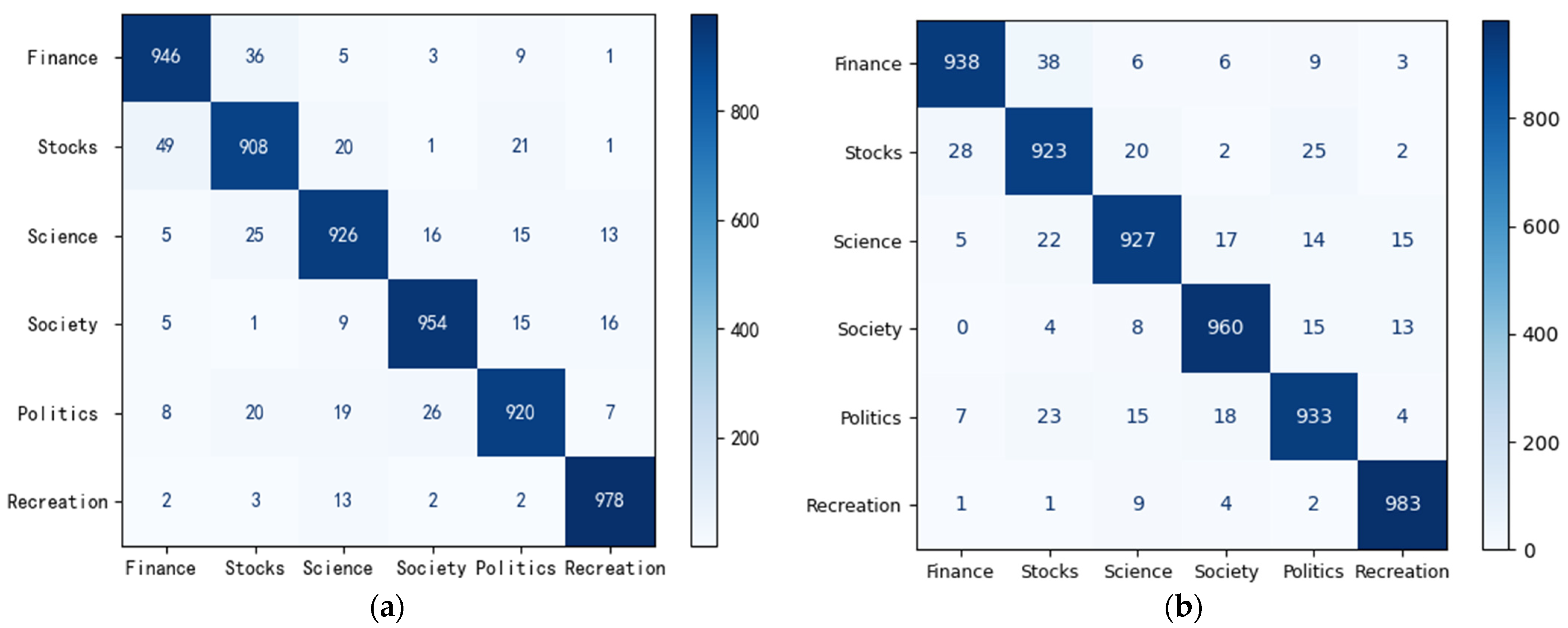
A confusion matrix is a tool used to evaluate the performance of a model, and its primary metrics are presented in Table 7. It can clearly show the correspondence between the model’s predictions and the ground truth labels across different categories. To explore the impact of incorporating knowledge on the prediction of each class in the dataset, we plot the test results of P-tuning and ConKgPrompt (w/SCL) under the full-data scenario, as shown in Figure 4.
Table 7. The first order index of the confusion matrix.
Figure 4. Comparison of confusion matrices between P-tuning and ConKgPrompt in the full-data scenario of THUCNews dataset: (a) P-tuning based on ERNIE 3.0; (b) ConKgPrompt.
We use ERNIE 3.0-Xbase as the feature extractor in order to remove the influence of PLMs on the introduction of knowledge prompt. From Figure 4a, we can see that the prompt-tuning-based approach can achieve good classification results, but it is difficult to distinguish between the Finance and Stocks categories due to some similarities in the semantic features of these two categories. We find from Figure 4b by using knowledge-guided prompt-tuning that each category has more accurate predictions than P-tuning, except for the “finance” category, and the overall number of correct predictions increases for both finance and stocks. We deduce that this is from the bias of the categorization weights due to the crossover of extended words’ meanings in the prediction of labeled words extended by external knowledge in both categories, so our future work will also focus on confusable text extension refinement and exploring PLM for word perception and understanding. This shows we introduced external knowledge of prompt-tuning to improve the classification effect overall. This is in line with our analysis above.

6.3. Impact of Contrastive Sample Module

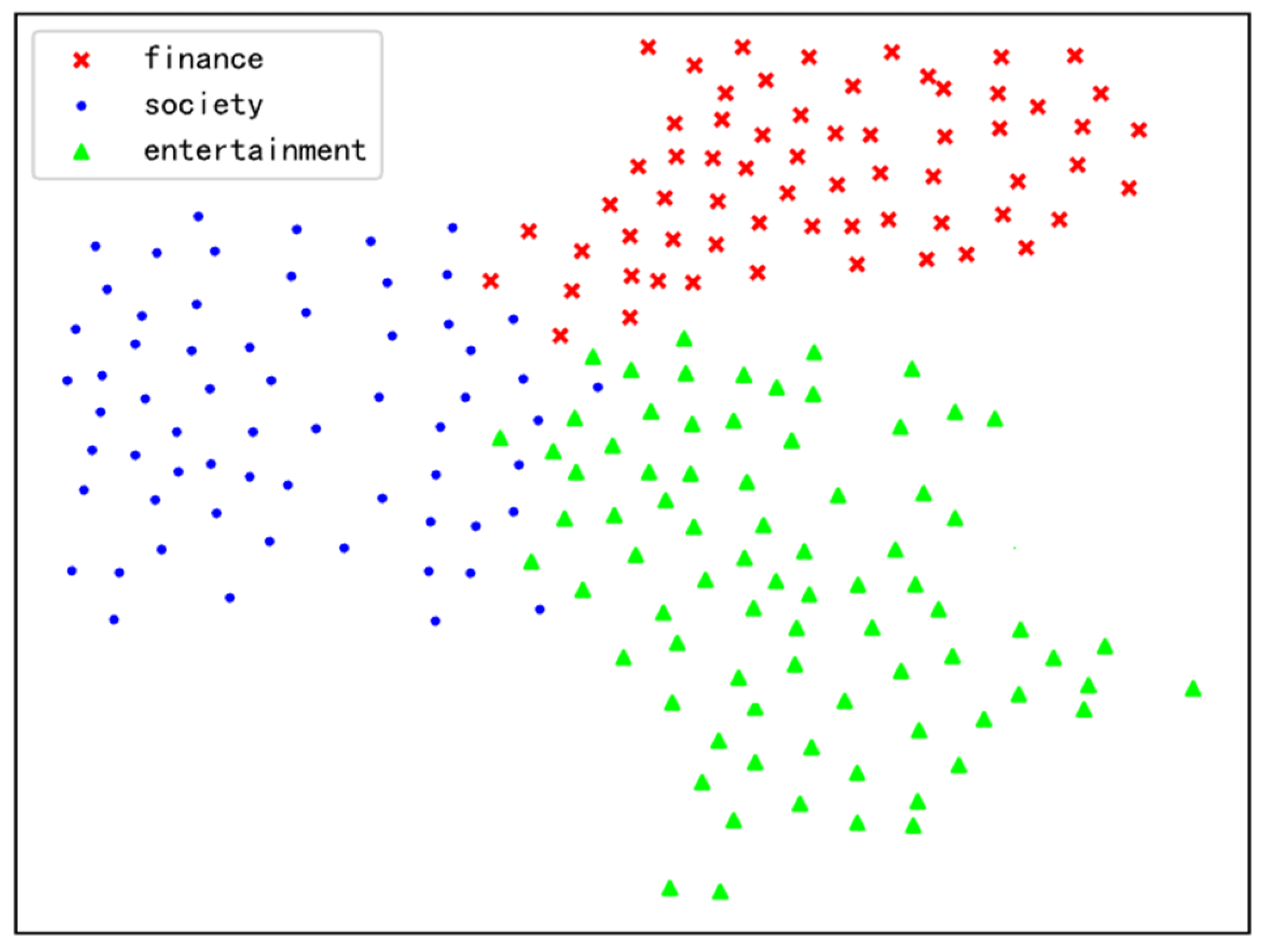
To further explore the ability of contrastive learning to improve the quality of representation, we select partial data from the THUCNews test dataset in the categories of finance, society, and entertainment, and use t-SNE (t-distributed stochastic neighbor embedding) to create a visual representation of the feature distribution under the 20-shot scenario, as shown in Figure 5.
Figure 5. t-SNE visualization of vectors over the low-resource of THUCNews test set.
From Figure 5, we clearly find that the distance between the same classes is reduced, demonstrating that the joint contrast loss uses the relationship between training samples to aggregate similar samples in the feature space, which can make the classifier more discriminative.

6.4. Visualization of Label Related Word Weights

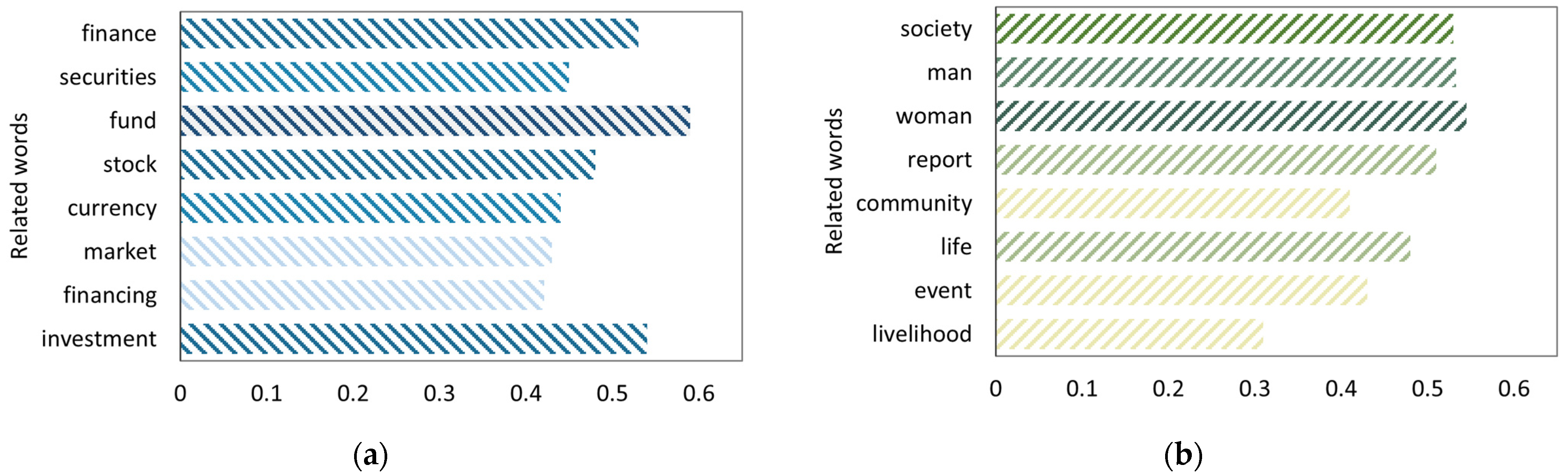
In order to understand the role of EKA more intuitively, we also analyze the weight distribution of each related word after training. In the experiment, we average weights in a few-shot setting. As shown in Figure 6, we show some news tag words filtered via EKA, among which finance and society have higher weight, which is consistent with our intuition. As shown in Figure 6a, “fund” has the highest weight. If the relevant words are selected only by intuition, “fund” may be omitted. Moreover, “financing” should have a higher weight intuitively, but in fact has the lowest weight. As shown in Figure 6b, “woman” and “man” have a high weight, which indicates that these keywords are likely to be filtered out if they are simply extended from the external knowledge graph without considering the sentence itself. These results suggest that PLMs may differ from how humans perceive and define words, and that PLMs understand words more in terms of semantics and relevance.
Figure 6. The weight distribution of label-related words in THUCNews: (a) the weights of finance; (b) the weights of society.

6.5. Hyperparameter Influence

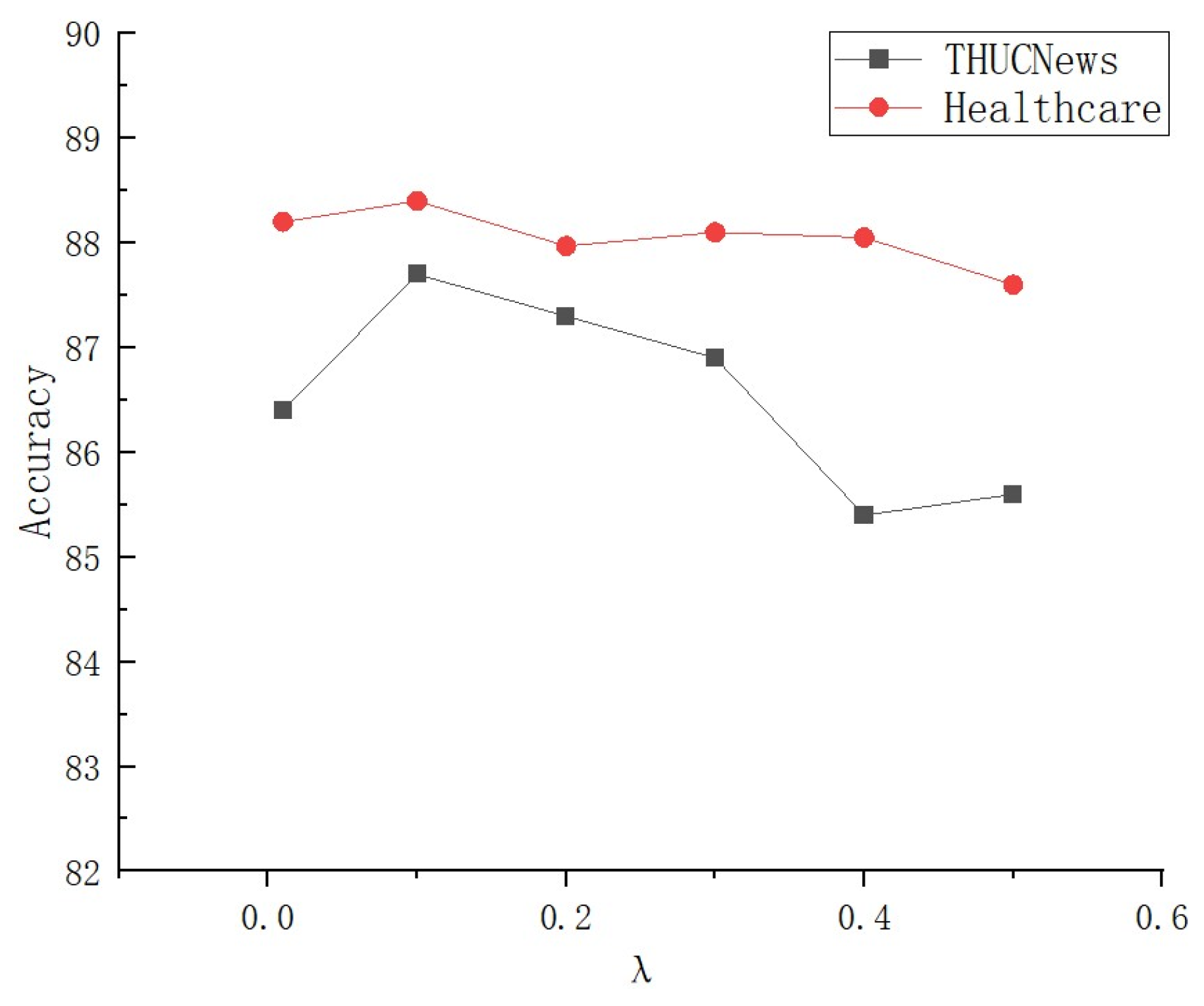
In order to explore the influence of the joint contrastive learning parameter r on the experimental results, we set λ { 0.01 : 0.5 } on THUCNews to analyze the influence on the classification effect of ConKgPrompt. As shown in Figure 7, our model obtains the best result when the scaling coefficient is set to 0.1.
Figure 7. Fluence of SupCon and CE fusion ratio.

7. Discussion

We proposed ConKgPrompt for text classification as efficient in both few-shot and full-data scenarios. Our method can be dissected into the following processes: first, amalgamating the input text with the prompt template to create a new sequence; next, incorporating an external knowledge base to construct label- and sentence-related words, ultimately confirming the definitive verbalizer; and lastly, acquiring features from the supervised contrastive module by learning from the output of the PLMs. As demonstrated in the main results, it becomes apparent that our proposed model exhibits minimal variance when applied to datasets characterized by robust labeling quality. Conversely, datasets featuring limited data or intricate semantics showcase higher variance. This disparity underscores the susceptibility of ConKgPrompt to diverse dataset attributes, implying that there is indeed scope for further enhancement. Addressing this facet will remain an integral component of our future endeavors. In this vein, we are keen on capitalizing on the prowess of unsupervised learning to capture more universally applicable features. By imbuing the training process with unsupervised objectives, we anticipate augmenting the model’s capacity to accommodate varied scenarios and contexts, thereby achieving a higher degree of generalization.

8. Conclusions

In this study, we proposed a contrastive sample method based on knowledge-guided prompt learning framework (ConKgPrompt) for text classification. ConKgPrompt utilizes external knowledge bases for multi-granularity construction of verbalizers and refines the verbalizer based on Word2vec and similarity. We employed ERNIE 3.0, which has rich prior knowledge, for feature extraction, and the training strategy utilizes supervised contrastive learning to exploit prior differences in samples to enhance sample representation. Experimental results and visual analyses indicate that the ConKgPrompt method achieves better classification performance than previous studies, particularly in the few-shot settings, and outperforms existing prompt-tuning methods, demonstrating the robustness and effectiveness of ConKgPrompt. Future work will focus on studying prompt continuous template generation strategies that can effectively express the grammatical relationships of text, and consider the use of unsupervised contrastive learning to enhance model representation

Author Contributions

Conceptualization, Q.W.; methodology, Q.W.; software, Q.W.; formal analysis, Q.W.; visualization, Q.W.; writing-original draft preparation, Q.W; writing-review and editing, C.Z.; resources, C.Z. and B.L.; funding acquisition, C.Z. and P.H. All authors have read and agreed to the published version of the manuscript.

Funding

This work is supported by the Key R & D projects in Hubei Province (No. 2021BAA188, 2021BAA184, 2022BAA044), the National Natural Science Foundation of China (No. 62102136), the Science and Technology Innovation Program of Hubei Province (No. 2020AEA008).

Data Availability Statement

The data presented in this study can be provided upon request.

Acknowledgments

The authors would like to thank the editors and the anonymous reviewers for their helpful comments and suggestions, which have improved the presentation.

Conflicts of Interest

The authors declare no conflict of interest.

References

  1. Tang, J.W.; Li, R.X.; Wang, K.P.; Gu, X.W.; Xu, Z.Y. A Novel Hybrid Method to Analyze Security Vulnerabilities in Android Applications. Tsinghua Sci. Technol. 2020, 25, 589–603. [Google Scholar] [CrossRef]
  2. Zhao, B.; Zhao, P.Y.; Fan, P.R. ePUF: A Lightweight Double Identity Verification in IoT. Tsinghua Sci. Technol. 2020, 25, 625–635. [Google Scholar] [CrossRef]
  3. Pagolu, V.S.; Reddy, K.N.; Panda, G.; Majhi, B. Sentiment analysis of Twitter data for predicting stock market movements. In Proceedings of the 2016 International Conference on Signal Processing, Communication, Power and Embedded System (SCOPES), Paralakhemundi, India, 3–5 October 2016; pp. 1345–1350. [Google Scholar]
  4. Debnath, K.; Kar, N. Email spam detection using deep learning approach. In Proceedings of the 2022 International Conference on Machine Learning, Big Data, Cloud and Parallel Computing (COM-IT-CON), Faridabad, India, 26–27 May 2022; pp. 37–41. [Google Scholar]
  5. Guo, Y.; Lamaazi, H.; Mizouni, R. Smart edge-based fake news detection using pre-trained BERT model. In Proceedings of the 2022 18th International Conference on Wireless and Mobile Computing, Networking and Communications (WiMob), Thessaloniki, Greece, 10–12 October 2022; pp. 437–442. [Google Scholar]
  6. Kim, Y.J. Convolutional neural networks for sentence classification. In Proceedings of the 2014 Conference on Empirical Methods in Natural Language Processing, Doha, Qatar, 25–29 October 2014; pp. 1746–1751. [Google Scholar]
  7. Liu, P.; Qiu, X.; Huang, X.J. Recurrent neural network for text classification with multi-task learning. arXiv 2016, arXiv:1605.05101. [Google Scholar]
  8. Devlin, J.; Chang, M.-W.; Lee, K.; Toutanova, K.J. BERT: Pre-training of Deep Bidirectional Transformers for Language Understanding. In Proceedings of the 2019 Conference of the North American Chapter of the Association for Computational Linguistics: Human Language Technologies, Minneapolis, MN, USA, 2–7 June 2019; Volume 1, (Long and Short Papers). pp. 4171–4186. [Google Scholar]
  9. Liu, Y.; Ott, M.; Goyal, N.; Du, J.; Joshi, M.; Chen, D.; Levy, O.; Lewis, M.; Zettlemoyer, L.; Stoyanov, V.J. Roberta: A robustly optimized bert pretraining approach. arXiv 2019, arXiv:1907.11692. [Google Scholar]
  10. Brown, T.; Mann, B.; Ryder, N.; Subbiah, M.; Kaplan, J.D.; Dhariwal, P.; Neelakantan, A.; Shyam, P.; Sastry, G.; Askell, A. Language models are few-shot learners. In Proceedings of the 34th Conference on Neural Information Processing Systems, Online, 6–12 December 2020; pp. 1877–1901. [Google Scholar]
  11. Sun, Y.; Wang, S.; Li, Y.; Feng, S.; Chen, X.; Zhang, H.; Tian, X.; Zhu, D.; Tian, H.; Wu, H.J. Ernie: Enhanced representation through knowledge integration. arXiv 2019, arXiv:1904.09223. [Google Scholar]
  12. Su, Y.S.; Han, X.; Lin, Y.K.; Zhang, Z.Y.; Liu, Z.Y.; Li, P.; Zhou, J.; Sun, M.S. CSS-LM: A Contrastive Framework for Semi-Supervised Fine-Tuning of Pre-Trained Language Models. IEEE ACM Trans. Audio Speech Lang. Process. 2021, 29, 2930–2941. [Google Scholar] [CrossRef]
  13. Liu, X.; Zheng, Y.; Du, Z.; Ding, M.; Qian, Y.; Yang, Z.; Tang, J.J. GPT understands, too. arXiv 2021, arXiv:2103.10385. [Google Scholar] [CrossRef]
  14. Gao, T.; Fisch, A.; Chen, D.J. Making pre-trained language models better few-shot learners. In Proceedings of the 59th Annual Meeting of the Association for Computational Linguistics and the 11th International Joint Conference on Natural Language Processing, Online, 1–6 August 2021; pp. 3816–3830. [Google Scholar]
  15. Schick, T.; Schütze, H.J. It’s not just size that matters: Small language models are also few-shot learners. arXiv 2020, arXiv:2009.07118. [Google Scholar]
  16. Hu, S.; Ding, N.; Wang, H.; Liu, Z.; Wang, J.; Li, J.; Wu, W.; Sun, M.J. Knowledgeable prompt-tuning: Incorporating knowledge into prompt verbalizer for text classification. In Proceedings of the 60th Annual Meeting of the Association for Computational linguistics, Dublin, Ireland, 22–27 May 2022; pp. 2225–2240. [Google Scholar]
  17. Sun, Y.; Wang, S.; Feng, S.; Ding, S.; Pang, C.; Shang, J.; Liu, J.; Chen, X.; Zhao, Y.; Lu, Y.J. Ernie 3.0: Large-scale knowledge enhanced pre-training for language understanding and generation. arXiv 2021, arXiv:2107.02137. [Google Scholar]
  18. Khosla, P.; Teterwak, P.; Wang, C.; Sarna, A.; Tian, Y.; Isola, P.; Maschinot, A.; Liu, C.; Krishnan, D. Supervised contrastive learning. In Proceedings of the 34th Conference on Neural Information Processing Systems, Online, 6–12 December 2020; pp. 18661–18673. [Google Scholar]
  19. Dan, Y.; Zhou, J.; Chen, Q.; Bai, Q.; He, L. Enhancing class understanding via prompt-tuning for zero-shot text classification. In Proceedings of the ICASSP 2022—2022 IEEE International Conference on Acoustics, Speech and Signal Processing (ICASSP), Singapore, 23–27 May 2022; pp. 4303–4307. [Google Scholar]
  20. Zhang, W.; Song, X.; Feng, Z.; Xu, T.; Wu, X.J. LabelPrompt: Effective Prompt-based Learning for Relation Classification. arXiv 2023, arXiv:2302.08068. [Google Scholar]
  21. You, Y.; Jiang, Z.; Zhang, K.; Jiang, J.; Wang, X.; Zhang, Z.; Wang, S.; Feng, H. TI-Prompt: Towards a Prompt Tuning Method for Few-shot Threat Intelligence Twitter Classification. In Proceedings of the 2022 IEEE 46th Annual Computers, Software, and Applications Conference (COMPSAC), Los Alamitos, CA, USA, 27 June–1 July 2022; pp. 272–279. [Google Scholar]
  22. Zhang, H.; Liang, B.; Yang, M.; Wang, H.; Xu, R.F. Prompt-Based Prototypical Framework for Continual Relation Extraction. IEEE ACM Trans. Audio Speech Lang. Process. 2022, 30, 2801–2813. [Google Scholar] [CrossRef]
  23. Shin, T.; Razeghi, Y.; Logan IV, R.L.; Wallace, E.; Singh, S.J. Autoprompt: Eliciting knowledge from language models with automatically generated prompts. In Proceedings of the 2020 Conference on Empirical Methods in Natural Language Processing (EMNLP), Online, 16–18 November 2020; pp. 4222–4235. [Google Scholar]
  24. Schick, T.; Schütze, H.J. Exploiting cloze questions for few shot text classification and natural language inference. In Proceedings of the 16th Conference of the European Chapter of the Association for Computational Linguistics: Main Volume, Online, 19–23 April 2021; pp. 255–269. [Google Scholar]
  25. Jiang, T.; Jiao, J.; Huang, S.; Zhang, Z.; Wang, D.; Zhuang, F.; Wei, F.; Huang, H.; Deng, D.; Zhang, Q.J. Promptbert: Improving bert sentence embeddings with prompts. In Proceedings of the 2022 Conference on Empirical Methods in Natural Language Processing, Abu Dhabi, United Arab Emirates, 7–11 December 2022; pp. 8826–8837. [Google Scholar]
  26. Gao, T.; Yao, X.; Chen, D.J. Simcse: Simple contrastive learning of sentence embeddings. arXiv 2021, arXiv:2104.08821. [Google Scholar]
  27. Guo, J.; Zhao, B.; Liu, H.; Liu, Y.; Zhong, Q.J.T.S. Technology Supervised contrastive learning with term weighting for improving Chinese text classification. Tsinghua Sci. Technol. 2022, 28, 59–68. [Google Scholar] [CrossRef]
  28. Liu, W.; Zhou, P.; Zhao, Z.; Wang, Z.; Ju, Q.; Deng, H.; Wang, P. K-bert: Enabling language representation with knowledge graph. In Proceedings of the AAAI Conference on Artificial Intelligence, New York, NY, USA, 7–12 February 2020; pp. 2901–2908. [Google Scholar]
  29. Liu, J.; Zhang, Z.; Guo, Z.; Jin, L.; Li, X.; Wei, K.; Sun, X.J.K.-B.S. KEPT: Knowledge Enhanced Prompt Tuning for event causality identification. Knowl. Based Syst. 2023, 259, 110064. [Google Scholar] [CrossRef]
  30. Song, C.; Cai, F.; Wang, M.; Zheng, J.; Shao, T.J.K.-B.S. TaxonPrompt: Taxonomy-aware curriculum prompt learning for few-shot event classification. Knowl. Based Syst. 2023, 264, 110290. [Google Scholar] [CrossRef]
  31. Qi, F.; Zhang, L.; Yang, Y.; Liu, Z.; Sun, M. Wantwords: An open-source online reverse dictionary system. In Proceedings of the 2020 Conference on Empirical Methods in Natural Language Processing: System Demonstrations, Online, 16–20 November 2020; pp. 175–181. [Google Scholar]
  32. Xu, B.; Xu, Y.; Liang, J.; Xie, C.; Liang, B.; Cui, W.; Xiao, Y. CN-DBpedia: A never-ending Chinese knowledge extraction system. In Proceedings of the International Conference on Industrial, Engineering and Other Applications of Applied Intelligent Systems, Online, 27–30 June 2017; pp. 428–438. [Google Scholar]
  33. Le, Q.; Mikolov, T. Distributed representations of sentences and documents. In Proceedings of the International Conference on Machine Learning, Beijing, China, 21–26 June 2014; pp. 1188–1196. [Google Scholar]
  34. Dai, Z.; Yang, Z.; Yang, Y.; Carbonell, J.; Le, Q.V.; Salakhutdinov, R.J. Transformer-xl: Attentive language models beyond a fixed-length context. arXiv 2019, arXiv:1901.02860. [Google Scholar]
  35. Xu, L.; Lu, X.; Yuan, C.; Zhang, X.; Xu, H.; Yuan, H.; Wei, G.; Pan, X.; Tian, X.; Qin, L.J. Fewclue: A Chinese few-shot learning evaluation benchmark. arXiv 2021, arXiv:2107.07498. [Google Scholar]
  36. Chen, Q.; Zhang, R.; Zheng, Y.; Mao, Y.J. Dual contrastive learning: Text classification via label-aware data augmentation. arXiv 2022, arXiv:2201.08702. [Google Scholar]
  37. Hambardzumyan, K.; Khachatrian, H.; May, J.J. Warp: Word-level adversarial reprogramming. In Proceedings of the Annual Meeting of the Association for Computational Linguistics and the 11th International Joint Conference on Natural Language Processing, Online, 1–6 August 2021; pp. 4921–4933. [Google Scholar]
Disclaimer/Publisher’s Note: The statements, opinions and data contained in all publications are solely those of the individual author(s) and contributor(s) and not of MDPI and/or the editor(s). MDPI and/or the editor(s) disclaim responsibility for any injury to people or property resulting from any ideas, methods, instructions or products referred to in the content.

Article Metrics

Citations

Article Access Statistics

Multiple requests from the same IP address are counted as one view.