You are currently viewing a new version of our website. To view the old version click .
Electronics
  • Article
  • Open Access

19 September 2022

IoT-Based Access Management Supported by AI and Blockchains †

,
and
Communication Systems Group CSG, Department of Informatics IfI, University of Zürich UZH, Binzmühlestrasse 14, CH-8050 Zurich, Switzerland
*
Author to whom correspondence should be addressed.
This paper is an extended version of our paper published in CNSM’21.
These authors contributed equally to this work.
This article belongs to the Special Issue Emerging Technologies for the Next Generation Smart Systems

Abstract

Internet-of-Things (IoT), Artificial Intelligence (AI), and Blockchains (BCs) are essential techniques that are heavily researched and investigated today. This work here specifies, implements, and evaluates an IoT architecture with integrated BC and AI functionality to manage access control based on facial detection and recognition by incorporating the most recent state-of-the-art techniques. The system developed uses IoT devices for video surveillance, AI for face recognition, and BCs for immutable permanent storage to provide excellent properties in terms of image quality, end-to-end delay, and energy efficiency.

1. Introduction

Internet-of-Things (IoT) is transforming the world of things, impacting many economic sectors, such as manufacturing, transportation, automotive, consumer goods, and healthcare [1]. Thanks to the advances in integrated circuit design, IoT devices are now equipped with powerful processors of a new generation, handling processing loads efficiently [2,3]. This offers an opportunity to run complex tasks on IoT devices in a distributed fashion. However, IoT comes with many challenges or gaps that still need to be improved [4], such as the centralization of various IoT platforms, e.g., Amazon Web Services (AWS)-IoT, security and privacy issues concerning communication protocols as well as vulnerability to various attacks related to the poor maintenance of IoT infrastructures, e.g., Mirai [5].
Blockchains (BC) [6,7] offer immutable storage of data records in a distributed ledger by cryptographic measures. BCs can help IoT infrastructures deal with centralization: when IoT infrastructures store and process data in a BC; this removes the single-point-of-failure present in currently available IoT platforms, such as AWS IoT [4,8,9,10]. BCs bring significant advantages in terms of information provenance, non-repudiation, and authenticity (while every originator signs every record with its private key), thus increasing the overall information security in the system [11]. Finally, Artificial Intelligence (AI) plays a significant role in providing accurate data analysis in real-time. Nevertheless, the design and development of an efficient data analysis tool using AI come with challenges, such as centralization and transparency [12]. Therefore, integrating BCs with AI can produce a robust approach to resolve those issues. AI is often considered a black box, providing classifiers or predictors, lacking transparency. However, the transparency can be materialized by ordering AI decisions among many nodes in a given BC. This provides a precise, immutable track of AI decisions ordered in time, which can, e.g., form the basis for managerial access control decisions. Therefore, the simultaneous application of IoT, BCs, and AI shows a successful synergy transforming data acquisition, analysis, and storage [11,13,14].
Having a closer look at the research in these three domains mentioned above, one may expect many proposals and architectures. However, no use case exists so far in which those three technologies may complement each other. Therefore, this paper’s primary goal is to design and develop a BC-enabled IoT Architecture coupled with AI to efficiently implement a use case, i.e., an access management approach.
The paper’s contributions are the following. First, we specify a use case in access management, in which a user is provided with access to a physical resource based on images collected by an IoT device. Second, we implement a real system in which an ESP32-based device [2] takes images and locally runs a Convolutional Neural Network (CNN) of a small size directly on the Micro Controller Unit (MCU) for face detection and face recognition [15]. The implemented infrastructure transports the image from the IoT device to a gateway. The gateway embeds the image and its metadata (i.e., user face identifier) into a transaction and sends the data toward an implemented smart contract. The smart contract runs on top of the Hyper Ledger Fabric (HLF) [7], handles the data received, and stores the data directly within the BC. Therefore, external storage systems such as InterPlanetary File System (https://docs.ipfs.io/ accessed on 25 January 2022) are not needed to handle images. The experimental validation of the system is based on the prototype developed.
Finally, this paper provides a real experience of the system, in which the AI algorithms run on the IoT device, i.e., MCU, directly. The information derived by the IoT-based AI is then provided towards an appropriately selected BC, which can be used as a communication backend or a storage system for auditing purposes.
The remainder of this paper is organized as follows. Section 2 introduces related work. While Section 3 provides a new use case and specifies the system architecture, Section 4 details its implementation and evaluates the performance of the system developed. Finally, Section 5 summarizes the work and adds an outlook on the future work.

3. Use Case and Architecture

Driven by the specific use case, this paper provides an extensive description of the architecture and gathers an in-depth analysis of the system previously briefly presented and superficially evaluated in a short conference proceedings paper [35].

3.1. Use Case

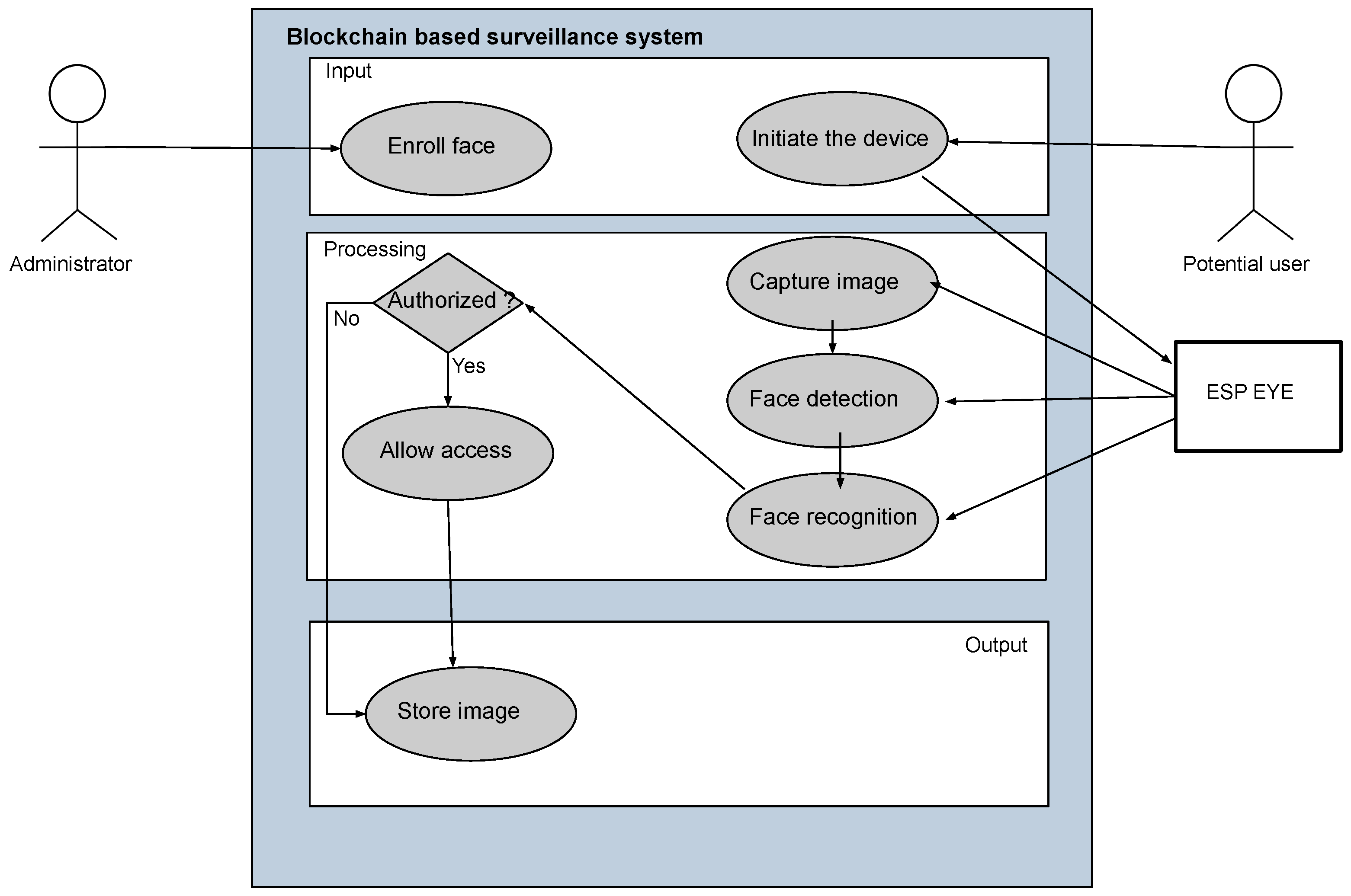
The system employees real-time face detection and recognition of authorized individuals to grant access to an institution. The access is granted or denied by the system automatically. For example, when access is granted, the door to an institution may open automatically without any intervention. However, the door will remain closed when access is denied, preventing the user from accessing a given resource. Every time an individual needs access, their picture is taken, processed, and stored in the immutable BC, preventing future tampering with data and enabling immutable storage that provides a solid foundation for auditing purposes.
This use case (cf. Figure 2) assumes that access is revoked when an individual is not registered in the system. However, a picture of unknown individuals is still taken and stored in the BC for auditing purposes. Once a stranger is detected continuously, a warning is raised to inform the administrator about this issue. Simultaneously, the number of people entering and leaving an institution or a room can be tracked. Tracking the number of people entering or leaving the room can be very beneficial in many situations, such as capacity tracking, infection spread.
Figure 2. High-Level Use Case Overview.
The process involves an individual approaching an entry point of an institution or a room, where an IoT device equipped with a camera detects and recognizes the person and grants or rejects access. Face recognition is performed with the help of face alignment, detection, and recognition. The images processed are forwarded to the BC, where they are stored in an immutable data structure. The system raises alarms if a continuous presence in front of the device is detected, where a person may want to perform a security breach.

3.2. Architecture

Based on the hardware components available, the software architecture design and the reasons for these design decisions taken to materialize the idea of IoT-based AI surveillance with BC are provided. Furthermore, different approaches, technologies, and communication protocols, considered throughout the design decisions, are described.

3.2.1. Hardware Components

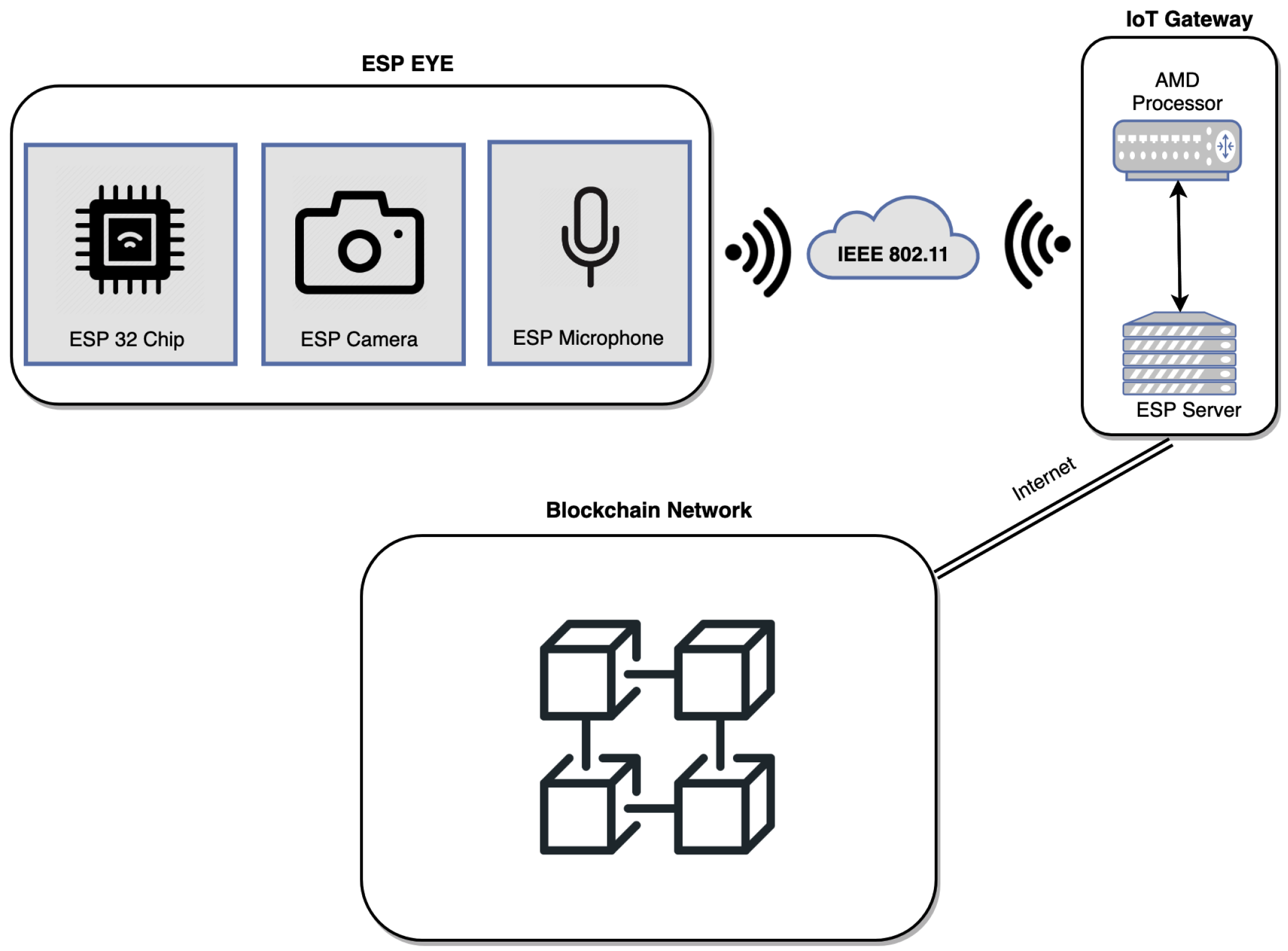
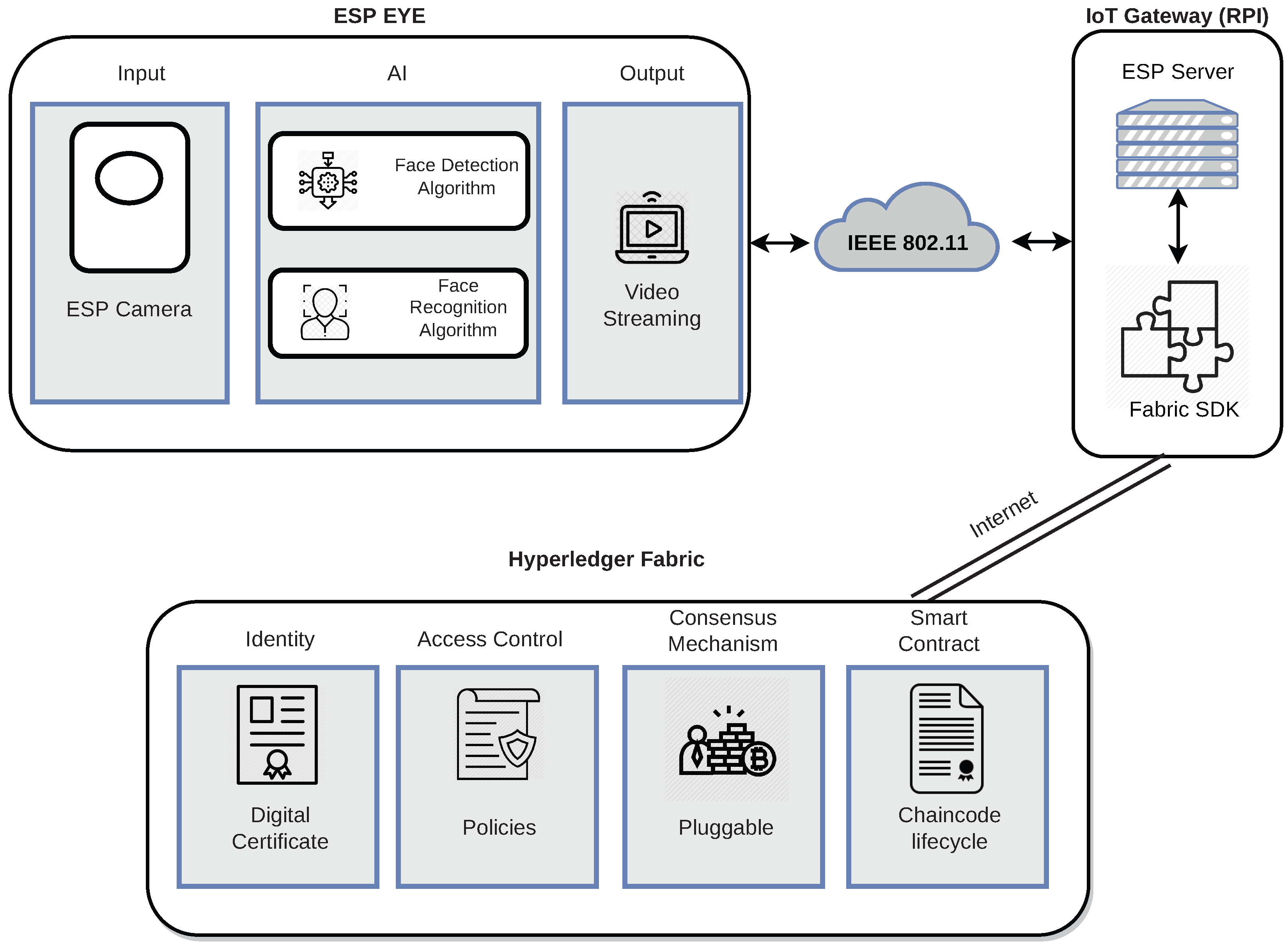
The image capturing and face recognition are handled by Esp Eye [2] directly, whereas the BC environment is based upon an Intel-based machine running a macOS. Figure 3, top left-hand side, displays multiple Esp Eye devices, which communicate with the IoT gateway within the same WiFi-based (i.e., IEEE 802.11) network. The IoT Gateway serves as the middle man, which waits for data (i.e., images and metadata) coming from Esp Eye devices to be inserted into the BC. The communication between Esp Eye devices and the IoT Gateway is achieved through a wireless communication compliant to the IEEE 802.11 Local Area Network (LAN) protocol. To provide integrated experimental facilities, the decision was to run a BC locally within the platform provided. However, the BC can be spanned among multiple machines organized as a BC network on the Internet without any hassle. Since HLF [7] was selected as the BC platform and its official build is provided for Intel-based CPUs, the decision was to run the IoT gateway on an Intel-based machine. It is, however, expected that HLF may run on low-capacity devices, such as ARM-based RPI devices. To this end, the HLF developer (i.e., IBM) shall provide an appropriate compilation environment to support ARM-based devices as well.
Figure 3. Hardware Architecture.
Esp Eye [2] integrates an embedded microphone and a camera with two megapixels. The camera is an OV2640 sensor with a maximum image size of 1600 × 1200 pixels. The board supports 2.4 GHz WiFi technology to connect to the Internet through a Local Area Network (LAN). A Micro USB port provides the power supply and also allows for debugging. In addition, it comes with a Universal Asynchronous Receiver-Transmitter (UART) port, which enables asynchronous serial communication to program the Esp Eye device. Esp Eye also supports several security features, such as flash encryption and secure boot. The flash encryption is intended to secure the content of the flash memory. In Esp Eye, flash encryption is performed using AES-256, and the key is stored in the eFuse (i.e., special-purpose storage on the chip). eFuse keeps the values intact and cannot be changed by a software. Furthermore, since the data on the flash are encrypted, a physical readout will not be possible. Additionally, secure boot can protect the device from uploading unsigned code. The device uses a typical digital signature method with the Rivest–Shamir–Adleman (RSA) cryptography. The public key is stored in the device itself, whereas the private key is kept secret and used upon each code upload. Apart from security, Esp Eye is an outstanding device due to its performance (i.e., a double-core architecture supporting the 240 MHz CPU frequency) and a face detection/recognition platform known as Esp Who. As elaborated in Section 2.2, Esp Who comes with algorithms for face detection (i.e., MTMN) and recognition (i.e., FRMN), which both run directly on the Esp Eye device.

3.2.2. Software Architecture

Figure 4 depicts a high-level overview of the software components. It is essential to mention that the software design shall be compatible with many underlying hardware architectures. However, the Esp Eye is required for the success of this project.
Figure 4. Software Architecture.
At the beginning, two approaches were considered: deployment of the face detection/recognition on the cloud and on the Esp Eye itself. In the first approach, the image processing AI is deployed on the cloud, which means the camera of a sensor captures images and sends them toward the cloud for face recognition. However, this centralized approach suffered from a single-point-of-failure and was later discontinued. In this work, Esp Eye uses the camera to capture images. Images are sent to the face detection and face recognition modules. It is noteworthy that face detection (i.e., MTMN [21,22]) and face recognition (i.e., FRMN [23]) run directly on the Esp Eye device. The outcome, i.e., an image accompanied by meta-data, is provided toward the implemented video streaming service, which connects with the implemented Esp Server running on the IoT Gateway. The Esp Server provides the image toward the implemented ESP Plugin (cf. the IoT Gateway), with the help of the HLF Software Development Kit (SDK), to submit the Transaction (TX) to the immutable ledger. HLF stores images coming from Esp Eye devices in immutable storage. HLF runs specific services required to run a BC. It consists of identity management, access control, and a consensus mechanism. Finally, HLF maintains the heart of the system, which is the smart contract implemented in this work that is responsible for handling data received from its clients (i.e., Esp Plugin residing on the IoT Gateway). HLF matches very well the use case (cf. Section 3.1) because a private permissioned BC is better suited for video surveillance due to privacy, BC block size, and BC block time reasons. The data gathered by a given organization have to remain protected against malicious third parties. This work also considered other BCs, for example, Ethereum (ETH) [6]. Although ETH is a public permissionless BC, it can still be adapted to the needs of this work (e.g., by running the private network or encrypting data on the chain). However, ETH comes with a Proof-of-Work (PoW) consensus mechanism, which is energy-demanding and costly. In contrast, HLF uses a modular architecture; it enables flexibility in selecting pluggable consensus mechanisms from a broader spectrum of candidate algorithms. Furthermore, HLF is fast, while some configurations allow for high workloads exceeding 20,000 supported TXs per second [36]. Additionally, HLF does not involve additional costs in terms of TX execution. Moreover, Hyperledger Fabric allows for splitting the network into multiple smaller networks (i.e., channels) to separate competing tenants and further improve privacy. Finally, HLF supports arbitrary user data of large sizes in TXs that do not hold for other BCs, which allow only short user-generated messages [37]. In our previous work [8,10], BAZO BC was used, which did not allow the storage of large portions of user data, such as images. We, therefore, decided to move on to a more suitable BC, i.e., HLF, rather than using less flexible BCs and storing data (i.e., images) off the chain.

3.2.3. Communication Protocols

Considering communication protocols, Esp Eye is attached to a WiFi network, which provides Internet Protocol (IP) communication. This work considered two major protocols, i.e., Message Queuing Telemetry Transport (MQTT) and Hypertext Transfer Protocol (HTTP), for the actual data transmission on the application layer, both supported by the Esp Eye device.
MQTT is a push-based client-server protocol that follows the Publish/Subscribe (Pub/Sub) communication model. Furthermore, MQTT is data-centric. Since video surveillance works with images, the decision was made to move towards document-oriented communication instead.
HTTP is a document-oriented client-server communication protocol. HTTP is employed between Esp Eye and the IoT Gateways to communicate in the client–server architecture. The Representational State Transfer (REST) architectural style is used for inter-machine communication because REST is considered a lightweight communication paradigm. The JavaScript Object Notation (JSON) data-interchange format [38] is employed to carry the actual information in the system. JSON is a lightweight format of syntax following the Javascript language notation. It makes JSON easy to read and process with high-level languages such as Javascript (JS).

3.3. Implementation

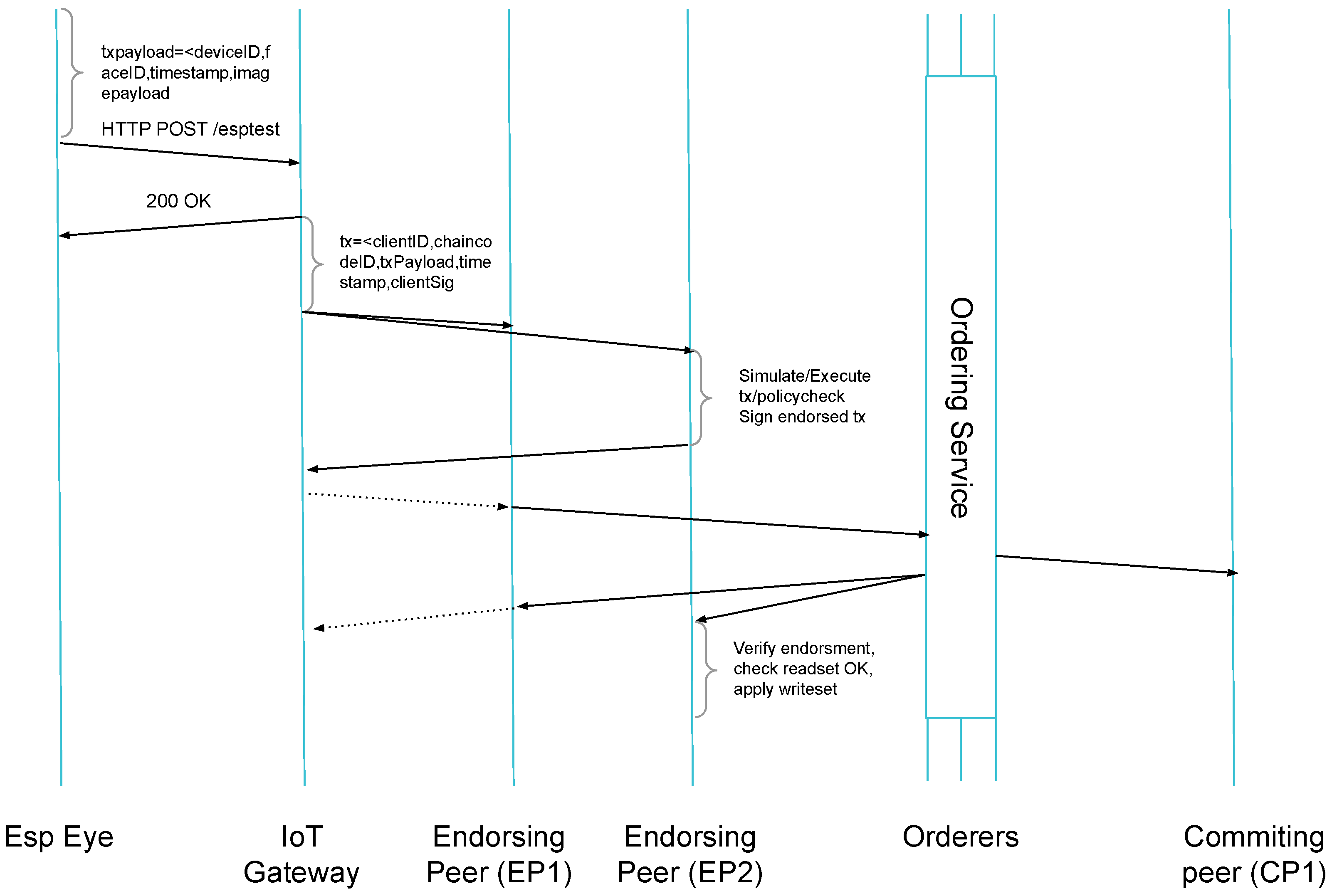
The implementation encompasses the data flow between Esp Eye, IoT Gateway, and HLF as shown in Figure 5, where data circulates from the left (i.e., the Esp Eye device) to the right (i.e., HLF) [39]. Several Application Programming Interfaces (API) and data structures are used to materialize the system.
Figure 5. Sequence Diagram Showing TX Execution.
Esp Who [15] analyses each frame with the MTMN face detection and if a face is detected, the image is provided towards the FRMN face recognition algorithm.

3.3.1. Multi-Task Cascaded Convolutional Networks (MTCNN) with MobileNets (MN)

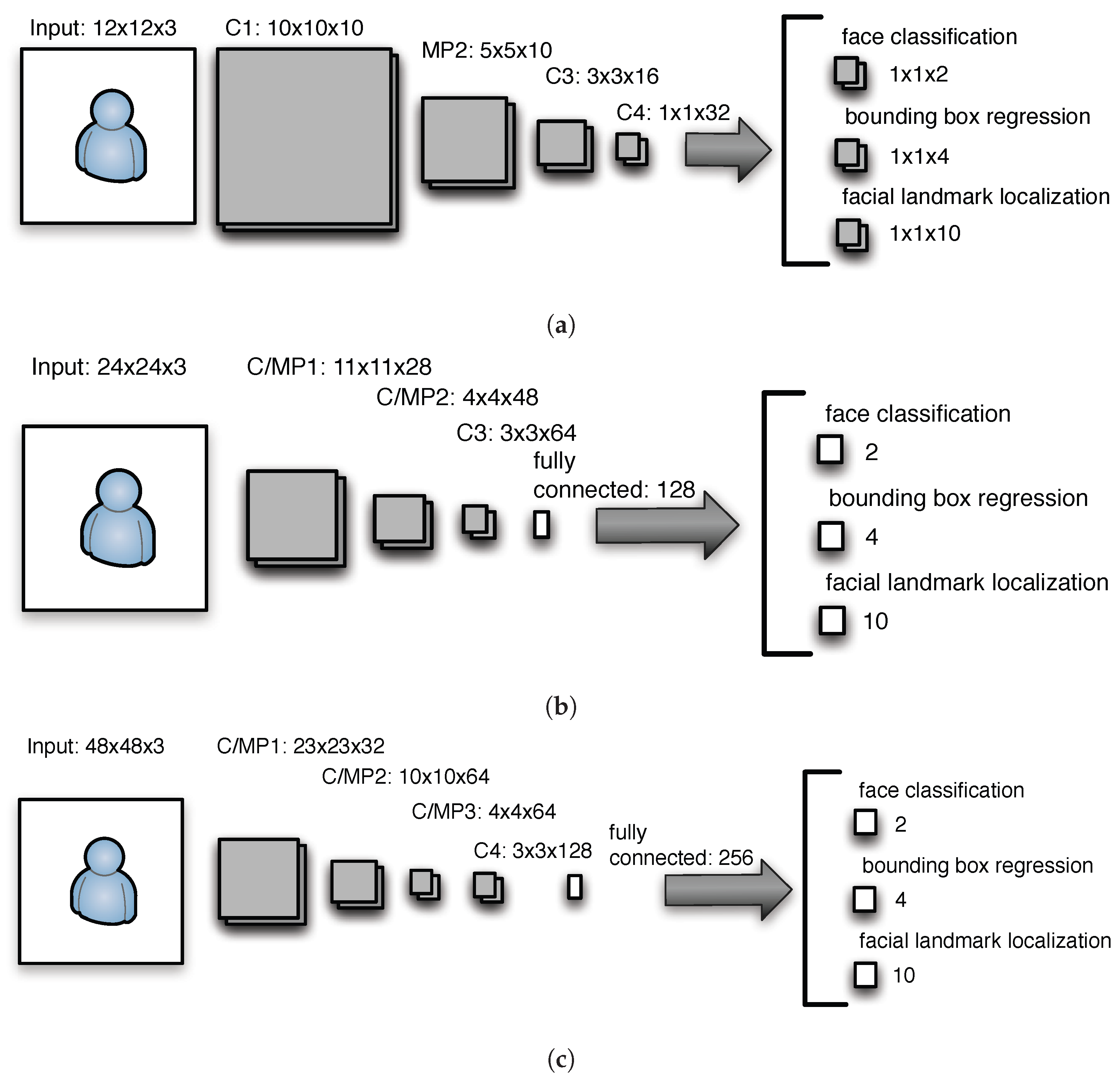
MTMN is an already trained model for face detection, which is based on the MTCNN implementation using the MobileNetsV2 convolution framework that significantly reduces the number of operations expressed in terms of MAdds and the number of model parameters. Table 1 gathers the number of parameters and number of operations in convolutions for each processing step of the MTCNN convolution network using regular convolutions (MTCNN) and MobileNetsV2. The calculations are performed for all convolutions within a given MTCNN step according to Section 2.2.4 (cf. Figure 1).
Table 1. MTCNN vs. MTMN.
It can be observed that the MTMN model size, when MobileNetsV2 convolutions are used, is very compact. Complexity-wise, it is worth noting that MTCNN/MTMN executes more complex stages (e.g., R-Net) only in the case of the previous operation (e.g., P-Net) suspecting a face in a given area of the picture. Thus, heavy processing is performed for picture areas with suspected face candidates. As input, MTMN acquires all images from the image pyramid constructed from the picture scaled accordingly.

3.3.2. Face Recognition MobileNets (FRMN)

FRMN is also part of the Esp Who [15] framework. By default, FRMN uses an adapted MobileNetV2 network, which is tuned to receive 56 × 56 × 3 images, and provide the output vector of 512 parameters (2 KB). FRMN can use the Euclidean or arc distances to compute distances between faces. The MobileNet used is a Deep Neural Network (DNN) with 0.5 mln parameters (2 MB) and has an execution time of 56 M MAdds. The size of the model provided by Esp Who is massive and takes a large portion of the available memory on the Esp Eye chip.

3.3.3. Note on MTMN and FRMN Complexity

It is, therefore, concluded that CNN is a well-suited method for IoT devices in terms of face detection and face recognition. However, CNN has to be used in conjunction with techniques optimizing the number of CNN parameters (i.e., RAM) and operations (i.e., CPU) on constrained devices. MTMN and FRMN from Esp Who [15] are lightweight versions of more heavyweight models provided in the literature [21,22], where FRMN is much more expensive than MTMN both in the case of RAM and CPU usage.

3.3.4. Esp Eye Transmission Overview

Hence, if a face is detected, but not necessarily recognized, the HTTP client is activated, while Esp Eye devices act as clients communicating with the remote server on the IoT Gateway. The video service takes the image equipped with meta-data (i.e., device ID, detected face ID, timestamp) and forwards it to the IoT Gateway. This is achieved with the help of a REST API call using the HTTP POST request. The node.js [40]-based server located in the IoT Gateway receives the request (e.g., an image with the details of a person detected provided as meta-data). Furthermore, the role of the node.js server is to properly acknowledge the successful reception of the transmission coming from Esp Eye devices.
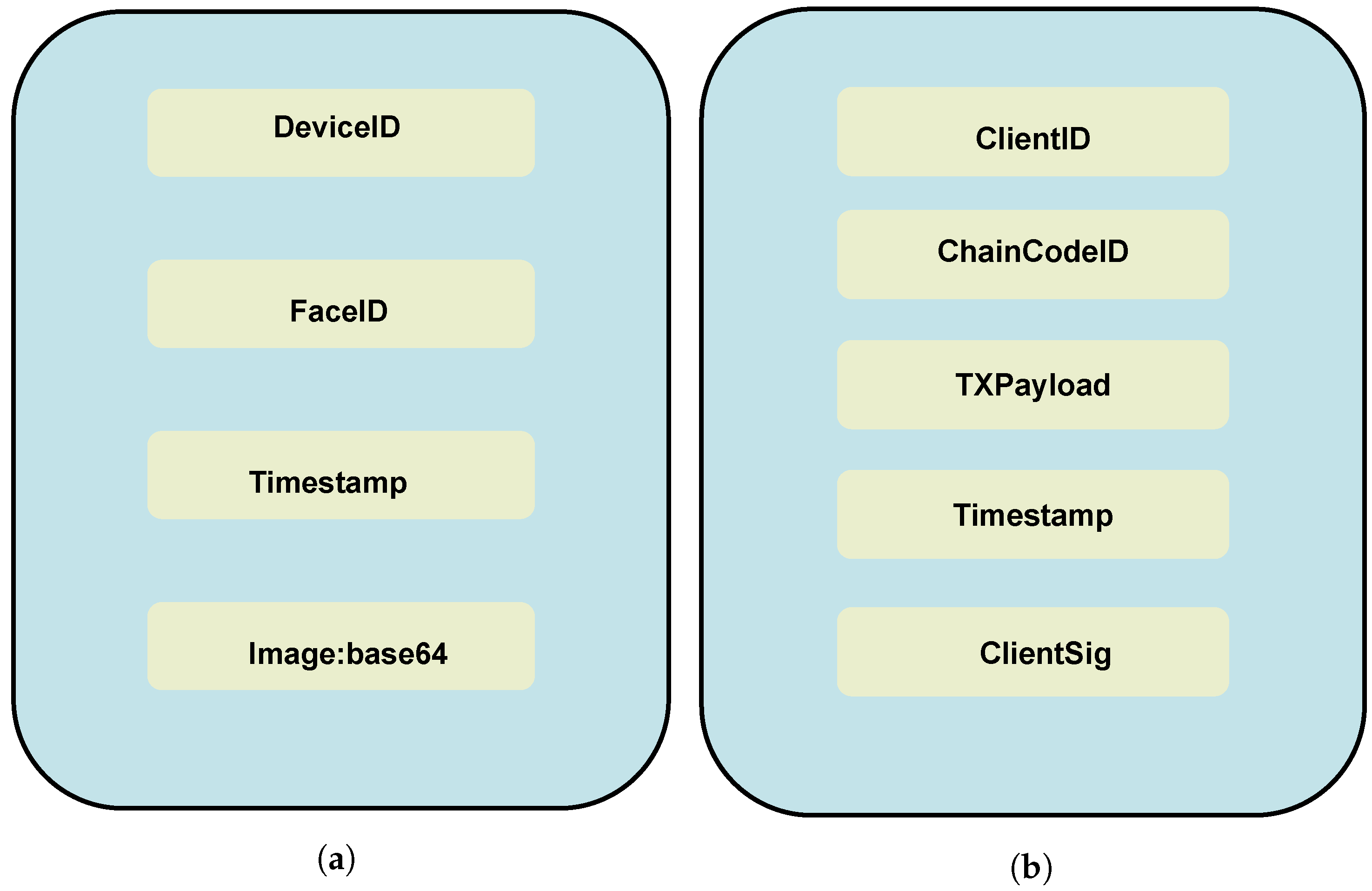
There are four significant parameters to be stored in the BC reflected in the JSON document (cf. Figure 6a) provided by Esp Eye devices. First, as multiple Esp Eye devices may be employed in access management, the device ID is essential, since the framework needs to distinguish particular devices from which the information is coming. Second, a face ID is needed, allowing for personal identification without processing the captured frame again. The successfully identified person on the sensor implies that access was granted to given resources protected by this access management system. Additionally, the timestamp identifies the time moment when the person is detected. Finally, the image frame is encoded in BASE64 [41]. As shown in Figure 5, all four parameters are sent as a JSON document. After receiving the document, the node.js server located on the IoT Gateway responds with a status code. The Esp Eye is programmed with the help of the Arduino IDE [42], which has to be equipped with the ESP32 board support. Consequently, the appropriate board called ESP-CAM has to be selected to program the Esp Eye device. The WiFiClient library (https://www.arduino.cc/en/Reference/WiFiClient accessed on 25 January 2022) enables establishing the connection to the IoT Gateway by using its IP address. The Esp Eye issues HTTP requests using the POST method towards the HTTP API exposed by the IoT Gateway. For submitting JSON documents, the application/json method is used, which is a standard format for sending structured data. JSON is handful for sending plain text or any other data types. Since HLF also uses a JSON format to store assets, this work converts the image into a data type supported by JSON as well. Hence, the best option is to store the image as a string. To this end, the image is first converted to BASE64. The Esp Eye converts images to BASE64 and encapsulate the BASE64 representation into a JSON format.
Figure 6. JSON Formats Used: (a) Sent From Esp Eye Devices, (b) Included in the HLF TX Proposed.

3.3.5. HLF Transaction Submission

The node.js HTTP server is responsible for receiving the data and forwarding it to the HLF. In order to interact with HLF, the node.js-based server uses the HLF SDK providing an API to submit TX to the ledger. The process of submission takes place right after the image has arrived from an Esp Eye device. The HLF TX data, also referred to as an asset, is a collection of key-value pairs. Since the JSON format for the image transfer is used from the start, node.js may forward a similar JSON file to the BC.
Before the HLF TX is initiated, three preconditions have to be fulfilled. (i) The HLF has to be configured and running. (ii) The HLF channel is established (i.e., HLF subnetwork for privacy concerns). (iii) The chaincode implemented in this work (i.e., HLF Smart Contract identified by its chaincode ID) with its endorsement policy is deployed within a given channel. Every Esp Eye is registered and enrolled with Certificate Authority (CA), while the Membership Service Providers (MSP) maintain the identities of every Esp Eye device. For more information, please consult the HLF documentation [7].
The IoT Gateway acts as an HLF client. Therefore, the IoT Gateway initiates the HLF TX with these four parameters provided as a JSON document by Esp Eye (cf. Section 3.3.4), which becomes the TX payload. Each Esp Eye is assigned with a public/private key pair, which is used to sign the HLF TX. In this work, the IoT Gateway retrieves the key pair of a given Esp Eye device and signs the TX on behalf of the device using the HLF SDK. Although TX signing is possible in the offline mode, meaning locally on the Esp Eye device, this was not implemented here, since the HLF client SDK is not ported for Esp Eye devices yet.
Typical BCs, such as ETH, use the order-and-execute paradigm, meaning the TX is first ordered in blocks and later on executed by all peers in a given BC network. The speed of the HLF environment is achieved through the application of a so-called execute-and-order TX submission scheme, which depends on the configurable number of endorsement peers, which first execute all TXs received. Endorsers endorse a given TX. When the HLF TX receives endorsements, which satisfies the configured endorsement policy, the TX can be ordered in blocks by the ordering service according to a configured consensus mechanism and committed into the ledger by committing peers.
This work configures two endorsers (i.e., EP1 and EP2, cf. Figure 5). They receive the TX proposal, which includes a client ID, the chaincode ID (i.e., HLF smart-contract ID), the TX payload, a timestamp, and the clientSignature as presented in Figure 6b. Only endorsing peers specified by the chaincode receive this TX proposal. The endorsement policy in this work requires both endorsement peers to endorse the received HLF TX before the TX might be submitted toward the ordering service. First, EP1 and EP2 check the format of the TX. Second, every TX has to possess a valid signature of a client appropriately registered within the MSP. Third, the client has an authorized member of the HLF channel. When all conditions have been checked, the endorsers invoke the chaincode using the JSON document received. Eventually, the TX is executed; however, it does not yet update the ledger. Now, the endorsers sign the proposed TX and send it back to the HLF client on the IoT Gateway. The intent of the HLF client is to submit the TX to the ordering service and update the ledger. If the HLF client’s intention was to query the ledger, there is no need to submit anything to the ordering service.
Before the HLF submits the final version of the TX, HLF clients send the TX endorsed toward the ordering service. Now, the TX is equipped with signatures of endorsing peers. While the ordering service may receive TXs from other clients or ESP devices, the ordering service orders TXs according to a sequence number and packages them into blocks. When the maximum number of TXs allowed in a block is reached or the maximum block-time has passed, blocks are sent to committing peers to be included in the ledger for an immutable storage.
Upon receiving a broadcast message with the created block from the orderers, committing peers verify the signatures of ordering nodes within a given block. HLF allows for configuring committing peers. However, typically all peers in a given channel may update the ledger. If the committing peers fail to verify the signature of ordering peers, the ledger will not include them and rejects the newly created block.

4. Evaluation

Important criteria for an evaluation include the reliability of the overall design, end-to-end delay from the moment the image is taken until it is finally submitted into the BC, the quality of images captured by Esp Eye as well as stored in Hyperledger Fabric, and the energy efficiency of the solution from an IoT device’s perspective. The evaluation integrates two Esp Eye sensors (dual-core Tensilica LX6 processor with a maximum frequency of 240 MHz, 4 MB PSRAM, and 4 MB flash) and regular macOS-based computer with 2-core Intel Core i5 running at 2.7 GHz, 512 GB SDD disk, and 8 GB RAM. To begin testing, several steps are recommended. (i) The Esp Eye sensors are powered up using an external charger power bank; 10 face profiles are uploaded on the device. (ii) HLF is started with the help of docker containers. Currently, one committing peer and two endorsing peers are supported. The ordering service is set to solo, i.e., one node submitting HLF TXs. The channel is configured and JS-based chaincode is deployed. (iii) The IoT Gateway starts the node.js-based HTTP server listening on port 8585.

4.1. Image Quality

The Esp Who platform supports the OV2640 camera embedded in Esp Eye. The camera can be configured in terms of frame size and pixel format. The frame size may be set to one of the following options: FRAMESIZE_CIF (400 × 296), FRAMESIZE_QVGA (320 × 240), FRAMESIZE_VGA (640 × 480), FRAMESIZE_SVGA (800 × 600), FRAMESIZE_XGA (1024 × 768), FRAMESIZE_SXGA (1280 × 1024), and FRAMESIZE_UXGA (1600 × 1200). With FRAMESIZE_QVGA and FRAMESIZE_CIF, the Esp Eye with face detection and recognition run almost equally well. One difference between them is the number of frames per second delivered. The larger the image size, the more processing time it takes to receive the image. Therefore, due to the higher width, the FRAMESIZE_CIF consumes more processing power, and it can achieve on average 3.2 fps (i.e., 312 ms to deliver an image). In contrast, with FRAMESIZE_QVGA, the sensor can deliver 5.2 fps (i.e., 190 ms to deliver an image). Therefore, FRAMESIZE_QVGA was selected as the image resolution used in this work.

4.2. Processing Delay of Face Detection and Recognition

First of all, the idea of performing face detection and recognition on Esp Eye is a novel approach because typically face detection and recognition run either on the cloud or on a local computer. In related work (cf. Section 2), it was previously reported that face detection and recognition offloading to the cloud takes at least 2 s and sometimes goes up to 5 s.
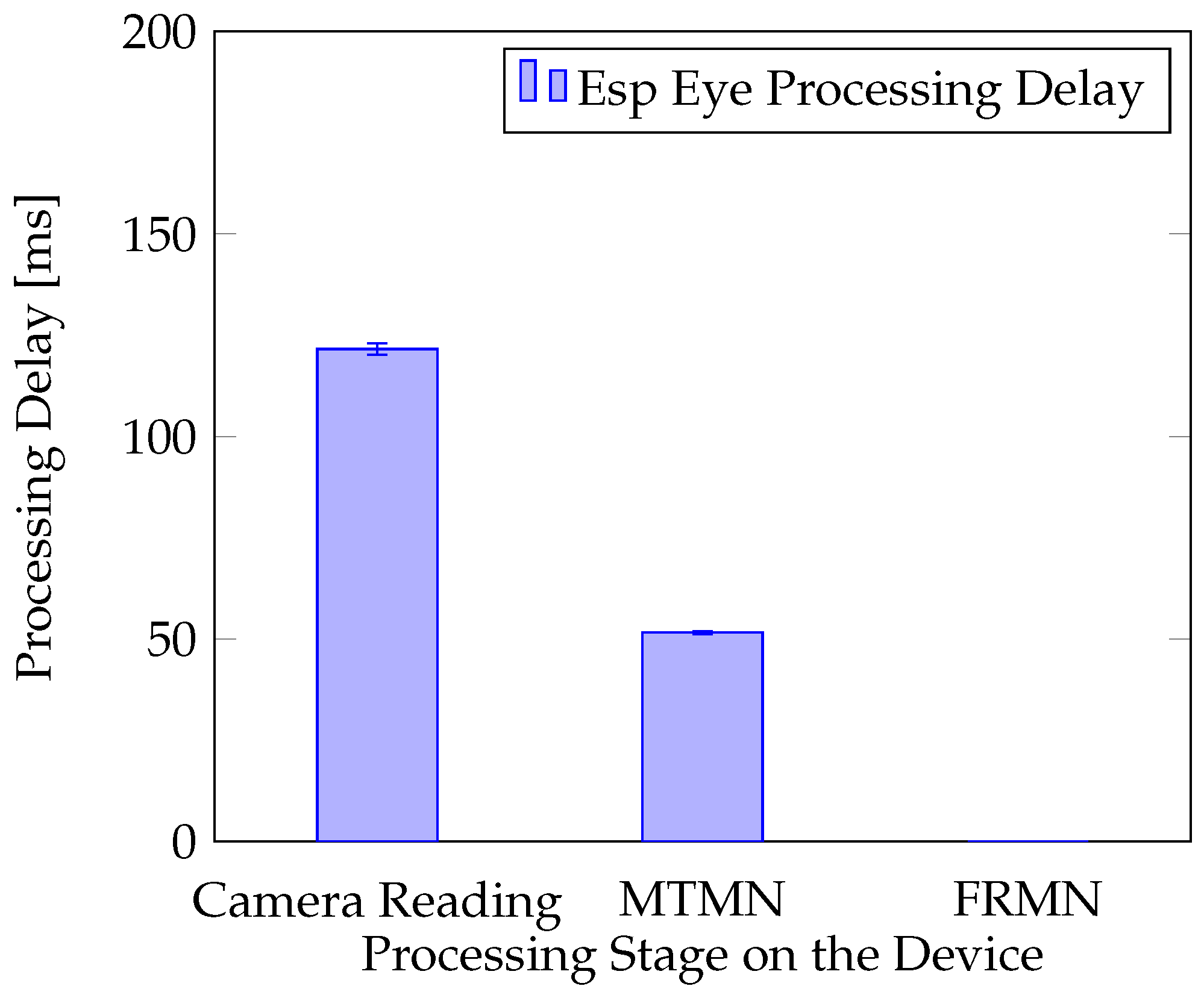
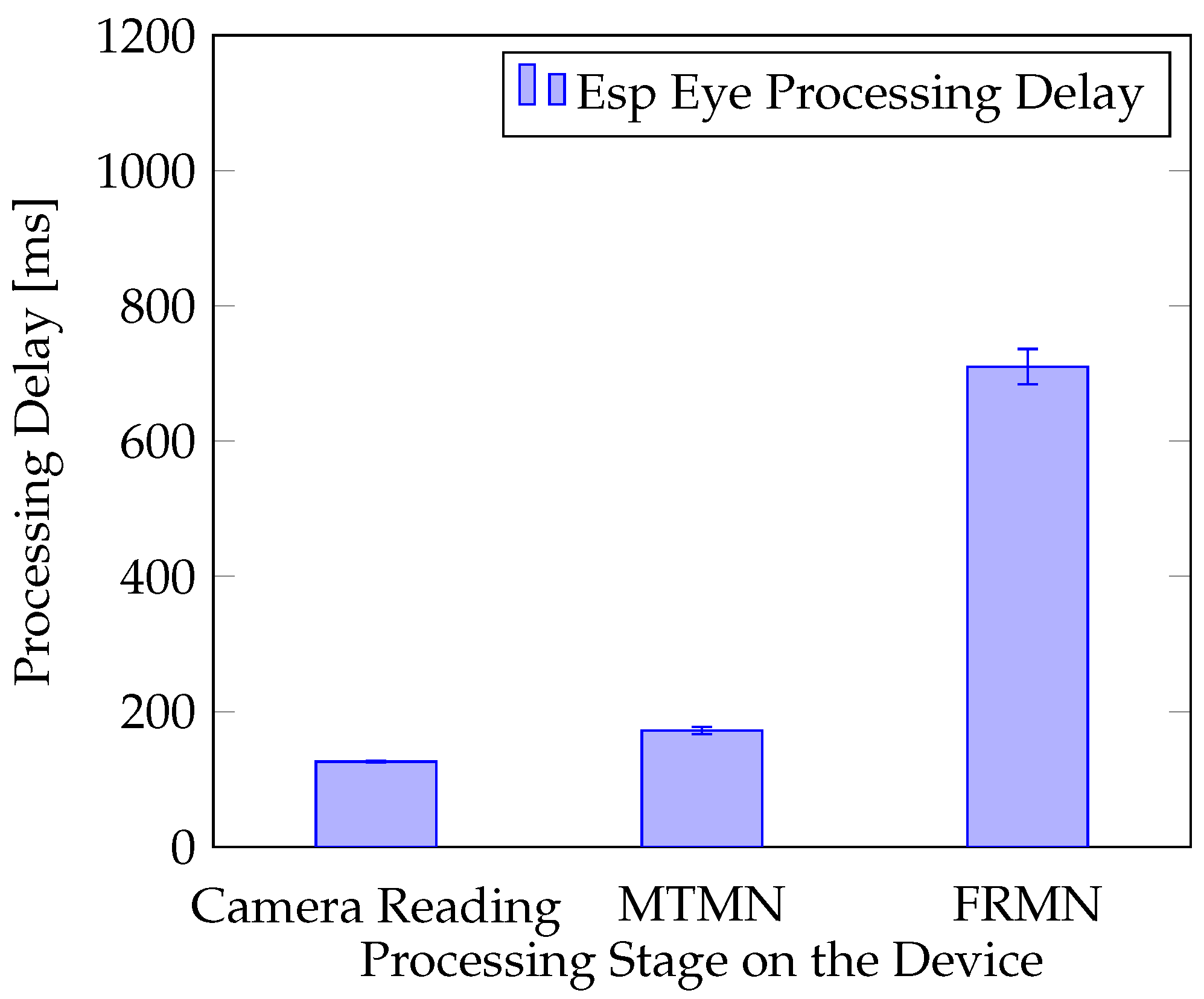
The real experiment was performed, in which the Esp Eye [2] sensor observed its surroundings. Two situations were considered. In the first situation, no face is presented in front of the camera. In the second case, the person registered with the sensor presents his face in front of the camera at a distance of around 0.4 m. The analysis that followed was based on the log of the processing time performed by Esp Eye. The processing was repeated up to five times. For instance, in the situation when no face is detected in the image delivered (Figure 7), the overall processing needs 174 ms to accomplish, which involves 122 ms to receive an image from the sensor, 52 ms to perform the face detection with MTMN, and 0 ms to perform the face recognition with FRMN. Since MTMN has detected no face, FRMN was not activated, resulting in 0 ms completion time. The standard deviation calculated for all processing stages (i.e., Reading the Camera, MTMN, and FRMN) is presented in the figure as well. It is noted that the average overall processing time varies only a little bit with the relative variation of less than 1.9% experienced in all the experiments performed. Face detection and recognition take on average 1008 ms (cf. Figure 8), which includes 126 ms for image acquisition, 172 ms for face detection, and 710 ms for face recognition. The overall processing time experiences a relative variation of around 7.9% in this experiment.
Figure 7. Esp Eye Processing Delay When no Face is Detected in Front of the Camera.
Figure 8. Esp Eye Processing Delay When a Face is Detected in Front of the Camera.
Furthermore, it is noted that MTMN displays accuracy of around 10%, as the face is discovered in 1–2 images for every 10 images taken. This is, however, evaluated positively, as the speed of MTMN is very fast, and several images can be analyzed per second (cf. Figure 8). FRMN displays higher performance as a face is recognized in one of every two images. The detection rate of 50% is understandable when considering the small size of the CNN. Robust networks (e.g., MobileFaceNets [22]) have much higher number of parameters (e.g., 1 M) and require higher computing cost (e.g., 221 M MAdds).

4.3. End-to-End Processing Delay

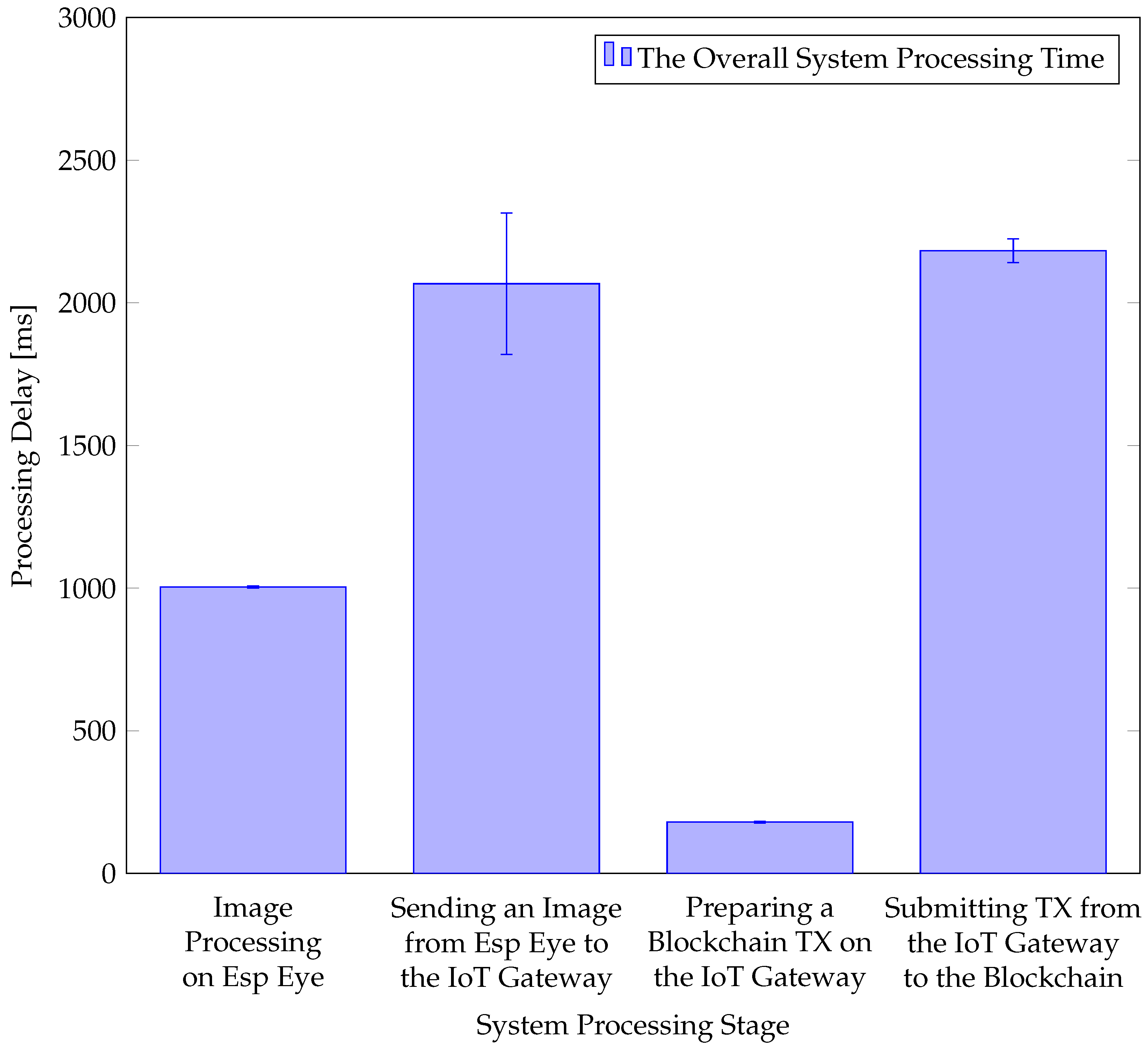
Many BC platforms suffer from a low TX rate. However, HLF executes TXs in an execute-and-order way. Thus, HLF gains significant speed in terms of processing delay to support large TX volumes per second. The end-to-end delay is measured by printing the timestamp at different individual processing steps to measure (i) image processing delay on the Esp Eye device, (ii) transmission delay of the collected image from Esp Eye to the IoT Gateway, (iii) preparation delay of the BC TX on the IoT Gateway, and (iv) BC TX submission delay from the IoT Gateway to the BC. The image is inserted in the ledger, and the BC service is finished when the BC TX reaches all peers. Figure 9 displays system processing stages starting with the Esp Eye image capturing until the image reaches all peers in the ledger, for an example TX. Similarly, as estimated earlier, face detection (i.e., MTMN) and recognition (i.e., FRMN) on Esp Eye take on average 1 s. However, if the face detection phase is not executed, the image processing is much shorter (i.e., at 200 ms). Sending the image from Esp Eye to the IoT Gateway takes almost 2 s. Furthermore, the time it takes from the IoT Gateway until the TX is submitted to HLF is very small compared to other functions. HLF consumes little more than 2 s. This is influenced by two configurable parameters, i.e., BatchTimeout and BatchSize. BatchTimeout is essential for this work, since it refers to a block-time limit. This work configures BatchTimeout at 2 s, which minimizes the idle time of ordering peers. However, depending on the use case, those parameters may need to be tuned such that there is no bottleneck in TX arrivals. The end-to-end delay experienced in the system for this example BC TX is 5.3 s from the moment the image is taken until the inclusion of the BC TX in the BC. Therefore, almost real-time use cases can be supported using HLF as a communication backend.
Figure 9. System Processing Delay.

4.4. Energy Efficiency of Esp Eye

The experimentation setup was used to measure the energy consumption of Esp Eye against image quality, face detection, and face recognition. After several tests with different image qualities and parameters, there was no difference experienced in Esp Eye energy consumption. Throughout the experiment, the energy consumption remained at the constant level of 600 mW (in total, the device consumed 600 mWh within an hour of operation), which allows for a 7-hour operation on an alkaline battery of 4200 mWh capacity. Furthermore, there is no difference in energy consumption when a face is recognized or no face is detected.

5. Summary and Future Work

This paper provides the first access management system that utilizes Artificial Intelligence (AI), Blockchains (BC), and Internet-of-Things (IoT) in an integrated use case. This use case is centered around access management without direct human intervention. Thus, the user needs to present their face in front of a camera to access a resource. The system takes an image of their face and checks whether this user has the right to access a given resource.
For that decision being taken, the face detection and recognition are performed directly on the IoT device. An MTCNN (Multi-Task Cascaded Convolutional Network) with MobileNets (MN) was deployed to detect faces. Furthermore, the Face Recognition model is based upon a Convolutional Neural Network (FRMN). To establish a good level of transparency, AI decisions on access rights and images taken by the sensor are stored in the immutable, tamper-resistant storage implemented with the help of the HyperLedger Fabric (HLF).
The system’s performance was evaluated at an excellent level, where a 5.3 s end-to-end delay is reached. This value reads to be outstanding compared to well-established BC systems, such as Bitcoin (BTC) or Ethereum (ETH), having a block time configured at the level of 10 min and 10 s, respectively.
Additionally, the size of data to be persisted inside a block does not lead to high costs, as for a BTC or ETH case, since HLF does offer “unlimited” storage capacity due to its private, permissioned characteristic. At the same time, data privacy is ensured since the private ledger within the HLF implementation will only allow for authorized accesses by definition.
As this approach taken is considered to be a prototype, two current drawbacks will have to be taken care of in the next generation:
1.
All face descriptors of recognized faces are hard-encoded on Esp Eye devices.
2.
The HLF Transaction (TX) signing is not performed directly on Esp Eye devices, since it is delegated to the IoT Gateway device supporting this process on behalf of the sensor.
Apart from solving these aspects, future work will not only close the gaps as identified in the currently specified and prototyped system, but will further develop the IoT-BC integration into operational and reusable software functionality:
1.
The face descriptor management will allow an IoT device to retrieve a remote directory of recognized faces.
2.
Porting the HLF Software Development Kit (SDK) to IoT devices will enable an HLF TX submission directly from IoT devices.

Author Contributions

Conceptualization, E.S.; methodology, E.S.; software, E.E.; validation, E.S. and E.E.; formal analysis, E.S. and E.E.; investigation, E.S., E.E. and B.S.; resources, B.S.; data curation, E.S. and E.E.; writing—original draft preparation, E.E.; writing—review and editing, E.S., E.E. and B.S.; visualization, E.S. and E.E.; supervision, E.S. and B.S.; project administration, B.S.; funding acquisition, B.S. All authors have read and agreed to the published version of the manuscript.

Funding

This research was partially funded by (a) the University of Zürich and (b) the European Union’s Horizon 2020 Research and Innovation Program under Grant Agreement No. 830927, the CONCORDIA project.

Data Availability Statement

The software generated in this work is publicly available on GitHub https://github.com/eesati/Master-Thesis/ (accessed on 25 January 2022).

Conflicts of Interest

The authors declare no conflict of interest.

References

  1. Atlam, H.F.; Walters, R.J.; Wills, G.B. Intelligence of Things: Opportunities Challenges. In Proceedings of the 3rd Cloudification of the Internet of Things (CIoT’18), Paris, France, 2–4 July 2018; pp. 1–6. [Google Scholar] [CrossRef]
  2. Espressif Systems. ESP-EYE Development Board. Available online: https://www.espressif.com/en/products/devkits/esp-eye/overview (accessed on 10 December 2020).
  3. Raspberry Pi Foundation Group. Raspberry Pi 3 Model B. Available online: https://www.raspberrypi.org/products/raspberry-pi-3-model-b (accessed on 2 October 2019).
  4. Banafa, A. IoT and Blockchain Convergence: Benefits and Challenges. IEEE Internet-of-Things Newsletter. Available online: https://iot.ieee.org/newsletter/january-2017/iot-and-blockchain-convergence-benefits-and-challenges.html (accessed on 25 January 2022).
  5. Kolias, C.; Kambourakis, G.; Stavrou, A.; Voas, J. DDoS in the IoT: Mirai and Other Botnets. IEEE Comput. 2017, 50, 80–84. [Google Scholar] [CrossRef]
  6. Valenta, M.; Sandner, P. Comparison of Ethereum, Hyperledger Fabric and Corda. 2017. Available online: http://explore-ip.com/2017_Comparison-of-Ethereum-Hyperledger-Corda.pdf (accessed on 29 December 2021).
  7. Androulaki, E.; Barger, A.; Bortnikov, V.; Cachin, C.; Christidis, K.; De Caro, A.; Enyeart, D.; Ferris, C.; Laventman, G.; Manevich, Y.; et al. Hyperledger Fabric: A Distributed Operating System for Permissioned Blockchains. In Proceedings of the 13th EuroSys Conference, EuroSys 2018, Porto, Portugal, 23–26 April 2018. [Google Scholar] [CrossRef]
  8. Rafati-Niya, S.; Schiller, E.; Cepilov, I.; Stiller, B. BIIT: Standardization of Blockchain-based I2oT Systems in the I4 Era. In Proceedings of the IEEE/IFIP Network Operations and Management Symposium (NOMS 2020), Budapest, Hungary, 20–24 April 2020; pp. 1–9. [Google Scholar] [CrossRef]
  9. Schiller, E.; Rafati-Niya, S.; Surbeck, T.; Stiller, B. Scalable Transport Mechanisms for Blockchain IoT Applications. In Proceedings of the 44th IEEE LCN Symposium on Emerging Topics in Networking (LCN Symposium), Osnabrueck, Germany, 14–17 October 2019; pp. 34–41. [Google Scholar] [CrossRef]
  10. Schiller, E.; Esati, E.; Niya, S.R.; Stiller, B. Blockchain on MSP430 with IEEE 802.15.4. In Proceedings of the 2020 IEEE 45th Conference on Local Computer Networks (LCN), Sydney, Australia, 16–19 November 2020; pp. 345–348. [Google Scholar]
  11. Atlam, H.F.; Azad, M.A.; Alzahrani, A.G.; Wills, G. A Review of Blockchain in Internet of Things and AI. Big Data Cogn. Comput. 2020, 4, 28. [Google Scholar] [CrossRef]
  12. Singh, S.K.; Rathore, S.; Park, J. BlockIoTIntelligence: A Blockchain-enabled Intelligent IoT Architecture with Artificial Intelligence. Future Gener. Comput. Syst. 2019, 110, 721–743. [Google Scholar] [CrossRef]
  13. Singh, S.; Sharma, P.K.; Yoon, B.; Shojafar, M.; Cho, G.H.; Ra, I.H. Convergence of Blockchain and Artificial Intelligence in IoT Network for the Sustainable Smart City. Sustain. Cities Soc. 2020, 63, 102364. [Google Scholar] [CrossRef]
  14. Parker, B.; Bach, C. The Synthesis of Blockchain, Artificial Intelligence and Internet of Things. Eur. J. Eng. Technol. Res. 2020, 5, 588–593. [Google Scholar] [CrossRef]
  15. Espressif Systems. ESP-WHO Platform. Available online: https://github.com/espressif/esp-who (accessed on 19 September 2020).
  16. Abedin, S.F.; Alam, M.G.R.; Haw, R.; Hong, C.S. A System Model for Energy Efficient Green-IoT Network. In Proceedings of the International Conference on Information Networking (ICOIN’15), Siem Reap, Cambodia, 12–14 January 2015; pp. 177–182. [Google Scholar] [CrossRef]
  17. Tang, J.; Sun, D.; Liu, S.; Gaudiot, J. Enabling Deep Learning on IoT Devices. Computer 2017, 50, 92–96. [Google Scholar] [CrossRef]
  18. Gopinath, S.; Ghanathe, N.; Seshadri, V.; Sharma, R. Compiling KB-Sized Machine Learning Models to Tiny IoT Devices. In Proceedings of the 40th ACM SIGPLAN Conference on Programming Language Design and Implementation (PLDI’19), Phoenix, AZ, USA, 22–26 June 2019; pp. 79–95. [Google Scholar] [CrossRef]
  19. Lin, J.; Chen, W.M.; Lin, Y.; Cohn, J.; Gan, C.; Han, S. Mcunet: Tiny deep learning on iot devices. arXiv 2020, arXiv:2007.10319. [Google Scholar]
  20. Ackerman, D. System Brings Deep Learning to Internet of Things Devices. Available online: https://news.mit.edu/2020/iot-deep-learning-1113 (accessed on 10 December 2020).
  21. Zhang, K.; Zhang, Z.; Li, Z.; Qiao, Y. Joint Face Detection and Alignment Using Multitask Cascaded Convolutional Networks. IEEE Signal Process. Lett. 2016, 23, 1499–1503. [Google Scholar] [CrossRef]
  22. Howard, A.G.; Zhu, M.; Chen, B.; Kalenichenko, D.; Wang, W.; Weyand, T.; Andreetto, M.; Adam, H. MobileNets: Efficient Convolutional Neural Networks for Mobile Vision Applications. arXiv 2017, arXiv:cs.CV/1704.04861. [Google Scholar]
  23. Shang, S.; Liu, H.; Qu, Q.; Li, G.; Cao, J. FRMN-A Face Recognition Model Based on Convolutional Neural Network. In Proceedings of the IOP Conference Series: Materials Science and Engineering, Hunan, China, 17–18 May 2019; Volume 585, p. 012101. [Google Scholar]
  24. LeCun, Y.; Jackel, D.L.; Bottou, L.; Cortes, C.; Denker, J.S.; Drucker, H.; Guyon, I.; Muller, U.A.; Sackinger, E.; Simard, P.; et al. Learning Algorithms for Classification: A Comparison on Handwritten Digit Recognition. In Neural Networks: The Statistical Mechanics Perspective; World Scientific: Singapore, 1995; pp. 261–276. [Google Scholar]
  25. Lecun, Y.; Bottou, L.; Bengio, Y.; Haffner, P. Gradient-based Learning Applied to Document Recognition. Proc. IEEE 1998, 86, 2278–2324. [Google Scholar] [CrossRef]
  26. Adelson, E.H.; Anderson, C.H.; Bergen, J.R.; Burt, P.J.; Ogden, J.M. Pyramid Methods in Image Processing. RCA Eng. 1984, 29, 33–41. [Google Scholar]
  27. Sandler, M.; Howard, A.G.; Zhu, M.; Zhmoginov, A.; Chen, L. Mobilenetv2: Inverted Residuals and Linear Bottlenecks: Mobile Networks for Classification, Detection and Segmentation. arXiv 2018, arXiv:1801.04381. [Google Scholar]
  28. Sandler, M.; Howard, A.; Zhu, M.; Zhmoginov, A.; Chen, L.C. Mobilenetv2: Inverted residuals and linear bottlenecks. In Proceedings of the IEEE Conference on Computer Vision and Pattern Recognition, Salt Lake City, UT, USA, 18–22 June 2018; pp. 4510–4520. [Google Scholar]
  29. Rafati Niya, S.; Schiller, E.; Stiller, B. Architectures for Blockchain-IoT Integration. In Communication Networks and Service Management in the Era of Artificial Intelligence and Machine Learning; Zincir-Heywood, N., Diao, Y., Mellia, M., Eds.; IEEE Press Series on Networks and Service Management; Wiley-IEEE Press: New York, NY, USA, 2021; pp. 100–137. [Google Scholar]
  30. Waheed, N.; He, X.; Ikram, M.; Usman, M.; Hashmi, S.S.; Usman, M. Security and Privacy in IoT Using Machine Learning and Blockchain: Threats and Countermeasures. ACM Comput. Surv. 2020, 53, 122. [Google Scholar] [CrossRef]
  31. Dinh, T.N.; Thai, M.T. AI and Blockchain: A Disruptive Integration. Computer 2018, 51, 48–53. [Google Scholar] [CrossRef]
  32. Liu, L.; Feng, J.; Pei, Q.; Chen, C.; Ming, Y.; Shang, B.; Dong, M. Blockchain-Enabled Secure Data Sharing Scheme in Mobile-Edge Computing: An Asynchronous Advantage Actor–Critic Learning Approach. IEEE Internet Things J. 2021, 8, 2342–2353. [Google Scholar] [CrossRef]
  33. Quadri, S.A.I.; Sathish, P. IoT based Home Automation and Surveillance System. In Proceedings of the International Conference on Intelligent Computing and Control Systems (ICICCS’17), Madurai, India, 15–16 June 2017; pp. 861–866. [Google Scholar] [CrossRef]
  34. LoRa Alliance. A Technical Overview of LoRa and LoRaWAN. Available online: https://lora-alliance.org/portals/0/documents/whitepapers/LoRaWAN101.pdf (accessed on 17 May 2019).
  35. Schiller, E.; Esati, E.; Stiller, B. IoT-based Access Management Supported by AI and Blockchains. In Proceedings of the 17th International Conference on Network and Service Management (CNSM’21), Izmir, Turkey, 25–29 October 2021; pp. 350–354. [Google Scholar] [CrossRef]
  36. Gorenflo, C.; Lee, S.; Golab, L.; Keshav, S. FastFabric: Scaling Hyperledger Fabric to 20,000 Transactions per Second. In Proceedings of the IEEE International Conference on Blockchain and Cryptocurrency (ICBC’19), Seoul, Korea, 14–17 May 2019; pp. 455–463. [Google Scholar] [CrossRef]
  37. Scheid, E.J.; Lakic, D.; Rodrigues, B.B.; Stiller, B. PleBeuS: A Policy-based Blockchain Selection Framework. In Proceedings of the NOMS 2020–2020 IEEE/IFIP Network Operations and Management Symposium, Budapest, Hungary, 20–24 April 2020; pp. 1–8. [Google Scholar] [CrossRef]
  38. Pezoa, F.; Reutter, J.L.; Suarez, F.; Ugarte, M.; Vrgoč, D. Foundations of JSON Schema; International World Wide Web Conferences Steering Committee: Geneva, Switzerland, 2016; pp. 263–273. [Google Scholar] [CrossRef]
  39. Esati, E. IoT-Based Access Management, GitHub Repository. Available online: https://github.com/eesati/Master-Thesis (accessed on 25 January 2022).
  40. Tilkov, S.; Vinoski, S. Node. js: Using JavaScript to Build High-Performance Network Programs. IEEE Internet Comput. 2010, 14, 80–83. [Google Scholar] [CrossRef]
  41. Josefsson, S. The BASE16, BASE32, and BASE64 Data Encodings; Technical Report, IETF RFC 4648; The Internet Society: Reston, VA, USA, October 2006. [Google Scholar]
  42. Badamasi, Y.A. The Working Principle of an Arduino. In Proceedings of the 11th International Conference on Electronics, Computer and Computation (ICECCO’14), Abuja, Nigeria, 29 September–1 October 2014; pp. 1–4. [Google Scholar] [CrossRef]
Publisher’s Note: MDPI stays neutral with regard to jurisdictional claims in published maps and institutional affiliations.

Article Metrics

Citations

Article Access Statistics

Multiple requests from the same IP address are counted as one view.