Review

Influence of Formulation, Application, and Environment on Sunscreen Effectiveness

by
Rodrigo Collina Romanhole
1,†,
Érica Mendes dos Santos
2,†,
Ana Laura Masquetti Fava
1,
Letícia de Souza Pagani
2,
Nicole Ferrari de Carvalho
2,
Giovanna Chagas Lima
2,
Carla Leandra Silva Godoi
2,
Thairiny Raiany Borges Toti
2,
Luiza Aparecida Luna Silvério
2,
Caroline Santinon
2,*,
Janaína Artem Ataide
3 and
Priscila Gava Mazzola
2
1
Faculdade de Ciências Médicas, Universidade Estadual de Campinas (UNICAMP), Campinas 13083-887, Brazil
2
Faculdade de Ciências Farmacêuticas, Universidade Estadual de Campinas (UNICAMP), Campinas 13083-871, Brazil
3
Faculdade de Ciências Farmacêuticas de Ribeirão Preto, Universidade de São Paulo (USP), Ribeirão Preto 14040-903, Brazil
*
Author to whom correspondence should be addressed.
These authors contributed equally to this work.
Cosmetics 2026, 13(3), 122; https://doi.org/10.3390/cosmetics13030122
Submission received: 9 April 2026 / Revised: 8 May 2026 / Accepted: 12 May 2026 / Published: 16 May 2026
(This article belongs to the Special Issue Sunscreen Advances and Photoprotection Strategies in Cosmetics)

Abstract

This review provides a comprehensive analysis of the multiple factors influencing sunscreen efficacy, integrating studies published between 2016 and 2026. Beyond the type and concentration of UV filters, sunscreen performance is strongly affected by formulation design, photostability, environmental exposure, and user application practices. Formulation strategies involving emulsion systems, excipients, solubilization methods, and encapsulation technologies directly influence sun protection factor (SPF), cosmetic acceptability, and safety. Recent advances, including nanoparticle-based carriers, hybrid organic–inorganic systems, and antioxidant-enriched formulations, have shown potential to improve photostability, broaden UV protection, and reduce systemic absorption and environmental impact. However, inadequate application and insufficient reapplication remain major limitations to real-world photoprotection. In addition, differences in skin type, age, and lifestyle reinforce the need for more personalized sunscreen approaches. Growing concerns regarding the environmental effects of UV filters also highlight the importance of sustainable formulations and stricter regulatory policies. Overall, optimizing sunscreen efficacy requires not only technological innovation but also improved public education, transparent labeling, and user adherence. Future research should focus on multifunctional, eco-friendly, and user-centered sunscreens capable of providing effective and sustainable photoprotection.

1. Introduction

Ultraviolet radiation (UVR) is naturally emitted from the sun and has been identified as the most common risk factor for skin cancer, as well as the primary cause of photoaging [1]. UV radiation comprises UVC (200–290 nm), UVB (290–320 nm), and UVA (320–400 nm). While UVC and part of UVB radiation are filtered by the ozone layer, the non-filtered portion of UVB penetrates the epidermis, causing erythema, whereas UVA reaches the dermis, contributing to photoaging and skin tanning [2,3,4,5]. Although UVB was once considered the main harmful component, UVA is now widely recognized for its role in immunosuppression, photocarcinogenesis, and photoaging [6,7].
Although photoprotection strategies have evolved substantially over the past decades, the burden of UV-induced skin damage remains high, indicating that current approaches are not fully effective under real-world conditions. Approximately one-third of the world’s population reports experiencing at least one sunburn annually [8]. The prevalence is particularly high among younger individuals, especially those aged 18–29 years, whereas significantly lower rates are observed in older age groups [9]. These findings highlight persistent gaps in preventive behavior, including inconsistent sunscreen use and inadequate application amounts.
Sunscreens represent the cornerstone of photoprotection and are formulated to absorb, reflect, or scatter incident radiation, providing broad-spectrum coverage against UVA and UVB wavelengths [6,10]. Their efficacy is primarily expressed by the sun protection factor (SPF), a parameter based on erythema prevention under standardized laboratory conditions. However, SPF-based assessment may not fully reflect real-life exposure patterns, user behavior, or cumulative UVA-induced damage [11].
Regulatory frameworks have strengthened requirements for UVA coverage, including a UVB/UVA protection ratio ≤3 and a critical wavelength ≥370 nm [12]. However, despite these standardized requirements, the real-world effectiveness of sunscreens does not depend solely on labeled SPF values. High-SPF formulations may encourage prolonged sun exposure because of a false perception of safety [13]. Furthermore, sunscreen performance is influenced by formulation stability, photostability of UV filters, interaction between active and inactive ingredients, application thickness, reapplication frequency, and user behavior [14].
In addition, growing concerns regarding the safety profile, environmental impact, and potential interference with vitamin D synthesis of certain UV filters have intensified the demand for innovative photoprotective solutions. Emerging strategies include multifunctional formulations combining UV filters with antioxidants, photo-stabilizers, bioactive compounds, advanced delivery systems, and novel materials capable of enhancing durability and broad-spectrum coverage [15].
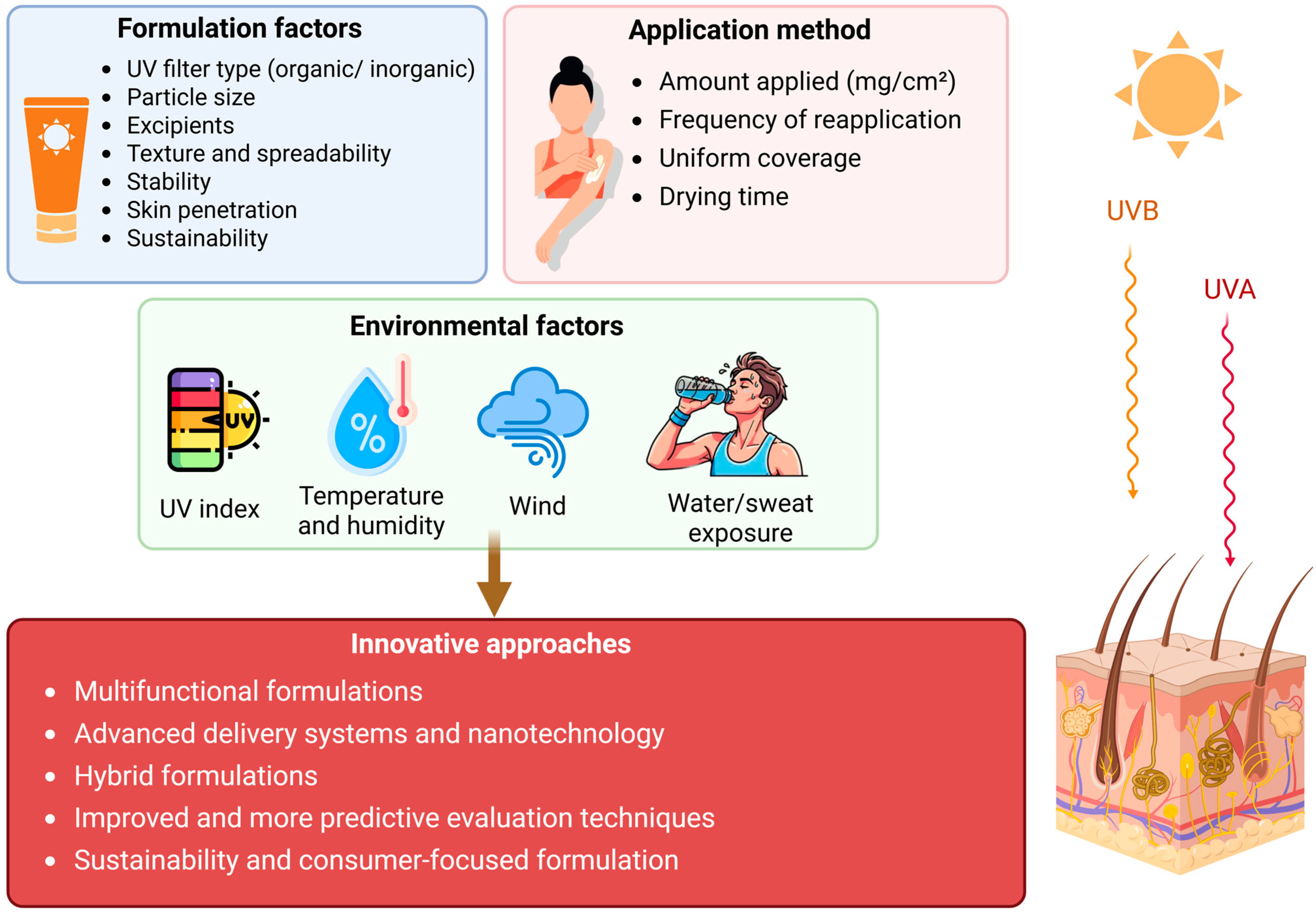
In this context, advancing photoprotection requires moving beyond conventional SPF-centered approaches. Therefore, this review discusses the main factors influencing sunscreen effectiveness, including UV filter selection, formulation strategies, application practices, environmental exposure, skin type variability, and packaging considerations, as well as emerging approaches to improve sunscreen safety, stability, and real-world performance. Figure 1 summarizes the main factors influencing sunscreen effectiveness and real-world photoprotection discussed throughout this review.

2. Methods

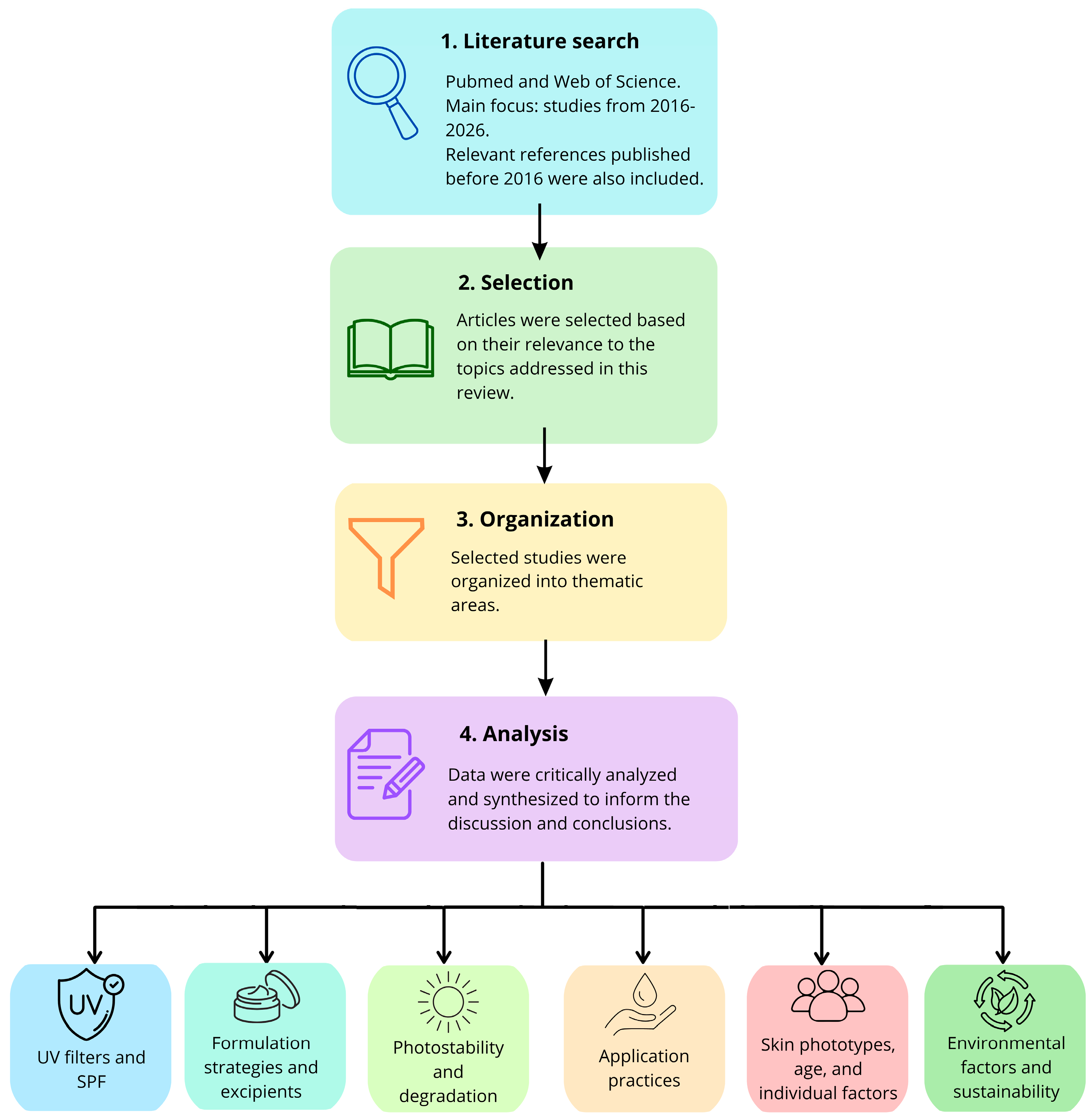
Relevant studies on sunscreen efficacy and photoprotection were retrieved from the Web of Science and PubMed databases, with a primary focus on publications published between 2016 and 2026. Earlier studies and classical references published before this period were additionally included when considered scientifically relevant to provide methodological, conceptual, or historical background for specific topics discussed throughout the review. The literature selection was based on the relevance of the studies to the main themes addressed in the manuscript, including sun protection factor (SPF), UV filters, photostability, formulation strategies, sunscreen application practices, skin phototypes, environmental exposure, and other factors influencing sunscreen effectiveness. Search keywords included “sun protection factor”, “sunscreen”, “UV filters”, “in vitro studies”, “in vivo studies”, “photoprotection”, “skin phototype”, and “sunscreen application”. Selected studies were subsequently organized into thematic sections to support the critical analysis and discussion presented in this narrative review. Figure 2 summarizes the literature selection approach and thematic organization adopted in this study.

3. How Sunscreen Effectiveness Is Measured

Sunscreen effectiveness is determined through the combined assessment of UVB and UVA protection, as contemporary regulatory frameworks require balanced broad-spectrum coverage. Although the SPF remains the most widely recognized metric, a comprehensive evaluation of sunscreen performance extends beyond the prevention of UVB-induced erythema.

3.1. UVB Protection: SPF Determination

SPF quantifies protection against UVB-induced erythema and is defined as the ratio between the minimal erythema dose (MED) on protected skin and the MED on unprotected skin under standardized conditions. Importantly, the relationship between SPF and UVB blocking capacity is not linear: SPF 15 filters approximately 93% of UVB radiation, SPF 30 about 97%, and SPF 50 around 98% [16].
The reference method for SPF determination remains in vivo testing on human volunteers, conducted in accordance with the ISO 24444:2019 protocol [17]. A standardized amount of sunscreen (2 mg/cm2) is uniformly applied to designated skin areas, typically on the back. Following a controlled drying period, incremental doses of artificial UV radiation are administered using a calibrated solar simulator. The minimal erythema dose (MED) is visually assessed 16–24 h after exposure, and SPF is calculated according to Equation (1).
SPF = M E D p r o t e c t e d M E D u n p r o t e c t e d
Although considered the gold standard due to its direct biological relevance, the in vivo testing is costly, time-consuming, and raises ethical concerns related to intentional UV exposure [18].
To address these limitations, in vitro SPF estimation methods have been developed. These assays typically involve applying sunscreen formulations onto artificial substrates such as polymethylmethacrylate (PMMA) plates or Transpore™ tape to simulate skin roughness. UV transmittance is measured using spectrophotometry across the UV spectrum, and the absorbance data are integrated with erythemal weighting functions to estimate SPF values [19]. High-performance liquid chromatography (HPLC) may additionally be employed to assess photostability by quantifying UV filter degradation after irradiation [20]. However, in vitro approaches may not fully replicate spreading behavior, film formation, or interactions with the stratum corneum.

3.2. UVA Protection Assessment

The in vivo determination of UVA protection factor (UVA-PF) follows a procedure analogous to SPF testing, with the key difference that the irradiation source emits exclusively UVA radiation. The biological endpoint assessed is persistent pigment darkening (PPD), which is evaluated approximately 2 h after exposure [21]. UVA-PF is calculated as the ratio between the minimal persistent pigment darkening dose (MPPDD) on sunscreen-protected skin and the corresponding MPPDD on unprotected skin that induces a pigmentation response of at least grade 1 (Equation (2)).
UVA - PF = M P P D p r o t e c t e d M P P D u n p r o t e c t e d
Despite their recognized accuracy and biological relevance, in vivo UVA methods present notable limitations. One major concern is the limited representation of darker skin phototypes in participant selection criteria. Additionally, while the erythemal endpoint used in UVB testing develops relatively rapidly, the pigmentation endpoint in UVA-PF assessment may take up to one hour to fully manifest. Consequently, participants are subjected to substantial UVA exposure. Given that UVA radiation is well established as a contributor to photocarcinogenesis, the long-term feasibility and ethical acceptability of repeated in vivo UVA testing remain questionable due to cumulative radiation exposure [22].
In this context, in vitro spectrophotometric methods are also employed to determine UVA-PF and the critical wavelength (λc). The critical wavelength corresponds to the wavelength below which 90% of total UV absorbance occurs; values ≥ 370 nm are required in several regulatory frameworks to classify a product as broad-spectrum (ISO 24443:2021) [23]. However, when formulations contain inorganic filters or exhibit film-formation irregularities, in vivo UVA-PF measurements are often considered more reliable, as in vitro methods may underestimate protection due to the limited ability of artificial substrates to adequately mimic skin [24].

3.3. Hybrid and Emerging Approaches

To reduce the gap between laboratory simulations and biological response, hybrid techniques such as Hybrid Diffuse Reflectance Spectroscopy (HDRS) have been introduced [25]. HDRS combines in vivo reflectance measurements with mathematical modeling to estimate both SPF and UVA-PF without inducing visible erythema [25,26,27]. These approaches offer improved reproducibility and reduce ethical burden, representing a promising direction for next-generation photoprotection assessment.
Overall, sunscreen effectiveness assessment relies on the integrated evaluation of UVB and UVA protection using complementary in vivo, in vitro, and hybrid methodologies [28,29]. However, current approaches are still largely based on surrogate biological endpoints such as erythema and pigmentation, which do not fully capture long-term molecular damage, oxidative stress, immunological alterations, or real-life usage conditions [30,31]. These limitations highlight the need for more biologically relevant, predictive, and technology-driven assessment strategies capable of better correlating laboratory results with real-world photoprotection performance [32].

4. Formulation

Sunscreen formulations are designed to provide protection against ultraviolet radiation (UVA, UVB, or both) while meeting requirements related to water resistance, photostability, safety, and consumer acceptance [33]. Broadly, sunscreens utilize two main classes of UV filters: organic (chemical) and inorganic (physical). Organic filters absorb UV radiation and dissipate the absorbed energy as heat or fluorescence through electronic excitation mechanisms, whereas inorganic filters such as zinc oxide (ZnO) and titanium dioxide (TiO2) attenuate UV radiation primarily by reflection, scattering, and partial absorption [34].
The selection and combination of these filters are critical to achieving broad-spectrum protection, regulatory compliance, and long-term stability. To meet labeling requirements for broad-spectrum protection, formulations typically combine organic and inorganic filters to ensure adequate coverage across both UVA and UVB regions [35].
There are a variety of formulations available on the market to meet specific customer needs and preferences. Usually, they consist of emulsified systems, hydroalcoholic solutions, gels, or anhydrous systems [33,36]. Emulsions are the most popular vehicle for sunscreen formulations, since they are compatible with both physical and chemical UV filters. Furthermore, they facilitate the optimization of sensory properties, such as texture, spreadability, and residue, which can be tailored to the target audience, contributing to user compliance and more effective application [34,37].

4.1. Active Ingredients

4.1.1. Inorganic Filters

Particle size is a critical factor in determining the optical and UV absorption properties of inorganic filters [38]. Microparticles (>100 nm) scatter visible light intensely, resulting in whitening on the skin [35,39,40]. Typically, ZnO particles range from 200–400 nm and TiO2 from 150–300 nm [41]. To overcome cosmetic drawbacks, nanoparticles (<100 nm) have been introduced, reducing visible light scattering while maintaining or enhancing UV protection [40,42].
Nanoparticles may exist as primary particles (5–20 nm), aggregates (30–150 nm), or agglomerates (>1 µm). During manufacturing, agglomerates are reconverted into aggregates to minimize excessive visible reflection [43]. As particle size decreases, the increased absorbance of nanoparticles enhances UV protection, improving the performance of inorganic filters in sunscreens. This improves UV shielding while reducing opacity caused by light scattering [39].
Toxicity evaluations of ZnO and TiO2 nanoparticles have been extensively conducted, including skin and oral exposure studies in animals and humans, assessing skin irritation, phototoxicity, photosensitization, and photoirritation. While concerns regarding potential genotoxicity and systemic accumulation have been raised, particularly in in vitro studies [30,31], it is crucial to differentiate between exposure routes. Risks associated with nanoparticles are primarily linked to inhalation, especially from spray formulations or powders, where the respiratory system’s limited clearance mechanisms could lead to absorption into the bloodstream and accumulation in internal organs [29].
However, for topical application in sunscreen formulations, numerous in vivo studies consistently demonstrate minimal to no penetration of ZnO and TiO2 nanoparticles into viable skin layers [44,45,46]. These particles typically remain on the skin surface or within the stratum corneum, with only superficial penetration into the epidermis, and do not reach the deeper dermis or subcutaneous tissue. Therefore, the systemic exposure and associated risks from dermal contact are considered very low, supporting the widespread and safe use of TiO2 as a food and cosmetic additive [21,47].
To enhance UV protection while minimizing toxicity, combining both minerals in composite formulations is a promising approach. Binding can involve aluminum hydroxide (Al(OH)3) and xylans. Al(OH)3 is commonly used to coat TiO2 nanoparticles, minimizing reactive oxygen species (ROS) generation and improving dispersion [48], while xylans act as sustainable stabilizing matrices that improve film formation, water resistance, and UV shielding efficiency [49]. In one study, a combination of micro- and nanosized particles was developed, in which nanoparticles were dispersed on microparticle surfaces to maximize UV filter performance through particle size synergy. This approach increased SPF by 60% using a dry nanodispersion technique [35]. To ensure stability, coatings are often applied to protect inorganic molecules and maintain their effectiveness. An outer layer increases molecular dispersion in sunscreen formulations, using hydrophobic agents like polydimethylsiloxane (PDMS) and stearic acid, while the photocatalytic activity is reduced through coatings with Al2O3 and SiO2. The external PDMS layer may undergo oxidation or partial desorption upon water contact, further enhancing particle dispersion and increasing the bioavailability of hydrophilic nanoparticles [38].
Overall, TiO2 and ZnO nanoparticles offer effective UV protection with improved cosmetic acceptability and reduced whitening effects [40]. Nevertheless, smaller particle sizes may exhibit increased photoactivity and ROS generation, which has raised concerns regarding oxidative stress and potential phototoxic or genotoxic effects [35,40,50]. Coatings on nanoparticles mitigate ROS-related toxicity [15]. Despite theoretical concerns, extensive in vitro and in vivo studies confirm minimal skin permeation and low systemic toxicity [40].
Considering their properties, inorganic UV filters offer reliable protection against UV-induced skin damage due to their stability and favorable safety profile. However, challenges related to optimal particle size, toxicity mitigation, and cosmetic acceptance remain challenging. Technological advances, such as hybrid and composite nanostructures, represent promising strategies for enhancing filter effectiveness, contributing to the development of safer and more effective sunscreens.

4.1.2. Organic Filters

Organic UV filters represent the most widely used class of compounds in sunscreens and other personal care products (PCPs), providing effective protection against UV radiation. Their photoprotective action is based on the ability to absorb UV photons and dissipate the energy as harmless heat or fluorescence, a process enabled by their high degree of conjugation that allows selective absorption within defined spectral regions [51]. To achieve broad-spectrum protection, formulations typically combine multiple filters, thereby enhancing both efficacy and photostability [52].
In regulatory terms, the number and type of approved organic filters vary worldwide. For instance, 27 filters are currently authorized in the European Union, 14 in the United States, and 34 in countries such as Japan and Australia, reflecting differences in regulatory frameworks and safety assessments [53,54]. Among the most common examples are benzophenone-3 (BP-3), octyl methoxycinnamate (OMC), octyl salicylate (OS), and butyl methoxydibenzoylmethane (BMDBM), which together cover both UVA and UVB spectra [54,55]. Despite their widespread use, recent studies have highlighted ongoing concerns regarding photostability, potential endocrine disruption, and environmental impacts, reinforcing the importance of continuous evaluation and regulatory harmonization [53].
In the United States, the FDA classifies UV filters into three categories for over-the-counter (OTC) use: GRASE (Generally Recognized as Safe and Effective—Category I), Not GRASE (Category II), and Category III, which requires additional data to determine safety and efficacy. According to the proposed order issued under the CARES Act framework, only ZnO and TiO2 are proposed as GRASE ingredients, while aminobenzoic acid (PABA) and trolamine salicylate are considered Not GRASE due to safety concerns. All other active ingredients, including oxybenzone, octinoxate, avobenzone, homosalate, and octocrylene, remain in Category III because of insufficient data regarding long-term safety, systemic absorption, and photostability. It is important to note that this classification is part of a proposed rule and has not yet been finalized, meaning that the regulatory status of these filters may change as new evidence becomes available [56]. These classifications are essential for guiding the formulation, regulation, and labeling of sunscreen products to ensure consumer safety and effective UV protection.
Formulating sunscreens with organic filters presents challenges because many compounds are crystalline at room temperature, requiring effective solubilization to ensure uniform distribution. Inadequate solubilization can lead to crystal formation, negatively impacting a product’s aesthetic, stability, and photoprotective efficacy. Proper solubilization, conversely, enhances appearance, homogeneity, SPF, and UVA protection [57].
Recent advancements aim to improve sunscreen efficacy while minimizing the concentration of organic UV filters. However, several widely used filters, including avobenzone, octinoxate, and octocrylene, are particularly susceptible to UV-induced degradation. Prolonged UV exposure can compromise the stability of these compounds, reducing efficacy and potentially generating undesirable photodegradation products [58].
Among them, avobenzone is one of the most widely used UVA filters because of its broad-spectrum UVA absorption, which is essential for protection against photoaging, DNA damage, and skin cancer. Nevertheless, it is also one of the most photounstable filters, with studies reporting degradation rates of up to 90% after UV exposure [59,60]. Due to the photoinstability of certain filter combinations, the US Federal Register on OTC drugs advises against combining avobenzone with octinoxate, as this interaction may promote photo-adduct formation and increase cytotoxicity risks [61].
Despite these limitations, avobenzone maintains a strong safety profile and remains approved by regulatory agencies worldwide. However, concerns regarding the environmental impact of organic UV filters and the potential toxicity of their degradation products have encouraged the development of more stable, sustainable, and environmentally friendly alternatives [62,63].
A comparative overview of inorganic and organic UV filters, including their mechanisms, advantages, and limitations, is presented in Table 1.
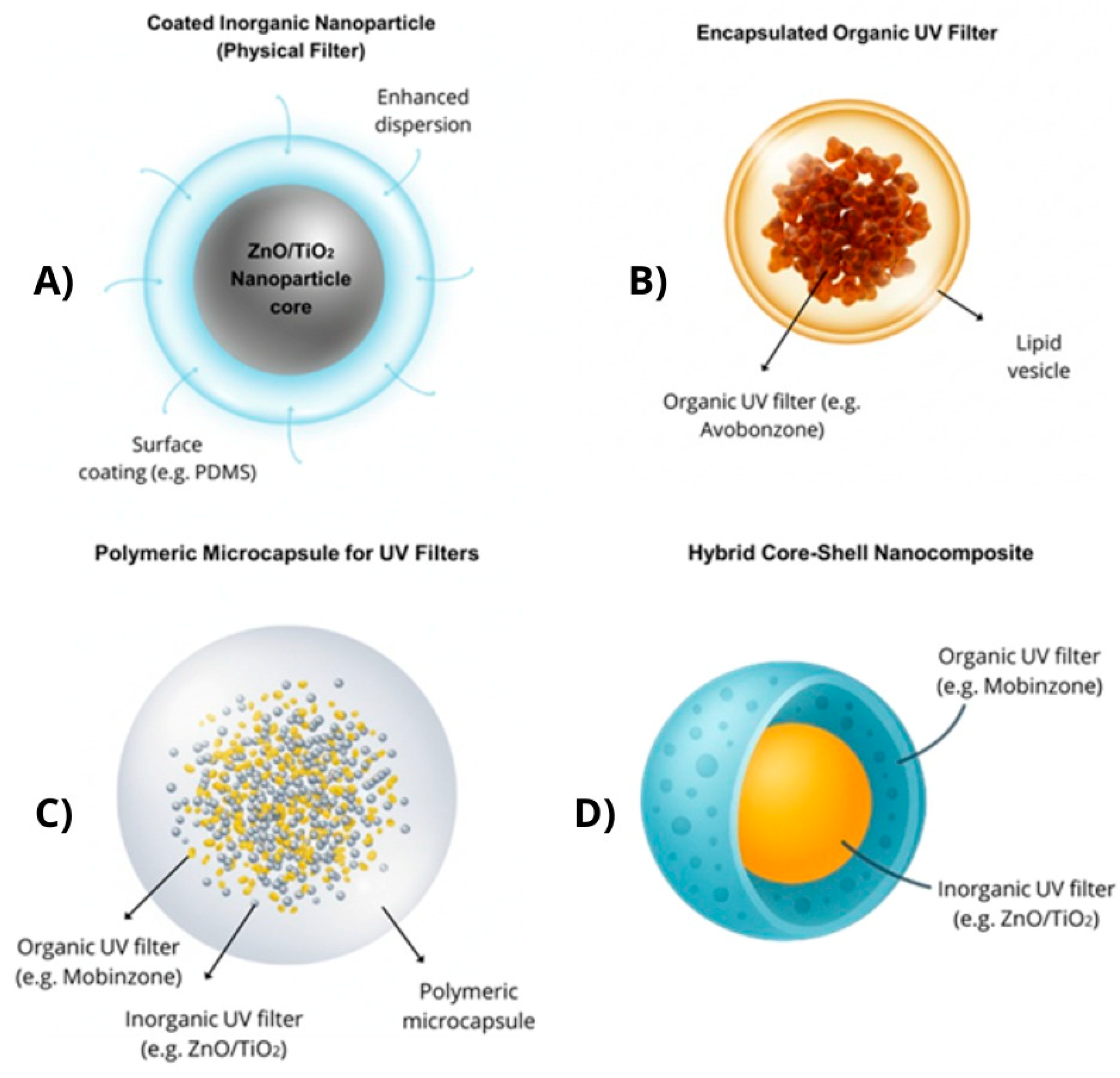
Furthermore, hybrid formulations that combine organic UV filters with inorganic particles are being developed to achieve broad-spectrum protection while reducing the required concentration of organic components. For example, a study using TiO2/SBA-15 mesoporous silica hybrids loaded with avobenzone and oxybenzone showed enhanced UVA/UVB protection, decreased skin deposition of the organic filters, and lowered inflammatory response in UV-exposed mouse skin compared to free filters [67]. Figure 3 provides a schematic overview of different strategies, including surface-coated inorganic nanoparticles, encapsulated organic UV filters within lipid vesicles, polymeric microcapsules containing both organic and inorganic filters, and hybrid core–shell nanocomposites.
Overall, organic UV filters remain indispensable in modern photoprotection, offering tailored solutions against harmful UV radiation [68,69]. Despite their extensive benefits, the environmental implications necessitate ongoing research and innovation. Future developments should focus on maintaining high efficacy while minimizing ecological effects, ensuring sustainable and safe use of these critical compounds [70].

4.2. Excipient’s Role

The selection of excipients interferes with sunscreen properties, such as stability, efficacy, and safety. For instance, certain preservatives can lead to phototoxicity due to oxidative stress [71], and the polarity of emollients and surfactants can change the UV protection [72].
As highlighted in Section 4.1.2, UV filters are sensitive to UV radiation, which can compromise the stability of sunscreen formulations. Therefore, photostability is a critical factor to consider during product development. The same SPF value may not correspond to the same biological effect, as SPF primarily measures erythema and does not reflect other biological processes triggered by UV exposure [7].
To further enhance the photostability and efficacy of UV filters, various strategies involving excipients and advanced delivery systems are employed. Antioxidants, such as vitamin E and ferulic acid, are frequently incorporated into formulations to neutralize free radicals generated during UV absorption, thereby protecting the filters from photodegradation. Similarly, natural substances like lignin, algae extracts, rutin, and caffeine also contribute to improved formulation stability and overall efficacy [69,73,74,75].
Furthermore, encapsulation technologies, including polymeric microspheres, liposomes, and silica-based carriers, are utilized to reduce the direct interaction of organic filters with environmental factors, significantly increasing their stability and enabling controlled release. These methods also limit skin penetration, enhancing the safety profile [76]. For example, studies by Cozzi et al. [6] and Li et al. [77] have demonstrated that encapsulated organic UV filters not only reduced skin penetration but also showed significantly improved photostability, contributing to superior overall performance.
According to Sohn et al. [57], increasing the polarity of emollients led to an improvement in UVA protection, as indicated by higher PPD values, without affecting SPF. This finding supports the use of polar emollients to optimize UVA protection. The enhanced performance is likely due to the improved solubilization of crystalline UV filters, as only fully dissolved filters can exert their photoprotective effects effectively. Among the emollients tested, dibutyl adipate demonstrated the best performance in terms of both SPF and PPD values [57].
Another important feature influencing sun protection is the film’s thickness and its distribution on the skin surface. The presence of areas with minimal film thickness is particularly critical, as they may allow UV penetration. In emulsion-based formulations, both emulsion type and viscosity are key parameters that determine film-forming properties, directly impacting the uniformity of UV filter distribution on the skin [78]. These rheological characteristics can be modulated by the type and concentration of emulsifiers and emollients, contributing to more homogeneous film formation. This can enhance in vivo SPF without increasing UV filter concentration [57,79].
The emulsion type significantly impacts sunscreen safety and efficacy by influencing the crystallization behavior of UV filters. When UV filters, particularly organic ones, recrystallize into macroscopic crystals, their ability to absorb UV radiation is diminished, leading to a reduction in photoprotective efficacy [51,80]. This rapid recrystallization is frequently observed in monophasic oil systems and water-in-oil (W/O) emulsions, where the continuous oil phase can facilitate crystal precipitation, especially at supersaturated concentrations or during formulation instability. Conversely, oil-in-water (O/W) emulsions generally exhibit greater stability due to the dispersed nature of UV filters within smaller oil droplets, which hinders aggregation and crystal growth [51]. Consequently, monitoring crystal growth at 4 °C serves as an effective predictive methodology for assessing long-term stability and potential recrystallization under ambient conditions. Low-temperature storage accelerates crystal formation and serves as a sensitive indicator of formulation instability and potential loss of photoprotective performance over time [81,82].
Additionally, the type of emulsion affects the in vitro skin permeation of UV filters, which is an undesirable outcome. Selecting appropriate commercial emulsifiers and oil-phase components in oil-in-water (O/W) emulsions can help minimize UV filter permeation, thereby enhancing both safety and efficacy [83,84].

5. Environmental and Application Conditions

5.1. Interactions with Other Products

The simultaneous use of sunscreens alongside moisturizers, serums, or makeup is a common practice in daily skincare routines, and recent research indicates that the efficacy of sunscreen is not significantly compromised by the concomitant application of other skincare products [85]. Nevertheless, the American Academy of Dermatology Association (AAD) suggests that sunscreen should be applied to clean, dry skin after applying other skincare products, such as moisturizers. The products must be applied after sufficient time for proper film formation and drying to create a uniform and effective protective barrier. This approach also reduces the risk of diluting or disrupting the sunscreen film, which can occur when products are mixed or applied too quickly [86].
Although limited, daily use of makeup products may offer supplementary protection against UV radiation. Combining sunscreen with makeup can address the common issue of insufficient sunscreen use in real-life conditions. However, while makeup contributes to UV protection, it should not be used as a substitute for properly applied sunscreen [87].
More recently, multifunctional cosmetics, such as makeup and tinted moisturizers infused with UV filters, have gained significant popularity for their ability to address aesthetic and protective needs simultaneously. In Brazil, these products are regulated under the Resolution RDC No. 752/2022, which classifies cosmetics into Grade 1 (requiring only notification) and Grade 2 (requiring proof of safety and efficacy). Multifunctional products fall under Grade 2, as they present specific claims, including UV protection. Despite this regulatory framework, requirements for multifunctional cosmetics remain less stringent compared to sunscreens, particularly regarding UVA protection [88]. While these products can contribute to overall UV defense, their effectiveness is often inconsistent. For this reason, dermatologists recommend their use as a supplementary measure, complementing the application of a properly used broad-spectrum sunscreen to ensure optimal photoprotection [89,90].
Another important consideration is the interaction between sunscreen and fabrics. The use of sunscreens directly on the skin can enhance the protective capabilities of fabrics, but the degree of protection depends on factors such as the type of fabric, application method, and nature of the sunscreen used. However, the sunscreen’s effectiveness can be compromised by factors like skin friction, which may degrade the sunscreen’s active ingredients when in contact with clothing. Additionally, sunscreens containing certain ingredients, such as avobenzone, can stain fabrics or leave residues that are difficult to remove [91,92].
Regarding the use of photoprotective clothing, research conducted by Berry et al. [93] compared four fabrics with two broad-spectrum organic sunscreens (SPF 30 and 50). The authors showed that all fabrics showed superior ultraviolet radiation protection when compared to the sunscreens tested, being an excellent alternative for combating skin cancer, despite being effective only in covered areas of the body.
Another relevant aspect in the context of combined topical product application is the concomitant use of insect repellents. Spray formulations, which are widely used in Brazil and in many other tropical and subtropical countries, often contain solvents, alcohols, and other excipients that can act as permeation enhancers. This property, although useful for increasing the efficacy of active repellent agents, may inadvertently facilitate the systemic absorption of substances that should ideally remain on the skin surface, such as UV filters or cosmetic actives [34,94]. The use of repellents is particularly high in regions where insect-borne diseases, such as dengue, Zika, chikungunya, or malaria, are prevalent, making daily application a common practice for large portions of the population. Given the frequent use of repellents, the potential interactions with sunscreens or other dermocosmetic products merit careful consideration. Current guidelines recommend applying sunscreen first, allowing adequate time for film formation, and then applying the repellent. This sequence minimizes absorption risks and helps preserve both protective and cosmetic efficacy [95]. In addition, Rodriguez and Maibach [96] reported that picaridin-based formulations were associated with lower percutaneous absorption of both sunscreen and repellent, whereas DEET (N,N-diethyl-meta-toluamide) combinations resulted in higher systemic absorption of both agents.

5.2. Effect of Environmental Exposure

Sunscreen performance is significantly challenged by various environmental and physiological factors that can compromise its protective efficacy in real-world conditions. These factors primarily lead to the physical removal of the product from the skin surface or alter the integrity and stability of the sunscreen film. Physical removal mechanisms include sweating, swimming, and physical activity, which can dislodge the sunscreen layer. Consequently, many sunscreens are formulated to be water-resistant, designed to maintain their protective film even after exposure to water. Regulatory bodies, such as the FDA, mandate specific testing protocols, requiring SPF evaluation after 40 or 80 min of water immersion [97,98].
Beyond physical removal, other environmental conditions can disrupt the uniform application and stability of the sunscreen film. High humidity and increased sebum production can interfere with film formation and adherence. Wind can accelerate the evaporation of volatile ingredients, potentially leading to an uneven distribution of UV filters and reduced protection. Furthermore, elevated temperatures can affect the physicochemical stability of the sunscreen film, diminishing its adherence and overall UV-blocking efficiency over time [99,100].
Moreover, prolonged exposure to environmental UV radiation contributes to the photodegradation of active components, particularly organic UV filters such as avobenzone, oxybenzone, and octinoxate. As discussed in Section 4.1.2, these filters possess an intrinsic sensitivity to UV-induced degradation, which is exacerbated under continuous environmental exposure. This degradation not only reduces the efficacy of the sunscreen but can also lead to the formation of undesirable photo-adducts [61].

5.3. Innovations in Sunscreen Formulations

Recent advancements in sunscreen formulations are focused on addressing limitations in photostability, environmental safety, and user comfort while enhancing efficacy and sensory appeal. Traditional sunscreens, while effective, face challenges such as degradation under UV exposure, potential environmental impact, and suboptimal adherence in real-life conditions. These issues have driven research into innovative technologies and ingredients to improve performance [101]. Table 2 presents selected examples of these emerging technologies, highlighting their mechanisms, benefits, and current limitations.
Current innovations in sunscreen formulations prioritize the synergy between high photoprotection, skin safety, and environmental sustainability. Modern broad-spectrum organic filters, such as bemotrizinol and bisoctrizole, represent a significant advancement over traditional filters due to their high molecular weight, which minimizes systemic absorption, and improved photostability [102,103]. In December 2025, the FDA proposed the inclusion of bemotrizinol as a permitted active ingredient in sunscreens, highlighting its safety and efficacy [115].
Beyond these active ingredients, the development of advanced delivery systems has become a cornerstone of next-generation sunscreens. Nanostructured Lipid Carriers (NLC) and Solid Lipid Nanoparticles (SLN) have emerged as superior strategies to encapsulate both UVA and UVB filters, including broad-spectrum molecules like bemotrizinol [116]. These lipid-based nanocarriers not only enhance the SPF by improving film uniformity on the stratum corneum but also boost the photostability of chemical filters and reduce potential skin irritation, addressing key limitations of conventional formulations [117,118,119].
Recent studies have further reinforced the efficacy and advantages of NLCs and SLNs in photoprotection. For instance, research by Araújo et al. [120] investigated sunscreen formulations with NLCs encapsulating UV filters such as Uvinul® A, Tinosorb® S, and Uvinul® T150 using bacuri butter and raspberry seed oil as natural lipid matrices. The results demonstrated that NLC-containing formulations exhibited appropriate particle size (122–135 nm), high encapsulation efficiency (>90%), and drug content (>80%), remaining stable for at least 90 days. Furthermore, the addition of NLCs into sunscreen cream bases at an optimal proportion of 20% (w/w) resulted in enhanced UVA and UVB photoprotection, even with a 10% reduction in the total filter content. Complementarily, the review by Safta et al. [121] highlights that SLNs and NLCs are effective nanocarriers for cutaneous applications, offering significantly improved encapsulation efficiency, stability, and bioactive delivery.
When comparing SLNs and NLCs, NLCs generally present superior characteristics due to their less ordered, imperfect crystalline structure, which is formed by a mixture of solid and liquid lipids. This structural difference allows NLCs to offer higher drug loading capacity, better physical stability, and a reduced tendency for drug expulsion during storage compared to SLNs, which have a more rigid and ordered lipid matrix [122].
Complementary strategies such as DNA repair enzymes and inorganic nanoparticles provide both active and passive mechanisms for advanced photoprotection. DNA repair enzymes, such as photolyase and T4 endonuclease V, directly correct UV-induced DNA lesions, reducing mutagenesis, photoaging, and photocarcinogenesis [106]. A recent review focused on Photoprotective Ingredients (PINGs) highlights the evidence supporting the addition of non-filter components, such as DNA repair enzymes and antioxidants, to provide active biological photoprotection, suggesting synergistic effects in protecting against UV-induced skin damage [123,124]. Inorganic nanoparticles such as ZnO and TiO2 continue to be widely used, offering stable, broad-spectrum coverage with high transparency and minimal whitening effects. Recent advances in these nanoparticles focus on further improving their transparency and safety profile [110]. The integration of these components enhances not only the efficacy but also the durability and cosmetic acceptability of modern sunscreens.
Nature-based approaches, including Mycosporine-Like Amino Acids (MAAs) and antioxidant extracts, have gained prominence due to their eco-friendly and biocompatible properties. MAAs, inspired by the natural UV-defense mechanisms of marine organisms, effectively absorb and dissipate UV radiation as harmless heat, while exhibiting high molar extinction coefficients and strong photo- and thermal stability [112]. In parallel, antioxidants and plant-derived compounds help neutralize ROS generated by UV, visible, and infrared light. Together, these ingredients promote photostability, anti-inflammatory effects, and sustainability, aligning with the growing demand for reef-safe and biodegradable sunscreens [125,126]. Recent studies have further explored chitosan-based nanoformulations incorporating MAA-rich extracts, demonstrating promising protective effects in human keratinocytes exposed to UVA radiation [127].
In addition, smart thermosensitive systems represent a promising next generation of adaptive sunscreens, with the potential to modulate their structure and UV protection in response to environmental temperature. Thermosensitive ZnO-PMMA/PEG microgels, for example, demonstrate adaptive SPF to temperature fluctuations. At higher temperatures, these systems tend to compact, enhancing SPF, while at lower temperatures they expand, improving skin comfort and breathability [114]. This adaptive SPF technology is considered revolutionary, adjusting protection based on UV intensity and environmental conditions.
Collectively, these technologies illustrate a clear trend towards multifunctional, safer, and environmentally conscious sunscreens. The integration of advanced delivery systems, active protective ingredients, and smart adaptive materials demonstrates the field’s ongoing efforts to optimize real-world photoprotection while addressing regulatory, manufacturing, and sustainability challenges.

5.4. Sunscreen Applications Versus Sunscreen Efficacy

Correct sunscreen application is essential for achieving effective photoprotection. Regulatory agencies such as the FDA standardize SPF testing using an application dose of 2 mg/cm2 [128]. However, real-world studies consistently show that consumers typically apply only 0.5–1.0 mg/cm2, leading to substantially lower protection than labeled SPF values and reductions that may reach up to 60% [129,130].
Previous studies have demonstrated that sunscreen efficacy decreases markedly when applied below the recommended amount. Ou-Yang et al. [131] observed a linear reduction in protection with decreasing application thickness, whereas Teramura et al. [132] described an exponential relationship, indicating that halving the applied amount results in a disproportionately greater reduction in SPF. These findings highlight the gap between laboratory conditions and real-life use, where inadequate application remains one of the main causes of reduced sunscreen effectiveness.
To partially compensate for under-application, reapplication has been proposed as an effective strategy [132]. Although advances in formulation technologies aim to improve film persistence and photostability, dermatological guidelines still recommend reapplication every two hours, especially after sweating, swimming, or towel drying, to restore the protective film and compensate for environmental loss and active ingredient degradation [91,133].
Selecting sunscreens with higher SPF values may also help minimize the impact of insufficient application. For example, an SPF 70 sunscreen applied at half the recommended dose may still provide protection comparable to a correctly applied SPF 30 product [131]. In addition, educational strategies such as the “teaspoon rule” and the “two-finger unit” guide have been proposed to improve consumer understanding of the amount required for adequate coverage [134,135,136]. Furthermore, educational attainment is a key determinant of sun protection behaviors. In Brazilian adults, Menezes-Júnior et al. [137] showed that individuals with higher education are more likely to use sunscreen, while those with lower education rely more on physical barriers or sun avoidance, highlighting the need for targeted interventions.
Overall, sunscreen efficacy depends strongly on application practices and environmental exposure. Factors such as improper layering, sweating, water, and heat can significantly reduce protection, highlighting the need for correct use and reapplication. Innovations in filters, nanocarriers, and smart systems aim to enhance photostability, safety, and user comfort, addressing both traditional limitations and environmental concerns.

6. Skin Type and Individual Variations

The concentration of melanin in the skin is a primary determinant of natural photoprotection, actively absorbing and dissipating UV energy, thereby limiting UVR penetration and neutralizing reactive oxygen species. This intrinsic protection, however, varies significantly across different skin types, directly influencing the perceived and actual efficacy of sunscreen products. Consequently, the accurate evaluation of Sun Protection Factor (SPF) and UVA Protection Factor (UVA-PF) must account for these inter-individual variations to ensure the relevance and applicability of testing methodologies across diverse populations [138,139,140,141,142].
The widely adopted Fitzpatrick Skin Type (FST) classification system, while providing a basic framework, exhibits notable limitations, particularly in its representation and nuanced characterization of darker skin tones. Its subjective and qualitative nature often fails to adequately differentiate between pigmentation levels and photosensitivity, potentially leading to imprecise assessments of individual photoprotection needs [141,143]. This inherent subjectivity underscores a critical need for more objective and inclusive sunscreen testing methodologies that can accurately assess efficacy across the full spectrum of human phototypes.
To address these limitations, objective and instrument-based methods have emerged as crucial alternatives. Spectrophotometry, for instance, offers precise and quantitative measurements of skin color, enabling the determination of the melanin index (MI) and erythema index (EI) [143]. These indices serve as more reliable predictors of overall risk for melanoma and other skin cancers. Furthermore, specialized narrow-band reflectometry can quantify UV-induced skin erythema by estimating hemoglobin and melanin content, allowing for a more accurate determination of the erythema index by subtracting melanin’s contribution from red absorbance [144]. The integration of these advanced objective approaches with traditional clinical assessments is essential for developing truly personalized photoprotection strategies and for refining sunscreen manufacturing and testing protocols. This ensures that products are formulated and validated to be effective for a broader range of consumers, as the underrepresentation of darker phototypes in SPF and UVA-PF evaluation studies can lead to products that do not offer optimal protection for these populations [140,145].
Generally, darker skin tones contain higher levels of eumelanin, whereas lighter skin tones have lower total melanin content and relatively higher pheomelanin levels. As a result, lighter skin allows greater UV penetration into the skin layers and provides lower intrinsic photoprotection compared to darker skin. Despite this natural variation, adequate photoprotection is universally recommended, as all skin types are susceptible to the cumulative effects of sun exposure, including photoaging, pigmentary disorders, and skin cancer [139,140,141,142,146]. Therefore, variations in skin type directly influence absorption, sensitivity, and sebum production, all of which are factors that significantly impact sunscreen performance. Individuals with diverse phototypes and skin conditions necessitate tailored formulations to ensure optimal protection and tolerability. This highlights the need for sunscreen formulations and efficacy assessments to consider diverse skin types, while SPF and UVA-PF testing should include a broader representation of skin tones, particularly darker skin tones, to better reflect real-world protection [32,136,147].
Overall, variations in skin type play a crucial role in sunscreen performance, influencing factors such as absorption, sensitivity, and sebum production. Individuals with different phototypes and skin conditions may require tailored formulations to ensure optimal protection and tolerability. This underscores the importance of personalized approaches in sunscreen development, as well as the need for broader representation in efficacy and safety studies.

7. Role of Packaging and Storage

In addition to all the mentioned factors, the efficacy and safety of UV filters also depend on the selection of packaging and storage conditions. Assessing the stability of the complete system, including formulation and packaging, is crucial for maintaining sunscreen photostability. The lipophilic nature of UV filters may interact with packaging materials, potentially altering the SPF, highlighting the importance of selecting packaging materials compatible with the formulation. Moreover, routine use and storage under high temperatures can compromise UV filter performance, emphasizing the importance of proper storage to maintain final product safety and efficacy [148].
Polyethylene, a thermoplastic resin produced by ethylene polymerization, is one of the most widely used materials for primary packaging. Being lipophilic, it can retain large amounts of compounds with similar chemical properties, such as UV filters. Polyethylene offers several advantages, including high resistance, elasticity, chemical stability, ease of heat-sealing, water vapor barrier properties, and cold resistance. However, the performance of polyethylene can vary depending on its type and density. Low-density and high-density polyethylene (LDPE/HDPE) may exhibit instability, which can affect gas barrier properties, impact resistance, toughness, and transparency. Another limitation is the potential migration of the plastic material itself, or additives used during production, into the product over time, especially under thermal exposure, mechanical stress, or aging, which can compromise the organoleptic properties and safety of the final formulation [149,150].
The stability of sunscreen formulations can be significantly influenced by the type of packaging material used. Briasco et al. [149] demonstrated that polyethylene containers (LDPE and HDPE) failed to prevent photodegradation and physicochemical alterations after simulated solar exposure and thermal cycling, leading to reduced UV filter content and diminished protective efficacy. Despite the publication date, the study by Santoro et al. [150] remains relevant, as no more recent investigations addressing this issue were found. Their results indicated that both glass and plastic containers maintained the physicochemical stability of emulsions containing UVA, UVB, and infrared filters, while metal tubes accelerated the degradation of active ingredients due to interactions with the formulation components.
Although proper sunscreen packaging plays a critical role in ensuring product stability and efficacy, there is still limited evidence in the literature regarding the physicochemical interactions between different packaging materials and formulations, making this an area that warrants further investigation. Packaging materials may compromise safety by losing their barrier properties or by releasing potentially harmful substances into the product. Thus, developing reliable methods to evaluate the compatibility of UV filters with the final container, along with assessing parameters related to mechanical performance and functionality, is essential. Ultimately, product quality and safety depend on a careful balance between formulation and packaging.
In summary, packaging plays a fundamental role in maintaining sunscreen stability, usability, and sustainability. It directly affects product protection against light and air exposure, as well as dosing accuracy during application. Recent innovations focus on improving user convenience and reducing environmental impact through recyclable and eco-friendly materials. As such, packaging should be considered an integral component of sunscreen performance and lifecycle design.

8. Conclusions

Sunscreens remain the cornerstone of effective photoprotection, yet their real-world efficacy is determined by the interplay between formulation design, proper application, environmental exposure, and individual factors. The choice of UV filters, whether organic or inorganic, must be complemented by excipients that enhance photostability and skin adherence while minimizing systemic absorption. Advances in both in vitro and in vivo methodologies, together with the emergence of hybrid systems and smart formulations, are reshaping the field of sunscreen development. Nevertheless, the gap between standardized SPF testing conditions and actual user behavior underscores the importance of continuous public education. Effective photoprotection depends not only on sunscreen formulation but also on correct daily use. Broad-spectrum sunscreens should be applied generously (approximately 2 mg/cm2) to all exposed skin before sun exposure and reapplied every two hours, especially after sweating, swimming, or towel drying. Sunscreen should be used as the final step of skincare routines and complemented with additional protective measures, such as photoprotective clothing, sunglasses, shade seeking, and avoidance of peak UV exposure hours. Selecting formulations according to skin type, environmental conditions, and user preferences may also improve adherence and real-world efficacy. By following these basic guidelines, consumers can maximize the effectiveness of sunscreens and significantly improve their daily photoprotection, contributing to the maintenance of long-term skin health.
At the same time, growing concerns about the impact of sunscreen on human health and ecosystems demand the pursuit of safer, more sustainable ingredients. Future research should adopt inclusive strategies that consider diverse skin phototypes, packaging compatibility, and the integration of eco-conscious technologies, ultimately ensuring broad, reliable, and long-term protection against solar radiation.

Author Contributions

Conceptualization, R.C.R. and É.M.d.S.; methodology, R.C.R. and É.M.d.S.; formal analysis, R.C.R. and É.M.d.S.; resources, P.G.M. and J.A.A.; writing—original draft preparation, R.C.R., A.L.M.F., L.d.S.P., N.F.d.C., G.C.L., C.L.S.G., T.R.B.T. and L.A.L.S.; writing—review and editing, C.S., P.G.M. and J.A.A.; supervision, P.G.M. and J.A.A.; project administration, P.G.M.; funding acquisition, P.G.M. All authors have read and agreed to the published version of the manuscript.

Funding

This work was supported by the Fundação de Amparo à Pesquisa do Estado de São Paulo (FAPESP), grant number 2020/11333-4; 2024/16162-4; 2024/04601-3; 2024/15522-7; 2025/04360-9; 2024/07573-0; 2022/11241-8; 2024/17505-2; 2018/06475-4; 2022/06228-2; Conselho Nacional de Desenvolvimento Científico e Tecnológico (CNPq, grant 301875/2022-7); Coordenação de Aperfeiçoamento de Pessoal de Nível Superior—Brasil (CAPES)—Finance Code 001.

Institutional Review Board Statement

Not applicable.

Informed Consent Statement

Not applicable.

Data Availability Statement

No new data were created or analyzed in this study. Data sharing is not applicable to this article.

Acknowledgments

During the preparation of this manuscript, the authors used Gemini 3 Flash (Google) for language refinement and image creation. The authors have reviewed and edited the output and take full responsibility for the content of this publication.

Conflicts of Interest

The authors declare no conflicts of interest.

References

  1. Tang, X.; Yang, T.; Yu, D.; Xiong, H.; Zhang, S. Current Insights and Future Perspectives of Ultraviolet Radiation (UV) Exposure: Friends and Foes to the Skin and beyond the Skin. Environ. Int. 2024, 185, 108535. [Google Scholar] [CrossRef]
  2. Bruce, A.F.; Theeke, L.; Mallow, J. A State of the Science on Influential Factors Related to Sun Protective Behaviors to Prevent Skin Cancer in Adults. Int. J. Nurs. Sci. 2017, 4, 225–235. [Google Scholar] [CrossRef]
  3. Khan, A.; Bai, H.; Khan, A.; Bai, Z. Neferine Prevents Ultraviolet Radiation-induced Skin Photoaging. Exp. Ther. Med. 2020, 19, 3189–3196. [Google Scholar] [CrossRef] [PubMed]
  4. Ansary, T.M.; Hossain, M.R.; Kamiya, K.; Komine, M.; Ohtsuki, M. Inflammatory Molecules Associated with Ultraviolet Radiation-mediated Skin Aging. Int. J. Mol. Sci. 2021, 22, 3974. [Google Scholar] [CrossRef]
  5. Fadadu, R.P.; Wei, M.L. Ultraviolet A Radiation Exposure and Melanoma: A Review. Melanoma Res. 2022, 32, 405–410. [Google Scholar] [CrossRef] [PubMed]
  6. Cozzi, A.C.; Perugini, P.; Gourion-Arsiquaud, S. Comparative Behavior between Sunscreens Based on Free or Encapsulated UV Filters in Term of Skin Penetration, Retention and Photo-Stability. Eur. J. Pharm. Sci. 2018, 121, 309–318. [Google Scholar] [CrossRef]
  7. Vilela, F.M.P.; Oliveira, F.M.; Vicentini, F.T.M.C.; Casagrande, R.; Verri, W.A.; Cunha, T.M.; Fonseca, M.J. V Commercial Sunscreen Formulations: UVB Irradiation Stability and Effect on UVB Irradiation-Induced Skin Oxidative Stress and Inflammation. J. Photochem. Photobiol. B 2016, 163, 413–420. [Google Scholar] [CrossRef] [PubMed]
  8. Bowers, J.M.; Hamilton, J.G.; Lobel, M.; Kanetsky, P.A.; Hay, J.L. Sun Exposure, Tanning Behaviors, and Sunburn: Examining Activities Associated with Harmful Ultraviolet Radiation Exposures in College Students. J. Prim. Prev. 2021, 42, 425–440. [Google Scholar] [CrossRef]
  9. Holman, D.M.; Ding, H.; Guy, G.P., Jr.; Watson, M.; Hartman, A.M.; Perna, F.M. Prevalence of Sun Protection Use and Sunburn and Association of Demographic and Behaviorial Characteristics with Sunburn Among US Adults. JAMA Dermatol. 2018, 154, 561–568. [Google Scholar] [CrossRef]
  10. Tampucci, S.; Burgalassi, S.; Chetoni, P.; Monti, D. Cutaneous Permeation and Penetration of Sunscreens: Formulation Strategies and in Vitro Methods. Cosmetics 2018, 5, 1. [Google Scholar] [CrossRef]
  11. Thy, L.T.M.; Thanh, L.N.P.; Dat, N.T.; Dat, N.M. Review on the Application of Inorganic UV Filters in Sunscreens: Mechanisms, Evaluation Methods, Toxicity, and Safety Enhancements. Results Surf. Interfaces 2025, 20, 100580. [Google Scholar] [CrossRef]
  12. Couteau, C.; Diarra, H.; Coiffard, L. Effect of the Product Type, of the Amount of Applied Sunscreen Product and the Level of Protection in the UVB Range on the Level of Protection Achieved in the UVA Range. Int. J. Pharm. 2016, 500, 210–216. [Google Scholar] [CrossRef] [PubMed]
  13. Salih, H.; Psomadakis, C.; George, S.M.C. Sunscreens: A Narrative Review. Skin Health Dis. 2024, 4, ski2.432. [Google Scholar] [CrossRef]
  14. Romanhole, R.C.; Ataide, J.A.; Cefali, L.C.; Moriel, P.; Mazzola, P.G. Photostability Study of Commercial Sunscreens Submitted to Artificial UV Irradiation and/or Fluorescent Radiation. J. Photochem. Photobiol. B 2016, 162, 45–49. [Google Scholar] [CrossRef] [PubMed]
  15. Lim, H.W.; Arellano-Mendoza, M.-I.; Stengel, F. Current Challenges in Photoprotection. J. Am. Acad. Dermatol. 2017, 76, S91–S99. [Google Scholar] [CrossRef] [PubMed]
  16. Garnacho Saucedo, G.M.; Salido Vallejo, R.; Moreno Giménez, J.C. Efectos de La Radiación Solar y Actualización En Fotoprotección. An. Pediatr. 2020, 92, 377.e1–377.e9. [Google Scholar] [CrossRef]
  17. ISO 24444:2019; Cosmetics—Sun Protection Test Methods—In Vivo Determination of the Sun Protection Factor (SPF). ISO: Geneva, Switzerland, 2019.
  18. Sullivan, M.; Gonzalez Obezo, C.; Lipsky, Z.; Panchal, A.; Jensen, J. Frontiers in Topical Photoprotection. Cosmetics 2025, 12, 96. [Google Scholar] [CrossRef]
  19. Tomazelli, L.C.; de Assis Ramos, M.M.; Sauce, R.; Cândido, T.M.; Sarruf, F.D.; de Oliveira Pinto, C.A.S.; de Oliveira, C.A.; Rosado, C.; Velasco, M.V.R.; Baby, A.R. SPF Enhancement Provided by Rutin in a Multifunctional Sunscreen. Int. J. Pharm. 2018, 552, 401–406. [Google Scholar] [CrossRef]
  20. Kockler, J.; Oelgemöller, M.; Robertson, S.; Glass, B.D. Photostability of Sunscreens. J. Photochem. Photobiol. C Photochem. Rev. 2012, 13, 91–110. [Google Scholar] [CrossRef]
  21. Donglikar, M.M.; Deore, S.L. Sunscreens: A Review. Pharmacogn. J. 2016, 8, 171–179. [Google Scholar] [CrossRef]
  22. Rajan, R. Sunscreen Metrics and Labelling Guidelines. In Sunscreens for Skin of Color; Rajan, R., Ed.; Springer Nature: Singapore, 2024; pp. 129–158. ISBN 978-981-97-3195-4. [Google Scholar]
  23. ISO 24443:2021; Cosmetics—Determination of Sunscreen UVA Photoprotection in Vitro. ISO: Geneva, Switzerland, 2021.
  24. Poh Agin, P. Measuring Ultraviolet A Protection in Sunscreen Products. J. Am. Acad. Dermatol. 2017, 77, e81. [Google Scholar] [CrossRef]
  25. Rohr, M.; Ernst, N.; Schrader, A. Hybrid Diffuse Reflectance Spectroscopy: Non-Erythemal in Vivo Testing of Sun Protection Factor. Skin Pharmacol. Physiol. 2018, 31, 220–228. [Google Scholar] [CrossRef] [PubMed]
  26. Miksa, S.; Lutz, D.; Guy, C.; Delamour, E. Sunscreen Sun Protection Factor Claim Based on in Vivo Interlaboratory Variability. Int. J. Cosmet. Sci. 2016, 38, 541–549. [Google Scholar] [CrossRef]
  27. Throm, C.M.; Wiora, G.; Reble, C.; Schleusener, J.; Schanzer, S.; Karrer, H.; Kolbe, L.; Khazaka, G.; Meinke, M.C.; Lademann, J. In Vivo Sun Protection Factor and UVA Protection Factor Determination Using (Hybrid) Diffuse Reflectance Spectroscopy and a Multi-Lambda-LED Light Source. J. Biophotonics 2021, 14, e202000348. [Google Scholar] [CrossRef]
  28. Zou, W.; Ramanathan, R.; Urban, S.; Sinclair, C.; King, K.; Tinker, R.; Bansal, V. Sunscreen Testing: A Critical Perspective and Future Roadmap. TrAC Trends Anal. Chem. 2022, 157, 116724. [Google Scholar] [CrossRef]
  29. Touti, R.; Renoux, P.; Nocairi, H.; Douezan, S.; Passeron, T.; Josso, M. Standardized In Vivo Method Using High-Resolution Diffuse Reflectance Spectroscopy for Evaluating Sunscreen Effectiveness Against Ultraviolet A and High-Energy Visible Light. Photodermatol. Photoimmunol. Photomed. 2025, 41, e70044. [Google Scholar] [CrossRef]
  30. González, S.; Aguilera, J.; Berman, B.; Calzavara-Pinton, P.; Gilaberte, Y.; Goh, C.-L.; Lim, H.W.; Schalka, S.; Stengel, F.; Wolf, P.; et al. Expert Recommendations on the Evaluation of Sunscreen Efficacy and the Beneficial Role of Non-Filtering Ingredients. Front. Med. 2022, 9, 790207. [Google Scholar] [CrossRef]
  31. Bienkowska, A.; Boedewadt, J.; Elsbroek, L.; Kolbe, L.; Gallinat, S.; Winnefeld, M. Sunscreen Application Substantially Mitigates Molecular Perturbations Induced by Repetitive UV Exposure and Maintains Healthy Skin. Sci. Rep. 2026, 16, 4326. [Google Scholar] [CrossRef] [PubMed]
  32. Haykal, D.; Lim, H.W.; Dréno, B.; Schalka, S.; Berardesca, E.; Cartier, H.; Passeron, T. Beyond Sun Protection Factor: The Future of Personalized Photoprotection through Biomarkers, Artificial Intelligence, and Digital Twins. J. Investig. Dermatol. 2026, 146, 21–25. [Google Scholar] [CrossRef]
  33. Dan, M.A.; Fița, A.C.; Nițulescu, G.; Ozon, E.A.; Stancu, E.; Baltă, M.D.; Balaci, T.; Lupuliasa, D.; Popescu, I.A. Sunscreen topical products—From conventional to novel formulations. Farmacia 2024, 72, 479–487. [Google Scholar] [CrossRef]
  34. Romanhole, R.C.; Fava, A.L.M.; Tundisi, L.L.; de Macedo, L.M.; dos Santos, É.M.; Ataide, J.A.; Mazzola, P.G. Unplanned Absorption of Sunscreen Ingredients: Impact of Formulation and Evaluation Methods. Int. J. Pharm. 2020, 591, 120013. [Google Scholar] [CrossRef]
  35. Jiménez Reinosa, J.; Leret, P.; Álvarez-Docio, C.M.; del Campo, A.; Fernández, J.F. Enhancement of UV Absorption Behavior in ZnO–TiO2 Composites. Boletín La Soc. Española Cerámica Y Vidr. 2016, 55, 55–62. [Google Scholar] [CrossRef]
  36. Yap, F.H.X.; Chua, H.C.; Tait, C.P. Active Sunscreen Ingredients in Australia. Australas. J. Dermatol. 2017, 58, e160–e170. [Google Scholar] [CrossRef] [PubMed]
  37. Hewitt, J.P. Sunscreen Formulation: Optimising Aesthetic Elements for Twenty-First-Century Consumers. In Principles and Practice of Photoprotection; Wang, S.Q., Lim, H.W., Eds.; Springer International Publishing: Cham, Switzerland, 2016; pp. 289–302. ISBN 978-3-319-29382-0. [Google Scholar]
  38. Catalano, R.; Masion, A.; Ziarelli, F.; Slomberg, D.; Laisney, J.; Unrine, J.M.; Campos, A.; Labille, J. Optimizing the Dispersion of Nanoparticulate TiO2-Based UV Filters in a Non-Polar Medium Used in Sunscreen Formulations—The Roles of Surfactants and Particle Coatings. Colloids Surf. A Physicochem. Eng. Asp. 2020, 599, 124792. [Google Scholar] [CrossRef]
  39. Torbati, T.V.; Javanbakht, V. Fabrication of TiO2/Zn2TiO4/Ag Nanocomposite for Synergic Effects of UV Radiation Protection and Antibacterial Activity in Sunscreen. Colloids Surf. B Biointerfaces 2020, 187, 110652. [Google Scholar] [CrossRef]
  40. Schneider, S.L.; Lim, H.W. A Review of Inorganic UV Filters Zinc Oxide and Titanium Dioxide. Photodermatol. Photoimmunol. Photomed. 2019, 35, 442–446. [Google Scholar] [CrossRef] [PubMed]
  41. Kera, N.H.; Pillai, S.K.; Ray, S.S. Characteristics and Performance of Inorganic UV Filter-Based Sunscreens. In Inorganic Ultraviolet Filters in Sunscreen Products: Status, Trends, and Challenges; Kera, N.H., Pillai, S.K., Ray, S.S., Eds.; Springer Nature: Cham, Switzerland, 2024; pp. 15–28. ISBN 978-3-031-64114-5. [Google Scholar]
  42. Hanigan, D.; Truong, L.; Schoepf, J.; Nosaka, T.; Mulchandani, A.; Tanguay, R.L.; Westerhoff, P. Trade-Offs in Ecosystem Impacts from Nanomaterial versus Organic Chemical Ultraviolet Filters in Sunscreens. Water Res. 2018, 139, 281–290. [Google Scholar] [CrossRef]
  43. Addae, A.J.; Weiss, P.S. Standardizing the White Cast Potential of Sunscreens with Metal Oxide Ultraviolet Filters. Acc. Mater. Res. 2024, 5, 392–399. [Google Scholar] [CrossRef]
  44. Newman, M.D.; Stotland, M.; Ellis, J.I. The Safety of Nanosized Particles in Titanium Dioxide– and Zinc Oxide–Based Sunscreens. J. Am. Acad. Dermatol. 2009, 61, 685–692. [Google Scholar] [CrossRef]
  45. Filipe, P.; Silva, J.N.; Silva, R.; Cirne de Castro, J.L.; Marques Gomes, M.; Alves, L.C.; Santus, R.; Pinheiro, T. Stratum Corneum Is an Effective Barrier to TiO2 and ZnO Nanoparticle Percutaneous Absorption. Skin Pharmacol. Physiol. 2009, 22, 266–275. [Google Scholar] [CrossRef]
  46. Araki, S.M.; Baby, A.R. New Perspectives on Titanium Dioxide and Zinc Oxide as Inorganic UV Filters: Advances, Safety, Challenges, and Environmental Considerations. Cosmetics 2025, 12, 77. [Google Scholar] [CrossRef]
  47. Warheit, D.B. Safety of Titanium Dioxide (E171) as a Food Additive for Humans. Front. Toxicol. 2024, 6, 1333746. [Google Scholar] [CrossRef]
  48. Virkutyte, J.; Al-Abed, S.R.; Dionysiou, D.D. Depletion of the Protective Aluminum Hydroxide Coating in TiO2-Based Sunscreens by Swimming Pool Water Ingredients. Chem. Eng. J. 2012, 191, 95–103. [Google Scholar] [CrossRef]
  49. Liu, X.; Chen, X.; Ren, J.; Zhang, C. TiO2-KH550 Nanoparticle-Reinforced PVA/Xylan Composite Films with Multifunctional Properties. Materials 2018, 11, 1589. [Google Scholar] [CrossRef]
  50. Grande, F.; Tucci, P. Titanium Dioxide Nanoparticles: A Risk for Human Health? Mini-Rev. Med. Chem. 2016, 16, 762–769. [Google Scholar] [CrossRef]
  51. Sohn, M.; Prost-Dame, M.; Bayraktar, M.; Schäfer, A.; Herzog, B. Crystallization Velocity and UV Performance of Formulations with Oversaturated UV-Filter Content. J. Pharm. Sci. 2019, 108, 1800–1807. [Google Scholar] [CrossRef]
  52. Battistin, M.; Durini, E.; Dissette, V.; Bonetto, A.; Marcomini, A.; Casagrande, E.; Brunetta, A.; Ziosi, P.; Molesini, S.; Gavioli, R.; et al. Synthesis and Characterization of New Multifunctional Self-Boosted Filters for UV Protection: ZnO Complex with Dihydroxyphenyl Benzimidazole Carboxylic Acid. Molecules 2019, 24, 4546. [Google Scholar] [CrossRef] [PubMed]
  53. Miller, I.B.; Pawlowski, S.; Kellermann, M.Y.; Petersen-Thiery, M.; Moeller, M.; Nietzer, S.; Schupp, P.J. Toxic Effects of UV Filters from Sunscreens on Coral Reefs Revisited: Regulatory Aspects for “Reef Safe” Products. Environ. Sci. Eur. 2021, 33, 74. [Google Scholar] [CrossRef]
  54. Matta, M.K.; Florian, J.; Zusterzeel, R.; Pilli, N.R.; Patel, V.; Volpe, D.A.; Yang, Y.; Oh, L.; Bashaw, E.; Zineh, I.; et al. Effect of Sunscreen Application on Plasma Concentration of Sunscreen Active Ingredients: A Randomized Clinical Trial. JAMA 2020, 323, 256–267. [Google Scholar] [CrossRef]
  55. Krause, M.; Frederiksen, H.; Sundberg, K.; Jørgensen, F.S.; Jensen, L.N.; Nørgaard, P.; Jørgensen, C.; Ertberg, P.; Juul, A.; Drzewiecki, K.T.; et al. Presence of Benzophenones Commonly Used as UV Filters and Absorbers in Paired Maternal and Fetal Samples. Environ. Int. 2018, 110, 51–60. [Google Scholar] [CrossRef] [PubMed]
  56. U.S. Food and Drug Administration Questions and Answers: FDA Posts Deemed Final Order and Proposed Order for over-the-Counter Sunscreen|FDA. Available online: https://www.fda.gov/drugs/understanding-over-counter-medicines/questions-and-answers-fda-posts-deemed-final-order-and-proposed-order-over-counter-sunscreen (accessed on 14 October 2025).
  57. Sohn, M.; Herzog, B.; Osterwalder, U.; Imanidis, G. Calculation of the Sun Protection Factor of Sunscreens with Different Vehicles Using Measured Film Thickness Distribution—Comparison with the SPF in Vitro. J. Photochem. Photobiol. B 2016, 159, 74–81. [Google Scholar] [CrossRef]
  58. Stiefel, C.; Schwack, W. Photoprotection in Changing Times—UV Filter Efficacy and Safety, Sensitization Processes and Regulatory Aspects. Int. J. Cosmet. Sci. 2015, 37, 2–30. [Google Scholar] [CrossRef]
  59. Moi, S.; Hosamani, B.; Kumar, K.; Gunaga, S.; Raghothama, S.; Gowd, K.H. Photochemical Studies of New Synthetic Derivatives of Avobenzone under Sunlight Using UV-Spectroscopy. J. Photochem. Photobiol. A Chem. 2021, 420, 113488. [Google Scholar] [CrossRef]
  60. Mandar, S.; Wulandari, P.; Savitri, V.F.; Aziz, H.; Refilda; Rahmawati, Y. Photostability of Avobenzone in a Commercial Sunscreen SPF 50 with the Addition of Quencher upon Sun Exposure. Int. J. Sci. Rep. 2023, 9, 202–209. [Google Scholar] [CrossRef]
  61. Serpone, N. Sunscreens and Their Usefulness: Have We Made Any Progress in the Last Two Decades? Photochem. Photobiol. Sci. 2021, 20, 189–244. [Google Scholar] [CrossRef]
  62. Chatzigianni, M.; Pavlou, P.; Siamidi, A.; Vlachou, M.; Varvaresou, A.; Papageorgiou, S. Environmental Impacts Due to the Use of Sunscreen Products: A Mini-Review. Ecotoxicology 2022, 31, 1331–1345. [Google Scholar] [CrossRef]
  63. Jesus, A.; Mota, S.; Torres, A.; Cruz, M.T.; Sousa, E.; Almeida, I.F.; Cidade, H. Antioxidants in Sunscreens: Which and What For? Antioxidants 2023, 12, 138. [Google Scholar] [CrossRef] [PubMed]
  64. Cole, C.; Shyr, T.; Ou-Yang, H. Metal Oxide Sunscreens Protect Skin by Absorption, Not by Reflection or Scattering. Photodermatol. Photoimmunol. Photomed. 2016, 32, 5–10. [Google Scholar] [CrossRef] [PubMed]
  65. Zhao, X.; Ji, F.; Liang, Y.; Li, P.; Jia, Y.; Feng, X.; Sun, Y.; Shi, Y.; Zhu, L.; Zhao, G. Theoretical and Spectroscopic Investigation on Ultrafast Nonadiabatic Photoprotective Mechanism of Novel Ultraviolet Protective Compounds Inspired by Natural Sunscreens. J. Lumin. 2020, 223, 117228. [Google Scholar] [CrossRef]
  66. Gaspar, L.R.; Maia Campos, P.M.B.G. Evaluation of the Photostability of Different UV Filter Combinations in a Sunscreen. Int. J. Pharm. 2006, 307, 123–128. [Google Scholar] [CrossRef] [PubMed]
  67. Lin, Y.-C.; Fang, Y.-P.; Hung, C.-F.; Yu, H.-P.; Alalaiwe, A.; Wu, Z.-Y.; Fang, J.-Y. Multifunctional TiO2/SBA-15 Mesoporous Silica Hybrids Loaded with Organic Sunscreens for Skin Application: The Role in Photoprotection and Pollutant Adsorption with Reduced Sunscreen Permeation. Colloids Surf. B Biointerfaces 2021, 202, 111658. [Google Scholar] [CrossRef]
  68. Sung, C.R.; Kim, K.B.; Lee, J.Y.; Lee, B.M.; Kwack, S.J. Risk Assessment of Ethylhexyl Dimethyl PABA in Cosmetics. Toxicol. Res. 2019, 35, 131–136. [Google Scholar] [CrossRef]
  69. Munir, N.; Jahangeer, M.; Bouyahya, A.; El Omari, N.; Ghchime, R.; Balahbib, A.; Aboulaghras, S.; Mahmood, Z.; Akram, M.; Shah, S.M.A.; et al. Heavy Metal Contamination of Natural Foods Is a Serious Health Issue: A Review. Sustainability 2022, 14, 161. [Google Scholar] [CrossRef]
  70. Juksu, K.; Liu, Y.-S.; Zhao, J.-L.; Yao, L.; Sarin, C.; Sreesai, S.; Klomjek, P.; Traitangwong, A.; Ying, G.-G. Emerging Contaminants in Aquatic Environments and Coastal Waters Affected by Urban Wastewater Discharge in Thailand: An Ecological Risk Perspective. Ecotoxicol. Environ. Saf. 2020, 204, 110952. [Google Scholar] [CrossRef]
  71. Hossy, B.H.; da Costa Leitão, A.A.; dos Santos, E.P.; Matsuda, M.; Rezende, L.B.; Rurr, J.S.C.; Pinto, A.V.; Ramos-e-Silva, M.; de Pádula, M.; de Oliveira Miguel, N.C. Phototoxic Assessment of a Sunscreen Formulation and Its Excipients: An in Vivo and in Vitro Study. J. Photochem. Photobiol. B 2017, 173, 545–550. [Google Scholar] [CrossRef] [PubMed]
  72. Berkey, C.; Oguchi, N.; Miyazawa, K.; Dauskardt, R. Role of Sunscreen Formulation and Photostability to Protect the Biomechanical Barrier Function of Skin. Biochem. Biophys. Rep. 2019, 19, 100657. [Google Scholar] [CrossRef]
  73. Joshi, H.; Hegde, A.R.; Shetty, P.K.; Gollavilli, H.; Managuli, R.S.; Kalthur, G.; Mutalik, S. Sunscreen Creams Containing Naringenin Nanoparticles: Formulation Development and in Vitro and in Vivo Evaluations. Photodermatol. Photoimmunol. Photomed. 2018, 34, 69–81. [Google Scholar] [CrossRef]
  74. Álvarez-Gómez, F.; Korbee, N.; Casas-Arrojo, V.; Abdala-Díaz, R.T.; Figueroa, F.L. UV Photoprotection, Cytotoxicity and Immunology Capacity of Red Algae Extracts. Molecules 2019, 24, 341. [Google Scholar] [CrossRef]
  75. Shetty, P.K.; Venuvanka, V.; Jagani, H.V.; Chethan, G.H.; Ligade, V.S.; Musmade, P.B.; Nayak, U.Y.; Reddy, M.S.; Kalthur, G.; Udupa, N.; et al. Development and Evaluation of Sunscreen Creams Containing Morin-Encapsulated Nanoparticles for Enhanced UV Radiation Protection and Antioxidant Activity. Int. J. Nanomed. 2015, 10, 6477–6491. [Google Scholar] [CrossRef] [PubMed]
  76. Mehandole, A.; Walke, N.; Mahajan, S.; Aalhate, M.; Maji, I.; Gupta, U.; Mehra, N.K.; Singh, P.K. Core–Shell Type Lipidic and Polymeric Nanocapsules: The Transformative Multifaceted Delivery Systems. AAPS PharmSciTech 2023, 24, 50. [Google Scholar] [CrossRef]
  77. Li, C.C.; Lin, Y.T.; Chen, Y.T.; Sie, S.F.; Chen-Yang, Y.W. Improvement in UV Protection Retention Capability and Reduction in Skin Penetration of Benzophenone-3 with Mesoporous Silica as Drug Carrier by Encapsulation. J. Photochem. Photobiol. B 2015, 148, 277–283. [Google Scholar] [CrossRef] [PubMed]
  78. D’Angelo Costa, G.M.; Maia Campos, P.M.B.G. Development of Photoprotective Formulations: Influence of Formulation Composition on the SPF and Mechanical Properties. AAPS PharmSciTech 2023, 24, 97. [Google Scholar] [CrossRef]
  79. Infante, V.H.P.; Maia Campos, P.M.B.G.; Calixto, L.S.; Darvin, M.E.; Kröger, M.; Schanzer, S.; Lohan, S.B.; Lademann, J.; Meinke, M.C. Influence of Physical–Mechanical Properties on SPF in Sunscreen Formulations on Ex Vivo and in Vivo Skin. Int. J. Pharm. 2021, 598, 120262. [Google Scholar] [CrossRef]
  80. da Silva Souza, I.D.; Berkowitz, E.; Chea, J.D.; McBride, N.; Sweet, K.; Torri, D.; Burgo, R.V.; Savelski, M.J.; Stanzione, J.F.I.I.I. Efficient UV Filter Solubilizers Prevent Recrystallization Favoring Accurate and Safe Sun Protection. ACS Appl. Mater. Interfaces 2018, 10, 40411–40423. [Google Scholar] [CrossRef]
  81. Yarovaya, L.; Waranuch, N.; Wisuitiprot, W.; Khunkitti, W. Chemical and Mechanical Accelerated and Long-Term Stability Evaluation of Sunscreen Formulation Containing Grape Seed Extract. J. Cosmet. Dermatol. 2022, 21, 6400–6413. [Google Scholar] [CrossRef] [PubMed]
  82. Kirkbride, L.; Humphries, L.; Kozielska, P.; Curtis, H. Designing a Suitable Stability Protocol in the Face of a Changing Retail Landscape. Cosmetics 2021, 8, 64. [Google Scholar] [CrossRef]
  83. Montenegro, L.; Carbone, C.; Puglisi, G. Vehicle Effects on in Vitro Release and Skin Permeation of Octylmethoxycinnamate from Microemulsions. Int. J. Pharm. 2011, 405, 162–168. [Google Scholar] [CrossRef]
  84. Montenegro, L.; Turnaturi, R.; Parenti, C.; Pasquinucci, L. In Vitro Evaluation of Sunscreen Safety: Effects of the Vehicle and Repeated Applications on Skin Permeation from Topical Formulations. Pharmaceutics 2018, 10, 27. [Google Scholar] [CrossRef] [PubMed]
  85. de Gálvez, M.V.; Aguilera, J.; Leal, M.; Sánchez-Roldán, C.; Herrera-Ceballos, E. Sunscreens Effectiveness Are Not Altered by Concomitant Use of Moisturizing Creams: An Ultraviolet Reflectance Photography Study. Photodermatol. Photoimmunol. Photomed. 2022, 38, 250–258. [Google Scholar] [CrossRef] [PubMed]
  86. American Academy of Dermatology How to Apply Sunscreen. Available online: https://www.aad.org/public/everyday-care/sun-protection/shade-clothing-sunscreen/how-to-apply-sunscreen (accessed on 22 September 2025).
  87. Addor, F.A.S.A.; Barcaui, C.B.; Gomes, E.E.; Lupi, O.; Marçon, C.R.; Miot, H.A. Sunscreen Lotions in the Dermatological Prescription: Review of Concepts and Controversies. An. Bras. Dermatol. 2022, 97, 204–222. [Google Scholar] [CrossRef]
  88. Brazilian Health Regulatory Agency (ANVISA). Resolução—RDC No 752, De 19 De Setembro De 2022; Brazilian Health Regulatory Agency (ANVISA): Brasília, Brazil, 2022.
  89. Sander, M.; Sander, M.; Burbidge, T.; Beecker, J. The Efficacy and Safety of Sunscreen Use for the Prevention of Skin Cancer. Can. Med. Assoc. J. 2020, 192, E1802. [Google Scholar] [CrossRef]
  90. Kim, M.A.; Jung, Y.C.; Bae, J.; Ha, J.; Kim, E. Layering Sunscreen with Facial Makeup Enhances Its Sun Protection Factor under Real-Use Conditions. Skin Res. Technol. 2021, 27, 751–757. [Google Scholar] [CrossRef]
  91. Li, H.; Colantonio, S.; Dawson, A.; Lin, X.; Beecker, J. Sunscreen Application, Safety, and Sun Protection: The Evidence. J. Cutan. Med. Surg. 2019, 23, 357–369. [Google Scholar] [CrossRef]
  92. Rocholl, M.; Weinert, P.; Bielfeldt, S.; Laing, S.; Wilhelm, K.P.; Ulrich, C.; John, S.M. New Methods for Assessing Secondary Performance Attributes of Sunscreens Suitable for Professional Outdoor Work. J. Occup. Med. Toxicol. 2021, 16, 25. [Google Scholar] [CrossRef]
  93. Berry, E.G.; Bezecny, J.; Acton, M.; Sulmonetti, T.P.; Anderson, D.M.; Beckham, H.W.; Durr, R.A.; Chiba, T.; Beem, J.; Brash, D.E.; et al. Slip versus Slop: A Head-to-Head Comparison of UV-Protective Clothing to Sunscreen. Cancers 2022, 14, 542. [Google Scholar] [CrossRef] [PubMed]
  94. Charrasse, S.; Poquillon, T.; Saint-Omer, C.; Schunemann, A.; Weill, M.; Racine, V.; Aouacheria, A. Computational Histology Reveals That Concomitant Application of Insect Repellent with Sunscreen Impairs UV Protection in an Ex Vivo Human Skin Model. Parasites Vectors 2025, 18, 84. [Google Scholar] [CrossRef]
  95. Peng, Z.Y.; He, M.Z.; Zhou, L.Y.; Wu, X.Y.; Wang, L.M.; Li, N.; Deng, S.Q. Mosquito Repellents: Efficacy Tests of Commercial Skin-Applied Products in China. Molecules 2022, 27, 5534. [Google Scholar] [CrossRef] [PubMed]
  96. Rodriguez, J.; Maibach, H.I. Percutaneous Penetration and Pharmacodynamics: Wash-in and Wash-off of Sunscreen and Insect Repellent. J. Dermatol. Treat. 2016, 27, 11–18. [Google Scholar] [CrossRef] [PubMed]
  97. Food and Drug Administration Guidance for Industry Labeling and Effectiveness Testing: Sunscreen Drug Products for Over-The-Counter Human Use-Small Entity Compliance Guide; Food and Drug Administration: Silver Spring, MD, USA, 2012.
  98. Ou-Yang, H.; Meyer, K.; Houser, T.; Grove, G. Sunscreen Formulations Do Not Interfere with Sweat Cooling during Exercise. Int. J. Cosmet. Sci. 2018, 40, 87–92. [Google Scholar] [CrossRef]
  99. Egambaram, O.P.; Kesavan Pillai, S.; Ray, S.S. Materials Science Challenges in Skin UV Protection: A Review. Photochem. Photobiol. 2020, 96, 779–797. [Google Scholar] [CrossRef]
  100. Garzón-Mosquera, J.C.; Aragón-Vargas, L.F. Exercise-Induced Local Sweating: Greater Reduction in Women than Men with Sunscreen Use. Temperature 2025, 12, 28–39. [Google Scholar] [CrossRef]
  101. Paiva, J.P.; Diniz, R.R.; Leitão, A.C.; Cabral, L.M.; Fortunato, R.S.; Santos, B.A.M.C.; de Pádula, M. Insights and Controversies on Sunscreen Safety. Crit. Rev. Toxicol. 2020, 50, 707–723. [Google Scholar] [CrossRef]
  102. Turner, C.W.; Torgerson, L. Modernizing U.S. Sunscreen Regulations: How Newer Filters Can Improve Public Health. Photodermatol. Photoimmunol. Photomed. 2025, 41, e70032. [Google Scholar] [CrossRef]
  103. Aguilera, J.; Gracia-Cazaña, T.; Gilaberte, Y. New Developments in Sunscreens. Photochem. Photobiol. Sci. 2023, 22, 2473–2482. [Google Scholar] [CrossRef]
  104. Nascimento Júnior, J.A.C.; Santos, A.M.; Oliveira, A.M.S.; Santos, A.B.; de Souza Araújo, A.A.; Aragón, D.M.; Frank, L.A.; Serafini, M.R. The Tiny Big Difference: Nanotechnology in Photoprotective Innovations—A Systematic Review. AAPS PharmSciTech 2024, 25, 212. [Google Scholar] [CrossRef] [PubMed]
  105. Gupta, V.; Mohapatra, S.; Mishra, H.; Farooq, U.; Kumar, K.; Ansari, M.J.; Aldawsari, M.F.; Alalaiwe, A.S.; Mirza, M.A.; Iqbal, Z. Nanotechnology in Cosmetics and Cosmeceuticals—A Review of Latest Advancements. Gels 2022, 8, 173. [Google Scholar] [CrossRef] [PubMed]
  106. Musielak, E.; Krajka-Kuźniak, V. Enzymes DNA Repair in Skin Photoprotection: Strategies Counteracting Skin Cancer Development and Photoaging Strategies. Cosmetics 2025, 12, 172. [Google Scholar] [CrossRef]
  107. Gupta, A.; Singh, A.P.; Singh, V.K.; Singh, P.R.; Jaiswal, J.; Kumari, N.; Upadhye, V.; Singh, S.C.; Sinha, R.P. Natural Sun-Screening Compounds and DNA-Repair Enzymes: Photoprotection and Photoaging. Catalysts 2023, 13, 745. [Google Scholar] [CrossRef]
  108. Bhattacharya, S.; Sherje, A.P. Development of Resveratrol and Green Tea Sunscreen Formulation for Combined Photoprotective and Antioxidant Properties. J. Drug Deliv. Sci. Technol. 2020, 60, 102000. [Google Scholar] [CrossRef]
  109. Ng, S.Y.; Eh Suk, V.R.; Gew, L.T. Plant Polyphenols as Green Sunscreen Ingredients: A Systematic Review. J. Cosmet. Dermatol. 2022, 21, 5409–5444. [Google Scholar] [CrossRef]
  110. Markandeywar, T.S.; Rath, G.; Kar, B.; Rai, V.K. Chapter 1—Overview of Inorganic and Organic Nanoparticles in Cosmetic Applications. In Nanotechnology in Cosmeceuticals; Lai, C.W., Thomas, P., Eds.; Academic Press: Cambridge, MA, USA, 2026; pp. 3–19. [Google Scholar]
  111. Maddaleno, A.S.; Casellas, C.; Teixidó, E.; Guardia-Escote, L.; Vinardell, M.P.; Mitjans, M. Optimizing Sunscreen Safety: The Impact of TiO2 Particle Size on Toxicity and Biocompatibility. Nanomaterials 2025, 15, 951. [Google Scholar] [CrossRef]
  112. Hammerle, F.J.; Schöpf, R.; Karg, C.A.; Krumme, U.; Gostner, J.M.; Karsten, U.; Ganzera, M. Photoprotective Mycosporine-like Amino Acids in Different Organs of Baltic Flatfish Species Revealed by Targeted and Untargeted Metabolomics Analyses. Front. Mar. Sci. 2025, 12, 1688685. [Google Scholar] [CrossRef]
  113. Rosic, N.; Climstein, M.; Boyle, G.M.; Thanh Nguyen, D.; Feng, Y. Exploring Mycosporine-like Amino Acid UV-Absorbing Natural Products for a New Generation of Environmentally Friendly Sunscreens. Mar. Drugs 2023, 21, 253. [Google Scholar] [CrossRef] [PubMed]
  114. Zhang, Y.; Zhang, J.; Li, J.; Shen, J.; Zhang, X. Thermosensitive ZnO-PMMA/PEG Microgels: A Smart Sunscreen with Adapting SPF to Ambient Temperature Fluctuations. Mater. Today Chem. 2024, 37, 102039. [Google Scholar] [CrossRef]
  115. U.S. Food and Drug Administration. FDA Proposes Expanding Sunscreen Active Ingredient List. Available online: https://www.fda.gov/news-events/press-announcements/fda-proposes-expanding-sunscreen-active-ingredient-list (accessed on 4 May 2026).
  116. Sarpietro, M.G.; Santonocito, D.; Greco, G.; Russo, S.; Puglia, C.; Montenegro, L. Bemotrizinol-Loaded Lipid Nanoparticles for the Development of Sunscreen Emulsions. Colloids Interfaces 2025, 9, 54. [Google Scholar] [CrossRef]
  117. Madan, K.; Nanda, S. Solid Lipid Nanoparticles as Innovative Sunscreen Carriers: Insights and Applications. Int. J. Polym. Mater. Polym. Biomater. 2026, 75, 973–985. [Google Scholar] [CrossRef]
  118. Chavda, V.P.; Acharya, D.; Hala, V.; Daware, S.; Vora, L.K. Sunscreens: A Comprehensive Review with the Application of Nanotechnology. J. Drug Deliv. Sci. Technol. 2023, 86, 104720. [Google Scholar] [CrossRef]
  119. Santos, A.C.; Marto, J.; Chá-Chá, R.; Martins, A.M.; Pereira-Silva, M.; Ribeiro, H.M.; Veiga, F. Nanotechnology-Based Sunscreens—A Review. Mater. Today Chem. 2022, 23, 100709. [Google Scholar] [CrossRef]
  120. de Araújo, M.M.; Schneid, A.C.; Oliveira, M.S.; Mussi, S.V.; de Freitas, M.N.; Carvalho, F.C.; Bernes Junior, E.A.; Faro, R.; Azevedo, H. NLC-Based Sunscreen Formulations with Optimized Proportion of Encapsulated and Free Filters Exhibit Enhanced UVA and UVB Photoprotection. Pharmaceutics 2024, 16, 427. [Google Scholar] [CrossRef]
  121. Safta, D.A.; Bogdan, C.; Moldovan, M.L. SLNs and NLCs for Skin Applications: Enhancing the Bioavailability of Natural Bioactives. Pharmaceutics 2024, 16, 1270. [Google Scholar] [CrossRef]
  122. Mura, P.; Maestrelli, F.; D’Ambrosio, M.; Luceri, C.; Cirri, M. Evaluation and Comparison of Solid Lipid Nanoparticles (SLNs) and Nanostructured Lipid Carriers (NLCs) as Vectors to Develop Hydrochlorothiazide Effective and Safe Pediatric Oral Liquid Formulations. Pharmaceutics 2021, 13, 437. [Google Scholar] [CrossRef]
  123. Garcia-Mouronte, E.; Pérez-González, L.A.; Naharro-Rodriguez, J.; Fernández Guarino, M. Understanding Active Photoprotection: DNA-Repair Enzymes and Antioxidants. Life 2024, 14, 822. [Google Scholar] [CrossRef] [PubMed]
  124. Krutmann, J.; Brown, A.; Passeron, T.; Granger, C.; Gilaberte, Y.; Trullas, C.; Piquero-Casals, J.; Leone, G.; Schalka, S.; Lim, H.W. PINGing Sunshine: A Review of the Evidence for Adding Non-Filtering Photoprotective Ingredients to Sunscreens. Photodermatol. Photoimmunol. Photomed. 2025, 41, e70062. [Google Scholar] [CrossRef]
  125. Sen, S.; Mallick, N. Mycosporine-like Amino Acids: Algal Metabolites Shaping the Safety and Sustainability Profiles of Commercial Sunscreens. Algal Res. 2021, 58, 102425. [Google Scholar] [CrossRef]
  126. Shubayr, N. Phytochemicals Properties of Herbal Extracts for Ultraviolet Protection and Skin Health: A Narrative Review. J. Radiat. Res. Appl. Sci. 2023, 16, 100729. [Google Scholar] [CrossRef]
  127. Vásquez, O.; Contreras-Trigo, B.; Castillo, E.; Contreras, N.; Lemus, J.; Zuniga, F.A.; Oyarce, K.; Núñez, D.; Díaz-García, V.; Oyarzún, P. Chitosan Nanoformulations of Mycosporine-like Amino Acid (MAA)-Rich Extracts from Mazzaella Laminarioides Effectively Protect Human Keratinocytes Against UVA Radiation Damage. Int. J. Mol. Sci. 2025, 26, 10394. [Google Scholar] [CrossRef]
  128. Couteau, C.; Philippe, A.; Vibet, M.-A.; Paparis, E.; Coiffard, L. Study of the Influence of Substrate and Spectrophotometer Characteristics on the in Vitro Measurement of Sunscreens Efficiency. Eur. J. Pharm. Sci. 2018, 121, 210–217. [Google Scholar] [CrossRef]
  129. Portilho, L.; Leonardi, G.R. The Real Protection of Facial Sunscreens. Br. J. Dermatol. 2020, 182, 1050–1052. [Google Scholar] [CrossRef] [PubMed]
  130. Schalka, S.; dos Reis, V.M.S.; Cucé, L.C. The Influence of the Amount of Sunscreen Applied and Its Sun Protection Factor (SPF): Evaluation of Two Sunscreens Including the Same Ingredients at Different Concentrations. Photodermatol. Photoimmunol. Photomed. 2009, 25, 175–180. [Google Scholar] [CrossRef]
  131. Ou-Yang, H.; Stanfield, J.; Cole, C.; Appa, Y.; Rigel, D. High-SPF Sunscreens (SPF ≥ 70) May Provide Ultraviolet Protection above Minimal Recommended Levels by Adequately Compensating for Lower Sunscreen User Application Amounts. J. Am. Acad. Dermatol. 2012, 67, 1220–1227. [Google Scholar] [CrossRef] [PubMed]
  132. Teramura, T.; Mizuno, M.; Asano, H.; Naito, N.; Arakane, K.; Miyachi, Y. Relationship between Sun-protection Factor and Application Thickness in High-performance Sunscreen: Double Application of Sunscreen Is Recommended. Clin. Exp. Dermatol. 2012, 37, 904–908. [Google Scholar] [CrossRef]
  133. American Cancer Society How to Use Sunscreen; American Cancer Society: Atlanta, GA, USA, 2024.
  134. Tamer, F.; Guven, E.; Adisen, E. Sun Protection Knowledge and Practices in Fifth-Year Medical Students: Impact of Gender, Sunburn Experience and Sunscreen Use. Dermatol. Pract. Concept. 2025, 15, 4996. [Google Scholar] [CrossRef]
  135. Julian, A.K.; Tribby, C.P.; Perna, F.M. Visual Aids for Sunscreen Application: A Mixed Methods Study. Photodermatol. Photoimmunol. Photomed. 2023, 39, 21–26. [Google Scholar] [CrossRef]
  136. Passeron, T.; Lim, H.W.; Goh, C.-L.; Kang, H.Y.; Ly, F.; Morita, A.; Ocampo Candiani, J.; Puig, S.; Schalka, S.; Wei, L.; et al. Photoprotection According to Skin Phototype and Dermatoses: Practical Recommendations from an Expert Panel. J. Eur. Acad. Dermatol. Venereol. 2021, 35, 1460–1469. [Google Scholar] [CrossRef]
  137. de Menezes-Júnior, L.A.A. Educational Inequalities in Sun Protection Practices among Brazilian Adults. Sci. Rep. 2025, 15, 31828. [Google Scholar] [CrossRef]
  138. Del Bino, S.; Bernerd, F. Variations in Skin Colour and the Biological Consequences of Ultraviolet Radiation Exposure. Br. J. Dermatol. 2013, 169, 33–40. [Google Scholar] [CrossRef] [PubMed]
  139. Moreiras, H.; O’Connor, C.; Bell, M.; Tobin, D.J. Visible Light and Human Skin Pigmentation: The Importance of Skin Phototype. Exp. Dermatol. 2021, 30, 1324–1331. [Google Scholar] [CrossRef] [PubMed]
  140. Del Bino, S.; Duval, C.; Bernerd, F. Clinical and Biological Characterization of Skin Pigmentation Diversity and Its Consequences on UV Impact. Int. J. Mol. Sci. 2018, 19, 2668. [Google Scholar] [CrossRef]
  141. Holm-Schou, A.S.S.; Philipsen, P.A.; Wulf, H.C. Skin Cancer Phototype: A New Classification Directly Related to Skin Cancer and Based on Responses from 2869 Individuals. Photodermatol. Photoimmunol. Photomed. 2019, 35, 116–123. [Google Scholar] [CrossRef]
  142. Lim, S.S.; Mohammad, T.F.; Kohli, I.; Hamzavi, I.; Rodrigues, M. Optimisation of Skin Phototype Classification. Pigment Cell Melanoma Res. 2023, 36, 468–471. [Google Scholar] [CrossRef] [PubMed]
  143. Sitek, A.; Rosset, I.; Żądzińska, E.; Kasielska-Trojan, A.; Neskoromna-Jędrzejczak, A.; Antoszewski, B. Skin Color Parameters and Fitzpatrick Phototypes in Estimating the Risk of Skin Cancer: A Case-Control Study in the Polish Population. J. Am. Acad. Dermatol. 2016, 74, 716–723. [Google Scholar] [CrossRef]
  144. Ly, B.C.K.; Dyer, E.B.; Feig, J.L.; Chien, A.L.; Del Bino, S. Research Techniques Made Simple: Cutaneous Colorimetry: A Reliable Technique for Objective Skin Color Measurement. J. Investig. Dermatol. 2020, 140, 3–12.e1. [Google Scholar] [CrossRef] [PubMed]
  145. Gupta, V.; Sharma, V.K. Skin Typing: Fitzpatrick Grading and Others. Clin. Dermatol. 2019, 37, 430–436. [Google Scholar] [CrossRef]
  146. Dadzie, O.E.; Sturm, R.A.; Fajuyigbe, D.; Petit, A.; Jablonski, N.G. The Eumelanin Human Skin Colour Scale: A Proof-of-concept Study. Br. J. Dermatol. 2022, 187, 99–104. [Google Scholar] [CrossRef]
  147. Seck, S.; Hamad, J.; Schalka, S.; Lim, H.W. Photoprotection in Skin of Color. Photochem. Photobiol. Sci. 2023, 22, 441–456. [Google Scholar] [CrossRef]
  148. Labille, J.; Catalano, R.; Slomberg, D.; Motellier, S.; Pinsino, A.; Hennebert, P.; Santaella, C.; Bartolomei, V. Assessing Sunscreen Lifecycle to Minimize Environmental Risk Posed by Nanoparticulate UV-Filters—A Review for Safer-by-Design Products. Front. Environ. Sci. 2020, 8, 101. [Google Scholar]
  149. Briasco, B.; Capra, P.; Mannucci, B.; Perugini, P. Stability Study of Sunscreens with Free and Encapsulated UV Filters Contained in Plastic Packaging. Pharmaceutics 2017, 9, 19. [Google Scholar] [CrossRef] [PubMed]
  150. Briasco, B.; Capra, P.; Cozzi, A.C.; Mannucci, B.; Perugini, P. Packaging Evaluation Approach to Improve Cosmetic Product Safety. Cosmetics 2016, 3, 32. [Google Scholar] [CrossRef]
Figure 1. Main factors influencing sunscreen effectiveness and real-world photoprotection. Created in BioRender. Rezende Souza, J. (2026) https://BioRender.com/35v7nhv (accessed on 13 May 2026).
Cosmetics 13 00122 g001
Figure 2. Schematic representation of the literature selection approach and thematic organization used in the review.
Cosmetics 13 00122 g002
Figure 3. Advanced sunscreen delivery systems: (A) coated inorganic nanoparticles (ZnO/TiO2); (B) lipid-encapsulated organic UV filters; (C) polymeric microcapsules; (D) hybrid organic–inorganic carriers. The figure was initially generated using ChatGPT (OpenAI, GPT-5, 2026) and subsequently corrected and refined by the authors to accurately represent the procedures performed in the study.
Cosmetics 13 00122 g003
Table 1. Comparison between inorganic (physical) and organic (chemical) UV filters used in sunscreens.
AspectInorganic/Physical FiltersOrganic/Chemical Filters
Mechanism of ActionReflect and scatter UV photons, providing broad protection against UVA and UVB radiation [40,64]Absorb UV radiation and dissipate energy as heat or fluorescence through isomerization or tautomerization, each compound covering specific UVA/UVB ranges [65]
ExamplesZnO e TiO2 [40]Oxybenzone (benzophenone-3), octinoxate (ethylhexyl methoxycinnamate), avobenzone (butyl methoxydibenzoylmethane), octocrylene, homosalate [54]
AdvantagesBroad-spectrum coverage; low irritation potential; transparent appearance when using nanoparticles; minimal skin penetration; high photochemical stability [40]High UV absorption efficiency; versatility in formulations (creams, sprays, oils); improved aesthetics (non-whitening effect); customizable photoprotection through filter combinations [66]
DisadvantagesWhitening effect in microparticulate forms [35,39]; oxidative reactivity of nanoparticles [50]; possible inhalation risk (aerosolized forms); stability affected by surfactant interactions.Potential photoinstability (e.g., avobenzone); systemic absorption and endocrine-disrupting effects (oxybenzone, octinoxate); risk of allergic or photoallergic reactions; environmental impact such as coral bleaching [54,67]
Table 2. Recent innovations in sunscreen formulations: mechanisms, benefits, and limitations.
InnovationMechanism of ActionAdvantagesLimitationsReferences
New Broad-Spectrum Filters (e.g., bisoctrizole and bemotrizinol)Highly lipophilic, oil-soluble molecules with exceptional photostability, designed to absorb UVA I, UVA II, and UVB radiation. Its large molecular weight prevents significant systemic absorption.Outstanding broad-spectrum coverage and superior photostability; excellent oil solubility allows easy incorporation into water-resistant formulations; minimal systemic absorption.Regulatory restrictions in certain regions (e.g., USA); need more long-term safety and accumulation studies.[102,103]
Polymeric and Lipid Nanocarriers (e.g., NLCs, SLNs, Nanocapsules)Encapsulate UV filters within lipid or polymeric matrices, protecting against photodegradation and allowing controlled release. Nanometric size (20–100 nm) ensures retention in the stratum corneum.Increased photostability and filter longevity; reduce irritation and systemic penetration; enhance SPF by forming a uniform, continuous protective film.Higher manufacturing complexity and costs; safety of nanoparticles is still under debate, though risk is lower with lipid-based carriers.[76,104,105]
DNA Repair Enzymes (e.g., Photolyase)Enzymes delivered topically that directly repair UV-induced DNA damage (e.g., pyrimidine dimers) after exposure, complementing conventional filtering.Provide an active defense mechanism post-exposure; significantly reduce mutagenesis, photocarcinogenesis, and photoaging risk.Very high cost; enzyme stability and effective delivery through topical formulations remain major technological hurdles.[106,107]
Antioxidants and Botanical Extracts (e.g., Green Tea Polyphenols, Vitamin E, Ferulic Acid)Potent scavengers of free radicals generated by UV, visible light, and IR, thereby limiting oxidative stress and inflammation.Extend protection beyond UV to visible and IR radiation; provide strong anti-inflammatory and anti-aging effects; add multifunctionality to formulations.Efficacy is highly dependent on the stability and concentration of antioxidant in the final product. Offers limited direct UV blocking.[108,109]
Inorganic nanoparticlesInorganic filters where particle size is reduced to the nanoscale. They mainly absorb UV radiation while scattering a small portion, providing high transparency to visible light.Provide photostable formulations and minimize the visible white cast.Possible cytotoxic effects and environmental risks associated with nanoparticle use.[110,111]
Mycosporine-Like Amino Acids (MAAs)Natural secondary metabolites that absorb UV radiation (310–360 nm) and dissipate it as harmless heat, mimicking marine organisms’ photoprotection.Eco-friendly, biodegradable, and sustainable; broad biocompatibility; align with reef-safe sunscreen trends.Low natural yield, requiring biotechnological production. Stability and large-scale cost remain under evaluation.[112,113]
Thermosensitive systemsSmart polymeric systems that reversibly respond to temperature, shrinking at higher temperatures to enhance UV protection, and swelling at lower temperatures to reduce SPF.Represent adaptive sunscreens; provide higher protection when sun exposure is more intense; improve consumer compliance through intelligent performance.Experimental stage; complex manufacturing; regulatory approval pending; thermal stability under repeated cycles not fully established.[114]
Disclaimer/Publisher’s Note: The statements, opinions and data contained in all publications are solely those of the individual author(s) and contributor(s) and not of MDPI and/or the editor(s). MDPI and/or the editor(s) disclaim responsibility for any injury to people or property resulting from any ideas, methods, instructions or products referred to in the content.