Review

Zinc Oxide as a UV-Filter: A Review of Environmental Risks & Exposure Scenarios in Marine Environments

1
SLI Chemicals GmbH, Insterburger Str. 7, 60487 Frankfurt am Main, Germany
2
Uviva Technologies, Weseler Str. 1, 47169 Duisburg, Germany
*
Authors to whom correspondence should be addressed.
Cosmetics 2026, 13(3), 113; https://doi.org/10.3390/cosmetics13030113
Submission received: 4 August 2025 / Revised: 23 March 2026 / Accepted: 25 March 2026 / Published: 6 May 2026
(This article belongs to the Special Issue Sunscreen Advances and Photoprotection Strategies in Cosmetics)

Abstract

Zinc oxide (ZnO) is widely utilized as a mineral UV filter in sunscreen formulations due to its broad-spectrum efficacy, photostability, and acceptance by natural cosmetic certification bodies. Despite its growing use, the environmental impact of ZnO on marine ecosystems remains under debate. While zinc is an essential micronutrient for aquatic organisms, excessive concentrations of Zn compounds, particularly in nanoparticulate form, have been thought to have detrimental effects, including coral bleaching, oxidative stress, and disruptions in metabolic and reproductive functions in marine species. This review synthesizes the current peer-reviewed literature on the ecotoxicological effects of ZnO, with particular emphasis on coral reef health, bioaccumulation, and trophic transfer pathways. Furthermore, real-world exposure scenarios are evaluated, incorporating field data from densely visited coastal regions and modeled environmental concentrations under worst-case use conditions. The aim of this study is to provide a comprehensive risk assessment of ZnO in sunscreen applications, balancing its recognized safety in human use with potential long-term impacts on aquatic ecosystems, thereby informing future regulatory decisions and sustainable product development.

1. Introduction

Over the last decade, concerns have been raised regarding the ecological impacts of several organic (chemical) UV filters on aquatic environments—particularly coral reef ecosystems [1,2]. Initially, research efforts focused primarily on these organic compounds, such as oxybenzone. More recently, however, attention has turned toward inorganic alternatives, including zinc oxide (ZnO) and titanium dioxide (TiO2), which have also been implicated in coral reef bleaching and broader marine toxicity concerns [3,4,5].
Indeed, while inorganic filters such as ZnO and TiO2 are considered natural and safe (and very often used in sunscreens with reef safe claims), the publication of some scientific papers [3] showed that they could also be linked to aquatic toxicity (for instance, coral bleaching) when reaching some concentrations. This dual and opposite presentation of ZnO as a natural and safe filter on the one hand and as a potential cause for coral bleaching on the other hand is confusing for consumers of cosmetic products, especially in today’s world, where an ingredient is quickly and too simplistically characterised as ”good” or ”bad” for the environment. Additionally, confusion often arises from the (nano) classification of the ingredient, mixing impacts on the human body with environmental impacts of ZnO.
This paper aims to put recent findings about nano and non-nano ZnO into a balanced perspective by comparing them to the extensive data already available on this substance. A key objective is to provide a balanced evaluation of its presumed ecological hazards, especially concerning coral reefs. By conducting a targeted exposure and risk assessment, we move beyond simplistic hazard identification toward a science-based, nuanced evaluation that considers both environmental concentrations and toxicological relevance.

2. Ecotoxicological Profile of ZnO

The hazard profile of ZnO is well known [6]. The REACH (Registration, Evaluation, Authorisation and Restriction of Chemicals) dossier classifies ZnO as Aquatic Acute 1 (H400) and Aquatic Chronic 1 (H410), with M-factors of 1. PNEC (Predicted No Effect Concentrations) values derived via Species Sensitivity Distribution (SSD) are (European Chemicals Agency, ECHA) [7]:
  • Marine water: 7.2 µg/L Zn2+
  • Sediment: 162.2 mg/kg Zn
These PNEC values represent the concentration thresholds at which a zinc based toxicity starts to be observed on the most sensitive species, based on Zn ions dissolution. Below these levels, no adverse effect is expected to be seen on any aquatic species. Other studies have shown higher tolerance levels for specific analysed maritime species.
Notably, studies show that marine algae exhibit no observed adverse effects at zinc concentrations up to 5–10 µg/L. In contrast, the symbiotic algae (zooxanthellae) within corals begin to show signs of impaired photosynthesis at around 100 µg/L, while actual coral bleaching has only been observed at much higher concentrations, exceeding 1200 µg/L [4].

3. Coral Reef Hazards

Coral reefs are among the most biologically diverse and ecologically valuable ecosystems on Earth. However, they are particularly vulnerable to environmental stressors, including pollutants such as UV filters. The potential role of zinc oxide (ZnO), especially in particulate form, in contributing to coral bleaching has received increasing attention in recent years [2,3,4,5,8]. While thermal stress remains the primary cause of coral bleaching globally, the contribution of chemical pollutants—including UV filters—has been proposed as a secondary factor, particularly in heavily frequented tourist regions [5,9]. Several regulations and marketing claims around this topic have increased end consumer awareness on this topic, leading customers to choose sunscreens without any adverse effect on corals.
The impact of ZnO on corals is believed to have several potential causes, the dominant and most environmentally relevant toxic mechanism of ZnO being its dissolution into Zn2+ ions in seawater [10].

3.1. Particle-Cell Interaction and Mechanical Damage

At very high, unrealistic concentrations (>40 mg/L), ZnO particles may physically interact with biological membranes or accumulate on the surfaces of cells and organisms, potentially causing mechanical abrasion, blockage of light, or interruption of physiological processes [5,10,11,12]. However, because such concentrations are orders of magnitude higher than those found in the environment, these particle-specific effects are negligible under realistic exposure scenarios and do not contribute meaningfully to the observed toxicity in corals.

3.2. Photocatalytic Generation of Reactive Oxygen Species (ROS)

Under UV radiation, ZnO particles are theoretically capable of generating reactive oxygen species such as hydroxyl radicals and singlet oxygen, which could induce oxidative stress in nearby organisms. However, this mechanism requires intense UV exposure and high particle densities that are not representative of natural marine conditions. Therefore, the contribution of photocatalytic ROS generation to ZnO toxicity in the marine environment is negligible [4,5,9,13].

3.3. Dissolution and Zn2+ Ion Toxicity

ZnO’s environmental toxicity primarily results from its dissolution into Zn2+ ions, which are well known to cause acute and chronic toxicity in a variety of aquatic organisms, particularly algae and invertebrates [7,14]. Crucially, this ion-driven toxicity is not specific to ZnO, but applies to all zinc compounds capable of releasing bioavailable Zn2+, as the ecotoxicity is governed by the concentration of dissolved zinc ions rather than the parent compound itself. Furthermore, research has demonstrated no significant differences in the toxicity profiles of nano- versus non-nano ZnO, indicating the absence of any nano-specific ecotoxicity concerns [14].
It is worth mentioning at this point that the presence of Zinc ions is natural (and necessary) and that the sources of Zn2+ ions in the water bodies originate from several sources [15]. These sources of zinc can be natural, such as weathering of bedrock/soils (as rocks and minerals break down over time, Zn is released into rivers). Another natural source is Rainwater and groundwater inputs (rain, groundwater, and pore water can contribute to the Zn concentration). Zinc and other metals can also be transported as atmospheric aerosols (dust), and deposit onto the oceans’ surface, a particularly important source of trace metals in remote or low-river regions [16,17].
Another source for Zn in the water bodies is anthropogenic, such as industrial wastewaters, urban runoffs, or agricultural runoffs [15]. The concentrations will vary widely depending on the surrounding conditions (wastewater effluents, runoff zones, …).
Moreover, the solubilization of the ZnO into Zn2+ ions will vary upon several parameters of the water itself, such as the acidity, carbonates or presence of other pollutants [18].
These Zn2+ ions can be adsorbed on mineral surfaces [19,20], can precipitate as secondary minerals such as hydrozincite [21], be bound biologically to Plants, algae, bacteria, and other biota in rivers and in marine waters [22] or uptaken by marine phytoplankton and flora [23,24].
While necessary for the growth of aquatic organisms, at higher concentrations, these bioavailable zinc ions can become toxic to a range of aquatic organisms. In corals, high Zn2+ ion levels interfere with the photosynthetic machinery of zooxanthellae, leading to oxidative stress, reduced energy production, and eventually the expulsion of the algae from coral tissues—a process that results in bleaching [14,25]. Studies on freshwater microalgae have also reported similar sensitivity ranges [26]. Studies have shown that Zn2+ concentrations as low as 50–200 µg/L can cause toxic effects in marine microalgae and coral symbionts, including inhibition of photosynthesis and an increase in ROS, which damage cellular structures and disrupt vital processes [12,14].
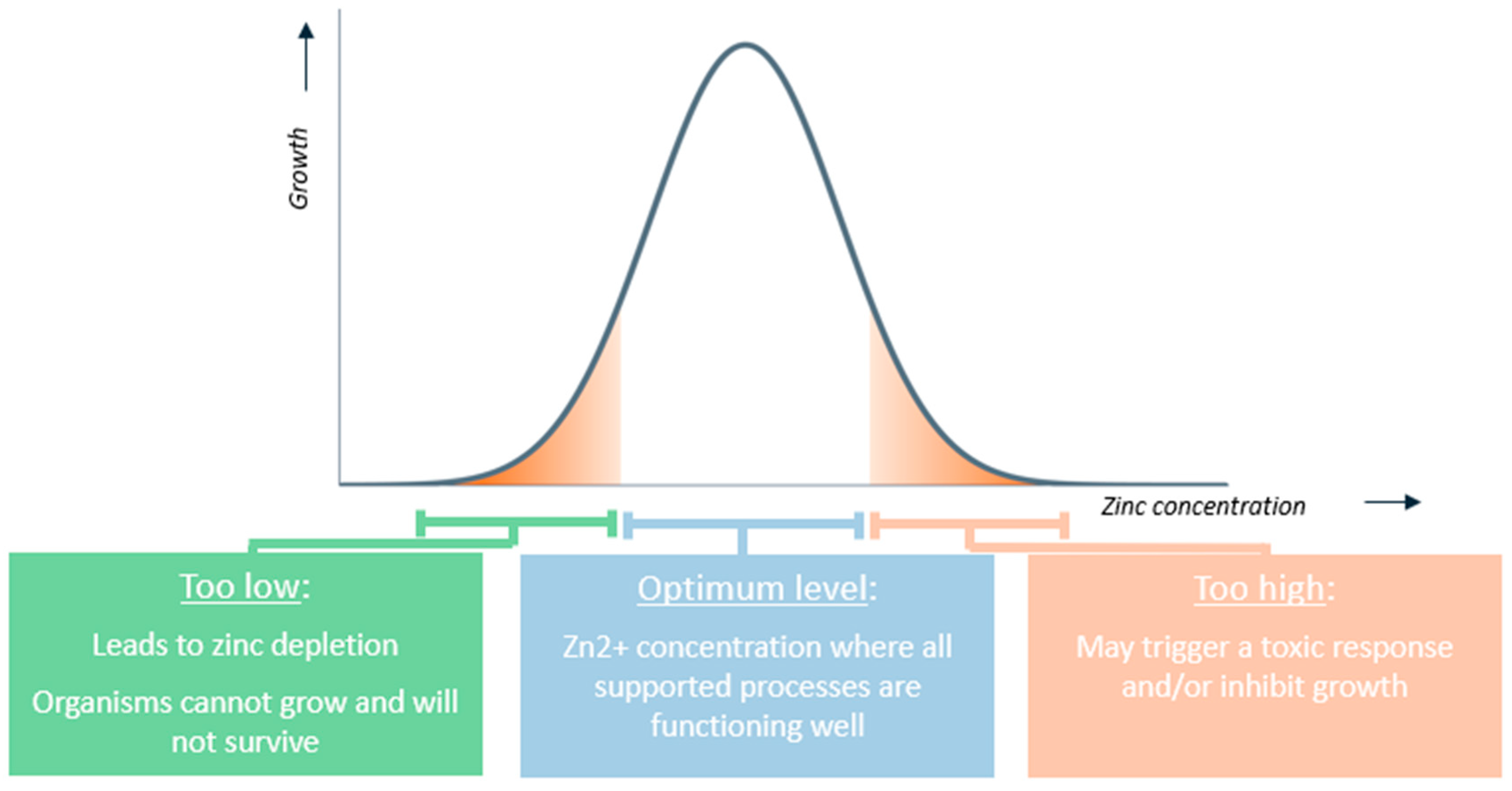
However, as briefly mentioned above, it is important to emphasize that zinc is an essential trace element: a minimum concentration of Zn2+ ions is required for primary producers such as phytoplankton to grow and maintain key functions like enzyme activity [23]. Typically, minimum concentrations needed for the healthy growth of marine algae lie in the range of 0.5–5 µg/L. Concentrations below this range can lead to growth inhibition and nutrient deficiency symptoms, while concentrations above approximately 50 µg/L become increasingly toxic. This dual role of zinc as both an essential micronutrient and a potential toxin highlights the importance of carefully monitoring and assessing environmental zinc levels in marine ecosystems [14]. This relationship is illustrated in Figure 1, which shows the typical bell-shaped curve of organism growth relative to zinc concentration, with clear zones of deficiency, optimum, and toxicity.

3.4. Conclusion on Ecotoxic Hazards of ZnO

Because toxicity is almost solely driven by the bioavailable Zn2+ ions, the physical size of the ZnO particles—whether nano- or micro-sized—does not affect the toxicity profile under environmentally relevant marine conditions. Both forms release Zn2+ through solubilization in water and therefore exhibit the same mode of action [14]. Furthermore, the mechanisms described in Section 3.1 (Particle-Cell Interaction and Mechanical Damage) and Section 3.2 (Photocatalytic Generation of ROS) are negligible at realistic exposure levels and do not contribute meaningfully to ZnO toxicity in corals.
This reinforces the conclusion that there is no nano-specific hazard of ZnO for corals, and that measured ZnO concentrations in coastal waters remain well below levels that could pose a risk to coral reef health [3,4].

4. The Impact of ZnO-Based Sunscreens on the Aquatic Environment: Environmental Exposure Scenarios

A thorough environmental exposure assessment is essential to evaluate whether ZnO used in sunscreens can reach concentrations of Zn2+ ions that pose risks to marine ecosystems. This section integrates field data and quantitative modelling to establish predicted environmental concentrations (PECs) under realistic and worst-case use conditions, providing context for the relevance of laboratory toxicity findings.

4.1. Measured Environmental Concentrations

Field measurements show that baseline zinc levels in ocean waters are very low. In open-ocean surface waters, background dissolved zinc concentrations typically range from about 0.006 to 0.12 µg/L. Closer to shore, natural and anthropogenic inputs raise zinc levels: coastal and estuarine waters often contain on the order of a few µg/L Zn (commonly ~4 µg/L), with highly impacted sites occasionally reaching up to ~25 µg/L. Only in extreme cases such as industrialized estuaries (e.g., near mining or smelting areas) do zinc concentrations approach the high µg/L to mg/L range; such scenarios are not related to sunscreens but to heavy pollution [2].
Detecting ZnO specifically from sunscreens in the environment is challenging because the concentrations are expected to be very low. The only direct measurements of sunscreen-derived ZnO in natural waters have been in the sea-surface microlayer at popular swimming beaches. This thin surface film can concentrate hydrophobic or particulate matter. Tovar-Sánchez et al. [27] reported zinc levels up to ~10 µg/L in the microlayer of touristic beach waters, whereas just 1 cm below the surface, the dissolved Zn dropped below 1 µg/L. A recent field study of French Mediterranean beaches observed a similar pattern: during peak recreational times, ZnO from sunscreens reached about 10–15 µg/L in the microlayer, while subsurface water (sampling the top 50 cm) contained only ~1–3 µg/L [28]. These findings indicate that even at highly frequented beaches, the bulk water ZnO concentrations remain on the order of a few micrograms per liter or less, with only the surface microlayer (a very small environmental compartment) accumulating slightly higher levels.
Besides field measurements, some studies have attempted to model environmental ZnO concentrations. Early modeling efforts yielded a wide range of predictions (from as low as 0.1 ng/L up to tens of µg/L), reflecting high uncertainty in usage and dilution assumptions. However, more refined analyses and analogies with other mineral UV filters suggest environmental concentrations are likely at the lower end of those ranges [12,14]. For example, TiO2 (another inorganic sunscreen ingredient) was measured at ~1.4 µg/L in a quiet recreational lake and <1 µg/L in a river, supporting the expectation that real-world ZnO levels from sunscreens are generally sub-µg/L under typical conditions. In summary, available evidence points to very low environmental zinc concentrations in coastal waters, usually well below 10 µg/L and often below 1 µg/L, even in tourism-heavy areas.

4.2. Modeled Exposure Scenario

To further assess a plausible worst-case scenario, a conservative quantitative model was constructed to estimate ZnO concentrations from intensive sunscreen use at a busy beach. The model incorporates high-end assumptions for all relevant factors, as summarized below:
  • Sunscreen Usage per Bather: Each adult beachgoer is assumed to use 18 g of sunscreen per day, a typical maximum application amount [29]. The European Union allows ZnO as a UV filter at up to 25% of the product by weight. In a worst-case situation, we assume the sunscreen is at this maximum ZnO content. Efficacy and cosmetic regulations indicate ZnO is about 80% elemental zinc by mass, so 18 g of a 25% ZnO sunscreen contains approximately 3.6 g of Zn (as elemental zinc). We further make the precautionary assumption that 100% of this ZnO is released into the water during bathing (i.e., none remains on skin or sand), yielding a potential release of 3.6 g Zn per bather per day.
  • Market Share of ZnO Sunscreens: Not all beachgoers use ZnO-based sunscreens. Industry data suggest that approx. 6,7% of sunscreens use ZnO [30]. This share is higher in children’s sunscreen, where mineral filters are favoured and can reach shares of up to 22%. A maximum 25% of sunscreen products on the market containing ZnO as the active ingredient can thus be considered a worst case scenario for this analysis. Incorporating this factor, the average Zn release per bather is adjusted downward. Effectively, 25% of users release 3.6 g Zn while 75% release none; this equates to an overall average of 0.9 g Zn per bather per day attributable to sunscreen ZnO.
  • Number of Bathers (Exposure Intensity): We consider a heavily-used beach scenario. According to Milieu Consulting [31], several Member States define a ‘large number of bathers’ as between 100 and 300 individuals per day, depending on national implementation of the Bathing Water Directive [31]. To ensure a conservative estimate, we apply a worst-case scenario of 1000 bathers per kilometer of beach per day, which is substantially above typical densities and thus provides a safety margin. Assuming an average Zn release of 0.9 g per person per day from sunscreen use, this would result in an input of approximately 900 g of zinc per kilometer of beach per day.
  • Receiving Water Volume: The released Zn is assumed to disperse in a 1 km × 1 km near-shore mixing zone with a representative depth of 10 m, which corresponds to a volume of 1 × 10⁷ m3 (10 million cubic meters) of water available for dilution. This assumption follows standard screening-level practice in marine environmental assessments [32,33,34], where simplified near-field mixing zones are applied when site-specific hydrodynamic models are not available. Coastal wave action and littoral currents typically disperse dissolved substances over scales of several hundred metres to kilometres within hours, making a 1 km along- and offshore extent a realistic first-order estimate of initial dilution. A depth of 10 m reflects typical near-shore bathymetry (5–15 m) at sandy beaches and provides a conservative dilution volume. This approach therefore yields precautionary Zn concentration estimates for subsequent risk assessment.
  • Water Exchange (Flushing Rate): Coastal waters are dynamic. Tidal action and nearshore currents continuously replace the water in the surf and nearshore zones. For the purposes of this assessment, we assume a residence time of approximately 10 days for a defined 1 km3 coastal water segment, meaning that the full volume of 107 m3 is, on average, refreshed every 10 days due to tidal exchange This 10-day residence time is considered a realistic approximation for open coastal and surf-zone environments, which typically experience faster mixing dynamics than enclosed or deeper waters. It contrasts with the default value of 40 days used in standard regional exposure models—such as those employed under the European REACH Regulation—which is selected as a reasonable average for the broader European aquatic environment. That default reflects more stable or semi-enclosed water bodies. Residence time refers to the average period during which water remains in a given aquatic system before it is replaced or continues through the hydrological cycle. In coastal areas, especially where tidal influence is strong, shorter residence times are more appropriate. Therefore, the 10-day value is adopted in this analysis to better reflect the dynamic and rapidly exchanging nature of marine surf zones.
To account for accumulation over time within the system due to repeated daily input, the following formula (Formula (1)) is used to estimate the total amount of Zn remaining in the water after 153 consecutive bathing days:
Z n 153 = Z n 1 × ( 1 + n = 1 152 F a c c n )
In which:
-
Z n 153 :   t h e   a m o u n t   o f   Z n   i n   t h e   s y s t e m   a f t e r   153   d a y s
-
Z n 1 :   t h e   a m o n t   o g   Z n   a d d e d   i n   d a y   ( 900   g Z n d a y )
-
F a c c :   f r a c t i o n   a c c u m u l a t i n g   i n   1   d a y , = e 1 ,   w i t h   r e s i d e n c e   t i m e   i n   d a y s (10 days)
From this accumulation, the maximum steady-state Zn mass present in the system can be estimated using Formula (2):
Z n s t e a d y :   s t a t e =   Z n 1   × ( 1 1 F a c c )  
Applying the 10-day residence time, the accumulation approaches a steady-state value of approximately 9.5 kg Zn in the system after several weeks of consistent input. This steady-state mass is then used as the numerator in further concentration calculations (see Formula (3)), ensuring that both dynamic flushing and continuous Zn release are considered.
6.
Accumulation and Steady-State: We simulate a continuous high-season of beach use over a prolonged period. For conservatism, 153 consecutive days (approximately 5 months, e.g., May through September) of peak use are assumed, with 900 g Zn added daily to the defined coastal zone. Because water is flushed out every 10 days, the Zn does not simply accumulate unchecked–it approaches a balance (steady state) where daily inputs equal outputs. Using a standard residence time model for continuous additions, the Zn mass in the system converges toward a steady value. After about ~75 days of repeated inputs, over 90% of the steady-state is achieved. At full 153 days, the system reaches essentially steady conditions with an estimated total of ~9.5 kg of Zn present in the water compartment from sunscreen release (the point where daily losses to outflow match the 0.9 kg daily input).
Based on the worst-case scenario, the predicted zinc concentration in coastal waters can be calculated using a conservative static box model, following the approach described by Labille et al. [28]. This model estimates the Predicted Environmental Concentration (PEC) by distributing the total mass of Zn released by beachgoers across a defined nearshore water volume. Specifically, assuming heavy recreational use with ~1000 bathers per kilometer of beach per day applying ~30 g of sunscreen containing 25% ZnO, the total Zn input amounts to approximately 9.5 kg per day. This mass is then diluted in an estimated 107 m3 of nearshore water, accounting for mixing by currents, tides, and water exchange over multiple days. This simple mass balance yields a Zn concentration on the order of 0.95 µg/L.
To account for zinc’s partitioning between the dissolved and particulate phases, a more conservative steady-state concentration can be derived using the following partitioning-based equation (Formula (3)), as applied in the REACH and ECHA environmental exposure models:
c w a t e r = a m o u n t   r e l e a s e d K p S u s p ×   S U S P w a t e r × v o l u m e
In which:
-
c w a t e r :   c o n c e n t r a t i o n   i n   s u r f a c e   w a t e r   ( µ g / L )
-
amount released: amount of Zn released, assuming complete dissolution (9,500,000 µg)
-
K p S u s p :   s o l i d s w a t e r   p a r t i t i o n i n g   c o e f f i c i e n t   o f   s u s p e n d e d   m a t t e r   ( 10,200   L / k g )   ( I n t e r n a t i o n a l   Z i n c   A s s o c i a t i o n ,   I Z A ,   2021 ,   p e r s o n a l   c o m m u n i c a t i o n )
-
S U S P w a t e r :   c o n c e n t r a t i o n   o f   s u s p e n d e d   m a t t e r   i n   t h e   w a t e r   ( d e f a u l t   v a l u e   o f   15   m g / L = 0.015   k g / m 3 ) [7].
-
Volume: volume oft he receiving water body (107 m3).
To be even more conservative, considering zinc’s partitioning between dissolved and particulate phases, the model predicts a steady-state Zn concentration of approximately 1.08 µg/L attributable to sunscreen use. Adding the typical natural background zinc level of ~0.5 µg/L in surface seawater results in a total PEC of ~1.58 µg/L in this worst-case scenario. In other words, even under extremely heavy and continuous recreational use of ZnO sunscreens, the local zinc concentration in coastal waters is expected to remain on the order of one to two micrograms per liter [28]. This modeling approach, widely used in UV filter risk assessments, relies on conservative assumptions to avoid underestimating potential exposure and can be easily adapted to different coastal environments and bather densities.
It is important to put this PEC into perspective with known ecotoxicological thresholds. The predicted 1.6 µg/L is well below the level of zinc that would cause concern for marine life. For instance, the regulatory Predicted No-Effect Concentration (PNEC) for zinc in marine waters is 7.2 µg/L, which is nearly five times higher than our worst-case PEC [7]. Studies on coral sensitivity indicate that no observable adverse effects on coral symbiosis occur at concentrations around 5 µg/L Zn; our PEC is roughly three times lower than that no-effect level [4]. Real-world measurements (generally <1 µg/L even at busy beaches) align with this worst-case PEC and remain far below levels expected to harm marine organisms.
Concerning corals specifically, Fel et al. [4] conducted one of the few experimental studies at environmentally relevant concentrations, exposing tropical corals to ZnO over 35 days. They reported a NOEC of 10 µg/L for zooxanthellae, slight and reversible decreases in photosynthetic efficiency at 100 µg/L, and significant bleaching only at concentrations exceeding 1200 µg/L. These findings indicate a wide safety margin, as field measurements at popular beaches show ZnO levels in surface waters typically below 10 µg/L—well below thresholds for coral impairment [2,4]. The experimental design of Fel et al. included continuous monitoring of key coral health parameters: chlorophyll content, symbiont density, and photosynthetic performance via Pulse Amplitude Modulation (PAM) fluorometry. This comprehensive assessment strengthens confidence that the harmful effects of ZnO require concentrations far above those realistically expected in marine environments.
Crucially, this exposure assessment highlights the discrepancy between realistic environmental concentrations and the much higher concentrations used in some laboratory toxicity studies. For example, Corinaldesi et al. [3] exposed tropical coral fragments to uncoated ZnO at 6.3 mg/L (6300 µg/L), a level that caused rapid bleaching. This is roughly 4000 times higher than our worst-case PEC (~1.58 µg/L), underscoring that such laboratory concentrations are environmentally unrealistic. Our assessment demonstrates that ZnO from sunscreens is highly unlikely to approach these levels in real marine settings, emphasizing the importance of exposure-driven risk assessments.

4.3. Sediment Exposure

Zinc has a strong affinity for binding to sediments, particularly in coastal and shallow water environments where particulates settle due to lower water movement [9,12]. Therefore, it is essential to assess the potential sediment exposure to ZnO from sunscreens alongside water column concentrations.
In a conservative worst-case modeling approach, approximately 9.5 kg of zinc is estimated to be released per kilometer of beach per day from sunscreen use. Of this amount, around 75% is expected to bind to suspended particles or adsorb onto existing sediment and eventually settle on the seafloor, resulting in approximately 7.125 kg of zinc accumulating in the coastal sediment. The affected sediment layer is assumed to extend over a 1 km stretch of beach with a 100 m wide nearshore zone and a depth of 0–5 cm, corresponding to a sediment volume of 5000 m3. Assuming an average wet sediment bulk density of 1.5 t/m3, this layer has a total mass of approximately 7.5 million kilograms (7.5 × 10⁶ kg). Dividing the deposited zinc mass by the total sediment mass yields an additional zinc concentration of approximately 9.5 mg/kg. When combined with the natural background zinc concentration of about 60 mg/kg already present in coastal sediments, the total modeled zinc concentration reaches approximately 68.5–69.5 mg/kg in the upper sediment layer within the defined coastal exposure zone.
This predicted concentration remains well below the regulatory Predicted No-Effect Concentration (PNEC) for zinc in mari`ne sediments, which is set at 162.2 mg/kg [7]. The PNEC accounts for sensitive benthic organisms and is derived from comprehensive ecotoxicological datasets. Therefore, even under worst-case continuous sunscreen use, sediment zinc concentrations are expected to stay safely below levels of ecological concern [35].
Moreover, it is important to note that coastal sediments are dynamic: wave action, currents, and bioturbation regularly mix and redistribute sediments, further diluting any added zinc over time. Additionally, zinc’s bioavailability in sediments is significantly reduced because it becomes strongly bound to mineral or organic particles, making it less accessible to benthic organisms [25].
In summary, the modeling indicates that even with intensive, prolonged use of ZnO-based sunscreens, sediment zinc concentrations remain well below ecotoxicologically relevant thresholds, and no significant risk to benthic communities is anticipated under realistic environmental conditions.

5. Risk Assessment

The combined results from measured field data and worst-case modeling consistently demonstrate that zinc oxide (ZnO) used in sunscreen formulations does not pose a significant environmental risk under realistic conditions [2,28,36]. The predicted environmental concentration (PEC) in marine water, calculated at 1.58 µg/L, remains well below the general predicted no-effect concentration (PNEC) of 7.2 µg/L and specifically the No Observed Effect Concentration (NOEC) of 10 µg/L for symbiotic algae associated with corals [4,7]. Similarly, for sediment exposure, the PEC of 68.5 mg/kg remains far below the sediment PNEC of 162.2 mg/kg, indicating minimal risk to benthic organisms [7].
These findings are in line with other studies coming to the same conclusions, such as Xu et al. [36] based on measured ZnO-NP concentrations (or dissolved zinc levels) in several Chinese coastal zones (Jiaozhou Bay, Yellow River Estuary, Laizhou Bay), which remained well below the reported acute toxicity (LC50/EC50) values for the seven tested species.
Following these various assessments, it is possible to conclude that there is no ecological risk linked to the presence of ZnO and Zn ions in coastal waters, not only for corals, which only represent the tip of the iceberg, but also for marine life in general.

6. Conclusions

The present review synthesizes the current state of knowledge regarding the ecotoxicological profile and environmental exposure of zinc oxide (ZnO), with a particular focus on its use as a UV filter in sunscreen formulations and its potential impact on marine ecosystems. The cumulative evidence from regulatory dossiers, peer-reviewed toxicological studies, and worst-case exposure modeling strongly supports the conclusion that ZnO, in both nano and non-nano forms, does not pose a significant risk to marine environments under realistic usage conditions [4,7,28].
Measured and modeled concentrations of Zn2+ in coastal waters, even in densely populated and high-usage recreational zones, remain well below established Predicted No Effect Concentrations (PNECs) for marine water and sediment [2,7]. Furthermore, coral-specific toxicity endpoints—such as the disruption of photosynthesis in symbiotic zooxanthellae and bleaching—occur only at concentrations orders of magnitude higher than those environmentally relevant [3,4].
The ecotoxicological behavior of ZnO shows no significant differences between its nano and non-nano forms. The primary driver of toxicity is the release of bioavailable Zn2+ ions, which is common to both forms. Extensive datasets, including those used in the REACH framework, support the conclusion that no nano-specific hazard exists [7,14]. Overall, this evidence confirms a wide margin of environmental safety for ZnO in sunscreen applications. Regulatory approaches should therefore be guided by realistic exposure and risk assessments rather than hazard-based assumptions derived from unrealistic laboratory concentrations.
Given the evidence above, transitioning from a hazard-based to a risk-based regulatory framework is both scientifically sound and necessary to ensure balanced environmental stewardship. A risk-based approach aligns with contemporary chemical safety principles—evaluating both exposure and hazard—rather than relying solely on laboratory-derived toxicity endpoints [9,37]. This shift is recommended for UV filters, including inorganic ones like ZnO, and has been called for in regulatory assessments of sunscreen ingredients, where equal consideration of organic and inorganic filters is urged [5]. It also aligns with broader calls across chemical regulation to mitigate misclassification of essential elements like zinc by focusing on realistic environmental exposure scenarios, not just inherent hazard [38].
Nevertheless, some data gaps remain. Future research should prioritize long-term chronic exposure studies at environmentally relevant concentrations, particularly under in situ conditions. Additionally, improved analytical methodologies for the detection of ZnO (nano)particles and their transformation products in natural waters and sediments are crucial to refining environmental models and ensuring robust risk assessments [5,9].
In conclusion, the responsible use of ZnO in sunscreens appears environmentally compatible with marine ecosystem health, including that of coral reefs. Continued scientific diligence and a commitment to proportionate regulation will be key to supporting both human health protection and marine conservation [38].

Author Contributions

Writing—original draft, I.K.; Writing—review and editing, T.M. All authors have read and agreed to the published version of the manuscript.

Funding

This research received no external funding.

Institutional Review Board Statement

Not applicable.

Informed Consent Statement

Not applicable.

Data Availability Statement

The original contributions presented in this study are included in the article. Further inquiries can be directed to the corresponding author.

Acknowledgments

During the preparation of this manuscript, the authors used ChatGPT version 4 for the purpose of improving the readability of the text. The authors have reviewed and edited the output and take full responsibility for the content of this publication.

Conflicts of Interest

Author Kracke Inola is currently employed by the company SLI Chemicals. Author Moraine Thibault is currently employed by the company Uviva Technologies. The authors declare that the research was conducted in the absence of any commercial or financial relationships that could be construed as a potential conflict of interest.

References

  1. Downs, C.A.; Kramarsky-Winter, E.; Segal, R.; Fauth, J.; Knutson, S.; Bronstein, O.; Ciner, F.R.; Jeger, R.; Lichtenfeld, Y.; Woodley, C.M.; et al. Toxicopathological effects of the sunscreen UV filter, oxybenzone (benzophenone-3), on coral planulae and cultured primary cells and its environmental contamination in Hawaii and the U.S. Virgin Islands. Arch. Environ. Contam. Toxicol. 2016, 70, 265–288. [Google Scholar] [CrossRef] [PubMed]
  2. Sánchez-Quiles, D.; Tovar-Sánchez, A. Are sunscreens a new environmental risk associated with coastal tourism? Environ. Int. 2015, 83, 158–170. [Google Scholar] [CrossRef]
  3. Corinaldesi, C.; Marcellini, F.; Nepote, E.; Damiani, E.; Danovaro, R. Impact of inorganic UV filters contained in sunscreen products on tropical stony corals (Acropora spp.). Sci. Total Environ. 2018, 637–638, 1279–1285. [Google Scholar] [CrossRef] [PubMed]
  4. Fel, J.P.; Lacherez, C.; Bensetra, A.; Mezzache, S.; Béraud, E.; Léonard, M.; Allemand, D.; Ferrier-Pagès, C. Photochemical response of the scleractinian coral Stylophora pistillata to some sunscreen ingredients. Coral Reefs 2019, 38, 109–122. [Google Scholar] [CrossRef]
  5. Miller, I.B.; Pawlowski, S.; Kellermann, M.Y.; Petersen-Thiery, M.; Moeller, M.; Nietzer, S.; Schupp, P.J. Toxic effects of UV filters from sunscreens on coral reefs revisited: Regulatory aspects for “reef safe” products. Environ. Sci. Eur. 2021, 33, 74. [Google Scholar] [CrossRef]
  6. Du, J.; Tang, J.; Xu, S.; Ge, J.; Dong, Y.; Li, H.; Jin, M. ZnO nanoparticles: Recent advances in ecotoxicity and risk assessment. Drug Chem. Toxicol. 2020, 43, 322–333. [Google Scholar] [CrossRef]
  7. European Chemicals Agency (ECHA). Zinc Oxide—Registered Substance Information. European Chemicals Agency (ECHA). 2023. Available online: https://echa.europa.eu/brief-profile/-/briefprofile/100.013.839 (accessed on 20 March 2026).
  8. Danovaro, R.; Bongiorni, L.; Corinaldesi, C.; Giovannelli, D.; Damiani, E.; Astolfi, P.; Greci, L.; Pusceddu, A. Sunscreens cause coral bleaching by promoting viral infections. Environ. Health Perspect. 2008, 116, 441–447. [Google Scholar] [CrossRef] [PubMed]
  9. OECD. Guidance Document on Aquatic and Sediment Toxicological Testing of Nanomaterials. OECD Series on Testing and Assessment No. 317. 2016. Available online: https://www.oecd.org/en/publications/guidance-document-on-aquatic-and-sediment-toxicological-testing-of-nanomaterials_08905c99-en.html (accessed on 20 March 2026).
  10. Ma, H.; Williams, P.L.; Diamond, S.A. Ecotoxicity of manufactured ZnO nanoparticles--a review. Environ. Pollut. 2013, 172, 76–85. [Google Scholar] [CrossRef]
  11. Fernández-Bertólez, N.; Alba-González, A.; Touzani, A.; Ramos-Pan, L.; Méndez, J.; Reis, A.T.; Quelle-Regaldie, A.; Sánchez, L.; Folgueira, M.; Laffon, B.; et al. Toxicity of zinc oxide nanoparticles: Cellular and behavioural effects. Chemosphere 2024, 363, 142993. [Google Scholar] [CrossRef]
  12. Loosli, F.; Le Coustumer, P.; Stoll, S. TiO2 nanoparticles aggregation and disaggregation in presence of alginate and Suwannee River humic acids. pH and concentration effects on nanoparticle stability. Water Res. 2013, 47, 6052–6063. [Google Scholar] [CrossRef]
  13. Schiavo, S.; Oliviero, M.; Li, J.; Manzo, S. Testing ZnO nanoparticle ecotoxicity: Linking time variable exposure to effects on different marine model organisms. Environ. Sci. Pollut. Res. Int. 2018, 25, 4871–4880. [Google Scholar] [CrossRef] [PubMed]
  14. Franklin, N.M.; Rogers, N.J.; Apte, S.C.; Batley, G.E.; Gadd, G.E.; Casey, P.S. Comparative toxicity of nanoparticulate ZnO, bulk ZnO, and ZnCl2 to a freshwater microalga (Pseudokirchneriella subcapitata): The importance of particle solubility. Environ. Sci. Technol. 2007, 41, 8484–8490. [Google Scholar] [CrossRef]
  15. Ding, Z.; Han, G.; Qu, R.; Liu, J.; Wang, P. Review on Zinc Isotopes in River Systems: Distribution and Application. Water 2024, 16, 87. [Google Scholar] [CrossRef]
  16. Desboeufs, K.; Fu, F.; Bressac, M.; Tovar-Sánchez, A.; Triquet, S.; Doussin, J.-F.; Giorio, C.; Chazette, P.; Disnaquet, J.; Feron, A.; et al. Wet deposition in the remote western and central Mediterranean as a source of trace metals to surface seawater. Atmos. Chem. Phys. 2022, 22, 2309–2332. [Google Scholar] [CrossRef]
  17. Jiang, S.; Zhang, Y.; Yu, G.; Han, Z.; Zhao, J.; Zhang, T.; Zheng, M. Source-resolved atmospheric metal emissions, concentrations, and deposition fluxes into the East Asian seas. Atmos. Chem. Phys. 2024, 24, 8363–8381. [Google Scholar] [CrossRef]
  18. Tong, L.; Song, K.; Wang, Y.; Yang, J.; Ji, J.; Lu, J.; Chen, Z.; Zhang, W. Zinc oxide nanoparticles dissolution and toxicity enhancement by polystyrene microplastics under sunlight irradiation. Chemosphere 2022, 299, 134421. [Google Scholar] [CrossRef]
  19. Coston, J.A.; Fuller, C.C.; Davis, J.A. Pb2+ and Zn2+ adsorption by a natural aluminum- and iron-bearing surface coating on an aquifer sand. Geochim. Et Cosmochim. Acta 1995, 59, 3535–3547. [Google Scholar] [CrossRef]
  20. Li, T.; Fu, K.-B.; Chen, S.; Yao, J.; Bian, L. Comparison of microscopic adsorption characteristics of Zn(II), Pb(II), and Cu(II) on kaolinite. Sci. Rep. 2022, 12, 15936. [Google Scholar] [CrossRef]
  21. Wanty, R.B.; Podda, F.; De Giudici, G.; Cidu, R.; Lattanzi, P. Zinc isotope and transition-element dynamics accompanying hydrozincite biomineralization in the Rio Naracauli, Sardinia, Italy. Chem. Geol. 2013, 337–338, 1–10. [Google Scholar] [CrossRef]
  22. Huarachi-Olivera, R.; Mata, M.T.; Valdés, J.; Riquelme, C. Biosorption of Zn(II) from Seawater Solution by the Microalgal Biomass of Tetraselmis marina AC16-MESO. Int. J. Mol. Sci. 2022, 22, 12799. [Google Scholar] [CrossRef]
  23. Kell, R.M.; Chmiel, R.J.; Rao, D.; Moran, D.M.; McIlvin, M.R.; Horner, T.J.; Schanke, N.L.; Sugiyama, I.; Dunbar, R.B.; DiTullio, G.R.; et al. High metabolic zinc demand within native Amundsen and Ross sea phytoplankton communities determined by stable isotope uptake rate measurements. Biogeosciences 2024, 21, 5685–5706. [Google Scholar] [CrossRef]
  24. Ma, L.; Wang, W.-X. Zinc source differentiation in hydrothermal vent mollusks: Insight from Zn isotope ratios. Sci. Total Environ. 2021, 773, 145653. [Google Scholar] [CrossRef]
  25. Bianchini, A.; Wood, C.M. Mechanism of acute silver toxicity in Daphnia magna: Role of sodium and chloride in silver bioavailability. Environ. Toxicol. Chem. 2003, 22, 1361–1367. [Google Scholar] [CrossRef]
  26. Saxena, P.; Harish. Toxicity assessment of ZnO nanoparticles to freshwater microalgae Coelastrella terrestris. Environ. Sci. Pollut. Res. 2019, 26, 26991–27001. [Google Scholar] [CrossRef]
  27. Tovar-Sánchez, A.; Sánchez-Quiles, D.; Basterretxea, G.; Benedé, J.L.; Chisvert, A.; Salvador, A.; Moreno-Garrido, I.; Blasco, J. Sunscreen products as emerging pollutants to coastal waters. PLoS ONE 2013, 8, e65451. [Google Scholar] [CrossRef]
  28. Labille, J.; Slomberg, D.; Catalano, R.; Robert, S.; Apers-Tremelo, M.L.; Boudenne, J.L.; Manasfi, T.; Radakovitch, O. Assessing UV filter inputs into beach waters during recreational activity: A field study of three French Mediterranean beaches from consumer survey to water analysis. Sci. Total Environ. 2020, 706, 136010. [Google Scholar] [CrossRef]
  29. Scientific Committee on Consumer Safety (SCCS). SCCS Notes of Guidance for the Testing of Cosmetic Ingredients and Their Safety Evaluation (9th rev.; Document No. SCCS/1564/15, Revised 25 April 2016). European Commission. 2015. Available online: https://ec.europa.eu/health/scientific_committees/consumer_safety/docs/sccs_o_190.pdf (accessed on 20 March 2026).
  30. Pniewska, A.; Kalinowska-Lis, U. A survey of UV filters used in sunscreen cosmetics. Appl. Sci. 2024, 14, 3302. [Google Scholar] [CrossRef]
  31. Milieu Consulting SPRL. Support to the Assessment of Member States’ Compliance with the Bathing Water Directive 2006/7/EC (Bathing Waters Directive): Final EU Overview Report. European Commission. 2019. Available online: https://environment.ec.europa.eu/topics/water/bathing-water_en (accessed on 20 March 2026).
  32. European Commission. Directive 2000/60/EC of the European Parliament and of the Council Establishing a Framework for Community Action in the Field of Water Policy. Off. J. Eur. Communities 2000. Available online: https://eur-lex.europa.eu/legal-content/EN/TXT/?uri=CELEX%3A32000L0060 (accessed on 20 March 2026).
  33. NOAA. Guidance for the Assessment of Environmental Impacts of Aquatic Discharges in Coastal Waters. National Oceanic and Atmospheric Administration. 2014. Available online: https://coast.noaa.gov/digitalcoast/ (accessed on 20 March 2026).
  34. U.S. EPA. Technical Support Document for Water Quality-based Toxics Control. U.S. Environmental Protection Agency, Office of Water, Washington, D.C. 1991. Available online: https://www.epa.gov/system/files/documents/2024-07/technical-support-document-for-water-quality-based-toxics-control.pdf (accessed on 20 March 2026).
  35. Hermansson, A.L.; Ytreberg, E. Zinc in Sediment: An Environmental Quality Standard Overview; Department of Mechanics and Maritime Sciences, Chalmers University of Technology: Gothenburg, Sweden, 2022. [Google Scholar]
  36. Xu, J.Y.; Xin-Ming, P.U.; Lu, D.C.; Xing, Y.Y.; Liu, C.; Wei, M.; Wang, B.; Pan, J.F. Seawater quality criteria and ecotoxicity risk assessment of zinc oxide nanoparticles based on data of resident marine organisms in China. Sci. Total Environ. 2023, 905, 166690. [Google Scholar] [CrossRef] [PubMed]
  37. Mitrano, D.M.; Wohlleben, W. Microplastic regulation should be more precise to incentivize both innovation and environmental safety. Nat. Commun. 2020, 11, 5324. [Google Scholar] [CrossRef] [PubMed]
  38. European Commission. Communication on the European Union’s Chemicals Strategy for Sustainability Towards a Toxic-Free Environment. COM(2020) 667 Final. 2018. Available online: https://eur-lex.europa.eu/legal-content/EN/TXT/?uri=CELEX:52020DC0667 (accessed on 20 March 2026).
Figure 1. Conceptual model illustrating the relationship between zinc concentration (Zn2+) and organism growth, highlighting the zones of deficiency (too low), optimal levels for physiological processes, and toxicity (too high). The bell-shaped curve indicates that zinc is essential in moderate amounts but can become harmful at elevated concentrations.
Cosmetics 13 00113 g001
Disclaimer/Publisher’s Note: The statements, opinions and data contained in all publications are solely those of the individual author(s) and contributor(s) and not of MDPI and/or the editor(s). MDPI and/or the editor(s) disclaim responsibility for any injury to people or property resulting from any ideas, methods, instructions or products referred to in the content.