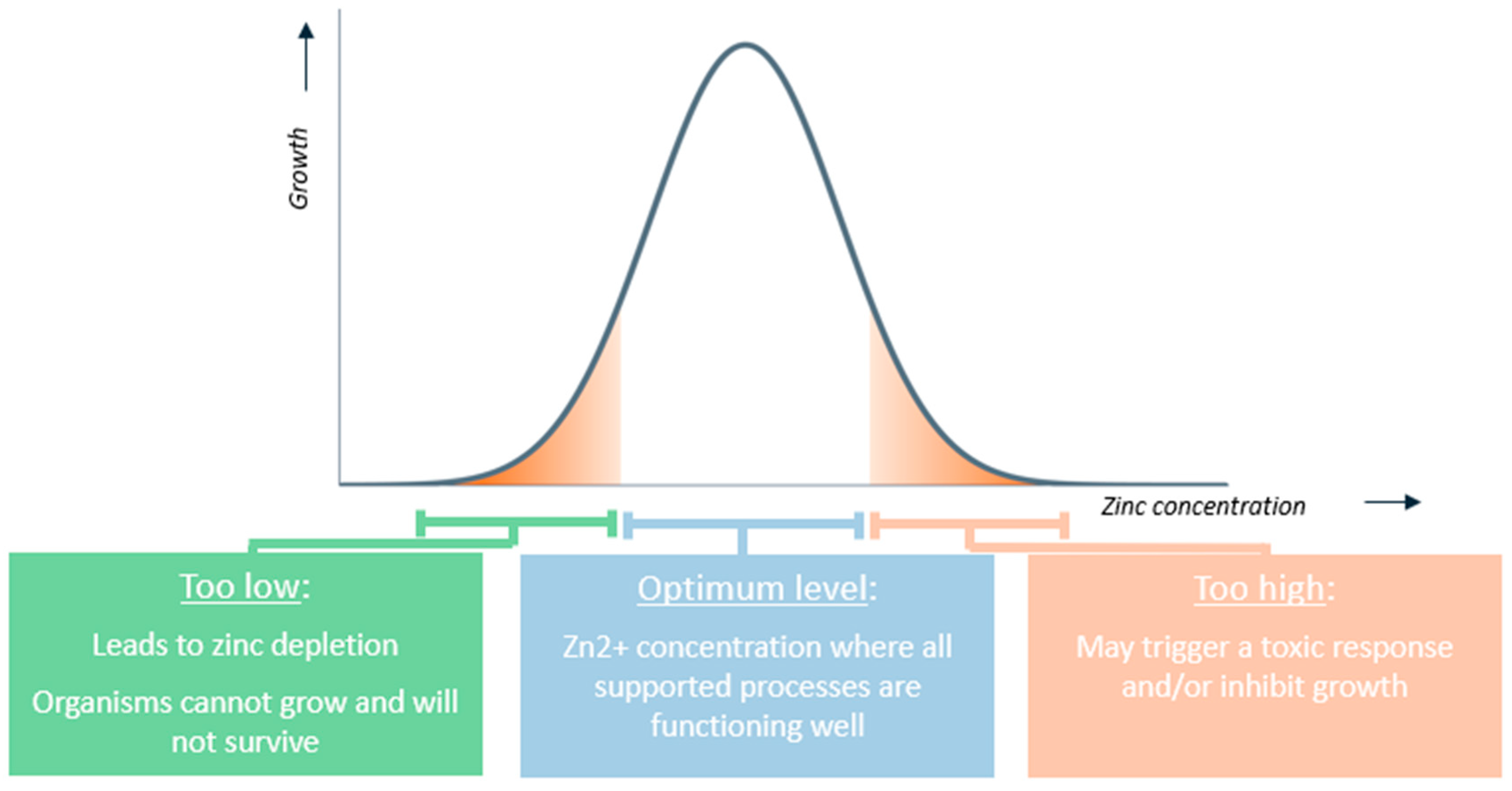

Zinc Oxide as a UV-Filter: A Review of Environmental Risks & Exposure Scenarios in Marine Environments

Abstract
1. Introduction
2. Ecotoxicological Profile of ZnO
- Marine water: 7.2 µg/L Zn2+
- Sediment: 162.2 mg/kg Zn
3. Coral Reef Hazards
3.1. Particle-Cell Interaction and Mechanical Damage
3.2. Photocatalytic Generation of Reactive Oxygen Species (ROS)
3.3. Dissolution and Zn2+ Ion Toxicity
3.4. Conclusion on Ecotoxic Hazards of ZnO
4. The Impact of ZnO-Based Sunscreens on the Aquatic Environment: Environmental Exposure Scenarios
4.1. Measured Environmental Concentrations
4.2. Modeled Exposure Scenario
- Sunscreen Usage per Bather: Each adult beachgoer is assumed to use 18 g of sunscreen per day, a typical maximum application amount [29]. The European Union allows ZnO as a UV filter at up to 25% of the product by weight. In a worst-case situation, we assume the sunscreen is at this maximum ZnO content. Efficacy and cosmetic regulations indicate ZnO is about 80% elemental zinc by mass, so 18 g of a 25% ZnO sunscreen contains approximately 3.6 g of Zn (as elemental zinc). We further make the precautionary assumption that 100% of this ZnO is released into the water during bathing (i.e., none remains on skin or sand), yielding a potential release of 3.6 g Zn per bather per day.
- Market Share of ZnO Sunscreens: Not all beachgoers use ZnO-based sunscreens. Industry data suggest that approx. 6,7% of sunscreens use ZnO [30]. This share is higher in children’s sunscreen, where mineral filters are favoured and can reach shares of up to 22%. A maximum 25% of sunscreen products on the market containing ZnO as the active ingredient can thus be considered a worst case scenario for this analysis. Incorporating this factor, the average Zn release per bather is adjusted downward. Effectively, 25% of users release 3.6 g Zn while 75% release none; this equates to an overall average of 0.9 g Zn per bather per day attributable to sunscreen ZnO.
- Number of Bathers (Exposure Intensity): We consider a heavily-used beach scenario. According to Milieu Consulting [31], several Member States define a ‘large number of bathers’ as between 100 and 300 individuals per day, depending on national implementation of the Bathing Water Directive [31]. To ensure a conservative estimate, we apply a worst-case scenario of 1000 bathers per kilometer of beach per day, which is substantially above typical densities and thus provides a safety margin. Assuming an average Zn release of 0.9 g per person per day from sunscreen use, this would result in an input of approximately 900 g of zinc per kilometer of beach per day.
- Receiving Water Volume: The released Zn is assumed to disperse in a 1 km × 1 km near-shore mixing zone with a representative depth of 10 m, which corresponds to a volume of 1 × 10⁷ m3 (10 million cubic meters) of water available for dilution. This assumption follows standard screening-level practice in marine environmental assessments [32,33,34], where simplified near-field mixing zones are applied when site-specific hydrodynamic models are not available. Coastal wave action and littoral currents typically disperse dissolved substances over scales of several hundred metres to kilometres within hours, making a 1 km along- and offshore extent a realistic first-order estimate of initial dilution. A depth of 10 m reflects typical near-shore bathymetry (5–15 m) at sandy beaches and provides a conservative dilution volume. This approach therefore yields precautionary Zn concentration estimates for subsequent risk assessment.
- Water Exchange (Flushing Rate): Coastal waters are dynamic. Tidal action and nearshore currents continuously replace the water in the surf and nearshore zones. For the purposes of this assessment, we assume a residence time of approximately 10 days for a defined 1 km3 coastal water segment, meaning that the full volume of 107 m3 is, on average, refreshed every 10 days due to tidal exchange This 10-day residence time is considered a realistic approximation for open coastal and surf-zone environments, which typically experience faster mixing dynamics than enclosed or deeper waters. It contrasts with the default value of 40 days used in standard regional exposure models—such as those employed under the European REACH Regulation—which is selected as a reasonable average for the broader European aquatic environment. That default reflects more stable or semi-enclosed water bodies. Residence time refers to the average period during which water remains in a given aquatic system before it is replaced or continues through the hydrological cycle. In coastal areas, especially where tidal influence is strong, shorter residence times are more appropriate. Therefore, the 10-day value is adopted in this analysis to better reflect the dynamic and rapidly exchanging nature of marine surf zones.
- -
- -
- -
- (10 days)
- 6.
- Accumulation and Steady-State: We simulate a continuous high-season of beach use over a prolonged period. For conservatism, 153 consecutive days (approximately 5 months, e.g., May through September) of peak use are assumed, with 900 g Zn added daily to the defined coastal zone. Because water is flushed out every 10 days, the Zn does not simply accumulate unchecked–it approaches a balance (steady state) where daily inputs equal outputs. Using a standard residence time model for continuous additions, the Zn mass in the system converges toward a steady value. After about ~75 days of repeated inputs, over 90% of the steady-state is achieved. At full 153 days, the system reaches essentially steady conditions with an estimated total of ~9.5 kg of Zn present in the water compartment from sunscreen release (the point where daily losses to outflow match the 0.9 kg daily input).
- -
- -
- amount released: amount of Zn released, assuming complete dissolution (9,500,000 µg)
- -
- -
- [7].
- -
- Volume: volume oft he receiving water body (107 m3).
4.3. Sediment Exposure
5. Risk Assessment
6. Conclusions
Author Contributions
Funding
Institutional Review Board Statement
Informed Consent Statement
Data Availability Statement
Acknowledgments
Conflicts of Interest
References
- Downs, C.A.; Kramarsky-Winter, E.; Segal, R.; Fauth, J.; Knutson, S.; Bronstein, O.; Ciner, F.R.; Jeger, R.; Lichtenfeld, Y.; Woodley, C.M.; et al. Toxicopathological effects of the sunscreen UV filter, oxybenzone (benzophenone-3), on coral planulae and cultured primary cells and its environmental contamination in Hawaii and the U.S. Virgin Islands. Arch. Environ. Contam. Toxicol. 2016, 70, 265–288. [Google Scholar] [CrossRef] [PubMed]
- Sánchez-Quiles, D.; Tovar-Sánchez, A. Are sunscreens a new environmental risk associated with coastal tourism? Environ. Int. 2015, 83, 158–170. [Google Scholar] [CrossRef]
- Corinaldesi, C.; Marcellini, F.; Nepote, E.; Damiani, E.; Danovaro, R. Impact of inorganic UV filters contained in sunscreen products on tropical stony corals (Acropora spp.). Sci. Total Environ. 2018, 637–638, 1279–1285. [Google Scholar] [CrossRef] [PubMed]
- Fel, J.P.; Lacherez, C.; Bensetra, A.; Mezzache, S.; Béraud, E.; Léonard, M.; Allemand, D.; Ferrier-Pagès, C. Photochemical response of the scleractinian coral Stylophora pistillata to some sunscreen ingredients. Coral Reefs 2019, 38, 109–122. [Google Scholar] [CrossRef]
- Miller, I.B.; Pawlowski, S.; Kellermann, M.Y.; Petersen-Thiery, M.; Moeller, M.; Nietzer, S.; Schupp, P.J. Toxic effects of UV filters from sunscreens on coral reefs revisited: Regulatory aspects for “reef safe” products. Environ. Sci. Eur. 2021, 33, 74. [Google Scholar] [CrossRef]
- Du, J.; Tang, J.; Xu, S.; Ge, J.; Dong, Y.; Li, H.; Jin, M. ZnO nanoparticles: Recent advances in ecotoxicity and risk assessment. Drug Chem. Toxicol. 2020, 43, 322–333. [Google Scholar] [CrossRef]
- European Chemicals Agency (ECHA). Zinc Oxide—Registered Substance Information. European Chemicals Agency (ECHA). 2023. Available online: https://echa.europa.eu/brief-profile/-/briefprofile/100.013.839 (accessed on 20 March 2026).
- Danovaro, R.; Bongiorni, L.; Corinaldesi, C.; Giovannelli, D.; Damiani, E.; Astolfi, P.; Greci, L.; Pusceddu, A. Sunscreens cause coral bleaching by promoting viral infections. Environ. Health Perspect. 2008, 116, 441–447. [Google Scholar] [CrossRef] [PubMed]
- OECD. Guidance Document on Aquatic and Sediment Toxicological Testing of Nanomaterials. OECD Series on Testing and Assessment No. 317. 2016. Available online: https://www.oecd.org/en/publications/guidance-document-on-aquatic-and-sediment-toxicological-testing-of-nanomaterials_08905c99-en.html (accessed on 20 March 2026).
- Ma, H.; Williams, P.L.; Diamond, S.A. Ecotoxicity of manufactured ZnO nanoparticles--a review. Environ. Pollut. 2013, 172, 76–85. [Google Scholar] [CrossRef]
- Fernández-Bertólez, N.; Alba-González, A.; Touzani, A.; Ramos-Pan, L.; Méndez, J.; Reis, A.T.; Quelle-Regaldie, A.; Sánchez, L.; Folgueira, M.; Laffon, B.; et al. Toxicity of zinc oxide nanoparticles: Cellular and behavioural effects. Chemosphere 2024, 363, 142993. [Google Scholar] [CrossRef]
- Loosli, F.; Le Coustumer, P.; Stoll, S. TiO2 nanoparticles aggregation and disaggregation in presence of alginate and Suwannee River humic acids. pH and concentration effects on nanoparticle stability. Water Res. 2013, 47, 6052–6063. [Google Scholar] [CrossRef]
- Schiavo, S.; Oliviero, M.; Li, J.; Manzo, S. Testing ZnO nanoparticle ecotoxicity: Linking time variable exposure to effects on different marine model organisms. Environ. Sci. Pollut. Res. Int. 2018, 25, 4871–4880. [Google Scholar] [CrossRef] [PubMed]
- Franklin, N.M.; Rogers, N.J.; Apte, S.C.; Batley, G.E.; Gadd, G.E.; Casey, P.S. Comparative toxicity of nanoparticulate ZnO, bulk ZnO, and ZnCl2 to a freshwater microalga (Pseudokirchneriella subcapitata): The importance of particle solubility. Environ. Sci. Technol. 2007, 41, 8484–8490. [Google Scholar] [CrossRef]
- Ding, Z.; Han, G.; Qu, R.; Liu, J.; Wang, P. Review on Zinc Isotopes in River Systems: Distribution and Application. Water 2024, 16, 87. [Google Scholar] [CrossRef]
- Desboeufs, K.; Fu, F.; Bressac, M.; Tovar-Sánchez, A.; Triquet, S.; Doussin, J.-F.; Giorio, C.; Chazette, P.; Disnaquet, J.; Feron, A.; et al. Wet deposition in the remote western and central Mediterranean as a source of trace metals to surface seawater. Atmos. Chem. Phys. 2022, 22, 2309–2332. [Google Scholar] [CrossRef]
- Jiang, S.; Zhang, Y.; Yu, G.; Han, Z.; Zhao, J.; Zhang, T.; Zheng, M. Source-resolved atmospheric metal emissions, concentrations, and deposition fluxes into the East Asian seas. Atmos. Chem. Phys. 2024, 24, 8363–8381. [Google Scholar] [CrossRef]
- Tong, L.; Song, K.; Wang, Y.; Yang, J.; Ji, J.; Lu, J.; Chen, Z.; Zhang, W. Zinc oxide nanoparticles dissolution and toxicity enhancement by polystyrene microplastics under sunlight irradiation. Chemosphere 2022, 299, 134421. [Google Scholar] [CrossRef]
- Coston, J.A.; Fuller, C.C.; Davis, J.A. Pb2+ and Zn2+ adsorption by a natural aluminum- and iron-bearing surface coating on an aquifer sand. Geochim. Et Cosmochim. Acta 1995, 59, 3535–3547. [Google Scholar] [CrossRef]
- Li, T.; Fu, K.-B.; Chen, S.; Yao, J.; Bian, L. Comparison of microscopic adsorption characteristics of Zn(II), Pb(II), and Cu(II) on kaolinite. Sci. Rep. 2022, 12, 15936. [Google Scholar] [CrossRef]
- Wanty, R.B.; Podda, F.; De Giudici, G.; Cidu, R.; Lattanzi, P. Zinc isotope and transition-element dynamics accompanying hydrozincite biomineralization in the Rio Naracauli, Sardinia, Italy. Chem. Geol. 2013, 337–338, 1–10. [Google Scholar] [CrossRef]
- Huarachi-Olivera, R.; Mata, M.T.; Valdés, J.; Riquelme, C. Biosorption of Zn(II) from Seawater Solution by the Microalgal Biomass of Tetraselmis marina AC16-MESO. Int. J. Mol. Sci. 2022, 22, 12799. [Google Scholar] [CrossRef]
- Kell, R.M.; Chmiel, R.J.; Rao, D.; Moran, D.M.; McIlvin, M.R.; Horner, T.J.; Schanke, N.L.; Sugiyama, I.; Dunbar, R.B.; DiTullio, G.R.; et al. High metabolic zinc demand within native Amundsen and Ross sea phytoplankton communities determined by stable isotope uptake rate measurements. Biogeosciences 2024, 21, 5685–5706. [Google Scholar] [CrossRef]
- Ma, L.; Wang, W.-X. Zinc source differentiation in hydrothermal vent mollusks: Insight from Zn isotope ratios. Sci. Total Environ. 2021, 773, 145653. [Google Scholar] [CrossRef]
- Bianchini, A.; Wood, C.M. Mechanism of acute silver toxicity in Daphnia magna: Role of sodium and chloride in silver bioavailability. Environ. Toxicol. Chem. 2003, 22, 1361–1367. [Google Scholar] [CrossRef]
- Saxena, P.; Harish. Toxicity assessment of ZnO nanoparticles to freshwater microalgae Coelastrella terrestris. Environ. Sci. Pollut. Res. 2019, 26, 26991–27001. [Google Scholar] [CrossRef]
- Tovar-Sánchez, A.; Sánchez-Quiles, D.; Basterretxea, G.; Benedé, J.L.; Chisvert, A.; Salvador, A.; Moreno-Garrido, I.; Blasco, J. Sunscreen products as emerging pollutants to coastal waters. PLoS ONE 2013, 8, e65451. [Google Scholar] [CrossRef]
- Labille, J.; Slomberg, D.; Catalano, R.; Robert, S.; Apers-Tremelo, M.L.; Boudenne, J.L.; Manasfi, T.; Radakovitch, O. Assessing UV filter inputs into beach waters during recreational activity: A field study of three French Mediterranean beaches from consumer survey to water analysis. Sci. Total Environ. 2020, 706, 136010. [Google Scholar] [CrossRef]
- Scientific Committee on Consumer Safety (SCCS). SCCS Notes of Guidance for the Testing of Cosmetic Ingredients and Their Safety Evaluation (9th rev.; Document No. SCCS/1564/15, Revised 25 April 2016). European Commission. 2015. Available online: https://ec.europa.eu/health/scientific_committees/consumer_safety/docs/sccs_o_190.pdf (accessed on 20 March 2026).
- Pniewska, A.; Kalinowska-Lis, U. A survey of UV filters used in sunscreen cosmetics. Appl. Sci. 2024, 14, 3302. [Google Scholar] [CrossRef]
- Milieu Consulting SPRL. Support to the Assessment of Member States’ Compliance with the Bathing Water Directive 2006/7/EC (Bathing Waters Directive): Final EU Overview Report. European Commission. 2019. Available online: https://environment.ec.europa.eu/topics/water/bathing-water_en (accessed on 20 March 2026).
- European Commission. Directive 2000/60/EC of the European Parliament and of the Council Establishing a Framework for Community Action in the Field of Water Policy. Off. J. Eur. Communities 2000. Available online: https://eur-lex.europa.eu/legal-content/EN/TXT/?uri=CELEX%3A32000L0060 (accessed on 20 March 2026).
- NOAA. Guidance for the Assessment of Environmental Impacts of Aquatic Discharges in Coastal Waters. National Oceanic and Atmospheric Administration. 2014. Available online: https://coast.noaa.gov/digitalcoast/ (accessed on 20 March 2026).
- U.S. EPA. Technical Support Document for Water Quality-based Toxics Control. U.S. Environmental Protection Agency, Office of Water, Washington, D.C. 1991. Available online: https://www.epa.gov/system/files/documents/2024-07/technical-support-document-for-water-quality-based-toxics-control.pdf (accessed on 20 March 2026).
- Hermansson, A.L.; Ytreberg, E. Zinc in Sediment: An Environmental Quality Standard Overview; Department of Mechanics and Maritime Sciences, Chalmers University of Technology: Gothenburg, Sweden, 2022. [Google Scholar]
- Xu, J.Y.; Xin-Ming, P.U.; Lu, D.C.; Xing, Y.Y.; Liu, C.; Wei, M.; Wang, B.; Pan, J.F. Seawater quality criteria and ecotoxicity risk assessment of zinc oxide nanoparticles based on data of resident marine organisms in China. Sci. Total Environ. 2023, 905, 166690. [Google Scholar] [CrossRef] [PubMed]
- Mitrano, D.M.; Wohlleben, W. Microplastic regulation should be more precise to incentivize both innovation and environmental safety. Nat. Commun. 2020, 11, 5324. [Google Scholar] [CrossRef] [PubMed]
- European Commission. Communication on the European Union’s Chemicals Strategy for Sustainability Towards a Toxic-Free Environment. COM(2020) 667 Final. 2018. Available online: https://eur-lex.europa.eu/legal-content/EN/TXT/?uri=CELEX:52020DC0667 (accessed on 20 March 2026).

Disclaimer/Publisher’s Note: The statements, opinions and data contained in all publications are solely those of the individual author(s) and contributor(s) and not of MDPI and/or the editor(s). MDPI and/or the editor(s) disclaim responsibility for any injury to people or property resulting from any ideas, methods, instructions or products referred to in the content. |
© 2026 by the authors. Licensee MDPI, Basel, Switzerland. This article is an open access article distributed under the terms and conditions of the Creative Commons Attribution (CC BY) license.
Share and Cite
Kracke, I.; Moraine, T. Zinc Oxide as a UV-Filter: A Review of Environmental Risks & Exposure Scenarios in Marine Environments. Cosmetics 2026, 13, 113. https://doi.org/10.3390/cosmetics13030113
Kracke I, Moraine T. Zinc Oxide as a UV-Filter: A Review of Environmental Risks & Exposure Scenarios in Marine Environments. Cosmetics. 2026; 13(3):113. https://doi.org/10.3390/cosmetics13030113
Chicago/Turabian StyleKracke, Inola, and Thibault Moraine. 2026. "Zinc Oxide as a UV-Filter: A Review of Environmental Risks & Exposure Scenarios in Marine Environments" Cosmetics 13, no. 3: 113. https://doi.org/10.3390/cosmetics13030113
APA StyleKracke, I., & Moraine, T. (2026). Zinc Oxide as a UV-Filter: A Review of Environmental Risks & Exposure Scenarios in Marine Environments. Cosmetics, 13(3), 113. https://doi.org/10.3390/cosmetics13030113