Article

Assessing the Impact on Barrier Function of Black Soldier Fly Larvae Lipids-Based Nanoparticles

1
CBIOS, ECTS, Lusófona University, 1749-024 Lisboa, Portugal
2
Universidad de Alcalá, Departamento de Ciências Biomédicas, 28805 Alcalá de Henares, Spain
3
Escola de Ciências e Tecnologias da Saúde (ECTS), Lusófona University, 1749-024 Lisboa, Portugal
4
Laboratório Associado para a Química Verde (LAQV), REQUIMTE (Rede de Química e Tecnologia), Faculty of Pharmacy, University of Porto, 4050-313 Porto, Portugal
*
Authors to whom correspondence should be addressed.
Cosmetics 2026, 13(3), 112; https://doi.org/10.3390/cosmetics13030112
Submission received: 6 April 2026 / Revised: 23 April 2026 / Accepted: 1 May 2026 / Published: 5 May 2026
(This article belongs to the Special Issue Feature Papers in Cosmetics in 2026)

Abstract

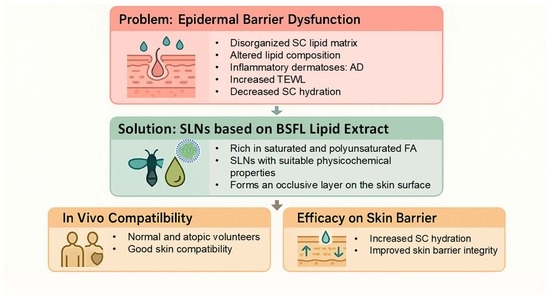
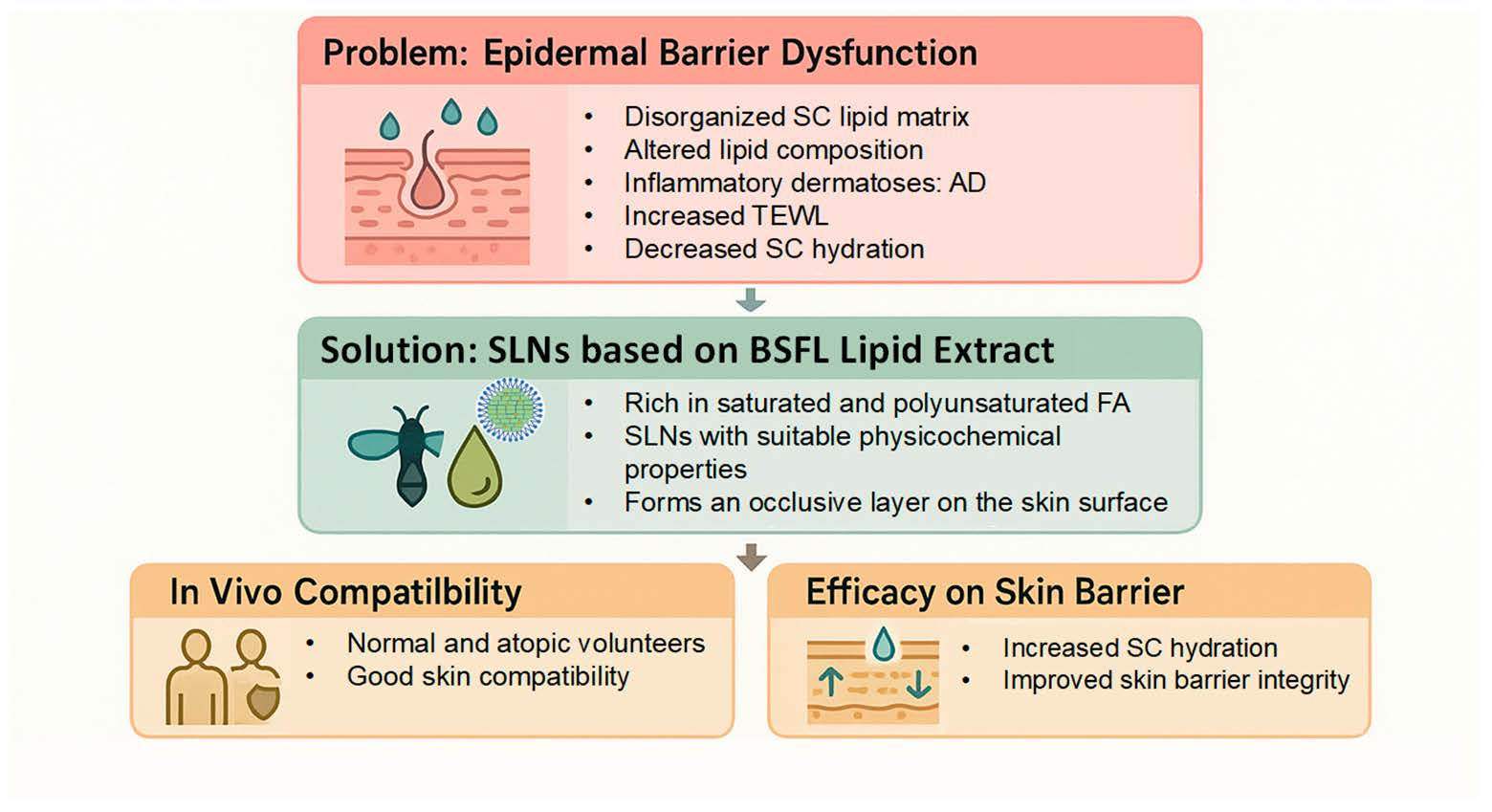
Epidermal barrier dysfunction, driven by disorganization and altered composition of the stratum corneum (SC) lipid matrix, underlies multiple inflammatory dermatoses, namely atopic dermatitis (AD). The lipid fraction derived from Black Soldier Fly larvae (BSFL) biomass has emerged as a promising biomaterial for skin health applications, particularly for restoring barrier function. Following previous work on the development of solid lipid nanoparticles (SLNs) incorporating BSFL lipid extract, the present study focused on the mechanistic evaluation of the occlusive, moisturizing and skin reinforcement potential of these nanoformulations (NFs), by exploring both in vitro and in vivo models. The compatibility assays showed no adverse effects after patch testing on healthy or atopic individuals, nor alterations on skin hydration, transepidermal water loss (TEWL), or redness. In vitro studies confirmed the ability of these NFs to form an occlusive lipid film, hampering moisture loss, with 39% reduction of water loss compared to the control. Efficacy assays in human volunteers revealed a statistically significant improvement in epidermal conditions at treated sites, evidenced by enhanced SC hydration. The plastic occlusion stress test (POST) revealed a trend toward a reduced evaporation half-life, suggesting a modulation of the epidermal water dynamics, although the effect did not reach statistical significance. Overall, BSFL-based lipid nanoparticles emerge as emollient agents with broad potential for incorporation into next-generation cosmetic and pharmaceutical products for the management of AD.

Graphical Abstract

1. Introduction

The skin constitutes the primary interface between the human body and the exposome, providing essential protection against microbial invasion, chemical exposure, and physical damage. The effectiveness of this protective barrier function largely depends on the integrity of the stratum corneum (SC), the outermost layer of the epidermis. The SC is organized as corneocytes immersed in a highly structured lipid matrix that plays a crucial role in maintaining skin hydration, as well as limiting xenobiotics intake and transepidermal water loss (TEWL) [1]. Preservation and restoration of this barrier are central objectives in both dermatological therapy and cosmetic skin care.
An impairment of the cutaneous barrier is a key pathogenic factor in several dermatological conditions, including inflammatory and chronic disorders [2]. Skin diseases, in particular, atopic dermatitis (AD), are strongly linked to SC lipid barrier dysfunction and, consequently, increased TEWL [1]. In addition to altered ceramides content, atopic individuals also exhibit modifications in SC fatty acid (FA) profiles, including reduced levels of long-chain FAs and increased proportions of shorter-chain FAs such as palmitic and stearic acids [3]. These alterations contribute to an increased susceptibility to irritants and allergens, clinically manifesting as persistent inflammation, dryness, erythema, and pruritus [4,5]. Consequently, innovative cosmetic and dermatological formulation strategies increasingly focus on restoring lipid balance and reinforcing barrier function as a complementary approach to conventional pharmacological treatments for AD.
Advances in biotechnology and sustainable resource valorization have facilitated the identification of novel biomaterials with potential applications in skin care and dermatology. One promising example is the lipid fraction derived from the biomass of Hermetia illucens (Black Soldier Fly Larvae, BSFL) [6,7]. This insect performs the bioconversion of food and agricultural industry waste and contains a distinctive profile of mono- and polyunsaturated FAs, including lauric (C12:0), myristic (C14:0), palmitic (C16:0), and oleic (C18:1) acids, which are recognized for their role in supporting skin barrier structure and function [8]. Beyond their emollient and occlusive effects, FAs have been associated with barrier reinforcement and modulation of cutaneous homeostasis [9,10], properties that are particularly relevant in barrier-impaired conditions such as AD [11]. Unlike non-physiological lipids commonly used in conventional emollient formulations, selected FAs can integrate into the endogenous lipid matrix of the SC and stratum granulosum [12]. For instance, Berkers et al. [13] showed that topically applied FA blends were able to intercalate into and promote regeneration of the lipid matrix in compromised skin [13]. The application of BSFL lipid extracts thus represents a sustainable and innovative raw material with promising applications in cosmetic and dermatological formulations aimed at improving skin barrier function.
Nanotechnology has expanded the possibilities for developing advanced topical delivery systems for drugs and bioactive compounds in both dermatology and cosmetic science. Lipid-based nanocarriers, such as solid lipid nanoparticles (SLNs), have shown significant potential in enhancing the stability, controlled release, and cutaneous deposition of bioactive compounds [14,15]. SLNs are submicron-sized particles composed of lipids that remain solid at room and body temperatures, offering high biocompatibility and the capacity to incorporate both hydrophilic and lipophilic substances [1,16]. In the context of AD, these systems may enable targeted drug/bioactives epidermal delivery and enhance local bioavailability, while limiting systemic exposure. However, SLNs may provide a complementary benefit by reinforcing the skin barrier through the delivery of physiological lipids and the formation of an occlusive surface film.
Despite the growing interest in lipid-based nanocarriers, comprehensive evaluations of nanoparticle performance in dermatological and cosmetic applications, particularly in atopic skin, remain limited. Thorough physicochemical characterization is essential, as nanoparticle properties critically influence their interaction with biological barriers and skin cells. Safety assessment typically involves complementary methodologies, including in vitro cytotoxicity assays and clinical patch testing to evaluate irritation and sensitization potential [16,17]. Conversely, efficacy assessment requires an integrated experimental approach: while in vitro models provide valuable preliminary insights into barrier interactions and occlusive properties, in vivo studies are indispensable to confirm performance under physiologically relevant and real-use conditions.
Building on previous work by Almeida et al. [18], the present study further investigates nanoformulations (NFs) incorporating BSFL lipid extract, aiming to validate the integration of this biomaterial with nanotechnology for skin applications. These NFs were designed to improve daily management options for patients with AD by combining conventional bioactive loading and delivery with epidermal moisturization and barrier support. Thus, the current work aims to provide mechanistic insights into the effects of the BSFL lipid blend on skin barrier function, specifically targeting compatibility, SC hydration, and water dynamics. Bioengineering-based in vivo methodologies were employed in both healthy and atopic volunteers. Additionally, an in vitro occlusion model was established to further characterize formulation performance and support their potential as innovative barrier-oriented strategies in the management of AD.

2. Materials and Methods

2.1. Materials

Black Soldier Fly larvae (BSFL) were kindly provided by Entogreen® (Ingredient Odyssey, S.A., Santarém, Portugal). Lipid extraction from the larval biomass was performed by maceration using acetone as the organic solvent, following the method described by Almeida et al. [8]. Acetone and Tween® 80 were purchased from Sigma-Aldrich (Saint Louis, MO, USA).

2.2. Nanoparticle Production and Characterization

NFs were prepared by hot homogenization followed by ultrasonication as described in Almeida et al. [18]. Briefly, SLNs were produced by homogenizing the lipid phase, composed of BSFL lipid extract (5% w/v) and Tween® 80 (3.25% w/v), with distilled water heated at 50 °C. No drug or bioactive was incorporated. Ultrasonication (5 min, 70% amplitude) was then applied to reduce and uniformize nanoparticle size. The characterization consisted of the evaluation of particle size (PS), polydispersity index (PDI), zeta potential (ZP), and pH, as described elsewhere [18].

2.3. In Vitro Occlusive Effect

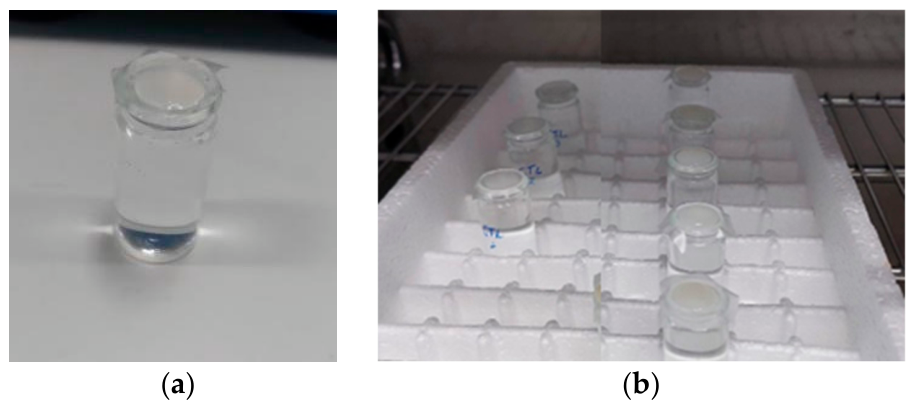
The occlusive potential of NFs was evaluated using an in vitro occlusion test probing the impact on mass water loss (MWL) adapted from Elmowafy et al. [19]. A defined volume (5 mL) of distilled water was placed in vials sealed with a polydimethylsiloxane (PDMS) membrane (Liveo™ 7-4107 Silicone Elastomer Membrane, DuPontTM, Braine-l’Alleud, Belgium). On the membrane surface, 150 µL of NFs were applied in the treated vials, whereas the same amount of distilled water was applied in the control. The vials were incubated at 32 °C (skin surface temperature) for 24 h, as shown in Figure 1. Water loss was determined gravimetrically, and experiments were performed in quintuplicate. The percentage of MWL was calculated as:
%   MWL   =   ( i n i t i a l   m a s s   o f   v i a l f i n a l   m a s s   o f   v i a l ) i n i t i a l   m a s s   o f   v i a l × 100

2.4. In Vivo Studies: Safety and Efficacy Assessment

Safety and efficacy studies were based on the evaluation of the cutaneous response upon application of the NFs. The in vivo tests were conducted on healthy and atopic human volunteers. The atopic group included people with a tendency towards sensitive skin or the development of other allergic disorders, such as allergic rhinitis and asthma. The study was approved by the Ethics Committee of the School of Health Sciences and Technologies of the Universidade Lusófona and fully complied with the principles of the Declaration of Helsinki (protocol code CE.ECTS/P01-22). All volunteers were informed of the study objectives and agreed participation upon completion of a written consent form.

2.4.1. Safety Assessment

Sixteen healthy human volunteers of both genders participated in the skin compatibility tests, with an age range from 21 to 55 years (mean age 29 ± 9 years). An additional group of atopic participants (n = 10, mean age 34 ± 13 years) was also evaluated.
The skin compatibility was tested by applying an occlusive patch using Finn Chambers® on Scanpor adhesive tape (Epitest Ltd. Oy, Tuusula, Finland) on the upper back of the volunteers for 24 h. One chamber of the patch contained the NFs, and distilled water was used as a negative control. A visual scoring was conducted after removal of the occlusive patch with the aim of evaluating possible reactions. The scoring was performed by a qualified researcher to avoid biases in the results.
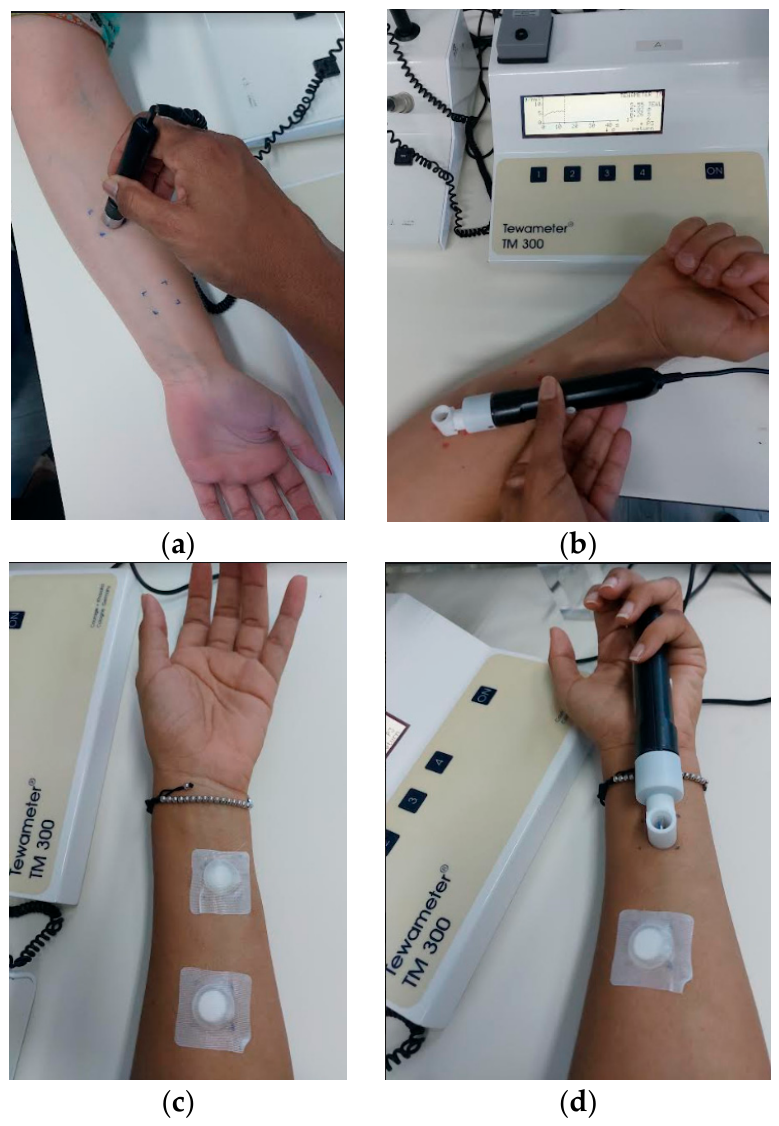
To verify the skin compatibility of the NFs under “in-use” conditions, an open application protocol was carried out on two predefined areas (4 cm2) on the volar forearms of both healthy and atopic volunteers, as shown in Figure 2. One area was reserved for control (untreated), whereas 2.5 µL/cm2 of the NFs were applied once to the remaining site following a randomization scheme (left/right, upper/lower forearm). The basal values for the skin color, hydration, and TEWL were determined on the first day of the study and repeated 24 h after application of the NFs. Standardized bioengineering equipment was used, namely the Chromameter® CR-300 (Minolta, Osaka, Japan), Tewameter® TM300, and Corneometer® CM825 (Courage Khazaka, Cologne, Germany), for measuring the skin redness (a* values under the L* a* b* system), TEWL, and skin hydration (in triplicate), respectively.

2.4.2. Efficacy Assessment

The efficacy of the NFs was evaluated from measurements of skin hydration and TEWL in healthy participants, as well as by the plastic occlusion stress test (POST). A similar randomized application protocol to that described above was adopted. An amount of 2.5 µL/cm2 of NFs was applied twice daily for seven days. Measurements of hydration and TEWL were performed at the beginning of the study (basal) and 48 h, 72 h, and 144 h after treatment. The measurements were performed in triplicate using the same equipment described above (Figure 2).
After one week of NF application according to the protocol described above, a plastic occlusion stress test (POST) was also conducted. This method induces water accumulation under a plastic film, allowing assessment of the skin’s water retention capacity and providing insights into the barrier function [20].
The POST was comprised of a 24 h occlusive patch application on NFs and control sites, followed by TEWL measurements starting immediately after patch removal (Figure 2) and recorded for 30 min—every 10 s for the first minute, every minute thereafter. The data obtained from the POST were transformed into quantitative parameters by a bicompartmental model adjusted to TEWL data sets, described by Equation (2) [20]. Dynamic water mass (DWM) was calculated from the area under the curve of TEWL decays of untreated and NF-treated areas. The evaporation half-life (t1/2evap) was calculated from Kevap parameter, as detailed in Equation (3), which represents the evaporation process to the exterior, being a measure of the time needed by the skin to reduce its water loss to half of the basal value [20].
T E W L = B + I ( e K e v a p × t e k h y d r × t )
t 1 / 2 e v a p = L n ( 2 ) K e v a p
B—baseline effect, I—multiplicative parameter common to both exponential terms, Kevap—evaporation rate constant, and Khydr—hydration rate constant associated with water distribution across the two compartments.

2.5. Statistical Analysis

The statistical analysis of the data obtained was conducted using GraphPad Prism® (GraphPad Software Inc., San Diego, CA, USA). For the in vivo study comparing treated and control sites, statistical differences were evaluated using the Wilcoxon signed-rank test for paired data. The results were considered statistically significant when p-values were <0.05. Data relating to POST were analyzed with Origin Pro® 8.5 (OriginLab Corporation, Northampton, MA, USA), for interpolation and fitting of TEWL data to Equation (2) and determination of the area under the curve as a function of measurement time.

3. Results

Building on our previous work that optimized the physicochemical properties of SLNs formulated using BSFL lipid extract for topical application and probed their cytocompatibility in vitro using the MTT assay [18], the present study advances the safety and efficacy characterization of these systems. The earlier optimized NFs exhibited a particle size of approximately 180 nm, a polydispersity index around 0.25, a zeta potential below –35 mV, a pH close to 5.5, and good keratinocyte compatibility [18]. The results presented here further expand on these findings by providing additional insights into the NFs’ occlusive properties and their effects on skin biocompatibility, hydration, and barrier function, assessed in both healthy and atopic individuals.

3.1. In Vitro Occlusive Effect

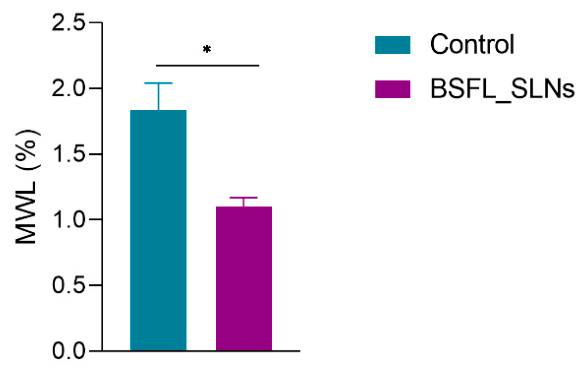
The occlusive effect of NFs, expressed as percentage of mass of water loss (MWL), is illustrated in Figure 3. SLNs have significantly increased the occlusive effect compared with the control. This difference can be related to the formation of a lipid film on the silicone membrane, which likely reduces water loss due to the presence of the lipid matrix of NFs.

3.2. Safety Assessment

The preliminary in vivo safety assay was performed using an occlusive application procedure to probe compatibility under exaggerated exposure (Patch Test). No signs of irritation were revealed following single patch application in both healthy and atopic volunteers.
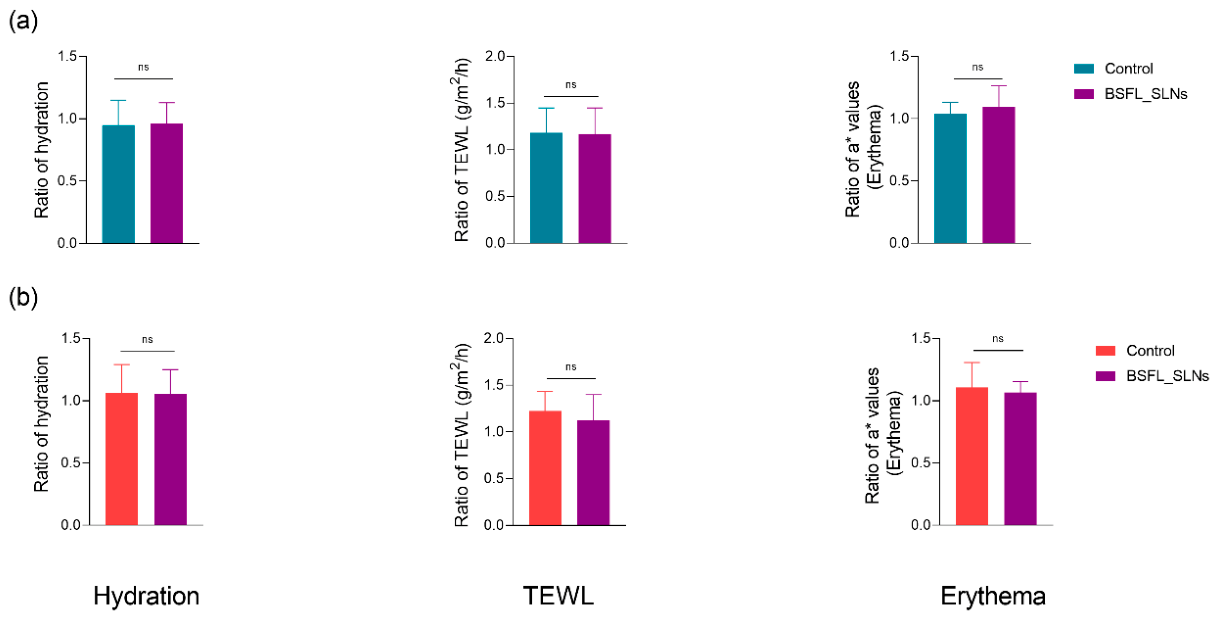
The results of the skin compatibility assessment using an open application protocol replicating “in use” conditions are presented in Figure 4. To reduce the impact of inter-individual variability, data were normalized by calculating the ratio between the values obtained after 24 h of application and their corresponding baseline measurements.
The results indicated that the application of the NFs produced no detectable changes in SC hydration, TEWL, or skin redness in healthy or atopic volunteers, since the ratios were all close to 1. Furthermore, no statistically significant differences were observed between the NF-treated sites and the untreated control areas. These data suggest that these NFs are well tolerated by atopic individuals, despite their compromised SC.

3.3. Efficacy Assessment

In the in vivo study evaluating the efficacy of the NFs, a repeated open application protocol was implemented in healthy volunteers. To minimize inter-individual variability, the data were normalized prior to statistical analysis, calculating the ratio between the values obtained in each time point and their corresponding baseline measurements.
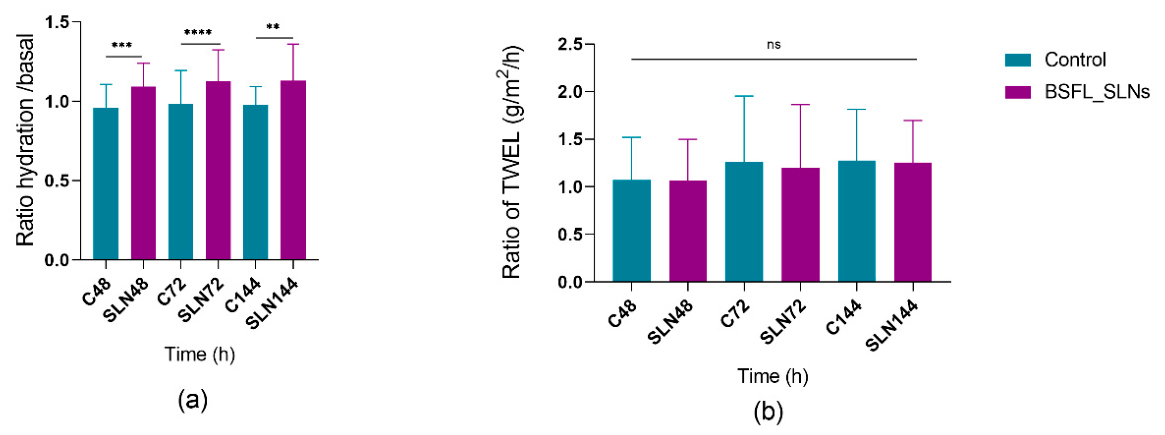
The results indicated a statistically significant increase in hydration throughout the application period in the sites treated with the NFs, as illustrated in Figure 5. Regarding TEWL, slightly lower values were observed in the treated sites; however, this difference was not statistically significant, and the overall ratios were close to 1.

3.4. Plastic Occlusive Stress Test

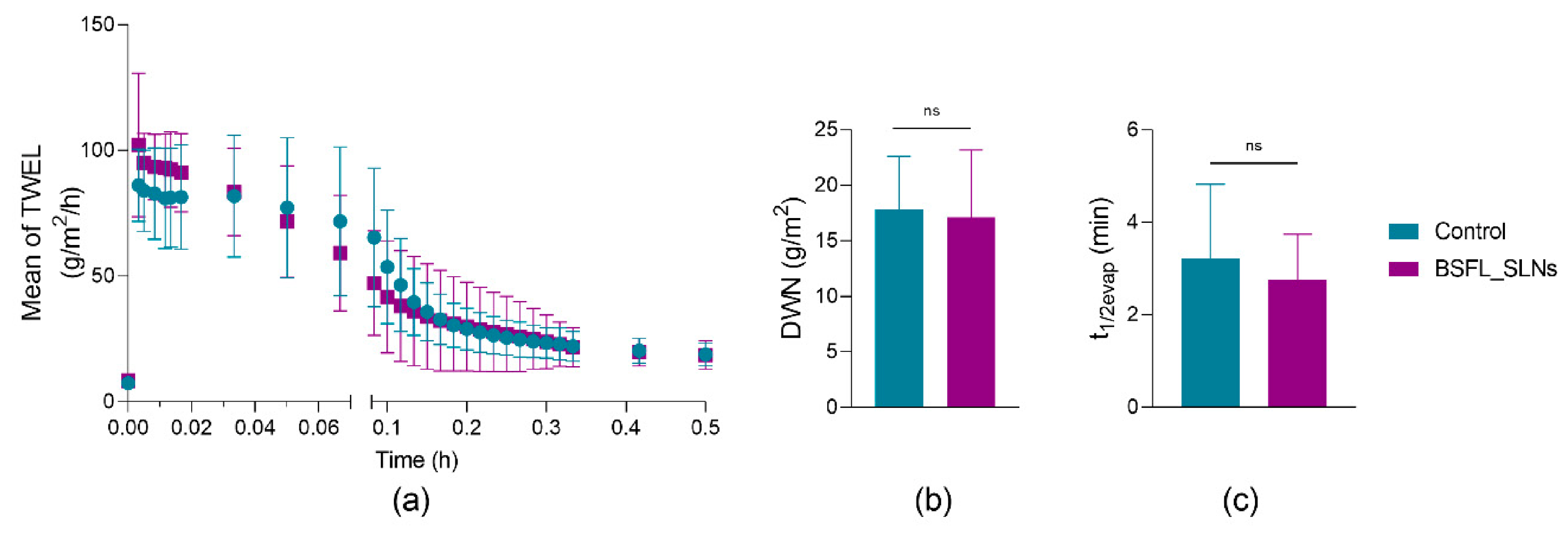
To further evaluate the NFs’ effect on barrier properties, the POST was employed. The average TEWL decays obtained in the POST are presented in Figure 6a, further enabling the assessment of the NFs’ impact on the SC water dynamics through the determination of t1/2evap and DWM. The DWM analysis showed no significant differences between the treated and control sites (Figure 6b). However, despite no statistical difference, the application of NFs led to a slight reduction in t1/2evap, which may be indicative of reinforcement of the skin barrier, as illustrated in Figure 6c.

4. Discussion

Maintaining adequate skin integrity is fundamental not only for preserving physiological function but also for ensuring a healthy and resilient skin appearance, which is a central objective in both dermatology and cosmetic science. Optimal hydration of the SC is critical to sustaining barrier cohesion, improving elasticity, and limiting TEWL. Reinforcing the epidermal barrier enhances the skin’s defense against environmental stressors, irritants, and microbial colonization. In AD, where barrier dysfunction and xerosis are hallmark features, formulation strategies that promote and maintain epidermal function and hydration represent an essential complementary approach to support barrier restoration and long-term skin homeostasis.
Topical therapy is known to be the cornerstone of AD treatment. This approach presents the challenge of developing a formulation that can cross the skin barrier, being at the same time safe and effective. The literature encompasses reviews and original papers focused on advanced delivery systems for the topical management of AD, such as nanoemulsions, liposomes, ethosomes, transferosomes, SLNs, and nanostructured lipid carriers (NLCs), among others [16,18,21,22]. These studies are mainly addressing the ability of nanostructures to promote controlled drug release profiles, in addition to fostering skin retention at the desired site of action. However, the safety of NFs remains poorly studied, especially in atopic skin, hindering the development of marketable products [16].
The development of lipid nanoparticles derived from insect biomass represents a promising approach to obtaining novel raw materials for nanodelivery systems. Previous work from our group demonstrated that NFs produced using BSFL-derived lipid extracts exhibit suitable physicochemical properties, including appropriate particle size, PDI, ZP, and pH values, as well as satisfactory storage stability and keratinocyte compatibility [18]. These characteristics supported further investigation of such NFs, particularly their intrinsic capacity to reinforce the skin barrier via their lipid composition, and to evaluate their safety and efficacy in both healthy and atopic volunteers, as detailed herein.
Assessment of the NFs in the in vitro occlusive assays resulted in an approximate 39% reduction in MWL compared to the control. Similarly, other in vitro occlusion studies, such as those conducted by Elmowafy et al. [19] using filter paper, reported satisfactory results with NLCs effectively reducing water loss. PDMS membranes are used in permeation studies as a simplified model of the SC, thus the observed reduction in water loss can be related to occlusive properties of the NFs, which promote the formation of a lipid film on the membrane surface, thereby limiting water evaporation [23]. In this context, the results obtained in this assay likely foresee a contribution to enhanced skin hydration and barrier function.
Favorable results were also obtained in the preliminary in vivo assays testing compatibility under exaggerated conditions. After the patch test, no redness or other skin alterations were observed in the tested areas with NFs, and neither healthy volunteers nor atopic volunteers reported any discomfort. Moreover, under in-use conditions in healthy volunteers, skin compatibility testing showed that NF-treated areas did not differ from untreated control areas in hydration or TEWL, indicating no barrier impairment. Additionally, no visible changes in skin color were detected, suggesting the absence of irritation or redness. A similar trend was observed in the group of atopic volunteers. These findings are aligned with previous reports demonstrating in vitro the compatibility with cutaneous cell lines of both BSFL lipid extract and corresponding nanosystems [18,24].
A modest reduction in TEWL was noted at sites treated with the NFs compared to untreated areas. These findings are in agreement with those observed in the in vitro occlusion test and, since statistical differences were not reached, may indicate a mild improvement following a single application, being more noticeable in the atopic volunteers possibly due to their inherent structural alterations in the SC [17,25,26]. The dysfunction of the skin barrier is associated with dryness, inflammation, scratching, and increased TEWL that characterize atopic skin [17,27]. Although the observed effects were not statistically significant, the subtle reduction in TEWL values after a single application supports the fact that atopic skin, being more prone to barrier dysfunction and water loss [26,27], may respond more noticeably to formulations containing lipid components that enhance hydration and film formation. Consequently, the BSFL lipid extract may serve as a beneficial excipient for reinforcing the skin barrier in atopic individuals.
In the efficacy assessment of the NFs, an overall improvement in skin condition was observed. After 48 h of application, treated areas already exhibited higher hydration levels compared with untreated controls, and this effect was maintained up to 144 h. This increase may be attributed to the lipid composition of NFs–BSFL lipid extract, which contains saturated FAs—lauric (37%), palmitic (14%), and myristic (7%) acids—and polyunsaturated FAs, including the essential FAs omega-3 linoleic (18%) and omega-6 α-linolenic (2%) acids [8]. The latter are known to trigger the enzymatic cascade responsible for producing long-chain FAs [11], and reduced levels of these lipids can disrupt the epidermal lipid matrix, impairing barrier function as observed in atopic patients [28]. On the other hand, the saturated FAs in the BSFL lipid blend, which is solid at room temperature, seem to contribute to the formation of a lipidic film at the skin surface, promoting moisture retention within the SC [7,29]. Similar behavior has been observed in NFs containing solid lipids such as stearic acid, Precirol®, or Compritol® [30,31].
As previously reported, lipid-based NFs are capable of reducing skin water loss [16], an effect attributed to the emollient properties of their lipid components. Interestingly, Sarhadi et al. [30] reported that the application of SLNs onto the skin leads to the formation of a thin film layer, with its surface coverage influenced by particle size. If the particles are smaller, narrower air channels are created within this layer, thereby reducing the hydrodynamic evaporation of water and consequently increasing the skin’s moisture content [21,30,32]. In our study, TEWL values remained relatively stable over time, suggesting that the formulation primarily improved hydration by a transient occlusive effect rather than structural restoration of the skin barrier. Considering interindividual variability, it is possible that a one-week application of the NFs may not have been sufficient to produce significant reductions in TEWL among volunteers with normal skin, whose barrier integrity is not compromised. Additionally, despite TEWL being traditionally considered an indicator of skin barrier function, it has recognized limitations and several studies have reported only minimal changes in this skin property even after intentional skin damage [33,34,35].
Under this context, the POST can represent a useful in vivo model to study the skin barrier function through the dynamic of skin water loss [33]. The method is based on the evaluation of the water retention capacity of the SC and its ability to recover after stress caused by prolonged occlusion. Analysis of the decay curves revealed that, during the initial minutes, the lipids in the NFs appeared to enhance water retention within the SC, as reflected in the higher TEWL values. Regarding the data from the kinetic parameters, despite no statistically significant differences, the NFs caused a slight decrease in t1/2evap, which may be indicative of alterations in the epidermal water dynamics. This parameter reflects the time required to recover basal TEWL values after water accumulation in the SC induced by occlusion [20], thus lower t1/2evap represents an improved capacity to retain water that would otherwise be released through the epidermal barrier. The interaction between NFs and the SC likely involves surface film formation and partial integration with intercellular lipids, enhancing water retention primarily through physical mechanisms. Overall, these findings suggest that the NFs play a role in improving the hydric capacity of the SC. Given the substantial impact of interpersonal variability and the low number of volunteers in the analysis of in vivo data, future studies will be conducted in larger panels and also with atopic individuals, which may allow more pronounced differences to be observed.
Recent studies have highlighted the potential of H. illucens larval biomass as a source of emollient ingredients [36,37]. Building on this evidence, the present work supports the use of BSFL lipid extracts for pharmaceutical and cosmetic applications.

5. Conclusions

This study supports the use of BSFL lipid extract as a sustainable, functional excipient for NFs. These NFs exhibited occlusive behavior in vitro, consistent with the formation of a lipid film capable of limiting moisture loss. In vivo, both exaggerated and in-use compatibility assessments in healthy and atopic volunteers indicated good tolerability, with no signs of irritation and no impairment of hydration or TEWL compared with untreated control areas. Efficacy data further showed sustained increases in SC hydration after application, while TEWL remained largely unchanged, suggesting a primary moisturizing effect within the study period. Water-dynamics analysis after prolonged occlusion provided additional mechanistic support for improved water retention and a trend towards a transient occlusive effect. Overall, BSFL-derived lipid NFs appear to be a promising barrier-oriented strategy for supporting daily management of AD. Future studies with larger cohorts, longer application periods, comparison with benchmark products, and disease-focused endpoints are warranted to confirm clinical relevance and better capture changes in barrier function.

Author Contributions

Conceptualization, C.A., C.P.-L. and C.R.; investigation, C.A., M.G., C.S., C.T. and A.J.; formal analysis, C.A., M.G., C.S. and T.C.; writing—original draft preparation, C.A.; visualization, C.A.; writing—review and editing, T.C., C.P.-L. and C.R.; supervision, C.P.-L. and C.R.; funding acquisition, C.P.-L. and C.R. All authors have read and agreed to the published version of the manuscript.

Funding

This research was funded by FCT-Foundation for Science and Technology, I.P., [DOI https://doi.org/10.54499/EXPL/BTM-MAT/0112/2021 and DOI https://doi.org/10.54499/UID/04567/2025], as well as for the research grant attributed to C.A. [https://doi.org/10.54499/UI/BD/151423/2021].

Institutional Review Board Statement

The study was conducted in accordance with the Declaration of Helsinki and approved by the Ethics Committee of the School of Health Sciences and Technologies of the Universidade Lusófona (protocol code CE.ECTS/P01-22 and date of approval 16 November 2022).

Informed Consent Statement

Informed consent was obtained from all subjects involved in the study.

Data Availability Statement

The original contributions presented in this study are included in the article. Further inquiries can be directed to the corresponding authors.

Acknowledgments

The authors thank EntoGreen® (Ingredient Odyssey, S.A., Portugal) company for kindly providing the Black Soldier Fly larvae used in this study and DuPontTM (Belgium) for kindly supplying Liveo™ 7-4107 Silicone Elastomer Membrane for occlusion studies.

Conflicts of Interest

The authors declare that they have no known competing financial interests or personal relationships that could have appeared to influence the work reported in this paper.

References

  1. Almeida, C.; Filipe, P.; Rosado, C.; Pereira-Leite, C. Nanodelivery Strategies for Skin Diseases with Barrier Impairment: Focusing on Ceramides and Glucocorticoids. Nanomaterials 2022, 12, 275. [Google Scholar] [CrossRef]
  2. Schmuth, M.; Eckmann, S.; Moosbrugger-Martinz, V.; Ortner-Tobider, D.; Blunder, S.; Trafoier, T.; Gruber, R.; Elias, P.M. Skin Barrier in Atopic Dermatitis. J. Investig. Dermatol. 2024, 144, 989–1000. [Google Scholar] [CrossRef] [PubMed]
  3. Mijaljica, D.; Townley, J.P.; Spada, F.; Harrison, I.P. The heterogeneity and complexity of skin surface lipids in human skin health and disease. Prog. Lipid Res. 2024, 93, 101264. [Google Scholar] [CrossRef]
  4. Fujii, M. The Pathogenic and Therapeutic Implications of Ceramide Abnormalities in Atopic Dermatitis. Cells 2021, 10, 2386. [Google Scholar] [CrossRef]
  5. Andrew, P.V.; Williams, S.F.; Brown, K.; Chittock, J.; Pinnock, A.; Poyner, A.; Cork, M.J.; Danby, S.G. Topical supplementation with physiological lipids rebalances the stratum corneum ceramide profile and strengthens skin barrier function in adults predisposed to atopic dermatitis. Br. J. Dermatol. 2025, 193, 729–740. [Google Scholar] [CrossRef]
  6. Lai-Foenander, A.S.; Kuppusamy, G.; Manogoran, J.; Xu, T.; Chen, Y.; Tang, S.Y.; Ser, H.L.; Yow, Y.Y.; Goh, K.W.; Ming, L.C.; et al. Black soldier fly (Hermetia illucens L.): A potential small mighty giant in the field of cosmeceuticals. Health Sci. Rep. 2024, 7, e2120. [Google Scholar] [CrossRef]
  7. Almeida, C.; Rijo, P.; Rosado, C. Bioactive Compounds from Hermetia illucens Larvae as Natural Ingredients for Cosmetic Application. Biomolecules 2020, 10, 976. [Google Scholar] [CrossRef]
  8. Almeida, C.; Murta, D.; Nunes, R.; Baby, A.R.; Fernandes, Â.; Barros, L.; Rijo, P.; Rosado, C. Characterization of lipid extracts from the Hermetia illucens larvae and their bioactivities for potential use as pharmaceutical and cosmetic ingredients. Heliyon 2022, 8, e09455. [Google Scholar] [CrossRef]
  9. Proksch, E.; Berardesca, E.; Misery, L.; Engblom, J.; Bouwstra, J. Dry skin management: Practical approach in light of latest research on skin structure and function. J. Dermatol. Treat. 2020, 31, 716–722. [Google Scholar] [CrossRef] [PubMed]
  10. Vaughn, A.R.; Clark, A.K.; Sivamani, R.K.; Shi, V.Y. Natural Oils for Skin-Barrier Repair: Ancient Compounds Now Backed by Modern Science. Am. J. Clin. Dermatol. 2018, 19, 103–117. [Google Scholar] [CrossRef] [PubMed]
  11. Olejnik, A.; Gornowicz-Porowska, J.; Jenerowicz, D.; Polańska, A.; Dobrzyńska, M.; Przysławski, J.; Sansone, A.; Ferreri, C. Fatty Acids Profile and the Relevance of Membranes as the Target of Nutrition-Based Strategies in Atopic Dermatitis: A Narrative Review. Nutrients 2023, 15, 3857. [Google Scholar] [CrossRef] [PubMed]
  12. Mao, M.M.; Feingold, K.R.; Thornfeldt, C.R.; Elias, P.M. Optimization of physiological lipid mixtures for barrier repair. J. Investig. Dermatol. 1996, 106, 1096–1101. [Google Scholar] [CrossRef]
  13. Berkers, T.; van Dijk, L.; Absalah, S.; van Smeden, J.; Bouwstra, J.A. Topically applied fatty acids are elongated before incorporation in the stratum corneum lipid matrix in compromised skin. Exp. Dermatol. 2017, 26, 36–43. [Google Scholar] [CrossRef] [PubMed]
  14. Eroğlu, C.; Sinani, G.; Ulker, Z. Current State of Lipid Nanoparticles (SLN and NLC) for Skin Applications. Curr. Pharm. Des. 2023, 29, 1632–1644. [Google Scholar] [CrossRef] [PubMed]
  15. Borkar, S.P.; Pawar, S.; Mohite, S. Solid Lipid Nanoparticles and Nanostructured Lipid Carriers: A Review on Their Role in Targeted Drug Delivery Systems. J. Pharm. Res. Integr. Med. Sci. 2025, 2, 117–132. [Google Scholar] [CrossRef]
  16. Cláudia Paiva-Santos, A.; Gama, M.; Peixoto, D.; Sousa-Oliveira, I.; Ferreira-Faria, I.; Zeinali, M.; Abbaspour-Ravasjani, S.; Mascarenhas-Melo, F.; Hamishehkar, H.; Veiga, F. Nanocarrier-based dermopharmaceutical formulations for the topical management of atopic dermatitis. Int. J. Pharm. 2022, 618, 121656. [Google Scholar] [CrossRef]
  17. Elahi, N.; Astaneh, M.E.; Ai, J.; Rizwan, M. Atopic dermatitis treatment: A comprehensive review of conventional and novel bioengineered approaches. Int. J. Biol. Macromol. 2024, 282, 137083. [Google Scholar] [CrossRef]
  18. Almeida, C.; Roque, R.; Vieira, J.; Júlio, A.; Saraiva, N.; Pereira-Leite, C.; Rosado, C. Lipid extract from Black Soldier Fly larvae: A high value excipient for solid lipid nanoparticles tailored to tackle atopic dermatitis. Int. J. Pharm. 2024, 667, 124929. [Google Scholar] [CrossRef]
  19. Elmowafy, M.; Shalaby, K.; Ali, H.M.; Alruwaili, N.K.; Salama, A.; Ibrahim, M.F.; Akl, M.A.; Ahmed, T.A. Impact of nanostructured lipid carriers on dapsone delivery to the skin: In vitro and in vivo studies. Int. J. Pharm. 2019, 572, 118781. [Google Scholar] [CrossRef]
  20. Rodrigues, L.; Pinto, P.; Galego, N.; Da Silva, P.A.; Pereira, L.M. Transepidermal water loss kinetic modeling approach for the parameterization of skin water dynamics. Skin Res. Technol. 1999, 5, 72–82. [Google Scholar] [CrossRef]
  21. Lopes, M.M.d.S.; Sehn, L.D.; Zimmermann, R.; Teixeira, H.F.; Matte, U.; Schuh, R.S.; Fachel, F.N.S. An overview of the potentialities and recent advances in nanotechnology-based systems for glucocorticoids delivery. J. Drug Deliv. Sci. Technol. 2026, 115, 107659. [Google Scholar] [CrossRef]
  22. Kumar, P.; Ashawat, M.S.; Pandit, V.; Singh Verma, C.P.; Ankalgi, A.D.; Kumar, M. Recent Trends in Nanocarriers for the Management of Atopic Dermatitis. Pharm. Nanotechnol. 2023, 11, 397–409. [Google Scholar] [CrossRef]
  23. Souto, E.B.; Fangueiro, J.F.; Fernandes, A.R.; Cano, A.; Sanchez-Lopez, E.; Garcia, M.L.; Severino, P.; Paganelli, M.O.; Chaud, M.V.; Silva, A.M. Physicochemical and biopharmaceutical aspects influencing skin permeation and role of SLN and NLC for skin drug delivery. Heliyon 2022, 8, e08938. [Google Scholar] [CrossRef]
  24. Phongpradist, R.; Semmarath, W.; Kiattisin, K.; Jiaranaikulwanitch, J.; Chaiyana, W.; Chaichit, S.; Phimolsiripol, Y.; Dejkriengkraikul, P.; Ampasavate, C. The in vitro effects of black soldier fly larvae (Hermitia illucens) oil as a high-functional active ingredient for inhibiting hyaluronidase, anti-oxidation benefits, whitening, and UVB protection. Front. Pharmacol. 2023, 14, 1243961. [Google Scholar] [CrossRef] [PubMed]
  25. Siddique, M.I.; Katas, H.; Jamil, A.; Mohd Amin, M.C.I.; Ng, S.-F.; Zulfakar, M.H.; Nadeem, S.M. Potential treatment of atopic dermatitis: Tolerability and safety of cream containing nanoparticles loaded with hydrocortisone and hydroxytyrosol in human subjects. Drug Deliv. Transl. Res. 2019, 9, 469–481. [Google Scholar] [CrossRef]
  26. Kim, B.E.; Leung, D.Y.M. Significance of Skin Barrier Dysfunction in Atopic Dermatitis. Allergy Asthma Immunol. Res. 2018, 10, 207–215. [Google Scholar] [CrossRef] [PubMed]
  27. Yoshida, T.; Beck, L.A.; De Benedetto, A. Skin barrier defects in atopic dermatitis: From old idea to new opportunity. Allergol. Int. 2022, 71, 3–13. [Google Scholar] [CrossRef]
  28. van Smeden, J.; Janssens, M.; Kaye, E.C.J.; Caspers, P.J.; Lavrijsen, A.P.; Vreeken, R.J.; Bouwstra, J.A. The importance of free fatty acid chain length for the skin barrier function in atopic eczema patients. Exp. Dermatol. 2014, 23, 45–52. [Google Scholar] [CrossRef]
  29. Fluhr, J.W.; Muguet, V.; Christen-Zaech, S. Restoring Skin Hydration and Barrier Function: Mechanistic Insights Into Basic Emollients for Xerosis Cutis. Int. J. Dermatol. 2025, 64, 5–12. [Google Scholar] [CrossRef] [PubMed]
  30. Sarhadi, S.; Gholizadeh, M.; Moghadasian, T.; Golmohammadzadeh, S. Moisturizing effects of solid lipid nanoparticles (SLN) and nanostructured lipid carriers (NLC) using deionized and magnetized water by in vivo and in vitro methods. Iran. J. Basic Med. Sci. 2020, 23, 337–343. [Google Scholar] [CrossRef]
  31. Loo, C.; Basri, M.; Ismail, R.; Lau, H.; Tejo, B.; Kanthimathi, M.; Hassan, H.; Choo, Y. Effect of compositions in nanostructured lipid carriers (NLC) on skin hydration and occlusion. Int. J. Nanomed. 2013, 8, 13–22. [Google Scholar] [CrossRef]
  32. Souto, E.B.; Wissing, S.A.; Barbosa, C.M.; Müller, R.H. Development of a controlled release formulation based on SLN and NLC for topical clotrimazole delivery. Int. J. Pharm. 2004, 278, 71–77. [Google Scholar] [CrossRef] [PubMed]
  33. Rosado, C.; Pinto, P.; Rodrigues, L.M. Modeling TEWL-desorption curves: A new practical approach for the quantitative in vivo assessment of skin barrier. Exp. Dermatol. 2005, 14, 386–390. [Google Scholar] [CrossRef]
  34. Alsamad, F.; Stamatas, G.N. Directional assessment of the skin barrier function in vivo. Skin Res. Technol. 2023, 29, e13346. [Google Scholar] [CrossRef]
  35. Seno, S.I.; Shimazu, H.; Kobayashi, H.; Kogure, E.; Watanabe, A.; Isoyama, T. Quantitative evaluation of skin barrier function using water evaporation time related to transepidermal water loss. Skin Res. Technol. 2023, 29, e13242. [Google Scholar] [CrossRef] [PubMed]
  36. Verheyen, G.R.; Ooms, T.; Vogels, L.; Vreysen, S.; Bovy, A.; Van Miert, S.; Meersman, F. Insects as an Alternative Source for the Production of Fats for Cosmetics. J. Cosmet. Sci. 2018, 69, 187–202. [Google Scholar]
  37. Franco, A.; Salvia, R.; Scieuzo, C.; Schmitt, E.; Russo, A.; Falabella, P. Lipids from Insects in Cosmetics and for Personal Care Products. Insects 2021, 13, 41. [Google Scholar] [CrossRef] [PubMed]
Figure 1. In vitro occlusion test. (a) Illustration of the membrane disposal on the vials. (b) Incubation of the vials with the samples of the SLN formulations and control at 32 °C.
Cosmetics 13 00112 g001
Figure 2. Evaluation of the efficacy of NFs in the volunteers: (a) the hydration measurement on the volar forearms using the Corneometer® equipment; (b) the measurement of TEWL by the Tewameter® equipment. POST assessment: (c) application of the occlusive plastic adhesive on the healthy volunteers’ forearms, both to the untreated site (control) and site treated with the NFs; (d) TEWL readings for 30 min at each site.
Cosmetics 13 00112 g002
Figure 3. Occlusive effect represented by percentage of mass of water loss (MWL) of water-applied (control) and NF-applied vials (mean values ± SD, n = 5). * p < 0.05, Mann–Whitney test compared to control.
Cosmetics 13 00112 g003
Figure 4. Skin compatibility of NFs concerning hydration, TEWL, and erythema. (a) Healthy volunteers (n = 16); (b) atopic volunteers (n = 10). Data are presented as mean ± SD of the ratio between the values obtained at 24 h compared to baseline values. No statistically significant differences (ns) were observed.
Cosmetics 13 00112 g004
Figure 5. Efficacy evaluation in terms of (a) hydration and (b) TEWL upon application of the NFs. The data obtained in healthy human volunteers (n = 16) are presented as mean ± SD of the ratio between the values obtained at each time point (48, 72, and 144 h) compared to baseline values. ** p < 0.05; *** p < 0.001; **** p < 0.0001 Wilcoxon test compared to control. No statistically significant differences (ns).
Cosmetics 13 00112 g005
Figure 6. Results of plastic occlusion stress test on healthy volunteers. (a) TEWL decays obtained after 24 h occlusion after the application of NFs and untreated area (Control) (mean ± SD, n = 16). The kinetic parameters calculated from TEWL decays: (b) dynamic water mass (DWM); (c) evaporation half-life (t1/2evap). No statistically significant differences (ns).
Cosmetics 13 00112 g006
Disclaimer/Publisher’s Note: The statements, opinions and data contained in all publications are solely those of the individual author(s) and contributor(s) and not of MDPI and/or the editor(s). MDPI and/or the editor(s) disclaim responsibility for any injury to people or property resulting from any ideas, methods, instructions or products referred to in the content.