1. Introduction
Solar radiation plays a fundamental role in human physiology, contributing to cutaneous vitamin D synthesis and promoting β-endorphin expression, thereby influencing overall well-being. Nevertheless, excessive exposure to ultraviolet (UV) radiation is associated with acute and chronic skin damage, including erythema, hyperpigmentation, photoaging, and types of skin cancer [
1]. The International Agency for Research on Cancer (IARC) has classified UV radiation within the 100–400 nm spectrum as a Group 1 carcinogen [
2]. At the cellular level, absorption of UV photons by endogenous chromophores—particularly DNA—induces molecular excitation and instability. This may result in direct DNA damage or indirect oxidative injury mediated by reactive oxygen species [
3].
Multiple preventive strategies are employed to reduce UV-induced skin damage, including physical protection through clothing and the use of systemic agents intended to enhance cutaneous resistance. However, topical sunscreens remain the primary option for photoprotection [
4]. These are multi-component formulations containing at least one UV filter—often a combination of several—together with auxiliary ingredients such as surfactants, preservatives, and stabilizers [
5].
According to Regulation (EC) No 1223/2009 of the European Parliament and of the Council, UV filters are substances intended exclusively or mainly to protect the skin against certain UV radiation by absorbing, reflecting, or scattering it. Currently, 34 UV filters are authorized for use in cosmetic products within the European Union, comprising 29 unique substances, five of which are also approved in nano form [
6]. UV filters are broadly categorized as organic or inorganic. Although organic filters are often termed “chemical” and inorganic filters “physical,” such terminology is considered misleading, as all filters are chemical substances [
5].
Organic UV filters function predominantly by absorbing UV radiation and dissipating the absorbed energy as heat [
4]. Their properties are determined by the molecular chromophore, typically comprising an aromatic ring linked directly or via a carbon–carbon double bond to a carbonyl group, forming conjugated π-electron systems [
5]. Inorganic filters—titanium dioxide and zinc oxide—exhibit particle-size-dependent behavior. Micronized particles reflect, scatter, and absorb UV radiation; both compounds provide broad-spectrum protection, with titanium dioxide being particularly effective in the UVB range and zinc oxide demonstrating substantial UVA coverage [
7,
8]. Because micro-sized oxides can impart a whitening effect by reflecting visible light, nano-sized forms have been developed to improve cosmetic acceptability [
9]. In nanoform, UV attenuation is achieved mainly through absorption, although formulation limitations and particle agglomeration restrict their concentration [
7]. Moreover, inorganic filters undergo chemical processing to ensure controlled particle size, and both titanium dioxide and zinc oxide used in cosmetic formulations are synthetically produced, rendering claims of inherent “naturalness” scientifically unfounded [
10].
Sunscreen formulations are designed to form a continuous protective film on the skin while limiting penetration of active ingredients. Sunscreens containing organic UV filters are available in several dosage forms, including emulsions (such as lotions and creams), light ointments, oils, gels, mousses, aerosols, sticks, and powders. Sunscreens containing inorganic UV filters are more difficult to formulate because of the particulate nature of such filters and are commonly designed as sprays, ointments or emulsion systems of thicker consistency such as creams and pastes [
4].
Despite robust evidence supporting the role of sunscreens in reducing the incidence of skin malignancies and delaying photoaging [
4], concerns have been raised regarding certain UV filters. Photoinstability remains a key issue, as UV absorption may induce photoisomerization or bond cleavage, generating degradation products that compromise efficacy or pose cellular risks [
1]. Butyl methoxydibenzoylmethane, ethylhexyl methoxycinnamate, and ethylhexyl dimethyl PABA are frequently cited as comparatively photolabile compounds [
1,
5,
11]. In addition, organic UV filters have been associated with allergic and photoallergic contact dermatitis; benzophenone-3, butyl methoxydibenzoylmethane, octocrylene, and ethylhexyl dimethyl PABA are among the most implicated agents [
12,
13]. Due to their lipophilic nature, certain filters may accumulate systemically and exhibit endocrine activity, particularly estrogenic effects. Benzophenone-3 and its metabolite benzophenone-1 have been discussed in the context of potential endocrine disruption following topical application [
14,
15]. Environmental concerns have also intensified, with evidence indicating that compounds such as benzophenone-3 and ethylhexyl methoxycinnamate may contribute to coral degradation, prompting regulatory restrictions in specific regions [
16]. Although inorganic UV filters are generally considered to pose a relatively low environmental risk, some concerns have been raised regarding their safety. Evidence suggests that inhalation exposure to titanium dioxide and zinc oxide nanoparticles may be toxicologically relevant, whereas studies on topical application have generally shown minimal skin penetration beyond the viable epidermis. In addition, their potential to generate reactive oxygen species under irradiation has been discussed, although this risk can be mitigated by appropriate particle surface coatings [
17].
As a type of skincare, sunscreens are available through various distribution channels, including supermarkets, cosmetic retailers, beauty salons, online platforms, and shopping centers. Community pharmacies represent a particularly important point of sale. A 2022 study conducted in Turkey reported that consumers considered pharmacies to be the most appropriate place to purchase cosmetic products, citing perceived product quality and reliability, access to professional consultation, opportunities to compare brands, and the possibility to test products as key determinants of preference [
18]. Although UV filters authorized within the European Union are regarded as safe when used within established concentration limits, regulatory frameworks are periodically revised in response to emerging safety data [
19]. Therefore, the aim of this study was to conduct a comprehensive analysis of sunscreens marketed in Lithuanian pharmacies and to characterize the distribution of incorporated UV filters.
3. Results
A total of 467 sunscreen products from 98 brands were included in the analysis. Across all formulations, 26 distinct UV filters were identified. Three of these—titanium dioxide, zinc oxide, and methylene bis-benzotriazolyl tetramethylbutylphenol—were present in both non-nano and nano forms. The identified UV filters were classified into nine chemical groups, with the ninth category comprising two compounds classified as “other” UV filters.
3.1. Distribution and Prevalence of UV Filters in Sunscreen Preparations
A detailed analysis of the UV filters found in sunscreen preparations, also regarding their chemical group and prevalence, is shown in
Table 1.
Triazine derivatives represented the most prevalent class of UV filters. Bis-ethylhexyloxyphenol methoxyphenyl triazine and ethylhexyl triazone were detected in 64.67% and 58.03% of formulations, respectively. These were followed by the dibenzoylmethane derivative butyl methoxydibenzoylmethane, present in 50.75% of products; notably, this compound was the sole representative of its chemical group. The benzophenone derivative diethylamino hydroxybenzoyl hexyl benzoate was identified in 44.33% of formulations, while the salicylic acid derivative ethylhexyl salicylate occurred in 35.76% of products.
Notably, three preparations (0.64%) contained 4-methylbenzylidene camphor, a UV filter banned under Commission Regulation (EU) 2024/996 of 3 April 2024, which prohibits placing such products on the Union market from 1 May 2025 [
21]. Its presence likely reflects products manufactured or distributed prior to the enforcement deadline and underscores the need for continued regulatory monitoring within pharmacy supply chains.
Among inorganic UV filters, titanium dioxide in its non-nano form was the most frequently used, appearing in 23.55% of formulations, whereas its nano form was detected in only 10.49% of products. Zinc oxide was used less frequently overall, with non-nano and nano forms present in 10.49% and 2.36% of formulations, respectively.
The distribution of UV filters across products revealed a pronounced usage imbalance. Of the 26 identified UV filters, three occurred in more than half of the formulations (50–65%), five were present in 20–49% of products, six occurred in 10–19% of formulations, and the remaining twelve were detected in fewer than 8% of products. Benzophenone-3 and benzophenone-4 were the least common, each appearing in only one formulation (0.21% each).
Contrasting trends were observed between organic and inorganic filters regarding particle size. The nano form of the organic filter methylene bis-benzotriazolyl tetramethylbutylphenol was substantially more prevalent than its non-nano counterpart (15.42% versus 3.43%). In contrast, inorganic UV filters were more commonly used in non-nano forms, indicating a preferential formulation strategy depending on filter class.
The distribution of chemical groups was evaluated based on total occurrences across ingredient lists, rather than product-level prevalence, as individual formulations frequently contained multiple filters from the same class. Triazine derivatives were the most frequently occurring group (n = 639 occurrences), followed by dibenzoylmethane derivatives (n = 237), inorganic oxides (n = 219), salicylic acid derivatives (n = 218), cinnamic acid derivatives (n = 218), benzophenone derivatives (n = 209; predominantly driven by diethylamino hydroxybenzoyl hexyl benzoate, accounting for 207 of 209 occurrences), and benzimidazole/benzotriazole derivatives (n = 209). Benzylidenecamphor derivatives (n = 28) and other UV-filter compounds (n = 25) were comparatively infrequent.
Overall, sunscreen formulations available in Lithuanian pharmacies are dominated by a limited number of UV filters, particularly triazine derivatives, with bis-ethylhexyloxyphenol methoxyphenyl triazine and ethylhexyl triazone being the most prevalent. Inorganic filters are used mainly in non-nano forms, titanium dioxide being more common than zinc oxide. The uneven distribution—as only three filters were present in more than half of products—indicates a clearly selective UV-filter landscape.
3.2. SPF Range and Distribution in Sunscreen Preparations
The sunscreen preparations were evaluated according to their labeled Sun Protection Factor (SPF) to characterize the distribution of declared photoprotective efficacy. The SPF values ranged from 6 to 100, indicating a broad spectrum of labeled protection levels; however, the distribution was markedly skewed toward higher SPF categories. Among individual values, SPF 50+ represented the largest proportion (36.19%), followed by SPF 50 (24.84%) and SPF 30 (21.41%). In contrast, medium SPF levels such as SPF 15 (5.78%) and SPF 20 (4.93%) were substantially less frequent, while low SPFs (SPF 6 and SPF 10) each accounted for less than 1.1%, reflecting their minimal presence. Notably, a limited proportion of formulations (n = 3; 0.64%) were labeled as SPF 100, representing the upper extreme of declared photoprotection within the analyzed sample.
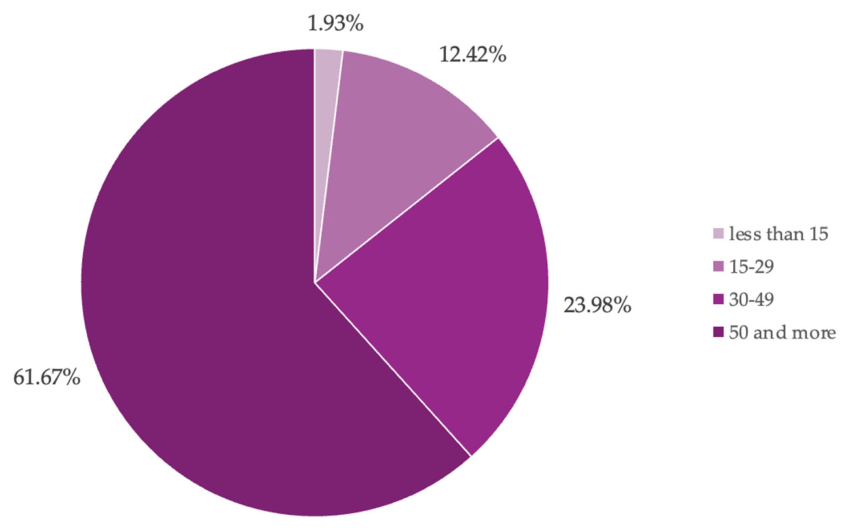
When grouped into standardized protection categories (according to [
22]), this pattern became even more pronounced. The distribution is shown in
Figure 1.
Preparations classified as providing “excellent protection” (SPF ≥ 50) comprised 61.67% of the analyzed products, clearly dominating the pharmacy assortment. “High protection” products (SPF 30–49) accounted for 23.98%, whereas “medium protection” (SPF 15–29) represented 12.42%. “Low protection” formulations (SPF < 15) constituted only 1.93% of the sample.
Overall, the pharmacy sunscreen market is dominated by products with very high SPF values, with nearly two-thirds of products positioned in the “excellent protection” category. The predominance of SPF 50 and 50+ formulations suggests that pharmacy-distributed sunscreens are primarily oriented toward maximal labeled photoprotection, consistent with the preventive and health-focused positioning characteristic of this retail setting.
3.3. Distribution of the Number of UV Filters per Sunscreen Preparation
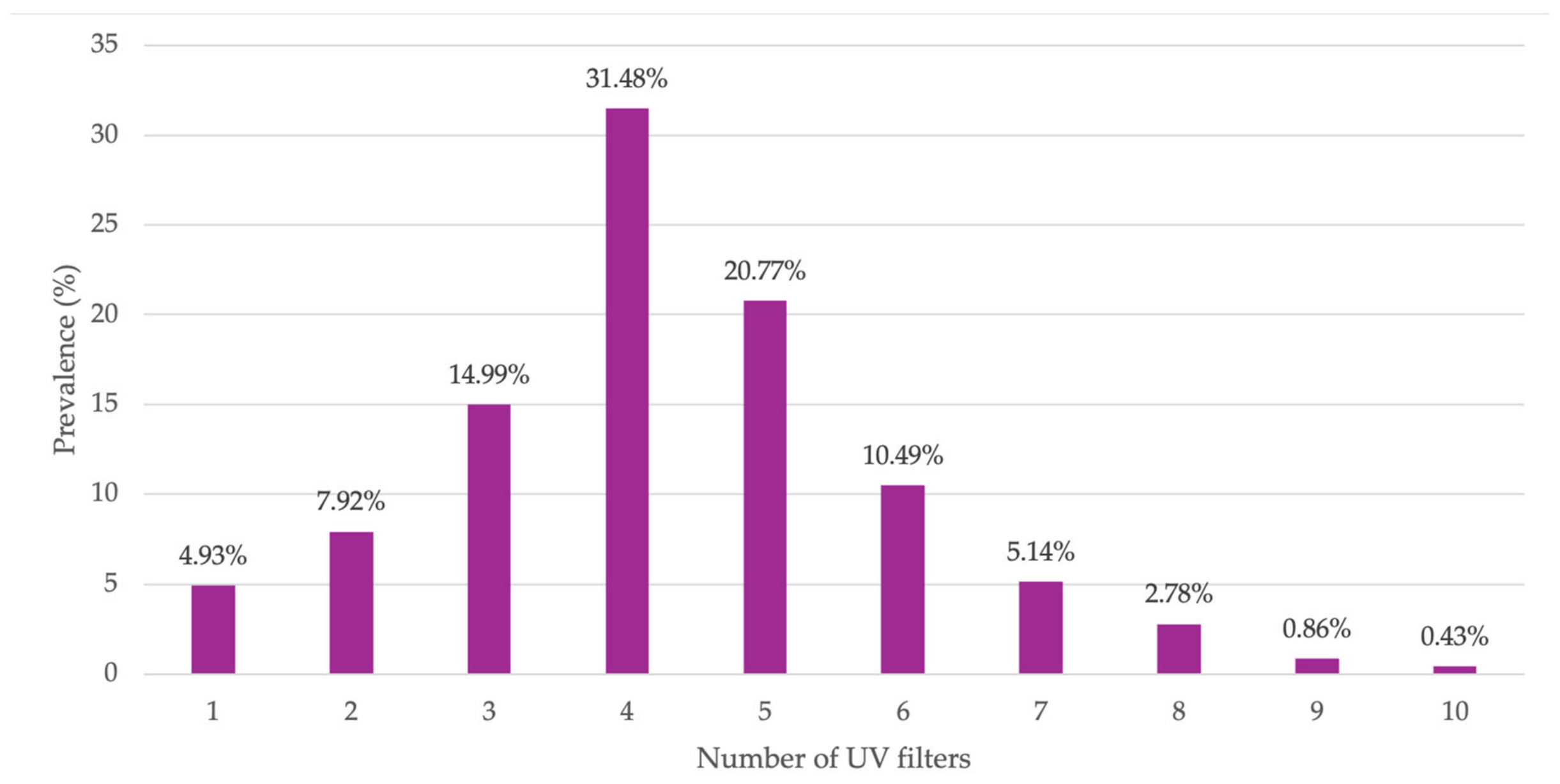
The sunscreen preparations were further evaluated according to the number of UV filters included in each formulation to assess formulation complexity within the pharmacy market. The distribution is shown in
Figure 2.
The mean number of UV filters was 4.29 (SD 1.66). The distribution demonstrates that products most frequently contained four UV filters (31.48%), representing the predominant formulation strategy. This was followed by formulations containing five filters (20.77%) and three filters (14.99%). Together, preparations comprising three to five UV filters accounted for most products, indicating a clear preference for multi-filter combinations.
Formulations containing six UV filters were also relatively common (10.49%), whereas products with only one (4.93%) or two filters (7.92%) were less prevalent. Preparations incorporating seven or more UV filters were comparatively rare, each category representing less than 6% individually, with formulations containing nine or ten filters occurring only sporadically (<1%).
Taken together, these findings suggest that pharmacy sunscreens are predominantly formulated with multiple UV filters, most commonly four or five, rather than relying on single-filter systems. This pattern likely reflects a strategy aimed at achieving broad-spectrum protection, optimizing photostability, and improving formulation performance while maintaining a manageable level of compositional complexity. The low proportion of single-filter products indicates that simplified formulations play only a minor role within the pharmacy market.
3.4. Relationship Between Protection Category and UV Filter Count
To evaluate whether higher-protection tiers were associated with a greater number of UV filters per formulation, the mean number of filters was calculated across protection groups. The average number of UV filters increased progressively from the low-protection group (n = 9; mean 3.22, SD 1.09) to the medium- (n = 58; mean 3.34, SD 1.10), high- (n = 112; mean 3.63, SD 1.44), and excellent-protection tiers (n = 288; mean 4.76, SD 1.68).
Given the non-normal distribution of the data, adjacent SPF groups were compared using the Mann–Whitney U test. No statistically significant differences were observed between the low- and medium-protection groups (p = 0.744) or between the medium- and high-protection categories (p = 0.143). However, a statistically significant increase in the number of UV filters was identified between the high- and excellent-protection tiers (p < 0.001).
In summary, these findings indicate that sunscreen products within the highest SPF tier available in Lithuanian pharmacies contain a significantly greater number of UV filters, suggesting increased formulation complexity at the upper end of the protection spectrum.
3.5. Co-Occurrence Patterns of UV Filters in Sunscreen Formulations
The prevalence of two-filter combinations was evaluated to identify the most frequently co-occurring UV filters within the analyzed formulations. Five combinations were present in more than 30% of all products. The most common pairing was bis-ethylhexyloxyphenol methoxyphenyl triazine and ethylhexyl triazone, occurring in 50.54% of sunscreens. Additional high-frequency combinations (30–40%) included diethylamino hydroxybenzoyl hexyl benzoate with ethylhexyl triazone (38.33%), bis-ethylhexyloxyphenol methoxyphenyl triazine with diethylamino hydroxybenzoyl hexyl benzoate (36.40%), bis-ethylhexyloxyphenol methoxyphenyl triazine with butyl methoxydibenzoylmethane (35.97%), and ethylhexyl triazone with butyl methoxydibenzoylmethane (30.41%).
Regarding inorganic filters, the concurrent use of titanium dioxide in both nano and non-nano forms was observed in 2.57% of formulations, whereas zinc oxide was never formulated simultaneously in its nano and non-nano forms. Any form of titanium dioxide combined with any form of zinc oxide was present in 8.99% of preparations.
Overall, these results demonstrate a consistent reliance on specific organic UV-filter pairings, with comparatively limited diversification in inorganic filter combinations among sunscreen products available in Lithuanian pharmacies.
4. Discussion
Sunscreen formulations containing UV filters are a primary measure for protecting the skin against ultraviolet radiation. However, UV filters differ in their physicochemical characteristics, photostability, and safety profiles. As community pharmacies are among the most trusted points of sale for sunscreens, evaluating the composition of products available in this setting is particularly relevant.
This analysis identified bis-ethylhexyloxyphenol methoxyphenyl triazine as the most prevalent UV filter in sunscreens marketed in Lithuanian pharmacies, occurring in 64.67% of formulations. Also known as bemotrizinol (USAN), anisotriazine, BEMT, or Tinosorb S, it is an oil-soluble broad-spectrum filter permitted at concentrations up to 10% in the European Union [
5,
6]. Its high photostability and strong photoprotective efficacy likely explain its widespread use [
5]. Although generally considered safe, rare cases of allergic reactions have been reported, indicating a potential for emerging sensitization [
23].
Ethylhexyl triazone was the second most common filter (58.03%). It is a photostable UVB filter with low dermal penetration and limited water solubility, authorized up to 5% in the European Union [
5,
6].
The third most frequent filter was butyl methoxydibenzoylmethane (avobenzone), present in 50.75% of formulations. This UVA filter is permitted up to 5% but is prone to photodegradation due to keto–enol tautomerism [
5], and is therefore often combined with photostabilizers such as antioxidants (e.g., ascorbic acid) or other UV filters (e.g., octocrylene) [
24].
The predominance of a broad-spectrum filter alongside distinct UVB and UVA filters indicates that sunscreen products in Lithuanian pharmacies are typically formulated to provide balanced photoprotection.
In the present study, triazine derivatives were the most common class of UV filters identified in sunscreens available in Lithuanian community pharmacies. Their predominance is likely related to their favorable formulation profile, as triazine-based filters commonly combine high photostability with strong UV absorption and good compatibility with other filters [
5]. The frequent use likely reflects current market preference for efficient and stable sunscreen systems.
Similar studies, although not restricted to pharmacy settings, have been conducted in Poland in 2023 [
25], Portugal in 2021 [
1], and Thailand in 2020 [
26].
During the study in Poland by Pniewska A and Kalinowska-Lis U (2024), 150 sunscreens for adults and 50 for children were assessed [
25]. In pediatric formulations, the most frequently identified filters were bis-ethylhexyloxyphenol methoxyphenyl triazine (60.0%), ethylhexyl triazone (52.0%), and ethylhexyl salicylate (46.0%). Among adult products, butyl methoxydibenzoylmethane predominated (56.0%), followed by ethylhexyl salicylate and bis-ethylhexyloxyphenol methoxyphenyl triazine (each at 54.7%) [
25]. Although our study did not differentiate between adult and pediatric formulations, the overall UV filter distribution was similar. Given that Poland and Lithuania are neighboring European Union countries, partial market overlap is likely. Moreover, the Polish authors reported that most formulations contained four or five UV filters, which aligns with the patterns observed in sunscreens marketed in Lithuanian pharmacies.
In the study by Jesus A et al. (2022), conducted in Portugal in 2021, the most frequently used UV filters in adult sunscreens were butyl methoxydibenzoylmethane (73.9%), octocrylene (51.7%), and bis-ethylhexyloxyphenol methoxyphenyl triazine (47.5%) [
1]. While both their findings and our dataset highlight bis-ethylhexyloxyphenol methoxyphenyl triazine and butyl methoxydibenzoylmethane as predominant filters, notable differences in relative prevalence are observed. In our dataset, bis-ethylhexyloxyphenol methoxyphenyl triazine shows a substantially higher usage frequency (+17 percentage points), whereas butyl methoxydibenzoylmethane is less prevalent (50.75% vs. 73.9%). Additionally, ethylhexyl triazone ranks second in our analysis (58.03%) but was reported as fourth in the Portuguese study (38.0%) [
1]. Importantly, the Portuguese study—similar to the Polish analysis [
25]—classified results by adult and pediatric formulations, whereas our dataset does not differentiate between these product categories. Consequently, variations in the reported percentages may partly reflect differences in product segmentation rather than true market trends.
In the Thai market survey by Chaiyabutr C et al. (2021), titanium dioxide was the most frequently used UV filter in sunscreens (66.7%), followed by ethylhexyl methoxycinnamate (56.1%) and butyl methoxydibenzoylmethane (42.3%), indicating markedly different results compared with our research [
26]. While both analyses show a high prevalence of butyl methoxydibenzoylmethane (42.3% vs. 50.75%), substantial discrepancies are evident for other filters. Titanium dioxide, the leading filter in the Thai study (66.7%), appears considerably less frequently in our dataset (23.55% for non-nano forms), whereas bis-ethylhexyloxyphenol methoxyphenyl triazine is more than twice as common in our analysis (64.67% vs. 31.1% in Thai sunscreens). Additionally, ethylhexyl triazone demonstrates a substantially higher prevalence in our dataset (58.03%) compared with Thai sunscreens (15.1%). Overall, our results reveal a clear predominance of triazine derivatives, whereas the Thai market survey indicates a greater reliance on inorganic filters, particularly titanium dioxide [
26].
Chaiyabutr C et al. (2022) evaluated 1000 best-selling sunscreens—50 products from each of 20 selected countries, including eight European markets—and reported that most products provided excellent protection (SPF ≥ 50), both globally (66.7%) and in Europe (61.8%) [
27]. These findings are consistent with our results, where 61.67% of sunscreens available in the Lithuanian pharmacy market were also categorized as SPF ≥ 50. Regarding formulation complexity, the mean number of UV filters per product was 4.5 ± 2.0 worldwide and 5.0 ± 1.8 in Europe, whereas our dataset demonstrated a slightly lower mean of 4.29 ± 1.66 filters per formulation [
27]. The Lithuanian pharmacy market aligns with international trends toward high-SPF formulations. The slightly lower number of UV filters per product may indicate more selective formulation strategies within this distribution channel. Sunscreens distributed through pharmacies may prioritize carefully selected filter combinations, potentially reducing consumer exposure to more controversial UV filters and reflecting a more safety-oriented formulation strategy.
Although our results showed that formulations in the highest SPF tier contained statistically significantly more UV filters, it should be emphasized that the efficacy of a sunscreen depends on multiple factors, including the specific UV filters used, their concentrations, spectral complementarity, photostability, and the overall formulation system. Moreover, certain natural compounds containing aromatic ring structures, such as flavonoids and polyphenols, are capable of absorbing UV radiation and may contribute to an increase in SPF. Although none of such substances are approved as commercial UV filters, they may be incorporated into sunscreen formulations as auxiliary ingredients because of their complementary properties, including antioxidant and anti-inflammatory activity [
28]. Therefore, the number of UV filters alone should not be considered a direct or the sole indicator of product strength and protective performance.
We identified 26 UV filters in sunscreens available in Lithuanian pharmacies. Of these, 25 are among the 34 filters currently permitted under EU legislation, while one—4-methylbenzylidene camphor—has since been banned [
21]. The filters not detected included three benzylidenecamphor derivatives (camphor benzalkonium methosulfate, terephthalylidene dicamphor sulfonic acid, and polyacrylamidomethyl benzylidene camphor), two PABA derivatives (PEG-25 PABA and ethylhexyl dimethyl PABA), tris-biphenyl triazine (nano and non-nano forms), and bis- (diethylaminohydroxybenzoyl benzoyl) piperazine (nano and non-nano forms). The absence of PABA and benzylidenecamphor derivatives may reflect their known issues with photostability, sensitization, and potential toxicity [
5]. Although tris-biphenyl triazine is considered effective and photostable [
29], its relatively recent EU approval (2014), and the even more recent approval of bis-(diethylaminohydroxybenzoyl benzoyl) piperazine (2022), may explain their limited use [
6].
The detection of 4-methylbenzylidene camphor in a small number of formulations may be associated with regulatory transition periods, during which products placed on the market before the enforcement deadline can still remain in distribution channels for some time because of stock turnover and existing supply logistics. Therefore, its presence should be interpreted cautiously and may reflect the practical dynamics of market transition rather than a broader market pattern. Nevertheless, this observation highlights the value of continued monitoring of sunscreen products available in pharmacy supply chains.
The role of community pharmacists should also be emphasized, as they are well positioned to guide consumers in the appropriate selection and correct use of sunscreens, as well as to warn patients about drug-induced photosensitivity [
30].
Several limitations of the present study should be acknowledged. First, the analysis did not differentiate between adult and pediatric formulations, which may have influenced the observed prevalence of certain UV filters. It was decided not to perform age-specific categorization because such designations were often absent or ambiguous in pharmacy catalogs, which could have compromised the reliability of data. Second, data collection was conducted during the winter season, when the assortment of sunscreens available in Lithuanian pharmacies may be different compared with the peak summer period. This may have shifted the analyzed assortment toward everyday skincare products containing SPF, rather than products specifically marketed as dedicated sunscreens. Finally, the analysis relied solely on ingredient labeling and did not assess the concentration of individual UV filters, which limits conclusions regarding actual exposure levels or regulatory compliance.