
Evaluating Coal Quality and Trace Elements of the Karagandy Coal Formation (Kazakhstan): Implications for Resource Utilization and Industry

 ,
, 
 , and
, and 
Highlights
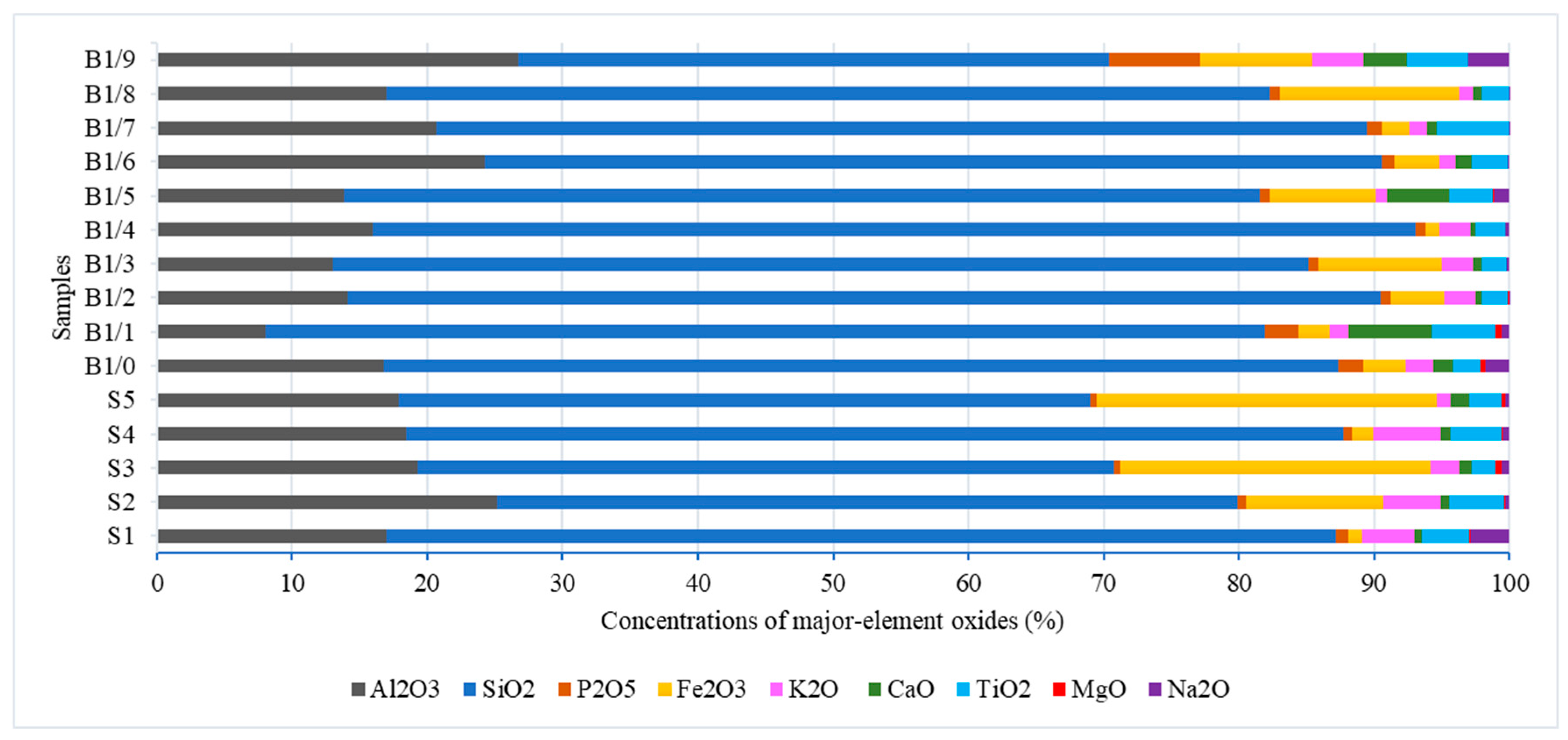
- KCF coals from Saradyr and Bogatyr are quartz–clay- dominated, low in sulfur and trace elements, and enriched in SiO2 and Al2O3.
- Al2O3/TiO2 ratios (3.8–10.8) indicate intermediate to mafic source rocks.
- High ash yield and frequent partings reflect strong detrital input and accommodation space during peat formation.
- The results clarify depositional controls on coal formation in the KCF.
- The findings support regional assessments of coal quality and inorganic matter distribution in NE Kazakhstan.
Abstract
1. Introduction
2. Geological Settings
3. Samples and Methods
3.1. Sample Selection
3.2. Sample Preparation
3.3. Analytical Procedure
4. Results
4.1. Proximate and Ultimate Analyses
4.2. Distribution of Functional Groups
4.3. Mineralogical Analysis of Coal: LTA-XRD and SEM-EDS
4.4. Major and Trace Element Analysis of Coal
5. Discussion
5.1. Depositional Environment
5.2. Sediment Source Region
5.3. Correlation of Ash Yields with Elements
5.4. Modes of Occurrence of Enriched Valuable Sm and Lu and Elements in Coals
5.5. Comparison with Previous Studies on Kazakhstani Ash and Slag Materials
6. Conclusions
- (1)
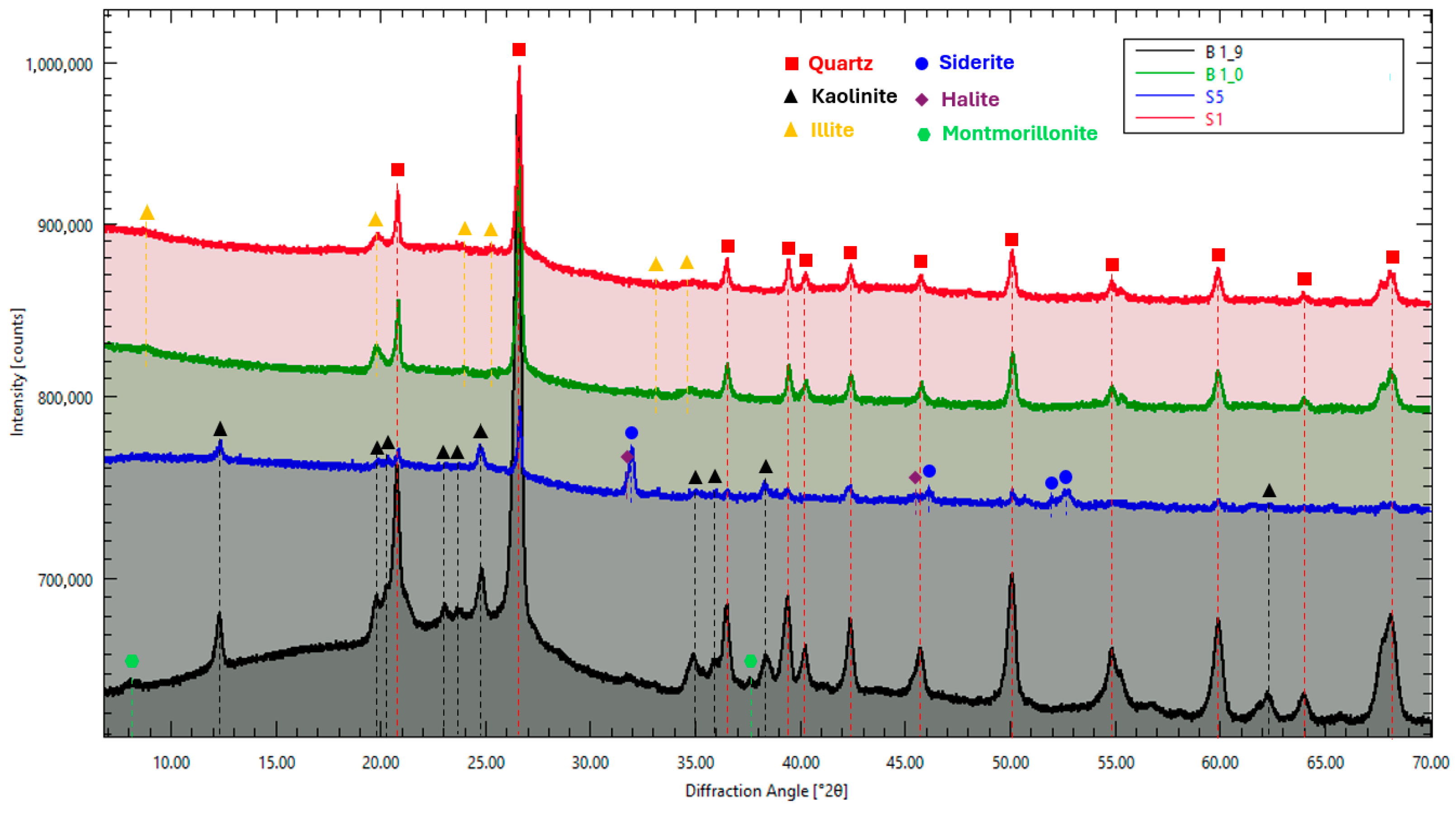
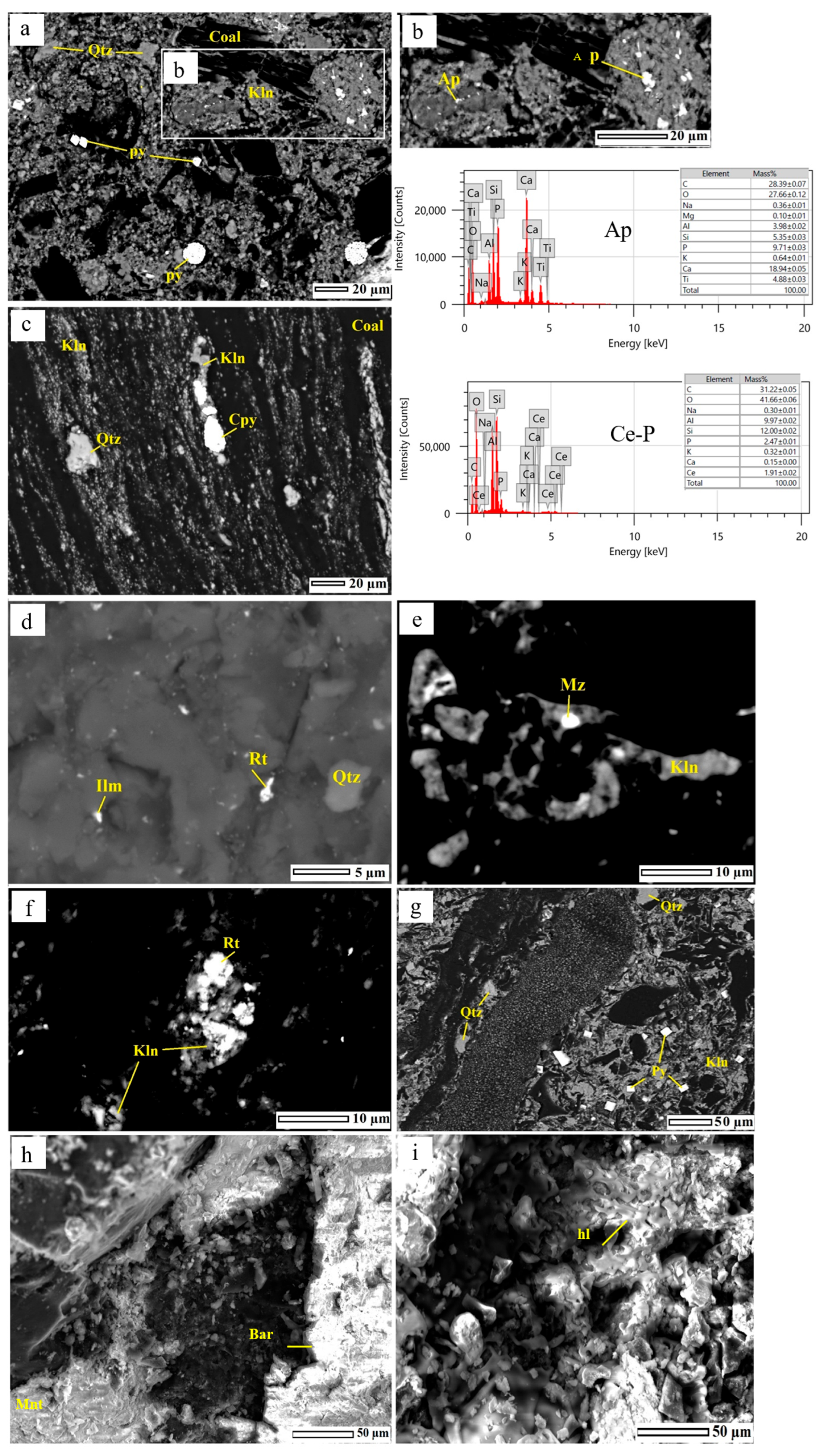
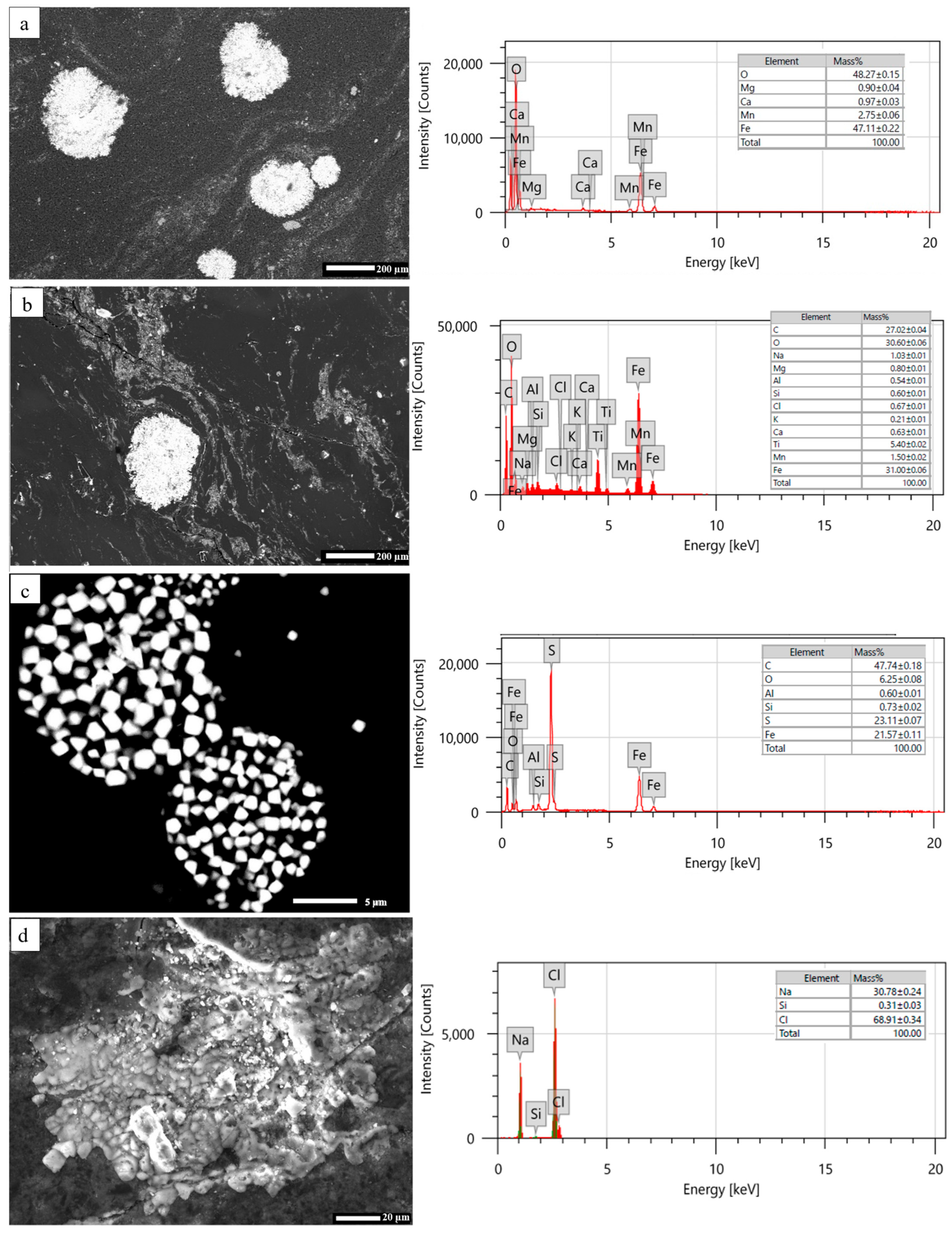
- The coal is predominantly composed of quartz and clay minerals (kaolinite, smectite, and illite), with minor pyrite. Accessory minerals include phosphate minerals (apatite), chalcopyrite, siderite, halite, rutile, and ilmenite. The occurrence of both detrital and authigenic minerals suggests a terrestrial depositional environment under freshwater-influenced conditions.
- (2)
- The mode of occurrence and morphology of detrital and authigenic minerals indicate accumulation with weathering during or shortly after peat deposition in lacustrine and wetland environments.
- (3)
- Twenty-four trace elements were identified, with Mn (23.8 ppm) and Sm (6.3 ppm) being the most abundant, followed by Ba, Zn, Sr, V, Pb, B, As, Ce, Li, Nd, and Cu. Rare earth elements and Y ranged from 7.5 to 39.2 ppm (average 25.3 ppm).
- (4)
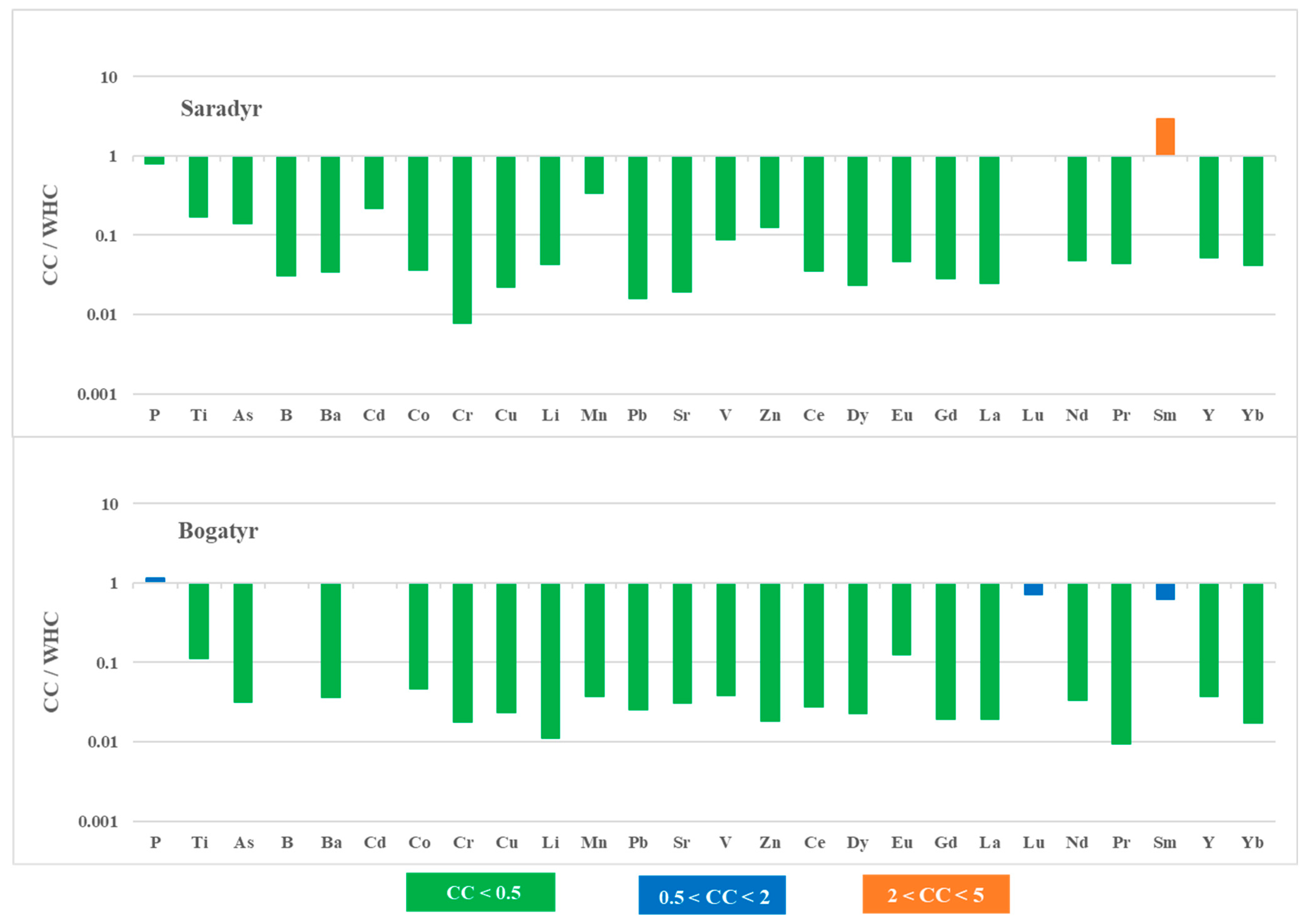
- Of industrial interest, Sm is slightly enriched (CC = 2.8), Lu shows normal concentration (CC < 1), and the remaining trace elements are depleted (CC < 0.5) in samples from both mines.
- (5)
- Al2O3/TiO2 ratios (3.8–10.8) suggest mineral and elemental enrichments originated from intermediate and mafic sources. Combined with detrital composition and high ash content, this indicates substantial accommodation space during or immediately after peat accumulation. The elevated SiO2 and Al2O3 contents and quartz–kaolinite mineralogy of KCF ash highlight promising potential for industrial applications, including geopolymers, ceramics, zeolites, and construction materials, supporting environmentally and economically valuable utilization of these coal resources.
Author Contributions
Funding
Data Availability Statement
Conflicts of Interest
References
- Finkelman, R.B. Coal rank, a measure of coalification. In Coal: Typology, Chemistry, Physics, Constitution; Elsevier: Amsterdam, The Netherlands, 1994; pp. 163–179. [Google Scholar]
- Finkelman, R.B. Modes of occurrence of potentially hazardous elements in coal: Levels of confidence. Fuel Process. Technol. 2004, 85, 1215–1247. [Google Scholar] [CrossRef]
- Finkelman, R.B. Medical geology: A global perspective. Environ. Geochem. Health 2004, 26, 193–199. [Google Scholar]
- Dai, S.; Jiang, Y.; Ward, C.R.; Hower, J.C.; Yan, X.; Zhu, X.; Li, T. Major and trace elements in Chinese coals: A national database and their geochemical implications. Int. J. Coal Geol. 2020, 218, 103331. [Google Scholar]
- Liu, G.; Lai, Y.; Zhao, L.; Yan, X. Geochemistry of rare earth elements in Chinese coals. Fuel 2005, 84, 426–430. [Google Scholar]
- Liu, Z.; Jiang, Y.; Wang, H.; Wang, X.; Zhang, Y.; Liu, G. The chemical characteristics of rare earth elements in Chinese coals. Int. J. Coal Geol. 2018, 187, 22–33. [Google Scholar]
- Ketris, M.P.; Yudovich, Y.E. Estimations of Clarkes for carbonaceous biolithes: World averages for trace element contents in black shales and coals. Int. J. Coal Geol. 2009, 78, 135–148. [Google Scholar] [CrossRef]
- Karayiğit, A.I.; Bircan, C.; Mastalerz, M. Coal characteristics, elemental composition and modes of occurrence of some elements in the İsaalan coal (Balıkesir, NW Turkey). Int. J. Coal Geol. 2017, 172, 43–59. [Google Scholar] [CrossRef]
- Hower, J.C.; Berti, D.; Hochella, M.F. Submicron-scale mineralogy of lithotypes and the implications for trace element associations: Blue Gem coal, Knox County, Kentucky. Int. J. Coal Geol. 2018, 192, 73–82. [Google Scholar] [CrossRef]
- Ward, C.R. The occurrence and geochemistry of siderite in some Australian coals. Int. J. Coal Geol. 2002, 50, 421–438. [Google Scholar]
- Ward, C.R. Petrology and geochemistry of coal. In Coal and Peat Fires: A Global Perspective 3; Schobert, H.D., Hwang, S.S., Matheus, J.M., Eds.; Elsevier: Amsterdam, The Netherlands, 2016; pp. 81–126. [Google Scholar]
- Harvey, H.R.; Ruch, R.R. Classification of inorganic constituents of coals: An organochemical approach. Org. Geochem. 1986, 10, 61–76. [Google Scholar]
- Seredin, V.V.; Finkelman, R.B. Metalliferous coals: A review of the main genetic and geochemical types. International J. Coal Geol. 2008, 76, 253–289. [Google Scholar] [CrossRef]
- Seredin, V.V.; Dai, S. Coal deposits as potential alternative sources for lanthanides and yttrium. Int. J. Coal Geol. 2012, 94, 67–93. [Google Scholar] [CrossRef]
- Dai, S.; Finkelman, R.B. Coal as a promising source of critical elements: Progress and future prospects. Int. J. Coal Geol. 2017, 182, 155–164. [Google Scholar] [CrossRef]
- Ammosov, I.I.; Burcev, D.N.; Gorsky, I.I.; Ivanov, G.A.; Kotlukov, V.A.; Kuznecov, I.A.; Lugovoy, G.I.; Mironov, K.V.; Molchanov, I.I.; Nekipelov, B.E.; et al. Geology of Coal and Black Deposits; Nedra: Moscow, Russia, 1973; pp. 13–718. (In Russian) [Google Scholar]
- Ammosov, I.I.; Burcev, D.N.; Gorsky, I.I.; Ivanov, G.A.; Kotlukov, V.A.; Kuznecov, I.A.; Lugovoy, G.I.; Mironov, K.V.; Molchanov, I.I.; Nekipelov, B.E.; et al. Geology of Coal and Black Deposits; Nedra: Moscow, Russia, 1973; pp. 2–219. (In Russian) [Google Scholar]
- Azizov, T.M.; Vlasov, Y.I. Coal and Oil Shale Basins and Deposits of Kazakhstan; AB Bekturov Institute of Chemical Sciences JS: Almaty, Kazakhstan, 2013; pp. 6–106. [Google Scholar]
- EIA Report 2017. Available online: https://www.ieee.es/en/Galerias/fichero/OtrasPublicaciones/Internacional/2017/EIA_Country_Aanlysis_Kazakhstan_10may2017.pdf (accessed on 16 March 2024).
- Amangeldikyzy, A.; Kopobayeva, A.N.; Blyalova, G.G.; Askarova, N.S. Geochemical speciation of coals in the Karaganda coal Basin. Min. J. Kazakhstan 2023, 7, 15–20. [Google Scholar]
- Kopobayeva, A.; Baidauletova, I.; Amangeldikyzy, A.; Askarova, N. Trace elements distribution in the k7 seam of the Karaganda Coal Basin, Kazakhstan. Geosciences 2024, 14, 143. [Google Scholar] [CrossRef]
- Kopobayeva, A.; Amangeldikyzy, A.; Blyalova, G.; Askarova, N. Mineralogical and geochemical features of coals and clay layers of the Karaganda Coal Basin. Minerals 2024, 14, 349. [Google Scholar] [CrossRef]
- Junussov, M.; Tarikhov, F.; Abildakhanov, A.; Zhanaidar, D.; Mekenbek, G.; Assambayeva, A. Mineralogical and elemental analysis of Kazakh coals from three mines: Preliminary insights from mode of occurrence to environmental impacts. Open Geosci. 2024, 16, 20220721. [Google Scholar] [CrossRef]
- Junussov, M.; Mustapayeva, S. Preliminary XRF analysis of coal ash from Jurassic and Carboniferous coals at five Kazakh mines: Industrial and environmental comparisons. Appl. Sci. 2024, 14, 10586. [Google Scholar] [CrossRef]
- Safaei-Farouji, M.; Misch, D.; Sachsenhofer, R.F.; Weitz, J.; Kojic, I.; Stojanović, K.; Tursyngaliyev, S.; Junussov, M.; Fustic, M. Organic petrography and geochemistry of the Lower-Carboniferous coals from the Ekibastuz Basin, Kazakhstan. Int. J. Coal Geol. 2025, 306, 104813. [Google Scholar] [CrossRef]
- David, B.R.; Anne, R.; Judith, T.P.; Ann, L.L.; Christopher, R.S.; Alfred, M.Z. Carboniferous paleogeographic, phytogeographic and paleoclimatic reconstructions. Int. J. Coal Geol. 1985, 5, 7–42. [Google Scholar] [CrossRef]
- ISO 7404-2; Methods for the Petrographic Analysis of Bituminous Coal and Anthracite—Part 2: Methods for Preparing Coal Samples. International Organization for Standardization: Geneva, Switzerland, 2009; 12p.
- ASTM STM D2013/D2013M-12; Standard Practice for Preparing Coal Samples for Analysis. ASTM International: West Conshohocken, PA, USA, 2012.
- Han, Q.; Liu, J.; Shang, N.; Zhao, S.; Jia, R. Optimization of Operating Parameters for Coal Low-Temperature Ashing: A Suitable and Efficient Treatment Method for Mineral Analysis in Coal. Minerals 2022, 12, 1119. [Google Scholar] [CrossRef]
- Qi, D.; Wu, S.; Li, S.; Zhao, G.; Xing, J.; Kang, S.; Wang, Q.; Gao, W. Enrichment Characteristics, Occurrence and Origin of Valuable Trace Elements in Lignite from Linchang Coal Mine, Guangxi, China. J. Geosci. Environ. Prot. 2021, 9, 12. [Google Scholar] [CrossRef]
- ASTM D3173-11; Standard Test Method for Moisture in the Analysis Sample of Coal and Coke. ASTM International: West Conshohocken, PA, USA, 2011.
- ASTM D3174-12; Standard Test Method for Ash in the Analysis Sample of Coal and Coke from Coal. American Society for Testing and Materials: West Conshohocken, PA, USA, 2013; pp. 498–503.
- ASTM D3175–11; Standard Test Method for Volatile Matter in the Analysis Sample of Coal and Coke. ASTM International: West Conshohocken, PA, USA, 2011.
- ASTM D5373-16; Standard Test Methods for Determination of Carbon, Hydrogen and Nitrogen in Analysis Samples of Coal and Carbon in Analysis Samples of Coal and Coke. ASTM International: West Conshohocken, PA, USA, 2016.
- Mesroghli, S.; Jorjani, E.; Chelgani, S.C. Estimation of Gross Calorific Value Based on Coal Analysis Using Regression and Artificial Neural Networks. Int. J. Coal Geol. 2009, 79, 49–54. [Google Scholar] [CrossRef]
- Munshi, T.A.; Jahan, L.N.; Howladar, M.F.; Hashan, M. Data-driven computational approaches to estimate gross calorific value of coal using proximate and ultimate analyses. Int. J. Coal Prep. Util. 2024, 44, 1653–1678. [Google Scholar] [CrossRef]
- ASTM D2492-02; Standard Test Method for Forms of Sulfur in Coal. ASTM International: West Conshohocken, PA, USA, 2002.
- ASTM D3177–02; Standard Test Methods for Total Sulfur in the Analysis Sample of Coal and Coke. ASTM International: West Conshohocken, PA, USA, 2002; Reapproved 2007.
- Yang, Y.; Wei, X.; Wang, H.; Ma, D. Characterization of coal ash from thermal power plants in China and its environmental impact assessment. Fuel 2015, 143, 39–45. [Google Scholar]
- Rietveld, H.M. A profile refinement method for nuclear and magnetic structures. J. Appl. Crystallogr. 1969, 2, 65–71. [Google Scholar] [CrossRef]
- Taylor, J.C. Computer programs for standardless quantitative analysis of minerals using the full powder diffraction profile. Powder Diffr. 1991, 6, 2–9. [Google Scholar] [CrossRef]
- Tian, X.; Zhao, L. Determination of concentrations of Sr and Ba in coal and coal combustion by-products: A comparison between results by ICP-MS and XRF techniques. Talanta 2024, 266, 124919. [Google Scholar] [CrossRef] [PubMed]
- Matsunami, H.; Matsuda, K.; Yamasaki, S.I.; Kimura, K.; Ogawa, Y.; Miura, Y.; Tsuchiya, N. Rapid simultaneous multi-element determination of soils and environmental samples with polarizing energy dispersive X-ray fluorescence (EDXRF) spectrometry using pressed powder pellets. Soil Sci. Plant Nutr. 2010, 56, 530–540. [Google Scholar] [CrossRef]
- Wang, J.; Nakazato, T.; Sakanishi, K.; Yamada, O.; Tao, H.; Saito, I. Microwave digestion with HNO3/H2O2 mixture at high temperatures for determination of trace elements in coal by ICP-OES and ICP-MS. Anal. Chim. Acta 2004, 514, 115–124. [Google Scholar] [CrossRef]
- Chen, C.; Zou, M.; Mastalerz, M.; Hu, S.; Gasaway, C.; Tao, X. Applications of micro-fourier transform infrared spectroscopy (FTIR) in the geological sciences—A Review. Int. J. Mol. Sci. 2015, 16, 30223–30250. [Google Scholar] [CrossRef]
- Davis, B.A.; Rodrigues, S.; Esterle, J.S.; Rintoul, L.; Duxbury, A.J.; Golding, S.D. In situ techniques for classifying apatite in coal. Int. J. Coal Geol. 2020, 230, 103572. [Google Scholar] [CrossRef]
- Srivastava, M.K.; Kishor, K.; Nath, M.; Singh, A.K. Inorganic geochemical attributes of Jaintia Hills coals, India: Implications for paleo-depositional conditions. Kuwait J. Sci. 2024, 51, 100227. [Google Scholar] [CrossRef]
- Jenkins, R.G.; Walker, P.L., Jr. Analysis of Mineral Matter in Coal. In Analytical Methods for Coal and Coal Products; Chapter 26; Academic Press: Cambridge, MA, USA, 1978; Volume II, pp. 265–292. [Google Scholar]
- Dai, S.; Li, T.; Jiang, Y.; Ward, C.R.; Hower, J.C.; Sun, J.; Liu, J.; Song, H.; Wei, J.; Li, Q.; et al. Mineralogical and geochemical compositions of the Pennsylvanian coal in the Hailiushu Mine, Daqingshan Coalfield, Inner Mongolia, China: Implications of sediment-source region and acid hydrothermal solutions. Int. J. Coal Geol. 2015, 137, 92–110. [Google Scholar] [CrossRef]
- Ingham, J.K.; Davies, G.R.; Taylor, P.N. 3D microtexture analysis of pyrite framboids in coal: Understanding modes of formation. Int. J. Coal Geol. 2013, 115, 19–34. [Google Scholar]
- Goodarzi, F.; Swaine, D.J. Environmental Aspects of Trace Elements in Coal. Environ. Geochem. Health 1994, 16, 67–82. [Google Scholar]
- Hower, J.C.; Eble, C.F.; Cobb, J.C. Siderite in coal and associated strata. Int. J. Coal Geol. 1991, 18, 3–20. [Google Scholar]
- Dai, S.; Fang, C.; Zhou, J.; Liu, H.; Wang, X.; Zhan, X. Sulfur forms in coals of China. Int. J. Coal Geol. 2002, 50, 135–152. [Google Scholar]
- Hower, J.C.; Eble, C.F.; O’Keefe, J.M.K.; Dai, S.; Wang, P. Petrology, Palynology, and Geochemistry of Gray Hawk Coal (Early Pennsylvanian, Langsettian) in Eastern Kentucky, USA. Minerals 2015, 5, 592–622. [Google Scholar] [CrossRef]
- Ward, C.R. Pyrite framboids in coal: An overview. Int. J. Coal Geol. 1984, 3, 279–307. [Google Scholar]
- Scott, A.C. Charcoal recognition, taphonomy and uses in palaeoenvironmental analysis. Palaeogeogr. Palaeoclimatol. Palaeoecol. 2010, 291, 11–39. [Google Scholar] [CrossRef]
- Hower, J.C. Halite in Coal: Significance and Implications. Int. J. Coal Geol. 1999, 40, 89–107. [Google Scholar]
- Ward, C.R.; French, D. Clay minerals in coal-fired sediments and sedimentary rocks: A review. Int. J. Coal Geol. 2006, 67, 2–18. [Google Scholar] [CrossRef]
- Smith, K.L.; Smoot, L.D. Characteristics of commonly-used US coals—Towards a set of standard re-search coals. Prog. Energy Combust. Sci. 1990, 16, 1–53. [Google Scholar] [CrossRef]
- Ribeiro, L.; Sharygin, I.; Karpinsky, G.; Krivovichev, S.; Platonov, Y.; Zhukhlistova, I.; Seryotkin, S. Comparative study of framing framboidal and non-framboidal pyrite in Permian coal samples from the Kuznetsk Basin, Russia. Minerals 2019, 9, 303. [Google Scholar]
- Renton, J.J. 7—Mineral Matter in Coal. In Coal Structure; Meyers, R.A., Ed.; Academic Press: Cambridge, MA, USA, 1982; pp. 283–326. [Google Scholar]
- Spears, D.A.; Zheng, Y. Geochemistry and origin of elements in some UK coals. Int. J. Coal Geol. 1999, 38, 161–179. [Google Scholar] [CrossRef]
- Hower, J.C.; Blake, D.J.; Howell, D.K.; Lawton, T.E.; Martin, H.P. Framboidal pyrite formation in coal: An SEM investigation of microstructure. Int. J. Coal Geol. 2015, 142, 13–21. [Google Scholar]
- Hower, J.C.; Rimmer, S.M.; Eble, C.F.; Freeman, P.A.; Stucker, J.D. The nature of pyrite in some Appalachian coals. Int. J. Coal Geol. 2015, 147–148, 104–115. [Google Scholar]
- Filho, J.G.S.; Hu, Y.; Lee, C.T.A.; Youbi, N. Low-sulfur coals from the Late Permian Gangra coalfield, the Yarlung–Tsangpo suture zone, southern Tibet: Origin and implications for tectonic setting. Int. J. Coal Geol. 2013, 109–110, 85–98. [Google Scholar]
- Finkelman, R.B. Potential Health Impacts of Burning Coal Beds and Waste Banks. Int. J. Coal Geol. 2004, 59, 19–24. [Google Scholar] [CrossRef]
- Goodarzi, F. Morphology and chemistry of fine particles emitted from a Canadian coal-fired power plant. Fuel 2006, 85, 273–280. [Google Scholar] [CrossRef]
- Hower, J.C.; Ruppert, L.F. Splint coals of the Central Appalachians: Petrographic and geochemical facies of the Peach Orchard No. 3 split coal bed, southern Magoffin County, Kentucky. Int. J. Coal Geol. 2011, 85, 268–275. [Google Scholar] [CrossRef]
- Moore, F.; Esmaeili, A. Mineralogy and geochemistry of the coals from the Karmozd and Kiasar coal mines, Mazandaran province, Iran. Int. J. Coal Geol. 2012, 96–97, 9–21. [Google Scholar] [CrossRef]
- Belkin, H.E.; Tewalt, S.J. Geochemistry of Selected Coal Samples from Sumatra, Kalimantan, Sulawesi, and Papua, Indonesia. US Geological Survey. 2007; 34p. Available online: https://pubs.usgs.gov/publication/ofr20071202 (accessed on 22 December 2025).
- Grim, R.E. Clay Mineralogy; McGraw-Hill Book Company: New York, NY, USA, 1962. [Google Scholar]
- Guo, W.; Dai, S.; Nechaev, V.P.; Nechaeva, E.V.; Wei, G.; Finkelman, R.B.; Spiro, B.F. Geochemistry of Palaeogene coals from the Fuqiang Mine, Hunchun Coalfield, northeastern China: Composition, provenance, and relation to the adjacent polymetallic deposits. J. Geochem. Explor. 2019, 196, 192–207. [Google Scholar] [CrossRef]
- Wang, J.; Shao, L.; Yan, A.; Wang, X. The coal-forming environment during mass extinction in the latest permian: Evidence from geochemistry of rare Earth elements. Front. Earth Sci. 2023, 10, 1057831. [Google Scholar] [CrossRef]
- Hayashi, K.I.; Fujisawa, H.; Holland, H.D.; Ohmoto, H. Geochemistry of ~1.9 Ga sedimentary rocks from northeastern Labrador, Canada. Geochim. Cosmochim. Acta 1997, 61, 4115–4137. [Google Scholar] [CrossRef]
- Saxby, J.D. Minerals in coal. In Organic Matter and Mineralisation: Thermal Alteration, Hydrocarbon Generation and Role in Metallogenesis; Glikson, M., Mastalerz, M., Eds.; Springer Netherlands: Berlin/Heidelberg, Germany, 2000; pp. 314–328. [Google Scholar]
- Junussov, M. Characteristics, distribution and morphogenesis of gold-bearing sulfde minerals in the gold black shale deposit of Bakyrchik. In Proceedings of the 18th International Multidisciplinary Scientifc Geoconference Surveying Geology and Mining Ecology Management, SGEM, Albena, Bulgaria, 2–8 July 2018; Volume 18, pp. 643–650. [Google Scholar] [CrossRef]
- Junussov, M.; Mohammad, A.; Longinos, S. Geochemical analysis of organic matter associated with gold in ore deposits: A study of Kazakhstan and Hungary. Acta Geochim. 2025, 44, 23–35. [Google Scholar] [CrossRef]
- Dai, S.; Seredin, V.V.; Ward, C.R.; Hower, J.C.; Xing, Y.; Zhang, W.; Song, W.; Wang, P. Enrichment of U–Se–Mo–Re–V in coals preserved within marine carbonate successions: Geochemical and mineralogical data from the Late Permian Guiding Coalfield, Guizhou, China. Miner. Depos. 2015, 50, 159–186. [Google Scholar] [CrossRef]
- Ward, C.R.; French, D.; Kuehn, S.C.; Mark, C. Variability in ash chemistry and mineralogy in Australian coals: Implications for ash utilisation. Int. J. Coal Geol. 2018, 186, 130–142. [Google Scholar] [CrossRef]
- Vassilev, S.V.; Vassileva, C.G.; Baxter, D.; Andersen, L.K. Relationships between chemical and mineral composition of coal and their potential applications as genetic indicators. Geol. Balanica 2010, 39, 21–41. [Google Scholar] [CrossRef]
- Speight, J.G. The Chemistry and Technology of Coal; CRC Press: Boca Raton, FL, USA, 2013. [Google Scholar]
- Junussov, M.; Abirov, R.; Mekenbek, G.; Assambayeva, A.; Mukhamediyarova, N. New insights into pyrite in the Western Mecsek uranium ore deposit: Its morphology, invisible gold and trace element composition. Bull. Miner. Res. Explor. 2025, 177, 1–2. [Google Scholar] [CrossRef]
- Vassilev, S.V.; Vassileva, C.G.; Karayiğit, A.I. Contents, modes of occurrence, and origin of chlorine and bromine in coal. Fuel 2010, 89, 811–824. [Google Scholar] [CrossRef]
- Zhao, C.; Zheng, Y.; Zhang, C.; Zhang, L. Rare earth elements in Chinese coals. Fuel 2007, 86, 584–591. [Google Scholar]
- Junussov, M.; Ferenc, M.; Ferenc, K.; Tivadar, T.; Krisztián, F.; Gábor, M.; Ádám, P.; Mária, H.V. Preliminary analysis on roles of metal–organic compounds in the formation of invisible gold. Acta Geochim. 2021, 40, 1050–1072. [Google Scholar] [CrossRef]
- Junussov, M.; Mádai, F.; Földessy, J.; Hámor-Vidó, M. The role of organic matter in gold occurrence: Insights from western mecsek uranium ore deposit. Econ. Environ. Geol. 2024, 57, 371–386. [Google Scholar] [CrossRef]
- Junussov, M.; Kembayev, M.K.; Rais, S.E.; Amantayev, A.; Biyakyshev, Y.; Akbarov, E.; Mekenbek, G.; Kokkuzova, M.; Baisalova, A.; Pan, J. Process Evolution and Green Innovation in Rare Earth Element Research: A 50-Year Bibliometric Assessment (1975–2024). Processes 2026, 14, 41. [Google Scholar] [CrossRef]
- Jordens, A.; Cheng, Y.P.; Waters, K.E. A review of the beneficiation of rare earth element bearing minerals. Ore Geol. Rev. 2013, 41, 97–114. [Google Scholar] [CrossRef]
- Junussov, M.; Kembayev, M.; Mukhamediyarova, N.; Rustembekov, M.M.; Abirov, A. Trace element geochemistry of dispersed organic matter in Western Mecsek uranium ore deposit, Southern Hungary. Acta Geochim. 2025, 1–21. [Google Scholar] [CrossRef]
- Asif, M.; Junussov, M.; Longinos, S.; Hazlett, R.; Satibekova, S. CO2 storage capacity of coal seams: A screening and geological review of carboniferous coal formations of Kazakhstan. Int. J. Coal Sci. Technol. 2025, 12, 18. [Google Scholar] [CrossRef]
- Junussov, M.; Kembayev, M.K.; Mekenbek, G.; Mukhamediyarova, N.; Kokkuzova, M.; Assambayeva, A.; Abirov, R. Four decades of trends in invisible gold research: A web of science-based bibliometric analysis (1985–2024). Earth Sci. Inform. 2025, 18, 484. [Google Scholar] [CrossRef]
- Arbuzov, S.I.; Volostnov, A.V.; Rikhvanov, L.P.; Mezhibor, A.M.; Ilenok, S.S. Geochemistry of radioactive elements (U, Th) in coal and peat of northern Asia (Siberia, Russian Far East, Kazakhstan, and Mongolia). Int. J. Coal Geol. 2011, 86, 318–328. [Google Scholar] [CrossRef]
- Junussov, M.; Kembayev, K.M.; Kokkuzova, M.; Baisalova, A.; Umarbekova, T.Z.; Abirov, R.; Rais, E.S.; Amantayev, A. Exploring rare earth elements in Northern Kazakhstan: The potential of ion-adsorption clays and coals as unconventional sources. Acta Geochim. 2025, in press. [Google Scholar] [CrossRef]
- Longinos, S.N.; Serik, A.; Bayramov, E.; Junussov, M.; Begaliyev, D.; Hazlett, R. Laboratory Study of Liquid Nitrogen Cryo-Fracturing as an Environmentally Friendly Approach for Coalbed Methane (CBM) Reservoirs. Energies 2024, 17, 2359. [Google Scholar] [CrossRef]
- Safaei-Farouji, M.; Misch, D.; Sachsenhofer, R.F.; Kostoglou, N.; Gaus, G.; Bauersachs, T.; Junussov, M.; Fustic, M. CO2 utilization and sequestration potential in deep coal seams: A case study on carboniferous coals from the Karaganda basin, kazakhstan. J. CO2 Util. 2025, 101, 103204. [Google Scholar] [CrossRef]
- Nurmakova, S.; Sarsembin, U.; Dalbanbay, A.; Abilova, G.; Tusupova, B.; Kurbanova, L.; Zharkimbaeva, G.; Shanbayev, M. Innovative approaches to the processing of ash and slag materials from the fuel and energy sector in the context of sustainable development. Eng. J. Satbayev Univ. 2025, 147, 30–39. [Google Scholar] [CrossRef]
- Nurpeisova, M.; Estemesov, Z.; Gabbasov, S.; Ashimova, A.; Bek, A. Studying the properties of ash and slag waste for use in the manufacture of construction products. Min. Miner. Depos. 2023, 17, 102–109. [Google Scholar] [CrossRef]



| Samples | M (Ad) | V (daf) | A (db) | Qgr (Ad) | C (daf) | H (daf) | N (daf) | St (db) | Sp (db) | Ss (db) | So (db) |
|---|---|---|---|---|---|---|---|---|---|---|---|
| S1 | 0.5 | 24.7 | 19.3 | 19.5 | 56.3 | 3.3 | 0.7 | 0.58 | 0.01 | 0.06 | 0.5 |
| S2 | 1.1 | 22.1 | 40.6 | 19.7 | 50.0 | 3.0 | 0.6 | 0.65 | 0.3 | 0.05 | 0.3 |
| S3 | 4.1 | 28.6 | 18.7 | 17.4 | 54.3 | 3.1 | 0.5 | 1.15 | 0.79 | 0.06 | 0.3 |
| S4 | 1.3 | 20.0 | 39.1 | 21.0 | 52.3 | 3.3 | 0.7 | 0.63 | 0.13 | bdl | 0.5 |
| S5 | 1.2 | 23.7 | 17.0 | 15.8 | 50.0 | 3.3 | 0.7 | 1.07 | 0.31 | 0.26 | 0.5 |
| B1/0 | 0.2 | 16.0 | 16.5 | 14.9 | 51.6 | 2.0 | 0.7 | 0.83 | 0.09 | 0.24 | 0.5 |
| B1/1 | 1.1 | 29.7 | 25.2 | 30.4 | 70.7 | 4.7 | 1.8 | 0.71 | 0.15 | 0.16 | 0.4 |
| B1/2 | 1.2 | 21.0 | 24.9 | 24.2 | 62.1 | 3.7 | 1.3 | 0.5 | 0.27 | 0.03 | 0.2 |
| B1/3 | 1.3 | 19.3 | 29.7 | 22.5 | 57.9 | 3.4 | 1.2 | 0.65 | 0.19 | 0.06 | 0.4 |
| B1/4 | 0.4 | 17.1 | 10.7 | 13.0 | 47.2 | 3.1 | 0.9 | 0.51 | 0.21 | bdl | 0.3 |
| B1/5 | 1.2 | 23.7 | 11.2 | 28.6 | 73.8 | 4.3 | 1.5 | 0.65 | 0.05 | 0.2 | 0.4 |
| B1/6 | 1.2 | 20.1 | 28.5 | 25.0 | 55.9 | 6.3 | 1.0 | 0.53 | 0.15 | 0.18 | 0.2 |
| B1/7 | 1.1 | 23.1 | 24.3 | 24.1 | 61.6 | 3.9 | 1.3 | 0.48 | 0.17 | 0.01 | 0.3 |
| B1/8 | 1.1 | 23.1 | 16.6 | 24.5 | 68.6 | 4.1 | 1.3 | 0.66 | 0.2 | 0.06 | 0.4 |
| B1/9 | 0.4 | 22.8 | 40.6 | 19.2 | 48.5 | 3.0 | 0.9 | 0.6 | 0.19 | 0.01 | 0.4 |
| Average | 1.1 | 21.6 | 24.1 | 21.3 | 57.3 | 3.6 | 1.0 | 0.68 | 0.21 | 0.10 | 0.37 |
| Samples | Quartz | Kaolinite | Smectite | Illite | Siderite | Halite |
|---|---|---|---|---|---|---|
| S1 | 97 | n.a. | n.a. | 3.0 | n.a. | n.a. |
| S2 | 88.8 | n.a. | n.a. | 11.2 | n.a. | n.a. |
| S3 | 66.1 | 25.2 | n.a. | n.a. | 4.1 | 4.6 |
| S4 | 86.0 | 10.0 | 0.4 | n.a. | n.a. | n.a. |
| S5 | 70.0 | 14.7 | n.a. | n.a. | 14 | 1.3 |
| B1/0 | 94.8 | n.a. | n.a. | 5.2 | n.a. | n.a. |
| B1/1 | 99.2 | n.a. | n.a. | 0.8 | n.a. | n.a. |
| B1/2 | 90.0 | 8.6 | 1.4 | n.a. | n.a. | n.a. |
| B1/3 | 88.2 | 10.6 | 1.2 | n.a. | n.a. | n.a. |
| B1/4 | 88.0 | 10.5 | 1.5 | n.a. | n.a. | n.a. |
| B1/5 | 84.0 | 16.0 | n.a. | n.a. | n.a. | n.a. |
| B1/6 | 69.6 | 28.7 | 1.7 | n.a. | n.a. | n.a. |
| B1/7 | 80.0 | 18 | n.a. | n.a. | 2.0 | n.a. |
| B1/8 | 86.0 | 13.5 | 0.5 | n.a. | n.a. | n.a. |
| B1/9 | 91.0 | 8.5 | 0.5 | n.a. | n.a. | n.a. |
| Average | 84.4 | 11.8 | 1.0 | 5.0 | 6.7 | 2.9 |
| Elements | Saradyr Samples | Average | *WHC | ||||||||||||
| Wavelength, nm | LOQ, ppb | S1 | S2 | S3 | S4 | S5 | |||||||||
| Al2O3% | 16.9 | 25.1 | 19.2 | 18.4 | 17.8 | 19.5 | nd | ||||||||
| SiO2% | 70.2 | 54.7 | 51.4 | 69.2 | 51.1 | 59.3 | nd | ||||||||
| P2O5% | 0.8 | 0.6 | 0.4 | 0.6 | 0.4 | 0.6 | 0.15 | ||||||||
| Fe2O3% | 1.0 | 10.1 | 23 | 1.5 | 25 | 12.1 | nd | ||||||||
| Na2O % | 2.9 | 0.2 | 0.6 | 0.4 | 0.3 | 0.3 | nd | ||||||||
| K2O % | 3.8 | 4.1 | 2.1 | 4.9 | 1.0 | 3.2 | nd | ||||||||
| CaO % | 0.5 | 0.6 | 0.8 | 0.7 | 1.3 | 0.8 | nd | ||||||||
| TiO2% | 3.4 | 3.9 | 1.7 | 3.8 | 2.3 | 3.0 | 5.3 | ||||||||
| MgO% | 0.1 | 0.1 | 0.3 | 0.1 | 0.3 | 0.2 | nd | ||||||||
| As | 396.15 | 4 | bdl | bdl | bdl | 1.27 | bdl | 1.2 | 9 | ||||||
| B | 249.67 | 10 | 2.52 | bdl | 1.09 | 2.0 | 0.18 | 1.4 | 47 | ||||||
| Ba | 455.40 | 0.05 | 8.41 | 0.52 | 0.5 | 16 | 0.57 | 5.2 | 150 | ||||||
| Cd | 214.43 | 0.2 | bdl | 0.04 | 0.03 | bdl | 0.06 | 0.04 | 0.2 | ||||||
| Co | 228.61 | 0.5 | 0.12 | 0.11 | 0.24 | 0.53 | 0.09 | 0.21 | 6 | ||||||
| Cr | 267.71 | 1 | 0.1 | 0.06 | 0.05 | 0.4 | 0.05 | 0.1 | 17 | ||||||
| Cu | 324.75 | 0.8 | 0.62 | 0.26 | 0.25 | bdl | 0.29 | 0.3 | 16 | ||||||
| Li | 670.78 | 3 | 1.46 | bdl | 0.36 | 0.31 | 0.26 | 0.5 | 14 | ||||||
| Mn | 257.61 | 0.1 | 3.6 | 36.5 | 26.2 | 0.6 | 52.4 | 23.8 | 71 | ||||||
| Pb | 220.35 | 3 | 0.11 | 0.19 | 0.02 | 0.11 | 0.29 | 1.9 | 9 | ||||||
| Sr | 421.55 | 0.04 | 0.63 | 0.84 | 0.61 | 2.1 | 5.46 | 1.9 | 100 | ||||||
| V | 292.40 | 5 | 2.07 | 1.46 | 1.06 | 5.0 | 2.7 | 2.4 | 28 | ||||||
| Zn | 206.20 | 0.3 | 11.27 | 0.44 | 5.51 | 0.38 | 0.32 | 3.5 | 28 | ||||||
| Ce | 456.23 | 5 | 0.62 | 0.4 | 0.78 | 1.9 | 0.39 | 0.8 | 23 | ||||||
| Dy | 353.17 | 0.5 | 0.03 | bdl | bdl | 0.07 | bdl | 0.05 | 2.1 | ||||||
| Eu | 381.96 | 2 | 0.01 | bdl | bdl | 0.03 | bdl | 0.02 | 0.4 | ||||||
| Gd | 335.04 | 2 | 0.06 | 0.06 | 0.08 | 0.14 | 0.05 | 0.07 | 2.7 | ||||||
| La | 412.32 | 7 | 0.07 | bdl | 0.24 | 0.5 | 0.0 | 0.2 | 11 | ||||||
| Lu | 291.13 | 5 | bdl | bdl | bdl | bdl | bdl | bdl | 0.2 | ||||||
| Nd | 406.10 | 20 | bdl | 0.26 | 0.69 | 1.37 | 0.01 | 0.5 | 12 | ||||||
| Pr | 414.31 | 3 | 0.1 | bdl | bdl | 0.2 | bdl | 0.1 | 3.4 | ||||||
| Sm | 330.63 | 6 | 1.52 | 9.08 | 6.24 | 2.55 | 12.5 | 6.3 | 2.2 | ||||||
| Y | 360.07 | 0.2 | 0.29 | 0.4 | 0.61 | 0.36 | 0.47 | 0.4 | 8.2 | ||||||
| Yb | 328.93 | 0.8 | 0.01 | 0.04 | 0.05 | 0.03 | 0.08 | 0.04 | 1 | ||||||
| REY | 18.2 | 23.6 | 39.2 | 14.4 | 29.6 | 25.3 | 67.2 ** | ||||||||
| SiO2/Al2O3 | 4.1 | 2.1 | 2.6 | 3.7 | 2.8 | ||||||||||
| Elements | Bogatyr samples | Average | *WHC | ||||||||||||
| B1/0 | B1/1 | B1/2 | B1/3 | B1/4 | B1/5 | B1/6 | B1/7 | B1/8 | B1/9 | ||||||
| Al2O3% | 16.7 | 8.0 | 14.0 | 12.9 | 16.0 | 13.8 | 24.2 | 20.6 | 16.9 | 26.7 | 17.0 | nd | |||
| SiO2% | 70.6 | 73.9 | 76.3 | 72.1 | 77.0 | 67.7 | 66.2 | 68.8 | 65.3 | 43.6 | 68.2 | nd | |||
| P2O5% | 1.8 | 2.4 | 0.7 | 0.7 | 0.7 | 0.7 | 0.9 | 1.0 | 0.7 | 6.6 | 1.6 | 0.15 | |||
| Fe2O3% | 3.1 | 2.3 | 3.9 | 9.0 | 1.0 | 7.8 | 3.3 | 2.0 | 13.3 | 8.3 | 5.4 | nd | |||
| Na2O | 1.7 | 0.5 | 0.07 | 0.2 | 0.3 | 1.1 | 0.1 | 0.03 | 0.06 | 3.0 | 0.7 | nd | |||
| K2O % | 2.0 | 1.4 | 2.3 | 2.2 | 2.2 | 0.8 | 1.2 | 1.2 | 1.0 | 3.7 | 1.8 | nd | |||
| CaO % | 1.4 | 4.4 | 0.5 | 0.6 | 0.3 | 4.4 | 1.1 | 0.7 | 0.5 | 3.1 | 1.8 | nd | |||
| TiO2% | 2.0 | 4.6 | 1.9 | 1.8 | 2.2 | 3.2 | 2.6 | 5.3 | 2.0 | 4.5 | 3.0 | 5.3 | |||
| MgO% | 0.4 | 0.4 | 0.03 | bdl | bdl | 0.06 | bdl | bdl | bdl | bdl | 0.09 | nd | |||
| As | 0.55 | bdl | 0.03 | bdl | bdl | bdl | bdl | bdl | bdl | bdl | 0.2 | 9 | |||
| B | bdl | bdl | bdl | bdl | bdl | bdl | bdl | bdl | bdl | bdl | bdl | 47 | |||
| Ba | 30 | 1.9 | 4.3 | 2.4 | 3.1 | 2.2 | 4.2 | 3.5 | 2.5 | 1.1 | 5.5 | 150 | |||
| Cd | bdl | bdl | bdl | bdl | bdl | bdl | bdl | bdl | bdl | bdl | bdl | 0.2 | |||
| Co | 0.39 | 0.12 | 0.26 | 0.13 | 0.06 | 0.08 | 1.34 | 0.18 | 0.17 | 0.11 | 0.1 | 6 | |||
| Cr | 0.21 | bdl | 0.19 | bdl | bdl | bdl | bdl | 0.14 | 0.94 | 0.05 | 0.3 | 17 | |||
| Cu | 1.32 | 0.12 | 0.26 | 0.13 | 0.06 | 0.08 | 1.32 | 0.18 | 0.17 | 0.11 | 0.3 | 16 | |||
| Li | 0.41 | 0.2 | bdl | 0.04 | 0.1 | bdl | 0.15 | 0.04 | bdl | bdl | 0.1 | 14 | |||
| Mn | 0.65 | 0.43 | 1.52 | 5.06 | 0.69 | 0.96 | 3.27 | 0.73 | 6.69 | 7.04 | 2.7 | 71 | |||
| Pb | 0.41 | 0.7 | 0.22 | 0.16 | 0.23 | 0.16 | 0.16 | 0.1 | 0.05 | 0.13 | 0.2 | 9 | |||
| Sr | 13.2 | 1.29 | 2.04 | 1.8 | 1.69 | 1.47 | 4.17 | 2.74 | 1.81 | 1.03 | 3.1 | 100 | |||
| V | 1.92 | 0.47 | 1.77 | 0.58 | 0.9 | 0.64 | 0.68 | 1.97 | 1.25 | 0.68 | 1.0 | 28 | |||
| Zn | 2.39 | 0.12 | 0.45 | 0.66 | 0.31 | 0.3 | 0.2 | 0.16 | 0.32 | 0.24 | 0.5 | 28 | |||
| Ce | 1.09 | 0.03 | 0.57 | 0.55 | 0.68 | 0.28 | 0.89 | 0.68 | 1.09 | 0.55 | 0.6 | 23 | |||
| Dy | 0.13 | 0.01 | 0.06 | 0.02 | 0.03 | 0.04 | 0.01 | 0.04 | 0.13 | 0.01 | 0.04 | 2.1 | |||
| Eu | 0.01 | bdl | bdl | bdl | bdl | bdl | bdl | bdl | 0.1 | bdl | 0.05 | 0.4 | |||
| Gd | 0.1 | bdl | 0.03 | bdl | bdl | bdl | 0.01 | 0.02 | 0.1 | bdl | 0.05 | 2.7 | |||
| La | 0.34 | bdl | 0.12 | bdl | bdl | bdl | 0.04 | 0.24 | 0.34 | bdl | 0.2 | 11 | |||
| Lu | bdl | bdl | bdl | 0.03 | bdl | 0.43 | 0.08 | bdl | bdl | 0.04 | 0.1 | 0.2 | |||
| Nd | 0.48 | 0.23 | bdl | 0.14 | 0.03 | 0.44 | 0.46 | 0.55 | 0.48 | 0.82 | 0.4 | 12 | |||
| Pr | 0.05 | 0.01 | 0.04 | bdl | bdl | bdl | bdl | 0.01 | 0.05 | bdl | 0.03 | 3.4 | |||
| Sm | 2.2 | 0.55 | 1.59 | 1.93 | 0.65 | 1.36 | 0.71 | 0.92 | 2.2 | 1.81 | 1.3 | 2.2 | |||
| Y | 0.61 | 0.04 | 0.43 | 0.26 | 0.34 | 0.25 | 0.16 | 0.21 | 0.61 | 0.19 | 0.3 | 8.2 | |||
| Yb | bdl | bdl | 0.01 | 0.02 | 0.03 | 0.01 | bdl | bdl | bdl | bdl | 0.01 | 1 | |||
| REY | 21.4 | 23.1 | 17.7 | 18.2 | 8.4 | 16.8 | 7.5 | 16.4 | 21.5 | 12.4 | 16.7 | 67.2 ** | |||
| SiO2/Al2O3 | 4.2 | 9.2 | 5.4 | 5.5 | 4.8 | 4.9 | 2.7 | 3.3 | 3.8 | 1.6 | |||||
| Ratio | Samples | ||||||||||||||
|---|---|---|---|---|---|---|---|---|---|---|---|---|---|---|---|
| S1 | S2 | S3 | S4 | S5 | B1/0 | B1/1 | B1/2 | B1/3 | B1/4 | B1/5 | B1/6 | B1/7 | B1/8 | B1/9 | |
| Al2O3/TiO2 | 4.8 | 6.3 | 10.8 | 4.8 | 7.5 | 8.3 | 1.7 | 7.3 | 6.9 | 7.2 | 4.2 | 9 | 3.8 | 8.3 | 5.9 |
Disclaimer/Publisher’s Note: The statements, opinions and data contained in all publications are solely those of the individual author(s) and contributor(s) and not of MDPI and/or the editor(s). MDPI and/or the editor(s) disclaim responsibility for any injury to people or property resulting from any ideas, methods, instructions or products referred to in the content. |
© 2025 by the authors. Licensee MDPI, Basel, Switzerland. This article is an open access article distributed under the terms and conditions of the Creative Commons Attribution (CC BY) license.
Share and Cite
Junussov, M.; Zholtayev, G.Z.; Moghazi, A.H.; Nurmakanov, Y.; Oraby, M.A.; Umarbekova, Z.T.; Mashrapova, M.A.; Togizov, K. Evaluating Coal Quality and Trace Elements of the Karagandy Coal Formation (Kazakhstan): Implications for Resource Utilization and Industry. Resources 2026, 15, 5. https://doi.org/10.3390/resources15010005
Junussov M, Zholtayev GZ, Moghazi AH, Nurmakanov Y, Oraby MA, Umarbekova ZT, Mashrapova MA, Togizov K. Evaluating Coal Quality and Trace Elements of the Karagandy Coal Formation (Kazakhstan): Implications for Resource Utilization and Industry. Resources. 2026; 15(1):5. https://doi.org/10.3390/resources15010005
Chicago/Turabian StyleJunussov, Medet, Geroy Zh. Zholtayev, Ahmed H. Moghazi, Yerzhan Nurmakanov, Mohamed Abdelnaby Oraby, Zamzagul T. Umarbekova, Moldir A. Mashrapova, and Kuanysh Togizov. 2026. "Evaluating Coal Quality and Trace Elements of the Karagandy Coal Formation (Kazakhstan): Implications for Resource Utilization and Industry" Resources 15, no. 1: 5. https://doi.org/10.3390/resources15010005
APA StyleJunussov, M., Zholtayev, G. Z., Moghazi, A. H., Nurmakanov, Y., Oraby, M. A., Umarbekova, Z. T., Mashrapova, M. A., & Togizov, K. (2026). Evaluating Coal Quality and Trace Elements of the Karagandy Coal Formation (Kazakhstan): Implications for Resource Utilization and Industry. Resources, 15(1), 5. https://doi.org/10.3390/resources15010005