


Abstract
Digital transformation (DT) requires organizations to navigate complex technological and organizational changes, often under conditions of uncertainty. While agile methodologies are widely adopted to address the iterative and cross-functional nature of DT, limited attention has been paid to identifying critical success factors (CSFs) from a socio-technical systems (STS) perspective. This study addresses that gap by integrating and prioritizing CSFs as interdependent elements within a layered socio-technical framework. Drawing on a systematic review of 17 empirical and conceptual studies, we adapt Chow and Cao’s agile success model and validate a set of 14 CSFs across five domains—organizational, people, process, technical, and project—through a Delphi-informed Analytic Hierarchy Process (AHP). The findings reveal that organizational and people-related enablers, particularly management commitment, team capability, and organizational environment, carry the greatest weight in agile-based DT contexts. These results inform a three-layered framework—comprising organizational readiness, agile delivery, and project artefacts—which reflects how social, technical, and procedural factors interact systemically. The study contributes both theoretically, by operationalizing STS theory in the agile DT domain, and practically, by providing a prioritized CSF model to guide strategic planning and resource allocation in transformation initiatives.
1. Introduction
Digital transformation (DT) represents a profound reconfiguration of how organizations create value, deliver services, and respond to uncertainty, through embracing emergent technologies, such as AI, big data, cloud platforms, and IoT [1,2,3]. These technologies reshape decision-making, team coordination, and the competencies required for effective project execution [4].
Despite these benefits, DT remains a high-risk endeavor: McKinsey estimates that only around 20–26% of digital transformations succeed fully, while Gartner and other reports suggest failure rates between 70 and 84%. Common stumbling blocks include unclear goals, fractured data strategies, and insufficient organizational readiness [5,6,7].
These high failure rates underscore the imperative for more adaptive and people-cantered approaches. Agile Project Management (APM), originally rooted in software engineering [8,9], has evolved into a broader governance paradigm that enables iterative learning, rapid decision-making, and flexible coordination across organizational units [10,11]. APM abandons rigid, phase-based frameworks in favor of iterative cycles, stakeholder collaboration, and flexibility, traits well aligned with DT challenges [12,13,14]. In DT contexts, agile methods support continuous feedback, cross-functional collaboration, and real-time responsiveness, making them increasingly essential for effective implementations [15,16].
Empirical studies have further validated this alignment between agile principles and DT imperatives. Kudyba et al. [17] described how Scrum-based delivery enables continuous refinement and stakeholder alignment; Shaba et al. [11] highlighted agile’s capacity to foster systemic, cross-departmental collaboration; and Sun and Tell [5] demonstrated how agile prototyping maintains coherence between temporary project teams and long-term organizational structures. These insights reflect not only agile’s technical efficiency but also its role as a systemic governance mechanism—integrating people, processes, and technologies, in alignment with socio-technical systems (STS) theory.
STS theory posits that successful transformation relies on the joint optimization of social and technical subsystems, including leadership, team capabilities, organizational structure, and digital tools [18,19]. From this perspective, agility is not merely a methodology, but a dynamic, system-level capability that enables organizations to adapt to uncertainty and complexity in digital contexts.
Despite the growing interest in agile DT practices, there has been limited attention given to critical success factors (CSFs) from a socio-technical perspective. Existing studies have tended to emphasize discrete dimensions—such as leadership and governance [20,21], organizational culture [22,23], technical infrastructure [24,25], or team agility [17,26], but rarely explored how these elements interact as a system. This fragmented view limits the ability of organizations to develop coherent transformation strategies.
To address this gap, this study investigates the following research question:
What are the critical success factors for agile-based digital transformation, and how can these be prioritized within a socio-technical systems framework?
Theoretically, this study not only integrates and refines fragmented CSF frameworks by adapting Chow and Cao’s agile success factor model, but also advances the literature by developing an empirically validated, hierarchical framework grounded in socio-technical systems (STS) theory. By mapping critical success factors across interdependent layers—organizational readiness, agile delivery, and project artefacts—the study offers a system-aware conceptualization of agile-based digital transformation that highlights how social and technical elements interact dynamically to shape transformation outcomes. Practically, the findings provide a diagnostic tool to guide managers in allocating resources toward high-impact enablers—particularly within the organizational and personnel domains—thereby supporting more holistic and system-aware transformation strategies.
The structure of the paper is as follows: Section 2 reviews relevant empirical literature on agile project management, digital transformation, and CSFs. Section 3 outlines the research methodology, detailing the Delphi-informed Analytic Hierarchy Process (AHP) used to prioritize the CSFs. Section 4 presents the findings, followed by Section 5, which discusses the results through the lens of STS theory. Section 6 concludes with implications for theory and practice, as well as directions for future research.
2. Literature Review
2.1. Digital Transformation and Agile
DT entails a fundamental reconfiguration of how organizations generate value by integrating digital technologies into core processes and decision-making routines [2,3]. Rather than merely adopting tools such as AI, blockchain, or IoT [4], DT reshapes inter-organizational coordination, team capabilities, and project governance, thereby challenging existing managerial logics [4,27]. The potential of DT to enhance productivity, streamline operations, and improve competitiveness has made it a central concern for both scholars and practitioners [3,28].
DT is commonly conceptualized as a three-stage process: digitization, digitalization, and digital transformation—which represent increasing levels of organizational integration and innovation [29,30,31]. Digitization refers to converting analogue processes into digital formats, to increase task efficiency [32]. Digitalization extends this by embedding digital tools into workflows to enhance coordination and performance [33]. The final stage, digital transformation, involves reconfiguring organizational structures, roles, and strategies, to integrate digital capabilities fully [34,35]. As such, DT is not merely a technological upgrade but a strategic and cultural shift demanding substantial organizational adaptation [23,36,37,38].
However, implementing DT in practice presents significant challenges. Ambiguity in transformation goals, fragmented interpretations across departments, and inconsistencies in data infrastructure often hinder coordination and execution [5,6,7]. In particular, organizations face difficulty aligning strategic intent with operational realities, especially when data strategies are inconsistent or internal capabilities insufficient—challenges that are especially pronounced in entrepreneurial and resource-constrained settings [39].
In response to these complexities, Agile Project Management (APM) has emerged as a governance-oriented methodology well suited to dynamic transformation contexts. Initially developed in the software sector through the Agile Manifesto [10], which is a set of guiding values and principles, APM has been widely adopted across sectors, to address the fluid and innovation-intensive nature of contemporary projects [40]. In contrast to traditional project management (TPM), which is linear and predictive, APM emphasizes adaptability, stakeholder engagement, and iterative delivery cycles [10,41].
The core principles of APM—incremental delivery, collaborative problem-solving, and responsiveness to change—align closely with the evolving and uncertain nature of DT initiatives [14]. Agile management’s flat, informal structures facilitate rapid feedback and learning, enabling teams to navigate uncertainty, while delivering continuous value. These qualities allow APM to bridge the tension between temporary project activities and enduring strategic goals, reconciling experimentation with institutionalization [5,10]. Moreover, by placing human capital at its center, APM highlights the importance of team competence, cross-functional communication, and engagement as critical enablers of successful DT execution [15,16].
Building on these capabilities, recent research has increasingly conceptualized agile not only as a delivery method, but as a systemic governance logic that embeds strategic responsiveness within DT ecosystems [10,42]. This governance-oriented view sees agile as a mechanism for enabling cross-level coordination, decentralized decision-making, and adaptive feedback loops—governance capacities that are especially vital in volatile, fast-evolving environments. Agile governance is operationalized through both formal structures (e.g., sprints, defined roles like product owners) and informal routines (e.g., team learning, iterative sense-making), creating an integrated system for ongoing alignment between project-level actions and strategic objectives [10]. For example, Sweetman et al. [43], drawing on complexity theory, portray agile portfolios as complex adaptive systems in which autonomous teams function as agents that continuously adjust to changing environmental signals. In this sense, agile becomes a structural enabler of DT—not simply a project technique, but a governance paradigm for navigating systemic transformation.
Empirical studies have reinforced agile’s governance potential in DT contexts. For instance, Kudyba and Cruz [17] lustrated how Scrum enabled iterative development and stakeholder alignment, while Shaba et al. [11] and Sun and Tell [5] demonstrated agile’s capacity to foster cross-functional learning and mediate structural tensions across organizational boundaries. These insights affirm that agile is not merely a management tool but a central mechanism for driving organizational adaptability in the digital era.
2.2. Critical Success Factor of Agile-Based DT Project
Given the complexity and diversity of elements influencing project success [44], scholars have long sought to identify the most critical factors that consistently determine positive outcomes. Rockart [45] defined CSFs as “the limited number of areas in which results, if they are satisfactory, will ensure successful competitive performance for the organization.” Since then, the CSF concept has been broadly adopted in project management research [46].
CSFs play a central role in shaping project strategies and enhancing the likelihood of success. Rather than representing outcomes themselves, CSFs are the conditions, resources, or practices that enable successful project execution. They help maintain operational continuity, improve managerial efficiency, and synchronize diverse project components [47,48]. However, their identification is often shaped by specific project contexts and research perspectives, leading to varied interpretations and prioritizations [49].
Leidecker et al. [50] emphasized the strategic utility of CSFs in evaluating project environments, integrating resources, and setting directions. Similarly, Freund [51] highlighted their role in aligning projects with broader organizational goals, optimizing resource investments, and clarifying management priorities. Wuni et al. [52] underscored the interdependencies among CSFs, suggesting they function as part of a dynamic ecosystem that supports effective, coordinated project execution.
Recent literature has broadened the evaluation of DT project success beyond financial performance to include intangible dimensions such as cultural adaptability, stakeholder engagement, and organizational maturity. Gertzen et al. [23] highlighted that as organizations progress digitally, their performance benchmarks evolve accordingly. Cordeiro et al. [21] presented a maturity model capturing readiness across IT infrastructure, workforce skills, and digital culture. Similarly, Bandara et al. [20] and Baier et al. [53] stressed the critical role of socio-technical alignment, governance fit, and stakeholder coordination.
These findings underscore that successful DT is contingent on a constellation of enabling factors, spanning people, processes, infrastructure, and leadership, reflecting an STS perspective [54]. Baxter et al. [42] showed that institutional complexity and regulatory ambiguity hinder agile DT efforts, barriers that can only be overcome through leadership commitment, clearly defined roles, and adaptive policy frameworks. Expanding on this, Grall et al. [55] introduced the concept of “bridging practices”—including co-design workshops, alignment mapping, and cross-departmental sense-making routines—as mechanisms that function as cross-level CSFs. These practices connect agile teams with executive leadership and external stakeholders, enabling coherence between operational agility and strategic intent. This perspective affirms that organizational readiness for digital transformation depends not only on technical capabilities but also on a constellation of critical success factors—including strategic leadership, structural alignment, and governance capacity—which enable organizations to navigate institutional, procedural, and project-level complexities effectively [10,43].
2.3. Rationale for Framework Selection
The selection of an appropriate CSF framework is crucial for ensuring both analytical robustness and empirical relevance. For agile-based DT projects, such a framework must meet three criteria: (1) offer structural clarity for empirical analysis; (2) align with agile principles and socio-technical perspectives; and (3) support adaptability across organizational levels.
Traditional CSF models, such as those by Pinto and Slevin [56] and Shenhar et al. [57], fall short of these criteria. The former provides a static checklist that lacks iterative agility, while the latter emphasizes outcome measures over enabling processes. Similarly, foundational works by Rockart and Freund [51] underscored the strategic value of CSFs but did not provide operational classification mechanisms.
Broader governance frameworks like PMBOK [58], McKinsey’s 7S [59], and TOGAF [60] also present limitations. Although useful for structuring processes or aligning enterprise strategy, they prioritize procedural and architectural coherence over dynamic factor identification. PMBOK is lifecycle-oriented, McKinsey’s components are conceptually interwoven and hard to operationalize, and TOGAF overlooks the human and socio-technical elements vital for DT.
In contrast, Chow and Cao’s [61] CSF framework offers a five-dimensional, empirically grounded model that directly responds to the needs of agile-based DT projects. Its classification—Organizational, People, Process, Technical, and Project-specific—mirrors the complexity of socio-technical systems, while remaining operationally clear for empirical tools like Delphi or AHP. Developed through a large-scale study of agile implementations, it captures the governance dynamics and human–technical interplay central to transformation contexts.
Chow and Cao’s framework introduced 12 factors within five dimensions. These dimensions reflect a comprehensive socio-technical perspective, encompassing both managerial enablers and operational conditions.
- Organizational factors include management commitment, organizational environment, and team environment, highlighting the contextual support essential for agile implementation.
- People factors focus on team capability and customer involvement, emphasizing human resource quality and stakeholder collaboration.
- Process factors involve the project management process and project definition process, capturing procedural clarity and adaptability.
- Technical factors consist of agile software techniques and delivery strategy, pointing to the technical foundations of agile execution.
- Project factors relate to project nature, project type, and project schedule, acknowledging the unique features of each project context.
To assess the reliability and applicability of Chow and Cao’s [61] framework, this study systematically reviewed 17 empirical and conceptual studies on agile-based digital transformation (see Table 1). The selected literature spans diverse organizational contexts, including large multinational corporations; small and medium-sized enterprises (SMEs); and entities operating in the manufacturing, service, and public sectors. This cross-sectoral and cross-organizational scope was deliberately chosen to capture both the shared patterns and contextual specificities of agile implementations across different digital transformation scenarios. Notably, many of these studies do not confine their analysis to a single industry, but instead focus on agile teams functioning within varied organizational structures. This approach provides a robust empirical foundation for identifying CSFs that are both generalizable and adaptable across multiple DT contexts.
Table 1.
Overview of selected studies and extracted CSFs for agile-based digital transformation.
Each study was carefully examined to extract reported success factors, which were then categorized into the framework’s five core dimensions: Organizational, People, Process, Technical, and Project-related factors. Through comparative analysis of the original textual descriptions and framework classifications, a total of 14 sub-factors were identified (see Table 2 for the classification and explanation of sub-factors). Two additional sub-factors—project cost (within Project-related factors) and project manager capability (within People factors)—were incorporated based on their recurrence in the reviewed literature, thereby enhancing the framework’s representativeness for agile-based digital transformation initiatives.
Table 2.
Conceptual descriptions of CSFs in agile-based digital transformation projects.
3. Methodology
3.1. Research Design
This study seeks to systematically identify and rank the CSFs that influence the outcomes of agile-based DT projects, an area where dynamic complexity and stakeholder diversity challenge traditional prioritization methods. Due to the complexity and interdisciplinary nature of DT initiatives, a robust methodological framework is required to capture expert knowledge and evaluate the relative importance of diverse influencing factors.
Accordingly, a Delphi–AHP integrated method is employed. The Delphi method enables iterative consensus-building among experts, to reduce conceptual ambiguity in CSF selection, while the AHP supports quantitative prioritization through structured pairwise comparisons. This integrated approach is particularly suited to agile-DT contexts, where CSFs are often interdependent, dynamic, and cross-disciplinary.
Data collection was conducted using structured online questionnaires, enabling participants from different locations to engage asynchronously and independently. This method was chosen for its convenience, flexibility, and ability to gather rich, expert-based comparative input [71].
3.2. Delphi Method
Originally developed by the RAND Corporation [72], the Delphi method is a widely used technique for eliciting expert consensus on complex or emerging topics. It is particularly suitable for digital transformation research, which often involves multiple stakeholders, unclear boundaries, and evolving practices [73].
The process began with the formulation of a preliminary list of potential CSFs based on a literature review and initial expert input. These factors were then subjected to a two-round Delphi process involving domain experts from academia and industry. Participants provided initial ratings, received anonymized feedback on group results, and were invited to adjust their responses accordingly [74,75]. This iterative process facilitated the convergence of expert views, while preserving independent judgment.
The Delphi method’s key strengths, including anonymity, controlled feedback, and statistical aggregation, are particularly beneficial in the context of agile-DT projects, where stakeholder roles and success definitions are fluid, geographically dispersed, and sometimes conflicting. Anonymity reduces reputational bias, controlled feedback promotes reflective reconsideration, and aggregation methods yield stable convergence, even when respondents differ in their professional background [76].
3.3. Sampling Strategy
To ensure the validity and relevance of the expert input, a purposive expert sampling approach was adopted [77]. Given the technical and managerial complexities of DT projects, participants were selected based on their experience in managing, studying, or advising on digital transformation initiatives.
The expert panel consisted of university professors and doctoral researchers specializing in digital strategy, agile management, and IT innovation, as well as senior project managers with practical DT implementation experience. According to Bhardwaj [78], expert sampling ensures that participants possess the domain-specific knowledge required to make informed judgments, particularly in exploratory and high-complexity research domains.
As detailed in Section 3.2, the Delphi technique provided a structured means for consensus development. In this section, we outline how the expert sample engaged with the Delphi–AHP process through iterative participation.
To ensure robust expert input and refine judgment consistency, this study employed the Delphi method, a structured multi-round process designed to obtain a reliable consensus from a panel of experts [72,79]. The Delphi technique is especially suitable for complex, multi-criteria decision-making studies such as identifying CSFs for digital transformation, where expert-based evaluations enhance analytical validity [73].
A total of 19 experts, including university researchers, senior project managers, and digital transformation consultants, were initially invited. In the first round, 13 valid responses were received. Experts were asked to provide pairwise comparisons of CSFs using a 9-point scale. Following Saaty’s method, the responses were averaged, and a consolidated matrix was formed. The results were shared with the panel, and experts were asked to review and revise their assessments in Round 2. This process aimed to reduce variability and enhance consensus, leading to 11 finalized responses with improved internal consistency, as shown in Table 3.
Table 3.
Delphi experts.
The Delphi rounds ensured that subjective judgments were refined through iteration and reflection, reducing the risk of individual bias and enhancing the credibility of the final AHP inputs [74,76].
3.4. Analytic Hierachy Process
AHP was employed to quantify the relative importance of CSFs contributing to digital transformation success. Developed by [80], AHP facilitates decision-making in complex environments by decomposing a problem into a structured hierarchy and applying pairwise comparisons to evaluate the priority of each element.
To implement AHP, this research followed a structured six-step procedure. First, the problem was hierarchically structured into three levels: the overall objective (effective digital transformation), five main CSF categories (Organizational, People, Process, Technical, and Project), and 14 sub-factors. This hierarchical model served as the foundation for the subsequent comparisons.
Next, the experts conducted pairwise comparisons of elements within each level of the hierarchy using a standardized 9-point AHP scale. The individual judgments were aggregated by averaging the responses to construct comparison matrices.
Each matrix was then normalized by dividing each element by the total of its respective column. The priority weight for each factor was calculated by averaging the normalized values across each row, thereby indicating the relative importance of each element within its group.
To verify the consistency of the expert judgments, a Consistency Index (CI) and Consistency Ratio (CR) were computed using the following formulas:
where is the maximum eigenvalue, n is matrix order, and RI is the Random Index. A CR below 0.1 is considered acceptable [80].
Following the consistency check, local weights (LWi) were derived to express the relative importance of each sub-factor within its respective CSF category. Finally, global weights were calculated by multiplying each sub-factor’s local weight by its category’s weight. These global weights informed the prioritization of critical success factors for agile-based digital transformation initiatives.
4. Findings
This chapter presents the results of the Delphi-informed AHP used to prioritize CSFs for agile-based DT. The findings emphasize the dominant influence of organizational and people-related factors, highlighting the central role of leadership, organizational alignment, and team capabilities over purely technical or procedural elements. Based on pairwise comparisons by eleven expert participants, the results demonstrate high logical consistency, as indicated by a CR below the threshold of 0.1.
4.1. Prioritization of CSF Categories
To assess the relative importance of the five main CSF categories—Organizational (B1), People (B2), Process (B3), Technical (B4), and Project (B5)—the experts conducted pairwise comparisons using the AHP scale. The aggregated comparison matrix (Table 4) reveals that Organizational factors (B1) received the highest priority, with a local weight (LWi) of 0.34, followed by People-related factors (B2) at 0.30. Together, these two categories account for 64% of the total weight, underlining the importance of strategic leadership, a supportive culture, and team competence in driving agile-based transformation. Process (B3) and Technical (B4) factors followed, with moderate weights of 0.15 and 0.12, respectively, while Project-related factors (B5) received the lowest weight of 0.09, suggesting that traditional project attributes like cost or scheduling, although relevant, are perceived as less critical in agile DT contexts. Table 5 summarizes the final prioritization of these categories.
Table 4.
Pairwise comparison matrix of middle layer (B1–B5).
Table 5.
Relative importance of critical success factor categories in agile-based digital transformation projects.
4.2. Prioritization of Sub-Factors
Further prioritization within each category was conducted to determine the relative significance of the 14 identified sub-factors, with local weights presented in Table 6. Within the Organizational category (B1), Management commitment (C1) was the most influential factor, assigned a weight of 0.48. This was notably higher than the weights for Organizational environment (C2) at 0.30 and Team environment (C3) at 0.22, underscoring the critical role of leadership in aligning strategic vision with agile transformation goals. In the People category (B2), Team capability (C4) emerged as the most significant sub-factor, with a local weight of 0.48, indicating that internal team agility, cross-functional skills, and collaborative capacity are essential drivers of success. Customer involvement (C5) and Project manager capability and experience (C6) were also recognized as important, but with lower weights of 0.27 and 0.25, respectively, reflecting the strong emphasis placed on team dynamics.
Table 6.
Local weights (C1–C14).
In the Process category (B3), the Project management process (C7) received a higher weight (0.55) than the Project definition process (C8) at 0.45, suggesting that the ability to manage and adapt execution processes is slightly more valued than upfront project design. Within the Technical category (B4), Digital solution delivery strategy (C10) was assigned a higher weight (0.58) than Technological adaptability (C9) at 0.42, indicating that structured approaches to delivering digital solutions are viewed as more critical than general technical responsiveness. Finally, in the Project category (B5), Project nature (C11) held the highest weight at 0.45, suggesting that factors such as project complexity and innovation level carry more strategic relevance than Project type (C12, 0.22), Project schedule (C13, 0.14), or Project cost (C14, 0.20).
4.3. Global Prioritization of CSFs
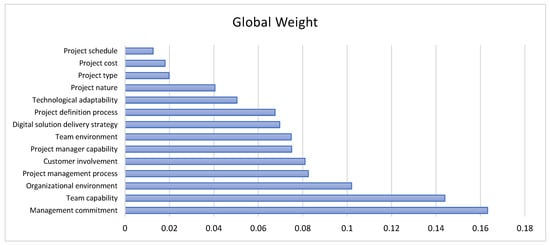
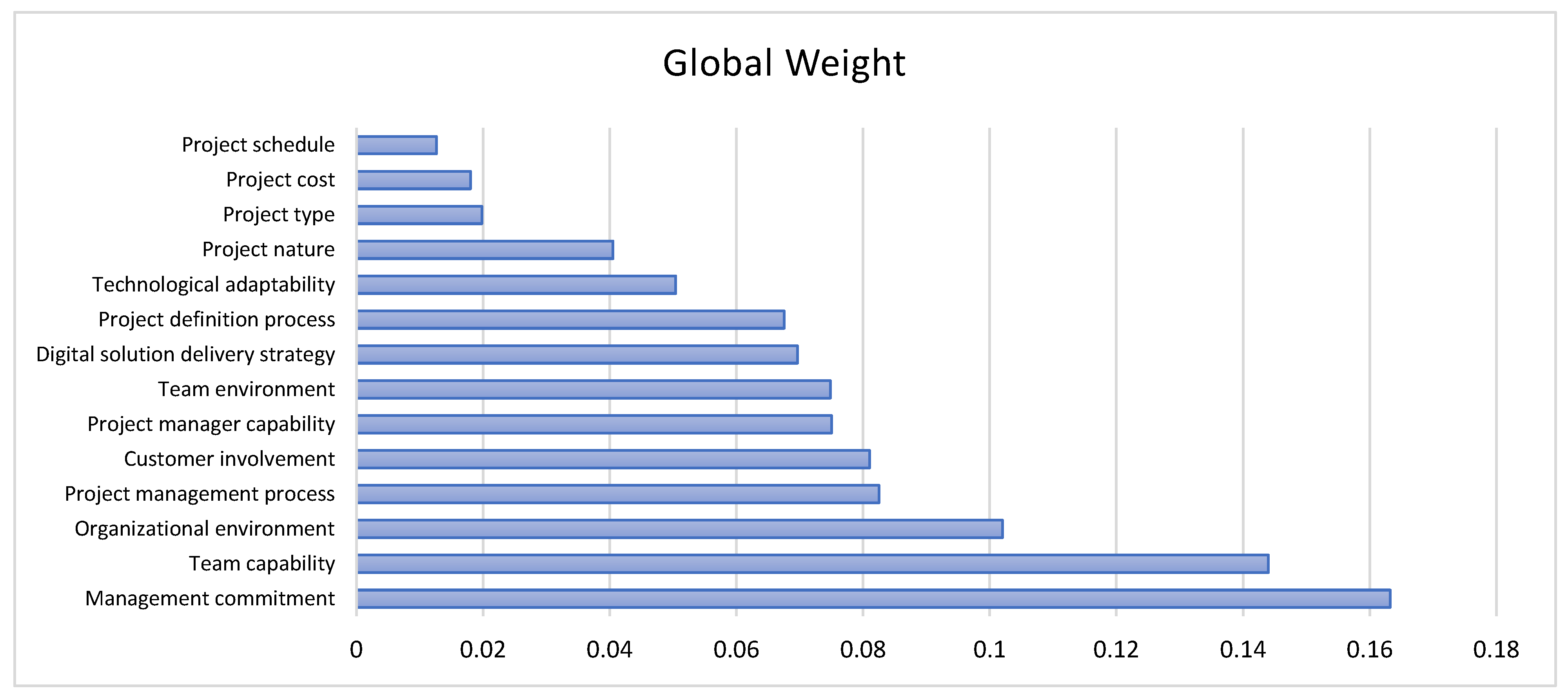
To derive a comprehensive view of the critical success factors (CSFs) influencing digital transformation, the global weight of each sub-factor was calculated by multiplying its local weight by the weight of its parent category. This aggregation provided a ranked list of CSFs that reflects their overall significance across all evaluated dimensions, see Table 7 and Figure 1.
Table 7.
Global ranking of critical success factor.
Figure 1.
Rank of subfactors.
Accordingly, the global weights were categorized into three tiers, including critical factors, important factors, and lower-priority factors.
Critical factors (Rank 1–3) represent the most influential elements for agile-based digital transformation (DT) success. These are management commitment (C1), team capability (C4), and organizational environment (C2). Together, they highlight the foundational role of strategic leadership, skilled teams, and supportive cultural and structural contexts in enabling agile transformation. These factors form the core of organizational readiness, ensuring alignment, commitment, and capacity at the outset of change initiatives.
Important factors (Rank 4–10) act as essential operational enablers, supporting but not individually driving transformation outcomes. This category includes the project management process (C7) and customer involvement (C5)—both crucial for maintaining adaptive planning and end-user focus. It also encompasses project manager capability (C6), team environment (C3), digital solution delivery strategy (C10), project definition process (C8), and technological adaptability (C9). These factors collectively represent the agile delivery layer, where technical systems and social practices converge to execute transformation initiatives responsively and iteratively.
Lower-priority factors (Rank 11–14) show limited strategic influence in this context. These included project nature (C11), project type (C12), project cost (C14), and project schedule (C13). While still relevant, their lower ranking suggests that traditional project parameters are perceived as less critical compared to dynamic, human-centric, and organizational enablers in agile-based digital transformation initiatives.
This prioritization can guide organizations in allocating resources, designing change strategies, and setting realistic expectations for digital transformation initiatives.
5. Discussion
The findings of this study identified a hierarchy of critical, important, and lower-priority factors contributing to the success of agile-based DT initiatives. This distribution reveals a layered system of interdependences that closely aligns with STS theory. As originally conceptualized by Emery and Trist [54], STS emphasizes that technological tools and innovations can only deliver sustainable value when embedded within supportive social systems. These systems are defined by complex interactions between people (the social components), technical tools and methods (the technical components), and the broader organizational environment [81].
STS posits that both social and technical dimensions must be jointly optimized for successful change [82]. In DT, this principle is particularly salient, as DT entails not only the adoption of new technologies, but also deep shifts in organizational structures, roles, and governance practices [34,35,37,38]. Prior research has acknowledged the multidimensional nature of DT and has identified a wide array of CSFs. However, these studies often treated CSFs as discrete or sector-specific variables, lacking a unified framework that reflects their systemic interdependence.
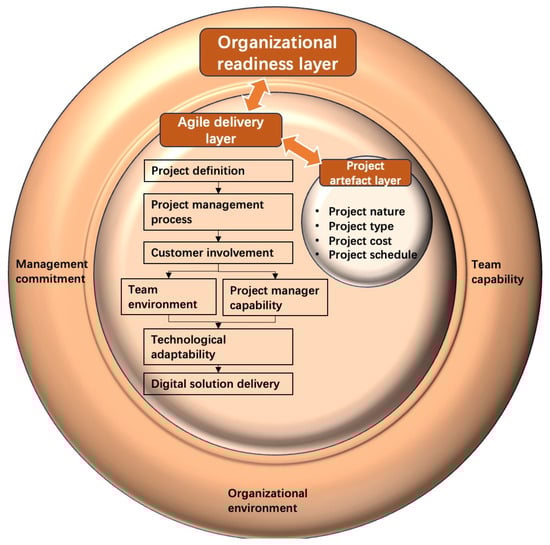
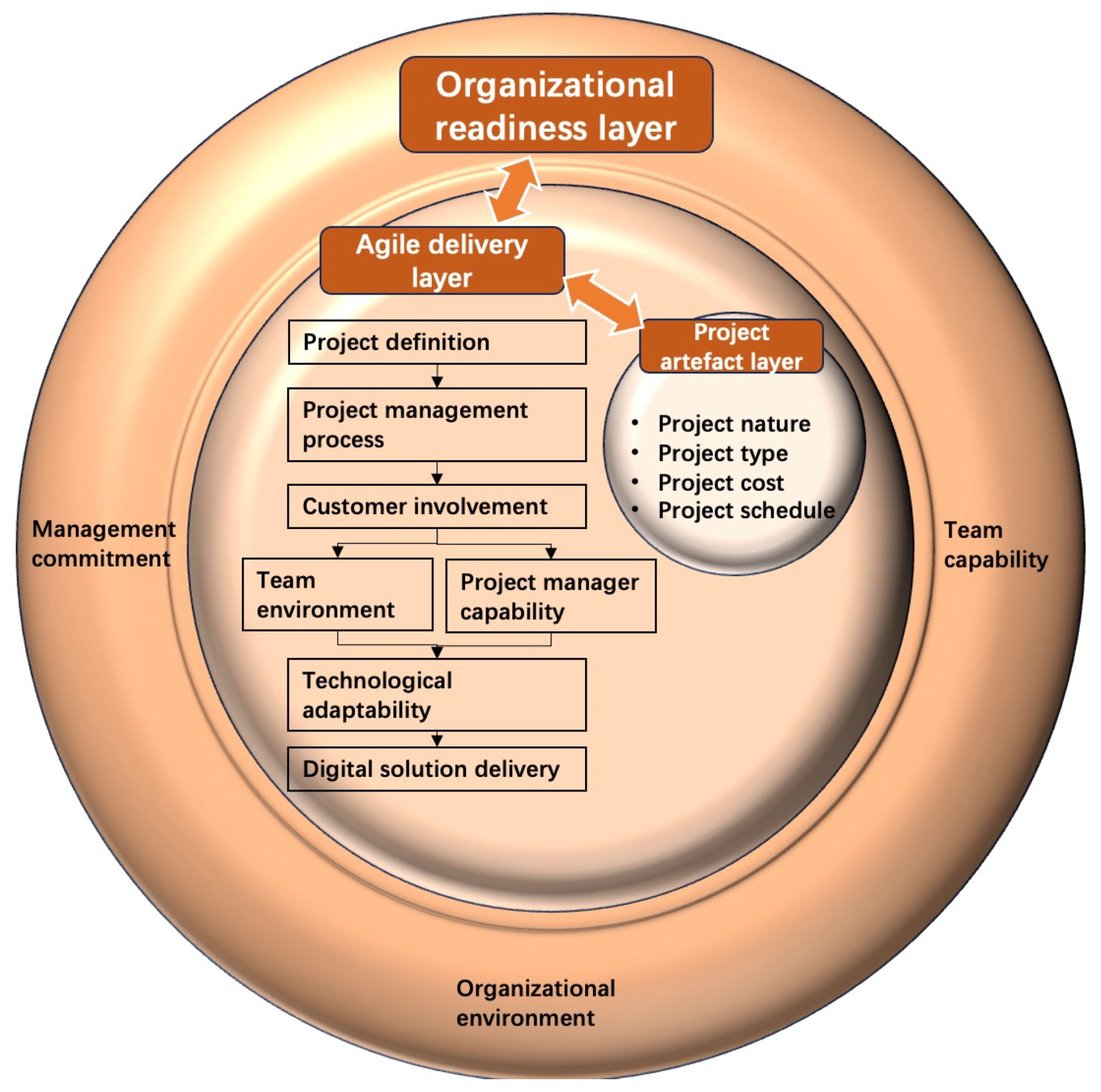
Our study advances this discourse by integrating diverse success factors from across 17 empirical and conceptual studies and validating them through a structured Delphi-AHP approach. This process yielded a hierarchy of 14 sub-factors that map onto three interrelated layers—organizational readiness, agile delivery, and project artefacts, as shown in Figure 2. This layered framework offers a novel contribution by aligning the empirical findings with the core logic of STS theory, revealing how the outer structural enablers condition the effectiveness of the inner technical processes.
Figure 2.
Layered structure of critical success factors in agile-based digital transformation projects.
Unlike previous literature, has which tended to emphasize isolated dimensions of success, our framework captures the dynamic interplay among social, technical, and procedural elements in agile-based DT projects. It thus provides both a theoretical advancement in operationalizing STS principles and practical guidance for managers seeking to prioritize transformation efforts in a holistic, system-aware manner.
The outermost layer of our proposed framework—Organizational Readiness—represents the foundational enablers of agile-based digital transformation (DT). This layer encompasses key factors such as management commitment, team capability, and the broader organizational environment. These dimensions reflect an organization’s strategic alignment, cultural adaptability, and institutional capacity to support agile practices at scale. Guided by socio-technical systems (STS) theory—which emphasizes the joint optimization of technical and social subsystems for sustainable transformation [83,84]—this layer constitutes the critical social infrastructure that allows agile methodologies to be effectively embedded and sustained. Agile tools and processes alone are insufficient when implemented within rigid hierarchies or misaligned governance structures.
This theoretical framing is consistently reinforced by the reviewed empirical literature. Marino-Romero et al. [25] highlighted that digital transformation requires leadership engagement, managerial risk acceptance, and strategic clarity (C1), alongside decentralized decision-making and productivity-focused agility (C2). Similarly, Gertzen et al. [23] identified strategic alignment and enhanced decision-making as key drivers of success (C1, C2), while also underscoring workforce reskilling as a crucial enabler (C4). Tuncel et al. [64] stressed change orientation and value-driven leadership (C1), as well as autonomy, collaboration, and psychological safety (C2, C4), as essential to transformation. Andrade et al. [68] elaborated practical readiness mechanisms, including HR restructuring, agile climate assessment, and the institutionalization of agile values (C1, C2). These findings were echoed by Baier et al. [53], who emphasized innovation-oriented cultures and top management support (C1, C2), along with the importance of team knowledge (C4). Carroll et al. [26] added that early competence development, clear communication, and active stakeholder engagement can help differentiate transformation goals and support collective learning (C1, C4). Collectively, these studies affirm that organizational readiness—anchored in coherent governance, integrative authority structures, and cross-functional alignment practices—is vital for enabling agile adaptability, particularly in highly regulated or complex environments [10,42,55].
From a managerial perspective, these insights reinforce that the success of agile-based DT extends beyond the adoption of agile tools or ceremonies. It requires the cultivation of a strategically aligned, culturally adaptive, and structurally agile environment. Leaders should begin by conducting organizational diagnostics to assess readiness across key dimensions—such as leadership commitment, governance adaptability, and team capability. This entails securing top-level sponsorship, reconfiguring decision structures to support agility, and promoting cross-functional collaboration, to facilitate cultural change.
The middle layer, Agile Delivery, represents the operational engine of transformation, where strategic intent is translated into iterative, user-centered execution. Encompassing elements such as project management processes, customer involvement, project manager capability, team environment, digital solution delivery strategy, project definition, and technological adaptability, this layer reflects the dynamic, cross-functional coordination required for agile success. Rather than following static templates, Agile Delivery is inherently adaptive—governance, feedback, and responsiveness must continuously interact to operationalize transformation within evolving contexts.
Our findings confirm that agile delivery teams function as decentralized, empowered agents navigating between top-level directives and emergent project complexities [43]. This aligns with socio-technical systems (STS) theory, which emphasizes that effective transformation depends on the integration of social components (e.g., team dynamics, communication routines) and technical elements (e.g., tools, processes) [82]. Across the literature, this interdependence is consistently highlighted. For example, Bandara et al. [20] and Cordeiro et al. [21] emphasize the criticality of robust project management capabilities and leadership development (C6), while Kudyba and Cruz [17] highlight the operational value of structured agile mechanisms—such as scrums, MVPs, and iterative dashboards—that help teams respond fluidly to changing project needs (C7). These mechanisms not only support delivery speed and alignment but also reinforce feedback-driven governance.
Customer involvement is another cornerstone of agile delivery, underscored by Ivanov [22], Cordeiro et al. [21], and Gertzen et al. [23], who detailed practices such as embedded user feedback, co-design processes, and omnichannel integration (C5). These studies collectively affirm that stakeholder engagement is not a supplementary activity, but a fundamental driver of responsiveness and relevance in agile projects. Equally important is technological adaptability—described by Wolf et al. [65] and Gertzen et al. [23] through concepts like digital platform integration, AI-enabled decision systems, and mobile toolkits (C9, C10). These tools are not just enablers of speed but serve as platforms for real-time coordination and organizational learning.
From a managerial perspective, these insights suggest that agile delivery cannot be achieved through process adoption alone. Leaders must proactively cultivate environments that support adaptive delivery by embedding agile-enabling structures—such as decentralized leadership, iterative scoping, real-time data integration, and team empowerment. Training investments should target both technical fluency and collaborative behaviors, while project scoping should remain fluid, to accommodate evolving goals and insights. As Dong et al. [10] argued, agile delivery mechanisms provide the connective infrastructure that binds local autonomy with strategic coherence, allowing organizations to continuously innovate, without losing sight of broader transformation objectives. In this sense, the Agile Delivery layer embodies the socio-technical core of transformation—where human capabilities, technological fluidity, and procedural frameworks converge to drive successful and sustainable change.
The innermost layer, Project Artefact, includes project nature, type, cost, and schedule—dimensions traditionally treated as fixed metrics in project management. However, in agile-based digital transformation, these artefacts function more fluidly as adaptive coordination mechanisms. Drawing on STS theory, their effectiveness is contingent not only on technical accuracy, but on their contextual integration within social systems and organizational processes [85,86].
Multiple studies affirm this dynamic interpretation. For instance, Gertzen et al. [23] frame artefacts like ROI, payback period, and project cost as evolving indicators that reflect digital maturity and strategic shifts, rather than static baselines. Guinan et al. [66] emphasize how funding pitches and cost projections adapt over time, highlighting the iterative nature of project artefacts in entrepreneurial settings. Similarly, Li et al. [69] demonstrate how budgeting and resource allocation are shaped by environmental uncertainty and external opportunity structures, showing artefacts as tools for ongoing sensemaking. Baier et al. [53] stress the role of goal clarity and project monitoring, not as rigid control points, but as elements within feedback-driven agile processes.
These perspectives support our theoretical stance that project artefacts are not standalone technical deliverables but socio-technical instruments—constantly reinterpreted through interaction with stakeholders, evolving technologies, and institutional dynamics. From a managerial standpoint, this implies a shift from compliance-oriented control to adaptive project governance. Managers should promote flexible review cycles, enable transparent communication about evolving constraints, and support project leaders in reframing artefacts in response to strategic realignment. Ultimately, when treated as living instruments embedded in a broader system, project artefacts can serve as critical enablers of agile transformation and organizational adaptability.
6. Conclusions
This study examined the CSFs for agile-based DT, addressing a significant research gap concerning the intersection between organizational agility and digital innovation. By systematically reviewing 17 empirical and conceptual studies and adapting Chow and Cao’s [61] framework, we identified five overarching CSF dimensions—organizational, people, process, technical, and project-related—comprising 14 specific sub-factors, including management commitment, team capability, and digital solution delivery strategy. These factors were evaluated using a Delphi-informed AHP, which engaged expert participants to assess their relative importance.
The results reveal a clear prioritization: organizational and people-related factors—particularly management commitment, team capability, and organizational environment—are perceived as significantly more influential than technical or project-specific dimensions. This finding aligns with STS theory, which posits that technological change must be embedded within supportive social and organizational structures to achieve sustainable transformation. Our prioritization thus reinforces the view that digital transformation success depends not solely on tools and technologies, but on leadership, cultural readiness, and human capability.
Based on these findings, we proposed a conceptual framework comprising three interdependent layers: organizational readiness, agile delivery, and project artefacts. The outer layer encompasses foundational enablers, such as leadership engagement, cultural fit, and team capacity. The middle layer captures agile delivery mechanisms, including collaborative team environments, adaptive planning, and digital execution strategies. The innermost layer comprises conventional project elements, such as cost, schedule, and project type. This layered model reflects the systemic interdependencies emphasized in STS theory, highlighting how outer organizational structures condition the effectiveness of inner technical and procedural processes.
This study offers significant contributions to both theory and practice in the domain of agile-based DT. Theoretically, it fills a critical gap by systematically identifying and prioritizing CSFs. While prior research has acknowledged the multidimensional nature of DT, existing studies often treat CSFs as isolated or sector-specific. Our study advances this discourse by synthesizing these factors into a unified, empirically validated, and theoretically grounded framework, comprising three interrelated layers: organizational readiness, agile delivery, and project artefacts. This layered model operationalizes STS theory in a digital transformation context, illustrating how social, procedural, and technical elements interact dynamically. In doing so, it bridges fragmented literatures, across agile project management, digital innovation, and organizational change.
Practically, the framework offers transformation leaders a strategic diagnostic tool. The prioritization results highlight the dominant influence of leadership commitment, cultural adaptability, and team capability—suggesting that agile transformation requires more than technical readiness; it demands deeply embedded organizational support. The middle layer, focusing on agile delivery mechanisms such as adaptive governance and stakeholder alignment, offers actionable guidance for managing operational complexity. Furthermore, by reframing traditional project artefacts (e.g., cost, scope, and schedule) as flexible coordination tools, rather than static benchmarks, the study encourages adaptive project governance, suited to volatile environments. Collectively, the findings can help organizations assess their transformation readiness, allocate resources effectively, and steer digital change with greater agility and systemic awareness.
Despite the contributions of this study, several limitations should be acknowledged. First, although the literature reviewed covers a broad spectrum of organizational contexts—including public and private sectors, as well as manufacturing and service-based organizations—the study did not conduct a comparative analysis across these domains. This inclusive scope was intended to identify generalizable success factors applicable across digital transformation settings. However, it limited the ability to examine sector-specific variations in how critical success factors interact. Future research should explore these differences by adopting comparative or sector-focused designs.
Second, while the use of expert judgement through the Delphi method added rigor, the relatively small panel size may affect the generalizability of the results. Expanding the expert pool across diverse industries, roles, and regions could improve the robustness of the prioritization framework.
Finally, the current study is cross-sectional and relies on expert perception, rather than longitudinal evidence. Future research should consider longitudinal or mixed-method approaches, to examine causal relationships among CSFs and evaluate the framework’s applicability over time and in evolving organizational environments.
In summary, this study offers a theoretically grounded and practically relevant model for understanding and managing agile-based digital transformation, serving both as a foundation for future academic inquiry and a strategic guide for practitioners navigating complex transformation landscapes.
Author Contributions
M.C.: Conceptualization, Data curation, Writing—original draft preparation. X.S.: Conceptualization, Methodology; M.L.: Methodology, Writing—review and editing. All authors have read and agreed to the published version of the manuscript.
Funding
This research received no external funding.
Data Availability Statement
The data presented in this study can be provided by the corresponding author upon reasonable request.
Acknowledgments
During the preparation of this manuscript, the authors used ChatGPT (OpenAI, GPT-4) for the purposes of language polishing. The authors have reviewed and edited the output and take full responsibility for the content of this publication.
Conflicts of Interest
The authors declare no conflicts of interest.
Abbreviations
The following abbreviations are used in this manuscript:
| DT | Digital transformation |
| CSFs | Critical success factors |
| AHP | Analytic hierarchy process |
| STS | Socio-technical systems |
| APM | Agile project management |
| TPM | Traditional project management |
| CI | Consistency index |
| CR | Consistency ratio |
| LW | Local weights |
References
- Correani, A.; De Massis, A.; Frattini, F.; Petruzzelli, A.M.; Natalicchio, A. Implementing a Digital Strategy: Learning from the Experience of Three Digital Transformation Projects. Calif. Manag. Rev. 2020, 62, 37–56. [Google Scholar] [CrossRef] [Scilit]
- Matt, C.; Hess, T.; Benlian, A. Digital Transformation Strategies. Bus. Inf. Syst. Eng. 2015, 57, 339–343. [Google Scholar] [CrossRef] [Scilit]
- Vial, G. Understanding digital transformation: A review and a research agenda. J. Strateg. Inf. Syst. 2019, 28, 118–144. [Google Scholar] [CrossRef] [Scilit]
- Dacre, N.; Kockum, F. Artificial Intelligence in Project Management: A Review of AI’s Usefulness and Future Considerations for the Project Profession; Association for Project Management: Princes Risborough, UK, 2022. [Google Scholar] [CrossRef] [Scilit]
- Sun, Y.; Tell, F. Tensions in Digital Transformation: How Prototype Work Links the Temporary and the Permanent. Proj. Manag. J. 2025, 56, 358–374. [Google Scholar] [CrossRef] [Scilit]
- Moschko, L.; Blazevic, V.; Piller, F.T. Paradoxes of implementing digital manufacturing systems: A longitudinal study of digital innovation projects for disruptive change. J. Product. Innov. Manag. 2023, 40, 506–529. [Google Scholar] [CrossRef] [Scilit]
- Shen, Y.; Brookes, N.; Flores, L.L.; Brettschneider, J. Data analytics for project delivery: Unlocking the potential of an emerging field. Int. J. Manag. Proj. Bus. 2024, 17, 302–337. [Google Scholar] [CrossRef] [Scilit]
- Stacey, P.; Nandhakumar, J. Opening up to agile games development. Commun. ACM 2008, 51, 143–146. [Google Scholar] [CrossRef] [Scilit]
- Leybourne, S.A. Improvisation and agile project management: A comparative consideration. Int. J. Manag. Proj. Bus. 2009, 2, 519–535. [Google Scholar] [CrossRef] [Scilit]
- Dong, H.; Dacre, N.; Baxter, D.; Ceylan, S. What is Agile Project Management? Developing a New Definition Following a Systematic Literature Review. Proj. Manag. J. 2024, 55, 668–688. [Google Scholar] [CrossRef] [Scilit]
- Shaba, E.; Guerci, M.; Canterino, F.; Gilardi, S.; Cagliano, R.; Bartezzaghi, E. Adopting an Ecosystem Approach to Digitalization-driven Organizational Change? Actionable Knowledge from a Collaborative Project. Syst. Pract. Action. Res. 2023, 36, 877–896. [Google Scholar] [CrossRef] [Scilit]
- Bianchi, M.; Marzi, G.; Dabic, M. Guest Editorial: Agile Beyond Software—In Search of Flexibility in a Wide Range of Innovation Projects and Industries. IEEE Trans. Eng. Manag. 2022, 69, 3454–3458. [Google Scholar] [CrossRef] [Scilit]
- Appio, F.P.; Frattini, F.; Petruzzelli, A.M.; Neirotti, P. Digital Transformation and Innovation Management: A Synthesis of Existing Research and an Agenda for Future Studies. J. Prod. Innov. Manag. 2021, 38, 4–20. [Google Scholar] [CrossRef] [Scilit]
- Conforto, E.C.; Salum, F.; Amaral, D.C.; da Silva, S.L.; de Almeida, L.F.M. Can Agile Project Management be Adopted by Industries Other than Software Development? Proj. Manag. J. 2014, 45, 21–34. [Google Scholar] [CrossRef] [Scilit]
- Sherehiy, B.; Karwowski, W. The relationship between work organization and workforce agility in small manufacturing enterprises. Int. J. Ind. Ergon. 2014, 44, 466–473. [Google Scholar] [CrossRef] [Scilit]
- Cockburn, A.; Highsmith, J. Agile software development, the people factor. Computer 2001, 34, 131–133. [Google Scholar] [CrossRef] [Scilit]
- Kudyba, S.; Cruz, A.D. Understanding project success involving analytic-based decision support in the digital era: A focus on IC and agile project management. J. Intellect. Capital. 2023, 24, 1429–1446. [Google Scholar] [CrossRef] [Scilit]
- Mumford, E. The story of socio-technical design: Reflections on its successes, failures and potential. Inf. Syst. J. 2006, 16, 317–342. [Google Scholar] [CrossRef] [Scilit]
- Cardoso, J.; Rhodes, D.; Rebentisch, E. Enterprise Digital Transformation using a Sociotechnical System Approach. INCOSE Int. Symp. 2023, 33, 448–462. [Google Scholar] [CrossRef] [Scilit]
- Bandara, W.; Gable, G.G.; Tate, M.; Rosemann, M. A validated business process modelling success factors model. Bus. Process Manag. J. 2021, 27, 1522–1544. [Google Scholar] [CrossRef] [Scilit]
- Cordeiro, G.A.; Ebi, C.N.O.; Ordóñez, R.E.C. Proposal of Maturity Assessment to Support Projects in Digital Transformation: Initiatives in the Brazilian Context. Syst. Eng. 2025. [Google Scholar] [CrossRef] [Scilit]
- Ivanov, I.I. Chasing the Crowd: Digital Transformations and the Digital Driven System Design Paradigm. In Business Modeling and Software Design: 9th International Symposium, BMSD 2019, Lisbon, Portugal, 1–3 July 2019; Proceedings; Shishkov, B., Ed.; Springer: Cham, Switzerland, 2019; pp. 64–80. [Google Scholar] [CrossRef] [Scilit]
- Gertzen, W.M.; Van der Lingen, E.; Steyn, H. Goals and benefits of digital transformation projects: Insights into project selection criteria. S. Afr. J. Econ. Manag. Sci. 2022, 25, 13. [Google Scholar] [CrossRef] [Scilit]
- Troise, C.; Corvello, V.; Ghobadian, A.; O’Regan, N. How can SMEs successfully navigate VUCA environment: The role of agility in the digital transformation era. Technol. Forecast. Soc. Change 2022, 174, 121227. [Google Scholar] [CrossRef] [Scilit]
- Marino-Romero, J.A.; Palos-Sanchez, P.R.; Velicia-Martin, F. Improving KIBS performance using digital transformation: Study based on the theory of resources and capabilities. J. Serv. Theory Pract. 2023, 33, 169–197. [Google Scholar] [CrossRef] [Scilit]
- Carroll, N.; Bjørnson, F.O.; Dingsøyr, T.; Rolland, K.-H.; Conboy, K. Operationalizing Agile Methods: Examining Coherence in Large-Scale Agile Transformations. In Agile Processes in Software Engineering and Extreme Programming—Workshops: XP 2020 Workshops, Copenhagen, Denmark, 8–12 June 2020, Revised Selected Papers; Springer: Cham, Switzerland, 2020; pp. 75–83. [Google Scholar] [CrossRef] [Scilit]
- Kockum, F.; Dacre, N. Project Management Volume, Velocity, Variety: A Big Data Dynamics Approach. SSRN Electron. J. 2021, 21, 1–6. [Google Scholar] [CrossRef] [Scilit]
- Bharadwaj, A.; El Sawy, O.A.; Pavlou, P.A.; Venkatraman, N. Digital Business Strategy: Toward a Next Generation of Insights. MIS Q. 2013, 37, 471–482. [Google Scholar] [CrossRef] [Scilit]
- Verhoef, P.C.; Broekhuizen, T.; Bart, Y.; Bhattacharya, A.; Dong, J.Q.; Fabian, N.; Haenlein, M. Digital transformation: A multidisciplinary reflection and research agenda. J. Bus. Res. 2021, 122, 889–901. [Google Scholar] [CrossRef] [Scilit]
- Wernicke, B.; Stehn, L.; Sezer, A.A.; Thunberg, M. Introduction of a digital maturity assessment framework for construction site operations. Int. J. Constr. Manag. 2023, 23, 898–908. [Google Scholar] [CrossRef] [Scilit]
- Gong, Z.; Dacre, N.; Dong, H. Fostering Digital Transformation through Project Integration Management. SSRN Electron. J. 2024. [Google Scholar] [CrossRef] [Scilit]
- Gobble, M.M. Digital Strategy and Digital Transformation. Res. Technol. Manag. 2018, 61, 66–71. [Google Scholar] [CrossRef] [Scilit]
- Nikmehr, B.; Hosseini, M.R.; Martek, I.; Zavadskas, E.K.; Antucheviciene, J. Digitalization as a Strategic Means of Achieving Sustainable Efficiencies in Construction Management: A Critical Review. Sustainability 2021, 13, 5040. [Google Scholar] [CrossRef] [Scilit]
- Bosch-Sijtsema, P.; Gluch, P. Challenging construction project management institutions: The role and agency of BIM actors. Int. J. Constr. Manag. 2021, 21, 1077–1087. [Google Scholar] [CrossRef] [Scilit]
- He, Q.; Wang, G.; Luo, L.; Shi, Q.; Xie, J.; Meng, X. Mapping the managerial areas of Building Information Modeling (BIM) using scientometric analysis. Int. J. Proj. Manag. 2017, 35, 670–685. [Google Scholar] [CrossRef] [Scilit]
- Elbanna, A.; Newman, M. The bright side and the dark side of top management support in Digital Transformaion –A hermeneutical reading. Technol. Forecast. Soc. Change 2022, 175, 121411. [Google Scholar] [CrossRef] [Scilit]
- Nelson, R.R. Transforming to Digital Product Management. MIS Q. Exec. 2024, 23, 1–18. [Google Scholar] [CrossRef] [Scilit]
- Wiedemann, A.; Wiesche, M.; Gewald, H.; Krcmar, H. Integrating development and operations teams: A control approach for DevOps. Inf. Organ. 2023, 33, 100474. [Google Scholar] [CrossRef] [Scilit]
- Kiani, A. Artificial intelligence in entrepreneurial project management: A review, framework and research agenda. Int. J. Manag. Proj. Bus. 2024; ahead of print. [CrossRef] [Scilit]
- Bergmann, T.; Karwowski, W. Agile Project Management and Project Success: A Literature Review. In Advances in Human Factors, Business Management and Society: Proceedings of the AHFE 2018 International Conference on Human Factors, Business Management and Society, 21–25 July 2018, Loews Sapphire Falls Resort at Universal Studios, Orlando, Florida, USA; Springer: Cham, Switzerland, 2019; pp. 405–414. [Google Scholar] [CrossRef] [Scilit]
- Dybå, T.; Dingsøyr, T.; Moe, N.B. Agile Project Management. In Software Project Management in a Changing World; Springer: Berlin/Heidelberg, Germany, 2014; pp. 277–300. [Google Scholar] [CrossRef] [Scilit]
- Baxter, D.; Dacre, N.; Dong, H.; Ceylan, S. Institutional challenges in agile adoption: Evidence from a public sector IT project. Gov. Inf. Q. 2023, 40, 101858. [Google Scholar] [CrossRef] [Scilit]
- Sweetman, R.; Conboy, K. Portfolios of Agile Projects. Proj. Manag. J. 2018, 49, 18–38. [Google Scholar] [CrossRef] [Scilit]
- Zhang, W.; Xu, X. Six Sigma and Information Systems Project Management: A Revised Theoretical Model. Proj. Manag. J. 2008, 39, 59–74. [Google Scholar] [CrossRef] [Scilit]
- Rockart, J.F. Chief executives define their own data needs. Harv. Bus. Rev. 1979, 57, 81–93. [Google Scholar]
- Campiranon, K.; Scott, N. Critical Success Factors for Crisis Recovery Management: A Case Study of Phuket Hotels. J. Travel. Tour. Mark. 2014, 31, 313–326. [Google Scholar] [CrossRef] [Scilit]
- Milosevic, D.; Patanakul, P. Standardized project management may increase development projects success. Int. J. Proj. Manag. 2005, 23, 181–192. [Google Scholar] [CrossRef] [Scilit]
- Alias, Z.; Zawawi, E.M.A.; Yusof, K.; Aris, N.M. Determining Critical Success Factors of Project Management Practice: A Conceptual Framework. Procedia Soc. Behav. Sci. 2014, 153, 61–69. [Google Scholar] [CrossRef] [Scilit]
- Fortune, J.; White, D. Framing of project critical success factors by a systems model. Int. J. Proj. Manag. 2006, 24, 53–65. [Google Scholar] [CrossRef] [Scilit]
- Leidecker, J.K.; Bruno, A.V. Identifying and using critical success factors. Long. Range Plan. 1984, 17, 23–32. [Google Scholar] [CrossRef] [Scilit]
- Freund, Y.P. Critical success factors. Plan. Rev. 1988, 16, 20–23. [Google Scholar] [CrossRef] [Scilit]
- Wuni, I.Y.; Shen, G.Q. Critical success factors for modular integrated construction projects: A review. Build. Res. Inf. 2020, 48, 763–784. [Google Scholar] [CrossRef] [Scilit]
- Baier, M.-S.; Lockl, J.; Röglinger, M.; Weidlich, R. Success factors of process digitalization projects—Insights from an exploratory study. Bus. Process. Manag. J. 2022, 28, 325–347. [Google Scholar] [CrossRef] [Scilit]
- Emery, F.E.; Trist, E.L. Socio-technical systems. Manag. Sci. Models Tech. 1960, 2, 83–97. [Google Scholar]
- Grall, M.; Charue-Duboc, F.; BenMahmoud-Jouini, S. Bridging Project Management and Design Thinking: Evidence from Digital Transformation Projects. Proj. Manag. J. 2025, 56, 390–410. [Google Scholar] [CrossRef] [Scilit]
- Pinto, J.K.; Slevin, D.P. Critical factors in successful project implementation. IEEE Trans. Eng. Manag. 1987, EM-34, 22–27. [Google Scholar] [CrossRef] [Scilit]
- Shenhar, A.J.; Dvir, D.; Levy, O.; Maltz, A.C. Project Success: A Multidimensional Strategic Concept. Long Range Plan. 2001, 34, 699–725. [Google Scholar] [CrossRef] [Scilit]
- PMI. A Guide to the Project Management Body of Knowledge (PMBOK® Guide), 7th ed.; Project Management Institute: Newtown Square, PA, USA, 2021. [Google Scholar]
- Waterman, R.H.; Peters, T.J.; Phillips, J.R. Structure is not organization. Bus. Horiz. 1980, 23, 14–26. [Google Scholar] [CrossRef] [Scilit]
- The Open Group. TOGAF® Version 9.2—The Open Group Architecture Framework; Van Haren Publishing: Zaltbommel, The Netherlands, 2018. [Google Scholar]
- Chow, T.; Cao, D.-B. A survey study of critical success factors in agile software projects. J. Syst. Softw. 2008, 81, 961–971. [Google Scholar] [CrossRef] [Scilit]
- Duvivier, F.; Gupta, G. Unleashing Digital Agility. J. Glob. Inf. Manag. 2023, 31, 1–22. [Google Scholar] [CrossRef] [Scilit]
- Tronvoll, B.; Sklyar, A.; Sörhammar, D.; Kowalkowski, C. Transformational shifts through digital servitization. Ind. Mark. Manag. 2020, 89, 293–305. [Google Scholar] [CrossRef] [Scilit]
- Tuncel, D.; Körner, C.; Plösch, R. Setting the Scope for a New Agile Assessment Model: Results of an Empirical Study. In Agile Processes in Software Engineering and Extreme Programming: 22nd International Conference on Agile Software Development, XP 2021, Virtual Event, 14–18 June 2021; Proceedings; Springer: Cham, Switzerland, 2021; pp. 55–70. [Google Scholar] [CrossRef] [Scilit]
- Wolf, M.; Semm, A.; Erfurth, C. Digital Transformation in Companies—Challenges and Success Factors. In Innovations for Community Services: 18th International Conference, I4CS 2018, Žilina, Slovakia, 18–20 June 2018; Proceedings; Springer: Cham, Switzerland, 2018; pp. 178–193. [Google Scholar] [CrossRef] [Scilit]
- Guinan, P.J.; Parise, S.; Langowitz, N. Creating an innovative digital project team: Levers to enable digital transformation. Bus. Horiz. 2019, 62, 717–727. [Google Scholar] [CrossRef] [Scilit]
- Reginaldo, F.; Santos, G. Challenges in Agile Transformation Journey. In Proceedings of the XXXIV Brazilian Symposium on Software Engineering, Natal, Brazil, 19–23 October 2020; ACM: New York, NY, USA, 2020; pp. 11–20. [Google Scholar] [CrossRef] [Scilit]
- Andrade, Á.J.D.C.; Mattos, C.S.; Fortuna, A.; Ramos, L.F.; Santos, R.P.D.; Santos, G. Critical Success Factors of Agile Transformation Initiatives from a Project Management Perspective. In Proceedings of the XIX Brazilian Symposium on Information Systems, Maceió, Brazil, 29 May–1 June 2023; ACM: New York, NY, USA, 2023; pp. 443–450. [Google Scholar] [CrossRef] [Scilit]
- Li, F.; Long, J.; Zhao, W. Mining Braces of Innovation Linking to Digital Transformation Grounded in TOE Framework. Sustainability 2022, 15, 301. [Google Scholar] [CrossRef] [Scilit]
- Arslan, A.; Al Kharusi, S.; Hussain, S.M.; Alo, O. Sustainable entrepreneurship development in Oman: A multi-stakeholder qualitative study. Int. J. Organ. Anal. 2023, 31, 35–59. [Google Scholar] [CrossRef] [Scilit]
- Marshall, G. The purpose, design and administration of a questionnaire for data collection. Radiography 2005, 11, 131–136. [Google Scholar] [CrossRef] [Scilit]
- Dalkey, N.; Helmer, O. An Experimental Application of the DELPHI Method to the Use of Experts. Manag. Sci. 1963, 9, 458–467. [Google Scholar] [CrossRef] [Scilit]
- Laakso, K.; Rubin, A.; Linturi, H. The role of regulation in the mobile operator business in Finland. Foresight 2012, 14, 154–167. [Google Scholar] [CrossRef] [Scilit]
- Geist, M.R. Using the Delphi method to engage stakeholders: A comparison of two studies. Eval. Program. Plan. 2010, 33, 147–154. [Google Scholar] [CrossRef] [Scilit]
- Nworie, J. Using the Delphi Technique in Educational Technology Research. TechTrends 2011, 55, 24–30. [Google Scholar] [CrossRef] [Scilit]
- Sourani, A.; Sohail, M. The Delphi Method: Review and Use in Construction Management Research. Int. J. Constr. Educ. Res. 2015, 11, 54–76. [Google Scholar] [CrossRef] [Scilit]
- Etikan, I. Sampling and Sampling Methods. Biom. Biostat. Int. J. 2017, 5, 00149. [Google Scholar] [CrossRef] [Scilit]
- Bhardwaj, P. Types of sampling in research. J. Pract. Cardiovasc. Sci. 2019, 5, 157. [Google Scholar] [CrossRef] [Scilit]
- Barrett, D.; Heale, R. What are Delphi studies? Evid. Based Nurs. 2020, 23, 68–69. [Google Scholar] [CrossRef] [Scilit]
- Saaty, R.W. The analytic hierarchy process—What it is and how it is used. Math. Model. 1987, 9, 161–176. [Google Scholar] [CrossRef] [Scilit]
- Trist, E.L.; Bamforth, K.W. Some Social and Psychological Consequences of the Longwall Method of Coal-Getting. Hum. Relat. 1951, 4, 3–38. [Google Scholar] [CrossRef] [Scilit]
- Maguire, M. Socio-technical systems and interaction design—21st century relevance. Appl. Ergon. 2014, 45, 162–170. [Google Scholar] [CrossRef] [Scilit]
- Walker, G.H.; Stanton, N.A.; Salmon, P.M.; Jenkins, D.P.; Rafferty, L. Translating concepts of complexity to the field of ergonomics. Ergonomics 2010, 53, 1175–1186. [Google Scholar] [CrossRef] [Scilit]
- Sony, M.; Naik, S. Industry 4.0 integration with socio-technical systems theory: A systematic review and proposed theoretical model. Technol. Soc. 2020, 61, 101248. [Google Scholar] [CrossRef] [Scilit]
- van Raay, A.; Cooper, V.; Sharp, R.; Duan, S.; Dick, M. In Pursuit of Agility: How to Transform Your Organisation’s IT Project Selection Process. Inf. Syst. J. 2025. [Google Scholar] [CrossRef] [Scilit]
- Chatterjee, S.; Moody, G.D.; Lowry, P.B.; Chakraborty, S.; Hardin, A. The Nonlinear Influence of Harmonious Information Technology Affordance on Organizational Innovation. SSRN Electron. J. 2020, 31, 294–322. [Google Scholar] [CrossRef] [Scilit]

Disclaimer/Publisher’s Note: The statements, opinions and data contained in all publications are solely those of the individual author(s) and contributor(s) and not of MDPI and/or the editor(s). MDPI and/or the editor(s) disclaim responsibility for any injury to people or property resulting from any ideas, methods, instructions or products referred to in the content. |
© 2025 by the authors. Licensee MDPI, Basel, Switzerland. This article is an open access article distributed under the terms and conditions of the Creative Commons Attribution (CC BY) license (https://creativecommons.org/licenses/by/4.0/).