


Abstract
The reasonable application of cross-domain knowledge tends to promote the generation of radical innovation. However, it is difficult to accurately capture the cross-domain knowledge needed for radical innovation. To solve this problem, this paper proposes a method for inspiring radical innovative design based on FOS and technological distance measurement. First, the functional analysis of the problem product is carried out to determine the target function. Second, the patent sets of problem domain and target domains are constructed based on FOS. Then, this study optimizes the method of technological distance measurement and uses it to determine the optimal target domain. After further categorizing and screening the patents contained in the optimal target domain, specific cross-domain knowledge is pushed to designers. This method can help firms select the most appropriate cross-domain knowledge to design solutions for different problems, thus increasing the possibility of generating radical innovation. In the end, the method is validated in the design of a stovetop cleaning device.
1. Introduction
In the fierce modern market competition, innovation is one of the primary mechanisms that allow for an enterprise to increase its competitiveness and ensure its long-term continuity in the market [1]. Radical innovation (RI) is the revolutionary improvement of a product or process with new technology, which has attracted extensive attention from the academic and industrial communities [2,3,4]. For example, 3D printing technology has dramatically increased productivity in traditional manufacturing [5]. Although many firms have been pursuing RI, most innovations remain incremental due to the lack of research from an ex ante perspective to guide firms in radical innovative design [6,7].
In new product development (NDP), the conceptual design stage plays a crucial role as it determines 70–80% of the cost, performance, and quality of the product [8,9]. RI begins with generating and developing radical concepts or ideas that provide a fresh solution to the problem [10]. Knowledge from outside the problem domain (cross-domain knowledge) is an essential inspiration for radical concept generation and development [11,12]. As a result, many scholars have focused on how to help firms acquire helpful knowledge from external sources to facilitate radical innovative design [13,14].
Function-oriented search (FOS), as a tool in the Theory of Inventive Problem Solving (TRIZ), can help companies acquire a large amount of cross-domain knowledge after generalizing a problem [15]. However, it is worth noting that not all cross-domain knowledge can inspire radical innovative designs, and further research is needed on choosing the optimal cross-domain knowledge. Some studies have introduced the concept of technological distance (TD) between firms, determining the suitability for knowledge transfer by calculating the differences in patents held by each firm [16]. This method provides a new idea to recommend appropriate cross-domain knowledge for large firms that have a large number of patents. However, for those small- and medium-sized enterprises (SMEs) that lack patent data, it is difficult for them to use the TD between them and other enterprises as a reference for knowledge transfer. As a result, there still needs to be a universal approach to help all types of firms capture and manage cross-domain knowledge to inspire radical innovative design.
To address the above issues, this paper attempts to establish a generalized methodology to inspire radical innovative design based on FOS and optimize the measurement of TD, which can help firms to select the most appropriate cross-domain knowledge and thus increase the possibility of RI generation. The rest of this paper is organized as follows: Section 2 reviews and summarizes the research on RI, FOS, and TD; Section 3 proposes a method for inspiring radical innovative designs, including the construction of patent sets based on FOS, optimization of TD measurement, determination of optimal target domains, and recommendation of patent schemes; Section 4 deals with a case study to validate the feasibility of the proposed method; and Section 5 discusses and summarizes the main contributions and research limitations of this paper and future research opportunities.
2. Related Research
2.1. Definition and Features of RI
The traditional dichotomy divides technological innovation into incremental innovation (II) and RI according to the different degrees of innovation [17]. As shown in Figure 1, the difference between RI and II can be understood with the help of technological S-curves. The whole process of II occurs on the same S-curve, such as the two curves a–b and c–d in Figure 1. A discontinuous break in the S-curve occurs from b to c, and a new S-curve is created and gradually replaces the current curve, which is the result of RI. Even though the performance of the new S-curve is not as superior as that of the current technology at the beginning, it will break through the performance limit of the current technology with time.
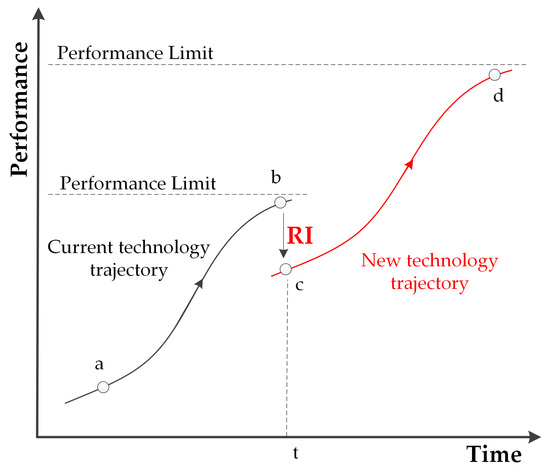
Figure 1.
S-curve: RI and II [18].
Over the past several decades, scholars in various fields have studied and defined RI from three perspectives, as shown in Table 1:

Table 1.
The definitions of relevant RI.
- (1)
- Focus on the antecedents of RI, including the novelty of the technology and scientific knowledge;
- (2)
- Focus on the cost, performance, function, and other significant changes in the product itself or entirely new features;
- (3)
- Focus on the macro impact on the industry and market, including the market layout, business model, and improving customer benefits.
Based on the above literature analysis, the recognized traits of RI are substantially consistent, involving technology breakthrough, performance change, and market breakthrough. Technology breakthrough means the core technology of the product changes. It is the internal driving force of radical innovation, which leads to changes in product performance, function, cost, and other aspects. RI appears when these technological changes make the market breakthrough, meaning that new markets are developed and higher customer benefits are offered.
2.2. Applications of FOS
As shown in Figure 2, FOS aims to achieve the target function by searching the generalized problem model and transferring the cross-domain knowledge solutions to the problematic engineering system [15,27]. The traditional search engine searches knowledge based on keyword search, which is challenging to extend to other domains, but FOS can solve this problem and improve problem-solving efficiency.
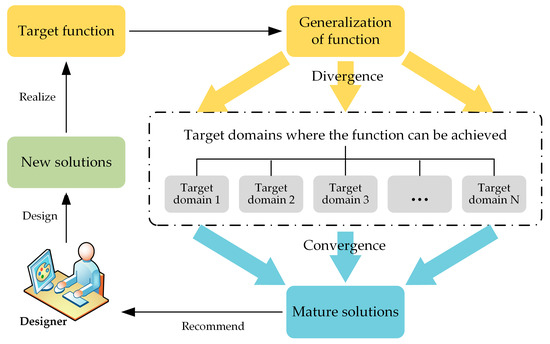
Figure 2.
The process of FOS.
There are three main types of applications for FOS. One is to search for biological knowledge in bionics and transfer specific unique structures, functions, and principles from nature to engineering [28]. The second application is to search abstract generic principles, including inventive principles, standard solutions, and effects in TRIZ. For example, Wang et al. [29] proposed an effect-solving method, including problem identification, functional analysis, effect selection, and structural mapping, which facilitated radical innovative design. However, utilizing biological knowledge or general principles to form a specific design solution requires the designer to have multi-disciplinary knowledge and rich design experience, so the innovative design is quickly limited by the designer’s knowledge level [30].
To solve this problem, some scholars have proposed the third application of FOS, which provides designers with more specific cross-domain knowledge based on patent mining. Patent knowledge is an essential source of knowledge for inspiring design as it contains more than 90% of the world’s technological innovations [31,32]. Choi et al. [33] constructed a well-structured technology database by automatically extracting the subject–action–object (SAO) structure from patents using relevant technologies for effective FOS implementation. Fantoni et al. [34] associated subject-specific patent knowledge with the function–behavior–structure model, which created a database of product FBS models. Yu et al. [14] proposed an approach to rapidly extract cross-domain technologies from patents to promote radical innovative design by generalizing the function of the core subsystem of a product and combining it with the SAO structure.
However, the biggest problem with FOS is not in the divergence process but in the convergence process. After searching a wide variety of cross-domain knowledge and technologies, how to choose the one that best inspires radical innovative design is an urgent problem.
2.3. The Measurement of TD
The radical behavior of RI depends on the differentiation of the new technology from what is already available in the industry, which is usually brought about by introducing such cross-domain knowledge or technology. As cross-domain knowledge has less overlap with existing product development technologies within the industry and more variability in the technological space, it is a great inspiration and incentive for firms’ technological innovations, especially RI [35,36].
However, knowledge from different domains has different impacts on firms’ innovation performance, and to measure the relationship between them, Jaffe [37,38] proposed the concept of TD. As shown in Figure 3, there is an inverted U-shaped relationship between TD and innovation performance [39,40]. The introduction of cross-domain knowledge with a small TD, while conducive to absorptive capacity, is detrimental to generating high-level innovations and makes it challenging to achieve RI. On the contrary, the introduction of cross-domain knowledge with a large TD can hinder firms’ absorptive capacity due to its high novelty value, again not conducive to radical innovative design. Therefore, cross-domain knowledge at a moderate TD is relatively more conducive to facilitating radical innovative design [16].
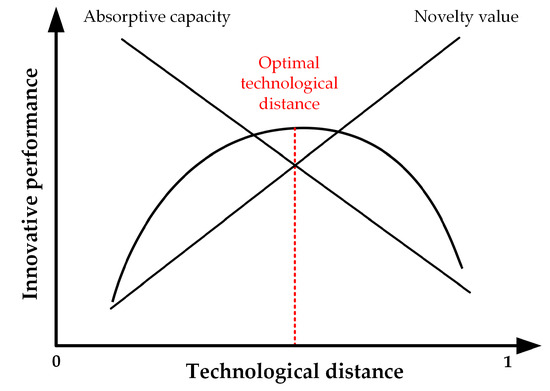
Figure 3.
Inverted U-shaped and the optimal TD.
In existing studies, the calculation of TD primarily relies on patent data and is carried out using patent vectors as a basis for computation. Most of the existing studies used IPC to represent patent vectors [16]. The International Patent Classification (IPC) system is an effective tool for patent classification, widely utilized by countries worldwide. Additionally, since the IPC code consists of letters and numbers, it is not limited by language; thus, patent vectors using the IPC system can better reflect the technological focus and distribution of firms or patent sets. As a result, the patent vector is defined as the number of patents in each IPC divided by the set of total patents of the firm, as shown in Equation (1):
where P is the patent vector of the firm, k is the classification number of the patent, pk is the ratio of the number of patents under classification k to the total patents of the firm, and n is the total number of patent classifications of the firm.
To calculate the distance between patent vectors, three methods have been studied: the cosine angle distance, the Euclidean distance, and the min-complement distance. Jaffe [38] first used the cosine angle distance to measure the distance between patent vectors. The higher the cosine value, the larger the overlap between patent vectors and the smaller the technological distance. The range of the Euclidean distance is [0, ], where a larger distance value indicates a larger TD, contrary to the meaning represented by the cosine angle distance values [41]. Bar and Leiponen [42] argued that the cosine angle distance and Euclidean distance take into account the number of patents in non-common domains between two patent vectors during the calculation process, which can affect the accuracy of the calculation results. Thus, they proposed using the min-complement distance to eliminate the effect of irrelevant patents on TD. Stein et al. [43] compared and analyzed the above three calculation methods using electric mobility as an example and believed that the min-complement distance is more suitable for measuring TD. Zhang and Tan [16] depicted firms’ patent vectors based on the IPC section (the first classification level). They used the min-complement distance to determine which firms’ technologies could be introduced. Similarly, Zhang et al. [44] introduced the min-complement distance measure method on the basis of product scenario analysis to determine suitable parasitic technologies, thereby assisting in product design.
The studies mentioned above, which use the differences in patent data between firms to reflect the TD between them, not only provide a new approach for enterprises to capture appropriate cross-domain knowledge but also offer reference points for establishing knowledge transfer, alliances, and partnerships among firms.
However, the existing research on the measurement of TD lacks generalizability and accuracy. First, the lack of generalizability means that this method of comparing differences in patent vectors between firms is not applicable to SMEs. Due to the limited number of patents held by these enterprises, their patent vectors are not sufficiently reflective of their technology and knowledge distribution to inform knowledge transfer. Second, the need for more accuracy refers to the fact that describing patent vectors based only on the section of the IPC system and making subsequent measurements are insufficient to reflect the true TD among firms. For example, if the patents of firm α are mainly concentrated in A01 (Agriculture et al. husbandry) and the patents of firm β are concentrated in A62 (Life-saving; Fire-fighting), the TD between the two firms is large, but if the first level of the IPC system is used for the calculation, the data obtained are much smaller than the actual value. Similarly, if the second level of the IPC system is used for the calculation, the data obtained are larger than the actual value.
2.4. Summary
The following conclusions can be drawn from the review and analysis of relevant studies:
- (1)
- Cross-domain knowledge is crucial for inspiring radical innovative design, but how to accurately search for the most appropriate cross-domain knowledge is the current problem.
- (2)
- There is a complementary relationship between FOS and the measurement of TD, which can provide a new way for firms to achieve RI. This is reflected in the fact that using FOS can obtain the patent sets of the problem domain and the target domains, which can be used to replace the patent set of firms and transfer the comparison of technology distribution from firms to products or knowledge domains, to solve the problem of lack of generalizability in the measurement of TD. In addition, selecting the most appropriate source of knowledge by measuring the TD between the problem domain and target domains can improve the completeness of the FOS.
- (3)
- To improve the accuracy of measuring TD, the first and second levels of the IPC system can be used to indicate the patent vectors, combined with the min-complement distance, to calculate the TD.
3. Proposed Method
Based on the summary in Section 2.4, this paper proposes a method to inspire radical innovative designs. The method mainly consists of seven steps, as shown in Figure 4:
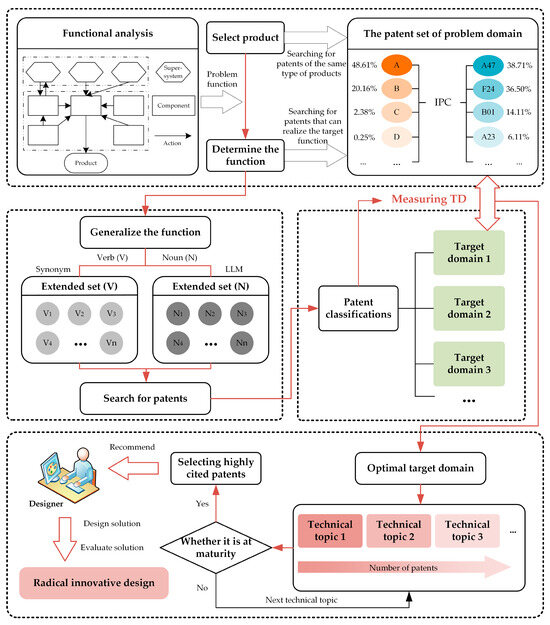
Figure 4.
The overall flow of the proposed method.
- (1)
- After identifying the product and function, construct the patent set of the problem domain;
- (2)
- Generalize the target function to search relevant patents;
- (3)
- Categorize the searched patents and construct the set of patents in the target domain;
- (4)
- Measure the TD between the problem domain and the target domains;
- (5)
- Determine the best target domain;
- (6)
- Recommend the patent schemes to the designer;
- (7)
- Design and evaluate the new solution.
3.1. The Construction of Patent Sets Based on FOS
3.1.1. The Patent Set of Problem Domain
After selecting the product to be designed, the product is analyzed functionally based on the functional model to determine the current major problem and target function. The patent set of the problem domain is constructed by searching for patents of the same type of products and patents that can realize the target function. Moreover, it is represented as patent vectors according to the IPC system for subsequent measurement of TD.
3.1.2. The Patent Set of Target Domains
The target function is first generalized; for instance, the generalized form of the function of mowing separates solids, which is part of the divergence process of FOS to search for as much cross-domain knowledge as possible. Functions can be expressed with a combination of verbs and nouns. Therefore, the generalized function can be split into verb and noun and expanded separately to expand the search scope.
The main focus for the expansion of verbs is on their synonyms, as observed in the functional categorization table proposed by Stone and Wood [45] in Appendix A. For the expansion of nouns, large language models (LLM) can be used to search for nouns it contains, e.g., adhesion on solid surfaces including metal oxides, marine fouling organisms, scale, etc. The extended verb set and noun set are combined to form different keywords to search for many patents that include cross-domain knowledge and construct the patent sets of different target domains.
3.2. The Optimization of TD Measurement
The first level of the IPC system consists of eight sections, while the second level consists of hundreds of classes. This categorization results in TD1, measured using data from the first level of the IPC system, being less than the actual TD, while TD2, measured using data from the second level of the IPC system, is bigger than the actual. Therefore, in this paper, the two levels of classification number data will be calculated separately based on the min-complement distance, and the two calculated values will be formed into a value range [TD1, TD2] to represent the TD between each domain. The min-complement distance is calculated as shown in Equation (2) [42]:
where M is the TD between domain I and domain J, and PI and PJ are the technical positions of the domain I and domain J. M ∈ [0, 1], and when M = 0, the TD between the two domains is the closest.
3.3. The Determination of Optimal Target Domain
To determine the optimal target domain, the specific value of the optimal TD should first be defined. Noteboom et al. [39] argued that, when TD ∈ [0, 1], the domain that provided the optimal cross-domain knowledge should be the one that lies in the category of TD = 0.5. After hypothesizing and validating knowledge transfer between firms, Wuyts et al. [46] concluded that the optimal TD is 0.38. Gao [47] analyzed the effect of TD on RI, and the study showed that the optimal value of TD is approximately 0.4. The optimal TD is not unique because novelty value and absorptive capacity are not equivalent [48].
Therefore, this paper uses the value range of 0.38–0.5 as the range of optimal technical distance. The optimal target domain is determined by comparing the overlap between the range of TD and [0.38, 0.5]. The higher the overlap, the more likely knowledge in that target domain will inspire radical innovative designs. As shown in Figure 5, the following are the five possible situations and the specific equations for calculating them:
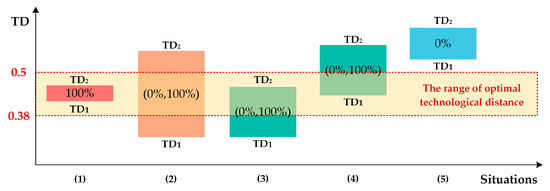
Figure 5.
Five possible situations and their overlap to the range of optimal TD.
- TD1 ∈ [0.38, 0.5] and TD2 ∈ [0.38, 0.5], the overlap between this range of TD and the range of optimal TD is 100%;
- TD1 ∈ [0, 0.38] and TD2 ∈ [0.5, 1], the overlap between this range of TD and the range of optimal TD is calculated as shown in Equation (3);
- 3.
- TD1 ∈ [0, 0.38] and TD2 ∈ [0.38, 0.5], the overlap between this range of TD and the range of optimal TD is calculated as shown in Equation (4);
- 4.
- TD1 ∈ [0.38, 0.5] and TD2 ∈ [0.5, 1], the overlap between this range of TD and the range of optimal TD is calculated as shown in Equation (5);
- 5.
- TD1 and TD2 ∈ [0.5, 1] or TD1 and TD2 ∈ [0, 0.38], the overlap between this range of TD and the range of optimal TD is 0%.
3.4. The Recommendation of Patent Schemes
Prioritizing technologies and knowledge in mature domains can shorten the design cycle and improve the reliability of conceptual solutions [49]. Thus, after determining the optimal target domain, all patents included in the domain can be categorized according to technical topics. Each technical topic is ranked according to the number of patents with priority given to technical topics with a large number of patents at a mature stage.
Patent application data can be used as a basis for judging whether a technical topic is at a mature stage or not. The judgment indicators include the technology growth rate (V) and the index of technology maturity (α), as shown in Equations (6) and (7). When both V and α have a decreasing trend, the technology topic is at the maturity stage [50].
where a is the number of invention patent applications in that year, b is the number of utility model patent applications in that year, and A is the total number of invention patent applications in the past five years.
The technology and knowledge embedded in highly cited patents are of significant value and influence and can lead to technology development [51]. Therefore, the ten most cited patent schemes were selected from the technical topic in the optimal target domain and recommended to the designers.
3.5. The Evaluation of New Solution
After designing a new solution based on recommended patent schemes, there are two methods that can be used to evaluate whether the new solution can develop into RI.
Liu et al. [10] proposed an equation for identifying radical solutions based on the degree of change in the technological subsystem, as shown in Equation (8):
where WE is the expected attributes of the working unit, CE is the expected attributes of control, and EE is the expected attributes of the engine. The measurement criteria of the above indicators are divided into four levels that are physical principle, working principle, implementation method, and detail change, which are assigned scores of 10, 6, 3, and 1, respectively.
Yu et al. [52] proposed six indicators for evaluating radical solutions from the dimensions of technology, product, and market, as shown in Table 2. An equation for evaluating RI is proposed based on a comparative analysis of a large number of cases, as shown in Equation (9):
where represents the weight of the kth indicator, and Ik represents the value assigned to the kth indicator. When S 0.648, the new solution has the potential to develop into RI.
Table 2.
Indicators for evaluating radical schemes [52].
The above two methods provide a theoretical basis for identifying radical solutions at the conceptual design stage. Therefore, this study will use these two methods to comprehensively evaluate the newly designed solution. If consistent and positive results can be obtained, it will demonstrate that the method proposed in this paper is conducive to inspiring radical innovative design.
4. Case Study
As an essential cooking equipment, the stove (shown in Figure 6a) has been widely used in commercial and home kitchens. However, the stovetop (shown in Figure 6b) is often clogged with sludge and other greasy substances, resulting in an insufficient flame or even the inability to complete the sending flame, increasing the probability and cost of equipment maintenance. For this problem, the existing solution mainly relies on manual physical cleaning, which is not only inefficient but also susceptible to damaging the stovetop. Therefore, this paper will verify the effectiveness of the proposed method by designing a stovetop cleaning device.
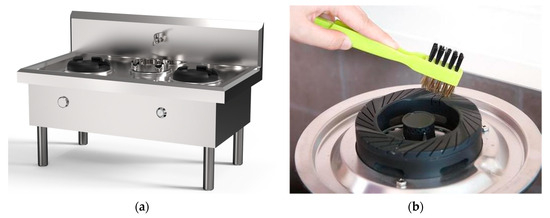
Figure 6.
(a) The display drawing of the stove; (b) Manual cleaning of the stovetop.
Over the past several decades, China has observed a vast incremental increase in the number of patents and gradually become the country that submits the most significant number of patent applications [53]. Therefore, the patent schemes covered in this section are from the China National Intellectual Property Administration (CNIPA).
4.1. Establishing the Patent Set of Problem Domain
Since the problem product was identified as the stovetop, all the knowledge related to those products used for cooking food belongs to the problem domain knowledge. Hence, 25,463 patents related to the problem product were searched in Patsnap [54] (a patent database covering more than 170 countries with more than 180 million patents). After its functional analysis using the functional model (as shown in Figure 7), the target function of the product can be identified as removing sludge and other greasy substances, and 11,348 patents were retrieved based on this function.
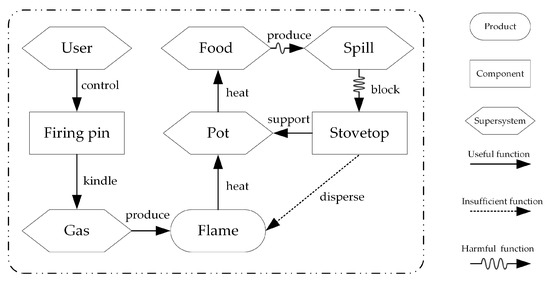
Figure 7.
The functional model.
A total of 36,197 patents were retrieved from the two searches, which constituted the patent set of the problem domain. These schemes were categorized according to the first and second levels of the IPC system, and the data for each classification number are shown in Figure 8 and Figure 9. The sum of the number of patents contained in each IPC is greater than the total number because each patent scheme may belong to more than one IPC.
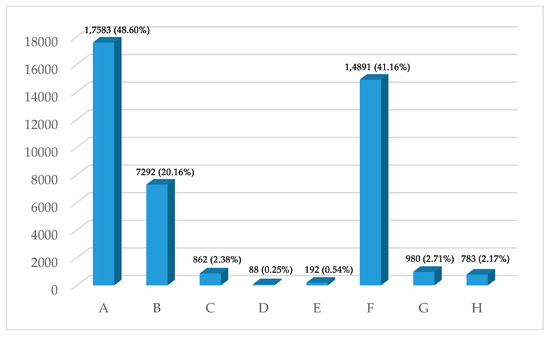
Figure 8.
The number of patent schemes in each IPC section.
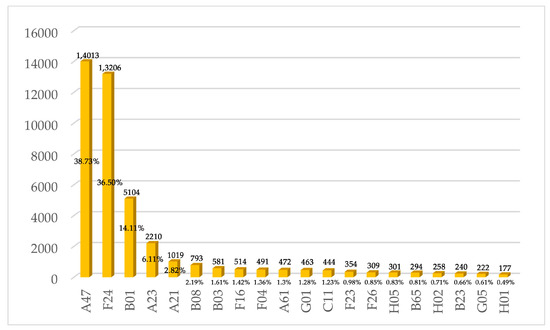
Figure 9.
The number of patent schemes in each IPC class.
Since there are hundreds of IPC classes and this study uses the min-complement distance to measure TD, those IPC classes with a small number of patent schemes will not significantly impact the final results of TD. However, this does not mean that those small number of patents are completely ignored; they are simply not included in the process of measuring TD. In other words, the number of patents in each target domain has not decreased; it is just that, when measuring technological distance, relying on the majority of patents is sufficient to ensure the accuracy of the calculation results. In this study, only those IPC classes with more than a 0.5% share of the number of patent schemes were used, and the subsequent TD was retained to two decimal places.
4.2. Establishing the Patent Set of Target Domains
The generalized form of the target function is separating attachments. First, according to Appendix A, the synonyms for separate include switch, divide, release, and so on. Then, when using LLM to expand noun, it is important to define the scope to avoid retrieving a large number of irrelevant nouns. This study considers states (gaseous, solid, liquid, or mixed state) and scenarios as conditions for restricting noun retrieval. Taking attachments as an example, one should retrieve solids that adhere to the surface of solids and limit the number to 50. Due to the fact that many of the retrieved words were duplicates, this study categorized them into seven groups after screening and summarizing, as shown in Table 3.
Table 3.
Nouns retrieved based on LLM.
The verbs and nouns obtained from the expansion were combined into keywords and searched in the patent database to obtain the patent sets of the seven target domains, as shown in Table 4 and Table 5.
Table 4.
Number of patent schemes in each IPC section.
Table 5.
Number of patent schemes in each IPC class.
4.3. Identifying Optimal Target Domain based on the Measurement of TD
After obtaining the patent data in Section 4.1 and Section 4.2, the range of TD between the problem domain and each target domain is obtained by measuring according to Equation (3), as shown in Table 6 and Table 7.
Table 6.
Results of TD1.
Table 7.
Results of TD2.
The range of TD between the problem domain and each target domain is composed of TD1 and TD2, and their overlap with the range of optimal TD is calculated according to the five situations proposed in Section 3, as shown in Figure 10 and Table 8. The results show that target domain 3 has the highest priority relative to the others and that technologies and knowledge from this domain should be prioritized to inspire radical innovative designs for stovetop cleaning.
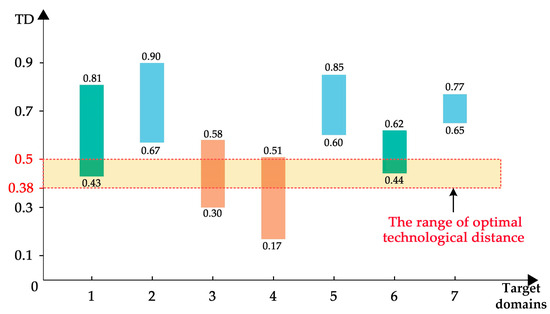
Figure 10.
The range of TD between the problem domain and each target domain.
Table 8.
Prioritization of target domains.
4.4. Recommending Patent Schemes to Designers
Since the target domain 3 includes 15,003 patents, further categorization is needed to more accurately recommend appropriate knowledge to the designers. This study used Patsnap [54] to categorize these patents according to the technical topic to which they belong, as shown in Figure 11. The technical topic of mechanical engineering includes the most significant number of patent schemes, accounting for approximately 60% of the total. So, the technical topic should first be judged whether it is in the mature stage.
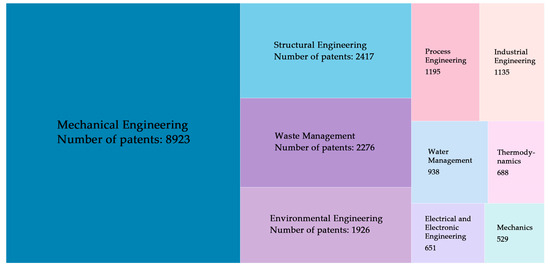
Figure 11.
The number of patent schemes in each technical topic.
After counting the number of patent applications per year within the technical topic, the trend of V and α is obtained based on Equations (6) and (7), as shown in Table 9 and Figure 12. Observing the last ten years of data, the peak of V and α occurred in 2018, after which there is an occasional rebound, but the overall linear trend is decreasing. The technical topic can, therefore, be judged to be at a mature stage.
Table 9.
Number of patents in the last ten years.
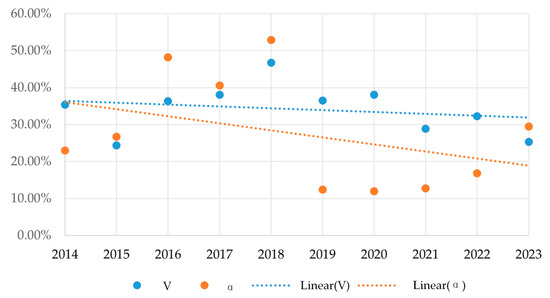
Figure 12.
The linear trend of V and α in the technical topic.
The problem domains account for approximately 90% or more of the patent solutions in the three IPCs, A47, F24, and B01. To ensure the novelty value of the recommended patent schemes, the highly cited patent schemes in other IPCs were finally selected to be recommended to the designers, as shown in Table 10. It has been demonstrated that the technology and knowledge contained in highly cited patents are valuable and influential and can lead to the development of subsequent technologies [51,55]. Therefore, the number of citations can be used as a key indicator for patent screening [56].
Table 10.
Specific recommended patent schemes.
4.5. Design and Evaluate New Solution
After reading and analyzing the patent schemes in Table 8, it was found that most of them use water washing to clean the target object. However, since the stovetop is a vital part of the sending flame, adding a device for water washing directly around it is not suitable. Thus, the stovetop needs to be disassembled for cleaning. The scheme’s feasibility for automatically cleaning a washing machine’s inner and outer walls mentioned in CN203923705U is relatively higher. Therefore, a solution was designed based on the cross-domain knowledge gained, as shown in Figure 13 and Figure 14. When the inner tube rotates, the brush is driven to rotate around the inner tube and the outer tube along the circular ring, rotating to clean the placed stovetop. This solution is reasonable and straightforward, easy to manufacture, and low cost and can improve the cleaning effect of the stovetop and extend its service life.
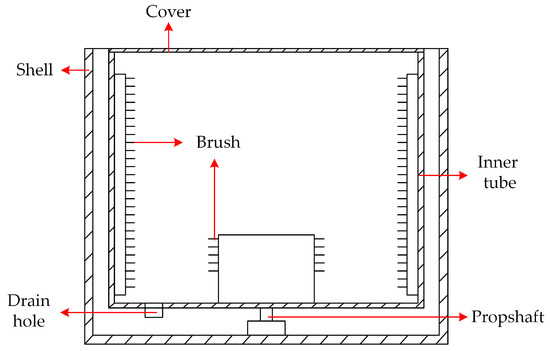
Figure 13.
Conceptual design solution for a stovetop cleaning device.
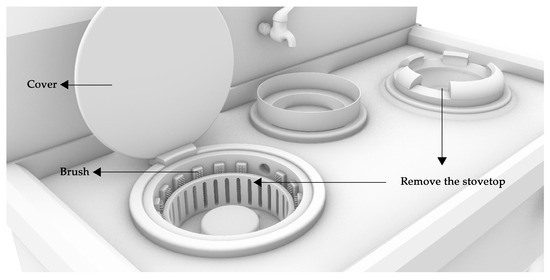
Figure 14.
3D rendering of the conceptual solution.
Compared to the traditional manual or machine physical scraping of the surface of the stove adherents, the changes in various indicators of the new solution are shown in Table 11.
Table 11.
The changes in various indicators and the evaluation results of the new solution.
Finally, the radicality of the new solution was evaluated based on Equations (8) and (9), resulting in positive and consistent outcomes. Therefore, the new solution obtained using the cross-domain knowledge in the recommended patent schemes meets the radical innovative design index, thus validating the effectiveness of the proposed method.
5. Discussion and Conclusions
This paper focuses on proposing a process management method for cross-domain knowledge development. Although previous studies have demonstrated that cross-domain knowledge is essential in motivating radical innovative designs, how to accurately search and screen cross-domain knowledge is still a problem. The method will help firms effectively utilize cross-domain knowledge to promote radical innovative design when facing problems and ultimately improve the success rate of RI. The following is a discussion of the contributions and limitations of this paper and opportunities for future research.
5.1. Contributions
The limitations of relying on the similarity of patent data among firms to determine whether knowledge transfer is appropriate are twofold. From the introduction perspective, only those large firms with a sufficient number of patents or that emphasize intellectual property protection can search for firms that are at a moderate TD from them for knowledge transfer according to their technological spatial distribution. SMEs, which occupy less market share, are eager to realize RI by introducing cross-domain knowledge to improve their influence in the market. However, due to the lack of their patent data, it is difficult for them to use the TD between them and other firms as a reference basis for knowledge transfer. This is very dangerous for firms aiming at RI because it is a double-edged sword with a high return accompanied by a high risk, and once it fails, the firm will pay a considerable price.
Similarly, the knowledge discovered using the previous methods also comes from large firms, which ignores the value of the knowledge and technology contained in SMEs. This is incompatible with the view of RI, which is first and foremost about breaking down fixed perceptions, finding as much cross-domain knowledge as possible, and then prioritizing from there. This idea only applies to assisting knowledge transfer between large firms and will limit radical innovative design.
The method proposed in this paper searches a large amount of patent knowledge based on FOS from the perspective of solving the product problem and realizing the target function. After categorizing the patent knowledge into problem and target domains, the TD between them is calculated to help firms choose the appropriate cross-domain knowledge. The method breaks the limitation of patent data to firms and can inspire radical innovative design. The case study in Section 4 validates the effectiveness of the proposed method by designing a stovetop cleaning device.
In addition, the measurement of TD is an effective tool for screening assist cross-domain knowledge. However, relying only on a certain level of IPC to represent patent vectors and measure TD is not sufficient as a reference basis for knowledge transfer. In this paper, the first and second levels of the IPC system are utilized to represent patent vectors respectively. TD1 and TD2, obtained based on the min-complementary distance, are used to compose the TD range between knowledge domains, and the best knowledge domain is determined by calculating the overlap between each TD range and the optimal TD range. It can provide a more accurate reference for enterprise knowledge transfer.
5.2. Limitations and Future Study Opportunities
First, different firms may obtain the same or similar cross-domain knowledge by applying the method proposed in this paper when facing the same problem. From a macro perspective, this is contrary to the trend of product diversification nowadays. Therefore, subsequent research can seek a method that applies to most firms and takes into account the firm’s strategic development direction to inspire radical innovative design.
Second, the IPC system’s first level of categorization is too coarse, which downplays the differences between different or similar knowledge domains. The second level of categorization is so fine-grained that it ignores the links between similar knowledge domains. Even if the two levels of classification numbers are used comprehensively to measure TD, there is still a certain degree of ambiguity. Subsequent research should explore a categorization that can distinguish knowledge domains relatively accurately and be used to measure TD.
Third, this method requires multiple searches, categorizations, and counting of patent schemes, and future attention should be given to developing software that incorporates artificial intelligence to extract the data automatically and complete the calculations.
Furthermore, the patent data involved in case study are all sourced from CNIPA. To further improve the comprehensiveness of the method, cross-domain knowledge should be extracted from all patent databases worldwide. It requires us to use more languages for technical retrieval and extraction.
In the end, the optimal TD for knowledge and technology transfer for RI in different domains has yet to be examined.
Author Contributions
Conceptualization, F.Y. and X.J.; Methodology, F.Y. and X.J.; Formal analysis, X.J. and J.L.; Data curation, X.J. and X.Z.; Writing—original draft, X.J.; Writing—review and editing, F.Y.; Visualization, X.Z. and J.L.; Supervision, F.Y.; Funding acquisition, F.Y. All authors have read and agreed to the published version of the manuscript.
Funding
This paper was sponsored by the National Innovation Method Fund of China (No. 2020IM030200-2) and the National Natural Science Foundation of China (No. 51805142).
Institutional Review Board Statement
Not applicable.
Informed Consent Statement
Not applicable.
Data Availability Statement
The data that support the findings of this study are available in Patsnap at: https://analytics.zhihuiya.com (accessed on 1 January 2024).
Conflicts of Interest
The authors declare that they have no known competing financial interests or personal relationships that could have appeared to influence the work reported in this paper.
Appendix A
Table A1.
Function classes, basic functions, and synonyms.
Table A1.
Function classes, basic functions, and synonyms.
| Class | Basic | Synonyms |
|---|---|---|
| Branch | Separate | Switch, Divide, Release, Detach, Disconnect, Disassemble, Subtract, Cut, Polish, Sand, Drill, Lathe |
| Refine | Purify, Strain, Filter, Percolate, Clear | |
| Distribute | Diverge, Scatter, Disperse, Diffuse, Empty, Absorb, Dampen, Dispel, Resist, Dissipate | |
| Channel | Import | Input, Receive, Allow, Form Entrance, Capture |
| Export | Discharge, Eject, Dispose, Remove | |
| Transfer | Lift, Move, Conduct, Convey | |
| Guide | Direct, Straighten, Steer, Turn, Spin, Constrain, Unlock | |
| Connect | Couple | Join, Assemble, Attach |
| Mix | Combine, Blend, Add, Pack, Coalesce | |
| Control Magnitude | Actuate | Start, Initiate |
| Regulate | Control, Allow, Prevent, Enable/Disable, Limit, Interrupt, Valve | |
| Change | Increase, Decrease, Amplify, Reduce, Magnify, Normalize, Multiply, Scale, Rectify, Adjust, Compact, Crush, Shape, Compress, Pierce | |
| Convert | Convert | Transform, Liquefy, Solidify, Evaporate, Condense, Integrate, Differentiate, Process |
| Provision | Store | Contain, Collect, Reserve, Capture |
| Supply | Fill, Provide, Replenish, Expose | |
| Extract | ||
| Signal | Sense | Perceive, Recognize, Discern, Check, Locate |
| Indicate | Mark | |
| Display | ||
| Measure | Calculate | |
| Support | Stop | Insulate, Protect, Prevent, Shield, Inhibit |
| Stabilize | Steady | |
| Secure | Attach, Mount, Lock, Fasten, Hold | |
| Position | Orient, Align, Locate |
References
- Domínguez-Escrig, E.; Broch, F.F.M.; Lapiedra, R.; Chiva, R. Promoting Radical Innovation through End-User Computing Satisfaction. Ind. Manag. Data Syst. 2018, 118, 1629–1646. [Google Scholar] [CrossRef]
- McDermott, C.M.; O’Connor, G.C. Managing Radical Innovation: An Overview of Emergent Strategy Issues. J. Prod. Innov. Manag. 2002, 19, 424–438. [Google Scholar] [CrossRef]
- Büschgens, T.; Bausch, A.; Balkin, D.B. Organizing for Radical Innovation—A Multi-Level Behavioral Approach. J. High Technol. Manag. Res. 2013, 24, 138–152. [Google Scholar] [CrossRef]
- Lin, M.; Patel, P.C. Distant Search, Technological Diversity, and Branding Focus: Incremental and Radical Innovation in Small- and Medium-Sized Consignees. IEEE Trans. Eng. Manag. 2019, 66, 170–179. [Google Scholar] [CrossRef]
- Shahrubudin, N.; Lee, T.C.; Ramlan, R. An Overview on 3D Printing Technology: Technological, Materials, and Applications. Procedia Manuf. 2019, 35, 1286–1296. [Google Scholar] [CrossRef]
- Lecossier, A.; Pallot, M.; Crubleau, P.; Richir, S. Towards Radical Innovations in a Mature Company: An Empirical Study on the UX-FFE Model. AI EDAM 2019, 33, 172–187. [Google Scholar] [CrossRef]
- Zhang, L.; Tan, R.; Peng, Q.; Yang, W.; Zhang, J.; Wang, K. A Holistic Method for Radical Concept Generation Based on Technological Evolution: A Case Application of DC Charging Pile. Comput. Ind. Eng. 2023, 179, 109213. [Google Scholar] [CrossRef]
- Tiwari, V.; Jain, P.K.; Tandon, P. Product Design Concept Evaluation Using Rough Sets and VIKOR Method. Adv. Eng. Inform. 2016, 30, 16–25. [Google Scholar] [CrossRef]
- Zhang, Z.; Gong, L.; Jin, Y.; Xie, J.; Hao, J. A Quantitative Approach to Design Alternative Evaluation Based on Data-Driven Performance Prediction. Adv. Eng. Inform. 2017, 32, 52–65. [Google Scholar] [CrossRef]
- Liu, W.; Tan, R.; Cao, G.; Zhang, Z.; Huang, S.; Liu, L. A Proposed Radicality Evaluation Method for Design Ideas at Conceptual Design Stage. Comput. Ind. Eng. 2019, 132, 141–152. [Google Scholar] [CrossRef]
- Datta, A.; Jessup, L.M. Looking beyond the Focal Industry and Existing Technologies for Radical Innovations. Technovation 2013, 33, 355–367. [Google Scholar] [CrossRef]
- Gassmann, O.; Zeschky, M.; Wolff, T.; Stahl, M. Crossing the Industry-Line: Breakthrough Innovation through Cross-Industry Alliances with ‘Non-Suppliers’. Long Range Plann. 2010, 43, 639–654. [Google Scholar] [CrossRef]
- Cheng, C.C.J.; Yang, C.; Sheu, C. Effects of Open Innovation and Knowledge-Based Dynamic Capabilities on Radical Innovation: An Empirical Study. J. Eng. Technol. Manag. 2016, 41, 79–91. [Google Scholar] [CrossRef]
- Yu, F.; Fu, J.; Guo, J.; Tan, R.; Yang, B. An Approach for Radical Innovative Design Based on Cross-Domain Technology Mining in Patents. Int. J. Prod. Res. 2023, 61, 7502–7523. [Google Scholar] [CrossRef]
- Litvin, S. New TRIZ-based tool—function-oriented search (FOS). In Proceedings of the TRIZ Future Conference, Florence, Italy, 3–5 November 2004. [Google Scholar]
- Zhang, J.; Tan, R. Radical Concept Generation Inspired by Cross-Domain Knowledge. Appl. Sci. 2022, 12, 4929. [Google Scholar] [CrossRef]
- Danneels, E.; Kleinschmidtb, E.J. Product Innovativeness from the Firm’s Perspective: Its Dimensions and Their Relation with Project Selection and Performance. J. Prod. Innov. Manag. 2001, 18, 357–373. [Google Scholar] [CrossRef]
- Ehrnberg, E. On the Definition and Measurement of Technological Discontinuities. Technovation 1995, 15, 437–452. [Google Scholar] [CrossRef]
- Castaldi, C.; Frenken, K.; Los, B. Related Variety, Unrelated Variety and Technological Breakthroughs: An Analysis of US State-Level Patenting. Reg. Stud. 2015, 49, 767–781. [Google Scholar] [CrossRef]
- Herrmann, T.; Binz, H.; Roth, D. Necessary Extension of Conventional Idea Processes by Means of a Method for the Identification of Radical Product Ideas. In Proceedings of the 21st International Conference on Engineering Design (ICED 17) Human Behaviour in Design, Vancouver, BC, Canada, 21–25 August 2017; pp. 79–88. [Google Scholar]
- Capponi, G.; Martinelli, A.; Nuvolari, A. Breakthrough Innovations and Where to Find Them. Res. Policy 2022, 51, 104376. [Google Scholar] [CrossRef]
- Chandy, R.K.; Tellis, G.J. Organizing for Radical Product Innovation: The Overlooked Role of Willingness to Cannibalize. J. Mark. Res. 1998, 35, 474–487. [Google Scholar] [CrossRef]
- Govindarajan, V.; Kopalle, P.K.; Danneels, E. The Effects of Mainstream and Emerging Customer Orientations on Radical and Disruptive Innovations. J. Prod. Innov. Manag. 2011, 28, 121–132. [Google Scholar] [CrossRef]
- Shaikh, I.A.; Colarelli O’Connor, G. Understanding the Motivations of Technology Managers in Radical Innovation Decisions in the Mature R&D Firm Context: An Agency Theory Perspective. J. Eng. Technol. Manag. 2020, 55, 101553. [Google Scholar] [CrossRef]
- O’Connor, G.C.; Rice, M.P. A Comprehensive Model of Uncertainty Associated with Radical Innovation. J. Prod. Innov. Manag. 2013, 30, 2–18. [Google Scholar] [CrossRef]
- Brondoni, S.M. Innovation and Imitation: Corporate Strategies for Global Competition. Symphonya Emerg. Issues Manag. 2012, 1, 10–24. [Google Scholar] [CrossRef]
- Tan, R. C-TRIZ and Its Application Theory of Inventive Process Solving; Higher Education Press: Beijing, China, 2020. [Google Scholar]
- Savelli, S.; Abramov, O.Y. Nature as a Source of Function-Leading Areas for FOS-Derived Solutions. TRIZ Rev. J. Int. TRIZ Assoc. MATRIZ 2019, 1, 86–98. [Google Scholar]
- Wang, K.; Tan, R.; Peng, Q.; Sun, Y.; Li, H.; Sun, J. Radical Innovation of Product Design Using an Effect Solving Method. Comput. Ind. Eng. 2021, 151, 106970. [Google Scholar] [CrossRef]
- Chiu, I.; Shu, L.H. Biomimetic Design through Natural Language Analysis to Facilitate Cross-Domain Information Retrieval. AI EDAM 2007, 21, 45–59. [Google Scholar] [CrossRef]
- Lee, C.; Kang, B.; Shin, J. Novelty-Focused Patent Mapping for Technology Opportunity Analysis. Technol. Forecast. Soc. Change 2015, 90, 355–365. [Google Scholar] [CrossRef]
- Song, K.; Kim, K.S.; Lee, S. Discovering New Technology Opportunities Based on Patents: Text-Mining and F-Term Analysis. Technovation 2017, 60, 1–14. [Google Scholar] [CrossRef]
- Choi, S.; Kang, D.; Lim, J.; Kim, K. A Fact-Oriented Ontological Approach to SAO-Based Function Modeling of Patents for Implementing Function-Based Technology Database. Expert Syst. Appl. 2012, 39, 9129–9140. [Google Scholar] [CrossRef]
- Fantoni, G.; Apreda, R.; Dell’Orletta, F.; Monge, M. Automatic Extraction of Function–Behaviour–State Information from Patents. Adv. Eng. Inform. 2013, 27, 317–334. [Google Scholar] [CrossRef]
- Tiberius, V.; Schwarzer, H.; Roig-Dobón, S. Radical Innovations: Between Established Knowledge and Future Research Opportunities. J. Innov. Knowl. 2021, 6, 145–153. [Google Scholar] [CrossRef]
- Tödtling, F.; Lehner, P.; Kaufmann, A. Do Different Types of Innovation Rely on Specific Kinds of Knowledge Interactions? Technovation 2009, 29, 59–71. [Google Scholar] [CrossRef]
- Jaffe, A.B. Technological Opportunity and Spillovers of R&D: Evidence from Firms’ Patents, Profits and Market Value. Natl. Bur. Econ. Res. 1986, 76, 985–1001. [Google Scholar]
- Jaffe, A.B. Characterizing the “Technological Position” of Firms, with Application to Quantifying Technological Opportunity and Research Spillovers. Res. Policy 1989, 18, 87–97. [Google Scholar] [CrossRef]
- Nooteboom, B.; Van Haverbeke, W.; Duysters, G.; Gilsing, V.; van den Oord, A. Optimal Cognitive Distance and Absorptive Capacity. Res. Policy 2007, 36, 1016–1034. [Google Scholar] [CrossRef]
- Gilsing, V.; Nooteboom, B.; Vanhaverbeke, W.; Duysters, G.; van den Oord, A. Network Embeddedness and the Exploration of Novel Technologies: Technological Distance, Betweenness Centrality and Density. Res. Policy 2008, 37, 1717–1731. [Google Scholar] [CrossRef]
- Angue, K.; Ayerbe, C.; Mitkova, L. A Method Using Two Dimensions of the Patent Classification for Measuring the Technological Proximity: An Application in Identifying a Potential R&D Partner in Biotechnology. J. Technol. Transf. 2014, 39, 716–747. [Google Scholar] [CrossRef]
- Bar, T.; Leiponen, A. A Measure of Technological Distance. Econ. Lett. 2012, 116, 457–459. [Google Scholar] [CrossRef]
- Vom Stein, N.; Sick, N.; Leker, J. How to Measure Technological Distance in Collaborations—The Case of Electric Mobility. Technol. Forecast. Soc. Change 2015, 97, 154–167. [Google Scholar] [CrossRef]
- Zhang, L.; Tan, R.; Peng, Q.; Miao, R.; Liu, L. Product Innovation Based on the Host Gene and Target Gene Recombination under the Technological Parasitism Framework. Adv. Eng. Inform. 2024, 59, 102341. [Google Scholar] [CrossRef]
- Stone, R.B.; Wood, K.L. Development of a Functional Basis for Design. J. Mech. Des. 2000, 122, 359–370. [Google Scholar] [CrossRef]
- Wuyts, S.; Colombo, M.G.; Dutta, S.; Nooteboom, B. Empirical Tests of Optimal Cognitive Distance. J. Econ. Behav. Organ. 2005, 58, 277–302. [Google Scholar] [CrossRef]
- Gao, T. International R&D Alliances, Technology Distance and Radical Innovation of Enterprises. Contemp. Econ. Manag. 2020, 42, 21–26. [Google Scholar]
- Seno Wulung, R.B.; Takahashi, K.; Morikawa, K. A Model for Selecting Appropriate Technology for Incubator-University Collaboration by Considering the Technology Transfer Mechanism. Int. J. Prod. Res. 2018, 56, 2309–2321. [Google Scholar] [CrossRef]
- Nolte, W.L. Did I Ever Tell You about the Whale? Or Measuring Technology Maturity; Information Age Publishing Inc. (IAP): Charlotte, NC, USA, 2008. [Google Scholar]
- Yang, M.; Chen, X. A Comparative Analysis of Patent Information of Domestic Enterprises, Universities and Research Institutions. Inf. Sci. 2010, 28, 1029–1032. [Google Scholar]
- Zhuang, Z.; Jia, H.; Xiao, C. Research advances for radical innovation. Econ. Perspect. 2020, 145–160. [Google Scholar]
- Yu, F.; Liu, J.; Fu, J.; Zhang, P. Construction of Identification Model of Radical Ideas Based on Similarity Matching. Comput. Integr. Manuf. Syst. 2022, 28, 2534–2544. [Google Scholar] [CrossRef]
- Chen, Z.; Zhang, J. Types of Patents and Driving Forces behind the Patent Growth in China. Econ. Model. 2019, 80, 294–302. [Google Scholar] [CrossRef]
- Patsnap. Available online: https://analytics.zhihuiya.com (accessed on 1 January 2024).
- Fontana, R.; Nuvolari, A.; Shimizu, H.; Vezzulli, A. Reassessing Patent Propensity: Evidence from a Dataset of R&D Awards, 1977–2004. Res. Policy 2013, 42, 1780–1792. [Google Scholar] [CrossRef]
- Sharma, P.; Tripathi, R.C. Patent Citation: A Technique for Measuring the Knowledge Flow of Information and Innovation. World Pat. Inf. 2017, 51, 31–42. [Google Scholar] [CrossRef]
Disclaimer/Publisher’s Note: The statements, opinions and data contained in all publications are solely those of the individual author(s) and contributor(s) and not of MDPI and/or the editor(s). MDPI and/or the editor(s) disclaim responsibility for any injury to people or property resulting from any ideas, methods, instructions or products referred to in the content. |
© 2024 by the authors. Licensee MDPI, Basel, Switzerland. This article is an open access article distributed under the terms and conditions of the Creative Commons Attribution (CC BY) license (https://creativecommons.org/licenses/by/4.0/).