


Abstract
Correlation networks and risk spillovers within financial institutions contribute to the generation and dissemination of systemic risk. In this paper, a risk correlation network is constructed among Chinese banks employing the maximum entropy method, which simulates the individual risks of banks in the presence of exogenous shocks, the contagious risks, and total systemic risk through the effect of network spillovers, and analyzes its influencing factors. The results show that there is an increasingly rising trend in the overall systemic risk of China’s banking industry, and that the value of systemic risk is relatively large. From the perspective of the composition of banking systemic risk, individual risk accounts for a large proportion, about 70%, which is the main source of banking systemic risk, among which China’s state-owned commercial banks are the largest source. The contagious risk of banks accounts for about 30%. Furthermore, the contagious risk contribution of various banks is basically negatively correlated with their scale. The smallest urban commercial bank in the banking industry contributes at least 50% of the contagion risk, while the state-owned commercial bank, which accounts for about 40% of the total assets of the banking industry, only contributes less than 30% of the contagion risk.
1. Introduction
In the financial system, a variety of financial institutions are related to each other through direct channels (business linkage) or indirect channels (the same asset holdings). On the one hand, the occurrence of risk events may affect multiple financial institutions at the same time, leading to multiple risk outbreaks. On the other hand, the risks of a single financial institution may also spread to other financial institutions through the interconnection between financial institutions. Risks spread in the network formed by financial institutions, causing harm to the financial system and even the real economy. In the 2008 financial crisis, consecutive defaults by foreign financial institutions caused serious systemic risks, which led to a setback in the global economy. This is why the modeling of systemic financial risks, especially the modeling of the systemic risks of the banking industry, is of great importance in correctly understanding and preventing risks.
For the measurement of systemic risk in banks, there are many mature and widely used methods currently in the academic community, such as CoVaR [1,2], the TENET model, which was developed from CoVaR [1], MES [3], SRISK [4], and the spillover index model based on the VAR method [5,6,7], which are widely used in extensive empirical transnational studies [7,8,9,10,11]. It is inevitable that there are some limitations to these studies. Firstly, those models are generally based on a reduced-form statistical structure that lacks a clear statement of the modeling mechanism. This type of approach typically treats the entire market as a portfolio of financial institutions and determines the institution’s level of risk contribution based on financial market data. In this case, risk is generated exogenously, and it is not taken into account since the loss caused by the shock is greater than the bank’s capital buffer. In terms of risk contagion, some models established the correlation matrix between institutions without considering the inherent logic. For example, before constructing a correlation matrix by variance decomposition, Diebold and Yilmaz [5] assumed that correlation generally existed among individuals ex ante, but did not gave us a definite mechanism. Thus, the validity of their models was weakened by these factors. In addition, the data used by such methods were relevant for large listed financial institutions [11,12,13]. However, studies have identified complex links between financial institutions, and smaller financial institutions may also have a greater risk of infectivity; systemic risks may also have different characteristics for different types of financial institutions [14]. Therefore, while examining large financial institutions, it is also very important to effectively analyze the risks of small- and medium-sized financial institutions. On the other hand, most of the aforementioned methods conduct an analysis on the basis of market data, and the accuracy and credibility of the results depend on the effectiveness of the securities market [15]. However, in developing countries such as China, the securities market is not highly effective [16]. Internal information, policy intervention, and other factors easily lead to the distortion of securities price, yield and volatility, which weakens the rationality of the aforementioned methods in measuring systemic financial risk in emerging market countries.
In recent years, the continuously developing network model methods provide new research perspectives on bank systemic financial risk [17,18]. Overall, the network model method mainly analyzes the risk contagion between financial institutions based on the economic relations between financial institutions. By constructing a correlation network between financial institutions, we can simulate the infection process of the risk when the risk occurs, and accordingly explore the systematic importance of financial institutions in addition to the factors affecting the systemic risk contribution of financial institutions. In the network model method, a correlation network model for direct association based on bank business data is somewhat mainstream in the literature. Benoit et al. [14] reviewed a systematically quantified network model. Different network models exist with different transmission channels. Studies can be divided into four categories. First, a correlation network model for direct association formed by inter-bank lending or payment and settlement business, which mainly captures the risk infection caused by the default cascade of bank bankruptcy. Second, a correlation network model for indirect association formed by banks holding the same or similar assets to form a common risk exposure, which focuses on the risk infection caused by banks’ “deleveraging”, namely selling liquid assets. Third, generate a correlation network referring to the complex network theory, then construct a scale-free network, random network, small-world network, etc., which has some structure characteristics of the real bank association network, and then simulate to analyze how different network structures and key parameters affect the inter-bank risk infection and systemic risk level. Fourthly, based on financial market data, such as the stock price of financial institutions, an association network of financial institutions is first constructed through a binary Granger causality test, generalized variance decomposition, LASSO quantile regression, and TENET methods, and then, the complex network analysis method is adopted to measure the relationship and systemic risk level of financial institutions.
This paper was mainly based on the literature of correlation network models for direct association. There are two reasons to apply a correlation network model for direct association. Firstly, compared with other models, correlation network models for direct association can better describe reality based on real banking business data. Secondly, it is valuable to study the shadow banking business formed by China’s banking industry based on inter-bank business, and this model can reflect the different risk between small banks and large banks. Furthermore, this paper draws on the idea of Zedda and Cannas [19] to decompose bank systemic risk into individual risk and infectious risk, applied the method of De Lisa et al. [20] to calculate the loss probability distribution of the banking system, and uses the maximum entropy algorithm to obtain a network model of bank assets and liabilities to describe its transmission mechanism. Compared with the above methods which need to use securities market data, this method just relies on a balance sheet. This means that it can realize the measure of systemic financial risk in non-listed small- and medium-sized banks, and overcome the limitations of the aforementioned quantitative methods based on market data. We also conducted numerical simulations using Chinese examples and then analyzed the proportion of infectious risk in systemic financial risk in addition to the degree of systemic financial risk contribution of different types of banks in the Chinese banking industry. There are many empirical studies using transnational data. Earlier ones, such as Frankel and Rose [21], were modeled with unit probabilities and maximum likelihood estimates; an analysis of 22 years of economic data from 105 developing countries yielded the relationship between currency devaluation and the currency crisis. Recent ones, such as Corsi et al. [22], used the Granger causal test to identify the risk contagion network between 33 global systemically important banks and 36 sovereign debts and analyzed the risk contagion during the European sovereign debt crisis. The reason for choosing Chinese examples is because China is a primarily banking financial structure, with a large number of small- and medium-sized banks, which can provide a rich data source for research. Moreover, using data from a single country can avoid the problem of biased results when the use of transnational data is susceptible to differences in political system, the degree of markets, and the degree of the development of capital markets in different countries. This research enriches the existing systemic risk measurement method literature, provides more empirical evidence to better identify the risk infection effect of different types of financial institutions in systemic financial risk, helps to further build and improve the risk prevention mechanisms of different types of banks, and provides a reference for maintaining the stability and security of the financial market.
2. The Measurement Model of Bank Systemic Risk
There are many network models of financial systemic risks. For most kinds of network model methods there are two key points in their application. One is the construction of an inter-bank network, and the other is the risk contagion mechanism between banks. The construction method of an inter-bank network and the risk transmission mechanism is explained in the following sections.
2.1. The Construction of an Inter-Bank Asset Liability Network
Many scholars are trying to explain the relationship between the inter-bank market and financial risk contagion, but detailed data on bilateral exposures between banks are not available. To solve this problem there are roughly two approaches. One is to focus on only a small part of the market where detailed bilateral exposure data are available [23], but this method only represents a small part of inter-bank risk. The other approach takes the whole inter-bank market into consideration. However, because detailed bilateral exposure data are not available, this method must assume that the inter-bank network complies with certain assumptions. In order to build a network between banks, Anand et al. [17] proposed a minimum density method while Gandy and Veraart [18] proposed a Bayesian method to estimate inter-bank networks, but these methods estimate more optional parameters and are flexible, such that it is difficult to determine the specific values of parameters. Therefore, most studies still employ maximum entropy estimates. The basic idea of the maximum entropy method is to adopt a probability distribution that fits this information but has the maximum entropy (the random variable is the most uncertain at the maximum entropy) when mastering only some information about the unknown part. That is, its advantage is that it does not rely on parametric assumptions, only on the total data of a bank’s inter-bank assets and liabilities. A small demand for information makes it able to be used in unlisted commercial banks [24,25,26]. In the analysis of this paper, we examine the infectious risks of numerous small- and medium-sized financial institutions; since these interbank specific loan data are not available, it is optimal to adopt maximum entropy methods to estimate the simulated inter-bank networks. As a result, based on the aggregated inter-bank asset and liability data, this paper uses the maximum entropy method to estimate the adjacency matrix of the inter-bank network [27]. The maximum entropy method only requires a bank’s inter-bank asset and liability data; thus, the amount of information required is relatively small and can be applied to unlisted commercial banks. Besides, its pre-assumptions are more reasonable. The basic idea of the maximum entropy method is to use the probability distribution that conforms to the information but has the largest entropy when only some information about the unknown part is mastered (the random variable is the most uncertain when the entropy is the largest. The specific ideas are as follows.
Suppose there are n banks in the network. Since the data usually obtained cannot cover all banks in the system, the total value of inter-bank assets in the sample may not be the same as that of inter-bank liabilities. In order to solve this problem, this paper assumes the remaining banks in the banking system into the banking network as a whole, the virtual bank. The total assets and total capital data of the virtual bank can be obtained by subtracting the total assets and total capital of the sample bank from the total assets and total capital of the banking industry. The data of the virtual bank’s inter-bank assets and inter-bank liabilities can be assumed to be equal to the average proportion of the inter-bank assets and inter-bank liabilities of the sample banks in the total assets of the bank. The inter-bank asset–liability matrix is :
In matrix , element represents bank’s loan to bank j. For bank i, its inter-bank assets are and its inter-bank liabilities are . The total inter-bank assets in the inter-bank network are and the total inter-bank liabilities are . Since the data currently known for each bank i are only and , it is impossible to determine . Assuming that and are the realized values of a certain distribution, respectively ( and can be standardized), based on the principle of maximum entropy there should be =×. However, it is conceivable that the diagonal of the matrix calculated in this way is non-zero, which means that each bank has a lending relationship with itself. However, this condition is obviously not in line with reality. For this we construct a virtual matrix, . The elements in matrix need to satisfy:
Nevertheless, because the sum of the elements in matrix after processing does not satisfy the constraint condition of , , is not the final matrix. Therefore, it is also necessary to find a matrix that is as close to as possible while satisfying the aforementioned constraints. That is, for element in the matrix, the cross-entropy of the two matrices can be found when and are satisfied:
Using the RAS algorithm [28], the unique solution of the matrix can be obtained, and an inter-bank asset liability matrix can then be obtained.
2.2. Inter-Bank Risk Contagion Mechanism
This paper applied the model of Zedda and Cannas [19] to decompose a bank’s systemic risk into individual risk and contagious risk. Individual risk refers to the losses suffered by individual banks, while contagious risk refers to the losses caused to other banks due to the outward spillover of a bank’s risks. The measurement of risk is based on the SYMBOL model (systemic model for banking originated losses) of the loss probability distribution of the banking system proposed by De Lisa et al. [20]. The SYMBOL model only needs information about a bank’s balance sheet to determine whether a bank goes bankrupt when hit. The specific method is divided into three steps: First, the implied default rate of the credit assets of each bank is estimated through the internal rating function of the Basel FIRB (the foundation internal-ratings-based approach). Then, the loss of banks in the system under an external impact is simulated based on the implied default rate. Finally, a bank’s losses under an external impact are compared to its capital to determine whether the bank is bankrupt. Thus, the model only relies on the information of a balance sheet in its calculation; therefore, it can also be used to measure the systemic risk of unlisted commercial banks. Using the SYMBOL model first requires the estimation of the implied average credit asset default rate of each bank, , which is the weighted average of the default rates of all k types of the credit assets of bank i. can be calculated by using the inverse function of FIRB. The foundation internal-ratings-based approach (the so-called FIRB) came from the regulatory framework of the Basel Committee on Banking Supervision. In the standard FIRB risk assets can have different types. However, for reasons of data availability, when actually constructing the network model and applying the FIRB function, this paper uses the total assets and total liabilities of a bank, and does not subdivide the assets.
For commercial bank i, the FIRB gives the required amount of capital, , for a single risk asset, k:
is the estimated value of the default rate of the k-th asset of bank i, is the default loss rate of the same asset, is the remaining maturity, is the size of the lender, and and are the given functions, as follows:
For commercial bank i, its minimum capital requires:
Since the detailed loans of each bank are not available, the default loss rate, , term, , and scale, , are further taken as the standard values: . Therefore, a value, , exists to make . can be obtained from bank balance sheet data (8% of risk-weighted assets). can be obtained by solving the inverse function of the FIRB.
After obtaining the implied default rate, , the second step of the SYMBOL model is to use the implied default rate to simulate the impact of each bank in the system for a Monte Carlo simulation, and assume that the losses caused by the impact on each bank have a certain correlation because there are direct and indirect loan relations among different banks, others will be affected by one bank going bankrupt), which simulates the systematic impact to a certain extent. For each simulation, j, the impact, , of bank i in the j-th simulation can be calculated according to the FIRB:
are inter-related random shocks, where i and j represent two banks in the system.
Since banks use their own capital to absorb losses, the third step of the SYMBOL model is to compare whether the losses suffered by each bank, , are greater than their total capital, . If they are greater, the bank fails, the failed bank cannot repay it, and the risk is then transmitted to the relevant banks. It is also necessary to determine whether contagious banks fail. If they do, the risk contagion process will continue until no bank in the system fails or all banks have failed. In the process of bank bankruptcy, defaulting and causing risk contagion, it is also necessary to set the default loss rate after bankruptcy default. By combining the settings of Upper and Worms [10], Lelyveld and Liedorp [9], this study takes the default loss rate as the median value, 70%. At the same time, because the probability of systemic financial risks is relatively small for the entire banking system, this article will mainly examine the tail events with large total losses in the banking system in a Monte Carlo simulation while only considering the expected loss in a certain confidence level.
Let be the expected loss of the system when the confidence is p; is the expected loss of the system after removing bank h. The difference of consists of two parts [19]:
is the tail expectation when bank h is impacted, that is, the individual risk of bank h; represents the part that increases the expected loss of other banks in the system when bank h is connected to the system, which is the contagious risk of bank h.
The value of may be positive or negative. When a negative value appears, it means that the bank has a barrier effect on risk. Since the sum of and is not equal to the overall system risk, in order to better represent the composition relationship of the various parts of the systemic risk we refer to the practice of Huang et al. [29] and adjust as follows:
Then, we define the systemic risk contribution of bank h as:
3. Bank Systemic Risk Simulation
We selected Chinese commercial banks for a simulation from 2013 to 2018. Due to different data missing conditions for each year, the number of banks participating in the simulation is also different for each year, with a maximum of 129 and a minimum of 102; the total number of banks involved is 158. See Table A1. in the appendix for the catalogue of bank names. The proportion of the total assets of the selected bank samples to the total assets of the banking industry each year is listed in Table 1. It can be seen that the total assets of the selected banks account for more than 60% of the total assets of the banking industry each year, and that most of them are around 70%. Therefore, it should be a good representation of the country’s banking system. For the systemic risk of each bank every year a Monte Carlo simulation was carried out 100,000 times, and the tail expectation at a confidence level of 99% is used for calculation, that is, the average value of the worst 1000 times is taken as each bank’s systemic risk. The data used in the simulation include total bank assets, risk-weighted assets, capital, inter-bank assets, and inter-bank liabilities. The data are from the Cathay Pacific database, BankFocus, the EPS database, and some commercial bank annual reports.
Table 1.
Proportion of sample bank assets in total banking assets.
Table 2 shows the ratio of the total assets of state-owned banks, joint-stock banks, and city commercial banks from 2013 to 2018. Table 2 shows that the total assets of state-owned banks accounted for about 60%, that the total assets of joint-stock banks accounted for between 20% and 30%, and that the total assets of city commercial banks have been stably between 12% and 15%.
Table 2.
Total assets of sample banks, 2013–2018.
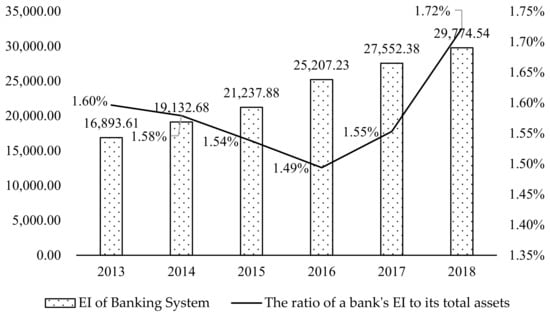
The system risk of China’s banking system from 2013 to 2018 simulated in this paper is shown in Figure 1. It can be seen that the systemic risks of China’s commercial banks are on the rise from 2013 to 2018, and that the absolute value of the expected loss of the banking system has increased year by year. The plot line in Figure 1 represents the ratio of the banking system’s expected loss to its total assets. Additionally, it is easily seen that the bank systemic risk ratio was the lowest in 2016, which might be related to the “deleveraging” policy introduced by the Chinese government in 2016. This will be discussed in a later section.
Figure 1.
Expected loss of the banking system in each year (100 million yuan, %).
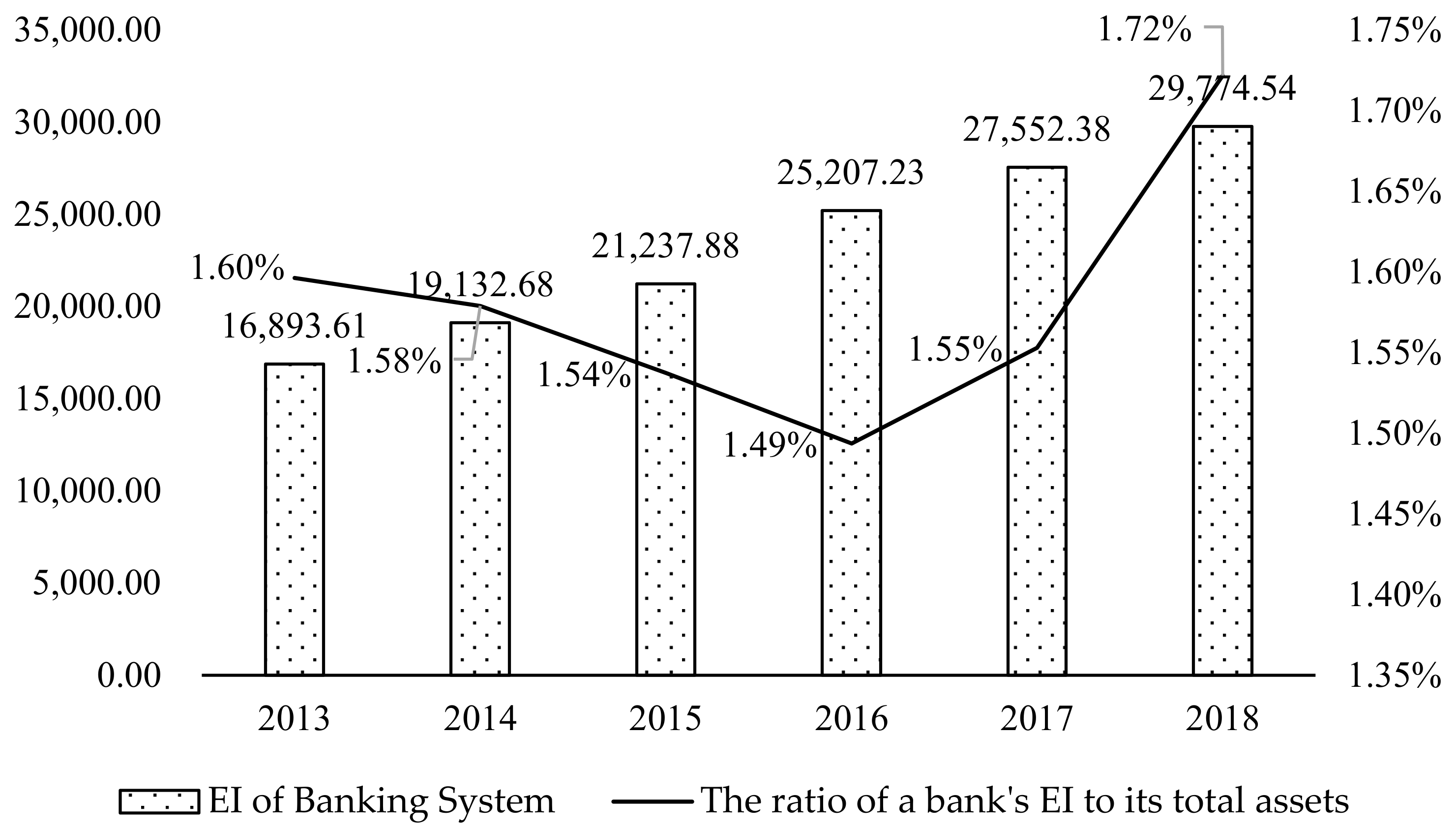
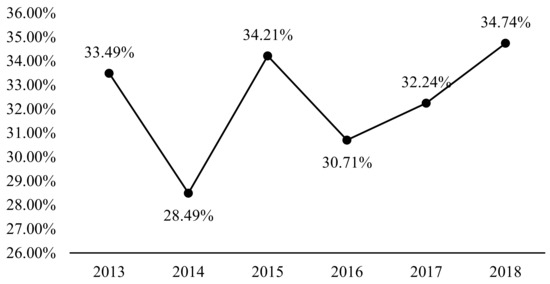
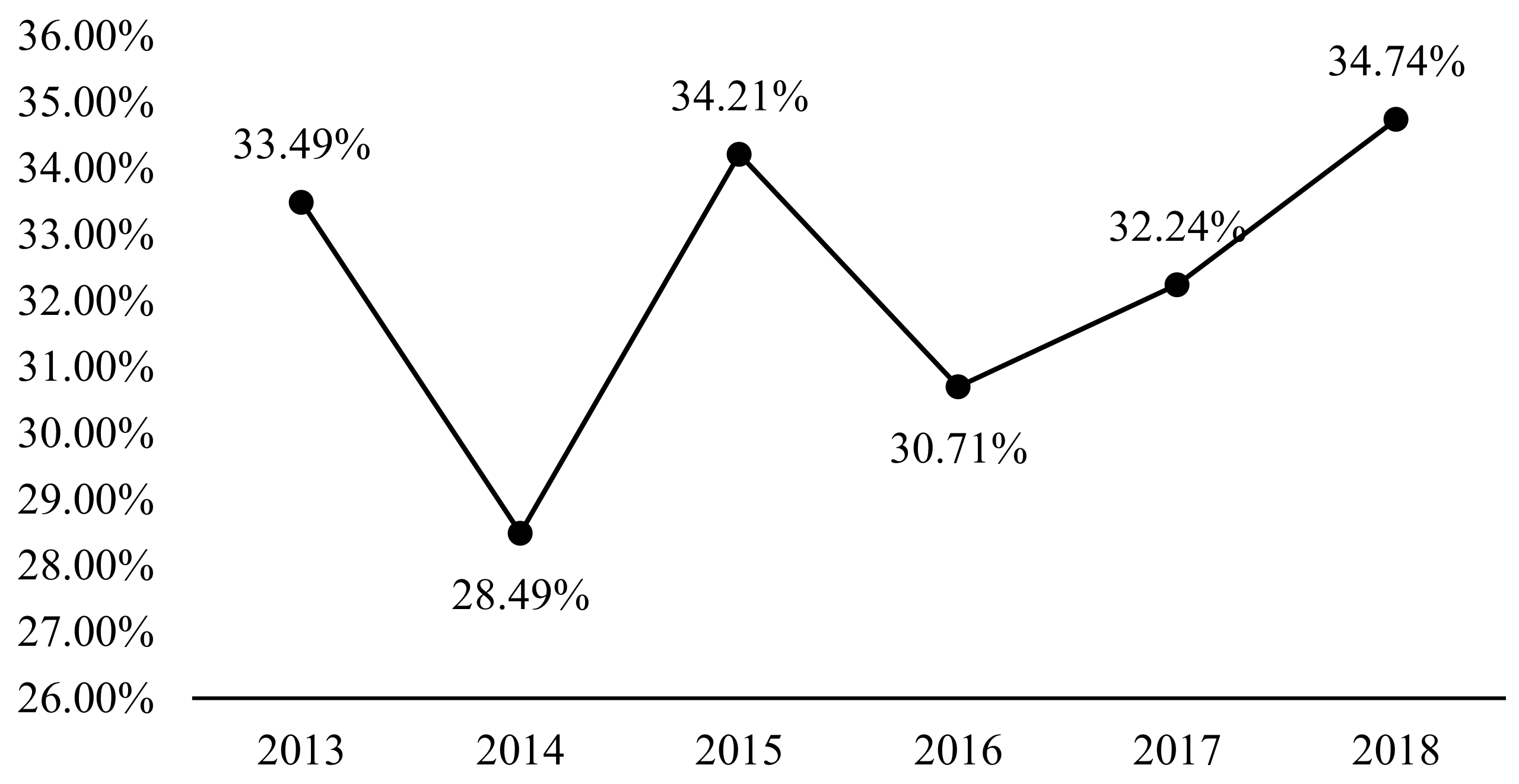
Figure 2 shows the proportion of contagious risks to the total risk of the banking system in each year. It can be seen that from 2013 to 2018 the proportion of contagious risks in banking system risks was relatively stable. About 30% of bank systemic risks were contributed by contagious risks, and the proportion of contagious risks increased after 2016. The contagious risks in the inter-bank network cannot be ignored.
Figure 2.
Proportion of contagious risk in bank systemic risk in each year.
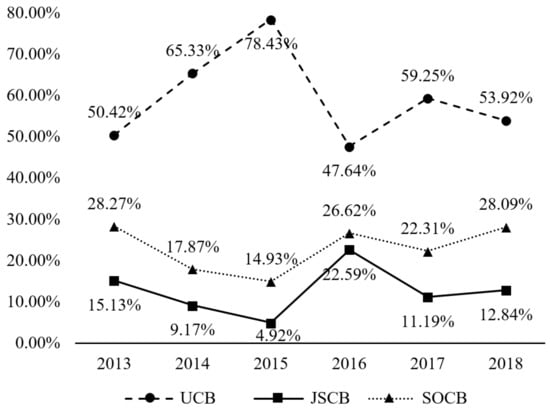
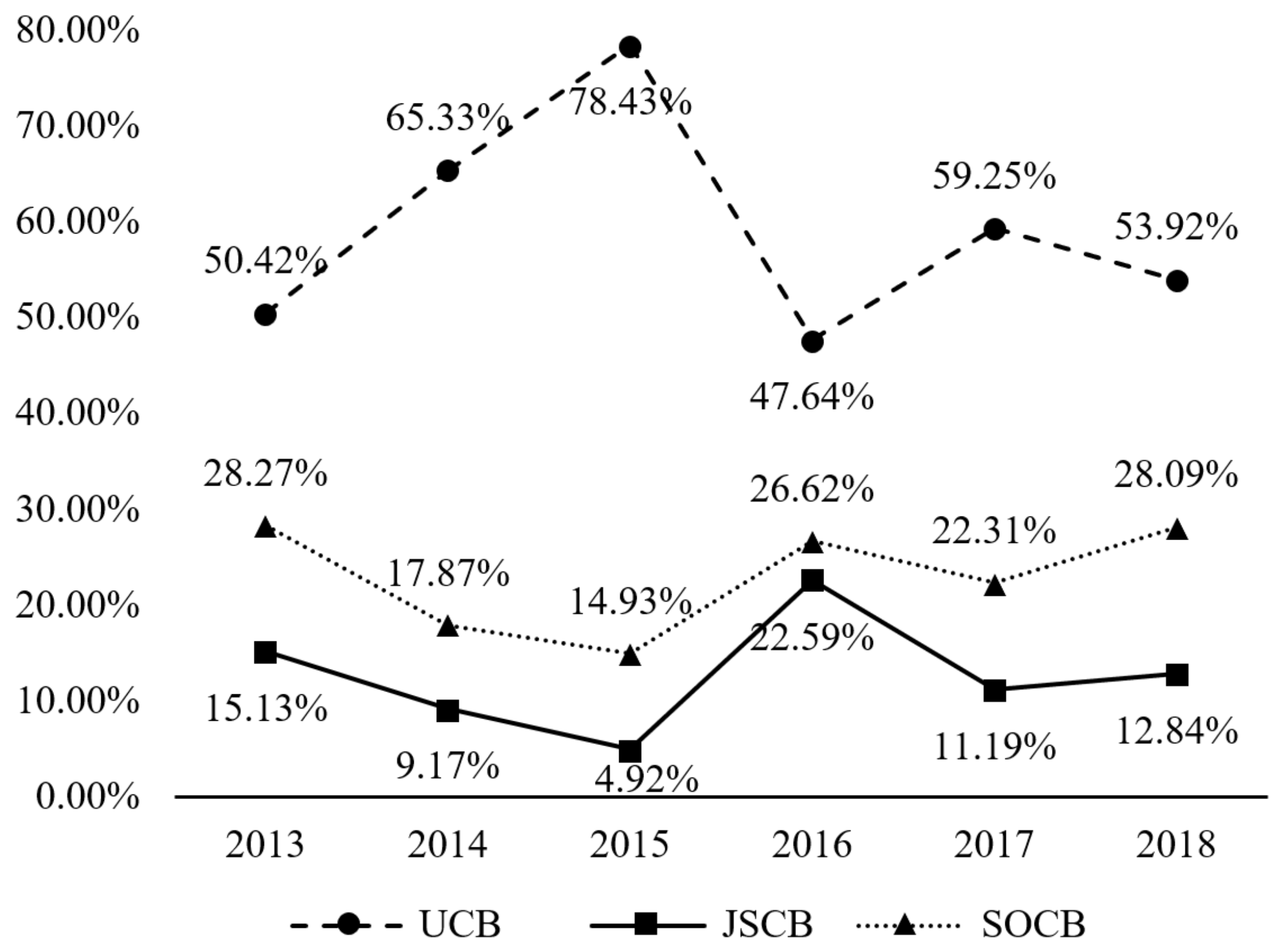
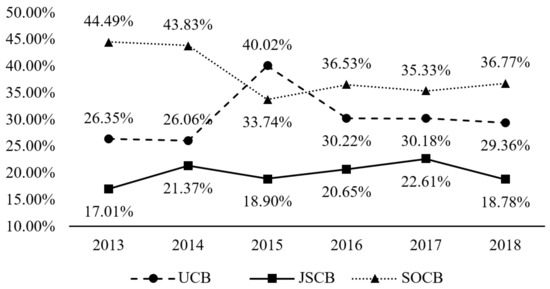
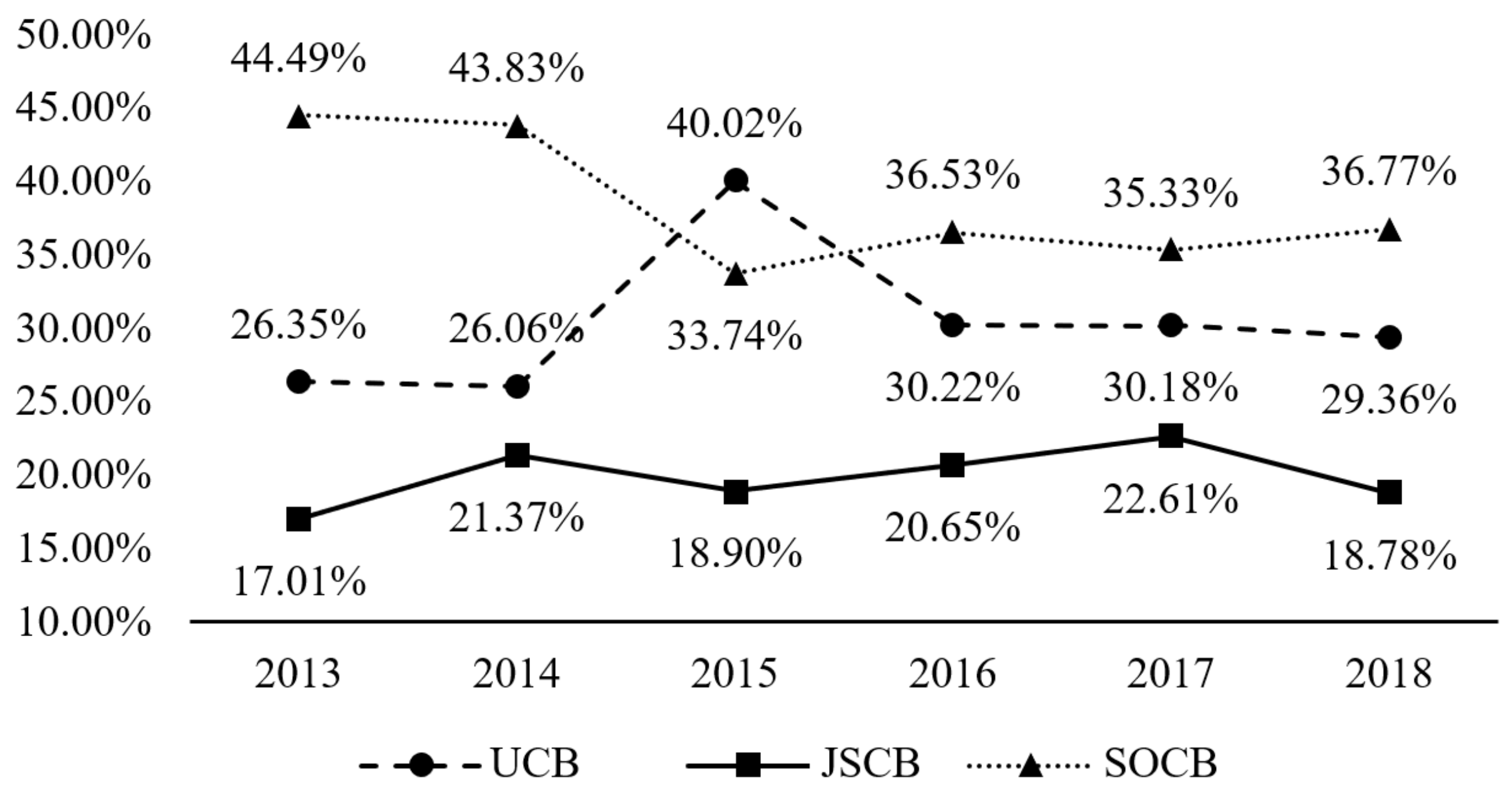
Then, we classified banks into urban commercial banks, national joint-stock commercial banks, and state-owned commercial banks, and further analyzed the contribution of different types of banks to systemic risks. It can be seen from Figure 3 that from 2013 to 2018, although the asset size of urban commercial banks (UCBs) was relatively small compared with the entire banking industry, the contagious risk contributed by it accounted for the largest proportion of the total contagious risk. Although urban commercial banks are small in scale, their contagious risks cannot be ignored. The relatively large-scale joint-stock commercial banks had the lowest risk of contagion. The largest state-owned commercial banks have a total asset size equivalent to about 40% of the total assets of the banking industry. However, its contagious risk contribution is less than 30% of the overall contagious risk.
Figure 3.
Proportion of contagious risks of various banks in total contagious risks in each year. UCBs refer to urban commercial banks. JSCBs refer to joint-stock commercial banks. SOCBs refer to state-owned commercial banks. Since the actual bank sample also includes some rural commercial banks and foreign banks, the total contagious risk contribution of urban commercial banks, joint-stock commercial banks, and state-owned commercial banks may not be 100%.
Under the extreme circumstances of financial risks, such as bank failure, relatively large joint-stock commercial banks (JSCB) and state-owned commercial banks (SOCB) will become a risk barrier, which will prevent the continuous infection of risks among banks to a great extent and avoid a major crisis in the banking system. This is especially the case for state-owned commercial banks: their total scale is more than twice that of joint-stock commercial banks, but their contagious risk contribution is not twice that of joint-stock commercial banks. For urban commercial banks, due to their relatively small scale, their resistance to risks is also relatively weak. Once extreme risks occur, they are likely to lead to the collapse of urban commercial banks and continue to transfer this risk to the banking network. If urban commercial banks are also affected by risk, due to their own vulnerability, they may become a new source of risk transmission, forming a chain or network transmission of risk. For individual risks, the individual risk contributions of different types of banks are also different. It can be seen from Figure 4 that the individual risk contribution of urban commercial banks is the smallest, while joint-stock banks are slightly larger and the individual risk contribution of state-owned commercial banks is the highest. The appearance of this phenomenon is related to the scale of various banks. Individual risk describes the losses of a single bank when it is impacted. Therefore, the larger the bank the higher its individual risk.
Figure 4.
Proportion of individual risks of various banks in total individual risks in each year.
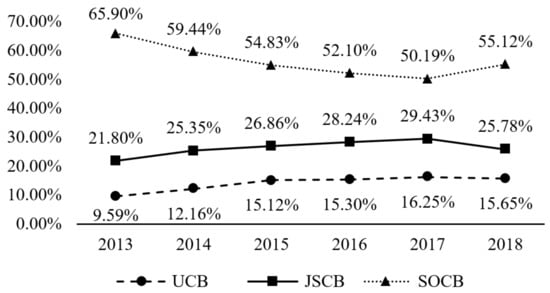
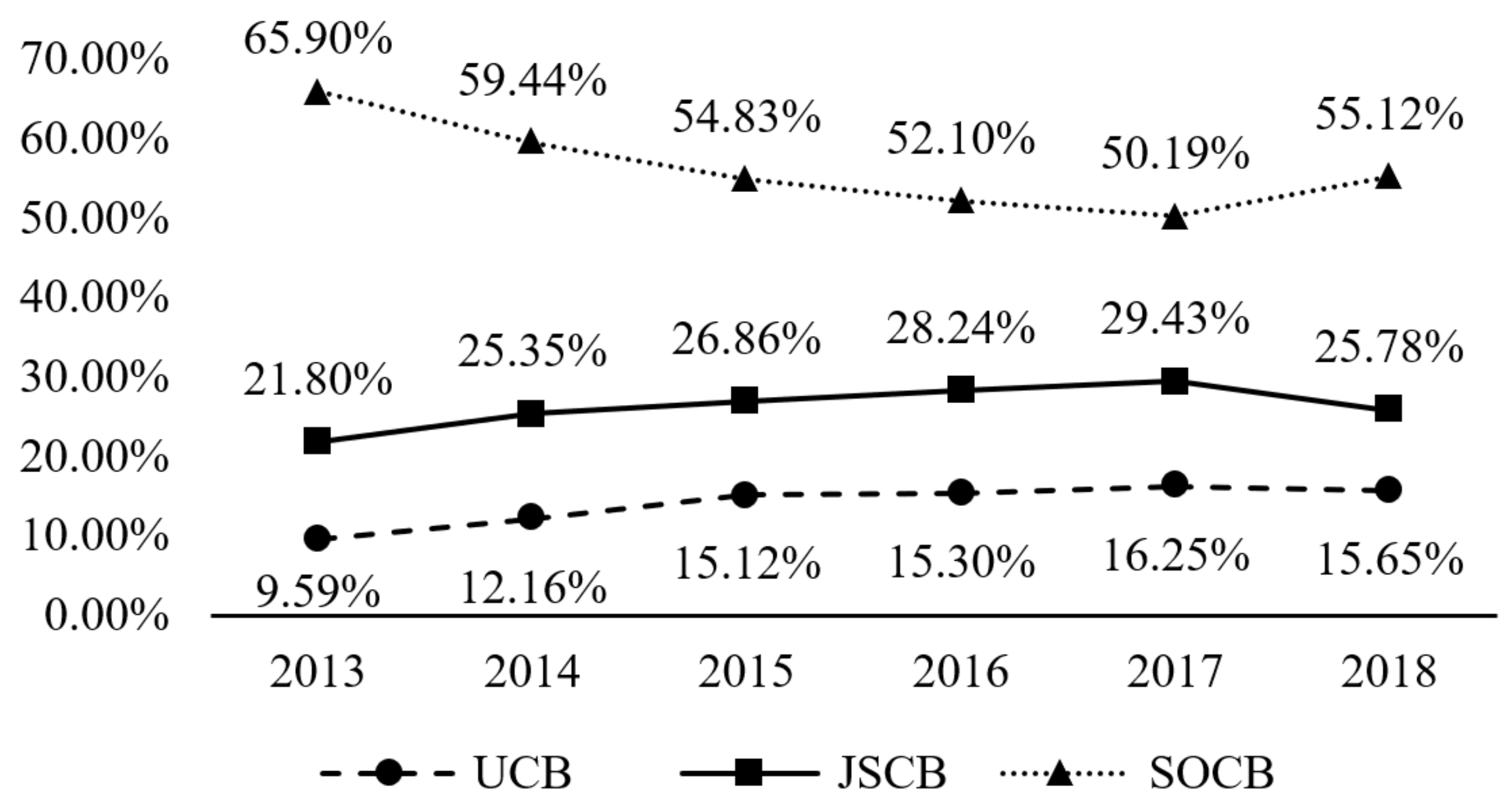
Figure 5 shows the contribution of various banks to the banking system risk in each year. From this chart we can see that although state-owned commercial banks made the greatest contribution to banking system risk, since 2015 their systemic risk contribution declined relatively. The systemic risk contribution of urban commercial banks was only second to state-owned commercial banks, reaching about 30%. Joint-stock commercial banks had the lowest contribution to systemic risk.
Figure 5.
Contribution rate of systemic risk of various banks in each year.
4. Further Discussion
4.1. Robustness Check
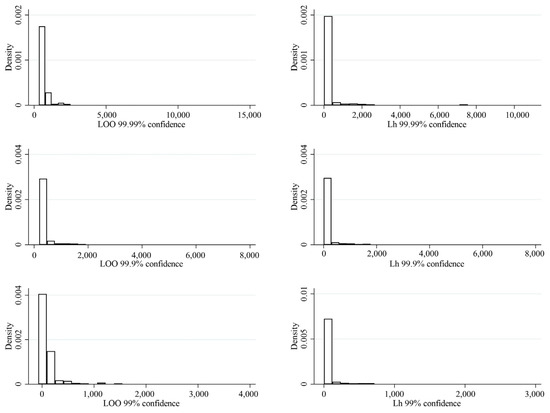
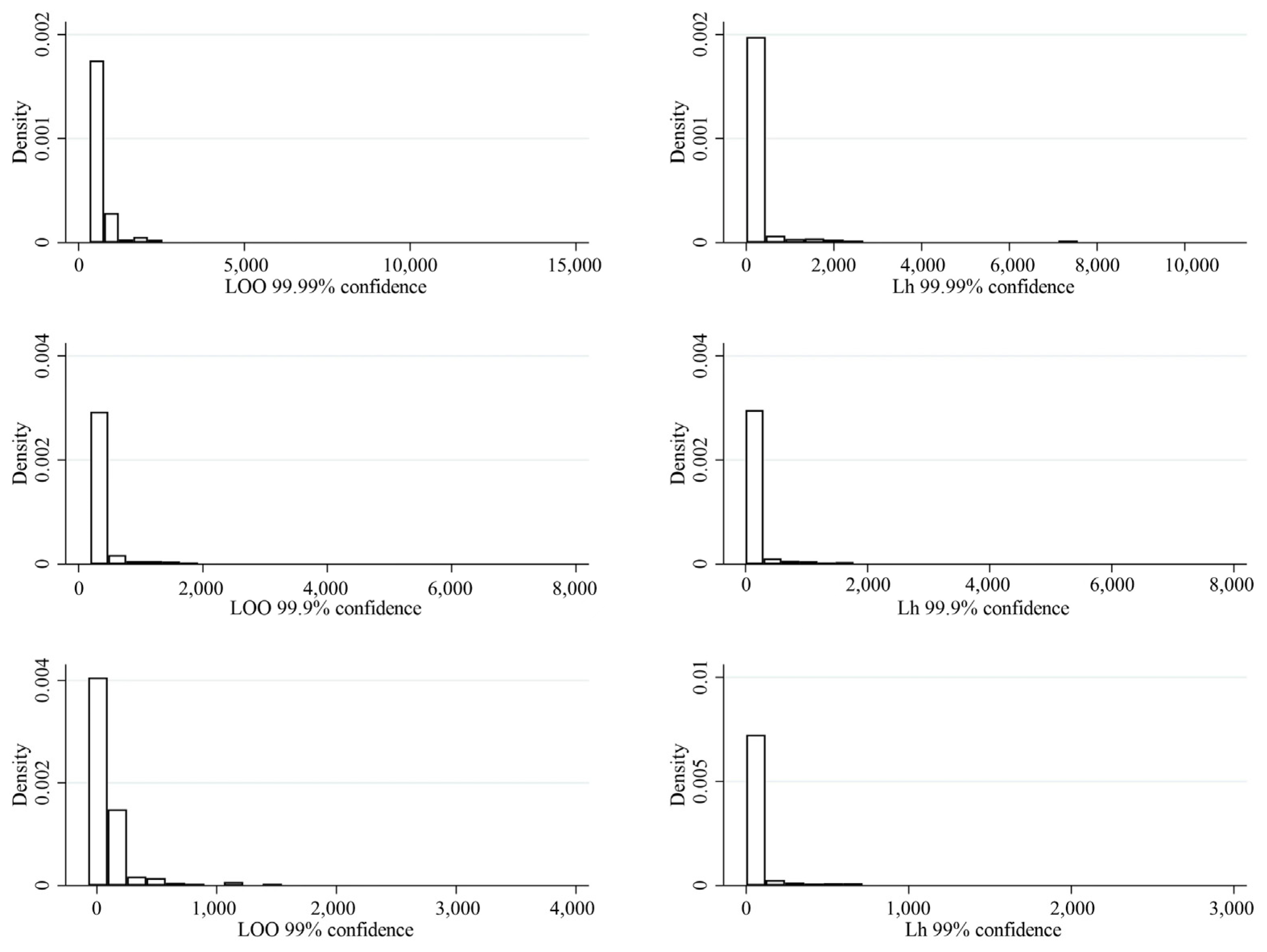
The basis of this model is the concept of unexpected loss in Basel II, in which the tail event probability (probability of an extreme default event) is the key parameter. To test the robustness of our conclusions, another two different tail event probabilities, namely 0.1% and 0.01%, besides the 1% above, were selected to investigate the systemic financial risk at different crisis severities. The confidence of the above tail event probabilities is 99%, 99.9%, and 99.99%, respectively. As shown in Figure 6, by comparing its density distribution maps, the results with different confidence remained robust.
Figure 6.
The density distribution of bank systemic risk and individual bank risk at 99%, 99.9%, and 99.99% confidence.
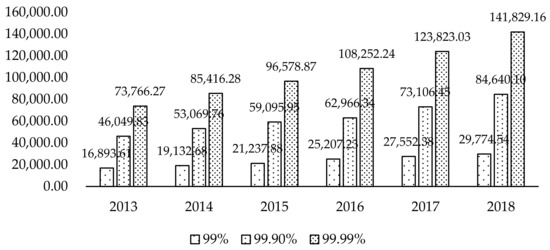
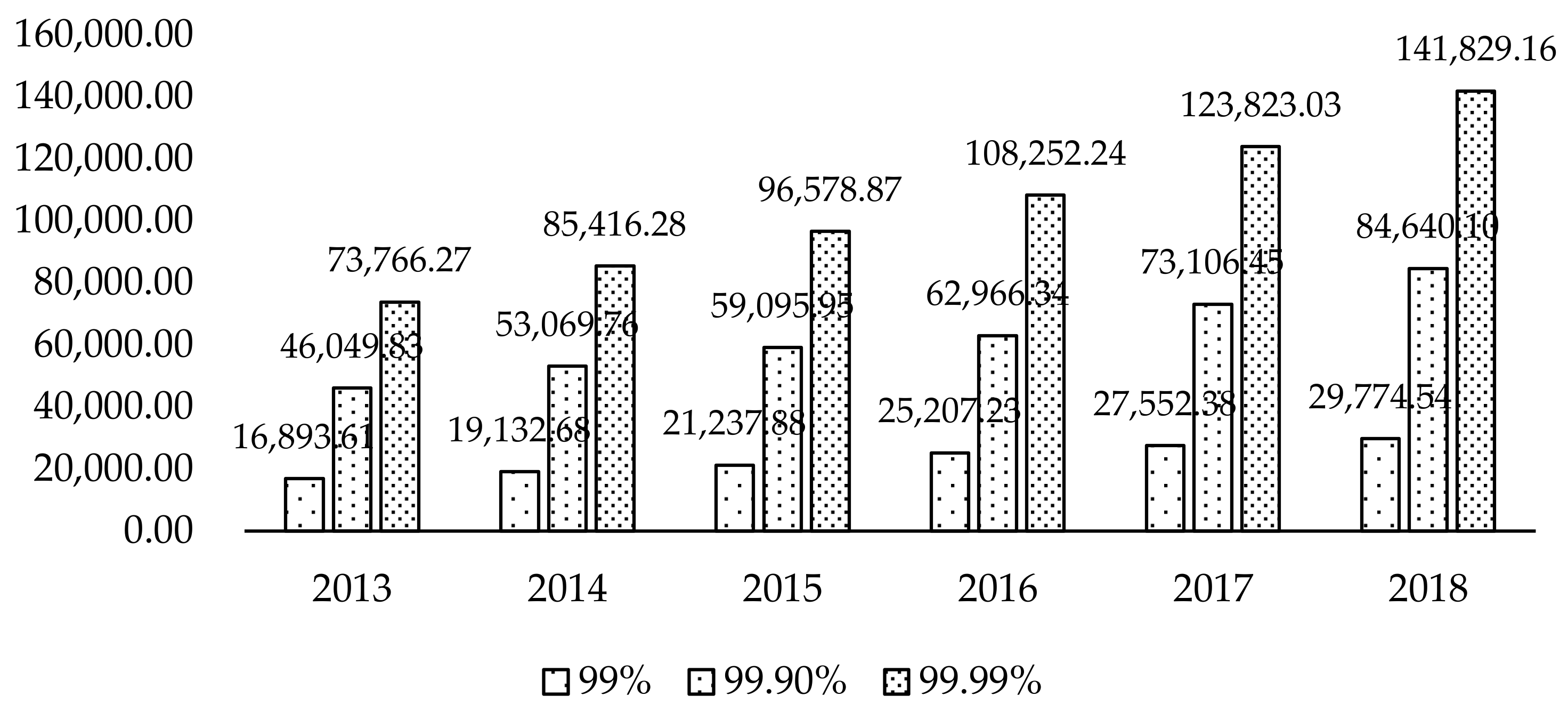
As shown in Figure 7, the overall systemic financial risk of China’s banking industry rose year by year, and the results based on different confidence are still robust, among which the expected loss at 99% confidence increased from 1689.3 billion yuan in 2013 to 2977.4 billion yuan in 2018, while the expected loss at 99.99% confidence rose from 7376.6 billion yuan in 2013 to 14,182.9 billion yuan in 2018. In 2016, systemic risk expected losses at tails in the banking sector with 99% confidence increased as high as 18.7%. This fully demonstrates that systemic financial risk in China’s banking industry is building up.
Figure 7.
Systematic risk in the Chinese banking industry at 99%, 99.9%, and 99.99% confidence levels from 2013 to 2018 (100 million).
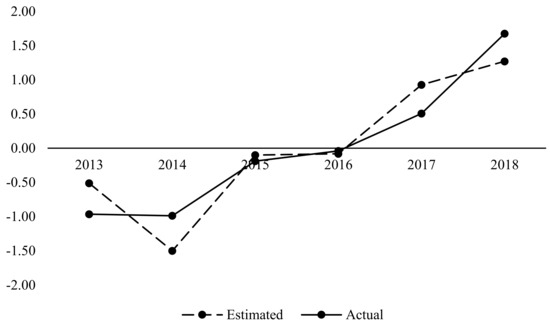
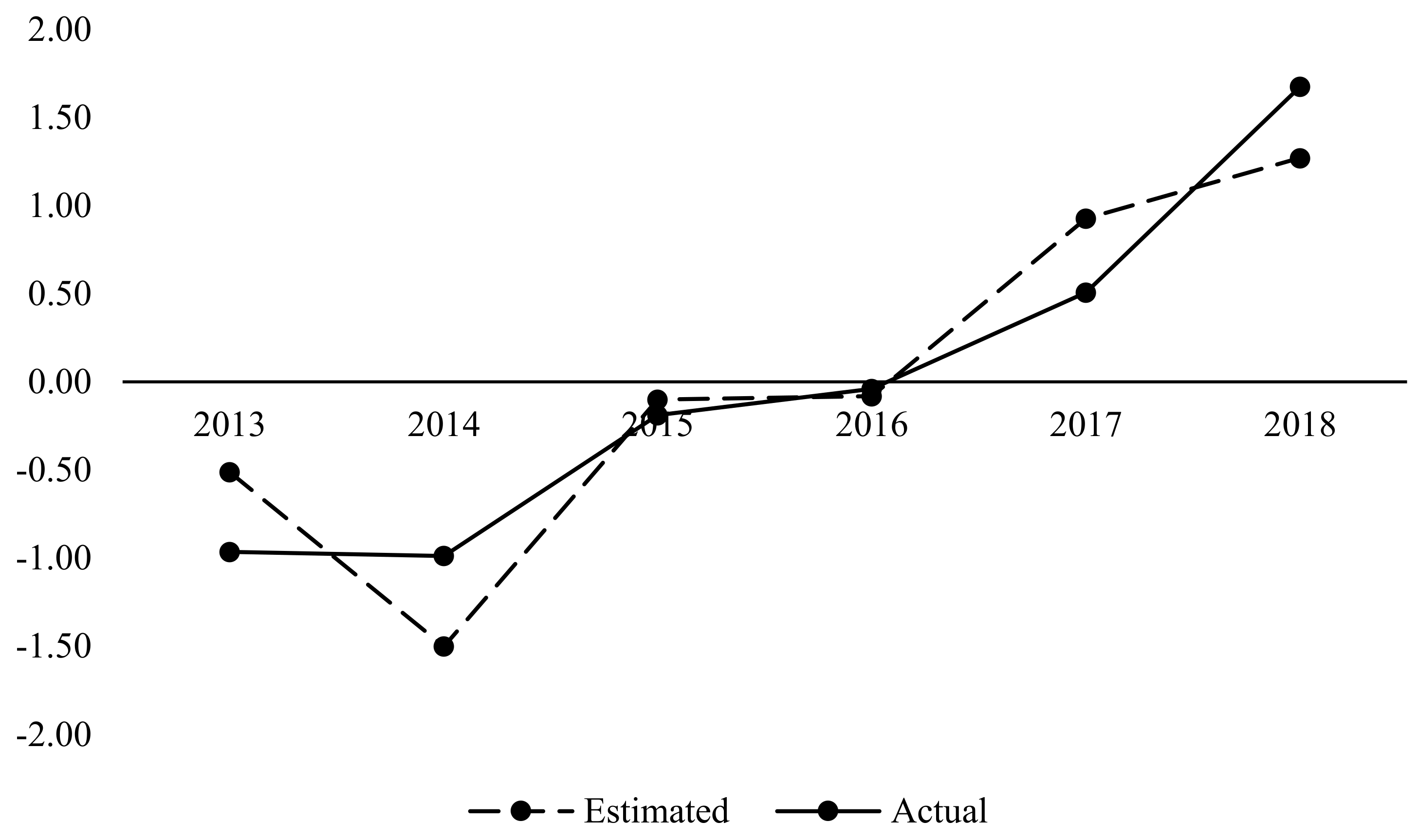
Moreover, the interbank network correlation matrix is calculated by the maximum entropy method; the contagion risk depends on the network structure. Therefore, we should check the robustness of the maximum entropy method. Following Paltalidis et al. [30], we estimated the normalized total contagious risk of one bank spilling over to all others and the normalized total interbank business which is the actual bilateral exposures by using the maximum entropy method and comparing the results to check the reliability of the research results. Figure 8 shows the results: the dotted line represents the estimated average contagion risk while the full line represents the average actual bilateral exposures. Additionally, the values are highly correlated, which means that our results are close to reality. Therefore, applying the method of a maximum-entropy-based network is reasonable to construct the entire banking network.
Figure 8.
Comparison of estimated contagion risk and actual bilateral exposures.
4.2. Banking Systemic Risk Influencing Factors: The Supervision of Shadow Banking
Next, this paper takes a linear regression approach to examine the determinants of systemic financial risk. In the previous quantification results, we found some interesting phenomena. As in Figure 2, the proportion of infectious risk to bank systemic risk decreased in 2014 and 2016. Correspondingly, in 2014 and 2016, the Chinese government issued two more important policy documents on strengthening the supervision of inter-bank business; the introduction of the policies enhanced the supervision of shadow banking business. In April 2014 the People’s Bank of China, the China Banking and Insurance Regulatory Commission, the China Securities Regulatory Commission, and the State Administration of Foreign Exchange jointly issued a notice on regulating financial institutions’ inter-bank business. According to the overall idea, the aim was to develop and promote regulatory compliance in inter-bank business behavior. In 2016, the State Council put forward their opinions on actively steadily reducing enterprise leverage, which indicated that government should adhere to a positive fiscal policy and a steady monetary policy orientation, strengthen self-restraint, revitalize stock assets, optimize debt structure, orderly marketize the transformation between bank debt and equity, bankruptcy, develop equity financing by marketization, the rule of law, promote mergers and reorganization, perfect the modern enterprise system, actively and steadily reduce enterprise leverage, boost supply-side structural reform, boost state-owned enterprise reform, boost economic transformation and upgrading and optimization, and lay a solid foundation for long-term sustainable and healthy economic development. It is believed that these priorities focus on undermining shadow banking business. At the same time, the original intention of regulators to regulate shadow banking business is to reduce risks. This article tries to take inter-bank business as a measure of shadow banking to demonstrate the effect of shadow banking on systemic financial risk. The basic measurement model is as follows:
In the model, and represent bank risk and related variables of inter-bank business, such as inter-bank funds and transaction financial assets, respectively, and represents control variables, including fixed assets, total assets, total liabilities, cash and central bank funds, derivative financial assets, and the provisions for risk. represents an individual fixed effect, represents an individual fixed effect, and is the error term. Sample banks’ descriptive statistics are shown in Table 3.
Table 3.
Descriptive statistics of sample banks.
A regression analysis was conducted with data from each bank, and the empirical results are shown in Table 4. Among them, the first column takes systemic risk as the dependent variable, and the results of column one show that the development of shadow banking business will lead to an increase in the systemic risk of the bank as a whole. The second to fifth columns take infectious risk as the dependent variable. Through column two we found that the relationship between shadow banking business volume and infectious risk is not significant, in addition to the fact that the coefficient is basically positive. This may be caused by the heterogeneity of the sample; therefore, this paper distinguishes the sample for state-owned banks, joint-stock banks, and city banks. The results of columns three and four show that the shadow banking business of state-owned banks, joint-stock banks, and other large banks is negatively related with infectious risk; column five shows that the shadow banking business volume of city banks and infectious risk have a positive relationship. Regarding column two to column five, we can find that even if large banks have a barrier effect on infectious risk, the relationship between shadow banking business and infectious risk is still positive. The dependent variable in the sixth column is the individual risk of a bank. According to column six, we can find that the coefficient between interbank business volume and bank individual risk is not significant. After the sample regression the coefficient was still not significant, so it is not reported in the table.
Table 4.
Relationship between inter-bank lending and bank risk.
It can be seen that shadow banking business may increase the correlation among a bank’s balance sheet, thus increasing infectious and systemic risks. Therefore, when the two “strong supervision” occurred in 2014 and 2016, the business volume of shadow banking decreased, and the overall systemic risk and infectious risk of banks were also reduced, respectively; due to the small change in individual risk, the proportion of infectious risk in systemic risk decreased. Meanwhile, the ability to access resident deposits of small- and medium-sized banks is much weaker than larger state-owned banks, resulting in small- and medium-sized banks being inclined to acquire capital from inter-bank borrowing. The data also verify the inference. Typically, the inter-bank assets of small- and medium-sized banks are around 15%, which is 5% more than large state-owned banks. Due to small- and medium-sized banks relying more on inter-bank borrowing, they become the main node of the correlation network and will generate more contagion risk if an economic shock occurs.
In Table 4, we used the logarithm of the explained variables to regress, which can reduce the collinearity and heteroscedasticity of the model. However, this process also drops some negative numbers and reduces the sample size. In order to test the robustness of the results, we regressed the data without adjusting for logarithms. We found essentially the same result.
5. Conclusions
This paper built a bank systemic risk model to simulate and analyze the expected losses of 158 Chinese banks when exposed to exogenous shocks, and obtained the systemic risk of Chinese banks from 2013 to 2018. In detail, by using balance sheet data for each bank, and especially inter-bank lending data, this paper generated an inter-bank network correlation matrix using the maximum entropy method. Then, it calculated individual risk by simulating the expected tail loss of an impacted bank in the case of an exogenous shock. Additionally, using the expected tail loss of other banks affected by an impacted bank, we calculated the contagion risk of the network spillover. According to the simulation results of banking systemic risk, we can conclude that: (1) Although the absolute value of the systemic risk of Chinese banks has been increasing year by year in recent years, its ratio to the total assets of the banking industry is relatively stable. (2) Banking systemic risk is based on individual risk. However, contagious risk still cannot be ignored. The contribution of contagious risk to systemic risk in each year accounts for about 30% in an increasing trend. (3) Individual risk is positively related to bank size. Individual risks of state-owned commercial banks have the greatest impact on their total individual risk, followed by those of city commercial banks and finally those of joint-stock banks. (4) Contagious risk is basically negatively correlated with bank size. The smallest urban commercial bank has the largest contribution to contagious risk, while the largest state-owned bank contributes less to contagion risk than city commercial banks. (5) Despite the fact that small- and medium-sized banks contribute the most to systemic risk, larger state-owned banks continue to be the main source of contagion risk. Therefore, the above findings indicate concern over contagious risk, in order to explain them further. In addition, we examined the effects of different types of assets and liabilities in bank balance sheets, especially those related to shadow banking, such as inter-bank lending. The results show that shadow banking can explain contagion risk and the contributions of small- and medium-sized banks to contagion risk. The above empirical results illustrate the impact of network linkages on contagion risk as well, since our network model relies heavily on shadow banking activities, such as interbank lending. Thus, small- and medium-sized banks rely more on interbank business than resident deposits for funding, which makes them more vulnerable to contagion risks.
Based on the above findings, the following inspirations have been drawn for this study:
- (1)
- In China’s banking system, contagion risk has become a key component of potential financial risk. In addition to managing individual bank risks from a micro-prudential perspective, we must also consider the impact of contagion across the banking system from a macro-prudential perspective. Furthermore, a bank’s asset–liability ratio shows a strong correlation with its contagious risk. It consequently suggests that China should track the inter-bank market capital transactions in real time in order to detect hidden risks and prevent the spread of contagious risks, thereby reducing the systemic financial risks of the banking industry and enhancing economic stability.
- (2)
- The results show that the contribution of different types of banks to systemic financial risk varies. Thus, it is a good idea to focus on classified banking supervision. Additionally, China should adopt flexible regulations for different types of banks to address different types of potential systematic risks, in particular paying more attention to small- and medium-sized banks, such as city commercial banks. In spite of the fact that these banking mechanisms are relatively flexible and provide a potential for financial innovation, they fail to address financial risks effectively, resulting in systemic risks. It is important for supervisors to ensure proper internal controls and to standardize business operations, to keep them from over-relying upon inter-bank market positions, and to provide liquidity during times of crisis.
Author Contributions
Conceptualization, J.Z. and C.G.; methodology, J.Z. and X.F.; software, C.G. and J.Y.; validation, C.G.; formal analysis, J.Z.; investigation, J.Z. and J.Y.; resources, J.Z. and X.F.; data curation, J.Z. and J.Y..; writing—original draft preparation, J.Z., X.F. and J.Y.; writing—review and editing, J.Z. and X.F.; supervision, C.G.; project administration, J.Z.; funding acquisition, J.Z. All authors have read and agreed to the published version of the manuscript.
Funding
This research was funded by Research on the effect of financial coordinated development under the goal of "double carbon" grant number 2021CXC11 and the APC was funded by Sichuan University.
Institutional Review Board Statement
Not applicable.
Informed Consent Statement
Not applicable.
Data Availability Statement
This study did not report any data.
Conflicts of Interest
The authors declare no conflict of interest.
Appendix A
Due to the lack of data, the number of banks involved in the simulation is also different for every year. We used 158 banks in this paper, including 94 urban commercial banks, 12 joint-stock commercial banks, 6 state-owned large commercial banks, 2 rural cooperative banks, 28 rural commercial banks, and 16 foreign trade banks.
When calculating the systemic risk we adopted all of the banks in the sample; due to the small systemic risk situation occupied by rural cooperative banks, rural commercial banks, and foreign trade banks, when considering the individual risk and infectious risk this paper mainly focuses on the analysis of large banks represented by large state-owned controlled commercial banks, medium-sized banks represented by joint-stock commercial banks, and small banks represented by urban commercial banks.
The bank names are as follows:
Table A1.
Sample bank name and bank type.
References
- Adrian, T.; Brunnermeier, M. CoVaR; NBER Working Paper, No.17454; National Bureau of Economic Research: Cambridge, MA, USA, 2011. [Google Scholar]
- Xu, Q.; Chen, L.; Jiang, C.; Yuan, J. Measuring systemic risk of the banking industry in China: A DCC-MIDAS-t approach. Pac.-Basin Financ. J. 2018, 51, 13–31. [Google Scholar] [CrossRef] [Scilit]
- Acharya, V.V.; Steffen, S. Analyzing systemic risk of the European banking sector. In Handbook on Systemic Risk; Fouque, J.P., Langsam, J.A., Eds.; Cambridge University Press: Cambridge, UK, 2013; pp. 247–282. [Google Scholar]
- Brownlees, C.T.; Engle, R. Volatility, Correlation and Tails for Systemic Risk Measurement. Available online: https://www.semanticscholar.org/paper/Volatility%2C-Correlation-and-Tails-for-Systemic-Risk-Brownlees-Engle/c3c8133b4b946aa72e939da4fa001dc8b4a16ce2 (accessed on 12 December 2021).
- Diebold, F.X.; Yilmaz, K. Better to give than to receive: Predictive directional measurement of volatility spillovers. Int. J. Forecast. 2012, 1, 57–66. [Google Scholar] [CrossRef] [Scilit]
- Diebold, F.X.; Yilmaz, K. Measuring financial asset return and volatility spillovers, with application to global equity markets. Econ. J. 2009, 534, 158–171. [Google Scholar] [CrossRef] [Scilit]
- Diebold, F.X.; Yilmaz, K. On the network topology of variance decompositions: Measuring the connectedness of financial firms. J. Econ. 2014, 182, 119–134. [Google Scholar] [CrossRef] [Scilit]
- Härdle, W.K.; Wang, W.; Yu, L. TENET: Tail-Event driven NETwork risk. J. Econ. 2016, 192, 499–513. [Google Scholar] [CrossRef] [Scilit]
- Lelyveld, I.; Liedorp, F. Interbank Contagion in the Dutch Banking Sector: A Sensitivity Analysis. Int. J. Cent. Bank. 2006, 5, 99–133. [Google Scholar]
- Upper, C.; Worms, A. Estimating bilateral exposures in the German interbank market: Is there a danger of contagion? Eur. Econ. Rev. 2004, 48, 827–849. [Google Scholar] [CrossRef] [Scilit]
- Verma, R.; Ahmad, W.; Uddin, G.S.; Bekiros, S. Analysing the systemic risk of Indian banks. Econ. Lett. 2019, 176, 103–108. [Google Scholar] [CrossRef] [Scilit]
- Wang, G.J.; Jiang, Z.Q.; Lin, M.; Xie, C.; Stanley, H.E. Interconnectedness and systemic risk of China’s financial institutions. Emerg. Mark. Rev. 2018, 35, 1–18. [Google Scholar] [CrossRef] [Scilit]
- Wang, G.-J.; Chen, Y.-Y.; Si, H.-B.; Xie, C.; Chevallier, J. Multilayer information spillover networks analysis of China’s financial institutions based on variance decompositions. Int. Rev. Econ. Finance 2021, 73, 325–347. [Google Scholar] [CrossRef] [Scilit]
- Benoit, S.; Colliard, J.E.; Hurlin, C.; Pérignon, C. Where the Risks Lie: A Survey on Systemic Risk. Narnia 2017, 21, 109–152. [Google Scholar] [CrossRef] [Scilit]
- Billio, M.; Getmansky, M.; Lo, A.W.; Pelizzon, L. Econometric measures of connectedness and systemic risk in the finance and insurance sectors. J. Financ. Econ. 2012, 104, 535–559. [Google Scholar] [CrossRef] [Scilit]
- Beltratti, A.; Bortolotti, B.; Caccavaio, M. Stock market efficiency in China: Evidence from the split-share reform. Q. Rev. Econ. Financ. 2016, 60, 125–137. [Google Scholar] [CrossRef] [Scilit]
- Anand, K.; Craig, B.R.; Von Peter, G. Filling in the Blanks: Network Structure and Interbank Contagion. Quant. Financ. 2014, 15, 625–636. [Google Scholar] [CrossRef] [Scilit]
- Gandy, A.; Veraart, L.A.M. A Bayesian methodology for systemic risk assessment in financial networks. LSE Res. Online Doc. Econ. 2017, 63, 215–229. [Google Scholar] [CrossRef] [Scilit]
- Zedda, S.; Cannas, G. Analysis of banks’ systemic risk contribution and contagion determinants through the leave-one-out approach. J. Bank. Financ. 2017, 112, 105160. [Google Scholar] [CrossRef] [Scilit]
- Lisa, R.D.; Zedda, S.; Vallascas, F.; Campolongo, F.; Marchesi, M. Modelling Deposit Insurance Scheme Losses in a Basel 2 Framework. J. Financ. Serv. Res. 2011, 40, 123–141. [Google Scholar] [CrossRef] [Scilit]
- Frankel, J.A.; Rose, A.K. Currency crashes in emerging markets: An empirical treatment. J. Int. Econ. 1996, 41, 351–366. [Google Scholar] [CrossRef] [Scilit]
- Corsi, F.; Lillo, F.; Pirino, D.; Trapin, L. Measuring the propagation of financial distress with granger-causality tail risk networks. J. Financ. Stab. 2018, 38, 18–36. [Google Scholar] [CrossRef] [Scilit]
- Furfine, C. Interbank Exposures: Quantifying the Risk of Contagion. J. Money Crédit. Bank. 2003, 35, 111–128. [Google Scholar] [CrossRef] [Scilit]
- Chen, B.; Li, L.; Peng, F.; Anwar, S. Risk contagion in the banking network: New evidence from China. North Am. J. Econ. Financ. 2020, 54, 101276. [Google Scholar] [CrossRef] [Scilit]
- Elsinger, H.; Lehar, A.; Summer, M. Network Models and Systemic Risk Assessment. Handb. Syst. Risk 2013, 1, 287–305. [Google Scholar]
- Upper, C. Simulation methods to assess the danger of contagion in interbank markets. J. Financ. Stab. 2011, 7, 111–125. [Google Scholar] [CrossRef] [Scilit]
- Mistrulli, P.E. Assessing financial contagion in the interbank market: Maximum entropy versus observed interbank lending patterns. J. Bank. Financ. 2011, 35, 1114–1127. [Google Scholar] [CrossRef] [Scilit]
- Blien, U.; Graef, F. Entropy Optimizing Methods for the Estimation of Tables. In Classification, Data Analysis, and Data Highways; Springer: Berlin/Heidelberg, Germany, 1998; pp. 3–15. [Google Scholar]
- Huang, X.; Zhou, H.; Zhu, H. Systemic Risk Contributions. J. Financ. Serv. Res. 2012, 42, 55–83. [Google Scholar] [CrossRef] [Scilit]
- Paltalidis, N.; Gounopoulos, D.; Kizys, R.; Koutelidakis, Y. Transmission channels of systemic risk and contagion in the European financial network. J. Bank. Financ. 2015, 61, S36–S52. [Google Scholar] [CrossRef] [Scilit]

Publisher’s Note: MDPI stays neutral with regard to jurisdictional claims in published maps and institutional affiliations. |
© 2022 by the authors. Licensee MDPI, Basel, Switzerland. This article is an open access article distributed under the terms and conditions of the Creative Commons Attribution (CC BY) license (https://creativecommons.org/licenses/by/4.0/).