


Simple Summary
We assembled and annotated a more complete chloroplast genome of P. arguta, which includes an 86,825 bp large single-copy (LSC) region, an 18,735 bp small single-copy (SSC) region, and two 26,126 bp inverted repeats (IRa/IRb). SSR detection identified 199 simple repeat loci, with A/T mononucleotide repeats being most frequent (59.8%). Phylogenetic tree results revealed high homology between P. arguta and Hydrangea davidii. This work provides a scientific basis for future studies on P. arguta’s genetics, biology, and conservation.
Abstract
As an important rare and endangered plant, Platycrater arguta urgently requires protective measures. In this study, we assembled and annotated a more complete chloroplast genome of P. arguta, which has a size of 157,812 bp. The chloroplast genome comprises a large single-copy (LSC) region of 86,825 bp, a small single-copy (SSC) region of 18,735 bp, and a pair of inverted repeats (IRa and IRb) of 26,126 bp each. SSR detection revealed that the chloroplast genome contains 199 simple repeat loci, with mononucleotide repeats of A and T being the most frequent, accounting for 59.8%. Comparative analysis of the chloroplast genome structure showed that the IR region boundaries are relatively conserved. The results of the phylogenetic tree indicate that P. arguta shares high homology with Hydrangea davidii. This work provides a scientific basis for future research on the genetics, biology, and conservation of P. arguta.
1. Introduction
Chloroplasts are plant-specific organelles responsible for photosynthesis, through which plants convert light energy into chemical energy and store it in cells [1]. In addition, chloroplasts also play a vital role in plant growth and development, as they are crucial for plant responses to light, heat, drought, salt, and other abiotic stresses [2]. The chloroplast genome encodes several important proteins that participate in metabolic processes, and the genes within this genome exhibit a relatively high degree of conservation across plant species [3,4]. Furthermore, the chloroplast genome exhibits a low recombination rate, which results in less genetic variation within itself (compared to the nuclear genome). This characteristic makes it widely applicable in phylogenetic analysis of plants at different taxonomic levels [5,6].
The chloroplast genomes are highly conserved in their overall organization in most lineages, with sizes ranging from <100 bp to >1000 bp, and typically have a four-part structure, including two inverted repeat (IR) regions, one large-single copy (L) region, and one small single-copy (SSC) region [7,8]. However, significant variations in the size, structural arrangement, and gene content of chloroplast genomes have been recorded from algae to angiosperms, reflecting evolutionary trajectories in these organisms [8]. For example, some algal plastid genomes contain large amounts of non-coding DNA, which occupies a part of the genome and may be involved in regulating gene expression, or in the replication and repair of the genome. Others are filled with autosplicing introns, as in Chlamdomonas [8]. The number of genes in the chloroplast genome is significantly fewer than that in the nuclear genome [7]. Due to variations in evolutionary patterns and geographic distribution, the chloroplast genomes of different plant groups may exhibit differences in gene presence/absence, repeat sequences, deletions, rearrangements, and other structural variations [9].
The rapid advancement of next-generation sequencing (NGS) technology has significantly accelerated research progress in chloroplast genetics and genomics, enhancing both the efficiency (speed) and depth of such studies [10]. Prior to the widespread adoption of NGS, Nicotiana tabacum (tobacco) was the first species for which a complete chloroplast genome was sequenced, with this milestone achieved in 1986 [11]. Subsequently, complete chloroplast genome sequences were generated for numerous other species, including Marchantia polymorpha [12], Oryza sativa [13], Euglena gracilis [14], and Pinus thunbergii [15]. To date, over 2000 complete chloroplast genome sequences have been publicly submitted to the National Center for Biotechnology Information (NCBI) database. The continuous expansion of chloroplast genome data in such public repositories will make valuable contributions to phylogenetic inference and related evolutionary studies [16,17]. For example, Hu et al. (2023) reported that the complete chloroplast genome of Sphaeropteris lepifera, a rare and endangered tree fern, has a length of 162,150 base pairs (bp), and they identified 161 simple sequence repeat (SSR) loci within this genome [10]. Phylogenetic analysis based on the complete chloroplast genome further indicated that Sphaeropteris lepifera shares a closer evolutionary relationship with Alsophila podophylla than with other related genera. Separately, Huo et al. (2019) compared the chloroplast genomes of nine Allium species, demonstrating the conservation of these genomes in terms of genome structure and gene organization; additionally, phylogenetic tree analysis clustered these nine Allium species into two distinct clades [18].
Platycrater arguta, a member of the family Hydrangeaceae and the monotypic genus Platycrater (i.e., a genus containing only one species), is a relic plant that existed in Japan prior to the archipelago’s separation from the Asian continent [19]. This deciduous shrub, endemic to East Asia, holds substantial value for investigating the phylogeography of continental-island disjunct distributions, a key biogeographic pattern in evolutionary ecology. Notably, in 1992, it was listed in the “Red Data Book of China” and designated as a national second-class endangered species under state protection, reflecting its critical conservation status [19].
P. arguta flowers in summer, producing white blooms with an elegant morphology; their petals exhibit dense venation resembling a spider’s web, hence its common name, “spiderweb calyx”. Owing to its unique floral architecture, high esthetic appeal, tolerance to pruning, and facile shaping, this species is widely utilized in flower beds and as indoor potted plants to enhance residential and horticultural environments, conferring substantial ornamental and economic value [19]. Furthermore, its leaves can serve as a tea substitute, exhibiting purported health-promoting effects, including physical vitality enhancement and mental refreshment, which signifies promising development prospects for its sustainable utilization. However, in recent decades, wild populations of P. arguta have declined drastically, and its distribution range has become progressively fragmented [19], a trend that threatens its long-term survival. To mitigate this adverse scenario, it is imperative to implement targeted protective measures for P. arguta, such as habitat restoration, ex situ conservation, and population monitoring, to safeguard its genetic diversity and ecological function.
Studies on chloroplast genomes are integral to the broader genomic research framework, and the chloroplast genome of P. arguta (hereafter P. arguta) provides a critical foundation for analyzing the species’ genetic information (particularly chloroplast-derived data) and supporting its germplasm conservation. However, current genomic resources for P. arguta remain limited, and previous chloroplast genome-related studies of this species are either incomplete or lack systematic comparative analysis, hindering in-depth investigations into its evolutionary biology and conservation needs. This study aims to (i) assemble and annotate the complete chloroplast genome of P. arguta, (ii) analyze its structural and evolutionary features, and (iii) infer phylogenetic relationships within Saxifragaceae. To achieve these objectives, we performed assembly, annotation, and comprehensive feature analysis of the P. arguta chloroplast genome, and inferred the phylogenetic relationships among 22 Saxifragaceae species. The results of this research are expected to serve as a robust reference for future studies on P. arguta, including species authentication, the development of ecological conservation strategies, and the elucidation of drivers underlying its endangered status.
2. Materials and Methods
2.1. Plant Material
The leaves of P. arguta were collected from Yandang Mountain, Wenzhou City, Zhejiang Province (27°50′ N, 120°27′ E). Total genomic DNA was extracted using a DNA Extraction Kit (Tiangen, Beijing, China) and stored at −80 °C until subsequent use [20]. Genomic DNA was then fragmented via mechanical disruption (ultrasound), followed by fragment purification, end repair, 3′-end adenylation, and ligation of sequencing adapters. Fragment size selection was performed using electrophoresis. The sequencing library was subsequently constructed through PCR amplification and subjected to paired-end (PE) sequencing on the Illumina NovaSeq 6000 platform (Illumina, Inc, San Diego, CA, USA).
2.2. The Sequence, Assembly and Annotation of Chloroplast Genome Sequence in P. arguta
Raw sequencing data were filtered using Fastp software (version 0.20.0, https://github.com/OpenGene/fastp) (accessed on 10 December 2023) [19]. High-quality clean data were obtained following these criteria: (1) removal of sequencing adapters and primer sequences from reads; (2) filtering out reads with an average quality score below Q20 or a length shorter than 50 bp; and (3) excluding reads containing more than 5 ambiguous “N” bases.
To acquire aligned sequences representing the chloroplast genome (cpDNA) of P. arguta, the very-sensitive-local algorithm of Bowtie2 (v2.2.4, https://bowtie-bio.sourceforge.io/bowtie2/index.shtml (accessed on 15 December 2023) was employed to map reads against a chloroplast genome database constructed by Nanjing Genepioneer Biotechnologies Co., Ltd., Nanjing, China [21].
Chloroplast genome assembly was performed using SPAdes v3.10.1 software (http://cab.spbu.ru/software/spades/ (accessed on 17 December 2023) [22], with kmer used 55, 87, and 121; and the assembly did not depend on the reference genome; following a seven-step protocol: SPAdes initially assembled cpDNA sequences to generate seed sequences; if contigs were produced, they were designated as pseudogenome sequences and processed directly in step 6; when contigs remained unassembled, SSPACE v2.0 https://bioinformaticshome.com/tools/wga/descriptions/SSPACE.html#gsc.tab=0 (accessed on 19 December 2023) was utilized to connect contigs into scaffolds; GapFiller v2.1.1 (https://sourceforge.net/projects/gapfiller/ (accessed on 21 December 2023) was applied to correct gaps within these scaffolds; if gaps persisted, specific primers were designed for PCR amplification and subsequent reassembly until complete pseudogenome sequences were obtained; sequences were aligned against the pseudogenome for genome correction; the corrected pseudogenome coordinates were rearranged according to canonical chloroplast genome structural features to generate circular chloroplast genome sequences [23].
To ensure accurate annotation of the P. arguta chloroplast genome, a two-pronged approach was implemented—integrating gene-specific tools with commonly used chloroplast genome annotation platforms: Coding sequences (CDS) were annotated using Prodigal v2.6.3 (https://www.github.com/hyattpd/Prodigal (accessed on 22 December 2023), while rRNAs and tRNAs were predicted using HMMER v3.1b2 (http://www.hmmer.org/ (accessed on 23 December 2023) and Aragorn v1.2.38 (https://bioconda.github.io/recipes/aragorn/README.html (accessed on 25 December 2023), respectively; annotations were further cross-referenced with results from the GeSeq platform to validate consistency. BLAST v2.6 (https://blast.ncbi.nlm.nih.gov/Blast.cgi (accessed on 26 December 2023) was used to align assembled sequences against published gene sequences of closely related species from the NCBI database (https://www.ncbi.nlm.nih.gov/) (accessed on 26 December 2023) [24]. The annotation datasets were manually cross-validated to resolve discrepancies, with erroneous and redundant annotations removed. Exon boundaries were precisely determined to finalize the annotation.
2.3. Chloroplast Genome Analysis
The codon usage bias of the P. arguta chloroplast genome was analyzed using the CodonW online tool integrated within the GALAXY platform (https://galaxy.pasteur.fr (accessed on 28 December 2023) [25]. To minimize deviations in codon usage bias results, protein-coding genes shorter than 300 nucleotides were excluded from the analysis.
Simple sequence repeats (SSRs) were identified across seven chloroplast genomes of Sapindaceae species using the MISA online tool (https://webblast.ipk-gatersleben.de/misa/ (accessed on 30 December 2023), with the following repeat unit threshold settings: 10 repeats for mononucleotides, 5 repeats for dinucleotides, 4 repeats for trinucleotides, and 3 repeats for tetra-, penta-, and hexanucleotides [26,27]. Repetitive sequences, encompassing forward, reverse, palindromic, and complementary repeats, were detected via the REPuter program vmatch 2.3.0, with parameters set to a minimum repeat region length of 10 bp and a minimum sequence identity of 90% [28].
The expansion and contraction of inverted repeat (IR) regions at junction sites were investigated across seven Sapindaceae chloroplast genomes, specifically those of H. davidii (MT861130.1), Hydrangea petiolaris (NC_034935.1), Hydrangea moellendorffii (NC_044805.1), Kirengeshoma palmata (NC_044808.1), Hydrangea paniculata (NC_044829.1), and Deutzia compacta (NC_044843.1). These IR junction dynamics were examined and visualized using the IRscope online tool (https://irscope.shinyapps.io/irapp/ (accessed on 30 December 2023) [29].
2.4. Phylogenetic Tree Was Conducted by the Chloroplast Genome Sequence
To clarify the phylogenetic position of P. arguta within Saxifragaceae and ensure representative taxon sampling, chloroplast genome sequences were retrieved from the NCBI database following three criteria: (1) 18 Saxifragaceae species covering 8 major genera (e.g., Hydrangea, Kirengeshoma, Deutzia) to represent the family’s taxonomic diversity; (2) 3 outgroup taxa (Nasa triphylla, Caiphora lateritia, Mentzelia albicaulis) from closely related families (Loasaceae) based on previous angiosperm phylogenetic frameworks [30], ensuring robust root placement; and (3) inclusion of P. arguta for direct phylogenetic positioning. In total, 22 taxa were analyzed. Complete chloroplast genome sequences of these taxa were first aligned using MAFFT v7.511 (https://mafft.cbrc.jp/alignment/server/ (accessed on 30 December 2023). Subsequent phylogenetic tree construction was performed in RAxML v8.2.10 (https://cme.h-its.org/exelixis/software.html (accessed on 30 December 2023) under the GTRGAMMA substitution model, with 1000 bootstrap replicates to assess branch support [31].
3. Results
3.1. Characteristics of the Chloroplast Genome in P. arguta
The chloroplast genome of P. arguta exhibits the typical quadripartite structure characteristic of most angiosperms. The size of the chloroplast genome in P. arguta is 157,812 bp. It consists of a large single-copy (LSC) region of 86,825 bp, a small single-copy (SSC) region of 18,735 bp, and a pair of inverted repeats (IRs) each measuring 26,126 bp. The genome encodes a total of 133 genes, including 88 protein-coding genes (PCGs), 37 transfer RNA (tRNA) genes, and 8 ribosomal RNA (rRNA) genes. Intron analysis reveals that three genes (ycf3, clpP, and rps12) contain two introns, while fifteen unique genes (trnA-UGC, trnG-UCC, trnI-GAU, trnK-UUU, trnL-UAA, trnV-UAC, ndhA, ndhB, petB, petD, atpF, rpl16, rpl2, rps16, and rpoC1) each contain a single intron (Figure 1, Table 1).
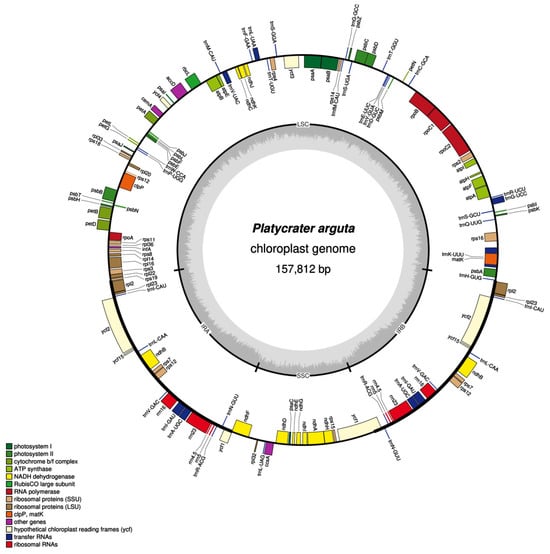
Figure 1.
Diagram of chloroplast genome in P. arguta. The transcribed clockwise and counterclockwise was drowned outside and inside, respectively. Genes with different functions are represented by different colors. The GC content was represented by the darker gray, and the AT content was represented by the lighter gray shows.

Table 1.
Gene contents of the P. arguta chloroplast genome based on genome annotation.
3.2. Sequence Analysis
A total of 26,920 codons were identified across all protein-coding sequences (PCSs). Leucine was the most frequently occurring amino acid, accounting for 2840 instances, whereas termination codons (Ter) were the least common, with only 88 occurrences. To further quantify codon usage bias, we calculated two key metrics: the GC content of the third codon position (GC3) was 28.6%, indicating a strong A/T preference at synonymous sites; and the Effective Number of Codons (ENC) was 47.2, suggesting moderate codon usage bias (ENC ranges from 20, extreme bias, to 61, no bias). Tryptophan, encoded exclusively by the codon TGG, exhibited no codon usage bias, as indicated by a relative synonymous codon usage (RSCU) value of 1. Notably, 65 codons had an RSCU value > 1, demonstrating significant codon usage bias (Figure 2). Specifically, among the codons with usage bias in P. arguta, 63 were A/T-ending. The only exceptions were the leucine-encoding codon UUG and the methionine-encoding codon AUG, both of which were G-ending; details of these codons are presented in Figure 2.
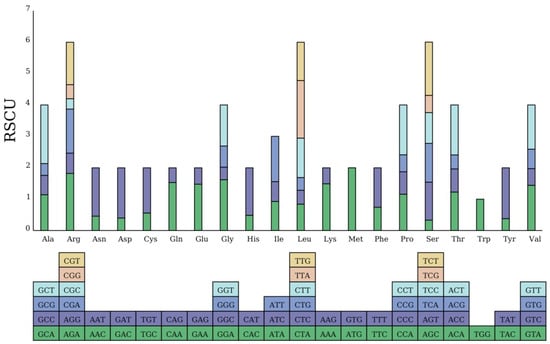
Figure 2.
Chloroplast genome sequence codon usage bias. The sum of the RSCU value of all the codons is represented by the height of the upper column, and all codons encoding each amino acid are represented by boxes below. In addition, the codons are represented by different colors.
In the chloroplast genome of P. arguta, a total of 40 larger repeats (>10 bp) were identified, comprising 19 forward repeats, 1 reverse repeat, and 21 palindromic repeats (Figure 3, Table S1). Notably, the largest of these repeats was a 26,126 bp palindromic repeat, which corresponds to the inverted repeat (IR) region, a canonical structural feature of angiosperm chloroplast genomes.
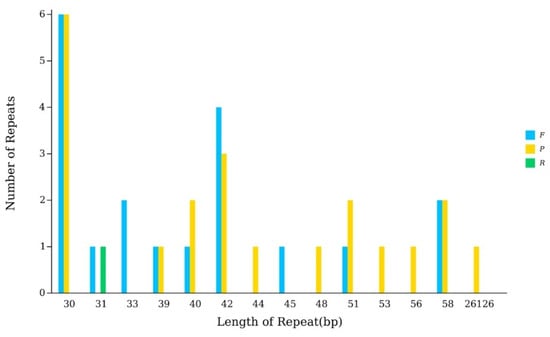
Figure 3.
The chloroplast genome repeated sequences in P. arguta. In detail, the X-ray are the length of the repeated sequence, and the Y-ray are the number of repeated sequences. F represents Forward, P stands for Ralindromic, R represents Reverse, and C represents Complement.
This study analyzed the simple sequence repeats (SSRs) located in the large single-copy (LSC), inverted repeat (IR), and small single-copy (SSC) regions, as well as in intergenic spacer (IGS) and gene regions. The highest number of repeats was found in the LSC region (62.30%), followed by the IR regions (19.10%) and the SSC region (18.60%). A total of 199 SSRs were identified in the chloroplast genome of P. arguta in the present study. Among these, 119 were mononucleotides, 3 were dinucleotides, 73 were trinucleotides, and 4 were tetranucleotides (Figure 4).
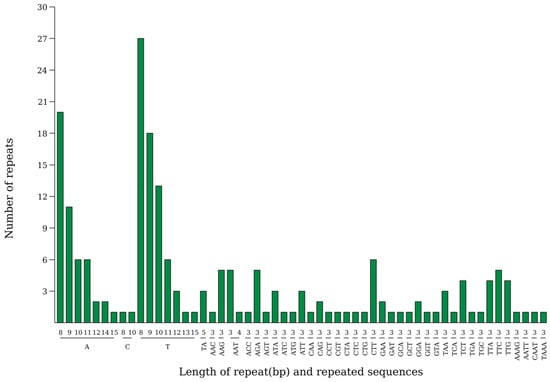
Figure 4.
The SSRs distribution in the chloroplast genome of P. arguta. X-ray represents SSR repeated unit, and the Y-ray represents the number of repeated units.
The average nucleotide diversity (Pi) of the chloroplast genome was calculated to be 0.01058. Notably, there were 37 regions exhibiting significantly higher Pi values (>0.01537). Among these, the rps15 gene region demonstrated the highest variability, with a Pi value of 0.04656, located within the SSC region (Figure 5).
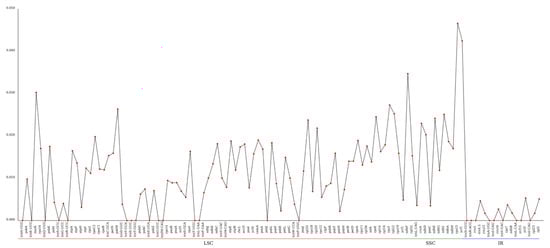
Figure 5.
The nucleotide diversity (Pi) analysis of the chloroplast genome among 7 species. The X-ray represents the gene name, while Pi value is presented by the Y-ray.
3.3. Expansion and Contraction of IR Regions
To analyze the evolutionary conservation of the Saxifragaceae, the IR regions and junction sites of the LSC and SSC regions were compared based on the chloroplast genomes of seven members of the Saxifragaceae family, including P. arguta (Figure 6). The length of the IR regions varied, ranging from 25,848 bp in D. compacta to 26,126 bp in P. arguta. A striking feature of the P. arguta chloroplast genome is its IR configuration: unlike the canonical arrangement where certain genes are typically fully contained within IR regions, the protein-coding gene ycf1 is largely excluded from the IRs, with only a very small portion present in these repeats. This deviation from the typical structure is noteworthy and may reflect unique evolutionary dynamics of the P. arguta chloroplast genome. In the present study, the ycf1 gene was found in the SSC/IRa junction across all seven species, while the LSC/IRa junction was located downstream of trnH-GUG. Additionally, the coding region of rpl22 created locations of 44, 0, 8, 34, 39, 17, and 12 bp at the LSC/IRb border, with the LSC/IRb junction distributed, respectively, across all seven chloroplast genomes.
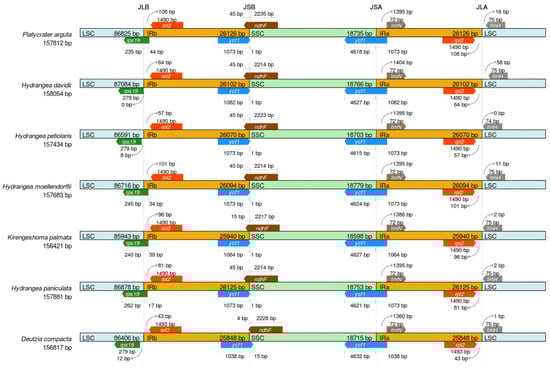
Figure 6.
Comparative analysis of the LSC, SSC and IR regions in chloroplast genomes among seven Saxifragaceae.
3.4. Phylogenetic Analysis
Multiple sequence alignments of 21 species based on chloroplast genomes were conducted. Specifically, 18 species belong to the Saxifragaceae family, while 3 outgroup species include Nasa triphylla, Caiphora lateritia, and Mentzelia albicaulis. The results indicated that P. arguta exhibited the highest homology with H. davidii, followed by the other 17 Saxifragaceae species. Furthermore, the outgroup species demonstrated lower homology with P. arguta (Figure 7).
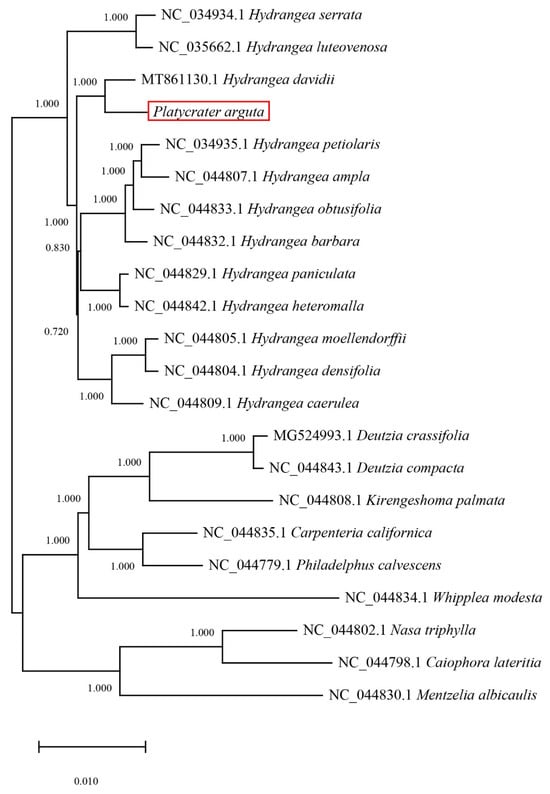
Figure 7.
The result of phylogenetic tree in 21 species. The phylogenetic tree was constructed based on the chloroplast genome with the GTRGAMMA model in RAxML v8.2.10, and bootstrap replicated 1000 times.
4. Discussion
Chloroplasts are plant-specific organelles that replicate independently and exhibit their own genetic inheritance. They play a crucial role in various functions within plant cells, such as photosynthesis, carbon fixation, and stress responses [32,33]. The chloroplast genome has a relatively small and highly conserved molecular structure, typically ranging from 107 to 218 kb in length, and encodes approximately 80 proteins [34]. Due to their relatively stable evolutionary rate and low nucleotide substitution rates, chloroplast genomes are widely utilized in plant research, providing valuable resources for species identification, genetic engineering, and phylogenetic analyses [34].
As the plant-specific organ, chloroplasts provide abundant genetic resources that are crucial for the protection of P. arguta. The chloroplast genome of P. arguta was sequenced, assembled, and annotated in a previous study [35]. However, the identification of the chloroplast genome in P. arguta was incomplete. Therefore, we conducted a comprehensive identification of the chloroplast genome of P. arguta and obtained a more complete sequence. In this study, the chloroplast genome of P. arguta is primarily divided into the LSC, SSC, and two IR regions, exhibiting a typical quadripartite structure consistent with other reported members of the Hydrangeaceae family [35]. This indicates a high degree of stability in the chloroplast genome structure of the genus Platycrater. The total length of the P. arguta chloroplast genome is 157,812 bp, with the LSC region measuring 86,825 bp, the SSC region 18,735 bp, and the IR region 26,126 bp. Furthermore, a total of 88 messenger RNA (mRNA) genes, 37 transfer RNA (tRNA) genes, and 8 ribosomal RNA (rRNA) genes have been annotated in the P. arguta chloroplast genome, totaling 133 genes, which aligns with the fundamental patterns observed in angiosperm chloroplast genomes.
SSR loci are widely distributed in the genomes of eukaryotes, characterized by significant polymorphism, substantial quantity, and stable inheritance [36,37]. The types, numbers, and distributions of SSRs vary among different plant species, which makes them widely used in molecular marker studies related to species identification and genetic diversity analysis [38,39]. In this study, a total of 199 SSR loci were detected in the chloroplast genome of P. arguta, with single nucleotide repeats being the most abundant (119, accounting for 59.8% of the total), followed by trinucleotide repeats (73, 36.68%). These two types of repeats predominantly exist in the forms of A/T and CTT/TTC. The remaining SSRs also mainly consist of combinations of A and T bases, which is consistent with previous observations [36], supporting the notion that SSRs in chloroplast genomes exhibit a significant AT bias, likely related to the easier denaturation of AT compared to GC.
Codon usage bias analysis showed that genes of P. arguta tend to have codons with A/T in the third position. This pattern likely reflects the combined effects of evolutionary forces: the strong A/T bias at synonymous sites (28.6% GC3 content) may primarily stem from mutational bias, chloroplast genomes are known to have high A/T content due to inherent mutational tendencies, which is further reinforced by potential selective pressure for translational efficiency (e.g., matching tRNA pools enriched for A/U anticodons, optimizing protein synthesis rate) [40,41]. The pattern of codon usage bias in the plant chloroplast genome is linked to gene structure and expression, which obviously affect gene function [40]. In previous studies, analysis of codon usage bias was conducted to better understand gene characteristics [42]; thus, we speculate this A/T-biased codon usage may modulate P. arguta chloroplast gene function by influencing translation efficiency. Pi can reveal the variation in nucleic acid sequences of different species, and regions with a high degree of variation can provide potential molecular markers for population genetics. This study indicates that the highly variable genes in the chloroplast genome of P. arguta are primarily located in the SSC and LSC regions. Genes such as rps15, ycf1, petN, matK, and ndhF have been identified as hypervariable regions across different plants [10].
The contraction and expansion of the IR/SC boundaries play a crucial role in the evolution of chloroplast genomes and are considered the main driving force behind structural variations in chloroplast genomes [43,44,45]. Recent studies (2019–2024) on angiosperm chloroplast genomes further confirm that IR boundary shifts, especially involving genes like ycf1, are common evolutionary events that shape genomic diversity within plant families [44,46]. The analysis of the IR/SC boundaries of the chloroplast genomes from six highly homologous species within the same family selected for this study reveals that the ycf1 gene is located at the SSC/IRa junction in all seven chloroplast genomes, while the LSC/IRa junction is positioned downstream of trnH-GUG. Notably, ycf1 holds substantial functional importance that further amplifies interest in its unusual genomic arrangement in P. arguta: it is one of the largest open reading frames encoded by the chloroplast genome in higher plants, and together with ycf2, experimental studies have demonstrated that both genes are essential for plant viability [47]. This indispensability underscores ycf1’s critical role in plastid biology. Evolutionarily, ycf1 is also significant: its N-terminal sequences are remarkably conserved across more than 700 million years of streptophyte evolution, and even its C-terminal region contains a motif conserved for over 500 million years of streptophyte evolution [48]. The unusual configuration of P. arguta’s IR regions, where ycf1 is largely excluded from the IRs, thus represents a notable divergence from the canonical plastid genome structure, with its functional essentiality making this structural deviation even more worthy of in-depth evolutionary investigation. The JSB and JSA boundaries are relatively conserved, whereas the JLB and JLA boundaries exhibit significant variation, which is consistent with reports on the majority of Hydrangeaceae plants [35].
This study demonstrates that, while plant chloroplast genomes are generally conserved in their four-part structure, P. arguta exhibits a distinct bias in configuration. Notably, the functionally important ycf1 gene is largely excluded from the IR region, indicating that this structural change is not trivial; it suggests that P. arguta may have undergone evolutionary or functional adaptations to preserve ycf1 function despite this genomic rearrangement. This phenomenon is not isolated, as similar occurrences have been observed in other species [47,48], providing a new perspective for understanding the constraints and flexibility in the evolution of plastid genomes.
Previous studies suggest that species with closer phylogenetic relationships exhibit more similar boundary features [49,50,51]. Phylogenetic trees constructed for 22 species (under GTRGAMMA model with 1000 bootstrap replicates) indicate that P. arguta forms a well-supported monophyletic clade with H. davidii (bootstrap support = 100%), and the pairwise sequence identity between their complete chloroplast genomes is 98.7%, the highest among all compared taxa. P. arguta and H. davidii together cluster with 17 other Saxifragaceae species, with most internal nodes receiving bootstrap support > 90%. Our comparative analysis aligns with these previous findings, demonstrating that the complete chloroplast genome of P. arguta is conserved [52].
5. Conclusions
In this study, we analyzed the chloroplast genome of P. arguta and found that it exhibits a typical quadripartite structure, with a genome size of 157,812 bp and a total of 133 annotated genes. SSRs detection indicated that the chloroplast genome includes 199 simple repeat loci, with the highest frequency of mononucleotide repeats composed of A and T, accounting for 59.8%. Comparative analysis of the chloroplast genome structure revealed that the IR region boundaries are relatively conserved. Phylogenetic analysis showed that P. arguta shares the highest homology with H. davidii. The findings provide a scientific basis for future research on the genetics, biology, and conservation factors of P. arguta and other endangered plants.
Supplementary Materials
The following supporting information can be downloaded at: https://www.mdpi.com/article/10.3390/biology14121726/s1, Table S1: The repeats in the P. arguta chloroplast genome.
Author Contributions
Conceptualization: J.Z. and X.M.; Methodology: X.M.; Software: Y.Y., Y.H. and X.M.; Formal Analysis: Y.Y. and L.F.; Investigation: R.L., R.Q. and L.F.; Resources: R.Q., Q.H. and Y.H.; Writing—original draft: Y.Y.; Writing—review and editing: X.M.; Visualization: X.M.; Supervision: X.Z. and Q.H.; Project Administration: R.L., X.Z. and J.Z.; Funding acquisition: X.M. All authors have read and agreed to the published version of the manuscript.
Funding
This project was supported by the Central government extension project ([2025]TS 12); Wenzhou Breeding Cooperation Group Project: No. ZX2024004-3; Open Fund of National Engineering Research Center for Special Plants in Southeast Coastal Areas of Forestry and Grassland.
Institutional Review Board Statement
Not applicable.
Informed Consent Statement
Not applicable.
Data Availability Statement
The genome sequence data that support the findings of this study are openly available in GenBank of NCBI at https://www.ncbi.nlm.nih.gov/ (accessed on 1 February 2024) under the accession number OL405445. The associated “BioProject,” “SRA,” and “Bio-Sample” numbers are PRJNA774471, SRR16572822, and SUB10569978, respectively.
Conflicts of Interest
The authors declare no conflicts of interest.
Abbreviations
| Bp | Base pair |
| LSC | Large single copy |
| SSC | Small single copy |
| IR | Inverted repeat |
| IUCN | International Union for Conservation of Nature |
| A | Adenine |
| T | Thymine |
| G | Guanine |
| C | Cytosine |
| Leu | Leucine |
| Cys | Cysteine |
| RSCU | Relative synonymous codon usage |
| SSR | Single sequence repeat |
| PEP | Plastid-encoded plastid RNA polymerase |
| NEP | Nucleus-encoded plastid RNA polymerase |
| DNA | Deoxyribonucleic acid |
References
- Heath, R.L.; Packer, L. Photoperoxidation in isolated chloroplast i. kinetics and stoichiometry of fatty acid peroxidation. Arch. Biochem. Biophys. 1968, 125, 89–198. [Google Scholar] [CrossRef] [PubMed]
- Daniell, H.; Lin, C.S.; Yu, M.; Chang, W. Chloroplast genomes: Diversity, evolution, and applications in genetic engineering. Genome Biol. 2016, 17, 134. [Google Scholar] [CrossRef] [PubMed]
- Schubert, M.; Petersson, U.; Haas, B.; Funk, C.; Schroder, W.; Kieselbach, T. Proteome Map of the Chloroplast Lumen of Arabidopsis thaliana. J. Biol. Chem. 2002, 277, 8354–8365. [Google Scholar] [CrossRef] [PubMed]
- Sugiura, M. The chloroplast genome. Plant Mol. Biol. 1992, 19, 149–168. [Google Scholar] [CrossRef]
- Martin, W.; Rujan, T.; Richly, E.; Cornelsen, S.; Lins, T.; Leister, D.; Stoebe, B.; Hasegawa, M.; Penny, D. Evolutionary analysis of Arabidopsis, cyanobacterial, and chloroplast genomes reveals plastid phylogeny and thousands of cyanobacterial genes in the nucleus. Proc. Natl. Acad. Sci. USA 2002, 99, 12246. [Google Scholar] [CrossRef]
- Shaw, J.; Lickey, E.; Schilling, E.; Small, R. Comparison of whole chloroplast genome sequences to choose noncoding regions for phylogenetic studies in angiosperms: The tortoise and the hare III. Am. J. Bot. 2007, 94, 3. [Google Scholar] [CrossRef]
- Green, B. Chloroplast genomes of photosynthetic eukaryotes. Plant J. 2011, 66, 34–44. [Google Scholar] [CrossRef]
- Keeling, P.J. Plastid genomes. Curr. Biol. 2018, 28, R336–R337. [Google Scholar] [CrossRef]
- Martin, W.; Deusch, O.; Stawski, N.; Grünheit, N.; Goremykin, V. Chloroplast genome phylogenetics: Why we need independent approaches to plant molecular evolution. Trends Plant Sci. 2005, 10, 203–209. [Google Scholar] [CrossRef]
- Hu, Q.; Qian, R.; Zhang, Y.; Ma, X.; Ye, Y.; Zhang, X.; Lin, L.; Liu, H.; Zheng, J. Complete chloroplast genome molecular structure, comparative and phylogenetic analyses of Sphaeropteris lepifera of Cyatheaceae family: A tree fern from China. Sci. Rep. 2023, 13, 1356. [Google Scholar] [CrossRef]
- Shinozaki, K.; Ohme, M.; Tanaka, M.; Wakasugi, T.; Hayashida, N.; Matsubayashi, T. The complete nucleotide sequence of the tobacco chloroplast genome: Its gene organization and expression. EMBO J. 1986, 5, 2043–2049. [Google Scholar] [CrossRef] [PubMed]
- Ohyama, K.; Fukuzawa, H.; Kohchi, T.; Shirai, H.; Sano, T.; Sano, S.; Umesono, K.; Shiki, Y.; Takeuchi, M.; Chang, Z. Chloroplast gene organization deduced from complete sequence of liverwort Marchantia polymorpha chloroplast DNA. Nature 1986, 322, 572–574. [Google Scholar] [CrossRef]
- Hiratsuka, J.; Shimada, H.; Whittier, R.; Ishibashi, T.; Sakamoto, M.; Mori, M. The complete sequence of the rice (Oryza sativa) chloroplast genome: Intermolecular recombination between distinct tRNA genes accounts for a major plastid DNA inversion during the evolution of the cereals. Mol. Gen. Genet. 1989, 217, 185–194. [Google Scholar] [CrossRef] [PubMed]
- Hallick, R.B.; Hong, L.; Drager, R.G.; Favreau, M.R.; Monfort, A.; Orsat, B.; Spielmann, A.; Stutz, E. Complete sequence of Euglena gracilis chloroplast DNA. Nucleic Acid Res. 1993, 21, 3537–3544. [Google Scholar] [CrossRef]
- Wakasugi, T.; Tsudzuki, J.; Ito, S.; Nakashima, K.; Tsudzuki, T.; Sugiura, M. Loss of all ndh genes as determined by sequencing the entire chloroplast genome of the black pine Pinus thunbergii. Proc. Natl. Acad. Sci. USA 1994, 91, 9794–9798. [Google Scholar] [CrossRef]
- Wambugu, P.W.; Brozynska, M.; Furtado, A.; Waters, D.L.; Henry, R.J. Relationships of wild and domesticated rices (Oryza AA genome species) based upon whole chloroplast genome sequences. Sci. Rep. 2015, 5, 13957. [Google Scholar] [CrossRef]
- Wang, Y.; Wang, S.; Liu, Y.; Yuan, Q.; Guo, L. Chloroplast genome variation and phylogenetic relationships of Atractylodes species. BMC Genom. 2021, 22, 103. [Google Scholar] [CrossRef]
- Huo, Y.; Gao, L.; Liu, B.; Yang, Y.; Kong, S.; Sun, Y.; Yang, Y.; Wu, X. Complete chloroplast genome sequences of four Allium species: Comparative and phylogenetic analyses. Sci. Rep. 2019, 9, 12250. [Google Scholar] [CrossRef]
- Wang, Y.; Lv, K.; Wu, Y.; Chen, F. Changes in the functional traits of the Platycrater arguta leaves with plant growth development. Plant Sci. J. 2021, 39, 526–534. [Google Scholar]
- Wang, J. FastPval: A fast and memory efficient program to calculate very low P-values from empirical distribution. Bioinformatics 2010, 26, 2897–2899. [Google Scholar]
- Langmead, B.; Salzberg, S. Fast gapped-read alignment with Bowtie 2. Nat. Methods 2012, 9, 357–359. [Google Scholar] [CrossRef]
- Gao, J.; Zhang, M.; Guan, S.; Chen, Y.; Liu, A.; Yan, Y.; Zhang, G. The complete chloroplast genome of Tradescantia pallida (Rose) DR Hunt. Mitochondrial DNA Part B 2020, 5, 2932–2933. [Google Scholar] [CrossRef]
- Boetzer, M.; Pirovano, W. Toward almost closed genomes with GapFiller. Genome Biol. 2012, 13, R56. [Google Scholar] [CrossRef]
- Altschul, S. Basic local alignment search tool (BLAST). J. Mol. Biol. 2012, 215, 403–410. [Google Scholar] [CrossRef] [PubMed]
- Goecks, J.; Nekrutenko, A.; Taylor, J. Galaxy: A comprehensive approach for supporting accessible, reproducible, and transparent computational research in the life sciences. Genome Biol. 2010, 11, R86. [Google Scholar] [CrossRef] [PubMed]
- Powell, W.; Machray, G.; Provan, J. Polymorphism revealed by simple sequence repeats. Trends Plant Sci. 1996, 1, 215–222. [Google Scholar] [CrossRef]
- Fenton, B.; Malloch, G.; Moxey, E. Analysis of eriophyid mite rDNA internal transcribed spacer sequences reveals variable simple sequence repeats. Insect Mol. Biol. 2010, 6, 23–32. [Google Scholar] [CrossRef]
- Khayi, S.; Gaboun, F.; Pirro, S.; Tatusova, T.; Mentag, R. Complete Chloroplast Genome of Argania spinosa: Structural Organization and Phylogenetic Relationships in Sapotaceae. Plants 2020, 9, 1354. [Google Scholar] [CrossRef]
- Ali, A.; Jaakko, H.; Peter, P. IRscope: An online program to visualize the junction sites of chloroplast genomes. Bioinformatics 2018, 17, 17. [Google Scholar]
- Soltis, P.S.; Folk, R.A.; Soltis, D.E. Darwin review: Angiosperm phylogeny and evolutionary radiations. Proc. R. Soc. B 2019, 286, 20190099. [Google Scholar] [CrossRef]
- Shaw, A.; Allen, B. Phylogenetic Relationships, Morphological Incongruence, and Geographic Speciation in the Fontinalaceae (Bryophyta). Mol. Phylogenet. Evol. 2000, 16, 225–237. [Google Scholar]
- Ivanova, Z.; Sablok, G.; Daskalova, E.; Zahmanova, G.; Apostolova, E.; Yahubyan, G.; Baev, V. Chloroplast genome analysis of resurrection tertiary relict Haberlea rhodopensis highlights genes important for desiccation stress response. Front. Plant Sci. 2017, 8, 204. [Google Scholar] [CrossRef]
- Chakraborty, S.; Yengkhom, S.; Uddin, A. Analysis of codon usage bias of chloroplast genes in Oryza species. Planta 2020, 252, 67. [Google Scholar] [CrossRef]
- Yao, X.H.; Tang, P.; Li, Z.Z.; Li, D.; Liu, Y.F.; Huang, H.W. The first complete chloroplast genome sequences in Actinidiaceae: Genome structure and comparative analysis. PLoS ONE 2015, 10, e0129347. [Google Scholar] [CrossRef] [PubMed]
- He, L.F.; Qiang, S.J.; Zhang, Y.H.; Li, H.F. The complete chloroplast genome of Hydrangea davidii (Hydrangeaceae). Mitochondrial DNA Part B 2020, 5, 3605–3607. [Google Scholar] [CrossRef] [PubMed]
- Powell, W.; Morgante, M.; McDevitt, R.; Vendramin, G.G.; A Rafalski, J. Polymorphic simple sequence repeat regions in chloroplast genomes: Applications to the population genetics of pines. Proc. Natl. Acad. Sci. USA 1995, 92, 7759–7763. [Google Scholar] [CrossRef]
- Yuan, Q.J.; Zhang, Z.Y.; Hu, J.; Guo, L.P.; Shao, A.J.; Huang, L.Q. Impacts of recent cultivation on genetic diversity pattern of a medicinal plant, Scutellaria baicalensis (Lamiaceae). BMC Genet. 2010, 11, 29. [Google Scholar] [CrossRef]
- Du, Q.Z.; Wang, B.W.; Wei, Z.; Zhang, D.; Li, B. Genetic diversity and population structure of Chinese white poplar (Populus tomentosa) revealed by SSR markers. J. Hered. 2012, 103, 853–862. [Google Scholar] [CrossRef]
- Chmielewski, M.; Meyza, K.; Chybicki, I.; Dzialuk, A.; Litkowiec, M.; Burczyk, J. Chloroplast microsatellites as a tool for phylogeographic studies: The case of white oaks in Poland. iForest—Biogeosci. For. 2015, 8, 765–771. [Google Scholar]
- Tatarinova, T.V.; Alexandrov, N.N.; Bouck, J.B.; Feldmann, K.A. GC3 biology in corn, rice, sorghum and other grasses. BMC Genom. 2010, 11, 308. [Google Scholar] [CrossRef]
- Im, E.H.; Choi, S.S. Synonymous codon usage controls various molecular aspects. Genom. Inform. 2017, 15, 123. [Google Scholar] [CrossRef]
- Bu, Y.; Wu, X.; Sun, N.; Man, Y.; Jing, Y. Codon usage bias predicts the functional MYB10 gene in Populus. J. Plant Physiol. 2021, 265, 153491. [Google Scholar] [CrossRef]
- Lilly, J.W.; Havey, M.J.; Jackson, S.A.; Jiang, J. Cytogenomic analyses reveal the structural plasticity of the chloroplast genome in higher plants. Plant Cell 2001, 13, 245–254. [Google Scholar] [CrossRef]
- Li, L.; Hu, Y.; He, M.; Zhang, B.; Wu, W.; Cai, P.; Huo, D.; Hong, Y. Comparative chloroplast genomes: Insights into the evolution of the chloroplast genome of Camellia sinensis and the phylogeny of Camellia. BMC Genom. 2021, 22, 138. [Google Scholar] [CrossRef]
- Zhang, R.; Liu, S.; Liu, Y.; Wei, P.; Xiang, N.; Zhao, Y.; Gao, X.; Yin, Y.; Qin, L.; Yuan, T. Comparative analysis of the organelle genomes of seven Rosa species (Rosaceae): Insights into structural variation and phylogenetic position. Front. Plant Sci. 2025, 16, 1584289. [Google Scholar] [CrossRef] [PubMed]
- Li, B.; Zheng, Y. Dynamic evolution and phylogenomic analysis of the chloroplast genome in Schisandraceae. Sci. Rep. 2018, 8, 9285. [Google Scholar] [CrossRef] [PubMed]
- Kuroda, H.; Bock, R. Essentiality of the chloroplast-encoded open reading frames ycf1 and ycf2 in tobacco. Plant J. 2008, 55, 681–690. [Google Scholar] [CrossRef]
- de Vries, J.; Gould, S.B.; Archibald, J.M. The carboxy terminus of YCF1 contains a motif conserved throughout >500 million years of streptophyte evolution. Genome Biol. Evol. 2017, 9, 345–356. [Google Scholar] [CrossRef] [PubMed]
- Liu, L.; Wang, Y.; He, P.; Lee, J.; Douglas, E.; Fu, C. Chloroplast genome analyses and genomic resource development for epilithic sister genera Oresitrophe and Mukdenia (Saxifragaceae), using genome skimming data. BMC Genom. 2018, 19, 235. [Google Scholar] [CrossRef]
- Wu, Z.; Liao, R.; Yang, T.; Dong, X.; Liu, H. Analysis of six chloroplast genomes provides insight into the evolution of Chrysosplenium (Saxifragaceae). BMC Genom. 2020, 21, 621. [Google Scholar] [CrossRef]
- Liu, R.; Xia, M.; Liu, D.; Jiang, L.; Shen, J.; Chen, W. Analysis of the maternal genome of Elymus nutans from the Qinghai-Tibet Plateau based on chloroplast genomes. Grassl. Sci. 2022, 6, 114–123. [Google Scholar] [CrossRef]
- Yuan, W.; He, S.; Zhang, S.; Chang, D.; He, Y. The complete chloroplast genome sequence of Cornus alba L. (Cornaceae). Mitochondrial DNA Part B 2021, 6, 1997–1998. [Google Scholar] [CrossRef]
Disclaimer/Publisher’s Note: The statements, opinions and data contained in all publications are solely those of the individual author(s) and contributor(s) and not of MDPI and/or the editor(s). MDPI and/or the editor(s) disclaim responsibility for any injury to people or property resulting from any ideas, methods, instructions or products referred to in the content. |
© 2025 by the authors. Licensee MDPI, Basel, Switzerland. This article is an open access article distributed under the terms and conditions of the Creative Commons Attribution (CC BY) license (https://creativecommons.org/licenses/by/4.0/).