Spinel-Encapsulated Ni-Rich Cathodes for Enhanced Thermal Safety: Unraveling the Decomposition Kinetics and Interfacial Reconstruction


Abstract
1. Introduction
2. Materials and Methods
3. Results and Discussion
3.1. Phase Identification and Interfacial Surface Chemistry
3.2. Evolution of the Layered Structure and Lattice Strain
3.3. Influence of LNMO Coating on NCM811 Particle Morphology and Structural Integrity
3.4. Surface Chemical Reconstruction and Electronic State Analysis
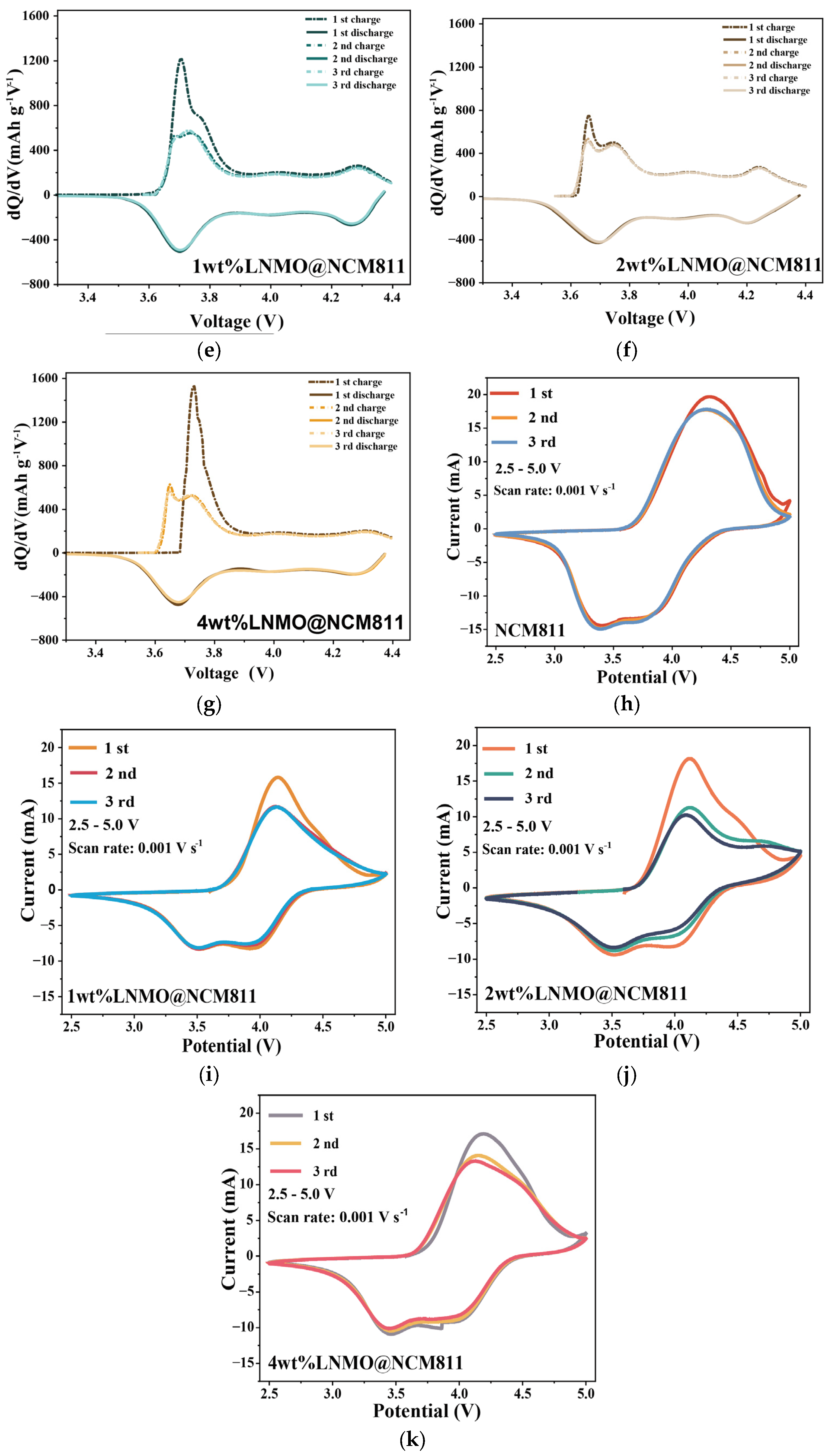
3.5. Electrochemical Performance
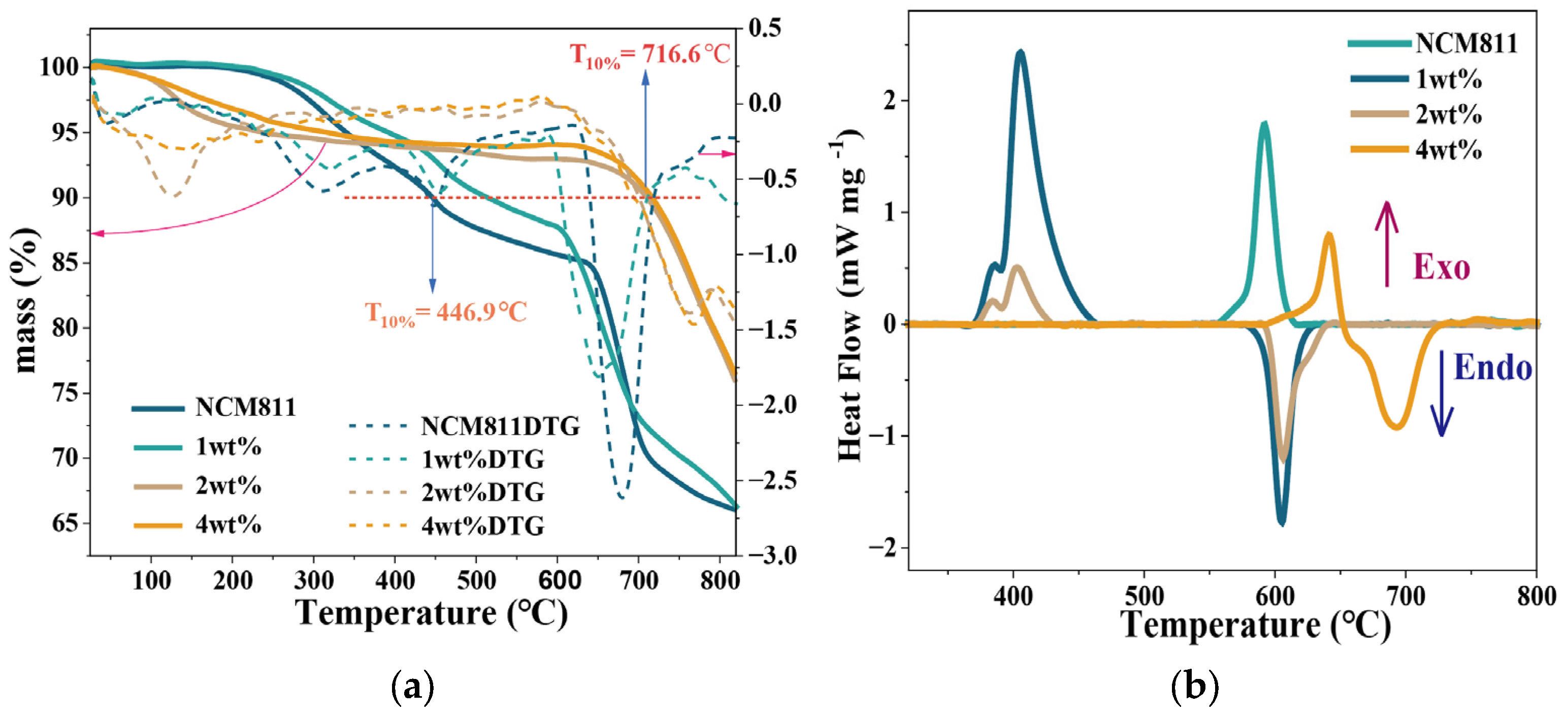
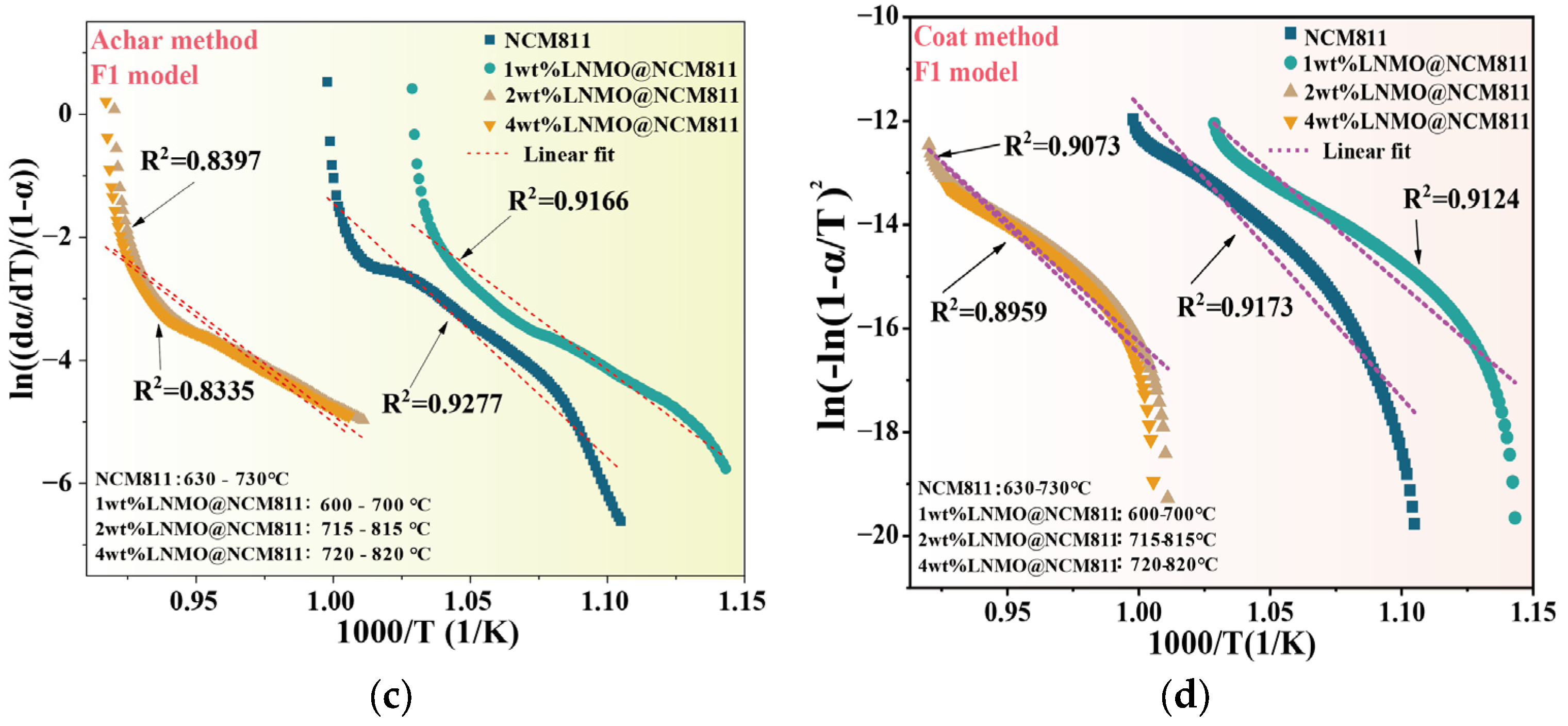
3.6. Thermal Stability Analysis and Mechanism Function Fitting
4. Conclusions
Supplementary Materials
Author Contributions
Funding
Data Availability Statement
Conflicts of Interest
Abbreviations
| NCM811 | LiNi0.8Co0.1Mn0.1O2 |
| LNMO | LiNi0.5Mn1.5O4 |
| TG-DSC | Thermogravimetric-differential scanning calorimetry |
| T10% | 10% mass loss temperature |
| XRD | X-ray diffraction |
| SEM | Scanning electron microscopy |
| XPS | X-ray photoelectron spectroscopy |
| DMC | Dimethyl carbonate |
| PVDF | Polyvinylidene fluoride |
| NMP | N-methyl-2-pyrrolidone |
| EC | Ethylene carbonate |
| EMC | Ethyl methyl carbonate |
References
- Shen, S.; Hong, Y.; Zhu, F.; Cao, Z.; Li, Y.; Ke, F.; Fan, J.; Zhou, L.; Wu, L.; Dai, P.; et al. Tuning Electrochemical Properties of Li-Rich Layered Oxide Cathodes by Adjusting Co/Ni Ratios and Mechanism Investigation Using in situ X-ray Diffraction and Online Continuous Flow Differential Electrochemical Mass Spectrometry. ACS Appl. Mater. Interfaces 2018, 10, 12666–12677. [Google Scholar] [CrossRef]
- Wang, H.; Feng, K.; Wang, P.; Yang, Y.; Sun, L.; Yang, F.; Chen, W.Q.; Zhang, Y.; Li, J. China’s electric vehicle and climate ambitions jeopardized by surging critical material prices. Nat. Commun. 2023, 14, 1246. [Google Scholar] [CrossRef]
- Schmuch, R.; Wagner, R.; Hörpel, G.; Placke, T.; Winter, M. Performance and cost of materials for lithium-based rechargeable automotive batteries. Nat. Energy 2018, 3, 267–278. [Google Scholar] [CrossRef]
- Manthiram, A. A reflection on lithium-ion battery cathode chemistry. Nat. Commun. 2020, 11, 1550. [Google Scholar] [CrossRef] [PubMed]
- Wei, A.; Mei, S.; Mu, J.; Liu, P.; Bai, X.; He, R.; Li, X.; Niu, Y.; Zhang, L.; Liu, Z.; et al. Enhanced electrochemical performance of NCM811-based batteries by using a multifunctional electrolyte additive. Chem. Eng. J. 2025, 507, 160411. [Google Scholar] [CrossRef]
- Zheng, Y.; Li, J.; Liu, Y.; Feng, L.; Liu, W.; Lin, L.; Wang, Y.; Peng, H.; Lu, J.; Zhou, D.; et al. Challenges and Advancements in High-Nickel Layered Oxides Cathode Material for Lithium-Ion Batteries. Energy Environ. Mater. 2025, 2, e70152. [Google Scholar] [CrossRef]
- Kim, H.; Jeong, M.; Kim, H.; Kim, Y.; Kang, K.; Oh, J.H. Enhanced Cycling Stability of NCM811 Cathodes at High C-Rates and Voltages via LiMTFSI-Based Polymer Coating. Small 2025, 21, 2502816. [Google Scholar] [CrossRef]
- Geldasa, F.T.; Kebede, M.A.; Shura, M.W.; Hone, F.G. Identifying surface degradation, mechanical failure, and thermal instability phenomena of high energy density Ni-rich NCM cathode materials for lithium-ion batteries: A review. RSC Adv. 2022, 12, 5891–5909. [Google Scholar] [CrossRef]
- Zhou, J.; Wei, B.; Liu, M.; Qin, Y.; Cheng, H.; Lyu, Y.; Liu, Y.; Guo, B. An effective co-modification strategy to enhance the cycle stability of LiNi0.8Co0.1Mn0.1O2 for lithium-ion batteries. RSC Adv. 2023, 13, 34194–34199. [Google Scholar] [CrossRef]
- Kim, Y.; Park, H.; Warner, J.H.; Manthiram, A. Unraveling the Intricacies of Residual Lithium in High-Ni Cathodes for Lithium-Ion Batteries. ACS Energy Lett. 2021, 6, 941–948. [Google Scholar] [CrossRef]
- Roberts, S.; Chen, L.; Kishore, B.; Dancer, C.E.J.; Simmons, M.J.H.; Kendrick, E. Mechanism of gelation in high nickel content cathode slurries for sodium-ion batteries. Colloid Interface Sci. 2022, 627, 427–437. [Google Scholar] [CrossRef]
- Divakaran, A.M.; Minakshi, M.; Bahri, P.A.; Paul, S.; Kumari, P.; Divakaran, A.M.; Manjunatha, K.N. Rational design on materials for developing next generation lithium-ion secondary battery. Prog. Solid State Chem. 2021, 62, 100298. [Google Scholar] [CrossRef]
- Dorji, G.; Minakshi, M.; Ariga, K.; Shrestha, L.K. Binary transition metal oxides vs. binary metal oxides for electrochemical supercapacitors: Performance, challenges, and future prospects. J. Energy Storage 2026, 147, 120116. [Google Scholar] [CrossRef]
- Myung, S.-T.; Maglia, F.; Park, K.-J.; Yoon, C.S.; Lamp, P.; Kim, S.-J.; Sun, Y.-K. Nickel-Rich Layered Cathode Materials for Automotive Lithium-Ion Batteries: Achievements and Perspectives. ACS Energy Lett. 2017, 2, 196–223. [Google Scholar] [CrossRef]
- Liao, C.; Li, F.; Liu, J. Challenges and Modification Strategies of Ni-Rich Cathode Materials Operating at High-Voltage. Nanomaterials 2022, 12, 1888. [Google Scholar] [CrossRef]
- Li, H.; Cormier, M.; Zhang, N.; Inglis, J.; Li, J.; Dahn, J.R. Is Cobalt Needed in Ni-Rich Positive Electrode Materials for Lithium Ion Batteries? J. Electrochem. Soc. 2019, 166, A429. [Google Scholar] [CrossRef]
- Yu, L.; Dai, A.; Zhou, T.; Huang, W.; Wang, J.; Li, T.; He, X.; Ma, L.; Xiao, X.; Ge, M.; et al. Parasitic structure defect blights sustainability of cobalt-free single crystalline cathodes. Nat. Commun. 2025, 16, 434. [Google Scholar] [CrossRef]
- Huang, Y.; Fan, F.; Zeng, C.; Wang, X.; Tian, G.; Liu, S.; Liu, P.; Wang, C.; Wang, S.; Zhang, Y.; et al. Mitigating internal strain of nickel-rich layered oxide enabled by microstructure modification. J. Power Sources 2025, 644, 237113. [Google Scholar] [CrossRef]
- Lee, S.; Su, L.; Mesnier, A.; Cui, Z.; Manthiram, A. Cracking vs. surface reactivity in high-nickel cathodes for lithium-ion batteries. Joule 2023, 7, 2430–2444. [Google Scholar] [CrossRef]
- Qiu, L.; Zhang, M.; Hua, W.; Wang, Y.; Deng, Y.; Li, Z.; Song, Y.; Wu, Z.; Xiao, Y.; Guo, X. Unveiling Surface Reconstruction as the Primary Trigger for Capacity Loss in Ultra-High Nickel Cathodes. Angew. Chem. Int. Edit. 2025, 64, e202417278. [Google Scholar] [CrossRef]
- Manthiram, A.; Knight, J.C.; Myung, S.-T.; Oh, S.-M.; Sun, Y.-K. Nickel-Rich and Lithium-Rich Layered Oxide Cathodes: Progress and Perspectives. Adv. Energy Mater. 2016, 6, 1501010. [Google Scholar] [CrossRef]
- Al-Amiery, A.A.; Fayad, M.A.; Abdul Wahhab, H.A.; Al-Azzawi, W.K.; Mohammed, J.K.; Majdi, H.S. Interfacial Engineering for Advanced Functional Materials: Surfaces, Interfaces, and Applications. Results Eng. 2024, 22, 102125. [Google Scholar] [CrossRef]
- Sun, Y.; Li, C.; Liu, D.; Zhang, F.; Xue, J.; Zheng, Q. Surface and Interfacial Engineering for Multifunctional Nanocarbon Materials. ACS Nano 2025, 19, 1944–1980. [Google Scholar] [CrossRef] [PubMed]
- RiesgoGonzález, V.; Hall, D.S.; Märker, K.; Slaughter, J.; Wright, D.S.; Grey, C.P. Effect of Annealing on the Structure, Composition, and Electrochemistry of NMC811 Coated with Al2O3 Using an Alkoxide Precursor. Chem. Mater. 2022, 34, 9722–9735. [Google Scholar] [CrossRef]
- Bunyanidhi, P.; Phattharasupakun, N.; Tomon, C.; Duangdangchote, S.; Kidkhunthod, P.; Sawangphruk, M. Mechanofusing garnet solid electrolyte on the surface of Ni-rich layered oxide cathode towards high-rate capability of cylindrical Li-ion battery cells. J. Power Sources 2022, 549, 232043. [Google Scholar] [CrossRef]
- Sun, H.H.; Ryu, H.; Kim, U.; Weeks, J.A.; Heller, A.; Sun, Y.; Mullins, C.B. Beyond Doping and Coating: Prospective Strategies for Stable High-Capacity Layered Ni-Rich Cathodes. ACS Energy Lett. 2020, 5, 1136–1146. [Google Scholar] [CrossRef]
- Liu, Y.; Lin, X.; Sun, Y.; Xu, Y.; Chang, B.; Liu, C.; Cao, A.; Wan, L. Precise Surface Engineering of Cathode Materials for Improved Stability of Lithium-Ion Batteries. Small 2019, 15, 1901019. [Google Scholar] [CrossRef]
- Fang, Y.; Zhao, J.; Su, Y.; Dong, J.; Lu, Y.; Li, N.; Wang, H.; Wu, F.; Chen, L. Understanding of Spinel Phases in Lithium-Rich Cathode for High-Energy-Density Lithium-Ion Batteries: A Review. Energy Mater. Adv. 2024, 5, 0115. [Google Scholar] [CrossRef]
- Yu, R.; Zhang, X.; Liu, T.; Yang, L.; Liu, L.; Wang, Y.; Wang, X.; Shu, H.; Yang, X. Spinel/Layered Heterostructured Lithium-Rich Oxide Nanowires as Cathode Material for High-Energy Lithium-Ion Batteries. ACS Appl. Mater. Interfaces 2017, 9, 41210–41223. [Google Scholar] [CrossRef]
- Liang, G.; Peterson, V.K.; See, K.W.; Guo, Z.; Pang, W.K. Developing high-voltage spinel LiNi0.5Mn1.5O4 cathodes for high-energy-density lithium-ion batteries: Current achievements and future prospects. Mater. Chem. A 2020, 8, 15373–15398. [Google Scholar] [CrossRef]
- Jang, J.; Chen, Y.; Deysher, G.; Cheng, D.; Ham, S.-Y.; Cronk, A.; Ridley, P.; Yang, H.; Sayahpour, B.; Han, B.; et al. Enabling a Co-Free, High-Voltage LiNi0.5Mn1.5O4 Cathode in All-Solid-State Batteries with a Halide Electrolyte. ACS Energy Lett. 2022, 7, 2531–2539. [Google Scholar] [CrossRef]
- Lin, C.; Yin, J.; Cui, S.; Huang, X.; Liu, W.; Jin, Y. Improved Electrochemical Performance of Spinel LiNi0.5Mn1.5O4 Cathode Materials with a Dual Structure Triggered by LiF at Low Calcination Temperature. ACS Appl. Mater. Interfaces 2023, 15, 16778–16793. [Google Scholar] [CrossRef]
- Xia, Y.; Ren, X.; Xiao, Z.; Gan, Y.; Zhang, J.; Huang, H.; He, X.; Mao, Q.; Wang, G.; Zhang, W. Spinel LiNi0.5Mn1.5O4 shell enables Ni-rich layered oxide cathode with improved cycling stability and rate capability for high-energy lithium-ion batteries. Electrochim. Acta 2022, 418, 140352. [Google Scholar] [CrossRef]
- Ma, D.; Wang, J.; Wang, H.; Qian, G.; Zhou, X.; Pei, Z.; Zheng, K.; Wang, Q.; Lu, J. Mg2+ and Cr3+ Co-Doped LiNi0.5Mn1.5O4 Derived from Ni/Mn Bimetal Oxide as High-Performance Cathode for Lithium-Ion Batteries. Nanomaterials 2025, 15, 429. [Google Scholar] [CrossRef] [PubMed]
- Oh, P.; Song, B.; Li, W.; Manthiram, A. Overcoming the chemical instability on exposure to air of Ni-rich layered oxide cathodes by coating with spinel LiMn1.9Al0.1O4. Mater. Chem. A 2016, 4, 5839–5841. [Google Scholar] [CrossRef]
- Li, Z.; Wang, Y.; Wang, J.; Wu, C.; Wang, W.; Chen, Y.; Hu, C.; Mo, K.; Gao, T.; He, Y.-S.; et al. Gradient-porous-structured Ni-rich layered oxide cathodes with high specific energy and cycle stability for lithium-ion batteries. Nat. Commun. 2024, 15, 10216. [Google Scholar] [CrossRef]
- Wang, H.; Dong, J.; Zhang, H.; Liu, J.; Lu, Y.; Liu, Y.; Wang, X.; Li, N.; Huang, Q.; Wu, F.; et al. Enhancing structural and thermal stability of ultrahigh-Ni cathodes via anion-cation codoping induced surface reconstruction strategy. J. Energy Chem. 2025, 106, 9–19. [Google Scholar] [CrossRef]
- Du, K.; Xie, H.; Hu, G.; Peng, Z.; Cao, Y.; Yu, F. Enhancing the Thermal and Upper Voltage Performance of Ni-Rich Cathode Material by a Homogeneous and Facile Coating Method: Spray-Drying Coating with Nano-Al2O3. ACS Appl. Mater. Interfaces 2016, 8, 17713–17720. [Google Scholar] [CrossRef]
- Zheng, X.; Cai, Z.; Sun, J.; He, J.; Rao, W.; Wang, J.; Zhang, Y.; Gao, Q.; Han, B.; Xia, K.; et al. Nickel-rich layered oxide cathodes for lithium-ion batteries: Failure mechanisms and modification strategies. J. Energy Storage 2023, 58, 106405. [Google Scholar] [CrossRef]
- Deng, Z.; Liu, Y.; Wang, L.; Fu, N.; Li, Y.; Luo, Y.; Wang, J.; Xiao, X.; Wang, X.; Yang, X.; et al. Challenges of thermal stability of high-energy layered oxide cathode materials for lithium-ion batteries: A review. Mater. Today 2023, 69, 236–261. [Google Scholar] [CrossRef]
- Xiao, X.; Wang, L.; Li, J.; Zhang, B.; Hu, Q.; Liu, J.; Wu, Y.; Gao, J.; Chen, Y.; Song, S.; et al. Rational synthesis of high-performance Ni-rich layered oxide cathode enabled via probing solid-state lithiation evolution. Nano Energy 2023, 113, 108528. [Google Scholar] [CrossRef]
- Li, W.; Erickson, E.M.; Manthiram, A. High-nickel layered oxide cathodes for lithium-based automotive batteries. Nat. Energy 2020, 5, 26–34. [Google Scholar] [CrossRef]
- Guo, J.; Gao, C.; Liu, H.; Jiang, F.; Liu, Z.; Wang, T.; Ma, Y.; Zhong, Y.; He, J.; Zhu, Z.; et al. Inherent thermal-responsive strategies for safe lithium batteries. J. Energy Chem. 2024, 89, 519–534. [Google Scholar] [CrossRef]
- Feng, X.; Ouyang, M.; Liu, X.; Lu, L.; Xia, Y.; He, X. Thermal runaway mechanism of lithium ion battery for electric vehicles: A review. Energy Storage Mater. 2018, 10, 246–267. [Google Scholar] [CrossRef]
- Wang, Y.; Li, C.; Guo, H.; Ahmad, S.; Rehman, W.U.; Zhang, P.; Ban, C.; Gao, X.-P. Origin and suppression of structural degradation in Ni-rich layered oxide cathodes at elevated temperatures. Energy Storage Mater. 2025, 80, 104413. [Google Scholar] [CrossRef]
- Lv, X.; Han, J.; Liu, M.; Yu, H.; Liu, K.; Yang, Y.; Sun, Y.; Pan, P.; Liang, Z.; Chang, L.; et al. Overview of preparation, modification, and application of tunicate-derived nanocellulose. Chem. Eng. J. 2023, 452, 139439. [Google Scholar] [CrossRef]
- Wang, S.; Quan, W.; Zhu, Z.; Yang, Y.; Liu, Q.; Ren, Y.; Zhang, X.; Xu, R.; Hong, Y.; Zhang, Z.; et al. Lithium titanate hydrates with superfast and stable cycling in lithium ion batteries. Nat. Commun. 2017, 8, 627. [Google Scholar] [CrossRef]
- Huang, Y.; Li, P.; Wei, H.; Luo, Y.H.; Chen, M.; Liu, S.; Yin, W.; Zhang, X.H.; Zheng, J.C. Revealing the Correlation between Structural Evolution and Reversible Phase Transition of Single-Crystalline Ni-Rich Cathode. ACS Nano 2025, 19, 23719–23731. [Google Scholar] [CrossRef]
- Ge, H.; Huang, B.; Wang, C.; Xie, L.; Pan, R.; Cao, X.; Sun, Z. Advanced design strategies for enhancing the thermal stability of Ni-rich co-free cathodes towards high-energy power lithium-ion batteries. Energy Storage Mater. 2025, 77, 104216. [Google Scholar] [CrossRef]
- Liang, W.; Jin, F.; Zhao, Y.; Shi, L.; Liu, Q.; Wang, Z.; Wang, Y.; Zhang, M.; Zhu, J.; Yuan, S. Synthesis of single-crystal LiNi0.8Co0.1Mn0.1O2 materials for Li-ion batteries by microfluidic technology. Chem. Eng. J. 2023, 464, 142656. [Google Scholar] [CrossRef]
- Liang, J.; Zhu, Y.; Li, X.; Luo, J.; Deng, S.; Zhao, Y.; Sun, Y.; Wu, D.; Hu, Y.; Li, W.; et al. A gradient oxy-thiophosphate-coated Ni-rich layered oxide cathode for stable all-solid-state Li-ion batteries. Nat. Commun. 2023, 14, 146. [Google Scholar] [CrossRef] [PubMed]
- Dedryvère, R.; Laruelle, S.; Grugeon, S.; Gireaud, L.; Tarascon, J.-M.; Gonbeau, D. XPS Identification of the Organic and Inorganic Components of the Electrode/Electrolyte Interface Formed on a Metallic Cathode. J. Electrochem. Soc. 2005, 152, A689. [Google Scholar] [CrossRef]
- Gauthier, M.; Carney, T.J.; Grimaud, A.; Giordano, L.; Pour, N.; Chang, H.-H.; Fenning, D.P.; Lux, S.F.; Paschos, O.; Bauer, C.; et al. Electrode–Electrolyte Interface in Li-Ion Batteries: Current Understanding and New Insights. J. Phys. Chem. Lett. 2015, 6, 4653–4672. [Google Scholar] [CrossRef] [PubMed]
- Kim, J.; Lee, H.; Cha, H.; Yoon, M.; Park, M.; Cho, J. Prospect and Reality of Ni-Rich Cathode for Commercialization. Adv. Energy Mater. 2018, 8, 1702028. [Google Scholar] [CrossRef]
- Zhang, S.S. Problems and their origins of Ni-rich layered oxide cathode materials. Energy Storage Mater. 2020, 24, 247–254. [Google Scholar] [CrossRef]
- Biesinger, M.C.; Payne, B.P.; Grosvenor, A.P.; Lau, L.W.M.; Gerson, A.R.; Smart, R.S.C. Resolving surface chemical states in XPS analysis of first row transition metals, oxides and hydroxides: Cr, Mn, Fe, Co and Ni. Appl. Surf. Sci. 2011, 257, 2717–2730. [Google Scholar] [CrossRef]
- Ryu, H.-H.; Park, K.-J.; Yoon, C.S.; Sun, Y.-K. Capacity Fading of Ni-Rich Li[NixCoyMn1–x–y]O2 (0.6 ≤ x ≤ 0.95) Cathodes for High-Energy-Density Lithium-Ion Batteries: Bulk or Surface Degradation? Chem. Mater. 2018, 30, 1155–1163. [Google Scholar] [CrossRef]
- Sim, S.-J.; Lee, S.-H.; Jin, B.-S.; Kim, H.-S. Improving the electrochemical performances using a V-doped Ni-rich NCM cathode. Sci. Rep. 2019, 9, 8952. [Google Scholar] [CrossRef]
- Song, Y.; Cui, Y.; Li, B.; Geng, L.; Yan, J.; Zhu, D.; Zhou, P.; Zhou, J.; Yan, Z.; Xue, Q.; et al. Revealing the origin of high-thermal-stability of single-crystal Ni-rich cathodes toward higher-safety batteries. Nano Energy 2023, 116, 108846. [Google Scholar] [CrossRef]
- Lu, S.; Zhao, J.; Song, J.; Chang, J.; Shu, C. Apparent activation energy of mineral in open pit mine based upon the evolution of active functional groups. Int. J. Coal Sci. Technol. 2023, 10, 75. [Google Scholar] [CrossRef]
- Fan, Y.H.; Gao, Z.X.; Bi, C.F.; Xie, S.T.; Zhang, X. Synthesis and thermal decomposition kinetics of La(III) complexwith unsymmetrical Schiff base ligand. J. Therm. Anal. Calorim. 2008, 91, 919–923. [Google Scholar] [CrossRef]
- Shi, Y.; Zhang, M.; Qian, D.; Meng, Y.S. Ultrathin Al2O3 Coatings for Improved Cycling Performance and Thermal Stability of LiNi0.5Co0.2Mn0.3O2 Cathode Material. Electrochim. Acta 2016, 203, 154–161. [Google Scholar] [CrossRef]
- Khalili Azar, M.; Razmjoo Khollari, M.A.; Esmaeili, M.; Heidari, E.; Hosseini-Hosseinabad, S.M.; Siavash Moakhar, R.; Dolati, A.; Ramakrishna, S. Enhanced Electrochemical Performance and Thermal Stability of ZrO2- and rGO–ZrO2-Coated Li[Ni0.8Co0.1Mn0.1]O2 Cathode Material for Li-Ion Batteries. ACS Appl. Energy Mater. 2021, 4, 934–945. [Google Scholar] [CrossRef]





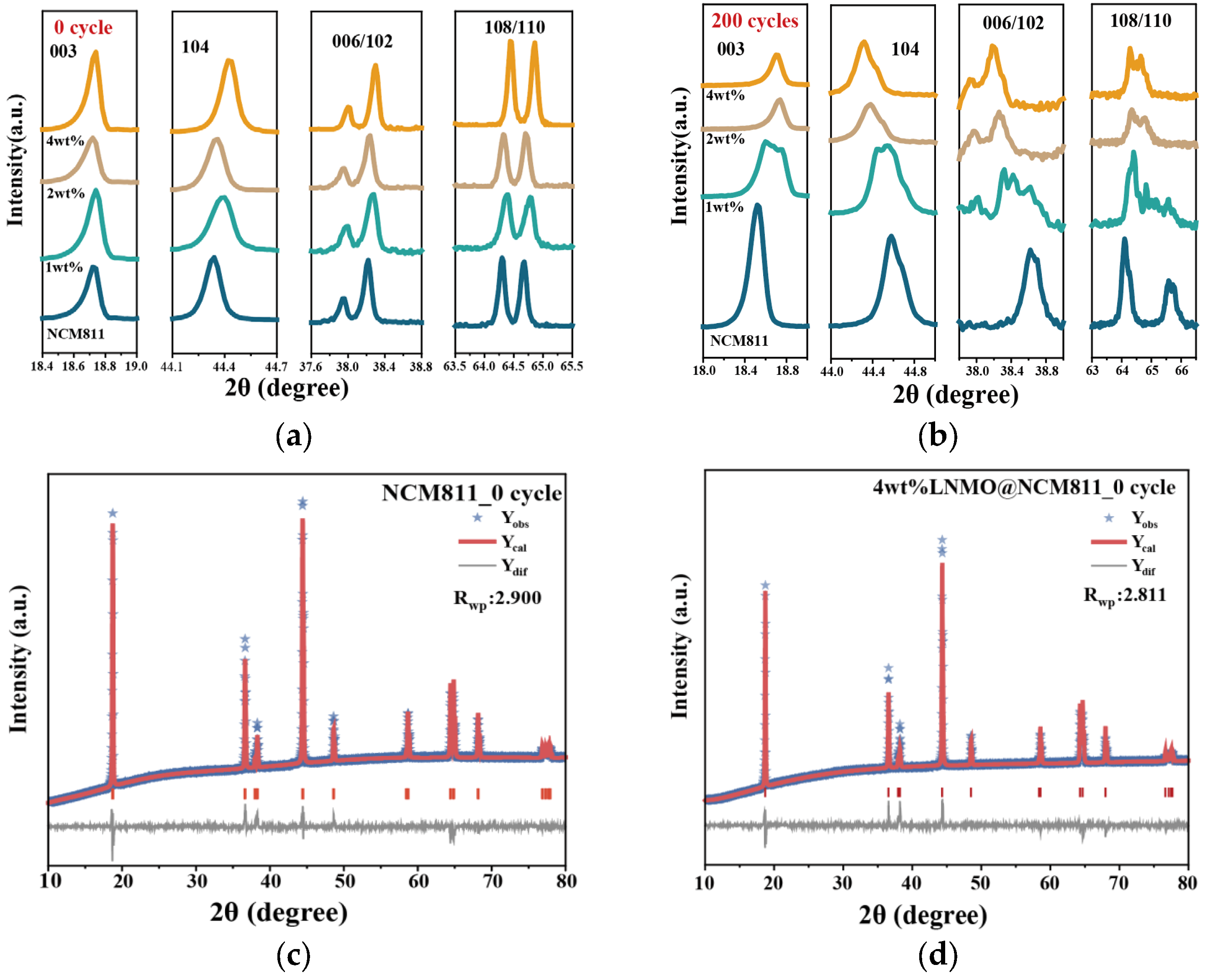
| Samples | a (Å) | c (Å) | c/a | V (Å3) | I(003)/I(104) | Rwp (%) | Micro Strain (ε × 10−6) |
|---|---|---|---|---|---|---|---|
| 0 cycle | |||||||
| NCM811 | 2.8719 | 14.1917 | 4.942 | 101.368 | 1.274 | 2.900 | 1161.6 |
| 4 wt% | 2.8796 | 14.2180 | 4.937 | 102.106 | 1.395 | 2.811 | 1100.7 |
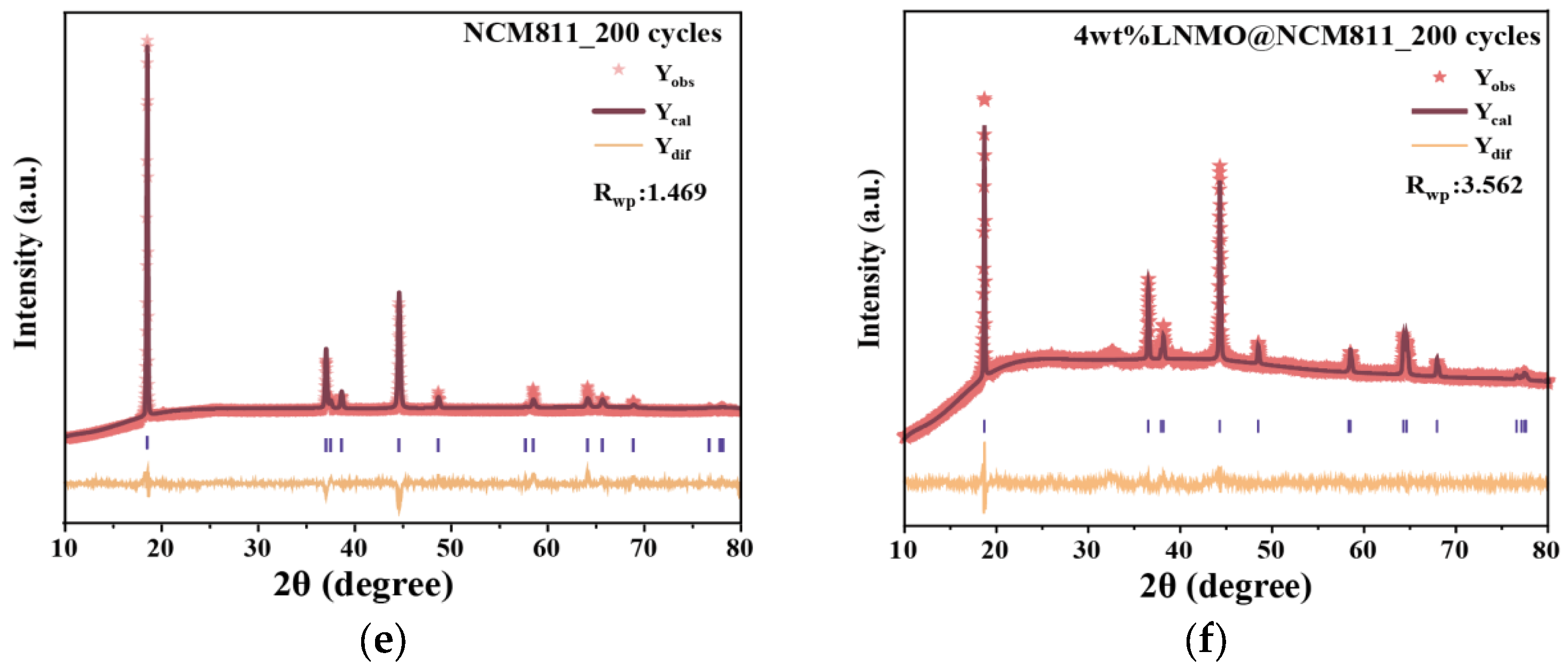
| Samples | a (Å) | c (Å) | c/a | V (Å3) | I(003)/I(104) | Rwp (%) | Micro Strain (ε × 10−6) |
|---|---|---|---|---|---|---|---|
| 200 cycles | |||||||
| NCM811 | 2.8809 | 14.2178 | 4.935 | 102.195 | 1.12 | 1169.1 | NCM811 |
| 4 wt% | 2.8381 | 14.3475 | 5.055 | 100.080 | 1.31 | 1277.0 | 4 wt% |
| Sample | Exothermic Peak (°C) | ΔH (J g−1) | Endothermic Peak (°C) | ΔH (J g−1) |
|---|---|---|---|---|
| NCM811 | 592.2 °C | 208.3 | ||
| 1 wt%LNMO | 405.6 °C | 463.5 | 605.4 °C | 175.8 |
| 2 wt%LNMO | 403.2 °C | 97.0 | 606.2 °C | 129.3 |
| 4 wt%LNMO | 641.2 °C | 81.5 | 693.5 °C | 221.7 |
| Number | Reaction Mechanism | F(α) | G(α) |
|---|---|---|---|
| 1 | First-order reaction model, n = 1.0 | 1 − α | −ln(1 − α) |
| 2 | Phase boundary reaction with spherical symmetry, n = 1/3 | 3(1 − α)2/3 | 1 − (1 − α)1/3 |
| 3 | Jander model with two-dimensional diffusion, n = 2 | (1 − α)1/2[1 − (1 − α)1/2]−1 | [1 − (1 − α)1/2]2 |
| 4 | Avrami–Erofeev model, n = 2 | 1/2(1 − α) [−ln(1 − α)]−1 | [−ln(1 − α)]2 |
| 5 | Avrami–Erofeev model, n = 3 | 1/3(1 − α) [−ln(1 − α)]−2 | [−ln(1 − α)]3 |
| Sample | Method | Mechanism | Ea (kJ/mol) | R2 |
|---|---|---|---|---|
| NCM811 | Coats-Redfern | First-order reaction model, n = 1.0 | 395.73 | 0.9173 |
| 1 wt%LNMO | 301.53 | 0.9124 | ||
| 2 wt%LNMO | 334.05 | 0.9073 | ||
| 4 wt%LNMO | 340.12 | 0.8959 |
Disclaimer/Publisher’s Note: The statements, opinions and data contained in all publications are solely those of the individual author(s) and contributor(s) and not of MDPI and/or the editor(s). MDPI and/or the editor(s) disclaim responsibility for any injury to people or property resulting from any ideas, methods, instructions or products referred to in the content. |
© 2026 by the authors. Licensee MDPI, Basel, Switzerland. This article is an open access article distributed under the terms and conditions of the Creative Commons Attribution (CC BY) license.
Share and Cite
Xie, L.; Sun, H.; Dou, J.; Jiang, J.; Liang, C. Spinel-Encapsulated Ni-Rich Cathodes for Enhanced Thermal Safety: Unraveling the Decomposition Kinetics and Interfacial Reconstruction. Nanomaterials 2026, 16, 183. https://doi.org/10.3390/nano16030183
Xie L, Sun H, Dou J, Jiang J, Liang C. Spinel-Encapsulated Ni-Rich Cathodes for Enhanced Thermal Safety: Unraveling the Decomposition Kinetics and Interfacial Reconstruction. Nanomaterials. 2026; 16(3):183. https://doi.org/10.3390/nano16030183
Chicago/Turabian StyleXie, Linjie, Huiqi Sun, Jiawei Dou, Juncheng Jiang, and Chen Liang. 2026. "Spinel-Encapsulated Ni-Rich Cathodes for Enhanced Thermal Safety: Unraveling the Decomposition Kinetics and Interfacial Reconstruction" Nanomaterials 16, no. 3: 183. https://doi.org/10.3390/nano16030183
APA StyleXie, L., Sun, H., Dou, J., Jiang, J., & Liang, C. (2026). Spinel-Encapsulated Ni-Rich Cathodes for Enhanced Thermal Safety: Unraveling the Decomposition Kinetics and Interfacial Reconstruction. Nanomaterials, 16(3), 183. https://doi.org/10.3390/nano16030183