Article

The Tuning of LIPSS Wettability during Laser Machining and through Post-Processing
Department of Chemical Engineering, McGill University, Montréal, QC H3A 0C5, Canada
*
Author to whom correspondence should be addressed.
Nanomaterials 2021, 11(4), 973; https://doi.org/10.3390/nano11040973
Submission received: 12 March 2021 / Revised: 7 April 2021 / Accepted: 8 April 2021 / Published: 10 April 2021
(This article belongs to the Special Issue Laser-Generated Periodic Nanostructures)

Abstract

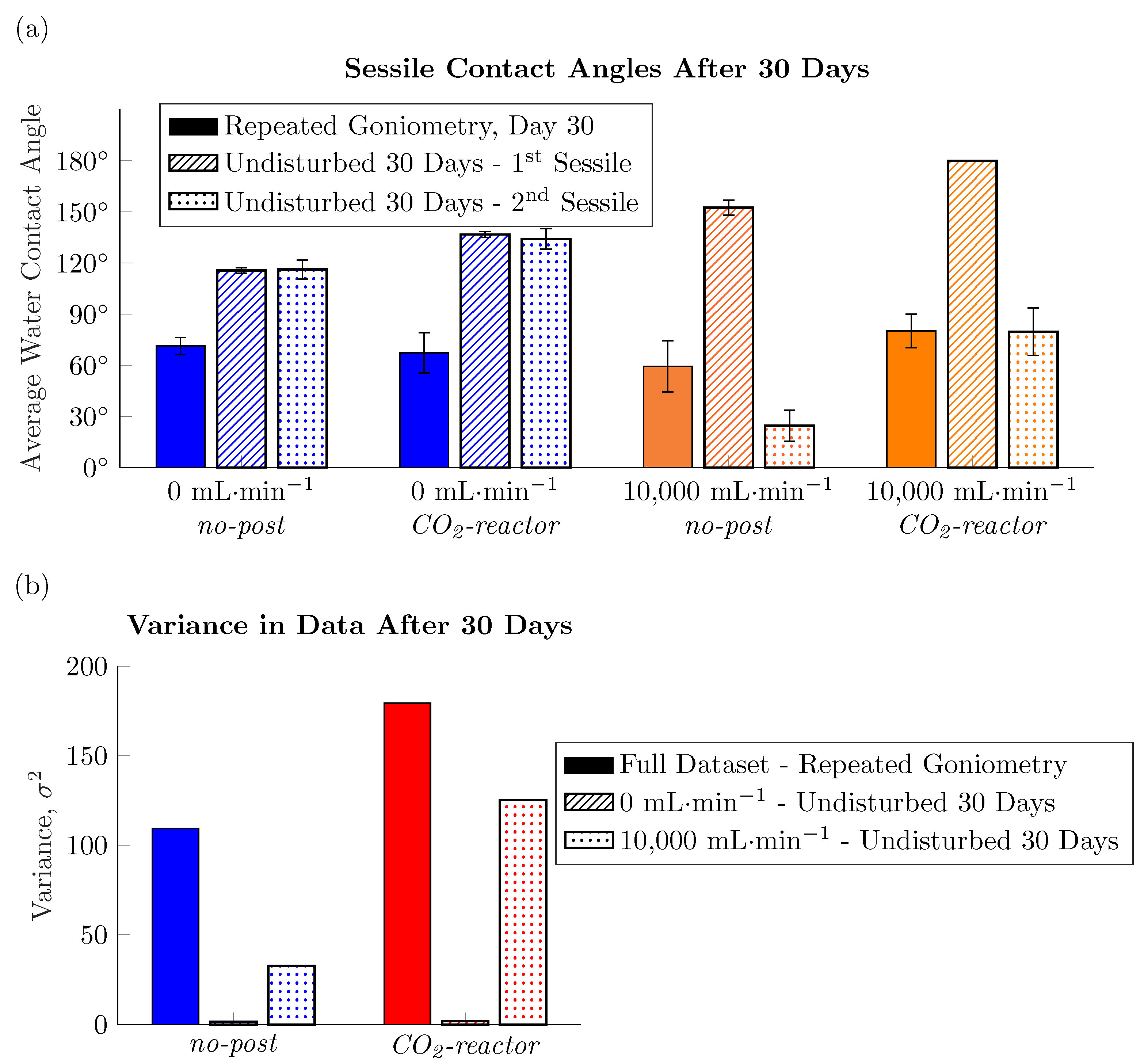
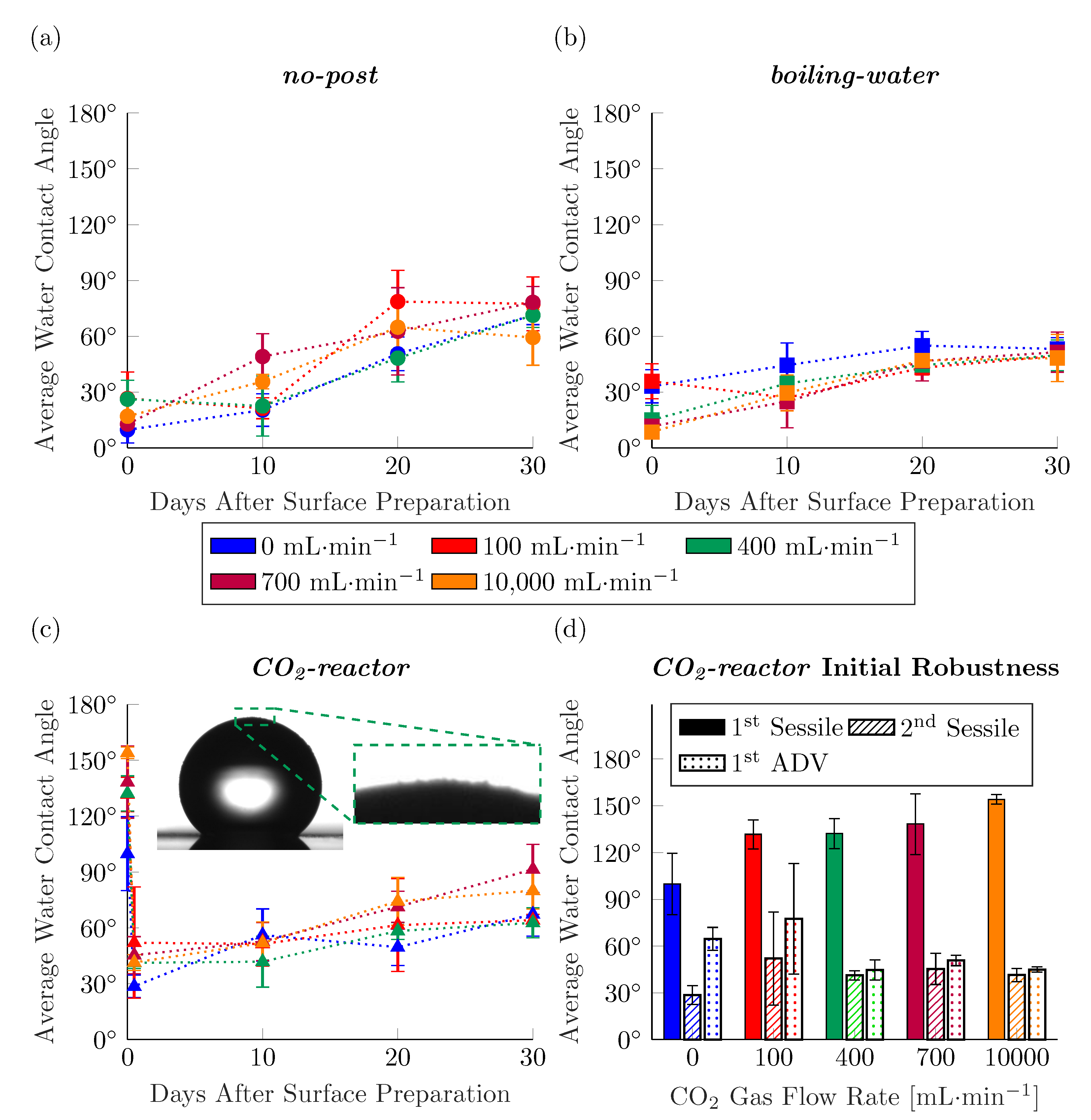
In this work, we investigate the fabrication of stainless-steel substrates decorated with laser-induced periodic surface structures (LIPSS) of both hydrophilic and hydrophobic wettability through different post-processing manipulation. In carrying out these experiments, we have found that while a CO2-rich atmosphere during irradiation does not affect final wettability, residence in such an atmosphere after irradiation does indeed increase hydrophobicity. Contrarily, residence in a boiling water bath will instead lead to a hydrophilic surface. Further, our experiments show the importance of removing non-sintered nanoparticles and agglomerates after laser micromachining. If they are not removed, we demonstrate that the nanoparticle agglomerates themselves become hydrophobic, creating a Cassie air-trapping layer on the surface which presents with water contact angles of 180°. However, such a surface lacks robustness; the particles are removed with the contacting water. What is left behind are LIPSS which are integral to the surface and have largely been blocked from reacting with the surrounding atmosphere. The actual surface presents with a water contact angle of approximately 80°. Finally, we show that chemical reactions on these metallic surfaces decorated with only LIPSS are comparatively slower than the reactions on metals irradiated to have hierarchical roughness. This is shown to be an important consideration to achieve the highest degree of hydro-philicity/phobicity possible. For example, repeated contact with water from goniometric measurements over the first 30 days following laser micromachining is shown to reduce the ultimate wettability of the surface to approximately 65°, compared to 135° when the surface is left undisturbed for 30 days.
Keywords: fs-laser; micromachining; wetting; hydrophobicity; LIPSS fs-laser; micromachining; wetting; hydrophobicity; LIPSS