
Four-Dimensional Superimposition Techniques to Compose Dental Dynamic Virtual Patients: A Systematic Review

Abstract
1. Introduction
2. Materials and Methods
2.1. Eligibility Criteria
2.2. Information Sources
2.3. Search Strategy
2.4. Study Records
2.5. Data Extraction
2.6. Evaluation of Quality
3. Results
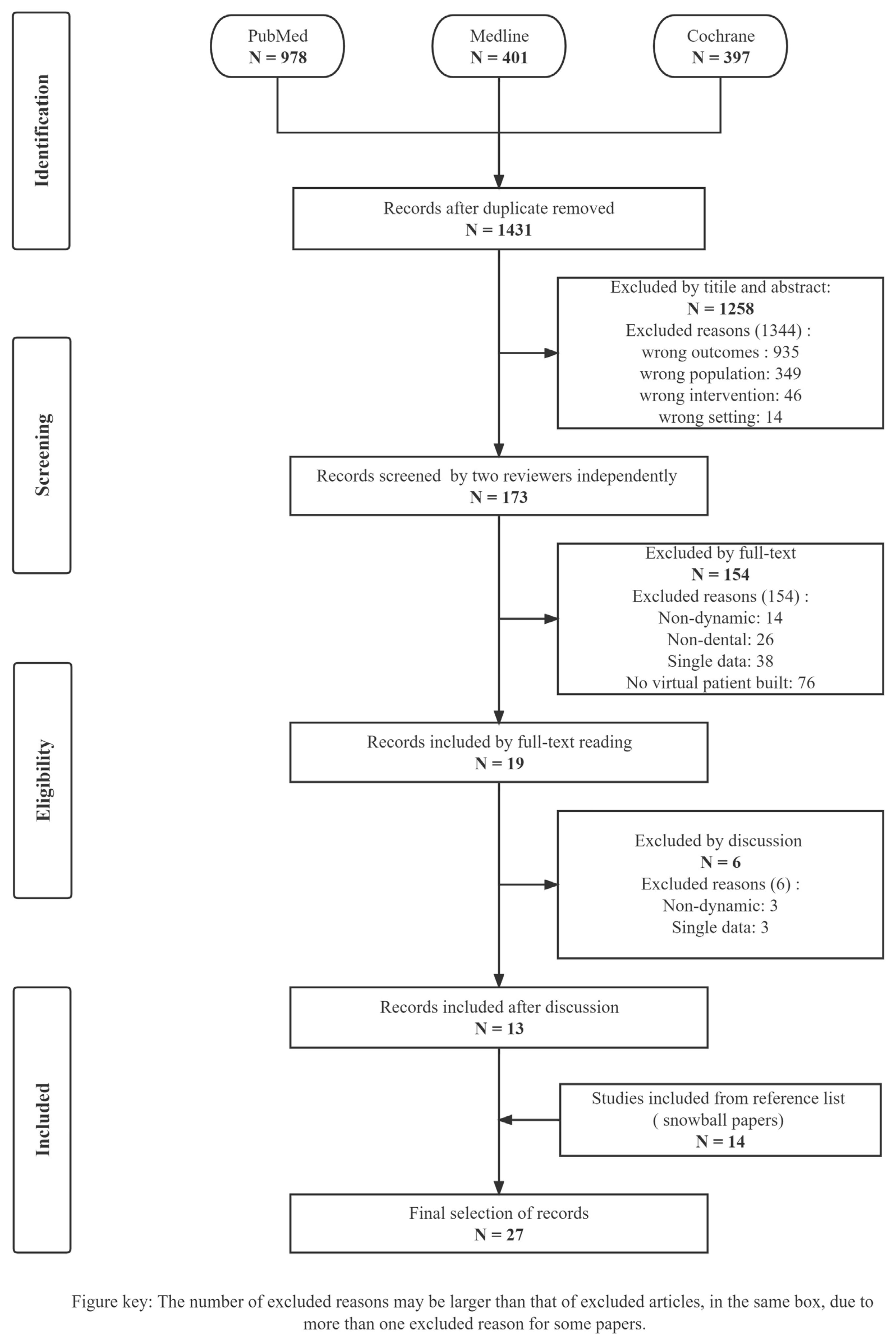
3.1. Search
3.2. Description of Studies
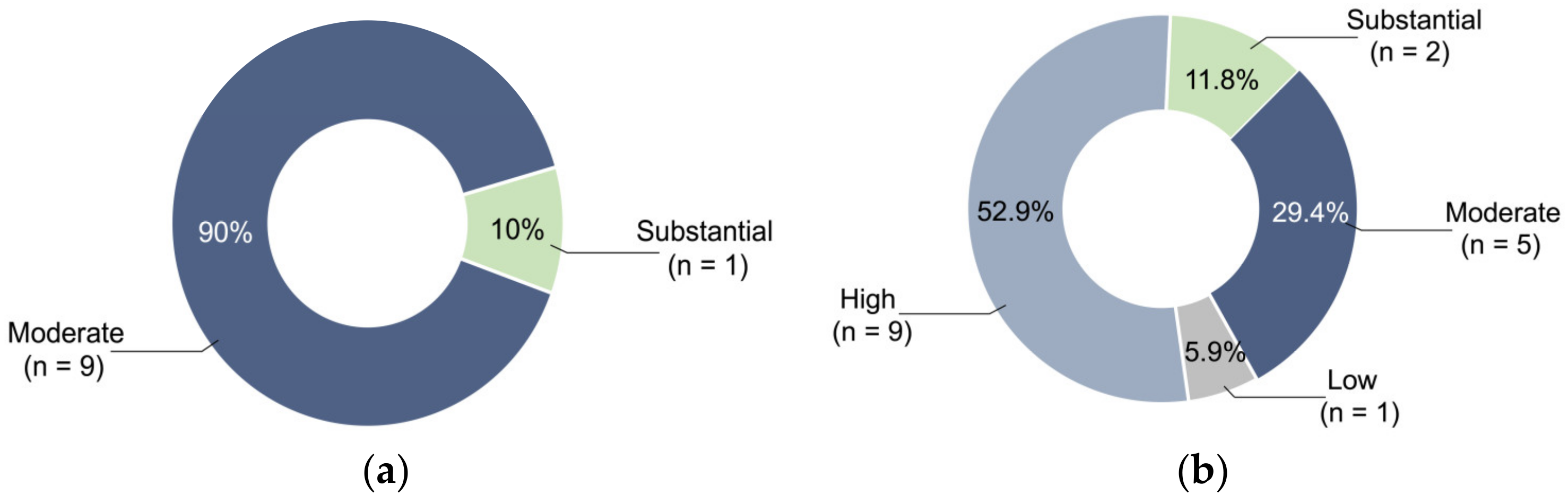
3.3. Risk of Bias in Included Studies
3.4. Outcomes
3.4.1. Dynamic Data Collection Methods of 4D Virtual Patients
- 1.
- Mandibular movement (jaw motion)
- 2.
- Dynamic faces
- 3.
- Positional relationships of the dentition, jaws, skull, and TMJ (jaw position)
- 4.
- Coordinated movement of the masticatory system
3.4.2. 4D Superimposition Techniques of Virtual Patients
- 1.
- Five types of information superimpositions
- SK + DENT + MM + SF + TMJ soft tissues/SK + DENT + MM + OA + muscles
- 2.
- Four types of information superimpositions
- SF + DENT + OA + MM/JP:
- SK + SF + DENT + JP:
- Six studies [24,27,28,32,33,34] constructed virtual patients mounted on the VA with faces from the FS (OBJ [24]/STL [27]/PLY [28] format)/photographs [34], bones from CBCT/CT (DICOM format), and dentition/prosthesis from the IOS (STL format). The models of three studies [24,27,28] were centric relation occlusion (CRO) and vertical dimension of occlusion (VDO). The prosthetic outcomes demonstrated a good fit, occlusion, and esthetics. Three studies created models based on points and fiducial markers [24,32,33]. One study [32] aligned the models with CBCT using the Iterative Closest Point (ICP) algorithm. The errors in tooth registration were less than 1 mm, whereas those of the nasion, alares, and tragions were 0.83 mm, 0.77 mm, and 1.70 mm, respectively. Further research is required to reduce this discrepancy and distortion. Granata et al. [42] created a virtual patient with faces in a smiling, open mouth, and maximum intercuspation (MICP) positions from FS (OBJ format), dental arches from IOS (PLY/STL format), and bones and jaw position from CBCT with the occlusal registration device Digitalbite (DGB). The superimposition was based on fiducial markers and a best-fitting algorithm.
- SK + SF + DENT + MM:
- SK + DENT + MM + TMJ soft tissues:
- 3.
- Three types of information superimpositions
- SK + DENT + MM:
- SF/SK + DENT + JP:
- 4.
- Software programs to create the virtual patients
3.4.3. Clinical Applications of 4D Virtual Patients
- 1.
- Application in prosthetic dentistry and dental implant surgery
- 2.
- Application in maxillofacial surgery
- 3.
- Application in orthodontics
4. Discussion
4.1. Dynamic Data Collection Methods
4.2. 4D Superimposition Techniques
4.2.1. Superimposition Methods
4.2.2. Software Programs
4.2.3. Outcome of the Technology
4.3. Clinical Applications
5. Conclusions
- Dynamic data collection methods of 4D virtual patients include the JMT, FS + targets, and target tracking camera to acquire real-time jaw motion, VF and VA to simulate jaw position, facial tracking systems, and FE programs to analyze the coordinated movement of the masticatory system.
- Superimposition of the skeleton, TMJs, soft tissue, dentition, mandibular movement/position, and occlusion from different static/dynamic information collection devices in various file formats is feasible for 4D dental patients.
- Four-dimensional virtual patient models facilitate pre-treatment planning, intraoperative assessment, and stable, healthy, and aesthetic treatment outcomes in different clinical scopes of dentistry.
- There is a lack of well-designed and less heterogeneous studies in the field of 4D virtual patients.
- Further studies should focus on evaluating the accuracy of the existing software, techniques, and final models of dental dynamic virtual patients and developing a comprehensive system that combines all necessary data.
Supplementary Materials
Author Contributions
Funding
Institutional Review Board Statement
Informed Consent Statement
Data Availability Statement
Acknowledgments
Conflicts of Interest
Abbreviations
References
- Joda, T.; Bragger, U.; Gallucci, G. Systematic literature review of digital three-dimensional superimposition techniques to create virtual dental patients. Int. J. Oral Maxillofac. Implant. 2015, 30, 330–337. [Google Scholar] [CrossRef]
- Joda, T.; Gallucci, G.O. The virtual patient in dental medicine. Clin. Oral Implant. Res. 2015, 26, 725–726. [Google Scholar] [CrossRef] [PubMed]
- Perez-Giugovaz, M.G.; Park, S.H.; Revilla-Leon, M. 3D virtual patient representation for guiding a maxillary overdenture fabrication: A dental technique. J. Prosthodont. 2021, 30, 636–641. [Google Scholar] [CrossRef]
- Terajima, M.; Endo, M.; Aoki, Y.; Yuuda, K.; Hayasaki, H.; Goto, T.K.; Tokumori, K.; Nakasima, A. Four-dimensional analysis of stomatognathic function. Am. J. Orthod. Dentofac. 2008, 134, 276–287. [Google Scholar] [CrossRef] [PubMed]
- Mangano, C.; Luongo, F.; Migliario, M.; Mortellaro, C.; Mangano, F.G. Combining intraoral scans, cone beam computed tomography and face scans: The virtual patient. J. Craniofac. Surg. 2018, 29, 2241–2246. [Google Scholar] [CrossRef]
- Lepidi, L.; Galli, M.; Mastrangelo, F.; Venezia, P.; Joda, T.; Wang, H.L.; Li, J. Virtual articulators and virtual mounting procedures: Where do we stand? J. Prosthodont. 2021, 30, 24–35. [Google Scholar] [CrossRef]
- Ruge, S.; Quooss, A.; Kordass, B. Variability of closing movements, dynamic occlusion, and occlusal contact patterns during mastication. Int. J. Comput. Dent. 2011, 14, 119–127. [Google Scholar] [PubMed]
- Mehl, A. A new concept for the integration of dynamic occlusion in the digital construction process. Int. J. Comput. Dent. 2012, 15, 109. [Google Scholar]
- Schendel, S.A.; Duncan, K.S.; Lane, C. Image fusion in preoperative planning. Facial Plast. Surg. Clin. 2011, 19, 577–590. [Google Scholar] [CrossRef]
- Page, M.J.; McKenzie, J.E.; Bossuyt, P.M.; Boutron, I.; Hoffmann, T.C.; Mulrow, C.D.; Shamseer, L.; Tetzlaff, J.M.; Akl, E.A.; Brennan, S.E.; et al. The PRISMA 2020 statement: An updated guideline for reporting systematic reviews. BMJ Br. Med. J. 2021, 372, n71. [Google Scholar] [CrossRef]
- Shamseer, L.; Moher, D.; Clarke, M.; Ghersi, D.; Liberati, A.; Petticrew, M.; Shekelle, P.; Stewart, L.A. Preferred reporting items for systematic review and meta-analysis protocols (PRISMA-P) 2015: Elaboration and explanation. BMJ Br. Med. J. 2015, 354, i4086. [Google Scholar] [CrossRef] [PubMed]
- The Preferred Reporting Items for Systematic Reviews and Meta-Analyses (PRISMA) Website. Available online: http://www.prisma-statement.org (accessed on 26 November 2022).
- Li, A.; Thomas, R.Z.; van der Sluis, L.; Tjakkes, G.H.; Slot, D.E. Definitions used for a healthy periodontium-A systematic review. Int. J. Dent. Hyg. 2020, 18, 327–343. [Google Scholar] [CrossRef] [PubMed]
- The Rayyan Website. Available online: https://rayyan.ai/reviews (accessed on 26 November 2022).
- Ouzzani, M.; Hammady, H.; Fedorowicz, Z.; Elmagarmid, A. Rayyan-a web and mobile app for systematic reviews. Syst. Rev. Lond. 2016, 5, 210. [Google Scholar] [CrossRef] [PubMed]
- Tufanaru, C.; Munn, Z.; Aromataris, E.; Campbell, J.; Hopp, L. Chapter 3: Systematic reviews of effectiveness. In JBI Manual for Evidence Synthesis; Aromataris, E., Munn, Z., Eds.; JBI: Adelaide, SA, Australia, 2020. [Google Scholar]
- Moola, S.; Munn, Z.; Tufanaru, C.; Aromataris, E.; Sears, K.; Sfetcu, R.; Currie, M.; Qureshi, R.; Mattis, P.; Lisy, K.; et al. Chapter 7: Systematic reviews of etiology and risk. In JBI Manual for Evidence Synthesis; Aromataris, E., Munn, Z., Eds.; JBI: Adelaide, SA, Australia, 2020. [Google Scholar]
- Fushima, K.; Kobayashi, M.; Konishi, H.; Minagichi, K.; Fukuchi, T. Real-time orthognathic surgical simulation using a mandibular motion tracking system. Comput. Aided Surg. 2007, 12, 91–104. [Google Scholar] [CrossRef]
- Li, J.; Chen, Z.; Decker, A.M.; Wang, H.L.; Joda, T.; Mendonca, G.; Lepidi, L. Trueness and precision of economical smartphone-based virtual facebow records. J. Prosthodont. 2022, 31, 22–29. [Google Scholar] [CrossRef]
- Zambrana, N.; Sesma, N.; Fomenko, I.; Dakir, E.I.; Pieralli, S. Jaw tracking integration to the virtual patient: A 4D dynamic approach. J. Prosthet. Dent. 2022; in press. [Google Scholar] [CrossRef]
- Kim, J.-E.; Park, J.-H.; Moon, H.-S.; Shim, J.-S. Complete assessment of occlusal dynamics and establishment of a digital workflow by using target tracking with a three-dimensional facial scanner. J. Prosthodont. Res. 2019, 63, 120–124. [Google Scholar] [CrossRef]
- Revilla-Leon, M.; Zeitler, J.M.; Kois, J.C. Scan body system to translate natural head position and virtual mounting into a 3-dimensional virtual patient: A dental technique. J. Prosthet. Dent. 2022; in press. [Google Scholar] [CrossRef]
- Revilla-Leon, M.; Zeitler, J.M.; Blanco-Fernandez, D.; Kois, J.C.; Att, W. Tracking and recording the lip dynamics for the integration of a dynamic virtual patient: A novel dental technique. J. Prosthodont. 2022, 31, 728–733. [Google Scholar] [CrossRef]
- Lepidi, L.; Galli, M.; Grammatica, A.; Joda, T.; Wang, H.L.; Li, J. Indirect digital workflow for virtual cross-mounting of fixed implant-supported prostheses to create a 3D virtual patient. J. Prosthodont. 2021, 30, 177–182. [Google Scholar] [CrossRef]
- Kim, S.-H.; Lee, S.-J.; Choi, M.-H.; Yang, H.J.; Kim, J.-E.; Huh, K.-H.; Lee, S.-S.; Heo, M.-S.; Hwang, S.J.; Yi, W.-J. Quantitative augmented reality-assisted free-hand orthognathic surgery using electromagnetic tracking and skin-attached dynamic reference. J. Craniofac. Surg. 2020, 31, 2175–2181. [Google Scholar] [CrossRef]
- Lee, S.-J.; Yang, H.J.; Choi, M.-H.; Woo, S.-Y.; Huh, K.-H.; Lee, S.-S.; Heo, M.-S.; Choi, S.-C.; Hwang, S.J.; Yi, W.-J. Real-time augmented model guidance for mandibular proximal segment repositioning in orthognathic surgery, using electromagnetic tracking. J. Cranio Maxillofac. Surg. 2019, 47, 127–137. [Google Scholar] [CrossRef]
- Li, J.; Chen, Z.; Dong, B.; Wang, H.L.; Joda, T.; Yu, H. Registering maxillomandibular relation to create a virtual patient integrated with a virtual articulator for complex implant rehabilitation: A clinical report. J. Prosthodont. 2020, 29, 553–557. [Google Scholar] [CrossRef]
- Li, J.; Att, W.; Chen, Z.; Lepidi, L.; Wang, H.; Joda, T. Prosthetic articulator-based implant rehabilitation virtual patient: A technique bridging implant surgery and reconstructive dentistry. J. Prosthet. Dent. 2021; in press. [Google Scholar] [CrossRef]
- Olszewski, R.; Villamil, M.B.; Trevisan, D.G.; Nedel, L.P.; Freitas, C.M.; Reychler, H.; Macq, B. Towards an integrated system for planning and assisting maxillofacial orthognathic surgery. Comput. Methods Programs Biomed. 2008, 91, 13–21. [Google Scholar] [CrossRef]
- Kois, J.C.; Kois, D.E.; Zeitler, J.M.; Martin, J. Digital to analog facially generated interchangeable facebow transfer: Capturing a standardized reference position. J. Prosthodont. 2022, 31, 13–22. [Google Scholar] [CrossRef] [PubMed]
- Kwon, J.H.; Im, S.; Chang, M.; Kim, J.-E.; Shim, J.-S. A digital approach to dynamic jaw tracking using a target tracking system and a structured-light three-dimensional scanner. J. Prosthodont. Res. 2019, 63, 115–119. [Google Scholar] [CrossRef] [PubMed]
- Lam, W.Y.; Hsung, R.T.; Choi, W.W.; Luk, H.W.; Pow, E.H. A 2-part facebow for CAD-CAM dentistry. J. Prosthet. Dent. 2016, 116, 843–847. [Google Scholar] [CrossRef] [PubMed]
- Lam, W.; Hsung, R.; Choi, W.; Luk, H.; Cheng, L.; Pow, E. A clinical technique for virtual articulator mounting with natural head position by using calibrated stereophotogrammetry. J. Prosthet. Dent. 2018, 119, 902–908. [Google Scholar] [CrossRef] [PubMed]
- Shao, J.; Xue, C.; Zhang, H.; Li, L. Full-arch implant-supported rehabilitation guided by a predicted lateral profile of soft tissue. J. Prosthodont. 2019, 28, 731–736. [Google Scholar] [CrossRef]
- He, S.; Kau, C.H.; Liao, L.; Kinderknecht, K.; Ow, A.; Saleh, T.A. The use of a dynamic real-time jaw tracking device and cone beam computed tomography simulation. Ann. Maxillofac. Surg. 2016, 6, 113–119. [Google Scholar] [CrossRef] [PubMed]
- Park, J.H.; Lee, G.-H.; Moon, D.-N.; Kim, J.-C.; Park, M.; Lee, K.-M. A digital approach to the evaluation of mandibular position by using a virtual articulator. J. Prosthet. Dent. 2021, 125, 849–853. [Google Scholar] [CrossRef] [PubMed]
- Amezua, X.; Iturrate, M.; Garikano, X.; Solaberrieta, E. Analysis of the influence of the facial scanning method on the transfer accuracy of a maxillary digital scan to a 3D face scan for a virtual facebow technique: An in vitro study. J. Prosthet. Dent. 2021, 128, 1024–1031. [Google Scholar] [CrossRef]
- Dai, F.; Wang, L.; Chen, G.; Chen, S.; Xu, T. Three-dimensional modeling of an individualized functional masticatory system and bite force analysis with an orthodontic bite plate. Int. J. Comput. Assist. Radiol. 2016, 11, 217–229. [Google Scholar] [CrossRef]
- Savoldelli, C.; Bouchard, P.-O.; Loudad, R.; Baque, P.; Tillier, Y. Stress distribution in the temporo-mandibular joint discs during jaw closing: A high-resolution three-dimensional finite-element model analysis. Surg. Radiol. Anat. 2012, 34, 405–413. [Google Scholar] [CrossRef] [PubMed]
- Perez-Giugovaz, M.G.; Mostafavi, D.; Revilla-Leon, M. Additively manufactured scan body for transferring a virtual 3-dimensional representation to a digital articulator for completely edentulous patients. J. Prosthet. Dent. 2021, 128, 1171–1178. [Google Scholar] [CrossRef] [PubMed]
- Solaberrieta, E.; Garmendia, A.; Minguez, R.; Brizuela, A.; Pradies, G. Virtual facebow technique. J. Prosthet. Dent. 2015, 114, 751–755. [Google Scholar] [CrossRef]
- Granata, S.; Giberti, L.; Vigolo, P.; Stellini, E.; Di Fiore, A. Incorporating a facial scanner into the digital workflow: A dental technique. J. Prosthet. Dent. 2020, 123, 781–785. [Google Scholar] [CrossRef]
- Noguchi, N.; Tsuji, M.; Shigematsu, M.; Goto, M. An orthognathic simulation system integrating teeth, jaw and face data using 3D cephalometry. Int. J. Oral Maxillofac. Surg. 2007, 36, 640–645. [Google Scholar] [CrossRef]
- Stella, M.; Bernardini, P.; Sigona, F.; Stella, A.; Grimaldi, M.; Fivela, B.G. Numerical instabilities and three-dimensional electromagnetic articulography. J. Acoust. Soc. Am. 2012, 132, 3941–3949. [Google Scholar] [CrossRef]
- Chen, G.; Lu, X.; Yin, N. Finite-element biomechanical-simulated analysis of the nasolabial fold. J. Craniofac. Surg. 2020, 31, 492–496. [Google Scholar] [CrossRef] [PubMed]
- Dai, J.; Dong, Y.; Xin, P.; Hu, G.; Xiao, C.; Shen, S.; Shen, S.G. A novel method to determine the potential rotational axis of the mandible during virtual three-dimensional orthognathic surgery. J. Craniofac. Surg. 2013, 24, 2014–2017. [Google Scholar] [CrossRef] [PubMed]


| Subjects | Answers |
|---|---|
| Database | PubMed, Medline (Web of Science), and Cochrane library |
| #1 Population | “Patient simulation” [MeSH] or “computer simulation” [MeSH] or “Patient Simulations” or “computer simulations” or “computerized model *” or “Computer Model *” or “Virtual patient *” or “digital patient *” or “simulation patient *” or ((“4D” OR “4-D” or “4 dimension *” or “4-dimension *” or “four D” or “four-D” or “four dimension *” or “four-dimension *”) and “patient *”) |
| #2 Intervention | “Dental Articulators” [MeSH] or “dynamic” or “Dental Articulator” or “Articulator, Dental” or “Articulator *” or “Condylar movement” or “ condylar position” or “computer aided diagnosis axiograph” or “Diagnosis, Computer Assisted” or “Computer-Assisted Diagnosis” or “Computer Assisted Diagnosis” or “Computer-Assisted Diagnosis” or “Diagnoses, Computer-Assisted” or “Jaw motion” or “jaw movement” or “mandibular movement” or “Face bow” or “facebow” or “Electromyography” [MeSH] or “Electromyographies” or “Surface Electromyograph *” or “Electromyography, Surface” or “Electromyogram *” or “EMG” or “EMCP” or “photogrammetry” [MeSH] or “Stereophotogrammetr *” or “Radiostereometric Analysis” or “ facial scanning” or “Mastication” [MeSH] or “chewing” or “Dental Occlusion” [MeSH] or “Occlusion?, Dental” or “Dental Occlusions” or “Occlusal Plane *” or “Plane?, Occlusal” or “Canine Guidance” or “Guidance, Canine” or “Occlusal Guidance *” or “Guidance, Occlusal.” |
| #3 Outcome | “Dimensional Measurement Accuracy” [MeSH] or “Dimensional Measurement Accurac *” or “Measurement Accuracy, Dimensional” or “accuracy” or “precision” or “reliability” or “Validity” or “stomatology” or “tooth” or “oral” or “dental” or “Dentistry” or “orthodontics *” or “prosthodontics *” or “implant dentistry*” or “orthognathic *” or “Maxillodental *” or “orthognathic* ” or “maxillofacial surgery *” or “plastic surgery *” |
| #4 Setting | “multi-modal” or “multi-mode” or “multi-modality” or “multimodal” or “multiple-modal” or “multiple-mode” or “multiple-modality” or “multi-source” or “multisource” or “fusion” or “integration” or “superimposition” or “merging” or “registration” or “alignment” or “calibration” |
| #1 and #2 and #3 and #4 | |
| Author Ref./Year | Study Designs (Humans/Phantom) | Sample Size (n) | Methods (+File Format) | Manufacturer Software Programs | Information | Types of Registration/Superimposition | Scopes | Outcomes | Limitations |
|---|---|---|---|---|---|---|---|---|---|
| Zambrana N [20]/2022 | Case report: method description (Humans) | Unknown | 1. CBCT (DICOM) 2. IOS(STL) 3. Target tracking camera (MP4) 4. DS 5. Open-source CAD software | 1. (Promax 3D Mid, Planmeca OY, Helsinki, Finland) 2. (TRIOS3; 3Shape A/S, Copenhagen, Denmark) 3. Camera of a mobile phone (iPhone 7; Apple Inc., Cupertino, CA, USA) 4. (Swing; DOF Inc., Seoul, Republic of Korea) 5. (Blender 3D; Blender Foundation, Amsterdam, Netherlands) | 1. TMJs, maxilla, and mandible 2. Dentitions and the maxillomandibular relationship 3. Mandibular movements 4. Maxillomandibular relationship, including the marker boards 5. 4D virtual patient with mandibular kinematic path and TMJ kinematic path | Markerboards + marker board from occlusal registration (IOS + DS): point-based | Prosthetic Dentistry | Feasibility | 1. Lack of a rigorous validation 2. Lack of comparison with other jaw-tracking systems and software programs |
| Kim JE [21]/2019 | Case report: method description (Humans) | Unknown | 1. DS 2. FS + targets 3. Image registration software 4. CAD software | 1. (Identica hybrid, Medit Inc., Seoul, Republic of Korea) 2. (Rexcan CS2, Medit Inc., Seoul, Republic of Korea) 3. (EzScan8, Medit Inc., Seoul, Republic of Korea) 4. (Exocad; exocad GmbH, Darmstadt, Germany) | 1. Virtual casts 2. Anterior part of dentition, face, and target position 3. Four types of antagonist mesh + models superimposing dental cast data on facial scan data 4. Occlusal contacts in the MICP and occlusal interference during eccentric movement | FS + DS: point-based(teeth) + horn alignment algorithm + ICP algorithm | Prosthetic dentistry | Feasibility | 1. Time-consuming 2. The need to maintain the retractor 3. Lack of validation of accuracy |
| Revilla-Leon M [22]/2022 | Case report: method description (Humans) | Unknown | 1. FS(PLY) 2. IOS(STL) 3. VA 4. DS(PLY) + scan body system 5. CAD software | 1. (InstaRisa Facial Scanner; InstaRisa, Clovis, CA, USA) 2. (TRIOS4, wireless, v21.2.0; 3Shape A/S, Copenhagen, Denmark) 3. (Panadent Articulator; Panadent, Colton, CA, USA) 4. (Medit T500; Medit Inc., Seoul, Republic of Korea) + (Kois Scan Body System; Kois Center, LLC, Seattle, WA, USA) 5. (DentalCAD 3.0, Galway; exocad GmbH, Darmstadt, Germany) | 1. Static and smiling face 2. The dentitions and a maxillomandibular registration 3. Jaw-correction function 4. NHP + registration tool 5. Virtual patient with a digitized scan body, maxillary digital scan, and reference facial scan | 1. Maxillary cast + the scan body (DS + IOS): point-based + best-fit alignment (teeth as common information) 2.Scan body + reference face (DS + FS): point-based (scan-body as common information) 3. Reference face + the smiling face (FS + FS): point-based (facial markers as common information) | Prosthetic dentistry | Feasibility | 1. Lack of validation of accuracy 2. Factors affecting accuracy: 1). the eye closure due to the intense light 2) color and surface texture of the scan body system |
| Li J [19]/2022 | Non-randomized controlled experimental study (Humans) | Two healthy subjects | 1. FS (STL/PLY) 2. IOS (STL) 3. DS + virtual facebow fork 4. CBCT + implant planning software (STL) 5. Open-source software 6. CAD software | 1. Application (Hege 3D scanner;) in (iPhone 11 Pro; Apple Inc., Cupertino, CA, USA) 2. (TRIOS Color Pod; 3Shape, Copenhagen, Denmark) 3. (D2000; 3Shape, Copenhagen, Denmark) 4. (3D Accuitomo 170; J Morita) + (Blue Sky Plan; Blue Sky Bio, LLC, Libertyville, IL, USA) 5. (Blender 3D; Blender Foundation, Amsterdam, Netherlands) 6. (Exocad version 2.2; exocad GmbH, Darmstadt, Germany) | 1. Facial information 2. Maxillary dentition 3. Alignment of dentition and the face 4. Model with face soft tissue and maxillary dentition 5 + 6. A composite model including the face, facebow fork, and the maxillary dentition | CBCT + FS + IOS: Surface-based + the best-fitting algorithm | Prosthetic dentistry: CAD/CAM | 1. Feasibility 2. Accuracy of the VF: (1) High trueness: 1.14 ± 0.40 mm (2). High precision: 1.08 ± 0.52 mm (the difference of eight measurements was small) | The factors influencing accuracy were not explored. |
| Revilla-Leon M [23]/2022 | Case report: method description (Humans) | One subject | 1. IOS(STL) 2. FS (PLY+STL) 3. Extra-oral scan body system 4. DS (STL) 5. Open-source software 6. 3D modeling software 7. Avatar generator software (OBJ) 8. Motion Engine software program + a facial tracking app in a smartphone | 1. (TRIOS 4, wireless, v. 21.2.0; 3Shape A/S, Copenhagen, Denmark) 2. (Instarisa facial scanner; Instarisa, Clovis, CA, USA) 3. (AFT Scan Body Teeth; AFT Dental System) 4. (T710 Scanner; Medit Inc., Seoul, Republic of Korea) 5. (Blender 3D; Blender Foundation, Amsterdam, Netherlands) 6. (Zbrush 2022; Maxon, Friedrichsdorf, Germany) 7. (Character Creator, v.3.44; Reallusion, SFO, CA, USA) 8. (Iclone, v.7.93; Reallusion) + (Live Face, v.1.08; Reallusion) in (iPhone 12 Pro; Apple Inc., Cupertino, CA, USA) | 1. Dentitions and a maxillo-mandibular registration 2. Facial scan with and without scan body system 3. Registration tool 4. Digitizing scan body 5. All data converted to the OBJ format 6. Avatar without the hair and eyes 7. Avatar with the hair and eyes, dentition, and scan body 8. Virtual patient with lip dynamics | IOS + DS: fiducial markers based (extra-oral scan body system) | 1. Prosthetic dentistry 2. Maxillofacial surgery | Feasibility | 1. Lack of validation of accuracy 2. Complicated and time-consuming |
| Lepidi L [24]/2021 | Case report: method description (Humans) | One subject | 1. IOS(STL) 2. FS(OBJ) 3. DS(STL) 4. CBCT (DICOM) 5. Dental CAD software (STL) | 1. (Cs 3600, Carestream Health, Rochester, NY, USA) 2. (Bellus 3D; Bellus 3D Inc., Campbell, CA, USA) 3. (Neway, Faro Technologies Inc., Brescia, Italy) 4. (Cs 9600 3D, Carestream Health, Rochester, NY, USA) 5. (Exocad; exocad GmbH, Darmstadt, Germany) | 1. Maxillary and mandibular fixed prosthesis in the desired CR and VDO 2. Facial scan with and without the fork 3. Cast with implant analogs 4. CBCT image contained the restorations 5. Virtual patient mounting to the VA The occlusal discrepancy between MICP/CR | 1. Cast with implant analogs, the casts with prostheses, and FS (DS + IOS + FS): fiducial markers based 2. FS with and without fork (FS + FS): point-based | Prosthetic dentistry | Feasibility | 1. Lack of validation of accuracy 2. Complicated and time-consuming |
| Kim SH [25]/2020 | Non-randomized controlled experimental study (phantom) | A skull phantom | 1. MDCT + occlusal splint with a registration body 2. DS 3. The flat-panel display monitor with a 3D depth camera 4. EM tracking system | 1. (SOMATOM Sensation 10, Siemens, Munich, Germany) 2. (Maestro 3D, Maestro, Pisa, Italy) 3. (QCT130, One Inc., Seoul, Republic of Korea) 4. (Aurora, Northern Digital Inc., Waterloo, ON, Canada) | 1. The maxillary and skeletal models 2. The maxillary dentition 3. 3D virtual objects superimposed on the real patient image 4. 3D tracking positions of the bone segment and the reference in physical space | 1. EM tracking + CT image spaces + AR camera spaces: fiducial markers based (markers on the registration body) 2. Dentition + maxillary model (MDCT + DS): ICP algorithm | Orthognathic surgery: AR-assisted free-hand orthognathic surgery | High accuracy: the MADs of the difference between actual and measured positions exhibited no significant differences between the SRT (0.20, 0.34, 0.29) and BRT (0.23, 0.37, 0.30) | Lack of validation of usability and accuracy in real patients |
| Lee SJ [26]/2019 | Non-randomized controlled experimental study (phantom and humans) | A skull phantom + a patient | 1. MDCT + Occlusal splint attached with a registration body 2. DS 3. EM tracking system | 1. (SOMATOM Sensation 10, Siemens, Munich, Germany) 2. (Maestro 3D, Maestro, Pisa, Italy) 3. (Aurora, Northern Digital Inc., Waterloo, ON, Canada) | 1. MPS and other skeletal models 2. Artifact-free model of the dentitions + final occlusal model 3. 3D tracking positions of MPS in a virtual maxillomandibular complex | 1. CT image + physical spaces: fiducial markers based (registration body) 2. Dentition + maxillary model (MDCT + DS): ICP algorithm | Orthognathic surgery: (MPS repositioning; model-guided surgery) | 1. Convenient 2. Accuracy: (The RMS differences between the simulated and intraoperative MPS models and between the simulated and postoperative CT models were 1.71 ± 0.63 mm and 1.89 ± 0.22 mm, respectively.) | Further development is needed to increase accuracy by reducing technical errors in the tracking devices, imaging errors from the modalities, registration errors, application errors, and human error |
| Li J [27]/2020 | Case report: case Reports (humans) | One subject | 1. IOS(STL) + a wax rim 2. CBCT (DICOM) + gothic arch 3. FS (STL) 4. Implant planning software 5. Dental CAD software + free CAD software. | 1. (TRIOS; 3Shape, Copenhagen, Denmark) 2. (3D Accuitomo 170; J. Morita, Osaka, Japan) 3. (3dMDtrio System; 3dMD, Atlanta, GA, USA) 4. (Blue Sky Plan; Blue Sky Bio, LLC Libertyville, IL, USA). 5. (Exocad version 2.2; exocad GmbH, Darmstadt, Germany) + (Meshmixer; Autodesk, San Rafael, CA, USA) | 1. Arches in approximate CR and VDO 2. (1) The maxilla, mandible, infraorbital points, and external acoustic meatus (2) The CR and VDO records 3. Smiling face 3D reconstruction of the face 4. Two-piece surgical templates 5. (1) Custom bases for a gothic arch tracer (2) The 3D images of FS, IOS, and skull mounted on a VA | Unknown | Dental implant surgery Prosthetic dentistry | Feasibility: successful prosthetic outcome | 1. Obtaining an occlusal record with increased VDO using the gothic arch tracer is difficult for the patient with remaining teeth. 2. Lack of a quantitative validation of accuracy |
| Li J [28]/2021 | Case report: method description (Humans) | Unknown | 1. IOS (STL) 2. Dental CAD software 3. CBCT (DICOM) 4. FS (PLY) 5. Implant planning software (STL) 6. Open-source 3D software program | 1. (TRIOS 3; 3Shape A/S, Copenhagen, Denmark) 2. (exocad; exocad GmbH, Darmstadt, Germany) 3. not mentioned 4. (Hege 3D scanner) in (iPhone 11 Pro; Apple Inc., Cupertino, CA, USA) 5. (BlueSkyPlan v4.70; Blue Sky Bio LLC, Libertyville, IL, USA) 6. (Blender 3D; Blender Foundation, Amsterdam, Netherlands) | 1. Arches in approximate CR and VDO 2. Design of the tooth-supported template 3. The maxilla, mandible, infraorbital points, and external acoustic meatus 4. Facial scan 5. 3D bone model and face model 6. Tooth-supported gothic arch tracer Alignment of the facebow and the skull Virtual patient with FS, IOS, CBCT | Unknown | Dental implant surgery Prosthetic dentistry: (complex implant-supported Prostheses) | 1. Predictability 2. Feasibility | 1. The need for a CBCT scan 2. Lack of a quantitative validation of accuracy |
| Olszewski R [29] /2008 | Non-randomized controlled experimental study (Humans) | Unknown | 1. CT (DICOM) + MRI 2. DS 3. 3D tracking device 4. System for planning and assisting orthognathic surgery | Data integration module of the system: MedicalStudio1 platform 1. ACRO 3D: 3D CT based craniofacial cephalometric Analysis 2. ACROTooth: virtual occlusion 3. TMJSim: TMJ movement Simulation 4. ACROSim: virtual surgery planning 5. ACROGuide: intra-operative AR assistance | 1. Maxilla, mandible, skull, and skin 2. Dental casts. 3. Mandibular movement: (1) translation and the rotation (2) the centric position for the condyles (3) The joint’s degrees of freedom 4. Virtual models | The physical space + the digital world: 1. algorithm (minimizing the mean square distance between the points) 2. fiducial markers (attached to the tracked surgical tools) based | Maxillofacial orthognathic surgery | Complete Accuracy: 1. ACRO 3D module: validated 2. TMJSim: partly validated; ACROGuide: partly validated. | Before clinical application: 1. accuracy needs to be further validated. 2. technology and algorithms need to be further improved. |
| Fushima K [18]/2007 | Non-randomized controlled experimental study (Humans) | More than 50 cases | 1. Lateral and PA cephalograms 2. 3D motion tracking 3. Facebow-transfer 4. Surgical simulation system: mandibular motion tracking system (ManMoS) | 1. Scanner (ES-2200, Epson Co., Owa, Suwa, Nagano, Japan) 2. (Polhemus, Colchester, VT, USA) 3. Unknown 4. (FASTRAK, Virtual Realities, LLC., League City, TX, USA)+2 | 1. Skeletal in a virtual space 2. Mandibular motion tracking 3. A record of how the upper dentition relates to the TMJ 4. Pilot surgical prediction and real-time surgical simulation: model of the craniofacial skeleton with the centric stops of the dental arches | Dentition + skeleton + motion tracking in a virtual space: fiducial markers based | Maxillofacial orthognathic surgery | 1. Feasibility 2. Trueness: sufficient (small SD) 3. Precision: SD in the 40 recordings was less than 0.1 mm | Complicated and time-consuming |
| Kois JC [30]/2022 | Case report: method description (Humans) | Unknown | 1. IOS 2. KFRG 3. Photography 4. CAD software 5. VA module | 1. (TRIOS 3; 3Shape A/S, Copenhagen, Denmark) 2. (Kois Center, LLC, Seattle, WA, USA) 3. Digital single-lens reflex camera (D850; Nikon Inc., Tokyo, Japan) 4. (DentalCAD; exocad GmbH, Darmstadt, Germany) | 1.Maxillary and mandibular arches 2. NHP 3. Photograph of dentition and face 4. Virtual Orientation: the project scene 5. Facially generated virtual mounting | IOS + photograph: “Align Mesh” tool | Prosthetic dentistry | Feasibility | Lack of the validation of accuracy |
| Kwon JH [31]/2019 | Case report: method description (Humans) | One subject | 1. CBCT (DICOM) 2. Image processing software (STL) 3. DS 4. FS + targets 5. Image registration tool | 1. (PaXZenith3D, Vatech Co., Ltd., Hwaseong, Republic of Korea;) 2. (OnDemand3D, Cybermed Co., Ltd., Seoul, Republic of Korea.) 3. (Identica hybrid, Medit Inc., Seoul, Republic of Korea.) 4. (Rexcan CS2, Medit Inc., Seoul, Republic of Korea.) 5. (Ezscan8, Medit Inc., Seoul, Republic of Korea) | 1. Maxilla and mandible 2. 3D skull and jaws 3. digital casts 4. The oral cavity and face in MICP 5. A 3D model with a CBCT scan Real-time mandibular motions | CBCT + DS: fiducial markers based (to generate the transformation matrix by comparing reference points) | Prosthetic dentistry | 1. Convenient 2. Stability: 36 mm in the mandible 30.78 mm/37.74 mm in the left/right condyle 3. Accuracy: high (4.1–6.9 mm) | The sample size needs to be expanded for further validation. |
| Lam WYH [32]/2016 | Non-randomized controlled experimental study (Humans) | Unknown | 1. FS with and without facebow 2. DS 3. IOS 4. Open-source software 5. CBCT scan+ the occlusal wafer + radiopaque markers | 1. (3dMDface; 3dMD Inc, Atlanta, GA, USA) 2. (Handyscan 3D; Creaform) 3. (True Definition; 3M ESPE, Iverson Dental Labs, MARB, CA, USA) 4.(MeshLab v1.3.3; Visual Computing Lab of the ISTICNR, Pisa, Italy) 5. Image analysis software (3D Slicer9 version 4.3; Slicer community, Boston, MA, USA) | 1.3D face with/without facebow 2. Facebow 3. (1) Dentitions and the maxillomandibular relationship; (2) Buccal surface of the maxillary dentition and the occlusal wafer 4. Virtual patients transferred to the VA 5. The facial skin, teeth, and radiographic markers | 1. FS + DS + IOS: point-based + ICP algorithm 2. Face-bow (DS) + CBCT: fiducial markers based + point-based algorithm | Prosthetic dentistry | 1. Feasibility 2. Accuracy (1) error in tooth registration: less than 1 mm (2) the facial alignment (the mean distances of the nasion, alares, and tragions: 0.83 mm, 0.77 mm, and 1.70 mm) | 1. The registration accuracy needs to be improved. 2. Distortion needs to be avoided. 3. Time-consuming |
| Lam WYH [33]/2018 | Non-randomized controlled experimental study (Humans) | One subject | 1. FS 2. IOS 3. DS 4. Open-source software 5. CBCT 6. CAD software | 1. (3dMDface; 3dMD Inc., Atlanta, GA, USA) 2. (True definition scanner; 3M ESPE, Iverson Dental Labs, MARB, CA, USA) 3. (DAVID SLS-3; Hewlett-Packard, Palo Alto, CA, USA) 4. (MeshLab v1.3.3; Visual Computing Lab of the ISTI-CNR, Pisa, Italy) 5. (ProMax 3D Mid, Planmeca OY, Helsinki, Finland) 6. (Exocad; Exocad GmbH, Darmstadt, Germany) | 1. 3D face in NHP position or with a VF 2. (1) Dentitions and the maxillomandibular relationship; (2) Buccal relationship of the maxillary teeth and VF 3. VF 4. The dentition and the 3D facial photographs in NHP 5. The dentition, jaws, and 3D facial photograph in NHP 6. Virtual patients transferred to the VA | FS + DS + IOS: point-based + ICP algorithm Face-bow (DS) + CBCT: fiducial markers based + point-based algorithm | Prosthetic dentistry | Good precision of the SP NHP technique: positional differences of less than 1 degree and 1 mm in five repeated measurements in one patient | The sample size needs to be expanded for further validation. |
| Shao J [34]/2019 | Case report: clinical report | One subject | 1. Multi-slice spiral CT 2. Facial photograph 3. Imaging software 4. DS 5. CAD software 6. CAD software + 3D printer | 1. (Philips MX16 EVO CT; Koninklijke Philips N.V., Amsterdam, NL) 2. (3dMDface System; 3dMD, Atlanta, GA, USA) 3. (Dolphin Imaging & Management Solutions; Patterson Dental, Chatsworth, CA, USA) 4. (3ShapeA/S, Copenhagen, Denmark) 5. (Exocad GmbH, Darmstadt, Germany) 6. (Formlabs Form 2; Formlabs, Boston, MA, USA) | 1. Bone and dentition 2. Virtual face model with bone and soft tissue in real-time in NHP 3. Simulation of the lateral facial profile influenced by the retrusion of anterior maxillary teeth Dentition casts scan preserving their articulator-mounted relationship 5. The restorations with incisal edges were retruded for 5.0 mm 6. Prosthetically driven planning | Unknown | Dental implant surgery Prosthetic dentistry | Feasibility | Lack of the validation of accuracy |
| He S [35] /2016 | Non-randomized controlled experimental study: (Humans) | One subject | 1. CBCT + GALAXIS 3D software (DICOM) 2. SICAT JMT + system | 1. (Sirona Galileos, Bensheim, Germany) 2. (SICAT Function; SICAT, Bonn, Germany) | 1. CT images: condylar status 2. (1) Jaw movements + incisor ranges (2) Models integrating CBCT and JMT data: movement of the mandible (including the translation of the condyles) | CBCT + JMT data: fiducial markers based (radiopaque markers on bite tray) | Maxillofacial orthognathic surgery Digital dentistry | 1. Reliable accuracy: the same positions between the simulated condylar position with that in the second CBCT 2. High precision | Further studies are needed to validate its accuracy. |
| Park JH [36] /2021 | Case report: clinical report (Humans) | One subject | 1. IOS + software program (STL) 2. CBCT 3. VA program (STL) | 1. (TRIOS; 3Shape, Copenhagen, Denmark) + (Ortho Analyzer; 3Shape, Copenhagen, Denmark) 2. (Alphard Vega; Asahi Roentgen, Kyoto, Japan) 3. (R2GATE 2.0.0; Megagen, Seoul, Republic of Korea) | 1. Cast in CRO and MICP position 2. CBCT model in CRO 3. (1) The maxillary cast registered on the CBCT model (2) VA (3) Models Superimposing the mandible position in CRO and MICP | IOS + CBCT: point-based + ICP algorithm | Prosthetic dentistry | Feasibility | Lack of the validation of accuracy |
| Amezua X [37] /2021 | Non-randomized controlled experimental study (phantom) | A skull phantom | 1. CAD software 2. DS by Industrial reference scanner (STL) 3. FS by the reference scanner (STL)/SWL scanner/SFM scanner methods (OBJ) 4. RE software | 1. (Solid Edge ST10; Siemens, Munich Ger) 2. (ATOS Compact Scan 5M scanner with ATOS Professional V7.5 software; GOM, GmbH, ZEISS, BS, Ger) 3. SFM: (PENTAX K-S1; Ricoh Imaging Co, Ltd., Tokyo, Japan) + (Agisoft Metashape Professional; Agisoft, SPB, Russia) SWL: (Go! SCAN20 scanner with VX element 6.3 SR1 software; Creaform, Inc., Lévis, CAN) 4. (Geomagic Studio 2013; Geomagic, Inc., RTP, NC, USA) | 1. IOTE 2 + 4. The maxillary model without regions not correspond to the teeth 3. (1) FS with IOTE (2) IOTE-free FS (3) FS with the mouth open 4. Models aligning IOTE-free FS and the maxillary scan | FS + DS/transferring maxillary digital scan to standard virtual patient: point-based + ICP algorithm | Prosthetic dentistry | Reliable accuracy: (below 1 mm): 0.182 mm for the RE group, 0.241 mm for the SWL group, and 0.739 mm for the SFM group | 1. Further studies are needed to validate its accuracy. 2. In vitro experiments may underestimate the scanning error. |
| Dai F [38] /2016 | Case report | One subject | 1. DS (STL) 2. Spiral CT (DICOM) + 3D software (STL) 3. Ultrasonic axiograph Arcus Digma system (TXT file) 4. RE software 5. Mathematical software MATLAB 7.0 + Amira software FE modeling 6. Analysis software Ansys 15.0 | 1. (Roland DG., Hamamatsu, Japan) 2. (PHILIPS Inc., Andover, MA, USA) + Amira5.2.2 (Visage Imaging Inc., SD, CA, USA) 3. (KaVo, Biberach, Germany) 4. Rapidform 2006 (Inus Technology Inc., Seoul, Republic of Korea) 5. MATLAB 7.0 (Math Works Inc., Natick, MA, USA) 6. (ANSYS Inc., Canonsburg, PA, USA) | 1. The upper cast with the bite fork and the occlusion 2. 3D bone, muscle, and teeth 3. Mandibular movement 4. Static model of the masticatory system 5. Dynamic model with a simulation of mandibular movement 6. The FE masticatory system model | 1. Casts + casts made in occlusion (IOS + IOS): regional registration method 2. Registration of the different coordinate systems: based on the global coordinates + the (bite fork) | Digital dentistry Orthodontics | 1. Feasibility 2. Accuracy: (1) the static masticatory system model: small difference (0.32 ± 0.25 mm) indicated good accuracy (2) the FE model showed accuracy similarity to that of the T-Scan (3) The accuracy of the 3D Arcus Digma system: 0.1 mm and 1.5° | The sample size needs to be expanded for further validation. |
| Savoldelli C [39]/2012 | Non-randomized controlled experimental study: (Humans) | One subject | 1. Multislice CT with a splint 2. MRI with a splint 3. 3D image segmentation software 4. FE analysis software | 1. (General Electric Medical System, UWM, WI, USA) 2. Gyroscan Intera 1.5-T MR system (Philips Medical Systems, Best, NL) 3. (AMIRA®) (Visage Imaging, Inc., SD, CA, USA) 4. FORGE (Transvalor, Glpre 2005, Antibes, France) | 1. Bone components of skull and mandible, dental arches when the jaw was opened 10 mm. 2. Soft tissues such as joint discs, temporomandibular capsules, and ligaments when the jaw was opened 10 mm. 3. Virtual models with surface and volume meshes of the above components 4. (1) Boundary conditions for closing jaw simulations by different jaw muscles (2) Stress distribution in both joint discs | MRI + CT: based on the anatomical structures (Hounsfield unit values + manual identification) | Digital dentistry Orthodontics | 1. Feasibility 2. Accuracy (high): stress levels (5.1 MPa) were within the range of reported stress (0.85–9.9 MPa) | 1. The material behavior of the articular discs was a linear elastic model and not a non-linear material model. 2. the sample size needs to be expanded for further validation. |
| Terajima M [4]/2008 | Case report: method description (Humans) | One subject | 1. CT + image processing software + visualization software 2. DS (VIVID format) 3. Jaw-movement analyzer 4. Image measurement software | 1. CT scanner (Aquilion, Toshiba Medical, Tokyo, Japan) + (Mimics version 7.0, CDI, Tokyo, Japan) + (Magics, CDI, Tokyo, Japan) 2. (VIVID 900, Minolta, Tokyo, Japan) 3. (TRI-MET, Tokyo-Shizaisha, Tokyo, Japan) 4. (3D-Rugle, Medic Engineering, Kyoto, Japan) | 1. Reconstruction of images integrating the CT, the 3D dental surface, ceramic spheres 2. Dental surface + ceramic spheres 3. Mandibular movement 4. Condyle position relative to the condylar fossa + contact areas during jaw movements | 1. CT +DS: fiducial markers based (ceramic balls) 2. Registration of 3D maxillofacial-dental images and that in the TRI-MET system: the least squares method | Digital dentistry Orthodontics Orthognathic surgery | Feasibility | Further studies are needed to validate its accuracy. |
| Perez-Giugovaz MG [40] /2021 | Case report: method description (Humans) | One subject | 1. IOS (STL) 2. CAD software (STL) 3. Printer software 4. FS + a facebow record 5. DS (STL) 6. CAD software | 1. (Cs 3600, Carestream Health, Rochester, NY, USA) 2. (MeshMixer; Autodesk, SR, CA, USA) 3. (ChiTuBox V1.7.0; ChiTuBox, Shenzhen, China) 4. (Bellus Face Camera Pro; Bellus3D Inc., Campbell, CA, USA) 5. (Open Technologies Small; Faro, Lake Mary, FL, USA) 6. (Dental CAD Plovdiv; exocad GmbH, Darmstadt, Germany) | 1. Maxillary and mandibular casts 2. Virtual design of: (1) custom tray and mandibular occlusion rim with gothic arch tracer (2) scan body 3. Manufacture of the above devices 4. Facial scan with occlusion rim and scan body 5. Casts with occlusion rims and the scan body 6. The virtual patient with the casts mounted on the VA | 1. FS + scan body (DS): fiducial markers based 2. FS with occlusion rim + FS with scan body: facial point-based | Digital dentistry Prosthetic dentistry: CAD/CAM | Feasibility | Further studies are needed to validate its accuracy. |
| Solaberrieta E [41]/2015 | Case report: method description (Humans) | Unknown | 1. IOS 2. Camera + reverse engineering software + target 3. Reverse engineering software | 1. (3Shape TRIOS; 3Shape A/S, Copenhagen, Denmark) 2. (Nikon D3200; Nikon Inc., Tokyo, Japan) + (Agisoft Photoscan; Agisoft LLC, SPB, Russia) 3. Rapidform 2006 (Inus Technology Inc., Seoul, Republic of Korea) | 1. (1) Maxillary and mandibular casts (2) The casts + facebow fork (3) Casts in the VA in MICP 2. 3D face with targets on the facebow fork 3. (1) Alignment of the face and facebow fork, the maxillary cast, and the facebow fork (2) Casts transferred to VA | 1. The maxillary cast + facebow fork + 3D face-facebow fork (IOS + FS): best-fit command 2. Alignment of cranial coordinate system: facial point-based | Digital dentistry Prosthetic dentistry: CAD/CAM | Feasibility | Additional studies need to validate the accuracy of the new systems. |
| Granata S [42]/2020 | Case report (Humans) | One subject | 1. Geometric occlusal registration prototype device 2. FS (OBJ) 3. IOS (PLY/STL) 4. CBCT with DGB1 (DCM) 5. DS 6. 3D-guided surgery planning software + CAD design software | 1. (DGB) (Digitalbite; Digitalsmile srl, Pietracamela, Italy) 2. (Bellus3D; Bellus3D Inc., Campbell, CA, USA) 3. (Cs 3600, Carestream Health, Rochester, NY, USA) 4. (Cs 9300, Carestream Health, Rochester, NY, USA) 5. (InEosXs; Dentsply Sirona, Charlotte, NC, USA) 6. (DDS-Pro; Dentalica Spa, Milano, Italy) + (Exocad; Exocad GmbH, Darmstadt, Germany) | 1. Auxiliary equipment for registration 2. (1) Face with a maximum smile, face with DGB1, and face with mouth open and MICP (2) Face with DGB2 in three poses 3. Maxillary and mandibular dental arches 4. Bone and dental arches after placing DGB1 5. DGB1 devices 6. Virtual patient and virtual prosthetic planning | FS in three poses + IOS: fiducial markers + geometric reference-based (DGB with radiopaque landmark) + best-fitting algorithm | Digital dentistry Prosthetic dentistry: CAD/CAM Dental implant surgery | Feasibility Dynamic Inexpensive | 1. The distortion caused by the processing of the original files and the matching method 2. Further studies are needed to validate its accuracy. |
| Noguchi N [43]/2007 | Case report (Humans) | One subject | 1. DS + FS 2. Cephalometry + digital radiograph system 3. A digitizer 4. 3D shape analysis software | 1. (SURFLACER 3D-VMS250/300, UNISN Inc., Osaka, Japan) 2. (FCR, Fuji Film Co., Ltd., Tokyo, Japan) 3. (KW4610, Graphtec, Yokohama, Japan) 4. (SURFLACER 3D-VMP300 (UNISN Inc., Osaka, Japan) 5. (Imageware Surfacer, Metrix Software Solutions Ltd., Montreal, Canada) | 1. (1) Dentition and occlusal impression; (2) facial soft-tissue 2. Data for the mandible 3. The traced bone, teeth, and soft tissue 4. (1) Virtual models integrating the data above (2) Movement displayed using a color map | Projection-matching technique: based on the contour line of the projection image | Orthodontics Orthognathic surgery | 1. Feasibility 2. Accuracy: registration error was the same as that in conventional Cephalometry. | Further studies are needed to validate its accuracy. |
| Type of Method | Reference | Ways to Acquire Dynamic Data | Type of Dynamic Data |
|---|---|---|---|
| Target tracking video | [20] | Target tracking video-camera of a mobile phone with 4000-pixel (4K) resolution (iPhone 7; Apple Inc., Cupertino, CA, USA) | Mandibular movements: mandibular kinematic path and TMJ kinematic path |
| FS + targets | [21,31] | FS (Rexcan CS2, Medit Inc., Seoul, Republic of Korea) + lip and cheek retractor + nonreflective targets attached to incisors | Real-time mandibular motions |
| JMT (Jaw motion tracker) | [25,26] | EM tracking system (Aurora, Northern Digital Inc., Waterloo, ON, Canada) + skin-attached dynamic reference frame | 3D tracking of the positions of the bone segment |
| [18] | EM tracking (Polhemus, Burlington, VT, USA) Facebow-transfer Three rectangular coordinate systems (Cartesian) | Mandibular motion tracking Real-time surgical simulation | |
| [4] | Optoelectronic analysis system with 6 degrees of freedom (TRI-MET, Tokyo-Shizaisha, Tokyo, Japan) Image measurement software (3D-Rugle, Medic Engineering, Kyoto, Japan) | 4D display of mandibular movement Condyle position relative to the condylar fossa Contact areas during jaw movements | |
| [29] | Ultrasonic tracking device with six degrees of freedom (TMJSim: TMJ movement) in (MedicalStudio1 platform) | Mandibular movement: translation and the rotation The centric position for both of the condyles Joint’s degrees of freedom | |
| [35] | SICAT JMT + system (SICAT Function; SICAT, Bonn, Germany) (with ultrasonic tracking device) | Mandibular movements: opening, right and left lateral movement, and protrusion Incisor ranges movement of the mandible, including the translation of the condyles | |
| [38] | Ultrasonic axiograph Arcus Digma system (KaVo, Biberach, Biberach, Germany) | Mandibular movements | |
| Facial tracking system | [23] | Facial tracking app (Live Face, v.1.08; Reallusion) in a smartphone (iPhone 12 Pro; Apple Inc., Cupertino, CA, USA) | Lip dynamics (including rest/“m” sound/smile/speech) |
| [42] | FS (Bellus3D; Bellus3D Inc, Campbell, CA, USA) Geometric occlusal registration prototype device (DGB) (Digitalbite; Digitalsmile srl, Pietracamela, Italy) | Face with a maximum smile, with mouth open and MICP | |
| [34] | 3D facial photograph Dolphin 3D Imaging | Lateral facial profile influenced by retrusion of anterior maxillary teeth. | |
| [43] | FS (SURFLACER 3D-VMS300, UNISN Inc., Osaka, Japan) Frontal and lateral cephalometry (FCR, Fuji Film Co. Ltd., Tokyo, Japan) Digitizer (KW4610, Graphtec, Yokohama, Japan) | The traced bone, teeth, and outline of the soft tissue | |
| Method to acquire positional relationships of jaws, skull, and TMJ | [22,30] | FS (InstaRisa Facial Scanner; InstaRisa, Clovis, CA, USA)/photograph Scan body system (Kois Scan Body System; Kois Center, LLC, Seattle, WA, USA) VA (Panadent Articulator; Panadent, Colton, CA, USA) CAD software | Dynamic facial information NHP Maxillomandibular registration and jaw-correction function |
| [41] | Photograph + reverse engineering software (Agisoft Photoscan; Agisoft LLC, SPB, Russia) + targets VF + VA Reverse engineering software | Mandibular position in MICP 3D face Maxillary and mandibular dentiton transfered on VA | |
| [19,42] | FS: smartphone (iPhone 11 Pro; Apple Inc., Cupertino, CA, USA) with a 3D scan application (Hege 3D scanner)/((Bellus3D; Bellus 3D Inc., Campbell, CA, USA) DGB) VF fork CAD software | Facial information Occlusion + position of the maxilla | |
| [24] | FS (Bellus 3D; Bellus 3D Inc., Campbell, CA, USA) VF CAD software | Position of the maxilla CR position with the joint axis of the VA Occlusal discrepancy | |
| [32,33] | FS (3dMDface; 3dMD Inc, Atlanta, GA, USA)/(DAVID SLS-3; Hewlett-Packard, Palo Alto, CA, USA) VF CAD software | The digital teeth to the 3D facial photographs in NHP Maxillomandibular relationship with maxilla | |
| [37] | FS by the reference scanner, SWL scanner, and SFM scanner RE software program | Maxillomandibular relationship with the maxilla Face with the mouth open | |
| [40] | FS (Bellus3D; Bellus3D Inc., Campbell, CA, USA) Facebow record CAD software program | The definitive casts mounted on the VA to simulate the jaw position | |
| [27,28] | FS: (3dMDtrio System; 3dMD, Atlanta, GA, USA)/application (Hege 3D scanner) in (iPhone 11 Pro; Apple Inc., Cupertino, CA, USA) CBCT + gothic arch tracing + articulator CAD software, Implant planning software | Maxillary and the mandible arches aligned in a proximal CR and VDO 3D face | |
| [36] | CBCT VF VA (R2GATE 2.0.0; Megagen, Seoul, Republic of Korea) | Mandible position in both CRO and MICP | |
| FE analysis system | [38] | FE modeling and analysis software Ansys 15.0 (ANSYS Inc., Canonsburg, PA, USA) Reverse engineering software (Rapidform 2006 (Inus Technology Inc., Seoul, Republic of Korea)) | A dynamic model of the individualized masticatory system including the cranio-maxilla, the mandible, masticatory muscles, and 28 complete teeth The FE masticatory system model |
| [39] | FE analysis software (FORGE (Transvalor, Glpre 2005, Antibes, France)) 3D image segmentation software (AMIRA®) (Visage Imaging, In, SD, CA, USA) | Boundary conditions for closing jaw simulations by different load directions of jaws muscles The stress distribution in both joint discs during closing conditions |
| References | Software | Type | Possible Registration | Imported Data |
|---|---|---|---|---|
| [19,20,23,28] | (Blender 3D; Blender Foundation, Amsterdam, The Netherlands) | Free open-source CAD software | Point-based Direct linear transform (DLT) algorithm | CBCT (DICOM) IOS (STL) JMT video (MP4) FS (PLY + STL) |
| [19,21,22,24,27,28,30,34,40,42] | (Exocad; exocad GmbH, Darmstadt, Germany) | CAD software | Point-based Fiducial markers-based Surface-based Best-fitting algorithm | CBCT (DICOM) IOS/DS (STL/PLY) FS (STL/PLY/OBJ) Photograph |
| [23] | (Zbrush 2022; Maxon, Friedrichsdorf, Ger-many) | 3D modeling software | Fiducial markers-based | IOS/DS (OBJ) |
| [19,21] | (EzScan8, Medit Inc., Seoul, Republic of Korea) | The image registration software | Point-based Horn alignment algorithm ICP algorithm | CBCT (STL transferred from DICOM) DS (STL) FS (STL) |
| [32,33] | (MeshLab v1.3.3; Visual Computing Lab of the ISTICNR, Pisa, Italy) | Open-source software | Point-based Fiducial markers based ICP algorithm | CBCT, IOS, FS |
| [34] | (Dolphin Imaging & Management Solutions; Patterson Dental, Chatsworth, CA, USA) | 3D Imaging software | Unknown | CT Facial photograph DS |
| [36] | (R2GATE 2.0.0; Megagen, Seoul, Republic of Korea) | Virtual articulator program | Point-based ICP algorithm | CBCT (DICOM) IOS (STL) |
| [38] | Rapidform 2006 (Inus Technology Inc., Seoul, Republic of Korea) | Reverse engineering software | Regional registration method Global coordinates-based | CT (DICOM) DS (VIVID) 3D motion tracking (TXT) |
| [38] | (ANSYS Inc., Canonsburg, PA, USA) | FE analysis software | * | * |
| [39] | (AMIRA) (Visage Imaging, Inc., SD, CA, USA) | 3D Imaging software | Hounsfield-unit values-based Manually identification of anatomical structures | CT, MRI |
| [39] | FORGE (Transvalor, Glpre 2005, Antibes, France) | FE analysis software | * | * |
| [41] | Rapidform 2006 (Inus Technology Inc., Seoul, Republic of Korea) | RE software | Best-fit command Facial point-based | IOS 2D photograph |
| [25,26] | (Aurora, Northern Digital Inc., Waterloo, ON, Canada) | Orthognathic navigation systems | Fiducial markers based ICP algorithm | CBCT/MDCT (DICOM) DS (STL) IOS (STL) |
| [29] | MedicalStudio1 platform: ACRO | Orthognathic planning and navigation systems | Fiducial markers based Algorithm minimizing the mean square distance between the points | CT (DICOM) MRI DS |
| [18] | ManMoS: (FASTRAK, Virtual Realities, LLC., League City, TX, USA) + (Polhemus, Colches-ter, VT, USA) | Orthognathic simulation systems | Fiducial markers based | Lateral and posteroanterior cephalograms 3D motion tracking |
| [35] | (SICAT, Bonn, Germany) | Orthognathic planning systems | Fiducial markers based | CBCT (DICOM) 3D motion tracking |
| [4] | (TRI-MET, Tokyo-Shizaisha, Tokyo, Japan) | Orthognathic planning systems | Fiducial markers based The least squares method | CT DS 3D motion tracking |
| [43] | (Imageware Surfacer, Metrix Software Solutions Ltd., Montreal, Canada) | Orthognathic planning systems | Projection-matching technique | Lateral and posteroanterior cephalograms DS FS 3D motion tracking |
Disclaimer/Publisher’s Note: The statements, opinions and data contained in all publications are solely those of the individual author(s) and contributor(s) and not of MDPI and/or the editor(s). MDPI and/or the editor(s) disclaim responsibility for any injury to people or property resulting from any ideas, methods, instructions or products referred to in the content. |
© 2023 by the authors. Licensee MDPI, Basel, Switzerland. This article is an open access article distributed under the terms and conditions of the Creative Commons Attribution (CC BY) license (https://creativecommons.org/licenses/by/4.0/).
Share and Cite
Yuan, Y.; Liu, Q.; Yang, S.; He, W. Four-Dimensional Superimposition Techniques to Compose Dental Dynamic Virtual Patients: A Systematic Review. J. Funct. Biomater. 2023, 14, 33. https://doi.org/10.3390/jfb14010033
Yuan Y, Liu Q, Yang S, He W. Four-Dimensional Superimposition Techniques to Compose Dental Dynamic Virtual Patients: A Systematic Review. Journal of Functional Biomaterials. 2023; 14(1):33. https://doi.org/10.3390/jfb14010033
Chicago/Turabian StyleYuan, Ying, Qian Liu, Shuo Yang, and Wulin He. 2023. "Four-Dimensional Superimposition Techniques to Compose Dental Dynamic Virtual Patients: A Systematic Review" Journal of Functional Biomaterials 14, no. 1: 33. https://doi.org/10.3390/jfb14010033
APA StyleYuan, Y., Liu, Q., Yang, S., & He, W. (2023). Four-Dimensional Superimposition Techniques to Compose Dental Dynamic Virtual Patients: A Systematic Review. Journal of Functional Biomaterials, 14(1), 33. https://doi.org/10.3390/jfb14010033