
Abstract
A class of third-order singularly perturbed two-parameter delay differential equations of boundary value problems is studied in this paper. Regular and singular components are used to estimate the solution’s a priori bounds and derivatives. A fitted finite-difference method is constructed to solve the problem on a Shishkin mesh. The numerical solution converges uniformly to the exact solution; it is validated via numerical test problems. The order of convergence of the numerical method is almost first-order, which is independent of the parameters and .
MSC:
34K10; 34K26; 34K28
1. Introduction
Third-order ordinary differential equations are crucial for modeling and forecasting phenomena in a wide range of scientific domains, including electromagnetic waves, thin-film flow, gravity-driven flows, and the propagation of sound waves in relaxing media [1,2,3,4,5], as well as in many other domains, such as biology, chemical, control engineering, celestial mechanics, and quantum mechanics.
One notable application of third-order ordinary differential equations (ODEs) is the nonlinear Genesio equation. This equation is essential for modeling jerk dynamical systems, which are systems that describe the rate of change of acceleration. The study by Umut and Yasar [6] explored the key characteristics of both regular and chaotic motion within these jerk systems. The most fundamental problem in considering such differential equations is well-posedness. The uniqueness and stability can be established via the differential inequality theorem or maximum principle theorem. For the solution existence, some regularity conditions are to be assumed. For the existence of the solution, the necessary and sufficient conditions for such a linear differential equation are discussed in [7].
Differential equations of the third order with deviating arguments are valuable tools in applied mathematics and physics. They are used to study entry-flow phenomena [8], model electrical pulse propagation in squid nerves with the Nagumo equation [9], and analyze feedback problems in nuclear reactors [10].
This paper deals with a third-order singularly perturbed delay differential equations (SPDDEs) when the diffusion and convection terms are multiplied by two parameters, and . The solution of such a problem exhibits multi-scale behavior (when ), i.e., the differential equation’s order is reduced, the reduced problem’s solution does not converge uniformly to the original problem’s solution within the definition’s domain, and the boundary condition is lost in the limiting case. This type of problem exhibits boundary and interior layers. Unless an infinitely large number of mesh points are used within the domain, standard numerical methods usually fail to provide a satisfactory approximate solution on a uniform mesh because of the presence of the boundary and interior layers, as well as the propagation of discontinuity caused by the delay term. Most classical numerical methods demand a large number of uniform mesh points, which leads to a huge algebraic system that is computationally expensive and takes longer to solve. Developing a numerical method is vital for addressing this problem effectively if the method allows more mesh points inside the boundary and interior layer region. A mesh of such kind is called a piecewise uniform Shishkin mesh. A priori knowledge about the solution and its derivatives is necessary for constructing this mesh. The fitted finite-difference method, which we apply in this article to a uniform Shishkin mesh, enables us to obtain robust numerical results. This means that, regardless of the magnitude of the parameters, the accuracy and rate of convergence of the method are guaranteed for the fixed mesh point.
Numerous authors in the literature have developed numerical techniques for two-parameter second-order singularly perturbed differential equations; see [11,12,13,14,15,16,17,18,19] and the references cited therein; however, there is limited work on SPDDEs for second-order; see [20]. The analysis for two-parameter problems occurs in two cases: Case (i) and Case (ii) The first case is straightforward and aligns with a simple reaction–diffusion problem. In contrast, the analysis for the second case uses a notably different approach, reflecting the complexities of this situation. O’Malley [13] was the first to introduce the two-parameter problem, highlighting the significance of the ratio of to , and established sufficient conditions for convergent analysis of the solution of the problem. Numerical methods for singularly perturbed third-order problems with and without deviating arguments have been extensively discussed in [21,22,23,24] and [25,26,27,28], respectively, and the references cited therein.
In the present paper, the motivation and statement of the problem are explained in Section 2. The analytical results are discussed in Section 3. In Section 4, we establish sharp bounds on the derivative estimates of the solution, effectively addressing both regular and singular components. We employ a robust barrier function and maximum principle techniques in this analysis. These sharp bounds are then decisively utilized to examine the upwind finite-difference scheme on the Shishkin mesh, as detailed in Section 5. We establish almost first-order convergence in Section 6. Section 7 examines several test problems that effectively validate our theoretical results, culminating in insightful remarks in Section 8.
Throughout this paper, C and its subscript denote a generic positive constant independent of the parameters , and N. Furthermore, denotes the supremum norm
2. Problem Statement
The following boundary value problem (BVP) for SPDDEs is taken into consideration, inspired by the works of [11,13].
Find such that
where ; ; ; ; ; ; ; ; and are sufficiently smooth on . The singularly perturbed BVP (1) can be written as the following equivalent problem.
Find and such that
where and denote the left and right limits of at respectively.
A layer of width is expected at the right-hand boundary of the domain at ; when is small, is and positive. If is negative, a layer is anticipated at the left boundary of the domain at When (or ), the above problem comprises two-parameter SPDDEs. In this case, the boundary layers may occur at both ends of the domain; the location and width of the layers depend on the magnitude of and
When and the above two-parameter problem (2) and (3) is reduced to well-known singularly perturbed reaction–diffusion and convection–diffusion problems of a single parameter, respectively. When the problem’s solution shows boundary layers that rely on both and
If the parameter satisfies the Case (i) condition then the reduced problem of (2) and (3) is
with the history function defined in a suitable subdomain. Thus, a boundary layer of width is expected in a right-hand neighborhood of (if ) and and also in a left neighborhood of (if ) and in a left neighborhood of
If the parameter satisfies the Case (ii) condition then the reduced problem of (2) and (3) is again a singularly perturbed delay problem with as a parameter.
with suitable initial conditions. In the right-hand neighborhood of and a boundary layer of width is anticipated. In the left-hand neighborhood of and , a boundary layer of width is anticipated. Since the reduced problem comprises a unit delay term, the boundary layer appears at in both cases.
3. Stability Result
In this section, properties of the solution of the above problem (2) and (3) are discussed. Additionally, the maximum principle is used to generate a stable solution for the same problem.
Theorem 1
(Maximum principle). For any function such that and , and , then, where
Proof.
See [24], Theorem 3.1. □
Corollary 1
(Stability result). For any , we have
Proof.
See [24], Corollary 3.1. □
4. Derivative Estimates
A priori bounds for the solutions of (2) and (3) and their derivatives are derived in this section. The subsequent section’s error analysis strongly depends on these bounds.
Lemma 1.
The solution of (2) and (3) and its derivatives satisfy the following estimates:
Proof.
Let We have
Let then, by the mean value theorem, there exists such that Choose such that then,
By the triangular inequality, we have
Since f, and are bounded functions. Therefore,
From the Equation (3), we have
Differentiating Equation (3) and using the bounds of we obtain
Now, let such that , then
Subsequent differentiation yields the following estimates: □
4.1. Case (i): Analysis and Estimates
To obtain uniform error estimates, sharper bounds on the derivatives of the solution are required. We obtain these by breaking down the solution into regular and singular components.
where where ; and , , and are, in turn, defined to be the solutions of the following problems, respectively:
4.1.1. Estimation of the Smooth Component
Find such that
such that
such that
and such that
Thus, the smooth component satisfies the following: Find such that
Since and are sufficiently differentiable functions and we have
Using Lemma 2 in [11], we have
Using (8) and for we have To bound the regular component using the above bounds and their derivatives, as well as the Corollary 1, we have
4.1.2. Estimates of Singular Component
Furthermore, satisfies the following problem:
find such that
Note that We further decompose , where and . The functions and satisfy the following problems, respectively:
Find , such that
and find such that
Using Lemma 1, and satisfy the following rough bounds:
The following theorem gives the sharp bounds of the above.
Theorem 2.
Let be the singular components of the solution for , we have the following:
Proof.
Let be the barrier function used to estimate the bounds of and in [0, 1] such that
It is easy to check that and and, for sufficiently large
By [27], Theorem 2.1, we have
Let thenm , where
Also, , and
Again, by using [27], Theorem 2.1, we have
Similarly, the singular component and its derivative bounds are estimated using the maximum principle with a suitable barrier function. □
Note: from the preceding theorem, it is clear that when we have
4.2. Case (ii): Analysis and Estimates
The estimates of the regular and singular components for the case are provided in this section.
4.2.1. Estimation of the Smooth Component
Furthermore, we have the decomposition of into and where and
Let satisfy the following:
Lemma 2
([29]). Let with , then,
Further decomposition of is defined below:
and
Let satisfy the following:
since , and are sufficiently differential functions on .
Hence,
Using (21) and Theorem 1, it is proved that
Therefore,
Consider the further decomposition of where and
Let and be the solutions, respectively, satisfying the following problems with zero initial function:
From (23)–(25) and Lemma 2 with suitable barrier function we obtain the following bounds
Therefore, and
Consider the further decomposition of where
Let and be the solutions of the following problems, respectively:
Using (26) with suitable barrier function and Lemma 2, it is easy to see that
Applying Theorem 1 with Equation (20), we obtain and
Using Lemma 1, it is easy to show that Since we obtain then,
4.2.2. Estimates of Singular Component
Furthermore, satisfies the following problem:
Find such that
Note that We further decompose , where and . The functions and satisfy the following problems, respectively:
Find such that
and find such that
Using Lemma 1, and satisfy the following bounds:
To bound the estimate of and we adopt the following procedure.
Lemma 3.
The singular component satisfies the following bounds for :
Proof.
Consider the following decomposition:
where
Consider the barrier function where It is easy to see that for a suitable choice of
Then, by Lemma 2, we have for
Consider the barrier function
Then, by Lemma 2, we have which gives the required estimate.
With the integration of (30), we obtain
Similarly, it is easy to prove the required bounds of in [1, 2].
We use Lemma 2 and the barrier functions
With the integration of (32), we obtain
Similarly, it is easy to prove the required bounds of in [1, 2].
Consider the barrier function where
It is easy to see that then, by Theorem 1, we have Hence, Using (33) and Lemma 1, we obtain Therefore, for the case we have □
Note: the functions and represent the left layer component and right layer component, respectively.
Theorem 3.
Let be the singular components of the solution , and let , We have the following:
Proof.
By Lemma 3 and using the technique given by Gracia et al. [11] and Kalaiselvan et al. [20], it is easy to prove the estimate of the above theorem with suitable barrier function and Theorem 1. □
Note: from the preceding theorem, it is clear that when we have
5. Finite Difference Method
This section presents the piecewise uniform mesh (Shishkin mesh) as the mesh selection strategy, along with an upwind finite-difference scheme that involves piecewise linear interpolation on the Shishkin mesh to solve problems (2) and (3).
5.1. Shishkin Mesh
We now discuss the behavior of upwind finite-difference schemes (38) and (39) on a special type of mesh called piecewise uniform Shishkin (S-type) mesh. Based on the relation between the magnitude of the parameters and we have the transition parameters as follows:
Define the two transition mesh parameters and such that
Divide the interval into six subintervals, namely, , The mesh is defined by
where the step size in each subinterval is as follows: and The partition of the domain is given in the Figure 1.
Figure 1.
Domain partition.
5.2. Finite-Difference Scheme
An upwind finite-difference scheme is defined on mesh as follows:
where
5.3. Discrete Maximum Principle and Stability Result
Lemma 4
(Discrete maximum principle). Let be mesh function satisfying and . Then, and , .
Proof.
Let us define , where
It is just obvious that, and . Let . Then, there exists one such that or or both. Now, we have Therefore, either or reaches its minimum at .
In the case where , the theorem does not hold true.
Case (A). reaches its minimum.
We have
This contradicts the theorem’s underlying assumption.
Case (B). reaches its minimum.
Case (i).
This contradicts the theorem’s underlying assumption.
Case (ii).
This contradicts the theorem’s underlying assumption.
Case (iii).
This leads contrary to the theorem’s underlying assumption. Thus, the theorem’s proof is complete. □
The following discrete stability result is a consequence of the discrete maximum principle.
Lemma 5
(Discrete stability result). For any mesh function, such that satisfies the followings:
We break down the numerical solution described by (38) and (39) as
which is analogous to the continuous function where and satisfy the following:
and
An estimate for the difference between the solutions of (38), (39) and (42) is provided by the following theorem.
Theorem 4.
Proof.
Consider a mesh function
where It is verified that and for large enough and
When
When
When
When
When
When
When , we have for large enough value of Hence, the proof is complete. □
6. Convergence Analysis
Theorem 6.
Proof.
Using the truncation error argument, the derivative bounds of the regular components, and the technique given in [30], one can estimate the bounds of the above Theorem.
Thus,
Using Lemma 5, we have
Hence, the proof is complete. □
Note: We use the following notations for better clarity of left layer and right layer functions:
Theorem 7.
Proof.
From (44), it is straightforward to verify that and for a large enough value of .
Then, by Lemma 4, we have and therefore,
From (44) and (45), we have
A similar procedure is used to show
For
Then, by (15) and Theorems 5 and 6, we have
Therefore,
Now, consider a mesh function , where
From (44), it is easy to verify that and for a suitable choice of .
Then, by Lemma 4, we have and therefore,
From (46) and (47), we have
Similarly, it is easy to prove the following estimates, respectively, for and we have
Hence, the proof is complete. □
Theorem 8.
Proof.
Given that , and the preceding Theorems 6 and 7, the required estimate is obtained. □
7. Numerical Examples
The theoretical results established here are tested by considering the following problems, whose exact solutions are unknown. In all cases, the exact solutions to the test problems remain unknown. Thus, for various values of we estimate the error and figure out the experiment rate of convergence in our constructed solution using the double mesh principle. The maximum pointwise global two mesh differences are defined as follows:
where and are the components of the numerical solutions on meshes of M and points, respectively. We compute the uniform global error and rate of convergence as
The numerical estimates for the various perturbation parameter values are shown for the following example: with or
Example 1.
Consider the boundary value problem
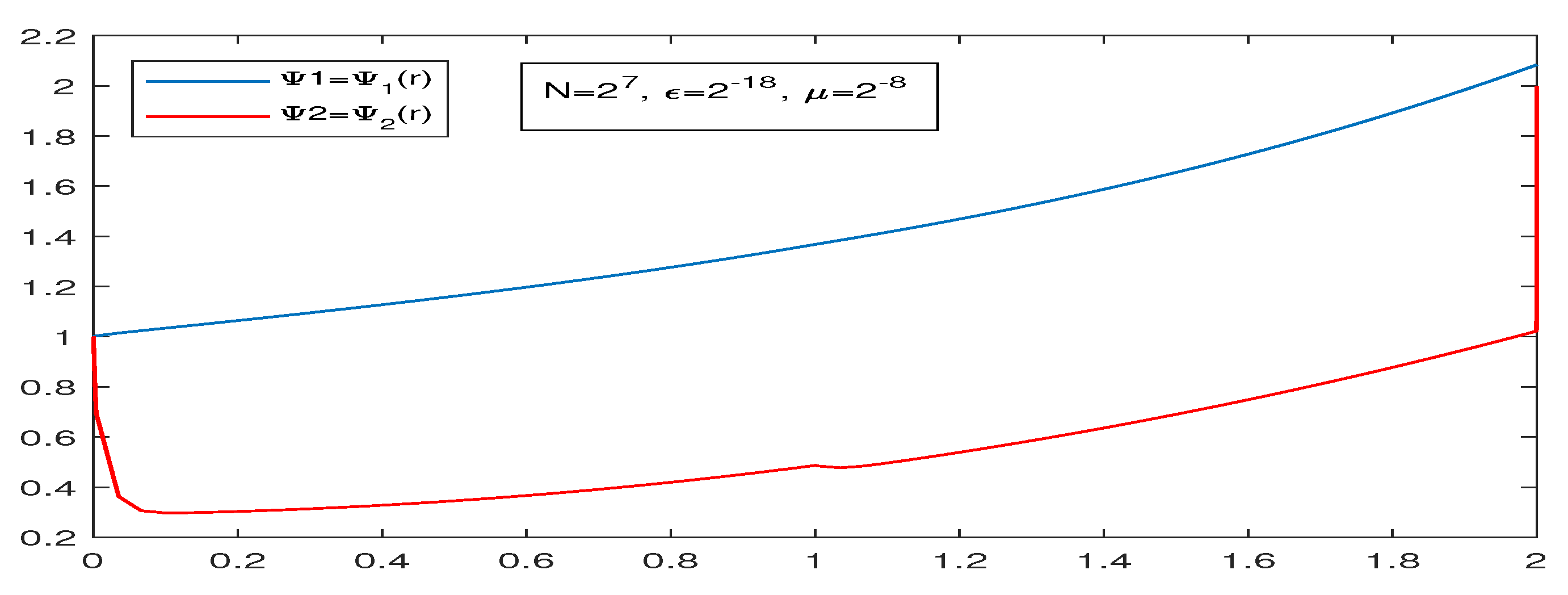
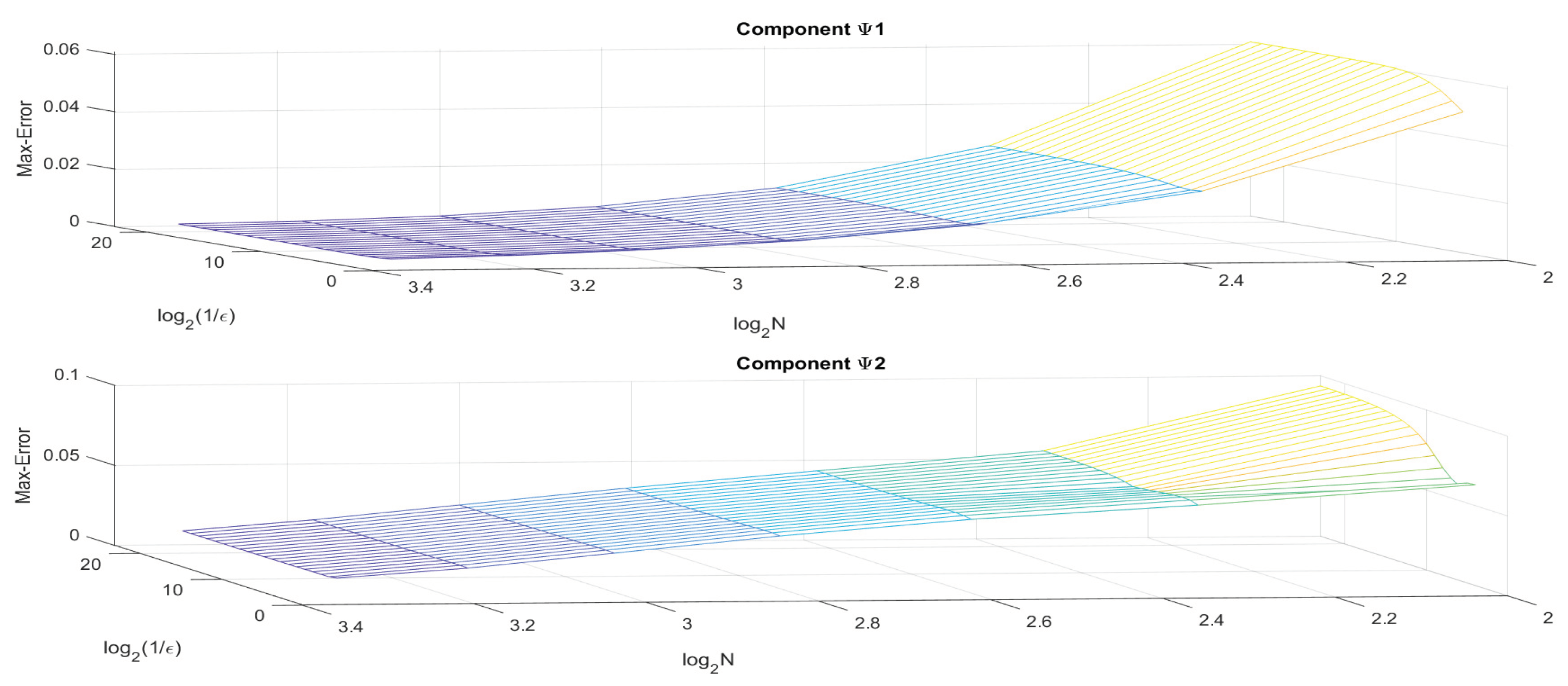
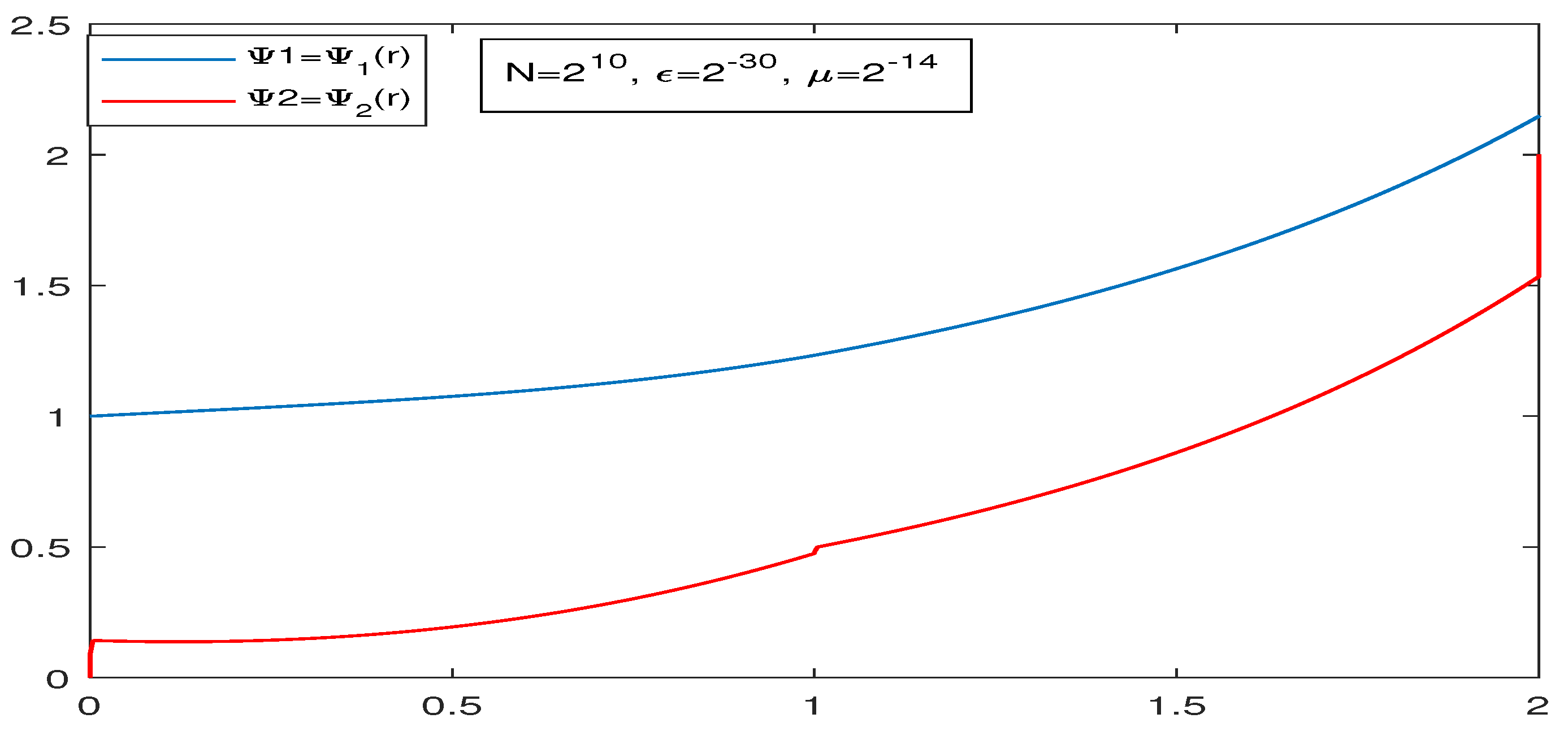
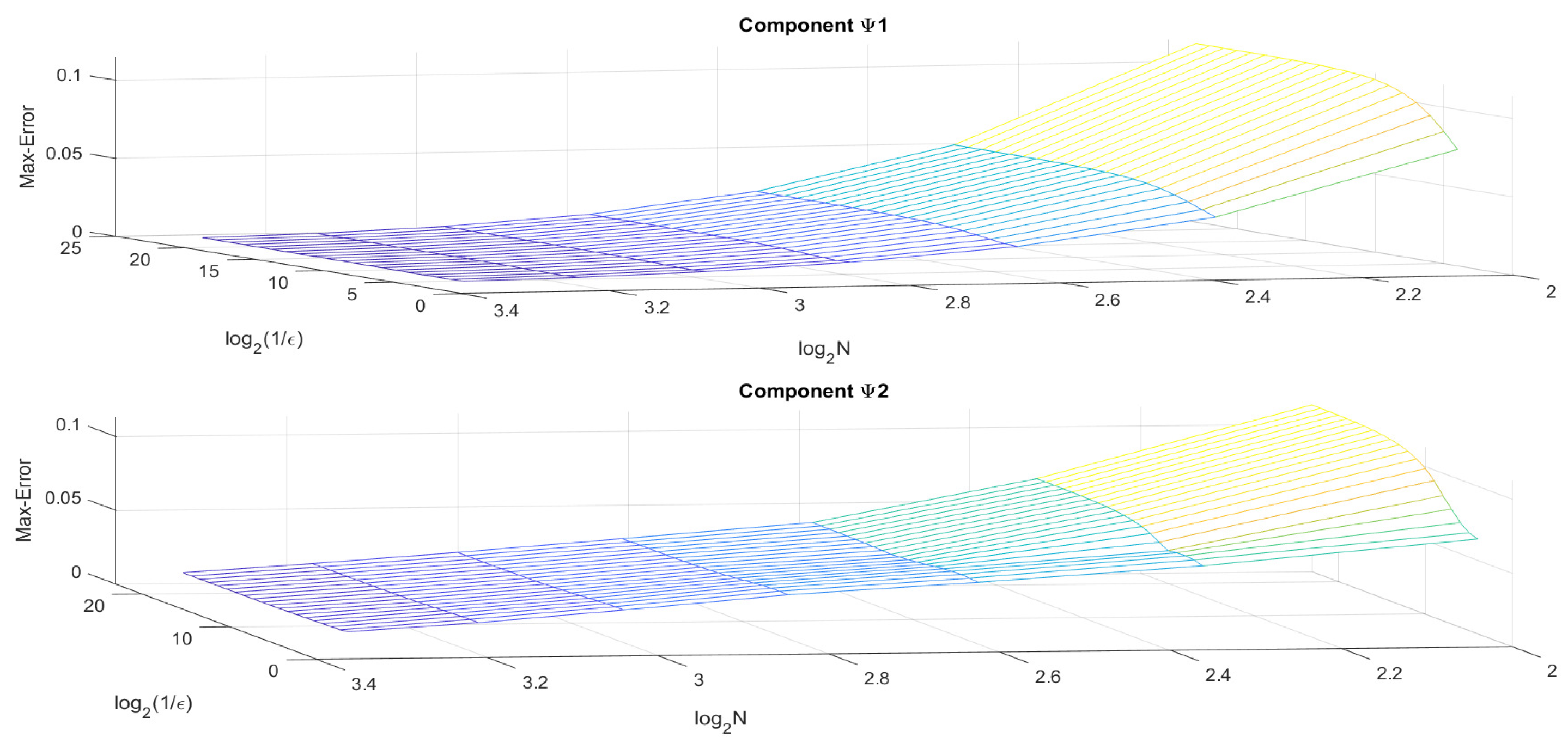
Table 1 presents the uniform error and order of convergence , for the solution components and when Figure 2 and Figure 3 represent the solution graph of and and the surface plot maximum pointwise error, respectively, of Example 1.
Table 1.
Numerical estimates for Example 1.
Figure 2.
Example 1—solution graph.
Figure 3.
Example 1—surface maximum error plot.
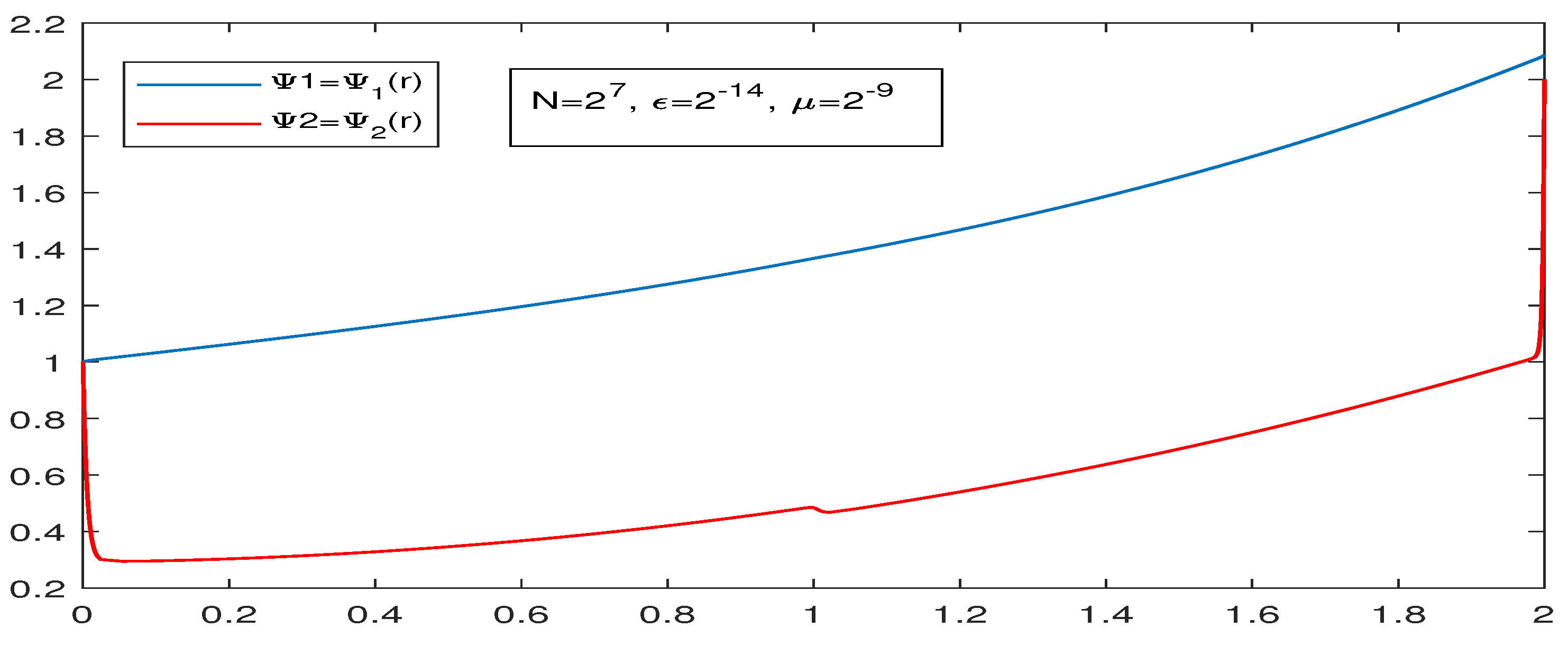
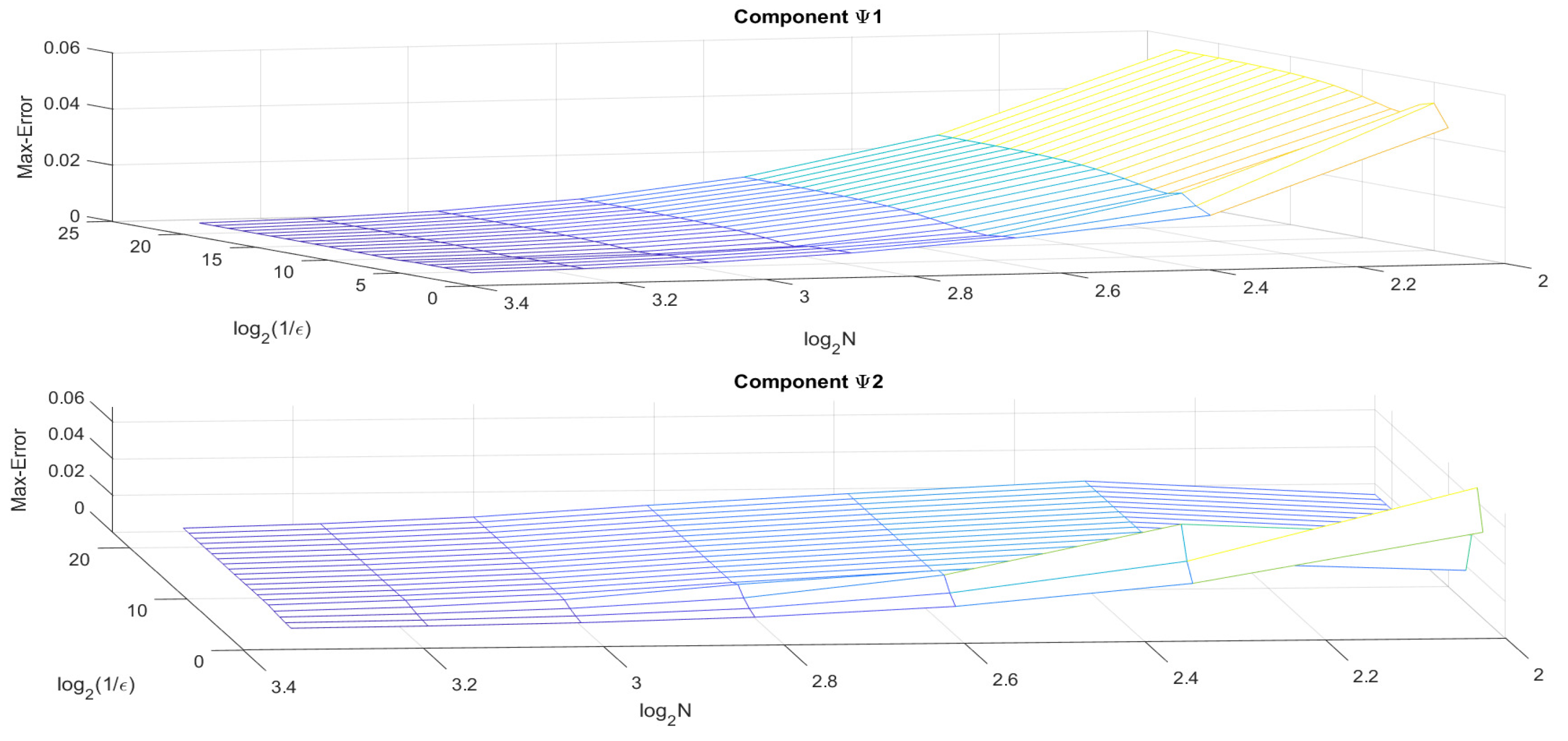
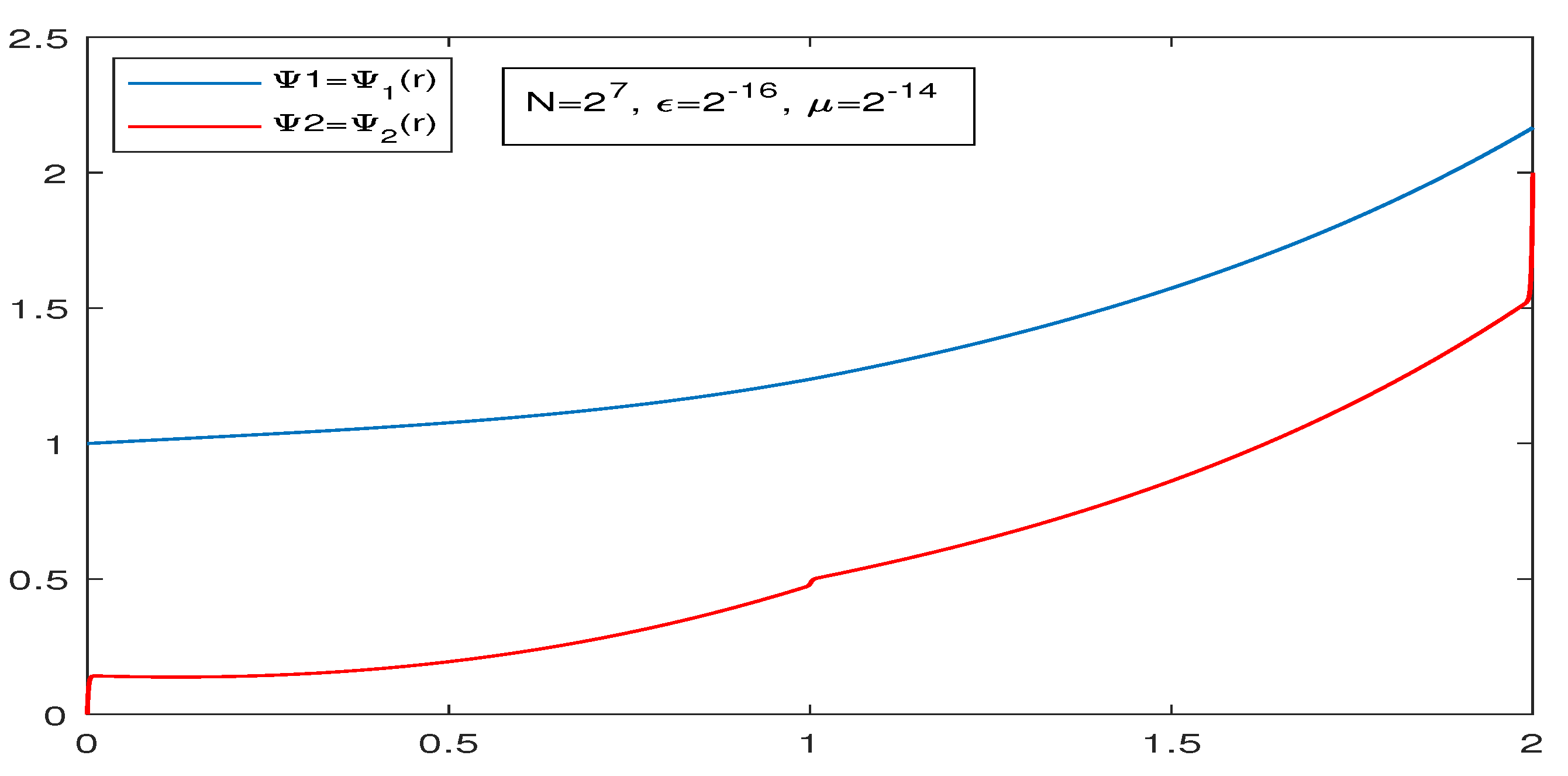
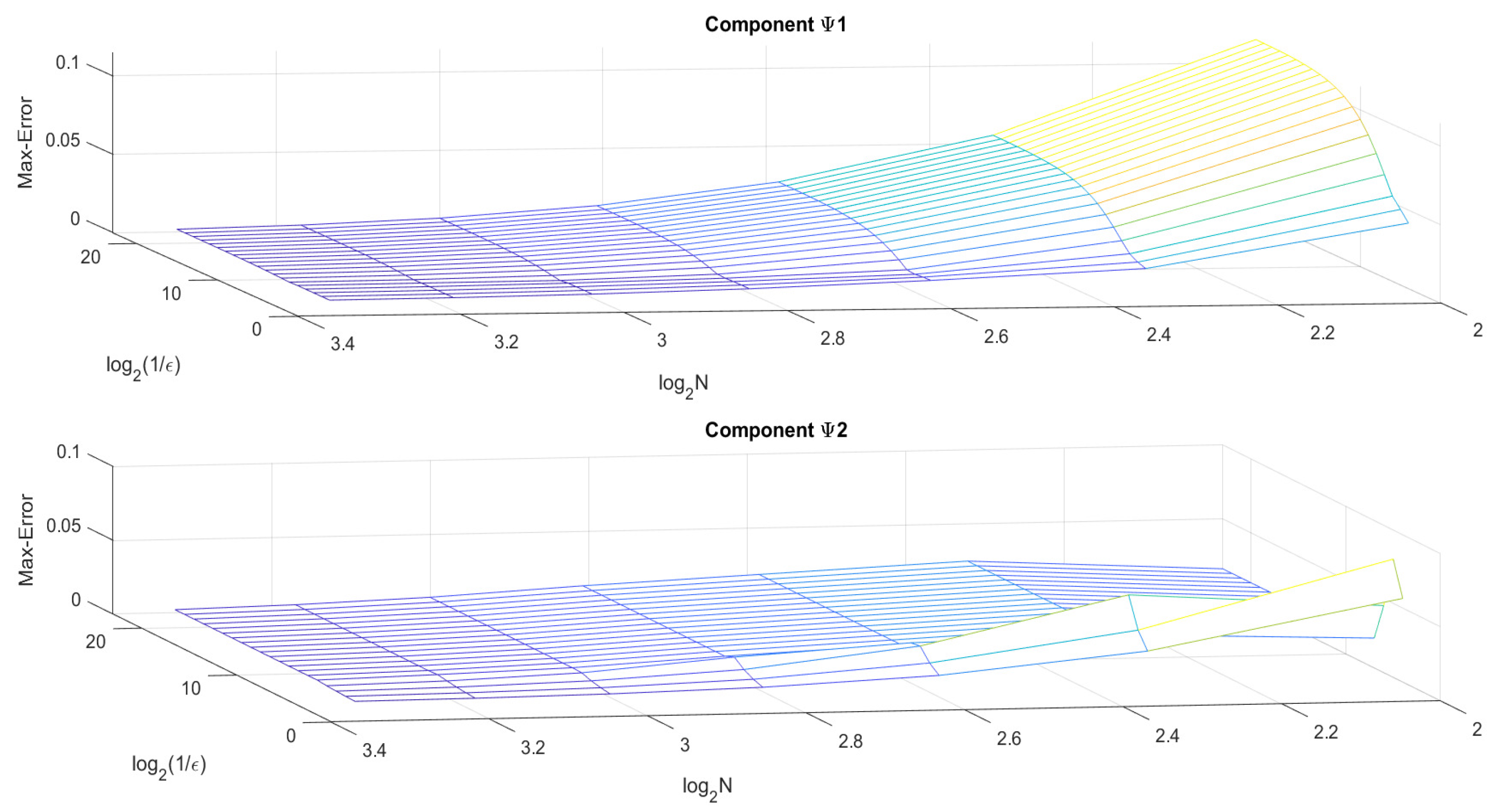
When , the values of and , correspond to the solution components and respectively, as shown in Table 2. Figure 4 and Figure 5 represent the solution graph of and and maximum pointwise error, respectively, of Example 1.
Table 2.
Numerical estimates for Example 1.
Figure 4.
Example 1—solution graph.
Figure 5.
Example 1—surface maximum error plot.
Example 2.
Table 3 presents the uniform error and order of convergence , for the solution components and respectively, when Figure 6 and Figure 7 represent the solution graph of and and the surface plot maximum pointwise error, respectively, of Example 2.
Table 3.
Numerical estimates for Example 2.
Figure 6.
Example 2—solution graph.
Figure 7.
Example 2—surface maximum error plot.
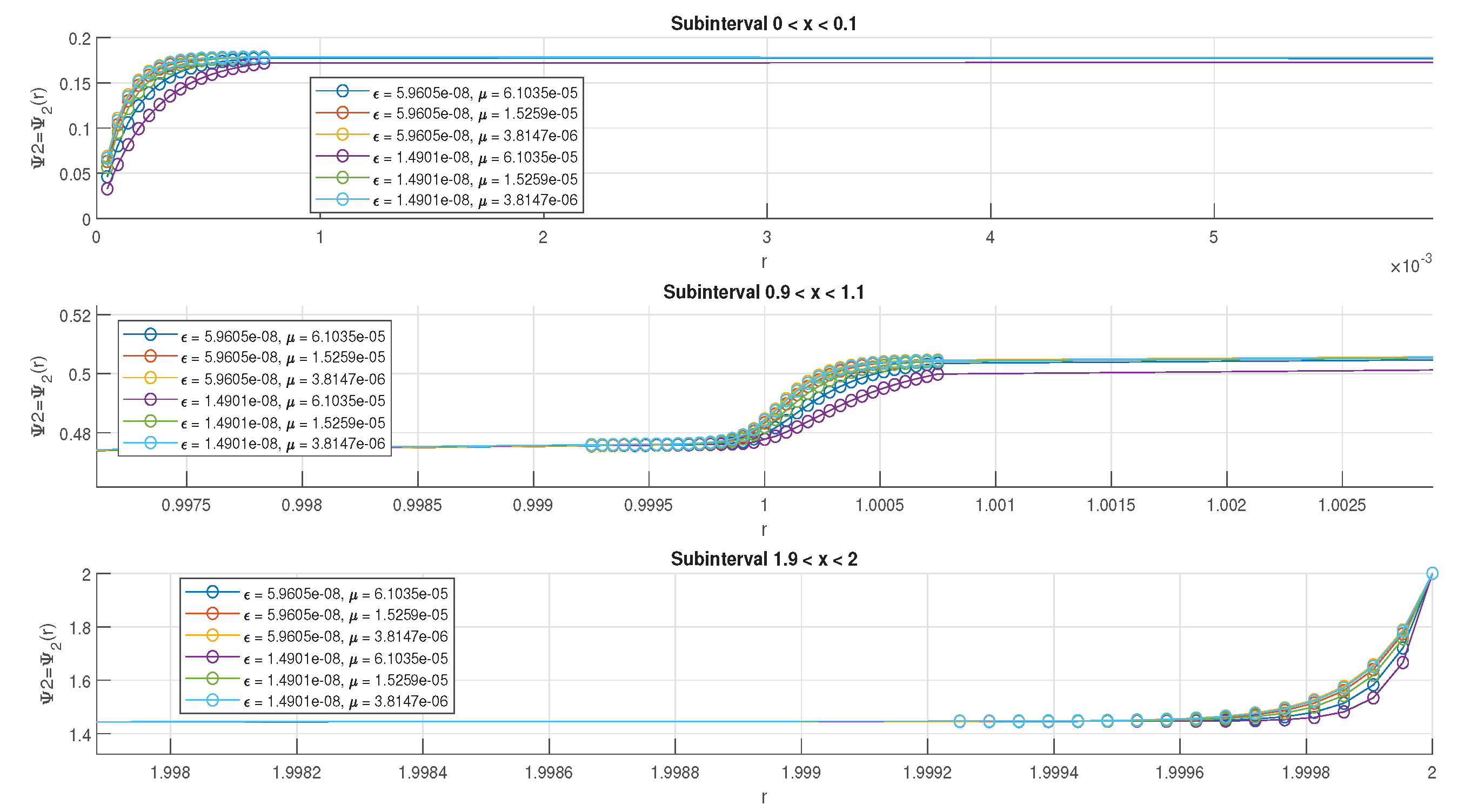
When , the values of and , correspond to the solution components and as shown in Table 4. Figure 8 and Figure 9 represent the solution graph of and and maximum pointwise error, respectively, of Example 2. Figure 10 represents the layer behavior of the solution component in the subintervals , and for fixed N and different values of parameter μ and
Table 4.
Numerical estimates for Example 2.
Figure 8.
Example 2—solution graph.
Figure 9.
Example 2—surface maximum error plot.
Figure 10.
Example 2— solution graph in the layer region.
8. Conclusions
In this article, we investigate the third-order two-parameter singularly perturbed delay differential equations. The problem is transformed into a weakly coupled system of one first-order equation with non-delay terms and another second-order singularly perturbed delay differential equation with a reaction-dominant, convection-dominant, or reaction–convection-dominant problem based on the relations of the parameters and . In [20], the boundary layer of width is expected at the right of and right of whereas the problem considered here admits the boundary layer of width at the left of and left of when As the problem shows that the solution component exhibit boundary and inner layers at and respectively, we split the domain into six subdomains. The mesh points with varying mesh sizes are defined on each subdomain. Piecewise linear interpolation is used in a fitted finite difference approach on this mesh. The point does not necessarily have to be a mesh point when . The interpolation must, therefore, be used to estimate Additionally, it has been demonstrated that the method suggested here, which uses piecewise linear interpolation, yields almost linear convergence of order For different parameter values the numerical solution of the problem is obtained by applying an upwind finite-difference technique to the piecewise uniform Shishkin mesh. This approach yields first-order convergence, which is consistent with the theoretical findings.
Author Contributions
Methodology, M.R., S.S. and S.V.; software, S.V.; formal analysis, M.R., S.S. and S.V.; investigation, M.R., S.S. and S.V.; writing—original draft preparation, M.R., S.S., S.V. and R.P.A.; writing—review and editing, S.V. and R.P.A. All authors have read and agreed to the published version of the manuscript.
Funding
This research received no external funding.
Institutional Review Board Statement
Not applicable.
Informed Consent Statement
Not applicable.
Data Availability Statement
Data are contained within the article.
Conflicts of Interest
The authors declare no conflicts of interest.
References
- Bernis, F.; Peletier, L.A. Two problems from draining flows involving third-order ordinary differential equations. SIAM J. Math. Anal. 1996, 27, 515–527. [Google Scholar] [CrossRef]
- Guo, J.S.; Tsai, J.C. The structure of solutions for a third-order differential equation in boundary layer theory. Jpn. J. Ind. Appl. Math. 2005, 22, 311–351. [Google Scholar] [CrossRef]
- Troy, W.C. Solutions of third-order differential equations relevant to draining and coating flows. SIAM J. Math. Anal. 1993, 24, 155–171. [Google Scholar] [CrossRef]
- Tuck, E.O.; Schwartz, L.W. A numerical and asymptotic study of some third-order ordinary differential equations relevant to draining and coating flows. SIAM Rev. 1990, 32, 453–469. [Google Scholar] [CrossRef]
- Varlamov, V.V. The third-order nonlinear evolution equation governing wave propagation in relaxing media. Math. Probl. Eng. 2001, 99, 25–48. [Google Scholar] [CrossRef]
- Lee, K.C.; Senu, N.; Ahmadian, A.; Ibrahim, S.N.I.; Baleanu, D. Numerical study of third-order ordinary differential equations using a new class of two derivative Runge-Kutta type methods. Alex. Eng. J. 2020, 59, 2449–2467. [Google Scholar] [CrossRef]
- Erbe, L. Existence of oscillatory solutions and asymptotic behavior for a class of third order linear differential equations. Pac. J. Math. 1976, 64, 369–385. [Google Scholar] [CrossRef]
- Jayaraman, G.; Padmanabhan, N.; Mehrotra, R. Entry flow into a circular tube of slowly varying cross-section. Fluid Dyn. Res. 1986, 1, 131–144. [Google Scholar] [CrossRef]
- McKean, H.P. Nagumo’s equation. Adv. Math. 1970, 4, 209–223. [Google Scholar] [CrossRef]
- Vreeke, S.A.; Sandquist, G.M. Phase space analysis of reactor kinetics. Nucl. Sci. Eng. 1970, 42, 295–305. [Google Scholar] [CrossRef]
- Gracia, J.L.; O’Riordan, E.; Pickett, M.L. A parameter robust second order numerical method for a singularly perturbed two-parameter problem. Appl. Numer. Math. 2006, 56, 962–980. [Google Scholar] [CrossRef]
- Toprakseven, S.; Zhu, P. Error analysis of a weak Galerkin finite element method for two-parameter singularly perturbed differential equations in the energy and balanced norms. Appl. Math. Comput. 2023, 441, 127683. [Google Scholar] [CrossRef]
- O’Malley, R.E. Two-parameter singular perturbation problems for second-order equations. J. Math. Mech. 1967, 16, 1143–1164. [Google Scholar]
- Roos, H.G.; Uzelac, Z. The SDFEM for a convection-diffusion problem with two small parameters. Comput. Methods Appl. Math. 2003, 3, 443–458. [Google Scholar] [CrossRef]
- Roy, N.; Jha, A. A parameter uniform method for two-parameter singularly perturbed boundary value problems with discontinuous data. MethodsX 2023, 10, 1–24. [Google Scholar] [CrossRef] [PubMed]
- Linß, T.; Roos, H.G. Analysis of a finite-difference scheme for a singularly perturbed problem with two small parameters. J. Math. Anal. Appl. 2004, 289, 355–366. [Google Scholar]
- Kadalbajoo, M.K.; Yadaw, A.S. B-Spline collocation method for a two-parameter singularly perturbed convection–diffusion boundary value problems. Appl. Math. Comput. 2008, 201, 504–513. [Google Scholar] [CrossRef]
- Kadalbajoo, M.K.; Yadaw, A.S. Parameter-uniform Ritz-Galerkin finite element method for two parameter singularly perturbed boundary value problems. Int. J. Pure Appl. Math. 2009, 55, 287–300. [Google Scholar]
- Kadalbajoo, M.K.; Yadaw, A.S. Finite difference, finite element and B-spline collocation methods applied to two parameter singularly perturbed boundary value problems1. JNAIAM. J. Numer. Anal. Ind. Appl. Math. 2011, 5, 163–180. [Google Scholar]
- Kalaiselvan, S.S.; Miller, J.J.H.; Valarmathi, S. A parameter uniform numerical method for a singularly perturbed two-parameter delay differential equation. Appl. Numer. Math. 2019, 145, 90–110. [Google Scholar] [CrossRef]
- Subburayan, V.; Mahendran, R. An ε-uniform numerical method for third order singularly perturbed delay differential equations with discontinuous convection coefficient and source term. Appl. Math. Comput. 2018, 331, 404–415. [Google Scholar] [CrossRef]
- Mahendran, R.; Subburayan, V. Fitted finite difference method for third order singularly perturbed delay differential equations of convection diffusion type. Int. J. Comput. Methods 2018, 15, 1840007. [Google Scholar] [CrossRef]
- Subburayan, V.; Mahendran, R. Asymptotic numerical method for third-order singularly perturbed convection diffusion delay differential equations. Comput. Appl. Math. 2020, 39, 1–21. [Google Scholar] [CrossRef]
- Subburayan, V.; Ramanujam, N. An initial value method for singularly perturbed third order delay differential equations. In Proceedings of the Conference “International Conference on Mathematical Sciences”, Chennai, India, 17–19 July 2014; Elsevier: Chennai, India, 2014; pp. 221–229, ISBN 978-93-5107-261-4. [Google Scholar]
- Toprakseven, S.; Natesan, S. An efficient weak Galerkin FEM for third-order singularly perturbed convection-diffusion differential equations on layer-adapted meshes. Appl. Numer. Math. 2024, 204, 130–146. [Google Scholar] [CrossRef]
- Zarin, H.; Roos, H.G.; Teofanov, L. A continuous interior penalty finite element method for a third-order singularly perturbed boundary value problem. Comput. Appl. Math. 2016, 37, 175–190. [Google Scholar] [CrossRef]
- Valarmathi, S.; Ramanujam, N. A computational method for solving third order singularly perturbed ordinary differential equations. Appl. Math. Comput. 2002, 129, 345–373. [Google Scholar]
- Valanarasu, T.; Ramanujam, N. An asymptotic numerical method for singularly perturbed third-order ordinary differential equations with a weak interior layer. Int. J. Comput. Math. 2007, 84, 333–346. [Google Scholar] [CrossRef]
- Subburayan, V.; Mahendran, R. Robust computational method for singularly perturbed first order ordinary differential difference equations with piecewise history function. Glob. J. Pure Appl. Math. 2016, 12, 16–20. [Google Scholar]
- Miller, J.J.H.; O’Riordan, E.; Shishkin, G.I. Fitted Numerical Methods for Singular Perturbation Problems: Error Estimates in the Maximum Norm for Linear Problems in One and Two Dimensions; World Scientific Publishing Co. Pte. Ltd.: Singapore, 1996. [Google Scholar]
Disclaimer/Publisher’s Note: The statements, opinions and data contained in all publications are solely those of the individual author(s) and contributor(s) and not of MDPI and/or the editor(s). MDPI and/or the editor(s) disclaim responsibility for any injury to people or property resulting from any ideas, methods, instructions or products referred to in the content. |
© 2025 by the authors. Licensee MDPI, Basel, Switzerland. This article is an open access article distributed under the terms and conditions of the Creative Commons Attribution (CC BY) license (https://creativecommons.org/licenses/by/4.0/).