


Abstract
Coding theory is the study of the properties of codes and their respective fitness for specific applications. Codes are used for data compression, cryptography, error detection, error correction, data transmission, and data storage. Codes are studied by various scientific disciplines, such as information theory, electrical engineering, mathematics, linguistics, and computer science, to design efficient and reliable data transmission methods. Many authors in the previous literature have discussed codes over finite fields, Gaussian integers, quaternion integers, etc. In this article, the author defines octonion integers, fundamental theorems related to octonion integers, encoding, and decoding of cyclic codes over the residue class of octonion integers with respect to the octonion Mannheim weight one. The comparison of primes, lengths, cardinality, dimension, and code rate with respect to Quaternion Integers and Octonion Integers will be discussed.
1. Introduction
Coding theory is a branch of mathematics that has many applications in information theory. Many types of codes and their parameters have been extensively studied. As one of the essential parameters of the code, the distance-related (Hamming, Lee, Mannheim, and so on) are also examined for many types of codes, and the expression for the minimum or maximum values of distances have been found [1,2].
A portion of these codes, which have gone through huge improvement in recent years, are Integer Codes. Integer Codes will be codes characterized over limited rings of whole numbers modulo , and enjoy a few upper hands over the customary block codes. One of these benefits is that integer codes are fit for rectifying a predetermined number of blunder designs which happen most often, while the ordinary codes plan to address all conceivable error designs, without completely succeeding. In real communication systems, integer codes have a low encoding and decoding complexity for a suitable application [3]. There are a few different codes like the Integer Codes, such as codes over Gaussian integers, Eisenstein–Jacobi integers [4,5,6], a class of mistake-revising codes given a summed-up Lee distance [7], codes over Hurwitz numbers [8], and so forth, which have been seriously contemplated as of late.
Quadrature amplitude modulation is used in various digital data radio communications and data communication applications. The most well-known errors which show up in numerous advanced information radio correspondences and information correspondence applications are those which change a point into its closest neighbor. The Hamming and the Lee distance cannot correct these errors in a QAM signal. In [5], Huber developed codes over Gaussian integers with another distance to advance the present circumstance, called the Mannheim distance. He demonstrated that these codes could address the Mannheim error of weight 1 and utilized this new distance to track down the properties of these codes (see [9] for additional subtleties). Furthermore, in [7], the authors presented another distance that summed up the Lee distance and built codes fit for adjusting errors of summed up Lee weight one or two.
Notwithstanding, Neto et al. [10] got cyclic codes over Euclidean quadratic field , where d = −1, −2, −3, −7, −11, by utilizing the Mannheim metric. They additionally offered decoding procedures to address errors of any Mannheim weight upsetting one and two coordinates of a cyclic code vector. Cyclic codes over finite rings regarding the Mannheim metric were acquired by involving Gaussian integers in [10]. Afterward, in [11], Özen and Güzeltepe utilized quaternion Mannheim metric perfect codes over finite quaternion rings were gotten and decoded these codes. Özen and Güzeltepe [12] treated the error of amendment of cyclic codes over quaternion numbers for quaternion Mannheim weight one. Shah and Rasool [13] got the decoding algorithms for the correction of errors of quaternion Mannheim weight two. Özen and Güzeltepe [14] got the cyclic codes over finite quaternion integer rings. Shah and Khan have constructed codes over semi-group-ring in [15]. Sajjad and Shah got quaternion integers based on higher-length cyclic codes and their decoding algorithm in [16].
In the present paper, the author defines octonion integers, fundamental theorems related to octonion integers, encoding, and decoding of cyclic codes over the residue class of octonion integers with respect to the octonion Mannheim weight one. The comparison of primes, lengths, cardinality, dimension, and code rate with respect to Quaternion Integers and Octonion Integers will be discussed.
This article is structured in the following Sections: In Section 2, octonion integers and some important algebraic notions are discussed. In Section 3, cyclic codes over octonion integer rings regarding the Octonion Mannheim metric are deliberated. Theorem 3 shows how to construct cyclic codes by using Proposition 1 and Theorem 2. In Proposition 3, the algebraic background is shown, which is important for constructing cyclic codes over the finite rings. Theorem 4, shows how to construct cyclic codes over the finite rings, and at the end decoding of the cyclic codes over octonion integers of octonion Mannheim weight one. A comparison of the proposed work with some existing works is described in Section 4. The conclusion and future directions are given in Section 5.
2. Octonion Integers
Definition 1.
An octonion algebraover the set of real numbersis non-associative until algebra by the following conditions:
- is free -module over
- 1 is a Multiplicative unit.
- where,isfor.
The set is a subset of octonion algebra . If is an octonion integer, then its octonion conjugate is . The norm of is . An octonion integer contains two parts: one is the real part and the other is the imaginary part. Let be an octonion integer, then its real part is , and the imaginary part is . The commutative and associative property of multiplication does not hold for octonion integers. The commutative and associative property of multiplication for octonion integers holds only if the imaginary part of two octonion integers is parallel to each other.
Define :
Contains octonion integers. Thus, the commutative and associative property of multiplication holds for
Theorems 1 and 2 show the relation between octonion integers and prime integers.
Theorem 1.
In [16], (Theorem 2.5.9), For every odd, rational prime, there exists a prime, such that. In particular,is not prime in
Theorem 2.
In [17,18], (Theorem 2.5.10), Letbe the element ofis a prime inif and only ifis prime in.
3. Cyclic Codes Based on Octonion Integers
The following Theorem is the modification of quaternion integers [15] to octonion integers.
Theorem 3.
Ifandare two integers and are relatively prime to each other, thenis isomorphic to.
Proof.
We can suppose without loss of generality and are positive integers. Then, the greatest common divisor of and is 1, thus, exists in . Since , , then, . Define by is surjective and preserves addition. □
Let and .
Since
Observes multiplication. Moreover, because , where represents an ideal generated by , and ker represents the kernel of the function . Let = , where and are two rational numbers. Since, which by
makes is an integer. Multiply by equation , which implies that which implies that from we have , thus is also an integer. We conclude , which means that . Hence, it is proven that is isomorphic to . □
3.1. Residue Class of Octonion Integers
Let be the residue class of over modulo , where is any positive integer and is an octonion prime integer. Conferring to the modulo function, :
Defined in Equation (1):
is isomorphic to , where and is an odd prime integer. can be substituted by in Equation (1), where are different octonion integers. In Equation (1), represents the rounding of the real part and coefficient of the vector part of the octonion integer to the closest integer. A linear code of length over of all -tuples modulo spaces of is . A cyclic code over octonion integers of length is a linear code of length by the following property:
In the present case, we have a 1-1, and onto the map:
To put it simply, we write: for . A non-empty set of is a cyclic code its image in Equation (2) is an ideal of
Definition 2.
Letbe a prime octonion integer. Then, the Octonion Mannheim’s (OM) Weight ofdefined as
An Octonion Mannheim (OM) Distance between and is defined as
Proposition 1.
Letbe a set of primes in, and letbe prime in. Ifis generated by, then, whererepresents the Euler phi function.
Proof.
If is a prime integer in , then the greatest common divisor of the real part and coefficient of the imaginary part of is 1. Then, is isomorphic to (by Theorem 2). If is generated by then constitutes a reduced residue system modulo in . Thus, a positive integer , such that , where . Hence, we concluded that . Since and we take or . If is , then we should have , but this is a contradiction of fact . Hence, if is generated by then , where represents the Euler phi function. □
The next Proposition is the generalization of Proposition 6.
Proposition 2.
Letbe the different primes inandare distinct prime integers in, whereIfis generated bythen.
Proof.
If is a prime in , then the greatest common divisor of the real part and coefficient of the imaginary part is 1. Then, is isomorphic to (by Theorem 2). If is generated by , then constitute a reduced residue system modulo in . Thus, a positive integer , such that , where . Hence, we concluded thatinline-formula>
. Since and we take or . If is , we should have , but this is a contradiction of fact . □
The next Theorem shows the cyclic code of length over the ring
Theorem 4.
Letbe a set of primes inandis a prime integer, where. Then, there exists alength cyclic code over the ring.
Proof.
has a generator since . Let be a generator. Then, . By Propositions 1 and 2. Hence, can be written
In this case, the Ideal of is . Hence, cyclic code is generated. □
If we chose generator polynomial as a monic polynomial, then any row of generator matrix consists without zero divisors.
Propositions 3 and 4 showed the isomorphic relation between two or more residue classes of octonion integers.
Proposition 3.
Letandbe the two prime integers inand,are two prime integers in. Then, two elements ofsuch thatand.
Proof.
Since the greatest common divisor of and is 1 in , the greatest common divisor of and is 1 in . Using the simple algebraic concepts and the function (1),
Furthermore, we get the following:
Since is a prime octonion integer, by previous Proposition is a cyclic group. Then, has a generator.
Thus has a generator too. Let is generated by . Then . In the same way, has a generator. Suppose that has a generator . Then, . □
Proposition 4.
Letbe the different primes inandare different prime integers in, Then,be the element of, such that,
Proof.
It is proved by mathematical induction using Proposition 3. □
Theorem 5.
Letandbe the two different prime integers inand,are two different odd prime integers in. Then, there existandlengths cyclic codes over
Proof.
By Proposition 3, we can find an element of , such that . Thus, factorizes the polynomial over as . If we chose generator polynomial, then forms the generator matrix which consists of all elements of any rows without zero divisors. Thus, we get length code , and it is generated by . In the same techniques, we can get length code. □
Remark 1.
The cyclic codegenerated byconsists of all linear combinations of the rows of the generator matrix. So, the cardinality of cyclic codes over octonion integers is. Additionally, the dimension of cyclic codes is, which consists of all linearly independent rows of generator matrix
3.2. Decoding Procedure of Cyclic Codes for Error of One Octonion Mannheim Weight
Let be the received vector, and be the syndrome with the parity check matrix and the transpose of the received vector as . If the syndrome is zero, then there will be no error in the received vector during transmission, but if the syndrome is not zero, then an error will occur in the received vector during transmission. Let syndrome . It means an error occurred in a received vector at the place, and the error value is computed by
The following examples show the whole finding of all Theorems, Propositions, and Corollaries of this article.
Example for the residue class of octonion integers and encoding of cyclic codes over Octonion Integers: Let . By using Theorem 3.5, polynomial can be factorized over as
If we take generator polynomial, then generator matrix ( is
The cyclic code generated by is consists of all linear combinations of the rows of generator matrix . Thus, the cardinality of cyclic codes over octonion integers is . Additionally, the dimension of cyclic codes is , which consists of all linearly independent rows of generator matrix
Example for Error corrections of octonion Mannheim weight one: Let . By using Theorem 3.5, polynomial can be factorized over as:
is the check polynomial. Parity check matrix is defined by check polynomial as
Let be a received vector during transmission.
Then, the syndrome (See Table 1), and the error occurred in the received vector at position , so that the error value (from Table 1). Thus, the octonion mannhein weight of error is 1. Hence, the corrected code word is

Table 1.
Cyclic group over the residue class of octonion integers generated by ω.
4. Comparison
In [15], the author presented cyclic codes over the residue class of quaternion integer with length where and dimension In the present article, the author presented cyclic codes over the residue class of octonion integer with different length , where with dimension The cardinality of code is the code rate for quaternion integers and octonion integers are given in the following Table 2 and Table 3, Figure 1 and Figure 2.
Table 2.
Primes, length, cardinality, and code rate (R) of code over quaternion integers.
Table 3.
Primes, length, cardinality, and code rate (R) of code over octonion integers.
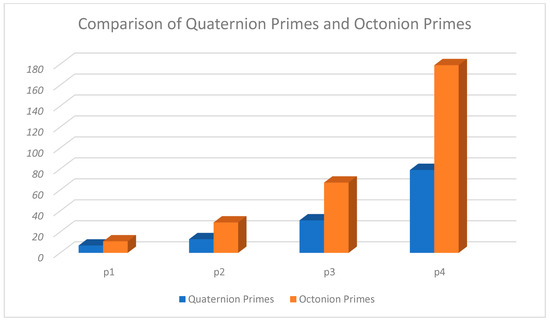
Figure 1.
Quaternion Primes vs. Octonion Primes.
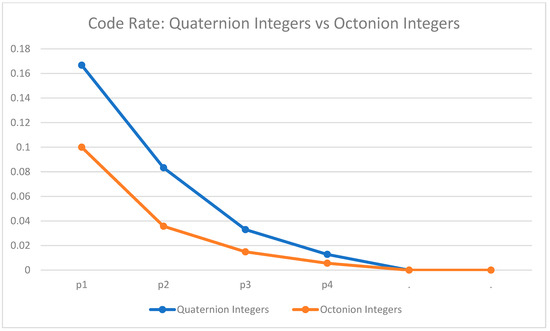
Figure 2.
Quaternion integers Code rate vs. Octonion integers Code rate.
Table 2 and Table 3, Figure 1 and Figure 2 for the same and of both quaternion and octonion integers; prime, length, and cardinality of code slightly increased but code rate of code slightly decreased. If length of the cyclic codes slightly increased with the dimension then the transmission will be slightly slow and the error correction capability of cyclic codes over the residue class of octonion integers will be better as compared to the cyclic codes over the residue class of quaternion integers.
5. Conclusions
In this paper, we had generalized the results of [15], octonion integers, fundamental theorems related to octonion integers, cyclic codes, and error correction of cyclic codes over the residue class of octonion integers with respect to the octonion Mannheim distance. If the prime, length and cardinality of cyclic codes slightly increased with dimension , then the transmission will be slightly slow, and the error correction capability of cyclic codes over the residue class of octonion integers will be better as compared to the cyclic codes over the residue class of quaternion integers.
Furthermore, the error correction and detection of cyclic codes over octonion integers may be extended to the error correction and detection of cyclic codes over sedenion integers.
Author Contributions
Conceptualization, M.S.; Supervisor, T.S.; Investigation, M.S., T.S., R.-J.S., Z.E.S.A. and O.S.D.; writing—review and editing, M.S., T.S., R.-J.S., Z.E.S.A. and O.S.D. All authors have read and agreed to the published version of the manuscript.
Funding
This work was supported by Universidad Pedagógica y Tecnológica de Colombia SGI 3334.
Institutional Review Board Statement
Not applicable.
Informed Consent Statement
Not applicable.
Data Availability Statement
Not applicable.
Acknowledgments
The authors thank the collaboration of all volunteers who participated in data collection.
Conflicts of Interest
The authors declare no conflict of interest.
References
- Sarabia, M.G.; Lara, J.N.; Márquez, C.R.; Rosales, E.S. Parameterized codes over cycles. An. Univ. Ovidius Constanta-Ser. Mat. 2013, 21, 241–256. [Google Scholar]
- Trajano, P.D.N.N.; Interlando, J.C.; Osvaldo, M.F.; Michele, E.; Reginaldo, P. Lattice constellations and codes from quadratic number fields. IEEE Trans. Inf. Theory 2001, 47, 1514–1527. [Google Scholar]
- Kostadinov, H.; Morita, H.; Iijima, N.; Vinck, A.H.; Manev, N. Soft decoding of integer codes and their application to coded modulation. IEICE Trans. Fundam. Electron. Commun. Comput. Sci. 2010, 93, 1363–1370. [Google Scholar] [CrossRef]
- Farhad, G.; Jurgen, F. Codes over Gaussian integer rings. In Proceedings of the 18th Telecommunications Forum TELFOR, Belgrade, Serbia, 23–25 November 2010. [Google Scholar]
- Klaus, H. Codes over Gaussian integers. IEEE Trans. Inf. Theory 1994, 40, 207–216. [Google Scholar]
- Josep, R. Groups of complex integers used as QAM signals. IEEE Trans. Inf. Theory 1995, 41, 1512–1517. [Google Scholar]
- Nishimura, S.; Hiramatsu, T. A generalization of the Lee distance and error correcting codes. Discret. Appl. Math. 2008, 156, 588–595. [Google Scholar] [CrossRef][Green Version]
- Murat, G. Codes over Hurwitz integers. Discret. Math. 2013, 313, 704–714. [Google Scholar]
- Morita, H. On soft decoding of coded QAM using integer codes. In Proceedings of the International Symposium on Information Theory and its Applications (ISITA), Parma, Italy, 10–13 October 2004. [Google Scholar]
- Murat, G.; Mehmet, O. Cyclic Codes over Some Finite Rings. arXiv 2009, arXiv:0905.4163. [Google Scholar]
- Murat, G.; Olof, H. Perfect Mannheim, Lipschitz and Hurwitz weight codes. Math. Commun. 2014, 19, 253–276. [Google Scholar]
- Mehmet, O.; Murat, G. Codes over quaternion integers. Eur. J. Pure Appl. Math. 2010, 3, 670–677. [Google Scholar]
- Tariq, S.; Sumera, S.R. On codes over quaternion integers. Appl. Algebra Eng. Commun. Comput. 2013, 24, 477–496. [Google Scholar]
- Mehmet, O.; Murat, G. Cyclic codes over some finite quaternion integer rings. J. Frankl. Inst. 2011, 348, 1312–1317. [Google Scholar]
- Tariq, S.; Atlas, K.; Antonio, A.D.A. Constructions of codes through the semi group ring B [X; 122Z0] and encoding. Comput. Math. Appl. 2011, 62, 1645–1654. [Google Scholar]
- Muhammad, S.; Tariq, S.; Mohammad, M.H.; Adel, R.A.; Iqtadar, H. Quaternion integers based higher length cyclic codes and their decoding algorithm. Comput. Mater. Contin. 2022, 73, 1177–1194. [Google Scholar]
- Muhammad, S.; Tariq, S.; Robinson, J.S. Designing Pair of Nonlinear Components of a Block Cipher Over Gaussian Integers. Comput. Mater. Contin. 2022, 74, 1–17. [Google Scholar]
- Giuliana, D.; Peter, S.; Alian, V. Elementary Number Theory, Group Theory, and Ramanujan Graphs; Cambridge University Press: Cambridge, UK, 2003. [Google Scholar]
Publisher’s Note: MDPI stays neutral with regard to jurisdictional claims in published maps and institutional affiliations. |
© 2022 by the authors. Licensee MDPI, Basel, Switzerland. This article is an open access article distributed under the terms and conditions of the Creative Commons Attribution (CC BY) license (https://creativecommons.org/licenses/by/4.0/).