
Graph Neural Networks in Medical Imaging: Methods, Applications and Future Directions


Abstract
1. Introduction
- Conducting a comparative review of GNN architectures employed in medical imaging, including recurrent, convolutional, attention-based, autoencoding, and spatiotemporal models, and distilling design patterns and performance trends across studies.
- Presenting a unified taxonomy of graph formulations and learning tasks tailored to medical imaging, spanning node-, edge-, subgraph-, and graph-level representations and linking these to core clinical objectives.
- Providing an imaging-centered synthesis of GNN applications organized by clinical task, including segmentation, classification, and multimodal fusion, thereby offering a consolidated view of its robustness in the medical domain.
- Summarizing cross-cutting challenges and outlining future directions grounded in the evidence reviewed in this study.
Review Methodology
2. Preliminaries
2.1. Overview of Graph Neural Networks
2.2. Graph Variants
2.2.1. Directed and Undirected Graphs
2.2.2. Static and Dynamic Graphs
2.2.3. Homogeneous and Heterogeneous Graphs
2.2.4. Attributed and Non-Attributed Graphs
2.3. Graph Learning Tasks and Levels of Representation
2.3.1. Node-Level Learning
2.3.2. Edge-Level Learning
2.3.3. Graph-Level Learning
2.3.4. Subgraph-Level Learning
3. GNN Architectures and Learning Paradigms
3.1. Architectural Categories of GNNs
3.1.1. Recurrent GNNs
3.1.2. Convolutional GNNs
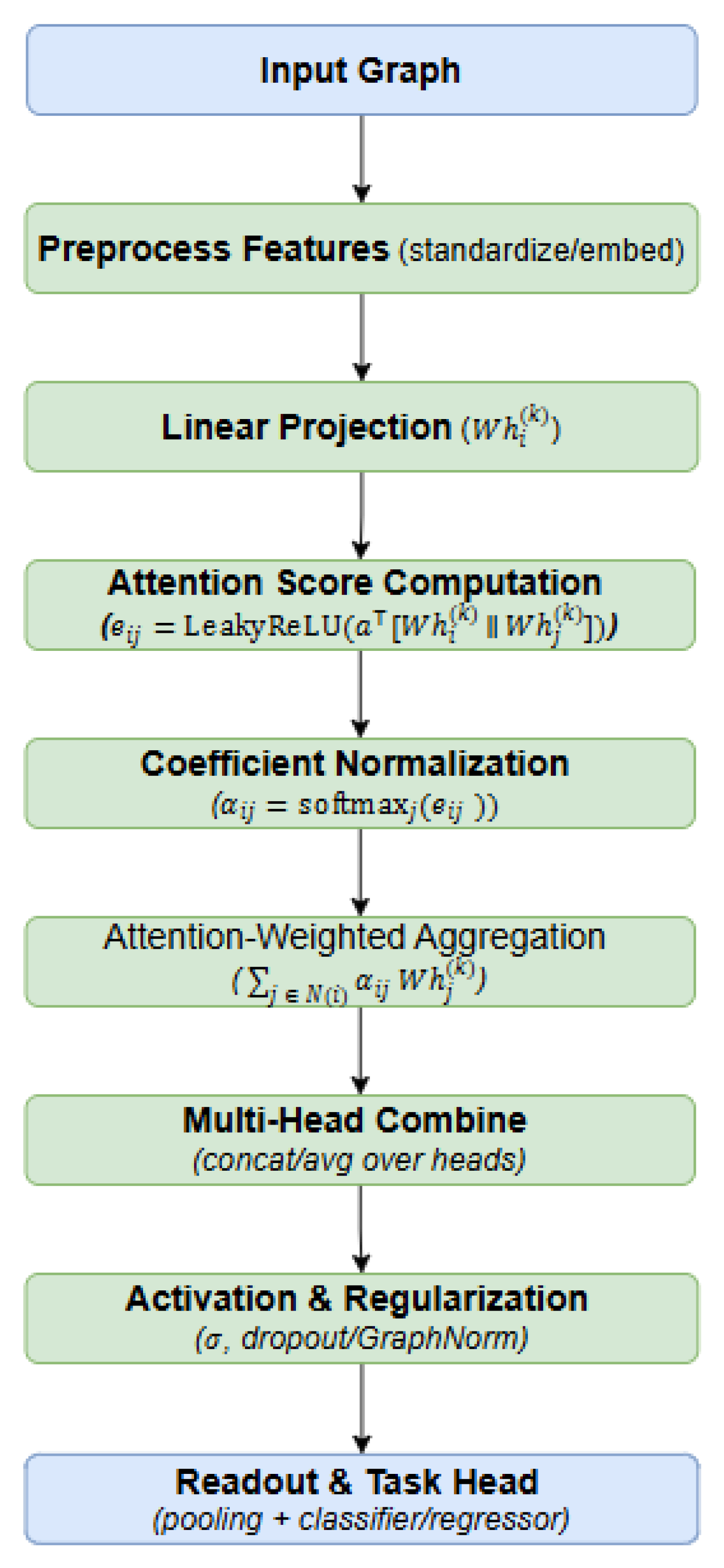
3.1.3. Graph Attention Networks
3.1.4. GraphSAGE
3.1.5. Graph Autoencoders
3.1.6. Spatial–Temporal GNNs
3.2. Learning Paradigms for GNNs
- Supervised Graph Learning: This paradigm relies on fully labeled data, where ground-truth labels are provided for nodes, edges, or entire graphs [46]. It is commonly used in segmentation, tissue classification, and disease diagnosis tasks. Although accurate, its dependency on expert annotations limits scalability in medical contexts.
- Semi-supervised Graph Learning: Here, only a subset of nodes is labeled, and information propagates through graph connectivity to infer labels for unlabeled nodes [47]. This paradigm has been effective in medical domains such as lesion segmentation and brain network analysis, where graph topology aids label propagation across similar regions [48,49].
- Unsupervised Graph Learning: Unsupervised methods focus on learning embeddings or latent representations without explicit labels, often optimizing reconstruction or contrastive objectives [50]. In medical imaging, they are useful for clustering patients, identifying abnormal subregions, and pretraining models for downstream tasks.
- Self-supervised Graph Learning: Self-supervision exploits auxiliary “pretext” tasks to learn transferable representations from unlabeled data. Examples include predicting masked node features, reconstructing subgraphs, or contrasting augmented graph views. Self-supervised strategies are increasingly employed to pretrain GNNs on large medical imaging datasets before fine-tuning on smaller labeled subsets [51].
- Few-shot and Meta Graph Learning: These paradigms address extreme label scarcity by learning to generalize from very few samples or across related tasks [52]. Meta-learning-based GNNs can adapt quickly to new cohorts or modalities, which is advantageous for rare disease imaging or small multi-center datasets.
4. Applications of GNNs in Medical Imaging
4.1. Segmentation Tasks
4.2. Classification Tasks
4.3. Image Retrieval and Reconstruction
4.4. Registration and Alignment
4.5. Multimodal Fusion
5. Challenges, Limitations, and Future Research Directions
5.1. Challenges and Limitations
5.1.1. Data Scarcity and Imbalance
5.1.2. Scalability and Computational Overhead
5.1.3. Interpretability and Clinical Trust
5.1.4. Generalization Across Institutions and Populations
5.1.5. Regulatory and Deployment Barriers
5.2. Future Research Directions
5.2.1. Graph–Transformer Hybrids
5.2.2. Self-Supervised and Foundation Models
5.2.3. Federated and Privacy-Preserving GNNs
5.2.4. Multimodal and Longitudinal Integration
5.2.5. Interpretability and Clinical Trust
6. Conclusions
Author Contributions
Funding
Institutional Review Board Statement
Informed Consent Statement
Data Availability Statement
Conflicts of Interest
Abbreviations
| AD | Alzheimer’s Disease |
| ADGCN | Attention-Driven Graph Convolutional Network |
| AUC | Area Under the Curve |
| BraTS | Brain Tumor Segmentation Challenge |
| CNN | Convolutional Neural Network |
| CT | Computed Tomography |
| CTR | Cardiothoracic Ratio |
| DL | Deep Learning |
| DMGN | Deep Multimodal Graph Network |
| ECG | Electrocardiogram |
| fMRI | Functional Magnetic Resonance Imaging |
| GCN | Graph Convolutional Network |
| GCNN | Graph Convolutional Neural Network |
| GAT | Graph Attention Network |
| GAE | Graph Autoencoder |
| GNN | Graph Neural Network |
| GNNExplainer | Graph Neural Network Explainer |
| GRFE | Graph Regional Feature Enhancer |
| GTU-Net | Graph Transformer U-Net |
| HGL | Heterogeneous Graph Learning |
| MAP | Mean Average Precision |
| MCI | Mild Cognitive Impairment |
| MRI | Magnetic Resonance Imaging |
| NSCLC | Non-Small Cell Lung Cancer |
| PET | Positron Emission Tomography |
| PSNR | Peak Signal-to-Noise Ratio |
| RBA-Net | Region–Boundary Aggregation Network |
| ROI | Region of Interest |
| SSIM | Structural Similarity Index Measure |
| VGAE | Variational Graph Autoencoder |
References
- Anil, S.; Vikas, B.; Thomas, N.G.; Sweety, V.K. Biomedical imaging: Scope for future studies and applications. In Multimodal Biomedical Imaging Techniques; Springer: Berlin/Heidelberg, Germany, 2025; pp. 319–338. [Google Scholar]
- Nazir, A.; Hussain, A.; Singh, M.; Assad, A. Deep learning in medicine: Advancing healthcare with intelligent solutions and the future of holography imaging in early diagnosis. Multimed. Tools Appl. 2025, 84, 17677–17740. [Google Scholar] [CrossRef]
- Fan, X.; Liu, X.; Xia, Q.; Chen, G.; Cheng, J.; Shi, Z.; Fang, Y.; Khadaroo, P.A.; Qian, J.; Lin, H. Advanced Image-Guidance and Surgical-Navigation Techniques for Real-Time Visualized Surgery. Adv. Sci. 2025, 12, e09294. [Google Scholar] [CrossRef]
- Li, M.; Jiang, Y.; Zhang, Y.; Zhu, H. Medical image analysis using deep learning algorithms. Front. Public Health 2023, 11, 1273253. [Google Scholar] [CrossRef] [PubMed]
- Zhang, S.; Metaxas, D. On the challenges and perspectives of foundation models for medical image analysis. Med. Image Anal. 2024, 91, 102996. [Google Scholar] [CrossRef]
- Ijebu, F.F.; Liu, Y.; Sun, C.; Jere, N.; Mienye, I.D.; Usip, P.U. Ensemble Answer Selection Leveraging Cross-lingual Dealignment for Improved Question Answering with Mixture-of-Experts Setup. IEEE Open J. Comput. Soc. 2025, 6, 1599–1610. [Google Scholar] [CrossRef]
- Jiao, L.; Chen, J.; Liu, F.; Yang, S.; You, C.; Liu, X.; Li, L.; Hou, B. Graph representation learning meets computer vision: A survey. IEEE Trans. Artif. Intell. 2022, 4, 2–22. [Google Scholar] [CrossRef]
- Li, D.; Lu, C.; Chen, Z.; Guan, J.; Zhao, J.; Du, J. Graph neural networks in point clouds: A survey. Remote Sens. 2024, 16, 2518. [Google Scholar] [CrossRef]
- Georgousis, S.; Kenning, M.P.; Xie, X. Graph deep learning: State of the art and challenges. IEEE Access 2021, 9, 22106–22140. [Google Scholar] [CrossRef]
- Wu, Z.; Pan, S.; Chen, F.; Long, G.; Zhang, C.; Yu, P.S. A comprehensive survey on graph neural networks. IEEE Trans. Neural Netw. Learn. Syst. 2020, 32, 4–24. [Google Scholar] [CrossRef]
- Zhou, J.; Cui, G.; Hu, S.; Zhang, Z.; Yang, C.; Liu, Z.; Wang, L.; Li, C.; Sun, M. Graph neural networks: A review of methods and applications. AI Open 2020, 1, 57–81. [Google Scholar] [CrossRef]
- Li, M.M.; Huang, K.; Zitnik, M. Graph representation learning in biomedicine and healthcare. Nat. Biomed. Eng. 2022, 6, 1353–1369. [Google Scholar] [CrossRef]
- Ahmedt-Aristizabal, D.; Armin, M.A.; Denman, S.; Fookes, C.; Petersson, L. Graph-based deep learning for medical diagnosis and analysis: Past, present and future. Sensors 2021, 21, 4758. [Google Scholar] [CrossRef]
- Bessadok, A.; Mahjoub, M.A.; Rekik, I. Graph neural networks in network neuroscience. IEEE Trans. Pattern Anal. Mach. Intell. 2022, 45, 5833–5848. [Google Scholar] [CrossRef] [PubMed]
- Li, R.; Yuan, X.; Radfar, M.; Marendy, P.; Ni, W.; O’Brien, T.J.; Casillas-Espinosa, P.M. Graph signal processing, graph neural network and graph learning on biological data: A systematic review. IEEE Rev. Biomed. Eng. 2021, 16, 109–135. [Google Scholar] [CrossRef] [PubMed]
- Paul, S.G.; Saha, A.; Hasan, M.Z.; Noori, S.R.H.; Moustafa, A. A systematic review of graph neural network in healthcare-based applications: Recent advances, trends, and future directions. IEEE Access 2024, 12, 15145–15170. [Google Scholar] [CrossRef]
- Zhang, L.; Zhao, Y.; Che, T.; Li, S.; Wang, X. Graph neural networks for image-guided disease diagnosis: A review. Iradiology 2023, 1, 151–166. [Google Scholar] [CrossRef]
- Khoshraftar, S.; An, A. A survey on graph representation learning methods. ACM Trans. Intell. Syst. Technol. 2024, 15, 1–55. [Google Scholar] [CrossRef]
- Khatun, Z.; Jónsson, H., Jr.; Tsirilaki, M.; Maffulli, N.; Oliva, F.; Daval, P.; Tortorella, F.; Gargiulo, P. Beyond pixel: Superpixel-based MRI segmentation through traditional machine learning and graph convolutional network. Comput. Methods Programs Biomed. 2024, 256, 108398. [Google Scholar] [CrossRef]
- Vrahatis, A.G.; Lazaros, K.; Kotsiantis, S. Graph attention networks: A comprehensive review of methods and applications. Future Internet 2024, 16, 318. [Google Scholar] [CrossRef]
- Wang, Z.; Zhang, Z.; Ma, T.; Chawla, N.V.; Zhang, C.; Ye, Y. Beyond Message Passing: Neural Graph Pattern Machine. arXiv 2025, arXiv:2501.18739. [Google Scholar]
- Mohammadi, H.; Karwowski, W. Graph neural networks in brain connectivity studies: Methods, challenges, and future directions. Brain Sci. 2024, 15, 17. [Google Scholar] [CrossRef]
- Zhang, S.; Yang, J.; Zhang, Y.; Zhong, J.; Hu, W.; Li, C.; Jiang, J. The combination of a graph neural network technique and brain imaging to diagnose neurological disorders: A review and outlook. Brain Sci. 2023, 13, 1462. [Google Scholar] [CrossRef]
- Beaini, D.; Passaro, S.; Létourneau, V.; Hamilton, W.; Corso, G.; Liò, P. Directional graph networks. In Proceedings of the International Conference on Machine Learning, Virtual, 18–24 July 2021; pp. 748–758. [Google Scholar]
- Tanglay, O.; Dadario, N.B.; Chong, E.H.; Tang, S.J.; Young, I.M.; Sughrue, M.E. Graph theory measures and their application to neurosurgical eloquence. Cancers 2023, 15, 556. [Google Scholar] [CrossRef] [PubMed]
- Barros, C.D.; Mendonça, M.R.; Vieira, A.B.; Ziviani, A. A survey on embedding dynamic graphs. ACM Comput. Surv. (CSUR) 2021, 55, 1–37. [Google Scholar] [CrossRef]
- Bing, R.; Yuan, G.; Zhu, M.; Meng, F.; Ma, H.; Qiao, S. Heterogeneous graph neural networks analysis: A survey of techniques, evaluations and applications. Artif. Intell. Rev. 2023, 56, 8003–8042. [Google Scholar] [CrossRef]
- Cui, H.; Lu, Z.; Li, P.; Yang, C. On positional and structural node features for graph neural networks on non-attributed graphs. In Proceedings of the 31st ACM International Conference on Information & Knowledge Management, Atlanta, GA, USA, 17–21 October 2022; pp. 3898–3902. [Google Scholar]
- Ji, S.; Pan, S.; Cambria, E.; Marttinen, P.; Yu, P.S. A survey on knowledge graphs: Representation, acquisition, and applications. IEEE Trans. Neural Netw. Learn. Syst. 2021, 33, 494–514. [Google Scholar] [CrossRef]
- Zhang, L.; Wang, S.; Liu, J.; Chang, X.; Lin, Q.; Wu, Y.; Zheng, Q. MuL-GRN: Multi-level graph relation network for few-shot node classification. IEEE Trans. Knowl. Data Eng. 2022, 35, 6085–6098. [Google Scholar] [CrossRef]
- Khemani, B.; Patil, S.; Kotecha, K.; Tanwar, S. A review of graph neural networks: Concepts, architectures, techniques, challenges, datasets, applications, and future directions. J. Big Data 2024, 11, 18. [Google Scholar] [CrossRef]
- Han, Z.; Hu, C.; Li, T.; Qi, Q.; Tang, P.; Guo, S. Subgraph-level federated graph neural network for privacy-preserving recommendation with meta-learning. Neural Netw. 2024, 179, 106574. [Google Scholar] [CrossRef]
- Pflueger, M.; Cucala, D.T.; Kostylev, E.V. Recurrent graph neural networks and their connections to bisimulation and logic. In Proceedings of the AAAI Conference on Artificial Intelligence, Vancouver, BC, Canada, 26–27 February 2024; Volume 38, pp. 14608–14616. [Google Scholar]
- Kipf, T. Semi-supervised classification with graph convolutional networks. arXiv 2016, arXiv:1609.02907. [Google Scholar]
- Zhou, T. M2GCNet: Multi-modal graph convolution network for precise brain tumor segmentation across multiple MRI sequences. IEEE Trans. Image Process. 2024, 33, 4896–4910. [Google Scholar] [CrossRef]
- Arshad Choudhry, I.; Iqbal, S.; Alhussein, M.; Aurangzeb, K.; Qureshi, A.N.; Hussain, A. A novel interpretable graph convolutional neural network for multimodal brain tumor segmentation. Cogn. Comput. 2025, 17, 24. [Google Scholar] [CrossRef]
- Kim, S.Y. Personalized explanations for early diagnosis of alzheimer’s disease using explainable graph neural networks with population graphs. Bioengineering 2023, 10, 701. [Google Scholar] [CrossRef] [PubMed]
- Hamilton, W.; Ying, Z.; Leskovec, J. Inductive representation learning on large graphs. In Proceedings of the 31st Conference on Neural Information Processing Systems (NIPS 2017), Long Beach, CA, USA, 4–9 December 2017; Volume 30. Available online: https://proceedings.neurips.cc/paper_files/paper/2017/file/5dd9db5e033da9c6fb5ba83c7a7ebea9-Paper.pdf (accessed on 12 October 2025).
- Kumar, S.; Hazarika, S.; Gupta, C.N. SAGEFusionNet: An Auxiliary Supervised Graph Neural Network for Brain Age Prediction as a Neurodegenerative Biomarker. Brain Sci. 2025, 15, 752. [Google Scholar] [CrossRef]
- Jemima, D.D.; Selvarani, A.G.; Lovenia, J.D.L. A Novel Approach for Recognition of Autism Spectrum Disorder based on GraphSAGE. In Proceedings of the 2024 5th International Conference on Data Intelligence and Cognitive Informatics (ICDICI), Tirunelveli, India, 18–20 November 2024; pp. 1497–1502. [Google Scholar]
- Ijebu, F.F.; Liu, Y.; Sun, C.; Jere, N.; Mienye, I.D.; Inyang, U.G. Cross-Encoder-Based Semantic Evaluation of Extractive and Generative Question Answering in Low-Resourced African Languages. Technologies 2025, 13, 119. [Google Scholar] [CrossRef]
- Bui, K.H.N.; Cho, J.; Yi, H. Spatial-temporal graph neural network for traffic forecasting: An overview and open research issues. Appl. Intell. 2022, 52, 2763–2774. [Google Scholar] [CrossRef]
- Kim, B.H.; Ye, J.C.; Kim, J.J. Learning dynamic graph representation of brain connectome with spatio-temporal attention. Adv. Neural Inf. Process. Syst. 2021, 34, 4314–4327. [Google Scholar]
- Ahn, S.J.; Kim, M. Variational graph normalized autoencoders. In Proceedings of the 30th ACM International Conference on Information & Knowledge Management, Gold Coast, Queensland, Australia, 1–5 November 2021; pp. 2827–2831. [Google Scholar]
- Zhang, R.; Zhang, Y.; Lu, C.; Li, X. Unsupervised graph embedding via adaptive graph learning. IEEE Trans. Pattern Anal. Mach. Intell. 2022, 45, 5329–5336. [Google Scholar] [CrossRef]
- Song, Z.; Yang, X.; Xu, Z.; King, I. Graph-based semi-supervised learning: A comprehensive review. IEEE Trans. Neural Netw. Learn. Syst. 2022, 34, 8174–8194. [Google Scholar] [CrossRef]
- Li, Z.; Liu, Y.; Zhang, Z.; Pan, S.; Gao, J.; Bu, J. Cyclic label propagation for graph semi-supervised learning. World Wide Web 2022, 25, 703–721. [Google Scholar] [CrossRef]
- Shin, H.K.; Uhmn, K.H.; Choi, K.; Xu, Z.; Jung, S.W.; Ko, S.J. Graph segmentation-based pseudo-labeling for semi-supervised pathology image classification. IEEE Access 2022, 10, 93960–93970. [Google Scholar] [CrossRef]
- Zhang, Y.; Li, Y.; Kong, Y.; Wu, J.; Yang, J.; Shu, H.; Coatrieux, G. GSCFN: A graph self-construction and fusion network for semi-supervised brain tissue segmentation in MRI. Neurocomputing 2021, 455, 23–37. [Google Scholar] [CrossRef]
- Rani, V.; Kumar, M.; Gupta, A.; Sachdeva, M.; Mittal, A.; Kumar, K. Self-supervised learning for medical image analysis: A comprehensive review. Evol. Syst. 2024, 15, 1607–1633. [Google Scholar] [CrossRef]
- Wen, G.; Cao, P.; Liu, L.; Yang, J.; Zhang, X.; Wang, F.; Zaiane, O.R. Graph self-supervised learning with application to brain networks analysis. IEEE J. Biomed. Health Inform. 2023, 27, 4154–4165. [Google Scholar] [CrossRef]
- Yu, X.; Fang, Y.; Liu, Z.; Wu, Y.; Wen, Z.; Bo, J.; Zhang, X.; Hoi, S.C. A Survey of Few-Shot Learning on Graphs: From Meta-Learning to Pre-Training and Prompt Learning. arXiv 2024, arXiv:2402.01440. [Google Scholar]
- Mohammadi, S.; Allali, M. Advancing brain tumor segmentation with spectral–spatial graph neural networks. Appl. Sci. 2024, 14, 3424. [Google Scholar] [CrossRef]
- Gaggion, N.; Mansilla, L.; Mosquera, C.; Milone, D.H.; Ferrante, E. Improving anatomical plausibility in medical image segmentation via hybrid graph neural networks: Applications to chest x-ray analysis. IEEE Trans. Med. Imaging 2022, 42, 546–556. [Google Scholar] [CrossRef] [PubMed]
- Shen, Y.; Li, J.; Zhu, W.; Yu, K.; Wang, M.; Peng, Y.; Zhou, Y.; Guan, L.; Chen, X. Graph attention u-net for retinal layer surface detection and choroid neovascularization segmentation in oct images. IEEE Trans. Med. Imaging 2023, 42, 3140–3154. [Google Scholar] [CrossRef]
- Xu, H.; Wu, Y. G2ViT: Graph neural network-guided vision transformer enhanced network for retinal vessel and coronary angiograph segmentation. Neural Netw. 2024, 176, 106356. [Google Scholar] [CrossRef]
- Joshi, A.; Sharma, K. Graph deep network for optic disc and optic cup segmentation for glaucoma disease using retinal imaging. Phys. Eng. Sci. Med. 2022, 45, 847–858. [Google Scholar] [CrossRef]
- Meng, Y.; Zhang, H.; Zhao, Y.; Yang, X.; Qiao, Y.; MacCormick, I.J.; Huang, X.; Zheng, Y. Graph-based region and boundary aggregation for biomedical image segmentation. IEEE Trans. Med. Imaging 2021, 41, 690–701. [Google Scholar] [CrossRef]
- Li, X.; Chen, G.; Wu, Y.; Yang, J.; Zhou, T.; Zhou, Y.; Zhu, W. MedSegViG: Medical Image Segmentation with a Vision Graph Neural Network. In Proceedings of the 2024 IEEE International Conference on Bioinformatics and Biomedicine (BIBM), Lisboa, Portugal, 3–6 December 2024; pp. 3408–3411. [Google Scholar]
- Yang, Z.; Wang, Y. Graph-based regional feature enhancing for abdominal multi-organ segmentation in CT. In Proceedings of the 2022 IEEE 35th International Symposium on Computer-Based Medical Systems (CBMS), Shenzhen, China, 21–23 July 2022; pp. 125–130. [Google Scholar]
- Tian, F.; Tian, Z.; Chen, Z.; Zhang, D.; Du, S. Surface-GCN: Learning interaction experience for organ segmentation in 3D medical images. Med. Phys. 2023, 50, 5030–5044. [Google Scholar] [CrossRef] [PubMed]
- Li, L.; Xu, M.; Chen, S.; Mu, B. An adaptive feature fusion framework of CNN and GNN for histopathology images classification. Comput. Electr. Eng. 2025, 123, 110186. [Google Scholar] [CrossRef]
- Lu, W.; Toss, M.; Dawood, M.; Rakha, E.; Rajpoot, N.; Minhas, F. SlideGraph+: Whole slide image level graphs to predict HER2 status in breast cancer. Med. Image Anal. 2022, 80, 102486. [Google Scholar] [CrossRef] [PubMed]
- Chang, X.; Zhang, Z.; Sun, J.; Lin, K.; Song, P. Breast cancer image classification based on H&E staining using a causal attention graph neural network model. Med. Biol. Eng. Comput. 2025, 63, 1965–1979. [Google Scholar]
- Zhang, Y.; Qing, L.; He, X.; Zhang, L.; Liu, Y.; Teng, Q. Population-based GCN method for diagnosis of Alzheimer’s disease using brain metabolic or volumetric features. Biomed. Signal Process. Control 2023, 86, 105162. [Google Scholar] [CrossRef]
- Huynh, N.; Yan, D.; Ma, Y.; Wu, S.; Long, C.; Sami, M.T.; Almudaifer, A.; Jiang, Z.; Chen, H.; Dretsch, M.N.; et al. The use of generative adversarial network and graph convolution network for neuroimaging-based diagnostic classification. Brain Sci. 2024, 14, 456. [Google Scholar] [CrossRef]
- Banus, J.; Ogier, A.C.; Hullin, R.; Meyer, P.; van Heeswijk, R.B.; Richiardi, J. Spatiotemporal graph neural process for reconstruction, extrapolation, and classification of cardiac trajectories. arXiv 2025, arXiv:2509.12953. [Google Scholar] [CrossRef]
- Lin, Q.; Oglić, D.; Lam, H.K.; Curtis, M.J.; Cvetkovic, Z. A Hybrid GCN-LSTM model for ventricular arrhythmia classification based on ECG pattern similarity. In Proceedings of the 2024 46th Annual International Conference of the IEEE Engineering in Medicine and Biology Society (EMBC), Orlando, FL, USA, 15–19 July 2024; pp. 1–4. [Google Scholar]
- Andayeshgar, B.; Abdali-Mohammadi, F.; Sepahvand, M.; Almasi, A.; Salari, N. Arrhythmia detection by the graph convolution network and a proposed structure for communication between cardiac leads. BMC Med. Res. Methodol. 2024, 24, 96. [Google Scholar] [CrossRef]
- Zedadra, A.; Zedadra, O.; Salah-Salah, M.Y.; Guerrieri, A. Graph-Aware Multimodal Deep Learning for Classification of Diabetic Retinopathy Images. IEEE Access 2025, 13, 74799–74810. [Google Scholar] [CrossRef]
- Pandugula, V.K.; Choudhary, A.; Uyyala, R.; Vurubindi, P. Hybrid CNN-Graph Attention Networks for Diabetic Retinopathy Grading: A Multimodal Feature Fusion Approach. In Proceedings of the 2025 3rd International Conference on Inventive Computing and Informatics (ICICI), Bangalore, India, 4–6 June 2025; pp. 953–958. [Google Scholar]
- Ma, Q.; Lai, Z.; Wang, Z.; Qiu, Y.; Zhang, H.; Qu, X. MRI reconstruction with enhanced self-similarity using graph convolutional network. BMC Med. Imaging 2024, 24, 113. [Google Scholar] [CrossRef]
- Ahmed, S.; Jinchao, F.; Manan, M.A.; Yaqub, M.; Ali, M.U.; Raheem, A. FedGraphMRI-net: A federated graph neural network framework for robust MRI reconstruction across non-IID data. Biomed. Signal Process. Control 2025, 102, 107360. [Google Scholar] [CrossRef]
- Wang, J.; Yang, Y.; Yang, H.; Lian, C.; Xu, Z.; Sun, J. MD-GraphFormer: A model-driven graph transformer for fast multi-contrast MR imaging. IEEE Trans. Comput. Imaging 2023, 9, 1018–1030. [Google Scholar] [CrossRef]
- Xia, W.; Lu, Z.; Huang, Y.; Shi, Z.; Liu, Y.; Chen, H.; Chen, Y.; Zhou, J.; Zhang, Y. MAGIC: Manifold and graph integrative convolutional network for low-dose CT reconstruction. IEEE Trans. Med. Imaging 2021, 40, 3459–3472. [Google Scholar] [CrossRef]
- Tang, Z.; Sun, Z.H.; Wu, E.Q.; Wei, C.F.; Ming, D.; Chen, S.D. MRCG: A MRI retrieval framework with convolutional and graph neural networks for secure and private IoMT. IEEE J. Biomed. Health Inform. 2021, 27, 814–822. [Google Scholar] [CrossRef] [PubMed]
- Isallari, M.; Rekik, I. Brain graph super-resolution using adversarial graph neural network with application to functional brain connectivity. Med. Image Anal. 2021, 71, 102084. [Google Scholar] [CrossRef] [PubMed]
- Tarasiewicz, T.; Kawulok, M. Multi-Image Super-Resolution Using Graph Neural Networks. In Super-Resolution for Remote Sensing; Springer: Berlin/Heidelberg, Germany, 2024; pp. 93–153. [Google Scholar]
- Ye, H.; Zhang, X.; Hu, Y.; Fu, H.; Liu, J. Vsr-net: Vessel-like structure rehabilitation network with graph clustering. IEEE Trans. Image Process. 2025, 34, 1090–1105. [Google Scholar] [CrossRef] [PubMed]
- Liang, H.; Lv, J.; Wang, Z.; Xu, X. Medical image mis-segmentation region refinement framework based on dynamic graph convolution. Biomed. Signal Process. Control 2023, 86, 105064. [Google Scholar] [CrossRef]
- Yang, T.; Bai, X.; Cui, X.; Gong, Y.; Li, L. GraformerDIR: Graph convolution transformer for deformable image registration. Comput. Biol. Med. 2022, 147, 105799. [Google Scholar] [CrossRef]
- Zhou, Y.; Cao, W. H-SGANet: Hybrid sparse graph attention network for deformable medical image registration. Neurocomputing 2025, 633, 129810. [Google Scholar] [CrossRef]
- Wang, L.; Yan, Z.; Cao, W.; Ji, J. Diegraph: Dual-branch information exchange graph convolutional network for deformable medical image registration. Neural Comput. Appl. 2023, 35, 23631–23647. [Google Scholar] [CrossRef]
- Hansen, L.; Heinrich, M.P. GraphRegNet: Deep graph regularisation networks on sparse keypoints for dense registration of 3D lung CTs. IEEE Trans. Med. Imaging 2021, 40, 2246–2257. [Google Scholar] [CrossRef]
- Ren, J.; An, N.; Zhang, Y.; Wang, D.; Sun, Z.; Lin, C.; Cui, W.; Wang, W.; Zhou, Y.; Zhang, W.; et al. SUGAR: Spherical ultrafast graph attention framework for cortical surface registration. Med. Image Anal. 2024, 94, 103122. [Google Scholar] [CrossRef]
- Suliman, M.A.; Williams, L.Z.; Fawaz, A.; Robinson, E.C. Unsupervised multimodal surface registration with geometric deep learning. arXiv 2023, arXiv:2311.13022. [Google Scholar] [CrossRef]
- Cheng, J.; Dalca, A.V.; Fischl, B.; Zöllei, L.; The Alzheimer’s Disease Neuroimaging Initiative. Cortical surface registration using unsupervised learning. NeuroImage 2020, 221, 117161. [Google Scholar] [CrossRef]
- Zhang, R.; Wang, L.; Tang, K.; Xu, J.; Wei, H. GESH-Net: Graph-Enhanced Spherical Harmonic Convolutional Networks for Cortical Surface Registration. arXiv 2024, arXiv:2410.14805. [Google Scholar]
- Tan, J.; Ren, X.; Chen, Y.; Yuan, X.; Chang, F.; Yang, R.; Ma, C.; Chen, X.; Tian, M.; Chen, W.; et al. Application of improved graph convolutional network for cortical surface parcellation. Sci. Rep. 2025, 15, 16409. [Google Scholar] [CrossRef]
- Arias-García, J.; García, H.F.; Escobar-Mejía, A.; Cárdenas-Peña, D.; Orozco, Á.A. Dynamic Graph Analysis: A Hybrid Structural–Spatial Approach for Brain Shape Correspondence. Mach. Learn. Knowl. Extr. 2025, 7, 99. [Google Scholar] [CrossRef]
- D‘Souza, N.S.; Wang, H.; Giovannini, A.; Foncubierta-Rodriguez, A.; Beck, K.L.; Boyko, O.; Syeda-Mahmood, T.F. Fusing modalities by multiplexed graph neural networks for outcome prediction from medical data and beyond. Med. Image Anal. 2024, 93, 103064. [Google Scholar] [CrossRef] [PubMed]
- Kim, S.; Lee, N.; Lee, J.; Hyun, D.; Park, C. Heterogeneous graph learning for multi-modal medical data analysis. In Proceedings of the AAAI Conference on Artificial Intelligence, Washington, DC, USA, 7–14 February 2023; Volume 37, pp. 5141–5150. [Google Scholar]
- Fu, X.; Patrick, E.; Yang, J.Y.; Feng, D.D.; Kim, J. Deep multimodal graph-based network for survival prediction from highly multiplexed images and patient variables. Comput. Biol. Med. 2023, 154, 106576. [Google Scholar] [CrossRef] [PubMed]
- Wang, Z.; Liu, Z.; Ma, T.; Li, J.; Zhang, Z.; Fu, X.; Li, Y.; Yuan, Z.; Song, W.; Ma, Y.; et al. Graph Foundation Models: A Comprehensive Survey. arXiv 2025, arXiv:2505.15116. [Google Scholar] [CrossRef]
- Tang, H.; Yang, H.; Zhang, W. DAHG: A Dynamic Augmented Heterogeneous Graph Framework for Precipitation Forecasting with Incomplete Data. Information 2025, 16, 946. [Google Scholar] [CrossRef]
- Zhang, Y.; He, X.; Chan, Y.H.; Teng, Q.; Rajapakse, J.C. Multi-modal graph neural network for early diagnosis of Alzheimer’s disease from sMRI and PET scans. Comput. Biol. Med. 2023, 164, 107328. [Google Scholar] [CrossRef]
- Cai, L.; Zeng, W.; Chen, H.; Zhang, H.; Li, Y.; Feng, Y.; Yan, H.; Bian, L.; Siok, W.T.; Wang, N. MM-GTUNets: Unified multi-modal graph deep learning for brain disorders prediction. IEEE Trans. Med. Imaging 2025, 44, 3705–3716. [Google Scholar] [CrossRef] [PubMed]
- Zheng, Y.; Conrad, R.D.; Green, E.J.; Burks, E.J.; Betke, M.; Beane, J.E.; Kolachalama, V.B. Graph attention-based fusion of pathology images and gene expression for prediction of cancer survival. IEEE Trans. Med. Imaging 2024, 43, 3085–3097. [Google Scholar] [CrossRef] [PubMed]
- Wu, J.; Ke, X.; Jiang, X.; Wu, H.; Kong, Y.; Shao, L. Leveraging tumor heterogeneity: Heterogeneous graph representation learning for cancer survival prediction in whole slide images. Adv. Neural Inf. Process. Syst. 2024, 37, 64312–64337. [Google Scholar]
- Peng, L.; Cai, S.; Wu, Z.; Shang, H.; Zhu, X.; Li, X. Mmgpl: Multimodal medical data analysis with graph prompt learning. Med. Image Anal. 2024, 97, 103225. [Google Scholar] [CrossRef]
- Sharma, A.; Sharma, A.; Guo, K. Intelligent Medical Diagnosis Model Based on Graph Neural Networks for Medical Images. CAAI Trans. Intell. Technol. 2025, 10, 1201–1216. [Google Scholar] [CrossRef]
- Gawlikowski, J.; Tassi, C.R.N.; Ali, M.; Lee, J.; Humt, M.; Feng, J.; Kruspe, A.; Triebel, R.; Jung, P.; Roscher, R.; et al. A survey of uncertainty in deep neural networks. Artif. Intell. Rev. 2023, 56, 1513–1589. [Google Scholar] [CrossRef]
- Mienye, I.D.; Obaido, G.; Emmanuel, I.D.; Ajani, A.A. A survey of bias and fairness in healthcare AI. In Proceedings of the 2024 IEEE 12th International Conference on Healthcare Informatics (ICHI), Orlando, FL, USA, 3–6 June 2024; pp. 642–650. [Google Scholar]
- Ying, Z.; Bourgeois, D.; You, J.; Zitnik, M.; Leskovec, J. Gnnexplainer: Generating explanations for graph neural networks. In Proceedings of the 33rd Conference on Neural Information Processing Systems (NeurIPS 2019), Vancouver, BC, Canada, 8–14 December 2019; Volume 32. Available online: https://proceedings.neurips.cc/paper_files/paper/2019/file/d80b7040b773199015de6d3b4293c8ff-Paper.pdf (accessed on 12 October 2025).
- Luo, D.; Cheng, W.; Xu, D.; Yu, W.; Zong, B.; Chen, H.; Zhang, X. Parameterized explainer for graph neural network. Adv. Neural Inf. Process. Syst. 2020, 33, 19620–19631. [Google Scholar]
- Perotti, A.; Bajardi, P.; Bonchi, F.; Panisson, A. GRAPHSHAP: Explaining Identity-Aware Graph Classifiers Through the Language of Motifs. arXiv 2022, arXiv:2202.08815. [Google Scholar]
- Huang, Q.; Yamada, M.; Tian, Y.; Singh, D.; Chang, Y. Graphlime: Local interpretable model explanations for graph neural networks. IEEE Trans. Knowl. Data Eng. 2022, 35, 6968–6972. [Google Scholar] [CrossRef]
- Liu, Z.; Wan, G.; Prakash, B.A.; Lau, M.S.; Jin, W. A review of graph neural networks in epidemic modeling. In Proceedings of the 30th ACM SIGKDD Conference on Knowledge Discovery and Data Mining, Barcelona, Spain, 25–29 August 2024; pp. 6577–6587. [Google Scholar]
- Mienye, I.D.; Swart, T.G. Ensemble Large Language Models: A Survey. Information 2025, 16, 688. [Google Scholar] [CrossRef]



| Architecture | Strengths | Weaknesses | Performance Trends |
|---|---|---|---|
| Recurrent GNN [33] | Captures long-range dependencies via iterative message passing. | Computationally expensive; prone to vanishing gradients. | Moderate accuracy; strong temporal modeling but low scalability. |
| GCN [34] | Simple and stable; effectively captures local topology. | Limited receptive field; weak on highly irregular graphs. | High accuracy on structured data; efficient with low cost. |
| GAT [20] | Attention improves contextual reasoning and boundary precision. | Heavy on dense graphs; prone to noise and overfitting. | High interpretability; moderate scalability. |
| GraphSAGE [38] | Highly scalable and inductive; supports large patient graphs. | Simplified aggregation may lose fine spatial details. | Excellent scalability; slightly reduced interpretability. |
| GAE/VGAE [44,45] | Useful for unsupervised embedding and anomaly detection. | Limited interpretability; weak spatial reasoning. | Moderate reconstruction accuracy; strong feature learning. |
| ST-GNN [42] | Models spatial–temporal dynamics in disease progression. | High computational demand; sensitive to missing timepoints. | Very high temporal accuracy; moderate scalability. |
| Author(s) | Year | Method(s) | Application | Reported Results |
|---|---|---|---|---|
| Arshad Choudhry et al. [36] | 2025 | Interpretable GCNN with class-activation guidance | Multimodal brain tumor segmentation | Dice up to 0.96; surpasses CNNs |
| Mohammadi and Allali [53] | 2024 | Spectral–spatial GCNN | Brain tumor segmentation | Dice up to 86.7%; surpasses U-Net |
| Zhou [35] | 2024 | M2GCNet | Brain tumor segmentation | Dice up to 84.3%; reduced HD (5.1 mm) |
| Gaggion et al. [54] | 2022 | HybridGNet (CNN encoder + GCNN decoder) | Chest X-ray anatomy | CTR correlation: 0.80→0.88 (normal), 0.70→0.85 (abnormal) |
| Shen et al. [55] | 2023 | Graph attention U-Net | Retinal OCT (layers/CNV) | MAE 1.82–2.30 μm; Dice 0.917; surpasses U-Net/SegNet |
| Xu and Wu [56] | 2024 | GNN-guided ViT | Retinal vessels | Dice 0.844–0.856 across DRIVE/STARE/ CHASE_DB1 |
| Joshi and Sharma [57] | 2022 | Graph deep network | OD/OC (glaucoma screening) | Dice 0.97 (OD) and 0.93 (OC); IoU up to 0.96 |
| Meng et al. [58] | 2021 | RBA-Net | OD/OC and polyps | OD 97.7%, OC 89.4%; polyp Dice 75.7%, BIoU 69.3% |
| Li et al. [59] | 2024 | MedSegViG | Polyps, skin lesions, vessels | Polyp Dice 0.899–0.908; skin 0.825; vessels 0.739 |
| Yang and Wang [60] | 2022 | Regional feature-enhancing GCN | Abdominal multi-organ (CT, Synapse) | Avg Dice 83.4%; +2.7 vs. 3D U-Net |
| Tian et al. [61] | 2023 | Surface-GCN with adaptive matching | Prostate MRI; abdominal CT | Dice 91.6%; HD −1.8 mm; smoother boundaries |
| Author(s) | Year | Method(s) | Application | Reported Results |
|---|---|---|---|---|
| Li et al. [62] | 2025 | CNN + GNN with adaptive fusion | Breast, lung, colon pathology classification | BRACS: F1 67.23%; LC25000: 99.84%; BreakHis: 96.97% |
| Lu et al. [63] | 2022 | SlideGraph and graph WSI modeling | HER2 status (breast) | AUC 0.83; beats WSI baselines |
| Chang et al. [64] | 2025 | Causal attention GNN | Invasive vs. non-invasive (H&E slides) | Accuracy 86.36%; outperforms CNN classifiers |
| Zhang et al. [65] | 2023 | Population GCN (phenotypic edges) | AD diagnosis | Accuracy of 88.95% |
| Huynh et al. [66] | 2024 | GAN + GCN | AD across cohorts | Robust under limited data; Outperforms CNN/GNN baselines |
| Kim [37] | 2023 | Correlation GCN + GNNExplainer | Early AD (ADNI) | AUCs: 0.8851 (CN), 0.8741 (MCI), 0.8632 (all); interpretable |
| Banus et al. [67] | 2025 | Spatiotemporal GN process (ODE+NP+GNN) | Cardiac trajectory classification | ACDC: 99% acc.; UKB AF: 67% acc. |
| Lin et al. [68] | 2024 | Hybrid GCN–LSTM (-graphs) | Ventricular arrhythmia (ECG) | Sensitivity 85.87%; > ResNet34 |
| Andayeshgar et al. [69] | 2024 | Inter-lead GCN | Arrhythmia (MIT–BIH) | Higher accuracy than traditional classifiers |
| Zedadra et al. [70] | 2025 | DRDiag (CNN + two-layer GNN) | Diabetic retinopathy (Messidor-2, APTOS2019) | Acc. 97.6–98.0%; kappa 0.957–0.960; Outperforms CNN/transformers |
| Pandugula et al. [71] | 2025 | CNN–GAT fusion | DR grading (APTOS2019) | Acc. 84.90%; quadratic kappa 89.98; +3–5% vs. CNNs |
| Author(s) | Year | Method(s) | Application | Reported Results |
|---|---|---|---|---|
| Ma et al. [72] | 2024 | GCESS | Accelerated MRI reconstruction (knee and brain) | PSNR 34.19 dB; SSIM 0.899; +1.05 dB and +2% SSIM vs. CNNs |
| Ahmed et al. [73] | 2025 | federated GNN framework | Robust MRI reconstruction across institutions | +1.8–2.3 dB PSNR vs. centralized CNNs; improved cross-client generalization |
| Xia et al. [75] | 2021 | MAGIC (manifold + graph integrative convolutional network) | Low-dose CT reconstruction | PSNR 36.26 dB; SSIM 0.9696 at 10% dose; > RED-CNN/LEARN/LPD |
| Tang et al. [76] | 2021 | MRCG | MRI retrieval with privacy/security focus | MAP 88.64% (CE-MRI), 86.59% (Kaggle); Outperformed Siamese CNN, ChebNet, GraphSAGE, and GAT |
| Wang et al. [74] | 2023 | MD-GraphFormer | Fast multi-contrast MRI reconstruction | Higher accuracy and reduced runtime vs. state-of-the-art reconstructions |
| Isallari and Rekik [77] | 2021 | Adversarial GNN for graph super-resolution | Functional brain connectivity reconstruction | 87.3% accuracy; outperforming non-adversarial GNNs |
| Tarasiewicz and Kawulok [78] | 2024 | spline-based GNN + recursive fusion | Multi-image super-resolution (DIV2K, PROBA-V) | Competitive PSNR/SSIM vs. CNNs/transformers; flexible input handling |
| Ye et al. [79] | 2025 | VSR-Net | Repairing ruptures in vessel-like segmentation | Dice +0.67–2.08% over topology-preserving methods; ECE reduced (0.0337→0.0281) |
| Liang et al. [80] | 2023 | Dynamic graph convolution for refinement | Correction of mis-segmented regions in biomedical images | Consistent Dice and Jaccard gains vs. CNN baselines across datasets |
| Author(s) | Year | Method(s) | Application | Reported Results |
|---|---|---|---|---|
| Yang et al. [81] | 2022 | GraformerDIR | Brain MRI deformable registration (with cardiac MRI validation) | Dice (OASIS), (MGH10) vs. VoxelMorph; ASD / mm; folds reduced by up to |
| Zhou and Cao [82] | 2025 | H–SGANet | Brain MRI deformable registration | Dice (OASIS), (LPBA40) vs. VoxelMorph; lower model complexity |
| Wang et al. [83] | 2023 | Dual-branch kNN correspondence GCN | Brain MRI deformable registration | Dice 0.806 (OASIS), 0.686 (LPBA40); up to vs. TransMorph; folding ≤0.20% |
| Hansen and Heinrich [84] | 2021 | GraphRegNet | 3D lung CT respiratory motion registration | Mean landmark error ≈1.00–1.04 mm; 20–30% lower than B-spline/deep baselines |
| Ren et al. [85] | 2024 | Spherical graph attention U–Net | Cortical surface registration at population scale | Sub-second runtime; higher accuracy and lower distortion than conventional methods |
| Suliman et al. [86] | 2023 | GeoMorph | Multimodal cortical surface registration | Smoother, biologically consistent deformations; competitive correspondence accuracy |
| Cheng et al. [87] | 2020 | Unsupervised cortical manifold correspondence (graph-based) | Cortical surface registration without spherical unwrapping | Higher accuracy than ICP and spectral-descriptor baselines |
| Zhang et al. [88] | 2024 | Graph-enhanced spherical-harmonic convolutions | Cortical surface registration under folding variability | Lower geodesic error vs. spherical-harmonic approaches |
| Tan et al. [89] | 2025 | U-shaped improved GCN with SE | Cortical surface parcellation | Dice 88.53%, accuracy 90.27%; exceeds FreeSurfer |
| Arias-García et al. [90] | 2025 | Dynamic structural–spatial graph + Kuhn–Munkres | Brain shape correspondence under occlusion/domain shift | Reduction in mean geodesic error by 33.5% vs. spectral GCNs; robust on TOSCA/SHREC–20 |
| Author(s) | Year | Method | Application | Reported Results |
|---|---|---|---|---|
| Zhang et al. [96] | 2023 | Multimodal GNN (sMRI + PET) | AD detection (ADNI) | 96.68% acc., 99.19% sens., 94.49% spec. (AD vs. NC); 78.0% acc. (sMCI vs. pMCI) |
| Zheng et al. [98] | 2024 | Graph attention fusion (pathology + gene expression) | NSCLC survival prediction | Outperformed multimodal baselines; improved survival prediction accuracy |
| Wu et al. [99] | 2024 | Heterogeneous graph WSI | Cancer survival (TCGA cohorts) | Consistently higher C-index than WSI baselines; improved prognostic signatures |
| Fu et al. [93] | 2023 | DMGN (IMC + patient variables) | Breast cancer survival | C-index 0.7484/0.7479 vs. DeepHit (0.691), AttentionSurv (0.708) |
| D’Souza et al. [91] | 2024 | MPlex-GNN | NIH-TB outcome prediction; autism diagnosis (ABIDE) | AUC gains over fusion baselines; 0.754 AUC on ABIDE |
| Peng et al. [100] | 2024 | MMGPL (graph prompt learning) | AD diagnosis (ADNI); autism (ABIDE) | 82.3% acc., 0.851 AUC (ADNI); 72.4% acc., 0.754 AUC (ABIDE) |
| Cai et al. [97] | 2025 | MM-GTUNets | Brain disorder prediction (ADNI, ADHD-200) | 88.5% acc. (AD vs. NC), 74.2% (sMCI vs. pMCI), 73.8% (ADHD-200) |
| Kim et al. [92] | 2023 | Heterogeneous graph learning | AD (ADNI), autism (ABIDE), Parkinson’s (PPMI) | +6.8% acc., +8.3% AUC over multimodal baselines |
| Challenge | Description | Emerging Research Directions |
|---|---|---|
| Data scarcity and imbalance | Limited annotated datasets restrict model robustness, especially for rare conditions. | Self-supervised and foundation models to exploit unlabeled data; efficient augmentation and transfer learning. |
| Scalability and computational overhead | High graph dimensionality and irregular topologies increase computational cost. | Lightweight graph–transformer hybrids, sparse attention, hierarchical pooling, and model compression. |
| Interpretability and clinical trust | Graph reasoning remains opaque, reducing clinician confidence and accountability. | Explainability via GNNExplainer or GraphSHAP; uncertainty calibration and human-in-the-loop validation. |
| Generalization across institutions and populations | Domain shifts from scanner and demographic variability limit reproducibility. | Domain adaptation, cross-cohort pretraining, and federated graph learning with standardized graph design. |
| Regulatory and deployment barriers | Inconsistent graph construction hinders reproducibility and regulatory approval. | Privacy-preserving federated GNNs, transparent reporting, and alignment with FAIR and ethical AI standards. |
Disclaimer/Publisher’s Note: The statements, opinions and data contained in all publications are solely those of the individual author(s) and contributor(s) and not of MDPI and/or the editor(s). MDPI and/or the editor(s) disclaim responsibility for any injury to people or property resulting from any ideas, methods, instructions or products referred to in the content. |
© 2025 by the authors. Licensee MDPI, Basel, Switzerland. This article is an open access article distributed under the terms and conditions of the Creative Commons Attribution (CC BY) license (https://creativecommons.org/licenses/by/4.0/).
Share and Cite
Mienye, I.D.; Viriri, S. Graph Neural Networks in Medical Imaging: Methods, Applications and Future Directions. Information 2025, 16, 1051. https://doi.org/10.3390/info16121051
Mienye ID, Viriri S. Graph Neural Networks in Medical Imaging: Methods, Applications and Future Directions. Information. 2025; 16(12):1051. https://doi.org/10.3390/info16121051
Chicago/Turabian StyleMienye, Ibomoiye Domor, and Serestina Viriri. 2025. "Graph Neural Networks in Medical Imaging: Methods, Applications and Future Directions" Information 16, no. 12: 1051. https://doi.org/10.3390/info16121051
APA StyleMienye, I. D., & Viriri, S. (2025). Graph Neural Networks in Medical Imaging: Methods, Applications and Future Directions. Information, 16(12), 1051. https://doi.org/10.3390/info16121051