


Abstract
Grasping the concerns of customers is paramount, serving as a foundation for both attracting and retaining a loyal customer base. While customer satisfaction has been extensively explored across diverse industries, there remains a dearth of insights into how distinct rural bed and breakfasts (RB&Bs) can effectively cater to the specific needs of their target audience. This research utilized latent semantic analysis and text regression techniques on online reviews, uncovering previously unrecognized factors contributing to RB&B customer satisfaction. Furthermore, the study demonstrates that certain factors wield distinct impacts on guest satisfaction within varying RB&B market segments. The implications of these findings extend to empowering RB&B owners with actionable insights to enhance the overall customer experience.
1. Introduction
The pursuit of authentic experiences, characterized by a genuine immersion in local life, drives touristic consciousness [1]. In the era of elevated global tourism consumption, travelers seek more profound and meaningful experiences, actively engaging in the daily lives of residents to encounter authentic cultural nuances. Rural bed and breakfasts (RB&Bs) transcend mere accommodation and breakfast offerings [2]. They not only provide glimpses into the local culture and daily routines, but also foster opportunities for meaningful interactions between tourists and residents [3]. Consequently, RB&Bs have witnessed a surge in popularity worldwide in recent years. In China, RB&Bs have evolved into an indispensable segment of the hospitality industry, boasting a market size exceeding CNY 30 billion.
The RB&B industry boasts a relatively low entry threshold, often characterized by establishments with a limited number of guest rooms and a modest staff count [4]. However, this landscape presents a challenge, as many RB&Bs offer similar products, making it difficult for operators to distinguish themselves and establish a competitive edge. The influx of new entrants into the RB&B sector has intensified industrial competition [5]. In this fiercely competitive tourism marketplace, customer satisfaction emerges as a pivotal factor for survival [6]. Even a slight improvement in customer satisfaction can significantly bolster loyalty towards tourism vendors [7]. Consequently, it becomes imperative for RB&B owners and managers to discern what aspects tourists value most and identify the strategies that efficiently enhance the overall satisfaction.
Regrettably, the scholarly exploration of customer experiences of RB&Bs is sparse, with only a handful of studies, such as those conducted by Zhang et al. [8] and Si et al. [9], delving into this aspect. Consequently, the factors influencing customer satisfaction within the RB&B context remain inadequately understood. Compounding this issue, the diverse expectations and preferences of customers across various market segments [10] necessitate a comprehensive investigation into how determinants of customer satisfaction manifest differently within distinct RB&B segments. This gap in our understanding hinders management’s ability to effectively allocate resources to various RB&B attributes, thereby impeding efforts to attract and retain customers.
Many previous customer satisfaction studies rely on the data from questionnaires and interviews [11,12,13], which requires a tradeoff between sampling costs and estimation performance [14]. Such studies also suffer from recall bias and question-framing bias [15]. The prevalence of Internet applications created highly convenient solutions for tourists to co-create their travel experiences [16]. Through online media, such as social networks and online travel agency (OTA) websites, tourists can express their opinions, rational evaluations, and emotions toward destinations, hotels, and other tourism establishments [17]. User-generated content (UGC), especially online reviews (ORs), is free of charge, spontaneous, in real-time, and passionate, and can serve as helpful customer feedback [14]. Therefore, this study attempts to explore customer satisfaction regarding RB&Bs through ORs. Specifically, to address the aforementioned research gap, two research questions are proposed: (1) what RB&B attributes lead to customer satisfaction, and (2) how do the impacts of customer satisfaction determinants vary across different RB&B market segments?
The structure of this paper is outlined as follows: Section 2 provides a summary of the literature pertaining to customer satisfaction, ORs, and a latent semantic analysis (LSA). Section 3 details the research processes, encompassing the sampling techniques and data analysis methods. In Section 4, the analytical results are presented, followed by a comprehensive discussion. Section 5 delves into the implications for both research and practical applications. The paper concludes with Section 6, covering the final remarks, limitations, and potential avenues for future research.
2. Literature Review
In the past two decades, the widespread adoption of Information and Communication Technologies (ICTs) has significantly transformed the consumption habits within the tourism sector. Travelers at present commonly share their experiences online, thereby influencing the purchasing decisions of potential customers. Consequently, there has been considerable research attention directed towards leveraging ORs to address marketing challenges in the hotel industry. The subsequent subsections provide a summary of the research progress in this evolving field.
2.1. Customer Satisfaction with Hotels
Customer satisfaction has long been a focal point in multidisciplinary research, encompassing diverse definitions [18]. In its early conceptualization, satisfaction was predominantly considered a cognitive construct. Czeplel and Rosenberg characterized customer satisfaction as an intricate evaluative attitude shaped by the entire product and purchase process [19]. Oliver proposed that customer satisfaction involves a cognitive assessment of the variance between consumers’ pre-purchase expectations and post-purchase perceptions of gain [20]. Subsequent studies posited that customer satisfaction was an outcome arising from both cognitive evaluations and emotional responses [21,22]. Synthesizing the previous research, Oliver Richard defined customer satisfaction as the delight or fulfillment experienced by customers through the gratification derived from consumption-related realization, which can emanate from products, services, or their distinctive features [23].
As a distinctive segment within the hospitality industry, the scholarly exploration into the satisfaction of RB&Bs is limited. However, extensive research has been conducted within the broader domain of hotel satisfaction. For instance, Ahmad et al. conducted a study examining customer satisfaction and service quality in small- and medium-sized hotels using a modified SERVQUAL model [11]. Sukhu et al. delved into the differences between customers’ beliefs and attitudes regarding hotel attributes, determining their emotions and satisfaction levels [24]. These investigations employed both traditional quantitative and qualitative research approaches to understand hotel customer satisfaction. In the current landscape, online reviews have become a prevalent means of expression among hotel guests, with positive comments serving as indicators of customer satisfaction with their experiences [25]. Consequently, there has been a shift towards exploring customer satisfaction determinants through online reviews. Guo et al., for instance, utilized a latent Dirichlet analysis (LDA) for online reviews to extract the key factors influencing customer satisfaction [14]. Li et al. further unveiled the asymmetric effects of hotel attributes on customer satisfaction outcomes, considering different hotel star ratings and diverse customer segments in their analysis of the online reviews [26]. To compare our findings for RB&B satisfaction against previous hotel studies, we scrutinized 11 representative studies on hotel satisfaction, as Table 1 shows.

Table 1.
Recent research on hotel customer satisfaction.
2.2. Background of the LSA
LSA operates on the premise that words sharing similar meanings co-occur in comparable texts, allowing for the deduction of latent concepts or themes from these texts. By identifying the patterns of terms used in documents, LSA reveals the implied meanings within extensive textual data [34]. LSA interprets the meaning of a word by considering its relationships with all other words in the semantic space, emphasizing that words derive meaning through their connections to other words. Moreover, LSA extracts concepts from the entire corpus of words to uncover knowledge [35]. In this method, types and documents are organized within a specific high-dimensional type–document vector space [36]. LSA discloses latent semantic structures related to human cognition and emotions within textual data by employing truncated, singular-value decompositions to reduce dimensions [35]. The semantic structure consists of two sets of factor loadings: one for terms and the other for documents [37]. Each latent semantic concept is linked to specific high-loading terms and high-loading documents.
In addition to the LSA, LDA has been widely applied in the tourism and hospitality domain to examine ORs [14,38,39]. While the applicability and effectiveness of LDA in comprehending customer perceptions and sentiments towards hotels have been acknowledged [40], LDA possesses a limitation in its reliance on prior knowledge and struggles to perform well in unexplored research areas [41]. The primary challenge lies in the requirement for researchers to determine the appropriate number of topics, a task fraught with difficulty due to the absence of a standard answer. Moreover, common words, like “good” and “bad”, frequently used to describe product or service features can cause the LDA to inaccurately cluster documents into irrelevant topics. In contrast, LSA stands out as a fully automated mathematical and statistical method that operates without dependence on human-established dictionaries, grammar, or knowledge bases [42]. Functioning akin to the human brain’s interpretation of text meanings [37], LSA overcomes the weaknesses of LDA by extracting and speculating contextual word meanings in discourse passages into specific topics. The determination of the number of topics occurs after analyzing the results rather than requiring a predetermined input, making LSA a more adaptive and versatile approach. Considering the advantages of LSA and the exploratory focus of this study, we adopted the LSA to explore the antecedents of customer satisfaction with RB&Bs.
2.3. Analysis of the Application of Hotel ORs
Customers have embraced the practice of booking hotels online [43], and the Internet’s accessibility establishes Ors as reliable sources for customers seeking information about hotels and for management to obtain cost-effective feedback. Guests share their stay experiences through Ors for various reasons, including expressing positive sentiments, alleviating negative emotions, and contributing altruistically to the community [44]. These reviews serve as reflections of customers’ evaluations across different aspects of their consumption experience, encompassing quality, value for money, and overall satisfaction [45]. As a form of electronic word of mouth (eWOM), Ors play a transformative role in shaping business and influencing customers’ accommodation choices, significantly impacting service providers’ revenue [46]. The research on the application of ORs in the hospitality field can be categorized into three main areas. Firstly, the most prevalent application involves exploring factors influencing hotel customer satisfaction, with location, room quality, and service quality identified as common determinants across diverse contexts [47,48,49]. Table 1 provides an overview of the research in this category. Secondly, using ORs for selecting desirable hotels has become a prominent research trend. Various machine learning techniques, including sentiment analysis [39], collaborative filtering [50], and the TODIM model [51], are applied to ORs for hotel recommendations. Thirdly, the application of ORs for evaluating hotel service quality constitutes another vital research branch. For instance, Hsiao and Hsiao [52] demonstrated the feasibility of quality evaluation and individual hotel diagnosis through OR analyses. Additionally, Wong et al. [53] extracted hotel service quality items from ORs and used them to assess customers’ perceptions of value, ultimately enhancing customer satisfaction.
3. Methodology
This study attempted to explore the RB&B customer satisfaction factors and determine their impacts on different market segments using ORs. To achieve this aim, various text analysis tools, including sentiment analysis, LSA, and text regression, were adopted. The methodologies are introduced in the subsections below. Furthermore, the lists of the languages and libraries used in the paper are summarized in Table A1 of the Appendix in the ending part of this paper.
3.1. Research Design
A methodical text mining approach was employed to tackle the research questions. Figure 1 illustrates the research process, encompassing the data collection, data pre-processing, sentiment analysis, inverse document frequency (TF-IDF) calculation, LSA, and text regression.
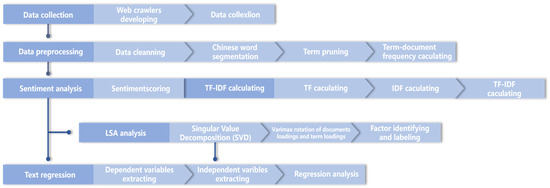
Figure 1.
Research process.
3.2. Data Collection
Mount Mogan, situated in Deqing County, Zhejiang Province, China, gained international recognition when the New York Times listed it among the 45 best places to visit in the world in 2012, acknowledging its outstanding ecological environment and rich historical–cultural resources [54]. As the most emblematic representative among the ten Chinese RB&B agglomerations, Mount Mogan stands out as one of the premier RB&B tourist destinations in China. Given its prominence, Mount Mogan serves as a fitting research area for the development of theories and the practical application of strategies within this specific industry segment [55]. Tongcheng-Elong, as the second-largest OTA in China, holds significance for its user base, particularly regarding the attention paid to hotel-related matters [56]. Previous studies, including those by Yang [57] and Hou et al. [56], utilized Tongcheng-Elong as a dependable data source. Hence, for a comprehensive exploration of the determinants of RB&B customer satisfaction, this study employed automatic web crawlers to collect ORs from Tongcheng-Elong. The data collection process unfolded in two stages. The initial stage involved retrieving basic RB&B information, including names, market segments, addresses, and URLs. The subsequent stage focused on detailed review data collection, with Figure 2 illustrating the structure of a review on Tongcheng-Elong.
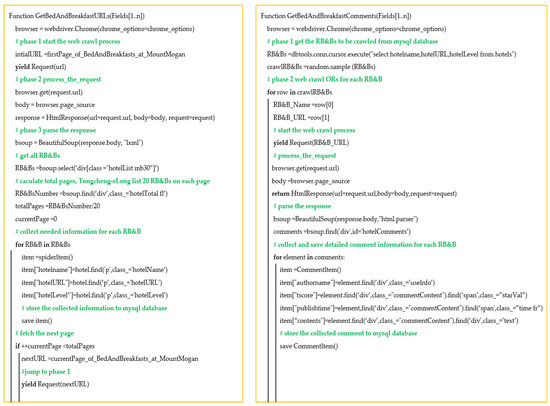
Figure 2.
Pseudocode for web-crawling ORs of RB&Bs. Note: The green characters in the figure represent code comments.
This study specifically concentrated on text comments. In the initial stage, 353 RB&Bs spanning three market segments (economy, midscale, and upscale) were identified. Subsequently, 11 RB&Bs were randomly chosen within each market segment, aligning with the simple random sampling criterion, which dictated that a sample should not exceed 10% of the total population [58]. Subsequently, 6531 ORs of the 33 RB&Bs were gathered, with 16 excluded for lacking numerical ratings or textual comments. This yielded a dataset comprising 6515 ORs. To provide a clearer representation of the web-crawling mechanism, Figure 3 shows the pseudocodes of two functions for web-crawling ORs of RB&Bs.
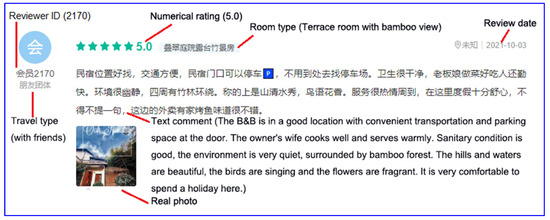
Figure 3.
Example of an OR in Tongcheng-Elong.
3.3. Data Pre-Processing Stage
Ensuring good data quality is crucial to avoid inaccuracies or misleading outcomes. Data cleaning serves the purpose of identifying and eliminating imprecise and irrelevant records, such as meaningless symbols and misspellings [59]. Additionally, brief comments can signal a lack of reviewer commitment, potentially impacting the usefulness of ORs negatively [59,60]. Previous studies, including those by Guo et al. [61] and Hou et al. [59], established a 15-word threshold to gauge the information value of Chinese ORs. Consequently, this study removed ORs with fewer than 15 words and subsequently addressed repetitive records during the cleaning process, resulting in the exclusion of 1399 useless records. Tongcheng-Elong’s review system allows users to rate hotels on a scale of one to five based on the overall satisfaction. Following the approach of Li et al. [45], ORs with numerical ratings above three out of five were considered positive. Acknowledging the disparities between determinants of tourist satisfaction and dissatisfaction [25], this study focused exclusively on positive ORs, extracting a total of 5047 ORs with ratings above three to explore customer satisfaction.
Chinese word segmentation serves to establish the boundaries of individual Chinese words. This study employed Jieba, a Chinese word segmentation package, to create a natural language processing tool that integrated a tailored lexicon of RB&B terms (e.g., “slow life” and “family suite”) for parsing ORs and extracting meaningful words. Text filtering was implemented to streamline the parsed words, retaining only valuable and relevant information [62]. Multiple regulations guided the text filtering process. Firstly, in line with Zhou et al. [63], the study amalgamated the “Baidu stop words”, “Harbin Institute of Technology stop words”, and “Machine Intelligence Laboratory of Sichuan University stop words” to construct a comprehensive vocabulary, eliminating superfluous terms. Secondly, adverbs, auxiliaries, conjunctions, interjections, modal particles, numerals, prepositions, pronouns, punctuations, and one-character words were systematically excluded. Thirdly, generic words (e.g., “disappointed”, “happy”, “like”, and “overall”) were omitted, as their meanings were inherently captured in the objects they described. Finally, synonyms were consolidated into single terms, as they did not contribute to distinguishing customers’ opinions. This meticulous Chinese word segmentation process resulted in a total of 7523 distinct words.
Words with low frequencies proved to be ineffective discriminators for analyzing customer opinions [62]. Consequently, this study implemented term pruning [64], eliminating words that appeared fewer than five times. Words occurring in just one comment were also excluded, as they lacked the ability to reflect a consensus among customers [25]. Following term pruning, the dataset comprised 561 high-frequency terms extracted from 4991 ORs, resulting in a 561 × 4991 term-by-document matrix that captured the occurrence frequency of the terms. Figure 4 shows the detailed methods of data collection and pre-processing.
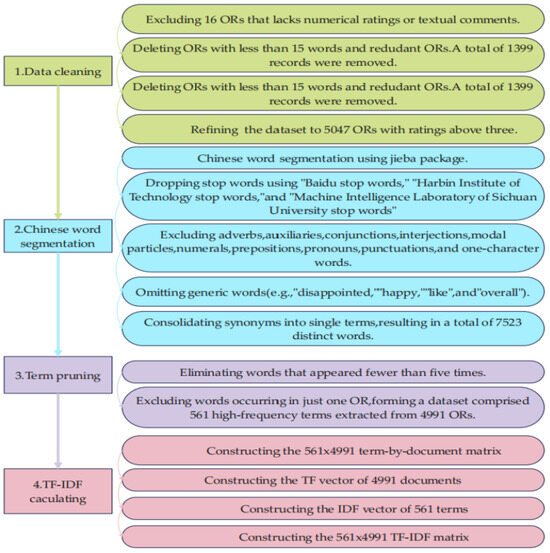
Figure 4.
Detailed methods of data collection and pre-processing.
3.4. Sentiment Analysis
Out of the 4991 ORS, 4318 received a five-point rating. This skewed data distribution posed challenges in using numerical ratings as a rational indicator for overall satisfaction. Sentiment analysis, capable of discerning and categorizing individual sentiments or opinions regarding specific topics in a text [65], was deemed more suitable. There exists a logical consistency between customer sentiment polarity and satisfaction [58]. Thus, the sentiment analysis was employed to objectively assess customer satisfaction with the ORs. The lexicon-based sentiment analysis approach computed sentiment scores for texts using dictionaries pre-annotated with sentiment orientations for words and phrases [66]. A well-defined dictionary ensured sentiment scoring with high accuracy and efficiency. In contrast to the sentiment analysis for the overall text, aspect-based sentiment analysis (ABSA) is a text analysis technique that categorizes data by aspect and identifies the sentiments regarding a given aspect [67]. ABSA can be used to analyze customer feedback by associating specific sentiments with different aspects of a product or service [68]. Customer satisfaction with an RB&B is determined by various factors. As our research sought to pinpoint these determinants and assess their importance for overall customer satisfaction, instead of categorizing or predicting the emotional polarity of specific dimensions, we did not utilize ABSA. In this study, each sentence in an OR was assigned a score on a scale from zero to one (representing negative to positive sentiments, respectively) using SnowNLP, a Chinese text processing library in Python. Subsequently, the final score for the entire comment was obtained by averaging the scores of its constituent sentences. Figure 5 shows the pseudocode for the sentiment analysis process.
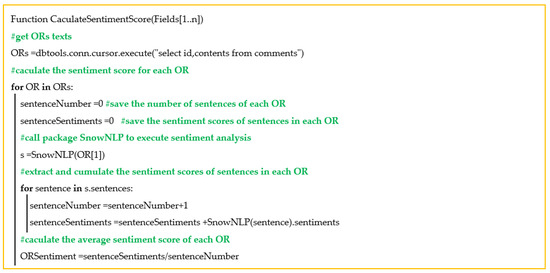
Figure 5.
Pseudocode for sentiment analysis of ORs. Note: The green characters in the figure represent code comments.
3.5. TF-IDF Calculation
Conceptually crucial terms may not readily surface in the term-by-document matrix [34]. TF-IDF, rooted in the relative frequency of terms within a specific document and inversely proportional to their occurrence in the entire corpus [64], addresses this issue. Terms that are frequent in one document but infrequent in others receive higher weights through TF-IDF. Consequently, TF-IDF reflects the significance of a term in a specific document and unveils significant themes. Employing the TF-IDF method, this study transformed the term-by-document matrix into a 561 × 4991 TF-IDF matrix by downplaying common terms and elevating rare terms [25]. Specifically, let denote the weight of term i in document j, represent the TF of i in document j, N indicate the number of documents, and signify the number of documents containing term i. To avoid the zero-division problem, the TF-IDF was actually implemented with a slight modification, as Formula (1) shows:
3.6. Singular Value Decomposition (SVD)
A SVD was employed to decompose the TF-IDF matrix, expressed as [34]. In this formulation, X represents the initial t × d TF-IDF matrix, where t is the number of terms and d is the number of ORs. SVD transforms X into three matrices: U, a t × r matrix of eigenvectors from the term covariance matrix; V, a d × r matrix of eigenvectors from the document covariance matrix; and Σ, an r × r diagonal matrix of singular values, with r representing the rank of matrix X corresponding to the number of latent semantic concepts [34]. The term loadings, UΣ, for the semantic concepts were obtained by multiplying the term-to-concept matrix, U, by matrix Σ. Similarly, the document loadings were generated by VΣ. Initially, the number of extracted semantic concepts matched the number of documents. Subsequently, this study condensed the semantic concepts to identify the crucial factors.
Rotations in LSA contribute to enhancing the interpretability of extracted semantic structures. Once the number of semantic dimensions (k) was established, we employed a varimax rotation on the loadings, using the same orthonormal matrix. Figure 6 shows the scree plot for determining the optimal number of components. This rotation optimized the semantic dimension variance by maximizing or minimizing loadings within specific semantic concepts, thereby simplifying the associations between these concepts. Following the rotation, the high-loading terms and documents for each semantic dimension were arranged in descending order based on the absolute values of the loadings. Finally, the latent factors influencing customer satisfaction were discerned and labeled through a careful examination of the high-loading terms and documents.
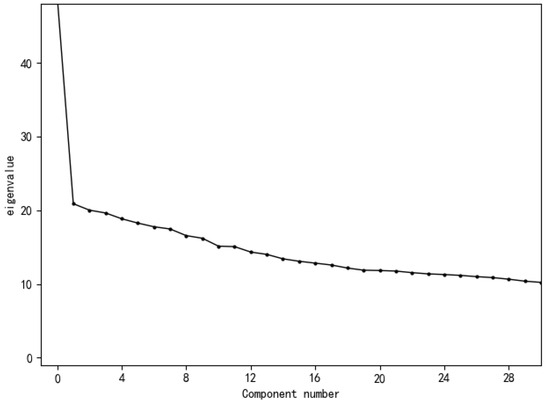
Figure 6.
Scree plot for determining the optimal number of components.
3.7. Text Regression
The singular values within matrix Σ served as indicators of the relevance of extracted semantic concepts to associated terms [32]. A higher singular value implied more frequent appearances of a term within a semantic concept. However, evaluating the significance of semantic concepts based solely on the TF would be unjustified. Additionally, verifying whether and how the impact of customer satisfaction determinants varied across different RB&B market segments necessitated further investigations. Hence, this study employed text regression to assess the relative importance of semantic concepts. The coordinates of the OR vector spaces within each extracted semantic concept in the LSA were utilized as independent variables for exploring customer satisfaction [32]. The previously calculated sentiment scores of the ORs served as the dependent variable.
4. Results
Online reviews represent consumers’ viewpoints of specific products or services after purchasing and experiencing them. The descriptive analysis of collected ORs in this study revealed tourists’ overall impressions about RB&B services. Through an in-depth text analysis, a more comprehensive picture of the different needs of RB&B customers was revealed.
4.1. Overview of Analyzed ORs
Table 2 illustrates a relatively even distribution of ORs across various market segments, underscoring the satisfactory external validity of this study. Notably, out of the 4991 ORS, over 91% (4551) of the reviewers assigned a 4.5 overall satisfaction rating. Given this inclination, numerical ratings may not entirely reflect their genuine satisfaction levels. Hence, this study utilized sentiment scores from the ORs as an indicator of customer satisfaction. An exploratory investigation unveiled the top 10 common terms in ORs, such as “host”, “room”, and “friendly staff”, reinforcing the key factors influencing hotel customer satisfaction as identified in previous studies [14,52,69].
Table 2.
Sample description.
4.2. RB&B Customer Satisfaction Factors
The determinants of customer satisfaction with RB&Bs were discerned and labeled through an examination of the associated high-loading terms and ORs, as illustrated in Table 3. These factors encapsulate the crucial dimensions of RB&B guest experience, as the high-loading terms encompass a significant portion of the semantic information.
Table 3.
High-loading terms of semantic concepts.
4.3. Relative Importance of Factors
In assessing the relative importance of factors, this study employed standardized regression coefficients, a widely accepted measure [70]. The standardization of dependent and independent variables facilitated a comparative analysis of text regression coefficients, revealing factors with varying impacts on customer satisfaction. The absolute transformation of coefficients indicated the significance of each factor, where larger values denoted greater importance. The regression analysis results in Table 4 highlight Factor 1’s highest singular value and substantial coefficients. However, differentiations among other factors across indicators implied a considerable variation in their importance across diverse market segments.
Table 4.
Text regression analysis results.
5. Discussion
5.1. Differences in Customer Satisfaction Factors between RB&Bs and Hotels
RB&B guests have a distinct interest in local cultural nuances, driven by their quest for authentic tourism experiences [5]. As a result, the determinants of customer satisfaction regarding RB&Bs can vary significantly from those regarding conventional hotels. In this study, we conducted a comparative analysis, aligning our findings with the factors identified in 10 hotel satisfaction studies (referenced in Table 1). This approach allowed us to scrutinize and comprehend the unique determinants influencing RB&B customer satisfaction reasults, as shown in Table 5.
Table 5.
Comparison of customer satisfaction factors.
5.2. What Factors Should RB&Bs Prioritize in Different Market Segments?
To efficiently allocate limited resources, RB&Bs need a thorough understanding of the factors that hold the utmost importance for customers. As shown in Table 4, Factor 3 (quality and affordability) and Factor 13 (diverse culinary offerings) exhibit no significant contributions to customer satisfaction across the three RB&B market segments, suggesting that these aspects are likely well-executed by all RB&Bs. This observation further emphasizes the existence of asymmetric effects concerning various customer satisfaction determinants. Factor 3 and Factor 13 serve as hygiene factors, where their negative performances can exert a more substantial impact on overall customer satisfaction outcomes than their positive performance. A case in point is the potential dissatisfaction arising from the absence of hot water, while its presence may not necessarily guarantee customer satisfaction. The other 11 determinants act as motivation factors, which can satisfy travelers’ pursuits of authentic tourism experiences. Table 6 presents the hygiene factors and the top 5 motivation factors identified for each RB&B market segment.
Table 6.
The customer satisfaction determinants across different RB&B segments.
Factor 1 (welcoming host with proficient culinary skills) and Factor 7 (natural environment) emerge as the primary drivers of customer satisfaction across all RB&B segments, supporting the notion that rural tourism revolves around visitors seeking an immersion in the local culture and the natural surroundings [74]. Notably, Factor 6 (excellent service) holds greater significance for customers of economy and midscale RB&Bs, securing the third position, compared to upscale RB&Bs, where it ranks fifth. This discrepancy can be attributed to heightened service expectations among upscale clientele, aligning with Li et al.’s [26] findings that emphasized the necessity of excellent service in high-tier accommodations. Factor 12 (aesthetic appeal) claims the fourth spot in both economy and upscale RB&Bs. However, for the midscale segment, it ranks seventh, potentially due to the prevalence of similar products and styles in midmarket establishments, limiting its impact on customer satisfaction. In the case of young families with children, typically opting for economy and midscale RB&Bs due to budget constraints [75], Factor 4 (family-friendly) assumes greater importance in these segments, securing the fifth position, as opposed to the high-end segment where it ranks seventh.
5.3. Implications
Our study contributes significantly to the customer satisfaction literature on several fronts. Firstly, given the limited exploration of factors influencing customer satisfaction in this domain, our study extends the scope of customer satisfaction research from the broader hotel context to the specific realm of RB&Bs, thereby enriching our knowledge of the tourism management field. The identified determinants of customer satisfaction serve as valuable insights for future studies seeking to assess and enhance the performance of RB&Bs. Secondly, our findings affirm the expectancy disconfirmation model of customer satisfaction. The ability of RB&Bs to satisfy customers hinges on meeting or surpassing their pre-purchase expectations. Notably, satisfactory service alone may not elevate customer satisfaction with upscale RB&Bs, given the elevated expectations of customers within this segment. Our results also lend credence to the two-factor theory [26], providing a robust framework for elucidating the asymmetric impact of product/service attributes on accommodation guest satisfaction. The effective performance of motivators, such as a hospitable host and excellent service, can positively influence customer satisfaction, while the subpar performance of hygiene factors, including price and quality, can lead to dissatisfaction. Thirdly, our study performs a comparative analysis of the importance of customer satisfaction determinants, unveiling substantial variations in the impacts of specific factors across different RB&B market segments. This underscores the imperative to tailor attributes based on target markets in future RB&B customer satisfaction research. Lastly, our research establishes a systematic analytical framework for extracting and ranking the importance of customer satisfaction determinants. By leveraging big data analytics to discern tourist opinions, our study demonstrates the efficacy of this approach and serves as inspiration for future relevant studies in the field.
In practical terms, our findings also yield several valuable contributions. Firstly, understanding customer needs and adapting to market dynamics are paramount for success in competitive markets [52]. The identified determinants of customer satisfaction serve as actionable insights for RB&Bs seeking avenues for improvement. Secondly, RB&Bs should strategically leverage the most influential factors shaping customer satisfaction. Our study delineates the varying impacts of RB&B attributes on customer satisfaction across diverse market segments, enabling management to judiciously allocate limited resources towards addressing the specific needs of their target customers. Thirdly, our insights extend to other stakeholders in the RB&B domain, including owners and investors. While management can enhance the performance of controllable determinants, such as training staff for improved service, certain aspects, like location and landscape, have an impact on customer satisfaction, but can be challenging to alter. Consequently, a careful consideration of these uncontrollable factors is essential during the planning, design, and construction phases of new RB&Bs.
6. Conclusions, Limitations, and Future Research
Building upon the comprehensive data analysis provided previously, this section is segmented into three pivotal areas: the conclusion, policy implication, and future research. In this section, the main conclusions from our research are summarized; based on this, we put forward a series of policy implications that may provide some benefits to developing countries, like China. Finally, the future research directions are also highlighted.
6.1. Conclusions
Comprehending customer satisfaction has a pivotal significance in tourism management as it serves as a key catalyst for instigating behavioral loyalty among tourists. This loyalty manifests in actions such as positive eWOM dissemination, repurchasing, and making recommendations [14]. Positioned within the realm of ORs in the hospitality industry, this study addresses one of the five crucial topics related to satisfaction and management, as identified by Schuckert et al. [76] The LSA undertaken in this study identified 13 critical customer satisfaction determinants, of which eight aligned with findings from prior hotel satisfaction studies. Notably, five determinants—“welcoming host with proficient culinary skills”, “cozy ambiance”, “tranquil escape”, “beautiful landscape”, and “aesthetic appeal”—emerged as unique to RB&Bs, reinforcing the notion that tourists perceive RB&Bs not merely as an accommodation choice, but as a distinct leisure travel mode. Consequently, RB&B operators are urged to amplify the performance of these distinctive attributes to carve out a niche against competitors and elevate customer satisfaction. The results of the text regression analysis underscore the universal appreciation among all types of RB&B guests for hospitable hosts and natural environments. However, the impacts of other factors on customer satisfaction varied across diverse market segments. Leveraging these insights, RB&B operators can formulate priority rules for improvements and devise effective marketing strategies tailored to the unique preferences of each market segment. In conclusion, this study provided comprehensive insights into the nuanced needs and preferences of RB&B guests, enabling operators to adeptly address these dynamics and heighten customer satisfaction and loyalty. It is our hope that this study serves as a catalyst for the future research on similar issues and as a practical management tool for RB&B oversights.
6.2. Limitations and Future Research
Several limitations should be acknowledged in this study. Firstly, the analysis exclusively focused on ORs submitted by Chinese customers of RB&Bs in the Mount Mogan area. While this approach effectively captured the opinions of Chinese customers, it inherently contained a cultural bias, given that diverse cultural backgrounds led to varying preferences, ultimately shaping tourists’ satisfaction outcomes [77]. Future research endeavors should consider broadening the dataset to encompass other cultural contexts, thereby enhancing the external validity of the findings and assessing their applicability in different countries. Secondly, this study concentrated on positive ORs as a means to examine customer satisfaction. Recognizing that the factors influencing customer dissatisfaction may differ from those contributing to satisfaction, future research should delve into the aspects leading to customer discontent with RB&Bs by analyzing negative ORs. This dual perspective would offer a more comprehensive understanding of customer experiences. Thirdly, customers’ preferences and needs are inherently dynamic, evolving over time. However, this study did not factor in the element of time. Subsequent research should explore customers’ perceptions of RB&Bs by analyzing the short- and long-term trends implicit in ORs. This temporal consideration would contribute to a more nuanced and accurate comprehension of evolving customer needs and preferences. Finally, in recent years, the remarkable advancements in AI technologies, such as deep learning and large language models (LLMs), have offered the potential to comprehend and predict customer needs and preferences more precisely. Subsequent research endeavors can leverage these innovative methods to delve deeper into customer satisfaction with RB&Bs.
Author Contributions
Conceptualization, X.W. and X.C.; Methodology, X.W. and Z.G.; Formal analysis, X.W. and Z.G.; Data curation: X.W. and Z.G.; Writing-original draft preparation, X.W.; Writing-review and editing, X.C. All authors have read and agreed to the published version of the manuscript.
Funding
This research was funded by the Humanities and Social Sciences Youth Foundation, Ministry of Education of the People’s Republic of China (Grant Number: 22YJCZH038) and Zhejiang Province statistical research project (Grant Number: 23TJQN18).
Institutional Review Board Statement
Not applicable.
Informed Consent Statement
Not applicable.
Data Availability Statement
The original contributions presented in the study are included in the article, further inquiries can be directed to the corresponding authors.
Conflicts of Interest
The authors declare no conflicts of interest.
Appendix A
Lists of the languages and libraries used in the paper are summarized in Table A1, as follows.
Table A1.
A list of languages and libraries used in this paper.
Table A1.
A list of languages and libraries used in this paper.
| Phase | Language | Libraries |
|---|---|---|
| Data collection | Python | BeautifulSoup, pymysql, scrapy, selenium |
| Data pre-processing | Python | dbtools, jieba, pandas, pymysql, |
| Sentiment analysis | Python | pandas, SnowNLP |
| TF-IDF calculating | Python | numpy, openpyxl, pandas, sklearn |
| LSA analysis | Python | numpy, pandas, sklearn |
| Text regression | R | stats |
References
- MacCannell, D. Staged authenticity: Arrangements of social space in tourist settings. Am. J. Sociol. 1973, 79, 589–603. [Google Scholar] [CrossRef]
- Jones, D.L.; Guan, J.J. Bed and breakfast lodging development in Mainland China: Who is the potential customer? Asia Pac. J. Tour. Res. 2011, 16, 517–536. [Google Scholar] [CrossRef]
- Wang, W.; Wu, J.; Wu, M.-Y.; Pearce, P.L. Shaping tourists’ green behavior: The hosts’ efforts at rural Chinese B&Bs. J. Dest. Mark. Manag. 2018, 9, 194–203. [Google Scholar]
- Liu, C.-W.; Cheng, J.-S. Exploring driving forces of innovation in the MSEs: The case of the sustainable B&B tourism industry. Sustainability 2018, 10, 3983. [Google Scholar]
- Lin, X.; Mi, C.; Chen, Y.; Huang, L. Understanding the determinants of consumer satisfaction with B&B hotels: An interpretive structural modeling approach. Int. J. Web Serv. Res. 2019, 16, 21–39. [Google Scholar]
- Jin, Y.; Park, Y. An integrated approach to determining rural tourist satisfaction factors using the IPA and conjoint analysis. Int. J. Environ. Res. Public Health 2019, 16, 3848. [Google Scholar] [CrossRef] [PubMed]
- Bowen, J.T.; Chen, S.L. The relationship between customer loyalty and customer satisfaction. Int. J. Contemp. Hosp. Manag. 2001, 13, 213–217. [Google Scholar] [CrossRef]
- Zhang, X.; Liu, J.; Zhu, H.; Huang, Z.; Zhang, S.; Li, P. A Comparative Study of Customer Perceptions of Urban and Rural Bed and Breakfasts in Beijing: An Analysis of Online Reviews. Sustainability 2021, 13, 11303. [Google Scholar] [CrossRef]
- Si, Y.; Liu, C.; Zhang, M. Feelings and Scenes of Rural Homestay Inns in China: A Perspective of Service Encounter. Secur. Commun. Netw. 2022, 2022, 1966335. [Google Scholar] [CrossRef]
- Nunkoo, R.; Teeroovengadum, V.; Ringle, C.M.; Sunnassee, V. Service quality and customer satisfaction: The moderating effects of hotel star rating. Int. J. Hosp. Manag. 2020, 91, 102414. [Google Scholar] [CrossRef]
- Ahmad, S.Z.; Ahmad, N.; Papastathopoulos, A. Measuring service quality and customer satisfaction of the small-and medium-sized hotels (SMSHs) industry: Lessons from United Arab Emirates (UAE). Tour. Rev. 2019, 74, 349–370. [Google Scholar] [CrossRef]
- Ariffin, A.A.M.; Nameghi, E.N.M.; Soon, Y.K. The relationships between national identity, hospitality, and satisfaction among foreign hotel guests. J. Travel Tour. Mark. 2015, 32, 778–793. [Google Scholar] [CrossRef]
- Rahimi, R.; Kozak, M. Impact of customer relationship management on customer satisfaction: The case of a budget hotel chain. J. Travel Tour. Mark. 2017, 34, 40–51. [Google Scholar] [CrossRef]
- Guo, Y.; Barnes, S.J.; Jia, Q. Mining meaning from online ratings and reviews: Tourist satisfaction analysis using latent dirichlet allocation. Tour. Manag. 2017, 59, 467–483. [Google Scholar] [CrossRef]
- Peterson, R.A.; Wilson, W.R. Measuring customer satisfaction: Fact and artifact. J. Acad. Mark. Sci. 1992, 20, 61–71. [Google Scholar] [CrossRef]
- Jeon, M.M.; Lee, S.; Jeong, M. e-Social influence and customers’ behavioral intentions on a bed and breakfast website. J. Hosp. Mark. Manag. 2018, 27, 366–385. [Google Scholar] [CrossRef]
- Dong, J.; Li, H.; Zhang, X. Classification of customer satisfaction attributes: An application of online hotel review analysis. In e-Business, e-Services and e-Society; Springer: Berlin/Heidelberg, Germany, 2014; pp. 238–250. [Google Scholar]
- Xiang, Z.; Schwartz, Z.; Gerdes, J.H., Jr.; Uysal, M. What can big data and text analytics tell us about hotel guest experience and satisfaction? Int. J. Hosp. Manag. 2015, 44, 120–130. [Google Scholar] [CrossRef]
- Czeplel, J.A.; Rosenberg, L.J. Consumer satisfaction: Concept and measurement. J. Acad. Mark. Sci. 1977, 5, 403–411. [Google Scholar] [CrossRef]
- Oliver, R.L. A cognitive model of the antecedents and consequences of satisfaction decisions. J. Mark. Res. 1980, 17, 460–469. [Google Scholar] [CrossRef]
- Burns, D.J.; Neisner, L. Customer satisfaction in a retail setting: The contribution of emotion. Int. J. Retail. Distrib. Manag. 2006, 34, 49–66. [Google Scholar] [CrossRef]
- Oliver, R.L.; DeSarbo, W.S. Response determinants in satisfaction judgments. J. Consum. Res. 1988, 14, 495–507. [Google Scholar] [CrossRef]
- Richard, L.O. Satisfaction: A Behavioral Perspective on the Consumer; Routledge: New York, NY, USA, 1997. [Google Scholar]
- Sukhu, A.; Choi, H.; Bujisic, M.; Bilgihan, A. Satisfaction and positive emotions: A comparison of the influence of hotel guests’ beliefs and attitudes on their satisfaction and emotions. Int. J. Hosp. Manag. 2019, 77, 51–63. [Google Scholar] [CrossRef]
- Xu, X.; Li, Y. The antecedents of customer satisfaction and dissatisfaction toward various types of hotels: A text mining approach. Int. J. Hosp. Manag. 2016, 55, 57–69. [Google Scholar] [CrossRef]
- Li, H.; Tan, C.-W.; Hu, F. Comprehending customer satisfaction with hotels: Data analysis of consumer-generated reviews. Int. J. Contemp. Hosp. Manag. 2020, 32, 1713–1735. [Google Scholar] [CrossRef]
- Ali, F.; Hussain, K.; Konar, R.; Jeon, H.-M. The effect of technical and functional quality on guests’ perceived hotel service quality and satisfaction: A SEM-PLS analysis. J. Qual. Assur. Hosp. Tour. 2017, 18, 354–378. [Google Scholar] [CrossRef]
- Dinçer, M.Z.; Alrawadieh, Z. Negative word of mouse in the hotel industry: A content analysis of online reviews on luxury hotels in Jordan. J. Hosp. Mark. Manag. 2017, 26, 785–804. [Google Scholar] [CrossRef]
- Lee, M.; Cai, Y.M.; DeFranco, A.; Lee, J. Exploring influential factors affecting guest satisfaction: Big data and business analytics in consumer-generated reviews. J. Hosp. Tour. Technol. 2020, 11, 137–153. [Google Scholar] [CrossRef]
- Ramanathan, R. An exploratory study of marketing, physical and people related performance criteria in hotels. Int. J. Contemp. Hosp. Manag. 2012, 24, 44–61. [Google Scholar] [CrossRef]
- Sann, R.; Lai, P.-C.; Liaw, S.-Y. Online complaining behavior: Does cultural background and hotel class matter? J. Hosp. Tour. Manag. 2020, 43, 80–90. [Google Scholar] [CrossRef]
- Xu, X. Does traveler satisfaction differ in various travel group compositions? Evidence from online reviews. Int. J. Contemp. Hosp. Manag. 2018, 30, 1663–1685. [Google Scholar] [CrossRef]
- Ying, S.; Chan, J.H.; Qi, X. Why are Chinese and North American guests satisfied or dissatisfied with hotels? An application of big data analysis. Int. J. Contemp. Hosp. Manag. 2020, 32, 3249–3269. [Google Scholar] [CrossRef]
- Evangelopoulos, N.; Ashton, T.; Winson-Geideman, K.; Roulac, S. Latent semantic analysis and real estate research: Methods and applications. J. Real Estate Lit. 2015, 23, 353–380. [Google Scholar] [CrossRef]
- Yalcinkaya, M.; Singh, V. Patterns and trends in building information modeling (BIM) research: A latent semantic analysis. Autom. Constr. 2015, 59, 68–80. [Google Scholar] [CrossRef]
- Landauer, T.K.; McNamara, D.S.; Dennis, S.; Kintsch, W. Handbook of Latent Semantic Analysis; Routledge: New York, NY, USA, 2013. [Google Scholar]
- Sidorova, A.; Evangelopoulos, N.; Valacich, J.S.; Ramakrishnan, T. Uncovering the intellectual core of the information systems discipline. MIS Q. 2008, 32, 467–482. [Google Scholar] [CrossRef]
- Nilashi, M.; Mardani, A.; Liao, H.; Ahmadi, H.; Manaf, A.A.; Almukadi, W. A hybrid method with TOPSIS and machine learning techniques for sustainable development of green hotels considering online reviews. Sustainability 2019, 11, 6013. [Google Scholar] [CrossRef]
- Nie, R.-X.; Tian, Z.-P.; Wang, J.-Q.; Chin, K.S. Hotel selection driven by online textual reviews: Applying a semantic partitioned sentiment dictionary and evidence theory. Int. J. Hosp. Manag. 2020, 88, 102495. [Google Scholar] [CrossRef]
- Calheiros, A.C.; Moro, S.; Rita, P. Sentiment classification of consumer-generated online reviews using topic modeling. J. Hosp. Mark. Manag. 2017, 26, 675–693. [Google Scholar] [CrossRef]
- Zhang, Y.; Zhang, L.; Hossain, M.A. Adaptive 3D facial action intensity estimation and emotion recognition. Expert Syst. Appl. 2015, 42, 1446–1464. [Google Scholar] [CrossRef]
- Landauer, T.K.; Foltz, P.W.; Laham, D. An introduction to latent semantic analysis. Discourse Process. 1998, 25, 259–284. [Google Scholar] [CrossRef]
- Li, M.; Ma, Y.; Cao, P. Revealing Customer Satisfaction with Hotels Through Multi-Site Online Reviews: A Method Based on the Evidence Theory. IEEE Access 2020, 8, 225226–225239. [Google Scholar] [CrossRef]
- Litvin, S.W.; Goldsmith, R.E.; Pan, B. Electronic word-of-mouth in hospitality and tourism management. Tour. Manag. 2008, 29, 458–468. [Google Scholar] [CrossRef]
- Li, H.; Ye, Q.; Law, R. Determinants of customer satisfaction in the hotel industry: An application of online review analysis. Asia Pac. J. Tour. Res. 2013, 18, 784–802. [Google Scholar] [CrossRef]
- Aakash, A.; Tandon, A.; Aggarwal, A.G. How features embedded in eWOM predict hotel guest satisfaction: An application of artificial neural networks. J. Hosp. Mark. Manag. 2021, 30, 486–507. [Google Scholar] [CrossRef]
- Alrawadieh, Z.; Law, R. Determinants of hotel guests’ satisfaction from the perspective of online hotel reviewers. Int. J. Cult. Tour. Hosp. Res. 2019, 13, 84–97. [Google Scholar] [CrossRef]
- Luo, J.; Huang, S.; Wang, R. A fine-grained sentiment analysis of online guest reviews of economy hotels in China. J. Hosp. Mark. Manag. 2021, 30, 71–95. [Google Scholar] [CrossRef]
- Sutherland, I.; Sim, Y.; Lee, S.K.; Byun, J.; Kiatkawsin, K. Topic modeling of online accommodation reviews via latent dirichlet allocation. Sustainability 2020, 12, 1821. [Google Scholar] [CrossRef]
- Ramzan, B.; Bajwa, I.S.; Jamil, N.; Amin, R.U.; Ramzan, S.; Mirza, F.; Sarwar, N. An intelligent data analysis for recommendation systems using machine learning. Sci. Program 2019, 2019, 5941096. [Google Scholar] [CrossRef]
- Wang, L.; Wang, X.-K.; Peng, J.-J.; Wang, J.-Q. The differences in hotel selection among various types of travellers: A comparative analysis with a useful bounded rationality behavioural decision support model. Tour. Manag. 2020, 76, 103961. [Google Scholar] [CrossRef]
- Hsiao, Y.-H.; Hsiao, Y.-T. Online review analytics for hotel quality at macro and micro levels. Ind. Manag. Data Syst. 2020, 121, 268–289. [Google Scholar] [CrossRef]
- Wong, E.; Rasoolimanesh, S.M.; Sharif, S.P. Using online travel agent platforms to determine factors influencing hotel guest satisfaction. J. Hosp. Tour. Technol. 2020, 11, 425–445. [Google Scholar] [CrossRef]
- Williams, I.K. The 45 Places to Go in 2012. 2012. Available online: https://www.nytimes.com/2012/01/08/travel/45-places-to-go-in-2012.html (accessed on 8 January 2012).
- Long, F.; Liu, J.; Zhang, S.; Yu, H.; Jiang, H. Development characteristics and evolution mechanism of homestay agglomeration in Mogan Mountain, China. Sustainability 2018, 10, 2964. [Google Scholar] [CrossRef]
- Hou, Z.; Cui, F.; Meng, Y.; Lian, T.; Yu, C. Opinion mining from online travel reviews: A comparative analysis of Chinese major OTAs using semantic association analysis. Tour. Manag. 2019, 74, 276–289. [Google Scholar] [CrossRef]
- Yang, Y. Understanding tourist attraction cooperation: An application of network analysis to the case of Shanghai, China. J. Dest. Mark. Manag. 2018, 8, 396–411. [Google Scholar] [CrossRef]
- Geetha, M.; Singha, P.; Sinha, S. Relationship between customer sentiment and online customer ratings for hotels-An empirical analysis. Tour. Manag. 2017, 61, 43–54. [Google Scholar] [CrossRef]
- Colladon, A.F.; Guardabascio, B.; Innarella, R. Using social network and semantic analysis to analyze online travel forums and forecast tourism demand. Decis. Support. Syst. 2019, 74, 113075. [Google Scholar] [CrossRef]
- Chen, H.-N.; Huang, C.-Y. An investigation into online reviewers’ behavior. Eur. J. Mark. 2013, 47, 1758–1773. [Google Scholar] [CrossRef]
- Guo, D.; Zhao, Y.; Zhang, L.; Wen, X.; Yin, C. Conformity feedback in an online review helpfulness evaluation task leads to less negative feedback-related negativity amplitudes and more positive P300 amplitudes. J. Neurosci. Psychol. Econ. 2019, 12, 73. [Google Scholar] [CrossRef]
- Chanwisitkul, P.; Shahgholian, A.; Mehandjiev, N. The reason behind the rating: Text mining of online hotel reviews. In Proceedings of the 2018 IEEE 20th Conference on Business Informatics (CBI), Vienna, Austria, 11–13 July 2018; pp. 149–157. [Google Scholar]
- Zhou, Z.; Gao, M.; Liu, Q.; Xiao, H. Forecasting stock price movements with multiple data sources: Evidence from stock market in China. Phys. A 2020, 542, 123389. [Google Scholar] [CrossRef]
- Sezgen, E.; Mason, K.J.; Mayer, R. Voice of airline passenger: A text mining approach to understand customer satisfaction. J. Air Transp. Manag. 2019, 77, 65–74. [Google Scholar] [CrossRef]
- Zhu, L.; Lin, Y.; Cheng, M. Sentiment and guest satisfaction with peer-to-peer accommodation: When are online ratings more trustworthy? Int. J. Hosp. Manag. 2020, 86, 102369. [Google Scholar] [CrossRef]
- Taboada, M.; Brooke, J.; Tofiloski, M.; Voll, K.; Stede, M. Lexicon-based methods for sentiment analysis. Comput. Linguist. 2011, 37, 267–307. [Google Scholar] [CrossRef]
- Liang, B.; Su, H.; Gui, L.; Cambria, E.; Xu, R. Aspect-based sentiment analysis via affective knowledge enhanced graph convolutional networks. Knowl.-Based Syst. 2022, 235, 107643. [Google Scholar] [CrossRef]
- Tarnowska, K.A.; Ras, Z.W. Sentiment Analysis of Customer Data. In Web Intelligence; IOS Press: Amsterdam, The Netherlands, 2019; pp. 343–363. [Google Scholar]
- Magnini, V.P.; Crotts, J.C.; Zehrer, A. Understanding customer delight: An application of travel blog analysis. J. Travel Res. 2011, 50, 535–545. [Google Scholar] [CrossRef]
- Darlington, R. Multiple Tests. In Regression and Linear Models; McGraw-Hill: New York, NY, USA, 1990; pp. 249–276. [Google Scholar]
- Hay, B. ‘Why do kids’ menus always have chicken nuggets? Children’s observations on the provision of food in hotels on family holidays. Hosp. Soc. 2018, 8, 69–96. [Google Scholar] [CrossRef]
- Yang, Y.; Mao, Z.; Tang, J. Understanding guest satisfaction with urban hotel location. J. Travel Res. 2018, 57, 243–259. [Google Scholar] [CrossRef]
- Thanvisitthpon, N. Statistically Validated Component-and Indicator-Level Requirements for Sustainable Thai Homestay Businesses. Sustainability 2021, 13, 936. [Google Scholar] [CrossRef]
- Fang, W.-T. Rural Tourism. In Tourism in Emerging Economies; Springer: Berlin/Heidelberg, Germany, 2020; pp. 103–129. [Google Scholar]
- Oksanen, A.; Aaltonen, M.; Rantala, K. Social determinants of debt problems in a Nordic welfare state: A Finnish register-based study. J. Consum. Policy 2015, 38, 229–246. [Google Scholar] [CrossRef]
- Schuckert, M.; Liu, X.; Law, R. Hospitality and tourism online reviews: Recent trends and future directions. J. Travel Tour. Mark. 2015, 32, 608–621. [Google Scholar] [CrossRef]
- Carreón, E.C.A.; España, H.A.M.; Nonaka, H.; Hiraoka, T. Differences in Chinese and Western tourists faced with Japanese hospitality: A natural language processing approach. Inf. Technol. Tour. 2021, 23, 381–438. [Google Scholar] [CrossRef]
Disclaimer/Publisher’s Note: The statements, opinions and data contained in all publications are solely those of the individual author(s) and contributor(s) and not of MDPI and/or the editor(s). MDPI and/or the editor(s) disclaim responsibility for any injury to people or property resulting from any ideas, methods, instructions or products referred to in the content. |
© 2024 by the authors. Licensee MDPI, Basel, Switzerland. This article is an open access article distributed under the terms and conditions of the Creative Commons Attribution (CC BY) license (https://creativecommons.org/licenses/by/4.0/).