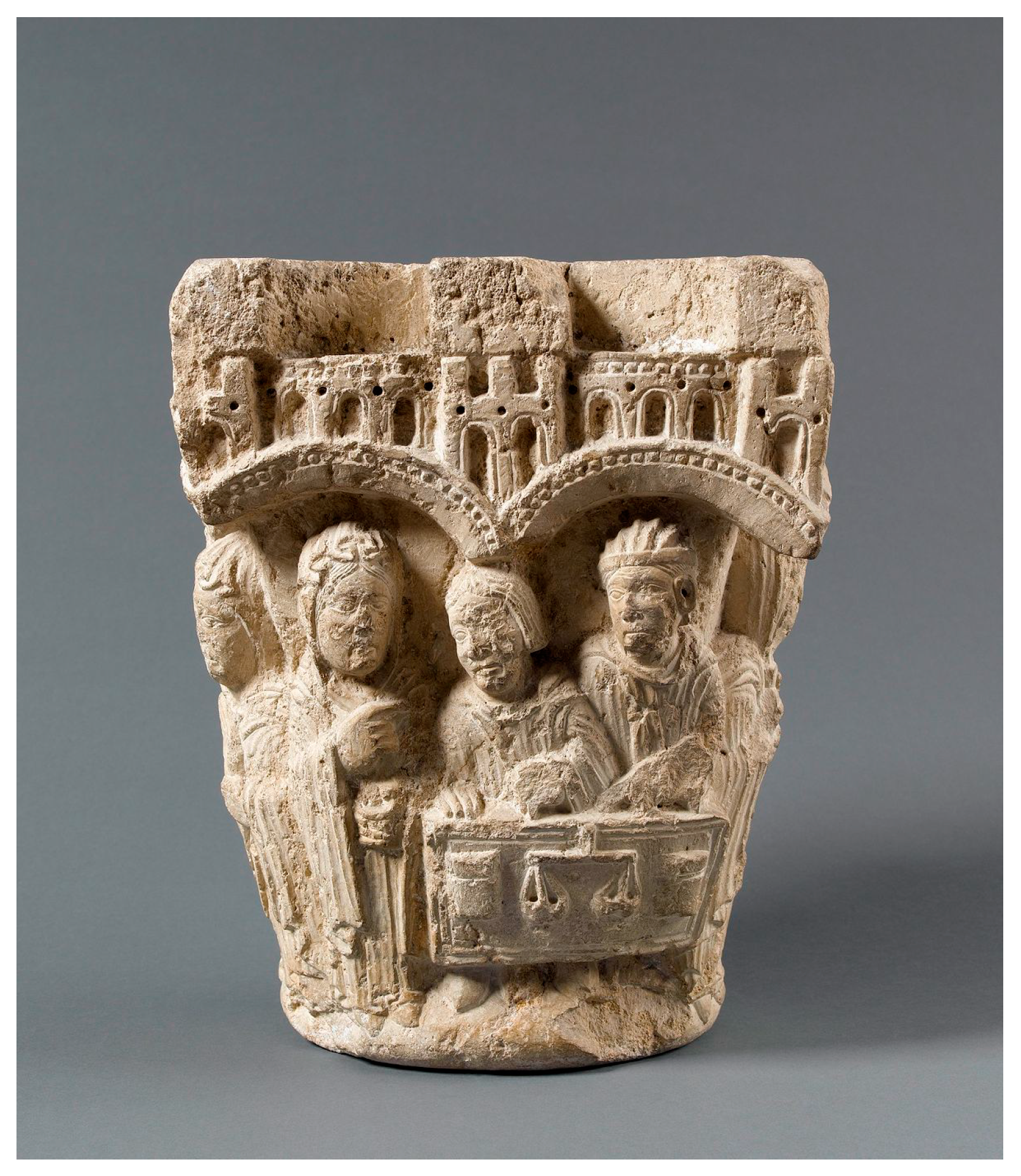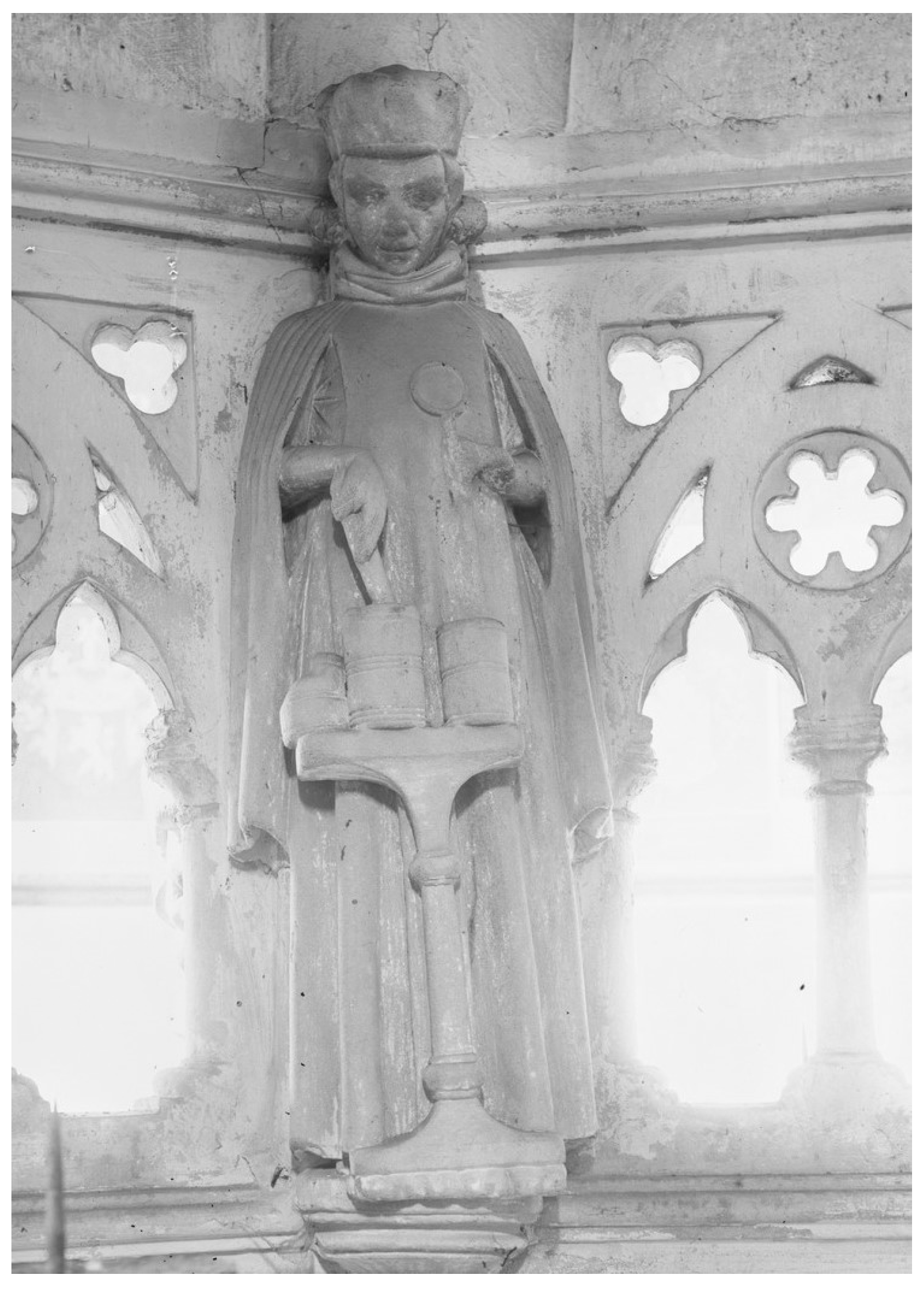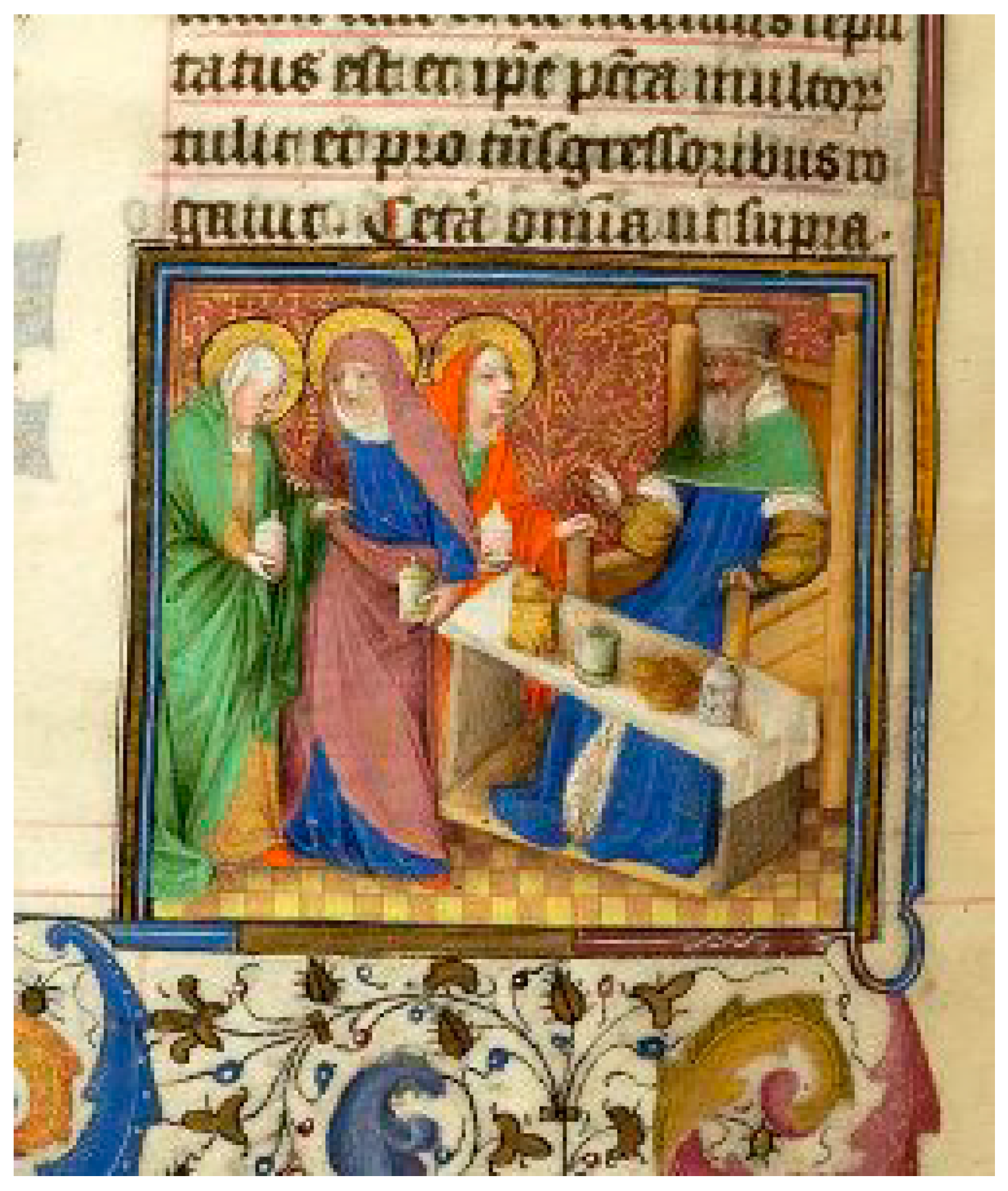
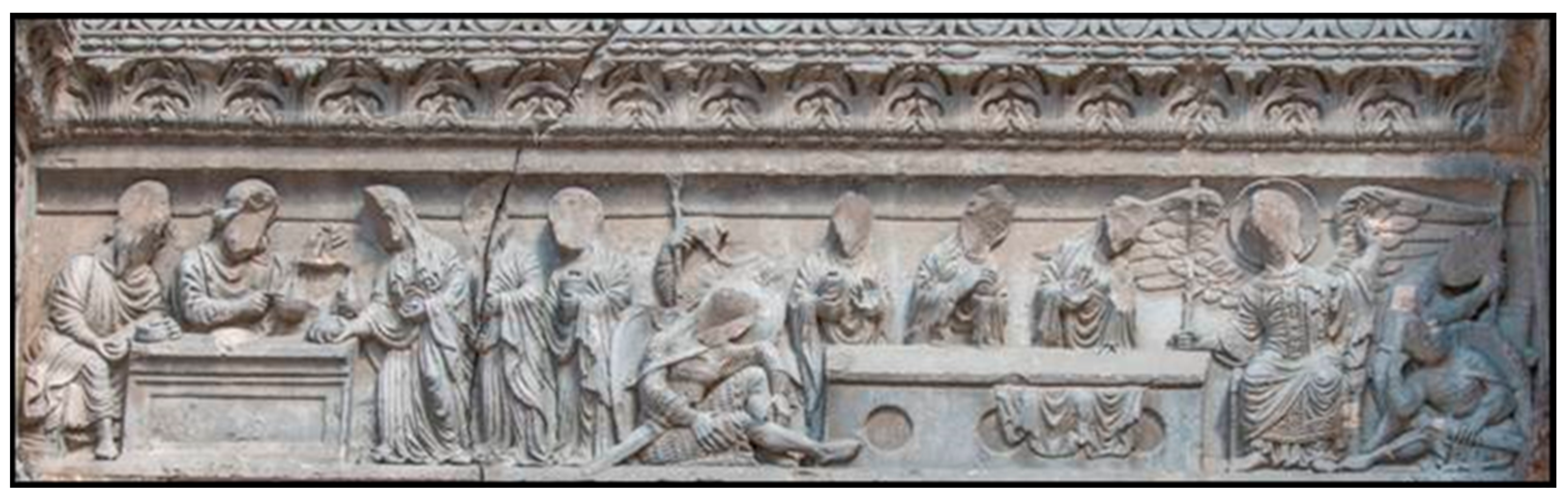
The Merchant Scene in Medieval Conceptions of the Visitatio Sepulchri: Origins and Transmission

Abstract
1. Introduction
2. The Visitatio Sepulchri of Vic 105
2.1. Formal Organization of the Merchant Scene
2.2. Liturgical Context and Connections of the Merchant Scene
There are numerous problems in understanding these pages of the manuscript, which also do not indicate any specific liturgical placement for either part of the mentioned textual units [Visitatio and Peregrinus]. The way it was edited by Karl Young and Peter Dronke seems to indicate that there is altogether one connected drama […] Donovan and Castro Caridad understand the text as two dramas, an Easter morning drama and a special, innovative Peregrinus drama for Easter Monday, the Easter morning drama ending with the Te Deum before the second mentioned rubric [“Versus de pelegrino”] […]Since there are no indications telling us when the ceremony was to be performed during Easter, we cannot know.
2.3. Manuscript Transmission of the Merchant Scene
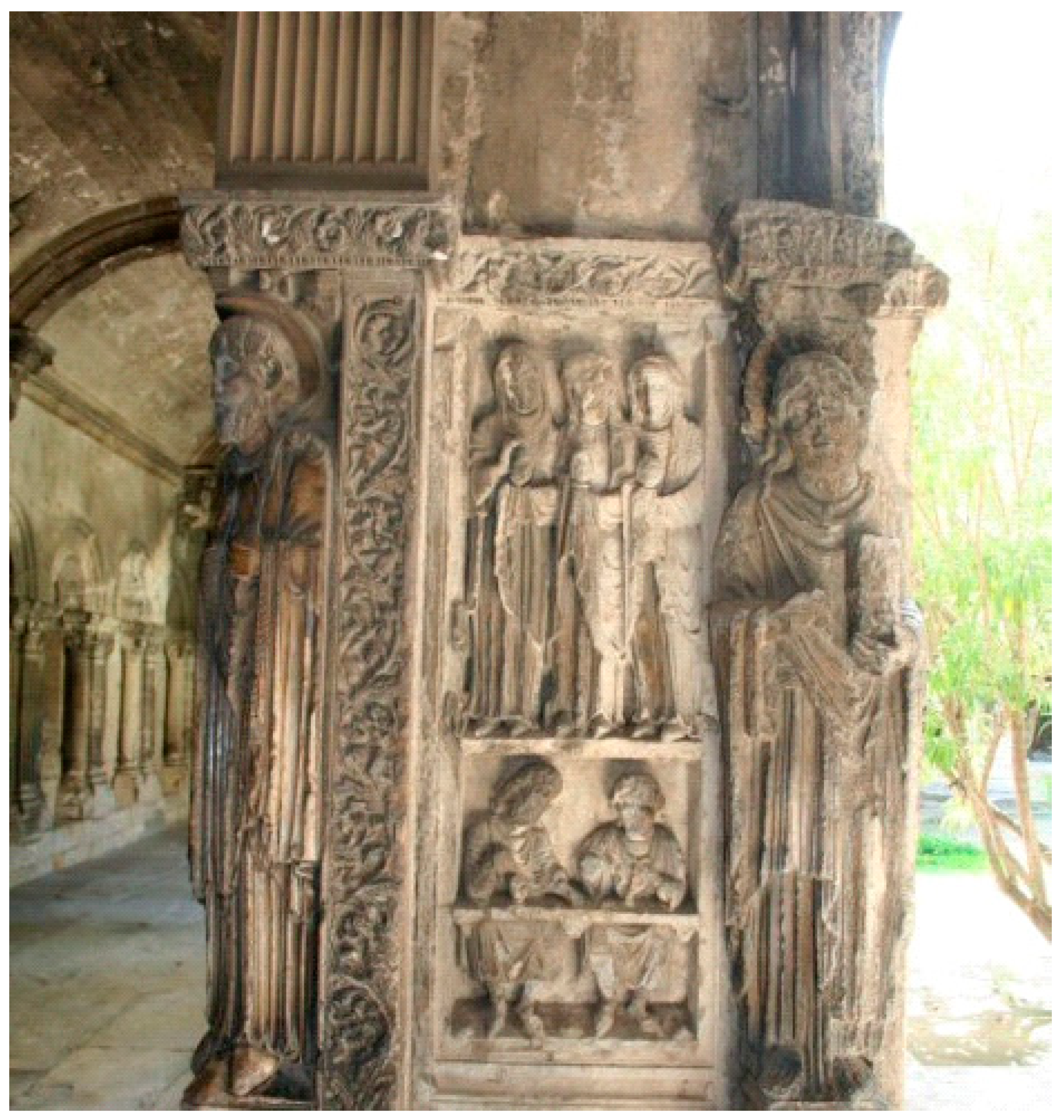
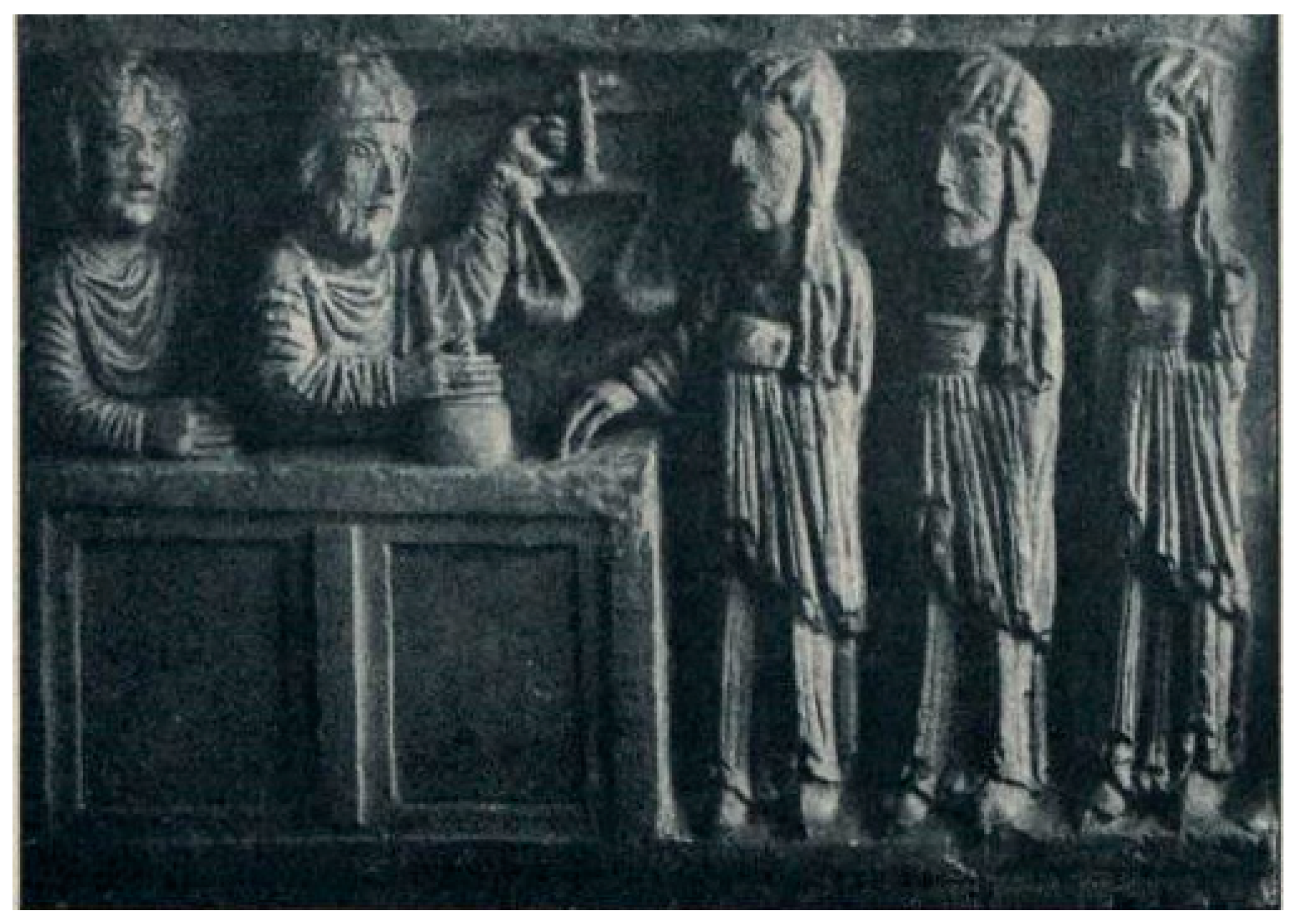
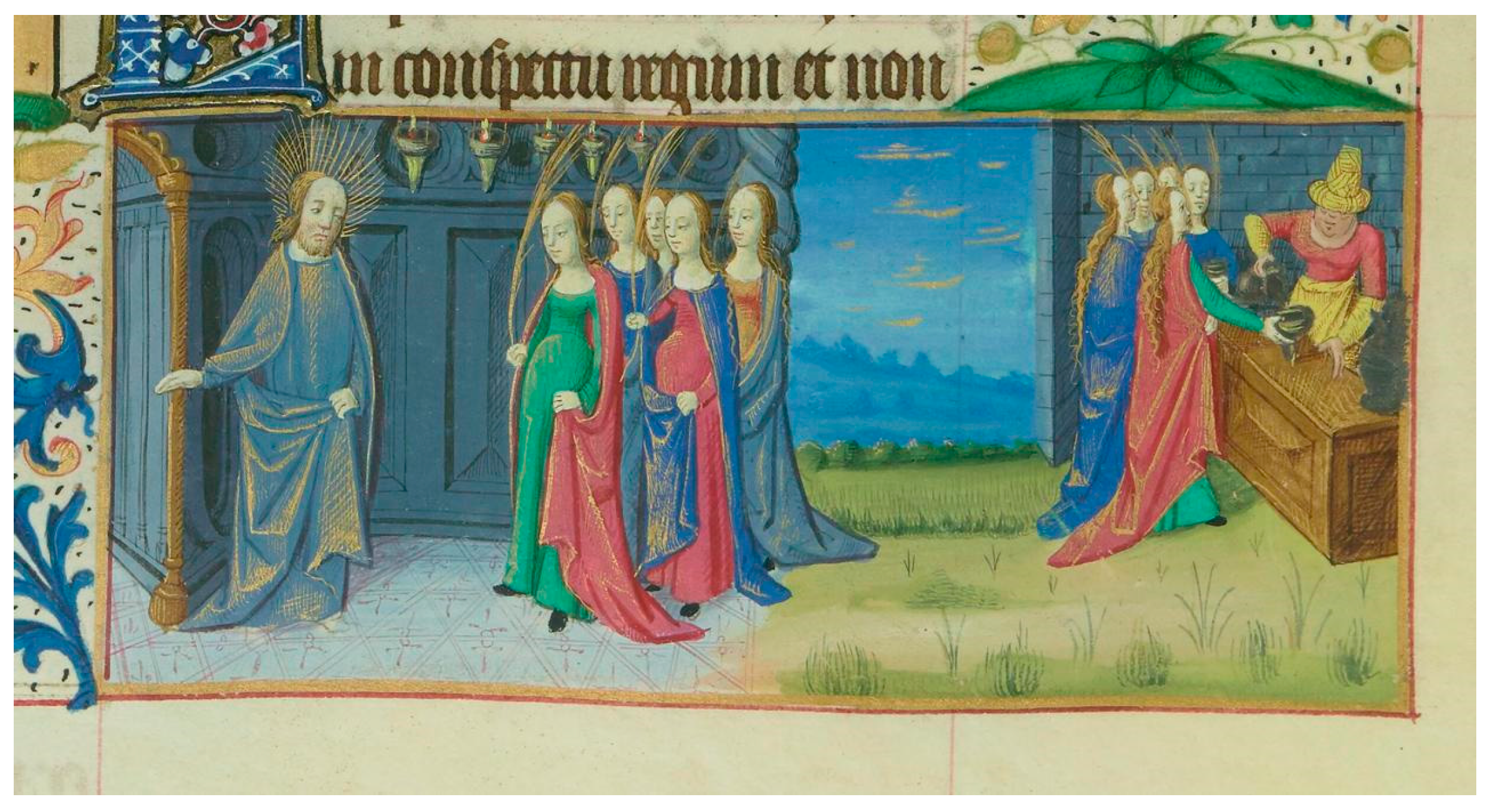
3. The Iconographic Motif of the Sale of Ointments
3.1. An Early Isolated Testimony
3.2. The Catalan–Occitan Group
3.3. Later Examples
4. Conclusions
Author Contributions
Funding
Institutional Review Board Statement
Informed Consent Statement
Data Availability Statement
Conflicts of Interest
Correction Statement
Appendix A. Synoptic Edition of Stanza I
Vic 105 |
| Catalonia and Occitanie |
Vic 187 |
Appendix B. Synoptic Edition of Stanzas II–V
Vic 105 |
| Catalonia and Occitanie |
Martène |
| Northwest |
Tours 927 |
SQ 86 |
DHaa 71 J 70 |
| Southern Bavarian Area and Black Forest |
Mü 4660a |
Mü 4660 |
SG Fragm. Fab. IV |
NY M 886 |
Vip IV (b) |
Vip IV (a) |
Vip XIV |
Ith 410 |
Bol I 51 |
Mü 7691 |
InnsK 1 rtr.m |
Vip III |
Vip VII |
InnsM 575 |
FBs 12 |
| Hesse–Thuringia Group |
FM 178 |
FM III 6 |
Be 757 |
Mühl 60/20 |
Inns 960 |
Be 1219 |
Ka 18 |
| Bohemia |
Wi 13427 |
PrU VIII G 29 (a) |
PrU VIII G 29 (b) |
PrU I B 12 |
Wro 226a |
PrU XVII E 1 (a) |
PrU XVII E 1 (b) |
Nürn 7060 |
Zwi 1 15 3 |
Zwi 36 1 24 (a–c) |
Eger B V 6 |
| Lower Saxony |
Hild 383 |
Wol VII B 203 |
Wol 965 |
TriS 1973/63 |
Appendix C. Synoptic Edition of the Refrain and Stanza IVα
Vic 105 |
| Catalonia and Occitanie |
Bar 911 |
Martène |
| Northwest |
Tours 927 |
DHaa 76 F 3 |
SQ 86 |
DHaa 71 J 70 |
| Southern Bavarian Area and Black Forest |
Mü 4660a |
Mü 4660 |
SG Fragm. Fab. IV |
NY M 886 |
Vip IV (b) |
Vip IV (a) |
Vip XIV |
Ith 410 |
Bol I 51 |
Karls D 137 |
InnsK 1 rtr.m |
Vip III |
Vip VII |
InnsM 575 |
| Hesse–Thuringia Group |
FM 178 |
FM III 6 |
Be 757 |
Mühl 60/20 |
Inns 960 |
Be 1219 |
Ka 18 |
| Bohemia |
PrU VIII G 29 (a) |
PrU VIII G 29 (b) |
PrU I B 12 |
Wro 226a |
PrU XVII E 1 (a) |
PrU XVII E 1 (b) |
Nürn 7060 |
Zwi 1 15 3 |
Zwi 36 1 24 (a–c) |
Eger B V 6 |
| Lower Saxony |
Hild 383 |
Wol VII B 203 |
Wol 965 |
TriS 1973/63 |
Appendix D. Synoptic Edition of Stanzas VI–VIII
Vic 105 |
| Catalonia and Occitanie |
Bar 911 |
| Northwest |
Tours 927 |
DHaa 76 F 3 |
SQ 86 |
DHaa 71 J 70 |
| Southern Bavarian Area and Black Forest |
Mü 4660a |
Mü 4660 |
SG Fragm. Fab. IV |
NY M 886 |
| Hesse–Thuringia Group |
FM 178 |
FM III 6 |
Be 757 |
Inns 960 |
Ka 18 |
| Bohemia |
Eger B V 6 |
| Lower Saxony |
Wol 965 |
Appendix E. Synoptic Edition of Stanza IX

Appendix F. Latin Stanzas Not Present in Vic 105 (The Source from Which the Reading Is Taken Is Indicated)
| Tours 927 | ||
| A. | Venite si | complacet emere |
| hoc unguentum | quod uellem uendere | |
| de quo bene | potestis ungere | |
| IVα. | corpus domini sacratum | |
| Mü 4660a | ||
| B. | Aromata | pretio querimus |
| corpus iesu | uolumus ungere | |
| aromata | sunt odorifera | |
| sepulture | xpisti memoria | |
| C. | Dabo uobis | ungenta optima |
| saluatoris | ungera uulnera | |
| sepulture | eius in memoriam | |
| et nomini | eius ad gloriam |
| Inns 960 | |
| D. | Heu nobis internas mentes |
| quanti pulsant gemitus | |
| pro nostra consolatione | |
| qua priuamur miseri | |
| quam crudelis iudeorum | |
| morte dedit populo | |
| E. | Iam percusso ceu pastore |
| oues errant miseri | |
| sic magistro discedente | |
| turbantur discipuli | |
| abque nobis eo absente | |
| dolor crescit nimius |
| F. | Sed eamus et ad eius |
| properemus tumulum | |
| si dileximus uiuentem | |
| diligamus mortuum | |
| et ungamus corpus eius | |
| o leo sanctissimo |
| G. | Ibant ibant tres mulieres |
| ihesum ihesum ihesum querentes | |
| maria jacobena maria cleophea et salomena | |
| re uemasti tu tres mulieres | |
| dare mihi narium | |
| dabo tibi sal salium |
| PrU VIII G 29 (a) | ||
| H. | Ad monumentum uenimus gementes | |
| angelum domini sedentem | uidimus et dicentem | |
| quia surrexit ihesus | ||
| (Cantus n.d., chant ID 850144) | ||
| PrU I B 12 | |
| J1. | Dum transisset |
| Et ualde mane una sabbatorum ueniunt ad monumentum orto iam sole | |
| (Intonation of Mc 16, 1–2) | |
| PrU XVII E 1 | |
| J2. | R. Dum transisset sabbatum maria magdalena et maria iacobi et salome emerunt aromata |
| Ut uenientes ungerent Jesum alleluia Alleluia | |
| ℣. Et ualde mane una sabbatorum ueniunt ad monumentum orto iam sole | |
| ℣. Gloria Patri et filio et spiritui sancto | |
| (Cantus n.d., chant ID 006565 and 006565a) | |
| K. | Leta Syon laudans plaude |
| renouata terra gaude | |
| agens deo gracias |
| L. | Veni desiderate |
| ueni xpiste amate | |
| ueni patris gloria | |
| ueni sanctorum corona |
| M. | Quis est iste qui uenit cum gloria |
| cum quo sanctorum copia | |
| peragi [sic] at [sic] celi palacia |
| Zwi 36 1 24 | |
| O. | Ihesu nostra redempcio |
| amor et desiderium | |
| deus creator omnium | |
| homo in fine temporum | |
| P. | Que te uicit clemencia |
| ut ferres nostra crimina | |
| crudelem mortem paciens | |
| ut nos ab hoste tolleres |
| Q. | Inferni claustra penetrans |
| tuos captiuos redimens | |
| uictor triumpho nobili | |
| ad dextram patris residens |
| Eger B V 6 | |
| S. | Nuper ueni de studio |
| scio quod tota regio | |
| mihi coequalem | |
| nescit nec habet talem | |
| hoc loquor sine fraude | |
| sed tamen ficta laude | |
| Wol VII B 203 | |
| T. | Heu uerus pastor occidit |
| quem culpa nulla infecit | |
| O mors plangenda | |
| U. | Heu nequam gens iudaica |
| innocentis homicida | |
| O gens damnanda |
| V. | Heu quid agemus misere |
| dulci magistro orbate | |
| O mors lacrimanda |
| W. | Hinc eamus |
| ut ungamus | |
| Condimentis | |
| Dormientis | |
| caraem sanctam xpisti |
| DHaa 76 F 3 | |
| X. | Femine quid gemitis |
| quid gementes queritis | |
| et sic hic preceditis | |
| et ex hiis non emitis | |
| rebus aromaticis | |
| sepulture debitis. | |
| Nostrum solatium heu | |
| Y. | Ihesu nostra redempcio |
| Z. | Ista pixis nobile | continet ungentum |
| ista cui simile | non est adimentum | |
| si quis huius | tercie deferat ungentum | |
| auri dabit integrum | marcam aut talentum | |
| Tibi dabimus heu | ||
Appendix G. Archival Souces
| Sigla | RISM Sigla | Signature | Provenance | Century | Typology | Area |
| Bar 662 | E–Bbc 662 | Barcelona, Biblioteca de Catalunya, M. 662 | Barcelona | 14/15 | Antiphonary | Catalonia and Occitanie |
| Bar 706 | E–Bbc 706 | Barcelona, Biblioteca de Catalunya, M. 662 | Catalunya | 14/15 | Antiphonary | Catalonia and Occitanie |
| Bar 911 | E–Bbc 911 | Barcelona, Biblioteca de Catalunya, M. 911, frag. f. 156 | Girona, Seu Sta. Maria | 13/14 | Troper–Proser | Catalonia and Occitanie |
| BarAm 381 | E–Bac m. 381 | Barcelona, Arxiu de la Corona d’Aragó, Monacales 381 (Cod. Varia. VIII) | Girona (Col·legiata St. Feliu?) | 12 | Antiphonary | Catalonia and Occitanie |
| BarFC s/n | E–Bcapdevila s/n | Barcelona, Felipe Capdevila Rovira, colección privada, Ms. s/n | Tarragona, Seu Sta. Tecla | 1568 (16m) | Processional | Catalonia and Occitanie |
| BarO s/n | E–Boc s/n | Barcelona, Centre de Documentació de l’Orfeó Català, Ms. s/n | Sant Joan de les Abadesses, Monestir St. Joan de les Abadesses | 1425 (15i) | Processional | Catalonia and Occitanie |
| Be 757 | D–B 757 | Berlin, Staatsbibliothek zu Berlin—Preußischer Kulturbesitz, Cod. germ. fol. 757 [Fragment] | Thuringia | 14 | Berliner Thuringian Easter Play | Hesse–Thuringia Group |
| Be 1219 | D–B 1219 | Berlin, Staatsbibliothek zu Berlin—Preußischer Kulturbesitz, Cod. germ. fol. 1219 | Mainz area | 1460 (15m) | Dirigierrolle of the Mainz Easter Play | Hesse–Thuringia Group |
| Bol I 51 | I–BZf I 51 | Bolzano, Biblioteca del Convento dei padri Francescani, Cod. I 51 | Bolzano (Tirol) | 1495 (15x) | Bolzano Passion Play | Southern Bavarian Area and Black Forest |
| DHaa 71 J 70 | NL–DHk 71 J 70 | Den Haag, Koninklijke Bibliotheek, ms. 71 J 70 | Egmond–Binnen, Benedictijnerabdij St. Adalbert | 15 | Hymnary | Northwest |
| DHaa 76 F 3 | NL–DHk 76 F 3 | Den Haag, Koninklijke Bibliotheek, ms. 76. F. 3 | Maastricht, St. Servaasbasiliek > Delft, St. Hippolytus–Kerk | 12x/13i | Evangeliary | Northwest |
| Eger B V 6 | H–EG B V 6 | Eger, Főegyházmegyei Könyvtár, Cod. B. V. 6 (olim 772–774) | Eger (Bohemia) | 1563 (16m) | Eger Passion Play | Bohemia |
| FBs 12 | D–FRsa 12 | Freiburg im Breisgau, Stadtarchiv, B 1 (H) Nr. 12 | Freiburg im Breisgau, Münsterplatz | 1599 (16x) | Freiburg Passion Play | Southern Bavarian Area and Black Forest |
| FM 178 | D–F 178 | Frankfurt am Main, Universitätsbibliothek Johann Christian Senckenberg, ms. Barth. 178 (Ausst. 29) | Frankfurt am Main | 14i | Dirigierrolle of the Frankfurt Passion Play | Hesse–Thuringia Group |
| FM III 6 | D–F germ. III 6 | Frankfurt am Main, Universitätsbibliothek Johann Christian Senckenberg, fragm. germ. III 6 | Frankfurt am Main | 14i | Frankfurt Passion Play | Hesse–Thuringia Group |
| Ger 20 e 3. | E–G 20 e 3 | Girona, Arxiu Capitular de la Catedral, ms. 20–e–3 (olim 9) | Girona, Seu Sta. Maria | 1356–1360 (14m) | Customary | Catalonia and Occitanie |
| Ger s/n | E–G s/n | Girona, Arxiu Capitular de la Catedral, s/n | Girona, Seu Sta. Maria | 1528–1539 (16im) | Chapter charters | Catalonia and Occitanie |
| GerS 18 | E–Gs 18 | Girona, Arxiu diocesà i Biblioteca diocesana del Seminari, Col·legiata de Sant Feliu, ms 18 (olim 158) | Girona, Col·legiata St. Feliu | 15im | Customary | Catalonia and Occitanie |
| GerS 45 | E–Gs 45 | Girona, Arxiu diocesà i Biblioteca diocesana del Seminari, Col·legiata de Sant Feliu, ms 45 (olim 20) | Girona, Col·legiata St. Feliu | 12 | Antiphonary | Catalonia and Occitanie |
| Hild 383 | D–His 383 | Hildesheim, Stadtarchiv, ms. Mus. 383 | Bad Bevensen (Lüneburg), Zisterzienserinnenkloster Medingen | 1320ca (14i) | Prayer book | Lower Saxony |
| Inns 960 | A–Iu 960 | Innsbruck, Universitäts– und Landesbibliothek Tirol, cod. 960 | Schmalkalden, Kollegiatstift St. Egidius? | 1391 (14x) | Neustift–Innsbruck Play | Hesse–Thuringia Group |
| InnsK 1 rtr.m | A–Iadk 1 rtr.m | Innsbruck, Provinzarchiv der Kapuzinerprovinz Österreich-Südtirol, Ms. Liturg. 1 rtr.m (olim Feldkirch, Bibl. des Kapuzinerklosters, Ms. Liturg. 1 rtr.m) | Benediktbeuern–Peißenberg–Schongau area | 16i | Processional [Augsburg (Feldkirch) Easter Play] | Southern Bavarian Area and Black Forest |
| InnsM 575 | A–Imf 575 | Innsbruck, Tiroler Landesmuseum Ferdinandeum, Musiksammlung, 575 (V2.p.18) | Bressanone (Tirol) | 1551 (16m) | Bressanone Passion Play | Southern Bavarian Area and Black Forest |
| Ith 410 | US–I 410 | Ithaca (N.Y.), Cornell University Library, Archives 4600 Bd. Ms. 410 (olim MS F 6) | Bolzano (Tirol) | 15x (1494–1595) | Bozner Passion Play | Southern Bavarian Area and Black Forest |
| Ka 18 | D–Kl 18 | Kassel, Landesbibliothek und Murhardsche Bibliothek der Stadt Kassel, 2° Ms. poet. et roman. 18 | Friedberg/Alsfeld | 16i (1501–1517) | Alsfeld Passion Play | Hesse–Thuringia Group |
| Karls D 137 | D–KA D 137 | Karlsruhe. Badische Landesbibliothek, Cod. Donaueschingen 137 | Donaueschingen | 15mx | Donaueschingen Passion Play | Southern Bavarian Area and Black Forest |
| Klos 574 | A–KN 574 | Klosterneuburg, Augustiner–Chorherrenstift, Bibliothek, Cod. 574 | Klosterneuburg, Augustiner–Chorherrenstift St. Mariä Geburt | 13i | Miscellany | Southern Bavarian Area and Black Forest |
| Martène | Edmond Martène. 1736. De antiquis Ecclesiae ritibus libri tres. Antwerpen: J. B. de La Bry, from an Ordinarium from Narbonne, which is no longer locatable | Narbonne, Cathédrale St. Just–et–St. Pasteur | 14/15 | Ordinary | Catalonia and Occitanie | |
| Mü 4660 | D–Mbs 4660 | München, Bayerische Staatsbibliothek, clm 4660 | Seckau, Augustiner–Chorherrenstift BMV | 1230ca (13i) | Carmina Burana | Southern Bavarian Area and Black Forest |
| Mü 4660a | D–Mbs 4660a | München, Bayerische Staatsbibliothek, clm 4660a | Seckau, Augustiner–Chorherrenstift BMV | 1230ca (13i) | Carmina Burana (fragmenta) | Southern Bavarian Area and Black Forest |
| Mü 7691 | D–Mbs 7691 | München, Bayerische Staatsbibliothek, clm 7691, Brevier des, 1496 | Indersdorf, Augustiner–Chorberrnstifts Maria Himmelfahrt, St. Peter und St. Paul | 1496 (15x) | Breviary | Southern Bavarian Area and Black Forest |
| Mü 13601 | D–Mbs 13601 | München, Bayerische Staatsbibliothek, clm 13601 | Regensburg, Kanonissenstift Niedermünster | 11i | Evangeliary | Southern Bavarian Area and Black Forest |
| Mühl 60/20 | D-MLHr 60/20 | Mühlhausen, Stadtarchiv, Ms. 60/20 (olim 87/20) | Eisenach (Thüringen) | 1350–1371 (14m) | Thuringian Play of the Ten Virgins | Hesse–Thuringia Group |
| Nürn 7060 | D–Ngm 7060 | Nürnberg, Germanisches National–Museum, Hs. 7060 | Eger (Bohemia) | 15x/16i (1500ca) | Eger Play | Bohemia |
| NY M 87 | US–NYpm M 87 | New York, The Morgan Library & Museum, MS M 87 | Egmond–Binnen, Benedictijnerabdij St. Adalbert | 1440ca | Breviary | Northwest |
| NY M 886 | US–NYpm M 886 | New York, The Morgan Library & Museum, MS M 886 [Fragment] | Melk, Benediktinerstift St. Peter und St. Paul | 15im (1430ca) | Mercatores Play | Southern Bavarian Area and Black Forest |
| Pa 873 | F–Pn 873 | Paris, Bibliothèque Nationale, ms. lat. 873 | Poitiers, Abbaye St. Jean de Montierneuf | 15m/x | Missal | Catalonia and Occitanie |
| Pa 1139 | F–Pn 1139 | Paris, Bibliothèque Nationale, ms. lat. 1139 | Limoges, Abbaye St. Martial | 11x + 12/13 | Troper-Proser/Miscellany | Southwest |
| Pa 1309 | F–Pn 1309 | Paris, Bibliothèque Nationale, ms. lat. 1309 | Girona, Seu Sta. Maria | 1457 (15x) | Breviary | Catalonia and Occitanie |
| Pa nal 903 | F–Pn nal 903 | Paris, Bibliothèque Nationale, ms. nouv. acq. lat. 903 | Vic, Seu St. Pere | 14 | Customary | Catalonia and Occitanie |
| PrU I B 12 | CZ–Pu I B 12 | Praha, Národní knihovna Ceské republiky, Cod. I B 12 (cat. 68) | Praha, Katedrála sv. Víta, Václava a Vojtěcha | 1384 (14x) | Easter Play | Bohemia |
| PrU VI G 10a | CZ–Pu VI G 10a | Praha, Národní knihovna Ceské republiky, Cod. VI G 10a (cat. 1175) | Praha, Bazilika–Klášter sv. Jiří | 13/14 | Processional Antiphonary | Bohemia |
| PrU XIII E 14d | CZ–Pu XIII E 14d | Praha, Národní knihovna Ceské republiky, Cod. XIII E 14d (cat. 1175) | Praha, Bazilika–Klášter sv. Jiří | 14 | Ordinary | Bohemia |
| PrU XIII H 3c | CZ–Pu XIII H 3c | Praha, Národní knihovna Ceské republiky, Cod. XIII H 3c (cat. 2396) | Praha, Bazilika–Klášter sv. Jiří | 14 | Processional | Bohemia |
| PrU XII E 15a | CZ–Pu XII E 15a | Praha, Národní knihovna Ceské republiky, Cod. XII E 15a (cat. 2182) | Praha, Bazilika–Klášter sv. Jiří | 14i | Processional | Bohemia |
| PrU VI G 3b | CZ–Pu VI G 3b | Praha, Národní knihovna Ceské republiky, Cod. VI G 3b (cat. 1167) | Praha, Bazilika–Klášter sv. Jiří | 14 | Processional Antiphonary | Bohemia |
| PrU VII G 16 | CZ–Pu VII G 16 | Praha, Národní knihovna Ceské republiky, Cod. VII G 16 (cat. 1363) | Praha, Bazilika–Klášter sv. Jiří | 14 | Processional Antiphonary | Bohemia |
| PrU VIII G 29 | CZ–Pu VIII G 29 | Praha, Národní knihovna Ceské republiky, Cod. VIII G 29 (Y.II.5.n. 5.) (cat. 1611–1612) | Praha, Katedrála sv. Víta, Václava a Vojtěcha | 14 | Easter Play | Bohemia |
| PrU XVII E 1 | CZ–Pu XVII E 1 | Praha, Národní knihovna Ceské republiky, Cod. XVII E 1 (olim Y.III.3.n.53) (cat. 177) | Bohemia | 15 | Easter Play | Bohemia |
| SG Fragm. Fab. IV | CH–SGsap fragm. fab. IV | Sankt Gallen, Stiftsarchiv (Abtei Pfäfers), Fragm. Fab. IV | Pfäfers, Benediktinerabtei BMV (Kanton Sankt Gallen) | 14i | Passion Play | Southern Bavarian Area and Black Forest |
| SQ 86 | F–SQ 86 | Saint–Quentin, Médiathèque Guy de Maupassant, ms. 86 | Origny, Abbaye Ste. Benoite | 1315–1317 (14i) | Ordinary | Northwest |
| Tar 84 | E–TAha 84 | Tarragona, Arxiu Històric Arxidiocesà, Ms. 84 | Tarragona, Seu Sta. Tecla | 14 | Customary | Catalonia and Occitanie |
| Tar s/n | E–TAha s/n | Tarragona, Arxiu Històric Arxidiocesà, Inc. s/n | Tarragona, Seu Sta. Tecla | 1485–1486 (15x) | Breviary (Patriarch Pere d’Urrea) | Catalonia and Occitanie |
| Tours 927 | F–TOm 927 | Tours, Bibliothèque municipale, ms. 927 | Norman/Angevin milieu | 13 | Miscellany | Northwest |
| TriS 1973/63 | D–TRs 1973/63 | Trier, Stadtbibliothek Weberbach, Hs. 1973/63 4º | Trier | 15m (1450ca) | Trier Easter Play | Lower Saxony |
| Vic 85 | E–VI 85 | Vic, Arxiu i Biblioteca Episcopal, Cod. 85 | Vic, Seu St. Pere | 1398 (14x) | Breviary | Catalonia and Occitanie |
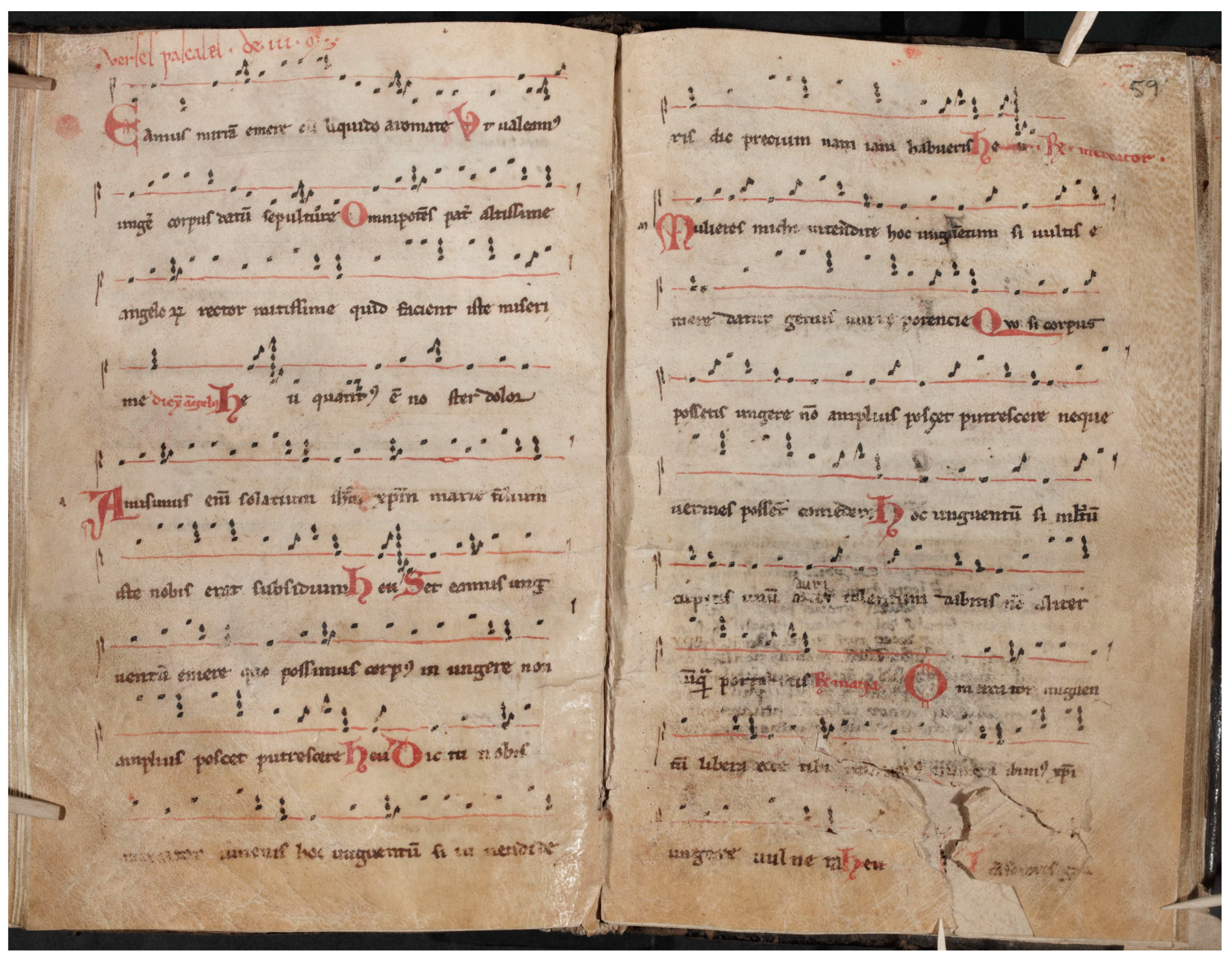
| Vic 105 | E–VI 105 | Vic, Arxiu i Biblioteca Episcopal, Cod. 105 (olim CXI) | Vic, Seu St. Pere | 12i [add. 12x and 13i] | Troper–Proser | Catalonia and Occitanie |
| Vic 117 | E–VI 117 | Vic, Arxiu i Biblioteca Episcopal, Cod. 117 (olim CXXIV) | Vic, Seu St. Pere | 1278–1318 (13x/14i) | Processional | Catalonia and Occitanie |
| Vic 118 | E–VI 118 | Vic, Arxiu i Biblioteca Episcopal, Cod. 118 | L’Estany, Monestir–canònica agustiniana Sta. Maria | 14m | Processional | Catalonia and Occitanie |
| Vic 134 | E–VI 134 | Vic, Arxiu i Biblioteca Episcopal, Cod. 134 (olim LXXXIV) | Vic, Seu St. Pere | 1216–1228 (13im) | Customary (by Andreu s’Almunia, d. 1234) | Catalonia and Occitanie |
| Vic 187 | E–VI 187 | Vic, Arxiu i Biblioteca Episcopal, Cod. 187 | Vic, Seu St. Pere | 1445 (15m) | Easter Play (Representació del Centurió) | Catalonia and Occitanie |
| Vic s/n | E–VI s/n | Vic, Arxiu i Biblioteca Episcopal, Cod. s/n | Vic, Seu St. Pere | 1413 (15i) | Customary/Chapter charters | Catalonia and Occitanie |
| Vic XVIII 13 | E–VI XVIII 13 | Vic, Arxiu i Biblioteca Episcopal, Fragments XVIII, n. 13 [Fragment] | Vic, Seu St. Pere | 14 | Antiphonary | Catalonia and Occitanie |
| Vip III | I–VIPbc III | Vipiteno, Biblioteca Civica, Cod. III | Bolzano (Tirol) | 1514 (16i) | Vigil Raver’s Passion Play | Southern Bavarian Area and Black Forest |
| Vip IV | I–VIPbc IV | Vipiteno, Biblioteca Civica, Cod. IV | Bolzano (Tirol) | 15mx | Bolzano Passion Play | Southern Bavarian Area and Black Forest |
| Vip VII | I–VIPbc VII | Vipiteno, Biblioteca Civica, Cod. VII | Tirol (Bolzano?) | 1520 (16i) | Tirol Passion Play | Southern Bavarian Area and Black Forest |
| Vip XIV | I–VIPbc XIV | Vipiteno, Biblioteca Civica, Cod. XIV (XVI) | Vipitieno (Tirol) | 1486 (15x) | Lienhart Pfarrkircher’s Passion Play (Church Provost in Vipiteno) | Southern Bavarian Area and Black Forest |
| Wi 13427 | A–Wn 13427 | Wien, Österreichische Nationalbibliothek, Cod. 13427 | Praha, Katedrála sv. Víta, Václava a Vojtěcha | 1334–1366 (14m) | Breviary | Bohemia |
| Wol 965 | D–W 965 | Wolfenbüttel, Herzog August Bibliothek, Cod. Guelf. 965 Helmst. (Heinemann–Nr. 1067) | Braunschweig (Brunswick) Kollegiatstift St. Cyriacus? | 15 | Miscellany | Lower Saxony |
| Wol VII B 203 | D–Wa VII B 203 | Wolfenbüttel, Niedersächsisches Landesarchiv – Standort Wolfenbüttel, VII B Hs, Nr. 203 | Braunschweig (Brunswick) Kollegiatstift St. Cyriacus | 1314 (14i) | Lectionary | Lower Saxony |
| Wro 226a | PL–WRu 226a | Wroclaw, Bibliotheka Uniwersytecka, MS I Q 226a [Fragment] | Wroclaw | 14x/15i | Wroclaw/Breslau Easter Play | |
| Würz s/n | D–WÜubs s/n | Würzburg, Universitätsbibliothek, Bruno Stäblein Archiv, s/n | Vic, Seu St. Pere | 1278–1318 (13x/14i) | Processional | Catalonia and Occitanie |
| Zwi 1 15 3 | D–Z 1 15 3 | Zwickau, Ratsschulbibliothek, 15.1.3 (olim ms. I XV 3) | Jächymov, Latinské školy | 1520–1523 (16i) | Collection of plays by Rector Stephan Roth for the Latin School | Bohemia |
| Zwi 36 1 24 | D–Z 36 1 24 | Zwickau, Ratsschulbibliothek, 36.1.24 (olim ms. XXXVI I 24) | Jächymov, Latinské školy | 1520–1523 (16i) | Collection of plays by Rector Stephan Roth for the Latin School | Bohemia |
| 1 | From the perspective of strictly poetic diction, the cadence of the second verse would be 8pp (arómate) with an iambic rhythm. However, it is the melodic configuration itself—marked by a pressus on “cum” and a pes subpunctis resupinus emphasizing the syllable “a–”—that shifts the accent to a trochee (cúm liquído áromáte), thereby aligning it with the fourth verse of the stanza, which obviously repeats the same melody. |
| 2 | Dante Alighieri. De vulgari eloquentia, II, X, 4. (Squarotti et al. 1983, p. 512). |
| 3 | An interesting and thorough melodic analysis can be found in (Eberle 2023). |
| 4 | We refer to the most recent references cited in the Introduction for access to an extensive bibliography. |
| 5 | Some of the capitals attributed to this monastery, which was plundered in the 19th century, are now preserved in various museums, including the Museum of Art in Girona, the Castle Museum of Peralada, and the aforementioned Cluny Museum in Paris. |
| 6 | We would like to express our sincere gratitude to Miss Nadia Smirnova, art historian and researcher at the Complutense University of Madrid, for her generosity in providing this reference. |
References
- Abajo Vega, Noemí. 2005. Arte románico y teatro litúrgico: Las posibilidades de un método en el estudio de la iconografía. Codex aquilarensis: Cuadernos de investigación del Monasterio de Santa María la Real 21: 108–31. [Google Scholar]
- Amstutz, Renate. 2002. Ludus de Decem Virginibus. In Recovery of the Sung Liturgical Core of the Thuringian Zehnjungfrauenspiel. Toronto: Pontifical Institute of Mediaeval Studies. [Google Scholar]
- Anglès, Higini. 1935. La Música a Catalunya fins al Segle XIII. Barcelona: Institut d’Estudis Catalans/Biblioteca de Catalunya. [Google Scholar]
- Arlt, Wulf. 1986. Nova cantica. Grundsätzliches und Spezielles zur Interpretation musikalischer Texte des Mittelalters. Basler Jahrbuch für historische Musikpraxis 10: 13–62. [Google Scholar]
- Arlt, Wulf. 1990. Das eine Lied und die vielen Lieder. Zur historischen Stellung der neuen Liedkunst des frühen 12. Jahrhunderts. In Festschrift Rudolf Bockholdt zum 60. Geburtstag. Edited by Norbert Dubowy and Sören Meyer-Eller. Pfaffenhofen: Ludwig, pp. 113–27. [Google Scholar]
- Avalle, Arco Silvio, and Raffaello Monterosso, eds. 1965. Sponsus: Dramma delle Vergini Prudenti e delle Vergini Stolte. Milano: R. Ricciardi. [Google Scholar]
- Batoff, Melanie Laura. 2013. Re-Envisioning the Visitatio Sepulchri in Medieval Germany: The Intersection of Plainchant, Liturgy, Epic, and Reform. Ph.D. thesis, University of Michigan, Ann Arbor, MI, USA. [Google Scholar]
- Berthold, Margot. 1972. A History of World Theater. New York: Frederick Ungar Publishing. [Google Scholar]
- Bonastre i Bertran, Francesc. 1982. Estudis sobre la Verbeta: (La Verbeta a Catalunya durant els Segles xi–xvi). Tarragona: Publicacions de la Diputació de Tarragona. [Google Scholar]
- Camprubí Vinyals, Adriana. 2020. Repertorio Métrico y Melódico de la Nova Cantica (Siglos XI, XII y XIII). De la Lírica Latina a la Lírica Románica, 2 Vols. Ph.D. thesis, Universitat Autònoma de Barcelona, Barcelona, Spain. [Google Scholar]
- Cantus. n.d. Available online: https://cantus.uwaterloo.ca (accessed on 15 March 2024).
- Castro Caridad, Eva. 1989. El texto y la función litúrgica del “Quem Quaeritis” Pascual en la Catedral de Vic. Hispania Sacra 41: 399–420. [Google Scholar]
- Castro Caridad, Eva. 1997. Teatro Medieval 1. El Drama Litúrgico. Barcelona: Crítica. [Google Scholar]
- Castro Caridad, Eva. 2019. Els Drames Litúrgics Pascuals a La Catedral De Vic. In La Catedral de Sant Pere de Vic. Edited by Marta Crispí, Sergio Fuentes and Judith Urbano. Montserrat: Publicacions de l’Abadia de Montserrat, pp. 141–50. [Google Scholar]
- Cohen, Adam S. 2000. The Uta Codex. Art, Philosophy, and Reform in Eleventh-Century Germany. University Park: Pennsylvania State University Press. [Google Scholar]
- De Boor, Helmut. 1967. Die Textgeschichte der Lateinishen Osterfeiern. Tübingen: Niemayer. [Google Scholar]
- Donovan, Richard. 1958. The Liturgical Drama in Medieval Spain. Toronto: Pontifical Institute of Medieval Studies. [Google Scholar]
- Dreves, Guido Maria, Clemens Blume, and Henry Marriott Bannister. 1886. Analecta Hymnica Medii Aevi. Leipzig: O. R. Reisland, vol. 55. [Google Scholar]
- Dronke, Peter. 1994. Nine Medieval Latin Plays. Cambridge: Cambridge University Press. [Google Scholar]
- Dürre, Konrad. 1915. Die Mercatorszene im Lateinisch-Liturgischen Altdeutschen und Altfranzösischen Religiösen Drama. Ph.D. thesis, Georg-August-Universität Göttingen, Göttingen, Germany. [Google Scholar]
- Eberle, Michael. 2019. Eamus mirram emere: Der Musikalische Beitrag zu Ritualität und Theatralität in den Frühen Osterfeiern von Vic. Master’s thesis, Universität Hamburg, Hamburg, Germany. [Google Scholar]
- Eberle, Michael. 2023. Von “veniunt” zu “eamus”. Zur semantischen Funktion der Melodien im frühen Osterspiel. Kirchenmusikalisches Jahrbuch 107: 7–19. [Google Scholar]
- Evers, Ute, and Johannes Janota, eds. 2013. Die Melodien der Lateinischen Osterfeiern: Editionen und Kommentare. Berlin and Boston: De Gruyter. [Google Scholar]
- Garrigosa i Massana, Joaquim. 2003. Els Manuscrits Musicals a Catalunya fins al Segle XlII (L’evolució de la Notació Musical). Lleida: Institut d’Estudis IIerdencs. [Google Scholar]
- González Montañés, Julio I. 2002. Drama e Iconografía en el Arte Medieval Peninsular (siglos XI–XV). Ph.D. thesis, Universidad Nacional de Educación a Distancia, Madrid, Spain. [Google Scholar]
- Gros i Pujol, Miquel S. 1999. Els Troper Prosers de la Cathedral de Vic: Estudi i Edició. Barcelona: Institut d’Estudis Catalans. [Google Scholar]
- Gros i Pujol, Miquel S., ed. 2010. Troparium Prosarium Ecclesiae Cathedralis Vicensis: Edició Facsimilar Monocroma amb Introducció i Índexs. Barcelona: Institut d’Estudis Catalans. [Google Scholar]
- Hofmann, Sigfrid. 1972. Salbenkauf der Frauen. In Lexikon der christlichen Ikonographie, Vol. 4. Allgemeine Ikonographie. Edited by Engelbert Kirschbaum. Rome, Freiburg, Basel and Vienna: Herder. [Google Scholar]
- Katritzky, M. A. 2007. Text and Performance. Medieval Religious Stage Quacks and the Commedia dell’Arte. In Transformationen des Religiösen: Performativität und Textualität im geistlichen Spiel. Edited by Ingrid Kasten and Erika Fischer-Lichte. Berlin and New York: Walter de Gruyter, pp. 99–126. [Google Scholar]
- Katritzky, M. A. 2018. Les représentations du charlatan pendant la première modernité, et leur origine dans la scène du marchand du théâtre religieux. In Théâtre et Charlatans dans l’Europe Moderne. Edited by Beya Dhraïef, Éric Négrel and Jennifer Ruimi. Paris: Presses Sorbonne Nouvelle, pp. 99–116. [Google Scholar]
- Katritzky, M. A. 2020. The Itinerant Healer as a Stage Role: Its Origins in Religious Drama. In Enacting the Bible in Medieval and Early Modern Drama. Edited by Eva von Contzen and Chanita Goodblatt. Manchester: Manchester University Press, pp. 81–103. [Google Scholar] [CrossRef]
- Kurmann, Peter. 2016. Le Saint-Sépulcre de Constance du XIIIe siècle, réceptacle eucharistique au service du “pèlerinage intérieur”. Reti Medievali Rivista 17: 399–416. [Google Scholar]
- Lipphardt, Walther. 1975–1990. Lateinischen Osterfeiern und Osterspiele. Berlin: De Gruyter, vol. 9. [Google Scholar]
- Llewellyn, Jeremy. 2018. Nova Cantica. In The Cambridge History of Medieval Music. Edited by Mark Everist and Thomas Forrest Kelly. Cambridge: Cambridge University Press, I, vol. 2, pp. 147–75. [Google Scholar]
- Lorés i Otzet, Imma. 1986. L’escena de la venda de perfums en la visita de les Maries al Sepulcre i el drame litúrgic pasqual. In Lambard. Estudis d’Art Medieval. Barcelona: Amics de l’Art Romànic. Institut d’Estudis Catalans, vol. 2, pp. 129–38. [Google Scholar]
- Lorés i Otzet, Imma. 1991. El monestir de Sant Cugat del Vallès. Escultura del claustre i de l’església. In Catalunya Romànica, XVIII. El Vallès Occidental. El Vallès Oriental. Barcelona: Enciclopèdia Catalana, pp. 169–82. [Google Scholar]
- Lorés i Otzet, Imma. 1994. El Claustre Romànic de Sant Pere de Rodes: de la Memòria a les Restes Conservades: Una Hipòtesi Sobre la Seva Composició Escultórica. Lleida: Universitat de Lleida. [Google Scholar]
- MacDonald, Aileen Ann. 1996. The Role of Mary Magdalene in the Provençal Passion Play and the Influence of the Magdalene Cult in Occitania. In Formes Teatrals de la Tradició Medieval. Actes del VII Col·loqui de la Société Internationale pour l’Etude du Théâtre Médiéval (Gerona, Julio de 1992). Barcelona: Institut del Teatre, Diputació de Barcelona, pp. 137–44. [Google Scholar]
- MacDonald, Aileen Ann. 1997. The Catalan-Occitan Easter Play. Romania 459–60: 495–518. [Google Scholar] [CrossRef]
- McShane, Margaret Mary. 1961. The Music of Medieval Liturgical Drama. Ph.D. thesis, Catholic University of America, Washington, DC, USA. [Google Scholar]
- Meyer, Wilhelm. 1901. Fragmenta Burana (Festschrift zur Feier des hundertfünfzigjährigen Bestehens der Königlichen Gesellschaft der Wissenschaften zu Göttingen). Berlin: Weidmann. [Google Scholar]
- Moore, Marie Dolores. 1971. The “Visitatio Sepulchri” of the Medieval Church: A Historical, Geographical, and Liturgical Survey. Ph.D. thesis, University of Rochester, Rochester, NY, USA. [Google Scholar]
- Nicoll, Allardyce. 1931. Masks, Mimes and Miracles: Studies in the Popular Theatre. London: G.G. Harrap. [Google Scholar]
- Norton, Michael Lee. 1983. The Type II Visitatio Sepulcri. A Repertorial Study. Ph.D. thesis, Ohio State University, Columbus, OH, USA. [Google Scholar]
- Norton, Michael Lee. 2017a. Liturgical Drama and the Reimagining of Medieval Theater. Kalamazoo: Medieval Institute Publications. [Google Scholar]
- Norton, Michael Lee. 2017b. Observations on the Tours Ludus Paschalis. In The Jeu d’Adam. MS Tours 927 and the Provenance of the Play. Edited by Christophe Chaguinian. Kalamazoo: Medieval Institute Publications, pp. 177–258. [Google Scholar]
- Peláez Bilbao, Patricia, and Arturo Tello Ruiz-Pérez. 2021. Hacia un concepto de la secuencia (o prosa) litúrgica medieval. Cuadernos de Música Iberoamericana 34: 431–91. [Google Scholar] [CrossRef]
- Peláez Bilbao, Patricia, and Arturo Tello Ruiz-Pérez. 2024. Visum et non visum en dos versus aquitanos de París, BnF lat. 3719c. In Enfermedad, Muerte y Trascendencia del Cuerpo en el Medievo. Madrid: La Ergástula, [forthcoming]. [Google Scholar]
- Petersen, Nils Holger. 2022. Framing Medieval Latin Liturgy through the Marginal. Religions 13: 95. [Google Scholar] [CrossRef]
- Rankin, Susan K. 1981. The Mary Magdalene Scene in the “Visitatio Sepulchri” Ceremonies. Early Music History 1: 227–55. [Google Scholar] [CrossRef]
- Rankin, Susan K. 1989. The Music of the Medieval Liturgical Drama in France and England. New York: Garland, vol. 2. [Google Scholar]
- Réau, Louis. 1957. Iconographie de l’art Chrétien. Vol. 2/2: Iconographie de la Bible. Nouveau Testament. Paris: Presses Universitaires de France. [Google Scholar]
- Romeu Figueras, José. 1963. Teatro Hispánico del Periodo Románico. Una Experiencia de Rehabilitación. Estudios Escénicos 9: 7–70. [Google Scholar]
- Salet, Francis. 1959. Chapiteaux catalans conservés au Musée de Cluny. In Congrés Archéologique de France, Catalogne. Paris: Société Française d’Archéologie, pp. 225–28. [Google Scholar]
- Schlier, Heinrich. 2008. On the Resurrection of Jesus Christ. Rome: 30Giorni. [Google Scholar]
- Schuler, Ernst August. 1951. Die Musik der Osterfeiern, Osterspiele und Passionen des Mittelalters. Kassel and Basel: Bärenreiter. And Die Musik der Osterfeiern, Osterspiele und Passionen des Mittelalters. Teil 2: Die Gesänge in Noten Übertragen. Ph.D. thesis, Universität Basel, Basel, Switzerland. [Google Scholar]
- Sevestre, Nicole. 1987. Le marchand dans le théâtre liturgique des XIIe et XIIIe siècles. Revue de Musicologie 73: 39–59. [Google Scholar] [CrossRef]
- Smoldon, William L. 1980. The Music of the Medieval Church Dramas. Edited by Cynthia Bourgeault. London: Oxford University Press. [Google Scholar]
- Squarotti, Giorgio Barberi, Sergio Cecchin, Angelo Jacomuzzi, and Maria Gabriella Stassi, eds. 1983. Dante Alighieri. Tutte le Opere (Vol. 2.1). Opere Minori. Vita Nuova, De Vulgari Eloquentia, Rime, Ecloge. Torino: UTET. [Google Scholar]
- Switten, Margaret Louise. 1985. The Cansos of Raimon de Miraval. A Study of Poems and Melodies. Cambridge: The Medieval Academy of America. [Google Scholar]
- Tello Ruiz-Pérez, Arturo. 2006. Transferencias del Canto Medieval. Los Tropos del Ordinarium Missae en los Manuscritos Españoles. Madrid: Servicio de Publicaciones de la Universidad Complutense de Madrid. Available online: https://hdl.handle.net/20.500.14352/56373 (accessed on 13 March 2024).
- Tello Ruiz-Pérez, Arturo. 2007. Figurata Ornamenta in Laudibus Domini: Gramática, Retórica y Música en los Repertorios de Canción Litúrgica Conservados en España. Cuadernos de Música Iberoamericana 13: 5–30. Available online: https://revistas.ucm.es/index.php/CMIB/article/view/61175 (accessed on 15 March 2024).
- Tello Ruiz-Pérez, Arturo. 2016. Center and Periphery Again. Could Spain be considered an Independent Tradition of Liturgical Song? In Musical Exchanges, 1100–650: Iberian Connections. Edited by Manuel Pedro Ferreira. Kassel: Reichenberger, pp. 21–30. Available online: https://www.academia.edu/9222426/Center_and_periphery_again_Could_Spain_be_considered_an_independent_tradition_of_liturgical_song (accessed on 15 March 2024).
- Tripps, Johannes. 1999. Das Handelnde Bildwerk in der Gotik. Forschungen zu den Bedeutungsschichten und der Funktion des Kirchengebäudes und Seiner Ausstattung in der Hoch-und Spätgotik. Berlin: Gebr. Mann Verlag. [Google Scholar]
- Warning, Rainer. 1974. Funktion und Struktur. Die Ambivalenzen des geistlichen Spiels. Munich: Wilhelm Fink. [Google Scholar]
- Young, Karl. 1933. The Drama of the Medieval Church. Oxford: Clarendon Press, vol. 2. [Google Scholar]





| Composition | Rubric | Scene/Chant | Section |
|---|---|---|---|
| Visitatio Sepulchri | Verses pascales de III Mariis | Mercator | A: Exhortative introduction |
| B: Lament and dialogue with the Merchant | |||
| Planctus | C: Lament | ||
| D: Lament (sine notatione) | |||
| Quem quaeritis | E: Dialogue with the Angel | ||
| Te Deum | |||
| Officium Peregrini | Versus de pelegrino | Hortulanus | A: Song of the Magdalene with the Angels |
| B: Dialogue with the Gardener | |||
| Nuntio Apostolis | C: Dialogue with the Apostles | ||
| Peregrinus | D: Journey to Emmaus | ||
| Doxologia | |||
| Ad Chrisma consecrandum | Versus de crismate in cena domini | Hymnus |
| Text | Translation | ||
|---|---|---|---|
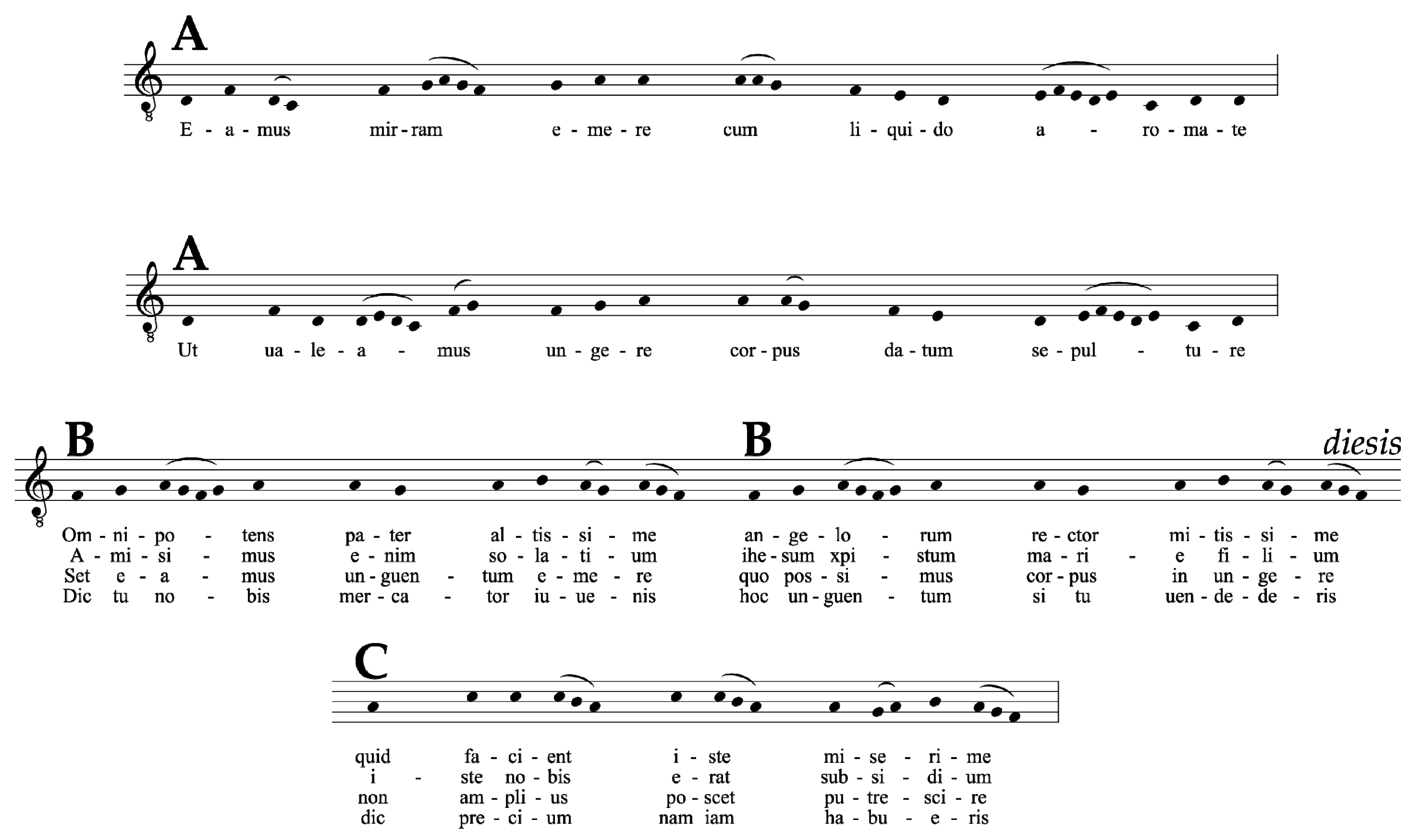
| Ia. | Eamus mirram emere | Let us go to buy myrrh | |
| cum liquido aromate, | with liquid spices, | ||
| Ib. | Ut ualeamus ungere | So that we may anoint | |
| corpus datum sepulture. | the body due for burial. | ||
| Dixit angelus | The angel says: | ||
| II. | Omnipotens | Pater altisisime, | Almighty Father, highest one, |
| angelorum | rector mitissime, | gentlest ruler of the angels, | |
| quid facient | iste miserime! | what shall these most wretched women do? | |
| R. | Heu, quantus est noster dolor! | Alas, how great is our grief! | |
| III. | Amisimus | enim solatium, | For we have lost our solace, |
| Ihesum Christum, | Marie filium. | Jesus Christ, the son of Mary: | |
| Iste nobis | erat subsidium. | he was our support— | |
| R. | Heu, [quantus est noster dolor!] | Alas, how great is our grief! | |
| IV. | Sed eamus | unguentum emere, | But let us go to buy the ointment |
| quo possimus | corpus inungere; | with which we may anoint his body: | |
| non amplius | poscet putrescere. | after that, it cannot decay. | |
| R. | Heu, [quantus est noster dolor!] | Alas, how great is our grief! | |
| V. | Dic tu nobis, | mercator iuuenis, | Tell us, young merchant, |
| hoc unguentum | si tu uendideris, | if you’ll sell us this ointment— | |
| dic precium, | nam iam habueris. | tell us the price, for you shall have it now. | |
| R. | Heu, [quantus est noster dolor!] | Alas, how great is our grief! | |
| Respondet Mercator | Merchant answers: | ||
| VI. | Mulieres | michi intendite. | Women, mark my words: |
| Hoc unguentum | si uultis emere, | if you want to buy this ointment, | |
| datur genus | mirre potencie, | it is endowed with the nature of myrrh’s power: | |
| VII. | quo si corpus | possetis ungere | If you can use this to anoint a body, |
| non amplius | posçet putrecere | after that, it cannot decay— | |
| neque uermes | possent comedere. | the worms will not be able to consume it. | |
| VIII. | Hoc unguentum | si multum cupitis, | If you want this ointment very much, |
| unum auri | talentum dabitis; | you must pay one talent of gold, | |
| Nec aliter | umquam portabitis. | otherwise you’ll never take it with you. | |
| Respondet Maria | Mary answers: | ||
| IX. | O mercator, | unguentum libera. | Merchant, do release the ointment: |
| Ecce tibi | <dabi>mus m<un>era. | Look, we’re handing you the money— | |
| Ibimus Christi ungere vulnera. | we shall go to anoint Christ’s wounds. | ||
| R. | Heu, [quantus est noster dolor!] | Alas, how great is our grief! | |
| Syllables | Rhyme | Melody | |
|---|---|---|---|
| Eamus mirram emere | 8pp | a | A |
| cum liquido aromate | 8p | a’ | |
| ut ualeamus ungere | 8pp | a | A |
| corpus datum sepulture | 8p | a’ |
| Syllables | Rhyme | Melody | ||
|---|---|---|---|---|
| Omnipotens | Pater altisisime | 10pp (4p + 6pp) | a | A |
| angelorum | rector mitissime | 10pp (4p + 6pp) | a | A |
| quid facient | iste miserime | 10pp (4p + 6pp) | a | B |
| Text | Translation | |
|---|---|---|
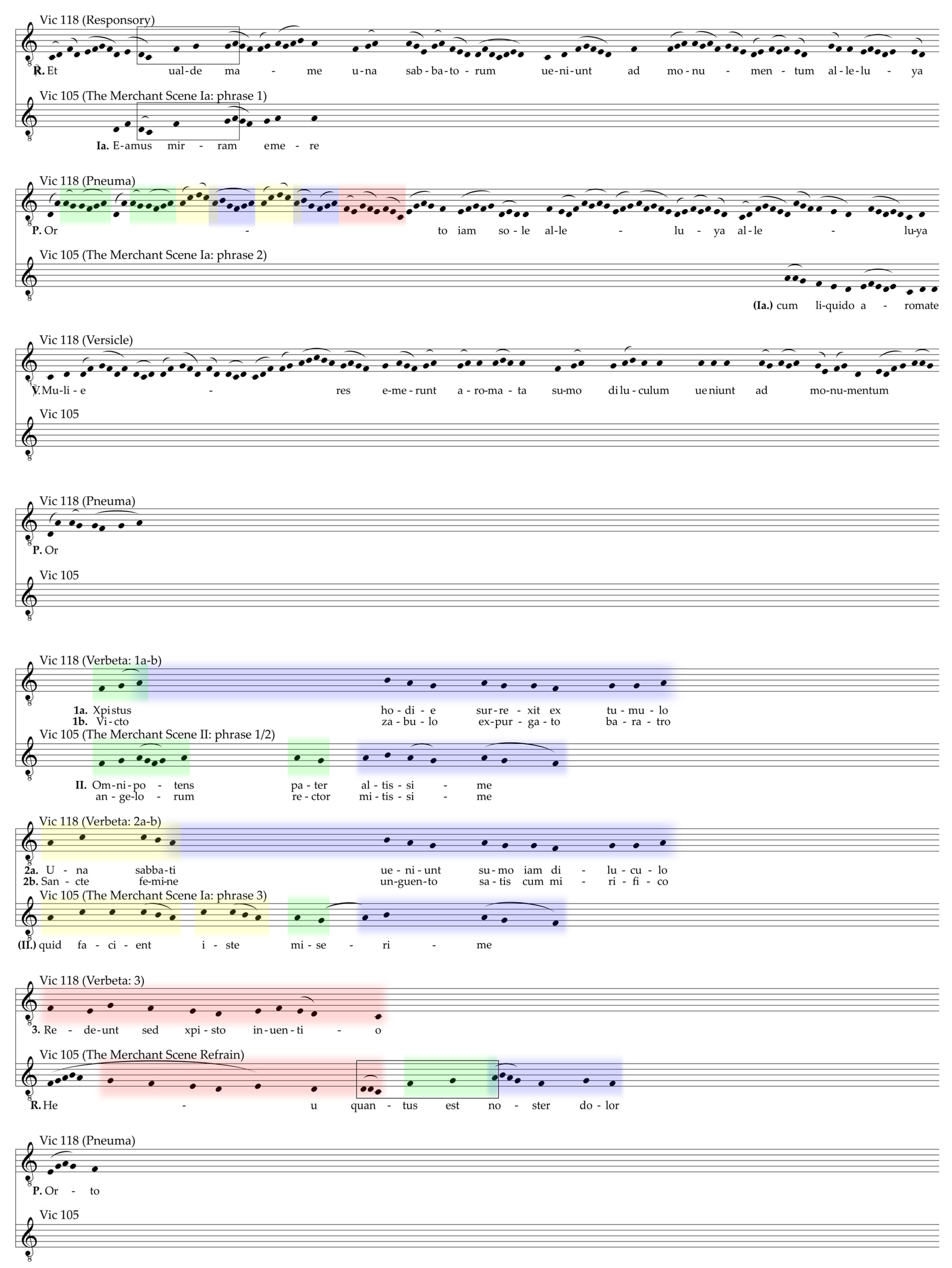
| […] Tercium responsorium, Et ualde mane et cum Gloria, et uerbeta:: | […] Third responsory: Et ualde mane, with the Gloria and the verbeta: Christ has risen from the tomb today, having once defeated the devil and purified hell. At the first light of Sunday, the holy women approach with their very aromatic ointment; but they return because they have not found Christ. Orto iam sole, alleluia, alleluia. Afterwards, if desired, the representation of the three Maries can be performed. Once completed, the bishop will say the Te Deum with the verse Surrexit Dominus de sepulchro. Then, Lauds will be recited. | |
| Christus hodie | surrexit ex tumulo, | |
| uicto Zabulo, | expurgato baratro. | |
| Una sabbati ueniunt | summo iam diluculo | |
| sancte femine unguento | satis cum mirifico | |
| redeunt | sed Christo non inuento. | |
| Orto iam sole, alleluia, alleluia. | ||
| Deinde fiat representacio de .III. Mariis si uoluerint. Qua facta, episcopus dicat: Te Deum laudamus; uersus Surrexit Dominus de sepulchro. Deinde dicantur laudes. | ||
| Text | Translation |
|---|---|
| […] In reuersione, oratio: Concede quaesumus. Et fiat Officium Peregrini, si uouerint, sicut ordinatum est. | […] Upon returning, the prayer Concede quaesumus shall be recited. If desired, the Pilgrim’s Ceremony may be performed as prescribed. |
| Syllables | Rhyme | Melody | ||
|---|---|---|---|---|
| Christus hodie | surrexit ex tumulo, | 12pp (5pp + 7pp) | a | A |
| uicto Zabulo, | expurgato baratro. | 12pp (5pp + 7pp) | a | A |
| Una sabbati ueniunt | summo iam diluculo | 8pp + 7pp | a | B |
| sancte femine unguento | satis cum mirifico | 8pp + 7pp | a | B |
| Redeunt | sed Christo non inuento. | 10p | a | C |
| Stanzas | Sources |
|---|---|
| Catalonia and Occitanie | |
| Ia–Ib II R III R IV R V R VI–VIII IX R | Vic 105 (ff. 58v–59r) |
| [incipit s.n.]: II R III IV | Martène (III, p. 172) |
| Ia–Ib | Vic 187 (f. 1v) |
| [mut.]: VII R VIII | Bar 911 (fragment) |
| Northwest | |
| II R III R IV R [A] VII R V R VI R VIII R | Tours 927 (f. 1v) |
| R [X] VI IVα [s.n.: Y] [Z] VIII | DHaa 76 F 3 (f. 1r) |
| [J2 E–F] II R III R IV R VI V R VIII R | SQ 86 (pp. 611–613) |
| II R III R IV IVα VI V VIII | DHaa 71 J 70 (ff. 163v–164r) |
| Southern Bavarian Area and Black Forest | |
| [B] VI R V R [C] VIII R | Mü 4660a (f. 6r) |
| V R VIII | Mü 4660 (f. 108r) |
| [Mut.]: [E] III R VI IVα VIII [D] | SG Fragm. Fab. IV (f. 1v) |
| [S] [incipit s.n.]: II III IV [s.n.]: R VI IVα V [incipit s.n.: D] | NY M 886 (ff. 5r–6v) |
| II R III R IV IVα | Vip IV (a) (f. 34v).–Vip IV (b) (ff. 80v–81r) |
| II R III R [F] | Vip XIV (ff. 74v–75r) |
| [D] II R III [F] | Ith 410 (ff. 52r–52v) |
| II R III | Bol I 51 (f. 47r) |
| R [B] | Karls D 137 (ff. 86v–87r) |
| [incipit s.n.]: [O–P] IV | Mü 7691 (f. 121r) |
| II R | InnsK 1 rtr.m (f. 75r–75v) |
| II R III R IV [D–F] | Vip III (ff. 60v–61r) |
| II R III R IV R | Vip VII (ff. 13v–14r) |
| [D] III R | InnsM 575 (ff. 118r–118v) |
| [incipit s.n.]: II | FBs 12 (f. 48v) |
| Hesse–Thuringia Group | |
| [incipit s.n.]: R [D–F] II III IV VI V VIII R | FM 178 (Dirigierrolle) |
| [mut.]: VI IVα V | FM III 6 (ff. 1r–1v) |
| [J2] II R III IV IVα VI IVα | Be 757 (ff. 4v–5r) |
| [incipit s.n.]: II [s.n.]: IVbis | Mühl 60/20 (f. 96r) |
| [s.n.]: II R III R IV [D–G] VI IVα V R VIII R | Inns 960 (ff. 41r–46r) |
| [s.n.]: [D–E] II R III R IV R | Be 1219 (Dirigierrolle, ff. 9r–12r) |
| R II R III R IV R VI IVα V R VIII R | Ka 18 (ff. 92v–94r) |
| Bohemia | |
| [incipit s.n.]: II III IV | Wi 13427 (ff. 129r–129v) |
| II R [D] III R [E H] IV IVα [F] | PrU VIII G 29 (a) (ff. 133r–134r) |
| IV IVα | PrU VIII G 29 (b) (f. 134r) |
| [J1] II R III R IV IVα [D–F] | PrU I B 12 (ff. 135v–136r) |
| II R | Wro 226a (f. 2v) |
| [J3] II R III R IV IVα [K D L E M F] | PrU XVII E 1 (a–b) (ff. 135r–144v) |
| II R III R IV IVα [D–E] | Nürn 7060 (ff. 128v–130) |
| [J3 O–Q] II R III R IV R | Zwi 1 15 3 (ff. 56r–56v).–Zwi 36 1 24 (a) (ff. 1r–2r) |
| [D–F] III II | Zwi 36 1 24 (b) (ff. 7r–8r) |
| [J3] II III IV | Zwi 36 1 24 (c) (ff. 10v–11v) |
| II R III R IV R [S] II R III R [E D] IV VI IVα V R VIII R [D–F] | Eger B V 6 (ff. 107v–112v) |
| Lower Saxony | |
| [D–F] II R | Hild 383 (f. 125v) |
| [T–V] II R [W] | Wol VII B 203 (ff. 23r–24r) |
| [D–F] IV | TriS 1973/63 (pp. 20–21) |
Disclaimer/Publisher’s Note: The statements, opinions and data contained in all publications are solely those of the individual author(s) and contributor(s) and not of MDPI and/or the editor(s). MDPI and/or the editor(s) disclaim responsibility for any injury to people or property resulting from any ideas, methods, instructions or products referred to in the content. |
© 2024 by the authors. Licensee MDPI, Basel, Switzerland. This article is an open access article distributed under the terms and conditions of the Creative Commons Attribution (CC BY) license (https://creativecommons.org/licenses/by/4.0/).
Share and Cite
Peláez Bilbao, P.; Tello Ruiz-Pérez, A. The Merchant Scene in Medieval Conceptions of the Visitatio Sepulchri: Origins and Transmission. Religions 2024, 15, 1441. https://doi.org/10.3390/rel15121441
Peláez Bilbao P, Tello Ruiz-Pérez A. The Merchant Scene in Medieval Conceptions of the Visitatio Sepulchri: Origins and Transmission. Religions. 2024; 15(12):1441. https://doi.org/10.3390/rel15121441
Chicago/Turabian StylePeláez Bilbao, Patricia, and Arturo Tello Ruiz-Pérez. 2024. "The Merchant Scene in Medieval Conceptions of the Visitatio Sepulchri: Origins and Transmission" Religions 15, no. 12: 1441. https://doi.org/10.3390/rel15121441
APA StylePeláez Bilbao, P., & Tello Ruiz-Pérez, A. (2024). The Merchant Scene in Medieval Conceptions of the Visitatio Sepulchri: Origins and Transmission. Religions, 15(12), 1441. https://doi.org/10.3390/rel15121441