1. Introduction
Three-dimensional reconstruction technology has emerged as an essential tool in the maritime industry, particularly in the domains of maritime 3D hull perception [
1] and ship maintenance [
2,
3,
4]. These advanced technologies facilitate the 3D perception of ship hulls in marine applications, offering a promising approach to enhancing autonomous navigation capabilities. By leveraging perception information, they significantly contribute to intelligent ship perception and have the potential to improve the comprehensibility of autonomous vessels. The 3D reconstruction of hulls provides a volumetric and precise visual representation that closely aligns with actual specifications.
The transformative impact of these technologies in shipbuilding and maintenance allows shipbuilders to accurately replicate offshore structures, thereby boosting production efficiency and product quality. In terms of maintenance and protection, ship 3D technology offers detailed data for structural analysis, enabling more targeted and meticulous maintenance efforts [
5,
6]. Thus, the application of ship 3D reconstruction technology in ocean engineering is of paramount importance. It not only enhances the perception capabilities of maritime 3D ships, but also elevates the overall quality and efficiency of ship design, production, and maintenance, thereby improving the autonomy and service life of ships.
Traditionally, maritime engineering has relied on manual surveying and modeling based on many international ship CAD/CAM systems for hull 3D reconstruction [
7]. However, these conventional methods are typically time-consuming and labor-intensive, prone to human error, and carry the risk of inaccuracies and project delays. Consequently, the field is seeking more efficient and lower-error alternative reconstruction methods. With the ongoing advancement of computer vision and machine learning technologies, systems that employ multi-angle photography to automatically capture and reconstruct the hull have emerged, offering a cost-effective and efficient new option for three-dimensional geometric reconstruction [
4]. These innovative technologies not only greatly outperform traditional methods in performance but also signal the immense potential for future improvements in the field. Advances in optical measurement technologies [
8], benefiting from breakthroughs in the field of computer vision, are able to capture high-definition images with minimal error, thus enhancing the resolution of hull 3D reconstruction. Moreover, the latest developments in deep learning, particularly in processing multi-view imagery [
9,
10], have brought about revolutionary progress in the three-dimensional reconstruction of hulls, making the process more streamlined and accurate.
Currently, Neural Radiance Fields (NeRFs) [
11] are widely acclaimed for their exceptional rendering capabilities. Given that 3D reconstruction is essentially the inverse process of volume rendering, methods based on NeRF demonstrate considerable advantages in the realm of multi-view 3D reconstruction. In recent years, many neural representation methods [
12,
13] have been proposed to address the limitation of maximum voxel resolution for high-quality rendering and reconstruction [
14,
15]. NeRF [
16] introduces radiance fields to address novel view synthesis and achieves photo-realistic quality. This representation has been quickly extended and applied in diverse graphics and vision applications, including appearance acquisition [
17,
18], multi-view 3D reconstruction [
19,
20,
21], fast rendering [
22,
23], dynamic capture [
24,
25] and generative modeling [
26,
27]. While leading to realistic rendering and a compact model, NeRF implicitly represents the scene in the MLP, which leads to very compact storage, but the reconstruction and rendering are extremely slow. In order to accelerate rendering speeds, a series of efforts [
23,
28] have been dedicated to reducing the complexity of inference by segmenting the scene into multiple units and learning to decrease the number of samples per ray. Nonetheless, these methods still necessitate high memory costs and compromise the compactness of NeRF. To surmount these limitations, recent research [
29] integrates neural radiance fields with tensor decomposition, significantly diminishing the computational demands while retaining the fidelity of rendered scenes, with the most typical being TensoRF.
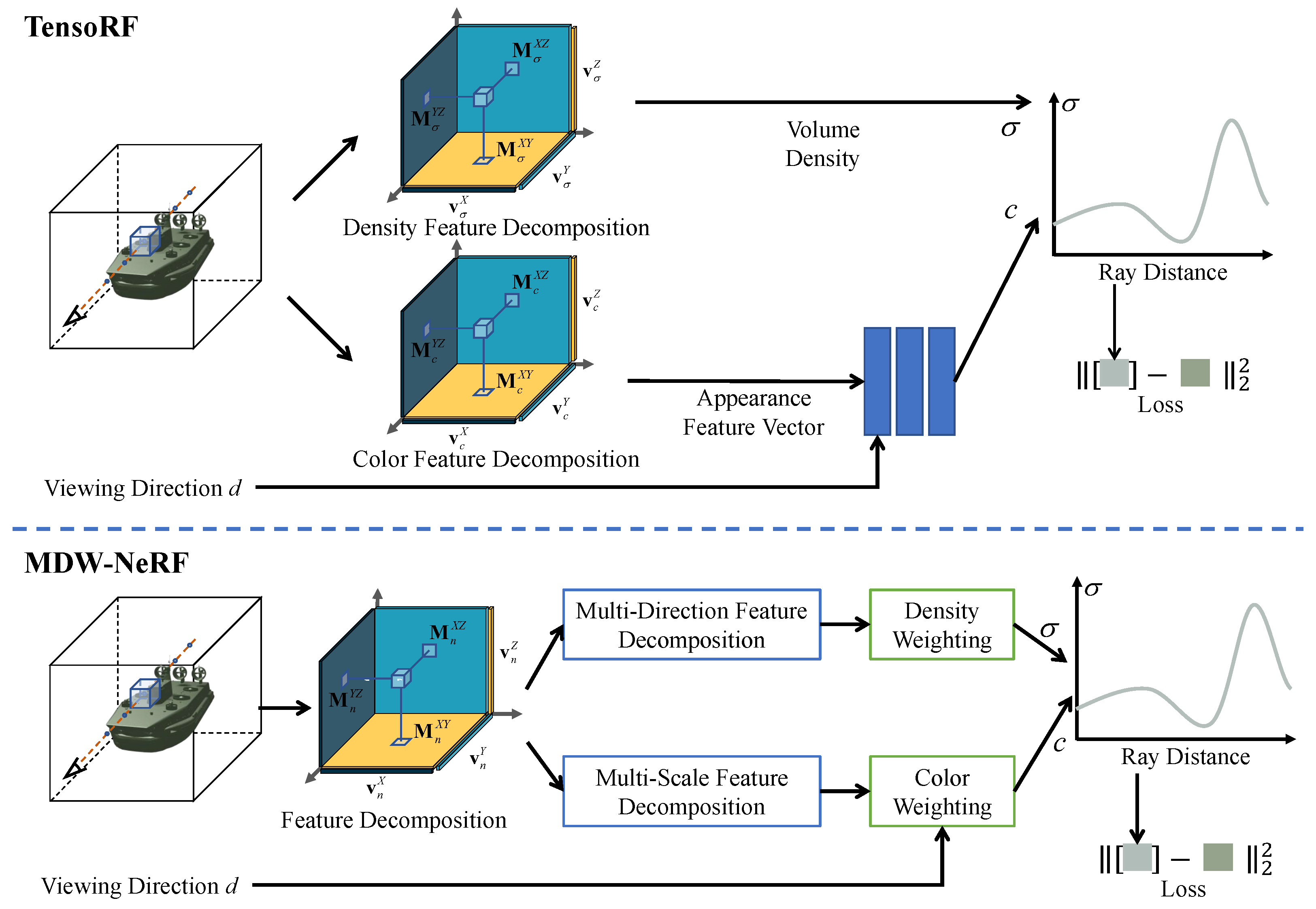
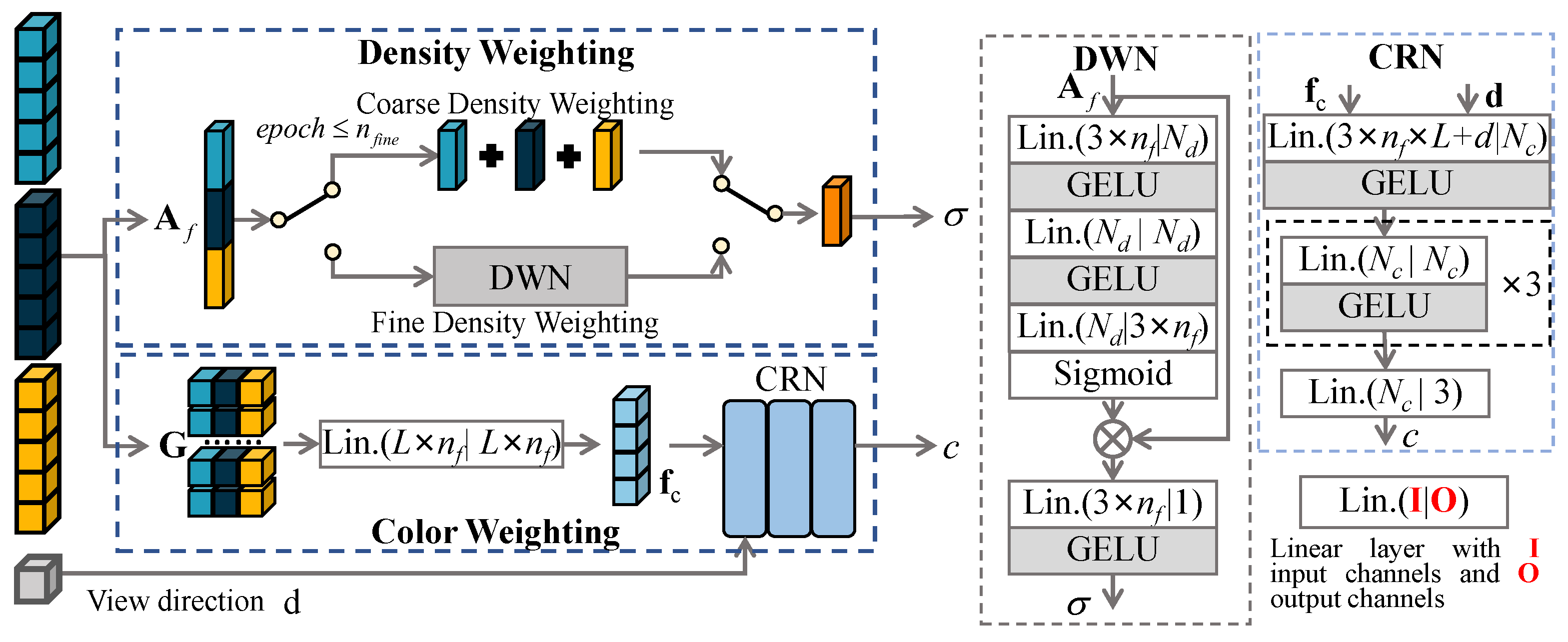
However, tensor-based methods may compromise spatial integrity when reconstructing complex geometrical details. To tackle this problem, we propose a multi-scale spatial density weighted NeRF (MDW-NeRF). As illustrated in
Figure 1, our method refines the calculation process for both density
and color
c, building upon the TensoRF framework to improve the accuracy of 3D ship reconstruction. The main contributions of this paper are summarized as follows:
- (1)
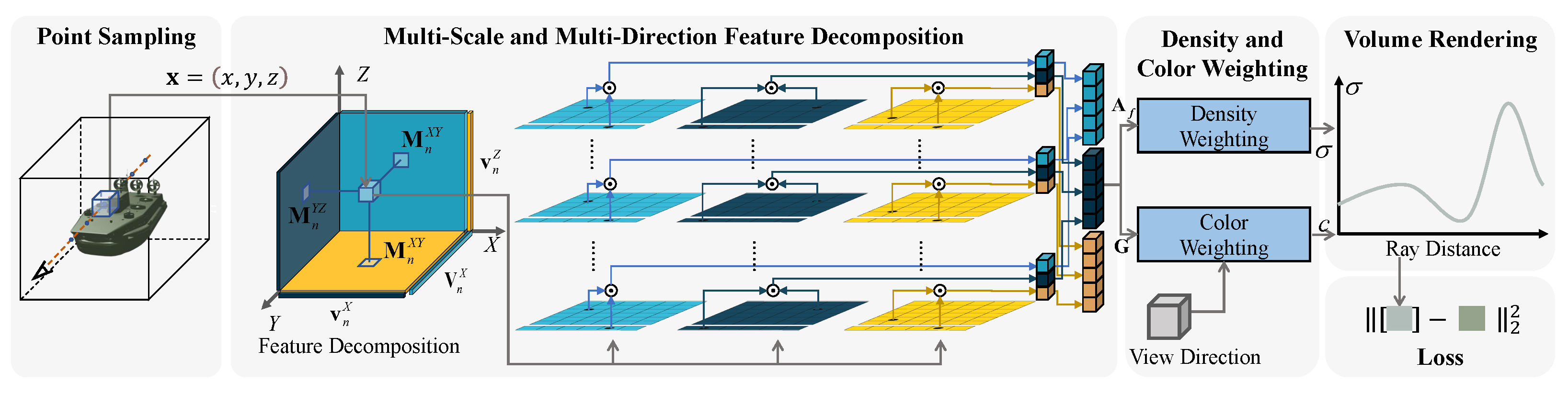
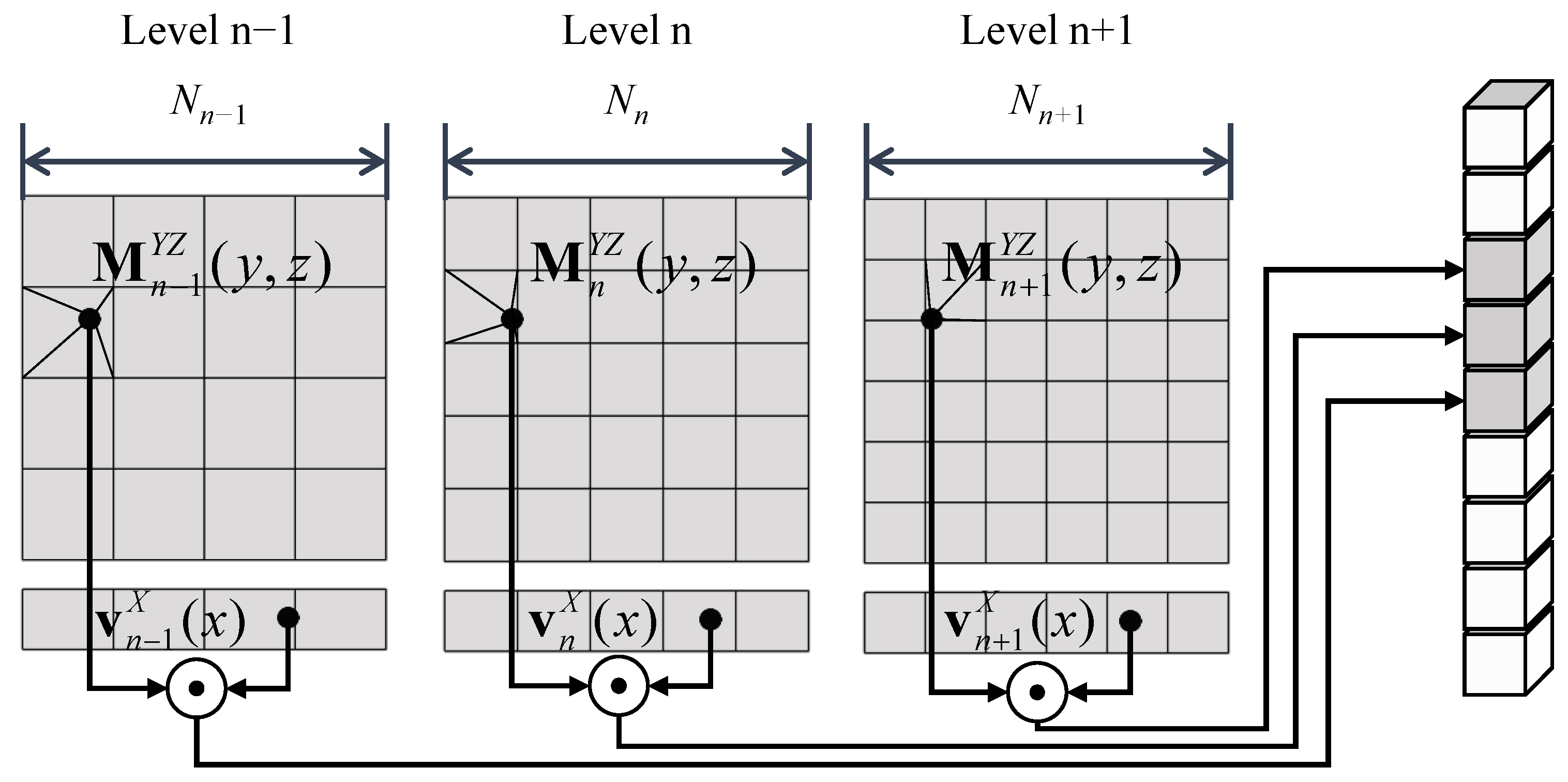
We introduce a multi-scale feature space decomposition mechanism, which models three-dimensional space by exploiting features at multiple levels of resolution. This enables the fusion of high-resolution detailed information with low-resolution regional information across different directions.
- (2)
To optimize the reconstruction process, we separately design color and density weights. The density weighting employs a coarse-to-fine strategy, initially determining the structure’s consistent rough outline, followed by the application of a density weighting network (DWN) to refine the model. For color weighting, we use a weighted matrix to decouple the feature vectors from the appearance attributes and calculate the color via a color rendering network (CRN).
- (3)
To accelerate the efficiency of the algorithm’s 3D reconstruction and rendering, we employ a hybrid point sampling strategy for volume rendering, namely, the selection of sampling points through volumetric density.
Collectively, these integrated innovations tackle the core limitation of spatial incoherence in tensor-based NeRF methods while achieving a judicious balance between reconstruction fidelity, rendering quality, and computational efficiency. By synergistically fusing multi-scale feature space decomposition, adaptive color and density weighting mechanisms, and the hybrid point sampling strategy, MDW-NeRF yields a robust and effective solution for high-precision hull 3D reconstruction, thereby filling the critical gap in fine-grained geometric recovery and spatial integrity that compromises the performance of existing tensor-based approaches. As validated in subsequent experiments, this work pushes forward the state-of-the-art of tensor-based NeRF-driven hull 3D reconstruction by overcoming key technical bottlenecks inherent to prior methods.
3. Experiments
In this section, we conduct extensive experiments to demonstrate the effectiveness of our method on 3D reconstruction with a comprehensive comparison to the existing state-of-the-art and mainstream methods.
3.1. Datasets
We employed the robust 3D modeling software Blender 5.0 to build the Synthetic Vessel Hull (SVH) 3D reconstruction dataset. This dataset comprises 13 different types of vessels, each represented by 600 individual samples. Each sample includes images as well as corresponding camera pose information. To ensure the diversity and comprehensiveness of the dataset, we specifically chose a range of vessel types for study. The shapes and structures of these vessels vary greatly, from small yachts to large warships, and we endeavored to include as many different types of vessels as possible. We allocated 400 samples for model training, 100 samples for testing, and an additional 100 samples for validation.
3.2. Implementation Details
We implemented our MDW-NeRF using PyTorch 1.13.1, and all experiments including baseline methods and MDW-NeRF were standardized to a consistent Tesla A6000 48 GB GPU (NVIDIA Corporation, Santa Clara, CA, USA), a batch size of 4096 pixels, and an image resolution of for fair and normalized comparisons. Based on experience, we set and to 64 and 256, respectively, and configured L to be 6. This parameter configuration, derived from systematic validation of multi-scale feature decomposition requirements and the trade-off between reconstruction performance and computational efficiency, is tailored to optimize cross-scale feature behavior: ensures coherent modeling of low-resolution global regional information to preclude structural fragmentation from overly sparse sampling, provides sufficient resolution to capture high-fidelity fine-grained hull details within hardware memory constraints, and (number of multi-scale layers) enables smooth coarse-to-fine feature transition via exponential resolution scaling—effectively mitigating inter-scale feature gaps and redundant computational overhead for efficient training and inference. The total number of iterations was fixed at 150,000.
We adopt the Adam optimizer for its tailored suitability to MDW-NeRF’s multi-module architecture: its integrated momentum and adaptive learning rate mechanisms efficiently handle heterogeneous parameter dynamics across multi-scale feature decomposition, density weighting network (DWN) and color rendering network (CRN), dynamically balancing updates for high-sensitivity and low-sensitivity parameters while eliminating manual learning rate tuning. It accelerates convergence in non-convex neural radiance field fitting, mitigates oscillations to avoid local optima during coarse-to-fine training, and outperforms SGD (requiring tedious tuning and slow convergence) and Adagrad (prone to premature learning rate shrinkage) in stabilizing high-dimensional tensor decomposition features, aligning with parameter-efficient tensor-based NeRF paradigms to achieve an optimal trade-off between convergence speed, stability and reconstruction performance for high-precision hull 3D reconstruction.
During the coarse-density weighting phase, the learning rate for the decomposition feature was set to 0.02, while the learning rate for the CRN network was 0.001. In the fine-density weighting phase, the initial learning rate for the decomposition feature was reduced to 0.001, the learning rate for the DWN was increased to 0.02, and the learning rate for the CRN network remained at 0.001.
The training loss of the proposed method consists of the mean squared error of the rendered pixel value, and a regularization term regarding the density features. Mathematically, the training loss is written as
where
is the ground truth color. To achieve a coarse-to-fine reconstruction, we set
based on the variation in loss. That is, we compute the variance of the loss every 100 iterations. When the variance at iteration
falls below 0.01, we consider the training to have sufficiently converged. At this stage, we set
and transition from coarse reconstruction to fine reconstruction.
3.3. Evaluation Metrics
When assessing the accuracy of image rendering performance, we utilized quantitative metrics such as Peak Signal-to-Noise Ratio (PSNR), Structural Similarity Index Measure (SSIM), and Learned Perceptual Image Patch Similarity (LPIPS). Meanwhile, when evaluating the accuracy of 3D reconstruction, we used Chamfer Distance (CD) as our evaluation metric. To measure processing speed, we conducted a timeliness analysis based on the time required for the reconstruction process. Additionally, we evaluated the system’s storage efficiency by calculating the required model parameters (Params.) as a proxy for storage resources. To rigorously substantiate the efficiency assertions, we additionally incorporate two pivotal metrics: (1) rendering speed (RS) reported as Frames Per Second (FPS) to quantify inference throughput; and (2) inference memory usage (IMU) to characterize GPU memory footprint during inference.
3.4. Performance Comparison
3.4.1. Comparison on Rendering
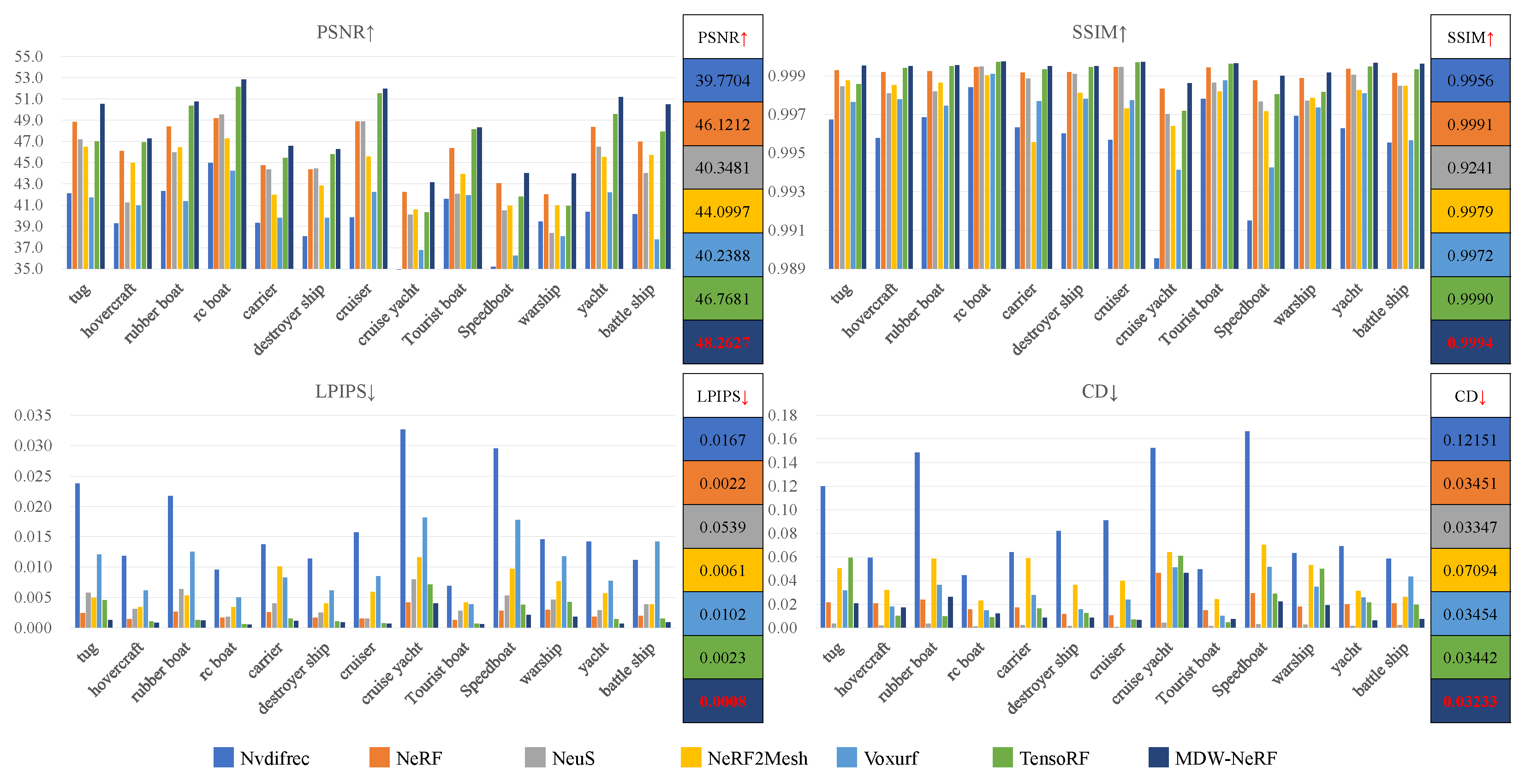
To quantitatively assess the effectiveness of the proposed method MDW-NeRF in volume rendering, we compared MDW-NeRF with several neural rendering methods, including Nvdiffrec [
30], original NeRF [
11], NeuS [
19], NeRF2mesh [
31], Voxurf [
32], and TensoRF [
29], as shown in
Figure 6. The evaluation metrics include PSNR, SSIM, and LPIPS.
Figure 6 illustrates the performance of different methods in ship model rendering applications. The results indicate that MDW-NeRF excels in rendering fine details and structural representations. The table adjacent to each subplot displays the average performance of each method across different ship models, with each color denoting a specific method. It is evident from the table that MDW-NeRF consistently outperforms the comparison algorithms in all benchmark tests. These quantitative results confirm the superior rendering performance of MDW-NeRF.
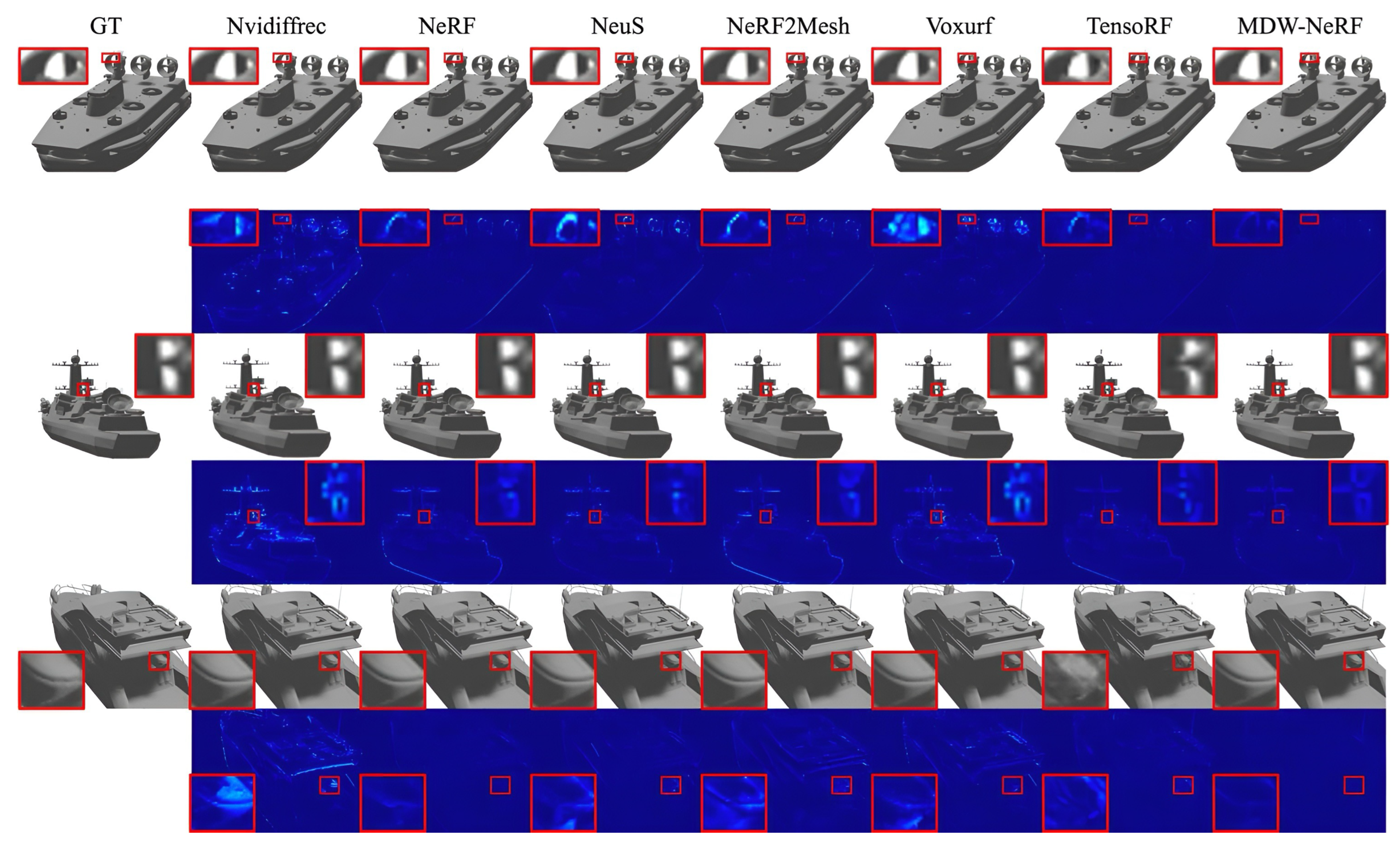
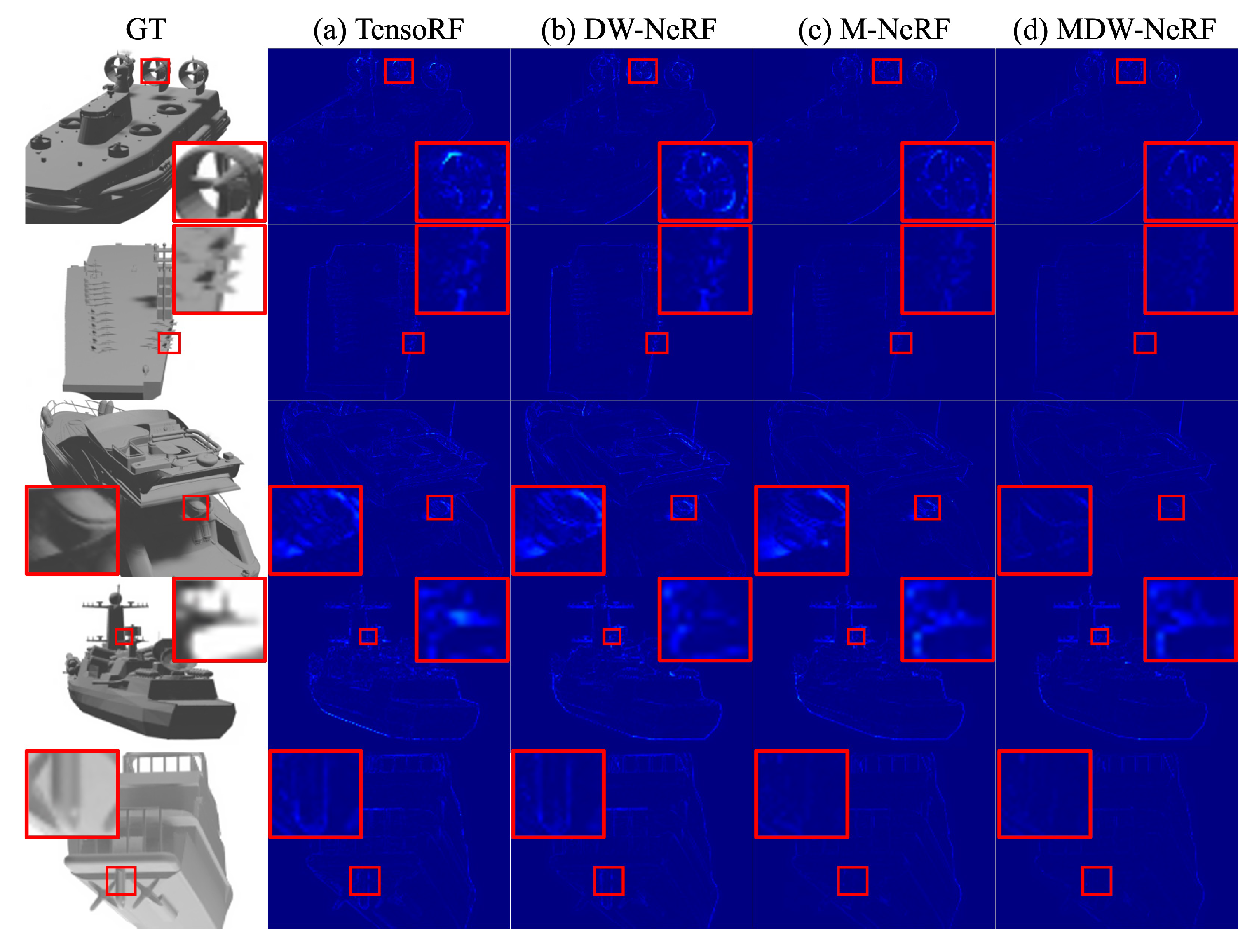
Given that our loss function is derived from the quality of image rendering, we display the selected rendered images to evaluate the efficacy of this loss function. Through a visual comparison of the rendering quality between our proposed method and existing techniques, the comparative findings are illustrated in
Figure 7. To emphasize these findings, we visualized the discrepancies between the rendered and original images and annotated the PSNR values. Our analysis revealed that deviations in rendering predominantly occur along the edges of the rendered images. However, in contrast to other methods, our proposed technique yields results that more closely approximate the real images. In particular, by incorporating fine-density weights and multi-scale feature decomposition, MDW-NeRF was able to capture the minute texture details of ship surfaces more accurately, thus achieving highly realistic visual effects in ship rendering tasks. The visualizations substantiate the superiority of MDW-NeRF in noise reduction and detail enhancement, achieving a more pronounced rendering effect.
3.4.2. Comparison on Reconstruction
Figure 6 provides a detailed analysis of the CD evaluation metrics for various ship categories. It is evident that MDW-NeRF excels in each category, demonstrating superior capability in capturing intricate details of ship surfaces. The table adjacent to the CD subplot presents a quantitative assessment of MDW-NeRF’s performance in 3D reconstruction tasks, comparing it against other algorithms. The findings illustrate that MDW-NeRF consistently surpasses the benchmark algorithms across all tests. The quantitative results corroborate the superiority of MDW-NeRF in the domain of 3D reconstruction methodologies.
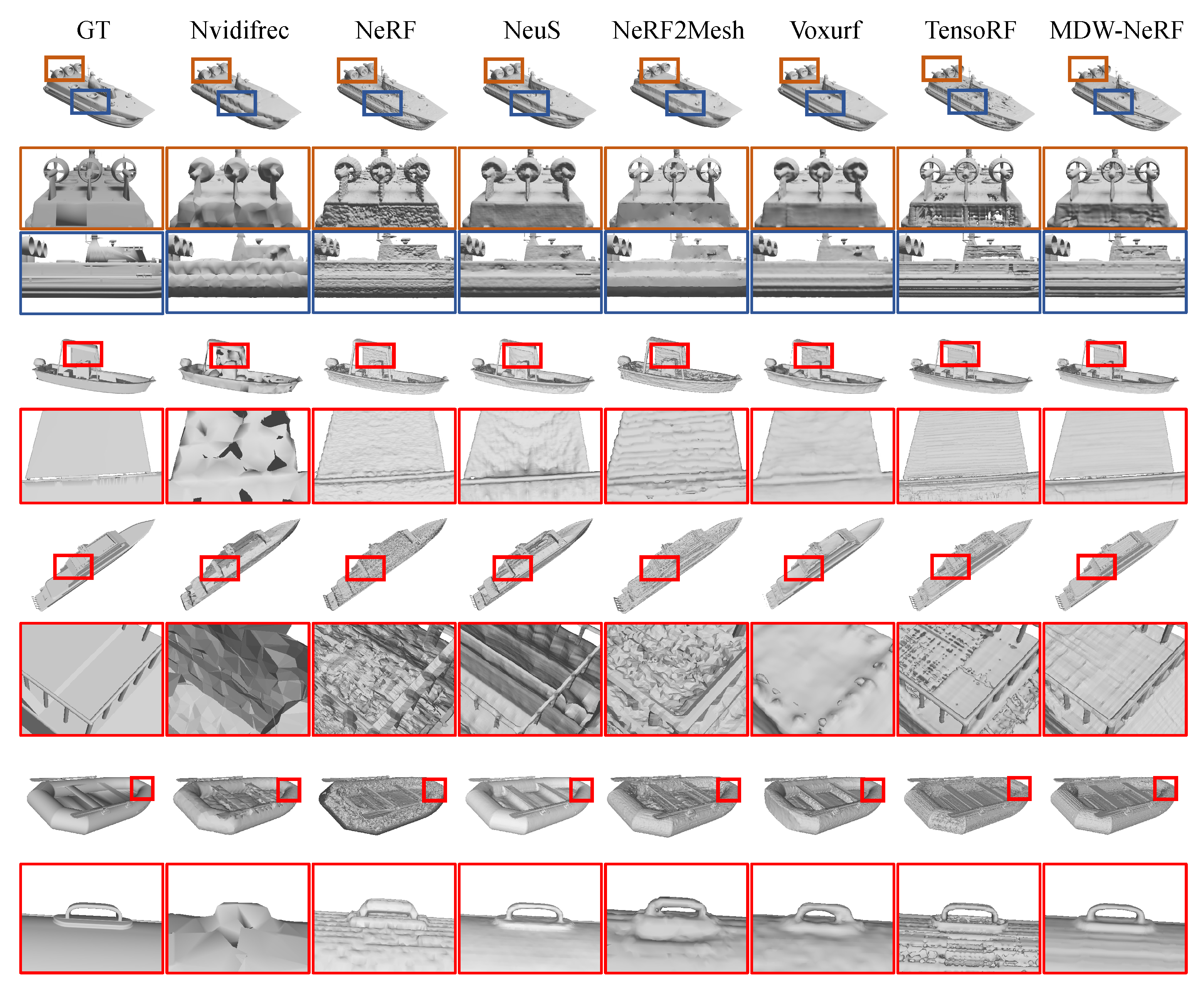
Figure 8 presents a visual comparison of the 3D reconstruction quality between our proposed method and other techniques. Particularly, the first comparative instance in
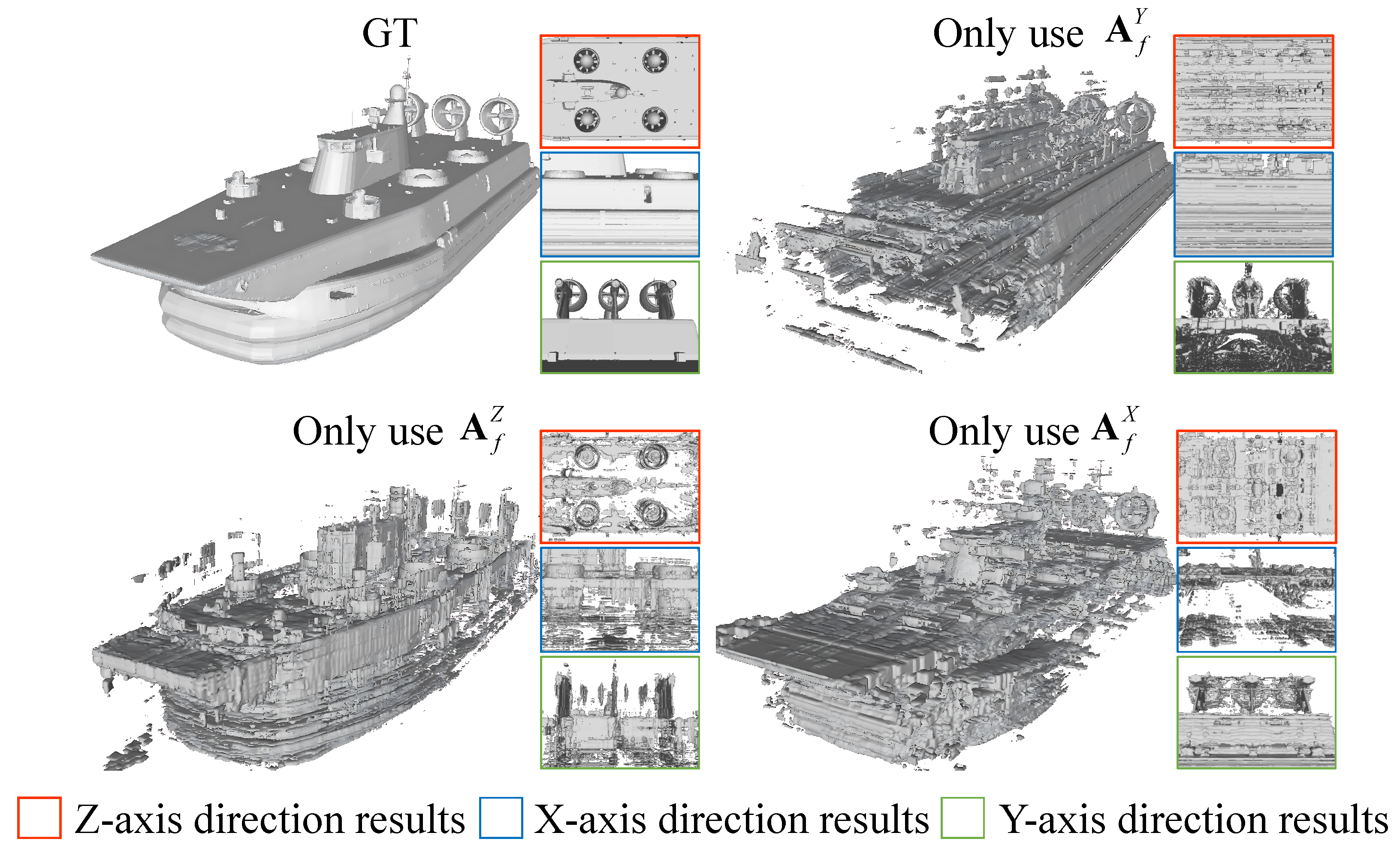
Figure 8 displays the reconstruction result of a hovercraft, revealing that some implicit reconstruction algorithms, especially NeuS, NeRF2mesh, and Nvdiffrec, fail to precisely reproduce the details of deep cavities in complex spatial structures due to excessively smooth processing. In contrast, our method exhibits exceptional capability in restoring these complex geometric shapes. Moreover, our algorithm demonstrates a unique method of addressing spatial discontinuities, a challenge often arising from insufficient correlation among tensor features. As visible in
Figure 8, our model consistently outperforms comparative methods in surface reconstruction tasks, achieving significant results in terms of the accuracy of detail reproduction, consistency of geometric structures and the integrity of overall shapes.
3.4.3. Comparison on Efficiency
We also compared our MDW-NeRF with various methods on the dataset in terms of efficiency, as shown in
Table 1. It can be seen that our MDW-NeRF achieves the fastest reconstruction among hybrid methods alongside TensoRF. Moreover, we reported the model size, that is, storage consumption, in
Table 1. We found that NeRF is 5.2 MB but reconstructs very slowly (6 h); explicit methods like Voxurf have a very large model size (>300 MB); while hybrid methods such as NeuS, TensoRF, and our MDW-NeRF have relatively small model sizes (<100 MB), with our MDW-NeRF having the smallest model size in hybrid methods (53.7 MB), reducing storage consumption by 9% compared to TensoRF. In terms of rendering speed, MDW-NeRF achieves 19.6 FPS, which is second only to TensoRF (22.4 FPS) among all compared methods and represents a significant advantage over traditional implicit models (NeRF: 0.8 FPS, NeuS: 1.2 FPS) and voxel-based methods (Voxurf: 8.3 FPS, NeRF2mesh: 12.5 FPS). Regarding model size, MDW-NeRF has the smallest storage footprint (53.7 MB) among hybrid methods, reducing storage consumption by 9% compared to TensoRF (60.5 MB). For inference memory usage (IMU), MDW-NeRF consumes 15,326 MB, which is higher than TensoRF (7572 MB) but justified by its superior reconstruction accuracy (1.5 dB higher in PSNR and 6.1% lower in CD). Notably, its IMU is still lower than resource-intensive voxel-based methods like Voxurf (25,323 MB) and comparable to NeRF2mesh (16,543 MB) while delivering far higher detail fidelity. These results, combined with standardized experimental settings, collectively validate MDW-NeRF’s balanced advantages in runtime speed, storage compactness, and reconstruction precision—critical for practical maritime engineering applications.
3.5. Ablation Study
In the ablation study conducted, the experimental parameters were kept consistent with those in previous implementation details. To isolate the contribution of each core module (multi-scale feature decomposition, density weighting) and clarify its synergistic interactions with TensoRF’s inherent multi-directional tensor decomposition, we focus on four configurations. Notably, TensoRF itself serves as the baseline for standalone multi-directional decomposition—its core tensor factorization paradigm inherently encodes directional feature correlations, thus no additional derivative configuration is required to validate this functionality. The method mainly compared four configurations: TensoRF (original version, providing baseline multi-directional decomposition), DW-NeRF (density weighting), M-NeRF (multi-scale feature decomposition), and MDW-NeRF (multi-scale feature decomposition + density weighting).
According to the quantitative performance metrics presented in
Table 2, MDW-NeRF demonstrates superior performance in terms of PSNR, LPIPS, and CD, whereas TensoRF, DW-NeRF, and M-NeRF achieve relatively lower scores on these metrics. However, regarding the SSIM evaluation, M-NeRF, DW-NeRF, and MDW-NeRF attain comparable results. Notably, as shown in
Table 3, DW-NeRF not only requires a shorter training period but also has the minimum number of parameters, underscoring its significant advantages in training efficiency and model economy. While MDW-NeRF exhibits a slight superiority in image rendering quality, DW-NeRF showcases its unique benefits in terms of training efficiency and parameter count. Additionally, a comparison between M-NeRF and DW-NeRF indicates that M-NeRF is more effective in enhancing reconstruction fidelity, highlighting the value of multi-scale feature representation. From an efficiency perspective, ablation results confirm the rationality of the modular design. DW-NeRF, integrating TensoRF with density weighting, achieves a competitive rendering speed of 20.5 FPS and the lowest inference memory usage of 11,323 MB among all variants, highlighting the lightweight advantage of the density weighting module in enhancing spatial coherence without excessive resource overhead. M-NeRF, combining TensoRF with multi-scale feature decomposition, attains 19.8 FPS with an inference memory usage of 13,534 MB, demonstrating that multi-scale feature decomposition incurs modest computational overhead while substantially improving fine-grained detail capture. By synergistically integrating both modules, MDW-NeRF maintains reasonable inference memory consumption at 15,326 MB and a rendering speed of 19.6 FPS, while achieving the highest reconstruction precision with a CD of 0.03233 and a PSNR of 48.2627 dB. This achieves an optimal trade-off between performance enhancement and resource efficiency, a critical consideration for maritime 3D reconstruction where high-precision geometric recovery—including hull cavities and surface textures—and practical resource constraints must be concurrently satisfied.
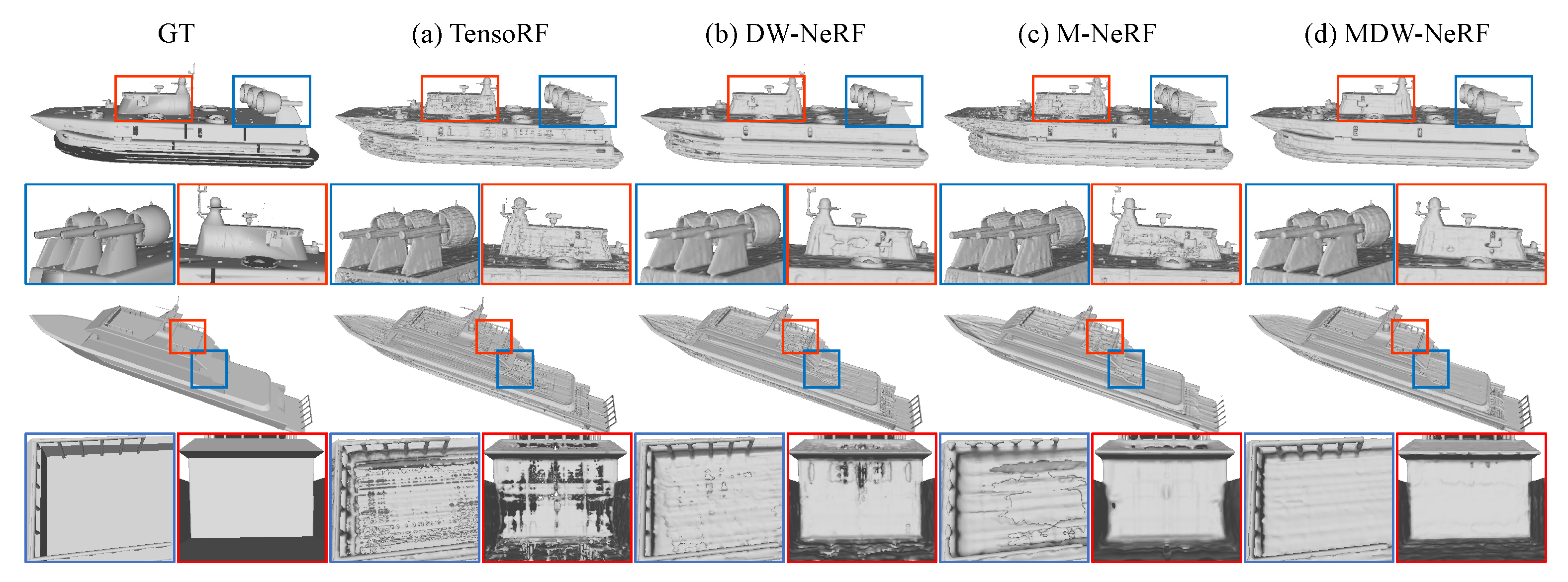
The visual representation illustrated in
Figure 9 delineates the efficacy of various methodologies incorporating distinct modules in reconstruction tasks. M-NeRF exhibits enhanced detail precision, yet fails to seamlessly integrate the surface of the reconstructed model. DW-NeRF’s performance is intermediary between TensoRF and M-NeRF, but it still encounters issues with insufficient fine-grained feature capture. Conversely, MDW-NeRF achieves superior reconstruction outcomes, showcasing unparalleled detail fidelity and spatial coherence.
Upon examining M-NeRF and TensoRF, it becomes evident that multi-scale feature decomposition significantly enhances the capture of fine-grained geometric details in reconstruction processes. Similarly, a comparative analysis of DW-NeRF and TensoRF reveals that the density weighting module substantially improves the spatial continuity of 3D reconstruction surfaces. MDW-NeRF retains the advantages of both DW-NeRF and M-NeRF, achieving synergistic improvement in surface fine-grained detail and coherent reconstruction for ship hulls.
Based on TensoRF’s failure cases in
Figure 9a and
Figure 10a, we find that its inherent multi-directional tensor decomposition is constrained by single-resolution factorization, leading to local detail incoherence. By comparing these failure cases with DW-NeRF’s rendering and reconstruction performance in
Figure 9b and
Figure 10b, we observe that the density weighting mechanism acts as a regulatory enhancement layer: it dynamically adjusts cross-directional feature contributions based on multi-directional feature inputs, enhancing partial local detail coherence and mitigating incoherence from independent multi-directional tensor decomposition. However, it only bridges minor gaps and fails to achieve full overall optimization. Comparing TensoRF’s failures with M-NeRF’s performance in
Figure 9c and
Figure 10c further shows that multi-scale feature decomposition effectively resolves the trade-off between reduced reconstruction efficiency (excessively high resolution) and insufficient accuracy (excessively low resolution), enabling fine precision at an efficiency level comparable to coarse resolution.
Notably, these individual module limitations are complementary: the density weighting mechanism (DW-NeRF) lacks global optimization capability, while multi-scale feature decomposition (M-NeRF) fails to handle complex hull cavities despite resolving the efficiency–accuracy trade-off. To address these limitations, we propose MDW-NeRF, which integrates density weighting with multi-scale feature decomposition to simultaneously achieve local detail coherence and global structural integrity.
3.6. Generalization Performance Evaluation on Public Dataset
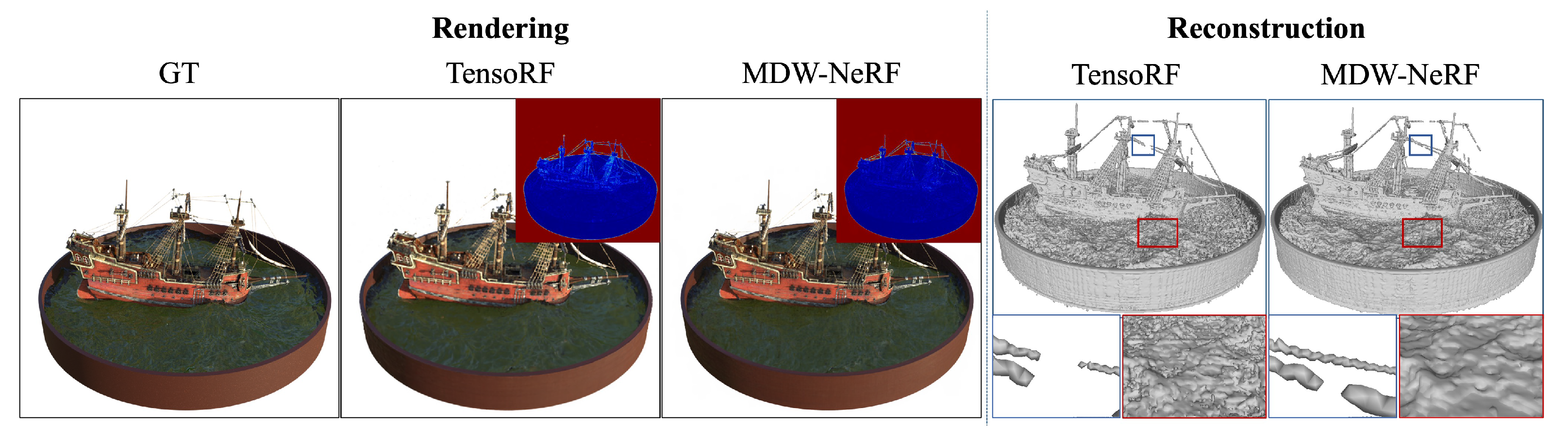
To further analyze the impact of environmental factors on MDW-NeRF’s performance and verify its generalization ability, this section evaluates MDW-NeRF using the Ship category from the public NeRF-Synthesis dataset, which realistically simulates environmental influences including illumination, water reflections and hull details. This category is represented by 400 multi-view images (100 for training, 100 for validation, and 200 for testing). We conduct exclusive comparisons between MDW-NeRF and TensoRF under consistent hardware, software and hyperparameter configurations to ensure fairness.
As shown in
Table 4, MDW-NeRF outperforms TensoRF on all core evaluation metrics. In terms of rendering quality, its PSNR (35.2 dB) and SSIM (0.978) demonstrate enhanced pixel fidelity and structural alignment with real-world scenes, while a 21.2% reduction in LPIPS narrows the perceptual discrepancy. Regarding 3D reconstruction accuracy, MDW-NeRF achieves a CD of 0.042, verifying reduced geometric reconstruction errors. These performance gains originate from fundamental mechanistic distinctions: TensoRF’s single-resolution tensor decomposition fails to sustain feature space consistency amid complex real-world perturbations, whereas MDW-NeRF’s multi-scale feature decomposition and adaptive weighting mechanisms underpin the simultaneous optimization of these metrics.
The visualization results in
Figure 11 intuitively validate these performance discrepancies. In rendering, TensoRF exhibits pronounced texture degradation and color incoherence, particularly at the interfaces of hull metallic reflective surfaces and water reflections. In contrast, MDW-NeRF can generate more natural color gradients and precisely restore deck fine textures and edge contours, which is consistent with its superiority in PSNR, SSIM, and LPIPS. For 3D reconstruction, TensoRF’s models present numerous fragments outside partial curved surface structures and obvious discontinuities in some fine structures. However, MDW-NeRF smoothly reconstructs complex curved surface features, enhancing integrity in both global shape and local details—aligning with its geometric accuracy advantage quantified by the CD metric.
4. Discussion
Ship hull 3D reconstruction technologies are primarily classified by method and principle, falling into traditional vision/laser scanning-based approaches and deep learning-based methods. Traditional vision/laser scanning-based methods reconstruct hull 3D models using multi-view images or point clouds combined with geometric registration, but struggle with complex scenes, detail capture, and variations in lighting/occlusion. In contrast, deep learning-based methods—particularly NeRF and its variants—have gained widespread attention for high-fidelity reconstruction by learning image-to-3D scene mappings to restore fine details. NeRF-based methods capture scene radiance transfer functions to retrieve object depth and color, enabling unprecedented precision in hull 3D modeling. Recent works such as DW-NeRF [
33] have further advanced hull reconstruction by introducing weighted feature space decomposition and coarse-to-fine density weighting, addressing spatial incoherence in tensor-based NeRF while maintaining efficiency—consistent with the core goal of enhancing structural integrity in marine-specific 3D reconstruction. Compared to traditional methods, NeRF excels in handling lighting, occlusion, and details, providing realistic restoration of hull appearance and structure, and unlocking new prospects for ship design and monitoring.
TensoRF innovatively combines spatial decomposition with NeRF, balancing rendering/reconstruction quality and efficiency. However, its feature decomposition granularity is resolution-limited: overly high resolution sacrifices contextual feature integration (causing reconstruction voids), while overly low resolution leads to detail loss, making optimal resolution selection critical. Similar to FGS-NeRF [
34], which adopts progressive voxel-MLP scaling to balance resolution granularity and computational efficiency for glossy surface reconstruction, our work targets resolution-related limitations by developing a multi-scale feature fusion strategy within the TensoRF framework—differentiating itself by focusing on hull-specific geometric coherence rather than glossy material handling. Recent efforts like multi-view stereo-regulated NeRF have also explored the potential of integrating stereo constraints for scene synthesis [
35], further validating that multi-view information enhancement is a promising direction for NeRF-based reconstruction.
In contrast to factorization-based radiance field models such as TensoRF, which rely on fixed-rank, single-resolution decompositions, our analysis identifies a more fundamental representational bottleneck. Vector decomposition-based neural radiance fields fail to capture multi-directional features, resulting in spatial voids and discontinuities on hull surfaces—attributed to the lack of cross-directional dependency modeling in standard tensor factorization, which fragments geometry for complex, high-curvature hull structures [
36]. To address this, we introduce a density weighting mechanism for sampling point density calculation to enhance model surface continuity and completeness.
Architecturally, while methods like TensoRF efficiently compress scene representation, they face inherent trade-offs between detail preservation and spatial coherence. Despite progress in hull reconstruction, fine texture detail handling remains challenging; feature weighting mitigates voids but may cause local high-frequency detail loss. MDW-NeRF addresses this through its multi-scale decomposition, which separately models coarse geometry and fine texture, thereby mitigating detail blurring while maintaining structural integrity.
Multi-scale spatial decomposition improves rendering and reconstruction performance but extends training time compared to single-scale methods. This design is theoretically motivated by the need to balance reconstruction frequency bandwidth: single-scale methods compromise between fine detail capture and surface smoothness, while multi-scale representation avoids this trade-off. Thus, model selection requires balancing performance and computational cost: single-scale models are preferable for storage/loading-critical scenarios, while multi-scale methods are justified for high geometric accuracy and fidelity demands (e.g., maritime inspection, digital twin, high-fidelity simulation), especially when depth consistency and perceptual quality take priority over compactness.
5. Conclusions
In this paper, we propose MDW-NeRF, an efficient and high-precision tensor-based neural surface reconstruction method for ship hulls. It addresses spatial incoherence and insufficient fine-grained geometric recovery in existing tensor-based NeRF methods via synergistic multi-scale feature decomposition, coarse-to-fine density weighting and weighted matrix-based color weighting. Comprehensive evaluations on SVH datasets confirm its superiority: compared to TensoRF, it achieves 1.5 dB higher PSNR, 6.1% lower CD and 9% smaller model size, and maintains competitive training efficiency. This work advances tensor-based NeRF-driven 3D reconstruction by establishing a novel paradigm balancing precision, rendering fidelity and efficiency, enriching NeRF’s theoretical framework for complex engineering structures. Practically, it provides a reliable tool for maritime engineering (hull design optimization, structural inspection, autonomous navigation perception), facilitating the industry’s intelligent transformation via accurate reconstruction of complex hull geometries and robustness to real-world interferences. To promote reproducibility and application, the code and pre-trained models of the MDW-NeRF framework will be released on GitHub after formal acceptance.





 and
and