


Abstract
The prediction of deep-sea mining sediment plumes is essential for assessing and mitigating the environmental impacts on vulnerable deep-sea ecosystems. In this paper, the numerical simulation method is adopted to predict the sediment plume transportation. Fluid dynamics are governed by the incompressible Navier–Stokes equations, coupled with the Standard k–ε turbulence model to capture turbulent diffusion. The air–water free surface is tracked by a high-resolution Volume of Fluid (VOF) method. The pressure–velocity coupling utilizes the PISO algorithm. Sediment transport is governed by the advection–diffusion equation. The mathematical model is validated through experiments. There is a good consistency between the experiment results and the numerical results, which proves that the numerical method can be applied. The study calculates the diffusion range and characteristics of plumes under different free stream velocities, injection velocities and discharge densities. The results indicate that an increase in free stream velocity enhances the development of turbulence, but conversely restricts the expansion of the mixing zone between the plume and the ambient water. A greater injection velocity leads to a wider distribution range of the plume, while inhibiting the development of local turbulence. A higher plume discharge density results in a larger horizontal distribution range, while hindering the effective mixing between the plume and the ambient water body.
1. Introduction
Due to the continuous exploitation of terrestrial mineral resources, the reserves and variety of ores have significantly declined (or become increasingly depleted) [1]. The ocean contains abundant mineral resources, with total reserves vastly exceeding those on land. The strategic value of deep-sea mineral resources has attracted strong interest from nations such as the United States, Russia, China, Australia, Japan, and South Korea, prompting a rapid phase of deep-sea mineral exploration and exploitation [2,3]. The extraction of deep-sea mineral resources can effectively address the scarcity of land-based resources and meet the demands of socio-economic development [4,5]. Reckless and extensive commercial mining operations will inevitably have a substantial impact on the marine ecological environment [6]. During deep-sea mining, the movement and collection activities of mining vehicles disturb the seabed surface sediments, causing them to suspend in the water column and form sediment plumes [7,8]. These plumes diffuse along the path of the mining vehicle, altering the surrounding seabed morphology and sediment distribution while carrying significant amounts of suspended particulate matter [9,10]. The environmental impacts of sediment plumes are multifaceted. Firstly, the suspended particulate matter in the plumes increases the turbidity concentration of seabed sediments, leading to water quality deterioration and disrupting the balance of marine ecosystems [11]. Secondly, the diffusion and suspension processes of the plumes interfere with benthic biological communities, destroying their habitats and foraging environments, and posing a threat to biodiversity [12]. Additionally, the plumes may carry heavy metals and other harmful substances, causing long-term pollution to deep-sea ecosystems [13]. These environmental impacts are not confined to the mining area but may also propagate to wider regions through physical processes like ocean currents, potentially affecting the global marine ecosystem.
Researching the plumes generated by deep-sea mining is crucial for assessing and controlling the environmental impacts of mining activities. Firstly, in-depth research on the generation mechanisms, diffusion pathways, and impact ranges of plumes enables more accurate prediction and assessment of potential threats to deep-sea ecosystems [14]. Secondly, studying plumes aids in formulating effective environmental protection measures and regulatory policies to minimize the damage caused by mining activities to the deep-sea environment. Furthermore, plume research can drive innovation and development in deep-sea mining technologies, promoting more environmentally friendly and sustainable mining practices [15].
Due to the severe impacts of plumes, many scholars have conducted research on them. Muñoz-Royo et al. [16] documented turbidity-current-type plumes generated by a preprototype collector vehicle on the abyssal seafloor, while Spearman et al. [17] combined controlled disturbance experiments, in situ observations and mathematical modeling to quantify the dispersion and deposition of deep-sea sediment plumes and their environmental implications. Laboratory and process-oriented work in the Clarion–Clipperton Fracture Zone has further characterized the physical and hydrodynamic properties of mining-generated plumes, emphasizing the key roles of particle size distribution, aggregation and settling behavior in controlling plume evolution [18]. Building on these efforts, Xu et al. [19] provided a comprehensive review of plume generation mechanisms, monitoring techniques and numerical approaches associated with polymetallic nodule collection, thereby clarifying current knowledge, identifying critical gaps and setting priorities for future research.
In parallel, the near-field and far-field behavior of mining-induced plumes has been explored using a hierarchy of numerical and theoretical models. Rzeznik et al. [20] developed idealized buoyant plume models to investigate discharge plumes from nodule mining operations, whereas Ouillon et al. [21,22] formulated advection–diffusion–settling models for midwater plumes and subsequently extended this framework to near-bottom collector plumes, explicitly linking emission conditions and environmental parameters to key impact metrics. At the scale of the mining vehicle, Liu et al. [23] employed small-scale three-dimensional CFD simulations to resolve the dynamic interaction between a deep-sea mining vehicle and its associated sediment plumes, providing more realistic source terms and boundary conditions for far-field plume prediction. In 2025, numerous studies provided new insights into the complex phenomenon of deep-sea mining plumes from both experimental and numerical perspectives. Regarding field monitoring and environmental assessment, Gazis et al. [24] conducted comprehensive monitoring of benthic plumes, revealing the detailed mechanisms of sediment redeposition and seafloor imprints caused by polymetallic nodule mining. To support such field efforts, Wu et al. [25] developed a novel sediment sampling system specifically designed for monitoring plume redeposition, thereby enhancing the accuracy of environmental data acquisition. In the realm of experimental mechanics and parameter quantification, Liu et al. [26] utilized large-scale water tank experiments to investigate the diffusion characteristics of plumes under flowing water conditions, providing crucial validation data for theoretical models. Furthermore, Liu et al. [27] focused on fundamental fluid properties by quantifying the rheological parameters of mining plumes, which are essential for accurate constitutive modeling. Concurrently, numerical simulation techniques have seen rapid advancements. Wang et al. [28] combined Computational Fluid Dynamics (CFD) with experiments to assess environmental impacts, specifically highlighting the critical influence of particle size on dispersion and settlement behaviors. To further improve simulation accuracy, Liu et al. [29] proposed a modified drag coefficient model to better analyze the diffusion characteristics of sediment plumes, while Li et al. [30] conducted detailed numerical simulations on tailwater discharge, offering a deeper understanding of near-field hydrodynamics.
Strengthening research on deep-sea mining plumes is of great significance for protecting deep-sea ecosystems and achieving sustainable development of deep-sea mineral resources [31]. This study employs numerical simulation methods to investigate the flow pattern and characteristics of plumes under varying free stream velocities, injection velocities, and densities, providing references for plume research.
2. Mathematical Model
2.1. The Continuity and Momentum Conservation Equation
Based on the immersed boundary method [32], the incompressible fluid equations are numerically solved [33]. When the fluid flows, the continuity conservation equation for the fluid is as follows [34]:
In this equation, u represents the fluid velocity vector, ρ is the density of the mixed fluid, ∇ is the vector differential operator. In the incompressible-flow, the density remains constant with time and the continuity equation is written as:
The conservation of momentum states that the rate of change in momentum of a body is equal to the sum of all forces acting on it, which is written as:
where t is time, ∂u/∂t is the local acceleration term, u∇u is the convective acceleration term, p is the pressure, μ is the dynamic viscosity, f is the body force vector, and −∇p is the pressure gradient term.
2.2. Standard k–ε Turbulence Model
Modeling turbulent flow remains challenging due to its inherent features, including strong unsteadiness and a broad range of interacting spatial and temporal scales [35,36]. In this study, the sediment plume transport is simulated using the standard k–ε model. The standard k–ε model is one of the most commonly applied turbulence models in CFD and is based on the eddy-viscosity hypothesis [37]. It solves two transport equations: one for the turbulent kinetic energy k, and another for the dissipation rate ε, which characterizes the rate at which turbulent kinetic energy is dissipated. However, because of its isotropic eddy-viscosity formulation, the model struggles to capture the complex coupling between turbulent energy production and anisotropic Reynolds stresses. The standard k–ε is calculated by the following equations.
where Gk denotes the production of turbulent kinetic energy generated by mean velocity gradients. The effective diffusivities for k and ε, represented by Dkeff and Deff, are computed as:
The turbulent kinematic viscosity at each computational point is given by:
where the turbulent Prandtl number for ε is set to 1.3.
The term Gk, which appears in most turbulence models, quantifies the production of turbulent kinetic energy and is defined as:
where the strain-rate tensor Sij is expressed as:
2.3. The Volume of Fluid (VOF) Method
In this work, the air–water interface is captured using a high-resolution volume of fluid (VOF) method with a compressive interface-tracking scheme [38]. The evolution of the volume fraction α is governed by the following transport equation [39,40]:
where α denotes the local water volume fraction within each computational cell. u represents the fluid velocity vector [41]. This value identifies the phase occupying the cell, as described by [40]:
Using the computed value of α [42], the local fluid density and laminar viscosity can be determined from the mixture relations:
In the model, the finite volume method (FVM) is employed for spatial discretization of the continuity and momentum equations [43], while the momentum interpolation method is used to couple the velocity and pressure fields [44,45]. The convection term is discretized with a second-order upwind scheme to enhance numerical stability, and central differencing is applied to approximate the diffusion and pressure gradient terms [46]. The pressure-implicit split-operator (PISO) algorithm is adopted for the iterative solution of velocity and pressure, ensuring mass conservation. The free surface between water and air is tracked using a high-resolution Volume of Fluid (VOF) method, specifically the STACS (Surface Tracking Algorithm for Complex Systems) scheme, which improves interface sharpness and reduces numerical diffusion [47].
The PISO (Pressure Implicit with Splitting of Operators) algorithm is an efficient pressure–velocity coupling method in Computational Fluid Dynamics (CFD) for solving the incompressible Navier–Stokes equations. The multiple pressure is corrected within a single time step, enhancing convergence speed, particularly for unsteady flow simulations. The algorithm comprises three key steps: 1. Solve the momentum equations using the initial pressure field to obtain a predicted velocity field u0. 2. Formulate a pressure correction equation (derived from the continuity and momentum equations) to solve for the pressure correction p′. Update the velocity field u = u0−∇p′Δt/ρ to enforce mass conservation. 3. Resolve the momentum equations using the corrected pressure field p = p′ + p1 to update the velocity field, eliminating non-orthogonality and discretization errors from the predictor step. Multiple corrections are possible.
2.4. The Transport of the Sediment
The sediment transport equation serves as the core equation for describing mass conservation of sediment within a fluid flow field [48], with its mathematical formulation grounded in the framework of the advection–diffusion equation [49]. The sediment settling velocity (ud) is written as [50]:
where νf is the kinematic viscosity of the fluid; |g| is the magnitude of the gravitational acceleration g. The sediment transport equation is written as:
where C is sediment concentration (volume fraction or mass concentration); t is time; u, v and w are the velocity components in x, y, z directions, respectively; AH is horizontal eddy diffusivity; KH is vertical eddy diffusivity; ud is sediment settling velocity; h is water depth; S is source/sink term.
3. Model Validation
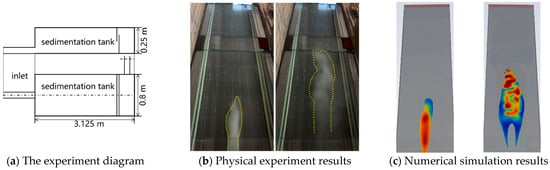
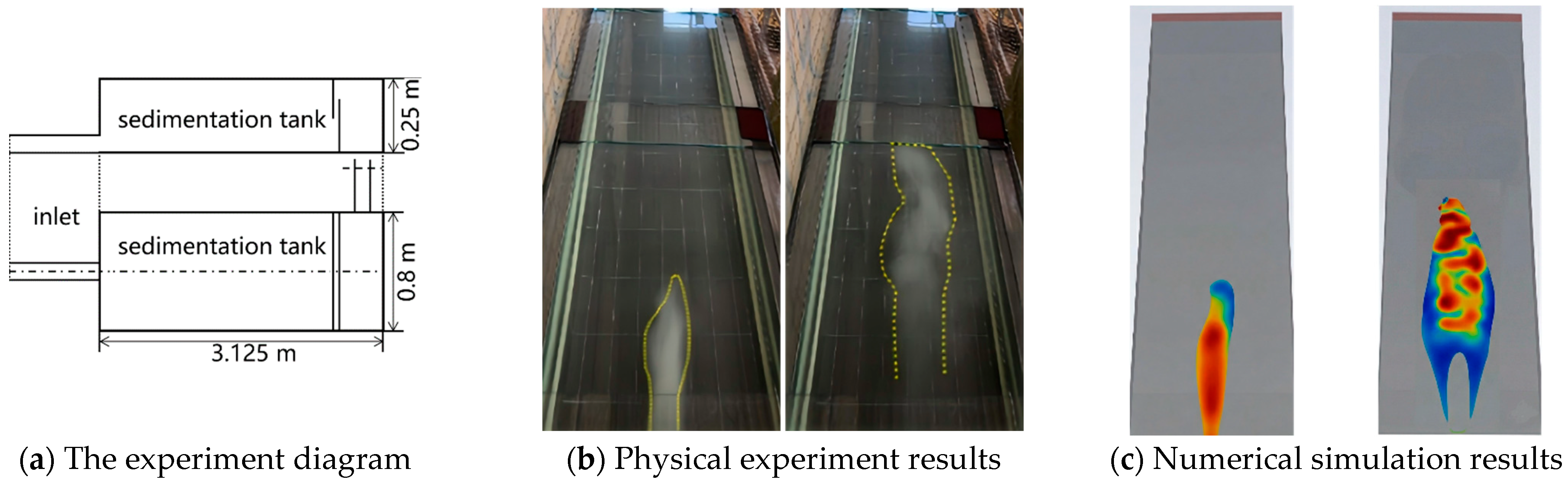
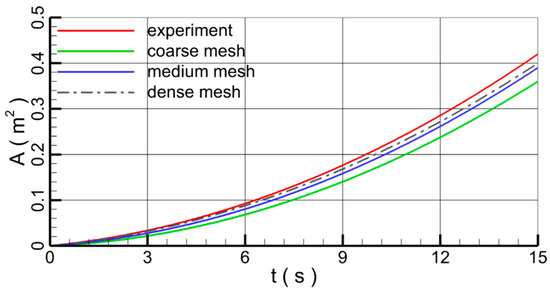
To validate the accuracy of the mathematical model, a physical experiment was conducted using a rectangular glass-walled flume [51]. Figure 1a shows the experiment diagram. The flume measured 3.125 m in length, 0.8 m in width, and 0.25 m in depth. A circular inlet was positioned along the longitudinal centerline at the bottom of the tank, and a weir with an upstream skimming board (weir coefficient μ = 0.62) was installed at the outlet to control the water level. Polystyrene particles with a diameter of 300 μm were used for sedimentation tests. The experiments used fresh water and solid particles. The density contrast is attributable to the presence of suspended polystyrene particles. plume density refers to the bulk density of the sediment–water mixture. A mathematical model was then defined based on this physical setup.
Figure 1.
The flow field comparisons between the experimental and numerical results. The color gradient represents the plume concentration level, where red indicates higher concentration and blue indicates lower concentration.
Figure 1b,c displays the sediment distribution in both the physical experiment and the numerical simulation at t = 10 s and t = 15 s. At 10 s, the simulation results exhibited diffusion near the inlet with a rightward deviation. At 15 s, two banded distributions appeared along the inlet direction with localized particle concentration, matching the flow direction observed in the experiment. Although minor discrepancies in detail existed—attributed to variations in specific model settings and observation angles—the numerical results generally showed good agreement with the experimental data.
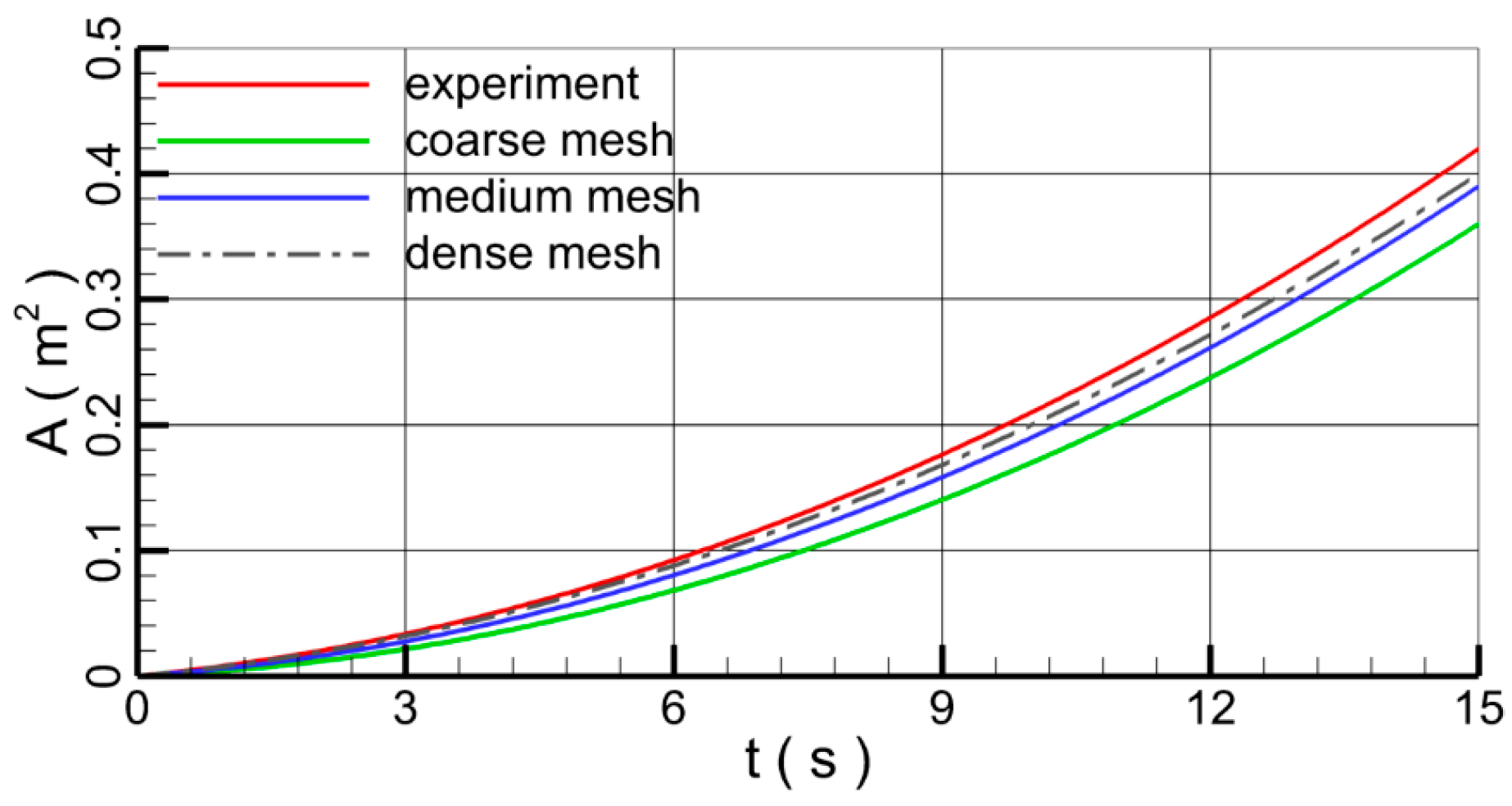
Furthermore, Figure 2 compares the experimental results with numerical simulations using three different mesh densities: coarse (195,312 cells), medium (512,301 cells), and dense (715,224 cells). As the diffusion time increased, the diffusion range expanded. The discrepancy between the simulation and experiment diminished significantly with finer meshes. Notably, the results from the medium and dense meshes were nearly identical. Therefore, to balance calculation accuracy with computational efficiency, the medium mesh was selected for the subsequent simulations. These results demonstrate good consistency between the experiment and the mathematical model, indicating that the developed method is suitable for simulating plume flow.
Figure 2.
Comparison of numerical simulations with different mesh densities against experimental results.
4. Results Analysis and Discussion
The computational domain was defined as a two-dimensional rectangular cuboid with a length of 50 m, a width of 1 m, and a height of 2 m. The left boundary of the domain was set as the velocity inlet for the free stream, while the right boundary was designated as the pressure outlet. The top and bottom surfaces were treated as walls. The plume was injected at the position x = 10 m, z = 0.5 m, with an upward discharge direction. The injection diameter D0 = 1 m. The domain was discretized into 520,124 grid cells, each with a uniform size of 0.06 m.
To systematically investigate the movement characteristics of the plume, a series of numerical simulations was conducted by varying the free stream velocity (v), injection velocity (vj), and discharge density (ρ). A summary of the simulation conditions is presented in Table 1. In each subsection of the results, one parameter is varied while the others are kept constant at their standard base values, unless otherwise specified.
Table 1.
Summary of simulation parameters.
The flow behavior is governed by the interplay between momentum and buoyancy fluxes. To characterize the flow regime, the jet length scale (LM) is calculated as LM = M03/4/B01/2, where M0 is the kinematic momentum flux and B0 is the buoyancy flux [52]. Based on the simulation parameters (D0 = 1.0 m, ρ = 1100 kg/m3, ρa = 1000 kg/m3), the calculated LM ranges from approximately 0.19 m (at vj = 0.2 m/s) to 1.33 m (at vj = 1.4 m/s). Consequently, despite the presence of the ambient crossflow, the flow exhibits distinct jet-like characteristics in the near-field before being deflected and evolving into a buoyancy-dominated plume downstream.
This study monitored the plume dynamics under varying free stream velocities, injection velocities, and discharge densities. At each condition, the plume flow pattern, turbulent kinetic energy, and vorticity fields were recorded at three characteristic times (10 s, 20 s, and 30 s). In addition, five monitoring points were arranged along the plume pathway to track the temporal evolution of velocity, located at x = 10.5 m, 11.0 m, 11.5 m, 12.0 m, and 12.5 m.
4.1. Influence of Free Stream on Plume
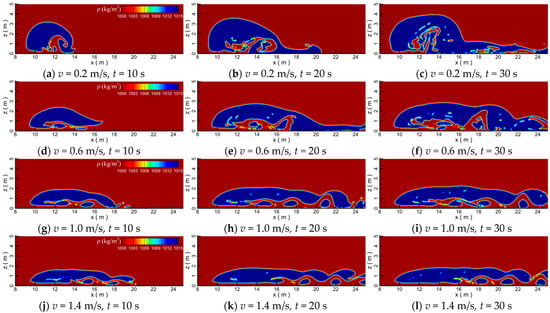
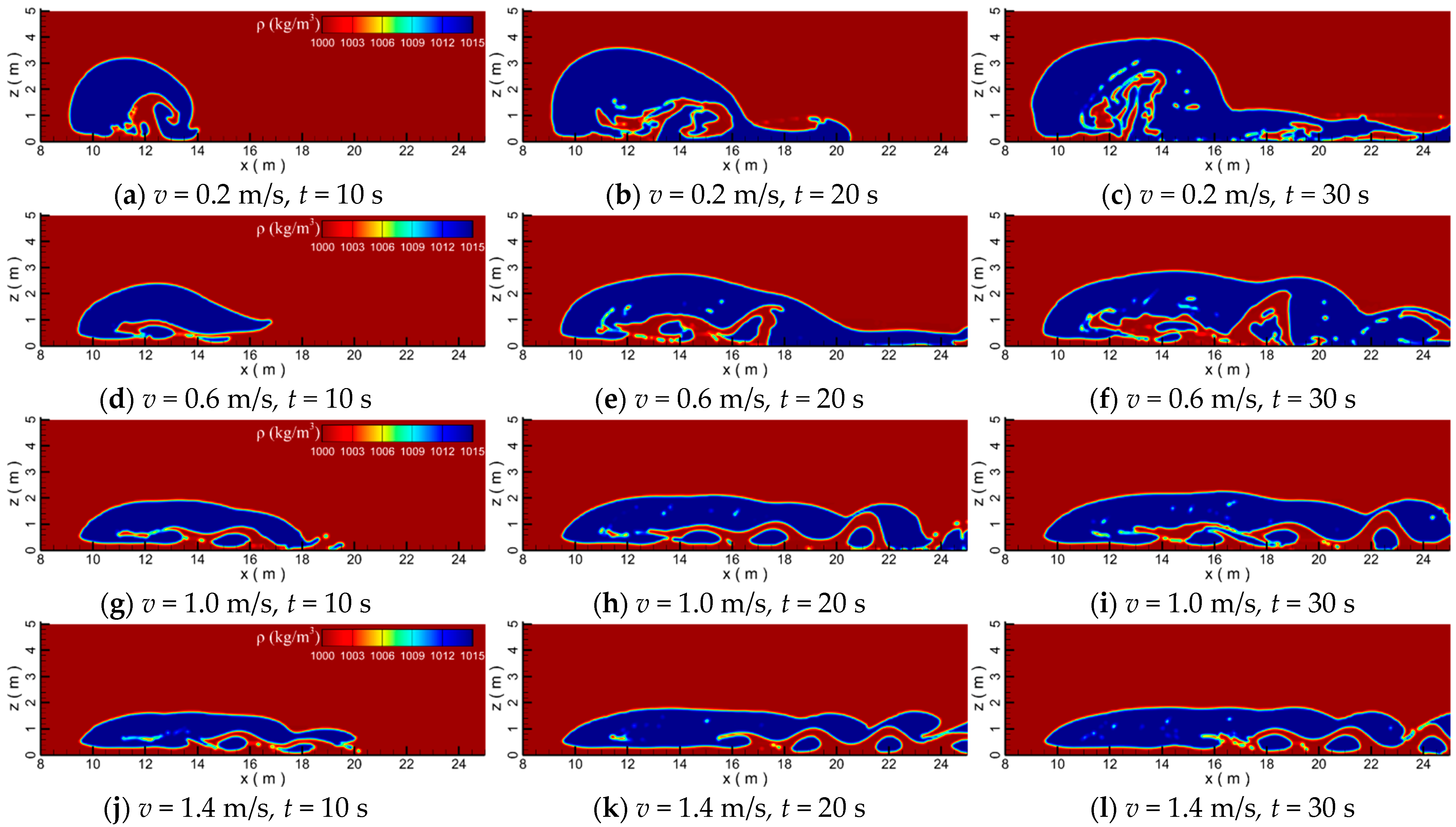
Simulations were performed with varying free stream velocities (v) ranging from 0.2 to 1.4 m/s, while the injection velocity (vj) and discharge density (ρ) were maintained constant at 1.0 m/s and 1015 kg/m3, respectively. A horizontal comparison is conducted for the plume motion under a free stream velocity of 0.2 m/s. In Figure 3a, the plume initially rises and subsequently forms a clockwise circulation under the influence of the free stream. Upon impinging on the bottom boundary, the plume bifurcates into two divergent branches. The backward-directed branch induces an “arching” pattern in the plume body, although no distinct vortex shedding is observed. In Figure 3b, the plume continues to extend toward the outlet, and the arching region becomes more pronounced. The flow separation following the plume’s impact on the bottom is also increasingly evident. The divergent flow directed toward the outlet is obstructed by the ambient water mass and is subsequently lifted upward, whereas the backward divergent flow begins to exhibit vortex shedding, indicating a more effective mixing between the plume and the surrounding fluid. In Figure 3c, the plume continues to advance toward the outlet and eventually exits the domain. The forward divergent branch displays pronounced turbulence and mixes with the ambient water, although a fully detached vortex does not form. The backward divergent branch undergoes intensive mixing with the ambient water, producing a vertically expanding structure while showing limited horizontal development.
Figure 3.
The range of plume flow movement at different times under different free stream velocities. (Fixed conditions: vj = 1.0 m/s, ρ = 1015 kg/m3).
A horizontal comparison is also conducted for plume evolution under a free stream velocity of 0.6 m/s. In Figure 3d, the plume exhibits a clockwise rotational tendency induced by the free stream and develops an “arching” pattern. However, after the plume front impinges on the bottom boundary, no distinct flow separation is observed, although initial vortex shedding begins to appear. In Figure 3e, the plume front has exited the domain, and well-developed vortex shedding is present upstream, accompanied by the intrusion of ambient water into the plume body. The arching structure continues to move downstream. In Figure 3f, this arching feature further advances, and the mixing between the plume and the ambient water becomes increasingly evident, exhibiting pronounced turbulent characteristics.
A horizontal comparison is further conducted for the plume evolution under a free stream velocity of 1.0 m/s. In Figure 3g, the plume develops downstream in a banded form, and fully developed vortex shedding is already present. In Figure 3h, periodically detached vortices emerge, and the plume front has exited the domain, exhibiting an alternating upward–downward oscillation. In Figure 3i, the spatial extent remains nearly unchanged from that in Figure 3h, indicating that the plume has reached a relatively stable turbulent regime.
A horizontal comparison is also performed for the plume evolution under a free stream velocity of 1.4 m/s. In Figure 3j, no evident vortex shedding is observed upstream, and shedding only appears in the mid-section of the plume. In Figure 3k, the shedding region shifts further downstream toward the outlet, the plume front has exited the domain, and the plume exhibits a more regular turbulent pattern. In Figure 3l, the overall plume extent remains largely unchanged, indicating limited further development.
A vertical comparison of plume motion under different free stream velocities shows that, at lower velocities, the plume exhibits a more pronounced “arching” near the outlet and a wider distribution in the vertical direction. This trend persists until the free stream reaches 1.0 m/s, beyond which the arching pattern becomes indistinct. When the free stream velocity is relatively low (v = 0.2 and 0.4 m/s), the plume also displays an initial clockwise rotational tendency, and the flow separation following bottom impingement is more evident. These features indicate that under weak free stream, the initial plume motion is strongly controlled by its own momentum, with negative buoyancy and inertial forces playing dominant roles. As the free stream velocity increases, the lateral development of the plume in the vertical direction becomes increasingly suppressed, and the free stream gradually assumes the dominant role in controlling plume evolution. At lower free stream velocities, the turbulence within the plume is relatively unstable, characterized by the presence of large vortical structures, and the mixing with the ambient water is, in fact, more extensive, although the mixing efficiency is difficult to quantify. With further increases in free stream velocity, the plume transitions toward a more stable turbulent regime, accompanied by the periodic and coherent shedding of vortices.
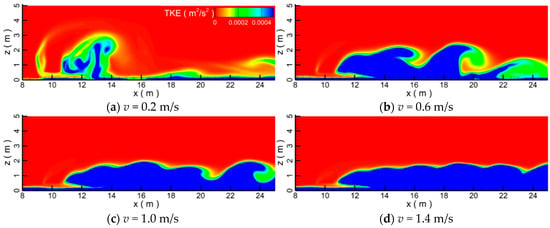
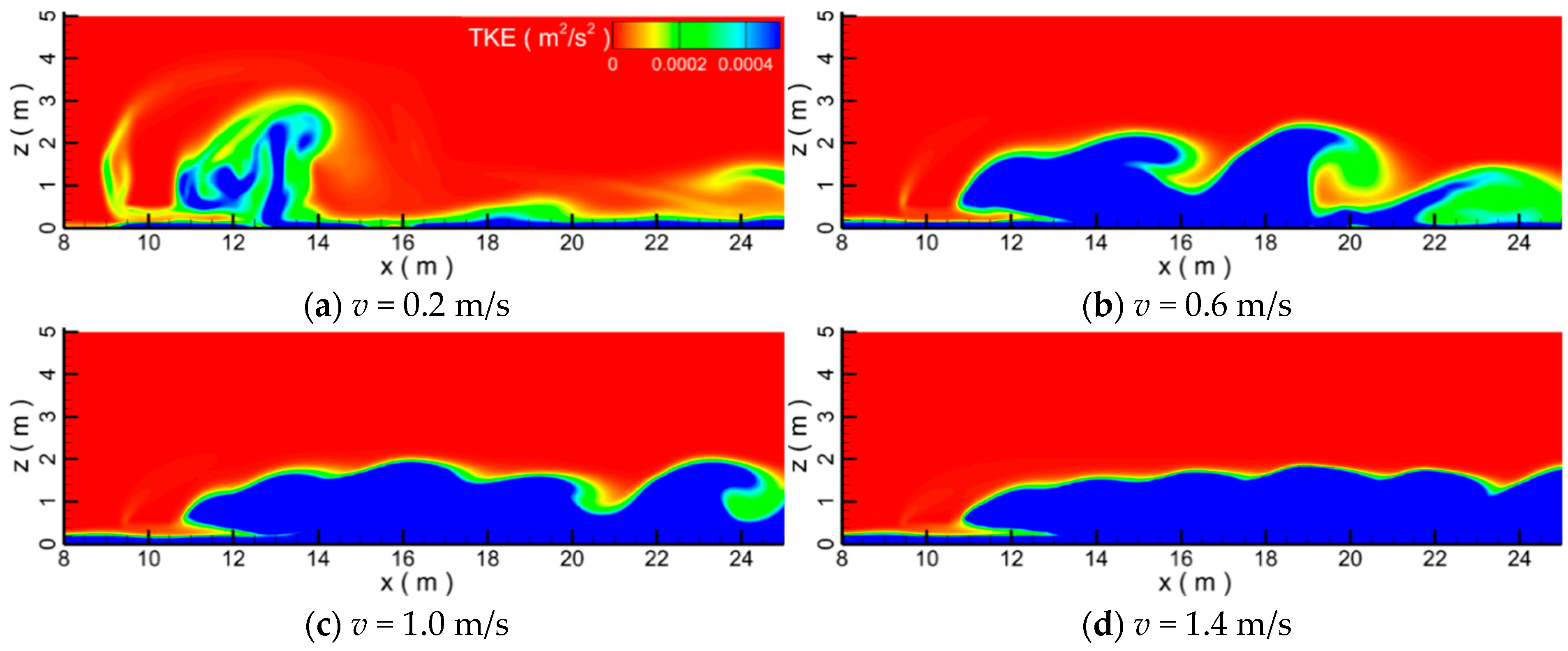
In Figure 4a, when the free stream velocity is 0.2 m/s, the turbulent kinetic energy (TKE) accumulates on the upstream side, and a small portion develops along the bottom boundary toward the outlet. At this stage, the turbulence intensity remains low, and energy dissipation is concentrated primarily near the plume inlet. In Figure 4b, the TKE exhibits a more regular distribution due to obstruction by the ambient water mass, with high turbulence intensity persisting near the plume inlet and progressive energy dissipation occurring as the plume mixes with the surrounding fluid while moving toward the outlet. In Figure 4c,d, under relatively high free stream velocities, the turbulence becomes fully developed, accompanied by markedly higher TKE levels. In Figure 4d, the TKE shows no significant dissipation even near the outlet.
Figure 4.
The turbulent kinetic energy of the plume flow at different times under different free stream velocities. (Fixed conditions: vj = 1.0 m/s, ρ = 1015 kg/m3).
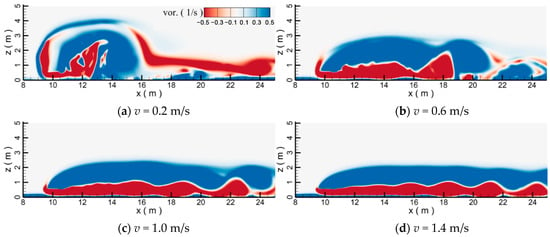
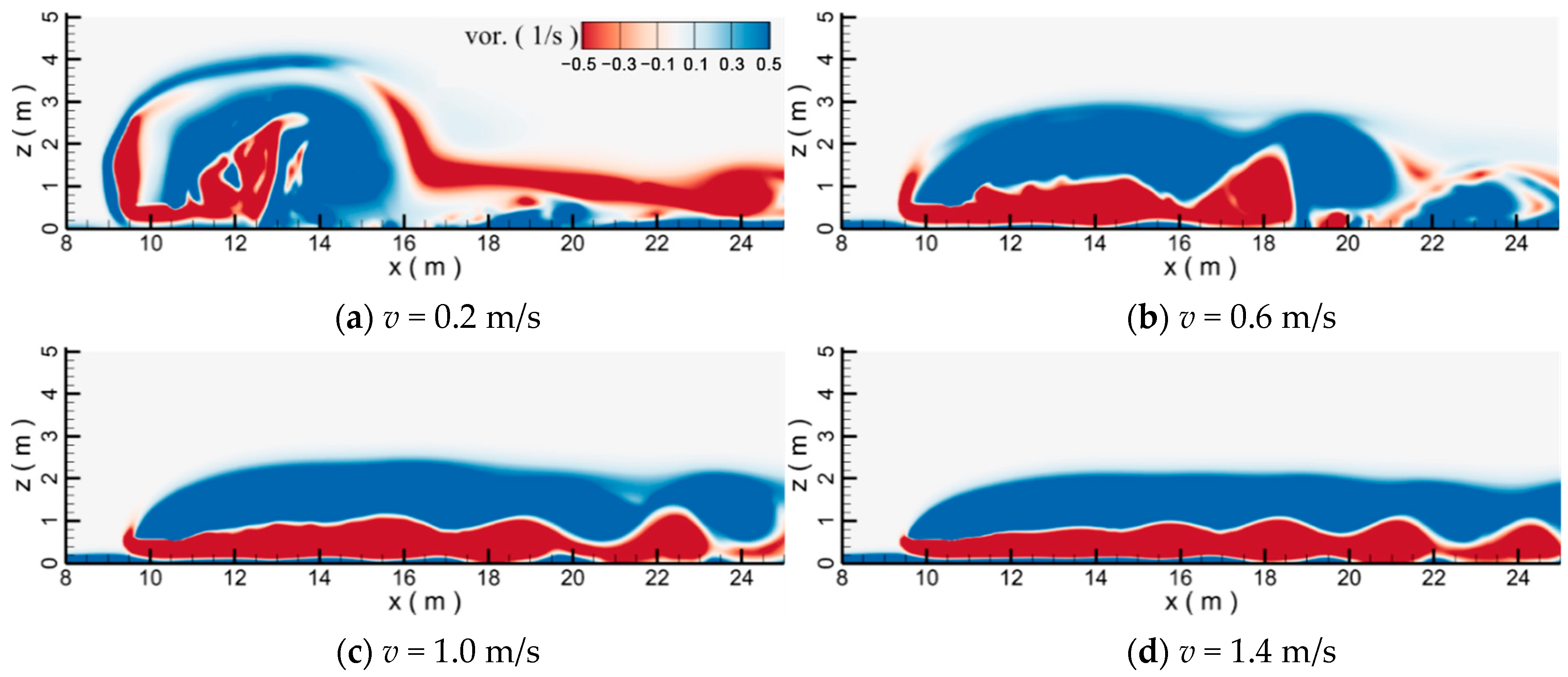
In Figure 5a, when the free stream velocity is relatively low, the plume generates comparatively large vortices; however, their intensity is weak, and the vortical structures remain disordered and irregular. In Figure 5c,d, as the free stream velocity increases, the vortices become smaller in scale and evolve into more coherent and stable structures. The vorticity distribution exhibits clear periodicity, and the turbulence gradually develops into a fully defined state. Figure 5b represents a transitional regime, in which the initially unstable plume turbulence begins to evolve toward a more stable turbulent structure.
Figure 5.
The vorticity of the plume flow at different times under different free stream velocities. (Fixed conditions: vj = 1.0 m/s, ρ = 1015 kg/m3).
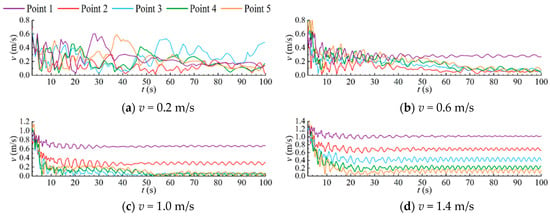
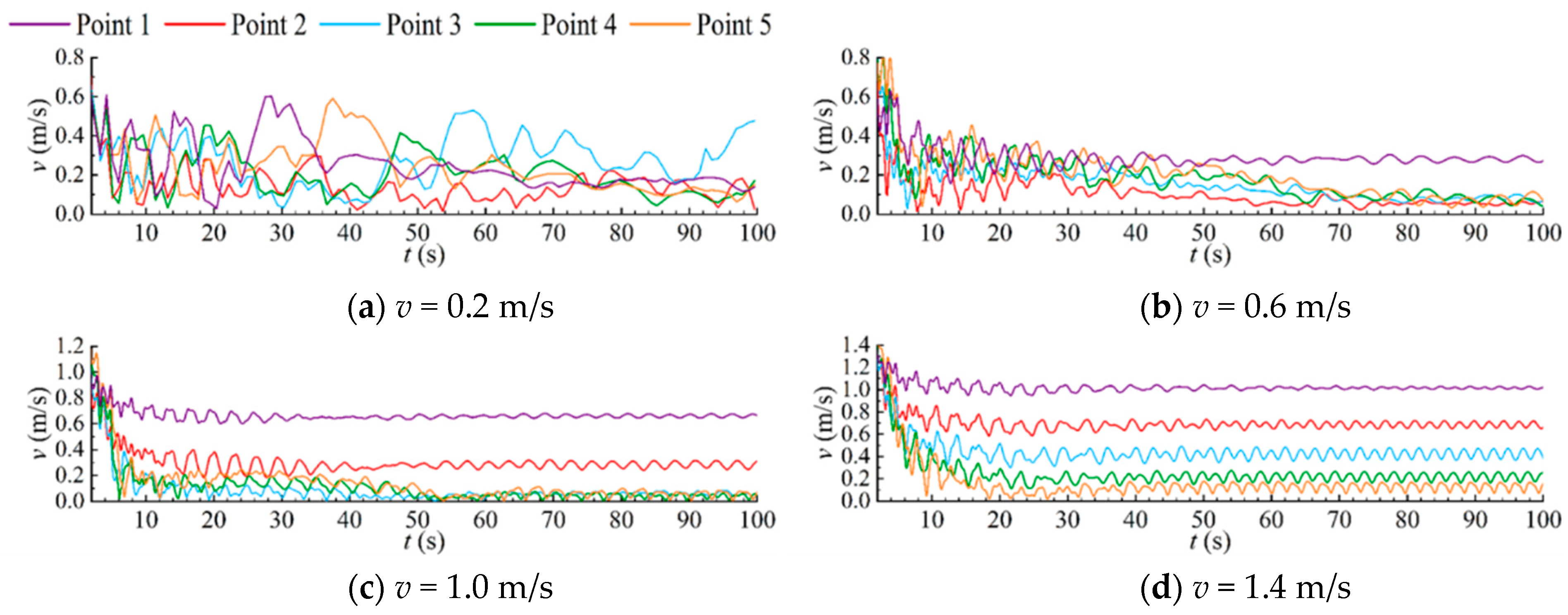
In Figure 6a, Point 1 reaches a maximum velocity of approximately 0.60 m/s at around 27 s, whereas Point 2 reaches a minimum velocity close to 0 m/s at around 54 s. The velocity periods and amplitudes at the five monitoring points are highly unstable, indicating that under a relatively low free stream velocity, the plume is unable to develop a stable turbulent structure. In Figure 6b, following an initial stage of strong oscillations, the velocities at the five points gradually exhibit a more consistent periodic behavior after 40 s, although fluctuations in amplitude still persist. This suggests that at this free stream velocity, the plume progressively evolves into a relatively stable turbulent regime, characterized by a stable time-averaged velocity but persistently fluctuating instantaneous velocities. Among the five monitoring points, the velocity fluctuations at Point 2 are the most irregular, indicating that the turbulence at this location is not yet fully developed. The time-averaged velocity at Point 1 is approximately 0.30 m/s, whereas the corresponding values at Points 2, 3, 4, and 5 are around 0.10 m/s. In Figure 6c, the velocities at all five points exhibit strong initial oscillations, characterized by short periods and a rapid decline in time-averaged velocity. After 10 s, the oscillation period gradually stabilizes, and the amplitude decreases progressively. Point 1 is the first to reach a stable state at around 40 s, with a time-averaged velocity of approximately 0.70 m/s. Point 2 reaches stability at about 48 s, with a time-averaged velocity of roughly 0.30 m/s. The remaining points stabilize at approximately 52 s, each with a time-averaged velocity near 0.05 m/s. The fluctuating velocities at the five monitoring points are generally comparable. In Figure 6d, the velocity variations at the five points resemble those in Figure 6c, but the periods and amplitudes stabilize earlier. After reaching stability, the time-averaged velocity at Point 1 is approximately 1.05 m/s; at Point 2, about 0.70 m/s; at Point 3, about 0.40 m/s; at Point 4, about 0.20 m/s; and at Point 5, about 0.15 m/s. Among these, Point 1 exhibits the smallest velocity fluctuations, indicating that the plume’s turbulence intensity at this location is the lowest.
Figure 6.
Different monitoring point velocities at different free stream velocities. (Fixed conditions: vj = 1.0 m/s, ρ = 1015 kg/m3).
4.2. Influence of Injection Velocity on Plume
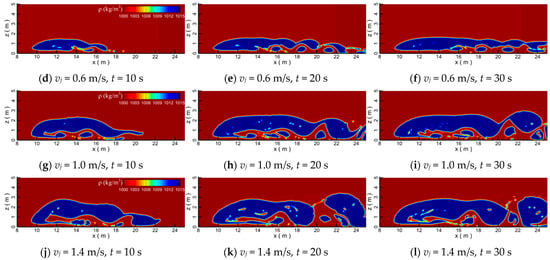
Simulations were performed with varying injection velocity (vj) ranging from 0.2 to 1.4 m/s, while the free stream velocities (v) and discharge density (ρ) were maintained constant at 1.0 m/s and 1015 kg/m3, respectively. A horizontal comparison of plume movement at a jet velocity of 0.2 m/s is conducted. In Figure 7a, the plume exhibits extremely limited lateral diffusion in the vertical direction, which is attributed to its relatively low initial momentum. The plume front advances only to the mid-section of the computational domain, and no distinct vortical structures are observed. In Figure 7b, the lateral distribution remains largely unchanged, while the plume front gradually detaches and eventually reaches the outlet. In Figure 7c, a more pronounced and stable turbulent structure begins to form near the mid-domain, where the plume edges lose their smoothness and small-scale vortices start to detach.
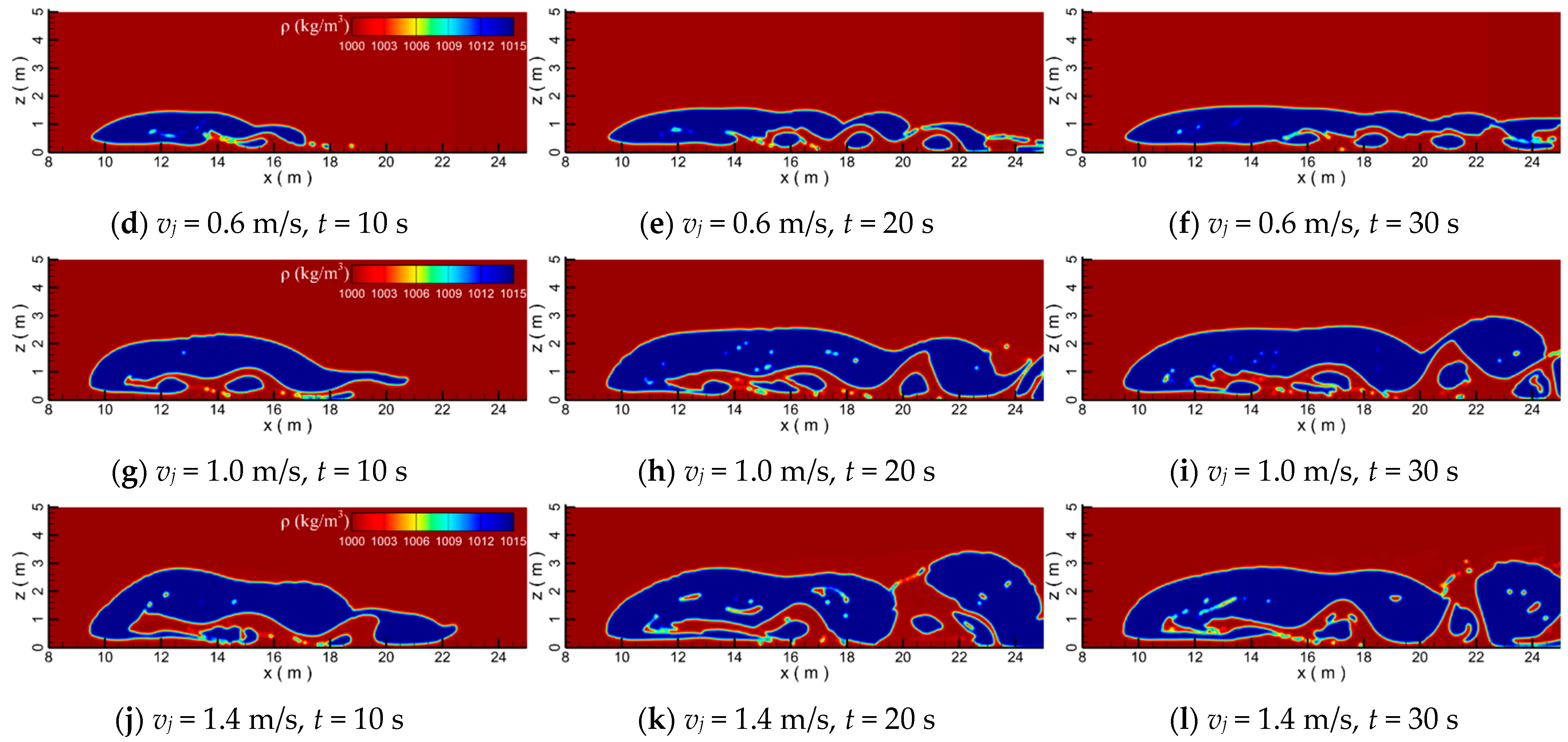
Figure 7.
The range of plume flow movement at different times under different injection velocities. (Fixed conditions: v = 1.0 m/s, ρ = 1015 kg/m3).
A horizontal comparison of plume movement at an injection velocity of 0.6 m/s is subsequently performed. In Figure 7d, the plume has already begun to develop a distinct turbulent structure, with partial detachment at the plume front and limited intrusion of ambient water into the plume interior. In Figure 7e, the plume evolves into a more organized turbulent structure, accompanied by fully developed vortex detachment, indicating enhanced mixing efficiency, and the plume front reaches the outlet. In Figure 7f, the overall plume extent remains similar to that in Figure 7e, although the location of vortex detachment shifts further downstream toward the outlet.
Next, a horizontal comparison of plume movement at an injection velocity of 1.0 m/s is conducted. In Figure 7g, the plume displays fully detached vortices and a continuous plume front. Near the outlet, the plume bifurcates, and a small amount of detached plume material can be observed along the bottom boundary. In Figure 7h, the plume continues to evolve toward the outlet and flows out of the domain, with larger vortices breaking into smaller ones, leading to more effective fluid mixing. In Figure 7i, the overall plume extent remains nearly identical to that in Figure 7h, indicating that a stable turbulent structure has been defined. A horizontal comparison of plume movement at an injection velocity of 1.4 m/s shows a distribution pattern similar to that observed at 1.0 m/s.
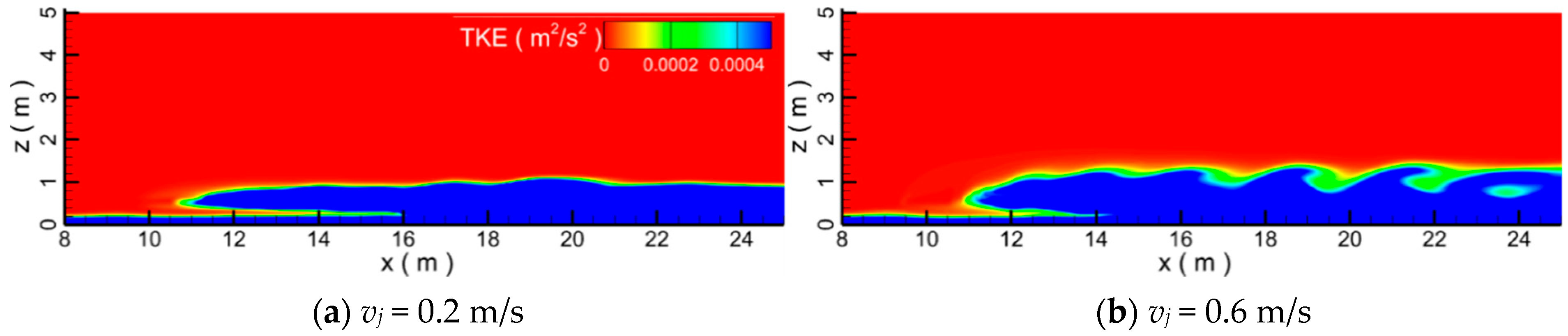
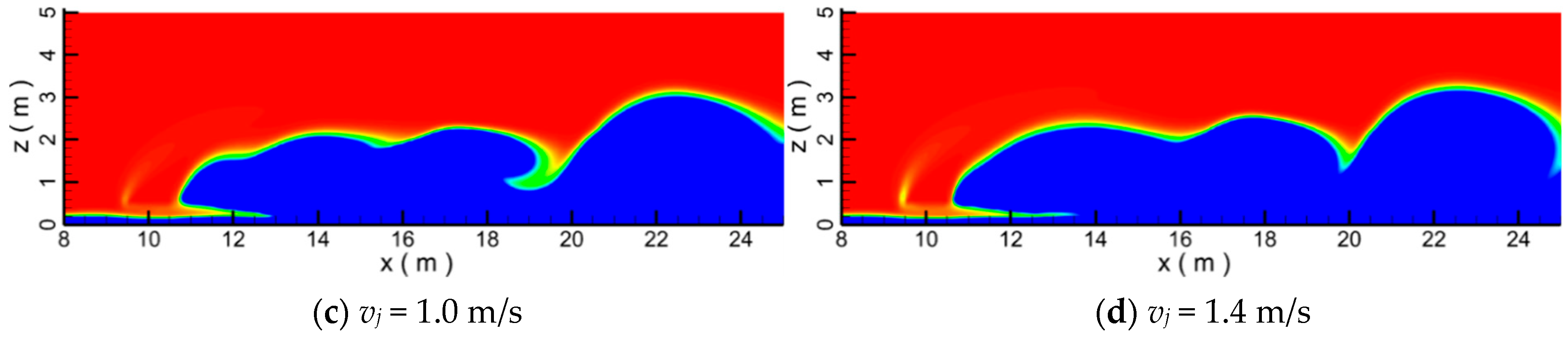
A vertical comparison of plume movement at different injection velocities shows that, as the injection velocity increases, the lateral spread of the plume in the vertical direction progressively widens, and the plume extent in the x-direction at 10 s also increases. This indicates that the initial momentum becomes the dominant factor governing the early-stage plume distribution. Comparing the results at 20 s, Figure 7k reveals that the plume contains a greater number of small entrained ambient-water masses, suggesting that a higher injection velocity enhances both the mixing efficiency and the spatial extent of plume-induced turbulence.
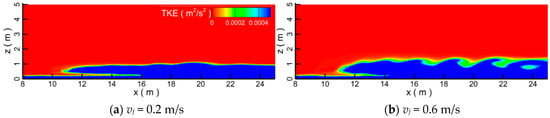
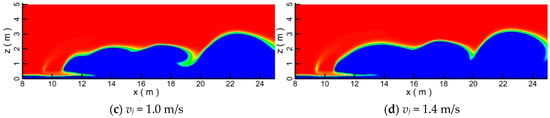
In Figure 8a, the distribution of turbulent kinetic energy (TKE) exhibits smooth boundaries and remains confined in the vertical direction. Although the turbulence intensity is relatively high, there is minimal energy exchange with the ambient water, and the associated energy dissipation is limited. In Figure 8b, the upper boundary of the TKE field begins to show signs of separation, indicating that at an injection velocity of 0.6 m/s, the plume initiates continuous energy exchange with the surrounding water. This promotes substantial energy dissipation and enhances the efficiency of turbulent diffusion. In Figure 8c, the TKE distribution widens noticeably, and energy exchange occurs with a larger portion of the ambient water, further expanding the turbulence diffusion range. However, due to the higher initial momentum associated with the larger injection velocity, the plume retains a relatively high level of TKE near the outlet. This indicates that although increasing the injection velocity improves the mixing efficiency between the plume and the ambient water, it also significantly enlarges the overall diffusion footprint of the plume. The TKE distribution in Figure 8d is similar to that in Figure 8c but extends over an even wider area.
Figure 8.
The turbulent kinetic energy of the plume flow at different times under different injection velocities. (Fixed conditions: v = 1.0 m/s, ρ = 1015 kg/m3).
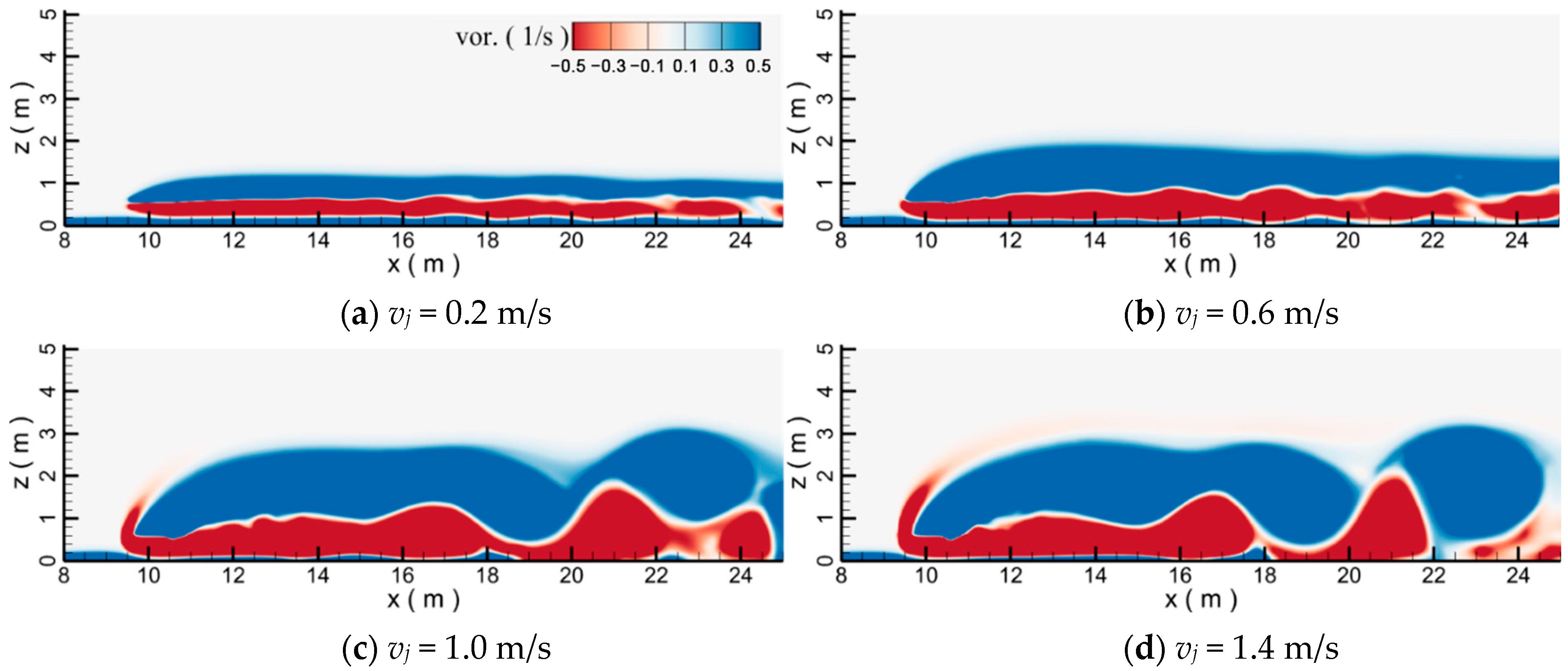
In Figure 9a, the vorticity field displays two relatively smooth, narrow, and elongated bands, indicating that a low injection velocity is insufficient to generate large vortex structures. Although the turbulence is developed, its intensity remains weak. In Figure 9b, the vorticity distribution expands laterally in the vertical direction, and interfacial fluctuations become more pronounced, suggesting that an increase in injection velocity enlarges the vortex scale and enhances mixing between the plume and a greater portion of the ambient water. In Figure 9c,d, the vorticity near the plume inlet splits into two distinct bands, and pronounced vortex structures emerge downstream. This demonstrates that a higher injection velocity promotes vortex detachment and significantly strengthens the mixing between the plume and the surrounding water.
Figure 9.
The vorticity of the plume flow at different times under different injection velocities. (Fixed conditions: v = 1.0 m/s, ρ = 1015 kg/m3).
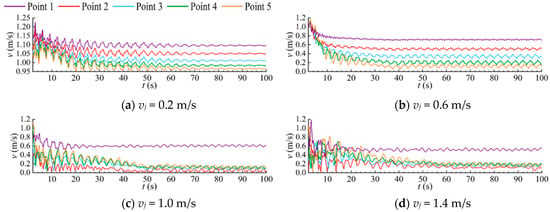
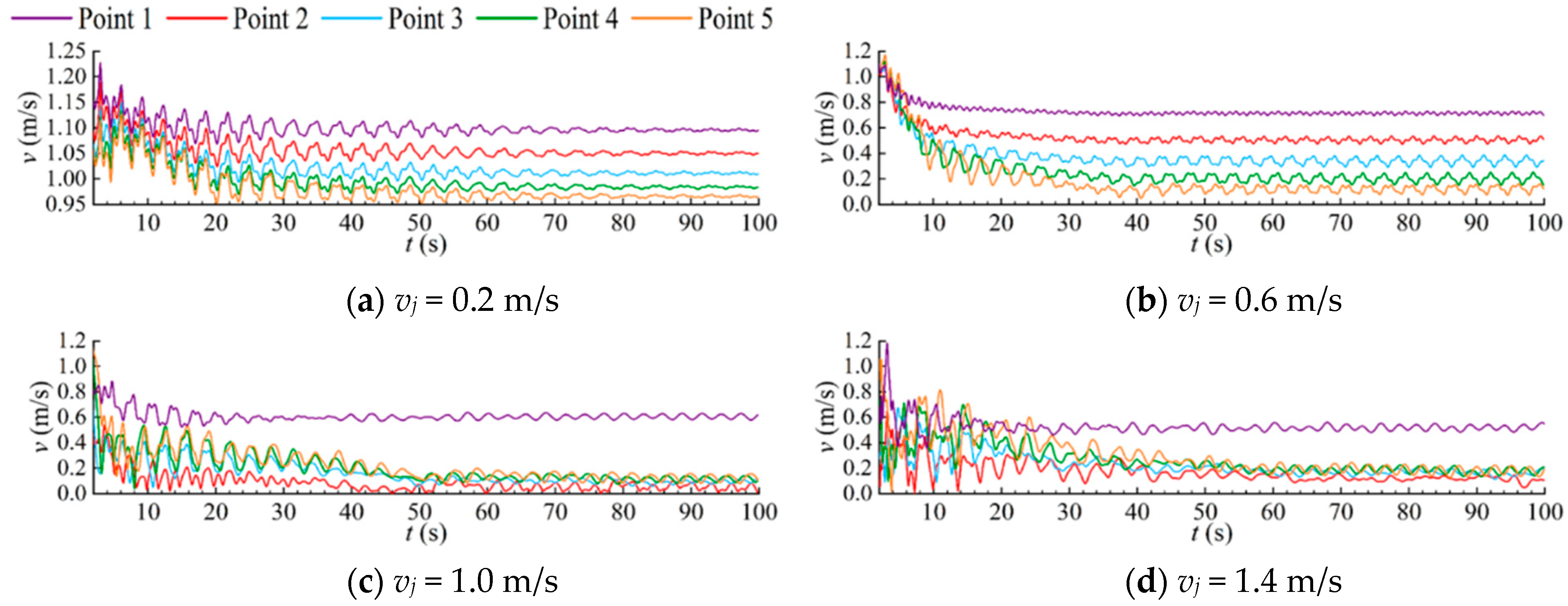
In Figure 10a, the velocity periods at the five monitoring points remain relatively stable. After an initial stage of oscillations, the amplitudes gradually diminish and eventually stabilize, indicating the formation of a well-developed and stable turbulent structure. In Figure 10b, the velocity fluctuations at all monitoring points exhibit regular patterns from the outset, with both the time-averaged and fluctuating velocities steadily decreasing. Point 1 reaches stability at approximately 20 s, Points 2 and 3 at about 35 s, and Points 4 and 5 at around 40 s. All points ultimately develop stable turbulent structures, with Point 1 showing the smallest velocity amplitude and thus the lowest turbulence intensity.
Figure 10.
Different monitoring point velocities at different injection velocities. (Fixed conditions: v = 1.0 m/s, ρ = 1015 kg/m3).
In Figure 10c, the velocities at the monitoring points initially exhibit unstable behavior, suggesting that the turbulence is not yet fully developed during the early stage. The velocities at all points gradually stabilize after around 50 s. The behavior in Figure 10d is generally consistent with that in Figure 10c; however, at an injection velocity of 1.4 m/s, the initial velocity oscillations are significantly more intense. Among the five points, only Point 2 eventually reaches a stable state, indicating that the turbulence at this point does not fully develop.
4.3. Influence of Discharge Density on Plume
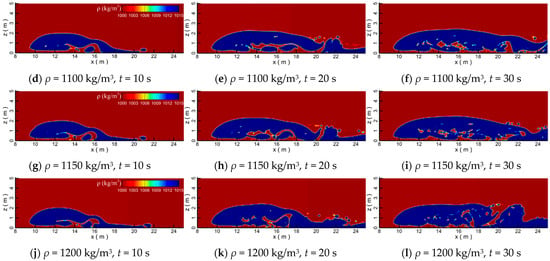
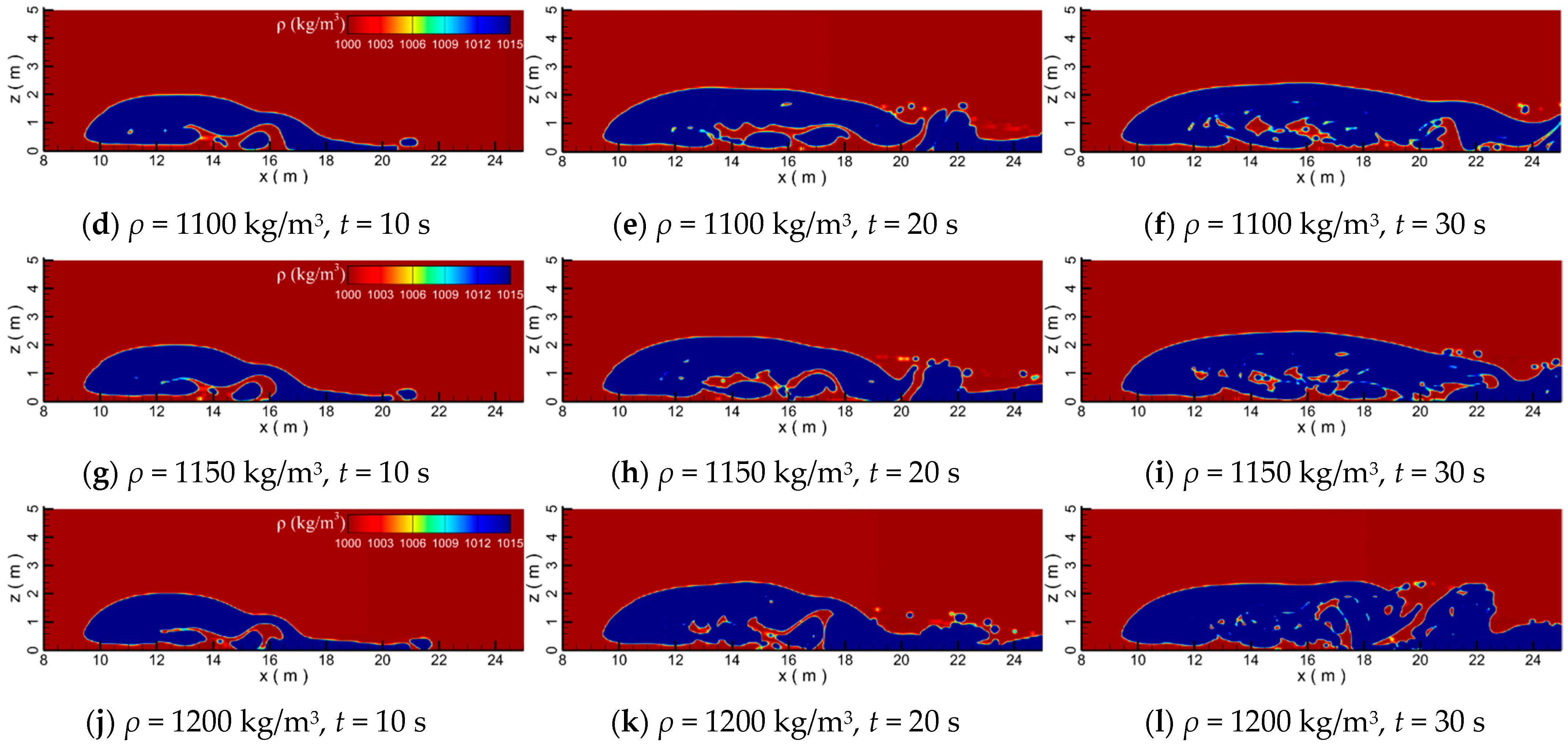
Simulations were performed with varying discharge density (ρ) ranging from 0.2 to 1.4 m/s, while the free stream velocities (v) and injection velocity (vj) were maintained constant at 1.0 m/s and 1.0 m/s, respectively. By comparing Figure 11a,d,g,j, it is evident that plume density has only a minor influence on the lateral spread of the plume in the vertical direction. As the density increases, the plume extends farther in the x-direction, indicating that inertial forces play a dominant role during the early stage of plume dispersion. When examining the motion range at 20 s and 30 s, it can be observed that higher plume density leads to less smooth plume edges and reduces the likelihood of forming fully detached vortices. Moreover, the entrained ambient-water masses become smaller in size. These characteristics suggest that increasing the plume density weakens its ability to generate turbulence and suppresses its mixing with the surrounding water.
Figure 11.
The range of plume flow movement at different times under different discharge densities. (Fixed conditions: v = 1.0 m/s, vj = 1.0 m/s).
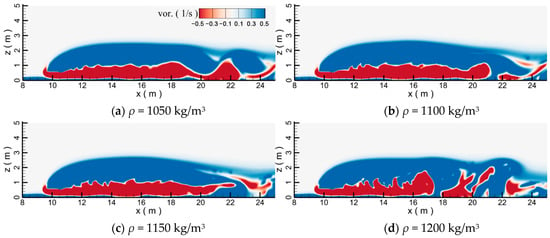
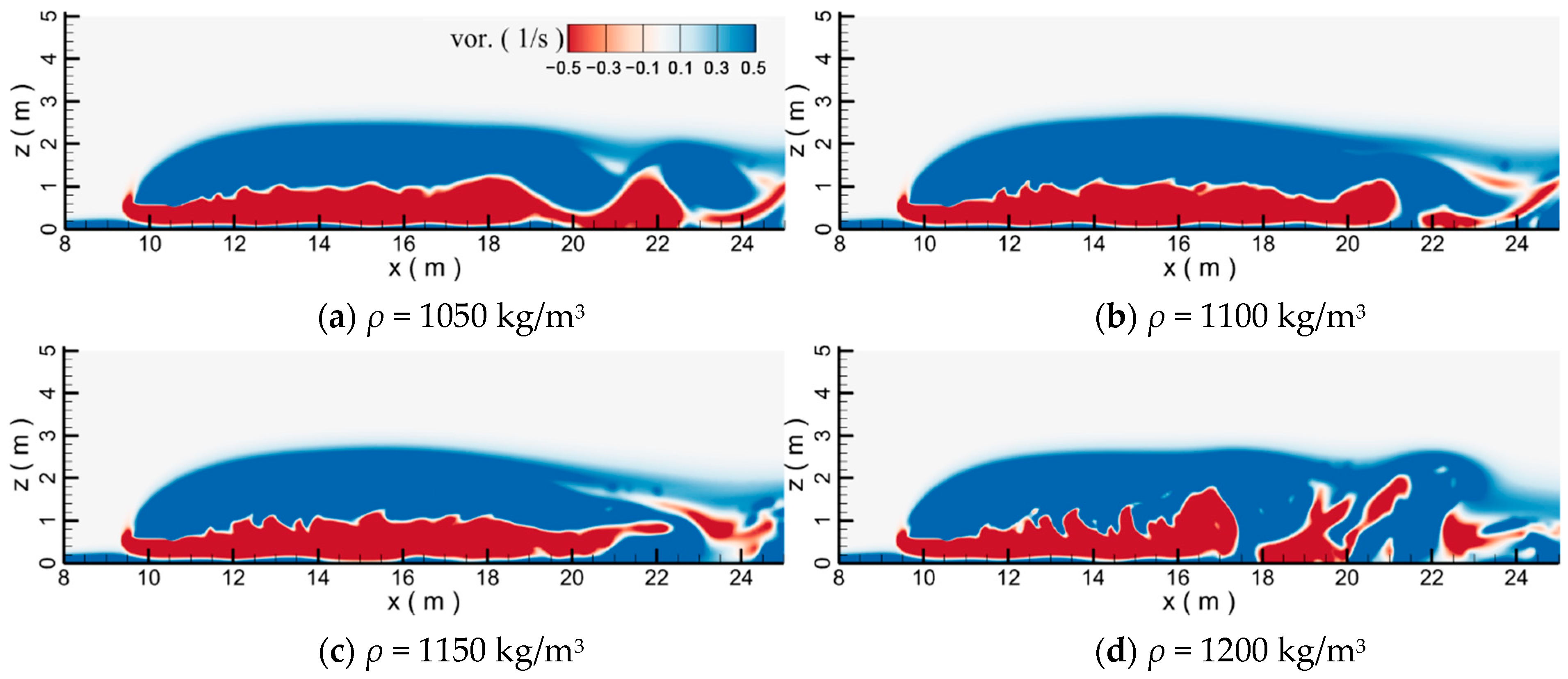
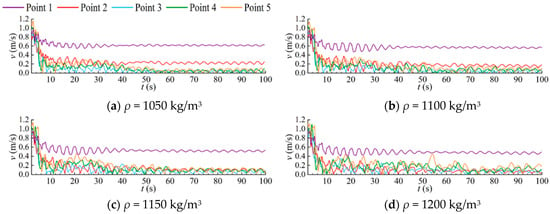
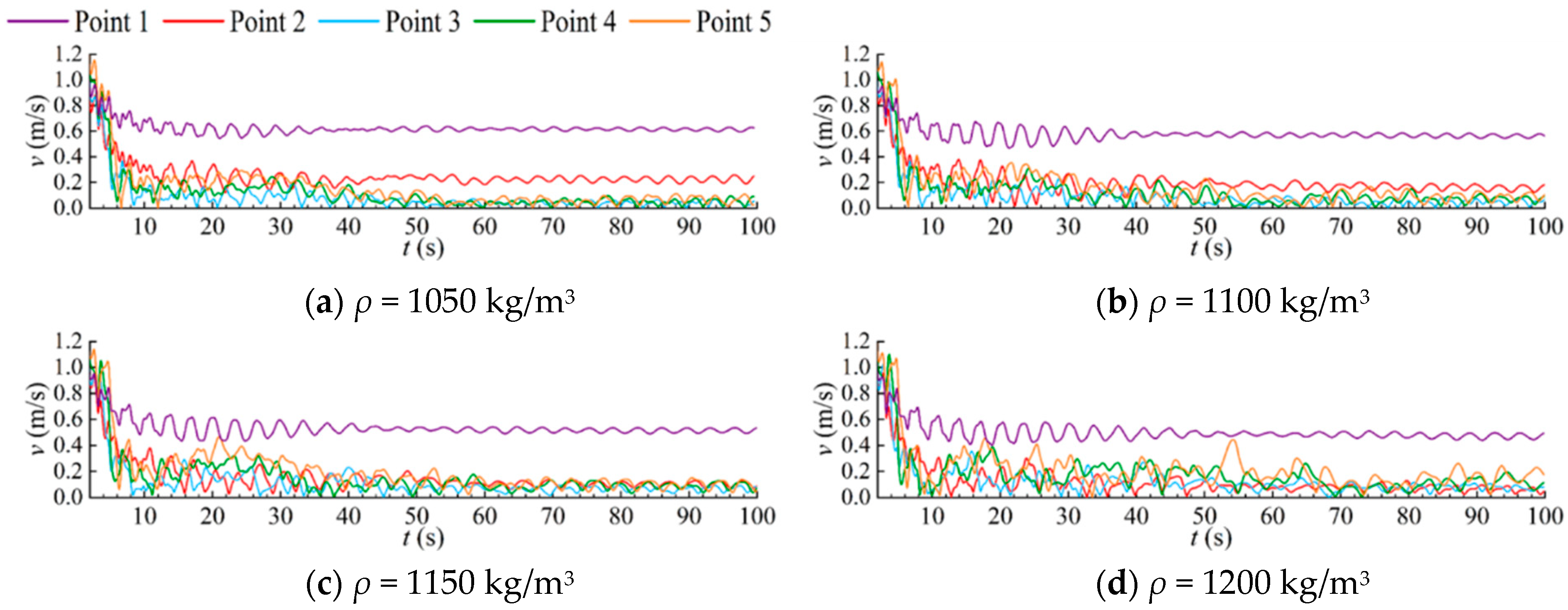
As shown in Figure 12, increasing plume density does not lead to a significant change in vortex size. However, the vorticity interface becomes less smooth, indicating weaker turbulence development and the inability to form stable turbulent structures. In Figure 13a–c, the velocity periods and amplitudes at all monitoring points eventually stabilize, and the time-averaged velocities converge to similar values. This demonstrates that variations in plume density do not substantially affect the macroscopic motion of the plume. Nevertheless, the initial velocity oscillations at each monitoring point become increasingly pronounced as the density increases. In Figure 13d, the velocities at Points 3, 4, and 5 fail to reach stability, suggesting that the turbulence at these locations does not fully develop. These observations indicate that plume density plays a critical role in governing the microscopic turbulent behavior.
Figure 12.
The vortices of the plume flow at different times under different discharge density. (Fixed conditions: v = 1.0 m/s, vj = 1.0 m/s).
Figure 13.
Different monitoring point velocities at different discharge densities. (Fixed conditions: v = 1.0 m/s, vj = 1.0 m/s).
4.4. The Diffusion Ranges of Plume
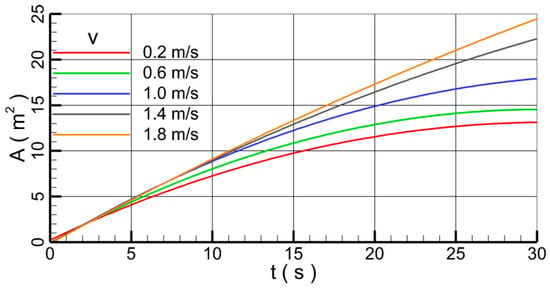
As shown in Figure 14, the horizontal diffusion area A of the plume increases monotonically with time for all free stream velocities, although the growth rate is strongly influenced by the flow magnitude. Under a weak free stream of v = 0.2 m/s, the plume area increases slowly and approaches a quasi-saturated state after approximately t ≈ 20 s, reaching only about 13 m2 at t = 30 s. In contrast, when the free stream strengthens to v = 1.4–1.8 m/s, the area–time curves remain nearly linear throughout the simulation period, with the plume being persistently advected downstream and the affected area expanding to approximately 21.5–24.5 m2 at t = 30 s. This behavior demonstrates that, once the free stream speed exceeds roughly 1.0 m/s, advection becomes the dominant process controlling the plume footprint, consistent with the enhanced turbulent mixing characteristics described in the preceding sections.
Figure 14.
Diffusion range at different times under different free stream velocities.
A more quantitative comparison further underscores the influence of the free stream on the diffusion range. At t = 10 s, the plume area is approximately 7 m2 for v = 0.2 m/s, increasing to about 10.5 m2 when the current velocity is raised to 1.8 m/s—an enlargement of roughly 50%. At t = 20 s, the area increases from about 11.2 m2 at v = 0.2 m/s to 15.0 m2 at v = 1.0 m/s, representing a growth of nearly 34%. Further increasing the current to 1.8 m/s expands the affected area to around 18.5 m2, which is approximately 65% greater than in the weakest-flow case. By t = 30 s, the contrast becomes even more pronounced: the plume area at v = 1.8 m/s reaches nearly 24.5 m2, almost 90% larger than the 13 m2 observed for v = 0.2 m/s. These results indicate that, under identical discharge conditions, increasing the free stream not only shifts the plume downstream but also substantially enlarges its instantaneous impact footprint on the surrounding water column and seabed—an effect of direct relevance to environmental impact assessments and to the design of monitoring strategies and buffer zones for deep-sea mining operations.
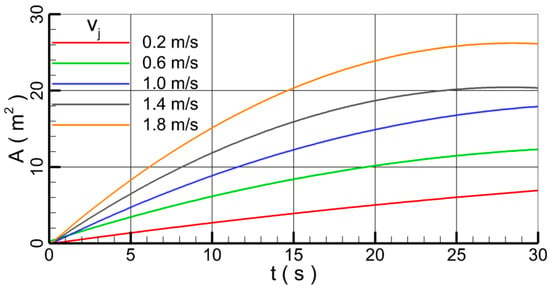
As shown in Figure 15, the horizontal diffusion area A of the plume increases with time for all injection velocities vj, and higher vj consistently produce a larger diffusion footprint. For the weakest jet (vj = 0.2 m/s), the plume area grows slowly and remains below approximately 9 m2 at t = 30 s. In contrast, when the injection velocity is increased to vj = 1.8 m/s, the plume expands much more rapidly, with the affected area reaching about 11 m2, 23 m2, and 28 m2 at t = 10 s, 20 s, and 30 s, respectively. Relative to the case of vj = 0.2 m/s, these values represent an enlargement of roughly 210% at t = 10 s, nearly 280% at t = 20 s, and about 230% at t = 30 s. These results demonstrate that increasing the injection velocity not only strengthens the initial vertical momentum of the plume but also substantially enhances its lateral entrainment and spreading, yielding more than a threefold increase in the instantaneous impact area during the early to middle stages of plume evolution.
Figure 15.
Diffusion range at different times under different injection velocities.
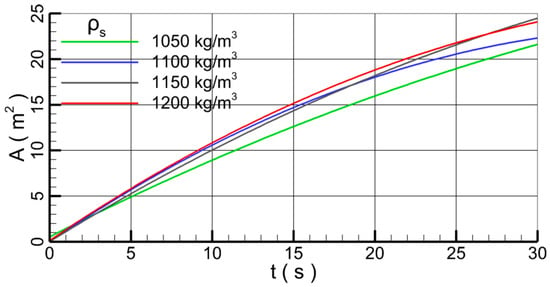
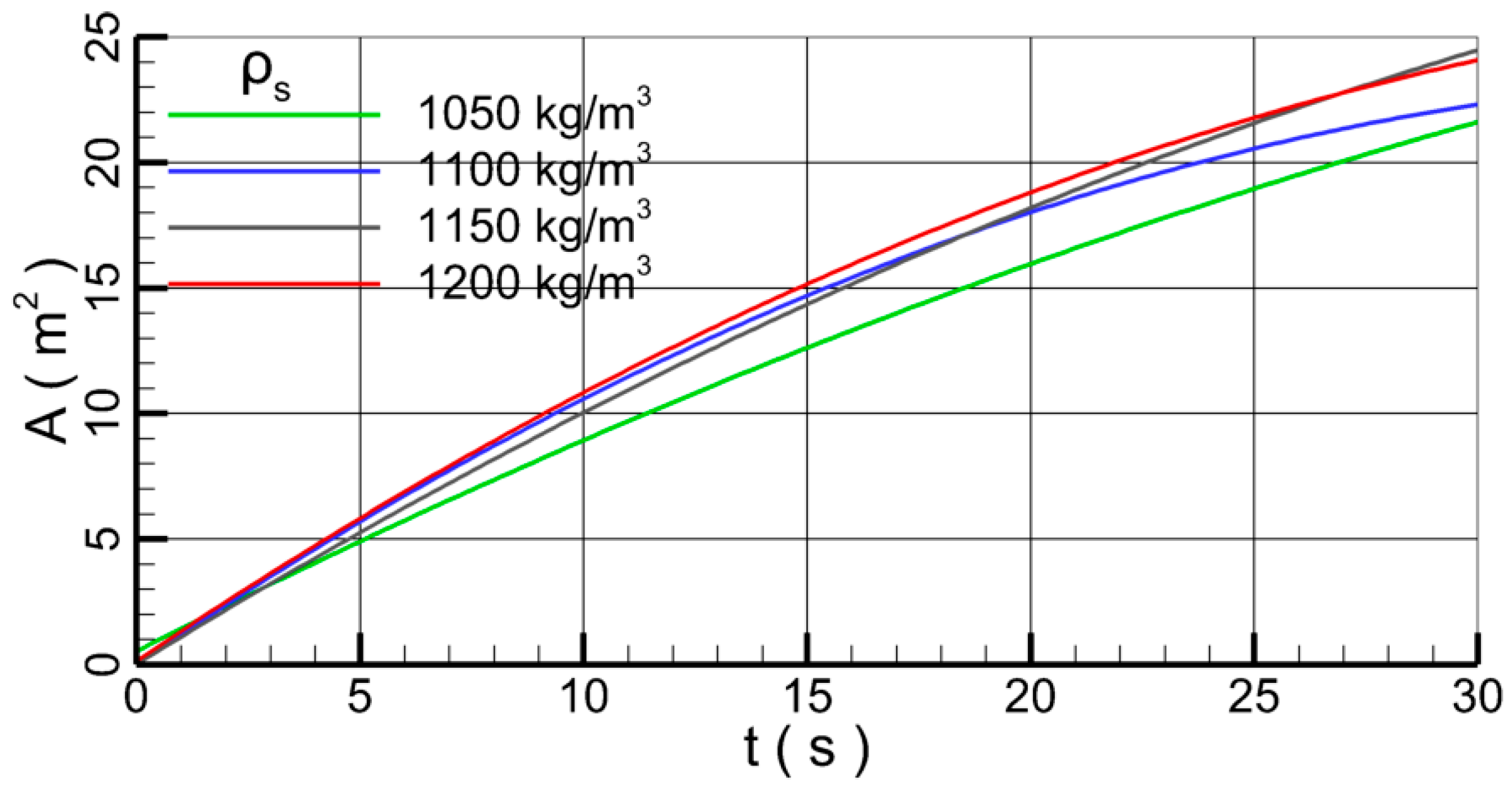
As shown in Figure 16, the horizontal diffusion area A of the plume increases monotonically with time for all discharge densities ρs, while higher ρs systematically produce a larger diffusion footprint. At t = 10 s, the plume generated with ρs = 1050 kg/m3 spreads over an area of roughly 9 m2. For ρs = 1100, 1150 and 1200 kg/m3, the corresponding areas increase to about 11, 11.5 and 12.2 m2, i.e., enhancements of approximately 22%, 28% and 36% relative to the lightest discharge. A similar trend is observed at t = 20 s, where the diffusion area grows from about 16 m2 at ρs = 1050 kg/m3 to 19.5, 20.5 and 21.5 m2 at ρs = 1100, 1150 and 1200 kg/m3, corresponding to increases of approximately 22%, 28% and 34%, respectively. By t = 30 s, the curves tend to converge, but the densest plume (ρs = 1200 kg/m3) still attains a diffusion area of about 25–25.5 m2, which is roughly 15–20% larger than the 21.5 m2 obtained for ρs = 1050 kg/m3. These results indicate that increasing the discharge density from 1050 to 1200 kg/m3 not only accelerates the initial expansion rate of the plume by roughly 30–35% but also maintains a consistently larger horizontal influence area throughout the 30 s evolution.
Figure 16.
Diffusion range at different times under different discharge densities.
The density dependence of the diffusion range is closely linked to the driving mechanisms resolved by the mathematical model. Higher-density discharges possess a larger negative buoyancy and momentum flux at the source, which enhances the initial collapse and near-field spreading of the jet–plume, thereby enlarging the horizontal mixing zone quantified by A. As the plume evolves, however, ambient entrainment progressively dilutes the suspended sediment cloud and reduces the density contrast with the surrounding water. Consequently, the curves for different ρs gradually approach one another at later times, suggesting that the governing role of density forcing is strongest in the early–intermediate stages and becomes less pronounced once the plume transitions toward a more passive, turbulence-controlled dispersion regime. Overall, Figure 16 demonstrates that higher discharge density is an efficient way to enlarge the short-term impact area of a deep-sea mining plume, but the relative advantage diminishes as the plume becomes more diluted downstream.
5. Conclusions
This study developed a predictive model for evaluating the fluid loading and scouring processes associated with deep-sea mining plumes using numerical simulation techniques. Based on a systematic analysis of plume motion characteristics and quantitative assessments of diffusion behavior, the key findings regarding plume dispersion laws can be summarized as follows:
(1) Under identical discharge conditions, increasing the free stream velocity significantly suppresses vertical plume spreading, reducing the maximum plume height by approximately 23% (from 0.2 m/s to 1.0 m/s). Conversely, it promotes turbulence development; quantitative analysis shows that the average Turbulent Kinetic Energy (TKE) intensity increases by 31%, which improves the mixing efficiency between the plume and the ambient water, even though the overall mixing zone volume remains relatively stable.
(2) Under identical conditions, a higher injection velocity leads to a broader plume distribution. Specifically, increasing the injection velocity from 0.2 to 1.0 m/s expands the dispersion range by 43% in the horizontal direction and 35% in the vertical direction. Although the formation of coherent large-scale turbulent structures is less evident, the mixing efficiency is enhanced, evidenced by a 26% increase in the dilution rate and a significantly larger spatial extent of mixing between the plume and the ambient water.
(3) Under the same conditions, an increase in plume density enlarges the plume distribution primarily in the horizontal direction. For instance, raising the density from 1050 to 1200 kg/m3 results in a 16% increase in the near-bed impact area. However, the higher density stratification inhibits turbulence development, causing a 17% reduction in TKE levels. This phenomenon is governed by the increase in the bulk Richardson number, where the strengthening buoyancy forces increasingly dominate over shear forces, thereby suppressing vertical mixing.
(4) Under identical discharge conditions, the plume footprint is highly sensitive to hydrodynamic forcing. At t = 30 s, increasing the free stream from 0.2 to 1.8 m/s enlarges the horizontal diffusion area from approximately 13 to 24.5 m2 (about 90%). Specifically, an injection velocity increase from 0.2 to 1.8 m/s causes the impacted area to increase by 210–280% at t = 10–20 s. In comparison, increasing the discharge density from 1050 to 1200 kg/m3 results in a moderate area increase of 32% at t = 10–20 s and 15–20% at t = 30 s.
The simulation assumes a flat seabed, neglecting the complex topography typical of deep-sea mining sites, which could influence local flow patterns and deposition. Future studies will aim to incorporate variable topography and complex particle interaction models to further improve prediction accuracy.
Author Contributions
Conceptualization, Y.W. and E.Z.; Data curation, C.N.; Writing—review & editing, H.L., Y.Z., C.N., Y.W. and E.Z.; Supervision, E.Z.; Funding acquisition, Y.W. All authors have read and agreed to the published version of the manuscript.
Funding
This work has been supported by the National Natural Science Foundation of China (Grant No. 52371295), Guangdong Basic and Applied Basic Research Foundation (Grant No. 2024A1515240071), Shenzhen Science and Technology Program (Grant No. JCYJ20240813114005008), the Open Fund of Shandong Provincial Key Laboratory of Marine Environment and Geological Engineering (Grant No. MEGE2024006).
Institutional Review Board Statement
Not applicable.
Informed Consent Statement
Not applicable.
Data Availability Statement
The data presented in this study are available on request from the corresponding author.
Conflicts of Interest
The authors declare no conflict of interest.
References
- Li, J.B.; Wang, Y.J.; Liu, L.; Xu, X.W. Current status and prospects of deep-sea mineral resource development technologies. Forw.-Look. Sci. Technol. 2022, 1, 92–102. [Google Scholar]
- Dunn, D.C.; Van Dover, C.L.; Etter, R.J.; Smith, C.R.; Levin, L.A.; Morato, T.; Colaço, A.; Dale, A.C.; Gebruk, A.V.; Gjerde, K.M.; et al. A strategy for the conservation of biodiversity on mid-ocean ridges from deep-sea mining. Sci. Adv. 2018, 4, eaar4313. [Google Scholar] [CrossRef] [Scilit]
- Vonnahme, T.R.; Molari, M.; Janssen, F.; Wenzhöfer, F.; Haeckel, M.; Titschack, J.; Boetius, A. Effects of a deep-sea mining experiment on seafloor microbial communities and functions after 26 years. Sci. Adv. 2020, 6, eaaz5922. [Google Scholar] [CrossRef] [Scilit]
- Williams, R.; Erbe, C.; Duncan, A.; Nielsen, K.; Washburn, T.; Smith, C. Noise from deep-sea mining may span vast ocean areas. Science 2022, 377, 157–158. [Google Scholar] [CrossRef] [Scilit]
- Wedding, L.M.; Reiter, S.M.; Smith, C.R.; Gjerde, K.M.; Kittinger, J.N.; Friedlander, A.M.; Gaines, S.D.; Clark, M.R.; Thurnherr, A.M.; Hardy, S.M.; et al. Managing mining of the deep seabed. Science 2015, 349, 144–145. [Google Scholar] [CrossRef] [Scilit]
- Yang, J.M.; Liu, L.; Lv, H.N.; Lin, Z.Q. Deep-sea mining equipment in China: Current status and prospect. Strateg. Study CAE 2020, 22, 1–9. [Google Scholar] [CrossRef] [Scilit]
- Sun, P.F.; Lu, H.N.; Yang, J.M.; Liu, M.Y.; Li, S.; Zhang, B. Numerical study on shear interaction between the track plate of deep-sea mining vehicle and the seafloor sediment based on CEL method. Ocean Eng. 2022, 266, 112785. [Google Scholar] [CrossRef] [Scilit]
- Ozturgut, E.; Lavelle, J.W.; Burns, R.E. Impacts of manganese nodule mining on the environment: Results from pilot-scale mining tests in the north equatorial Pacific. Elsevier Oceanogr. Ser. 1981, 27, 437–474. [Google Scholar]
- Muñoz-Royo, C.; Peacock, T.; Alford, M.H.; Smith, J.A.; Boyer, A.L.; Kulkarni, C.S.; Lermusiaux, P.F.J.; Haley, J.P., Jr.; Mirabito, C.; Wang, D.Y.; et al. Extent of impact of deep-sea nodule mining midwater plumes is influenced by sediment loading, turbulence and thresholds. Commun. Earth Environ. 2021, 2, 148. [Google Scholar] [CrossRef] [Scilit]
- Zhang, H.; Jia, Y.G.; Liu, X.L.; Wei, Z.M.; Ji, C.S.; Jiao, X.R.; Zhu, C.Q. Progress in in-situ measurement of sediment mechanical properties for full ocean depth. Mar. Geol. Front. 2019, 35, 1–9. (In Chinese) [Google Scholar]
- Weaver, P.P.E.; Aguzzi, J.; Boschen-Rose, R.E.; Colaço, A.; de Stigter, H.; Gollner, S.; Haeckel, M.; Hauton, C.; Helmons, R.; Jones, D.O.B.; et al. Assessing plume impacts caused by polymetallic nodule mining vehicles. Mar. Policy 2022, 139, 105011. [Google Scholar] [CrossRef] [Scilit]
- Mewes, K.; Mogollón, J.M.; Picard, A.; Rühlemann, C.; Kuhn, T.; Nöthen, K.; Kasten, S. Impact of depositional and biogeochemical processes on small-scale variations in nodule abundance in the Clarion-Clipperton Fracture Zone. Deep.-Sea Res. I 2014, 191, 125–141. [Google Scholar] [CrossRef] [Scilit]
- Volz, J.B.; Haffert, L.; Haeckel, M.; Koschinsky, A.; Kasten, S. Impact of small-scale disturbances on geochemical conditions, biogeochemical processes and element fluxes in surface sediments of the eastern Clarion–Clipperton Zone, Pacific Ocean. Biogeosciences 2020, 17, 1113–1131. [Google Scholar] [CrossRef] [Scilit]
- Christiansen, B.; Denda, A.; Christiansen, S. Potential effects of deep seabed mining on pelagic and benthopelagic biota. Mar. Policy 2020, 114, 103442. [Google Scholar] [CrossRef] [Scilit]
- Zhang, N.; Feng, X.W.; Pang, H.D.; Zhang, C.Y. Environmental impacts and technological prospects of deep-sea mining. Miner. Eng. Res. 2019, 34, 22–28. [Google Scholar]
- Muñoz-Royo, C.; Ouillon, R.; El Mousadik, S.; Alford, M.H.; Peacock, T. An in situ study of abyssal turbidity-current sediment plumes generated by a deep seabed polymetallic nodule mining preprototype collector vehicle. Sci. Adv. 2022, 8, eabn1219. [Google Scholar] [CrossRef] [Scilit]
- Spearman, J.; Taylor, J.; Crossouard, N.; Cooper, A.; Murton, B.J. Measurement and modelling of deep sea sediment plumes and implications for deep sea mining. Sci. Rep. 2020, 10, 5075. [Google Scholar] [CrossRef] [Scilit] [PubMed]
- Gillard, B.; Purkiani, K.; Chatzievangelou, D.; Vink, A.; Iversen, M.H.; Thomsen, L. Physical and hydrodynamic properties of deep sea mining-generated, abyssal sediment plumes in the Clarion Clipperton Fracture Zone (eastern-central Pacific). Elem. Sci. Anth. 2019, 7, 5. [Google Scholar] [CrossRef] [Scilit]
- Xu, L.; Li, X.; Liu, Y.; Dou, P.; Hong, Z.; Han, C. A review of plume research in the collection process of deep-sea polymetallic nodules. Water 2024, 16, 3379. [Google Scholar] [CrossRef] [Scilit]
- Rzeznik, A.J.; Flierl, G.R.; Peacock, T. Model investigations of discharge plumes generated by deep-sea nodule mining operations. Ocean Eng. 2019, 172, 684–696. [Google Scholar] [CrossRef] [Scilit]
- Ouillon, R.; Muñoz-Royo, C.; Alford, M.H.; Peacock, T. Advection-diffusion-settling of deep-sea mining sediment plumes. Part 1: Midwater plumes. Flow 2022, 2, E22. [Google Scholar] [CrossRef] [Scilit]
- Ouillon, R.; Muñoz-Royo, C.; Alford, M.H.; Peacock, T. Advection–diffusion settling of deep-sea mining sediment plumes. Part 2. Collector plumes. Flow 2022, 2, E23. [Google Scholar] [CrossRef] [Scilit]
- Liu, S.H.; Yang, J.M.; Lu, H.; Sun, P.F.; Zhang, B. A numerical investigation of the dynamic interaction between the deep-sea mining vehicle and sediment plumes based on a small-scale analysis. J. Mar. Sci. Eng. 2023, 11, 1458. [Google Scholar] [CrossRef] [Scilit]
- Gazis, I.-Z.; de Stigter, H.; Mohrmann, J.; Heger, K.; Diaz, M.; Gillard, B.; Baeye, M.; Veloso-Alarcón, M.E.; Purkiani, K.; Haeckel, M.; et al. Monitoring benthic plumes, sediment redeposition and seafloor imprints caused by deep-sea polymetallic nodule mining. Nat. Commun. 2025, 16, 1229. [Google Scholar] [CrossRef] [Scilit] [PubMed]
- Wu, J.; Chen, J.; Tan, X.; Wang, K.; Zhou, J.; Jin, Z.; Huang, C.; Lin, Y.; Wang, C.; Yang, J.; et al. A sediment sampling system for monitoring plume redeposition from deep-sea polymetallic nodule mining. Int. J. Min. Sci. Technol. 2025, 35, 1975–1987. [Google Scholar] [CrossRef] [Scilit]
- Liu, Z.L.; Wu, X.; Rao, Q.H.; Yi, W.; Chen, S.P.; Zheng, H. Diffusion characteristics of deep-sea mining sediment plumes in flowing water by large-scale water tank experiments. Trans. Nonferrous Met. Soc. China 2025, 35, 2747–2761. [Google Scholar] [CrossRef] [Scilit]
- Liu, X.L.; Liu, Y.H.; Jia, Y.G.; Guo, X.S. Quantification of rheological parameters in deep-sea mining plumes. Deep Undergr. Sci. Eng. 2025; online first. [CrossRef] [Scilit]
- Wang, X.; Chen, Z.; Xia, J. Assessing the environmental impact of deep-sea mining plumes: A study on the influence of particle size on dispersion and settlement using CFD and experiments. J. Mar. Sci. Eng. 2025, 13, 1987. [Google Scholar] [CrossRef] [Scilit]
- Liu, Z.L.; Wu, X.; Zheng, H.; Rao, Q.H.; Yi, W. Diffusion characteristics analyses of the deep-sea mining sediment plume based on a modified drag coefficient model. Ocean Eng. 2025, 343, 123193. [Google Scholar] [CrossRef] [Scilit]
- Li, D.Z.; Yu, Z.B.; Zou, L.; Jin, G.Q. Numerical simulation of tailwater discharge plume in deep-sea mining. Shipbuild. China 2025, 66, 208–217. [Google Scholar]
- Hein, J.R.; Mizell, K.; Koschinsky, A.; Conrad, T.A. Deep-ocean mineral deposits as a source of critical metals for high-technology applications: Comparison with land-based resources. Ore Geol. Rev. 2013, 51, 1–14. [Google Scholar] [CrossRef] [Scilit]
- Zhao, E.J.; Sun, J.K.; Jiang, H.Y.; Mu, L. Numerical study·on the hydrodynamic: Characteristics and responses of moored floating marine·cylinders·under world tsunami-like waves. IEEE Access 2019, 7, 122435–122458. [Google Scholar] [CrossRef] [Scilit]
- Olsen, N.R.B. CFD Algorithms for Hydraulic Engineering; Department of Hydraulic and Environmental Engineering, Norwegian University of Science and Technology: Trondheim, Norway, 2000. [Google Scholar]
- Versteeg, H.K.; Malalasekera, W. An Introduction to Computational Fluid Dynamics: The Finite Volume Method; Longman Scientific & Technical: Harlow, UK, 1995; ISBN 978-0582218840. [Google Scholar]
- Launder, B.E.; Spalding, D.B. The numerical computation of turbulent flows. Comput. Methods Appl. Mech. Eng. 1974, 3, 269–289. [Google Scholar] [CrossRef] [Scilit]
- Tajnesaie, M.; Nodoushan, E.J.; Barati, R.; Moghadam, M.A. Performance comparison of four turbulence models for modeling of secondary flow cells in simple trapezoidal channels. ISH J. Hydraul. Eng. 2018, 26, 187–197. [Google Scholar] [CrossRef] [Scilit]
- Kheirkhah Gildeh, H. Numerical Modelling of Thermal/Saline Discharges in Coastal Waters. Master’s Thesis, University of Ottawa, Ottawa, ON, Canada, 2013. [Google Scholar]
- Hirt, C.W.; Nichols, B.D. Volume of fluid (VOF) method for the dynamics of free boundaries. J. Comput. Phys. 1981, 39, 201–225. [Google Scholar] [CrossRef] [Scilit]
- Maronnier, V.; Picasso, M.; Rappaz, J. Numerical simulation of free surface flows. J. Comput. Phys. 1999, 155, 439–455. [Google Scholar] [CrossRef] [Scilit]
- Scardovelli, R.; Zaleski, S. Direct Numerical Simulation of Free-Surface and Interfacial Flow. Annu. Rev. Fluid Mech. 1999, 31, 567–603. [Google Scholar] [CrossRef] [Scilit]
- Larmaei, M.M.; Mahdi, T.F. Simulation of shallow water waves using VOF method. J. Hydro-Environ. Res. 2010, 3, 208–214. [Google Scholar] [CrossRef] [Scilit]
- Rudman, M. A volume-tracking method for incompressible multifluid flows with large density variations. Int. J. Numer. Methods Fluids 1998, 28, 357–378. [Google Scholar] [CrossRef]
- Merabtene, T.; Garoosi, F.; Mahdi, T.F. Comparative study of Eulerian FVM-VOF and Lagrangian MPS approaches for single- and multiphase flow simulations. Ocean Eng. 2026, 343, 123378. [Google Scholar] [CrossRef] [Scilit]
- Yan, S.L.; Zhang, X.B.; Luo, Z.H. Adaptive mesh refinement for VOF modeling gas-liquid two-phase flow: A summary of some algorithms and applications. Chem. Eng. Sci. 2025, 306, 121291. [Google Scholar] [CrossRef] [Scilit]
- Pope, S.B. Turbulent flows. Meas. Sci. Technol. 2001, 12, 2020–2021. [Google Scholar] [CrossRef] [Scilit]
- Kaye, N.B. Turbulent plumes in stratified environments: A review of recent work. Atmos.-Ocean 2008, 46, 433–441. [Google Scholar] [CrossRef]
- Deshpande, S.S.; Anumolu, L.; Trujillo, M.F. Evaluating the performance of the two-phase flow solver interFoam. Comput. Sci. Discov. 2012, 5, 014016. [Google Scholar] [CrossRef] [Scilit]
- List, E.J. Turbulent jets and plumes. Annu. Rev. Fluid Mech. 1982, 14, 189–212. [Google Scholar] [CrossRef] [Scilit]
- Liu, S.; Yang, J.; Lu, H.; Lin, Z.; Sun, P.; Zhang, B. Numerical and experimental investigation of the coupling effect of double plume discharge sources in deep-sea mining. Ocean Eng. 2025, 337, 121861. [Google Scholar] [CrossRef] [Scilit]
- Soulsby, R.L. Dynamics of Marine Sands; Thomas Telford: London, UK, 1997. [Google Scholar]
- Yan, H.; Vosswinkel, N.; Ebbert, S.; Lipeme Kouyi, G.; Mohn, R.; Uhl, M.; Bertrand-Krajewski, J.L. Numerical investigation of particles’ transport, deposition and resuspension under unsteady conditions in constructed stormwater ponds. Environ. Sci. Eur. 2020, 32, 76. [Google Scholar] [CrossRef] [Scilit]
- Lee, J.H.W.; Chu, V.H. Turbulent Jets and Plumes: A Lagrangian Approach; Kluwer Academic Publishers: Dordrecht, The Netherlands, 2003. [Google Scholar]





Disclaimer/Publisher’s Note: The statements, opinions and data contained in all publications are solely those of the individual author(s) and contributor(s) and not of MDPI and/or the editor(s). MDPI and/or the editor(s) disclaim responsibility for any injury to people or property resulting from any ideas, methods, instructions or products referred to in the content. |
© 2025 by the authors. Licensee MDPI, Basel, Switzerland. This article is an open access article distributed under the terms and conditions of the Creative Commons Attribution (CC BY) license.