


Abstract
Maritime activities pose significant safety risks, particularly with the growing presence of nuclear-powered vessels (NPVs) alongside traditional fossil-powered vessels (FPVs). This study employs a probabilistic risk assessment (PRA) approach to evaluate and compare accident hazards involving NPVs and FPVs. By analyzing historical data from 1960 to 2024, this study identifies risk patterns, accident frequency (probability), and severity levels. The methodology focuses on incidents such as marine incidents, marine casualties, and very serious cases with sub-causes. Key findings reveal that Russia exhibits the highest risk for very serious incidents involving both NPVs and FPVs, with a significant 100% risk for NPVs. China has the highest FPV risk, while France and the USA show above-average risks, particularly for marine casualties and very serious incidents. Moreover, collision is the most significant global risk, with a 26% risk for NPVs and 34% for FPVs, followed by fire hazards, which also pose a major concern, with a 17% risk for NPVs and 16% for FPVs, highlighting the need for enhanced safety and fire-prevention measures. In conclusion, comparative analysis highlights the need for enhanced stability improvements, fire prevention, and maintenance practices, particularly in the UK, France, Russia, and China. This study underscores the importance of targeted safety measures to mitigate risks, improve ship design, and promote safer maritime operations for both nuclear- and fossil-fueled vessels.
1. Introduction
The safety and environmental effects of nuclear-powered vs conventional fossil-powered ships have become crucial research topics as the worldwide maritime industry progressively investigates alternate propulsion systems [1]. Military fleets and research expeditions frequently deploy nuclear-powered ships because of their great power efficiency, longer operational range, and lower refueling requirements [2]. Nevertheless, these advantages come with special concerns related to nuclear technology, such as the possibility of reactor failure, radiation threats, and intricate emergency-response needs. In contrast, the bulk of the commercial and civilian fleet consists of fossil-powered ships, which are known to present hazards such exhaust emissions, engine fires, and fuel leaks. Both surface and underwater vessel types are susceptible to unique and overlapping accident scenarios that can seriously jeopardize international security, environmental health, and human life [3].
Nuclear-powered ships are susceptible to a variety of accident situations due to the special dangers they encounter, which are mostly related to their reactor systems and nuclear infrastructure. The reactor may overheat due to core damage or reactor malfunctions such as coolant system failures, control rod malfunctions, and cooling system power losses. Radiation hazards put the crew and adjacent areas at serious risk of exposure or leakage because of containment breaches or failures. Steam generator failures in steam-driven nuclear reactors pose a serious risk as well, since they can result in radiation leakage and propulsion loss. Additionally, there is a chance that malfunctioning containment of nuclear material could result in radioactive discharge in the event of a crash, grounding, or external attack. Reactor safety procedures can also be jeopardized by operational human error in emergency response, maintenance, or other operations, which can worsen accident outcomes [4,5]. As nuclear systems are sensitive and complicated, cybersecurity risks increase the danger by possibly allowing sabotage or illegal access. Furthermore, Ølgaard [5] reported on accidents involving nuclear-powered vessels (NPVs) between 1960 and 1994 and reviewed 61 reported events, primarily concerning Soviet/Russian submarines, and analyzed accident probabilities, emphasizing that the consequences of these were localized. Zucchetti and Aumento [6] studied accidents in nuclear-powered submarines and their effects on environmental marine pollution. Hogberd [7] highlighted the root causes and impacts of the Three Mile Island, Chernobyl, and Fukushima Daiichi accidents, emphasizing the need for improved safety management and culture to prevent severe core damage and limit radioactive releases. Adumene et al. [8] reviewed advancements in the design of nuclear-power ship machinery and fault-based safety analysis, highlighting research opportunities and proposing a hybrid framework for risk-informed decision-making in nuclear-powered shipping operations. Strupczewski [9] concluded from his study that the risks associated with nuclear power plants, including core damage and cancer deaths from accidents, were significantly lower than those from other energy sources like oil, gas, and coal, based on probabilistic safety analyses and historical data. Kauker et al. [10] found from their studies that the North and Nordic Seas are more vulnerable to the dispersal of radioactive materials from accidents than previously thought, highlighting the need for effective emergency resources and monitoring programs in this critical fishery region by means of adjoint sensitivity analysis. Voutilainen et al. [11] assessed the radiological consequences of NPV and floating nuclear power plant (FNPP) accidents, revealing that significant protective actions are needed in the event of NPV accidents near populated areas, while FNPP transit accidents posed minimal risk under the analyzed scenarios. Lee et al. [12] investigated recent developments in Ocean Nuclear Power Plants, focusing on designs, safety features, and initiatives from countries like France, Russia, South Korea, and the USA, while addressing associated challenges. Mian et al. [13] discussed the evolving South Asian nuclear race while examining the risks of nuclear submarine accidents and their implications for nuclear escalation. Reistad et al. [14] highlighted the proliferation and environmental risks of Russian naval nuclear fuel and reactors, emphasizing the need for improved safety and security measures to ensure effective international assistance amid a lack of reliable data.
The dangers associated with FPVs, on the other hand, are distinct and mostly relate to the operational and mechanical components of the propulsion and fuel systems. Propulsion loss is frequently the result of engine and propulsion system faults brought on by mechanical defects, problems with the fuel pump, or overheating. Significant fire hazards and environmental threats are presented by fuel spills or leaks that may occur during refueling or because of tank rupture. Water intrusion and vessel destabilization can result from structural failures such as hull breaches brought on by corrosion, material fatigue, or collisions. Additionally, fire and explosion risks are common, and these are frequently made worse by electrical malfunctions and overheating, especially in the engine room or fuel tanks. Fossil-powered ships are also vulnerable to harsh weather and environmental risks, such as storms, undersea obstructions, and challenging navigational situations, all of which raise the possibility of accidents. Lastly, the likelihood of accidents with FPVs is further increased by human error, including bad maintenance, poor navigation, and insufficient emergency preparedness [15,16]. In the research work conducted on this issue, Gan et al. [17] developed a Mutual Information-based Deep Graph Convolutional Network (MIDG-GCN) model to analyze and predict the causes of maritime vessel traffic accidents; using data from 501 investigation reports, the model achieved high accuracy in ranking and identifying key accident factors. Choe et al. [18] aimed to develop and validate a maritime accident prediction model for the Republic of Korea, considering oceanic challenges and using machine learning for analysis. Kim et al. [19] applied a formal safety assessment technique to analyze fishing vessel accidents and develop effective preventive measures based on insurance data. Ma et al. [20] introduced a semi-automated method for constructing and analyzing a complex network of influential risk factors relating to ship collision accidents, addressing issues of factor extraction, ranking, and robustness analysis to improve maritime safety management. Hasanspahic et al. [21] analyzed 135 marine accident reports to identify common human factors contributing to accidents and suggested that addressing these factors could enhance shipping safety. Mullai et al. [22] presented a conceptual model for analyzing marine accidents based on empirical data from the Swedish Maritime Administration, demonstrating its applicability to other datasets and highlighting its theoretical and practical significance. Wang et al. [23] analyzed factors influencing the severity of marine accidents, finding that certain conditions, ship types, and crew qualifications significantly impacted accident outcomes. Akyuz [24] presented a hybrid model combining an analytical network process (ANP) and Human Factors Analysis and Classification System (HFACS) to assess human error factors in maritime accidents, aimed at enhancing safety in the shipping industry. To assist maritime safety authorities in implementing effective risk control measures, Chen et al. [25] investigated total-loss marine accidents from 1998 to 2018 across various ship types and sea regions, identifying foundering, stranding, fires, and explosions as the main factors influencing such accidents. Kum and Sahin [26] analyzed marine accidents in the Arctic from 1993 to 2011, using root cause analysis, to improve safety and reduce future incidents as shipping traffic increases due to global warming. Liu et al. [27] developed a quantitative analysis method to identify and evaluate key risk factors for passenger ship evacuation accidents, using complex network analysis, the decision-making trial and evaluation laboratory (DEMATEL) method, and interpretive structural modeling (ISM) to enhance risk management and improve safety measures.
By simulating accident sequences and estimating the probability of key failures, probabilistic risk assessment (PRA) [28] provides an organized method for comprehending and measuring the hazards related to each type of vessel. Originally created for the nuclear sector, PRA approaches have been modified for several uses to assess and contrast complex systems in unpredictable circumstances. When it comes to marine safety, PRA can assist in estimating the probability of serious events such nuclear vessel reactor coolant failure, propulsion loss, fuel system leaks, and human error [29]. This enables a thorough comparison of safety profiles.
To the best of authors’ knowledge, there has been no study comparing the safety risk during maritime operation of nuclear- and FPVs by means of probabilistic risk assessment. In this study, the PRA approach was utilized to systematically evaluate and compare the accident risks for nuclear- and fossil-powered vessels. Through the identification of current accident information and the evaluation of accident probability, this study offers valuable knowledge about the overall safety profiles of nuclear- and FPVs. The findings are meant to assist in influencing future design, operational procedures, and regulatory standards for both nuclear- and fossil-powered ships, as well as to educate stakeholders, regulators, and ship operators about the relative dangers and necessary safety precautions.
2. Materials and Methods
In this study, a systematic literature review was conducted to gather data on the total number of vessels, the number of accidents, and the severity of the casualty event—categorized into marine incident, marine casualty, and very serious accidents—as well as the causes of these accidents. Given that NPV accidents began to occur in the 1960s, this study focused on the time frame from 1960 to 2024. Furthermore, this research specifically concentrated on countries with NPVs, including Germany, Japan, China, India, France, Russia, the United Kingdom, and the United States.
The detailed framework for the comparative PRA study of NPVs and FPVs is presented in Figure 1.
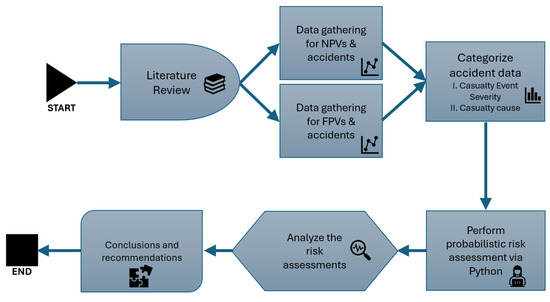
Figure 1.
Framework of the research.
2.1. Data Collection for the Case Studies
The total number of FPVs, which includes “Steamships” and “Motorships”, during the specified period between 1960 and 2024 was obtained from databases including the United Nations Trade and Development Data Hub [30], Equasis and EMSA [31], and Lloyd’s Register Foundation Heritage and Education Centre [32]. Figure 2a–c illustrates the total numbers and tonnages of FPVs between 1960–2024.
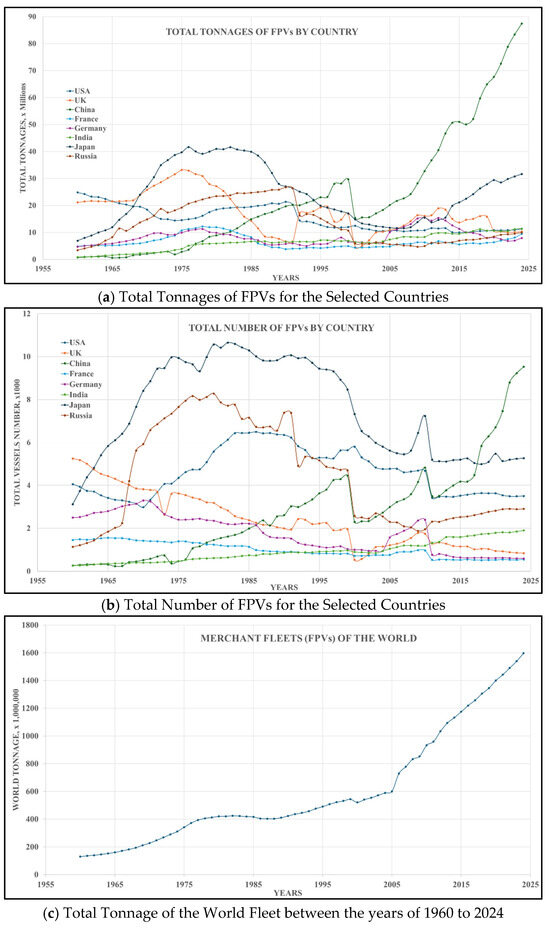
Figure 2.
Total Numbers and Tonnages of FPVs between 1960–2024.
Data on the number of accidents, their casualty event severity (marine incident, marine casualty, very serious), and the causes of these accidents were extracted from the database of the International Maritime Organization Global Integrated Shipping Information System (GISIS) Marine Casualties and Incidents. The classification of each accident as a mild to severe marine incident, marine casualty, or very serious was determined by assessing the number and severity of injuries or fatalities and the damage to the vessel. Types of marine incident and marine casualty, including very serious marine casualties, were detailed in the GISIS as follows: capsize, collision, contact, fire, flooding, grounding, loss of control, hull failure, occupational accidents, ship missing, and ship/equipment damage.
Figure 3 shows the number of casualty events and their severity for FPVs from the selected countries between the years 1960 and 2024.
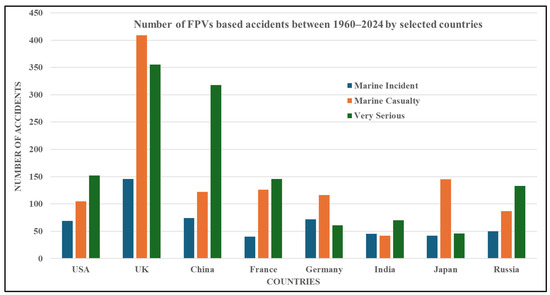
Figure 3.
Numbers of Casualty Event according to Severity for FPVs between 1960 and 2024.
The total numbers of NPVs, including submarines, icebreakers, and ships, were identified through systematic searches using key words such as “nuclear powered”, “submarines”, “icebreakers”, and “ships”. Accident data, including the number of accidents, their severity, and causes, were gathered from documented accident reports [5] and systematic searches using combinations of key words such as “accidents”, “nuclear powered”, “submarines”, “icebreakers”, and “ships”.
Figure 4 illustrates the numbers of casualty event severities and total numbers of NPVs between 1960 and 2024.
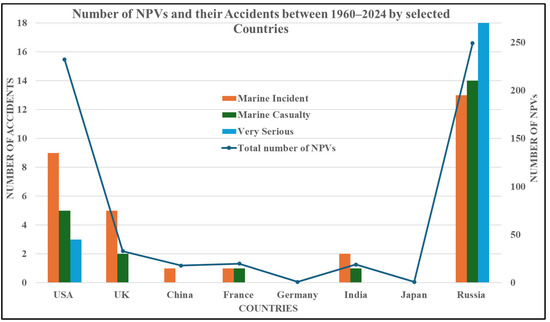
Figure 4.
Numbers of Casualty Events by Severity and Total numbers of NPVs between 1960 and 2024.
Detailed accident data including year of occurrence, name of vessel, type of casualty event, severity, sub-cause, and a summary of events relating to the selected countries that have NPVs are comprehensively presented in Appendix A.
2.2. Probabilistic Risk Assessment (PRA) Methodology
Using the collected data, the PRA methodology—a systematic, quantitative approach used to assess the likelihood and potential consequences of adverse events in fields such as aviation, maritime, finance, and especially nuclear energy—was applied to assess accident risks and trends, as well as to compare the safety profiles of nuclear-powered and fossil-fueled vessels [33,34,35,36,37,38]. All PRA calculations were performed using Python V3.9 programming. Figure 5 illustrates the Python coding for the PRA approach to analyze the risks relating to NPVs and FPVs.
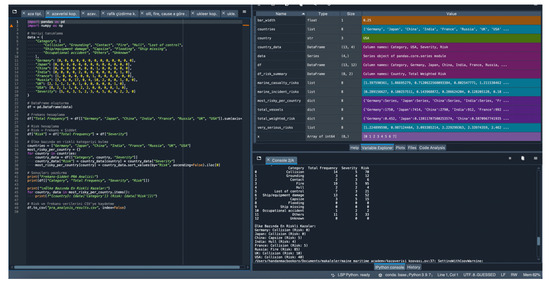
Figure 5.
Python coding for PRA Approach.
Simple probability calculation, relative frequency, fault tree analysis, Bayes’ theorem, the frequency–severity approach, and Monte Carlo simulation are among the methods used for PRA, from simple to complex [39,40]. In this study, the frequency–severity approach is used since the probability of risk is not only related to the frequency of the event but also to the severity of the consequences of the event. In practice, risk calculation using the frequency–severity approach was carried out according to the following formula [41,42,43]:
where R is the risk, P is the probability of the event occurring, which depends on the number of accidents per total number of vessels, S is the severity, a coefficient of influence of the consequences of the event, and n is the total number of identified hazardous scenarios.
Rtotal = Σi = 1−>n(Pi × Si)
In theory, the severity Si in each scenario was evaluated with respect to three primary dimensions: (i) potential fatalities, (ii) environmental impact, and (iii) economic losses, as follows:
- Potential Fatalities: Historical data provided the average and worst-case fatality counts for each type of event (collisions, fires, etc.). A weighted factor w1 was assigned based on casualty rates [44];
- Environmental Impact: A factor w2 captured ecological consequences (e.g., oil spills) by examining total spill volume, environmental sensitivity (e.g., proximity to protected habitats), and restoration time [45];
- Economic Losses: Direct costs (e.g., vessel repair, salvage) and indirect losses (e.g., port downtime, third-party liability) were translated into monetary terms [44]. A factor w3 captured these impacts.
A composite severity measure Si was then defined as follows:
where Fi is the normalized index of expected fatalities, Ei is the normalized index of environmental damage, and Ci is the normalized index of economic cost. The weighting coefficients w1, w2, w3 were determined through stakeholder consultation and regulatory guidelines [46]. This linear combination approach [43] allows weights to be adjusted to reflect differing safety priorities across different maritime stakeholders.
Si = w1 × Fi + w2 × Ei + w3 × Ci,
In this study, a marine incident refers to any event that could potentially lead to significant consequences, a marine casualty involves substantial damage or loss, and very serious incidents are those with catastrophic impacts such as large-scale loss of life or environmental damage. These terms are ranked according to their respective severity. Weighting coefficients for the severity of casualty events were determined as 1, 3, 5 for marine incident, marine casualty, and very serious, as categorized by IMO according to fatalities, environmental damage, and economic cost, respectively, while weighting coefficients for causes of casualty were determined as 5, 4, 3, 5, 2, 3, 4, 5, 1, 1, 2, 3, and 1 for collision, grounding, contact, fire, hull, loss of control, ship/equipment damage, capsize, flooding, ship missing, occupational accident, others, and unknown, respectively, as categorized by IMO according to the impacts [47]. For NPVs, this assessment was based on a case-by-case evaluation with expert opinion.
2.3. Limitations
Data for FPVs were based on vessels of 100 GRT and above. Also, both steamships and motorships were included in the analysis of FPVs. Records for the period from 1960 to 2000 were sourced from the Lloyd’s Register Foundation Heritage and Education Center [32]. Data covering 2005 to 2010 were obtained from the Equasis database [31], while records for 2010 to 2024 were acquired from United Nations Trade and Development reports [30]. The data for the period from 2000 to 2005 were estimated using a regression analysis method.
The data presented in the NPVs section were compiled by the authors through independent research, due to the absence of adequate recording and reporting systems. Consequently, this dataset represents the maximum amount of information accessible to the authors.
From a statistical perspective, it is important to note that the sample sizes of the NPVs and FPVs population differed. Nonetheless, this discrepancy did not impede the research, as the PRA methodology facilitates proportion-based calculations, ensuring robustness in comparative analysis.
Furthermore, the NPVs group predominantly comprised military vessels, particularly submarines. While a more precise assessment would have involved comparing fossil-fueled standard ships with nuclear-powered ships of equivalent tonnage, power, and operational characteristics, this study prioritizes the broader evaluation of nuclear- and fossil-powered maritime experiences. By leveraging accident data, the analysis focuses on the performance and safety records of countries operating both types of vessels.
Collisions included instances where the own ship is not underway, as well as collisions involving multiple ships or other vessels. Occupational accidents included the following categories: body movement under or with physical stress (generally leading to internal injury), body movement without any physical stress (generally leading to external injury), breakage, bursting, splitting, fall or collapse of material agent, overflow, overturn, leak, flow, vaporization, emission of material agent, electrical problems, explosion, fire, loss of control of the machine, means of transport, or handling equipment. Other categories of occupational accidents involved hand-held tools, objects, animals, shock, fright, violence, aggression, threat, slipping, stumbling, people falling overboard, and people falling to a lower level or on the same level. In this context, loss of control refers to loss of containment, loss of directional control, loss of electrical power, or loss of propulsion power. Contact refers to contact with fixed, floating, or flying objects. Finally, instances of grounding included those while drifting or while under power.
3. Results and Discussion
In this study, the PRA approach was employed to systematically assess and compare accident risks associated with nuclear- and FPVs. By analyzing existing accident data and evaluating the likelihood of accidents, this study provides valuable insights into the overall safety profiles of both nuclear- and FPVs.
Table 1 illustrates the total number of accidents categorized by severity of casualty event and the total numbers of vessels, for NPVs and FPVs by country. The relevant data source for FPVs reported the total number of ships registered annually in each country from 1960 to 2024, with the overall total for this period determined using an averaging method. Numbers of NPVs were determined according to the numbers of vessels utilized over the same period, including for countries with very few NPVs, such as Germany and Japan. The results were calculated and analyzed separately for NPVs and FPVs.

Table 1.
Total number of accidents vs. vessels between 1960 and 2024.
PRA based on the probability and severity of accidents involving NPVs and FPVs from various countries is presented in Figure 6. The data highlight the performance of each country’s fleet in terms of marine incidents, marine casualties, and very serious accidents. The probabilities were calculated as the ratio of specific accidents to the total number of vessels, and risks were derived by multiplying these probabilities by the respective severity levels.
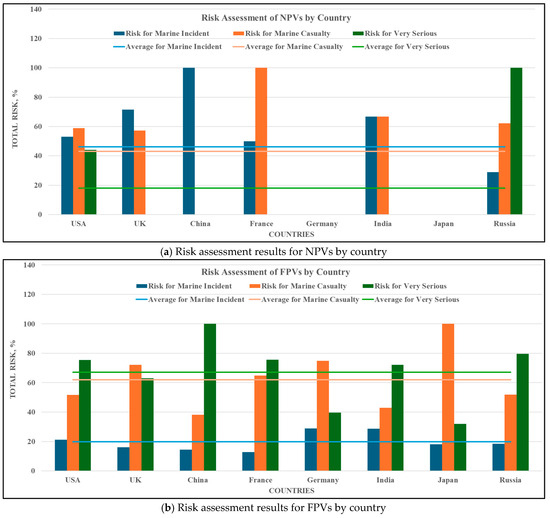
Figure 6.
NPV (a) and FPV (b) risk assessment according to casualty event severity.
Regarding the evaluation according to NPVs, Germany and Japan both operated one NPV for a short period. These countries converted their vessels from nuclear power to diesel-fueled engines. There have been no recorded accidents for these two; hence, the probability and risk values are zero. On the other hand, Germany operated 1750 FPVs with 249 reported accidents, including 61 very serious incidents, with a risk of 39.6%. The numbers indicate 72 marine incidents and 116 marine casualties, with corresponding risks of 28.9% and 74.8%, respectively. Japan, with 7414 vessels, had 233 reported accidents, a comparatively lower accident rate considering its large fleet size. However, 145 cases of marine casualties of 145 cases dominate its profile, contributing to a risk of 100%.
China had a relatively low number of vessels at 18 and a single reported marine incident involving an NPV. Its risk and probability values are minimal, indicating effective risk controls but with room for improvement. India’s fleet has a higher accident count relative to its size (19 vessels), with risks of 66.7% for both marine incidents and marine casualties. Although no very serious accidents have been recorded, the country’ average risk of 44.4% suggests potential vulnerabilities in their safety systems. China’s 2790 vessels reported 514 total accidents, with 318 very serious cases involving FPVs, which is a significant number. The high risk of very serious accidents, 100%, leads to an overall elevated risk profile, contributing to a country-based average risk of 50.8%. This underscores the need for immediate intervention targeting high-severity incidents. A significant proportion of India’s 912 vessels were involved in very serious accidents, with 70 cases and a total risk of 72.1%. While marine incidents and casualties are also noteworthy, emphasis should be placed on reducing high-severity events to improve overall safety.
France reported two accidents across 20 NPVs, evenly split between marine incidents and marine casualties. While this demonstrates a balanced accident profile, the risk of marine incident was 50% while the risk of marine casualty was found to be 100%, with a country-based average risk of 50%. With 992 FPVs, France had 312 total accidents, including 146 very serious cases, contributing substantially to that country’s average risk of 51.1%. This distribution emphasizes the need to address high-severity incidents while maintaining focus on marine casualties [23].
Russia operated the largest NPV fleet of 249 vessels and accounted for 45 total accidents, including a significant number of very serious cases—18 in total. The risks associated with marine incidents, marine casualties, and very serious accidents were found to be notably higher compared with other countries. This highlights the need for stringent safety measures and advanced risk mitigation strategies. Russia’s 4399 FPVs exhibited an accident count of 270 in total. The highest number of very serious cases, 133, resulted in a risk of 79.6%. Mitigating these severe outcomes will be crucial.
The UK’s NPV fleet of 33 vessels exhibited a high risk for marine casualty of 57.1% but no very serious cases. Their country-based average risk of 42.8% suggests that while severe consequences have been avoided, frequent minor incidents necessitate improved operational protocols. In addition, the UK had 2378 FPVs and a strikingly high number of total accidents, 910, with 355 classified as very serious. The country-based average risk of 50.4% reflects the substantial impact of these accidents. Efforts should prioritize addressing frequent marine casualties while targeting high-severity accidents.
The USA had the second-largest fleet of 232 NPVs, with 17 total accidents. The distribution of accident types indicates a relatively balanced safety profile with moderate risks for marine incidents, at 52.9%. The country-based average risk of 52% is indicative of a need to review existing safety frameworks. The USA operated the largest fleet of 4610 FPVs, with 326 total accidents. A significant number of very serious cases, 152, contributed to total risk of 75.4%, suggesting a need to further refine safety frameworks, especially for high-severity incidents.
For NPVs, the average risk levels were as follows: marine incidents at 46.2%, marine casualties at 43.1%, and very serious incidents at 18%. Marine incidents are classified as error-prone, marine casualties as moderately error-prone, and very serious incidents as occurring at the non-error-prone level [48]. Assessing risks across all countries for NPVs, it was found that China, UK, and India exhibited above-average risk levels for marine incidents, while France and the USA were around the average. For marine casualties, the highest risks were observed for France, India, and Russia. Regarding cases of very serious incidents, Russia showed a significantly elevated risk level of 100%, far exceeding the average of 18%.
According to evaluation of the risk results for both FPVs and NPVs, Russia presents a significant danger in the very serious risk category. In contrast, China has the highest risk rate for FPVs, while its NPVs exhibit no serious risk apart from marine incidents. France demonstrates a much higher-than-average risk for NPVs in the marine casualty category, classified as moderate risk. Regarding FPVs, France, along with the USA, shows an above-average risk profile in the very serious risk category, following China and Russia.
This study also investigated the risks associated with various reasons for accidents in nuclear- and fossil-powered vessels, both on a global scale and within specific countries. The analysis employed weighted risk values derived from the probability of each accident type and its severity. The results are shown in Figure 7.
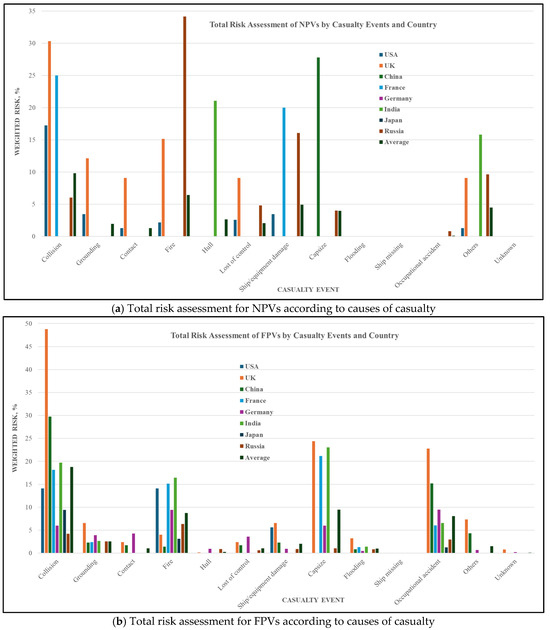
Figure 7.
NPVs (a) and FPVs (b) total risk assessment according to the causes of casualty.
It is a well-known fact that nuclear-powered ships are much more reliable than their fossil-fueled counterparts [4,49,50]. This has been proven once again in this study, with risk values calculated based on both the severity of the casualty event and its sub-cause.
In the evaluation of NPVs and FPVs, collision emerged as the most significant global risk among casualty events. Its highest global risk value of 26% for NPVs and 34% FPVs underscores the critical need to address operational safety measures to mitigate such incidents. Furthermore, fire represents a significant hazard, with its high-risk value [51] indicating the importance of fire prevention and control systems on both NPVs and FPVs, presenting high global risk values of 17% and 16%, respectively. The risk associated with equipment damage in relation to NPVs, with a global risk value of 13%, highlights the criticality of regular inspections and robust maintenance practices. Although rare, capsizing incidents carry high severity [52] with a global risk value of 10% for NPVs and 17% for FPVs, emphasizing the need for stability checks and design improvements.
Based on the country-specific risk analysis of NPVs, the UK exhibited the highest total risk of 28%, largely influenced by collision and fire risks. Russia had a relatively high total risk of 25%, with fire and equipment damage identified as the major contributors. France’s total risk was found to be 15%, in third place, driven primarily by risks of collision and equipment damage.
Based on the country-specific risk analysis of FPVs, the UK again had the highest total risk among the countries analyzed, at 27%, with significant contributions from collision and capsize. These elevated risk levels highlight an urgent need for improved maritime safety protocols, particularly in relation to vessel stability and fire prevention. India followed with a relatively high total risk of 16%, driven by capsize and collision. France demonstrated the third highest total risk of capsize, collision, or fire, at 15%. Enhancing fire safety measures, preventing collisions, and addressing worker protection and vessel stability concerns should be prioritized to effectively mitigate risks [53].
In general, these results emphasize an urgent need for enhanced safety regulations, training, and emergency preparedness. Targeted fire prevention and maintenance protocols are essential to reduce these risks effectively [54]. Focused measures to enhance navigation and equipment reliability would be beneficial.
The analysis shows that the UK, Russia, and France hold prominent positions in the NPVs category, while the UK, India, and France are significant in the FPVs category. Notably, the UK and France ranked first and third for the highest risk levels, respectively, in both categories. However, it was observed that Russia has been unable to transfer its expertise from FPVs to NPVs effectively.
In this study, the uncertainty levels for the different countries based on the probability distributions of different types of maritime accidents were calculated using entropy. Entropy is a measure that provides information about the diversity and randomness of events; high entropy values indicate a more balanced distribution among event types, while low entropy values indicate the dominance of a particular event type. According to the results based on NPV data, Germany, Japan, and China had zero entropy values because they had no accidents and one accident, respectively; so, the uncertainty of the system is minimal. For France and India, entropy values ranging between 0.9 and 1.0 indicated a more even distribution of event types and higher uncertainty. For Russia, the UK, and the USA, moderate entropy was observed, indicating some variability in the system despite certain types of events becoming dominant. According to the results based on FPV data, India (1.545), Germany (1.528), and France (1.420) had the highest entropy values, indicating that these countries have experienced a relatively balanced distribution of types of marine accidents and more uncertain systems. This requires all types of incidents to be considered for risk management. In the calculated results for Japan (1.333) and China (1.323), entropy was relatively low, suggesting that certain types of incidents were more dominant than others. In these countries characterized by lower uncertainty, more targeted measures can be taken to address the dominant incident type. As a result, holistic and multifaceted risk management strategies are recommended for countries with high entropy, while in countries with lower entropy, accidents can be reduced by focusing on specific risk factors.
4. Conclusions
This study underscores the importance of PRA in identifying safety gaps and guiding policy decisions for both NPVs and FPVs. Moreover, this study highlights the varying safety profiles of NPVs and FPVs across nations. Several conclusions can be drawn, as follows:
- According to the casualty event severity, a country-specific analysis of NPVs reveals that China, the United Kingdom, and India exhibit above-average risk levels for marine incidents, while France and the United States remain close to the average. In the category of marine casualties, the highest risks are associated with France, India, and Russia. For very serious incidents, Russia stands out with an exceptionally elevated risk level of 100%, significantly surpassing the average of 18%;
- Comparing risk levels across both FPVs and NPVs, Russia emerges as a significant concern in the very serious risk category. Conversely, China demonstrates the highest risk in relation to FPVs. Notably, NPVs display no substantial risks beyond the category of marine incidents. In the case of NPVs, France exhibits a considerably higher-than-average risk in the marine casualty category, classified as moderate risk. For FPVs, France, alongside the United States, demonstrates an above-average risk profile in the category of very serious events, following China and Russia;
- An analysis of casualty event categories reveals that the United Kingdom, Russia, and France hold prominent positions in the NPV category, while the United Kingdom, India, and France are significant in the FPV category. The United Kingdom and France emerge as the leading countries with the highest risk levels, in first and third positions across both categories. In contrast, the analysis reveals that Russia has struggled to translate its expertise from FPVs to NPVs effectively;
- Countries with higher risk values, particularly Russia, France, and the UK, should invest in accident prevention programs, emphasizing training, technology upgrades, and proactive maintenance schedules;
- Given the severe consequences associated with very serious accidents, countries like Russia should prioritize high-impact risk mitigation measures, such as stricter safety audits and real-time monitoring systems;
- To mitigate the high risks associated with collisions and fire, it is essential to implement advanced collision-avoidance systems, strengthen navigational protocols, and enhance measures to prevent and suppress fire, across both NPVs and FPVs;
- Global organizations such as the International Maritime Organization (IMO) should strengthen regulatory frameworks specific to NPVs, enforcing uniform safety standards;
- Leveraging advanced technologies such as predictive maintenance and AI-based incident monitoring systems can help countries with high accident risks, particularly Russia, China, and France;
- PRA should be conducted regularly, considering evolving fleet dynamics and operational environments, to ensure adaptive safety measures;
- Nuclear engineering programs could be integrated into maritime education to enhance educational offerings.
Author Contributions
Conceptualization, H.T.-K., G.K. and J.S.; methodology, G.K. and H.T.-K.; software, H.T.-K.; validation, H.T.-K.; formal analysis, G.K. and J.S.; investigation, H.T.-K. and G.K.; resources, H.T.-K. and G.K.; data curation, H.T.-K. and G.K.; writing—original draft preparation, H.T.-K. and G.K.; writing—review and editing, G.K. and J.S. All authors have read and agreed to the published version of the manuscript.
Funding
This research received no external funding.
Institutional Review Board Statement
Not applicable.
Informed Consent Statement
Not applicable.
Data Availability Statement
The data for FPVs are given in the related references, and the data available for NPVs are given in Appendix A.
Conflicts of Interest
The authors declare no conflicts of interest.
Abbreviations
The following abbreviations are used in this manuscript:
| NPVs | Nuclear-Powered Vessels |
| FPVs | Fossil-Powered Vessels |
| PRA | Probabilistic Risk Assessment |
| Equasis | Electronic Quality Shipping Information System |
| EMSA | European Maritime Safety Agency |
| IMO GISIS | International Maritime Organization Global Integrated Shipping Information System |
Appendix A
Table A1.
Detailed Accident Data for Nuclear-Powered Vessels between 1960 and 2024.
Table A1.
Detailed Accident Data for Nuclear-Powered Vessels between 1960 and 2024.
| No. | Year of Occurence | Country | Vessel Involved | Casualty Event Severity | Sub-Cause | Summary of Events |
|---|---|---|---|---|---|---|
| 1 | 1960 | Russia | K8 | Marine Casualty | Fire explosion | Major steam generator leak accompanied by a helium leak from the pressurizer system; fire |
| 2 | 1961 | Russia | K19 | Very Serious | Ship equip. damage | Crack in a coolant pipe of the pressurizer system |
| 3 | 1962 | US | SSN Skate | Marine Incident | Ship equip. damage | Leak in a seawater circulation system |
| 4 | 1963 | US | SSN Thresher | Very Serious | Loss of control | Failure in the submarine’s saltwater piping system |
| 5 | 1964 | Russia | K27 | Marine Incident | Ship equip. damage | Coolant freeze in one of its liquid metal-cooled reactors |
| 6 | 1965 | Russia | K11 | Very Serious | Other | Personnel |
| 7 | 1965 | Russia | K74 | Marine Casualty | Loss of control | Failure of an automatic control system |
| 8 | 1966 | Russia | Icebreaker NS Lenin | Marine Casualty | Loss of control | Operator error during refueling |
| 9 | 1967 | Russia | K3 | Very Serious | Fire explosion | Fire |
| 10 | 1968 | Russia | K129 | Very Serious | Capsize | Sinking |
| 11 | 1968 | Russia | K27 | Marine Casualty | Ship equip. damage | Reactor accident due to coolant leakage in the port reactor’s steam generators |
| 12 | 1968 | Russia | K140 | Marine Incident | Other | Personnel |
| 13 | 1968 | US | SSN Scorpion | Marine Casualty | Other | Personnel |
| 14 | 1970 | Russia | K8 | Marine Casualty | Fire explosion | Fire |
| 15 | 1970 | Russia | K320 | Marine Incident | Other | Personnel |
| 16 | 1972 | Russia | K19 | Very Serious | Fire explosion | Fire |
| 17 | 1972 | Russia | K377 | Marine Incident | Loss of control | Reactor accident during sea trials when the liquid metal coolant (Pb-Bi) solidified |
| 18 | 1973 | Russia | K56 | Marine Casualty | Collision | Collided with the Soviet research vessel Akaldernik Berg |
| 19 | 1973 | US | SSN Guardfish | Marine Incident | Ship equip. damage | Leak in the primary cooling circuit |
| 20 | 1976 | Russia | K47 | Marine Casualty | Fire explosion | Fire |
| 21 | 1977 | Russia | Echo-II class | Marine Casualty | Fire explosion | Fire |
| 22 | 1978 | Russia | K451 | Marine Incident | Fire explosion | Fire |
| 23 | 1978 | Russia | K171 | Very Serious | Other | Personnel |
| 24 | 1979 | Russia | K116 | Very Serious | Other | Human error |
| 25 | 1980 | Russia | Echo-II class | Very Serious | Fire explosion | Fire |
| 26 | 1980 | Russia | K222 | Very Serious | Other | Personnel |
| 27 | 1982 | Russia | K123 | Marine Casualty | Ship equip. damage | Solidification of the primary circuit coolant |
| 28 | 1983 | Russia | K429 | Marine Casualty | Other | Personnel |
| 29 | 1984 | Russia | K131 | Marine Casualty | Occupational accident | Crew member’s clothes caught fire while working on electric installations in the electro-technical compartment |
| 30 | 1985 | Russia | Echo-II class | Very Serious | Other | Personnel |
| 31 | 1985 | Russia | Echo-II class | Very Serious | Ship equip. damage | Reactor overheating |
| 32 | 1986 | Russia | Echo-II class | Marine Incident | Ship equip. damage | Propulsion system failure |
| 33 | 1986 | Russia | K219 | Very Serious | Fire explosion | Explosion and fire |
| 34 | 1989 | Russia | K278 Komsomolets | Very Serious | Fire explosion | Fire |
| 35 | 1989 | Russia | K192 | Very Serious | Ship equip. damage | Leak in the primary circuit of one of its reactors, causing loss of coolant |
| 36 | 1989 | Russia | ALFA CLASS | Marine Incident | Loss of control | Fault in the reactor system |
| 37 | 1990 | Russia | Admiral Ushakov Class Cruiser | Marine Incident | Ship equip. damage | Small leakage in the primary circuit of one of its reactors |
| 38 | 1991 | Russia | Typhoon Class Submarine | Marine Incident | Ship equip. damage | Missile failure during a test launch |
| 39 | 1992 | Russia—US | Kostroma—USS Baton Rouge | Marine Incident | Collision | aCollision with the American Los Angeles-class nuclear-powered attack submarine Baton Rouge (SSN-689) |
| 40 | 1992 | US—Russia | USS Baton Rouge—Kostroma | Marine Incident | Collision | Collision with the American Los Angeles-class nuclear-powered attack submarine Baton Rouge (SSN-689) |
| 41 | 1994 | France | Emeraude Nuclear Submarine | Marine Casualty | Ship equip. damage | Failure of the sea-water cooling system of a steam condenser |
| 42 | 1996 | Russia | Yamal (icebreaker) | Marine Casualty | Fire explosion | Fire |
| 43 | 2000 | Russia | K141 Kursk | Very Serious | Fire explosion | Leak of hydrogen peroxide in the forward torpedo room; explosion |
| 44 | 2000 | UK | HMS Tireless | Marine Incident | Loss of control | Reactor coolant leak |
| 45 | 2001 | US—Japan | USS Greeneville -Ehime Maru | Very Serious | Collision | Collision |
| 46 | 2002 | US | USS Oklahoma City | Marine Incident | Collision | Collision with tanker |
| 47 | 2003 | Russia | K159 | Very Serious | Capsize | Sinking |
| 48 | 2003 | US | USS Hartford | Marine Incident | Grounding | Grounding |
| 49 | 2005 | US | USS San Francisco | Very Serious | Contact | Collision |
| 50 | 2005 | US | USS Philadelphia | Marine Incident | Collision | Collision |
| 51 | 2006 | Russia | Daniil Moskovsky | Marine Casualty | Fire explosion | Fire |
| 52 | 2006 | US | USS Minneapolis-Saint Paul | Marine Casualty | Loss of control | Washed overboard by heavy waves |
| 53 | 2007 | Russia | Arktika (1972 icebreaker) | Marine Incident | Fire explosion | Fire |
| 54 | 2007 | UK | HMS Tireless | Marine Casualty | Fire explosion | Explosion |
| 55 | 2007 | US | USS Newport News | Marine Incident | Collision | Collision with Japanese tanker Mogamigawa |
| 56 | 2008 | Russia | K152 | Very Serious | Ship equip. damage | Asphyxiation caused by a gas leak |
| 57 | 2008 | UK | HMS Superb | Marine Incident | Contact | Collision—hit a rock |
| 58 | 2009 | France—UK | Le Triomphant—HMS Vanguard | Marine Incident | Collision | Collision |
| 59 | 2009 | Russia | Yamal (icebreaker) | Marine Incident | Collision | Collision |
| 60 | 2009 | UK—France | HMS Vanguard—Le Triomphant | Marine Incident | Collision | Collision |
| 61 | 2009 | US | USS Hartford—USS New Orleans | Marine Casualty | Collision | Collision |
| 62 | 2010 | UK | HMS Astute | Marine Incident | Grounding | Grounding |
| 63 | 2011 | India | INS Arihant | Marine Casualty | Hull | Caisson (temporary docking gate) collapsed |
| 64 | 2011 | UK | HMS Astute | Marine Casualty | Other | Fatal shooting |
| 65 | 2012 | US | USS Miami | Marine Casualty | Fire explosion | Fire |
| 66 | 2012 | US | USS Montpelier—USS San Jacinto | Marine Incident | Collision | Collision |
| 67 | 2013 | Russia | K150 Tomsk | Marine Casualty | Fire explosion | Fire |
| 68 | 2013 | US | USS Jacksonville | Marine Incident | Collision | Collision |
| 69 | 2016 | UK | HMS Ambush | Marine Incident | Collision | Collision with a merchant ship |
| 70 | 2017 | India | INS Arihant | Marine Incident | Other | Personnel |
| 71 | 2017 | India | INS Chakra | Marine Incident | Hull | Large hole in the sonar dome in the bow |
| 72 | 2019 | Russia | AS-12 | Very Serious | Fire explosion | Fire |
| 73 | 2021 | US | USS Connecticut | Marine Casualty | Grounding | Grounding |
| 74 | 2023 | Russia | Icebreaker | Marine Incident | Fire explosion | Fire |
| 75 | 2024 | China | - | Marine Incident | Capsize | Sinking |
References
- Bhattacharyya, R.; El-Emam, R.S.; Khalid, F. Climate Action for the Shipping Industry: Some Perspectives on the Role of Nuclear Power in Maritime Decarbonization. e-Prime Adv. Electr. Eng. Electron. Energy 2023, 4, 100132. [Google Scholar] [CrossRef]
- Wulff, L. Feasibility of the Implementation of Nuclear Reactors as Main Energy Source in Passenger Vessels. Master’s Thesis, Aalto University, Espo, Finland, 2023. [Google Scholar]
- Adamantiades, A.; Kessides, I. Nuclear Power for Sustainable Development: Current Status and Future Prospects. Energy Policy 2009, 37, 5149–5166. [Google Scholar] [CrossRef]
- Wang, Q.; Zhang, H.; Zhu, P. Using Nuclear Energy for Maritime Decarbonization and Related Environmental Challenges: Existing Regulatory Shortcomings and Improvements. Int. J. Environ. Res. Public Health 2023, 20, 2993. [Google Scholar] [CrossRef]
- Ølgaard, P.L. Accidents in Nuclear Ships; NKS-RAK-2(96)TR-C3; NKS: Roskilde, Denmark, 1996. [Google Scholar]
- Zucchetti, M.; Aumento, F. Accidents in Nuclear-Powered Submarines and Their Effect on Environmental Marine Pollution. J. Environ. Prot. Ecol. 2006, 7, 176–185. [Google Scholar]
- Högberg, L. Root Causes and Impacts of Severe Accidents at Large Nuclear Power Plants. AMBIO 2013, 42, 267–284. [Google Scholar] [CrossRef]
- Adumene, S.; Islam, R.; Amin, M.T.; Nitonye, S.; Yazdi, M.; Johnson, K.T. Advances in Nuclear Power System Design and Fault-Based Condition Monitoring towards Safety of Nuclear-Powered Ships. Ocean Eng. 2022, 251, 111156. [Google Scholar] [CrossRef]
- Strupczewski, A. Accident Risks in Nuclear-Power Plants. Appl. Energy 2003, 75, 79–86. [Google Scholar] [CrossRef]
- Kauker, F.; Kaminski, T.; Karcher, M.; Dowdall, M.; Brown, J.; Hosseini, A.; Strand, P. Model Analysis of Worst Place Scenarios for Nuclear Accidents in the Northern Marine Environment. Environ. Model. Softw. 2016, 77, 13–18. [Google Scholar] [CrossRef]
- Voutilainen, M.; Peltonen, T.; Mattila, A.; Tanskanen, A. Consequence Assessment of Nuclear-Powered Vessel Accidents and Floating Nuclear Power Plant Transit Accidents in the Arctic Region. Available online: https://www.julkari.fi/handle/10024/146769 (accessed on 16 January 2025).
- Lee, K.-H.; Kim, M.-G.; Lee, J.I.; Lee, P.-S. Recent Advances in Ocean Nuclear Power Plants. Energies 2015, 8, 11470–11492. [Google Scholar] [CrossRef]
- Mian, Z.; Ramana, M.V.; Nayyar, A.H. Nuclear Submarines in South Asia: New Risks and Dangers. J. Peace Nucl. Disarm. 2019, 2, 184–202. [Google Scholar] [CrossRef]
- Reistad, O.; Mærli, M.B.; Bøhmer, N. Russian Naval Nuclear Fuel and Reactors. Nonorolif. Rev. 2005, 12, 163–197. [Google Scholar] [CrossRef]
- Elliott, J.E. Alternative Fuel Response Operations: The Evolution of Marine Casualty Response. Int. Oil Spill Conf. Proc. 2024, 1, 252. [Google Scholar]
- Pilatis, A.N.; Pagonis, D.-N.; Serris, M.; Peppa, S.; Kaltsas, G. A Statistical Analysis of Ship Accidents (1990–2020) Focusing on Collision, Grounding, Hull Failure, and Resulting Hull Damage. J. Mar. Sci. Eng. 2024, 12, 122. [Google Scholar] [CrossRef]
- Gan, L.; Gao, Z.; Zhang, X.; Xu, Y.; Liu, R.W.; Xie, C.; Shu, Y. Graph Neural Networks Enabled Accident Causation Prediction for Maritime Vessel Traffic. Reliab. Eng. Syst. Saf. 2025, 257, 110804. [Google Scholar] [CrossRef]
- Choe, C.-W.; Lim, S.; Kim, D.J.; Park, H.-C. Development of Spatial Clustering Method and Probabilistic Prediction Model for Maritime Accidents. Appl. Ocean Res. 2025, 154, 104317. [Google Scholar] [CrossRef]
- Kim, S.-H.; Lee, S.-H.; Ryu, K.-J.; Lee, Y.-W. Applying Formal Safety Assessment (FSA) to Fishing Vessels: An Analysis of Occupational Injuries on Korean Trap Boats. Fishes 2025, 10, 30. [Google Scholar] [CrossRef]
- Ma, J.; Tian, H.; Xu, L.; Xu, T.; Yang, H.; Gao, F. Semi-Automatic Construction and Analysis of Complex Networks for Ship Collision Accidents. Ocean Coast. Manag. 2025, 261, 107519. [Google Scholar] [CrossRef]
- Hasanspahić, N.; Vujičić, S.; Frančić, V.; Čampara, L. The Role of the Human Factor in Marine Accidents. J. Mar. Sci. Eng. 2021, 9, 261. [Google Scholar] [CrossRef]
- Mullai, A.; Paulsson, U. A Grounded Theory Model for Analysis of Marine Accidents. Accid. Anal. Prev. 2011, 43, 1590–1603. [Google Scholar] [CrossRef]
- Wang, H.; Liu, Z.; Wang, X.; Graham, T.; Wang, J. An Analysis of Factors Affecting the Severity of Marine Accidents. Reliab. Eng. Syst. Saf. 2021, 210, 107513. [Google Scholar] [CrossRef]
- Akyuz, E. A Marine Accident Analysing Model to Evaluate Potential Operational Causes in Cargo Ships. Saf. Sci. 2017, 92, 17–25. [Google Scholar] [CrossRef]
- Chen, J.; Bian, W.; Wan, Z.; Yang, Z.; Zheng, H.; Wang, P. Identifying Factors Influencing Total-Loss Marine Accidents in the World: Analysis and Evaluation Based on Ship Types and Sea Regions. Ocean Eng. 2019, 191, 106495. [Google Scholar] [CrossRef]
- Kum, S.; Sahin, B. A Root Cause Analysis for Arctic Marine Accidents from 1993 to 2011. Saf. Sci. 2015, 74, 206–220. [Google Scholar] [CrossRef]
- Liu, Z.; Wang, X.; Cao, W.; Wang, J.; Fang, S.; Loughney, S. Quantitative Analysis of Risk Influential Factors of Evacuation Accidents for Passenger Ships. ASCE-ASME J. Risk Uncertain. Eng. Syst. Part A Civ. Eng. 2025, 11, 04024088. [Google Scholar] [CrossRef]
- Rausand, M. Risk Assessment: Theory, Methods, and Applications; John Wiley & Sons: Hoboken, NJ, USA, 2013; ISBN 978-1-118-28110-9. [Google Scholar]
- Prins, M.J. A Probabilistic Risk Assessment for the Transportation of Department of Defense Micro Reactors with the Effects of an Accident on the Surrounding Population. Master’s Thesis, North Carolina State University, Raleigh, NC, USA, 2023. [Google Scholar]
- The United Nations Trade and Development Data Hub Merchant Fleet by Flag of Registration and by Type of Ship, Annual. Available online: https://unctadstat.unctad.org/datacentre/dataviewer/US.MerchantFleet (accessed on 16 January 2025).
- Equasis and EMSA The World Merchant Fleet—Statistics from Equasis. Available online: https://www.emsa.europa.eu/equasis-statistics/items.html?cid=95&id=472 (accessed on 16 January 2025).
- Lloyd’s Register Foundation Heritage & Education Centre World Fleet Statistics. Available online: https://hec.lrfoundation.org.uk/archive-library/world-fleet-statistics (accessed on 14 January 2025).
- Chen, P.; Huang, Y.; Mou, J.; van Gelder, P. Probabilistic Risk Analysis for Ship-Ship Collision: State-of-the-Art. Saf. Sci. 2019, 117, 108–122. [Google Scholar] [CrossRef]
- Xiao, F.; Ma, Y.; Wu, B. Review of Probabilistic Risk Assessment Models for Ship Collisions with Structures. Appl. Sci. 2022, 12, 3441. [Google Scholar] [CrossRef]
- Kaneko, F. Methods for Probabilistic Safety Assessments of Ships. J. Mar. Sci. Technol. 2002, 7, 1–16. [Google Scholar] [CrossRef]
- Xin, X.; Liu, K.; Yang, Z.; Zhang, J.; Wu, X. A Probabilistic Risk Approach for the Collision Detection of Multi-Ships under Spatiotemporal Movement Uncertainty. Reliab. Eng. Syst. Saf. 2021, 215, 107772. [Google Scholar] [CrossRef]
- Aras, E.M.; Diaconeasa, M.A. A Critical Look at the Need for Performing Multi-Hazard Probabilistic Risk Assessment for Nuclear Power Plants. Eng 2021, 2, 454–467. [Google Scholar] [CrossRef]
- Zhang, S.; Tong, J.; Zhao, J. An Integrated Modeling Approach for Event Sequence Development in Multi-Unit Probabilistic Risk Assessment. Reliab. Eng. Syst. Saf. 2016, 155, 147–159. [Google Scholar] [CrossRef]
- Sheehan, B.; Murphy, F.; Ryan, C.; Mullins, M.; Liu, H.Y. Semi-Autonomous Vehicle Motor Insurance: A Bayesian Network Risk Transfer Approach. Transp. Res. Part C Emerg. Technol. 2017, 82, 124–137. [Google Scholar] [CrossRef]
- Cabral, E.A.; Tofoli, F.L.; Sampaio, R.F.; Leão, R.P.S. Reliability Assessment Applied in the Design of an Industrial Substation in the Context of Industry 4.0. Electr. Power Syst. Res. 2024, 231, 110365. [Google Scholar] [CrossRef]
- Davis, E. The Advanced Measurement Approach to Operational Risk; Risk Books: London, UK, 2006; ISBN 978-1-904339-88-5. [Google Scholar]
- Probabilistic Risk Assessment. Available online: https://en.wikipedia.org/w/index.php?title=Probabilistic_risk_assessment&oldid=1263013503 (accessed on 16 January 2025).
- Haimes, Y.Y. On the Complex Definition of Risk: A Systems-Based Approach. Risk Anal. 2009, 29, 1647–1654. [Google Scholar] [CrossRef]
- Stopford, M. Maritime Economics, 3rd ed; Routledge: London, UK, 2009; ISBN 0-203-89174-0. [Google Scholar]
- Guideline for Arctic Marine Risk Assessment. Available online: https://eppr.org/projects/risk-assessment-methods-and-metadata/ (accessed on 19 January 2025).
- American Bureau of Shipping Risk Assessment Applications for the Marine and Offshore Industries. Available online: https://ww2.eagle.org/content/dam/eagle/rules-and-guides/current/other/97_riskassessapplmarineandoffshoreoandg/risk-assessment-gn-may20.pdf (accessed on 19 January 2025).
- Kiran, D.R. Chapter 26—Failure Modes and Effects Analysis. In Total Quality Management; Kiran, D.R., Ed.; Butterworth-Heinemann: Oxford, UK, 2017; pp. 373–389. ISBN 978-0-12-811035-5. [Google Scholar]
- Cao, Y.; Wang, X.; Wang, Y.; Fan, S.; Wang, H.; Yang, Z.; Liu, Z.; Wang, J.; Shi, R. Analysis of Factors Affecting the Severity of Marine Accidents Using a Data-Driven Bayesian Network. Ocean Eng. 2023, 269, 113563. [Google Scholar] [CrossRef]
- Bayraktar, M.; Pamik, M. Nuclear Power Utilization as a Future Alternative Energy on Icebreakers. Nucl. Eng. Technol. 2023, 55, 580–586. [Google Scholar] [CrossRef]
- Furfari, S.; Mund, E. Advanced Nuclear Power for Clean Maritime Propulsion. Eur. Phys. J. Plus 2022, 137, 747. [Google Scholar] [CrossRef]
- Li, C.; Zhang, H.; Zhang, Y.; Kang, J. Fire Risk Assessment of a Ship’s Power System under the Conditions of an Engine Room Fire. J. Mar. Sci. Eng. 2022, 10, 1658. [Google Scholar] [CrossRef]
- Wang, H.; Liu, Z.; Wang, X.; Huang, D.; Cao, L.; Wang, J. Analysis of the Injury-Severity Outcomes of Maritime Accidents Using a Zero-Inflated Ordered Probit Model. Ocean Eng. 2022, 258, 111796. [Google Scholar] [CrossRef]
- Durlik, I.; Miller, T.; Kostecka, E.; Tuński, T. Artificial Intelligence in Maritime Transportation: A Comprehensive Review of Safety and Risk Management Applications. Appl. Sci. 2024, 14, 8420. [Google Scholar] [CrossRef]
- Duong, P.A.; Ryu, B.R.; Jung, J.; Kang, H. A Comprehensive Review of the Establishment of Safety Zones and Quantitative Risk Analysis during Ship-to-Ship LNG Bunkering. Energies 2024, 17, 512. [Google Scholar] [CrossRef]
Disclaimer/Publisher’s Note: The statements, opinions and data contained in all publications are solely those of the individual author(s) and contributor(s) and not of MDPI and/or the editor(s). MDPI and/or the editor(s) disclaim responsibility for any injury to people or property resulting from any ideas, methods, instructions or products referred to in the content. |
© 2025 by the authors. Licensee MDPI, Basel, Switzerland. This article is an open access article distributed under the terms and conditions of the Creative Commons Attribution (CC BY) license (https://creativecommons.org/licenses/by/4.0/).