Abstract
As an important sensor of an unmanned surface vehicle (USV), an electro-optical device is usually used to detect ships and obstacles in USV autonomous navigation and collision avoidance. However, the installation perpendicularity error of the electro-optical device greatly impacts the line-of-sight (LOS) stability control. This error is difficult to eliminate through mechanical calibration because the platform inertial navigation axis cannot be led out. This study aims to establish the model for the perpendicularity error of electro-optical devices during circumferential scanning and analyze its impact on the stability of LOS. In addition, we present a measurement technique for perpendicularity errors utilizing sea–sky line images. Through this method, we find an error function of LOS elevation angle, which is a convex function that can quickly search out high-precision perpendicularity errors step by step. Finally, we measured and compensated the perpendicularity error according to experimental data collected by the electro-optical device. The findings of this research demonstrate that the suggested approach can efficiently mitigate low-frequency disruptions and minor amplitude high-frequency vibrations of LOS in the elevation direction. As a result, it considerably enhances the precision of stability and image observation effect of electro-optical devices.
1. Introduction
In recent years, with the rapid developments of unmanned technology, artificial intelligence, and internet technology, unmanned intelligent autonomous systems have been widely used in military and civilian fields. An unmanned surface vehicle [1], as a highly autonomous sea mobile platform, can be employed for large-scale, long-term, low-cost engineering tasks and marine scientific research tasks in the ocean. It can even replace manned platforms to conduct operations in dangerous sea areas or sea conditions [2,3,4]. Hence, unmanned surface vehicles (USVs) have emerged as a crucial research subject in achieving ship intelligence and automation. In non-military applications, USVs primarily serve the purpose of marine environmental monitoring, maritime surveillance and patrol, evidence collection and investigation, search and rescue operations, and elimination of floating debris from the ocean’s surface [5,6,7]. USVs are usually equipped with advanced sensing systems [8], control systems, communication systems, and navigation systems that can accomplish various tasks such as intelligent environmental perception, autonomous planning and decision-making, navigation collision avoidance [4,9,10], and target detection and recognition [11,12,13]. USV sensing systems are mainly composed of electro-optical, radar, sonar, and other devices [14,15]. The electro-optical device can detect and recognize ships and obstacles in the sea and is thus an important means for USVs to achieve navigation collision avoidance, intelligent target awareness, and auxiliary decision-making [16,17,18].
USVs roll and pitch under the influence of surface waves when sailing on the sea. To ensure that the line-of-sight (LOS) of the electro-optical device is not affected by the sway of the hull, the electro-optical device is usually designed with a two-axis stabilization function for the LOS [19]. The hull attitude information provided by the USV inertial navigation equipment is acquired, then used to adjust the rotation of the electro-optical sensor assembly in the azimuth and elevation directions in real time, to reversely compensate for the hull swing to isolate hull disturbance and stabilize the LOS. In principle, the device’s coordinate system of electro-optical equipment should be parallel to the platform’s inertial navigation coordinate system, utilizing the platform’s inertial navigation attitude data. Therefore, during the installation of the equipment on the ship’s deck, the electro-optical device must be leveled and calibrated to ensure consistency between the two coordinate systems. However, in practical terms, extracting and measuring the three axes of the inertial navigation coordinate system is challenging, leading to a deviation between the base plane of the electro-optical device and the horizontal plane of the inertial navigation. Consequently, the azimuth rotation axis of the electro-optical device is not perpendicular to the horizontal plane of the inertial navigation. The perpendicularity error causes an angular deviation between the electro-optical stabilization and the required pointing [20]. For example, when the electro-optical device performs a circumferential scanning at the zero-degree angle of the elevation, the LOS should move along the sea–sky line; however, the actual LOS moves upward and downward around the sea–sky line and vibrates in small amplitude and high frequency. When observing distant scenes in a small viewing field, an image of the sky or the sea may also be included. In view of this phenomenon, we study the influence of LOS stability control in the circumferential scanning process caused by the installation perpendicularity error between the base of the electro-optical device and the platform of USV, and propose an error measurement and compensation method based on sea–sky line images. The simulation and experimental results reveal that the proposed correction method could effectively reduce low-frequency disturbances and small high-frequency vibrations of the LOS and improve the system’s stabilization accuracy.
2. LOS Stabilization Representation
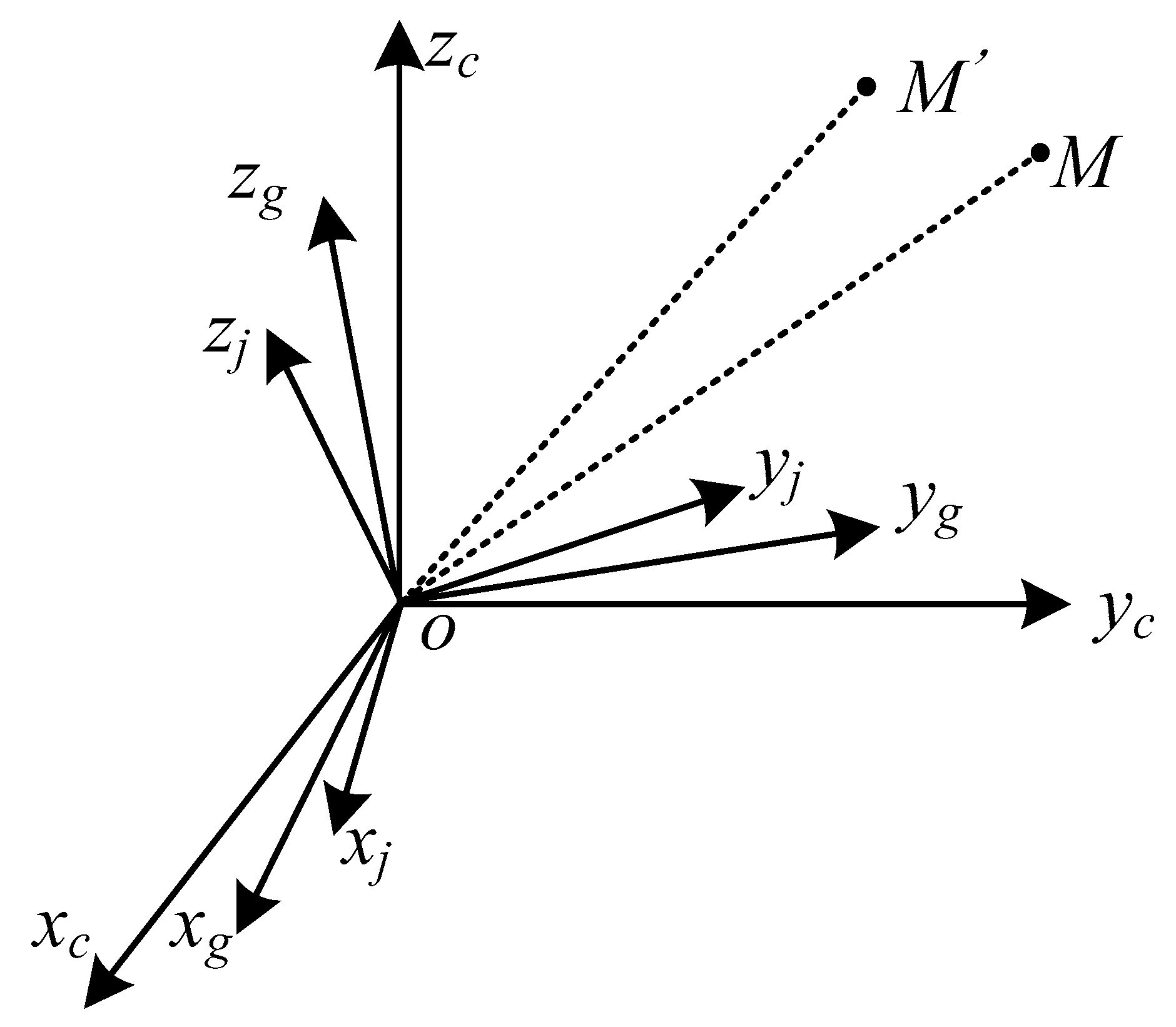
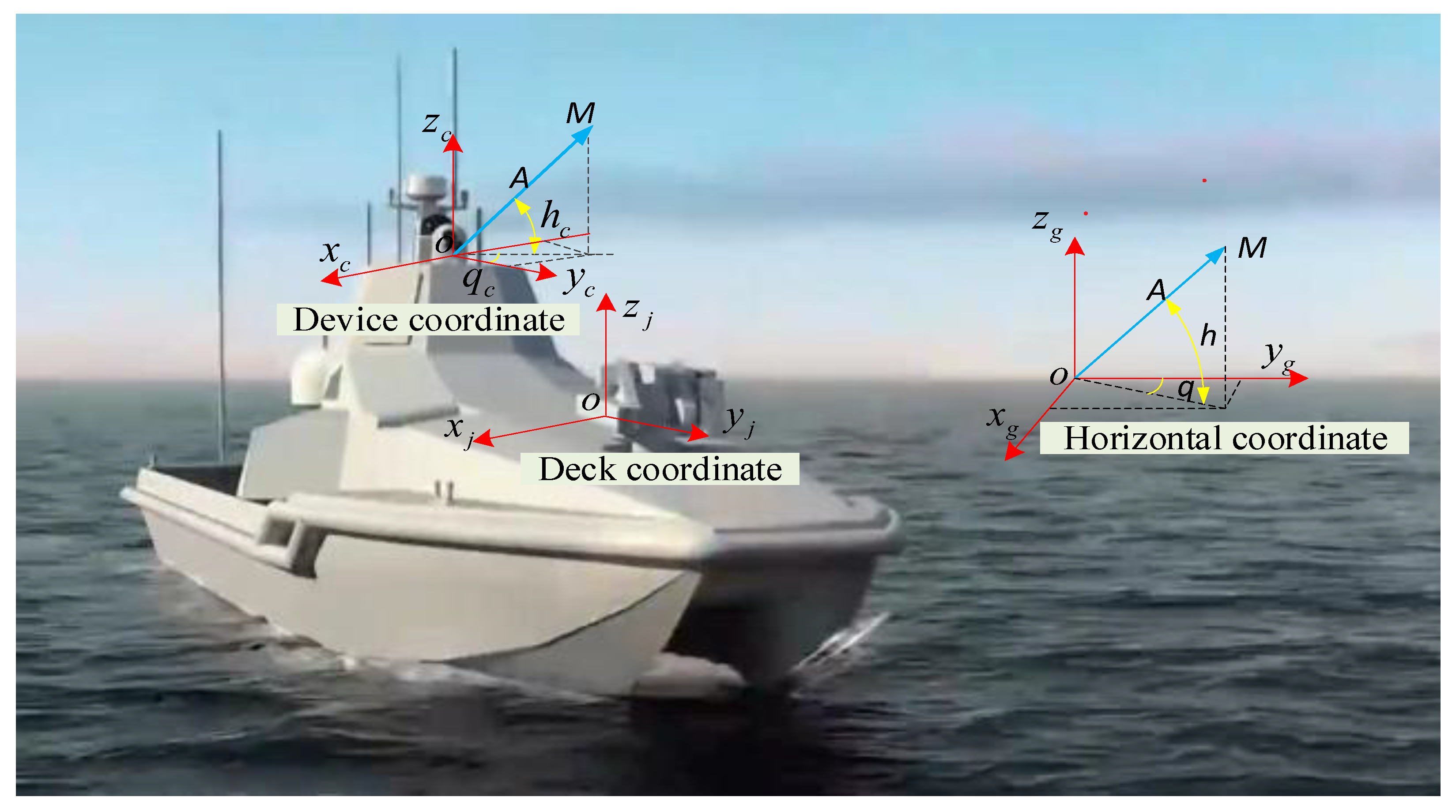
As shown in Figure 1, the coordinate system of the electro-optical device installed on the USV and connected with the carrier is . The coordinate system of the deck where the USV inertial navigation base is installed is , where , , point ship heading, starboard, and upwards, respectively [21]. The horizontal coordinate system is , with pointing due north, pointing due east, facing up, and the plane parallel to the earth. The is the reference coordinate system, and , are the axis coordinate system of the electro-optical device and inertial navigation device, respectively. These coordinate systems conform to the right-hand rule [22]. When there is no installation perpendicularity error or azimuth initialization error, the can coincide with by coordinate system translation.
Figure 1.
The device coordinate system and the deck coordinate system.
The matrix expression of the pointing vector of the LOS M of the electro-optical device in the horizontal coordinate system is as follows:
where q and h are the azimuth and elevation angles of the LOS M in the horizontal coordinate system, respectively.
When the hull rotates around the axis by a pitch angle P, the transformation matrix of point M from the horizontal coordinate system to the deck coordinate system can be expressed as follows:
When the hull rotates around the axis by a roll angle R, the transformation matrix of point M from the horizontal coordinate system to the deck coordinate system can be written as follows:
Accordingly, the matrix expression of vector in the deck coordinate system is as follows:
Furthermore, the azimuth angle and pitch angle of the LOS M in the deck coordinate system after rotation can be, respectively, expressed as follows:
Because the device coordinate system is consistent with the deck coordinate system , the azimuth angle and elevation angle of the LOS M in the device coordinate system are , respectively.
To ensure that the LOS is pointing to on the sea–sky line, the electro-optical device must be rotated in the azimuth and elevation directions relative to the device coordinate system by angles , respectively. Thus, the shaking of the captured images caused by the swaying of the carrier can be eliminated to realize the LOS stabilization function in the horizontal coordinate system. When the elevation angle is zero, the center of the images captured by the electro-optical device is always stable on the sea–sky line.
3. Influence of the Perpendicularity Error on Stability
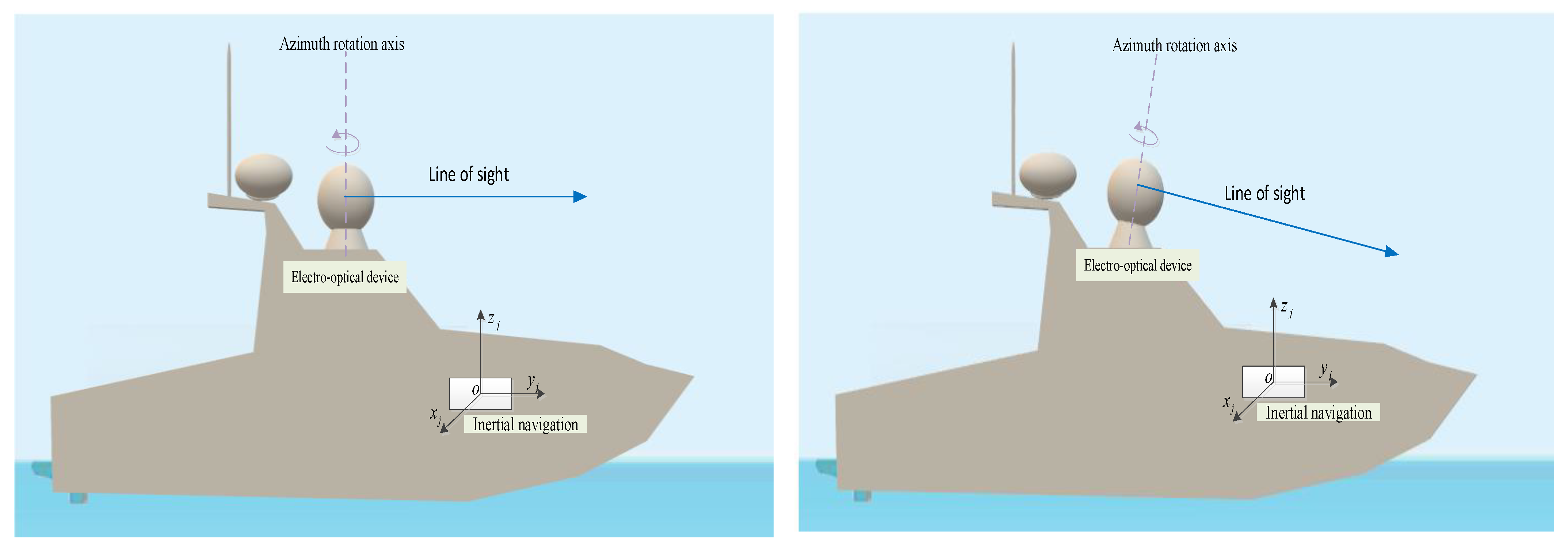
When the electro-optical device is installed on the USV, the base plane of the equipment must be level with the horizontal plane of the platform inertial navigation and aligned with the inertial navigation azimuth so that the coordinate system of the electro-optical device is parallel to the coordinate system of the deck [23]. The attitude angle of the hull sensitive to inertial navigation is consistent with the swing angle of the electro-optical device (i.e., the rotation angles of and are the same) only when the aforementioned condition is satisfied. The electro-optical equipment compensates for carrier swing by utilizing real-time calculations of the inertial navigation’s attitude data [24,25]. Achieving image stabilization necessitates maintaining consistency between the attitude angle obtained through the boat’s inertial navigation and that of the electro-optical equipment. Where there is an installation perpendicularity error, as shown in Figure 2, the above precondition is violated, and there is a deviation between the attitude angle of the electro-optical device and the inertial navigation sensitive attitude angle. This causes a deviation in the pointing of the LOS in the horizontal coordinate system after compensation.
Figure 2.
Schematic for the case of a perpendicularity error in installing the electro-optical device.
In the case of a perpendicularity error in the installation of the electro-optical device, the electro-optical azimuth rotation axis is inclined at a certain angle, and a certain space angle exists between the and planes [26]. Assume that the error angle component relative to the and axes are and , respectively, and the azimuth angle and elevation angle of in the device coordinate system are known.
According to Euler’s law of rotation, the real pointing coordinates of the LOS in this state can be calculated by rotating the vector by perpendicularity error angles and from the coordinate system to the coordinate system, as shown in Figure 3, and then its coordinate matrix in the horizontal coordinate system can be calculated according to the attitude angle.
Figure 3.
Attitude relationship of each coordinate system of the electro-optical device.
- (1)
- Transformation from the device coordinate system to the deck coordinate system
According to Equations (5) and (6), the coordinate matrix of in the device coordinate system can be expressed as follows:
Then, its coordinate matrix in the deck coordinate system can be obtained through the following transformation:
where and are rotation matrices and can be expressed as follows:
- (2)
- Transformation from the deck coordinate system to the horizon coordinate system transformation
The coordinate matrix of the coordinate matrix relative to the horizontal coordinates can be obtained by the inverse transformation of Equation (4):
By using Equations (4), (8) and (11), the coordinate matrix of in the horizon coordinate system can be obtained as follows:
Accordingly, the deviation between and the actual required point in the horizontal coordinate system can be expressed as
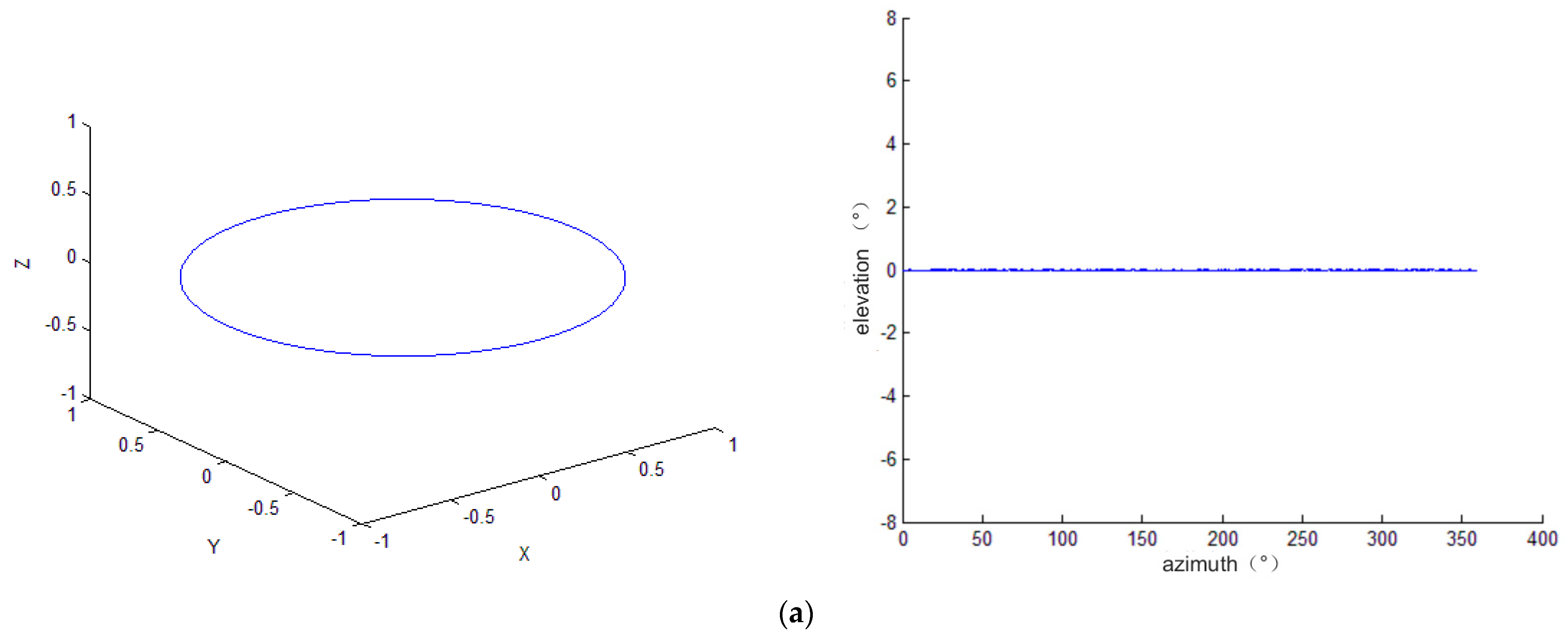
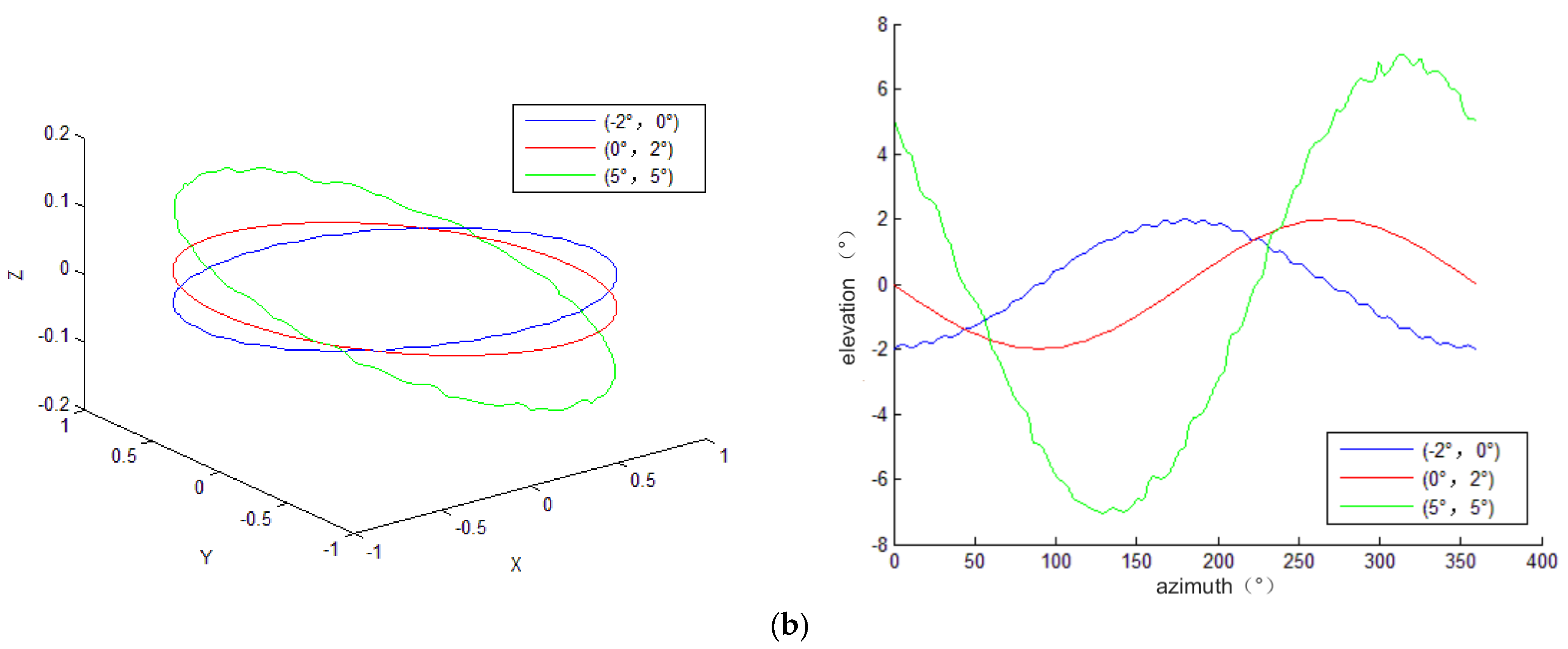
During circumferential scanning observation by using the electro-optical device, the sea–sky line is a circular trajectory in the horizontal coordinate system, that is, in Equation (1), azimuth is and elevation h is zero, and is the angular velocity of the scanning operation. The simulation calculations were performed with the following initial conditions: = , and the hull roll R and pitch P were simple harmonic motion with amplitudes of 20° and 10° and periods of 4 and 5 s, respectively; the corresponding perpendicularity errors were, respectively, (0°, 0°), (−2°, 0°), (0°, 2°), and (5°, 5°). The comparison of the simulation calculation results in the four cases is presented in Figure 4; the left column shows the trajectory of the LOS in the surrounding scan in space, and the right column shows the elevation angle error caused by the perpendicularity error to the LOS stability in the horizon coordinate system. Simulation outcomes demonstrate that in the absence of a perpendicularity error, LOS moves along the sea–sky line, with the elevation angle always at zero degrees in the horizontal coordinate system. However, in the presence of an installation perpendicularity error, as depicted in Figure 4b, the line of sight’s center no longer forms a horizontal circular track but is inclined and exhibits high-frequency oscillations. Furthermore, as can be seen, the center of the LOS deviates above and below the sea–sky line.

Figure 4.
Comparison of LOS pointing curve for two cases under three-dimensional rectangular coordinates and two-dimensional angular coordinates. (a) The LOS Pointing curve without installation perpendicularity error (both
and are 0°). (b) The LOS pointing curve with installation perpendicularity error (,
) are (−2°, 0°), (0°, 2°), (5°, 5°).
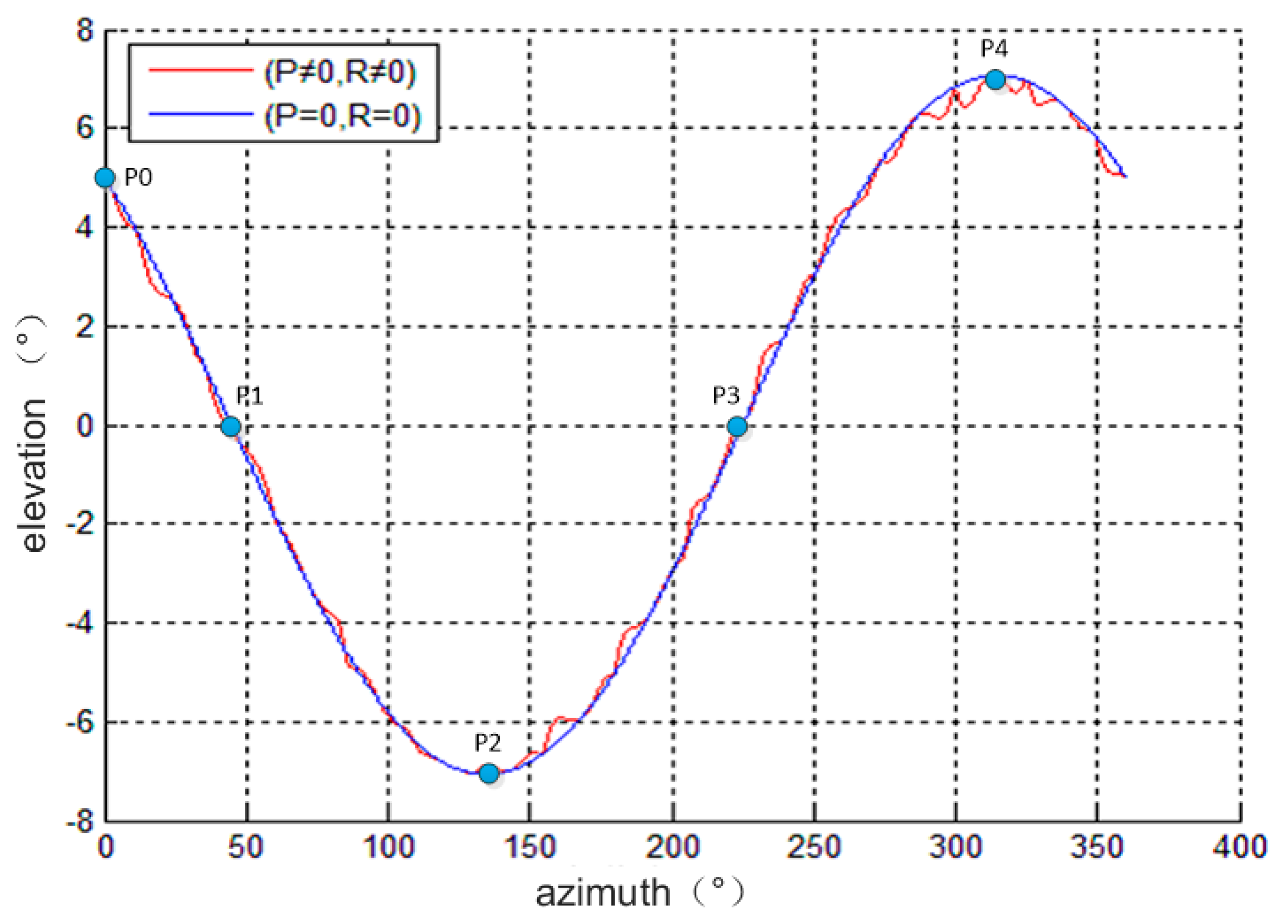
As can be seen from the simulation results, the overall deviation trend of the LOS error is a trigonometric function curve with a small high-frequency vibration superimposed on this curve. Further analysis reveals that the overall deviation trend of is related to the perpendicularity error and the small-magnitude high-frequency vibrations are related to hull roll R and pitch P. The angles are fixed, and the roll R and pitch P of the hull are, respectively, set as zero and non-zero simple harmonic motion for comparative simulation. Simulation results are shown in Figure 5, where are (5°, 5°), and the hull roll R and pitch P are (0, 0) and [, ], respectively. As can be seen from the simulation results, the LOS is a smooth trigonometric function curve when (R, P) is (0, 0). There are many small vibrations around the blue curve when (R, P) is [, ], further indicating that the frequency of the vibrations is related to the frequency of roll and pitch.
Figure 5.
The effect of hull roll and pitch on the elevation error curve.
4. Calculation Method of the Perpendicularity Error
Let , and . Substituting these values into Equation (12), we obtain
For the points P2 and P4 at the valley and peak values in Figure 5, by using trigonometric functions, Equation (16) can be transformed as follows:
When , the right side of Equation (17) takes the maximum value, and is the peak value. Because is a sine function, P2 is the valley point and P4 is the peak point in ; the maximum and minimum values are
Substituting into Equation (16), the value of at the elevation error zero points P1 and P3 can be obtained as follows:
Substituting Equation (19) into Equation (15), we obtain
The coordinate values of P0–P4 can be measured. Assuming that the known zero point P1 and peak point P2 are and , respectively, we obtain
From Equations (21) and (22), we obtain
By using Equation (23), the perpendicularity error angles and can be approximated by extracting the coordinates P1 and P2 at the peak point where the LOS deviates from the sea–sky line in the circumferential scanning image and the zero-crossing point passing through the sea–sky line. At point P0 , let . Then, by using Equations (15) and (16), and are obtained, that is, the coordinate of point P0 is . Therefore, the sign of obtained using Equation (23) is consistent with that of , and the sign of is negative if there is a peak point first and then a valley point from azimuth 0° to 359°; otherwise, it takes a positive sign. There are two peak points in the elevation error curve, and two points of zero-degree intersection with the sea–sky line, and the azimuth angle difference between the two points is ; thus, the average value of the two points can be obtained to improve the coordinate accuracy of the extraction point. The aforementioned formula derivation and error analysis are mainly used to obtain the rules and effects of perpendicularity errors and on the stability, without considering the effect of small vibrations errors on the curve caused by the roll and pitch; however, the low-precision perpendicularity error can be calculated using the values of several special points P0–P4.
The known data during electro-optical circumferential scanning include roll and pitch and a given azimuth angle , and the measurable value on the circumferential scanning image is the elevation deviation angle between the LOS and the sea–sky line. A sequence of n points can be obtained by sampling at equal azimuth angles on the images. Due to the lack of values, multivariate data fitting parameters and cannot be determined using Equation (12).
To obtain high-precision perpendicularity error values, first, the low-precision and values can be calculated using Equation (23). Then, taking 21 × 21 groups of within the range of and a step size of 0.1°, can be calculated for each group using Equation (12) and , and the mean value of the absolute value of the error between and the measured value can be calculated using Equation (24):
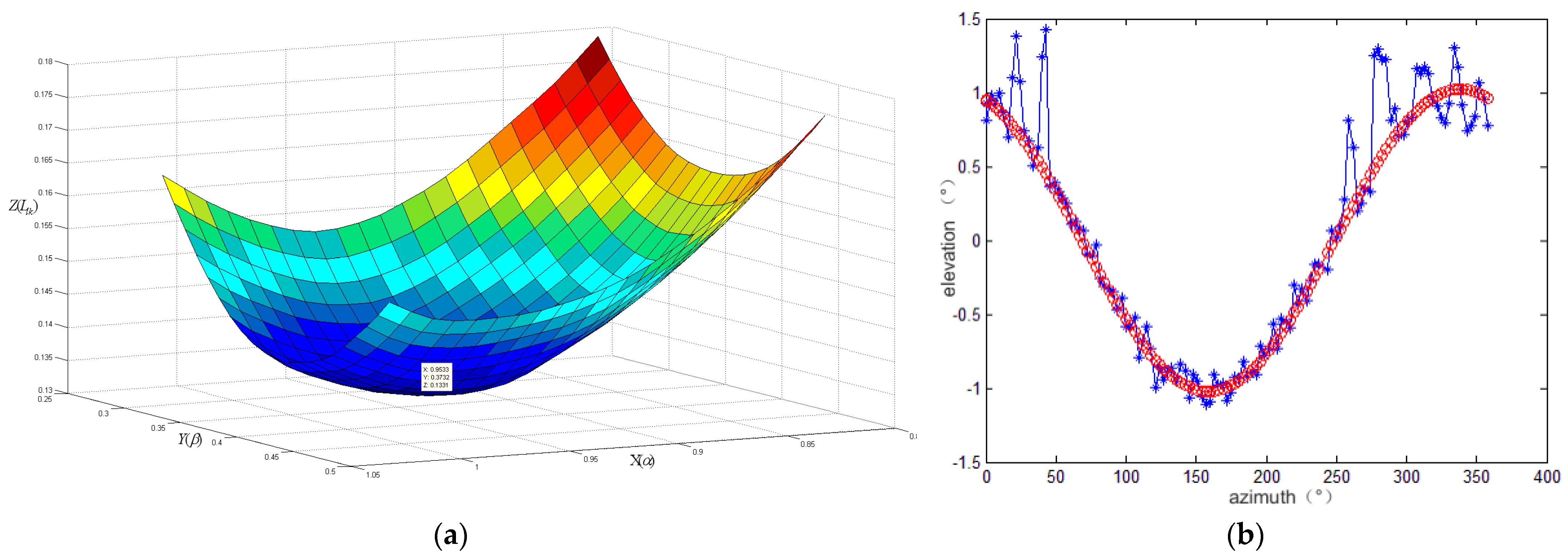
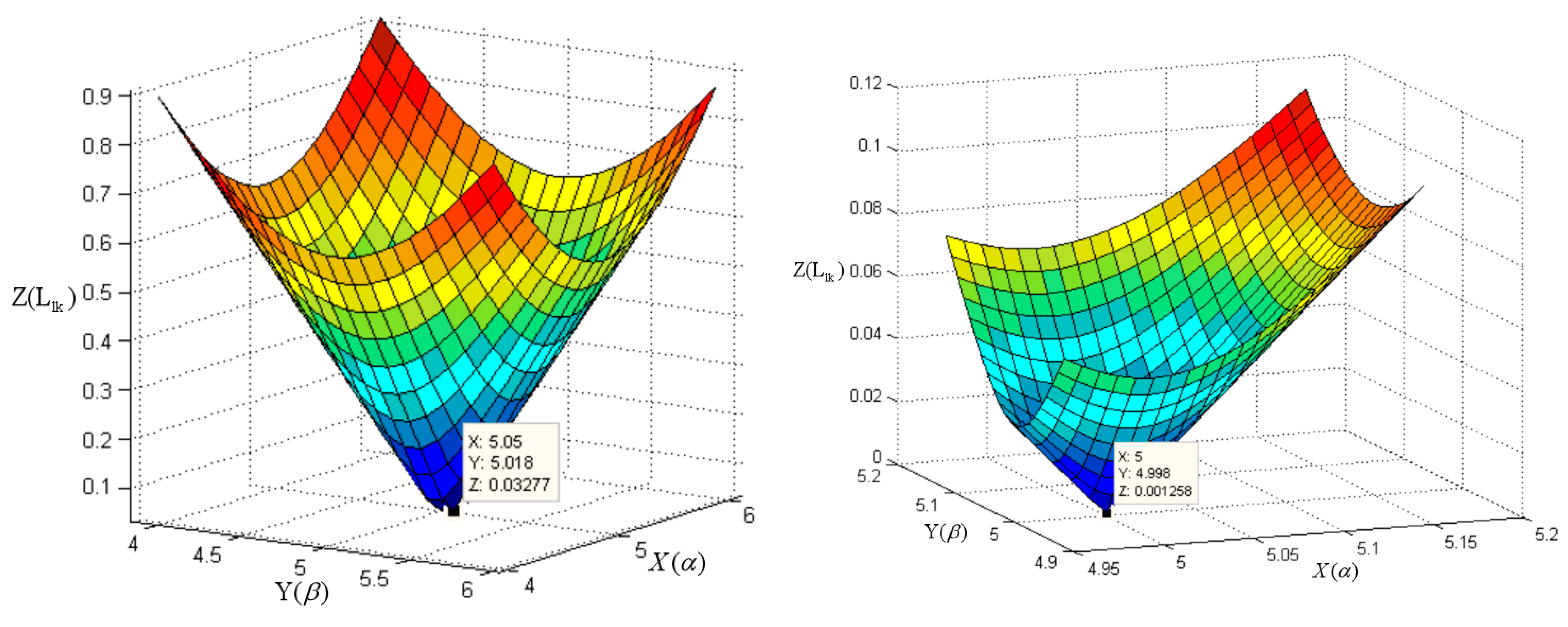
Next, the and values corresponding to the minimum value from 21 × 21 are obtained. Subsequently, and are taken as the center, and the above process is repeated to determine the and values corresponding to the minimum in the range of with a step size of 0.01°. and have very high precision, with errors of less than 0.01°. For example, substituting the measured values (44.5, 0.004) and (130.5, −7.044) of points P1 and P2 in Figure 5 into Equation (23) yields and . The minimum value in the range of ±1° with a step size of 0.1° is obtained, yielding , , and . As shown in the curve on the left of Figure 6, is a convex function of and . Next, the minimum value is obtained within the range of ±0.1° of and with a step size of 0.01°, and , , and are obtained. The deviation between the values of and and the true value (5, 5) is (0, 0.002), and the precision is less than 0.01°.
Figure 6.
High-precision perpendicularity error search chart with 0.1°and 0.01°steplength.
5. Error Compensation Method
A perpendicularity error is a systematic error that occurs during the installation of electro-optical equipment. As the inertial navigation axis of the platform cannot be extracted, it is challenging to eliminate this error through mechanical calibration. Therefore, the error values and can be accurately calculated using the method presented in Section 4 and corrected using software when performing LOS stabilization control. Adhering to the principle of LOS stabilization control, the correction of the perpendicularity error is possible after converting LOS from the horizontal coordinate system to the deck coordinate system. is calculated using Equation (4) and multiplied with the inverse matrix of the and rotation matrices and then converted into the device coordinate system by using Equation (25). Therefore, the rotation angles and of the electro-optical device in the azimuth and elevation directions relative to the device coordinate system can be calculated. After error correction, the electro-optical device can be stabilized near the sea–sky line.
6. Experimental Results
The USV electro-optical device used in the experiment has the function of two-axis LOS stabilization and is equipped with a color TV. The resolution and the vertical field angle of the TV sensor are 768 × 576 and 6.67° × 5°, respectively. The experimental area is located in a wide sea area. Before conducting the experiment, the pitch angle of the LOS of the electro-optical equipment is established at 0°, while the azimuth angle ranges from 0° to 360°. During the circumferential scanning process, sea–sky line images are captured using the TV sensor, and the corresponding roll R and pitch P of the USV are documented at the time of each image. The angle error in the pitching direction between the LOS and the sea–sky line can be calculated by Equation (28).
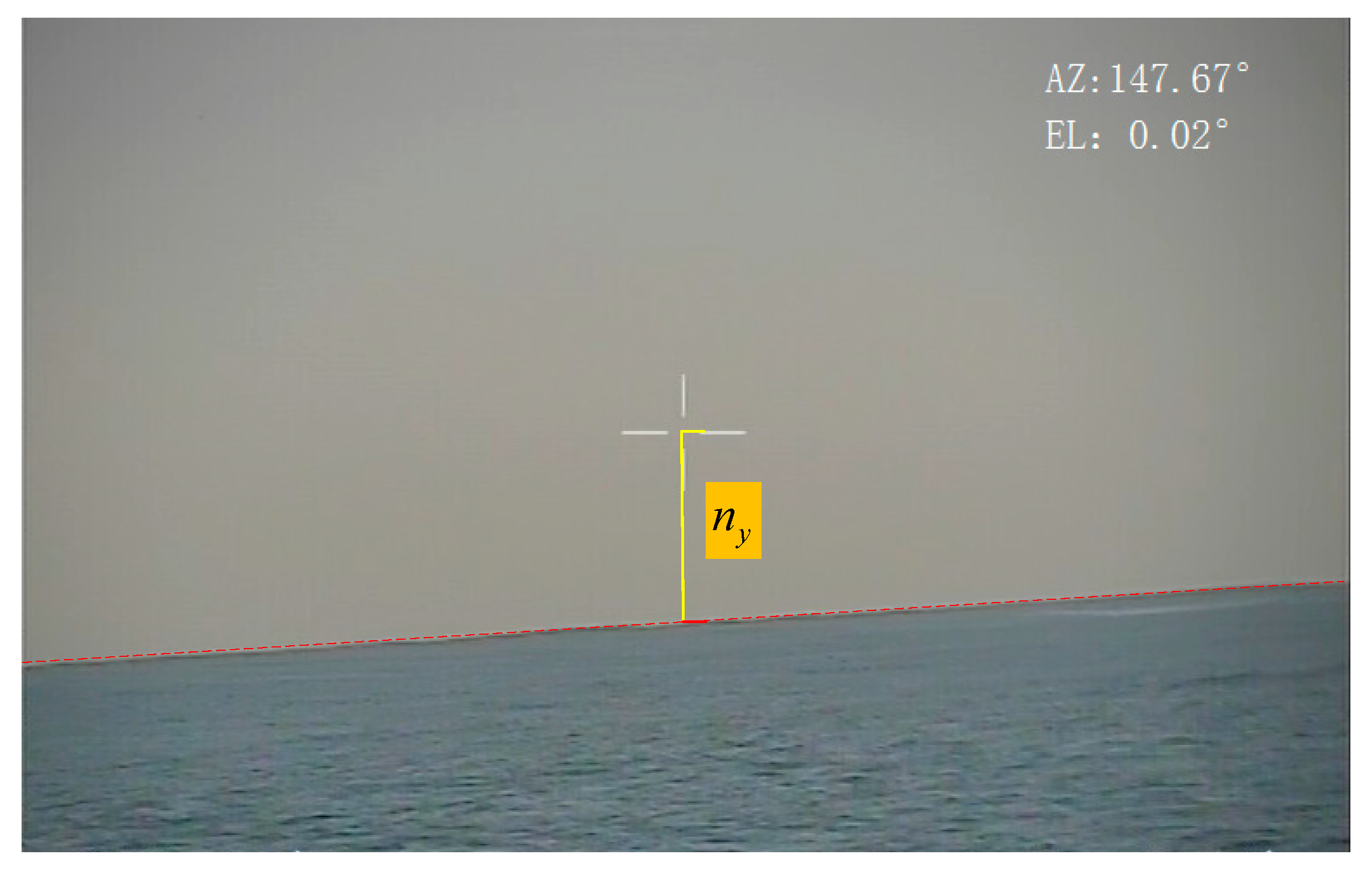
As shown in Figure 7, in Equation (28), is the number of pixels in the i-th image from the LOS to the sea–sky line in the pitching direction (positive when the sea–sky line is above the LOS, otherwise negative). is the vertical resolution of the TV, that is . is the vertical view field of the TV, that is . is the pitch error when the electro-optical device is stably controlled. For example, in Figure 7, the measured value of is −107 and the is 0.02°, according to the above parameters the can be calculated as −0.91°.
Figure 7.
The error in the pitching direction between the LOS and the sea–sky line.
The images collected by the electro-optical device during the circumferential scanning process are shown in Figure 8. Figure 8a illustrates that at an azimuth angle of 70.28°, the center of LOS intersects with the sea–sky line and subsequently moves upwards from the sea to the sky. When the azimuth angle is 160.04° (Figure 8b), the LOS reaches the peak value of 1.076° and gradually moves downward from the sky toward the sea. At 249.94°, the LOS intersects with the sea–sky line again and then continues to move downward on the sea surface. When the azimuth angle is 339.76°, the LOS reaches the valley value of −0.9722°, and after passing the valley point, it moves from the sea to the sky in the opposite direction. The azimuth difference between the peak point and the valley point is about 180°, and that between LOS and sea–sky line intersection is about 180°. This phenomenon occurs repeatedly throughout the scanning procedure, in line with the simulation outcomes presented in Section 3.
Figure 8.
The LOS deviates up and down around the sea–sky line when the electro-optical device moves during circumferential scanning.
According to the method described in Section 4, the low-precision and values calculated by special points are 1.0133° and 0.3632°, respectively. One-hundred-and-twenty groups of data collected at 3° azimuth intervals were collected from the circumferential scanning images of the electro-optical device, including azimuth , pitch , roll , and elevation error angle of the LOS. We obtained 120 groups of experimental data, and Table 1 shows all the experimental data.
Table 1.
The 120 groups of data collected in the experiment.
As shown in Figure 9a, the high-precision and values obtained using the method presented in Section 4 are 0.9533 and 0.3732, respectively. The blue star points in Figure 9b are the measured values of the elevation error angle , and the red dots are the elevation error values calculated based on the calculated high-precision and values. The calculated values exhibit good agreement with the measured values. A small part of the error measurement value deviations is too large. The nearby surge obstructs the distant sea–sky line, leading to a significant elevation angle error in the measured sea–sky line. However, this does not affect the calculation of and values as these values with large deviations can be removed during calculation, and the number of sampling points can be increased by increasing the number of circumferential scans. Finally, the values of and are corrected according to the perpendicularity error in Section 5. Subsequently, the electro-optical device is well stabilized near the sea–sky line, as shown in Figure 10.
Figure 9.
Comparison of pitch angle error measurement values and fitting calculation values between the line-of-sight and the sea–sky line.
Figure 10.
Circumferential scanning image after the electro-optical device corrects the perpendicularity error.
7. Conclusions
The influence of the installation perpendicularity error between the base of the electro-optical device and the platform of the USV on the stability control of the LOS of the electro-optical device during the circumferential scanning process is studied. In real-world scenarios, eliminating the perpendicularity error through mechanical calibration is difficult because the platform inertial navigation axis cannot be led out. In this regard, a novel method is introduced to measure and rectify the perpendicularity error utilizing sea–sky line images. The corresponding error function of LOS caused by perpendicularity errors in the elevation direction is established. The error function is a convex function concerning the perpendicularity error and can accurately identify the error with an error precision of up to 0.01°. The simulation calculations and experimental results demonstrate that the low-frequency disturbance phenomenon of the LOS near the sea–sky line during the actual scanning process is consistent with the simulation results. By measuring the elevation error angle of the LOS from the sea–sky line and using the proposed method, the perpendicularity error can be accurately calculated and then corrected using software when performing LOS stabilization control. The electro-optical device, after error correction, can eliminate low-frequency disturbances and small high-frequency vibrations of the LOS during the circumferential scanning process, thus, greatly improving the system’s LOS stabilization accuracy and image observation effect. The suggested approach is uncomplicated and efficient, making it suitable for the routine or online calibration of the electro-optical equipment used in USV, and it has considerable engineering practicality.
Author Contributions
Conceptualization, J.Z., J.C. and X.W.; methodology, J.Z. and J.C.; software, C.Z. and Y.L.; validation, J.Z., H.L. and C.S.; formal analysis, Z.Z.; investigation, J.Z.; resources, X.W.; data curation, C.W.; writing—original draft preparation, J.Z.; writing—review and editing, H.L. and Z.Z.; visualization, D.H.; supervision, C.W.; project administration, J.Z.; funding acquisition, J.C. All authors have read and agreed to the published version of the manuscript.
Funding
This research was supported by the National Natural Science Foundation of China under Grant No. 62272178.
Institutional Review Board Statement
Not applicable.
Informed Consent Statement
Not applicable.
Data Availability Statement
Not applicable.
Acknowledgments
The authors would like to express their gratitude to all their colleagues in the Key Laboratory of Information Storage System, Huazhong University of Science and Technology.
Conflicts of Interest
The authors declare no conflict of interest. The funders had no role in the design of the study; in the collection, analyses, or interpretation of data; in the writing of the manuscript; or in the decision to publish the results.
References
- Barrera, C.; Padron, I.; Luis, F.S.; Llinas, O. Trends and challenges in unmanned surface vehicles (Usv): From survey to shipping. TransNav 2021, 15, 135–142. [Google Scholar] [CrossRef]
- Villa, J.L.; Paez, J.; Quintero, C.; Yime, E.; Cabrera, J. Design and control of an unmanned Surface vehicle for environmental monitoring applications. In Proceedings of the 2016 IEEE Colombian Conference on Robotics and Automation (CCRA), Bogota, Colombia, 29–30 September 2016; pp. 1–5. [Google Scholar]
- Kim, M.; Joung, T.-H.; Jeong, B.; Park, H.-S. Autonomous shipping and its impact on regulations, technologies, and industries. J. Int. Marit. Saf. Environ. Affairs Ship. 2020, 4, 17–25. [Google Scholar] [CrossRef]
- Mousazadeh, H.; Jafarbiglu, H.; Abdolmaleki, H.; Omrani, E.; Monhaseri, F.; Abdollahzadeh, M.-r.; Mohammadi-Aghdam, A.; Kiapei, A.; Salmani-Zakaria, Y.; Makhsoos, A. Developing a navigation, guidance and obstacle avoidance algorithm for an Unmanned Surface Vehicle (USV) by algorithms fusion. Ocean Eng. 2018, 159, 56–65. [Google Scholar] [CrossRef]
- Barrera, C.; Morales, T.; Moran, R.; Caudet, E.; Marrero, R.; Cianca, A.; Alcaraz, D.; Campuzano, F.; Fernandes, C.; de Sousa, J.T.B. Expanding operational ocean-observing capabilities with gliders across the Macaronesia region. In Proceedings of the Ocean Sciences Meeting 2020, San Diego, CA, USA, 16–21 February 2020. [Google Scholar]
- Setiawan, J.D.; Septiawan, M.A.; Ariyanto, M.; Caesarendra, W.; Munadi, M.; Alimi, S.; Sulowicz, M. Development and Performance Measurement of an Affordable Unmanned Surface Vehicle (USV). Automation 2022, 3, 27–46. [Google Scholar] [CrossRef]
- Han, J.; Kim, J. Three-dimensional reconstruction of a marine floating structure with an unmanned surface vessel. IEEE J. Ocean. Eng. 2018, 44, 984–996. [Google Scholar] [CrossRef]
- Balestrieri, E.; Daponte, P.; De Vito, L.; Lamonaca, F. Sensors and measurements for unmanned systems: An overview. Sensors 2021, 21, 1518. [Google Scholar] [CrossRef] [PubMed]
- Sang, H.; You, Y.; Sun, X.; Zhou, Y.; Liu, F. The hybrid path planning algorithm based on improved A* and artificial potential field for unmanned surface vehicle formations. Ocean Eng. 2021, 223, 108709. [Google Scholar] [CrossRef]
- Wang, H.; Fu, Z.; Zhou, J.; Fu, M.; Ruan, L. Cooperative collision avoidance for unmanned surface vehicles based on improved genetic algorithm. Ocean Eng. 2021, 222, 108612. [Google Scholar] [CrossRef]
- Liu, T.; Pang, B.; Zhang, L.; Yang, W.; Sun, X. Sea surface object detection algorithm based on YOLO v4 fused with reverse depthwise separable convolution (RDSC) for USV. J. Mar. Sci. Eng. 2021, 9, 753. [Google Scholar] [CrossRef]
- Zhang, W.; Gao, X.-Z.; Yang, C.-F.; Jiang, F.; Chen, Z.-Y. A object detection and tracking method for security in intelligence of unmanned surface vehicles. J. Ambient. Intell. Humaniz. Comput. 2020, 10, 1279–1291. [Google Scholar] [CrossRef]
- Kim, J.-H.; Kim, N.; Park, Y.W.; Won, C.S. Object detection and classification based on YOLO-V5 with improved maritime dataset. J. Mar. Sci. Eng. 2022, 10, 377. [Google Scholar] [CrossRef]
- Thombre, S.; Zhao, Z.; Ramm-Schmidt, H.; García, J.M.V.; Malkamäki, T.; Nikolskiy, S.; Hammarberg, T.; Nuortie, H.; Bhuiyan, M.Z.H.; Särkkä, S. Sensors and AI techniques for situational awareness in autonomous ships: A review. IEEE Trans. Intell. Transp. Syst. 2020, 23, 64–83. [Google Scholar] [CrossRef]
- Cormack, D.; Schlangen, I.; Hopgood, J.R.; Clark, D.E. Joint registration and fusion of an infrared camera and scanning radar in a maritime context. IEEE Trans. Aerosp. Electr. Syst. 2019, 56, 1357–1369. [Google Scholar] [CrossRef]
- Han, J.; Cho, Y.; Kim, J.; Kim, J.; Son, N.s.; Kim, S.Y. Autonomous collision detection and avoidance for ARAGON USV: Development and field tests. J. Field Robot. 2020, 37, 987–1002. [Google Scholar] [CrossRef]
- Zhang, Y.; Li, Q.-Z.; Zang, F.-N. Ship detection for visual maritime surveillance from non-stationary platforms. Ocean Eng. 2017, 141, 53–63. [Google Scholar] [CrossRef]
- Prasad, D.K.; Rajan, D.; Rachmawati, L.; Rajabally, E.; Quek, C. Video processing from electro-optical sensors for object detection and tracking in a maritime environment: A survey. IEEE Trans. Intell. Transp. Syst. 2017, 18, 1993–2016. [Google Scholar] [CrossRef]
- Liu, H.; Zhou, X.; Liu, Q.; Ma, R.; Lu, M.; Lin, J.; Ma, M. Modeling and Simulation Analysis of Optical Axis Pointing Error of Aerial Complex Optomechanical System. In Proceedings of the 2019 International Conference on Modeling, Simulation and Big Data Analysis (MSBDA 2019), Wuhan, China, 23–24 June 2019; pp. 119–123. [Google Scholar]
- Wu, F.; Li, S.; Zhu, H.; An, C.; Cai, J.; Du, P.; Wang, C.; Cui, X.; Yan, X. Analysis on the optical axis error of the spherical shell in the electro-optical system. Optik 2018, 168, 458–461. [Google Scholar] [CrossRef]
- Zhang, Z.; Zhou, X.; Fan, D. Analysis, modeling and correction of pointing errors for electro-optical detection systems. Acta Aeronaut. Astronaut. Sin. 2011, 32, 2042–2054. [Google Scholar]
- Huang, L.; Ma, W.; Huang, J. Modeling and calibration of pointing errors with alt-az telescope. New Astron. 2016, 47, 105–110. [Google Scholar] [CrossRef]
- Zhou, X.; Liu, H.; Liu, Q.; Lin, J. Modeling and optimization of the integrated TDICCD aerial camera pointing error. Appl. Opt. 2020, 59, 8196–8204. [Google Scholar] [CrossRef]
- Masten, M.K. Inertially stabilized platforms for optical imaging systems. IEEE Contr. Syst. Mag. 2008, 28, 47–64. [Google Scholar]
- Tang, Q.; Yang, Q.; Wang, X.; Forbes, A.B. Pointing error compensation of electro-optical detection systems using Gaussian process regression. Int. J. Metrol. Qual. Eng. 2021, 12, 22. [Google Scholar] [CrossRef]
- Huang, B.; Li, Z.H.; Tian, X.Z.; Yang, L.; Zhang, P.J.; Chen, B. Modeling and correction of pointing error of space-borne optical imager. Optik 2021, 247, 167998. [Google Scholar] [CrossRef]
Disclaimer/Publisher’s Note: The statements, opinions and data contained in all publications are solely those of the individual author(s) and contributor(s) and not of MDPI and/or the editor(s). MDPI and/or the editor(s) disclaim responsibility for any injury to people or property resulting from any ideas, methods, instructions or products referred to in the content. |
© 2023 by the authors. Licensee MDPI, Basel, Switzerland. This article is an open access article distributed under the terms and conditions of the Creative Commons Attribution (CC BY) license (https://creativecommons.org/licenses/by/4.0/).