


Abstract
Widespread outbreaks of avian influenza occurred in 2004–2005. The outbreaks resulted in extensive losses for the poultry sector in East and South East Asia. Thailand suffered a tremendous impact from the disease. Later, in 2006, there was another outbreak of the aforementioned disease in poultry production clusters (PPCs) in Nakhon Phanom province in the northeastern region of Thailand. In this study, we conducted an intervention by working together with the Department of Livestock Development officials to improve the biosecurity level of PPCs in this province. The methods employed in the intervention included meetings to build understanding and hear about various ideas and problems among stakeholders; instructions; having the farmers perform self-evaluations of the level of biosecurity on the farms; and measures for motivating farmers, e.g., farm contests and handing out awards. The results revealed the following information: After intervention, attraction to wild bird of poultry farms in PPCs decreased (p < 0.05), because the farmers cut down trees around farm and poultry housing. Moreover, biosecurity system planning inside farms in PPCs increased (p < 0.05). The scores for biosecurity system planning inside farms that increased following the intervention are a positive sign that farmers will continue to develop better biosecurity systems on their farms.
1. Introduction
In 2004–2005, outbreaks of avian influenza were reported in eight countries in the Southeast and Eastern Asian regions, namely, China, Cambodia, Indonesia, Japan, Laos, South Korea, Thailand and Vietnam. The resulting damages were a tremendous blow to the poultry production sector [1]. Additional damages had far-reaching economic, environmental and public health implications in the region. Generally, poultry farms with weak biosecurity systems were susceptible to outbreaks [2,3,4,5,6]. In 2006, there was an avian influenza outbreak in Nakhon Phanom province in the northeastern region of Thailand adjacent to Laos with the Mekong River serving as a natural border. Characteristically, the farmers in this province raise layer chickens in lift housing; the number of houses in each farm is about 3–10, which are located in the same area. The distance between farms is 50 m on average. At the time of the outbreak, the Department of Livestock Development, which oversees livestock issues in Thailand, asked the Nakhon Phanom Livestock Development officials to destroy all of the chicken eggs belonging to the layer chicken clusters in compliance with the policy for disease prevention and control. Next, the province and provincial livestock development officials visited the farms to offer assistance in establishing clusters in the form of cooperatives to develop poultry farming and biosecurity systems on the farms [7]. Nevertheless, the government’s policy for poultry destruction damaged the relationships between the livestock development officials and the poultry farmers. Hence, poultry farming and disease control on the farms following the avian influenza outbreak was not as good as it should have been in the clusters. Although every farm practiced control, the farms need to develop good agricultural practice (GAP) standardized farming systems, as set forth by the Department of Livestock Development; this was stated by Wei and Aengwanich [8], who evaluated the level of biosecurity systems layer farms in poultry production clusters in Nakhon Phanom province in 2012. According to the findings, the biosecurity systems on the egg farms in the poultry production clusters in Nakhon Phanom province were low because there were numerous trees on the farms surrounding the poultry production clusters and water sources composed of large ponds spread out everywhere that attracted wild and migratory birds in large numbers (Figure 1 and Figure 2).
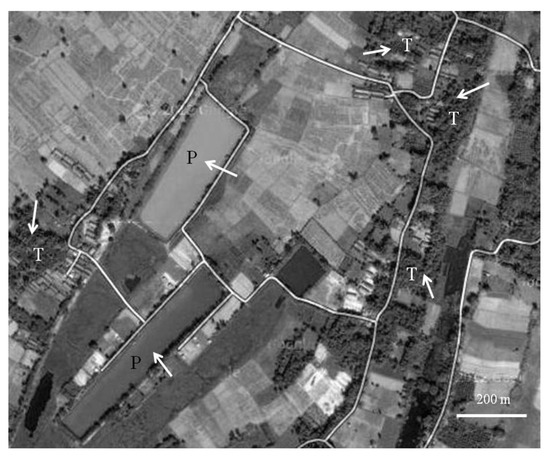
Figure 1.
The ecosystems in the communities of poultry production clusters in Nakhon Phanom province, which are composed of large ponds (P) as community water sources and trees (T) surrounding the poultry farms.
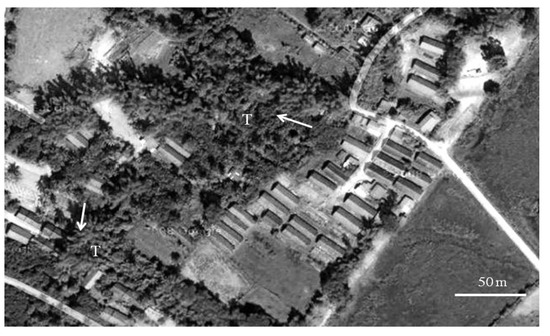
Figure 2.
Poultry pens densely situated in the same area and surrounded by trees (T) in the poultry clusters in Nakhon Phanom province.
In addition, practice in line with biosecurity systems on the farms is not as stringent as it should be due to the investments involved in biosecurity systems which incur huge costs for improvement, as some farmers are not ready to invest. Therefore, the objective of this study was to use various measures to stimulate farmers of PPCs in Nakhon Phanom to improve biosecurity levels on their farms. The results from this study will provide data for policy makers, officers and researchers who work in this field both currently and in the future.
2. Results and Discussion
The results for a comparison of biosecurity level in poultry farms before and after intervention are shown in Table 1.

Table 1.
Comparison of the biosecurity system on layer farms in poultry production clusters (PPCs) in Nakhon Phanom province before and after intervention.
| Results of Evaluations of Biosecurity Systems on Poultry Farms in Nakhon Phanom Province (n = 59 Farms) | |||
|---|---|---|---|
| No. | Biosecurity Indicators on the Farms | Before Intervention | After Intervention |
| 1 | Attraction of wild birds | 1.56 ± 0.84 a | 1.81 ± 0.48 b |
| 2 | Prevention of wild birds | 0.14 ± 0.35 | 0.19 ± 0.39 |
| 3 | Measures for farm workers | 1.01 ± 0.23 | 1.10 ± 0.31 |
| 4 | Measures for new poultry on the farms | 1.09 ± 0.28 | 1.12 ± 0.32 |
| 5 | Measures for farm visitors | 1.09 ± 0.34 | 1.17 ± 0.50 |
| 6 | Measures for vendors | 2.85 ± 0.66 | 2.90 ± 0.55 |
| 7 | Measures for equipment and vehicles | 1.02 ± 0.29 | 1.12 ± 0.33 |
| 8 | Water sources and water quality care | 1.98 ± 0.13 | 2.04 ± 0.18 |
| 9 | Food sources | 1.03 ± 0.18 | 1.07 ± 0.26 |
| 10 | Environments surrounding farms: Distance between farms and roads, and other parts | 0.23 ± 0.63 | 0.26 ± 0.64 |
| 11 | Type of poultry on farms | 2.95 ± 0.22 | 2.97 ± 0.18 |
| 12 | Cleaning and disinfection capacity on farms | 1.97 ± 0.18 | 2.02 ± 0.13 |
| 13 | Measures from entry to poultry pens | 1.00 ± 0.19 | 1.05 ± 0.22 |
| 14 | Biosecurity system planning inside farms | 1.00 ± 0.00 a | 1.21 ± 0.41 b |
Remarks: (1) 0 point was the lowest score and 3 points was the highest score; (2) a,b are letters with the same horizontal differences with statistical significance (p < 0.05).
As seen in Table 1, there are differences between the before and after intervention scores for two indicators, namely, attraction of wild birds and biosecurity system planning inside farms (Farmers have a plan for development biosecurity system in their farm according with Department of Livestock Development (DLD) standard). The increased scores for attraction of wild birds were caused by certain farmers who cut down trees surrounding the farms which were a local source or attraction for wild birds. The aforementioned wild birds could be vectors for avian influenza. However, most of the trees were left uncut because the trees surrounding the farms were local fruit trees generating income for the farmers. Concerning the indicator on biosecurity system planning inside farms, the findings indicated increased scores following the intervention and some of the farmers had already invested in farm development. With regard to the eleven other indicators, there were slight changes between the before and after intervention scores because the Nakhon Phanom Livestock Development Office had published standards for disease control following the outbreak of avian influenza in 2006 by stipulating that new poultry farmers were required to build and develop farms meeting GAP standards in order to be granted poultry production licenses on layer farms. Hence, all of the farm types in these poultry production clusters were similar. Therefore, when the evaluations were performed using the aforementioned form, the results yielded by the evaluation were not different. Concerning the index scores for all of the indictors evaluated, the lowest score was zero points and the highest score was three points. According to the findings, eight of the indicators had scores between 0 and 1, thereby indicating that the layer farms in the PPCs in Nakhon Phanom province were at risk of outbreaks of avian influenza.
3. Experimental Section
This research study has already been approved by the Research Ethics Committee of Maha Sarakham University. The intervention was conducted from July to October 2013 and plans for the intervention were made by employing a model called “Thailand’s Model” in the work process; this was achieved by working together with Nakhon Phanom Livestock Development officials who have a duty directly involving the promotion and support of poultry farming in the aforementioned group. The work process was carried out through the joint activities of the Provincial Livestock Development officials and the farmers. The researchers facilitated the activities, arranged meetings and served as a source of academic information for the activities used in the intervention as follows: Meetings to build understanding about the work and hearing of ideas and problems among the stakeholders; providing instruction about biosecurity systems and displaying the good results yielded by the aforementioned systems on the health of the poultry and increased income as fewer sick animals will increase the farmers’ income whilst reducing expenditure for disease prevention and control, which will yield good results for farmers; having the farmers evaluate biosecurity levels on their own farms to enable them to acknowledge the situations of the biosecurity systems on the farms to give them the opportunity to realize the errors on each farm; and initiating measures to motivate the farmers, such as farming contests for farms with high level biosecurity systems, and granting awards. In addition, once the systems had been developed, the farms were managed to meet the Department of Livestock Development’s GAP standards and the farms were accredited and received certificates. For the before and after intervention processes, the biosecurity levels of the farms in this poultry product cluster were evaluated using the biosecurity system evaluation form developed by Wei and Aengwanich [8] (Table 2). Next, the before and after intervention biosecurity data were compared by using t-test by using SPSS. Results of the analysis are presented in the form of Mean ± SD.
Table 2.
Indicators and definition of biosecurity score in each level.
| Indicators | Scores | Definition |
|---|---|---|
| 1. Attractiveness to wild birds | 3 | The farm located in the non-migrated bird area. No trees or water pools within 100 m. |
| 2 | Trees surrounding the farm, but no pond. | |
| 1 | Ponds nearby the farm within 50 m. | |
| 0 | Both trees and ponds located within 50 m. | |
| 2. Wild-bird protection | 3 | Poultry indoor or use bird net as shield 100%. |
| 2 | The net can cover more than 70% of the poultry house. | |
| 1 | The net can cover more than 50% of the poultry house. | |
| 0 | The bird net is not efficacious at all. | |
| 3. Measures related to staffs in the farm | 3 | Farmers live in the farm permanently, at least for per cycle. |
| 2 | Do not live permanently but take some measures. No birds kept as pet in the living house (nor the fighting cock). Record everyone entering and leaving the farm. Use disinfectant equipment when entering the farm. | |
| 1 | Taking some measures but affect so little to the poultry biosecurity. | |
| 0 | Staffs in the farm work without any control. | |
| 4. Measures for incoming poultry (incl. fighting cocks) | 3 | The whole farm keeps the same cycle and all the poultry comes from the same company or registered groups under contact. |
| 2 | Measures taken for the control of the incoming poultry, e.g., traders’ questionnaire, take records in each cycle etc. | |
| 1 | Find sources of chicken and measures for disease control in poultry farm. | |
| 0 | No measure taken. | |
| 5. Measures for visitors | 3 | Visitor cannot enter the building or there is a fully developed disinfection system (taking a shower; changing clothes). |
| 2 | Taking some measures for the visitors, protection under functional equipment. Setting a sign in front of the farm. Fencing around the farm. Footwear and disinfection are required at the entrance. | |
| 1 | Measures taken but not so effective or under poor arrangement. | |
| 0 | Visitor can enter the poultry house directly. | |
| 6. Measures for traders | 3 | Traders do not need to enter the farm. |
| 2 | Traders enter the farm without entering the poultry house. | |
| 1 | Traders stay inside the house after getting disinfection. | |
| 0 | No measures for the traders at all. | |
| 7. Measures for equipment and vehicles | 3 | No vehicle in the farm. |
| 2 | Disinfect the vehicles upon entry. | |
| 1 | Measures taken but not so effective or under poor arrangement. | |
| 0 | No control to the vehicles. | |
| 8. Source and treatment of water | 3 | Healthy cool water from underground. |
| 2 | Water from healthy source (rain, recycle), no pollution. | |
| 1 | High quality surface water and under protection during transfer. | |
| 0 | Surface water without treatment. | |
| 9. Source of feed | 3 | Feed provided by the company, no process is needed. |
| 2 | Feed mixed by machine indoor. | |
| 1 | Feed mixed by human indoor. | |
| 0 | Feed mixed outdoor. | |
| 10. Local environment: Distance from the road and other farm | 3 | Fully protection of the farm, far from a public road more than 300 m. |
| 2 | Either other farm or public road located within 200 m. | |
| 1 | Either other farm or public road located within 100 m. | |
| 0 | Both other farm and public road located within 50 m. | |
| 11. Types of poultry in the farm | 3 | Only one type of poultry in the farm. |
| 2 | A few types of poultry in the farm, reared in separated housings. | |
| 1 | A few types of poultry in the farm, free range. | |
| 0 | Many types of poultry in the farm, free range. | |
| 12. Capacity to clean and disinfect the farm | 3 | Clean and disinfect the whole area regularly (more than once a week). |
| 2 | Clean and disinfect the whole area or only several parts of the farm regularly (more than a month per time). | |
| 1 | Clean and disinfect only several parts of the farm irregularly. (Usually upon the outbreaks). | |
| 0 | No disinfection or cleaning at all. | |
| 13. Measures taken at the entrance to poultry sheds | 3 | Fully developed system of disinfection (Usually under the guidance of a company). |
| 2 | Some measures of disinfection, including scored 2. Changing boots or other footwear for the poultry house. Taking a shower and changing clothes. Passing a disinfectant tank before entering the poultry house and wear gloves | |
| 1 | Measures taken but not so effective. | |
| 0 | No disinfection or cleaning at all. | |
| 14. Biosecurity plans | 3 | Design a coherently suitable plan under sustainable development. |
| 2 | Farmers have separate plans e.g., updating equipment for a better biosecurity level, studying about the biosecurity. | |
| 1 | Just obey any guidance or regulation of the local area. No individual plan. | |
| 0 | No plan or guidance to follow. |
Source: Wei and Aengwanich [8].
4. Conclusions
The biosecurity system of poultry production cluster in Nakhon Phanom province showed improvements for two indicators, namely, attraction of wild birds and biosecurity system planning inside farms when compared between before and after intervention. The interventions were made by employing a model called “Thailand’s Model” in the work process by working together with Nakhon Phanom Livestock Development officials and the farmers. The changes were made by the stakeholder with researchers working as facilitators for change.
Acknowledgments
This research was funded by International Development Research Centre; Foreign Affairs, Trade and Development Canada (through the Global Health Research Initiative); and the Australian Agency for International Development.
Author Contributions
Worapol Aengwanich and Prayat Srikot conceived and designed the experiments; Worapol Aengwanich, Prayat Srikot and Thongchai Boonsorn performed the intervention; Prayat Srikot contributed data collection at field site; Worapol Aengwanich and Thongchai Boonsorn analyzed the data; Worapol Aengwanich wrote the paper and are responsible for the discussion of the results.
Conflicts of Interest
The authors declare no conflict of interest.
References
- APEIR. Avian Influenza: Impact and Key Policy Messages for Asia; APEIR Coordinating Office, Health Systems Research Institute, Ministry of Public Health: Nonthaburi, Thailand, 2013; p. 4. [Google Scholar]
- Tiensin, T.; Chaitaweesub, P.; Songserm, T.; Chaisingh, A.; Hoonsuwan, W.; Buranathai, C.; Parakamawongsa, T.; Premashthira, S.; Amonsin, A.; Gilbert, M.; et al. Highly pathogenic avian influenza H5N1, Thailand, 2004. Emerg. Infect. Dis. 2005, 11, 1664–1672. [Google Scholar] [CrossRef]
- Tiensin, T.; Nielen, M.; Songserm, T.; Kalpravidh, W.; Chaitaweesub, P.; Amonsin, A.; Chotiprasatintara, S.; Chaisingh, A.; Damrongwatanapokin, S.; Wongkasemjit, S.; et al. Geographic and temporal distribution of highly pathogenic avian influenza A virus (H5N1) in Thailand, 2004–2005: An overview. Avian Dis. 2007, 51, 182–188. [Google Scholar] [CrossRef]
- NaRanong, V. Structural changes in Thailand’s poultry sector: Avian influenza and its aftermath. TDRI Q. Rev. 2008, 23, 3–10. [Google Scholar]
- Heft-Neal, S.; Kahrl, F.; Otte, J.; Roland-Holst, D. Assessment of Smallholder Indigenous Poultry Producer Viability in Thailand; Mekong Team Working Paper No. 9; Department for International Development: London, UK, 2009; pp. 1–5. [Google Scholar]
- Safman, R.M. The Political Economy of Avian Influenza in Thailand; STEPS Centre: Brighton, UK, 2009; pp. 5–24. [Google Scholar]
- Aengwanich, W.; Intarakhamhaeng, M.; Wandee, J.; Nongbua, T.; Chaiyasak, S.; Srikot, P.; Thammasar, K.; Junsanitsri, N.; Sritongtuam, K.; Tawinwaang, T. Poultry production clusters (PPCs) after AI outbreaks in Thailand: Past, present and future direction. Int. J. Poult. Sci. 2012, 11, 541–550. [Google Scholar] [CrossRef]
- Wei, H.; Aengwanich, W. Biosecurity evaluation of poultry production cluster (PPCs) in Thailand. Int. J. Poult. Sci. 2012, 11, 582–588. [Google Scholar] [CrossRef]
© 2014 by the authors; licensee MDPI, Basel, Switzerland. This article is an open access article distributed under the terms and conditions of the Creative Commons Attribution license (http://creativecommons.org/licenses/by/3.0/).