Coconut Value Chain Analysis: A Systematic Review



Abstract
1. Background of the Study
1.1. Market Competition for Coconut-Based Products in Selected Countries
1.2. Research Gap and Aim
1.3. Implications
1.4. Contribution
2. Coconut Industry: At a Glance
2.1. Coconut Supply Chain
2.2. Coconut Value Chain
3. Materials and Methods
3.1. Search Strategy
3.2. Study Selection
3.3. Study Selection
3.4. Coding Procedures
4. Results
4.1. Study Characteristics
4.2. Discussion
5. Conclusions
5.1. Implications
5.2. Contribution
Author Contributions
Funding
Institutional Review Board Statement
Data Availability Statement
Conflicts of Interest
References
- Abeysekara, M.G.D.; Waidyarathne, K. The Coconut Industry: A Review of Price Forecasting Modelling in Major Coconut Producing Countries. Cord 2020, 36, 17–26. [Google Scholar] [CrossRef]
- Allied Market Research. Available online: https://www.prnewswire.com/news-releases/coconut-products-market-to-garner-31-1-bn-globally-by-2026-at-13-6-cagr-says-allied-market-research-300975188.html (accessed on 16 December 2019).
- Nor, M.; A’liah, N.A.; Engku Ariff, E.E.; Nik Omar, N.R.; Zainol Abidin, A.Z.; Muhammad, R.M.; Rahim, H.; Nazmi, M.S.; Sulaiman, N.H. Total productivity and technical efficiency of coconuts in Malaysia. Econ. Technol. Manag. Rev. 2020, 15, 11–22. [Google Scholar]
- Man, N.; Shah, J.A. Acceptance of New Coconut Seed Matag Among Coconut Growers in Bagan Datoh, Perak and Bachok, Kelantan. Int. J. Acad. Res. Bus. Soc. Sci. 2020, 10, 1–26. [Google Scholar] [CrossRef]
- Saha, G.C.; Che Mat, R. A study of coconut plantation management practice: Problems and Status. In Proceedings of the SMMTC Postgraduate Symposium 2018, Universiti Utara Malaysia, Sintok, Malaysia, 18–19 March 2018. [Google Scholar]
- Department of Agriculture Malaysia (DOA). Booklet Statistik Tanaman 2021, Malaysia; Khazanah Research Institute: Kuala Lumpur, Malaysia, 2021. [Google Scholar]
- Comtrade. 2020. Available online: http://www.comtrade.org (accessed on 3 January 2021).
- UN Comtrade. United Nations Department of Economic and Social Affairs/Statistics Division. United Nations Commodity Trade Statistics Database. 2021. Available online: https://comtrade.un.org/db/default.aspx (accessed on 12 June 2016).
- Zakaria, M.H.; Amin, M.Z.; Ahmad, M.F.; Dani, M.S. Market potential and competitiveness assessment of Malaysian coconut-based products. Econ. Technol. Manag. Rev. 2022, 18, 11–22. [Google Scholar]
- FAOSTAT (2020). Available online: http://www.fao.org/faostat/ (accessed on 3 March 2021).
- Mohd; Hafizuddin, Z.; Rozhan, A.D.; Rozhan, M.A. Business Potential of Coconut-Based Products in the Global Markets. FFTC Agricultural Policy Platform (FFTC_AP). 2022. Available online: https://ap.fftc.org.tw/article/3046 (accessed on 12 May 2022).
- Gunawan, I.; Trihastuti, D.; Mulyana, I.J. Sustainability Issues of the Coconut Supply Chain in Indonesia. In Proceedings of the 2021 IEEE International Conference on Industrial Engineering and Engineering Management (IEEM), Singapore, 13–16 December 2021; IEEE: New York, NY, USA, 2021; pp. 158–162. [Google Scholar] [CrossRef]
- Masinading, G.M.; Capili, A.F. Intervention analysis of the coconut production in davao oriental. Adv. Appl. Stat. 2021, 68, 241–263. [Google Scholar] [CrossRef]
- Samarasinghe, C.R.; Meegahakumbura, M.K.; Dissanayaka, H.D.; Kumarathunge, D.; Perera, L. Variation in yield and yield components of different coconut cultivars in response to within year rainfall and temperature variation. Sci. Hortic. 2018, 238, 51–57. [Google Scholar] [CrossRef]
- Rethinam, P. International Scenario of Coconut Sector. In The Coconut Palm (Cocos nucifera L.)—Research and Development Perspectives; Springer: Singapore, 2018; pp. 21–56. [Google Scholar] [CrossRef]
- Purba, H.J.; Erwidodo; Hestina, J.; Yusuf, E.S.; Azahari, D.H.; Dabukke, F.B.; Darwis, V. Export performance and competitiveness of Indonesian coconut oil and desiccated coconut. IOP Conf. Series Earth Environ. Sci. 2021, 892, 012072. [Google Scholar] [CrossRef]
- Kuwornu, J.K.; Moreno, M.L.; Martey, E. Assessment of the factors influencing the export of coconut from the Philippines. Int. J. Value Chain Manag. 2020, 11, 366–388. [Google Scholar] [CrossRef]
- Salum, U.; Foale, M.; Biddle, J.; Bazrafshan, A.; Adkins, S. Towards the Sustainability of the “Tree of Life”: An Introduction. In Coconut Biotechnology: Towards the Sustainability of the ‘Tree of Life’; Springer: Cham, Switzerland, 2020; pp. 1–15. [Google Scholar] [CrossRef]
- Limpianchob, C. Integrated of harvesting and production planning in aromatic coconut supply chain using mixed-integer linear programming. Int. J. Oper. Res. 2017, 30, 360–374. [Google Scholar] [CrossRef]
- Briones, R.M. The Unfinished Agenda of Trade Liberalization in Philippine Agriculture: Assessing the Impact of Reducing Tariff and Nontariff Barriers; Philippine Institute for Development Studies: Makati, Philippines, 2020; pp. 1–6. [Google Scholar]
- Rozhan, A.R.; Rohany, M.Y. Strengthening the Coconut Industry in Malaysia; FFTC Agricultural Policy Platform (FFTC-AP): Taipei, Taiwan, 2021. [Google Scholar]
- Sutoni, A. Analysis of Coconut Supply Chain as Industry Potential in Sula Islands Regency, North Maluku Province. J. Media Tek. dan Sist. Ind. 2020, 4, 18–24. [Google Scholar] [CrossRef]
- Bandara, J.M.A.K.; Kumari, D.A.T. Factors Affecting Coconut Price Determinants in Sri Lanka: An Integrative Review. Appl. Econ. Bus. 2020, 4, 61–71. Available online: https://www.indexbox.io/store/sri-lanka-coconut-market-analysis-forecast-size-trends-and-insights/ (accessed on 1 May 2023).
- Moreno, M.L.; Kuwornu, J.K.M.; Szabo, S. Overview and Constraints of the Coconut Supply Chain in the Philippines. Int. J. Fruit Sci. 2020, 20, S524–S541. [Google Scholar] [CrossRef]
- Pushpa; Srivastava, S. Marketing efficiency and Marketing channels for Paddy crop in the eastern region of uttar Pradesh. Econ. Aff. 2017, 62, 289–296. [Google Scholar] [CrossRef]
- Alfaliansyah, M.; Maswadi, M. The performance of coconut supply chain in kubu raya district. J. Sos. Ekon. Pertan. 2021, 14, 47–56. [Google Scholar] [CrossRef]
- Kamariah, L.; Azmi, A.; Rosmawati, A.; Ching, M.W.; Azlina, M.D.; Sivapragasam, A.; Tan, C.P.; Lai, O.M. Physico-chemical and quality characteristics of virgin coconut oil—A Malaysian survey. J. Trop. Agric. Food Sci. 2008, 36, 239–248. Available online: http://jtafs.mardi.gov.my/jtafs/36-2/Virgin%20coconut%20oil.pdf (accessed on 1 May 2023).
- Porter, M.E. The value chain and competitive advantage. In Understanding Business Processes; MCB UP Ltd.: Bingley, UK, 2001; Volume 2, pp. 50–66. [Google Scholar]
- Odero, D.O.; Mburu, J.I.; Ackello-Ogutu, C.; Nderitu, J.H. Value chain analysis of smallholder snap bean production in Kirinyaga County, Kenya. In Proceedings of the African Association of Agricultural Economists (AAAE), 2013 Fourth International Conference, Hammamet, Tunisia, 22–25 September 2013. No. 309-2016-5195. [Google Scholar] [CrossRef]
- Miller, C.; Jones, L. Agricultural Value Chain Financetools and Lessons; Practical Action Publishing: Rugby, UK, 2010. [Google Scholar] [CrossRef]
- Reddy, G.P.; Murthy, M.R.; Meena, P.C. Value chains and retailing of fresh vegetables and fruits, Andhra Pradesh. Agric. Econ. Res. Rev. 2010, 23, 455–460. [Google Scholar]
- Kalidas, K.; Mahendran, K.; Akila, K. Constraints in Coconut Value Chain—A Framework for Analysis Using Response Priority Index. Curr. J. Appl. Sci. Technol. 2020, 39, 76–82. [Google Scholar] [CrossRef]
- Pathiraja, E.; Griffith, G.; Farquharson, B.; Faggian, R. The Economic cost of climate change and the benefits from investments in adaptation options for Sri Lankan coconut value chains. In Proceedings of the 2017 International European Forum, Innsbruck-Igls, Austria, 13–17 February 2017. [Google Scholar] [CrossRef]
- Young, D.; Pelomo, M. Solomon Islands Coconut Value Chain Analysis. 2014. Available online: https://documents1.worldbank.org/curated/en/455191468115141729/pdf/ (accessed on 1 January 2014).
- Abdulsalam, A. Connecting to the World Market through Regional Value Chains: Partnership Opportunities in Coconut Value Chain for the Small Caribbean Economies; Governance and Competitiveness: Geneva, Switzerland, 2016; pp. 1–76. [Google Scholar] [CrossRef]
- Omar, Z.; Fatah, F.A. Determinants of Technical Efficiency Among Coconut Smallholder Production in Johor, Malaysia: A Cobb Douglas Stochastic Frontier Production Approach. IOP Conf. Series Earth Environ. Sci. 2021, 757, 012013. [Google Scholar] [CrossRef]
- Chopra, S.; Meindl, P. Supply Chain Management. Strategy, Planning & Operation. In Das Summa Summarum des Management; Gabler Verlag: Wiesbaden, Germany, 2007; pp. 265–275. [Google Scholar]
- Covidence Systematic Review Software [Computer Program]; Veritas Health Innovation: Melbourne, Australia, 2019.
- Strauss, A.; Corbin, J. Basics of Qualitative Research; Sage Publications: Thousand Oaks, CA, USA, 1990; Available online: https://psycnet.apa.org/record/1990-98829-000 (accessed on 1 January 2014).
- Creswell, J.W. Educational research: Planning. Conduct. Eval. 2012, 260, 375–382. [Google Scholar]
- Saeloe, T.; Prichanont, S. Aggregate Supply Chain Planning for a Coconut Plantation. In Proceedings of the 2017 International Conference on Industrial Engineering, Management Science and Application (ICIMSA), Seoul, Republic of Korea, 13–15 June 2017; IEEE: New York, NY, USA, 2017; pp. 1–5. [Google Scholar] [CrossRef]
- Ganeshkumar, B.; GVT, G.K. Spatial assessment of climate variability effects on coconut crops in Tamil Nadu State—A case study. Theor. Appl. Clim. 2022, 148, 121–129. [Google Scholar] [CrossRef]
- Pathmeswaran, C.; Lokupitiya, E.; Waidyarathne, K.; Lokupitiya, R. Impact of extreme weather events on coconut productivity in three climatic zones of Sri Lanka. Eur. J. Agron. 2018, 96, 47–53. [Google Scholar] [CrossRef]
- Abhinav, M.C.; Lazarus, T.P.; Priyanga, V.; Kshama, A. Impact of rainfall on the coconut productivity in Kozhikode and Malappuram Districts of Kerala. Curr. Agric. Res. J. 2018, 6, 183–187. [Google Scholar] [CrossRef]
- Pole, F.N.; Karemesi, M.; Sowa, W. Effect of Water Conservation Method on the Yield of Coconuts. In Contribution of Forestry Research to Sustainable Development, Proceedings of the 5th KEFRI Scientific Conference at KEFRI Headquarters, Nairobi, Kenya, 17–19 April 2018; ASFA Monographs; Kenya Forestry Research Institute: Nairobi, Kenya, 2018; p. 22. [Google Scholar]
- Kappil, S.R.; Aneja, R.; Rani, P. Decomposing the performance metrics of coconut cultivation in the South Indian States. Humanit. Soc. Sci. Commun. 2021, 8, 114. [Google Scholar] [CrossRef]
- Narmadha, N. An Economic Analysis on Indian Scenario of Coconut Production: Trends and Prospects. Econ. Aff. 2022, 67, 263–269. [Google Scholar] [CrossRef]
- Salvacion, A.R. Mapping land limitations for agricultural land use planning using fuzzy logic approach: A case study for Marinduque Island, Philippines. Geojournal 2021, 86, 915–925. [Google Scholar] [CrossRef]
- Andal, C.K. Marketing Problems of Coconut Cultivators with Special Reference to Coimbatore District. Editor. Board 2016, 5, 130. [Google Scholar]
- Davila, F. Human ecology and food discourses in a smallholder agricultural system in Leyte, The Philippines. Agric. Hum. Values 2020, 37, 719–741. [Google Scholar] [CrossRef]
- Muyengi, Z.E.; Msuya, E.; Lazaro, E. Assessment of factors affecting coconut production in Tanzania. J. Agric. Econ. Dev. 2015, 4, 83–94. Available online: http://bestdialogue2.antenna.nl/handle/20.500.12018/7168 (accessed on 1 September 2015).
- Alouw, J.C.; Wulandari, S. Present status and outlook of coconut development in Indonesia. IOP Conf. Ser. Earth Environ. Sci. 2020, 418, 012035. [Google Scholar] [CrossRef]
- Gurbuz, I.B.; Manaros, M. Impact of coconut production on the environment and the problems faced by coconut producers in Lanao del Norte Province, Philippines. Sci. Pap. Ser. Manag. Econ. Eng. Agric. Rural. Dev. 2019, 19, 247–258. [Google Scholar]
- Perera, S.A.C.N. Genetic improvement for sustainability of coconut production: The Sri Lankan experience. In Agricultural Research for Sustainable Food Systems in Sri Lanka: A Historical Perspective; Springer: Singapore, 2020; Volume 1, pp. 149–169. [Google Scholar] [CrossRef]
- Omar, Z.; Fatah, F.A. Unravelling the factors affecting agriculture profitability enterprise: Evidence from coconut smallholder production. Accounting 2020, 6, 493–500. [Google Scholar] [CrossRef]
- Sivakumar, K.; Ahmed, M.P.P. Impact of Water Pollution on Coconut Cultivation in Vellore District, Tamil Nadu. In Integrated Waste Management in India: Status and Future Prospects for Environmental Sustainability; Springer: Cham, Switzerland, 2016; pp. 3–11. [Google Scholar] [CrossRef]
- Nair, K.M.; Abdul Haris, A.; Mathew, J.; Srinivasan, V.; Dinesh, R.; Hamza, H.; Subramanian, P.; Thamban, C.; Chandran, K.P.; Krishnakumar, V.; et al. Coconut-growing soils of kerala: 2. Assessment of fertility and soil related constraints to coconut production. J. Plant. Crop. 2018, 46, 84–91. [Google Scholar] [CrossRef]
- Nenci, S.; Pietrobelli, C.; De Angelis, M.; Manson, H. Coconut Productivity in the Caribbean: Relational Value Chains in Traditional Farming; ZBW—Leibniz Information Centre for Economics: Kiel, Germany, 2023. [Google Scholar]
- Jayasekhar, S.; Chandran, K.P.; Thamban, C.; Muralidharan, K. Coconut sector in India experiencing a new regime of trade and policy environment: A critical analysis. J. Plant. Crops 2019, 47, 48–54. [Google Scholar] [CrossRef]
- Datang, H.G.P.; Lomanog, J.M.E.; Balaria, F.E. Coconut Farming Industry in Dingalan, Aurora: Practices and Challenges. Int. J. Adv. Eng. Manag. Sci. 2019, 5, 11–17. [Google Scholar] [CrossRef]
- Bhalerao, P.P.; Patel, B.N.; Maheswarappa, H.P.; Jilu, V.S. Status, problems and prospects of coconut cultivation in Gujarat. Indian Coconut J. 2018, 60, 4–7. [Google Scholar]
- Yamuna, S.M. A study of coconut cultivation and marketing in Pollachi Taluk. Int. J. Innov. Res. Manag. Stud. 2016, 1, 77–98. [Google Scholar]
- Thamban, C.; Jayasekhar, S.; Chandran, K.P.; Jaganathan, D. Coconut Production in Kerala: Trend, Challenges and Opportunities. Indian Coconut J. 2016, 59, 10–15. [Google Scholar]
- Sportel, T.; Véron, R. Coconut Crisis in Kerala? Mainstream Narrative and Alternative Perspectives. Dev. Chang. 2016, 47, 1051–1077. [Google Scholar] [CrossRef]
- Premkumar, T.E. A Study on Problems and Prospects of Coconut Growers in Pollachi Taluk, India. J. Contemp. Trends Bus. Inf. Technol. 2016, 1, 52–69. [Google Scholar]
- Pole, F.N.; Nguma, B.; Mohammed, N. Status of Coconut Farming and the Associated Challenges in Kenya. Cord 2014, 30, 11. [Google Scholar] [CrossRef]
- Biswas. Coconut Cultivation in West Bengal: Challenges and Extension Approaches to Step up Production. Indian Coconut J. 2020, 13–17. Available online: https://www.researchgate.net/publication/342697646_Coconut_cultivation_in_West_Bengal_Challenges_and_extension_approaches_to_step_up_production (accessed on 1 September 2015).
- Arifin, Z.A. The Analysis of Coconut Market Value Chain. Int. J. Law Policy Gov. 2022, 1, 33–39. [Google Scholar] [CrossRef]
- Lin, J.; Flachsbarth, I.; Cramon-Taubadel, S. The role of institutional quality on the performance in the export of coconut products. Agric. Econ. 2020, 51, 237–258. [Google Scholar] [CrossRef]
- Kumar, M.S.; Chandrakumar, M.; Deepa, N.; Selvi, R.P. A study of marketing constraints among coconut farmers in Palakkad district. Age 2022, 15, 1. [Google Scholar]
- Arumugam, T.; Hatta, M.A.M. Improving Coconut Using Modern Breeding Technologies: Challenges and Opportunities. Plants 2022, 11, 3414. [Google Scholar] [CrossRef] [PubMed]
- Manaros, M.; Gurbuz, I.B. Assessment of Labor Issues Faced by the Coconut Producer in Lanao del Norte Province. Erwerbs-Obstbau 2020, 62, 195–200. [Google Scholar] [CrossRef]
- Jayawardhana, M.B.; Warnakulasooriya, B.N. Impact of Problems associated with Supply Chain Management Practices of Wholesalers on their Business Performance in the Coconut Industry in Sri Lanka with special reference to Kurunegala District. Vidyodaya J. Manag. 2020, 6, 59–87. [Google Scholar]
- Mathuthra, O.; Arumugaswamy, P. The study of problems faced by coconut growers in coimbatore district during covid-19 pandemic. Int. J. Manag. 2021, 11, 2137–2146. [Google Scholar] [CrossRef]
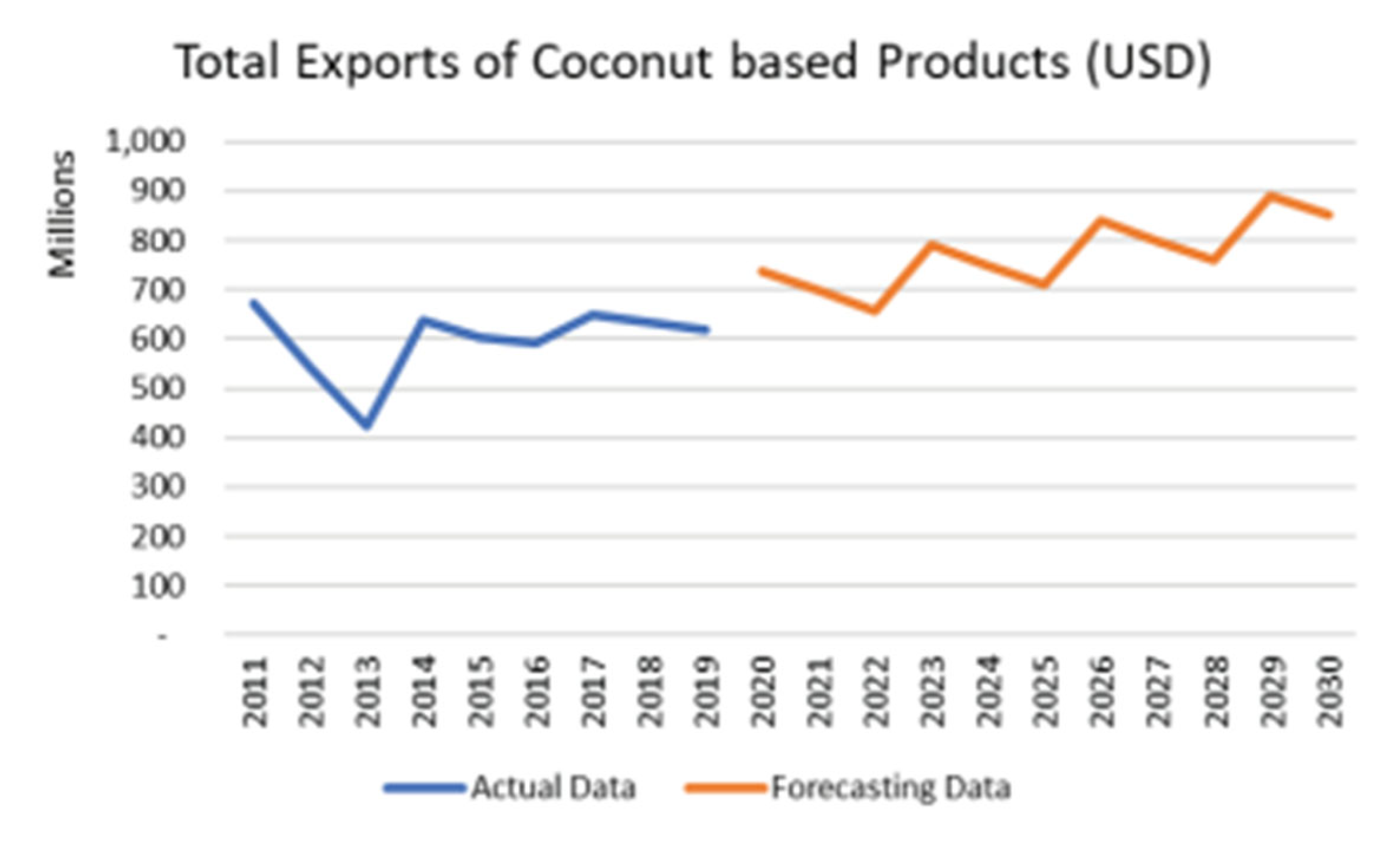
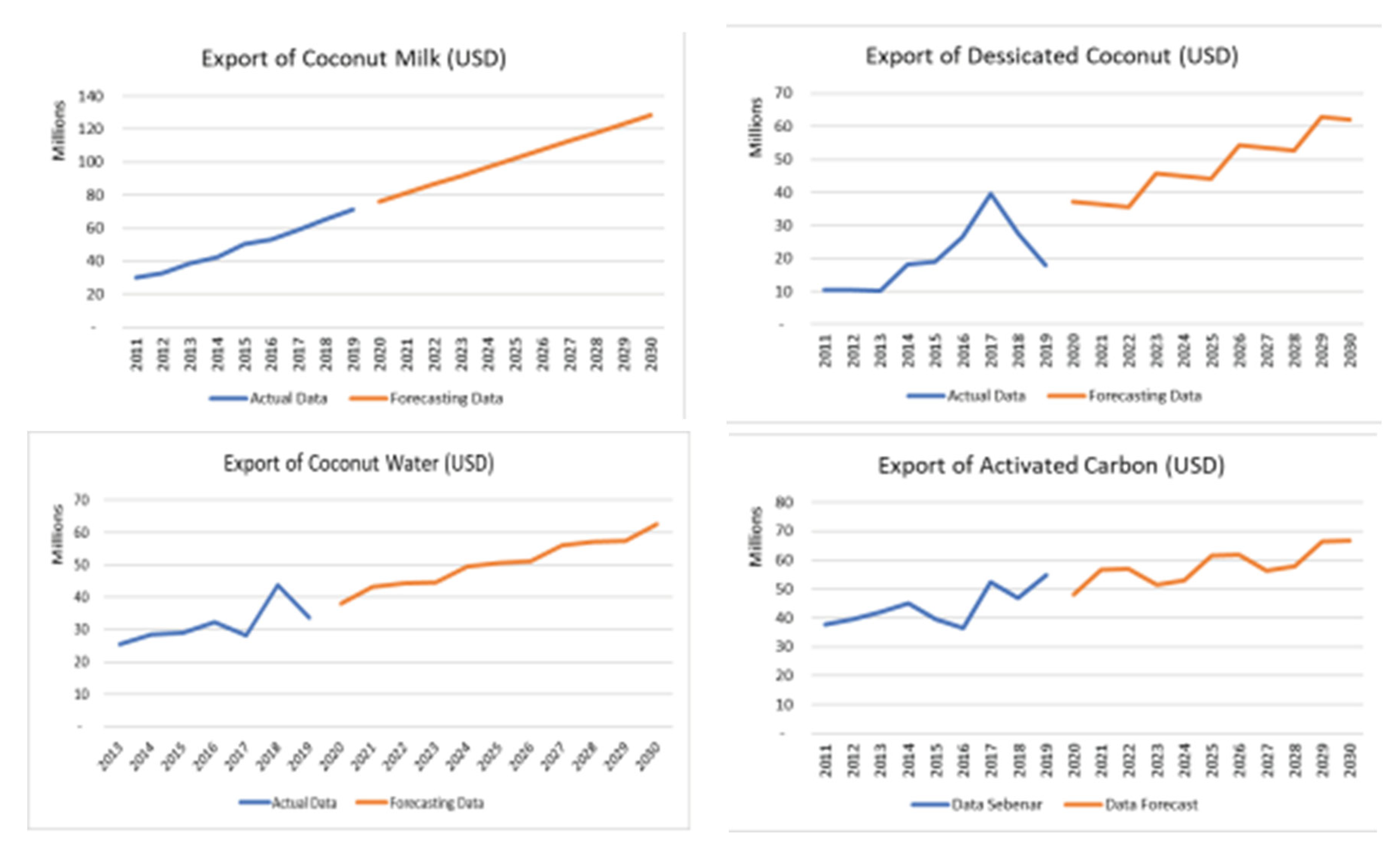


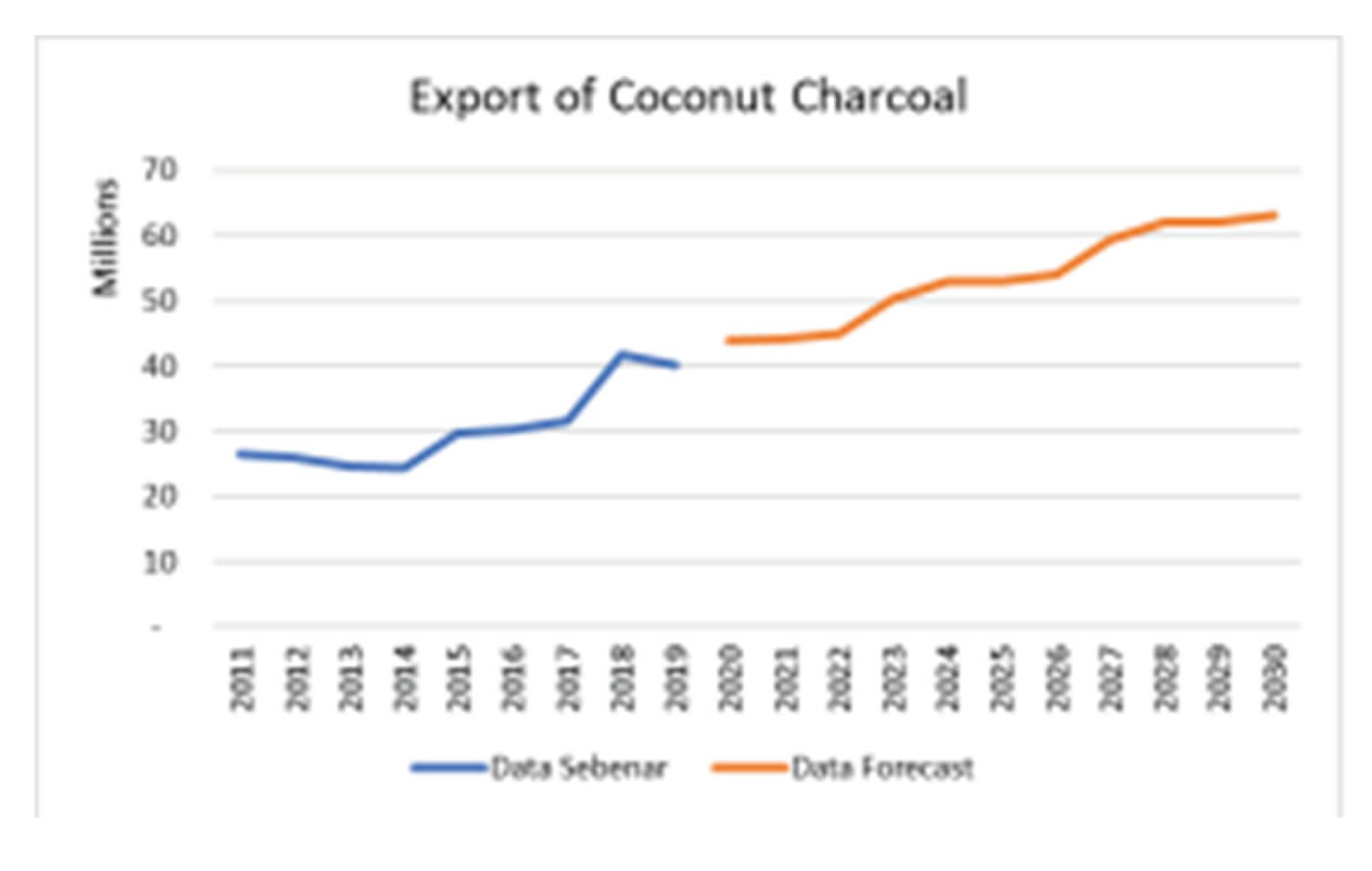
| Coconut Based Products | Value (RM Million) |
|---|---|
| Coconut oil | 3395.81 |
| Coconut milk | 655.12 |
| Activated carbon | 609.63 |
| Coconut charcoal | 503.11 |
| Processed coconut water | 234.69 |
| Desiccated coconut | 173.75 |
| Coconut fibre | 77.46 |
| Fresh coconut | 49.16 |
| Total | 5698.75 |
| Products | Top Five Countries Malaysian Market Channel | Total of Export (RM) | ||||
|---|---|---|---|---|---|---|
| 1 | 2 | 3 | 4 | 5 | ||
| Coconut oil | USA | Italy | Netherlands | China | Turkey | 798 |
| Coconut milk | Singapore | China | Hong Kong | UAE | Indonesia | 151.2 |
| Desiccated coconut | Singapore | Pakistan | Turkey | United Kingdom | Bangladesh | 40.74 |
| Processed coconut water | China | USA | Singapore | Australia | Hong Kong | 55.02 |
| Activated carbon | Japan | China | Other Asian Countries | Italy | USA | 142.8 |
| Coconut charcoal | Japan | China | Turkey | South Korea | Saudi Arabia | 118.44 |
| Product | Indonesia | Malaysia | Philippines | Thailand | Vietnam |
|---|---|---|---|---|---|
| Coconut Oil | |||||
| 2015 | 2.4 | 2.8 | 0.4 | −2.7 | −1.6 |
| 2016 | 2.6 | 3.0 | 3.0 | −2.7 | 0.4 |
| 2017 | 1.6 | 2.1 | 1.2 | −3.0 | −1.1 |
| 2018 | 2.1 | 2.3 | 2.4 | −3.3 | −1.1 |
| 2019 | 1.6 | 1.8 | −4.4 | −2.7 | −4.9 |
| Coconut milk | |||||
| 2015 | −6.6 | −1.1 | −6.0 | −3.4 | −3.1 |
| 2016 | −7.1 | −1.7 | −4.2 | −3.9 | −2.2 |
| 2017 | −7.7 | −1.3 | −3.5 | −4.3 | −3.7 |
| 2018 | −6.6 | −0.5 | −3.0 | −4.0 | −1.6 |
| 2019 | −3.0 | 2.3 | −1.0 | −0.8 | 1.5 |
| Desiccated coconut | |||||
| 2015 | −0.13 | −0.49 | 0.83 | −5.57 | −1.02 |
| 2016 | 0.32 | −0.20 | −1.85 | −5.88 | −1.26 |
| 2017 | 1.24 | 0.23 | −3.84 | −9.69 | −0.70 |
| 2018 | 0.39 | −0.52 | −1.92 | −6.20 | −1.35 |
| 2019 | −0.04 | −0.92 | −0.85 | −5.74 | −1.87 |
| Product | Indonesia | Malaysia | Philippines | Thailand | Vietnam |
|---|---|---|---|---|---|
| Processed coconut water | |||||
| 2015 | −7.52 | −0.95 | NA | −1.04 | −3.01 |
| 2016 | −5.62 | −1.57 | NA | −0.30 | −1.72 |
| 2017 | −6.97 | −0.39 | −4.17 | −0.50 | −0.40 |
| 2018 | −5.17 | 0.65 | −4.76 | −0.46 | −0.62 |
| 2019 | −12.94 | −0.05 | −0.85 | −0.44 | 0.63 |
| Product | Indonesia | Malaysia | Philippines | Thailand | Vietnam |
|---|---|---|---|---|---|
| Coconut activated carbon | |||||
| 2015 | −2.39 | −1.59 | −1.74 | −2.51 | −1.76 |
| 2016 | −2.13 | −1.57 | −1.39 | −2.36 | −1.81 |
| 2017 | −1.70 | −1.11 | −1.33 | −1.42 | −1.80 |
| 2018 | −1.76 | −0.87 | −1.39 | −1.84 | −1.62 |
| 2019 | NA | NA | NA | NA | NA |
| Coconut shell charcoal | |||||
| 2015 | 2.98 | 2.69 | NA | 2.14 | 2.29 |
| 2016 | 2.91 | 2.85 | NA | 2.60 | 2.72 |
| 2017 | 0.99 | 0.97 | −0.16 | 0.48 | 0.89 |
| 2018 | 1.04 | 1.02 | 0.29 | 0.57 | 1.00 |
| 2019 | 1.96 | 1.84 | 1.45 | 1.43 | 1.86 |
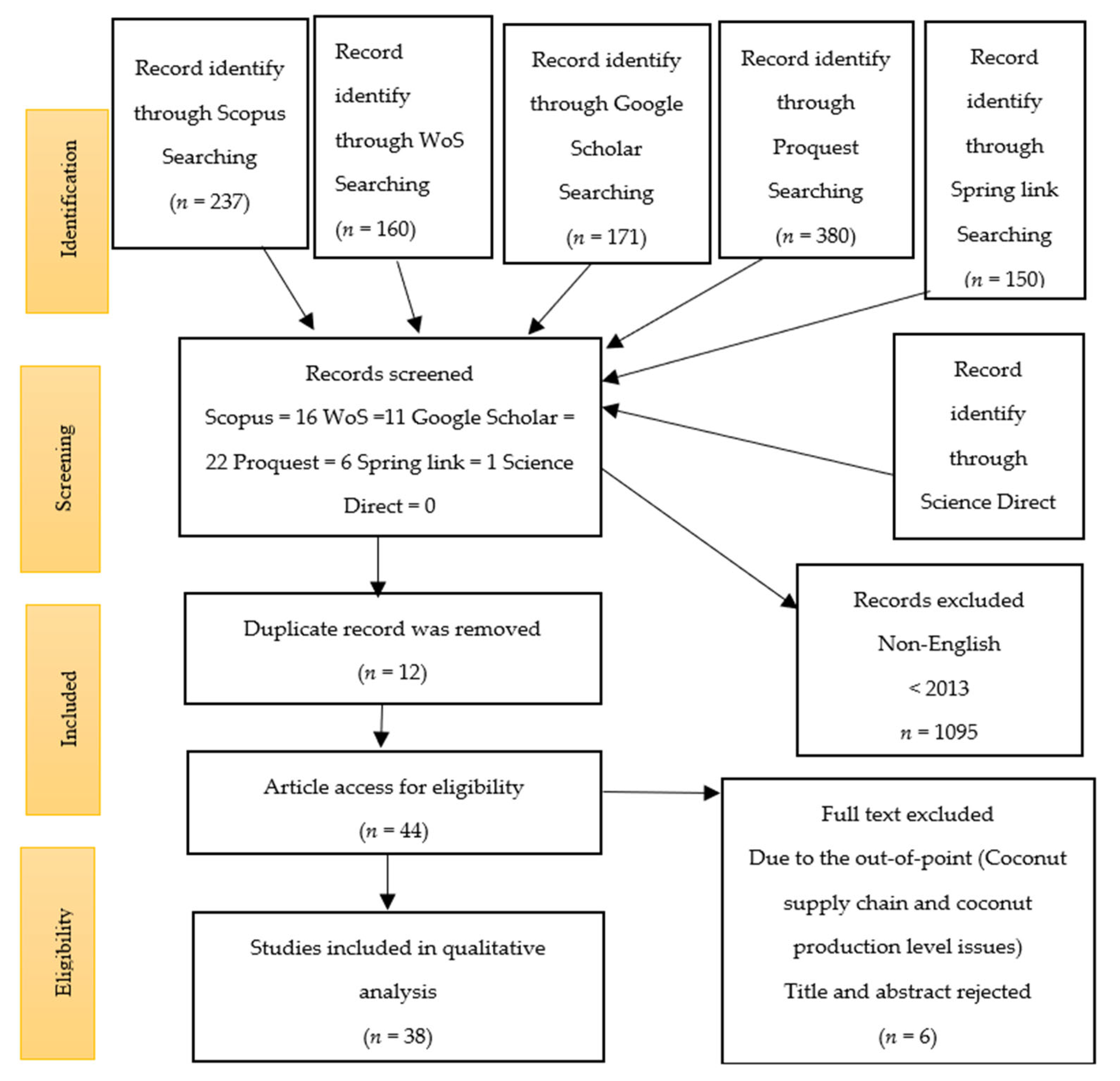
| Criterion | Inclusion | Exclusion |
|---|---|---|
| Language | English | Non-English |
| Timeline | 2013–2022 | <2013 |
| Literature type | Journal (book chapter, conference proceeding) | |
| Document Type | Article Review, Conference Paper Book Chapter, Book | |
| Subject Area | Agribusiness and Agricultural Science | Besides Agribusiness and Agricultural Sciences |
| Themes | Features | Count |
|---|---|---|
| Theme 1 | Drop in seasonal rainfall and the extreme summer air temperature | 4 |
| Theme 2 | Area effect and yield effect | 2 |
| Theme 3 | Indonesia’s sustainable coconut supply chain encounters problems | 1 |
| Theme 4 | Coconut production is declining with increasing magnitude. | 3 |
| Theme 5 | Rainfall, soil, and the interaction of these elements with slope are additional land constraints. | 2 |
| Theme 6 | The trade in coconut products declines as a result of voice and accountability scores. | 1 |
| Theme 7 | Farmers are imprisoned in an agricultural system that is impacted by a lengthy history of colonial institutions and social structures due to unequal access to education and training in rural systems. | 1 |
| Theme 8 | poor agronomic practices, pests and diseases, inferior varieties, Senility, and land conversion were among the technological, political, and socioeconomic factors that contributed to the low coconut production. | 4 |
| Theme 9 | Long juvenile phase, long economically productive life span (typically exceeding 50 years), variation in genetic potential among cultivars, and levels of germplasm diversity are a few of the main inherent factors, whereas environmental factors, such as biotic and abiotic stresses, pose the main challenges for the sustainability of coconut cultivation. | 1 |
| Theme 10 | Different elements such as land, labor, fungicides, experience, education, and extension visits affected the coconut output. | 1 |
| Theme 11 | The long distance between the farm and the market road, intercropping, the high cost of labor, and the low and unstable pricing of coconut products were internal issues with coconut production that contributed to the apparent issues. | 4 |
| Theme 12 | Coconut productivity fell as a result of increased pesticide use and poor water quality from domestic waste. | 1 |
| Theme 13 | The wide areas of midland laterites and Onattukara sandy plain with strong acid reaction and aluminium in soil solution significantly inhibit coconut growth. | 1 |
| Theme 14 | Analysis reveals that in Guyana and Jamaica, the productivity of coconuts is influenced by the type of personnel, whether temporary or permanent, and the presence of an irrigation system. | 1 |
| Theme 15 | There aren’t enough coordinated efforts being made to take advantage of the potential synergies between robust research infrastructure and technology delivery networks for boosting production and marketing efficiencies. | 1 |
| Theme 16 | The challenges that included low yield due to inadequate of farming practices and lack of strong political assistance. | 1 |
| Theme 17 | The small size of land holdings, Labour shortage and high labor charges, Combined with poor management practises, a high plant density of around 200 plants per hectare, and severe infestation of diseases and pests are all the problems leading to low levels of coconut production. | 1 |
| Theme 18 | It gradually loses ground because of the low price. Additionally, because of its declining production and average age, coconut palms are less productive. | 1 |
| Theme 19 | Natural resources in coconut gardens are being depleted, and there are issues with the soil, inadequate irrigation systems, a lack of good-quality planting materials, a manpower shortage, and excessive wages. Coconut farming in the state is negatively impacted by crop loss due to the occurrence of different pests and diseases, particularly significant loss due to root (wilt) disease, low degree of product diversification, etc. | 1 |
| 20 | Coconut growers are poorly organised and state support is strongly linked to nationally financed projects and programmes, thus restrictions still apply. | 1 |
| 21 | Power outages, frequent pest and disease attacks, monsoon failure, high fertiliser and boosting chemical costs, lack of quality fertiliser and boosting chemicals availability, groundwater level depletion, and lack of quality seedling availability are all factors that contribute to problems with cultivation and maintenance. | 1 |
| 22 | High rates of pests and diseases, poor agronomic practises, low-quality planting materials, and a limited genetic foundation are some of the difficulties. | 1 |
| 23 | In West Bengal, impending climate change is causing cyclones, rainfall deficits, invading pests, and more. Coconut palms are also suffering extensive damage as a result of whitefly invasion. The plantations are also becoming unhealthy due to stem bleeding, bud rot disease, and insects like the rhinoceros beetle, red palm weevil, and eriophyid mite. | 2 |
| 24 | Lack of government backing, a lack of human resources, and a lack of facilities and infrastructure to support the coconut market activities are the issues. | 2 |
| S/N | Authors | Title | Aim (s) | Country Setting | Key Findings | Year |
|---|---|---|---|---|---|---|
| 1 | Ganeshkumar B and Gopala Krishna GVT [42] | Spatial assessment of climate variability effects on coconut crops in Tamil Nadu State—A case study | The spatial assessment of climate variability effects on coconut crop felt in Dindigul and Attur Taluks of Dindigul District, Tamil Nadu State, through applying geospatial technologies. | India | The irregularities caused by the ongoing drop in seasonal rainfall and the extreme summer air temperature conditions may have contributed to the inter-annual discrepancy in coconut yield between 2010 and 2014. | 2022 |
| 2 | Narmadha, N., Karunakaran, K. R., Anjugam, M., Palanisamy, N. V., & Vasanthi, R. [47] | An Economic Analysis on Indian Scenario of Coconut Production: Trends and Prospects | To examine the coconut sector’s growth performance and instability in the Indian context. | India | The area effect and yield effect are key factors in the overall change in coconut output among the chosen states, according to decomposition analysis. | 2022 |
| 3 | Gunawan, I., Trihastuti, D., and Mulyana, I.J [12] | “Sustainability Issues of the Coconut Supply Chain in Indonesia” | To investigate and build the information necessary to identify and describe the issue of the long-term viability of the Indonesian coconut supply chain. | Indonesia | The outcome demonstrates that there are disruptions in the sustainability of Indonesia’s coconut supply chain, necessitating the development of an immediate, long-term strategy for restoration. | 2021 |
| 4 | Masinading, G. M., & Capili, A. F. [13] | Intervention Analysis of the Coconut Production In Davao Oriental | conducted with the goal of determining how Typhoon Pablo affected Davao Oriental’s coconut production, a province that produces coconuts in the Philippines. | Philippines. | The intervention model that was fitted shows that coconut production is declining with increasing magnitude. Permanently reduced output of 120,524 tons is anticipated to begin in the second quarter of 2013 as a result of the effect. | 2021 |
| 5 | Salvacion Arnold R. [48] | Mapping land limitations for agricultural land use planning using fuzzy logic approach: a case study for Marinduque Island, Philippines | The study used publicly accessible data for the province of Marindu-que, the Philippines, to illustrate the usage of fuzzy logic technique in mapping land restrictions for agricultural land use planning. | Philippines | For the cultivation of coconuts and bananas, slope is a limitation in around 80% and 18% of the province’s agricultural land, respectively. Rainfall, soil, and the interaction of these elements with slope are additional land constraints for coconut cultivation in the province. | 2021 |
| 6 | “Moreno, M. L., Kuwornu, J. K., & Szabo, S” [24] | “Overview and Constraints of the Coconut Supply Chain in the Philippines” | “Study provides an overview of the coconut supply chain in the Philippines” | Philippines | One of the main issues with the export of coconut products is the diminishing production volume, which made it impossible to satisfy global market demand. | 2020 |
| 7 | “Lin, J., Flachsbarth, I., & von Cramon-Taubadel, S.” [69] | “The role of institutional quality on the performance in the export of coconut products” | To investigate institutional quality and its effects on bilateral coconut commerce based on three indicators from the World Bank’s world governance indicators. | Germany | According to our research, whereas higher voice and accountability scores encourage the trade of high-value goods, they deter it for coconut products with both low and high levels of value addition. | 2020 |
| 8 | Davila Federico [50] | Human ecology and food discourses in a smallholder agricultural system in Leyte, the Philippines | This study looks at how market food security and food sovereignty principles are reflected in the agricultural practices of smallholder farmers. | Philippines | Farmers are entrapped in an agricultural system that has been formed by a long history of colonial institutions and social structures because of continuous support for coconut cultivation and unequal accessibility to education and expertise in rural areas. | 2020 |
| 9 | Alouw J. C and Wulandari S. [52] | Present status and outlook of coconut development in Indonesia | An overview of the current state of coconut development in Indonesia, recent technological developments for coconut enhancement, and the prospects for coconut development until 2045 are provided in this paper. | Indonesia | Among the technological, political, and socioeconomic factors that contributed to the low cocoa-nut production were pests and diseases, inferior varieties, senility, land conversion, and poor agro-nomic practices. On the other hand, an unfavorable supply chain, a small selection of goods, poor product quality, and a monoculture-planting system may have an effect on farmers’ financial well-being. | 2020 |
| 10 | Perera S. A. C. N [54] | Genetic Improvement for Sustainability of Coconut Production: The Sri Lankan Experience | To research the influences on the coconut industry’s sustainability and the productivity of the coconut palm, both internal and external. | Sri Lanka | The primary inherent factors for the sustainability of coconut farming are the relatively long juvenile phase, the long economic productive life span (typically exceeding 50 years), the varying genetic potential of different cultivars, and the levels of germplasm diversity, while environmental factors, such as biotic and abiotic stresses, represent the main challenges. | 2020 |
| 11 | Omara Z. and Fatah A. F. [55] | Unravelling the factors affecting agriculture profitability enterprise: Evidence from coconut smallholder production | To research the concerns surrounding the district of Batu Pahat in Johor’s socioeconomic state, profitability, and coconut production | Malaysia | The findings show that a variety of factors, including land, labor, fungicides, experience, extension visits, and education had an impact on the coconut output. | 2020 |
| 12 | Gurbuz I. B. and Manaros M. [53] | Impact of Coconut Production on the Environment and the Problems Faced By Coconut Producers In Lanao Del Norte Province, Philippines | To ascertain the environmental effects of coconut cultivation, the challenges that producers confront both internally and externally, the variables affecting yield, and the methods that producers use to increase yield. | Philippines | The study found that intercropping, labor costs that were high relative to other industries, low and unstable prices for coconut products, and the extreme distance of the land from the farm to the market road were the major issues that the coconut producers faced. In addition, significant issues with pests and illnesses, challenges with nut collection, high transportation costs in marketing, and government taxes for the obvious problem were noted. | 2019 |
| 13 | Nair, K. M., Abdul Haris, A., Mathew, J., Srinivasan, V., Dinesh, R., Hamza, H., … & Singh, S. K. [57] | Coconut-growing soils of Kerala: 2. Assessment of fertility and soil related constraints to coconut production | Assessment of fertility and soil-related constraints to coconut production | India | Coconut is severely restricted by the vast regions of midland laterites and Onattukara sandy plain with strong acid reaction and aluminum in soil solution. Additionally, the acid soils are deficient in boron, copper, zinc, calcium, magnesium, and potassium. | 2018 |
| 14 | Pathmeswaran, C., Lokupitiya, E., Waidyarathne, K. P., & Lokupitiya, R. S. [43] | Effects of harsh weather on Sri Lanka’s three climate zones’ coconut production | To determine how harsh weather conditions affect coconut productivity. | Sri Lanka | In the dry zone, productivity was positively impacted by the mean rainfall and negatively impacted by the number of high Tmax and high rainfall days throughout the study period. | 2018 |
| 15 | Rethinam, P. [15] | International scenario of coconut sector. | To give a breakdown of how much coconut oil, copra meal/copra cake, fresh coconut, desiccated coconut, coconut milk, cream, milk powder, coconut shell charcoal, activated carbon, coir, and coir products are consumed domestically as well as internationally. | India | There will be a rise in demand for coconuts because there is already a shortage in many nations, including Thailand, Malaysia, and Indonesia. | 2018 |
| 16 | Sivakumar, K., & Parvez Ahmed, M. P. [56] | Water pollution’s effects on coconut farming in Tamil Nadu’s Vellore District | To assess how pollution of water in Tamil Nadu’s Vellore District affects coconut output | India | Since the productivity of coconuts decreased as a result of the poor quality of water from domestic waste and increased chemical use, the rate of coconut production is flexible. | 2016 |
| 17 | Arifin, Z. A. [68] | The Analysis of Coconut Market Value Chain. | To investigate the management of the coconut market value chain in Indragiri Hilir, Riau Province, in order to improve agricultural economic growth. | Indonesia | Lack of government assistance, a lack of human resources, and a lack of adequate infrastructure and facilities to support market activity for cocoa nuts are the issues. | 2022 |
| 18 | Kumar, M. S., Chandrakumar, M., Deepa, N., & Selvi, R. P. [70] | A study of marketing constraints among coconut farmers in Palakkad district | To pinpoint the issues that farmers have with marketing and production and to offer advice on how to get around obstacles. | India | The study also came to the conclusion that the farmer experienced significant marketing challenges due to market price volatility. | 2022 |
| 19 | Nenci, S., Pietrobelli, C., De Angelis, M., & Manson, H. [58] | Coconut productivity in the Caribbean: Relational value chains in traditional farming. | To use the fresh data from two original farm-level surveys in Guyana and Jamaica to enhance our knowledge of coconut production in the Caribbean. | Guyana and Jamaica. | Analysis reveals that in Guyana and Jamaica, the productivity of coconuts is influenced by the type of personnel, whether temporary or permanent, and the presence of an irrigation system. | 2023 |
| 20 | Arumugam, T., & Hatta, M. A. M. [71] | Improving Coconut Using Modern Breeding Technologies: Challenges and Opportunities. | To improve the limitations of present breeding techniques and the promise of biotechnological technologies including genomic-assisted breeding, next-generation sequencing (NGS)-based genotyping, and genome editing tools. | Malaysia | Stagnant production, poor planting supplies, the effects of climate change, pests, and diseases are a few of the major problems that the global coconut industry needs to address immediately. | 2022 |
| 21 | Kappil, S. R., Aneja, R., & Rani, P. [46] | Decomposing the performance metrics of coconut cultivation in the South Indian States. | This study looks at the production and yield of coconuts in the key coconut-producing states of India from 2000–2001 to 2017–2018, as well as the growth trends in the region. | India | It demonstrates that the yield impact and pricing effect are significant factors in the overall change in coconut production among the chosen states. | 2021 |
| 22 | Manaros, M., & Gurbuz, I. B. [72] | Assessment of Labor Issues Faced by the Coconut producer in Lanao del Norte Province. | To assess the labor issues encountered by coconut producers | Philippines | According to the survey, the main challenge faced by coconut growers in the province is the high cost of labour. | 2020 |
| 23 | Jayawardhana, M. B. S. M. T., & Warnakulasooriya, B. N. F [73] | Impact of Problems associated with Supply Chain Management Practices of Wholesalers on their Business Performance in the Coconut Industry in Sri Lanka with special reference to Kurunegala District. | To examine the impact of problems associated with SCM practices of coconut wholesalers on their business performance with special reference to Kurunegala district, Sri Lanka. | Sri Lanka | Farmers’ poor agricultural practices, a lack of government assistance, and the negative effects of urbanization. | 2020 |
| 24 | Biswas, S. [67] | Coconut cultivation in West Bengal: Challenges and extension approaches to step up production. | To investigate the difficulties and additional production-enhancing strategies. | India | In West Bengal, impending climate change is causing cyclones, a lack of rainfall, invasive pests, and cyclones. The whitefly infestation is also widely destroying coconut palms. The plantations are also becoming unhealthy due to stem bleeding, bud rot disease, and insects like the rhinoceros beetle, red palm weevil, and eriophyid mite. | 2020 |
| 25 | Kalidas, K., Mahendran, K., & Akila, K. [32] | Constraints in Coconut Value Chain-A Framework for Analysis Using Response Priority Index. | To determine the importance and priority of the limitations using the responses priority index. | India | It was clear that the main issues facing the various stakeholders in coconut production and marketing were yield reduction caused by pest and disease and large price fluctuations. | 2020 |
| 26 | Mathuthra, O., & Arumugaswamy, P. [74] | The Study of Problems Faced by Coconut Growers in Coimbatore District During Covid-19 Pandemic. | To rank the problems of coconut growers and identify problems experienced during the COVID-19 pandemic in the Coimbatore district. | India | Lack of quality saplings, finance, high cost, and labor problem was the major problems faced by the coconut growers during the pandemic period. | 2020 |
| 27 | Jayasekhar, S., Chandran, K. P., Thamban, C., & Muralidharan, K. [59] | Coconut sector in India experiencing a new regime of trade and policy environment: A critical analysis. | To address the pertinent issues on various facets of coconut economy by employing appropriate economic tools of analysis. | India | Concerted efforts are lacking to effectively utilize the possible linkages between strong research support and technology delivery systems for increasing production and marketing efficiencies | 2019 |
| 28 | Datang, H., Lomanog, J., & Balaria, F. [60] | Coconut Farming Industry in Dingalan, Aurora: Practices and Challenges. | The study attempted to describe the status of coconut farming industry practices and challenges in Dingalan, Aurora. | Philippines | The challenges that included low yield due to inadequate of farming practices and lack of strong political assistance. | 2019 |
| 29 | Bhalerao, P. P., Patel, B. N., Maheswarappa, H. P., & Jilu, V. S. [61] | Status, problems and prospects of coconut cultivation in Gujarat | To investigate the status, problem and prospects of coconut cultivation in Gujarat | India | The small size of land holdings, Labour shortage and high labor charges, a high plant density of around 200 plants per hectare combined with poor management practises, and severe infestation of diseases and pests are all the problems leading to low levels of coconut production. | 2018 |
| 30 | Abhinav, M. C., Lazarus, T. P., Priyanga, V., & Kshama, A. V. [44] | Impact of rainfall on the coconut productivity in Kozhikode and Malappuram Districts of Kerala. | To identify the variation in coconut production due to rainfall based on data collected over a certain time period. | India | The Keralan districts of Kozhikode and Malappuram have experienced a decline in cultivation of coconuts as a result of changes in the pattern of rainfall. | 2018 |
| 31 | Pole, F N; Karemesi, M; Sowa, W; Maingu, R; Ochieng, D; Wanjiku, J; Gathogo, M; Chagala-Odera, E. [45] | Effect of water conservation method on the yield of coconuts | To address how climate change is affecting coconut production | Kenya | The inconsistent rainfall that coastal Kenya experiences has led to low productivity and the loss of many coconut palms. | 2018 |
| 32 | Yamuna, S. M. [62] | A study of coconut cultivation and marketing in Pollachi Taluk | To address the opportunities and difficulties presented by the global markets under the liberalised trade system | India | It gradually loses ground because of the low price. Additionally, because of the coconut palm’s declining output due to its typical ageing. | 2016 |
| 33 | Thamban, C., Jayasekhar, S., Chandran, K. P., & Jaganathan, D. [63] | Coconut Production in Kerala: Trend, Challenges and Opportunities. | To examine the trend, challenges and Opportunities of coconut | India | Natural resources in coconut gardens are being depleted, and there are issues with the soil, insufficient irrigation systems, a lack of good-quality planting materials, a manpower shortage, and exorbitant wages. Crop loss brought on by the occurrence of numerous pests and diseases, particularly a significant loss from the root (wilt) disease and a lack of product diversification, etc. negatively impacts the state’s coconut farming. | 2016 |
| 34 | Sportel, T.,& Véron, R. [64] | Coconut crisis in Kerala? Mainstream narrative and alternative perspectives | This article describes the crisis narrative based on a literature review of academic and official reports and challenges its problem analysis by juxtaposing it with information from ethnographic research with local farmers and traders. | India | There are still barriers: coconut growers are poorly organised, and state support is heavily dependent on federally financed plans and initiatives. | 2016 |
| 35 | Andal, C. K. [49] | Marketing Problems of Coconut Cultivators with Special Reference to Coimbatore District | To identify the problems of coconut cultivation and marketing and to evolve remedial measures to those problems | India | Fluctuation in the price of the coconut, shortage rainfall, No subsidy from the government, shortage of Skilled labour, more labour cost, lack of knowledge about diseases and pesticides, inadequate storage facilities, delays in collecting payments from merchants, and transportation costs are all problems faced by the farmers. | 2016 |
| 36 | Premkumar, T. E. [65] | A Study on Problems and Prospects of Coconut Growers in Pollachi Taluk, India | To know the demographic profile, performance, and problems in the areas of cultivation, maintenance, and marketing of coconut and also to elicit the prospects. | India | Power outages, frequent pest and disease attacks, monsoon failure, high fertiliser and boosting chemical costs, lack of availability of high-quality fertiliser and boosting chemicals, decline in ground water level, and scarcity of high-quality seedlings are all factors that contribute to problems with cultivation and maintenance. | 2016 |
| 37 | Pole, F. N., Nguma, B., & Mohammed, N. [66] | Status of coconut farming and the associated challenges in Kenya. | To be aware of the state of coconut cultivation and the difficulties it faces in Kenya | Kenya | Problems include widespread infestations of pests and diseases, subpar agronomic methods, insufficient planting supplies, and a limited genetic pool. | 2014 |
| 38 | Muyengi ZE, Msuya E, Lazaro E. [51] | Assessment of factors affecting coconut production in Tanzania | To assess the production of coconuts and factors affecting the production of coconut | Tanzania | Coconut output was hampered by poor agronomic methods, a lack of inputs, and a lack of extension services, among other factors. | 2015 |
Disclaimer/Publisher’s Note: The statements, opinions and data contained in all publications are solely those of the individual author(s) and contributor(s) and not of MDPI and/or the editor(s). MDPI and/or the editor(s) disclaim responsibility for any injury to people or property resulting from any ideas, methods, instructions or products referred to in the content. |
© 2023 by the authors. Licensee MDPI, Basel, Switzerland. This article is an open access article distributed under the terms and conditions of the Creative Commons Attribution (CC BY) license (https://creativecommons.org/licenses/by/4.0/).
Share and Cite
Zainol, F.A.; Arumugam, N.; Daud, W.N.W.; Suhaimi, N.A.M.; Ishola, B.D.; Ishak, A.Z.; Afthanorhan, A. Coconut Value Chain Analysis: A Systematic Review. Agriculture 2023, 13, 1379. https://doi.org/10.3390/agriculture13071379
Zainol FA, Arumugam N, Daud WNW, Suhaimi NAM, Ishola BD, Ishak AZ, Afthanorhan A. Coconut Value Chain Analysis: A Systematic Review. Agriculture. 2023; 13(7):1379. https://doi.org/10.3390/agriculture13071379
Chicago/Turabian StyleZainol, Fakhrul Anwar, Nalini Arumugam, Wan Norhayate Wan Daud, Nurul Aisyah Mohd Suhaimi, Balogun Daud Ishola, Aida Zairina Ishak, and Asyraf Afthanorhan. 2023. "Coconut Value Chain Analysis: A Systematic Review" Agriculture 13, no. 7: 1379. https://doi.org/10.3390/agriculture13071379
APA StyleZainol, F. A., Arumugam, N., Daud, W. N. W., Suhaimi, N. A. M., Ishola, B. D., Ishak, A. Z., & Afthanorhan, A. (2023). Coconut Value Chain Analysis: A Systematic Review. Agriculture, 13(7), 1379. https://doi.org/10.3390/agriculture13071379