


Abstract
This study aims to evaluate the flowering phenology of selected 95 Elepidote Rhododendron taxa. The flowering period was assessed, distinguishing ten developmental stages. Flowering was observed every three days. The comparative scale prepared indicates the exact succession of bloom of taxa. Flowering of 95 taxa lasted from the end of April to the second half of June. The flowering period of individual cultivars ranged from 2 to 9 weeks. The flowering time of cultivars belonging to the same species was mostly similar. The term of cultivars flowering was in the following tendency order: R. caucasicum–R. wardii–R. forestii–R. williamsianum–R. catawbiense–R. ponticum.
1. Introduction
Rhododendrons, members of the Ericaceae family, are popular garden shrubs. In Poland, between 1989 and 2000, the number of nurseries specialising in rhododendron production almost doubled. At the same time, there was a fivefold increase in the number of shrubs produced [1]. Ornamental plant nurseries are affiliated with the Polish Nurserymen Association. In 2020, 44 nurseries produced heath plants [2]. Nurseries buy young plants propagated in vitro and grow them until flowering. The value of sales of rhododendrons in Poland in 2000 was close to EUR 100 million [3]. Similarly, in Germany, Winkelmann et al. [4] reported an increase in the number of companies propagating rhododendrons in vitro. In 20 years, the number of laboratories there has almost tripled.
Assortment of Rhododendron cultivars is very rich. More than 4100 cultivated rhododendron cultivars are on the Deutsche Genbank Rhododendron checklist [5]. In turn, according to Hoffmann [6], this number exceeds 2000 cultivars per the List of Names of Woody Plants. Marosz [7] reported in 2007 that there were more than 25,000 registered worldwide cultivars.
The available literature does not take into account the vast number of commercially available cultivars. Most information on cultivars can be found in the Deutsche Genbank Rhododendron database and the RHS Rhododendron Checklist with all supplements, as well as Leach [8], Krusmann [9], Czekalski [10], Salle and Greer [11], Schmalscheidt [12,13,14], Cox [15], Hobbie et al. [16], Grzeszczak-Nowak and Muras [17]. Although many of these were published years ago, they are an essential source of information on rhododendron cultivation. The cultivars recommended by these authors are often no longer in production. Nurseries are promoting new taxa that they consider attractive. Unfortunately, it is often difficult to find information on the cultivars available. There are also no data on the exact time of flowering. Knowing the flowering time is vital to determine suitability for cultivation. This is particularly true of early cultivars whose flowers can be damaged by frost. It is also invaluable to know the succession of bloom of rhododendrons. Selecting cultivars in this manner can help develop a set of plants for green spaces. These sets could provide continuous flowering and long-lasting ornamental quality for at least two months.
This study aims to provide a preliminary evaluation of the flowering phenology of 95 common and lesser-known large-flowered rhododendron taxa, allowing cultivation and use to be determined.
2. Materials and Methods
The experiment was carried out from 21 April to 26 June 2020 on the premises of a private heather plant collection located in the southern district of Gdynia at a distance of approximately 1.5 km from the Baltic Sea coastal strip (USDA zone 7A).
The experiment determined the dynamics and flowering phenology of 95 large-flowered rhododendron taxa of the Elepidote group (Table 1). Elepidote is a term that refers to shrubs with leaves without glands on the underside. These usually include shrubs with large evergreen foliage and azaleas with seasonal foliage. The age of the plants studied ranged from 7 to 10 years. All the shrubs observed had reached the generative development stage at least two years earlier.

Table 1.
Cultivars of rhododendrons used in the experiment, their leading species, parentage and breeder.
Plants were grown in the ground, under canopy conditions of a Class 5 pine forest. The cultivation substrate was a mixture of acidic peat with a high pH of 4.5–5.5 and native soil (sand with clay subsoil and compost soil) at an estimated volume ratio of 3:1:2. The soil surface was mulched with composted pine bark.
No plants were watered, and no chemical protection treatments were applied during the experiment. Plants grew in conditions as close to natural as possible.
The different cultivars of shrubs were monitored for bud development. Subsequent stages were determined using a developed 10-degree comparative scale (Table 2). Stages 1–3 defined the development of the inflorescence bud. Stage 4 was established when the first flower in the inflorescence had developed. Stage 5 corresponded to the development of at least half of the flowers in the inflorescence. Full bloom (all flowers open) was designated as Stage 6. Stages 7, 8 and 9 described shedding blossom. Stage 7 determined the first wilted flowers, Stage 8 determined that all flowers wilted, and Stage 9 determined flower browning and dropping off. Reaching Stage 10 was indicative of the completely finished flowering of the shrub (no flower petals).
Table 2.
Flower development scale used in the work.
Damage caused by spring frost and heavy rain was also reported. Observations were made every three days. During the experiment, no patchy development of individual inflorescences was observed on the shrubs.
Based on Muras [18], this study used the Körung method. It relies on the cross-assessment of single, rare specimens against individual traits. This work studied flowering dynamics.
Figure 1 shows meteorological data from the Institute of Meteorology and Water Management from the Gdańsk-Rębiechowo station (10 km in a straight line from the collection site). The data include maximum temperature, minimum temperature, average temperature and amount of rainfall.
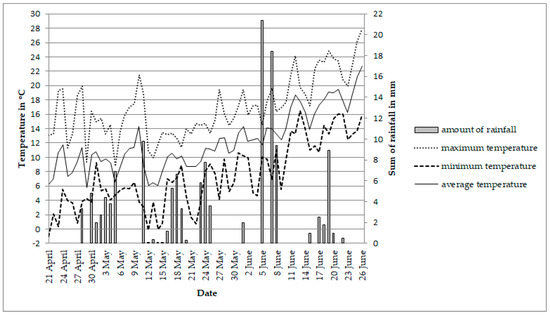
Figure 1.
Meteorological data obtained within the period of observation in 2020.
3. Results and Discussion
The 95 rhododendron taxa assessed differed in the timing of the appearance of the different flowering stages (Table 3). The beginning of inflorescence bud development of the first cultivars occurred in the 17th week of the year. Five—‘Andantino’, ‘Jacksonii’, ‘Cheer’, ‘Christmas Cheer’ and ‘George Sand’—reached their first stage of development on 21 April 2020. The latest started to develop in late May and early June. The difference between the start of flowering in the first variety, ‘Cheer’, and the wilting of the flowers in the last, ‘Rasputin’, was 45 days.
Table 3.
Flowering phenology of selected 95 Rhododendron taxa.
The experiment showed that the largest number of cultivars was in full bloom in the 23rd week of the year. In this week, 23% of all observed cultivars developed. However, the first cultivars were flowering as early as week 18 (7%) and the last cultivars at week 24 (6%). The shortest flowering was found in ‘Cheer’ and its sister variety ‘Christmas Cheer’. ‘Cunningham’s White’, on the other hand, retained the longest ornamentation. The long flowering period of this variety is in line with the data presented by Malciute et al. [19]. In the Lithuanian climate, flowering time was 26–29 days, while in our experiment, it was about three weeks. According to the cited authors, the cultivars ‘Goldkrone’ and ‘Bengal’ show short flowering (9–15 days). The flowering of the first variety under Polish conditions lasted less than two weeks, while ‘Bengal’ remained ornamental for about 20 days. Under both Polish and Lithuanian conditions, flowering lasting 16–25 days was found in ‘Blurettia’, ‘Gartendirektor Rieger’, ‘Hachmann’s Charmant’, ‘Helsinki University’, ‘Pohjola’s Daughter’ and ‘Rasputin’. However, according to our research, ‘Album Novum’, ‘Baden-Baden’ and ‘Percy Wiseman’ remained ornamental for a shorter period than reported by Malciute et al. [19]. Most of the shrubs observed presented a flowering time of approximately 1.5 weeks. As reported by Sauliene et al. [20], more than one-third of rhododendron shrub cultivars have two-week flowering, and almost 5% maintain their inflorescences for more than three weeks. The vast majority of shrubs (42%) flowered for two to three weeks. In their opinion, however, the intensity of flowering may depend on the degree of acclimatisation and proper nutrition of the particular specimen of the cultivars studied.
Muras [21] reported that the flowering of ‘Baden-Baden’ occurs from the beginning to the second half of May, while ‘Jacksonii’ flowered from the third week of April to the first week of May. These findings are confirmed by our research. Flowering of Rhododendron brachycarpum occurs from late May to mid-June, depending on the geographical source of the specimen. In our experiment, the flowering of ‘Helsinki University’, a relative of this species, occurred from mid-June onwards. ‘Pohjola’s Daughter’ was an earlier variety of R. brachycarpum, flowering from the 20th week of the year. Flowering of R. degronianum subsp. yakushimanum lasts from the beginning to almost the end of May. Similar results were found in almost all tested cultivars of this species in our experiment. The exception was ‘Edelweiβ’, which started flowering in early June. It should be noted that it also has exceptionally ornamental leaves. The upper side of the leaf blade is covered with silvery-white tomentum. The underside of the leaves has a brown lining. It is one of the best cultivars in terms of ornamental foliage. Under British conditions, it flowers from early to mid-May. Leaf blades with multicoloured features, modified structure or mossiness are also found in other cultivars examined, including ‘Andantino’, ‘Dominik’, ‘Golfer’, ‘Graziella’, ‘President Roosevelt’ and ‘Wine & Roses’. Growing them in the garden offers the possibility of a year-round ornamental effect.
Aleksandrova [22] listed five groups of cultivars depending on flowering time. She identified five categories of cultivars: very early, medium-early, early, late and very late. The proposed classification was used by Malciute et al. [19]. ‘Helsinki University’, ‘Blurettia’ and ‘Album Novum’ have been classified as early cultivars (flowering from day 145 to day 159 of the year), even though they are considered medium-late and late cultivars. Hobbie et al. [16] described ‘Album Novum’ as a late variety and ‘Blurettia’ as a late April/May flowering variety. ‘Hachmann’s Charmant’ and ‘Percy Wiseman’ start flowering in Poland in the second half of May. Malciute et al. [19] considered them to be late cultivars.
Caprar et al. [23], conducting observations of rhododendrons at the Jibou Botanical Garden in Romania, divided them into seven groups: from very early and early, through intermediate, early intermediate and late intermediate to late and very late. The variety ‘Scarlet Wonder’ was described as intermediate. The term is comparable to that found in our work.
By creating groups that take into account the earliness of flowering, a link to pedigree can be established. The earliest flowering cultivars in our experiment were developed with a distant contribution from R. caucasicum. The cultivars ‘Bengal’ and those derived from R. forrestii started flowering almost simultaneously in early May (18th/19th week). Yellow-flowered R. wardii hybrids also started to develop inflorescences in the first days of May (18th/19th week). The cultivar that deviated from this date was ‘Bellini’, which flowered in the second half of May (21st week). The R. williamsianum hybrid group was distinguished by flowering from week 20 onwards; the latest cultivar was ‘Osmar’, flowering at week 21. Most rhododendrons flowering from week 20 onwards included cultivars not assigned to any group. R. catawbiense hybrids: ‘Blutopia’, ‘Gomer Waterer’, ‘Humboldt’, ‘Alfred’, ‘Album Novum’ and ‘Mars’ showed flower development from weeks 22 and 23. The latest cultivars were purple-flowered hybrids developed from R. ponticum. The flowering of R. yakushimanum cultivars was very diverse and started from the 19th to 22nd week. Such exact information on flowering is not provided on the labels when the plants are purchased. The timing is often averaged out as late May and early June.
Blatsios [24] selected four groups of rhododendron shrubs grown from free pollination. Most of the shrubs (55%) flowered in mid-May. Very early flowering occurred in 43% of the shrubs, and early flowering in 23%. Late flowering was reported in 19%, and very late flowering in 1% of the hybrids produced.
Malciute et al. [19] found the Humboldt variety to be long flowering. However, under Polish cultivation conditions in the coastal zone in our study, its flowering lasted about 1.5 weeks. It is suggested that this may have been a result, among other things, of water deficiency in the soil during inflorescence development.
The effect of the amount of precipitation on inflorescence longevity was also observed during the experiment. Cultivars starting to flower in 22nd week and in 24th week had lower inflorescence longevity than those flowering during heavy rainfall.
Currently, growing new cultivars aims to extend the flowering period. Increasing attention is being paid to cultivars flowering from early June onwards, e.g., ‘Leo’ or ‘Albarello’ [25]. In recent years, cultivars showing partial flowering in autumn have also been developed: ‘Herbstfreude’, ‘Herbstzauber’ and ‘September Charm’ [26]. In addition, partial autumn flowering of the cultivars ‘Weinlese’ and ‘Karminkissen’ is also observed in the research garden. Repeat flowering in autumn is also characteristic of the two cultivars evaluated in the experiment, i.e., ‘Herbstgruβ’ and ‘September Red’. Partial repeat flowering also occurs in ‘Cunningham’s White’ and ‘Cheer’, sometimes lasting until the first frost. Malciute et al. [19] confirmed that ‘Cunningham’s White’ blooms twice a year. The same applies to ‘Pohjola’s Daughter’ and ‘Nova Zembla’. In the last one, the autumn flowering period was longer than in the spring one. Ciepłucha [27] described the partial autumn flowering of ‘Królowa Jadwiga’. In the online promotional material of this author’s nursery, there is also information about the autumn flowering of the ‘Lugano’ and ‘Bezdĕz’ cultivars.
In addition to the main flowering period of large-flowered rhododendrons, summer also sees the flowering of other heath shrubs, which can extend the ornamental appeal of the setting created. A less common group includes Japanese azalea hybrids developed using Rhododendron nakaharae. The cultivars ‘Juliette’, ‘Hachmann’s Evita’, ‘Michael Hill’ and ‘Late Love’ have red and pink flowers, developing from mid-June. Additionally, azalea shrubs with seasonal foliage developed using R. viscosum bloom in June and July. They also have highly fragrant flowers. The earliest hybrids are R. dauricum and R. carolinianum ‘Stacatto’, ‘April Gem’, ‘April Rose’, and five cultivars derived from the P.J.M. group [20]. Along with these, R. mucronulatum blooms eight days earlier than R. dauricum [28]. Therefore, when deciding which cultivars to choose, it is worth knowing the exact flowering time to achieve as long a flowering succession as possible.
Our work did not consider the flowering of the three most common cultivars, i.e., ‘Nova Zembla’, ‘Roseum Elegans’ and ‘Catawbiense Grandiflorum’. These cultivars are the most commonly available commercially. However, they were not included, due to their incorporation into the observations of cultivars that are less widespread or practically unknown and yet worth propagating. Due to the extensive area of this research topic, many other shrubs were not included: the most commonly offered evergreen rhododendrons, large-flowered azaleas, ‘Japanese’ azaleas and dwarf rhododendrons. However, this gap should not be seen as negative. The authors’ collection, which has been amassed and expanded annually with new taxa, provides the opportunity to continue research in the years to come. It will make it possible to better understand the flowering phenology of the various representatives of the genus Rhododendron.
Based on these observations, rhododendrons could be selected for gardens. For small gardens, we can recommended rhododendrons with white and pink flowers: ‘Cheer’, ‘Herbstgruss’, ‘Nicoletta’, ‘Butterfly’, ‘Danuta’, ‘Claudine’ and ‘Edelweiss’, or with red flowers: ‘Bengal’, ‘Halfdan Lem’, ‘September Red’ and ‘Taragona’. For small gardens, we can also recommend ‘George Sand’, ‘Scarlet Wonder’, ‘August Lamken’, ‘Osmar’, ‘Golden Torch’ and ‘Lugano’.
Author Contributions
Conceptualization, P.M.N. and A.K.-B.; methodology, P.M.N. and A.K.-B.; software, P.M.N. and A.K.-B.; validation, P.M.N. and A.K.-B.; formal analysis, P.M.N. and A.K.-B.; investigation, P.M.N. and A.K.-B.; resources, P.M.N. and A.K.-B.; data curation, P.M.N. and A.K.-B.; writing—original draft preparation, P.M.N. and A.K.-B.; writing—review and editing, A.K.-B.; visualization, P.M.N. and A.K.-B.; supervision, A.K.-B.; funding acquisition, A.K.-B. All authors have read and agreed to the published version of the manuscript.
Funding
The publication was co-financed within the framework of the Polish Ministry of Science and Higher Education’s program: “Regional Initiative Excelence” in the years 2019–2023 (No. 005/RID/2018/19), financing amount 12,200,000 PLN.
Institutional Review Board Statement
Not applicable.
Data Availability Statement
Not applicable.
Conflicts of Interest
The authors declare no conflict of interest.
References
- Marosz, A. Produkcja roślin wrzosowatych w Polsce w latach 1989–2000. Erica Pol. Rocz. Roślin Wrzosowatych 2002, 13, 25–30. [Google Scholar]
- Pilaszek, U.; Czupa, W.; Szczepaniak, M.; Wróblewski, K. Związek Szkółkarzy Polskich—Katalog Szkółek 2020; Agencja Promocji Zieleni: Warsaw, Poland, 2020; p. 198. [Google Scholar]
- Marosz, A. Sprzedaz rózaneczników i azalii pomiędzy krajami Unii Europejskiej w 2007 roku. Erica Pol. Rocz. Roślin Wrzosowatych 2010, 19, 63–69. [Google Scholar]
- Winkelmann, T.; Geiert, T.; Preil, W. Commercial in vitro plant production in Germany in 1985–2004. Plant Cell Tissue Organ Cult. 2006, 86, 319–327. [Google Scholar] [CrossRef]
- Bundessortenamt. Available online: https://www.bundessortenamt.de/bsa/pflanzengenetische-ressourcen/deutsche-genbank-zierpflanzen/deutsche-genbank-rhododendron (accessed on 20 September 2022).
- Hoffmann, M.H.A. List of Names of Woody Plants. International standard ENA 2016–2020, 9th ed.; Naktuinbouw: Roelofarendsveen, The Netherlands, 2016; p. 1080. [Google Scholar]
- Marosz, A. Wpływ retardantów na kwitnienie i wzrost różaneczników. Erica Pol. Rocz. Roślin Wrzosowatych 2007, 16, 25–34. [Google Scholar]
- Leach, D.G. Rhododendrons of the World and How to Grow Them; Charles Scribner’s Son: New York, NY, USA, 1961; p. 544. [Google Scholar]
- Krüssmann, G. Rhododendron und Andere Immergrüne Laubgehölze und Koniferen; Paul Parey Verlag: Hamburg-Berlin, Germany, 1968; p. 188. [Google Scholar]
- Czekalski, M. Różaneczniki, 2nd ed.; PWRiL: Warsaw, Poland, 1991; p. 138. [Google Scholar]
- Salley, H.E.; Greer, H.E. Rhododendron Hybrids, 2nd ed.; Batsford Publishing: London, UK, 1992; p. 391. [Google Scholar]
- Schmalscheidt, W. Rhododendron und Azaleenzüchtung in Deutschland; Selbstverlag: Westerstede, Germany, 1991; p. 336. [Google Scholar]
- Schmalscheidt, W. Rhododendron-und Azaleensorten im Sichtungsgarten der Lehr-und Versuchsanstalt für Gartenbau; Gartenbildverlag Heinz Hansmann: Rinteln, Germany, 1995; p. 240. [Google Scholar]
- Schmalscheidt, W. Rhododendron-Sorten im Sichtungsgarten der Lehr-und Versuchsanstalt für Gartenbau; Gartenbildverlag Heinz Hansmann: Rinteln, Germany, 1999; p. 258. [Google Scholar]
- Cox, K. Rhododendrons and Azaleas. A Colour Guide; The Crowood Press: Wiltshire, UK, 2018; p. 240. [Google Scholar]
- Hobbie, E.; Hobbie, V.; Hobbie, B.; Tonjes, H.; Schmalscheidt, W. Hobbie Rhododendron. Fachbuch und Katalog; Rautenberg Druck GmbH: Westerstede, Germny, 2014; p. 194. [Google Scholar]
- Grzeszczak-Nowak, H.; Muras, P. Różaneczniki i Azalie; Officina Botanica: Krakow, Poland, 2015; p. 372. [Google Scholar]
- Muras, P. XIII Seminaium grupy “Rośliny Wrzosowate”—Ammerald, maj 2009. Erica Pol. 2009, 19, 7–20. [Google Scholar]
- Malciute, A.; Naujalis, J.R.; Sauliene, I. The seasonal development characteristics of different taxa and cultivars of rhododendrons in Northern Lithuania. 2.Flowering peculiarities. Žemdirbystė 2011, 98, 81–92. [Google Scholar]
- Sauliene, I.; Malciute, A.; Naujalis, R. Estimation of Rhododendron flowering intensity in Botanical Garden of Siauliai University during 2003–2007. Acta Hortic. 2010, 885, 313–317. [Google Scholar] [CrossRef]
- Muras, P. Rozwój mniej rozpowszechnionych gatunków i odmian różaneczników w południowej Polsce I. Podejmowanie wzrostu i kwitnienie. Erica Pol. Rocz. Roślin Wrzosowatych 1996, 7, 45–51. [Google Scholar]
- Aleksandrova, M.S. Rododendron; Lesnaja promyšlenost: Moskow, Russia, 1989; pp. 29–38. [Google Scholar]
- Caprar, M.; Cantor, M.; Sicora, C. Some ideas for Rhododendron use in landscaping. ProEnvironment 2013, 6, 570–573. [Google Scholar]
- Blatsios, D. Zróżnicowanie Kolekcji Różaneczników (Rhododendron L.) pod Względem Wybranych cech Dekoracyjnych, Użytkowych, Polimorfizmu DNA. Ph.D. Thesis, University of Life Sciences, Wrocław, Poland, 2019. [Google Scholar]
- The Silva Tarouca Research Institute for Landscape and Ornamental Gardening. Available online: https://www.vukoz.cz/index.php/cultivars-summary/rhododendron (accessed on 3 June 2021).
- Schröder. Available online: https://www.schroeder-rhododendron.de/en/assortment (accessed on 19 August 2022).
- Ciepłucha, J. Katalog Ofertowy. Gospodarstwo Szkółkarskie Ciepłucha; Gospodarstwo Szkółkarskie Ciepłucha: Konstantynów Łódzki, Poland, 2019; p. 82. [Google Scholar]
- Duży, A. Rożaneczniki kwitnące w Polsce najwcześniej. Biul. Rośliny Wrzosowate 1993, 3, 54–56. [Google Scholar]
Disclaimer/Publisher’s Note: The statements, opinions and data contained in all publications are solely those of the individual author(s) and contributor(s) and not of MDPI and/or the editor(s). MDPI and/or the editor(s) disclaim responsibility for any injury to people or property resulting from any ideas, methods, instructions or products referred to in the content. |
© 2022 by the authors. Licensee MDPI, Basel, Switzerland. This article is an open access article distributed under the terms and conditions of the Creative Commons Attribution (CC BY) license (https://creativecommons.org/licenses/by/4.0/).