Excimer Laser Coronary Atherectomy: Current Evidence, Clinical Applications, and Future Directions
 , , , , , , , and
Abstract
1. Introduction
2. Mechanism of Action and Physical Principles
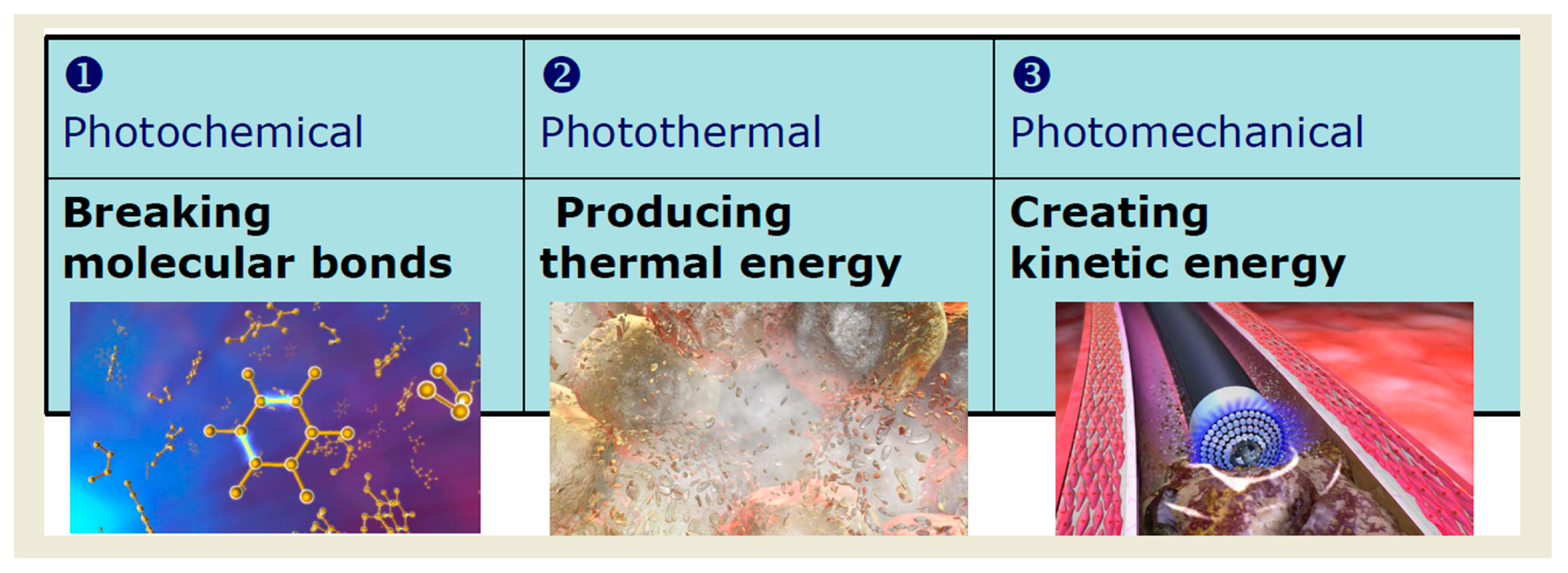
- Photochemical ablation: Ultraviolet photons are absorbed by atheromatous material, leading to rupture of carbon–carbon bonds and direct photodissociation of plaque components. Each laser pulse lasts approximately 120 ns, preventing significant heat transfer to surrounding tissue.
- Photothermal effect: Molecular bond rupture increases intracellular water temperature, resulting in cell disruption and vapor bubble formation. This effect occurs over a very short duration (approximately 100 µs), thereby minimizing thermal injury to adjacent tissue.
- Photomechanical effect: Rapid expansion and subsequent implosion of vapor bubbles further disrupt plaque and facilitate removal of ablation by-products such as water, gas, and microparticles. Most particles are <10 µm in diameter and are subsequently cleared by the reticuloendothelial system, minimizing the risk of distal embolization [6,7] (Figure 1).
3. Laser Equipment
4. Procedure
5. Indications and Clinical Evidence
5.1. Thrombotic Lesion
5.2. Device Uncrossable Lesion
5.3. Stent Underexpansion
5.4. In-Stent Restenosis
6. Complications
7. Technical and Procedural Considerations
8. Future Perspectives
9. Conclusions
Funding
Data Availability Statement
Conflicts of Interest
References
- Ginsburg, R.; Kim, D.S.; Guthaner, D.; Toth, J.; Mitchell, R.S. Salvage of an Ischemic Limb by Laser Angioplasty: Description of a New Technique. Clin. Cardiol. 1984, 7, 54–58. [Google Scholar] [CrossRef]
- Bittl, J.A.; Ryan, T.J.J.; Keaney, J.F.J.; Tcheng, J.E.; Ellis, S.G.; Isner, J.M.; Sanborn, T.A. Coronary Artery Perforation during Excimer Laser Coronary Angioplasty. The Percutaneous Excimer Laser Coronary Angioplasty Registry. J. Am. Coll. Cardiol. 1993, 21, 1158–1165. [Google Scholar] [CrossRef]
- Litvack, F.; Grundfest, W.S.; Papaioannou, T.; Mohr, F.W.; Jakubowski, A.T.; Forrester, J.S. Role of Laser and Thermal Ablation Devices in the Treatment of Vascular Diseases. Am. J. Cardiol. 1988, 61, 81G–86G. [Google Scholar] [CrossRef]
- Grundfest, W.S.; Litvack, F.; Forrester, J.S.; Goldenberg, T.; Swan, H.J.; Morgenstern, L.; Fishbein, M.; McDermid, I.S.; Rider, D.M.; Pacala, T.J. Laser Ablation of Human Atherosclerotic Plaque without Adjacent Tissue Injury. J. Am. Coll. Cardiol. 1985, 5, 929–933. [Google Scholar] [CrossRef]
- Rawlins, J.; Din, J.N.; Talwar, S.; O’Kane, P. Coronary Intervention with the Excimer Laser: Review of the Technology and Outcome Data. Interv. Cardiol. Rev. 2016, 11, 27–32. [Google Scholar] [CrossRef] [PubMed]
- Egred, M.; Brilakis, E.S. Excimer Laser Coronary Angioplasty (ELCA): Fundamentals, Mechanism of Action, and Clinical Applications. J. Invasive Cardiol. 2020, 32, E27–E35. [Google Scholar] [CrossRef] [PubMed]
- Golino, L.; Caiazzo, G.; Calabrò, P.; Colombo, A.; Contarini, M.; Fedele, F.; Gabrielli, G.; Galassi, A.R.; Golino, P.; Scotto di Uccio, F.; et al. Excimer Laser Technology in Percutaneous Coronary Interventions: Cardiovascular Laser Society’s Position Paper. Int. J. Cardiol. 2022, 350, 19–26. [Google Scholar] [CrossRef] [PubMed]
- Shafiabadi Hassani, N.; Ogliari, L.C.; Vieira de Oliveira Salerno, P.R.; Pereira, G.T.R.; Ribeiro, M.H.; Palma Dallan, L.A. In-Stent Restenosis Overview: From Intravascular Imaging to Optimal Percutaneous Coronary Intervention Management. Medicina 2024, 60, 549. [Google Scholar] [CrossRef]
- Nishino, M.; Mori, N.; Takiuchi, S.; Shishikura, D.; Doi, N.; Kataoka, T.; Ishihara, T.; Kinoshita, N. Indications and Outcomes of Excimer Laser Coronary Atherectomy: Efficacy and Safety for Thrombotic Lesions—The ULTRAMAN Registry. J. Cardiol. 2017, 69, 314–319. [Google Scholar] [CrossRef]
- Topaz, O.; Das, T.; Dahm, J.; Madyhoon, H.; Perin, E.; Ebersole, D. Excimer Laser Revascularisation: Current Indications, Applications and Techniques. Lasers Med. Sci. 2001, 16, 72–77. [Google Scholar] [CrossRef]
- Mohandes, M.; Fernández, L.; Rojas, S.; Moreno, C.; Fuertes, M.; Fernández, F.; Pernigotti, A.; Gonzalez-Del-Hoyo, M.; Guarinos, J.; Sanz, E.; et al. Safety and Efficacy of Coronary Laser Ablation as an Adjunctive Therapy in Percutaneous Coronary Intervention: A Single-Centre Experience. Coron. Artery Dis. 2021, 32, 241–246. [Google Scholar] [CrossRef] [PubMed]
- Tcheng, J.E.; Wells, L.D.; Phillips, H.R.; Deckelbaum, L.I.; Golobic, R.A. Development of a New Technique for Reducing Pressure Pulse Generation during 308-Nm Excimer Laser Coronary Angioplasty. Cathet. Cardiovasc. Diagn. 1995, 34, 15–22. [Google Scholar] [CrossRef] [PubMed]
- Mahmood, U.A.; Hajj, G. Excimer Laser Coronary Angioplasty. In StatPearls; StatPearls Publishing: Treasure Island, FL, USA, 2025. [Google Scholar]
- Jeon, H.S.; Kim, Y.I.; Lee, J.-H.; Park, Y.J.; Son, J.-W.; Lee, J.-W.; Youn, Y.J.; Ahn, M.-S.; Kim, J.-Y.; Yoo, B.-S.; et al. Failed Thrombus Aspiration and Reduced Myocardial Perfusion in Patients with STEMI and Large Thrombus Burden. JACC Cardiovasc. Interv. 2024, 17, 2216–2225. [Google Scholar] [CrossRef] [PubMed]
- Jolly, S.S.; Cairns, J.A.; Yusuf, S.; Meeks, B.; Pogue, J.; Rokoss, M.J.; Kedev, S.; Thabane, L.; Stankovic, G.; Moreno, R.; et al. Randomized Trial of Primary PCI with or without Routine Manual Thrombectomy. N. Engl. J. Med. 2015, 372, 1389–1398. [Google Scholar] [CrossRef]
- Topaz, O.; Minisi, A.J.; Bernardo, N.L.; McPherson, R.A.; Martin, E.; Carr, S.L.; Carr, M.E.J. Alterations of Platelet Aggregation Kinetics with Ultraviolet Laser Emission: The “Stunned Platelet” Phenomenon. Thromb. Haemost. 2001, 86, 1087–1093. [Google Scholar] [CrossRef]
- Topaz, O.; Ebersole, D.; Das, T.; Alderman, E.L.; Madyoon, H.; Vora, K.; Baker, J.D.; Hilton, D.; Dahm, J.B. Excimer Laser Angioplasty in Acute Myocardial Infarction (the CARMEL Multicenter Trial). Am. J. Cardiol. 2004, 93, 694–701. [Google Scholar] [CrossRef]
- Shishikura, D.; Otsuji, S.; Takiuchi, S.; Fukumoto, A.; Asano, K.; Ikushima, M.; Yasuda, T.; Hasegawa, K.; Kashiyama, T.; Yabuki, M.; et al. Vaporizing Thrombus with Excimer Laser before Coronary Stenting Improves Myocardial Reperfusion in Acute Coronary Syndrome. Circ. J. 2013, 77, 1445–1452. [Google Scholar] [CrossRef]
- Iiya, M.; Arai, R.; Nakada, K.; Okazawa, H.; Yoshikawa, H.; Hanyu, Y.; Kobayashi, I.; Onishi, Y. Efficacy and Safety of Excimer Laser Coronary Atherectomy in Acute Coronary Syndrome: Real-World Evidence from a Propensity-Adjusted Analysis. Catheter. Cardiovasc. Interv. 2025, 106, 359–366. [Google Scholar] [CrossRef]
- Arai, T.; Tsuchiyama, T.; Inagaki, D.; Yoshida, K.; Fukamizu, S. Benefits of Excimer Laser Coronary Angioplasty over Thrombus Aspiration Therapy for Patients with Acute Coronary Syndrome and Thrombolysis in Myocardial Infarction Flow Grade 0. Lasers Med. Sci. 2022, 38, 13. [Google Scholar] [CrossRef]
- Shimojo, K.; Shibata, N.; Takagi, K.; Mitsuhashi, H.; Morita, Y.; Kanzaki, Y.; Watanabe, N.; Yoshioka, N.; Miyazawa, H.; Imaoka, T.; et al. Excimer Laser Coronary Angioplasty versus Manual Aspiration Thrombectomy in Patients with ST-Segment Elevation Myocardial Infarction: Analyzed by Nuclear Scintigraphy. Int. J. Cardiovasc. Imaging 2023, 39, 831–842. [Google Scholar] [CrossRef]
- Mohandes, M.; Pernigotti, A.; Torres, M.; Moreno, C.; Coimbra, H.; Bejarano, R.; Guarinos, J.; Fernández, F.; Ferreiro, J.L. Safety and Efficacy Profile of Excimer Laser Coronary Angioplasty for Thrombus Removal in STEMI. REC 2025, in press. [Google Scholar] [CrossRef]
- Yamanaka, Y.; Shimada, Y.; Tonomura, D.; Terashita, K.; Suzuki, T.; Yano, K.; Nishiura, S.; Yoshida, M.; Tsuchida, T.; Fukumoto, H. Laser Vaporization of Intracoronary Thrombus and Identifying Plaque Morphology in ST-Segment Elevation Myocardial Infarction as Assessed by Optical Coherence Tomography. J. Interv. Cardiol. 2021, 2021, 5590109. [Google Scholar] [CrossRef] [PubMed]
- Rao, S.V.; O’Donoghue, M.L.; Ruel, M.; Rab, T.; Tamis-Holland, J.E.; Alexander, J.H.; Baber, U.; Baker, H.; Cohen, M.G.; Cruz-Ruiz, M.; et al. 2025 ACC/AHA/ACEP/NAEMSP/SCAI Guideline for the Management of Patients with Acute Coronary Syndromes: A Report of the American College of Cardiology/American Heart Association Joint Committee on Clinical Practice Guidelines. J. Am. Coll. Cardiol. 2025, 85, 2135–2237. [Google Scholar] [CrossRef] [PubMed]
- Patel, S.M.; Pokala, N.R.; Menon, R.V.; Kotsia, A.P.; Raja, V.; Christopoulos, G.; Michael, T.T.; Rangan, B.V.; Sherbet, D.; Patel, V.G.; et al. Prevalence and Treatment of “Balloon-Uncrossable” Coronary Chronic Total Occlusions. J. Invasive Cardiol. 2015, 27, 78–84. [Google Scholar] [PubMed]
- Karacsonyi, J.; Karmpaliotis, D.; Alaswad, K.; Jaffer, F.A.; Yeh, R.W.; Patel, M.; Bahadorani, J.; Doing, A.; Ali, Z.A.; Karatasakis, A.; et al. Prevalence, Indications and Management of Balloon Uncrossable Chronic Total Occlusions: Insights from a Contemporary Multicenter US Registry. Catheter. Cardiovasc. Interv. 2017, 90, 12–20. [Google Scholar] [CrossRef]
- Mohandes, M.; Rojas, S.; Moreno, C.; Fernández, F.; Fuertes, M.; Guarinos, J. Excimer Laser in Percutaneous Coronary Intervention of Device Uncrossable Chronic Total and Functional Occlusions. Cardiovasc. Revasc. Med. 2020, 21, 657–660. [Google Scholar] [CrossRef]
- Karacsonyi, J.; Alaswad, K.; Choi, J.W.; Vemmou, E.; Nikolakopoulos, I.; Poommipanit, P.; Rafeh, N.A.; ElGuindy, A.; Ungi, I.; Egred, M.; et al. Laser for Balloon Uncrossable and Undilatable Chronic Total Occlusion Interventions. Int. J. Cardiol. 2021, 336, 33–37. [Google Scholar] [CrossRef]
- Ojeda, S.; Azzalini, L.; Suárez de Lezo, J.; Johal, G.S.; González, R.; Barman, N.; Hidalgo, F.; Bellera, N.; Dangas, G.; Jurado-Román, A.; et al. Excimer Laser Coronary Atherectomy for Uncrossable Coronary Lesions. A Multicenter Registry. Catheter. Cardiovasc. Interv. 2021, 98, 1241–1249. [Google Scholar] [CrossRef]
- Litvack, F.; Eigler, N.; Margolis, J.; Rothbaum, D.; Bresnahan, J.F.; Holmes, D.; Untereker, W.; Leon, M.; Kent, K.; Pichard, A. Percutaneous Excimer Laser Coronary Angioplasty: Results in the First Consecutive 3,000 Patients. The ELCA Investigators. J. Am. Coll. Cardiol. 1994, 23, 323–329. [Google Scholar] [CrossRef]
- Sintek, M.; Coverstone, E.; Bach, R.; Zajarias, A.; Lasala, J.; Kurz, H.; Kennedy, K.; Singh, J. Excimer Laser Coronary Angioplasty in Coronary Lesions: Use and Safety from the NCDR/CATH PCI Registry. Circ. Cardiovasc. Interv. 2021, 14, e010061. [Google Scholar] [CrossRef]
- Hoffmann, R.; Mintz, G.S.; Mehran, R.; Pichard, A.D.; Kent, K.M.; Satler, L.F.; Popma, J.J.; Wu, H.; Leon, M.B. Intravascular Ultrasound Predictors of Angiographic Restenosis in Lesions Treated with Palmaz-Schatz Stents. J. Am. Coll. Cardiol. 1998, 31, 43–49. [Google Scholar] [CrossRef] [PubMed][Green Version]
- de Feyter, P.J.; Kay, P.; Disco, C.; Serruys, P.W. Reference Chart Derived from Post-Stent-Implantation Intravascular Ultrasound Predictors of 6-Month Expected Restenosis on Quantitative Coronary Angiography. Circulation 1999, 100, 1777–1783. [Google Scholar] [CrossRef] [PubMed]
- Fujii, K.; Carlier, S.G.; Mintz, G.S.; Yang, Y.; Moussa, I.; Weisz, G.; Dangas, G.; Mehran, R.; Lansky, A.J.; Kreps, E.M.; et al. Stent Underexpansion and Residual Reference Segment Stenosis Are Related to Stent Thrombosis after Sirolimus-Eluting Stent Implantation: An Intravascular Ultrasound Study. J. Am. Coll. Cardiol. 2005, 45, 995–998. [Google Scholar] [CrossRef] [PubMed]
- Chandrasekhar, J.; Allada, C.; O’Connor, S.; Rahman, M.; Shadbolt, B.; Farshid, A. Efficacy of Non-Compliant Balloon Post-Dilation in Optimization of Contemporary Stents: A Digital Stent Enhancement Study. Int. J. Cardiol. Heart Vessels 2014, 3, 43–48. [Google Scholar] [CrossRef]
- Latib, A.; Takagi, K.; Chizzola, G.; Tobis, J.; Ambrosini, V.; Niccoli, G.; Sardella, G.; DiSalvo, M.E.; Armigliato, P.; Valgimigli, M.; et al. Excimer Laser LEsion Modification to Expand Non-Dilatable STents: The ELLEMENT Registry. Cardiovasc. Revasc. Med. 2014, 15, 8–12. [Google Scholar] [CrossRef]
- Mohandes, M.; Pernigotti, A.; Moreno, C.; Torres, L.M.; Fernández, F.; Zambrano, D.; Bardají, A. Coronary Laser with Simultaneous Contrast Injection for the Treatment of Stent Underexpansion. Cardiol. J. 2024, 31, 235–242. [Google Scholar] [CrossRef]
- Tovar Forero, M.N.; Sardella, G.; Salvi, N.; Cortese, B.; di Palma, G.; Werner, N.; Aksoy, A.; Escaned, J.; Salazar, C.H.; Gonzalo, N.; et al. Coronary Lithotripsy for the Treatment of Underexpanded Stents: The International & Multicentre CRUNCH Registry. EuroIntervention 2022, 18, 574–581. [Google Scholar] [CrossRef]
- Wańha, W.; Wolny, R.; Kleczyński, P.; Mattesini, A.; Iwańczyk, S.; Dziarmaga, M.; Kulczycki, J.; Kuźma, Ł.; Gąsior, P.; Wańczura, P.; et al. Acute and Short-Term Outcome of Intravascular Coronary Lithotripsy and Excimer Laser Coronary Atherectomy for Severe Stent Underexpansion: The Multicenter IVL-ELCA DRAGON Registry. Kardiol. Pol. 2025, 83, 180–187. [Google Scholar] [CrossRef]
- Stefanini, G.G.; Alfonso, F.; Barbato, E.; Byrne, R.A.; Capodanno, D.; Colleran, R.; Escaned, J.; Giacoppo, D.; Kunadian, V.; Lansky, A.; et al. Management of Myocardial Revascularisation Failure: An Expert Consensus Document of the EAPCI. EuroIntervention 2020, 16, e875–e890. [Google Scholar] [CrossRef]
- Erdogan, E.; Bajaj, R.; Lansky, A.; Mathur, A.; Baumbach, A.; Bourantas, C.V. Intravascular Imaging for Guiding In-Stent Restenosis and Stent Thrombosis Therapy. J. Am. Heart Assoc. 2022, 11, e026492. [Google Scholar] [CrossRef]
- Vrints, C.; Andreotti, F.; Koskinas, K.C.; Rossello, X.; Adamo, M.; Ainslie, J.; Banning, A.P.; Budaj, A.; Buechel, R.R.; Chiariello, G.A.; et al. 2024 ESC Guidelines for the Management of Chronic Coronary Syndromes. Eur. Heart J. 2024, 45, 3415–3537. [Google Scholar] [CrossRef] [PubMed]
- Giacoppo, D.; Alfonso, F.; Xu, B.; Claessen, B.E.P.M.; Adriaenssens, T.; Jensen, C.; Pérez-Vizcayno, M.J.; Kang, D.-Y.; Degenhardt, R.; Pleva, L.; et al. Paclitaxel-Coated Balloon Angioplasty vs. Drug-Eluting Stenting for the Treatment of Coronary in-Stent Restenosis: A Comprehensive, Collaborative, Individual Patient Data Meta-Analysis of 10 Randomized Clinical Trials (DAEDALUS Study). Eur. Heart J. 2020, 41, 3715–3728. [Google Scholar] [CrossRef] [PubMed]
- He, P.; Chen, H.; Yang, J.; Gao, L.; Guo, J.; Chen, Y.; Wang, Q. Excimer Laser Coronary Angioplasty Combined with Drug-Coated Balloon in the Treatment of in-Stent Restenosis. Lasers Surg. Med. 2024, 56, 474–484. [Google Scholar] [CrossRef] [PubMed]
- Ichimoto, E.; Kadohira, T.; Nakayama, T.; De Gregorio, J. Long-Term Clinical Outcomes after Treatment with Excimer Laser Coronary Atherectomy for In-Stent Restenosis of Drug-Eluting Stent. Int. Heart J. 2018, 59, 14–20. [Google Scholar] [CrossRef]
- He, P.; Chen, H.; Yang, J.; Gao, L.; Guo, J.; Chen, Y.; Wang, Q. Debulking With Excimer Laser Coronary Angioplasty Versus Balloon Angioplasty in Patients with in Stent Restenosis (ELDISR Study): A Randomized Controlled Trial. Lasers Surg. Med. 2025, 57, 329–338. [Google Scholar] [CrossRef]
- Ishihara, T.; Dohi, T.; Nakamura, D.; Kikuchi, A.; Okamoto, N.; Mori, N.; Iida, O.; Tsujimura, T.; Mizote, I.; Higuchi, Y.; et al. Impact of In-Stent Tissue Characteristics on Excimer Laser Coronary Angioplasty Prior to Drug-Coated Balloon Treatment. Int. J. Cardiol. 2021, 339, 28–32. [Google Scholar] [CrossRef]
- Lee, T.; Shlofmitz, R.A.; Song, L.; Tsiamtsiouris, T.; Pappas, T.; Madrid, A.; Jeremias, A.; Haag, E.S.; Ali, Z.A.; Moses, J.W.; et al. The Effectiveness of Excimer Laser Angioplasty to Treat Coronary In-Stent Restenosis with Peri-Stent Calcium as Assessed by Optical Coherence Tomography. EuroIntervention 2019, 15, e279–e288. [Google Scholar] [CrossRef]
- Vergara-Uzcategui, C.E.; Henessey, B.; Ortiz, A.F.; Núñez-Gil, I.J. Excimer Laser Coronary Atherectomy in Double-Layer Stent Restenosis and Its Evaluation with OCT. Eur. Heart J. Case Rep. 2023, 7, ytad068. [Google Scholar] [CrossRef]
- Hinton, J.; Tuffs, C.; Varma, R.; Hurwitz-Bremner, R.; Hein, A.; Kwok, C.S.; Din, J.; Kodoth, V.; Levy, T.; Swallow, R.; et al. An Analysis of Long-Term Clinical Outcome Following the Use of Excimer Laser Coronary Atherectomy in a Large UK PCI Center. Catheter. Cardiovasc. Interv. 2024, 104, 27–33. [Google Scholar] [CrossRef]
- Wacinski, P.; Madejczyk, A.; Kondracki, B.; O’Kane, P.; Wacinski, J.; Kijewski, B.; Kawiak, A.; Binko, P.; Głowniak, A.; Wysokiński, A. Complex, High-Risk, and Indicated Percutaneous Coronary Angioplasty in Essentially Calcified Stented Coronary Lesions Using Excimer Laser Coronary Atherectomy with Contrast Mix Injection. Postep. Kardiol. Interwencyjnej 2023, 19, 209–216. [Google Scholar] [CrossRef]



| Catheter Diameter | Design Available | Typical Lesion Characteristics | Relative Energy Delivery * | Practical Energy Strategy |
|---|---|---|---|---|
| 0.9 mm | Concentric | Severely stenotic or uncrossable lesions; thrombotic lesions | Low | Initiate at low fluence and repetition rate; gradual, stepwise escalation once catheter advancement is achieved |
| 1.4 mm | Concentric | Fibrotic or moderately calcified lesions | Moderate | Intermediate fluence with cautious escalation based on lesion response |
| 1.7 mm | Concentric/Eccentric | In-stent restenosis, bifurcation lesions, plaque modification | Higher | Careful stepwise escalation; eccentric catheter for selective ablation when appropriate |
| 2.0 mm | Concentric/Eccentric | Larger luminal lesions; selected cases of ISR | Highest | Conservative initial settings due to higher total energy delivery; escalation only after stable catheter positioning |
Disclaimer/Publisher’s Note: The statements, opinions and data contained in all publications are solely those of the individual author(s) and contributor(s) and not of MDPI and/or the editor(s). MDPI and/or the editor(s) disclaim responsibility for any injury to people or property resulting from any ideas, methods, instructions or products referred to in the content. |
© 2026 by the authors. Licensee MDPI, Basel, Switzerland. This article is an open access article distributed under the terms and conditions of the Creative Commons Attribution (CC BY) license.
Share and Cite
Mohandes, M.; Pernigotti, A.; Torres, M.; Ambroj, C.M.; Fernández, F.; Bejarano-Arosemena, R.; Moreno, P.; Vidal-Romero, A.; Guarinos, J.; Ferreiro, J.L. Excimer Laser Coronary Atherectomy: Current Evidence, Clinical Applications, and Future Directions. J. Clin. Med. 2026, 15, 766. https://doi.org/10.3390/jcm15020766
Mohandes M, Pernigotti A, Torres M, Ambroj CM, Fernández F, Bejarano-Arosemena R, Moreno P, Vidal-Romero A, Guarinos J, Ferreiro JL. Excimer Laser Coronary Atherectomy: Current Evidence, Clinical Applications, and Future Directions. Journal of Clinical Medicine. 2026; 15(2):766. https://doi.org/10.3390/jcm15020766
Chicago/Turabian StyleMohandes, Mohsen, Alberto Pernigotti, Mauricio Torres, Cristina Moreno Ambroj, Francisco Fernández, Roberto Bejarano-Arosemena, Pablo Moreno, Anna Vidal-Romero, Jordi Guarinos, and Jose Luis Ferreiro. 2026. "Excimer Laser Coronary Atherectomy: Current Evidence, Clinical Applications, and Future Directions" Journal of Clinical Medicine 15, no. 2: 766. https://doi.org/10.3390/jcm15020766
APA StyleMohandes, M., Pernigotti, A., Torres, M., Ambroj, C. M., Fernández, F., Bejarano-Arosemena, R., Moreno, P., Vidal-Romero, A., Guarinos, J., & Ferreiro, J. L. (2026). Excimer Laser Coronary Atherectomy: Current Evidence, Clinical Applications, and Future Directions. Journal of Clinical Medicine, 15(2), 766. https://doi.org/10.3390/jcm15020766