1. Introduction
Optic disc drusen (ODD) are acellular, calcified deposits located within the optic nerve head, typically anterior to the lamina cribrosa. They are thought to arise from impaired axonal metabolism within a congenitally narrow scleral canal in genetically predisposed individuals, leading to intra-axonal accumulation and subsequent extrusion and calcification of axoplasmic by-products [
1]. Historically considered benign incidental findings, ODD are now increasingly recognized as a cause of structural optic neuropathy, with a high proportion of affected eyes demonstrating subclinical or symptomatic visual field (VF) loss [
1]. Clinically, drusen may be superficial and obvious as refractile bodies, or deeply buried and detectable only with ancillary imaging such as B-scan ultrasonography or optical coherence tomography (OCT). Because buried ODD can mimic disc edema, it is a frequent diagnostic pitfall in patients investigated for suspected papilledema or raised intracranial pressure [
1].
The reported prevalence of ODD in the general population ranges from approximately 0.3% to 2%, depending on age, ethnicity, and diagnostic method, with upper estimates around 2.4% when sensitive imaging techniques are used [
1,
2]. A recent systematic review and meta-analysis pooling data from multiple population-based and clinic-based cohorts confirmed that prevalence estimates cluster around 1–2% and forecast a substantial global increase in the number of individuals living with ODD as populations age [
2]. In children, buried drusen predominate, with the Copenhagen Child Cohort 2000 Eye Study reporting ODD in approximately 0.4% of 11–12-year-olds and demonstrating that affected discs are on average smaller, with shorter axial length and a more crowded scleral canal, supporting a developmental-anatomical substrate for ODD formation [
3]. Buried drusen may become more superficial and more heavily calcified with age, contributing to higher detection rates in adulthood and a dynamic structural evolution over the life course [
1,
2,
3].
Modern multimodal imaging has substantially reshaped the understanding and clinical definition of ODD. The Optic Disc Drusen Studies (ODDS) Consortium has proposed OCT-based diagnostic criteria and positioned enhanced-depth imaging OCT (EDI-OCT) as the reference structural modality, with hyperreflective ovoid lesions within the prelaminar optic nerve head considered the hallmark of drusen [
4]. These recommendations emphasize the importance of standardized scan protocols and careful distinction between ODD and other causes of optic disc elevation. Quantitative OCT studies have demonstrated that peripapillary retinal nerve fibre layer (RNFL) thinning is common in ODD and that thinner RNFL correlates with the presence, location, and extent of VF defects, underscoring the axonal nature of the injury [
5]. Recent reviews highlight an expanded imaging phenotype that includes peripapillary hyperreflective ovoid mass-like structures (PHOMS), alterations in the ganglion cell–inner plexiform layer, and peripapillary microvascular changes on OCT angiography, which may represent early markers of damage and help differentiate pseudopapilledema from true optic disc edema [
6]. Collectively, these advances have shifted ODD from a purely ophthalmoscopic curiosity to a well-defined structural optic neuropathy.
Functionally, ODD are strongly associated with VF defects. Classic cross-sectional series reported abnormal perimetry in the majority of eyes with visible or buried drusen, typically showing enlargement of the blind spot, arcuate and altitudinal scotomas, and generalized sensitivity loss, even when central visual acuity remains normal [
7]. Longitudinal cohorts suggest that mean rates of standard automated perimetry (SAP) mean deviation decline are generally slow but not negligible, with a subset of “fast progressors” losing sensitivity at rates comparable to early glaucoma [
8,
9]. Structural–functional coupling has been demonstrated, with worse RNFL thinning associated with more negative VF mean deviation and more complex defect patterns [
5]. Despite this, many patients remain asymptomatic until late stages because foveal function and Snellen acuity are relatively preserved, creating a potential mismatch between subjective visual complaints, central acuity, and the objective extent of peripheral field loss [
1,
5,
7,
8,
9].
Beyond insidious field loss, ODD is linked to sight-threatening complications. Case series and registry-based studies have shown that ODD are overrepresented among young adults with non-arteritic anterior ischemic optic neuropathy (NAION), and that affected patients often carry conventional vascular risk factors such as hypertension, hyperlipidemia, or migraine [
1,
10]. The crowded, rigid optic nerve head environment created by drusen may predispose to ischemic events by impairing microvascular perfusion and amplifying mechanical susceptibility at the disc [
1,
6,
10]. Peripapillary choroidal neovascularization and intraretinal or peripapillary hemorrhages, while less common, have also been described and may further compromise central or paracentral vision [
1,
6]. These observations reinforce the notion that, for a subset of patients, ODD constitutes not only an anatomical variant but a clinically meaningful optic neuropathy with a non-trivial risk of permanent visual disability.
Several systemic and ocular factors have been proposed as risk modifiers for ODD. Shorter axial length and hyperopic refractive error, which contribute to a small, crowded scleral canal, are more frequent among patients with drusen and in affected children [
1,
3]. Familial clustering and reports of autosomal dominant inheritance patterns point towards a genetic contribution, although specific causal loci remain incompletely defined [
1]. In cohorts with ODD-associated NAION, traditional vascular risk factors such as arterial hypertension, obstructive sleep apnoea, and smoking are common, raising the possibility that systemic comorbidities influence not only the likelihood of ischemic complications but perhaps also the functional impact of drusen over time [
10]. However, most prior work has focused on anatomical descriptors, imaging biomarkers, or VF outcomes, and has rarely integrated systemic risk profiling with patient-reported measures of visual functioning. As a result, the extent to which structural and perimetric abnormalities translate into everyday activity limitations and perceived health remains poorly characterized.
Quality of life (QoL) and patient-reported outcome measures (PROMs) are now considered key endpoints in chronic ophthalmic diseases, particularly in conditions dominated by field loss rather than loss of central acuity. The 25-item National Eye Institute Visual Function Questionnaire (NEI VFQ-25) is the most widely used vision-specific instrument; it captures vision-related functioning across domains such as general vision, near and distance tasks, peripheral vision, driving, social functioning, and mental health [
11]. Population-based data from the Gutenberg Health Study provide age- and sex-stratified reference values and demonstrate that NEI VFQ-25 scores decline with worsening visual function across a range of ocular diseases, supporting its construct validity and usefulness for comparative research [
12]. Generic health-status instruments such as the EuroQol EQ-5D, including its 5-level version (EQ-5D-5L), complement vision-specific tools by situating visual disability within an overall health-related QoL and utility framework, enabling cost–utility analyses and health-economic modelling [
13]. At the same time, studies in low-vision populations suggest that EQ-5D is relatively insensitive to modest changes in visual function, highlighting the importance of using both disease-specific and generic instruments when assessing the impact of eye disease on patients’ lives [
14]. In glaucoma, for example, faster rates of binocular VF loss are strongly associated with worse vision-related QoL as measured by NEI VFQ-25, underscoring the clinical relevance of perimetric progression beyond structural metrics alone [
15].
Therefore, there is a clear need for integrated data linking structural damage, functional loss, systemic risk factors, and QoL, specifically in patients with ODD. To date, most ODD studies have emphasized diagnostic differentiation from papilledema, imaging biomarkers, or VF outcomes, while patient-centred outcomes have been largely overlooked [
1,
2,
3,
4,
5,
6,
7,
8,
9,
10]. The present retrospective–cross-sectional case–control study was designed to address this gap in a tertiary ophthalmology clinic. We aimed to (i) compare clinical–pathological characteristics and systemic risk factors between patients with ODD and matched controls without ODD; (ii) quantify the impact of ODD on vision-related and generic QoL using the NEI VFQ-25 and EQ-5D-5L; and (iii) explore within-ODD associations between structural damage, VF loss, and QoL, including multivariable predictors of impaired vision-related QoL.
2. Materials and Methods
2.1. Study Design, Setting, and Population
We conducted a single-centre observational study combining a retrospective chart review with a cross-sectional case–control survey of quality of life. The study took place at the Ophthalmology Clinic of a tertiary university hospital, which functions as a regional referral centre for optic nerve head anomalies and neuro-ophthalmic disorders. The retrospective component comprised consecutive patients with clinically suspected ODD evaluated between January 2010 and December 2024, in whom the diagnosis was confirmed by B-scan ultrasonography and/or characteristic EDI-OCT findings.
For the cross-sectional survey, we invited a subset of these patients who were alive, contactable, and able to attend an outpatient visit during the study inclusion window. Inclusion criteria for the ODD group were: age ≥ 18 years, ultrasonography- or OCT-confirmed ODD in at least one eye, availability of at least one reliable standard automated perimetry test, and sufficient language skills to complete questionnaires. Exclusion criteria included coexisting ocular conditions with major visual impact (advanced glaucoma, proliferative diabetic retinopathy, macular degeneration), neurologic diseases affecting vision, and significant cognitive impairment. Controls without ODD were recruited from the same clinic among patients presenting for refractive evaluation or cataract screening and were individually matched 1:1 to ODD cases by age (±3 years) and sex. Controls underwent the same imaging protocol to exclude ODD.
2.2. Retrospective Clinical and Imaging Data
Retrospective data were extracted from electronic medical records by trained investigators using a standardized form. Demographic variables included age and sex. Systemic risk factors captured were arterial hypertension, diabetes mellitus, hyperlipidemia, migraine, smoking status, and other vascular or autoimmune comorbidities when documented. Ocular variables included best-corrected visual acuity (BCVA) converted to logMAR, spherical equivalent refraction (D), axial length (mm) measured by optical biometry when available, and intraocular pressure (IOP, mmHg). For patients with ODD, we also recorded whether drusen were unilateral or bilateral and whether they were clinically visible or only detected on imaging.
In eyes with ODD, we additionally derived a semi-quantitative drusen burden score (0–3) based on combined ophthalmoscopic appearance, EDI-OCT, and B-scan ultrasonography. The optic disc was divided into four quadrants, and drusen were graded according to their number, confluence, and associated disc elevation as follows: 0 = minimal focal drusen confined to ≤1 quadrant without appreciable disc margin elevation; 1 = mild drusen burden with discrete lesions in 2 quadrants and/or mild disc elevation; 2 = moderate burden with drusen present in ≥3 quadrants and definite disc elevation or clustered drusen; and 3 = severe, confluent drusen occupying most of the disc with marked elevation and crowded disc margins. For descriptive analyses in the ODD group, we used this 0–3 scale as an ordinal measure of structural load. This score is exploratory and not a standardized or validated grading system, and its use is restricted to within-study correlation and clustering analyses.
Imaging data included peripapillary RNFL thickness obtained from spectral-domain OCT and qualitatively graded RNFL thinning (present/absent) based on colour-coded deviation maps. B-scan ultrasonography reports were reviewed for highly reflective calcific deposits consistent with ODD. Standard automated perimetry (24-2 strategy) provided global indices, of which we used mean deviation (MD, dB) as the primary functional measure. We defined a reproducible visual field defect as the presence of a consistent cluster of depressed test points on at least two reliable visual field tests according to standard reliability criteria. For the purposes of group-level comparisons, we analyzed data from the worse eye in each ODD patient, defined as the eye with more negative MD, because this eye is most likely to drive perceived functional limitation in daily life. In control participants, in whom both eyes typically had normal fields, a randomly selected eye was used. We acknowledge that this asymmetric eye selection may inflate between-group differences in structure–function measures and that our estimates should be interpreted as worst-eye contrasts rather than per-patient averages.
2.3. Prospective Quality-of-Life Assessment
The prospective component consisted of a structured visit during which participants completed validated questionnaires under supervision. Vision-related quality of life was assessed with the 25-item National Eye Institute Visual Function Questionnaire (VFQ-25), using the standard scoring algorithm to derive domain scores and a composite score ranging from 0 to 100, with higher scores indicating better self-reported visual function. Particular attention was paid to the general vision, near activities, and peripheral vision subscales, which we hypothesized would be most affected by ODD-related field loss.
Generic health-related quality of life was assessed using the EQ-5D-5L questionnaire, which evaluates five dimensions (mobility, self-care, usual activities, pain/discomfort, anxiety/depression) on five response levels. Health states were converted into a country-specific utility index (0–1 scale) and participants also rated their current overall health on the EQ visual analogue scale (EQ-VAS, 0–100). Questionnaires were self-administered in a quiet room, with research staff available to clarify wording without influencing responses. To minimize missing data, forms were checked for completeness before the participant left; any missing items were re-offered, and participants were free to decline answering sensitive questions.
2.4. Statistical Analysis
All analyses were performed using R software (version 4.3; R Foundation for Statistical Computing, Vienna, Austria). Continuous variables were summarized as mean ± standard deviation (SD) and categorical variables as counts and percentages. Group differences between ODD patients and controls were assessed using Welch’s t-tests for continuous variables (to account for potential inequality of variances) and χ2 tests for categorical variables; Fisher’s exact test was used when expected cell counts were <5. Before fitting multivariable models, we inspected pairwise correlation matrices and calculated variance inflation factors (VIFs) for candidate predictors to assess collinearity. No VIF exceeded commonly accepted thresholds for problematic multicollinearity, and all prespecified variables were retained in the final models. Two-sided p-values < 0.05 were considered statistically significant.
Within the ODD group, we compared patients with vs. without reproducible visual field defects using Welch’s t-tests for continuous variables. Pearson correlation coefficients (r) quantified associations between VFQ-25 composite score and clinical parameters (BCVA, MD, RNFL thickness, a semiquantitative drusen burden score, EQ-5D index, age). Correlation strength was interpreted using conventional thresholds, and p-values were derived from the t distribution with n−2 degrees of freedom. Finally, we constructed a multivariable linear regression model with VFQ-25 composite score as the dependent variable and age (per 10 years), BCVA (per 0.1 logMAR), MD (per 1 dB increase), EQ-5D index (per 0.1 unit), and migraine (yes/no) as predictors. Model fit was summarized by R2, and regression coefficients were reported with 95% confidence intervals (CI) and p-values. Assumptions of linearity, homoscedasticity, and normality of residuals were checked visually using residual plots and Q–Q plots.
K-means cluster analysis (k = 3) was then applied to the same standardized variables to identify latent clinical phenotypes; the number of clusters was chosen using the Calinski–Harabasz index. This unsupervised clustering represents an exploratory machine-learning approach to phenotype derivation rather than a predictive model. Principal component analysis (PCA) was performed on standardized BCVA, visual field MD, global RNFL thickness, VFQ-25 composite score, EQ-5D-5L utility, and drusen burden score. We examined solutions with two and three components, using the Kaiser criterion (eigenvalues > 1) and scree plot inspection to guide component retention. Because the third component explained only a small additional proportion of variance and did not reveal a distinct or clinically interpretable axis beyond PC1 and PC2, we present the two-component solution in the main text.
3. Results
Table 1 summarizes demographic and systemic characteristics of patients with optic disc drusen (ODD) compared with age- and sex-matched controls. Mean age and sex distribution were closely comparable between groups, indicating successful matching. However, ODD patients exhibited a higher burden of vascular and headache-related comorbidities: arterial hypertension was significantly more frequent in the ODD group (51.7% vs. 31.7%,
p = 0.026), and migraine was almost twice as common (38.3% vs. 21.7%,
p = 0.046). Hyperlipidemia also tended to be more prevalent in ODD, although this did not reach conventional statistical significance (46.7% vs. 31.7%,
p = 0.092). The prevalence of diabetes mellitus and current smoking did not differ significantly between groups. Refractive and biometric parameters showed the expected anatomic profile of ODD: affected patients were more hyperopic (mean spherical equivalent + 0.9 D vs. −0.2 D,
p = 0.001) and had shorter axial length (22.7 vs. 23.2 mm,
p = 0.001), consistent with a smaller, more crowded scleral canal.
Table 2 details ocular structural and functional characteristics in ODD patients versus controls. Central visual acuity was mildly but significantly worse in ODD, with a mean BCVA of 0.2 ± 0.1 logMAR in the worse eye compared with 0.1 ± 0.1 logMAR in controls (
p < 0.001), indicating that most patients retained relatively good central vision despite drusen. In contrast, peripapillary RNFL thickness was significantly reduced in the ODD group (95.3 ± 14.7 µm vs. 103.8 ± 9.6 µm,
p < 0.001), and visual field mean deviation was substantially more depressed (−4.7 ± 3.8 dB vs. −1.3 ± 1.9 dB,
p < 0.001), reflecting clinically relevant structural and functional damage. Intraocular pressure did not differ significantly between groups. Qualitative indices showed marked divergence: RNFL thinning was present in nearly two-thirds of ODD patients (63.3%) but in only 18.3% of controls (
p < 0.001), and reproducible visual field defects were documented in 68.3% of ODD eyes compared with 11.7% of controls (
p < 0.001).
Table 3 examines vision-related and generic quality of life outcomes in ODD patients and controls. Vision-specific QoL, as measured by the VFQ-25 composite score, was significantly lower in the ODD group (77.3 ± 11.4 vs. 89.7 ± 8.6,
p < 0.001), indicating a meaningful impact of ODD on daily visual functioning. Domain-level analyses showed a consistent pattern: general vision, near activities, and peripheral vision scores were all significantly reduced in ODD (68.9 ± 14.2, 74.1 ± 13.8, and 69.4 ± 16.7, respectively) compared with controls (82.1 ± 11.7, 87.3 ± 9.9, and 85.2 ± 11.3; all
p < 0.001), with the largest absolute differences observed for peripheral vision, consistent with the predominant field involvement. Generic health-related QoL was also impaired: the EQ-5D-5L utility index averaged 0.8 ± 0.1 in ODD versus 0.9 ± 0.1 in controls (
p < 0.001), and EQ-VAS self-rated health scores were lower in ODD (71.4 ± 12.7 vs. 83.9 ± 10.3,
p < 0.001).
Table 4 compares clinical, structural, functional, and QoL parameters within the ODD group according to the presence of reproducible visual field defects. Patients with VF defects were older on average (44.9 ± 10.7 vs. 38.6 ± 11.3 years,
p = 0.041) and had worse central visual acuity (BCVA 0.2 ± 0.1 vs. 0.1 ± 0.1 logMAR,
p = 0.001). Structurally, they showed more pronounced axonal loss, with thinner global RNFL thickness (90.8 ± 12.7 vs. 104.7 ± 12.1 µm,
p < 0.001). Functionally, the difference in mean deviation was substantial (−6.7 ± 3.1 vs. −1.3 ± 1.7 dB,
p < 0.001), delineating a more advanced field compromise in the defect group. Correspondingly, vision-related QoL was significantly lower in ODD patients with VF defects (VFQ-25 composite 72.4 ± 10.8 vs. 86.2 ± 8.7,
p < 0.001), and generic health status was also reduced (EQ-5D-5L utility 0.7 ± 0.1 vs. 0.9 ± 0.1,
p < 0.001).
Table 5 presents Pearson correlation coefficients between vision-related QoL (VFQ-25 composite score) and key clinical parameters in ODD patients. Worse central visual acuity (higher logMAR) was moderately associated with poorer QoL (r = −0.52,
p < 0.001), while better visual field status (less negative MD) correlated positively with VFQ-25 (r = 0.47,
p < 0.001), underscoring the functional relevance of both acuity and field integrity. Structural damage showed a weaker but still significant relationship: thinner RNFL was associated with lower QoL (r = 0.33,
p = 0.008), and a higher drusen burden score correlated with worse VFQ-25 (r = −0.28,
p = 0.026). The strongest single correlate of vision-related QoL was generic health status, with EQ-5D-5L utility showing a robust positive correlation (r = 0.61,
p < 0.001), suggesting that systemic and psychosocial factors captured by EQ-5D add substantially to the variance in perceived visual functioning. Age showed a small, non-significant negative association (r = −0.18,
p = 0.163), indicating that, within the studied age range, disease-related factors exert a greater influence on vision-related QoL than chronological age alone. By comparison, the correlation between RNFL thickness and VFQ-25 composite was modest (r = 0.33) and RNFL thickness was not included as a predictor in the final multivariable QoL model (
Table 6), indicating that structural thinning, while relevant, is a weaker direct correlate of patient-reported disability than visual field loss or generic health status.
Table 6 reports the multivariable linear regression model identifying independent predictors of vision-related QoL (VFQ-25 composite score) in ODD patients. The model explained 57% of the variance in VFQ-25 (R
2 = 0.57, overall
p < 0.001), indicating good explanatory power. Older age was associated with lower QoL, with a 2.7-point decrease in VFQ-25 per 10-year increase (β = −2.7, 95% CI −5.1 to −0.3,
p = 0.028). Worse central visual acuity independently predicted poorer QoL: each 0.1 logMAR worsening in BCVA was linked to a 3.9-point reduction in VFQ-25 (β = −3.9, 95% CI −6.5 to −1.3,
p = 0.004). Visual field damage remained a significant determinant after adjustment, with each 1 dB improvement in MD associated with a 1.2-point increase in QoL (β = 1.2, 95% CI 0.6 to 1.8,
p < 0.001). Generic health status showed a strong independent contribution, with a 0.1-unit gain in EQ-5D-5L utility corresponding to a 4.7-point higher VFQ-25 score (β = 4.7, 95% CI 2.3 to 7.1,
p < 0.001). Migraine was associated with a trend towards lower QoL (β = −3.1,
p = 0.058), suggesting a possible additional burden that did not quite reach statistical significance. There was no evidence of problematic multicollinearity among predictors in this model based on inspection of correlation matrices and VIFs.
Table 7 summarizes the multivariable logistic regression analysis for the presence of reproducible visual field defects in ODD patients. Increasing age was independently associated with a higher likelihood of VF defects, with an adjusted odds ratio (OR) of 1.6 per 10-year increase (95% CI 1.1–2.4,
p = 0.018). Thinner RNFL strongly protected against normal fields, as each 10 µm increase in RNFL thickness was associated with a 40% reduction in the odds of having a VF defect (OR 0.6, 95% CI 0.3–0.8,
p = 0.006), reinforcing the structural–functional link. Migraine was also an independent predictor (OR 2.1, 95% CI 1.1–4.4,
p = 0.041), suggesting that headache-prone patients with ODD are more likely to exhibit objective field loss. Axial length, arterial hypertension, and spherical equivalent showed trends in the expected directions (shorter eyes, hypertensive status, and more hyperopic refraction associated with higher odds of VF defects), but did not reach statistical significance. The model’s pseudo-R
2 of 0.34 and highly significant likelihood ratio test (
p < 0.001) indicate a moderate ability to discriminate patients with and without reproducible field defects based on the included covariates.
Table 8 uses PCA to condense multiple correlated structural, functional, and patient-reported variables into interpretable latent dimensions. The first principal component (PC1) has an eigenvalue of 2.8 and explains 46.7% of total variance, with strong positive loadings from visual field mean deviation (0.8), RNFL thickness (0.7), VFQ-25 composite score (0.7), and EQ-5D utility (0.6), and strong negative loadings from recoded BCVA (−0.7) and drusen burden (−0.6). PC2 (eigenvalue 1.1, 18.3% variance) has a more nuanced pattern, with moderate positive loadings from drusen burden (0.6), RNFL (0.4), EQ-5D (0.4), and VFQ-25 (0.3), and modest negative loadings from mean deviation (−0.3) and BCVA (−0.1). A three-component solution was also inspected, but the third component accounted for only limited additional variance and lacked a clear, clinically meaningful pattern; therefore, it is not tabulated. This suggests a partial dissociation between anatomical drusen load and functional field performance: some patients with high drusen scores still maintain relatively preserved fields but differ in how these changes are experienced at the QoL level.
Table 9 introduces a more advanced, data-driven angle by using k-means clustering to identify latent clinical phenotypes among ODD patients. Three distinct clusters emerged. Cluster 1 (“Mild structural–high QoL”,
n = 21) comprises patients with near-normal acuity (BCVA 0.1), relatively mild field loss (MD −2.3 dB), thickest RNFL (101.2 µm), and the lowest drusen burden (1.4). Their VFQ-25 (85.1) and EQ-5D (0.9) scores are highest, and fewer than half have a field defect (47.6%), with only 14.3% falling below the VFQ-25 < 70 threshold, representing a comparatively compensated phenotype.
Cluster 2 (“Damage–symptomatic”, n = 23) shows intermediate severity: BCVA averages 0.2, MD is more depressed (−5.2 dB), RNFL is thinner (94.3 µm), and drusen burden is moderate (2.1). Vision-related QoL is clearly reduced (VFQ-25 76.4), generic health slightly lower (EQ-5D 0.8), and roughly seven in ten patients have a visual field defect (69.6%). About one-third (30.4%) have VFQ-25 scores < 70, indicating clinically important functional impact.
Cluster 3 (“Advanced–QoL-impaired”, n = 16) contains the most vulnerable patients: they have the worst acuity (BCVA 0.3), most negative MD (−7.1 dB), thinnest RNFL (88.7 µm), and highest drusen burden (2.6). Correspondingly, VFQ-25 (67.9) and EQ-5D (0.7) are lowest; almost all have a field defect (93.8%), and over half (57.1%) fall below the VFQ-25 < 70 threshold.
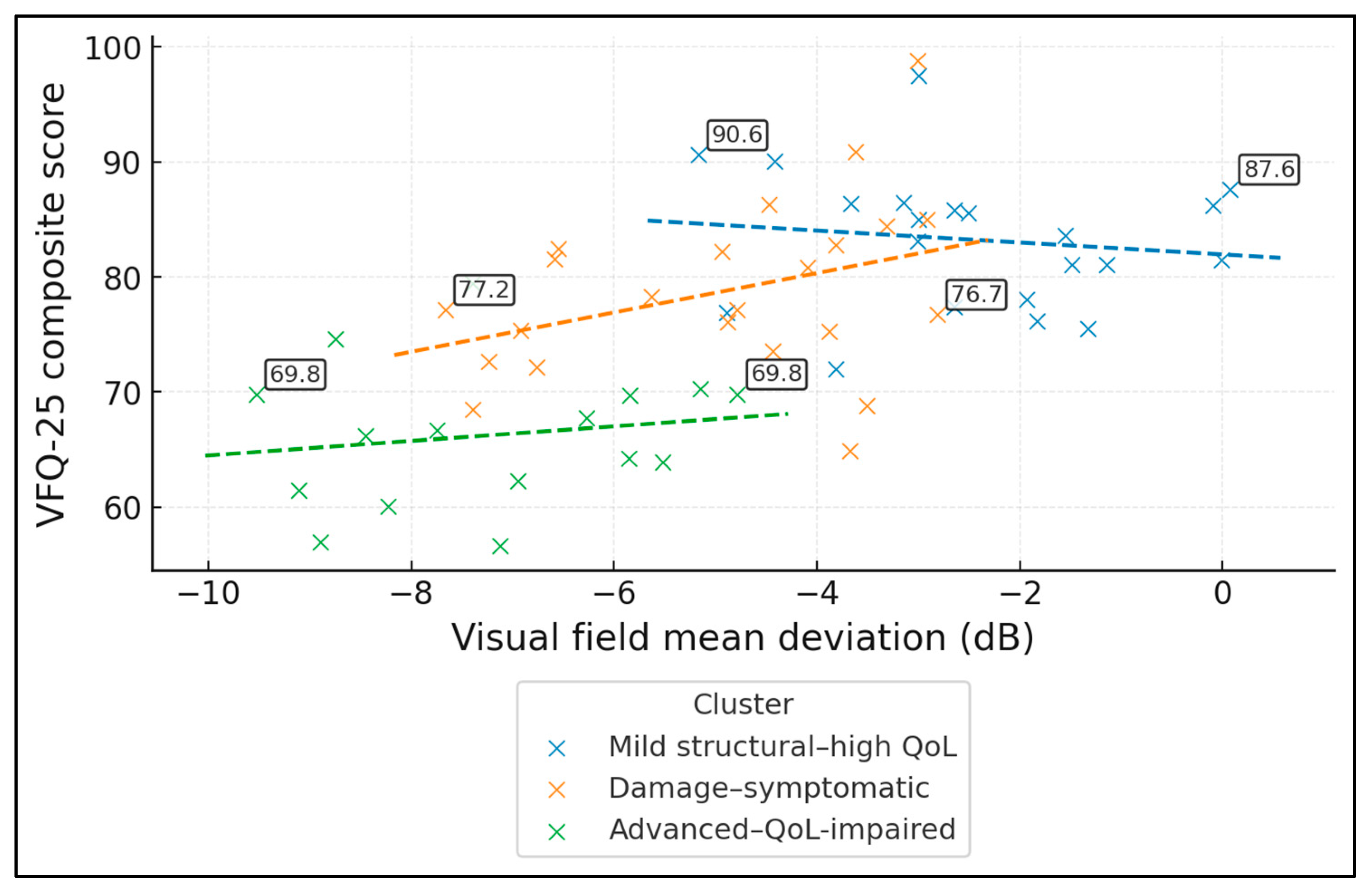
Figure 1 shows that vision-related QoL deteriorates as visual field damage increases, and that this relationship differs across the three data-driven ODD phenotypes. In the full ODD sample (
n = 60), the Pearson correlation between mean deviation (MD, higher = better field) and VFQ-25 composite is r ≈ 0.60, indicating a moderately strong structure–function–QoL link. Cluster-level correlations are weaker but directionally similar: r ≈ −0.13 in the “mild structural–high QoL” group (
n = 21), r ≈ 0.36 in the “damage–symptomatic” group (
n = 23), and r ≈ 0.16 in the “advanced–QoL-impaired” group (
n = 16). Regression lines highlight that for the same degree of MD loss, patients in the advanced cluster tend to report systematically lower VFQ-25 scores (often in the 60–70 range) compared with those in the mild cluster (typically 80–90).
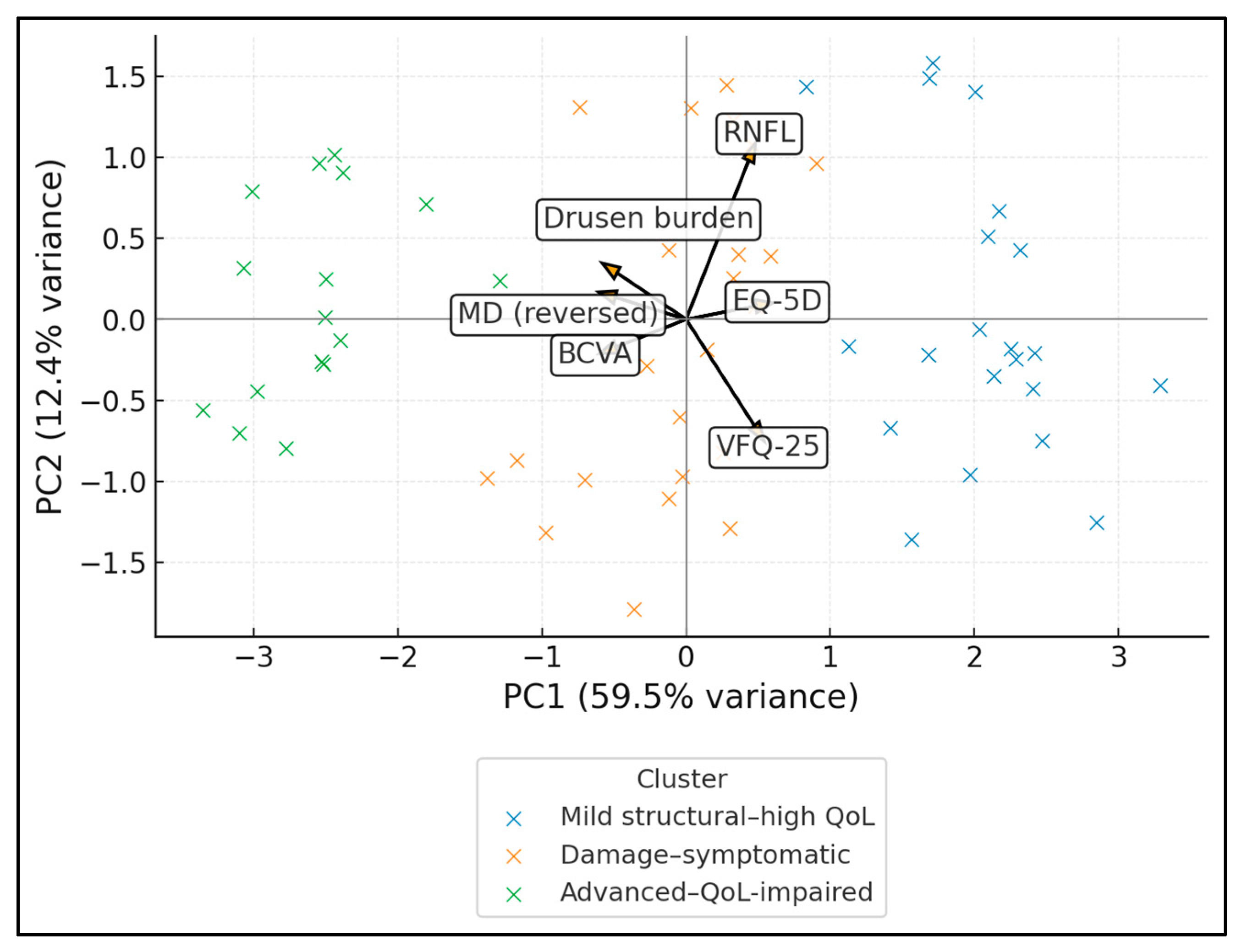
The PCA biplot shows individual ODD patients in the PC1–PC2 plane, coloured by data-driven cluster, with arrows indicating loadings of each variable. PC1 explains 59.5% of the variance and represents a global “better structure/better function/better QoL” axis: MD (reversed), RNFL, VFQ-25 and EQ-5D load positively, while BCVA and drusen burden load negatively. PC2 (12.4% of variance) contrasts mainly RNFL (positive loading) with VFQ-25 (negative), suggesting a secondary dimension of structural–symptom discordance. Mild structural–high QoL patients cluster in the positive PC1 region, advanced–QoL-impaired cases in the negative PC1 region, and damage–symptomatic patients occupy an intermediate band (
Figure 2).
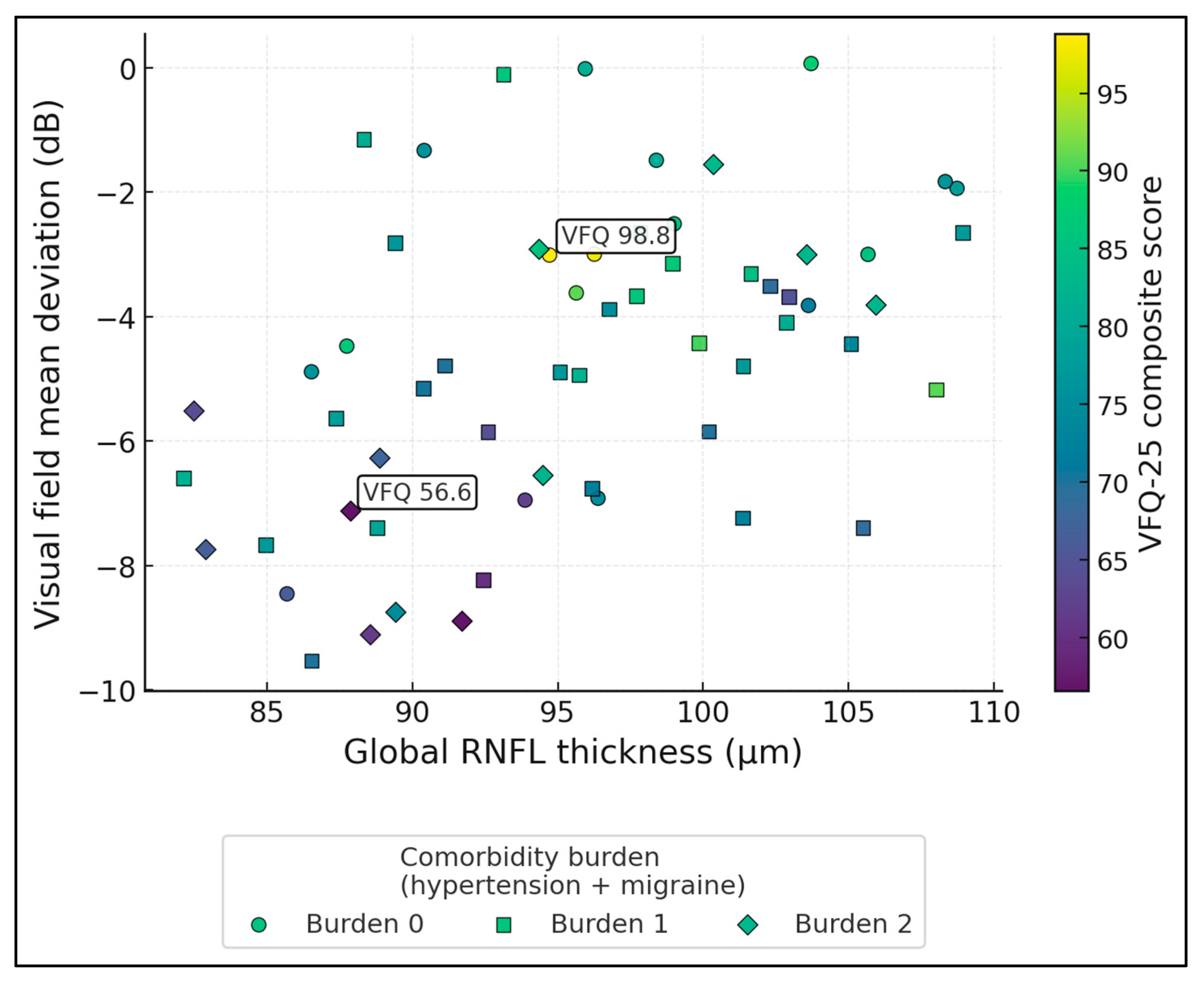
Figure 3 maps global RNFL thickness (x-axis) against visual field mean deviation (y-axis), with point colour encoding VFQ-25 (range 56.6–98.8, mean 77.0) and marker shape indicating comorbidity burden (0, 1, or 2 = hypertension + migraine). RNFL and MD are moderately correlated (r ≈ 0.46), forming an upward trend where thinner RNFL corresponds to more negative MD. The two labelled points illustrate extremes: the “best” case (VFQ ≈ 98.8) lies in the high-RNFL, near-normal MD region, whereas the “worst” case (VFQ ≈ 56.6) sits in the low-RNFL, markedly depressed MD area. Higher-burden diamonds are over-represented in the lower-left quadrant, where both structure and function are poorest and colours shift toward lower VFQ values, visually linking systemic comorbidity with more severe structure–function damage and worse vision-related quality of life.