


The Prevalence of Sjögren’s Disease in Dental Clinics in the Netherlands Compared with the Prevalence in a Systematic Literature Review of Studies in Other Countries



Abstract
1. Introduction
2. Material and Methods
2.1. Patient Selection for Prevalence Study
2.2. Systematic Literature Review
2.2.1. Type of Studies
2.2.2. Type of Participants
2.2.3. Types of Outcome Measures
2.2.4. Search Strategy, Screening and Selection
2.2.5. Quality Assessment
2.2.6. Data Extraction
3. Results
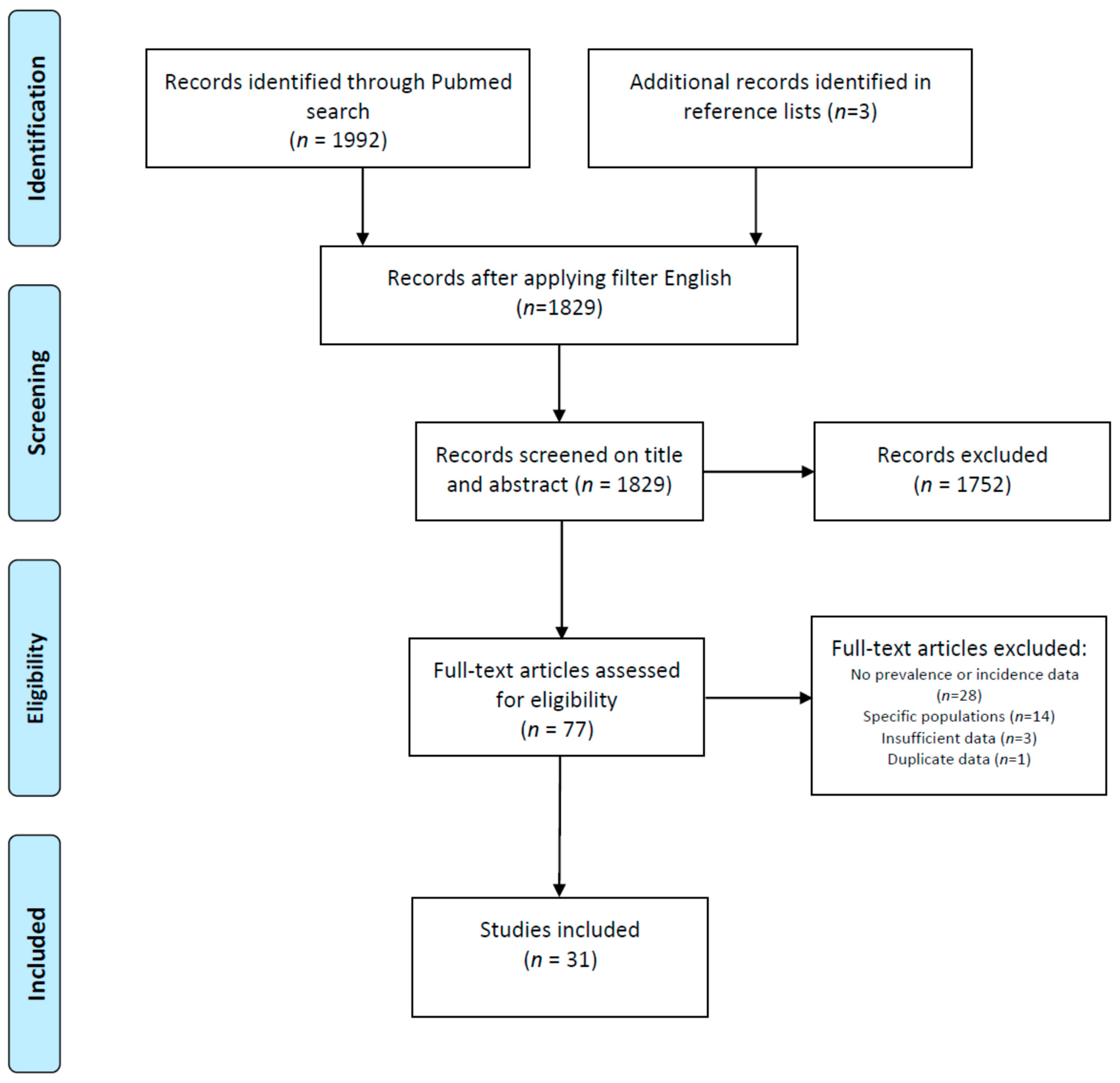
3.1. Literature Study
3.2. Prevalence Ratio of SjD
3.3. Incidence Ratio of SjD
3.4. Quality Assessment
4. Discussion
5. Conclusions
Author Contributions
Funding
Institutional Review Board Statement
Data Availability Statement
Conflicts of Interest
References
- Fox, R.I. Sjögren’s syndrome. Lancet 2005, 366, 321–331. [Google Scholar] [CrossRef]
- Reksten, T.R.; Jonsson, M.V. Sjögren’s Syndrome: An update on epidemiology and current insights on pathophysiology. Oral Maxillofac. Surg. Clin. N. Am. 2014, 26, 1–12. [Google Scholar] [CrossRef]
- Malladi, A.S.; Sack, K.E.; Shiboski, S.C.; Shiboski, C.H.; Baer, A.N.; Banushree, R.; Dong, Y.; Helin, P.; Kirkham, B.W.; Li, M.; et al. Primary Sjögren’s syndrome as a systemic disease: A study of participants enrolled in an international Sjögren’s syndrome registry. Arthritis Care Res. 2012, 64, 911–918. [Google Scholar] [CrossRef] [PubMed]
- Bongi, S.M.; Del Rosso, A.; Orlandi, M.; Matucci-Cerinic, M. Gynaecological symptoms and sexual disability in omen with primary sjögren’s syndrome and sicca syndrome. Clin. Exp. Rheumatol. 2013, 31, 683–690. [Google Scholar]
- Van Nimwegen, J.F.; Arends, S.; Van Zuiden, G.S.; Vissink, A.; Kroese, F.G.M.; Bootsma, H. The impact of primary Sjögren’s syndrome on female sexual function. Rheumatology 2015, 54, 1286–1293. [Google Scholar] [CrossRef] [PubMed]
- Mariette, X.; Criswell, L.A. Primary Sjögren’s syndrome. N. Engl. J. Med. 2018, 378, 931–939. [Google Scholar] [CrossRef] [PubMed]
- Tsuboi, H.; Asashima, H.; Takai, C.; Hagiwara, S.; Hagiya, C.; Yokosawa, M.; Hirota, T.; Umehara, H.; Kawakami, A.; Nakamura, H.; et al. Primary and secondary surveys on epidemiology of Sjögren’s syndrome in Japan. Mod. Rheumatol. 2014, 24, 464–470. [Google Scholar] [CrossRef]
- Baldini, C.; Ferro, F.; Bombardieri, S. Classification criteria in Sjögren’s syndrome. Ann. Transl. Med. 2017, 5, 313. [Google Scholar] [CrossRef]
- Mathews, S.A.; Kurien, B.T.; Scofield, R.H. Oral Manifestations of Sjögren’s Syndrome. J. Dent. Res. 2008, 87, 308–318. [Google Scholar] [CrossRef]
- Pijpe, J.; Kalk, W.W.I.; Bootsma, H.; Spijkervet, F.K.L.; Kallenberg, C.G.M.; Vissink, A. Progression of salivary gland dysfunction in patients with Sjögren’s syndrome. Ann. Rheum. Dis. 2007, 66, 107–112. [Google Scholar] [CrossRef]
- Weifenbach, J.M.; Schwartz, L.K.; Atkinson, J.C.; Fox, P.C. Taste performance in Sjogren’s syndrome. Physiol. Behav. 1995, 57, 89–96. [Google Scholar] [CrossRef] [PubMed]
- Pierce, J.L.; Tanner, K.; Merrill, R.M.; Miller, K.L.; Kendall, K.A.; Roy, N. Swallowing Disorders in Sjögren’s Syndrome: Prevalence, Risk Factors, and Effects on Quality of Life. Dysphagia 2016, 31, 49–59. [Google Scholar] [CrossRef] [PubMed]
- Al Hamad, A.; Lodi, G.; Porter, S.; Fedele, S.; Mercandante, V. Interventions for dry mouth and hyposalivation in Sjögren’s syndrome: A systematic review and meta-analysis. Oral Dis 2019, 25, 1027–1047. [Google Scholar] [CrossRef] [PubMed]
- Assy, Z.; Bikker, F.J.; Picauly, O.; Brand, H.S. The association between oral dryness and use of dry-mouth interventions in Sjögren’s syndrome patients. Clin. Oral Investig 2022, 26, 1465–1475. [Google Scholar] [CrossRef] [PubMed]
- Karagozoglu, K.H.; Mahraoui, A.; Bot, J.C.J.; Cha, S.; Ho, J.-P.T.F.; Helder, M.H.; Brand, H.S.; Bartelink, I.H.; Vissink, A.; Weisman, G.A.; et al. Intraoperative Visualization and Treatment of Salivary Gland Dysfunction in Sjögren’s Syndrome Patients Using Contrast-Enhanced Ultrasound Silaoendoscopy (CEUSS). J. Clin. Med. 2023, 12, 4152. [Google Scholar] [CrossRef]
- Assy, Z.; Brand, H.S. A systematic review of the effects of acupuncture on xerostomia and hyposalivation. BMC Complement Altern. Med. 2018, 18, 57. [Google Scholar] [CrossRef]
- Gøransson, L.; Haldorsen, K.; Brun, J.; Harboe, E.; Jonsson, M.; Skarstein, K.; Time, K.; Omdal, R. The point prevalence of clinically relevant primary Sjögren’s syndrome in two Norwegian counties. Scand. J. Rheumatol. 2011, 40, 221–224. [Google Scholar] [CrossRef]
- Vitali, C.; Bombardieri, S.; Jonsson, R.; Moutsopoulos, H.M.; Alexander, E.L.; Carsons, S.E.; Daniels, T.E.; Fox, P.C.; Fox, R.I.; Kassan, S.S.; et al. Classification criteria for Sjögren’s syndrome: A revised version of the European criteria proposed by the American-European Consensus Group. Ann. Rheum. Dis. 2002, 61, 554–558. [Google Scholar] [CrossRef]
- Shiboski, C.H.; Shiboski, S.C.; Seror, R.; Criswell, L.A.; Labetoulle, M.; Lietman, T.M.; Rasmussen, A.; Scofield, H.; Vitali, C.; Bowman, S.J.; et al. 2016 American College of Rheumatology/European League Against Rheumatism classification criteria for primary Sjögren’s syndrome: A consensus and data-driven methodology involving three international patient cohorts. Ann. Rheum. Dis. 2017, 76, 9–16. [Google Scholar] [CrossRef]
- Baldini, C.; Talarico, R.; Tzioufas, A.G.; Bombardieri, S. Classification criteria for Sjogren’s syndrome: A critical review. J. Autoimmun. 2012, 39, 9–14. [Google Scholar] [CrossRef] [PubMed]
- van Kempen, E.E.J.; de Visscher, J.G.A.M.; Brand, H.S. Are periodontitis, dental caries and xerostomiamore frequently present in recreational ecstasy users? Br. Dent. J. 2022, 232, 389–395. [Google Scholar] [CrossRef] [PubMed]
- Higgins, J. Cochrane Handbook for Systematic Reviews of Interventions Version; The Cochrane Collaboration: London, UK, 2011. [Google Scholar]
- Alamanos, Y.; Tsifetaki, N.; Voulgari, P.V.; Venetsanopoulou, A.I.; Siozos, C.; Drosos, A.A. Epidemiology of primary Sjögren’s syndrome in north-west Greece, 1982–2003. Rheumatology 2006, 45, 187–191. [Google Scholar] [CrossRef] [PubMed]
- Tomšič, M.; Logar, D.; Grmek, M.; Perkovič, T.; Kveder, T. Prevalence of Sjogren’s syndrome in Slovenia. Rheumatology 1999, 38, 164–170. [Google Scholar] [CrossRef][Green Version]
- Trontzas, P.I.; Andrianzakos, A. Sjogren’s syndrome: A population based study of prevalence in Greece. The ESORDIG study. Ann. Rheum. Dis. 2005, 64, 1240–1241. [Google Scholar] [CrossRef]
- Anagnostopoulos, I.; Zinzaras, E.; Alexiou, I.; Papathanasiou, A.A.; Davas, E.; Koutroumpas, A.; Barouta, G.; Sakkas, L.I. The prevalence of rheumatic diseases in central Greece: A population survey. BMC Musculoskelet Disord. 2010, 11, 98. [Google Scholar] [CrossRef]
- Bowman, S.J.; Ibrahim, G.H.; Holmes, G.; Hamburger, J.; Ainsworth, J.R. Estimating the prevalence among Caucasian women of primary Sjögren’s syndrome in two general practices in Birmingham, UK. Scand. J. Rheumatol. 2004, 33, 39–43. [Google Scholar] [CrossRef]
- Dafni, U.G.; Tzioufas, A.G.; Staikos, P.; Skopouli, F.N.; Moutsopoulos, H.M. Prevalence of Sjogren’s syndrome in a closed rural community. Ann. Rheum. Dis. 1997, 56, 521–525. [Google Scholar] [CrossRef]
- Eaton, W.W.; Rose, N.R.; Kalaydjian, A.; Pedersen, M.G.; Mortensen, P.B. Epidemiology of autoimmune diseases in Denmark. J. Autoimmun. 2007, 29, 1–9. [Google Scholar] [CrossRef]
- Haugen, A.J.; Peen, E.; Hultén, B.; Johannessen, A.C.; Brun, J.G.; Halse, A.K.; Haga, H. Estimation of the prevalence of primary Sjögren’s syndrome in two age-different community-based populations using two sets of classification criteria: The Hordaland Health Study. Scand. J. Rheumatol. 2008, 37, 30–34. [Google Scholar] [CrossRef]
- Maldini, C.; Seror, R.; Fain, O.; Dhote, R.; Amoura, Z.; De Bandt, M.; Delassus, J.; Falgarone, G.; Guillevin, L.; Le Guern, V.; et al. Epidemiology of primary Sjögren’s syndrome in a french multiracial/multiethnic area. Arthritis Care Res. 2014, 66, 454–463. [Google Scholar] [CrossRef] [PubMed]
- Sardu, C.; Cocco, E.; Mereu, A.; Massa, R.; Cuccu, A.; Marrosu, M.G.; Contu, P. Population based study of 12 autoimmune diseases in Sardinia, Italy: Prevalence and comorbidity. PLoS ONE 2012, 7, e32487. [Google Scholar] [CrossRef]
- Thomas, E.; Hay, E.M.; Hajeer, A.; Silman, A.J. Sjogren’s syndrome: A community-based study of prevalence and impact. Br. J. Rheumatol. 1998, 37, 1069–1076. [Google Scholar] [CrossRef] [PubMed]
- Cafaro, G.; Perricone, C.; Ronconi, G.; Calabria, S.; Dondi, L.; Dondi, L.; Pedrini, A.; Esposito, I.; Gerli, R.; Bartoloni, E.; et al. Primary Sjögren’s syndrome in Italy: Real-world evidence of a rare disease through administrative healthcare data. Eur. J. Inten. Med. 2024, 124, 122–129. [Google Scholar] [CrossRef] [PubMed]
- Seror, R.; Chiche, L.; Beydon, M.; Desjeux, G.; Zhuo, J.; Vannier-Moreau, V.; Devauchelle-Pensec, V. Estimated prevalence, incidence and healthcare costs of Sjögren’s syndrome in France: A national claims-based study. RMD Open 2024, 10, e003591. [Google Scholar] [CrossRef] [PubMed]
- Stankeviciene, I.; Puriene, A.; Mieliauskaite, D.; Stangvaltaite-Mouhat, L.; Aleksejuniene, J. Detection of xerostomia, sicca and Sjogrens’ syndromes in a national sample of adults. BMC Oral Health 2021, 21, 552. [Google Scholar] [CrossRef]
- Narvaez, J.; Sanchez-Fernandez, S.A.; Seoane-Mato, D.; Diaz-Gonzalez, F.; Bustabad, S. Prevalence of Sjögren’s synrome in the general adult population in Spain: Estimating the proportion of undiagnosed cases. Sci. Rep. 2020, 10, 10627. [Google Scholar] [CrossRef]
- Barrio-Cortes, J.; López-Rodríguez, J.A.; Gómez-Gascón, T.; Rayo-Gómez, Á.; del Cura-González, I.; Domínguez-Berjón, F.; Esteban-Vasallo, D.; Chalco-Orrego, J.P.; Vicente-Rabaneda, E.; Baldini, C.; et al. Prevalence and comorbidities of Sjogren’s syndrome patients in the Community of Madrid: A population-based cross-sectional study. Jt. Bone Spine 2023, 90, 105544. [Google Scholar] [CrossRef]
- Birlik, M.; Akar, S.; Gurler, O.; Sari, I.; Birlik, B.; Sarioglu, S.; Oktem, M.A.; Saglam, F.; Can, G.; Kayahan, H.; et al. Prevalence of primary Sjogren’s syndrome in Turkey: A population-based epidemiological study. Int. J. Clin. Pract. 2009, 63, 954–961. [Google Scholar] [CrossRef]
- Kabasakal, Y.; Kitapcioglu, G.; Turk, T.; Öder, G.; Durusoy, R.; Mete, N.; Egrilmez, S.; Akalin, T. The prevalence of Sjögren’s syndrome in adult women. Scand. J. Rheumatol. 2006, 35, 379–383. [Google Scholar] [CrossRef]
- Yu, K.H.; See, L.C.; Kuo, C.F.; Chou, I.J.; Chou, M.J. Prevalence and incidence in patients with autoimmune rheumatic diseases: A nationwide population-based study in Taiwan. Arthritis Care Res. 2013, 65, 244–250. [Google Scholar] [CrossRef] [PubMed]
- See, L.C.; Kuo, C.F.; Chou, I.J.; Chiou, M.J.; Yu, K.H. Sex- and age-specific incidence of autoimmune rheumatic diseases in the Chinese population: A Taiwan population-based study. Semin. Arthritis Rheum. 2013, 43, 381–386. [Google Scholar] [CrossRef] [PubMed]
- Zhang, N.; Shi, C.S.; Yao, Q.P.; Pan, G.X.; Wang, L.L.; Wen, Z.X.; Li, X.C.; Dong, Y. Prevalence of primary Sjogren’s syndrome in China. J. Rheumatol. 1995, 22, 659–661. [Google Scholar] [PubMed]
- Izmirly, P.M.; Buyon, J.P.; Wan, I.; Belmont, H.M.; Sahl, S.; Salmon, J.E.; Askanase, A.; Bathon, J.M.; Geraldino-Pardilla, L.; Ali, Y.; et al. The Incidence and Prevalence of Adult Primary Sjögren’s Syndrome in New York County. Arthritis Care Res. 2019, 71, 949–960. [Google Scholar] [CrossRef]
- Moreno-Quispe, L.A.; Velarde-Grados, I.V.N.; Guzmán-Avalos, M.; De Arriba, L.; María López-Pintor, R. Prevalence of sicca syndrome in the Peruvian population. Clin. Exp. Rheumatol. 2019, 118, 65–69. [Google Scholar]
- Valim, V.; Zandonade, E.; Pereira, A.M.; de Brito Filho, O.H.; Serrano, E.V.; Musso, C.; Giovelli, R.A.; Ciconelli, R.M. Primary sjögren’s syndrome prevalence in a major metropolitan area in Brazil. Rev. Bras. Reumatol. 2013, 53, 33–34. [Google Scholar] [CrossRef]
- Fernández-Ávila, D.G.; Rincón-Riano, D.N.; Bernal-Macías, S.; Gutiérrez Dávila, J.M.; Rosselli, D. Prevalence and demograohic characteristics of Sjögren’s syndrome in Colombia, based on information from the Official Ministry of Health Registry. Reumatol. Clin. 2020, 16, 286–289. [Google Scholar] [CrossRef]
- Pillemer, S.R.; Matteson, E.L.; Jacobsson, L.T.H.; Martens, P.B.; Melton, L.J.; O’Fallon, W.M.; Fox, P.C. Incidence of physician-diagnosed primary Sjögren syndrome in residents of Olmsted County, Minnesota. Mayo Clin. Proc. 2001, 76, 593–599. [Google Scholar] [CrossRef]
- Plešivčnik Novljan, M.; Rozman, B.; Hočevar, A.; Grmek, M.; Kveder, T.; Tomšič, M. Incidence of primary Sjögren’s syndrome in Slovenia. Ann. Rheum. Dis. 2004, 63, 874–876. [Google Scholar] [CrossRef]
- Weng, M.Y.; Huang, Y.T.; Liu, M.F.; Lu, T.H. Incidence and mortality of treated primary sjögren’s syndrome in Taiwan: A population-based study. J. Rheumatol. 2011, 38, 706–708. [Google Scholar] [CrossRef]
- Conrad, N.; Misra, S.; Verbakel, J.Y.; Verbeke, G.; Molenberghs, G.; Taylor, P.N.; Mason, J.; Sattar, N.; McMurray, J.J.; McInnes, I.B.; et al. Incidence, prevalence, and co-occurrence of autoimmune disorders over time and by age, sex, and socioeconomic status: A population-based cohort study of 22 million individuals in the UK. Lancet 2023, 401, 1878–1890. [Google Scholar] [CrossRef] [PubMed]
- Chen, H.H.; Ma, K.S.K.; Dong, C.; Chang, W.J.; Gao, K.R.; Perng, W.T.; Huang, J.Y.; Wei, J.C.C. Risk of primary Sjogren’s syndrome following human papillomavirus infections: A nationwide population-based cohort study. Front. Immunol. 2022, 13, 967040. [Google Scholar] [CrossRef] [PubMed]
- Vitali, C.; Bombardieri, S.; Moutsopoulos, H.M.; Balestrieri, G.; Bencivelli, W.; Bernstein, R.M.; Bjerrum, K.B.; Braga, S.; Coll, J.; Vita, S.D.; et al. Preliminary criteria for the classification of Sjögren’s syndrome. Results of a prospective concerted action supported by the European community. Arthritis Rheum. 1993, 36, 340–347. [Google Scholar] [CrossRef] [PubMed]
- Beydon, M.; McCoy, S.; Nguyen, Y.; Sumida, T.; Mariette, X.; Seror, R. Epidemiology of Sjögren syndrome. Nat. Rev. Rheumatol. 2024, 20, 158–169. [Google Scholar] [CrossRef]
- Kuryata, O.; Lysunets, T.; Karavanska, I.; Semenov, V. Duration till diagnosis and clinical profile of Sjögren’s syndrome: Data from real c;inical practice in a single-center cohort. Egypt. Rheumatol. 2022, 42, 41–46. [Google Scholar] [CrossRef]
- Papageorgiou, A.C.; Croft, P.R.; Ferry, S.; Jayson, M.I.V.; Silman, A.J. Estimating the prevalence of low back pain in the general population: Evidence from the south Manchester back pain survey. Spine (Phila Pa 1976). 1995, 20, 1889–1894. [Google Scholar] [CrossRef]
- Christensen, L.B.; Petersen, P.E.; Thorn, J.J.; Schiødt, M. Dental caries and dental health behavior of patients with primary Sjögren syndrome. Acta Odontol. Scand. 2001, 59, 116–120. [Google Scholar] [CrossRef]
- Meijer, J.M.; Meiners, P.M.; Huddleston Slater, J.J.; Spijkervet, F.K.; Kallenberg, C.G.; Vissink, A.; Bootsma, H. Health-related quality of life, employment and disability in patients with Sjögren’s syndrome. Rheumatology 2009, 48, 1077–1082. [Google Scholar] [CrossRef]

| Author | Publication Year | Country of Origin | Study Period | Patients Age (yrs) | Diagnostic Criteria Used | Patient Selection Method | Study Population | Number of SjD Patients | Prevalence Rate | Prevalence Ratio per 100,000 | Study Design |
|---|---|---|---|---|---|---|---|---|---|---|---|
| Alamanos et al. [23] | 2006 | Greece | 1982–2003 | Mean 55 | AECG | Medical record search | 488,435 | 422 pSS | 0.09% | 92.8 | Population based |
| Anagnostopoulos et al. [26] | 2010 | Greece | 2007–2008 | Mean 51.08 | AECG | Questionnaire + clinical examination | 1705 | 4 pSS | 0.23% | 234.6 | Cross-sectional Population survey |
| Barrio-Cortes et al. [38] | 2023 | Spain | 2015 | ≥ 18 | AECG, 2012 ACR or 2016 ACR/EULAR | Medical record search | 6,401,162 | 4778 | 0.084% | 84 | Cross-sectional Population based |
| Birlik et al. [39] | 2009 | Turkey | NS | Mean 43.7 | AECG | Questionnaire + clinical examination | 2835 | 6 pSS | 0.21% | 211.6 | Population based |
| Bowman et al. [27] | 2004 | UK | NS | 35–74 | AECG | Questionnaire + clinical examination | 846 women | 2 pSS | 0.2% | 236.4 | Population survey |
| Cafaro et al. [34] | 2024 | Italy | 2018 | Mean 61 | ICD 9 | Medical record search | 4,809,005 | 1756 pSS | 0.038% | 38 | Population based |
| Dafni et al. [28] | 1997 | Greece | 1992 | NS | EU 1993 | Questionnaire + clinical examination | 837 women | 5 pSS | 0.60% | 597.3 | Population survey |
| Eaton et al. [29] | 2007 | Denmark | 1977–2001 | NS | ICD 10 | Medical record search | 5,472,032 | 2615 SS | 0.048% | 47.8 | Population based |
| Fernández-Ávila et al. [47] | 2020 | Colombia | 2012–2016 | NS | ICD 10 | Medical record search | NS | 58,680 SS | 0.12% | 120 | Population based |
| Gøransson et al. [17] | 2011 | Norway | 2008 | Mean 61.6 | AECG | Medical record search | 890,255 | 424 pSS | 0.050% | 49.7 | Population based |
| Haugen et al. [30] | 2008 | Norway | 1997–1999 | 40–44 & 71–74 | EU 1996 | Questionnaire + clinical examination | 13,182 & 2864 | 2 pSS & 9 pSS | 0.22% & 1.40% | 430.01 | Population survey |
| Izmirly et al. [44] | 2019 | USA | 2007–2009 | ≥ 18 | AECG | Medical record search | 1,585,873 | 260 pSS | 0.01% | 13.1 | Population based |
| Kabasakal et al. [40] | 2006 | Turkey | 2001–2002 | Mean 37.7 | AECG | Questionnaire + clinical examination | 831 women | 6 pSS | 0.72% | 722 | Cross-sectional Population survey |
| Maldini et al. [31] | 2014 | France | 2008–2011 | Mean 57.1 | AECG | Medical record search | 1,172,482 | 133 pSS | 0.01% | 10.2 | Population based |
| Moreno-Quispe et al. [45] | 2019 | Peru | 2016 | NS | ICD 10 | Medical record search | 15,417,345 | 1301 SS | 0.0084% | 8.4 | Cross-sectional Population survey |
| Narváez et al. [37] | 2020 | Spain | 2016–2017 | NS | AECG | Telephone survey + medical records | 4916 | 16 pSS 4 sSS | 0.25% 0.08% | 250 81 | Cross-sectional Population survey |
| Sardu et al. [32] | 2012 | Italy | 2009 | 15–89 | ICD 9 | Medical record search | 25,885 | NS SS | 0.03% | 31 | Population based |
| See at al. [42] | 2013 | Taiwan | 2005–2009 | NS | ICD 9 | Medical record search | 1,000,000 | 583 SS | 0.05% | 58.3 | Population based |
| Seror et al. [35] | 2024 | France | 2011–2018 | NS | ICD 10 | Medical record search | 67,000,000 | 23,848 pSS 14,809 sSS | 0.023% 0.016% | 23 16 | Population based |
| Stankeviciene et al. [36] | 2021 | Lithuania | 2017–2019 | 35–74 | 2016 ACR/EULAR | Medical record search + clinical examination | 1405 | 2 pSS 2 sSS | 0.14% 0.14% | 140 140 | Cross-sectional Population survey |
| Thomas et al. [33] | 1998 | UK | NS | 18–75 | EU 1993 | Questionnaire + clinical examination | 341 | 13 SS | 3.30% | 3300 | Population survey |
| Tomšič et al. [24] | 1999 | Slovenia | NS | Mean female 52.2 Mean male 56.3 | EU 1993 | Questionnaire + clinical examination | 332 | 2 pSS | 0.60% | 602.4 | Population survey |
| Trontzas et al. [25] | 2005 | Greece | 1966–1999 | Mean 55 | AECG | Questionnaire + clinical examination | 8740 | 13 pSS | 0.15% | 148.7 | Population survey |
| Valim et al. [46] | 2013 | Brazil | 2000 | 18-65 | AECG | Questionnaire + clinical examination | 1205 | 2 pSS | 0.175% | 165.9 | Cross-sectional Population survey |
| Yu et al. [41] | 2013 | Taiwan | 2005–2009 | NS | ICD 9 | Medical record search | 963,355 | 154 SS | 0.016% | 16.0 | Population based |
| Zhang et al. [43] | 1995 | China | NS | NS | San Diego | Questionnaire + clinical examination | 2066 | 7 pSS | 0.33% | 338.82 | Population survey |
| Author | Publication Year | Country of Origin | Study Period | Patients Age (yrs) | Diagnostic Criteria Used | Patient Selection | Study Population | Number of SjD Patients | IR (95%CI)/100,000 | Study Design |
|---|---|---|---|---|---|---|---|---|---|---|
| Alamanos et al. [23] | 2006 | Greece | 1982–2003 | Mean 55 | AECG | Medical record search | 488,435 | 422 pSS | 5.3 (4.5–6.1) | Population based |
| Chen et al. [52] | 2022 | Taiwan | 2002–2012 | Mean 42.6 | AECG/ACR-EULAR | Medical record search | 189,200 | 1081 pSS | 0.63 (0.59–0.67) | Cross-sectional Population survey |
| Conrad et al. [51] | 2023 | UK | 2000–2019 | Mean 54 | ICD 10 | Medical record search | 22,009,375 | 12,292 SS | 6.0-10.7 (NS) | Cross-sectional Population based |
| Izmirly et al. [44] | 2019 | USA | 2007–2009 | Mean 53 | AECG | Medical record search | 1,585,873 | 222 pSS | 3.5 (2.90–4.1) | Population based |
| Pillemer et al. [48] | 2001 | USA | 1976–1992 | Mean 59 | NS | Medical record search | 108,145 | 53 pSS | 3.9 (2.8–4.9) | Cross-sectional Population survey |
| Plešivčnik et al. [49] | 2004 | Slovenia | 2000–2002 | Mean 51.3 | EU 1996 | Medical record search + clinical examination | 600,000 | 71 pSS | 3.9 (1.1–10.2) | Population based |
| See at al. [42] | 2013 | Taiwan | 2005–2009 | NS | ICD 9 | Medical record search | 1,000,000 | 583 SS | 11.8 (10.8–12.7) | Population based |
| Seror et al. [35] | 2024 | France | 2011–2018 | NS | ICD 10 | Medical record search | 67,000,000 | 23,848 pSS 14,809 sSS | 0.7–4.3 (NS) 0.2–2.0 (NS) | Population based |
| Weng et al. [50] | 2011 | Lithuania | 2005–2007 | Mean 53 | AECG | NHI research database | 23,000,000 | 3352 pSS | 6.0 (5.8–6.2) | Cross-sectional Population survey |
| Yu et al. [41] | 2013 | Taiwan | 2000–2008 | NS | ICD 9 | Medical record search | 2,375,407 | 855 SS | 10.6 (9.9–11.4) | Population based |
| SELECTION | COMPARABILITY | EXPOSURE | |||||||
|---|---|---|---|---|---|---|---|---|---|
| Is the Case Definition Adequate (1) | Representativeness of the Cases (2) | Selection of Controls (3) | Definition of the Controls (4) | Comparability of Cases on the Basis of the Design and Analysis (5) | Ascertainment of Exposure (6) | Same Method of Ascertain for Cases (7) | Non-Respons Rate (8) | Score | |
| Alamanos et al. [23] | * | * | NA | NA | * | NA | * | 4 | |
| Anagnostopoulos et al. [26] | * | * | NA | NA | * | NA | * | * | 5 |
| Barrio-Cortes et al. [38] | * | * | NA | NA | * | NA | * | 4 | |
| Birlik et al. [39] | * | * | NA | NA | * | NA | * | * | 5 |
| Bowman et al. [27] | * | NA | NA | * | NA | * | * | 4 | |
| Cafaro et al. [34] | * | * | NA | NA | NA | * | 3 | ||
| Chen et al. [52] | * | * | NA | NA | * | NA | * | * | 5 |
| Conrad et al. [51] | * | * | NA | NA | * | NA | * | * | 5 |
| Dafni et al. [28] | * | * | NA | NA | * | NA | * | 4 | |
| Eaton et al. [29] | * | * | NA | NA | * | NA | * | 4 | |
| Fernández-Ávila et al. [47] | * | * | NA | NA | * | NA | 3 | ||
| Gøransson et al. [17] | * | * | NA | NA | * | NA | * | * | 5 |
| Haugen et al. [30] | * | * | NA | NA | * | NA | * | 4 | |
| Izmirly et al. [44] | * | * | NA | NA | * | NA | * | 4 | |
| Kabasakal et al. [40] | * | NA | NA | * | NA | * | * | 4 | |
| Maldini et al. [31] | * | * | NA | NA | * | NA | * | * | 5 |
| Moreno-Quispe et al. [45] | NA | NA | * | NA | * | 2 | |||
| Narváez et al. [37] | * | * | NA | NA | NA | * | 4 | ||
| Pillemer et al. [48] | * | NA | NA | * | NA | * | 3 | ||
| Plešivčnik et al. [49] | * | * | NA | NA | * | NA | * | 4 | |
| Sardu et al. [32] | * | NA | NA | * | NA | 3 | |||
| See at al. [42] | * | * | NA | NA | * | NA | * | 3 | |
| Seror et al. [35] | * | * | NA | NA | NA | * | 3 | ||
| Stankeviciene et al. [36] | * | * | NA | NA | NA | * | 3 | ||
| Thomas et al. [33] | * | * | NA | NA | * | NA | * | 4 | |
| Tomšič et al. [24] | * | * | NA | NA | * | NA | * | 4 | |
| Trontzas et al. [25] | * | NA | NA | NA | * | * | 4 | ||
| Valim et al. [46] | * | * | NA | NA | * | NA | * | 4 | |
| Weng et al. [50] | * | NA | NA | * | NA | * | 3 | ||
| Yu et al. [41] | * | * | NA | NA | NA | * | 4 | ||
| Zhang et al. [43] | * | * | NA | NA | * | NA | * | 4 | |
Disclaimer/Publisher’s Note: The statements, opinions and data contained in all publications are solely those of the individual author(s) and contributor(s) and not of MDPI and/or the editor(s). MDPI and/or the editor(s) disclaim responsibility for any injury to people or property resulting from any ideas, methods, instructions or products referred to in the content. |
© 2024 by the authors. Licensee MDPI, Basel, Switzerland. This article is an open access article distributed under the terms and conditions of the Creative Commons Attribution (CC BY) license (https://creativecommons.org/licenses/by/4.0/).
Share and Cite
Maarse, F.; Huisinga, J.F.; Jager, D.H.J.; Brand, H.S. The Prevalence of Sjögren’s Disease in Dental Clinics in the Netherlands Compared with the Prevalence in a Systematic Literature Review of Studies in Other Countries. J. Clin. Med. 2024, 13, 5918. https://doi.org/10.3390/jcm13195918
Maarse F, Huisinga JF, Jager DHJ, Brand HS. The Prevalence of Sjögren’s Disease in Dental Clinics in the Netherlands Compared with the Prevalence in a Systematic Literature Review of Studies in Other Countries. Journal of Clinical Medicine. 2024; 13(19):5918. https://doi.org/10.3390/jcm13195918
Chicago/Turabian StyleMaarse, Floor, Jitse F. Huisinga, Derk Hendrik Jan Jager, and Henk S. Brand. 2024. "The Prevalence of Sjögren’s Disease in Dental Clinics in the Netherlands Compared with the Prevalence in a Systematic Literature Review of Studies in Other Countries" Journal of Clinical Medicine 13, no. 19: 5918. https://doi.org/10.3390/jcm13195918
APA StyleMaarse, F., Huisinga, J. F., Jager, D. H. J., & Brand, H. S. (2024). The Prevalence of Sjögren’s Disease in Dental Clinics in the Netherlands Compared with the Prevalence in a Systematic Literature Review of Studies in Other Countries. Journal of Clinical Medicine, 13(19), 5918. https://doi.org/10.3390/jcm13195918

